



Content Writer
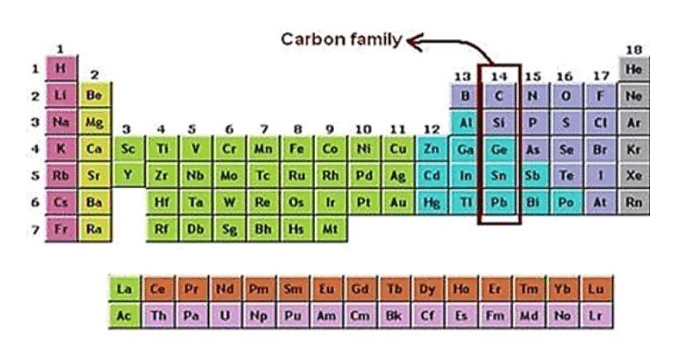
The group 14 elements are also known as the carbon group. The group 14 elements can be found on the right side of the periodic table. The elements of the carbon group are Carbon - C, Silicon - Si, Germanium - Ge, Tin - Sn, Lead - Pb, and Flerovium - FI. The group 14 elements or the carbon family belongs to the p-block of the periodic table. The carbon group is also the second group in the p-block.
| Table of Content |
Elements of Carbon Group
[Click Here for Sample Questions]
The elements or the members of the carbon group include Carbon, Silicon, Germanium, Tin, Lead, and Flerovium. Mentioned below is a brief description of each of the elements for your reference.
- Carbon: It is the first element in the carbon group. It is also one of the mostly available elements on the planet. Carbon can be found in combined as well as free states in polymers, air, organic compounds, carbonates, etc. The three isotopes of carbon are 12C, 13C, and 14C (14C is radioactive).
- Silicon: Silicon is a metalloid. It is a common element which could be found in sand, dust, clay, silicate minerals, silica, and stone. Silicon is neither a non-metal nor a metal.
- Germanium: It is a rare element used for the manufacturing of semiconductor devices. Pure germanium occurs in traces only as it is too reactive to be found in an elemental state.
- Tin: Tin is obtained mainly from the mineral cassiterite. Tin has two main allotropes at regular temperature and pressure. It is also a soft and malleable metal with low melting point.
- Lead: Lead is a toxic element obtained from Galena. Lead can be found commonly in the making of lead-acid batteries, alloys and oxidizing agents.
Electronic Configuration
[Click Here for Sample Questions]
The arrangement of electrons in the orbitals of a molecule or atom is known as electronic configuration. The general electronic configuration of the group 14 elements is ns2np2.
| Group 14 Elements - Electronic Configuration | ||||
|---|---|---|---|---|
| Period | Element | Symbol | Atomic Number | Electronic Configuration |
| 2 | Carbon | C | 6 | [He] 2s2 2p2 |
| 3 | Silicon | Si | 14 | [Ne] 3s2 3p2 |
| 4 | Germanium | Ge | 32 | [Ar] 3d10 4s2 4p2 |
| 5 | Tin | Sn | 50 | [Kr] 4d10 5s2 5p2 |
| 6 | Lead | Pb | 82 | [Xe] 4f14 5d10 6s2 6p2 |
All group 14 elements have 4 electrons in the outer shell. Hence, the valency of the carbon family or group 14 elements is 4.
Properties of Group 14 Elements
[Click Here for Sample Questions]
Group 14 elements have various chemical properties as well as physical properties. Covalent radii, ionization enthalpy, and electronegativity are the chemical properties. The physical properties of the carbon family are metallic character, melting and boiling points, covalent compounds, and density.
- Covalent Radii: The radii of the carbon group are smaller than the group 13. There is a significant increase in radii from C to Si. This increase in radii is due to the poor shielding of d and f orbitals. Hence, the effectiveness of nuclear charge also increases causing the radii smaller.
- Ionization Enthalpy: The ionization energy of group 14 elements is much higher than that of group 13 elements. This variation in energy is attributed to the physical size. The ionization enthalpy decreases from C to Si.
- Electronegativity: Due to the small size, group 14 elements have more electronegativity than the group 13 elements. The element's electronegativity values are nearly identical ranging from Si to Pb.
- Metallic Character: This is one of the physical characters of group 14 elements. The elements are less electropositive compared to group 13. This is due to the small size and high ionization enthalpy. Sn and Pb have low melting points and they are soft metals. C and Si elements are non-metals and Ge is metalloid.
- Density: The density increases as the atomic number rises. This is due to the increase of mass per unit volume in the group.
- Four Covalent Compounds: These are the compounds in which the 4 electrons in valence shell promptly participate in bonding. The majority of the group 14 elements are being shared here.
- The Melting and Boiling Points: Due to the extreme solid structures, carbon, silicon and germanium have extreme high melting and boiling points. Sn and Pb possess lower melting points because of the inert pair effect. It is also because of the formation of two bonds instead of four. The group 14 elements possess a diamond-like lattice structure. These extremely stable structures are broken due to the melting process. Tin and lead are metals, so they have extremely lower melting points.
Oxidation States and Inner Pair Effect
[Click Here for Sample Questions]
The group 14 elements have general oxidation states that are +4 and +2. As the group goes down, the tendency to form +2 ions increases. This happens due to the inert pair effect. The electrons fill the d and f orbitals of the Sn and Pb elements. Due to the poor shielding ability of d and f orbitals, the nuclear charge attracts the s orbital closer to the nucleus. Hence, only p electrons are involved in bonding and Pb+4 becomes a good oxidizing agent.
Carbon is different from other elements due to the small size, high ionization enthalpy, high electronegativity and lack of d-orbital in the valence shell. This is the anomalous behavior of carbon.
Important Compounds Formed by the Elements
[Click Here for Sample Questions]
There are some really important compounds formed by group 14 elements as follows:
Oxides of Group 14 Elements: The oxides such as MO and MO2 are being formed by group 14 elements. A mixture of PbO and PbO2 can create oxide Pb3O4 which is formed by ‘lead’. SnO and PbO are amphoteric, GeO is basic, and CO is a neutral monoxide. Sp hybridized in CO2 is C that is sp3 hybridized Si. SiO2 possesses a three-dimensional shape, because each O atom in SiO2 is bonded to two Si bonds.
Hydrides of Group 14: All group 14 elements form hydrides.Extensive hydrides are formed by carbon due to its ability to catenate. The hydrides of carbon are listed as follows:
- Alkanes (paraffin): General formula is CnH2n+2
- Alkenes (olefins): General formula is CnH2n
- Alkynes (Acetylenes): General formula is CnH2n-2
- Aromatics compounds
- Silicon creates hydrides with the general formula as SinH2n+2 (Silanes)
- Germanium creates hydrides of GenH2n+2. Here, nmax = 5 and they are known as germanes
- Tin creates SnH4 and they are known as stannane. They are also less stable
Halides of Group 14 Elements: Halides of the group combines to form MX4 tetrahalides. The central atom takes a tetrahedral structure and becomes sp3 hybridized. The elements below carbon possess d-orbitals, that allows them to back the bond with halogens. Dihalides have a bend structure. They are not formed by carbon and are sp2 hybridized.
Things to Remember
[Click Here for Sample Questions]
- The group 14 elements are the carbon group which can be found in the p-block of the periodic table.
- The group's 14 members are Carbon - C, Silicon - Si, Germanium - Ge, Tin - Sn, Lead - Pb, and Flerovium - FI.
- The general electronic configuration of group 14 elements is ns2np2.
- The carbon group possesses various chemical and physical properties. They are covalent radii, ionization enthalpy, and electronegativity (Chemical properties) and metallic character, melting/ boiling points, covalent compounds, and density (Physical properties).
- Some of the important compounds formed by carbon group elements are oxides of group 14, hydrides of group 14, and halides of group 14.
Also read:
Sample Questions
Ques. Why is carbon different compared to other elements in group 14? (2 marks)
Ans. The carbon is different from other elements due to its high electronegativity, high ionization enthalpy, small size and the lack of d-orbital in the valence shell.
Ques. Define catenation? (2 marks)
Ans. It is the ability of an element to create covalent bonds with other atoms of the same element. This will result in an atom chain formation.
Ques. What are the p-block elements? And why are they named like that? (3 marks)
Ans. It is a region or space in the periodic table which consist of columns IIIA to VIIIA except helium. The p-block has 35 elements and each element has valence electrons in the p orbital (Hence the name p-block elements). The p-block elements possess a wide range of properties. It also has a diverse group of elements.
Ques. What is covalent bonding? (2 marks)
Ans. The bond formation by sharing electrons is called bonding. There will not be a loss or gain of electrons in this bonding. Having covalent nature makes it covalent bonding.
Ques. What are group 14 elements? (2 marks)
Ans. The group 14 elements also known as the carbon group are the second group in the p-block of the periodic table. The members of the carbon group are Carbon (C), Silicon (Si), Germanium (Ge), Tin (Sn), Lead (Pb), and Flerovium (FI).
Ques. Why are carbon compounds used as fuels? (1 mark)
Ans. The carbon and the carbon compounds are used as fuels because they discharge a lot of heat energy when the carbon burns in the air.
Ques. What makes the bottoms of cooking utensils blackened? (2 marks)
Ans. The reason is that the gas stove’s air openings get clogged. The fuel does not burn properly, hence, a sooty flame is formed. This makes the bottom of kitchen utensils blackened.
Ques. What makes the electronegativity change on the group 14 elements? (2 marks)
Ans. Generally the electronegativity decreases as moving down to the group. However, the reason behind this distortion is because of the bushing of intervening d and f atomic orbitals. From silicon to lead, the electronegativity remains almost the same.
Ques. Why is carbon dioxide necessary for the human body? (2 marks)
Ans. The presence of carbon dioxide is necessary for the internal respiration of the human body. In the internal respiration mechanism, the oxygen is being transported to body tissues and removes carbon dioxide. Also, the carbon dioxide protects pH in the blood, which is essential for life.



Comments