



Content Curator
The hund’s rule of maximum multiplicity is used to determine the electronic configuration of elements. According to Hund's rule,
- Every orbital in the sub-level is singly occupied before the double occupation of any orbital.
- All electrons in a single-occupancy orbital have the same spin in order to maximize overall spin.
| Table of Content |
Hunds Rule of Maximum Multiplicity
It states that electron pairing in orbitals belonging to the same subshell (p, d, or f) does not occur until each orbital of that subshell has one electron, i.e. it is singly occupied. The filling of electrons into orbitals belonging to the same subshell is dealt with by this rule (that is, orbitals of equal energy, called degenerate orbitals).
Because an electron has the ability to fill all of its orbitals with similar energy, it will not pair with another electron in a half-filled orbital. Atoms in the ground state have a large number of unpaired electrons. When two electrons come into touch, they behave similarly to two magnets. Before they have to pair up, the electrons want to go as far apart from each other as possible.
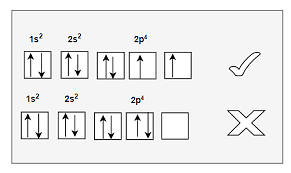
As there are three p, five d, and seven f orbitals, electron pairing begins with the entry of the fourth, sixth, and eighth electrons, respectively, in the p, d, and f orbitals. The symmetry of half-filled and fully-filled degenerate orbitals has been demonstrated to provide additional stability.
Explanation of Hund’s Rule
Before pairing up, the electrons enter an empty orbital. Electrons repel each other because they are negatively charged. To decrease repulsion, the electrons do not share orbitals.
The spin of unpaired electrons in singly occupied orbitals is the same when the second rule is applied. The spin of the first electrons in the sub-level determines the spin of the other electrons. The electron configuration of a carbon atom, for example, is 1s22s22p2. According to Hund's rule, the two 2s electrons will occupy the same orbital, but the two 2p electrons will occupy distinct orbitals.
Electron Configuration and its Purpose
The electrical configuration of an atom is the distribution of electrons into orbitals. The electronic configurations of different atoms can be expressed quite easily if one remembers the basic laws that govern the filling of different atomic orbitals.
Electronic configurations of atoms can be described in two ways. Consider the following example:
-
sa pb dc …….
- Orbital diagram
The subshell is represented by the respective letter symbol in the first notation, and the number of electrons present in the subshell are displayed as the superscript, such as a, b, c,... etc. The primary quantum number is written before the respective subshell to distinguish similar subshells for distinct shells. In the second notation, each subshell orbital is represented by a box, and the electron is represented by a positive spin arrow (↑) or a negative spin arrow (↓). The second notation has the advantage of representing all four quantum numbers, as opposed to the first.
The hydrogen atom has only one electron, which is assigned to the lowest-energy orbital, 1s. Hydrogen atom's electrical configuration is 1s1, which means it has one electron in the 1s orbital.
Download: Complete Guide to Write Electronic Configurations pdf
In helium (He), the second electron can also occupy the 1s orbital. As a result, its configuration is 1s2. As previously stated, the two electrons have opposite spins, as shown in the orbital diagram.
The Pauli exclusion principle prevents the third electron of lithium (Li) from entering the 1s orbital. As a result, it opts for the next best option, the 2s orbital. Li has the electrical arrangement 1s22s1. One more electron can be accommodated in the 2s orbital.

The electron configuration can also be used to predict stability. An atom is most stable when all of its orbitals are filled. Noble gases, for example, have orbitals with complete energy levels, which are the most stable. These elements don't react with other substances.
Things to Remember based on Hund’s Rule of Maximum Multiplicity
- According to Hund's rule,
- Every orbital in the sub-level is singly occupied before the double occupation of any orbital.
- All electrons in a single-occupancy orbital have the same spin in order to maximize overall spin.
- Electrons repel each other because they are negatively charged. To decrease repulsion, the electrons do not share orbitals.
- Electronic configeration gives us information about both location of electrons as well as their stability
Sample Questions based on Hund’s Rule of Maximum Multiplicity
Ques. What kinds of configurations are in violation of Hund's rule? (1 mark)
Ans. Before you deposit two electrons in the same orbital, every orbital with the same energy must contain at least one electron with the same spin.
Ques. What will the electrical configuration of the oxygen atom be? (3 marks)
Ans. Taking into account the electron arrangement of oxygen as well. Oxygen is made up of eight electrons. 1s22s22p4 can be written as the electron configuration. Begin by making the following observations: the first two electrons will pair up in the 1s orbital shell, followed by the next two electrons in the 2s orbital shell. There are four electrons left to place in the 2p orbital shell. All orbitals will be once filled before any electron is twice filled, according to Hund's rule. As a result, two p orbitals will receive one electron and one will receive two electrons. The unpaired electrons must all have the same spin, according to Hund's rule.
Ques. Describe Hund's rule in simple terms. (1 mark)
Ans. Before teaming up, electrons always enter an empty orbital, according to the first rule of physics. Electrons repel one another because they are negatively charged particles. They can easily minimize repulsion if they occupy their orbitals.
Ques. What use does Hund's rule serve? (1 mark)
Ans. It's mostly employed in atomic chemistry, quantum chemistry, and spectroscopy, among other fields.
Ques. What will the carbon atom's electrical configuration be? (3 marks)
Ans. Carbon atoms are in the 1s22s22p2 electron configuration. In accordance with Hund's rule, the two 2s electrons will fill the same orbital, whereas the two 2p electrons will be in different orbitals (and oriented in the same direction).



Comments