



Education Journalist | Study Abroad Lead
Hydrogen bonding implies the formation of hydrogen bonds which are an attractive intermolecular force. An example of hydrogen bonding is the bond between the H atom and the O atom in water. In this article, we will discuss the conditions, types, and strength of hydrogen bonding.
| Table of Content i. Association ii. Dissociation i. Intramolecular Hydrogen Bonding ii. Intermolecular Hydrogen Bonding iii. Symmetrical Hydrogen Bonding iv. Metallic Bonding |
What is Hydrogen Bonding?
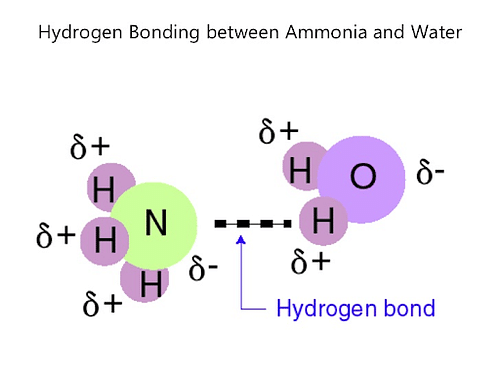
A special type of intermolecular attractive force arises only in the compounds having Hydrogen atoms bonded to an electronegative atom. This force is known as the Hydrogen bond. For instance, in water molecules, the hydrogen atom is bonded to a highly electronegative Oxygen. Hence, the dipole-to-dipole interactions between the Hydrogen atom of one molecule and the Oxygen atom of another molecule lead to the formation of hydrogen bonding.
- Hydrogen bonding is an electrostatic dipole-to-dipole interaction between molecules while exhibiting some covalent bonding properties.
- They are comparatively stronger than the usual dispersion and dipole-dipole forces while they remain weaker than the ionic or covalent bonds.
- Hydrogen bonds are directional and strong in nature, they create shorter interatomic distances, and generally involve a limited number of interaction partners.
- Its strength varies from per mole of hydrogen bonds 4 kJ to 50 kJ.

Hydrogen bonding between H2O atoms
Read more about Chemical Bonding and Molecular Structure.
Conditions for formation of Hydrogen bonds
In a molecule, when a hydrogen atom is bound to a strongly electronegative atom, it attracts the shared pair of electrons more strongly, thus this end of the molecule becomes negative while the other end becomes slightly positive. The negative end of one molecule attracts the positive end of the other, creating a weak bond between them which is known as a hydrogen bond.
As a result of hydrogen bonding, a hydrogen atom binds the two electronegative atoms at the same time, one by a covalent bond and the other by a hydrogen bond. The conditions for hydrogen bonding are:
- The molecule must contain a strongly electronegative atom that is bound to the hydrogen atom. The higher the electronegativity, the more polarized is the molecule.
- The electronegative atom must be small. The smaller the size, the greater the electrostatic magnetism.

Hydrogen Bonding in Molecules
Effect of Hydrogen Bonding on Elements
-
Association
Molecules such as Carboxylic acids exist as dimers because of hydrogen bonds. The molecular weights of these compounds are twice as high as those calculated using their simple formula.
-
Dissociation
HF dissociates in an aqueous solution and releases the difluoride ion in its place due to the hydrogen bonding in it. HCl, HBr, HI molecules do not form a hydrogen bond. This explains the lack of compounds like KHCl2, KHBr2, KHI2.
Hydrogen Bonding: Examples and Importance
Properties of Hydrogen Bond
- Solubility: Lower alcohols are more soluble in water because of the hydrogen bonding between a molecule of alcohol and water.
- Volatility: Because compounds with hydrogen bonds between different molecules have a higher boiling point, they are less volatile.
- Viscosity and surface tension: Substances that contain hydrogen bonds exist as associated molecules, so they are comparatively difficult to flow, have a higher consistency or viscosity, and have high surface tension.
- The lower density of ice than of water: With solid ice, a box-like structure of water molecules is created. In fact, each water molecule is tetrahedrally bound to four water molecules. The molecules are not packed as they are in the liquid state. When ice melts, this structure collapses, and the molecules move closer together. Thus, with the same water mass, the volume decreases, and the density increases. Therefore, at 273 K, ice has a lower density than water. That's why ice floats.
Why do compounds with hydrogen bonds have high boiling and melting points?
Compounds with hydrogen bonds have unusually high melting and boiling points. This is because of the fact that additional energy is required to split these bonds.
- The hydrogen fluoride's unusual high boiling point among the other halogen acids is because of the existence of hydrogen bonds.
- H2O is a liquid, while H2S, H2Se, and H2Te are gases at normal temperatures.
- Ammonia has a higher boiling point than PH3 because there are hydrogen bonds in NH3, but not in PH3.
- Similarly, compared to diethyl ether, ethanol has a higher boiling point as it contains hydrogen bonds.

Hydrogen bonding in Ethanol
Types of Hydrogen bonding
- Intramolecular Hydrogen bonding
- Intermolecular hydrogen bonding
- Symmetrical Hydrogen bonding

Intramolecular hydrogen bonding vs inter-molecular hydrogen bonding
Intramolecular Hydrogen Bonding
- When there is a hydrogen bond within a molecule itself, it is known as an intramolecular hydrogen bond.
- Intramolecular hydrogen bonds take place in the two groups of compounds, with one group having a hydrogen atom attached to an electronegative atom.
- The other group contains a strongly electronegative atom bound to a less electronegative atom from the other group.
Intermolecular Hydrogen Bonding
- When there are hydrogen bonds between different types of molecules of the same or different types of compounds, this is known as intermolecular hydrogen bonds.
- Examples are water and alcohol.
Symmetrical Hydrogen Bonding
- This hydrogen bond is a special type in which the proton is usually placed in between the two identical atoms.
- The power of the bond between each atom is the same.
- The symmetrical hydrogen bond is a kind of three-center-four-electron bond.
- It is also much stronger compared to "normal" hydrogen bonds, and its strength is almost similar to a covalent bond.
Metallic Bonding
- Metals are characterized by brilliance, gloss, high electrical and ductility, thermal conductivity, malleability, and high tensile power.
- A metallic crystal is made up of a large number of atoms arranged in a regular pattern.
- Various models have been proposed to explain the nature of metallic bonding. However, the two most significant ones are mobile electrons and positive kernels.
Strength of Hydrogen Bonds
The strength of Hydrogen bonding varies from weak to strong. It is somewhere between the weaker Van der Waals forces and the stronger covalent or ionic bonds.
The energy of dissociation of hydrogen bonding relies on the attraction that exists between the shared pairs of electrons and therefore it depends on the atom’s electronegativity.
Hydrogen Bonding Example
Hydrogen bonding Model of the Electron Sea
This model assumes that metal is made up of a lattice of positive ions (or nuclei) immersed in a sea of moving valence electrons, moving freely within the confines of a crystal. The atom together with its nucleus is therefore equal in absolute terms to the total valence electronic charge per atom.
- Positively charged ions are protected by free electrons from mutual electrostatic repulsive forces that otherwise they would exert on one another. In this way, these free electrons act as a “glue” to hold the ion nuclei together.
- The forces that hold atoms together in a metal due to the attraction between positive ions and the electrons freely surrounding them are known as metallic bonds.
- Though the electron sea is older than quantum mechanics, it still satisfactorily explains certain properties of metals. For example, the thermal and electrical conductivity of metals can be explained by the presence of mobile electrons in metals.
- By applying an electron field, these moving electrons conduct electricity through metals from one end to the other. When a part of the metal is heated, the moving electrons in that part of the metal acquire a large amount of kinetic energy. Because they are free and mobile, these electrons move quickly through the metal and conduct heat to the other part of the metal.

Hydrogen bonding Model of the Electron Sea
Class 11 Chemistry: Hydrogen Bonding
Hydrogen Bonding Things to Remember
-
- Hydrogen bonding is an intermolecular attractive force that arises in the compounds having Hydrogen atoms bonded to an electronegative atom.
- Compounds with hydrogen bonds have higher melting and boiling points. They are less volatile and have high surface tension.
- Intramolecular Hydrogen bonding: Hydrogen bond within a molecule itself
- Intermolecular hydrogen bonding: Hydrogen bonds between different types of molecules of the same or different types of compounds,
- Symmetrical Hydrogen Bond: Here, the proton is usually placed in between the two identical atoms.
- The strength of the hydrogen bonds is somewhere between the weaker Van der Waals forces and the stronger covalent bonds.
Sample Questions based on Hydrogen Bonding
Ques. What is hydrogen bonding? 1 mark
Ans. A special attractive force that forms when a hydrogen atom is linked to an electronegative atom is known as hydrogen bonding.
Ques. In an H2O molecule, how many hydrogen bonds can be formed? 1 mark
Ans. In water, 5 of the molecules are attached to each other through four hydrogen bonds.
Ques. Why water has such an exceptionally high boiling point? 1 mark
Ans. Water molecules have hydrogen bonding between them. Hydrogen bonds increase the boiling point of any substance. Hence, water has a high boiling point.
Ques. Why o-nitrophenol has higher volatility than p-nitrophenol? 2 marks
Ans. O-nitrophenol has higher volatility as it shows intramolecular hydrogen bonding. Whereas p-Nitrophenol shows intermolecular hydrogen bonding and hence has a higher boiling point.
Ques. Explain the place of Hydrogen in the periodic table based on the electron configuration. 2 marks
Ans. Hydrogen was placed on top of the alkali metal group but is not a member of the group. Its position is not sufficiently justified because of its electron configuration as (1s1). It can be placed with alkali metals as it also has a similar configuration (ns1) as the alkali metals. However, it can also be assigned to group 17 together with halogen, since, like halogen, it can assume an inert gas configuration by taking up an electron.
Ques. Hydrogen fluoride has unusually high boiling and melting points. Why? 2 marks
Ans. Hydrogen fluoride has a hydrogen bond between Hydrogen and a fluorine atom. Additional energy is required to split these bonds. Hence, it has higher boiling and melting points.
Ques. State the types of hydrogen bonding that exist in nature. 3 marks
Ans. The various types of hydrogen bonding are:
- Intramolecular Hydrogen bonding: A hydrogen bond occurring within a molecule itself is known as an intramolecular hydrogen bond.
- Intermolecular hydrogen bonding: Hydrogen bonds between different molecules of either the same or different types of compounds is known as intermolecular hydrogen bonds.
- Symmetrical Hydrogen Bond: A special type of bond in which the proton is usually placed in between the two identical atoms is known as a symmetrical hydrogen bond.
Ques. State some properties of compounds having hydrogen bonding. 3 marks
Ans. 1. Substances with hydrogen bonds have a higher consistency or viscosity and have high surface tension.
- Compounds displaying hydrogen bonds between various molecules have a higher boiling point.
- They are less volatile.



Comments