



Content Curator
Intermolecular forces are the forces of attraction and repulsion that arise between the molecules or atoms of a substance. These forces hold together the molecules of solid and liquid and are responsible for several physical properties of matter. Here in this article, we will go through the Intermolecular forces, their types and some important questions related to intermolecular forces.
| Table of Content |
Intermolecular Forces
[Click Here for Sample Questions]
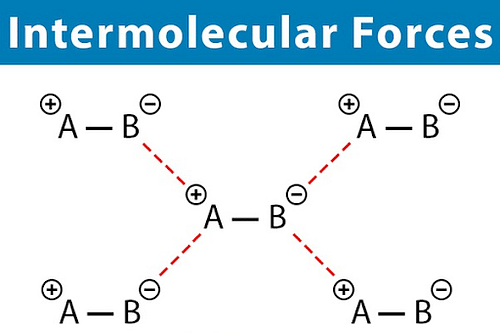
The attractive and repulsive forces that arise between the molecules of a substance are termed as the intermolecular forces. These forces are responsible for the physical and chemical properties of the matter. Intermolecular forces or IMF are also known as the electrostatic forces between molecules and atoms.
Intermolecular forces exist between the molecules and affect the physical properties of a substance. The intermolecular forces of attraction are the result of the reaction between the protons or positive compounds and the electrons or negative compounds of a molecule.
Also Read: Intermolecular Force
Types of Intermolecular Forces
[Click Here for Sample Questions]
There are several types of intermolecular forces based on the bonds. Repulsive and interactive forces are the two kinds of forces where electrostatic forces cause attraction. Van der Waals forces are another name for the intermolecular forces of attraction.
The boiling point of different substances is directly proportional to the intermolecular forces. If the boiling point of a substance increases, the strength of intermolecular forces also increases.
The boiling point of the different substances can be determined by the strength of their intermolecular forces. The intermolecular forces break due to the absorbed heat while converting the liquid to vapor. There are various types of interaction that affects the intermolecular forces such as:
Ion dipole interaction
The bond formed in ion-dipole interaction is between polar molecules and ions. The intensity of the interaction depends on:
- Charge and size of an ion
- The proportion of the dipole moment
- The magnitude of the polar molecule
Sodium chloride molecules dissolved in water are examples of intermolecular forces. Chlorine has negative ions (Cl-) and sodium has positive ions (Na+). Water possessing polar molecules is attracted towards the oppositely charged ions.

Dipole-dipole interaction
Dipole-dipole interaction occurs in polar molecules. The difference in the electronegativity of the atom which happens due to covalent bonds, gives rise to permanent dipoles in the polar molecules. The positive part of the molecule is attracted to the negative part of another molecule when two molecules interact with each other. Thus the force created by the attraction is known as the dipole-dipole interaction.
For Example: In HCI, chlorine is partially negatively charged as it is more electronegative than hydrogen whereas hydrogen is positively charged. The opposite charges cause the attractive forces which give rise to dipole-dipole interaction. The polarity of the molecules helps in detecting the intensity of these forces.

Ion induced dipole interaction
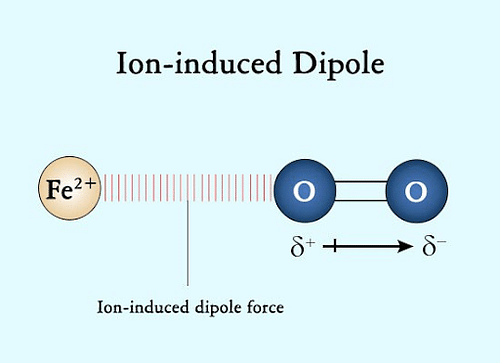
A molecule that is non-polar is made polar by placing an ion near it. When charged, the non-polar molecules behave like induced dipoles. The force created between an induced dipole and an ion is known as ion-induced interaction. The strength of the intermolecular forces depends upon the tendency with which the non-polar molecules get charged.
Dipole-induced dipole interaction
The presence of polar molecules changes the non-polar molecules into induced molecules and results in the dipole-induced dipole interaction. The interaction takes place between the molecules without dipoles and the polar moles with dipoles. The other molecule becomes a dipole as the permanent dipole of the polar molecules makes the electrically neutral molecule's dipole by damaging its electron cloud.

Dispersion forces or London forces
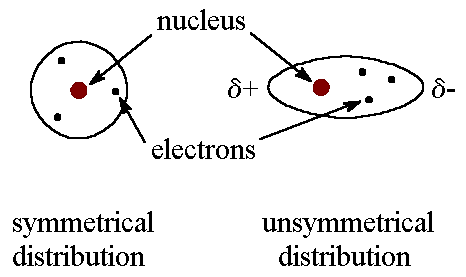
Dispersion forces or London forces create temporary positively and negatively charged regions because of the movement of the electrons. The electrically charged cloud of atoms and non-polar molecules is symmetrically distributed, which is why they exist without a dipole moment. But atoms and molecules may show dipole properties temporarily.
These forces are the weakest and travel only across a limited distance.
Intermolecular Forces: Formulae
[Click Here for Sample Questions]
- In solids, potential energy of dipole-dipole interaction is = 1/r3
Where r = distance between polar molecules
- Dispersion force = 1/r6
Where r = distance between two particles
- The potential energy between the non-polar identical molecules v= - ¾ α2I /r6
Where, α= Polarizability of non-polar molecules
r = Distance between two molecules
I = First ionization energy of the molecule
- The potential energy of interaction between the ion and polar molecules:
V = - qµ / (4π?0) r2
Where, r = Distance of separation
q = Charge of ion
µ= Dipole moment
- Electrostatic interaction between two dipoles: V = -(2/3) (µ12 µ22)/(4π?0)2r6
Where, µ = permanent dipole moment of the molecules
- Potential Energy of Dipole forces:
V = - (3/2) [(IAIB)/ (IA + IB)] αA αB / r6
- Van der waals equation :
(P + an2/v2) (v- nb) = nRT
Where n = number of moles of the gas
Constant a and b depend on the characteristics of the gas
Intermolecular Forces: Things to Remember
[Click Here for Sample Questions]
- Intermolecular forces are the forces of attraction and repulsion that arise between the molecules/atoms of a substance.
- Intermolecular forces or IMF are also referred to as the electrostatic forces between molecules and atoms.
- The boiling point of different substances is directly proportional to the intermolecular forces.
- London forces or dispersion forces are the weakest forces.
- Ion-dipole interactions are similar to dipole-dipole interactions but they arise between ions and polar molecules.
Intermolecular Forces: Important Questions
Ques.1: (a) Define Van der waals forces.
(b) Give an example to show dipole-dipole forces. (2 Marks)
Ans: (a) Van der waals forces are defined as the attractive intermolecular forces that act between the molecules of a substance.
(b) Dipole-dipole forces are the forces that act between the molecules possessing a permanent dipole. For example - the interaction between two HCl molecules.
Ques.2: Why does viscosity of liquids decrease as the temperature is raised? (2 Marks)
Ans: Viscosity of liquids decreases as the temperature rises because at high temperature the molecules of a substance acquire high kinetic energy and can overcome the intermolecular forces to slip over one another between the layers.
Ques.3: The stability of a crystal is reflected in the magnitude of its melting point. Explain (2 Marks)
Ans: Melting point of a solid explains about the intermolecular forces that act between the particles of a substance. When these forces are strong, the melting point of the substance is higher and when these forces are weak, the substance has a high melting point. Greater the melting point, the more stable the solid is.
Ques.4: Ionic solids are good conductors in molten state and in aqueous solutions but not in solid state. Why? (2 Marks)
Ans: In the solid state, the ions of the ionic solid do not move freely due to the rigid structure and strong electrostatic force. Therefore, they cannot conduct electricity when in the molten state and in aqueous solution the ions move freely and they conduct electricity.
Ques.5: Stability of a crystal is reflected in the magnitude of its melting point'. Comment. Collect melting points of solid water, ethyl alcohol, diethyl ether and methane from a data book. What can you say about the intermolecular forces between these molecules? (3 Marks)
Ans. The higher the melting point of the substance, the greater the intermolecular force of attraction of the substance and greater the stability. A substance with a higher melting point is more stable than a substance with a lower melting point.
The melting points of the given substances are:
Solid water = 273 K
Ethyl alcohol = 158.8 K
Diethyl ether = 156.85 K
Methane = 89.34 K
By observing the values of the given substances, the intermolecular forces in solid water are the strongest and those in methane are the weakest.
Ques.6: What are the forces which are responsible for the viscosity of a liquid? Why is glycerol more viscous than water? (3 Marks)
Ans: The forces which are responsible for the viscosity of a liquid are:
- Hydrogen bonding
- Van der Waals forces.
Glycerol is more viscous than water because the molecules of glycerol have extensive hydrogen bonding due to the pressure of three-oil groups in it as compared to the hydrogen bonding in the molecules of water.
Ques.7: Leaving electrostatic forces that exist between oppositely charged ions, which other intermolecular attractive forces exist between atoms or ions. Mention them. (2 Marks)
Ans: The intermolecular forces that exist between the atoms or ions are:
- Van der Waals forces
- London Forces or Dispersion Forces
- Dipole-dipole forces
- Dipole-induced dipole forces
- Hydrogen bond.
Ques.8: Give an expression for the van der Waals equation. Give the significance of the constants used in the equation. What are their units? (3 Marks)
Ans: The expression for the van der waals equation is:

Where, n is the no. of moles present in the substance and ‘a’ and ‘b’ are the van der Waals constants.
Significance of van der Waals constants are-
Van der Waals constant ‘a’ : ‘a’ is the magnitude of the attractive forces among the molecules of a particular gas.
Unit of ‘a’ = L2 mol-2
Van der Waals Constant ‘b’: ‘b’ determines the volume occupied by the gas molecules which depends upon size of molecule.
Unit of ‘b’ = L mol-1.



Comments