



Content Curator
Effective length of the Pendulum is the length of the string and radius of the metallic Bob. Just plot two graphs as L-T and L-T2. A simple pendulum is required to calculate the effective length of the simple Pendulum by experimenting with it. To find effective length of seconds pendulum using graph, results rely on length of the string. This length is subject to different forces such as tension, shear, and compression. The period of the simple Pendulum is nearly 2s.
Read More: Period Motion
Key Terms: Pendulum, effective length, time, bob, force, gravity, X-axis, and Y-axis
Principle of Simple Pendulum
[Click Here for Sample Questions]
Simple Pendulum runs on the principle of simple harmonic motion, where the given mass of the body moves to and fro in equal intervals of time. A bob is suspended from a pivotal point with a cotton thread, which restores Gravity’s force and accelerates in its position.
Acceleration is directly proportional to the displacement. Length of simple Pendulum is the length of thread+ length of the hook + radius of the bob, given as L= T + h + r. The period for the simple Pendulum is the time that Bob takes to complete one oscillation which can be calculated with the below formulae.
T=2π or T2=4π2l/G or l=GT2/4π2
T= period, L= Length of the Pendulum, G= Gravity.
Apparatus required
[Click Here for Sample Questions]
The apparatus required detail along with the pictorial representation.
- Metal bob with a hook
- Clamp stand
- Split Cork
- Long and strong cotton thread
- Graph Paper
- Scale
- Pencil and Eraser
- Stopwatch

Arrangement of Apparatus
How to Perform the Experiment
[Click Here for Sample Questions]
- The first step to execute the experiment is to keep the clamp stand on the table. Fix the metal bob with the hook and the string. The length of the string should be set to about 150 cm.
- Fix the cork tightly with the clamp to show that it can properly separate two split pieces. The split cork is at right angles to the line OA. Once Bob starts oscillating, we can observe changes.
- Once the setup is completed, measure the simple Pendulum’s length from the pivotal point to the Bob.
- Take some effective length from the x-axis and then consider the y-axis value of T2 for points in the graph.
- Take three points as: A as the mean along with point B and C as an extreme point.
- Start moving the Bob from C to A and then from A to B. Be careful when the Bob returns from C to A, so that it does not spin.
- Count one vibration when Bob moves from point C to A and A to B and again from B to C as A mean point. Note down the point and second vibration in a similar way. This way continues with the experimentation till the 20th vibration.
- Note down the time taken to complete 20 vibrations.
- Similarly, perform the same experiment in the same length of pause a number of times.
- Now reduce the length by 10 centimetres, repeat the experiment, and take the observation.
- According to the measuring, put L and T2 in both axes.

Ways to Calculate Effective Length
The outcome of experiment
[Click Here for Sample Questions]
When students set up the apparatus, they must take the following observations/ results.
- Length of the hook=_____cm
- Radius of the bob=____cm
- Time counted in the stopwatch =___s
- Reading of the meter scale=____mm
Also Check: Simple Harmonics
Steps to plot the graph
[Click Here for Sample Questions]
L vs. T Graph
One can plot the graph as L-T to take out the different results. Make a table that will help to understand the observation clearly. Take L on the x-axis and T on the y-axis. The below available graph will let all understand that the graph will be a curve line.
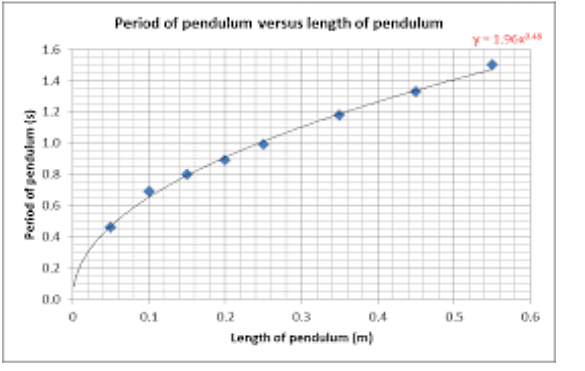
Length vs Time Graph
L vs. T2 Graph
One can plot the graph of L and T2, which will help all to get data in tabular form. Plotting the graph as L in the X-axis and T2 in the y axis will give a straight line. Finally, it will become easy to find the effective length of the Pendulum with T2=4s2.

L vs T2 graph
Also Check: Plotting of Graph
Result
[Click Here for Sample Questions]
The outcome of the above experiment is that a curve line will come from L-T on the graph, and a straight line will come from L-T2.
Things to Remember
[Click Here for Sample Questions]
- Get to perform this experiment for one month. Just be careful below points.
- Tie the thread tightly so that it is strong enough and extensible.
- The point of suspension should be enough fixed point.
- The movement of Bob should be in a straight line, and it does not bend much while the vibration or oscillation.
- While taking this experiment, one must choose a perfect place without disturbance so that anyone causes the Bob to vibrate.
- The stopwatch meter scale should be in good condition.
Sample Questions
Ques. What is the importance of using a simple pendulum? (2 Marks)
Ans. As the pendulums act as proof for Newton's first motion law, it serves as a basis for many scientific calculations.
Ques. Explain the working of a simple Pendulum? (2 Marks)
Ans. Simple pendulums work on the principle of simple harmonic motion. The motion's direction is towards the mean position, which is directly proportional to the displacement.
Ques. What is the difference between a simple Pendulum and a complex Pendulum? (2 Marks)
Ans. Simple Pendulum has one ball, while the complex Pendulum has more than one limb with unequal length and Bob with unequal masses. Their motion is in three dimensions.
Ques. Define restoring force. (1 Mark)
Ans. Restoring force is that force that tends the vibration body to come to the original position.
Ques. Find the length of a second’s pendulum at a place where Gravity =10ms-2 where π=3.14. (2 Marks)
Ans. T=2π
2=2π
L=g/π2=10/3.142 = 1.01m
Ques. The length of a second pendulum is 80 centimetres. Find the length of a pendulum whose time create is 1.4 sec. (3 Marks)
Ans. T1 =2s where length = 80 cm
T2= 1.4s, so the length will be
T1/T2=
2/1.4=80/l2
Squaring both sides
4/1.96= 80/l2
80*1.96/4 = 39.2
Ques. State how the length of the simple Pendulum depends on its period. (1 Mark)
Ans. The time is directly proportional to the square root of the length
Ques. State two things on which time depends on. (2 Marks)
Ans. Two things for which time depends is the acceleration due to Gravity and the length of the string on which the Pendulum is hung.



Comments