



Exams Prep Master
Lewis Acid and Base was named after American chemist Gilbert Newton Lewis, who contributed to the field of thermodynamics. A Lewis base is also a Brønsted- Lowry base, but a Lewis acid does not need to be a Brønsted- Lowry acid. The two theories are distinct but yet complementary. Let's look into the theories in depth along with some important questions.
| Table of Content |
What are Lewis acids?
[Click Here for Sample Questions]
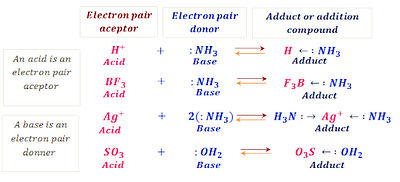
Lewis acid is a chemical species that has an empty orbital that accepts a lewis basis to form a Lewis adduct. Lewis acid can be called electrophiles as they are electron-rich and can accept electron pairs. The term was used in order to describe chemical species with a trigonal planar structure and an empty p-orbital. Water along with some other compounds are considered as both Lewis acids and bases as they can accept as well as donate electron pairs based on the reaction.
Examples of Lewis Acids
- Hydrogen H+ ions with onium ions H2O+
- Iron, copper
- Cation of d block element with high oxidation properties. An example of such a cation is Fe3+
- Cation metal such as Li+ and Mg2+
- Arsenic
- Antimony
- Phosphorus
What is Lewis base?
[Click Here for Sample Questions]
Molecular or atomic chemical species having highly localized HOMO i.e, Highly Occupied Molecular Orbital, act as Lewis base. They have the ability to donate an electron pair to a given Lewis acid to form an adduct. Lewis bases can be called nucleophiles as they are electron-rich and can donate electron pairs. Some of the common Lewis bases are ammonia, alkyl amines and other conventional amines. Generally, the Lewis bases are anionic in nature. Their base strength depends on the pKa of the corresponding parent acid.

Examples of Lewis Bases
Following are some examples of Lewis base:
- H2O
- Cl-
- I-
- CH3-
- NH3
- F-
- H-
- SbCl5
- SO42-
- C2H2
?
The Reaction between Lewis base and Lewis acid
[Click Here for Sample Questions]
The Reaction with H+ ions
The H+ ions behave as Lewis acid, while H2O behaves as Lewis base. The reaction between water molecules and protons results in hydronium ions ( H3O+). Here, the oxygen ions, forming a covalent bond in the process, give a pair of an electron pair to the proton. The resulting Lewis acid possesses a +1 charge with it.

Another example where H+ ion acts as Lewis acid is its reaction with Ammonia (NH3) to form an ammonium ion (NH4+)

The Reaction between Ag+ ion and Ammonia
Here two Lewis bases with one Lewis acid form an adduct wherein ammonia behaves as lewis bases and silver ion (Ag+) acts as lewis acid. Here, each nitrogen atom donates an electron pair to a silver ion that results into two separate coordinate covalent bonds. The adduct will form from the Lewis acid and base will have the chemical formula Ag(NH3)2+.

The Reaction between the Fluoride and Boron Trifluoride
This reaction shows the formation of a coordinate bond between the fluoride anion (F-) and boron trifluoride (BF3). Here, in this reaction fluoride acts as an electron pair donor while boron trifluoride accepts the electron pair. The reaction between the Lewis acid and base causes the formation of an adduct with a chemical formula BF4-.

Application of Lewis Acids and Bases
[Click Here for Sample Questions]
An alternate theory in order to describe acids and bases was introduced by G. N Lewis which states a general explanation of acids and bases based on bonding and structure. Now, a lot of chemists can predict a wider variation of acid-base reactions with the application and easy definitions of acids and bases. The theory of Lewis was based on electrons instead of proton transfer.
Following are few application of Lewis acid and base:
- In organic chemistry, lewis acid is used for many cationic or pseudo cationic chemical reactions.
- In modification of selectivity and activity of metal catalyst, Lewis base is immensely used.
- One example of this is the use of AlCl3 in Friedel-Crafts alkylation reaction wherein AlCl3 accepts a pair of electrons to form a strongly acidic and electrophilic carbonium ion.
RCl + ACl3 → R+ (carbonium) + AlCl3-
- Lewis base is also used for production of pharmaceuticals.
- Lewis acid and base reaction has a strong bond know as multidentate Lewis base which is widely
- Lewis theories are also used in agricultural industry
Lewis Acids and Bases: Sample Question
Ques: What are the types of Lewis acids? (2 marks)
Click Here To View Answer
Ans. The following chemical species that act as Lewis acid:
- Molecules where central atom has incomplete octet
- All cations act as Lewis acid as they are deficient of electrons
- Molecules in which central atom doesn’t have d orbitals
- Molecules have many bonds of atom of dissimilar electronegativity
Ques: What are the types of Lewis base? (1 mark)
Click Here To View Answer
Ans. The following chemical species that act as Lewis base:
- Neutral species which has at least one lone pair of electron
- Negative charge anions or species
Ques: Does ethyl act as a Lewis base? (2 marks)
Click Here To View Answer
Ans. Yes the ethyl acts as Lewis acid base as it has the ability to donate a pair of an electron to a suitable lewis acid and form a Lewis adduct.
Ques. Does hydrochloric acid act as a Lewis acid? (2 marks)
Click Here To View Answer
Ans. No hydrochloric acid cannot act as lewis acid as it doesn't have the ability to accept a pair of electrons from lewis acid base to form lewis adduct.
Ques: Which of the following are Lewis acids: H2O, BF3, H+, and NH4+. (2 marks)
Click Here To View Answer
Ans. Among these acids, BF3 and H+ ions are the Lewis acids.
Ques: What will be the conjugate bases for the Bronsted acids: HF, H2SO4, and H2CO3? (2 marks)
Click Here To View Answer
Ans. The conjugate bases for these acids will be: F-, HSO-4, HCO-3.
Ques: The species H2O, HCO3-, HSO4- and NH3 can behave both as Bronsted acid and base. For ease case, show the corresponding conjugate acid and base. (3 marks)
Click Here To View Answer
Ans. 
Ques: Classify the following species into Lewis acids and Lewis bases and show how this can act as Lewis acid or Lewis base. a) OH- ions, b) F-, c) H+, d) BCl3. (3 marks)
Click Here To View Answer
Ans. a) OH- ions can donate an electron pair and act as Lewis base.
b) F- can donate an electron pair and act as Lewis base.
c) H+ ion can accept an electron pair and act as Lewis acid.
d) BCl3 can accept an electron pair as the Boron atom is electron deficient. Thus it acts as a Lewis acid.
Lewis Acids and Base: Things to Remember
[Click Here for Sample Questions]
- Lewis Acids and Bases is covered in Unit 7 i.e, Equilibrium of NCERT Class 11 Chemistry.
- There will be no reduction in CBSE syllabus for the academic year 2021-22.
- The whole unit 7 will carry a weightage of 12 periods and students can expect around 05 marks from this topic in the CBSE class 11 examination.



Comments