



Content Curator
Linear momentum is defined as the product of a mass of an object to its velocity. It is a vector quantity. It is represented by the symbol p. The direction of the momentum of a body is the same as the direction of its velocity. Momentum is a conserved quantity, which is to say the total momentum of an isolated system remains constant. The SI unit of linear momentum is kg m/s.
The formula for the linear momentum of a body is given by
p = m⋅v
Where,
m = mass of the object
v = velocity of the object
| Table of Content |
Key Takeaways: Linear Momentum, Dimensional Formula, Conservation of Linear Momentum, Centre of Mass
Dimensional Formula of Linear Momentum
Now, linear momentum is calculated using the formula,
linear momentum = mass × velocity
So, the dimensional formula of linear momentum can be calculated using the above formula.
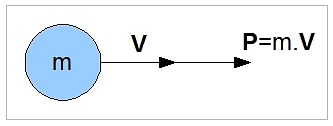
Linear Momentum Formula
Dimensional formula of mass = [M1L0T0]
Dimensional formula of velocity = [M0L1T-1]
Dimensional Formula of linear momentum = [M1L0T0] × [M0L1T-1] = [M1L1T-1]
Therefore, the dimensional formula of linear momentum is [M1L1T-1].
Also Read: What is Unit of Momentum? - SI & Other Units
Conservation of Linear Momentum
The conservation of linear momentum of an object can be explained using Newton’s second law of motion. And according to this law, the rate of change of linear momentum of an object is equal to the net force acting on that object.
F = dpdt
We know, p = m⋅v
Differentiating this equation on both sides, we get
dpdt= mdvdt= ma = Fext
Ifdpdt= 0, then p is constant.
Now, if the net external force on a system is zero, then the linear momentum is conserved and the velocity of the centre of mass remains constant.
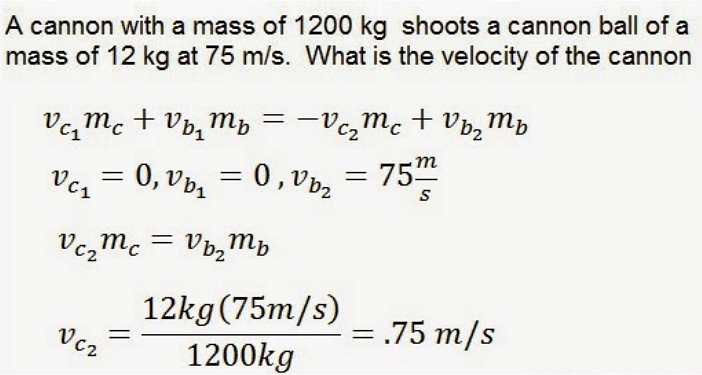
Conservation of Momentum: Example
Things To Remember
- Linear momentum is a vector quantity that is calculated as the product of a mass of an object to its velocity.
- The SI unit of linear momentum is kg m/s.
- The dimensional formula of linear momentum is [M1L1T-1].
- The direction of linear momentum is in the direction of the velocity of the object.
- The linear momentum of a system remains constant if the net external force acting on it is zero. This means that the momentum is conserved.
Also Read:
Sample Questions
Ques: Determine the linear momentum of a body with a mass of 5 kg and moving with a velocity of 50 m/s. (2 marks)
Ans: m = 5 kg
v = 50 m/s
Linear momentum, p = m⋅v
p = 5 × 50 = 250 kg m/s
The linear momentum of this body is 250 kg m/s.
Ques: If the linear momentum of an object moving with a velocity of 25 m/s is 100 kg m/s, then find out the mass of the object. (3 marks)
Ans: v = 25 m/s
p = 100 kg m/s
The formula for linear momentum is p = m⋅v
100 = m × 25
m = 4 kg
So, the mass of this object is 4 kg.
Ques: Explain the conservation of linear momentum. (2 marks)
Ans: The law of conservation of linear momentum states that if the net external force on a system is zero, then the linear momentum is conserved. The linear momentum of the individual particles in the system keeps changing, but the overall linear momentum of the system remains constant unless an external force acts on it.
Ques: An object of mass 10 kg is at rest. Calculate its linear momentum. (2 marks)
Ans: Here, the given object of mass 10 kg is at rest, which means its velocity is zero.
Now, we know linear momentum is calculated as p = m⋅v
p = 10 × 0 = 0
Thus, the linear momentum of the given object is zero.
Ques: A child sits motionless at the end of a long trolley moving on a smooth horizontal path with uniform speed. If the child runs about the trolley randomly, then what is the speed of the centre of the mass of the system? (2 marks)
Ans: When the child starts running about the trolley in any manner, the speed of the centre of mass of the system remains unchanged. Here, the child and the trolley serve as a single system and the forces applicable are only internal. So, the momentum of the system is conserved and hence, the velocity remains the same.
Ques: Is the total momentum of the universe constant? Explain. (2 marks)
Ans: The total momentum of the universe remains constant. There is no system larger than the universe comprising it. So, there is no external force acting on the universe and hence, its linear momentum is conserved.
Ques: If the linear momentum of an object with a mass of 2 kg is 36 kg m/s, then calculate its velocity. (3 marks)
Ans: m = 2 kg
p = 36 kg m/s
Linear momentum, p = m⋅v
36 = 2 × v
v = 18 m/s
So, the velocity of this object is 18 m/s



Comments