



Education Journalist | Study Abroad Lead
Missing Numbers are those numbers that were left out of a specific series of numbers with similar differences. Finding similar alterations between those numbers and filling in the missing terms in the precise series and places is indicated as the process of writing the missing numbers. The goal of reasoning is to find an unknown number in a given series. Here we will go through the essential ideas of missing number reasoning and the different forms of missing number reasoning, and tips and tactics for solving missing number reasoning questions.
| Table of Content |
Key Takeaways: Missing Number, Missing Number Sequence, Series Pattern, Number Series, Numerical Sequence, Square Laws, Numerical Series, Reasoning
What are Missing Numbers?
[Click Here for Sample Questions]
Missing numbers can be defined as those numbers that have been missing in a given series of a number with similar differences among them. The process of finding out and writing the missing numbers is defined as estimating the similar changes between those numbers and filling the missing terms in the specific series and places.
A missing number sequence is a series or sequence in which a number is missing. A pattern may exist in the number series, such as comparable differences, products, square laws, or other mathematical structures. Furthermore, the number series may have a formula or guideline to follow throughout the sequence.
Read More: Natural Numbers and Whole Numbers
Missing Number Series
[Click Here for Sample Questions]
A number series is a collection of numbers that follow a specific rule or formula, as we've seen. There are many different series, and one of them is the missing number series. In a missing number series, you are given a series with one missing number and instructed to discover the missing term. To locate the missing number, we must first determine the rule or formula used in the provided missing number sequence. Let's look at how to find the missing number in a sequence.
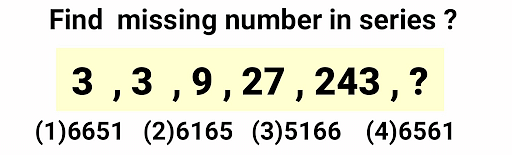
Missing Number Series
How to Find The Missing Number in A Series?
[Click Here for Sample Questions]
To locate a missing number in a sequence, we must first determine the series' pattern. Any pattern can be used. To find the pattern in the given number sequence, we must learn and apply all feasible mathematical formulas. We are asked to find the missing number in the beginning, middle, or end of a finding a missing number sort of question.
Given below are the steps to find the missing numbers in a series:
- Choose 2 or 3 terms to the text to add the rule to locate the missing number. For example, If we have 5 numbers in a series then pick up the first 3 terms to check the rule that is to be applied in the series
- When you are selecting the number to check the rule, choose the number that is easy to operate. These numbers include terms that are factors of 2, 3, 5, or 10. Now, use common methods such as the sum of the terms, squares, cube, or other to check the series.
Read More: Addition and Subtraction of Integers
Solved Examples
[Click Here for Sample Questions]
Example 1: Find the missing number in the given series: 1, 9, 17, 33, 49, 73, ?
- 93
- 97
- 99
- 100
Solution: B
Explanation: As, we can see that the pattern is:
1 + 8 = 9
9 + 8 = 17
17 + 16 = 33
33 + 16 = 49
49 + 24 = 73
73 + 24 = 97
Example 2: Solve the pattern and get the missing number: 1, 5, 13, 25, 41, ?
- 52
- 58
- 60
- 61
Solution: D
Explanation: The given pattern is +4, +8, +12, +16
So, the missing term is 41 + 20 = 61
Read More: Associative Law
Things to Remember
- Missing numbers are those left out of a specific series of numbers with similar differences.
- Finding similar alterations between such numbers and filling their missing values in their respective series and places is the process of writing the missing numbers.
- Finding similar alterations between those numbers and filling in the missing terms in the precise series and places is indicated as writing the missing numbers.
- There are basically two steps in order to find out the missing number in a series.
- First, choose 2-3 terms to check the rule that is to be applied in the series. Then, use common methods such as the sum of the terms, squares, cube, or others to check the series.
Sample Questions
Ques. Find the missing numbers. (5 Marks)
a) In the sequence 30, 23, ?, 9
b) In the sequence 1, 3, 5, 7, 11, ?, 17, 19
Ans. a) The numbers in the sequence are in decreasing order, as we can see. 30 − 23 = 7 is the difference between the two numbers. The numbers have a difference of seven and are in decreasing order. As a result, if we remove 7 from 23, we obtain 16, which is the series' missing number.
b) All of these numbers are prime numbers, as we can see. As a result, an unaccounted-for number is a prime number between 11 and 17. Is there a prime number between 11 and 17 that we don't know about? The number that is missing is 13.
Ques. What is the missing number in the series 5, 7, 12, 11, 13, 24, 17, 19, _ ? (5 Marks)
Ans. The sequence is made up of prime numbers and their sums, as we can see. 5 and 7 are prime numbers, for example, and their sum is 12. 11 and 13 are the next prime numbers, and their sum is 24. Similarly, the next prime numbers are 17 and 19, which add up to 36.
As a result, 36 is the missing number.
Ques. Find the missing number in the sequence 2, 3, 6, 4, 5, 20, ?, 3, 18 (3 Marks)
Ans. This is an example of a product sequence.
The product of two and three is six, whereas four and five are twenty. However, the number drops to 18, implying that the product of 3 and 6 must equal 18.
As a result, 6 is the missing number.
Ques. Find the missing number from the given series: 49, 121, 169, ?, 361. (3 Marks)
Ans. The missing number can be found with the following method of finding the squares of the numbers:
The square of 7 is = 49
The square of 11 is = 121
The square of 13 is = 169
The square of 17 is = 289
The square of 19 is = 361
So, according to the squares of the numbers in the given series, the correct answer is 289.
Ques. What will be the missing number in the following sequence? (5, 7, 11, ?, 17, 19) (3 Marks)
Ans. The missing number is 13.
We can clearly see that all the given orders of numbers in a number line contain the prime numbers 5, 7, 11, 13, 17, 19 which are all divisible by only ‘1’ and itself.
Hence, the series will be 5, 7, 11, 13, 17, 19.
Ques. Find the missing number in the given series: 8, 64, 216, ?, 1000 (3 Marks)
Ans. To find the solution of the series, we should find the cube root of different even numbers; the series will be as follows.
The cube of 2 is 8
The cube of 4 is 64
The cube of 6 is 216
The cube of 8 is 512
The cube of 10 is 1000
Hence, the missing number in the series is 512.
Ques. How many digits in the number 381576 will remain in the same place when it is sorted in ascending order? (3 Marks)
Ans. 381576 is the original number form.
135678 is the ascending order form.
We will get the answer if we look for the number(s) whose position will be the same in both versions. Only one number, which is the number 7, remains the same or unmodified. As a result, the answer is One.
Ques. Find the missing term: 16384, 4096, 1024, 256, ?, 16, 4 (3 Marks)
Ans. The solution of the series is as follows.
When we divide 16384 by 4, we get 4096.
When we divide 4096 by 4, we get 1024.
When we divide 1024 by 4, we get 256.
When we divide 256 by 4, we get 64.
When we divide 64 by 4, we get 16.
When we divide 16 by 4, we get 4.
Hence, the correct answer is 64.
Related Links:



Comments