



Content Curator
Neptune is an intriguing world about which little is known. It could be because Neptune is the farthest planet from the sun. There have been very few exploration missions that have gone that far. Regardless, it is a fascinating world. It is the solar system's sole planet discovered through mathematical prediction rather than empirical observation. We'll talk about Neptune's nature and more in this article.
| Table of Content |
Neptune: Definition
Neptune is the eighth and farthest planet in the Solar System from the Sun. It is the fourth-largest planet in terms of diameter, the third-largest planet in terms of mass, and the densest big planet. Neptune is 17 times the mass of Earth and 17 times the mass of Uranus, its near-doppelganger.
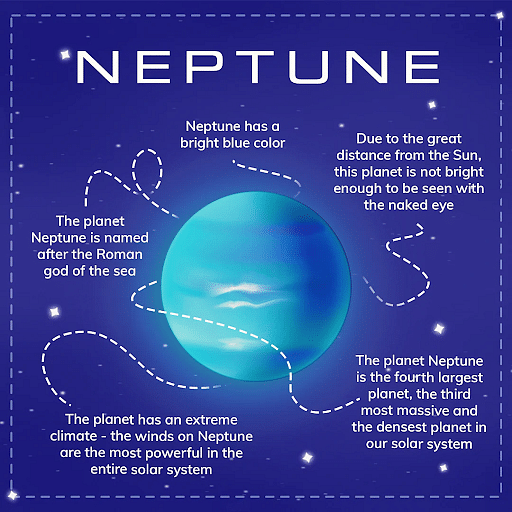
Because of its higher mass, Neptune is a dense and tiny planet with increased gravitational compression of its atmosphere.This planet is impenetrable to the naked eye. It is the Solar System's sole planet discovered through mathematical prediction rather than empirical observation.
Neptune: History
Neptune has been named after the God of Seas in Roman mythology because of its blue color. After Neptune was discovered, it was discovered that its orbit did not follow Newton's law. As a result, it was assumed that Uranus' orbit was being disturbed by another distant planet. Galle and Le Verrier were the first to discover Neptune, based on calculations derived from Jupiter, Saturn, and Uranus' observed positions.
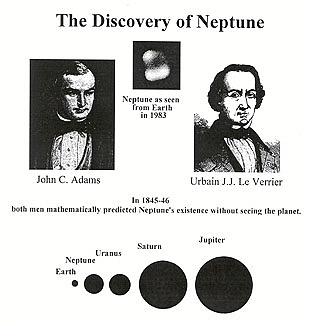
Galileo Galilei first sighted Neptune in 1613. He initially mistook it for a star, but as he tried to investigate more, the planet's motion became far too small to be observed. The planet Uranus, whose orbit astronomers were calculating, was the most important factor in the discovery of Neptune. Uranus, they noticed, did not follow their traditional models.

Astronomers were obliged to assume that another undiscovered planet was to blame due to Uranus's disturbed orbit. They projected where it should be, and Urbain Le Verrier, an astronomer, enlisted Johann Galle's assistance. He discovered Neptune one degree off the expected position, making it the first planet discovered using mathematical calculations and predictions.
Neptune: Characteristics
Neptune is a cold, dark, and windy planet. It's the last of our solar system's planets. Neptune's composition is identical to Uranus': ice and rock with around 15% hydrogen and a trace of helium. Hydrogen, helium, and methane make up its atmosphere. The absorption of red light by methane in Neptune's atmosphere is the primary cause of the planet's blue hue.
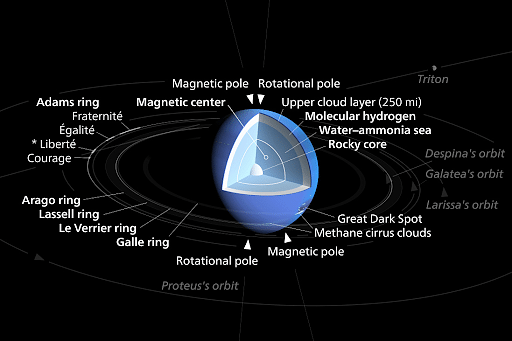
Neptune is made up of a solid core and a viscous soup of water, ammonia, and methane. It has a strong, suffocating breeze. The fastest winds in the solar system are on Neptune, which reach speeds of 2000 km/hr. On Neptune, one day is equal to 16 hours. It takes around 165 Earth years for Neptune to complete one rotation around the sun. Neptune has a total of 14 moons.

Neptune is the eighth planet from the sun and the farthest away. Uranus is the only planet it has as a neighbour. Neptune is encircled by five known rings of rock and dust, each named after astronomers who helped shed light on the windswept world. Neptune also possesses arcs, which are partial rings. Researchers will have to satisfy their curiosity from afar, relying on observations from the Hubble Space Telescope and other telescopes with their bases firmly planted on the ground, until a specific plan to visit Neptune is devised.
Neptune: Moons/Satellites
Neptune is surrounded by 14 known moons. Triton was found 17 days after Neptune. It was the first and largest moon known. They're all named after Greek mythological water gods. Regular, irregular, and uncommon irregular moons are the three types.

Regular Moons
Of the 14 moons, seven are inner regular moons, meaning they orbit Neptune's ecliptic with circular orbits or low eccentricity orbits. They are classed as Naiad, Thalassa, Despina, Larissa, Hippocamp, and Proteus in order of their distance from Neptune.
Irregular Moons
Irregular moons make up the rest of the seven moons. They travel in an orbit that is inclined, eccentric, and retrograde. They are classed as Triton, Nereid, Halimede, Sao, Laomedeia, Psamanthe, and Neso in order of their distance.

Neptune: Atmosphere and Climate
Neptune's atmosphere consists of Hydrogen, Helium, and Methane. While being the farthest planet from the Sun and receiving the least energy from it, Neptune has the most powerful winds, despite being colder than Uranus. It has the oddest and most unusual weather.

The average temperature of Neptune is -214 degrees Celsius. On the equator, wind speeds can exceed 2,160 kilometres per hour, which is practically supersonic. On this planet, bands and massive storms form as well.
Orbit and Rotation
Because it is the farthest planet from the Sun, it has the longest orbital duration, taking nearly 165 years to complete a revolution around the Sun. On the other hand, one spin on Neptune takes 16.11 hours. At perihelion, 29.81 AU, and aphelion, 30.33 AU, the average distance from the Sun is roughly 30.1 AU. When compared to Earth, Neptune's elliptical orbit is inclined 1.77 degrees.

Things to Remember
- Neptune is the 8th and farthest planet in the solar system. It was first sighted in 1613 by Galileo Galilei.
- Neptune has been named after the God of Seas in Roman mythology because of its blue color.
- Neptune is the first planet discovered using mathematical calculations and predictions.
- Neptune’s atmosphere is chiefly made of Hydrogen, Helium, and Methane.
- On Neptune, one day is equal to 16 hours. It takes around 165 Earth years for Neptune to complete one rotation around the sun.
- Neptune is surrounded by 14 known moons: Regular and Irregular.
- The average temperature of Neptune is -214 degrees Celsius. On the equator, wind speeds can exceed 2,160 kilometres per hour
- Neptune takes 165 years to complete a revolution around the Sun. On the other hand, one rotation on Neptune only takes 16.11 hours.
Sample Questions
Ques: Is it possible to see Neptune without a telescope? (1 mark)
Ans: Neptune is the only large planet that requires a telescope to see. It has an apparent magnitude of 7.8 and is one-fifth the brightness of the weakest stars visible to the naked eye. As a result, there were no Neptune observations prior to the adoption of telescopes.
Ques: What is the reason behind the colour of Neptune being blue? (2 marks)
Ans: Neptune is mostly made up of the gases methane, helium, and hydrogen, with 1% methane, 19% helium, and roughly 80% hydrogen. The presence of methane accounts for its blue tint. Methane clouds absorb the red end of the visible light spectrum when sunlight strikes Neptune's surface. The blue spectrum is reflected back to the observer.
The reflected sunlight, without the red light, is visible when Neptune's vivid bluish tint is viewed. A few thin, coloured bands have been discovered surrounding Neptune, indicating that it accurately resembles a celestial blue gaseous orb with a faint splash of coloured rings, according to scientists.
Ques: In Neptune's atmosphere, what gases are present? (1 mark)
Ans: The outer atmosphere of Neptune is primarily made up of hydrogen and helium, accounting for 98 percent of all atmospheric molecules. Methane gas makes up the majority of the remaining. The presence of methane lends Neptune a bluish cast. Hydrogen and helium are almost invisible.
Ques: Why does Neptune have such a short day? (1 mark)
Ans: One rotation of Neptune around its axis takes 16 hours. Neptune has the third shortest day among the solar system's eight planets.
Ques: When was Neptune discovered? (1 mark)
Ans: On September 23, 1846, Neptune was discovered. It is the second planet discovered by the use of a telescope.
Ques: Why is there methane gas on Neptune? (1 mark)
Ans: Even though the Sun is around 900 times fainter on Neptune than it is on Earth, it has released frozen methane gas into its atmosphere due to its internal heating.
Ques: What is Neptune's Structure Like? (2 marks)
Ans: The interior structure of Neptune is remarkably similar to Uranus. The atmosphere makes up around 5% to 10% of its mass and extends about 10% to 20% of the way to the core, reaching pressures of roughly 10 GPa. Methane, ammonia, and water concentrations are typically found in the lower layers of the atmosphere.
Even methane can break down into diamond crystals that fall down like hailstones under certain conditions. Iron, nickel, and silicates make up the majority of the core. The mass of the core is estimated to be 1.5 times that of the Earth. Neptune's centre has a pressure of 7 Mbar (700 Gpa).



Comments