



Content Curator
The study of organic compounds is vast. Millions of compounds fall under the category of organic compounds. There are a few organic compounds that consist of functional groups. Most organic molecules have functional groups as their primary structure. The name of the organic compound is determined by the name of the functional group and the bonding between them. This is why the titles of the functional groups must be explicit. The structure and properties of functional groupings determine their names.
| Table of Content |
Key words: Organic compounds, functional groups, Bonds, atoms, Carbon, Structure, IUPAC Nomenclature functional groups
Organic Compounds
[Click Here for Sample Questions]
Organic compound is a set of chemical compounds in which one or more atoms of carbon are covalently bonded with other atoms. Because carbon has a catenation property, carbon atoms are the key elements of an organic compound. Organic compounds have different functional groups according to their structure.
Functional Groups
[Click Here for Sample Questions]
Functional groups are the main structure of organic compounds. The name of the organic compounds depends on the functional group name and their bonding. Depending on their structure and properties the functional groups are named accordingly. An atom or a compound that is formed individually in a unique manner is called a functional group. It is considered the most reactive part of an organic molecule.
The examples are -
hydroxyl group ( -OH), aldehyde group ( -CHO), Carboxylic acid group ( - COOH)
Compounds having similar functional groups have a similar type of reaction. For example - Ethanol and Propanol, both have similar types of reactions because of the same functional group that is - OH. These liberate hydrogen when the compound is related to sodium metal.
In organic chemistry, while naming an organic compound consisting of a functional group, we need to follow the sequential order in IUPAC (International Union of Pure and Applied Chemistry) nomenclature.
Order of Functional Group in IUPAC
[Click Here for Sample Questions]
We need to follow the order of functional groups in IUPAC Nomenclature, for naming functional groups when a molecule has multiple functional groups attached to it. According to the priority, the table starting from the functional groups are arranged as :
- Carboxylic acid - Prefix : carboxy, and suffix : carboxylic acid or -Oic acid.
Example - Ethanoic acid.
- Sulfonic acid - Prefix : sulfo, and suffix : sulfonic acid.
Example - Benzenesulfonic acid.
- Ester - Prefix : alkoxycarbonyl, and suffix : -Oate.
Example - Methyl ethanoate.
- Acid halide - Prefix : halo carbonyl, and suffix : -Oyl halide.
Example - Ethanoyl Chloride.
- Amide - Prefix : carbamoyl, and suffix : carboxamide or - amide.
Example - Ethanamide.
- Nitrile - Prefix : cyano, and suffix : nitrile.
Example - Ethanenitrile.
- Aldehyde - Prefix : formyl,and suffix : -al or, carbaldehyde.
Example - Ethanal.
- Ketone - Prefix : oxo, and suffix : -One.
Example - 2 propane.
- Alcohol - Prefix : hydroxy, and suffix : -Ol.
Example - Methanol.
- Thiol - Prefix : mercapto, and suffix : -thiol
Example - Methanethiol.
- Amine - Prefix : amino, and suffix : amine.
Example - Methylamine.
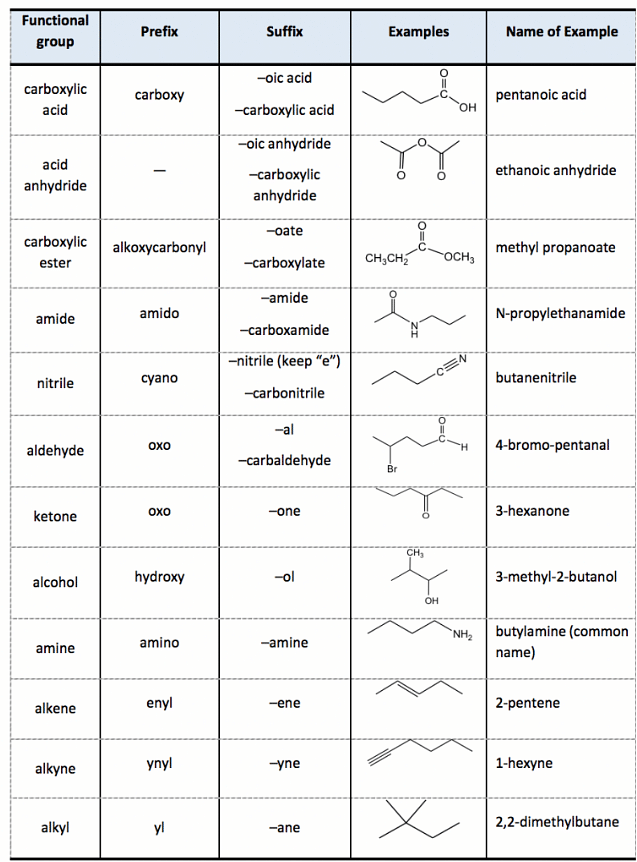
Nomenclature of Functional Group
[Click Here for Sample Questions]
Nomenclature systems should focus on two things at least. Firstly, indicate how the carbon atoms of a particular compound are bonded together in the form of a chain. And secondly, it should identify any functional groups present in the compound.
The IUPAC nomenclature system is a set of rules used by organic chemists to get around the problems caused by arbitrary nomenclature. These rules give a structural formula for every distinct compound. There are some particular steps for the nomenclature of organic compounds. They are as follows:
- Firstly, the longest carbon chain is to be set on
- All the backups from parent chains are to be recognized
- The functional group of compounds needs to be spotted out
- Determining the number of carbon compounds and carbon-hydrogen bonds
- Lastly, the functional group will be termed considering the above-mentioned factors and also by following the IUPAC Nomenclature rules
The systematic IUPAC name of an organic compound consists of 4 parts -
- Root word
- Suffixes
- Prefixes and
- Infix
Things to Remember
- Nomenclature helps in establishing an International standard of naming compounds. This provides a better classification of compounds on the basis of name and structure.
- Compounds consisting of carbon and hydrogen only are called hydrocarbons.
- A hydrocarbon is said to be saturated if it only has a single carbon-carbon bond.
- Unsaturated hydrocarbons are those which contain at least one carbon, carbon double or triple bond.
- An Alkyl group is taken from a saturated hydrocarbon by taking off a hydrogen atom from carbon.
Solved Question
Ques. The IUPAC name for - (1 marks)

a.) 1- Hydroxypentane-1,4-dione
b.) 1,4 - Dioxopentanol
c.) 1- carboxy butan -3-one
d.) 4 - oxopentanoic acid
Ans. The correct answer is (d).

4- Oxopentanoic acid or levulinic acid is classified as keto acid. Levulinic acid was first traced by Freiherrn von Grote and Tollens. The name was given so because the laboratory fructose called levulose was reactant for the generation of acid.
Ques. In the given following functional group isomerism which seems impossible? (3marks)
a.) Alcohols
b.) Aldehydes
c.) Alkyl halides
d.) Cyanides
Ans. (c) Functional isomerism does not exist in alkyl halides.
Explanation: In alcohols, aldehydes and cyanides, isomerism is not possible as alcohols and ethers: aldehyde and ketones; cyanides and isocyanides are all functional groups of isomerism. For eg. Cyanides are functional isomerism with isocyanides as the two have similar molecular formulas but dissimilar functional groups. CN and -NC respectively.
Ques. H3C - CH2 - COOH, Identify and name the functional group present in the following compound. (2 marks)
Ans. IUPAC Name- Propanoic Acid
Functional group- Carboxylic Acid (R- COOH)
Ques. What is the full form of IUPAC and when was it formed? (2 marks)
Ans. IUPAC stands for International Union of Pure and Applied Chemistry. The IUPAC was formed in 1919. Scientists and academicians recognised the need for a standardization in Chemistry.
Ques. Name the IUPAC name of the following compounds: (2 marks)
- (CH3)2C=CH2
- (CH)2CH-CH2-CH2C1 (3marks)
Ans. The IUPAC name of the above Mentioned compounds are
- 2- methylpropene
- 1- chloro, 3- methyl butane
Ques. What is a carboxyl group? What is the IUPAC name of the compound COOH COOH COOH? (5 marks)
Ans. It is a typical group of functions shown in chemistry. A group of carboxyls is classified as having a group of carboxyls and hydroxyls all bound to a carbon atom. The Carboxyl group is a carbon double-bonded to oxygen in order to update the mind, and an OH group is a hydroxyl group.

In the longest chain, there are two carbon atoms. Hence the parent chain belongs to ethane.The formation of the carboxylic group involves both carbon atoms. As a result, it's dioic acid. As a result, ethanedioic acid is the IUPAC name for oxalic acid.
Ques. How many functional groups are there in organic chemistry? (4 marks)
Ans. The main element of an organic compound is carbon atoms. Depending on the structure and arrangements, different carbon bondings are called functional groups. There are in total 9 functional groups in organic chemistry. They are-
- Aldehyde
- Amine
- Hydroxyl
- Ketone
- Phenyl
- Amino
- Ether
- Amide
- Ester
Ques. Explain the functional group of ketone in brief. Give the IUPAC name of CH2=CH2. (4 marks)
Ans. Ketone has oxygen in bond with carbon atoms. These carbon atoms also bonded with two or more carbon atoms. Ethyl methyl ketone, phenyl propyl ketone, phenyl p-tolyl ketone are a few examples of compounds named using the IUPAC system.
Two carbons are present so the root word is 'Eth'. A double bond is present between the two carbons. So the suffix is 'Ene'. The IUPAC name of the compound will be 'Ethene.'
Also Read:



Comments