



Content Curator
Phase changes occur when matter changes from one state (solid, gas, liquid) to another. These changes happen when an appropriate amount of energy is supplied to the system. They also occur when a sufficient amount of energy is lost or when the pressure on the system changes. The temperature and pressure at which these changes occur are based on the physical and chemical properties of the system.
| Table of Content |
Types of Phase Changes
[Click Here for Sample Questions]
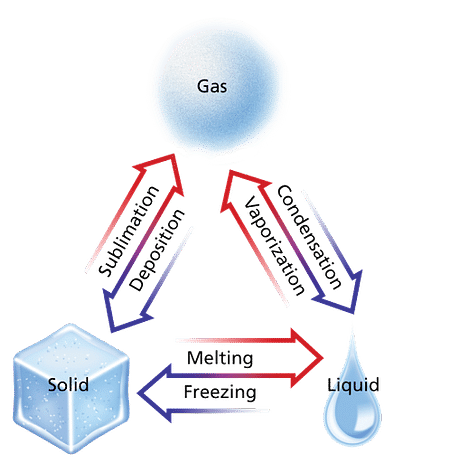
Each substance can change into solid, liquid, or gas. At specific temperatures, every material is in one of these three phases. Melting, freezing, evaporating, condensing, sublimation, and deposition are the six ways a substance can transition between these three phases. These processes are reversible, and each one transitions from one phase to the next in a different way.
Boiling
Boiling is the process of converting a substance's liquid phase into its gaseous phase. When the temperature is raised to the boiling point or the pressure is reduced to atmospheric levels, this process occurs. This method is used in cooking, water purification, and other applications.

Determination of Boiling Point of Water
Condensation
The condensation process changes the physical state of a substance from its gas phase to the liquid phase. It's also known as the conversion of water vapour into water droplets when it comes into contact with a solid surface. This method can be used to separate a solute and its solvent from its solution. When the solution is heated, the solvent evaporates, and the vapour is collected separately after condensation.
Heating a Metal
Metals' structural, magnetic, and electrical characteristics change when they are heated. The metal expands when it is heated. It grows in length, volume, and surface area. This process is called Thermal Expansion. Different metals have different degrees of thermal expansion. The process is applicable in designing metallic structures, such as household pipes and fittings.

Heating a Metal
Freezing
Freezing is the transformation of a substance's physical state from liquid to solid. Phase changes happen when the temperature is reduced to the point where the liquid reaches its freezing point. This method is used in labs to preserve fruits and vegetables (frozen food) or animal specimens since it slows the decay and growth of bacteria.

Freezing vs. Melting
Melting
Melting is the process of converting material from its solid to a liquid state. The application of heat causes the phase change by raising the temperature of the material to its melting point. This method is used to change the form of any substance. For example, metal blobs are melted and recast into various ring and block shapes.
Sublimation
Sublimation is the process by which matter goes from solid to gas without first being transformed into liquid. For example, the naphthalene balls used in the households are an example of sublimation.
Deposition
Deposition is the opposite of sublimation. In this case, the substance is in a gaseous state. When the reaction takes place, it changes into a soil state without being changed into a liquid, which is the intermediate state. It's difficult to find an example of this since it requires a sub-zero temperature.
Latent Heat
[Click Here for Sample Questions]
Latent heat is the heat or energy absorbed or released during the phase change process. It could be from a gas to a liquid or liquid to solid and vice versa. Latent heat is associated with a heat property called enthalpy.
An important point to consider regarding latent heat is that the substance’s temperature remains constant. In terms of mechanism, latent heat is the effort required to overcome the attractive forces that hold molecules and atoms together in a substance.

If a solid changes to a liquid, it must absorb energy to push the molecules into a larger, more fluid volume. Similarly, as a material changes from a gas phase to a liquid phase, its density levels must shift from lower to higher, requiring the substance to release or lose energy to bring the molecules closer together. Latent heat is defined as the energy required by a substance to either freeze, melt, or boil.
Characteristics of Phase Changes
[Click Here for Sample Questions]
- A phase change can be identified by monitoring the temperature of a material when it is heated or cooled. During a phase shift, a substance's temperature does not change.
- When two states of the same material exist at the same time, each state is referred to as a phase. An iceberg floating in the water, for example, has both a solid and a liquid phase.
- Energy is exchanged between a material and its environment during a phase change. The type of phase change determines the transfer direction. During a phase change, energy is either absorbed or released.
- When a substance changes from one state of matter to another, it undergoes a reversible physical change known. The six most common phase transitions are melting, freezing, vapor, condensation, sublimation, and deposition.
Things to Remember based on Phase Changes
[Click Here for Sample Questions]
- Evaporation is a phase change from the liquid to the gas phase that happens at temperatures lower than the boiling point at a given pressure.
- To evaporate, liquid molecules have to be near the surface, moving in the right direction and have enough kinetic energy to overcome liquid-phase intermolecular interactions.
- Boiling is a phase change from liquid to gas that happens at or above the boiling point.
- When a liquid is heated to its boiling point, it undergoes rapid vaporization, which is known as boiling. A liquid’s boiling point is the temperature at which its vapour pressure falls equivalent to the pressure exerted on the liquid by its surroundings (air).
- Vaporization is the process through which a liquid phase changes to a gas phase.
- A manometer is a device used to measure pressure in a fluid, particularly a double-legged liquid column gauge used to compare the pressures of two fluids.
Sample Questions
Ques. How much energy is required to boil 9 moles of liquid water at its boiling point, and what is the temperature of the water vapor product? (3 Marks)
ΔHvapH20=40.65kJ/mol
Ans. The enthalpy of vaporization gives the amount of energy required  to evaporate a liquid at its boiling point, in units of energy per mole. The total energy required to heat a given amount of steam is found by multiplying the number of moles to be vaporized by the energy of vaporization per mole.
(9mol)(40.65kJ/mol)=366kJ
The temperature remains constant throughout a phase change, thus the final temperature would still be 100°C.
Ques. What is the energy change when 66.7 g of Br2(g) condenses to a liquid at 59.5°C? (4 Marks)
Ans. The ΔHvapof Br2 is 15.4 kJ/mol. Even though this is a condensation process, we can still use the numerical value of ΔHvap as long as we realize that we must take energy out, so the Hvalue will be negative.
To determine the magnitude of the energy change, we must first convert the amount of Br2 to moles. Then we can use Hvap as a conversion factor.
66.7 g Br2 =6.43 kJ
Because the process is exothermic, the actual value will be negative:
ΔH= -6.43 kJ.
Ques. The heating curve represents a substance in phases solid, liquid, and gas. Which segment represents only the liquid phase? (3 Marks)

Ans. When the kinetic energy is increasing (the temperature is also increasing) the substance is not going through a phase change. Therefore only the segments that are at an incline will have the substance in just one phase.
The flat areas of the graph represent areas in which heat is being added, but there is no corresponding increase in temperature. Rather, this added heat energy is used to break the intermolecular forces between molecules/atoms and drive phase changes.
Finally, because liquids are higher in energy than solids, and lower in energy than gasses the middle slanted line must be the liquid phase. In this case, it is labeled as segment 3.
Ques. How much heat must be added to raise a sample of 100g of water at 270K to 280K? The specific heat capacity of water is 4.180J/g*K, and the water's heat of fusion is 335J/g. (4 Marks)
Ans. The following formula gives the heat needed to generate a given temperature change for a substance of known specific heat capacity:
q= m*c*ΔT,
where qis the heat input in Joules, m is the mass of the sample in grams, and c is the specific heat capacity in J/g*K.
However, in the event of a phase change (water melts at 273K), the heat of fusion or vaporization must be added to the total energy cost. The formula becomes:
q = m*c*ΔT+ m*ΔHfus
q = 100g*4.184 J/g*K*10K + 100g*335J/g
q = 3.77*104J
Ques. If 8.00 kg of ice at -9.00°C is added to 25.00 kg of water at 40.00°C, what is the approximate temperature of the water at equilibrium, assuming that the specific heats of ice and water are 2220 J/kg⋅K and 4187 J/kg⋅K, respectively and the latent heat of fusion of water is 3.33×10⁵ J/kg? (5 Marks)
Ans. With the addition of thermal energy Qice the ice will warm to 0°Cwith the addition of energy Qmelt. Next, the melted ice will warm to a certain final temperature T by absorbing energy Qice_water. All of these energies are obtained from the energy change of the original liquid water, Qwater.
Since the total energy input from the surroundings is zero, these quantities must sum to zero:
Qice = micecice (Tf-Ti) = (8.00 kg) (2220 J/kg.K) (0°C-(-9.00°C)) ≈ 1.60*105J
Qmelt = miceLf = (8.00 kg) (3.33*105J/kg) ≈ 2.66*106J
Qice_water = micecwater(Tf-Ti) = (8.00 kg) (4187 J/kg.K) (T-0°C) ≈ (3.35*104) (T-0°C) J
Qwater= mwater cwater (Tf-Ti) = (25.00 kg) (4187 J/kg.K) (T-40.00°C) ≈ (1.05*105) (T-40.00°C) J
Hence, by solving for T we have T=9.96°C



Comments