



Content Curator
Physics is one of the core pillars of science which lays an important foundation to understanding all the basic concepts surrounding us. Physics is the branch of science that deals with the study of matter, its composition, motion, its behaviors, and patterns, through space and with time. It correlates every concept to energy and force. It has been flourishing for ages and with the recent advances, its scope and excitement have flourished multiple times. The article below gives an overview of the subject, its scope, and its excitement.
Read Also: Current Electricity
| Table of Content |
Key Takeaways: Physics, Macroscopic, Microscopic, Scope, Excitement, Classical Physics, Modern Physics, Laws, etc.
What is Physics?
[Click Here for Sample Questions]
Physics is one of the core pillars of science which lays an important foundation to understanding all the basic concepts surrounding us. Physics is the branch of science which deals with the study of matter, its composition, motion, its behaviors, and patterns, through space and with time. It correlates every concept to energy and force. It includes the study of both macroscopic and submicroscopic matter.
The study of physics mainly focuses on finding a single set of laws governing the study of matter, motion, and energy at microscopic and subatomic levels, and also at the macroscopic level used in everyday life. However, all the laws are not the same, but all of them are interrelated to each other. Several different phenomenons are studied in physics: heat, motion, sound, electricity, magnetism, light, etc.

What is the Scope of Physics?
[Click Here for Sample Questions]
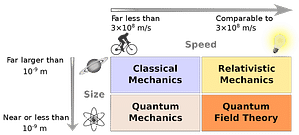
Scope of physics tries to simply explain all the recent advances taking place in the field of science and its correlation with the past developments. Physics has a vast scope and high chances of development; however, it cannot be explained in short but can be divided into two broad classes based on the size of its subjects. These two disciplines are microscopic physics and macroscopic physics.
| Microscopic Physics | Macroscopic physics |
|---|---|
|
|
|
Read More: Moving Charges and Magnetism
What is the Excitement of Physics?
[Click Here for Sample Questions]
The excitement of physics explains the constant curiosity in the field of science and physics, which helps in the development and advancement of discoveries every day. A few recent advances which have unfolded in physics are mentioned below:
- Plasma Physics: This branch of physics deals with the study of the interaction of the electric and magnetic fields with charged particles and fluids. This branch has been widely applied in the fields of space and astrophysics, controlled fusion, accelerator physics, and beam storage.
- Cosmic Rays Physics: Cosmic rays are high-power radiations that are emitted in outer space. They are generated by the explosions in stars. Cosmic rays are mainly composed of protons.
- Astrophysics: Astrophysics is a branch of physics that deals with the study of space. It applies the laws of both physics and chemistry to explain the origin, existence, and destruction of stars, planets, galaxies, nebulae, and other objects in the universe and space. Astrophysics creates physical theories for all the small to medium-size structures in the universe.

- Acoustics: Acoustics is a branch of physics that deals with the study of mechanical waves in all the states of matter, gases, liquids, and solids along with other phenomena such as vibration, sound, ultrasound, and infrasound. Acoustics primarily studies the levels of pressure and the frequencies in the sound wave and further how this wave interacts with the environment. It studies the nature of the propagation of sound waves.
- Computational Physics: Computational physics is the branch of physics that deals with the study of scientific problems related to physics using computational methods, that is, it combines computer science, physics, and applied mathematics to develop scientific solutions to complex scientific problems. Computational physics tries to combine the areas of bookish theory and experimentation of a traditional scientific investigation to produce fruitful results.
Read More: Nuclear Physics
Things to Remember
[Click Here for Sample Questions]
- Physics is one of the core pillars of science which lays an important foundation to understanding all the basic concepts surrounding us.
- Physics is the branch of science which deals with the study of matter, its composition, motion, its behaviors, and patterns, through space and with time.
- Physics uses two major approaches: unification and reduction. That is, it interrelates all the concepts, and tries to explain all the topics using a few laws.
- Reductionism is an approach used in physics that explains an effort used to derive the properties of a bigger, more complex, system from the properties and interactions of its simpler parts.
- Physics has a vast scope and high chances of development; however, it cannot be explained shorty but can be divided into two broad classes based on the size of its subjects. These two disciplines are:
- Microscopic
- Macroscopic
Check More: Radioactivity
Sample Questions
Question 1: What is physics?
Click here for the answer
Answers: Physics is the branch of science which deals with the study of matter, its composition, motion, its behaviors, and patterns, through space and with time. It correlates every concept to energy and force. It includes the study of both macroscopic and sub macroscopic matter. Several different phenomenons are studied in physics heat, motion, sound, electricity, magnetism, light, etc.
Question 2: What is the scope of physics?
Click here for the answer
Answers: The scope of physics tries to simply explain all the recent advances taking place in the field of science and its correlation with the past developments. Physics has a vast scope and high chances of development; however, it cannot be explained in short but can be divided into two broad classes based on the size of its subjects. These two disciplines are:
- Microscopic: Quantum mechanics, and theory of relativity
- Macroscopic: Mechanics, Electrodynamics, Thermodynamics, and Optics.
Question 3: Write a short note on macroscopic physics.
Click here for the answer
Answers: This branch deals with the study of all the phenomena taking place at a bigger scale, such as laboratory scale, terrestrial scale, and astronomical (Space) scale. A few scientists specializing in Macroscopic physics were, Newton, Coulomb, Oersted, Ampere, Faraday, etc. Macroscopic physics is also known as Classical physics. This includes the study of the following topics: Mechanics, Electrodynamics, Thermodynamics, and Optics.
Question 4: Write a short note on microscopic physics.
Click here for the answer
Answers: This branch deals with the study of all the phenomena taking place at a smaller scale, such as atomic scale, and subatomic scale. A few scientists specializing in microscopic physics were Einstein, Newton, C.V Raman, etc. Microscopic physics is also known as Modern physics. This includes the study of the following topics: Quantum mechanics, and the theory of relativity.
Question 5: What is the excitement of physics?
Click here for the answer
Answers: The excitement of physics explains the constant curiosity in the field of science and physics, which helps in the development and advancement of discoveries every day. A few recent advances which have unfolded in physics are plasma physics, astrophysics, computational physics, etc.
Question 6: What is reductionism?
Click here for the answer
Answers: Reductionism is an approach that explains an effort to derive the properties of a bigger, more complex, system from the properties and interactions of its constituent simpler parts. Physics uses two major approaches: unification and reduction. That is, it interrelates all the concepts, and tries to explain all the topics using a few laws.
Question 7: Write a short note on computational physics
Click here for the answer
Answers: Computational physics is the branch of physics that deals with the study of scientific problems related to physics using computational methods, that is, it combines computer science, physics, and applied mathematics to develop scientific solutions to complex scientific problems. Computational physics complements and combines the areas of bookish theory and experimentation in a traditional scientific investigation.
Physics Related Links:



Comments