



Content Curator
Ervin Schrödinger was the first person whose equation delivered profitable qualities on the physical and chemical properties of elements and compounds. Therefore, the fundamental quantum theory is based upon Schrödinger's equation and the explanation.
ψ is the wave function, which is also called an atomic orbital. The wave function, ψ doesn't have any crucial role to be played but the ψ² has many functions which include a finding of probability density and radial probability distribution.
| Table of Content |
The issue faced by Schrödinger's Equation
The only major problem faced by Schrödinger's Equation was that it could not be used in the case of multi-electron atoms, as it was unable to come up to an exact number in the case of multi-electron atoms. But, the problem was solved by the usage of approximate procedures.
Further, it was the application of Schrödinger's wave equation that defined the structure of an atom which ultimately led to the arrangement of the quantum mechanical model of an atom.
Download: Quantum mechanical model of atom pdf
Significant topics in Quantum Mechanical Model of Atom
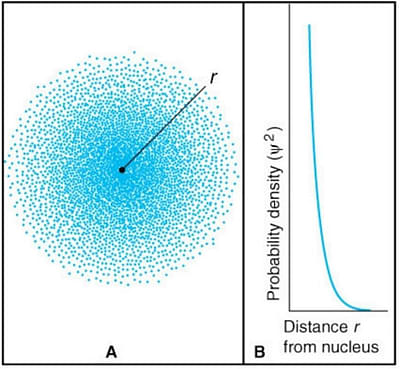
- Probability Density
It aids in delivering a 3D picture of the expected location of an atom by approximating the allowed energy significance from the atoms. The ψ² helps to be known about the distance from the nucleus as it behaves like a function. It is always positive.
- Radial Probability Density
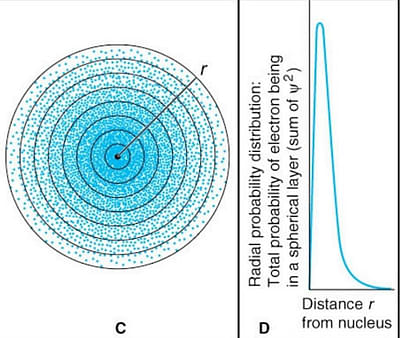
It is escorted after the Probability density, it aids one in determining the possibility of discovering the electron from a specific extent from the nucleus.
- Atomic orbital Surface
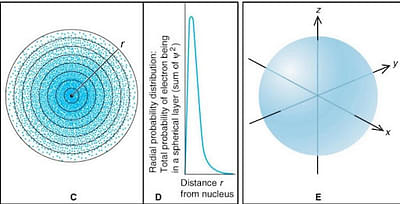
A surface taken into consideration is constantly the surface where the probability of finding the electron is nearly 90%.
- The energy of an Atom
The energy of an atom is quantized which means that an atom has a limit to the values of energy.
- Quantum Numbers
Each atomic orbital is depicted by a distinct set of numbers called quantum numbers. These numbers help in specifying the size, shape and frontage of the orbitals. Further, it was observed that all the possible orbitals are not spherical.
- Major types of Quantum Numbers
The three major categories of Quantum Numbers include:
- Principal Quantum Numbers
They contain positive integers i.e 1,2,3…. It depends upon the size of the orbital.
- Angular Momentum Quantum Numbers
They contain numbers that range from 0 to (n-1). It is related to the shape of the orbital.
- Magnetic Quantum Numbers
They contain integers that range from -/ to +/. It is related to the orientation of the orbital.
- Spin
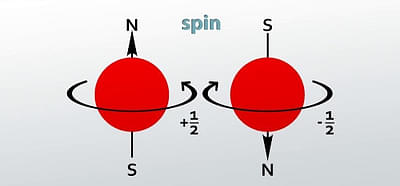
The electrons have an intrinsic property of spin, and an electron can have two directions of spin i.e. spin-up or spin-down.
Important formulas in Quantum Mechanical Model of Atom
- Deriving the wavelength of a particle with mass 'm'.
λ = h/mv
It is a formula proposed by Louis de Broglie, where λ is the Broglie wavelength and h is Plank's constant.
- Schrödinger is noted as
Hψ = Eψ
where ψ characterizes the amplitude of the wave and E is the total energy of the electron and H is a mathematical operator known as the Hamiltonian operator.
- The ψ², known as the wave function, depicts the probability of locating an atom at a given region.
Various shapes and attributes of the Quantum Mechanical Model
- Spherical
In the s orbitals, l = 0.
- Dumbbell shaped
In the p orbital, l = 1.
There are three orbitals quoted px, py, and pz.
It is made of a single node plane.
- Varied other shapes
In the d orbital, l = 2
There are five orbitals named dyz, dxz, dxy, dx²-y² and dz².
It has two node surfaces.
Important diagrams

Diagram depicting the Electron probability and contour probability, with the various nodes i.e. 1s, 2s and 3s.
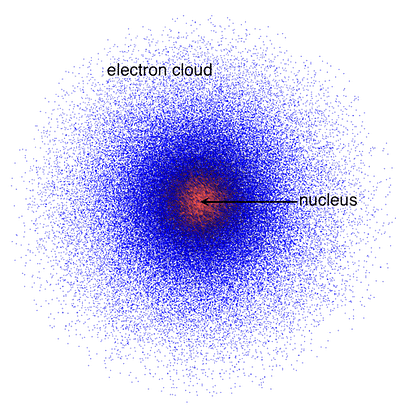
The diagram depicts an electron cloud with a nucleus aligned in the centre.

The diagram shows the various kinds of nodal planes.

The diagram depicts the probability density of an electron and the nucleus.
Things to Remember based on Quantum Mechanical Model of an Atom
- This theory came up because Schrödinger's Equation failed to take into account the case of multi electron atoms
- The three major categories of Quantum Numbers include: principal quantum number, azimuthal quantum number, angular momentum quantum number, magnetic quantum number
- The main shapes of the orbital include spherical, dumbbell, double dumbbell, and some two node surfaces.
Sample Questions based on Quantum Mechanical Model of an Atom
The sample questions based upon the Quantum Mechanical Model of Atom are divided into two categories: Objective type and Theoretical based.
Objective type
Ques. For d-electron, the orbital angular momentum is
- √(2h)/2π
- √(2)h/2π
- √(2x4) h/2π
- √(6)h/2π
Answer. D
Ques. Assertion: The number of radials and angular nodes for 3p orbital is 1, 1 respectively.
Reason: Number of radial and angular nodes depends only on the principal quantum number.
- Both assertion and reason are true and the reason is the correct explanation of assertion.
- both assertion and reason are true but the reason is not the correct explanation of assertion.
- assertion is true but the on is false
- both assertion and reason are false
Answer. C
Ques. The maximum number of electrons subshell is given by the expression
- 2n2
- 2l + 1
- 4l + 2
- none of these
Answer. C
Ques. Electron density in the yz plane of 3dx 2 −y2 orbital is
- zero
- 0.50
- 0.75
- 0.90
Answer. A
Ques. If n = 6, the correct sequence for filling of electrons will be,
- ns → (n – 2) f → (n – 1)d → np
- ns → (n – 1) d → (n – 2) f → np
- ns → (n – 2) f → np → (n – 1) d
- none of these are correct
Answer. A
Theoretical Type Questions
Ques. Does the shielding effect occur between atomic orbitals of the same quantum number? Explain with reasons.
Answer. Shielding refers to the core electrons repelling the outer rings which refer to lowering the 1:1 ratio. In the same shell, other electrons are also present due to which the electrons experience a force of repulsion. Due to the force, the force in the outermost shells is increased and the nucleus is pulled with a much greater force. It concludes that the quantum effect occurs between atomic orbitals of the same quantum number.
Ques. What is Quantum Number?
Answer. Quantum number refers to the set of numbers that are used to describe the position and energy of an atom. The quantum number of all the electrons in an atom has to comply with Schrödinger's equation.
Ques. What is the principal quantum number, azimuthal quantum numbers and magnetic Quantum number?
Answer.
- Principal Quantum Numbers: These quantum numbers are used to designate the principal electron shell. They are denoted by the symbol 'n'.
- Azimuthal Quantum Numbers: These quantum numbers are used to allocate the shape of a given orbital. They are denoted by the symbol 'la.
- Magnetic Quantum Numbers: The value of Magnetic Quantum Numbers are dependent upon the Azimuthal quantum numbers. They are used to determine the orbitals in a subshell and the orientation of a subshell. They are denoted by the symbol 'ml'.



Comments