



Content Curator
Every day, we witness several changes such as water boiling, iron rusting, ice melting, paper burning, and so on. In all of these processes, we notice that the system in question transitions from an initial state to a final state in which the system absorbs some heat from the environment and performs some work W on the environment.
Now, how many of these systems can the system and its environment be restored to their original state? With popular instances like rusting and fermentation, we may conclude that it is not possible in the vast majority of cases. We will study reversible and irreversible processes in this part.
What are Reversible Processes?
A thermodynamic process (state I to state f ) is considered to be reversible if it can be reversed so that the system and its surroundings return to their original states with no further changes in the universe. As we all know, there are no such things as reversible processes in reality.
Reversible processes can thus be simply characterised as idealizations or models of real processes, based on which the system or device's boundaries have to be specified. They assist us in determining the maximum efficiency a system can deliver under ideal operating conditions, as well as the target design that can be established.

Extension of springs, slow adiabatic compression or expansion of gases, electrolysis (with no resistance in the electrolyte), frictionless motion of solids, slow isothermal compression or expansion of gases are only a few instances of reversible processes.
How Reversible Processes Work
If we move backward along the path of the process, we can restore the system and environment to exactly the same initial states that they were in before the process occurred. The quasi-static requirement is thus an essential condition for a reversible process. It's worth noting that restoring a system to its initial condition is quite simple; the difficult part is restoring its environment at the same time.

For example, if an ideal gas expands to double its initial volume in vacuum, we can easily push it back with a piston and restore its temperature and pressure by extracting some of the heat from the gas.
What are Irreversible Processes?
An irreversible process is one in which the system and its surroundings do not revert to their original state after the process has been started.
Consider the case of an automotive engine that has travelled a certain distance using a certain amount of fuel. The fuel burns to generate energy to the engine, converting itself to smoke and heat energy in the process. We will never be able to recover the energy lost by the fuel, nor will we ever be able to return to its original state.

How Irreversible Processes Work
The irreversibility of a process is caused by a number of causes, including friction, which turns the energy of the fuel into heat energy. The unconstrained expansion of the fluid that prevents the fuel from resuming its original form, Heat transfer through a finite temperature, which cannot be reversed because the forward process is spontaneous in this instance. Mixing two dissimilar substances that can't be separated since the act of intermixing is spontaneous in nature, and the opposite isn't possible.
As a result, depending on their ability to return to their original form from their final state, certain processes are reversible and others are irreversible. Relative motion with friction, Throttling Heat transfer, Diffusion Electricity flow via a resistance are a few instances of irreversible processes.
In practically every situation, we are confronted with an irreversible process. It is impossible to restore both the system and its environment to their original states at the same time. This is referred to as a natural process because it occurs in nature. The limited gradient between the states that occur in the real process is the indicator of an irreversible process.
When heat moves from one thing to another, for example, the temperature differential between the two objects is finite. More crucially, the system is unlikely to be in equilibrium or a well-defined state at any point during the process. This is referred to as irreversibility.
Factors Affecting Reversibility
The reversibility of a process is determined by a number of factors, including:
- Resistance to electricity
- Non-elasticity
- Friction
- Hysteresis or magnetic resistance
- Viscosity
Thermodynamic Processes: Reversible and Irreversible
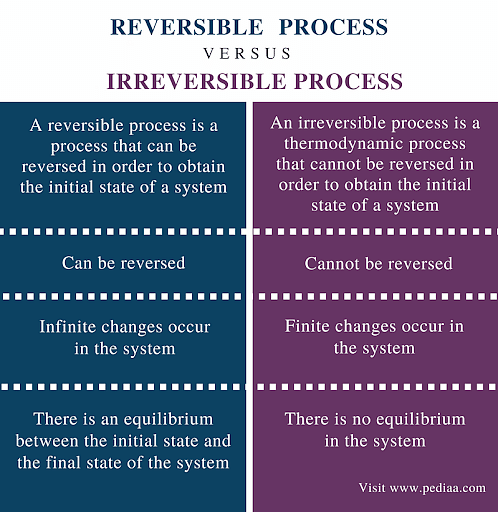
In thermodynamics, a reversible process is one in which the participants return to their original state by introducing slight or negligible changes to their environment. An irreversible process, on the other hand, is a naturally occurring phenomenon that does not return to its initial condition.

Thermodynamics' Second Law (Clausius Statement)
“Heat never flows spontaneously from a colder object to a hotter object.”
The Second Law of Thermodynamics can be stated in a variety of ways. The Clausius formulation of the second law of thermodynamics is credited to German physicist Rudolf Clausius (18221888) and is known as the Clausius statement. The term "spontaneously" implies that no extra effort has been made by a third party, or by someone who is neither the hotter nor the colder item.

We'll go through a few more key expressions of the second law and illustrate how they all imply one another. In fact, all of the possible statements of the second rule of thermodynamics are equal, and they all lead to irreversible spontaneous heat transfer between macroscopic objects containing a high number of molecules or particles.
Things to Remember
- Reversible Processes are those where a thermodynamic process can be reversed so that the system and its surroundings return to their original states with no further changes in the universe.
- The process can be reversed, if the system and environment are restored to exactly the same initial states that they were in before the process occurred.
- Irreversible process is one where the system and its surroundings do not revert to their original state after the process starts.
- Reversibility of a process is determined by a number of factors such as Resistance to electricity, Non-elasticity, Friction, Hysteresis or magnetic resistance, Viscosity
-
Thermodynamics' Second Law (Clausius Statement) states that “Heat never flows spontaneously from a colder object to a hotter object.”
Sample Questions
Ques: Give an example of a natural process that is as near to being reversible as possible. [2 marks]
Ans: Frictionless movement, restrained compression or expansion, energy transfer as heat due to infinitesimal temperature nonuniformity, electric current flow through a zero resistance, restrained chemical reaction, and mixing of two samples of the same substance at the same state are some of the solutions that could be used.
Ques: What is the difference between reversible and irreversible processes? [2 marks]
Ans: A reversible process is one in which the ingredients can be returned to their original state when the process is completed. An irreversible, on the other hand, is the polar opposite, in which the elements do not return to their original state. For better understanding, consider the reversible and irreversible processes of melting ice and burning paper, respectively.
Ques: What exactly do you mean when you say "free expansion"? [1 mark]
Ans: The concept of free expansion is defined as a gas's ability to escape into space without exerting any effort. In other words, in this reversible process, no heat or energy is lost.
Ques: What is the definition of a quasi-static process? [1 mark]
Ans: In scientific words, an irreversible process is described as being in quasi-static mode, meaning that the change is expected to occur at a very slow rate. The rate of change is so slow that it appears to be in constant equilibrium.



Comments