



Content Curator
Sodium Chloride (NaCl), also known as common salt, is a white crystalline solid which is used as a preservative and flavor enhancer in our daily diet. It is one of the most essential ions present in extracellular fluid in the human body. It is present in small quantities in natural food and huge amounts in processed food. Some of the other names of Sodium Chloride are table salt, sea salt, rock salt, and mineral halite.
| Table of Content |
Key Terms: Use of sodium chloride, Sodium hydro chloride, Sodium chloride salt, NaCl, Preparation of Sodium Chloride
What is Sodium Chloride?
[Click Here for Sample Questions]
Sodium Chloride (NaCl) is formed when Chlorine ‘Cl’ (a poisonous gas) and Sodium Na (a toxic metal) combine together to form an ionic compound NaCl which is a nutrient. In this ionic compound, the sodium and chloride ions are present in a ratio of 1:1.
Sodium Chloride
Structure of Sodium Chloride?
[Click Here for Sample Questions]
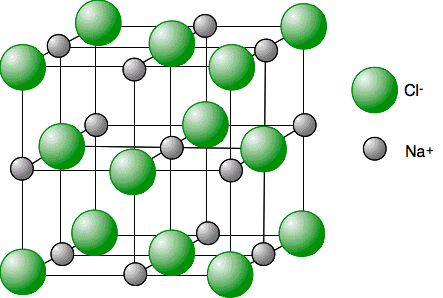
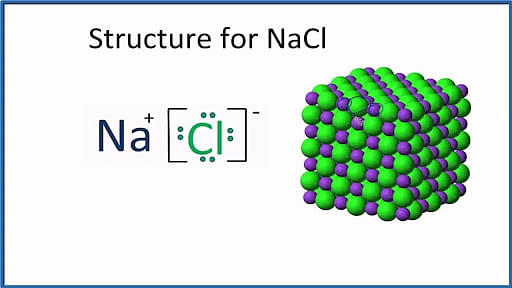
Sodium Chloride (NaCl) is an ionic compound arranged in an endlessly repeating giant three-dimensional lattice structure. The oppositely charged ions are held together in the giant lattice by strong electrostatic forces of attraction. It has a face-centered cubic (fcc) array of anions with an interpenetrating fcc cation lattice leading to a cubic close pack (ccp) arrangement. It has a local octahedral geometry.
Structure if Sodium Chloride
Properties of Sodium Chloride?
[Click Here for Sample Questions]
Sodium Chloride is hygroscopic in nature which means it absorbs water from the atmosphere. In its pure form, it is odorless and possesses a unique taste. It conducts electricity when dissolved in water or is in a molten state.
| Physical Properties | |
|---|---|
| Appearance | Clear/white solid crystal |
| Density | 2.16 g/mL |
| Aqueous form | Saline solution |
| Chemical Properties | |
| Molecular formula | NaCl |
| Molecular weight | 58.44g/mol |
| Solubility | Soluble in water and other polar solvents |
| Melting point | 801 °C |
| 1,413 °C | |
Read more : Periodic Classification of Elements
Uses of Sodium Chloride?
[Click Here for Sample Questions]
- Table salt is widely used as a food condiment for its nutritional value and also as a preservative and taste enhancer.
- It is used in deicing of roadways and walkways. Its crystalline structure helps in ice removal by lowering the freezing point of water. In places experiencing extreme winter, salt keeps roads safe. The saltwater is created by applying salt on snowy and icy roads; this saltwater has a lower freezing temperature.
- It is used in the household cleaning routine to prevent mold, remove stains/grease, and for cleaning pots and pans.
- Medical uses of saline solution are Eye/Nasal drops, IV drips, saline flush injections, and cleaning wounds.
- It is used in dyeing and bleaching, and the production of pottery, soap, shampoo, toothpaste, household bleach, detergents, and leather.
- Salt is used in the production of chlorine and caustic soda.
- It is used in the manufacturing of plastic, paper, polyester, rubber, and glass.
Health Benefits of Sodium Chloride?
[Click Here for Sample Questions]
- Its unique characteristics make processes like the regulation of fluid pressures and the transmission of electrical impulses possible in the body.
- It improves glucose absorption
- It helps in preventing sunstroke by replacing the loss of important electrolytes in the body
- It helps in removing excess carbon dioxide in the human body through excretion
- It improves the skin by moisturizing and prevents the early signs of aging
- It prevents cramps when consumed in the form of fluids and juices that are rich in sodium content to help restore the electrolyte balance.
- It develops and improves the functioning of the brain
- Sea salt is very effective for cleaning the teeth and removing plaque.
- Salt helps in neutralizing stomach acid which alleviates heartburn and indigestion.
- It also helps in regulating muscle contractions, enzyme operations, and the proper functioning of the nervous system.
- It improves the performance of the heart by keeping nerve contractions normal resulting in proper blood pressure.
Occurrence and Preparation of Sodium Chloride?
[Click Here for Sample Questions]
The main source of sodium chloride is seawater. It is one of the most abundantly found minerals in the world. Its other sources are salt beds, and salt brines. It is found in large deposits of rocks in the United States, Great Britain, France, Germany, Russia, China, and India. In tropical countries, it is obtained by naturally evaporating seawater. India produces around 50 lakh tons of salt annually by sea salt harvesting.

Occurrence and Preparation of Sodium Chloride
Crude sodium obtained from brine crystallization has impurities in the form of calcium chloride, sodium sulfate, and magnesium chloride. The crude salt is dissolved in small amounts of water to filter the insoluble impurities. This solution is then saturated by hydrogen chloride gas.
Sodium Chloride is also obtained by mining the underground deposits by room and pillar method. In the room and pillar method, miners make use of drilling and blasting to break up the rock salt by sinking shafts into the ground.
Underground Halite deposits are mined by drilling wells into the salt layer and introducing in it hot water which dissolves the salt into the brine. The brine is then saturated with dissolved salt and is pumped out.
Things to Remember [Click Here for Sample Questions]
- Sodium chloride is the most abundantly found mineral on earth.
- It has a simple cubic lattice structure.
- It plays an important role in our lives as it is very essential for the proper functioning of the human body and maintaining good health.
- It regulates fluid pressure, absorbs and transports nutrients, and helps in transmitting electrical impulses.
- It is widely used in industrial productions and its aqueous form has many medical applications.
- Owing to its hygroscopic nature it is often used as a cheap and safe desiccant to preserve food.
Sample Questions
Ques. Identify the acid and the base whose combination forms the common salt that you use in your food. Write the formula and chemical name of this salt. Name the source from where it is obtained. (2 Marks)
Ans. HCl is acid and NaOH is base whose combination forms the common salt. Its formula is NaCl (Sodium chloride). It is obtained from seawater.
Ques. What is rock salt? Mention its color and the reason due to which it has this color. (2 Marks)
Ans. Rock salt is the common name for the mineral “halite”. Its chemical formula is NaCl. It is used in our daily diet as a flavor enhancer.
It may be white or a little colored depending upon the impurities present in it.
Ques. What happens when electricity is passed through brine? (2 Marks)
Ans. When electricity is passed through brine it decomposes to form sodium hydroxide along with the evolution of chlorine gas at anode and hydrogen gas at cathode.
Ques. What type of bond is found in NaCl? (2 Marks)
Ans. When sodium transfers its spare electron in the outermost shell to chlorine which has 7 electrons, then sodium forms a positive ion by losing one electron and chlorine forms a negative ion by gaining one electron. Thus, an ionic bond is formed.
Ques. State a few commercial uses of sodium chloride. (2 Marks)
Ans.
- De-icing slippery roads and bridges
- The production of glass and rubber
- Manufacturing of shampoo, soap, detergents, toothpaste, and other household cleaning agents.
- Used as a preservative in processed food.
- Used in dyeing, bleaching, and tannery
Ques. What are the medical uses of saline solution? (2 Marks)
Ans. Medical uses of saline solution are Eye/Nasal drops, IV drips, saline flush injections, and cleaning wounds. Saline is used for fluid and electrolyte replenishment through intravenous administration.
strong>Ques. Why is sodium chloride 6:6-coordinated? (2 Marks)
Ans. A lot of energy is released due to strong attraction between the positive and negative ions. The higher the release of energy, the more stable the structure is. So, to gain maximum stability it needs 6 ions of chloride to fit around a central sodium ion before the chloride ions start touching each other. If they start touching, it introduces repulsions in the crystal which makes it less stable.
Ques. How is sodium chloride obtained? (2 Marks)
Ans. Sodium Chloride is obtained by evaporation of seawater also known as sea salt harvesting and through underground mining of Halite.
Also read:



Comments