



Content Curator
Thermal Conductivity is defined as the measure of an object’s ability to conduct or transfer heat. Thermal conductivity is commonly denoted by the symbol ‘κ’ and ‘λ’. The inverse of thermal conductivity is termed thermal resistivity. Materials with fewer values of 'λ’ are used as thermal insulators whereas in heat sinks, materials with high thermal conductivity are used.
What is Thermal Conductivity?
The measure of the ability to conduct heat is known as thermal conductivity. Transfer of heat from one body to another is also known as thermal conductivity. 'K' is termed as the thermal conductivity of a substance. With laser flash analysis, it is often measured. Due to composition, mixtures may have variable thermal conductivities.
Thermal Conductivity is expressed through the following equation,
q = -k.∇T
Where
q → Heat flux or thermal flux (W.m-²)
k → Thermal conductivity (W.m-¹.K-¹)
∇T → Temperature gradient (K.m-¹)
This law is known as Fourier's Law for heat conduction or the law of thermal conduction. This law states that the rate at which heat moves through a material is equal to the negative temperature gradient and also equal to the area through which the heat flows.

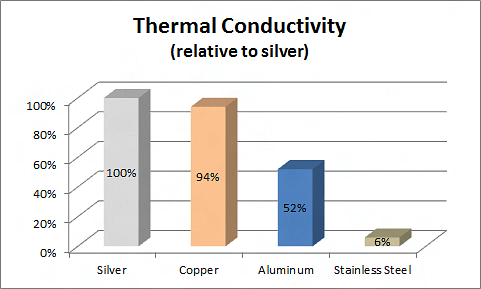
The thermal conductivity of copper is 400 watts per meter kelvin. It implies that area 'A' and thickness 'L' of a plate of copper will conduct heat at a rate of 400.A/L.ΔT joules per second whose faces are kept at a constant relative temperature difference of ΔT. The coefficient of Thermal conductivity of Copper is 385 (W/m K)

Copper is said to be the most common metal that is used to manufacture conductive appliances. Copper has a moderate corrosion rate and high melting point. For minimizing energy loss at the time of transfer of heat, copper is said to be an effective metal. Appliances like car radiators, hot water pipes, metal pans, etc use the conductive properties of copper.

There are various options that are available to measure thermal conductivity. Depending on thermal temperature and properties, each of them is suitable for a restricted range of materials. Upon the specific thermal characteristics of the material and the magnitude of the temperature gradient, the transfer of heat depends.
Properties Of Copper
- Copper is known for being a good conductor of heat and electricity.
- It takes place inside the solid lattice of metals because the delocalized electrons have the freedom to move freely in their lattice.
- Copper acts as the transporters of electric charge and heat. It transports from one end to the other.
- It turns metals into good conductors.
- The thermal conductivity tends to decrease with the increase of temperature because of the blockage of the movement of free electrons which is due to the kernel of metal ions with high vibration temperature. For eg., If we use a copper bar and heat the bar by using a burner, then the atoms that lie in that part of the copper bar will scatter and vibrate the heat through the bar.
Methods to Test Thermal Conductivity of Copper
There are different methods to test the thermal conductivity of copper which are mentioned below:
Transient Method: The measurement of thermal conductivity in this method is done through the heating process. Thus, the measurement can be made quickly which is one of the advantages of the transient methods. By needle probes, they are usually carried out.

Steady-state Method: When the temperature of the material measured doesn't change with time, the steady-state method is used for the measurement. The signal analysis in the Steady-state method is straightforward. Steady-state method provides signals that are constant.
Applications of Thermal Conductivity of Copper
Copper allows heat to pass quickly. Therefore, copper can be used in many devices which are mentioned below:
Heat exchanger: Copper is said to be the popular choice for exchangers of heat in air conditioning, industrial facilities, hot water tanks, underfloor heating systems, refrigeration, etc.
In Electronics: Since copper is an excellent conductor of heat and electricity, it is widely used in electricals and electronics such as disk drives, Computers, TV sets.

Copper Vessels: The good thermal performance and resistance to corrosion of copper makes it an ideal choice for kitchen and industrial vessels such as hot water tanks, Saucepan bottoms, etc.
Things To Remember
- Thermal Conductivity is defined as the measure of an object’s ability to conduct or transfer heat.
- Thermal conductivity is commonly denoted by the symbol ‘κ’ and ‘λ’.
- The inverse of thermal conductivity is termed thermal resistivity.
- Thermal Conductivity is expressed by q = -k.∇T
- The thermal conductivity of copper is 400 watts per meter kelvin.
- The coefficient of Thermal conductivity of Copper is 385 (W/m K).
- Transient method and steady state method are the two methods of testing thermal conductivity.
Sample Questions
Ques. Why is copper said to have a high thermal conductivity? (2 marks)
Ans. Copper is said to have a high thermal conductivity because copper is a lattice of positive copper ions. It has free electrons that move between them. These free electrons help in electrical conduction.
Ques. Name the methods to test the Thermal conductivity of Copper? (2 marks)
Ans. The methods to test the Thermal conductivity of Copper are the Transient Method and Steady-state Method.
Ques. What is the coefficient of Thermal conductivity of Copper? (2 marks)
Ans. The coefficient of Thermal conductivity of Copper is 385 (W/m K)
Ques. What is Thermal Expansion? (2 marks)
Ans. The increase of size of a body due to the increase in the temperature is called thermal expansion. Three types of expansions can take place in solids viz. linear, superficial and volume expansion.
Ques. What is Linear Expansion? (3 marks)
Ans. The increase in the length of a solid on heating is called linear expansion.
If the temperature of a rod of original length l is raised by a small amount Δt, its length increases by Δl. Then the linear expansion is given by
Δl = l ∞ Δt
where a is the coefficient of linear expansion of the given solid. The unit of α is per degree Celsius (°C-1) in the CGS and per kelvin (K-1) in the SI system.
Ques. Define Thermal Stress. (3 marks)
Ans. When a rod is held between two fixed supports and its temperature is increased, the fixed supports do not allow the rod to expand, which results in a stress which is called thermal stress.
Thermal stress in the rod is given by

where Y is the Young’s modulus for the material of the rod, A is the area cross-section of the rod, A is the coefficient of linear expansion and F is the developed force in the rod.

Ques. Define Thermal Resistance. (2 marks)
Ans. The thermal resistance of a body is a measure of its opposition to the flow of heat through it. It is defined as

Ques. Heat is associated with Kinetic energy. Explain. (2 marks)
Ans. When a body is heated its temperature rises and in liquids and gases vibration of molecules about their mean position increases, hence kinetic energy associated with random motion of molecules increases.
So, thermal energy or heat is associated with the random and translatory motions of molecules.
Ques. These days people use steel utensils with copper bottoms. This is supposed to be good for uniform heating of food. Explain this effect using the fact that copper is the better conductor. (2 marks)

Ans. The copper bottom of the steel utensil gets heated quickly.
Because of the reason that copper is a good conductor of heat as compared to steel. But steel does not conduct as quickly, thereby allowing food inside to get heated uniformly.
Ques. Define Thermal Capacity. (2 marks)
Ans. The thermal capacity of a body is the quantity of heat required to raise the temperature of the whole of the body through a unit degree. It is measured in calorie per °C or joule per K.
If Q be the amount of heat needed to produce a change in temperature (Δt) of the substance, then thermal capacity of the substance is given by

Dimensional formula of heat capacity is [ML2T -2K-1 ]
Ques. Define Specific Heat Capacity. (2 marks)
Ans. The specific heat capacity (also referred to as specific heat) of a substance is the amount of heat required to raise the temperature of a unit mass of substance through 1 °C. It is measured in cal g-1(°C)-1 or J kg-1 K-1.
The specific heat capacity of a substance is given by

where m is mass of substance and Q is the heat required to change its temperature Δt.
Ques. What are the different methods of Heat Transfer? (5 marks)
Ans. Heat can be transferred from one place to another by three different methods, namely, conduction, convection and radiation. Conduction usually takes place in solids, convection in liquids and gases, and no medium is required for radiation.
(i) Conduction: According to Maxwell, conduction is the flow of heat through an unequally heated body from places of higher temperature to those of lower temperature. Rate of heat transfer is given by

where K is called Thermal Conductivity and A is the area of cross-section.
(ii) Convection: Maxwell defines convection as the flow of heat by the motion of the hot body itself carrying its heat with it.
(iii) Radiation: Radiation is the mode of heat transfer in which heat travels directly from one place to another without the agency of any intervening medium.
Thermal conductivity is defined as heat energy transferred in unit time from unit area having a unit difference in temperature over unit length. It is expressed in Js-1 m-1 °C-1 or W-1 K-1



Comments