



Education Journalist | Study Abroad Lead
Wavelength and frequency are both important characteristics to describe the nature of a given wave. All points on a wave oscillate, which means that they all show a regular change in a specific value. When you generate a wave by wriggling up and down, the rope molecules move up and down again. When considering an electromagnetic wave, the value of magnetic and electric fields changes when the wave passes through a spot. The value of electric and magnetic fields varies at any point if the wave is not a brief pulse. For example, two points on a wave that reach their maximum value oscillate in synchrony simultaneously. The wavelength is the distance between two close points in phase with each other. In this article, we will understand the wavelength to frequency formula with the help of some solved examples.
| Table of Content |
Key Takeaways: Wavelength, frequency, wave speed, electromagnetic radiations, lightwave theories
What is wavelength?
[Click Here for Sample Questions]
The distance between two successive troughs or crests is known as the wavelength. The crest is the wave’s highest point, while the lowest point is the trough. Wavelength is also defined as the distance between two locations in a wave that have the same oscillation phase. The length of a wave is measured in its propagation direction. The wavelength is calculated in meters, centimeters, nanometres, and other units since it is a distance measurement.

Crest and Trough of a Wave
What is frequency?
[Click Here for Sample Questions]
The number of waves that travel through a spot in a certain period is frequency. The wave's frequency is in relation inversely proportional to its duration. As a result, the frequency can be explained as the number of times the motion repeats in a second. The frequency is indicated by f, while T denotes the period, f = 1/T is the relation between T and f.
Pitch and frequency are closely proportional. Sounds with frequencies ranging from 20 to 20000 Hz may be heard by humans. Ultrasound refers to noises with frequencies higher than those heard by humans, whereas infrasound refers to sounds with frequencies lower than those heard by humans.

Frequency
Frequency measured in SI units
[Click Here for Sample Questions]
When it concerns the SI unit of frequency, Hertz (Hz) is the most often used unit. Whenever we mention one Hertz, we're referring to something that occurs only once per second. For example, a screen with a refresh rate of 1 hertz will refresh the image once per second.
Revolutions per minute, shortened as r/min or rpm, were once the standard unit of measurement. One Hertz, for example, represents 60 rotations per minute.
Other Units of Frequency
Some common units which are used to measure the frequency of a wave are times per second, rounds per second, calls per second, frames per second, beats per minute, terahertz, gigahertz, megahertz.

Relation between Frequency and Wavelength
[Click Here for Sample Questions]
Period (T) is another number that may define a wave. It's the amount of time it takes for an oscillation to complete. Because frequency, which may be represented as f influences the number of times a wave oscillates,
f = 1/t
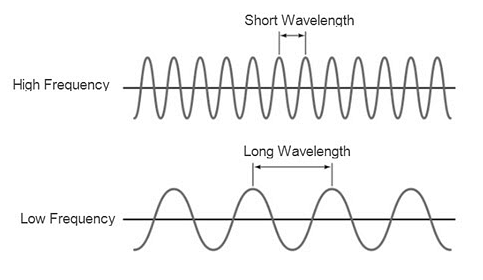
Wavelength and frequency
Because a wave oscillates once per period, every point on the wave returns to the same value after one time. This occurs due to each oscillation session moving a wavelength in one period to complete.
The distance traveled by a wave per unit time is specified as the wave speed (v). If the wave travels one wavelength in one period, the equation becomes v = \(\lambda\)/T.
We can write the preceding equation as T = 1/f since we know T = 1/f.
v = f \(\lambda\)
The link between frequency and wavelength is implied by the fact that the wave speed is equal to the product of its frequency and wavelength.
Wavelength to Frequency Formula
[Click Here for Sample Questions]
The wavelength to frequency formula is:
Speed = Wavelength x Frequency
Wavelength = (Wave Speed)/(Frequency)
As previously stated, each quantity is represented by a unique symbol. The following is a representation of the formula in an equation form as mentioned earlier:
C = f × \(\lambda\)
The formula for converting wavelength to frequency is as follows:
\(\lambda\) = c/f
Where,
c is the wave's speed in the chosen medium, measured in meters per second.
\(\lambda\) is the wavelength of the wave in question, measured in meters,
Wave’s frequency is given in Hertz as f.
Solved Examples
Example 1: We know that the wavelength of a photon particle in an experiment was observed as 500 nm. Determine the frequency of this wave.
Solution: Wavelength of the photon particle = 500 nm
As per the formula, f = c/ \(\lambda\)
Now, we know that c = 3 x 10⁸ ms-1
Substituting this value in the given formula:
f = 3 x 10⁸ / 500 x10-9
= 6 x 10⁻⁴ Hz
Example 2: A sound wave is traveling at a speed of 360 m/s and has a frequency equal to 1200 Hz. Calculate the wavelength of the wave.
Solution: \(\nu\) = 1200 Hz
v = 360 m/s
= V/\(\nu\) = 360/1200
= 0.3 m
Things to Remember
[Click Here for Sample Questions]
- The wavelength can be described as the distance between two successive crests or troughs.
- The wavelength is calculated in millimeters (m) in the SI system.
- The frequency can be explained as the number of waves traveling through a spot in a given time.
- The frequency unit in SI is Hz.
- The result of multiplying wavelength and frequency is wave speed.
- m/s is the SI unit for wave speed.
- The ratio of the speed of light to the wave's frequency is known as wavelength.
Sample Questions
Ques. What are the light wave theories? (3 marks)
Ans. Christian Huygens proposed the theory of light, which states that light is a wave. The following are some of the various approaches that support the wave theory:
- Maxwell's postulated wave has an electromagnetic character.
- De Broglie's Dual Properties of Light discusses light's particle and wave nature.
- The theories explain that light, in addition to being a particle, has a wave character and that every point inside a wave is a genesis of a secondary wavelet.
Ques. Which has more energy: a higher frequency electromagnetic wave or a longer wavelength electromagnetic wave? (5 marks)
Ans. If all other factors remain constant, the energy of an electromagnetic wave is exactly proportional to its frequency. A wave's energy is inversely related to its wavelength similarly. The following equations support both of these assertions:
Energy = Planck’s constant * Frequency
Energy = (Planck’s constant * Speed of light)/(Wavelength)
If all other factors remain constant, a wave with a higher frequency has more energy than one with a longer wavelength.
The practical importance of this notion may be seen in the fields of radiology and radiotherapy, where high-frequency waves are utilized to burn or cauterize a specific tissue or tumor inside the body without the need for a surgical incision. Radiofrequency ablation is the name for this treatment.
Ques. What is the significance of knowing a wave's wavelength? (3 marks)
Ans. Wave’s wavelength is one of its most essential qualities, and it has various uses in physics research, spectroscopic applications in Precision Agriculture, and aerial equipment. The wave’s wavelength, whether sound or light, can reveal information about its nature and kind. The idea of wavelength is essential for studying tidal waves, earthquakes, or any other everyday occurrence. The concept of wavelength is crucial in determining the speed at which a wave will propagate and its frequency and amplitude.
Ques. What is the connection between wavelength and frequency? (3 marks)
Ans. A wave's speed is calculated as the product of the frequency and wavelength of the wave. This refers to the relationship between the wave's wavelength and frequency. The wavelength will shrink as the frequency rises. As a result, they are related as inversely proportional to one another. The feature of an electromagnetic wave is that it has a specific speed equal to the constant speed of light. As a result, a wave with a longer wavelength has a lower frequency than one with a shorter wavelength and vice versa.
Ques. Based on wavelengths, how many different forms of electromagnetic radiation are there? (5 marks)
Ans. Waves are categorized into the following seven kinds based on their length. There are many wavelengths, but the following are the most common forms of electromagnetic radiation based on their frequency, energy, wavelength:
- Radio waves have a large wavelength and a low frequency. They are utilized in radio broadcasting, navigation, air traffic control, military communication and television, and numerous remote-controlled gadgets and toys.
- Microwaves have a wavelength of one meter to one millimeter. These are employed in various applications, including spacecraft communication, cancer therapy, food heating in microwave ovens, and even processes involving thermal energy.
- The wavelengths of infrared waves range from one millimeter to seven hundred nanometres. It's employed in medical equipment, nightlights, and various scientific and military gadgets.
- Optical waves are employed to detect refractive indexes and surface imperfections in astronomy, oceanography, and industry. Optical waves have wavelengths ranging from a few hundred nanometers to one millimeter.
- Ultraviolet waves are utilized for various uses, including destroying bacteria and other microbes, photography, water purification, UV lights, vitamin D generation, and more. The wavelength range spans from ten to four hundred nanometers.
- The wavelengths of X-rays range from 0.01 to 10 nanometres. They have a significantly shorter wavelength and are used in medicine to identify fractures, stones, and cancers and do chest x-rays and mammography.
- Gamma rays, which have the shortest wavelength of all of the above, have a wavelength of one-tenth of an angstrom. Therefore, it can be utilized to treat malignant cells using radiation treatment.
Gamma rays have the shortest whereas radio waves have the longest wavelength.
Ques. Calculate the frequency of a light ray with a wavelength of 200 nm. (3 marks)
Ans. The wavelength of the beam of light is given to be 200 nm. Then, the formula described above is used to compute the frequency.
f = c/λ
c = 3 x 10⁸ is the speed of light, as we all know.
We obtain the frequency by replacing the values which are known to us in the equation above:
f = (3 x 10⁸) / (200 x 10−9)
f = 1.5 × 10¹⁴ Hz
The frequency of the wave is equal to 1.5 × 10¹⁴ Hz.



Comments