



University of Rostock Courses and Fees 2026


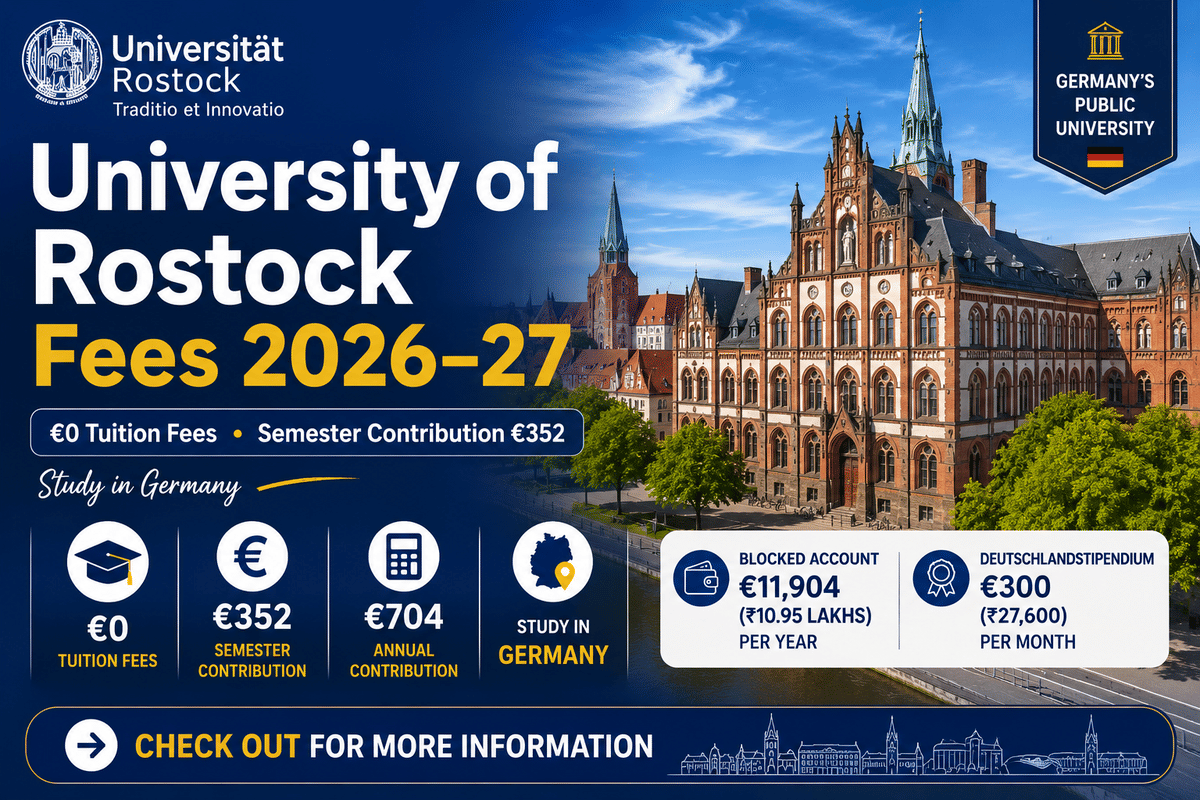
University of Rostock fees for Indian students in the 2026/27 academic year come to a semester contribution of €352 (₹32,384) per semester for both Bachelor’s and Master’s programmes, with no tuition fees charged to non-EU students in Mecklenburg-Vorpommern. Popular Master’s choices for Indian applicants, MSc Computer Science, MSc Computational Science and Engineering, and MSc Electrical Engineering, all follow this same contribution model.
The Summer 2027 intake is open with a January 15, 2027 deadline for most programmes and November 30, 2026 for engineering, while the Winter 2027/28 intake accepts applications until July 15, 2027 (May 31, 2027 for engineering). Most Indian applicants target the Winter intake because it opens the widest programme catalogue.
- Semester Contribution: €352 (₹32,384) per semester
- Annual Contribution: €704 (₹64,768) across two semesters
- Full 2-year MSc contribution: €1,408 (₹1.29 Lakhs)
- Blocked Account (Sperrkonto) requirement: €11,904 (₹10.95 Lakhs) per year
- Deutschlandstipendium scholarship: €300 (₹27,600) per month
Your 2-year MSc total budget lands at approximately ₹24.47 Lakhs, and the 3-year BSc total at approximately ₹36.33 Lakhs, because living costs, not tuition, are the main expense.
Exchange rate used throughout: 1 EUR = ₹92 .
Winter 2027/28 Intake: Planning Cycle for Indian Applicants
Intake: Summer 2027 is open (deadline January 15, 2027, engineering November 30, 2026), useful for a narrow set of Master’s programmes. Winter 2027/28 is the realistic entry for most Indian students, with deadlines July 15, 2027 (general) and May 31, 2027 (engineering). Both fit German student visa processing of 6-12 weeks.
Fee update: The 2026/27 semester contribution stays at €352 (₹32,384). Rostock does not charge tuition to non-EU students; the €658 (₹60,536) annual contribution covers your semester ticket, student services, and administration.
When to pay: The semester contribution is paid at matriculation (enrollment on campus in Rostock), not at application, so there is no upfront deposit before visa.
Scholarships: DAAD Study Scholarship for Master’s applicants closes October 31, 2026 for Winter 2027/28. Inlaks Shivdasani closes March 12, 2027. Deutschlandstipendium opens after matriculation each autumn.
➤ Check University of Rostock Admissions and Deadlines for Indian Students →
Table of Contents
- University of Rostock Tuition Fees by Programme
- University of Rostock Semester Contribution Trend by Year
- University of Rostock Cost of Living in Rostock for Indian Students
- University of Rostock Total Cost of Studying
- University of Rostock Scholarships for Indian Students
- University of Rostock Semester Contribution Payment Options
- Hidden Costs of Studying at University of Rostock
- University of Rostock Fee Saving Strategies for Indian Students
- Is University of Rostock Worth the Cost for Indian Students
- FAQs
University of Rostock Tuition Fees by Programme
University of Rostock charges no tuition to Indian students at the Bachelor’s or Master’s level. The only mandatory university payment is the semester contribution (Semesterbeitrag) of €352 (₹32,384) per semester, which pays for administration, the student union, and the regional semester transport ticket.
Undergraduate Fees: Winter 2027/28
All Bachelor’s programmes carry the same €352 (₹32,384) semester contribution regardless of discipline. Most Bachelor’s programmes are taught in German and require a TestDaF or DSH language certificate.
| Bachelor’s Programme | Semester Contribution | Annual (2 Semesters) | 3-Year Total |
|---|---|---|---|
| BSc Computer Science | €352 (₹32,384) | €704 (₹64,768) |
€2,112 (₹1.94 Lakhs) |
| BSc Electrical Engineering | €352 (₹32,384) | €704 (₹64,768) | €2,112 (₹1.94 Lakhs) |
| BSc Physics | €352 (₹32,384) | €704 (₹64,768) | €2,112 (₹1.94 Lakhs) |
| BSc Chemistry | €352 (₹32,384) | €704 (₹64,768) | €2,112 (₹1.94 Lakhs) |
| BSc Business Administration | €352 (₹32,384) | €704 (₹64,768) | €2,112 (₹1.94 Lakhs) |
Source: uni-rostock.de semester fees page. No application fee is charged for direct applications; Uni-Assist evaluations cost €75 (₹6,900) for the first application and €30 (₹2,760) for each additional in the same term.
Postgraduate Fees: Winter 2027/28
Master’s programmes charge the same €329 (₹30,268) semester contribution. Rostock offers six English-taught Master’s programmes, which is why MSc Computer Science and MSc Computational Science and Engineering are the two most-applied choices for Indian students.
| Master’s Programme | Language | Semester Contribution | 2-Year Total |
|---|---|---|---|
| MSc Computer Science | English | €352 (₹32,384) | €1,408 (₹1.29 Lakhs) |
| MSc Computational Science and Engineering | English | €352 (₹32,384) | €1,408 (₹1.29 Lakhs) |
| MSc Electrical Engineering | English | €352 (₹32,384) | €1,408 (₹1.29 Lakhs) |
| MSc Physics | English/German | €352 (₹32,384) | €1,408 (₹1.29 Lakhs) |
| MSc Chemistry | German | €352 (₹32,384) | €1,408 (₹1.29 Lakhs) |
Source: uni-rostock.de programme directory. Language of instruction is confirmed on each individual programme page.
Note: The €329 semester contribution is not tuition. It covers your Semesterticket (unlimited local and regional public transport in Mecklenburg-Vorpommern, worth roughly €150), student union services (Studierendenwerk), and administrative processing. Skipping this payment cancels your enrollment.
➤ Check Out Study in Germany For Indian Students After 12th →
University of Rostock Semester Contribution Trend by Year
Rostock’s semester contribution has moved within a €310-€329 band over the last five academic years, an average annual change of about 1.4%. This is nothing like the 4-6% annual UK tuition creep and reflects Germany’s public-university funding model.
| Academic Year | Semester Contribution (EUR) | Semester Contribution (INR) | Year on Year Change |
|---|---|---|---|
| 2022/23 | €312 | ₹28,704 | Base year |
| 2023/24 | €317 | ₹29,164 | +1.6% |
| 2024/25 | €322 | ₹29,624 | +1.6% |
| 2025/26 | €325 | ₹29,900 | +0.9% |
| 2026/27 | €352 | ₹32,384 | +1.2% |
Source: uni-rostock.de semester fees archive. Small year-to-year changes reflect updates to the Studierendenwerk fee and the mobility ticket price negotiated with regional transport operators.
Key Insight: The Winter 2027/28 intake is billed at the 2027/28 rate that will be set by summer 2027, but past trend suggests a change of no more than €5-€8 per semester over 2026/27. Even at €345 per semester across a 2-year Master’s, you are looking at €1,380 (₹1.27 Lakhs) in total university payments, less than a single month of London tuition. Rank Rostock on living-cost planning and scholarships, not on tuition inflation risk.
University of Rostock Cost of Living in Rostock for Indian Students
Rostock is a Baltic-coast city of 210,000 in Mecklenburg-Vorpommern and one of the most affordable German university cities, with total monthly living costs of €850-€1,000 (₹78,200-₹92,000). That is 30-40% cheaper than Munich or Frankfurt and roughly on par with Leipzig.
| Expense | Monthly (EUR) | Monthly (INR) | Annual (INR) | Notes for Indian Students |
|---|---|---|---|---|
| Student Dorm (Wohnheim) | €230-€380 | ₹21,160-₹34,960 | ₹2.54-₹4.20 Lakhs | Apply through Studierendenwerk Rostock 6 months ahead; furnished, all-inclusive |
| Shared Apartment (WG) | €320-€450 | ₹29,440-₹41,400 | ₹3.53-₹4.97 Lakhs | Warm rent (with utilities); listed on wg-gesucht.de |
| Groceries and Cooking | €200-€250 | ₹18,400-₹23,000 | ₹2.21-₹2.76 Lakhs | Aldi, Lidl, Netto; Indian groceries at Asia stores in Rostock centre |
| Health Insurance (Mandatory) | €120 | ₹11,040 | ₹1.32 Lakhs | TK, AOK or Barmer public insurance; required for visa and enrollment |
| Mobile, Internet, Utilities | €40-€60 | ₹3,680-₹5,520 | ₹0.44-₹0.66 Lakhs | Aldi Talk or Vodafone; usually included in warm rent |
| Personal, Leisure, Buffer | €100-€150 | ₹9,200-₹13,800 | ₹1.10-₹1.66 Lakhs | Cinema €10, Mensa lunch €3-€5, gym €25 |
| Monthly Total | €850-€1,000 | ₹78,200-₹92,000 | ₹9.94-₹11.04 Lakhs | Public transport already paid via Semesterticket |
Source: uni-rostock.de financing your studies page (university guidance of €867-€1,000/month), cross-checked with Numbeo Rostock cost data.
Note: Public health insurance (Gesetzliche Krankenversicherung) at €120 (₹11,040) per month is mandatory before your visa is granted and before you can enroll. Do not use travel insurance, which is not accepted by matriculation offices. Register with TK (Techniker Krankenkasse), AOK, or Barmer as soon as you receive the admission letter.
Rostock’s biggest cost advantage is the Wohnheim system. The Studierendenwerk operates roughly 3,300 dorm rooms across the city at €230-€380 per month all-in, compared with €500-€700 for equivalent private studios. Applying in the first week you receive the admission letter is the single most impactful cost decision an Indian student makes at Rostock.
Currency Tip: You will fund your Sperrkonto (blocked account) of €11,904 (₹10.95 Lakhs) in one wire transfer to Fintiba, Coracle, or Expatrio before your visa appointment. Use a low-margin remittance service like Wise or your bank’s LRS forex desk to save 1-2% on the transfer, worth roughly ₹15,000-₹22,000 on that single transaction. Fintiba typically settles the same day.
Check Out How to Study in Germany for Free
University of Rostock Total Cost of Studying
Your total first-year cost at Rostock is €13,506 (₹12.43 Lakhs) for a Master’s student and €13,180 (₹12.13 Lakhs) for a Bachelor’s student, of which tuition contributes less than 5%.
| Scenario | Annual Contribution | Living (12 Months) | Mandatory Fees | Total Year 1 |
|---|---|---|---|---|
| BSc, 12-month basis | €704 (₹64,768) |
€10,800 (₹9.94 Lakhs) |
€1,722 (₹1.58 Lakhs) |
€13,180 (₹12.13 Lakhs) |
| MSc, 12-month basis | €704 (₹64,768) |
€10,800 (₹9.94 Lakhs) |
€2,048 (₹1.88 Lakhs) |
€13,506 (₹12.43 Lakhs) |
Mandatory Fees include health insurance €1,440 (₹1.32 Lakhs), one-time visa €75 (₹6,900), one-time flight €650 (₹59,800), and setup buffer (residence permit, initial groceries) €233-€558. All students are billed on a 12-month basis; there is no shorter academic-year cycle in Germany.
Extrapolated across the full programme, a 2-year MSc costs approximately €26,596 (₹24.47 Lakhs) and a 3-year BSc approximately €39,494 (₹36.33 Lakhs). On a ₹25 Lakhs education loan, that maps to an EMI of about ₹33,700 per month over 10 years at 10.5%. This is the smallest total loan burden across almost any Western study destination and one of the strongest arguments for Germany.
Key Insight: A DAAD Study Scholarship at €992 (₹91,264) per month covers your full living cost plus health insurance for the Winter 2027/28 intake, effectively taking your out-of-pocket 2-year MSc down to under ₹2 Lakhs. Miss the October 31, 2026 DAAD deadline and you fund the full ₹24.47 Lakhs yourself. Lock the application before other Master’s deadlines.
University of Rostock Scholarships for Indian Students
Rostock has no dedicated university-wide merit scholarship for international students, but Indian students routinely stack the Deutschlandstipendium after enrollment with an external Indian award and a DAAD Study Scholarship. Together these can cover the entire cost of study.
University-Administered Scholarships
| Scholarship | Amount | Level | How to Apply |
|---|---|---|---|
| Deutschlandstipendium | €300 (₹27,600) per month | UG and PG | Apply at Rostock each autumn after matriculation; based on grades and social engagement |
| STIBET Contact Scholarship (DAAD-funded, Rostock) | €300-€500 (₹27,600-₹46,000) one-off | UG and PG | International Office nomination; needs-based, distributed each semester |
| Rostock Graduate Completion Grant | €800 (₹73,600) per month for 6 months | PhD and final-year Master’s | Faculty nomination; supports thesis completion |
Source: uni-rostock.de scholarships page. All three are open to Indian students subject to enrollment at Rostock.
External Scholarships Open to Indian Applicants for Winter 2027/28
The DAAD Study Scholarship for Master’s applicants closes October 31, 2026 for Winter 2027/28 entry. Inlaks Shivdasani closes March 12, 2027. Both are worth applying to before you receive admission.
| Scholarship | Amount | Deadline | Eligibility |
|---|---|---|---|
| DAAD Study Scholarship for Master’s | €992 (₹91,264) per month + travel + health insurance | October 31, 2026 | Indian graduates in engineering, science, humanities |
| Deutschlandstipendium (post-enrollment) | €300 (₹27,600) per month | Rolling (autumn semester) | Any enrolled student with strong academics or social engagement |
| Inlaks Shivdasani Foundation | Up to USD 100,000 (₹86 Lakhs) total | March 12, 2027 | Indian citizens under 30 with a strong undergraduate record |
| JN Tata Endowment | Loan-scholarship of ₹1-₹10 Lakhs | March 22, 2027 | Indian citizens with confirmed admission abroad |
| KC Mahindra Scholarship for PG Studies Abroad | Up to ₹8 Lakhs interest-free loan-scholarship | March 31, 2027 | Indian Master’s applicants with GRE/GMAT scores |
| Narotam Sekhsaria Foundation Loan Scholarship | Up to ₹20 Lakhs interest-free | April 15, 2027 | Indian students with admission to top overseas programmes |
Source: DAAD India funding portal, Inlaks Foundation, JN Tata Endowment, KC Mahindra Trust, and Narotam Sekhsaria Foundation official pages. Deadlines confirmed as of 29 July 2026 IST.
Tip for Indian Students: For a Winter 2027/28 entry, submit the DAAD Study Scholarship before October 31, 2026 first, well before your Rostock application deadline of July 15, 2027. If your DAAD result is negative, target Inlaks (closes March 12, 2027) and JN Tata Endowment (March 22, 2027) in the same window. Do not wait for your Rostock admission letter to start scholarship applications; the two tracks run in parallel.
University of Rostock Semester Contribution Payment Options
Rostock does not require any pre-arrival tuition deposit, because there is no tuition. The €352 (₹32,384) semester contribution is paid only after you arrive in Rostock and complete matriculation in person, and it must clear before you receive your student ID (Studierendenausweis) and Semesterticket. There is no refundable deposit or partial payment structure.
Methods of Payment
- SEPA Bank Transfer from your German bank account, once opened, the standard method used by 90% of enrolled students.
- Direct Debit (Lastschrift) mandate for automatic re-enrollment each semester after the first.
- International Wire Transfer for the first payment before opening a German account; the university publishes IBAN and BIC on the matriculation instructions.
- Forex Card or International Debit at the Studierendenwerk counter, subject to a 2-3% surcharge and not recommended.
Steps to Pay the Semester Contribution as an International Student
- Accept the admission offer online via the University of Rostock applicant portal.
- Fund the Sperrkonto (blocked account) of €11,904 (₹10.95 Lakhs) and apply for the German student visa at VFS Global India (visa fee €75, ₹6,900).
- Arrive in Rostock and open a Deutsche Bank, Sparkasse Rostock, or N26 current account within your first week.
- Transfer €329 (₹30,268) from your German account to the university’s IBAN, referencing your applicant ID.
- Present the transfer receipt at matriculation to collect your student ID and Semesterticket.
Source: uni-rostock.de enrollment procedure page. Keep every receipt for residence-permit renewal in year two.
Tip for Indian Students: Open the Sperrkonto with Fintiba or Expatrio at least 8 weeks before your visa appointment at the German embassy, because VFS Global slots in Delhi and Mumbai for Winter 2027/28 fill by June 2027. The bank transfer to Fintiba clears in 1-2 working days, but the visa slot booking is the real bottleneck. Do this immediately after your DAAD or admission decision.
Hidden Costs of Studying at University of Rostock
For Winter 2027/28 entry, the Sperrkonto lock-in of €11,904 (₹10.95 Lakhs) is the single biggest cash outflow before your visa is even granted. Budget for it in January-February 2027 so it does not clash with your DAAD funding decision.
- Sperrkonto (Blocked Account): €11,904 (₹10.95 Lakhs), held for the year and released to you monthly in Germany. Not a fee, but locked capital.
- German Student Visa Fee: €75 (₹6,900), one-time at the German consulate in Delhi, Mumbai, Chennai, Kolkata, or Bengaluru.
- Uni-Assist Application Evaluation: €75 (₹6,900) for the first, €30 (₹2,760) for each additional programme in the same term.
- Anmeldung and Residence Permit: €100-€110 (₹9,200-₹10,120) at the Rostock Ausländerbehörde within two weeks of arrival.
- Winter Clothing: €200-€300 (₹18,400-₹27,600) if bought locally; Rostock winters hit -5°C on the Baltic coast.
- Public Health Insurance Enrollment: €30 (₹2,760) admin fee at TK, AOK, or Barmer before matriculation.
- TestDaF or DSH Language Test: €195 (₹17,940) each attempt for German-taught programmes; not needed for the six English-taught Master’s.
Budget approximately ₹1.5-₹2 Lakhs for first-year hidden costs, over and above the visible ₹12.13-₹12.43 Lakhs first-year budget. This does not include the Sperrkonto, which is returned to you as monthly allowance rather than spent.
Note: The residence permit fee of €100-€110 (₹9,200-₹10,120) is often forgotten because it falls two weeks after arrival, when your visa is already in your passport. Book the Ausländerbehörde appointment online while still in India for a slot in your first week in Rostock, otherwise you can wait 6-8 weeks and risk your enrollment lapsing.
Explore: How to Study in Germany for Free
University of Rostock Fee Saving Strategies for Indian Students
The highest-value action for a Winter 2027/28 applicant is the DAAD Study Scholarship application before October 31, 2026, worth up to €23,808 (₹21.90 Lakhs) across two years, effectively covering your entire out-of-pocket cost.
- Apply for DAAD before October 31, 2026: Worth up to €23,808 (₹21.90 Lakhs) across two years, more than 90% of your total Master’s cost.
- Choose a Wohnheim over private housing: Saves €150-€250 (₹13,800-₹23,000) per month, or ₹1.65-₹2.76 Lakhs per year.
- Work 20 hours per week as a Werkstudent: Legally allowed on a German student visa; typical wage €13.90 (₹1,279) per hour, worth up to €12,000 (₹11.04 Lakhs) per year tax-free.
- Claim India’s Section 80E deduction: Full interest on education loans is deductible for 8 years for the loan-taking parent or student.
- Use the EU Blue Card route post-study: Germany’s 18-month post-study job-search visa converts to a Blue Card at €45,300 (₹41.68 Lakhs) starting salary in STEM shortage occupations. Payback on a ₹25 Lakhs loan is 3-4 years.
- Pool the Semesterticket: Your €329 (₹30,268) contribution already covers all regional transport across Mecklenburg-Vorpommern, worth €1,800 (₹1.66 Lakhs) if bought separately.
Tip for Indian Students: The single highest-value saving lever for Winter 2027/28 entry is DAAD + Wohnheim stacked. DAAD covers €992 (₹91,264) per month, Wohnheim caps housing at €300 (₹27,600) per month, and the arithmetic works out to a positive net €400 (₹36,800) per month in your bank account across the entire two-year Master’s. That flips Rostock from an expense into a self-funding degree, worth roughly ₹19 Lakhs across the programme.
Is University of Rostock Worth the Cost for Indian Students
Yes, on financial arithmetic alone. A total 2-year MSc cost of €26,596 (₹24.47 Lakhs), before scholarships, is roughly one-third of a comparable UK Master’s and one-fifth of a US Master’s. Add DAAD and Wohnheim, and your net cost drops under ₹2 Lakhs.
Rostock is ranked #901-950 globally in QS 2027, #835 in US News Best Global 2025-26, and #501-600 in ARWU 2025. Founded in 1419, it is one of the oldest universities in Northern Europe and holds a #118 QS Western Europe 2026 position. Collegedunia Study Abroad ranks it #172 globally and #18 in Germany for 2026.
Germany’s post-study framework is in force on this date. International Master’s graduates receive an 18-month job-search residence permit and can convert to an EU Blue Card at a minimum salary of €45,300 (₹41.68 Lakhs) for STEM occupations, €58,400 (₹53.73 Lakhs) for general roles. Indian graduates from Rostock in computer science, computational science and engineering, and electrical engineering routinely enter that Blue Card band directly.
On a ₹25 Lakhs education loan, EMI of ₹33,700 per month against a Blue Card starting salary of €45,300 (₹41.68 Lakhs) per year (roughly ₹2.90 Lakhs per month net after German taxes) means your loan payback horizon is 3-4 years, one of the fastest in any Western study destination.
Key Insight: A DAAD-funded MSc at Rostock has a net out-of-pocket cost under ₹2 Lakhs for two years, against a first-year Blue Card salary of €45,300 (₹41.68 Lakhs). That is a payback horizon under 2 months for tuition, or under 24 months even for an unfunded ₹25 Lakhs education loan. No other established Western destination gets close on this ratio for Winter 2027/28 entry.
University of Rostock is the strongest cost-adjusted study-abroad choice for an Indian Master’s applicant in the Winter 2027/28 intake. Budget approximately ₹24.47 Lakhs total for a 2-year MSc before scholarships, or under ₹2 Lakhs with DAAD funding. On a ₹25 Lakhs education loan, expect ₹33,700 EMI over 10 years, offset by a €45,300 (₹41.68 Lakhs) Blue Card starting salary within 18 months of graduation. The one action that matters most: file your DAAD Study Scholarship application before October 31, 2026.
FAQs
Ques. Does University of Rostock charge tuition fees for Indian students?
Ans. No. Mecklenburg-Vorpommern, the German state where Rostock is located, does not charge tuition to non-EU students at any of its public universities. Your only mandatory university payment is the semester contribution of €352 (₹32,384), which covers administration, student services, and unlimited regional public transport.
Ques. What is the total cost of a 2-year Master’s at University of Rostock for Indian students?
Ans. Approximately €26,596 (₹24.47 Lakhs), covering €1,316 (₹1.21 Lakhs) in semester contributions, €21,600 (₹19.87 Lakhs) in living costs, €2,880 (₹2.65 Lakhs) in health insurance, and €800 (₹73,600) in one-time visa, flight, and setup costs.
Ques. How much money do I need to show in a blocked account for a German student visa at Rostock?
Ans. €11,904 (₹10.95 Lakhs) per year in a Sperrkonto with Fintiba, Expatrio, or Coracle. The funds are released to you as €992 (₹91,264) per month once you arrive in Germany, so it is locked capital and not a fee.
Ques. Is the DAAD Study Scholarship available for Master’s students at University of Rostock?
Ans. Yes. Indian Master’s applicants can apply for the DAAD Study Scholarship worth €992 (₹91,264) per month plus travel and health insurance. The deadline for Winter 2027/28 entry is October 31, 2026. Application is made directly to DAAD, not through Rostock.
Ques. What is the monthly cost of living for an Indian student in Rostock?
Ans. €850-€1,000 (₹78,200-₹92,000) per month, covering rent, food, health insurance, mobile, and personal expenses. Rostock is roughly 30-40% cheaper than Munich and Frankfurt, with student dorm rooms available at €230-€380 (₹21,160-₹34,960) per month through the Studierendenwerk.
Ques. When are the application deadlines for Winter and Summer intakes at University of Rostock?
Ans. Winter 2027/28 closes on July 15, 2027 (general) and May 31, 2027 (engineering programmes). Summer 2027 closes on January 15, 2027 (general) and November 30, 2026 (engineering). Winter is the primary intake with the widest programme choice.
Ques. Can Indian students work part-time at University of Rostock to cover living costs?
Ans. Yes. The German student visa allows 20 hours per week during term and full-time during breaks. Typical Werkstudent wages are €13.90 (₹1,279) per hour, giving a tax-free annual earning of up to €12,000 (₹11.04 Lakhs), enough to cover living costs and health insurance completely.
Ques. Is there any application fee to apply to University of Rostock?
Ans. No direct application fee is charged by the university. However, most international applicants must route their documents through Uni-Assist, which charges €75 (₹6,900) for the first application and €30 (₹2,760) for each additional programme within the same term.
Ques. What is the Deutschlandstipendium and can Indian students at Rostock apply for it?
Ans. The Deutschlandstipendium is a federal-plus-private merit scholarship worth €300 (₹27,600) per month for one year, renewable. Any enrolled student at Rostock, including Indian nationals, can apply each autumn after matriculation based on academic performance and social engagement.
Ques. How does the total cost of studying at University of Rostock compare with the UK or the US for Indian students?
Ans. A 2-year MSc at Rostock costs approximately ₹24.47 Lakhs total, against ₹55-₹70 Lakhs for a comparable UK Master’s and ₹80 Lakhs to ₹1.2 Crore for a US Master’s. With DAAD funding stacked on a Wohnheim, net out-of-pocket at Rostock drops under ₹2 Lakhs, an efficiency no established Western destination matches.
Popular Programs and Important Dates
| Program | Important Dates | Fees | Eligibility | Financial Aid |
|---|---|---|---|---|
Application Deadline For Summer 2026 Intake (30th Nov 2026) | USD 430 /Yr EUR 384 /Yr | 85 %, IELTS: 6.4, TOEFL: 4.5 |
Do you think the Dates are wrong ? Report Here
STEM Course
Master of Science [M.S] Computer Science
Do you think the fees are wrong ? Report Here
Master of Science [M.S] Mathematics
Bachelor of Science [B.S] Chemistry
Master of Science [M.S] Physics
Bachelor of Science [B.S] Computer Science
Bachelor of Science [B.S] Physics
Bachelor of Science [B.S] Mathematics
Master of Science [M.S] Chemistry
Course Finder - Search from 50K+ courses
Popular Streams:
SUBSCRIBE TO OUR NEWS LETTER



Comments