


.png?h=90&w=90&mode=stretch)
University of Bonn Courses and Fees 2026


University of Bonn charges zero tuition for both Bachelor’s and Master’s programmes, Indian students pay only a semester contribution of EUR 345.07 (INR 32,782) that also covers the Deutschlandticket for nationwide public transport. The most Indian-applied Master’s programmes are MSc Computer Science, MSc Mathematics, and MSc Economics, each at the same zero-tuition rate.
Bonn is one of four German Universities of Excellence and ranks 92 in THE World 2026, so the value equation is uniquely favourable: a two-year MSc here costs less than one year at most UK or US public universities. The one financial gate is the blocked account of EUR 11,904 (INR 11.31 Lakhs) that the German consulate requires as visa proof.
The primary open intake is Winter Semester 2027/28 (October 2027 start), with international Master’s deadlines closing between 15 March 2027 and 15 July 2027 depending on programme. Summer Semester 2028 is open only for select programmes such as MSc Life Science Informatics.
- UG semester contribution: EUR 345.07 (INR 32,782)
- PG semester contribution: EUR 345.07 (INR 32,782)
- Annual total (two semesters): EUR 690.14 (INR 65,563)
- Deutschlandstipendium award: EUR 300 per month (INR 28,500 per month)
- Blocked account requirement for visa: EUR 11,904 (INR 11.31 Lakhs)
Your total two-year MSc budget lands near INR 24 Lakhs including Bonn living costs, with tuition itself under INR 66,000 across two years; the three-year Bachelor’s runs about INR 33 Lakhs all-in.
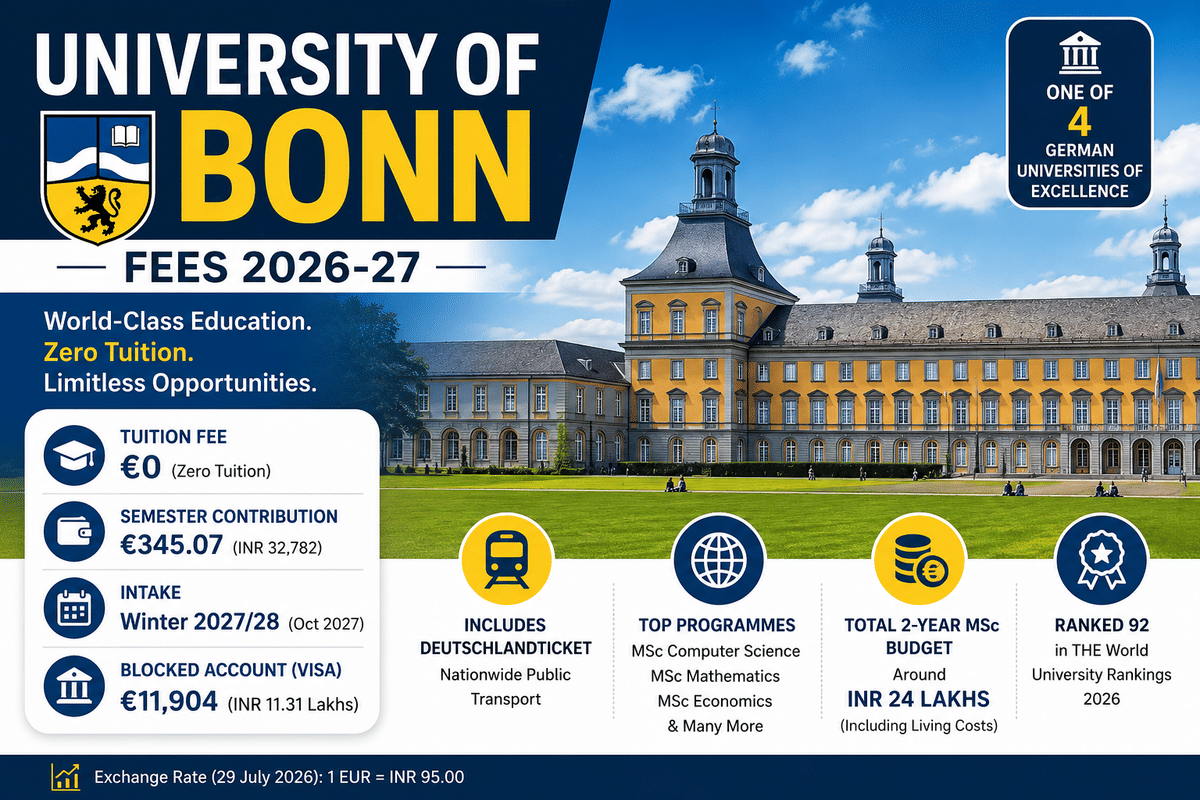
Exchange rate as of 29 July 2026: 1 EUR = INR 95.00.
Winter Semester 2027/28: Planning Cycle for Indian Students
Intake: Winter Semester 2027/28 (October 2027) is the primary intake and is workable given 8-12 week German student visa processing. Summer Semester 2028 (April 2028) is open only for a subset of programmes including MSc Life Science Informatics.
Fee update: Zero tuition continues; the semester contribution for 2026/27 is EUR 345.07 (INR 32,782), historically adjusting 1-3% per year for the Deutschlandticket component.
When to pay: No upfront deposit is required; the EUR 345.07 semester contribution is paid after admission and before enrolment, full instalment steps sit in the semester contribution section.
Scholarships: External Indian awards for the 2027 intake open November-December 2026; Narotam Sekhsaria closes end-February 2027 and Inlaks closes 12 March 2027, both well before the Uni Bonn deadline window.
For the full application timeline and document checklist for Indian students, see the University of Bonn Admissions guide.
Table of Contents
- University of Bonn Semester Fees by Programme
- University of Bonn Fee Trend by Year
- Cost of Living in Bonn for University of Bonn Indian Students
- Total Cost of Studying at University of Bonn
- University of Bonn Scholarships for Indian Students
- University of Bonn Semester Contribution and Payment Options
- Hidden Costs of Studying at University of Bonn
- University of Bonn Fee Saving Strategies for Indian Students
- Is University of Bonn Worth the Cost for Indian Students
- FAQs
University of Bonn Semester Fees by Programme
Every programme at University of Bonn charges the same semester contribution of EUR 345.07 (INR 32,782). Tuition itself is zero for Indian and all other international students, a policy set by the state of North Rhine-Westphalia for all public universities. What varies between programmes is only the language of instruction and the duration.
University of Bonn Bachelor’s Semester Fees
Bachelor’s degrees run six semesters (three years). The total semester-fee commitment across the degree is EUR 2,070.42 (INR 1.97 Lakhs). Most Bachelor’s programmes are taught in German, so a C1-level German test (TestDaF or DSH) is required alongside the fee.
| Programme | Language | Duration | Total Semester Fee (INR) |
|---|---|---|---|
| BSc Mathematics | German | 6 semesters | INR 1.97 Lakhs |
| BSc Physics | German | 6 semesters | INR 1.97 Lakhs |
| BSc Computer Science | German | 6 semesters | INR 1.97 Lakhs |
| BA Economics | German | 6 semesters | INR 1.97 Lakhs |
| BSc Biology | German | 6 semesters | INR 1.97 Lakhs |
Source: University of Bonn Study Programs. Application fee via uni-assist: EUR 75 for the first programme, EUR 30 for each additional.
University of Bonn Master’s Semester Fees
Master’s degrees run four semesters (two years), for a total semester-fee outlay of EUR 1,380.28 (INR 1.31 Lakhs). English-taught Master’s are the most Indian-relevant, no German-language proof required for these programmes.
| Programme | Language | Duration | Total Semester Fee (INR) |
|---|---|---|---|
| MSc Computer Science | English | 4 semesters | INR 1.31 Lakhs |
| MSc Mathematics | English | 4 semesters | INR 1.31 Lakhs |
| MSc Economics | English | 4 semesters | INR 1.31 Lakhs |
| MSc Life Science Informatics | English | 4 semesters | INR 1.31 Lakhs |
| MSc Agricultural Sciences (ARTS) | English | 4 semesters | INR 1.31 Lakhs |
| MSc Physics | English | 4 semesters | INR 1.31 Lakhs |
Source: University of Bonn International Students. All Master’s charge the identical EUR 345.07 (INR 32,782) per semester.
Note: The EUR 345.07 (INR 32,782) semester contribution is not tuition, it splits into a Studierendenwerk social fee of about EUR 116, an AStA student union contribution of about EUR 20, an administrative fee of about EUR 20, and the Deutschlandticket of about EUR 189. The Deutschlandticket alone is worth about EUR 58 per month of nationwide unlimited public transport, which offsets more than half your semester payment.
University of Bonn Fee Trend by Year
Because tuition is zero, the only variable is the semester contribution. It has risen about 12% cumulatively over the last four years, driven almost entirely by the introduction of the Deutschlandticket in 2023.
| Academic Year | Semester Contribution (EUR) | Annual (2 Semesters) INR | YoY % |
|---|---|---|---|
| 2022/23 | 306.90 | INR 58,311 | Baseline |
| 2023/24 | 316.90 | INR 60,211 | +3.26% |
| 2024/25 | 338.07 | INR 64,233 | +6.68% |
| 2025/26 | 340.07 | INR 64,613 | +0.59% |
| 2026/27 | 345.07 | INR 65,563 | +1.47% |
Source: University of Bonn Re-registration Fees Archive. Rates set by Studierendenwerk Bonn each semester.
Key Insight: The Winter Semester 2027/28 intake will pay the 2027/28 rate, which historic trend suggests will land between EUR 350 and EUR 355 (INR 33,250 to INR 33,725) per semester. This is roughly INR 950 more per year than the current rate, still a rounding error against your annual living budget of INR 10.72 Lakhs.
Cost of Living in Bonn for University of Bonn Indian Students
Bonn is a former West German capital of about 335,000 residents, cheaper than Munich or Frankfurt and roughly on par with Cologne. Budget EUR 940 (INR 89,300) per month, or EUR 11,280 (INR 10.72 Lakhs) annually, aligned with the blocked account minimum the German consulate requires.
| Expense | Monthly (EUR) | Monthly (INR) | Annual (INR) | Notes for Indian Students |
|---|---|---|---|---|
| Rent (Studentenwerk dorm) | 350 | INR 33,250 | INR 3.99 Lakhs | Apply 6 months ahead via Studierendenwerk Bonn, private WG rooms cost EUR 450-600. |
| Groceries and food | 250 | INR 23,750 | INR 2.85 Lakhs | Mensa lunch EUR 3.50-5, Aldi and Lidl cheapest for groceries. |
| Health insurance (statutory) | 130 | INR 12,350 | INR 1.48 Lakhs | Mandatory for enrolment, TK or AOK standard rate for under-30 students. |
| Public transport | 0 | INR 0 | INR 0 | Deutschlandticket already included in semester contribution. |
| Utilities and internet | 60 | INR 5,700 | INR 68,400 | Often included in Studentenwerk dorm rent, add EUR 40-80 for private flats. |
| Personal and leisure | 150 | INR 14,250 | INR 1.71 Lakhs | Mobile plan EUR 15-25, gym EUR 20, occasional travel. |
| Total | 940 | INR 89,300 | INR 10.72 Lakhs | Matches blocked account minimum of EUR 992 per month. |
Sources: University of Bonn Financing Your Studies; Numbeo Bonn cost of living.
Note: Studentenwerk Bonn housing is roughly 40% cheaper than the private market but demand outstrips supply, register the moment your admission letter arrives. Indian students who wait until visa approval typically end up in short-term private rentals at EUR 500-650 (INR 47,500 to INR 61,750) per month for the first three months.
Bonn’s living costs sit about 15% below Munich and 8% below Berlin, largely because rent pressure is lower. The Deutschlandticket bundled into your semester contribution means transport within the city and out to Cologne, Frankfurt, and beyond costs zero incremental, materially different from a UK or US student budget.
Currency Tip: Load your first semester’s EUR 12,000 into the blocked account via Fintiba or Expatrio before flying out, they charge 0.5% versus a Wise transfer at 0.4-0.6% or a raw SBI wire at 1.5-2%. Locking the rate at INR 95 per EUR through Fintiba beats hoping the market stays flat until October 2027.
Total Cost of Studying at University of Bonn
Because tuition is zero, the total budget for an Indian student at University of Bonn is dominated by living costs and one-off setup fees. The two-year MSc budget lands at INR 22.75 Lakhs of consumable spend plus the refundable blocked account.
| Scenario | Semester Fees | Living (12 months) | Mandatory Setup | Total Year 1 |
|---|---|---|---|---|
| UG (BSc, per year) | INR 65,563 | INR 10.72 Lakhs | INR 91,000 | INR 12.28 Lakhs |
| PG (MSc, per year) | INR 65,563 | INR 10.72 Lakhs | INR 91,000 | INR 12.28 Lakhs |
Mandatory setup (Year 1 only): national visa fee EUR 75 (INR 7,125), residence permit EUR 100 (INR 9,500), one-time flights INR 40,000, initial dorm deposit EUR 400 (INR 38,000), miscellaneous documentation INR 15,000. Blocked account (EUR 11,904 / INR 11.31 Lakhs) is refundable and not shown here.
The full three-year Bachelor’s totals about INR 33 Lakhs and the two-year Master’s about INR 24 Lakhs, in both cases excluding the blocked account which comes back to you EUR 992 per month during the year. An education loan of INR 20 Lakhs at 10.5% for 10 years works out to roughly INR 27,000 monthly EMI, well within reach of a Bonn MSc graduate salary of EUR 55,000-70,000 (INR 52-66 Lakhs) per year in the German tech or research sector.
Key Insight: A single Deutschlandstipendium award of EUR 300 per month (INR 3.42 Lakhs annually) covers roughly 32% of your annual living cost. Landing that scholarship for both years of an MSc reduces the two-year all-in from INR 24 Lakhs to about INR 17.2 Lakhs, applications open at Uni Bonn each October for the following academic year.
University of Bonn Scholarships for Indian Students
Two funding pools matter here: university and German-government awards (DAAD, Deutschlandstipendium, Erasmus+), and India-side scholarships that support any overseas degree. Because tuition is already zero, awards are used to cover living costs.
| Scholarship | Amount | Application | Coverage |
|---|---|---|---|
| Deutschlandstipendium (Uni Bonn) | EUR 300 per month (INR 28,500) |
Uni Bonn portal, October | 1 year, renewable |
| DAAD Study Scholarship (Masters) | EUR 992 per month (INR 94,240) |
DAAD portal, deadline 15 October | 10-24 months |
| Erasmus+ (Uni Bonn partnerships) | EUR 350-500 per month (INR 33,250 to INR 47,500) |
International Office, February | 3-12 months exchange |
| STIBET Doctoral / Contact | EUR 300-500 per month (INR 28,500 to INR 47,500) |
Faculty-level, ongoing | PhD and doctoral candidates |
| BIGS-M Economics Fellowship | EUR 1,365 per month (INR 1.30 Lakhs) |
bgsm.uni-bonn.de, 31 January | MSc Economics doctoral track |
The DAAD Study Scholarship for Master’s applicants from India is the single most valuable award, it covers the full blocked account requirement and eliminates the need for parental funding proof. Deadline for 2027 intake is 15 October 2026, so it is the immediate priority for anyone targeting Winter Semester 2027/28.
India-Side Scholarships for University of Bonn
These are open to Indian nationals studying at any overseas university, including Uni Bonn. Combine them with a DAAD or Deutschlandstipendium award without conflict.
| Scholarship | Amount | Deadline (2027 Intake) | Type |
|---|---|---|---|
| Inlaks Shivdasani Foundation | Up to USD 100,000 (INR 83.50 Lakhs) total | 12 March 2027 | Grant |
| JN Tata Endowment | Up to INR 10 Lakhs | April 2027 | Loan-scholarship |
| KC Mahindra Trust | Up to INR 8 Lakhs | 31 March 2027 | Interest-free loan |
| Narotam Sekhsaria Foundation | Up to INR 20 Lakhs | February 2027 | Interest-free loan |
| Aga Khan Foundation | 50% grant + 50% loan, tuition and stipend | 31 March 2027 | Hybrid |
Tip for Indian Students: For the Winter Semester 2027/28 intake, submit DAAD by 15 October 2026, Narotam Sekhsaria by end-February 2027, and Inlaks by 12 March 2027. Landing DAAD plus one Indian award covers the entire blocked account requirement of EUR 11,904 (INR 11.31 Lakhs) without any parental funding proof.
See the full award-by-award eligibility and document checklist in the University of Bonn overview for Indian students.
University of Bonn Semester Contribution and Payment Options
The EUR 345.07 (INR 32,782) semester contribution is paid once per semester, after your offer is issued and before you enrol. There is no admission deposit and no application-stage payment beyond the uni-assist processing fee. Once enrolled, the same amount is due each subsequent semester for Rückmeldung (re-registration).
Methods of payment
- SEPA bank transfer from a German account (Deutsche Bank, Sparkasse, N26, Fintiba, Expatrio).
- International wire from India via SBI, ICICI, HDFC, expect 3-5 working days and a fee of INR 500-1,500 per transfer.
- Wise or Revolut EUR transfer, mid-market rate plus 0.4-0.6%, cheapest for Indian students without a German account.
- Uni Bonn does not accept credit cards for the semester contribution.
Steps to pay the semester contribution as an international student
- Accept your Uni Bonn offer through the applicant portal by the deadline in your letter.
- Complete online enrolment and download your personal Verwendungszweck (payment reference number).
- Transfer EUR 345.07 to the Uni Bonn bank account listed in your enrolment email, quoting the reference number exactly.
- Wait 5-10 working days for the payment to reconcile and your matriculation number to be issued.
- Retain the SWIFT confirmation, you need it for both the residence permit appointment and any refund request.
Source: University of Bonn Payment and Re-registration.
There is no full-payment discount and no instalment plan, the EUR 345.07 is a single lump-sum charge per semester. Miss the deadline and you incur a EUR 20 late fee plus the risk of de-registration.
Tip for Indian Students: For the Winter Semester 2027/28 intake, plan the first semester contribution to reach Uni Bonn by 15 September 2027. An India-to-Germany SEPA transfer takes 3-5 working days, initiate at least 10 days before the deadline so a delayed correspondent-bank check does not push you past enrolment cut-off.
Hidden Costs of Studying at University of Bonn
Setup costs in your first three months in Germany typically consume INR 15-16 Lakhs, most of which is the refundable blocked account. Plan cash flow around these, not the semester fee.
- Blocked account (Sperrkonto): EUR 11,904 (INR 11.31 Lakhs), required before the visa is issued and returned monthly at EUR 992 (INR 94,240).
- Health insurance activation: EUR 130 (INR 12,350) per month, first month often prepaid before enrolment.
- German national visa fee: EUR 75 (INR 7,125) paid at VFS Global India during application.
- Residence permit on arrival: EUR 100 (INR 9,500) paid at the Bonn Ausländerbehörde within 90 days.
- uni-assist application fee: EUR 75 (INR 7,125) first programme, EUR 30 (INR 2,850) each additional.
- Anmeldung (address registration): free, but requires a rental contract, budget 2-3 weeks of temporary accommodation at EUR 600 (INR 57,000).
- APS certificate for Indian applicants: INR 18,000, mandatory academic verification before any German university application.
- TestDaF / IELTS / TOEFL: INR 15,500-17,500 per attempt.
Budget approximately INR 2 to INR 3 Lakhs in first-year hidden costs on top of the blocked account, which itself becomes your living-cost pool over the following year.
Note: The APS certificate (Academic Evaluation Certificate) is the one hidden cost most Indian families forget, it takes 3-4 weeks to issue and is a mandatory precondition for the German student visa. Apply through the German Embassy portal by November 2026 for a 2027 intake to avoid a rushed timeline.
University of Bonn Fee Saving Strategies for Indian Students
The largest saving levers for the 2027 intake cycle are securing a Studentenwerk dorm, landing DAAD or Deutschlandstipendium funding, and taking a Werkstudent job during the second semester.
- Book a Studentenwerk dorm immediately after admission, the rent gap versus a private WG room is EUR 100-250 per month (INR 9,500 to INR 23,750), or INR 1.14-2.85 Lakhs per year. Register the moment your Zulassung arrives.
- Take a student job (Werkstudent) at 20 hours per week, German law permits Indian students 120 full days or 240 half-days per year. Typical pay is EUR 13-16 per hour (INR 1,235-1,520), generating EUR 900-1,100 per month (INR 85,500 to INR 1.04 Lakhs), enough to cover living entirely.
- Apply for Deutschlandstipendium in October 2027, university-run scholarship of EUR 300 per month (INR 28,500), awarded to top-decile students regardless of nationality.
- Claim Section 80E tax deduction in India, unlimited-amount interest deduction on education loans for eight years, taken by the earning parent.
- Stay in Germany for a 18-month Jobseeker Visa post-graduation, converts to a full work permit or EU Blue Card at a salary threshold of EUR 45,300 (INR 43 Lakhs), so the loan EMI is paid from a German pay cheque, not from Indian income.
Tip for Indian Students: For the Winter Semester 2027/28 intake, the single highest-value saving is landing the DAAD Study Scholarship of EUR 992 per month (INR 94,240), worth INR 22.62 Lakhs across a two-year MSc. Application deadline is 15 October 2026 at daad.de, submit at least two weeks early to allow for document corrections.
Is University of Bonn Worth the Cost for Indian Students
A two-year MSc at University of Bonn costs INR 24 Lakhs total against a median first-year German salary of EUR 55,000-70,000 (INR 52-66 Lakhs) for STEM graduates, giving a payback horizon of well under 12 months. This is one of the strongest cost-to-return equations available to Indian students anywhere in the developed world.
Bonn ranks 92 in THE World 2026, 209 in QS 2027, and 68 in ARWU 2025, and holds the German Universities of Excellence status, one of only four German institutions currently in the top ARWU 100. QS ranks Bonn’s Mathematics subject at 39 globally and Economics inside the world top 50, so the underlying academic brand travels well to Indian employers and to US or UK PhD programmes.
Post-study rights are the second half of the equation. Germany permits international graduates an 18-month Jobseeker Visa, and converts to a full EU Blue Card at a salary of EUR 45,300 (INR 43 Lakhs) for shortage occupations including IT, engineering, mathematics, and natural sciences. On a EUR 60,000 (INR 57 Lakhs) starting salary, a INR 20 Lakhs loan at 10.5% for 10 years costs about INR 27,000 per month, comfortably serviced from a German pay cheque.
Key Insight: A two-year MSc at Uni Bonn with a DAAD scholarship comes to a net out-of-pocket of about INR 1.4 Lakhs, essentially covering only setup and visa costs. Without any scholarship the payback horizon on the full INR 24 Lakhs budget is under 12 months at median Bonn-graduate salaries, faster than any UK or US alternative at comparable ranking.
Plan a two-year MSc budget of INR 24 Lakhs all-in, dominated by living costs rather than tuition. Landing DAAD or Deutschlandstipendium drops that to INR 1.4 Lakhs net, and Winter Semester 2027/28 is the primary target with DAAD deadline 15 October 2026, Narotam Sekhsaria end-February 2027, and Inlaks 12 March 2027 as the three funding milestones. The APS certificate should be initiated by November 2026 so the visa timeline stays clean.
FAQs
Ques. How much does it cost to study at University of Bonn for Indian students?
Ans. Zero tuition plus a semester contribution of EUR 345.07 (INR 32,782). Total annual all-in for an Indian student, including living costs in Bonn, comes to approximately EUR 12,000 (INR 11.42 Lakhs). A two-year MSc totals around INR 24 Lakhs and a three-year BSc around INR 33 Lakhs, both excluding the refundable blocked account.
Ques. Does University of Bonn charge tuition fees for international students?
Ans. No. As a public university in North Rhine-Westphalia, University of Bonn charges zero tuition for both German and international students including Indians, at both Bachelor’s and Master’s level. Only the semester contribution of EUR 345.07 (INR 32,782) applies, and it covers the Deutschlandticket for nationwide public transport.
Ques. What is the blocked account requirement for University of Bonn students?
Ans. Indian applicants must deposit EUR 11,904 (INR 11.31 Lakhs) in a German blocked account (Sperrkonto) before the student visa is issued. Providers include Fintiba, Expatrio, Deutsche Bank, and ICICI Bank Germany. The amount is released to you at EUR 992 (INR 94,240) per month once you arrive.
Ques. Which scholarships can Indian students apply for at University of Bonn?
Ans. The most valuable are the DAAD Study Scholarship at EUR 992 (INR 94,240) per month and the Deutschlandstipendium at EUR 300 (INR 28,500) per month. India-side options include Inlaks Shivdasani (up to USD 100,000), Narotam Sekhsaria (up to INR 20 Lakhs), and JN Tata Endowment (up to INR 10 Lakhs). For the 2027 intake, DAAD closes 15 October 2026, Inlaks closes 12 March 2027, and Narotam Sekhsaria closes end-February 2027.
Ques. What is the semester contribution at University of Bonn for 2026/27?
Ans. EUR 345.07 (INR 32,782) per semester, or EUR 690.14 (INR 65,563) per year. It splits into Studierendenwerk social fees (about EUR 116), AStA student union (about EUR 20), administrative fee (about EUR 20), and the Deutschlandticket (about EUR 189) for nationwide public transport.
Ques. How much does it cost to live in Bonn as an Indian student?
Ans. Budget EUR 940 (INR 89,300) per month or EUR 11,280 (INR 10.72 Lakhs) annually. This covers dorm rent EUR 350, groceries EUR 250, health insurance EUR 130, utilities EUR 60, and personal spending EUR 150. Public transport is already included in your semester contribution via the Deutschlandticket.
Ques. What is the intake deadline for Indian students at University of Bonn?
Ans. Winter Semester 2027/28 (October 2027 start) is the primary intake with international deadlines between 15 March 2027 and 15 July 2027, depending on programme. MSc Computer Science and MSc Economics typically close 15 March 2027 for international applicants via uni-assist. Summer Semester 2028 (April 2028 start) opens for a subset of programmes with 15 January 2028 deadlines.
Ques. Can Indian students work part-time to cover costs at University of Bonn?
Ans. Yes. Indian students on a German student visa may work 120 full days or 240 half-days per year, typically as a Werkstudent at EUR 13-16 (INR 1,235-1,520) per hour. Earnings of EUR 900-1,100 (INR 85,500 to INR 1.04 Lakhs) per month are enough to cover living costs entirely.
Ques. How much is the German student visa fee for University of Bonn?
Ans. The German national visa (D-visa) for studies costs EUR 75 (INR 7,125), paid at VFS Global in India during application. After arrival, the Bonn Ausländerbehörde charges a further EUR 100 (INR 9,500) for the residence permit valid for the duration of your studies.
Ques. Is University of Bonn worth the cost for Indian students?
Ans. Yes. A two-year MSc costs INR 24 Lakhs against a median German STEM starting salary of EUR 55,000-70,000 (INR 52-66 Lakhs), giving a payback horizon under 12 months. Combined with the 18-month Jobseeker Visa, EU Blue Card at EUR 45,300 (INR 43 Lakhs) salary, and Bonn’s German Universities of Excellence status with THE World rank 92 and ARWU rank 68, the cost-to-return ratio outperforms most UK and US alternatives at comparable ranking.
Top Subjects:
STEM Course
Master of Science [MS] Computer Science
Master of Science [MS] Microbiology
Do you think the fees are wrong ? Report Here
Master of Education [MEd] Biology
Master of Science [MS] Biochemistry
Master of Science [MS] Plant Sciences
Master of Science [MS] Neurosciences
Master of Science [MS] Geodetic Engineering
Master of Science [MS] Mathematics
Master of Science [MS] Chemistry
Course Finder - Search from 50K+ courses
Popular Streams:
University of Bonn Reviews
7 Reviews Found
Likes
- The quality of education and the professors was really good. The facilities in the university and student accommodation was also great.
Dislikes
- Not many extracurricular activities, and chance to socialize.
Course Curriculum
- The syllabus is advanced, updated, and relevant. Students can choose from a range of courses depending on their interests. The choices are flexible.
- Internships are possible in all fields and are recommended. Students can gain direct lab experience, and industry as well,l depending on their interests.
- The course load is meant to be for 40 hours a week. This includes classes, time for assignments, and self-study. But students have the flexibility to choose their courses and the number of courses. Students can also choose to extend studies by spreading the courses over extra semesters. Classes happen between 8 am and 6 pm.
- The compulsory course in my batch had about 60 students, at least half of that international students. But there were fewer students in other specialization courses. Theoretical courses typically had 20-30 students, and experimental/applied courses had 30-50 students.
Fees
- No tuition fees in Germany at public universities. Only costs paid to the university is a semester fees, which give students access to libraries and other facilities, and also free public transport tickets in the whole state (NRW) for the semester.
- This was about 300 euros per semester in 2021. Other costs include accommodation costs, reduced cost if student accommodation. It was 220 euros per month in 2021. Health insurance for students was about 120 euros.
Likes
- The course was a perfect fit because I was planning to enter and shift from wet-lab to computational field. It mostly focuses on computer science, AI and ML. I went through the module catalog of the program and understood which courses will be taught.
- "- International group and support from the community - Organized and student friendly department/professors - Straight-forward application process (without need of application fee) - Public Transportation facility for entire state within student ID"
Dislikes
- "- Less support during the pandemic - Slow/rigid decisions on conduction of online-classes during pandemic - Hard housing crisis and no support from university in this regard. Students have to find their own accommodation in a new city/country without uni's help."
Course Curriculum
- Course Syllabus is pretty relevant and updated. It is important to understand what the program will focus on during the program. For example, my course focused more on ""Chemo informatics"" part of bioinformatics. But not ""Genomic analysis"" part. But this aligned with my research interests. - As someone who simultaneously worked in an industry, the course is pretty industry relevant also. Although there is no particular exposure/ hands-on in the course to bridge the gap to industry.
Fees
Tuition fee is zero. But there is semester fee, contribution fee of about 325 euro/semester. This includes public transport fee for entire state.
Likes
- The course was a perfect fit because I was planning to enter and shift from wet-lab to computational field. It mostly focuses on computer science, AI and ML. I went through the module catalog of the program and understood which courses will be taught.
- International group and support from the community.
- Organized and student friendly department/professors.
Dislikes
- Less support during the pandemic.
- Slow/rigid decisions on conduction of online-classes during pandemic.
- Hard housing crisis and no support from university in this regard.
Course Curriculum
Course Syllabus is pretty relevant and updated. It is important to understand what the program will focus on during the program. For example, my course focused more on ""Chemo informatics"" part of bioinformatics. But not ""Genomic analysis"" part. But this aligned with my research interest. As someone who simultaneously worked in an industry, the course is pretty industry relevant also. Although there is no particular exposure/ hands-on in the course to bridge the gap to industry.
Fees
Tuition fee is zero. But there is semester fee, contribution fee of about 325 euro/semester. This includes public transport fee for entire state.
Likes
- "It is one of top universities for the department. I was impressed with course work and the faculty and how widespread it was. Germany has loads of public universities with good coursework and minimal fees. "
- The course work is very course intensive. It brings some discipline to your life. Which would be required to get everything done. The professors are top of the field. Since it is a collection of various institutions, a wide exposure in the field is provided
Dislikes
- The course is so intensive that it might get a little difficult to keep up sometimes, specially for people from non computer backgrounds. It gets very difficult to question the authority of professors or administration. Specially if you are not an EU citizen.
Course Curriculum
The course work is very updated and the professors are working real time in the field so we are provided with very recent updates. We have plenty of research opportunities during the course and thesis, as institutions are readily looking for assistants and TAs.
Fees
Its ~370 euros per semester. Since the public unis are free. This is just the semester fee.
Course Curriculum
If I remember correctly, the course was of 120 credits. There were probably around 50 students in the class. Classes were conducted by the teachers via presentations or the blackboard. Also, the presentations were uploaded by the professors on the University portal after the class for referring later. There were weekly assignments given which were graded, and a less than 50% score overall debarred you from sitting for the semester exams.
Fees
Fees for the course were paid at the student secretariat. There was no tuition fee, but there was a semester feee to be paid for student servises and a travel card/I-card. The I-card allowed us to travel without cost on trains, trams and buses throughout the state of North-Rhine Westphalia. Library services were also included.
SUBSCRIBE TO OUR NEWS LETTER



Comments