





Royal Academy of Art, The Hague admissions are portfolio-led and highly selective, with Bachelor’s seats needing Class XII plus a creative portfolio and Master’s seats needing a Bachelor’s in a related design or art field.
- Applications are closed for Bachelor’s and master's programmes for 2026-2027. Preparatory Year applicants, apply before July 1, 2026.
- Base tuition is €11,488 (around INR 12.39 Lakhs) per year, with no application fee.
- Bachelor’s needs Class XII plus portfolio, Master’s needs a Bachelor’s, IELTS 6.0 minimum.
- Highly selective overall, with Graphic Design reporting roughly 4% admission in 2023-24.
Popular tracks for Indian applicants include Master Type and Media, Master Industrial Design, and Bachelor Graphic Design, with students reporting an intense studio culture. Read the full programme list on the Royal Academy of Art, The Hague overview page.
Currency note: All INR figures in this article use EUR 1 = INR 107.85 (June 2026). Live rates may vary, so confirm with your bank before remitting.
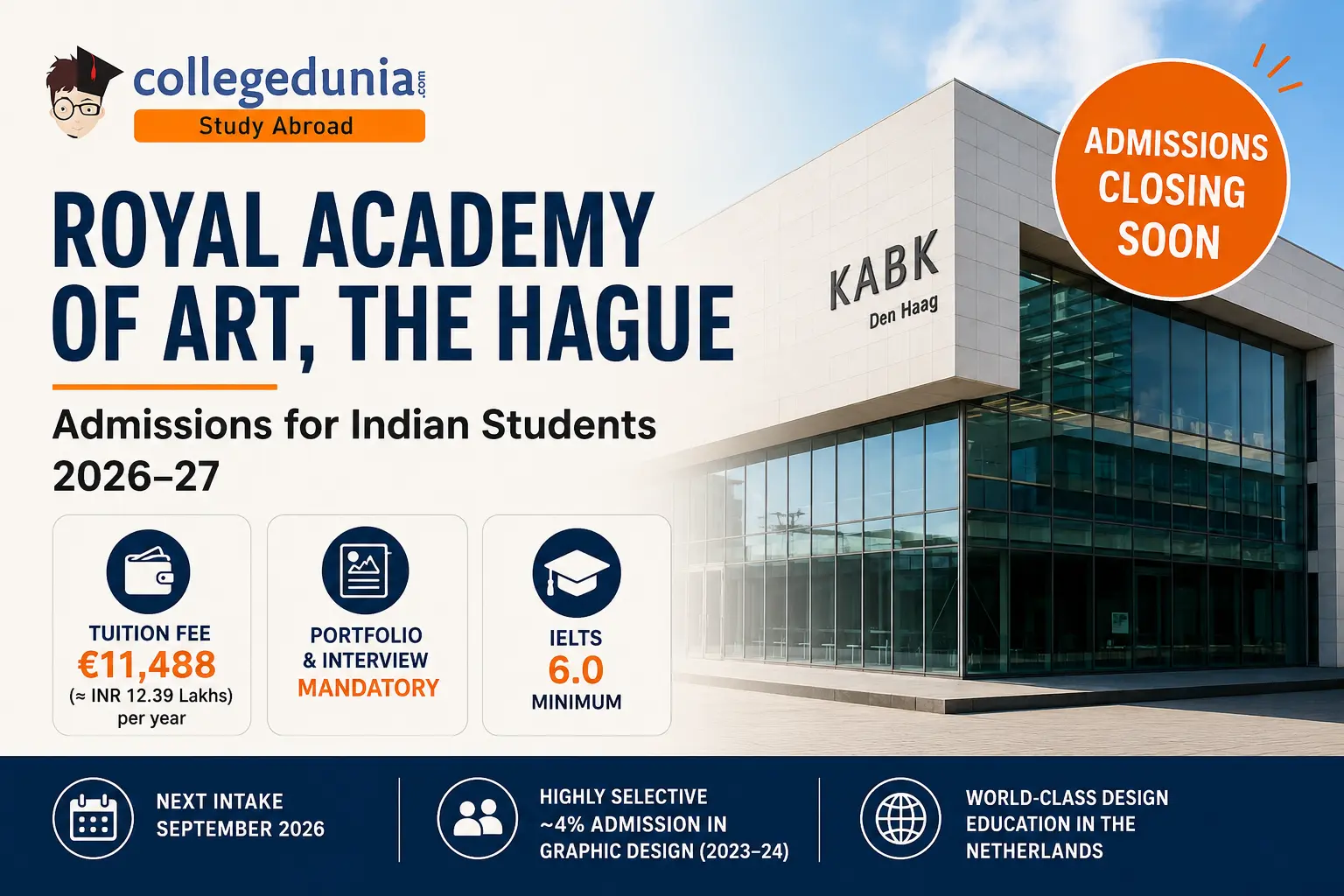
Table of Contents
- Application Deadlines and Intakes
- Eligibility for Indian Students
- Master’s Programs and Requirements
- Bachelor’s Programs and Requirements
- PhD Pathway via Leiden University
- Application Process Step by Step
- Admission Decisions and Offer Timeline
- Documents Required for Application
- Acceptance Rate and Selectivity
- Netherlands Student Visa Process
- Tips for Indian Applicants
- Admissions Checklist
- Frequently Asked Questions
Royal Academy of Art, The Hague Application Deadlines for Indian Students
All KABK degree programmes start in September, which the academy treats as its single primary intake. Bachelor’s and Master’s applications open on October 1 each year and close on March 2. Master Industrial Design runs an additional summer round for any remaining seats.
The table below lists each cycle per the official KABK application procedure FAQ page. KABK’s primary intake for Indian students is September, the month every Bachelor’s and Master’s programme begins.
| Intake | Level | Applications Open | Deadline | Portal |
|---|---|---|---|---|
| September 2026 | Bachelor’s (all 7 programmes) | October 1, 2025 (Closed) | March 2, 2026 (Closed) | Studielink and Osiris |
| September 2026 | Master’s (6 of 7 programmes) | October 1, 2025 (Closed) | March 2, 2026 (Closed) | Studielink and Osiris |
| September 2026 | Master Industrial Design (extra round) | Open (rolling) | July 20, 2026 (Closing Soon), others closed | Studielink and Osiris |
| September 2027 (Primary intake) | Bachelor’s and Master’s (all programmes) | October 1, 2026 (est., per prior cycle) | March 2, 2027 (est., per prior cycle) | Studielink and Osiris |
Planning note: The Preparatory Year that closes July 1, 2026 is open only to EU/EEA candidates because of residence-permit rules and is not an admission path for Indian students.
Royal Academy of Art, The Hague Eligibility for Indian Students
KABK assesses every applicant on academic background, English proficiency, and a creative portfolio judged at interview. Academic floors below come from the institution-wide admission requirements page. Paperwork sits in the Documents section.
- Bachelor’s academic floor: Class XII (CBSE, ISC, IB, or state board) judged comparable to a Dutch VWO, HAVO, or MBO 4 diploma.
- Master’s academic floor: A completed Bachelor’s degree, with the relevant design or art discipline preferred for most tracks.
- Portfolio: Required for every Bachelor’s and Master’s programme, in PDF form via Osiris.
- Interview: Shortlisted applicants attend an entrance assessment, either on campus or online.
- Without recognised credentials: Departments may offer a competency test costing €250 (around INR 26,963), paid by the applicant.
For English, all non-EU and non-EEA candidates must upload a valid test certificate before July 1, 2026 for the next cycle. Certificates must remain valid on September 1, 2026.
- IELTS: Minimum overall 6.0 at both Bachelor’s and Master’s level.
- TOEFL iBT: Accepted at the institutional minimum band published by KABK.
- Cambridge English (CAE or CPE): Accepted at the published institutional minimum.
- Duolingo English Test: Not accepted by KABK.
KABK IELTS Waiver for Indian Students
KABK does not run a general medium-of-instruction waiver for Indian English-medium schools. You are exempt only if you hold a passport from the USA, UK, Canada, Australia, or New Zealand, completed secondary or higher education in English in those countries (or in Ireland or the Netherlands), or earned an English-taught International Baccalaureate (IB) diploma. Indian IB graduates qualify on the IB route.
Royal Academy of Art, The Hague Master’s Programs for Indian Students
KABK offers seven Master’s programmes, all English-taught and starting in September. Cohorts are small (Type and Media admits only 12 each year), and most tracks expect a Bachelor’s in a related design or art discipline. Base tuition for non-EU/EEA Master’s students is €11,488 (around INR 12.39 Lakhs) for 2026-2027, with full cost detail on the course-wise fees breakdown page.
| Programme | Duration | Minimum Eligibility | English Req. Min. |
|---|---|---|---|
| Master Type and Media | 1 year (60 ECTS) | Bachelor’s in Graphic Design with typography practice | IELTS 6.0 |
| Master Artistic Research | 2 years (120 ECTS) | Bachelor’s in art or design with research practice | IELTS 6.0 |
| Master ArtScience | 2 years (120 ECTS) | Bachelor’s in art, design, or related field | IELTS 6.0 |
| Master Industrial Design | 2 years (120 ECTS) | Bachelor’s or Master’s in any discipline with design portfolio | IELTS 6.0 |
| Master Interior Architecture (INSIDE) | 2 years | Bachelor’s in design, architecture, or related field | IELTS 6.0 |
| Master Non Linear Narrative | 2 years (120 ECTS) | Bachelor’s preferably in Graphic Design (other design fields welcomed) | IELTS 6.0 |
| Master Photography & Society | 2 years | Bachelor’s in photography, art, or related practice | IELTS 6.0 |
Insider note: Master Type and Media admits only 12 students per cohort, so portfolios that show calligraphy, lettering process work, and finished type design sketches usually fare best at interview.
Note: Programme-specific entry requirements, fees, and intake availability may differ from the institution-wide minimums shown above. Always confirm on the official KABK application procedure page for your chosen programme before applying.
Royal Academy of Art, The Hague Bachelor’s Programs for Indian Students
All seven Bachelor’s programmes are full-time, four-year (240 ECTS), and English-taught, starting in September. Non-EU/EEA students cannot take the part-time variants of Fine Arts or Photography because of residence-permit rules.
| Programme | Duration | Minimum Eligibility | English Req. Min. |
|---|---|---|---|
| Bachelor ArtScience | 4 years (240 ECTS) | Class XII or equivalent with portfolio of cross-disciplinary work | IELTS 6.0 |
| Bachelor Fine Arts | 4 years (240 ECTS) | Class XII or equivalent with creative portfolio | IELTS 6.0 |
| Bachelor Graphic Design | 4 years (240 ECTS) | Class XII or equivalent with design portfolio | IELTS 6.0 |
| Bachelor Interactive Media Design | 4 years (240 ECTS) | Class XII or equivalent with media or design portfolio | IELTS 6.0 |
| Bachelor Interior Architecture & Furniture Design | 4 years (240 ECTS) | Class XII or equivalent with spatial or product design portfolio | IELTS 6.0 |
| Bachelor Photography | 4 years (240 ECTS) | Class XII or equivalent with photography portfolio | IELTS 6.0 |
| Bachelor Textile and Fashion | 4 years (240 ECTS) | Class XII or equivalent with textile or fashion portfolio | IELTS 6.0 |
Royal Academy of Art, The Hague PhD Admissions
KABK does not award doctorates on its own. Practice-based PhD candidates apply through PhDArts, a joint doctoral programme run with the Academy of Creative and Performing Arts at Leiden University. The doctorate is conferred by Leiden, while studio supervision sits at KABK.
- Eligibility: Master’s degree in an art or design field plus a sustained creative practice.
- Research proposal: Required as part of the PhDArts application, alongside a portfolio of recent work.
- Funding: Most candidates self-fund or hold an external grant. See the funding page on the academy’s main site for live scholarship options.
- Application route: Submitted via Leiden University’s PhDArts portal, not KABK’s Studielink.
Planning note: Indian PhDArts applicants should budget for a long lead time. Proposals are usually reviewed once a year, and you will need both an institutional supervisor and proof of financial support.
Royal Academy of Art, The Hague Application Process
The application runs across two systems: Studielink for enrolment data and Osiris for portfolio and documents. Indian applicants follow the same sequence as other non-EU students, with one extra step for English proof.
- Create a Studielink account at studielink.nl using your personal details. International applicants register without DigiD.
- Choose your programme and intake year, then submit the Studielink request. No application fee is charged at this step.
- Wait for KABK’s automated email with Osiris instructions for portfolio and document upload.
- Upload your portfolio (PDF, 10 to 50 MB per programme), motivation letter (one A4), and CV (up to two pages).
- Attend the entrance assessment if shortlisted. Format is on-campus or online, depending on programme.
- Submit final documents on offer: passport copy, Class XII or Bachelor’s transcripts, IELTS or TOEFL certificate, and a profile photo.
- Pay the €11,488 (around INR 12.39 Lakhs) tuition or set up the SEPA instalment plan to complete enrolment.
Insider note: Studielink lets you list two KABK programmes in one year. Use that slot to apply to a primary and a secondary track if your portfolio fits both.
Royal Academy of Art, The Hague Admission Decisions and Offer Timeline
KABK runs a single review wave for its main cycle, with assessment days clustered between mid-March and mid-April. Most applicants hear back by the end of May, well before the visa window opens.
- Interview window: Late March to mid-April for the September intake (Master Type and Media dates ran March 23, April 9, and April 13 for the 2026 cycle).
- Decision notification: Email confirmation by end of May, with conditional or unconditional offers.
- Acceptance window: Indicate your decision through Studielink within the timeline stated in your offer letter.
- Conditional offers: Issued where final transcripts or English scores are still pending. Conditions must clear before September 1.
- Deferral: Not standard practice at KABK. Reapplying the next cycle is the usual route.
Royal Academy of Art, The Hague Documents Required for Indian Students
The list below covers paperwork only. Academic thresholds and English scores sit in the Eligibility section above. Have soft and certified copies ready before October 1 to avoid scrambling near the deadline.
- Passport copy: Photo page and personal information page, valid through 2027.
- Class XII mark sheet and certificate (for Bachelor’s applicants), with attested English translation if needed.
- Bachelor’s degree certificate and full academic transcripts (for Master’s applicants).
- Portfolio PDF: Programme-specific format and page limits, uploaded via Osiris.
- Motivation letter: One A4 page explaining fit with the programme.
- CV: Up to two A4 pages covering education, exhibitions, awards, and skills.
- English proficiency certificate: Score report from an accepted test, valid through September 1.
- Profile photograph: Recent passport-style image for the student file.
- Financial proof: Bank statements totalling about €26,000 (around INR 28.04 Lakhs) for the residence permit application.
- Residence permit forms: KABK files these with IND on your behalf as a recognised sponsor.
Royal Academy of Art, The Hague Acceptance Rate
KABK does not publish an institution-wide acceptance rate. Selectivity is decided per department by a committee that reviews portfolio, interview, and motivation together. Demand for the leading design tracks is intense and the cohort sizes are small.
KABK Graphic Design Acceptance Rate
The most-cited figure is from the 2023-24 cycle, when Graphic Design admitted roughly 50 students from around 1,200 applicants, an admission rate near 4%. The number sets the floor for how competitive popular tracks can be at the academy. See the subject ranking band page for KABK’s standing in QS Art and Design.
Royal Academy of Art, The Hague Acceptance Trends by Department
Smaller departments such as Type and Media (12 seats per cohort) and Master Photography & Society are harder to read because the absolute applicant pool is also small. Industrial Design’s summer extra round suggests it sees seat availability after the March wave, which is a softer signal for late applicants.
Insider note: Selection at KABK is committee-driven, not score-driven. A strong portfolio with a coherent statement can offset an average academic record, but a weak portfolio will not be rescued by high grades.
Netherlands Student Visa for Royal Academy of Art, The Hague Applicants
Indian admits need an MVV (Provisional Residence Permit) plus a VVR (Residence Permit for Study), both filed with the Dutch immigration service (IND). KABK is a recognised sponsor, so the academy submits your MVV and VVR application to IND on your behalf once you accept the offer and pay the deposit.
You will need to show about €26,000 (around INR 28.04 Lakhs) upfront, covering one year of tuition, the IND fee, and living-cost proof for the Dutch BSN registration. Processing typically takes around 60 days through the recognised-sponsor route, so paying tuition by early July is the practical cut-off for a September start. Collect biometrics at the Dutch Embassy in New Delhi or VFS Mumbai once IND clears your file.
2026 update: The IND fee for student residence permits sits at €228 (around INR 24,590). Confirm the exact figure on the IND portal before transferring funds, as Dutch immigration fees revalue each January.
Tips for Royal Academy of Art, The Hague Admissions
The following tips are drawn from Indian-applicant patterns at KABK and the academy’s own guidance to international portfolio applicants.
- Lead with process work: Sketches, iterations, and rejected ideas often weigh more than polished final pieces.
- Pre-test English early: Book IELTS by November so any retake clears the July 1 certificate cutoff for September.
- Apply to two tracks: Studielink permits two KABK choices per year. Pick a primary and an adjacent fallback discipline.
- Budget the NL Scholarship: One-off €5,000 (around INR 5.39 Lakhs), five awards per year, deadline May 1, so prepare it alongside the March 2 application.
- Plan tuition payment timing: KABK runs SEPA instalments across eight tranches, but visa processing wants the first tranche cleared by early July.
- Treat the interview as a critique: Bring two or three works to discuss live, not a 30-page slideshow.
- For Industrial Design, watch the July round: The extra July 20 deadline is the only second-chance window across KABK’s Master tracks.
Royal Academy of Art, The Hague Admissions Checklist for Indian Applicants
The following steps cover what Indian applicants typically complete in the weeks leading up to KABK’s October opening and March 2 deadline.
- September: Confirm shortlist of two KABK programmes and start the portfolio outline.
- October: Open the Studielink account on day one of the cycle (October 1).
- November: Sit IELTS or TOEFL so the score is valid through September 1, 2027.
- December to January: Finalise portfolio PDF, motivation letter, and CV against programme-specific briefs.
- By February 15: Request Class XII or Bachelor’s transcripts and English translations from your school or university.
- March 2: Submit Osiris portfolio and supporting documents before midnight CET.
- April to May: Attend the entrance assessment, then wait for the end-of-May decision email.
- June to July: Pay tuition, prepare €26,000 (around INR 28.04 Lakhs) financial proof, and provide biometrics at the Dutch mission.
KABK admissions reward a strong, well-organised portfolio more than test scores, with March 2 as the universal Bachelor’s and Master’s deadline and a single September intake. Indian applicants should plan the IELTS, the €26,000 (around INR 28.04 Lakhs) visa proof, and Studielink registration in parallel from October.
Frequently Asked Questions
Ques. Does the Royal Academy of Art, The Hague charge an application fee?
Ans. No. KABK does not charge a general application fee on Studielink or Osiris. The only conditional cost is a €250 (around INR 26,963) competency test fee if a department requests it for applicants without recognised academic credentials.
Ques. What is the next live application deadline at the Royal Academy of Art, The Hague?
Ans. The closest live deadline is Master Industrial Design’s extra round, which closes on July 20, 2026 for a September 2026 start. The general Bachelor’s and Master’s cycle for September 2027 opens on October 1, 2026 and closes on March 2, 2027 based on the prior-year pattern.
Ques. What is the IELTS requirement for Indian applicants at KABK?
Ans. KABK’s institutional minimum is IELTS 6.0 overall for both Bachelor’s and Master’s programmes. The certificate must remain valid on September 1 of the start year. Duolingo English Test results are not accepted.
Ques. Can Indian students get an English test waiver based on English-medium schooling?
Ans. No general waiver exists for Indian English-medium schools. KABK waives the test only for passport holders from the USA, UK, Canada, Australia, or New Zealand, for prior English-taught education in those countries (or in Ireland or the Netherlands), and for English-taught International Baccalaureate diploma holders.
Ques. What is the tuition fee at KABK for non-EU students in 2026-2027?
Ans. The non-EU/EEA fee for both Bachelor’s and Master’s programmes is €11,488 (around INR 12.39 Lakhs) per year. Non-EU students who later secure a residence permit allowing the statutory fee pay €2,694 (around INR 2.91 Lakhs) instead.
Ques. How selective is admission to KABK?
Ans. Admission is highly selective and decided by department committee. The most cited figure is Graphic Design’s 2023-24 cycle, where roughly 50 students were admitted from around 1,200 applicants, an admission rate of about 4%. KABK does not publish an institution-wide rate.
Ques. Is the Preparatory Year an option for Indian applicants?
Ans. No. KABK confirms that the Preparatory Year is open only to EU/EEA candidates because Dutch residence-permit rules do not cover non-degree study at this level. Indian applicants apply directly to a Bachelor’s programme.
Ques. What documents does an Indian applicant need to submit?
Ans. Required documents include passport copy, Class XII or Bachelor’s transcripts, portfolio PDF, motivation letter, CV, English test certificate, profile photo, and financial proof of around €26,000 (around INR 28.04 Lakhs) for the residence permit application.
Ques. How long does the Netherlands student visa take for KABK admits?
Ans. KABK is a recognised sponsor and files the MVV and VVR with IND on your behalf. Processing usually takes around 60 days, so paying tuition by early July is the practical cut-off for a September start.
Ques. What scholarships are open to Indian students at KABK?
Ans. The flagship option is the NL Scholarship at €5,000 (around INR 5.39 Lakhs), capped at five awards per year and aligned with the May 1 deadline. KABK also points to the DUO tuition fee loan and a Profileringsfonds support of up to €2,500 (around INR 2.70 Lakhs) for exceptional circumstances.
Ques. Can I defer my offer to the next intake?
Ans. KABK does not run a standard deferral process. The usual route is to reapply in the next cycle through Studielink, with the option to refresh your portfolio and motivation letter before resubmission.
Ques. Where is the application portal for KABK?
Ans. All applicants begin at Studielink at studielink.nl and complete the portfolio and documents on KABK’s Osiris portal after the academy emails you the link. No fee is charged on either portal at submission.



Comments