



Study Abroad Expert | Updated On - Jul 23, 2026
A letter of motivation is the one-page document European universities and visa officers use to judge your fit and intent. For Indian applicants, it often decides borderline files. For Indian students, a weak motivation letter is a leading rejection reason at both desks. This guide covers the structure, the university and visa versions, writing rules, and samples.
- Europe expects a letter of motivation (LOM), shorter and more formal than the US-style SOP.
- Keep it to one page, 500 to 700 words, in a formal letter layout.
- University letters argue academic fit; visa letters answer course, funding, and plan.
- This guide includes 3 downloadable PDFs and an annotated example image.
| Parameter | Detail |
|---|---|
| Length | One page, 500 to 700 words |
| Format | Formal letter: header, salutation, 4 to 5 paragraphs, sign-off |
| Where it is asked | Germany, France, Netherlands, Italy, Nordics and most EU applications |
| University version | Academic fit with named modules and labs |
| Visa version | Course choice, funding line and post-study plan |
| Golden rule | One tailored letter per university and per visa file |
| Downloads below | Format template PDF, 2 sample PDFs, annotated example image |
Read More:
- Study abroad guide for Indian students
- Statement of Purpose (SOP): Format, Sample, and How to Write
- Letter of Recommendation (LOR) for Study Abroad
- Gap Certificate for Study Abroad: Format, Affidavit and PDF
Letter of Motivation vs SOP
The letter of motivation is Europe's answer to the SOP: shorter, more formal in layout, and focused on one program, whereas an SOP narrates a longer personal journey. Sending one where the other is asked reads as carelessness. The differences that matter:
| Aspect | Letter of Motivation | SOP |
|---|---|---|
| Length | One page, 500 to 700 words | Often 800 to 1,200 words |
| Layout | Formal letter with header and salutation | Essay, no letter formatting |
| Focus | This program, this university, now | Your journey and long arc |
| Where asked | Most European universities and visa files | Mostly US and some UK programs |
| Tone | Direct and evidence-led | More narrative freedom |
Note: The LOM is closer to a job application letter than an essay. Every paragraph should answer a question the reader actually has: who are you, can you handle this program, why here and what happens after. Anything that answers none of those four questions is cut.
Read More:
- Letter of Motivation (LOM) vs Statement of Purpose (SOP)
- Statement of Purpose (SOP): Format, Writing Tips, & Samples
- Documents Required for Study Abroad 2026: Full Guide
Structure and Format with Example
The structure is fixed: header, salutation, an opening naming the exact program, an evidence paragraph, a why-this-university paragraph, and a plan-plus-closing. The annotated example below shows each block in place. Study the annotations before writing, then build your draft against the downloadable skeleton:
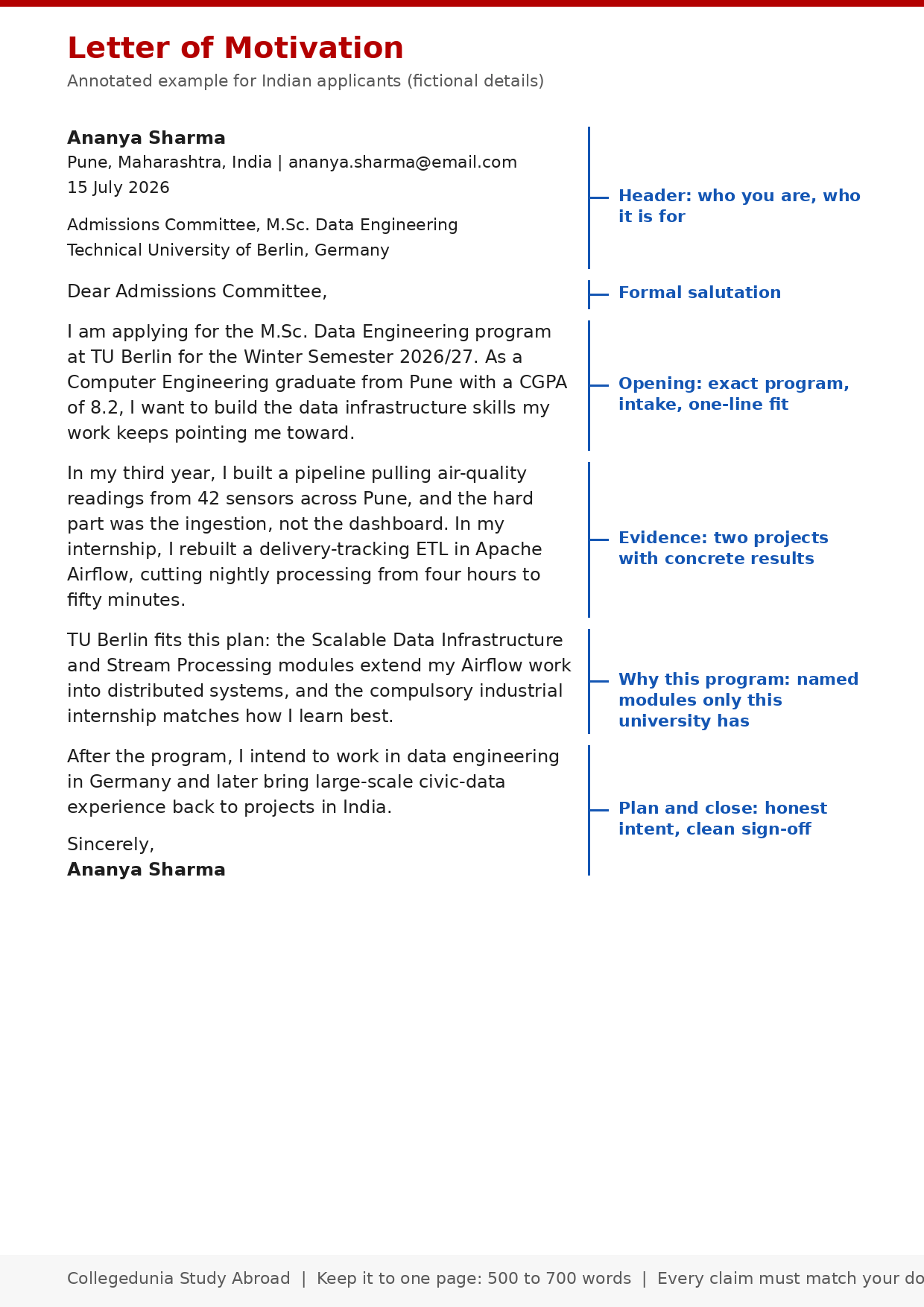
Downloads for this section:
University LOM vs Visa LOM
The university letter argues you belong in the program, while the visa letter assures the officer about course choice, funding and your plan after study. Same skeleton, different centre of gravity. Weak motivation is a recurring refusal cluster at European missions, so the visa version deserves equal care. The application context sits in this guide on the September intake in the USA, UK, Canada and Germany. The split:
| Element | University letter | Visa letter |
|---|---|---|
| Core question | Will this student succeed here | Is this a genuine, funded, completable plan |
| Evidence weight | Projects, modules, labs, thesis fit | Course logic, funding line, language prep, plan |
| Funding mention | Usually none | One clear line: blocked account, loan or scholarship |
| Addressee | Admissions committee | Visa section of the mission or consulate |
Read More:
Writing Rules for Indian Applicants
The rules that lift an Indian file: mirror the exact program name, quantify two projects, name what only this university offers and keep every claim consistent with the documents. Specificity is the whole game. Shortlisting first makes the letter easier, using this list of top universities abroad for Indian students. The rules:
- Mirror names exactly: the program title, intake and university as the portal writes them.
- Quantify evidence: "cut nightly processing from four hours to fifty minutes" beats "worked on optimisation".
- Name the unique fit: two named modules or labs, one structural feature such as an industrial internship.
- Match the file: CGPA, dates and project claims must align with transcripts and CV to the digit.
- Address the gaps once: a backlog or year gap gets one factual sentence with the fix, not an apology paragraph.
- Close with an honest plan: for visa letters, a clear post-study intent beats a rehearsed promise.
Note: Scholarship files reuse this same letter with one changed centre of gravity: impact. An award committee funds outcomes, so the plan paragraph grows and the module list shrinks. Draft the university version first, then tilt copies for the visa and scholarship desks rather than writing three letters from scratch.
Award deadlines often run weeks ahead of admission ones, covered in this guide on fully funded scholarships for Indian students.
Mistakes That Sink the Letter
The recurring sinkers: template sentences, praise without evidence, inconsistencies with the file, ignoring the visa version and letters that run past one page. Every one is avoidable in a single edit pass. Check your draft against this list:
- Borrowed openings: "Since my childhood" and "esteemed university" mark a template within one line.
- Praise without proof: calling a university world-class says nothing; naming the lab you want says everything.
- File mismatches: a CGPA or date that differs from the transcript reads as carelessness at best.
- One letter everywhere: committees spot recycled letters, and visa officers spot recycled study plans.
- Overrunning the page: a second page signals you cannot prioritise, which is itself an answer.
- AI-flavoured filler: generic fluent paragraphs with no verifiable detail invite deeper scrutiny of the whole file.
Also Check:
A letter of motivation is one page of evidence arranged around four questions: who you are, whether you can handle the program, why this university and what comes after. Build it on the downloadable skeleton, study the annotated example and keep the university and visa versions pointed at their different readers. Mirror every name, quantify every claim and match the file to the digit. Do that, and the letter stops being the document Indian applicants fear and becomes the one place in the file where you get to make the argument yourself.
FAQs
Ques. What is a letter of motivation for European universities?
Ans. A one-page formal letter of 500 to 700 words arguing your fit for one specific program: who you are, your evidence, why this university and your plan. Most European universities and several visa files require it.
Ques. How is a letter of motivation different from an SOP?
Ans. The LOM is shorter, formatted as a formal letter and pointed at one program, while an SOP is a longer essay narrating your journey. Europe generally asks for the LOM, the US for the SOP.
Ques. How long should the letter of motivation be?
Ans. One side of A4, 500 to 700 words, in a standard font at 10.5 to 12 point. A second page signals poor prioritisation, and committees rarely read past the first anyway.
Ques. What structure should Indian applicants follow?
Ans. Six blocks: header, salutation, an opening naming the exact program and intake, an evidence paragraph with quantified projects, a why-this-university paragraph with named modules, and a plan plus closing. The template PDF above maps each block.
Ques. Is the visa letter of motivation different from the university one?
Ans. Same skeleton, different centre: the visa version adds one clear funding line, language preparation and an honest post-study plan, because the officer is judging whether the plan is genuine, funded and completable.
Ques. Can a weak letter cause a visa rejection?
Ans. Yes. Weak or generic motivation is a recurring refusal cluster at European missions, alongside funding and document errors. A specific course logic, a funding line and a credible plan directly address what officers check.
Ques. Should I mention my CGPA and backlogs in the letter?
Ans. State your CGPA where it helps and address a backlog or gap in one factual sentence with the fix. Never hide what the transcript will show, and never spend a paragraph apologising for it.



Comments