



Study Abroad Expert | Updated On - Aug 20, 2026
LOM and SOP describe the same job with different accents. The Letter of Motivation is shorter, personal, and European. The Statement of Purpose is longer, structured, and academic. Many universities use the terms interchangeably. The program page decides which one you are actually writing. German universities make the overlap explicit. Programs there use motivation letter, statement of purpose, personal statement, and cover letter for one document. The definitions, the comparison, the four examples, and the choosing rules below settle it.
- Geography drives the difference, since Europe and America built different habits.
- Format follows the label loosely, so the prompt matters more than the name.
- Length separates them in practice, at one page against two.
- Writing the wrong one wastes the page, even when content is strong.
| Parameter | Detail |
|---|---|
| Letter of Motivation | Shorter, personal, motivation-led; common across Europe |
| Statement of Purpose | Longer, structured, academic; standard in the USA and Canada |
| LOM length | Commonly 500 to 800 words, often one page |
| SOP length | Commonly 800 to 1,000 words, sometimes two pages |
| German term | Motivationsschreiben, covering both labels |
| Interchangeable use | Yes, at many European universities |
| The deciding source | The program page and admission regulations |
Must Check,
- Statement of Purpose (SOP): Format, Sample, and How to Write
- How to Write a Strong SOP for UK University Applications
- Letter of Motivation for German Universities
- Letter of Motivation (LOM) for European Universities and Visa
What Each Document Actually Is
Both documents answer why you want this program. They differ in how much of you they expect. Both are read by the same kind of committee, with different expectations. The Letter of Motivation:
- Purpose: to show motivation, interest in the course, and fit with the program.
- Tone: personal and direct, closer to a professional letter than an essay.
- Where: Germany, the Netherlands, France, Italy and much of Europe.
- Shape: often addressed to an admissions committee with a subject line naming the program.
The Statement of Purpose:
- Purpose: to argue academic suitability, trajectory and program fit in structured form.
- Tone: formal and academic, built on evidence rather than enthusiasm.
- Where: the USA, Canada and increasingly Australia.
- Shape: an essay in blocks, sometimes with departmental formatting rules.
The base format sits in our guide to the statement of purpose format and samples.
Note: Do not panic when a European program calls it a statement of purpose or a cover letter. German universities use these translations of one term almost interchangeably. Write to the stated word count and the questions asked, not to the label.
Must Check,
- Documents Required for Student Visa Germany for Indians
- APS Certificate Germany 2026: Full Form and Fees
- Study in Germany: Find Universities, Fees and Visa Guide
The Differences That Matter
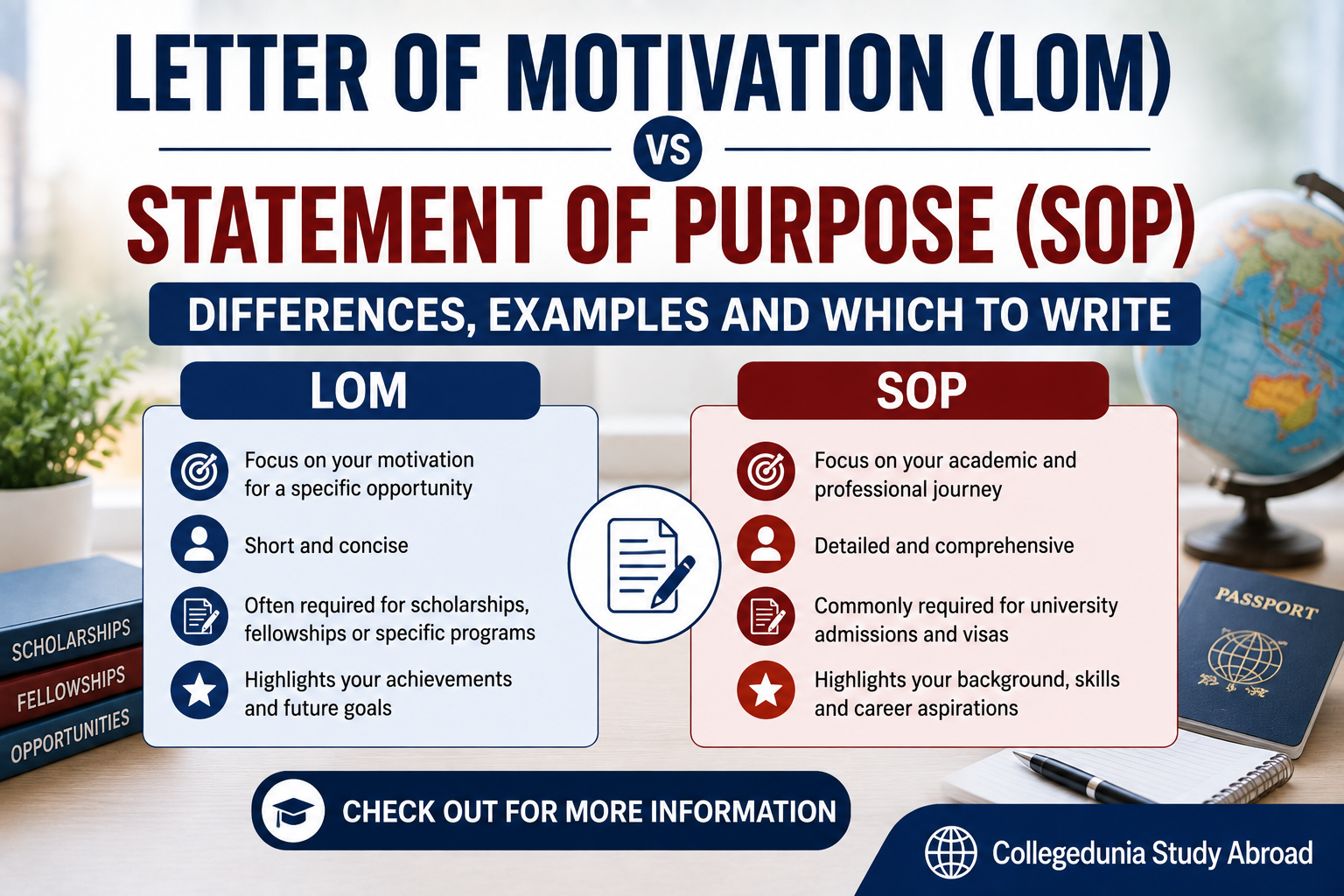
Five practical differences change what you actually write. The comparison graphic accompanying this guide covers the same ground visually.
| Aspect | Letter of Motivation | Statement of Purpose |
|---|---|---|
| Length | 500 to 800 words, usually one page | 800 to 1,000 words, up to two pages |
| Focus | Motivation and personal interest | Academic evidence and trajectory |
| Tone | Personal, letter-like | Formal, essay-like |
| Format | Subject line, salutation, sign-off | Continuous prose in blocks |
| Region | Europe, including Germany and the Netherlands | USA, Canada and many Australian programs |
| Formatting rules | Rarely specified beyond a page limit | Sometimes exact, including fonts and spacing |
Scholarship applications add a third shape again, since funding bodies ask about merit and need rather than fit alone. One thing stays identical across both. Specific evidence outperforms enthusiasm, and generic praise for a university weakens either document. Visa refusal patterns follow the same logic. This guide on the most common reasons for German student visa rejection shows it clearly.
Two Examples of Each
The same applicant, an engineering graduate applying for a Master's, would open these documents differently. Compare the four openings.
Letter of Motivation, example one:
- Subject: Motivation letter for the M.Sc. Power Engineering programme, winter intake.
- Opening: "I am applying because my thesis left one question unresolved. How do transmission networks stay stable as renewable generation replaces conventional capacity?"
Letter of Motivation, example two:
- Subject: Motivation letter for the M.Sc. Data Science programme.
- Opening: "Two years of building dashboards taught me the hardest part of data work. It is deciding what to measure, and that is what this programme teaches."
Statement of Purpose, example one:
- Opening block: "My final-year project modelled frequency response in a distribution feeder with high solar penetration. The simulation held only under assumptions the next decade of the Indian grid will break."
- Followed by: academic background, methods and tools, research exposure, program fit with named labs, then goals.
Statement of Purpose, example two:
- Opening block: "The recommendation engine I built during my internship improved click-through by 12%. I could not explain why the simpler model outperformed the complex one."
- Followed by: coursework, the datasets and statistical methods handled, faculty whose work connects, then career goals.
Notice what the letters leave out. Neither opening spends a sentence on background, because a one-page document cannot afford it. The statements can build slowly, so they begin with a result and explain it afterwards.
Which One Should You Write
The answer is never the label. It is the prompt. Four checks decide it. Four steps settle it in minutes. The checks:
- Read the admission regulations, since these override any general guide including this one.
- Follow the stated word or page limit, which tells you more than the document's name.
- Answer set questions where they exist instead of submitting a prepared essay.
- Match the regional habit when nothing is specified. Europe expects the shorter motivation letter, America the longer statement.
The overlap is larger than the difference, which is why the label misleads so many applicants. What both documents cover and do not:
- Cover: your reasoning, your fit, and the evidence behind both.
- Do not: replace transcripts, test scores or recommendation letters.
Also Check:
LOM versus SOP is a question of accent, not of substance. Both ask why this program and both reward evidence over enthusiasm. Write the shorter, personal, letter-shaped version for Europe and the longer, structured, academic version for North America. Above all, follow the prompt in front of you. Do that, and the label stops mattering entirely. The document that answers the question asked always outperforms the one written from a template.
FAQs
Ques. What is the difference between an LOM and an SOP?
Ans. The LOM is shorter, personal and motivation-led. The SOP is longer, structured and academic. European universities favour the letter, while American and Canadian programs expect the statement.
Ques. Are the two terms interchangeable?
Ans. Often yes. German universities use motivation letter, statement of purpose, personal statement and cover letter for the same document. The prompt and word limit tell you what is actually wanted.
Ques. How long should each document be?
Ans. The LOM commonly runs 500 to 800 words on one page. The SOP commonly runs 800 to 1,000 words and sometimes two pages, with departments occasionally setting exact formatting rules.
Ques. Which countries want which document?
Ans. Europe leans toward the Letter of Motivation, including Germany, the Netherlands, France and Italy. The USA and Canada expect the Statement of Purpose, and Australian programs increasingly use it too.
Ques. Can I convert my SOP into an LOM?
Ans. Not by trimming it. The letter needs a different shape, with a subject line, a salutation and a motivation-led opening. Compressed statements read as extracts rather than letters.
Ques. Which one is harder to write?
Ans. The letter, usually. One page forces ruthless selection, so weak evidence has nowhere to hide. The statement gives more room to build an argument in stages.
Ques. Does the LOM need academic evidence too?
Ans. Yes, in condensed form. Motivation without coursework, projects or methods behind it reads as enthusiasm. European readers still want subject depth, just delivered in fewer words.
Ques. What if the program asks set questions instead?
Ans. Answer those questions and nothing else. Program forms override both formats. Submitting a prepared essay instead looks like inattention to the checklist.
Ques. Do I need both if I apply across regions?
Ans. Yes. An applicant targeting Germany and the USA writes a one-page motivation letter and a longer academic statement. The evidence overlaps, but the shape and emphasis differ.
Ques. What matters more than the label?
Ans. Specific evidence. Both documents reward named courses, real projects and measurable outcomes. Generic praise for a university weakens either one equally.



Comments