





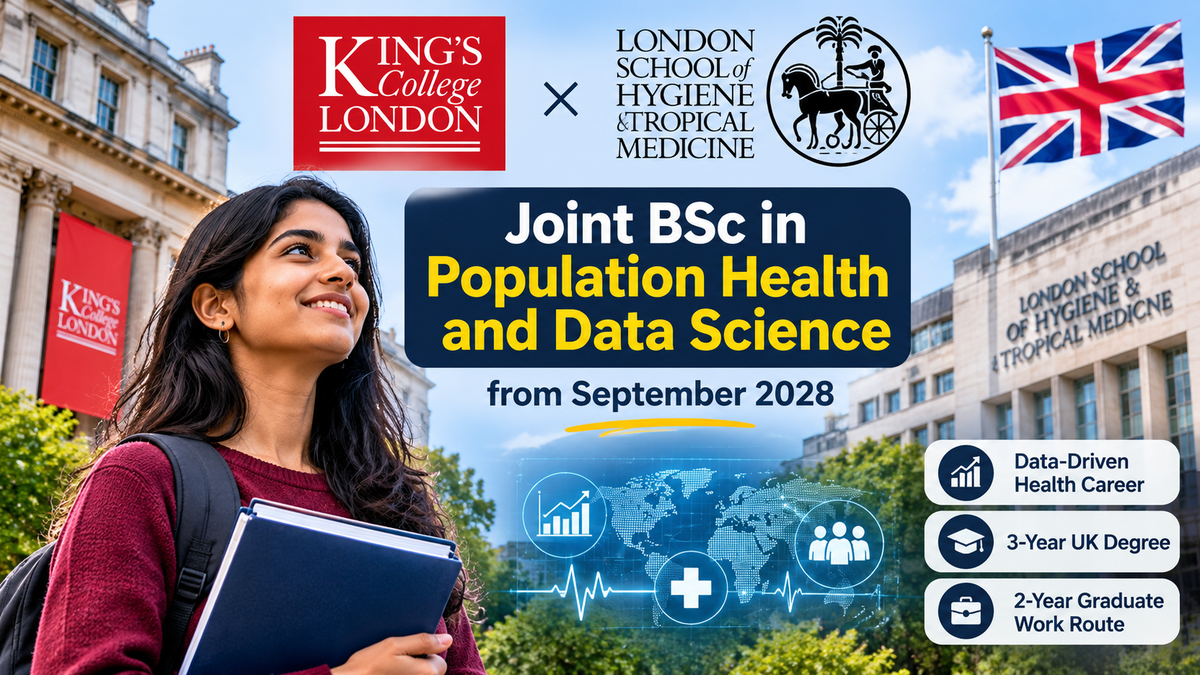
Kings College London and LSHTM have announced a joint BSc in Population Health and Data Science from September 2028. The three-year degree lets Indian students build a data career in health without an MBBS route. Teaching sits across both London campuses, and the final degree carries both names.
- Joint teaching from a Russell Group university and the world’s top-ranked public health school.
- Strong fit for Indian students chasing data careers in health, not clinical medicine.
- A three-year UK undergraduate route keeps total cost lower than most US or Australian options.
- Graduates qualify for the Graduate Route, a two-year work permit after the course.
Check King’s College London course list and fee bands
LSHTM has ranked in the global top three for public health in the QS subject league table for several recent cycles. Pairing that with King’s is a serious credential for a 20-year-old building a career. The joint BSc is one of the few UK undergraduate routes that pairs real health policy content with coding and statistics.
Quick Facts on the Joint BSc
| Parameter | Detail |
|---|---|
| First intake | September 2028 |
| Duration | 3 years full-time |
| Qualification | BSc Honours (joint award from King’s and LSHTM) |
| Campuses | King’s Guy’s and Waterloo, LSHTM Bloomsbury (central London) |
| Application route | UCAS (opens autumn 2027 for 2028 entry) |
| Indicative tuition | Based on King’s current international BSc band of £29,000 to £33,000 per year (2028 figure confirmed in late 2027) |
| English requirement | King’s standard IELTS 7.0 overall with 6.5 in each band |
| Typical academic entry | A-levels around AAA or CBSE / ISC 90% plus with Maths |
New KCL LSHTM Population Health BSc
The new KCL LSHTM BSc in Population Health and Data Science blends health policy with coding, statistics and modelling. The course reads like a modern public health degree rebuilt for the data age. Students learn epidemiology, biostatistics, Python or R, and health systems inside the same three years.
The joint award means the final certificate carries both King’s College London and the other Russell Group peers, plus LSHTM. Teaching splits across the two institutions by subject area. King’s covers the biomedical and policy modules at Guy’s and Waterloo. LSHTM runs the epidemiology, data science and global health content from Bloomsbury. The two schools sit a 20-minute walk apart in central London. Shared library and bioethics access works through the University of London system.
What the joint BSc gives you:
- A joint-award certificate from both institutions, not a King’s degree with LSHTM content bolted on.
- Access to LSHTM research faculty from year one, not just at masters stage.
- A direct feeder into LSHTM’s MPH, MSc Health Data Science and MSc Epidemiology later.
- Coding plus health policy skills on one transcript, useful for both NHS and private hire.
What this BSc does not cover:
- Clinical medicine or any MBBS equivalence.
- Hospital placements or patient-facing training.
- Pharmacy, nursing, or clinical psychology registration.
If a student has strong maths and wants a health career without the MBBS route, then this joint BSc fits the profile. That means mapping Class 12 subjects now, with Maths in the top four.
Why King’s and LSHTM joined forces
King’s and LSHTM already share a research neighbourhood in central London, so the undergraduate tie-up builds on existing teaching links. LSHTM has been a postgraduate-only school for most of its history. The joint BSc gives it a direct undergraduate route into its masters programmes.
King’s brings scale, a broad student mix and a central London campus. LSHTM brings specialist faculty in infectious disease modelling and the kind of applied epidemiology taught in top UK MPH courses. Both are part of the University of London system, which keeps shared services and libraries simple.
The combined brand matters for recruiters back in India. A Russell Group name plus the world’s top public health school opens doors in both research and industry hires. Hiring managers at NHS trusts, GSK, AstraZeneca and IQVIA know both names well.
Key Insight: If a student wants an MPH at LSHTM later, this BSc is likely the strongest internal preparation available in the UK system right now.
The pairing also matters for research exposure. First-year students sit in lectures taught by faculty who publish in The Lancet and the BMJ. Few other UK BSc routes give that kind of access that early.
Read More: King’s College London ranking and subject strengths
Entry rules for the joint BSc 2028
The joint BSc expects strong A-levels or an equivalent CBSE or ISC score, plus solid English. Indian students applying for September 2028 should plan Class 12 subjects now. Based on King’s current entry patterns for data-heavy BSc courses, A-level grades around AAA are a safe target. Maths at A-level is expected to be essential given the data science core. A second science helps but the exact subject rule goes live closer to UCAS opening.
For Indian boards:
- CBSE Class 12: aim for 90% or more overall for competitive King’s BSc courses.
- ISC Class 12: the same 90% band usually works.
- Maths and a science subject should be in your top four or five scoring subjects.
- Predicted grades on the UCAS reference matter if results are not yet out.
English language rules follow King’s standard. The usual requirement for most BSc courses is IELTS 7.0 overall with 6.5 in each band. TOEFL iBT around 100 and PTE Academic 69 are typical alternatives. Book the IELTS slot that lines up with UCAS deadlines for UK undergraduate entry early, since London test centres book out fast between September and December.
If predicted grades miss AAA by one band, then King’s typically still reviews the application in context. That means a strong personal statement and reference matter even if one grade slips.
Fees for the KCL LSHTM BSc 2028
Final tuition for the 2028 intake will be confirmed in late 2027. Current King’s international BSc fees sit between £29,000 and £33,000 per year. Data-heavy health programmes usually fall in the upper half of that band.
After the usual yearly 3 to 5% fee rise, expected 2028 tuition could land between £31,000 and £35,000 per year. At an indicative INR 108.50 per GBP, that works out to roughly INR 33.6 lakh to INR 38 lakh per year in tuition alone.
Total three-year cost including central London accommodation and the usual Indian student living budget looks like this.
| Head | Per year (GBP) | Per year (INR, indicative) |
|---|---|---|
| Tuition (expected 2028) | £31,000 to £35,000 | INR 33.6 lakh to INR 38 lakh |
| London rent and bills | £10,800 to £16,800 | INR 11.7 lakh to INR 18.2 lakh |
| Food and travel | £3,600 to £6,000 | INR 3.9 lakh to INR 6.5 lakh |
| Books, insurance, NHS surcharge | £1,500 to £2,500 | INR 1.6 lakh to INR 2.7 lakh |
| Total per year | £46,900 to £60,300 | INR 50.9 lakh to INR 65.4 lakh |
Over three years, the full-cost bill lands at roughly £140,000 to £180,000 (INR 1.5 crore to INR 1.95 crore). Source: King’s College London published international BSc fee band 2026-27, applied with a standard annual uplift. Add a 5 to 8% currency buffer for rupee weakening across three intake cycles. A student locking a loan today for a 2028 start should model the top end of the range, not the bottom.
Key Insight: Central London rent is where most families underestimate cost. A shared King’s residence hall near Waterloo runs 20 to 30% higher than zone-3 private rentals.
Scholarships for Indian BSc students
Indian applicants to the joint BSc can stack a King’s scholarship with a bank education loan to cut out-of-pocket costs. King’s runs a mix of merit awards and need-based grants for international undergraduates. Named awards relevant to this BSc are listed below. Chevening and Commonwealth do not apply at BSc level but matter later for a masters.
| Scheme | Indicative value | Who it fits |
|---|---|---|
| King’s International Hardship Award | up to £6,000 | Need-based, international UG students |
| King’s Living Bursary | up to £3,750 per year | Low family income applicants |
| Faculty of Life Sciences Awards | varies by year | Strong academic profile in science |
| External: Inlaks, J N Tata Endowment | partial support | India-based competitive awards |
What a King’s undergraduate scholarship covers:
- A partial tuition contribution, usually £3,000 to £6,000 per year.
- One-off hardship support for emergencies.
- Living bursaries for low-income families.
What it does not cover:
- Full tuition and London living costs combined.
- Student visa fee or the NHS Immigration Health Surcharge.
- Any dependent or family support.
Most Indian students bridge the gap with loans. Common lenders for a UK BSc include HDFC Credila, Avanse, SBI Global Ed-Vantage and Prodigy Finance. SBI collateral-backed loans typically cover up to INR 1.5 crore. Credila and Avanse offer unsecured options for strong co-applicant profiles.
Read More: Scholarships to study in the UK for Indian students
How to apply via UCAS for 2028
All UK undergraduate applications run through UCAS, including the new KCL LSHTM BSc in Population Health and Data Science. There is one personal statement across up to five course choices. There is no separate King’s or LSHTM form for the BSc.
| Month | Step for 2028 entry |
|---|---|
| May 2027 | UCAS opens for 2028 registrations |
| September 2027 | UCAS applications open properly |
| Mid-October 2027 | Early deadline (Oxbridge and Medicine only, not this BSc) |
| Late January 2028 | UCAS equal consideration deadline |
| March to May 2028 | Offer decisions returned |
| June 2028 | Reply deadline (firm plus insurance choices) |
| July 2028 | Offer-holder documents, visa prep begins |
| August 2028 | A-level results and clearing (if needed) |
| September 2028 | Enrolment at King’s and LSHTM |
Source: UCAS cycle calendar, standard pattern for UK undergraduate entry. The joint BSc is not a special-deadline programme like Medicine or Oxbridge.
Documents needed for the UCAS form for UK undergraduate entry:
- Class 12 predicted or achieved results (CBSE, ISC, A-levels or equivalent).
- IELTS or TOEFL score, taken before January 2028 if possible.
- One academic reference letter from a school teacher or principal.
- A 4,000-character personal statement following the UK undergraduate style.
- Passport copy and residential address proof.
If a student applies by the January 2028 deadline, then the application gets equal consideration with every other on-time submission. That means later submissions can still be accepted but lose priority for popular courses.
Careers after the KCL LSHTM BSc
Graduates leave with coding, statistical modelling and health policy skills in one bundle. That mix fits roles in public health agencies, consulting, insurance and health tech. The degree is not a direct route to medicine or NHS clinical jobs.
Typical first roles for population health graduates in the UK include junior data analyst, research assistant, epidemiology analyst and health policy associate. NHS England, UKHSA (the successor to Public Health England), GSK, AstraZeneca and IQVIA all hire in this space. Several big-four consulting firms also run dedicated healthcare data teams.
Entry-level data roles in London health sit around £28,000 to £35,000 per year. That works out to roughly INR 30 lakh to INR 38 lakh in Indian terms, before London tax and rent. Source: ONS labour market data and typical NHS Agenda for Change Band 5 and 6 salaries.
The UK Graduate Route gives most BSc graduates two years to work in any role after course completion. The route needs no sponsor and allows any job at any skill level. Permanent residence comes later through the Skilled Worker visa.
| Route | Duration | Work rights |
|---|---|---|
| Graduate Route | 2 years | Any job, any employer, no sponsor needed |
| Skilled Worker visa | 5 years | Sponsor-tied, salary threshold applies |
| ILR (UK PR) | permanent | Full UK work and settlement rights |
If a graduate wants a long-term UK career, then the Graduate Route to Skilled Worker pathway is the standard route. That means lining up a sponsor-ready employer within the two-year window after graduation. Most NHS trusts, big pharma UK offices and London health-tech firms hold Home Office sponsor licences.
Key Insight: A population health BSc graduate who moves straight into an LSHTM MPH buys two extra years in the UK before the Graduate Route clock starts. Many Indian students use this stacking strategy.
Also Check:
| Public Health BSc options in the UK | Data Science BSc options in the UK | Epidemiology courses in the UK |
| King’s College London scholarships | LSHTM admission requirements | UK Student visa guide for Indians |
The Kings College London and LSHTM BSc in Population Health and Data Science is a rare undergraduate route into applied health data in the UK. First-cohort students in September 2028 get a joint-award degree, direct faculty access at both schools and a two-year Graduate Route visa afterwards. Fees will land in the upper half of the King’s international band, and loans from Credila, Avanse or SBI cover most of the three-year bill. Plan Class 12 subjects now with Maths in the top four, and register on UCAS when the 2028 cycle opens in May 2027. Watch both King’s and LSHTM official sites in late 2027 for the final module list and confirmed fee.
FAQs
Ques. What is the new Kings College London and LSHTM BSc in Population Health and Data Science?
Ans. It is a three-year joint undergraduate degree launched by King’s College London and the London School of Hygiene and Tropical Medicine. The first cohort starts in September 2028. The course blends epidemiology, biostatistics, coding and health policy. Graduates receive a joint-award BSc Honours from both institutions.
Ques. When does the first cohort start?
Ans. September 2028 is the first intake. UCAS applications open in September 2027, and the equal consideration deadline falls in late January 2028. Decisions go out between March and May 2028. Enrolment follows in autumn 2028.
Ques. Who is eligible to apply from India?
Ans. Indian students with strong Class 12 results from CBSE, ISC or equivalent boards can apply. Expect a floor of 90% or more overall, with Maths in your top subjects. A-level applicants should target AAA. English language rules follow the King’s standard of IELTS 7.0 overall with 6.5 in each band.
Ques. How much does the joint BSc cost per year?
Ans. The 2028 fee is confirmed in late 2027. Based on King’s current international BSc band, tuition for a 2028 start is expected between £31,000 and £35,000 per year. That maps to roughly INR 33.6 lakh to INR 38 lakh per year at today’s reference rate. Total three-year cost with London living runs INR 1.5 crore to INR 1.95 crore.
Ques. How do Indian students apply?
Ans. All applications run through UCAS, the UK undergraduate gateway. You get one personal statement across up to five course choices. The equal consideration deadline for 2028 entry is late January 2028. There is no separate King’s or LSHTM form for this BSc.
Ques. Will IELTS be needed for the 2028 intake?
Ans. Yes. King’s requires IELTS 7.0 overall with 6.5 in each band for most BSc courses, and the joint BSc is expected to follow the same rule. TOEFL iBT around 100 and PTE Academic 69 are typical alternatives. Book a test slot before December 2027 to avoid the January rush.
Ques. What jobs does the joint BSc lead to?
Ans. Graduates move into roles like junior data analyst, research assistant, epidemiology analyst and health policy associate. NHS England, UKHSA, GSK, AstraZeneca, IQVIA and health-focused consulting teams all hire in this space. London entry salaries sit around £28,000 to £35,000 per year.
Ques. Can Indian graduates stay in the UK after the BSc?
Ans. Yes. The Graduate Route gives two years of open work in the UK after a BSc. No sponsor is needed during this window. Moving to the Skilled Worker visa after that leads to Indefinite Leave to Remain, which is UK permanent residency, after five more years.
Ques. Are scholarships available for Indian BSc applicants?
Ans. Yes, but not full-tuition at BSc level. King’s offers the International Hardship Award up to £6,000 and a Living Bursary of up to £3,750 per year for low-income families. External India-based awards like Inlaks and the J N Tata Endowment can add partial support. Chevening and Commonwealth apply only at postgraduate level.
Ques. How is this different from a standard BSc Public Health?
Ans. A standard BSc Public Health focuses on policy and health systems with limited coding. The joint KCL LSHTM BSc adds data science, Python or R programming and statistical modelling as core content. The LSHTM teaching also means direct access to global health faculty, which few UK BSc routes offer at undergraduate level.
Ques. Can education loans cover the full cost?
Ans. Yes, for strong profiles. SBI Global Ed-Vantage collateral loans cover up to INR 1.5 crore. HDFC Credila and Avanse offer unsecured options with a solid co-applicant income. Prodigy Finance funds UK degrees with no Indian co-signer but at higher interest rates. Start the sanction at least six months before UCAS reply deadlines.
Ques. Does the joint BSc count as a medical degree?
Ans. No. This is a non-clinical BSc. It does not lead to MBBS registration or NHS clinical jobs. Students who want to become doctors should look at the King’s MBBS route instead. The joint BSc is built for data, policy and research careers in health, not for patient-facing medical practice.







interested in this College ?
Follow & Share this college to get information about admission.



Comments