





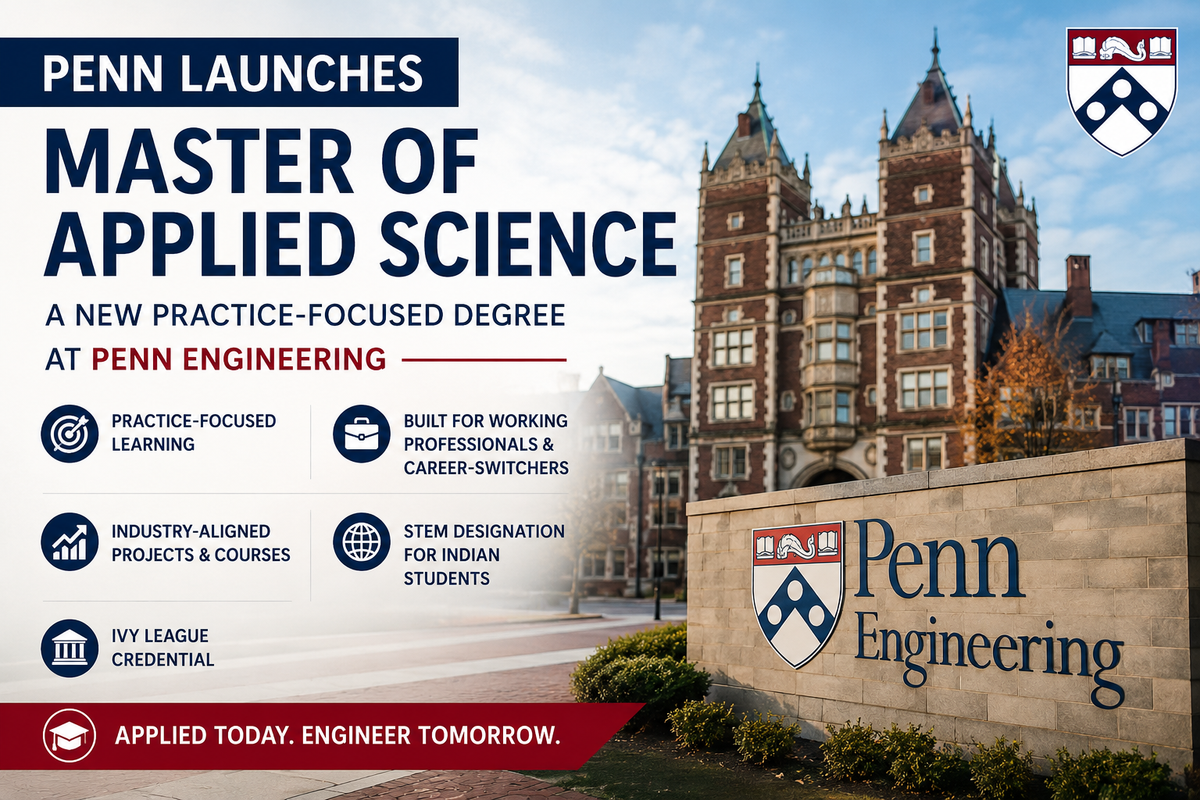
The University of Pennsylvania Trustees have approved a new Penn Master of Applied Science degree at the School of Engineering and Applied Science. The new credential sits alongside the existing MSE programs at Penn Engineering. It targets working professionals and career-switchers who want an applied engineering degree.
- The Master of Applied Science (MAS) is Penn Engineering’s new practice-focused master’s track.
- The degree is built for working engineers and career-switchers, not pure research students.
- Indian applicants get a STEM course tag (lets you work in the US for up to 3 years after).
- Expect fees in Ivy League territory, so a solid funding plan is non-negotiable.
Check Full Fee Structure for MS in USA for Indian Students
Indian applicants have been asking about applied engineering routes at Ivy League schools for two reasons: shorter payback and clearer job outcomes. The Penn MAS is built to answer exactly that question. For Indian students weighing a Fall 2027 application, this changes what Penn Engineering can offer beyond its MSE line.
- What Is the Penn Master of Applied Science?
- Why the Trustees Approved This Degree
- How Penn MAS Differs From an MSE
- Eligibility for Indian Students
- Penn Applied Science Fees and Funding
- Application Timeline and Deadlines
- Visa, STEM OPT and Work Rights
- Career Outcomes and Hiring
- How to Decide if Penn MAS Fits You
What Is the Penn Master of Applied Science?
The Penn Master of Applied Science is a new practice-focused graduate degree at the School of Engineering and Applied Science. It sits beside the existing MSE programs. The MAS format is standard across US engineering schools for applied, industry-ready learning.
The degree puts weight on real projects, labs and industry-aligned coursework. It still carries the Penn Engineering seal and Ivy League credibility. Expect specialisations that mirror Penn’s current strengths in AI, data science, robotics and biotech.
- Credential type: Master of Applied Science (MAS).
- Home school: Penn Engineering (School of Engineering and Applied Science).
- Approving body: University of Pennsylvania Board of Trustees.
- Audience: Working engineers, career-switchers and applied builders.
Source: University of Pennsylvania Board of Trustees public announcement, November 2026. Verify specialisation list on the official Penn Engineering site before applying.
Key Insight: An "applied" master’s is not a lighter master’s. It is a different filter. Penn is picking people who want to build and ship, not write papers.
Why the Trustees Approved This Degree
University of Pennsylvania Trustees signed off on the Penn Master of Applied Science to meet rising demand for applied engineering talent. Big tech, biotech and finance firms want engineers who can ship on day one. A pure research master’s does not always deliver that.
Peer schools have moved in this direction over the last five years. Harvard, Columbia and Cornell Tech run strong applied tracks. Penn Engineering wants a direct answer to that shift.
- Industry demand: Applied engineers are the current hiring priority for US employers.
- Peer pressure: Other Ivies launched applied tracks first. Penn is closing the gap.
- Revenue line: Self-funded applied master’s are a fast-growing income stream for US schools.
Source: University of Pennsylvania Trustees meeting minutes, November 2026. Programme start date and intake size are expected to be confirmed on the Penn Engineering admissions page.
How Penn MAS Differs From an MSE
The Penn MAS is built for application. The MSE leans more toward research and theory. Both carry equal Ivy weight. They just filter and train different kinds of engineers. If you plan a PhD after your master’s, an MSE is the safer pick. If you plan a product or applied-research job, the MAS maps better to that outcome.
| Dimension | Penn MAS | Penn MSE |
|---|---|---|
| Core focus | Applied, industry-ready work | Research and theoretical depth |
| Thesis | Capstone or applied project | Research thesis option |
| Best for | Builders and switchers | PhD-bound and research roles |
| Classmates | Mix of working engineers | Mostly recent graduates |
| Typical length | 12 to 18 months | 16 to 24 months |
Both degrees share labs, faculty and Penn’s recruiter network. The difference is the frame you walk in with. Pick based on whether you want to write papers or ship products.
Key Insight: The MAS is not a backup for the MSE. Applicants aiming for research jobs should still choose the MSE. Picking wrong hurts your fit score at admissions.
Read More: Differences Between MS, MSE and MEng Programs in USA
Eligibility for Indian Students
Indian applicants need a four-year engineering or science degree with a strong GPA. Penn Engineering typically looks for a 3.3/4.0 or better (roughly 75% and above in Indian grading). Final eligibility will be on the official MAS admissions page.
Standardised tests may be waived for some tracks. English-language tests are required for most Indian applicants from non-English-medium undergrads.
- Undergrad: Four-year BE, BTech or BSc Engineering from a recognised Indian university.
- GPA cutoff: Typically 3.3/4.0 or higher (approximate, verify on official page).
- GRE: Expected to be optional, matching current Penn Engineering master’s policy.
- TOEFL: Usually 100 or above; IELTS 7.0 or above.
- Work experience: Preferred but not always mandatory for applied tracks.
Source: Penn Engineering master’s admissions policy (verify specifics on the official admissions page). Figures above are based on current MSE requirements and are expected to apply to the MAS.
Penn Applied Science Fees and Funding
Penn Engineering master’s fees sit in Ivy League range, roughly USD 55,000 to USD 65,000 per year for tuition alone. The MAS is expected to fall in the same band. Add living costs in Philadelphia of around USD 20,000 to USD 25,000 a year. Scholarships at Penn are limited for master’s students. Most Indian students fund through education loans from Indian or international lenders.
| Cost Head | Estimated Annual Range (USD) | INR Equivalent (approx) |
|---|---|---|
| Tuition | $55,000 to $65,000 | INR 48.68 lakh to INR 57.53 lakh |
| Living (Philadelphia) | $20,000 to $25,000 | INR 17.70 lakh to INR 22.13 lakh |
| Health insurance | $3,500 to $4,500 | INR 3.10 lakh to INR 3.98 lakh |
| Books and supplies | $1,200 to $2,000 | INR 1.06 lakh to INR 1.77 lakh |
| Total per year | $79,700 to $96,500 | INR 70.54 lakh to INR 85.40 lakh |
Conversions based on a USD-INR rate of INR 88.50 as of November 17, 2026. Rates fluctuate; check the current rate before financial planning.
Total two-year cost can reach INR 1.4 crore to INR 1.7 crore before any scholarship or part-time earnings. Plan a 5 to 8% currency buffer for rupee weakening over the course.
- HDFC Credila: Loans up to INR 1.5 crore for Ivy League admits.
- Avanse: Flexible repayment, good for Penn Engineering admits.
- SBI Global Ed-Vantage: Lower interest, requires collateral for high-ticket loans.
- Prodigy Finance: No-collateral option for top US master’s admits.
Key Insight: At Penn Engineering, assistantships are easier to win in research-heavy MSE tracks. The applied MAS may have fewer on-campus funding routes. Budget as if no scholarship will land.
Source: University of Pennsylvania Student Financial Services published cost-of-attendance (verify Fall 2027 numbers on the official site).
Application Timeline and Deadlines
Penn Engineering master’s applications typically open in September and close between December and February. The first MAS intake is expected for Fall 2027. Deadlines will be published on the official Penn Engineering admissions page. Plan backwards from the deadline. GRE (if needed), TOEFL, letters, SOP and transcripts each take real time.
| Month | Action |
|---|---|
| March to May 2026 | Research the MAS specialisation; shortlist faculty projects |
| June to July 2026 | Take TOEFL or IELTS; prep GRE if required |
| August 2026 | Draft SOP and request recommendation letters |
| September 2026 | Portal opens; start filling application |
| December 2026 to February 2027 | Submit application by the posted deadline |
| March to April 2027 | Decisions released |
| May 2027 | Accept offer; pay deposit; start I-20 process |
| June to July 2027 | Apply for F-1 visa; book interview |
| August to September 2027 | Fly out for Fall 2027 intake |
If a February 2027 deadline is yours, then your SOP finish line sits 3 weeks before. That means recommenders should hear from you 6 weeks before.
Source: Penn Engineering master’s application cycle (verify MAS-specific dates on the official page once published).
Visa, STEM OPT and Work Rights
Penn Engineering master’s degrees carry a STEM course tag, which lets you work in the US for up to 3 years after graduation. The MAS is expected to carry the same STEM designation. Indian students get 12 months of standard OPT plus a 24-month STEM OPT extension. The F-1 visa is the standard route. You need an I-20 from Penn, SEVIS fee payment and a visa interview at a US consulate.
- F-1 visa: Standard US student visa for degree programmes.
- OPT: 12 months of post-course work permission on your F-1.
- STEM OPT: 24 extra months if your course is STEM-tagged.
- H-1B: You can enter the H-1B lottery during OPT for long-term work.
Source: USCIS official pages on F-1, OPT and STEM OPT extension (verify STEM CIP code on the MAS programme once listed).
Career Outcomes and Hiring
Penn Engineering graduates place strongly across tech, finance and biotech in the US. Median first-year salaries at Penn Engineering master’s programmes sit in the USD 110,000 to USD 145,000 range for strong profiles. MAS graduates are expected to land in similar bands given the applied focus.
Top recruiters at Penn Engineering historically include Google, Amazon, Microsoft, Meta, JPMorgan, Goldman Sachs and biotech firms in the Boston and Philadelphia corridors.
| Role | Estimated Median Salary (USD) | INR Equivalent |
|---|---|---|
| Software Engineer | $130,000 to $150,000 | INR 1.15 cr to INR 1.33 cr |
| Data Scientist | $120,000 to $140,000 | INR 1.06 cr to INR 1.24 cr |
| ML Engineer | $135,000 to $160,000 | INR 1.19 cr to INR 1.42 cr |
| Product Engineer | $115,000 to $135,000 | INR 1.02 cr to INR 1.19 cr |
| Biotech R&D Engineer | $95,000 to $115,000 | INR 84 lakh to INR 1.02 cr |
Source: Approximate Penn Engineering employment outcomes (verify on the official Penn Engineering career services report). These are estimates based on past MSE placement bands.
What the Penn MAS gives you:
- Ivy League engineering brand recognised by every US recruiter.
- Applied projects that match job descriptions directly.
- STEM OPT eligibility for a 3-year US work window.
- Access to Penn’s East Coast recruiter pipeline.
What Penn MAS does not cover:
- A guaranteed H-1B visa after OPT.
- Full scholarship funding for most admits.
- A PhD research pathway (choose MSE for that).
- Sponsorship from every employer on campus.
How to Decide if Penn MAS Fits You
Pick the Penn Master of Applied Science if you want an applied engineering career with an Ivy League seal. Pick the MSE if you want to keep a PhD route open. Pick a cheaper state school if ROI is your main filter.
If you have 2 to 5 years of work experience, this MAS is likely a stronger fit than a traditional MSE. If you are a fresh graduate with research intent, think again.
- Good fit: Working engineers, applied builders, career-switchers from adjacent fields.
- Okay fit: Fresh graduates with strong product projects and clear industry goals.
- Weak fit: PhD-track students or anyone who wants heavy research lab time.
Key Insight: The Penn MAS is built for industry-bound students. The trade-off is less time in research labs and less chance of tuition waiver. Pick the degree that matches your five-year plan, not the brand prestige.
Also Check:
The Penn Master of Applied Science is a direct response to how engineering hiring has shifted in the US. Applied talent wins interviews. The MAS format tells recruiters you can ship, not just write papers. Indian applicants should treat this as a serious option alongside the MSE, not a lighter version of it. Confirm specialisation lists, deadlines and final fees on the official Penn Engineering admissions page before you apply.
FAQs
Ques. What is the Penn Master of Applied Science degree?
Ans. The Penn Master of Applied Science is a new practice-focused graduate degree at Penn Engineering. It sits beside the existing MSE programs. The Trustees approved it in November 2026. The degree targets working engineers and career-switchers who want applied training with an Ivy seal.
Ques. When does the Penn MAS programme start?
Ans. The first intake is expected in Fall 2027. Official start dates will be posted on the Penn Engineering admissions page once applications open. Indian students should plan tests and documents by mid-2026 to meet the first deadline.
Ques. How much does the Penn MAS cost for Indian students?
Ans. Expect total costs of USD 80,000 to USD 96,500 per year, or around INR 70 lakh to INR 85 lakh. Two-year totals can touch INR 1.7 crore. Scholarships are limited at the master’s level, so most Indian students use education loans.
Ques. Is the Penn MAS STEM-designated?
Ans. Yes. Penn Engineering master’s degrees carry a STEM course tag. That gives Indian graduates up to 36 months of US work permission (12 months OPT plus 24 months STEM OPT). The MAS is expected to carry the same tag.
Ques. What are the eligibility requirements for Indian applicants?
Ans. You need a four-year engineering or science degree with a GPA of 3.3/4.0 or higher (about 75% and above). TOEFL 100+ or IELTS 7.0+ is standard. GRE is expected to be optional. Work experience is preferred for the applied track.
Ques. How is the Penn MAS different from the Penn MSE?
Ans. The MAS is built for applied work and industry careers. The MSE leans toward research and PhD preparation. Both carry the same Ivy weight. Pick MAS if you want to ship products. Pick MSE if you plan a PhD or a research job.
Ques. Can Indian students get scholarships for the Penn MAS?
Ans. Scholarships are limited at Penn Engineering master’s level. Some merit awards exist but cover only part of the tuition. Most Indian students use loans from HDFC Credila, Avanse, SBI Global Ed-Vantage or Prodigy Finance.
Ques. What jobs can I get after a Penn MAS?
Ans. Common roles include Software Engineer, Data Scientist, ML Engineer, Product Engineer and Biotech R&D Engineer. Median first-year salaries for strong profiles sit in the USD 110,000 to USD 145,000 range. Top recruiters include Google, Amazon, Microsoft, Meta and JPMorgan.
Ques. When will Penn MAS applications open?
Ans. Penn Engineering master’s applications typically open in September. For the Fall 2027 intake, expect the portal to open in September 2026. Deadlines usually fall between December 2026 and February 2027. Confirm on the official admissions page.
Ques. Is GRE required for the Penn MAS?
Ans. GRE is expected to be optional, matching current Penn Engineering policy. Submit a strong GRE score if your GPA is below 3.5 or your undergrad school is not well-known. For IIT, BITS and NIT profiles, the GRE is often skipped.
Ques. Can I work in the US after the Penn MAS?
Ans. Yes. Indian graduates get 12 months of OPT on their F-1 visa. If the MAS keeps its STEM tag, you get 24 extra months of STEM OPT. That is three years of US work, plus three H-1B lottery tries for long-term stay.
Ques. Is the Penn MAS worth it for Indian students?
Ans. Yes for applied engineers with a clear industry plan. The Ivy League brand, STEM OPT tag and East Coast recruiter pipeline justify the fees for most Indian applicants. ROI payback is typically 3 to 5 years post-graduation for strong placements.







interested in this College ?
Follow & Share this college to get information about admission.



Comments