




SLAT 2026 Slot 2 Question Paper with Solution PDF is available for download. Symbiosis International (Deemed University) conducted the SLAT 2026 exam for Slot 2 on Dec 28, 2025. The question paper comprised a total of 60 questions, divided across sections including Logical Reasoning, Legal Reasoning, Analytical Reasoning, Reading Comprehension, and General Knowledge. The total duration of the exam is 60 minutes. You can download SLAT 2026 Slot 2 Question paper with Solutions from the links provided below.
SLAT 2026 Question Paper Slot 2 with Solution PDF
| SLAT 2026 Slot 2 Question Paper | Download PDF | Check Solutions |
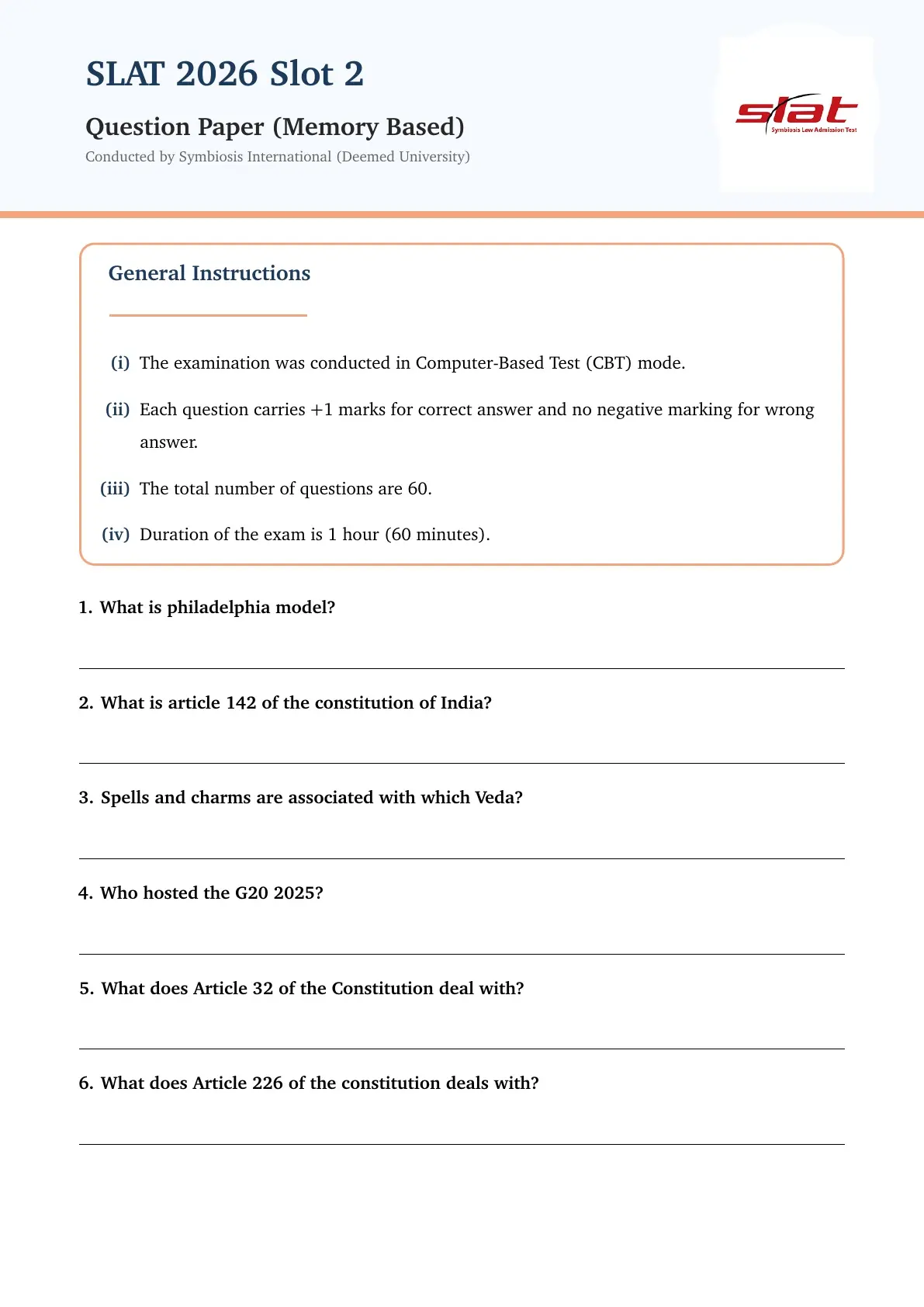
What is philadelphia model?
View Solution
Concept:
In criminal jurisprudence and policing reform, the Philadelphia Model refers to a groundbreaking collaborative oversight mechanism established to evaluate, audit, and improve police responses to crimes of sexual assault and gender-based violence.
The model directly confronts the systemic issue of secondary victimization and the premature administrative dismissal or classification of sexual assault complaints as "unfounded" by investigating authorities.
Step 1: Origin and Historical Context:
The model originated in Philadelphia, United States, in 2000 following investigative revelations that the local police department was routinely dismissing hundreds of legitimate rape and sexual assault complaints without thorough inquiry.
To restore institutional accountability, the Philadelphia Police Department partnered with frontline civilian advocates, legal experts, and crisis center specialists.
This landmark initiative granted independent advocates direct, authorized access to closed and unfounded case files for annual auditing.
Step 2: Core Operational Mechanism:
Under the Philadelphia Model, independent civilian review teams systematically review case files classified as unfounded, inactive, or cleared without charges.
The external auditors examine whether investigators adhered to trauma-informed interview protocols, conducted proper forensic testing, pursued critical evidentiary leads, and avoided gender-biased assumptions.
If deficiencies are uncovered, the audit committee possesses the formal authority to recommend the reopening and reinvestigation of cases.
Step 3: Global Adoption and Relevance to Legal Reforms:
Due to its remarkable success in drastically lowering unfounded rates and boosting conviction rates, the model has been replicated across jurisdictions worldwide, including nationwide implementation in Canada and adaptations in democratic policing reforms.
In contemporary legal studies and human rights discourse, the Philadelphia Model represents the gold standard for independent victim-centered external scrutiny in law enforcement.
Final Answer:
The Philadelphia Model is an innovative criminal justice and police accountability framework wherein external, independent sexual assault advocates and legal experts audit police files on sexual violence to ensure thorough, unbiased investigations and prevent wrongful case dismissals.
It promotes trauma-informed practices, procedural justice, and institutional transparency.
What is article 142 of the constitution of India?
View Solution
Concept:
Article 142 of the Constitution of India equips the Supreme Court of India with plenary, equitable, and inherent constitutional jurisdiction.
It empowers the apex court to transcend procedural constraints and existing statutory lacunae to ensure substantive justice between disputing parties.
Step 1: Constitutional Text and Core Provision:
Article 142(1) explicitly provides:
"The Supreme Court in the exercise of its jurisdiction may pass such decree or make such order as is necessary for doing complete justice in any cause or matter pending before it."
The provision further mandates that any decree or order passed under this article shall be enforceable throughout the territory of India in such manner as prescribed by Parliament.
Step 2: Scope and Jurisprudential Significance:
The power under Article 142 is extraordinary and curative in nature.
It is designed to address situations where ordinary statutory law is either silent, inadequate, or incapable of granting immediate, equitable relief.
However, the Supreme Court has clarified in landmark rulings (such as the Supreme Court Bar Association v. Union of India) that this power cannot be used to completely override substantive statutory prohibitions or rewrite parliamentary legislation.
Step 3: Landmark Applications of Article 142:
1. Union Carbide Corporation v. Union of India (1991): Invoked to award comprehensive monetary relief and medical rehabilitation to victims of the Bhopal Gas Disaster.
2. M. Siddiq v. Mahant Suresh Das (Ayodhya Case, 2019): Used to allocate an alternative five-acre plot of land to the Sunni Central Waqf Board.
3. Shilpa Sailesh v. Varun Sreenivasan (2023): Affirmed that the Supreme Court can grant divorce directly on the ground of irretrievable breakdown of marriage without waiting for the mandatory statutory cooling-off period under the Hindu Marriage Act.
Final Answer:
Article 142 of the Constitution of India empowers the Supreme Court to pass any decree or order necessary for doing "complete justice" in any cause or matter pending before it.
It represents the apex court’s inherent equitable power to remedy injustice.
Spells and charms are associated with which Veda?
View Solution
Concept:
The sacred literature of ancient India is organized into four canonical Vedas: the Rigveda, Samaveda, Yajurveda, and Atharvaveda.
While the first three Vedas (collectively called the Trayi Vidya) primarily deal with cosmic hymns, sacrificial rituals, and liturgical melodies, the fourth Veda addresses the everyday lived reality, folklore, and practical concerns of common people.
Step 1: Identifying the Fourth Veda:
The Veda universally associated with spells, charms, incantations, and magical formulas is the Atharvaveda.
Named after the revered ancient sages Atharvan and Angiras, it is also historically termed the Atharvangirasa.
It comprises approximately 20 books containing 730 hymns and roughly 6,000 verses.
Step 2: Content and Classification of Hymns:
Unlike the purely liturgical Rigveda, the Atharvaveda contains chants and spells categorized into distinct everyday domains:
1. Bhaisajyani (Medicinal charms): Spells, medicinal plant lore, and invocations utilized to heal physical diseases, snakebites, fevers, and mental afflictions. It forms the foundational precursor to Ayurveda.
2. Santika and Paustika: Chasm-healing spells for domestic peace, harmony, rainfall, long life, and agricultural prosperity.
3. Abhicarika: Protective charms and spells intended to ward off hostile forces, malevolent spirits, curses, and sorcery.
Step 3: Cultural and Historical Importance:
The Atharvaveda offers invaluable anthropological insights into popular religious beliefs, domestic traditions, early medical wisdom, and folkloric spiritual practices of Vedic society.
Final Answer:
Spells and charms are associated with the Atharvaveda.
- Rigveda \(\rightarrow\) Hymns of Praise
- Samaveda \(\rightarrow\) Melodies & Chants
- Yajurveda \(\rightarrow\) Sacrificial Rituals
- Atharvaveda \(\rightarrow\) Spells, Charms, & Healing
Who hosted the G20 2025?
View Solution
Concept:
The Group of Twenty (G20) is the premier international forum for global economic cooperation and governance, comprising nineteen sovereign nations, the European Union, and the newly admitted African Union.
The leadership of the G20 operates on an annual rotational system, where the host nation sets the intergovernmental agenda, steers ministerial task forces, and conducts the concluding Leaders’ Summit.
Step 1: Tracing the G20 Troika and Chronological Presidencies:
The governance of the G20 is guided by the "Troika", comprising the past, current, and incoming host countries:
- 2023: Hosted by India (18th Summit held in New Delhi under the theme "Vasudhaiva Kutumbakam").
- 2024: Hosted by Brazil (19th Summit held in Rio de Janeiro).
- 2025: Hosted by South Africa (20th Summit).
Step 2: Significance of the 2025 Host Nation:
South Africa holds the formal G20 Presidency for the 2025 calendar year, commencing from December 1, 2024, through November 30, 2025.
This marks a historic milestone in international diplomacy, as it is the first time an African country has hosted the G20 Leaders’ Summit.
South Africa completes the consecutive cycle of Global South leadership of the G20 (Indonesia 2022, India 2023, Brazil 2024, and South Africa 2025).
Step 3: Key Priorities of South Africa’s 2025 Presidency:
The South African presidency prioritizes inclusive economic growth, climate financing, sovereign debt restructuring for developing nations, and advancing the African Union’s integration into global economic governance.
Final Answer:
The G20 Summit in 2025 is hosted by South Africa.
2022: Indonesia \(\rightarrow\) 2023: India \(\rightarrow\) 2024: Brazil \(\rightarrow\) 2025: South Africa.
South Africa is the first African nation ever to hold the G20 presidency.
What does Article 32 of the Constitution deal with?
View Solution
Concept:
A declaration of fundamental rights remains meaningless unless an effective, accessible, and expeditious legal remedy exists to enforce them against state infringement.
Article 32 of the Indian Constitution provides the foundational procedural mechanism for the judicial enforcement of fundamental rights guaranteed under Part III.
Step 1: Constitutional Guarantee of Legal Remedies:
Article 32 guarantees the Right to Constitutional Remedies.
Significantly, Article 32 is itself a Fundamental Right; this means an aggrieved citizen does not merely request judicial discretion, but exercises a guaranteed constitutional right to directly petition the Supreme Court of India.
Dr. B.R. Ambedkar famously remarked in the Constituent Assembly that Article 32 is the "very soul of the Constitution and the very heart of it", asserting that without it, the Constitution would be rendered a nullity.
Step 2: Prerogative Writ Powers:
Under Article 32(2), the Supreme Court is empowered to issue directions, orders, or writs in the nature of:
1. Habeas Corpus: To produce a person unlawfully detained and secure their release.
2. Mandamus: To command a public authority or official to execute a statutory duty.
3. Prohibition: To prevent an inferior court or tribunal from exceeding its legitimate jurisdiction.
4. Certiorari: To quash illegal or unconstitutional orders passed by inferior judicial or quasi-judicial bodies.
5. Quo Warranto: To challenge an unlawful claimant’s title to a public office.
Step 3: Essential Limitations and Protections:
Article 32 can be invoked strictly for the enforcement of Part III Fundamental Rights, not for ordinary legal or common-law rights.
Furthermore, Article 32(4) mandates that this right cannot be suspended except as expressly provided by the Constitution (such as during a Proclamation of Emergency under Article 359).
Final Answer:
Article 32 deals with the Right to Constitutional Remedies, empowering citizens to move the Supreme Court directly for the enforcement of Fundamental Rights through the issuance of prerogative writs.
It can ONLY be invoked to enforce Fundamental Rights (Part III), not ordinary legal rights.
What does Article 226 of the constitution deals with?
View Solution
Concept:
While Article 32 confers writ jurisdiction upon the apex court, Article 226 of the Constitution of India equips the High Courts across the states with extraordinary power to issue prerogative writs and orders.
This establishes a decentralized, accessible constitutional safeguard against administrative arbitrariness and legislative overreach at the state level.
Step 1: Scope and Text of Article 226:
Article 226(1) states that every High Court shall have the power, throughout the territories in relation to which it exercises jurisdiction, to issue to any person or authority (including any Government) orders, directions, or writs.
These include the five classic prerogative writs: Habeas Corpus, Mandamus, Prohibition, Quo Warranto, and Certiorari.
Step 2: Key Distinction Between Article 226 and Article 32:
1. Broader Subject-Matter Jurisdiction:
Article 32 can be invoked exclusively for the enforcement of Fundamental Rights.
In contrast, Article 226 empowers High Courts to issue writs for the enforcement of Fundamental Rights "and for any other purpose".
The phrase "for any other purpose" extends High Court jurisdiction to ordinary statutory, legal, and common-law rights, making its writ scope wider than that of the Supreme Court.
2. Discretionary Nature:
Unlike Article 32 (which is itself a fundamental right), the remedy under Article 226 is a discretionary constitutional power of the High Court.
3. Territorial Limitation:
A High Court can only issue writs within its defined territorial jurisdiction, or where the cause of action wholly or partially arises within its territory (Article 226(2)).
Step 3: Institutional Significance:
Article 226 acts as the backbone of judicial review and administrative law in India, allowing citizens to rapidly challenge arbitrary executive actions, illegal tender cancellations, unlawful detentions, and regulatory violations.
Final Answer:
Article 226 deals with the power of the High Courts to issue directions, orders, and writs (including Habeas Corpus, Mandamus, Prohibition, Quo Warranto, and Certiorari) for the enforcement of Fundamental Rights as well as for any other legal purpose.
- Article 32 (Supreme Court): Fundamental Rights ONLY (Guaranteed Right).
- Article 226 (High Courts): Fundamental Rights + Any Other Purpose (Wider, Discretionary Power).



Comments