



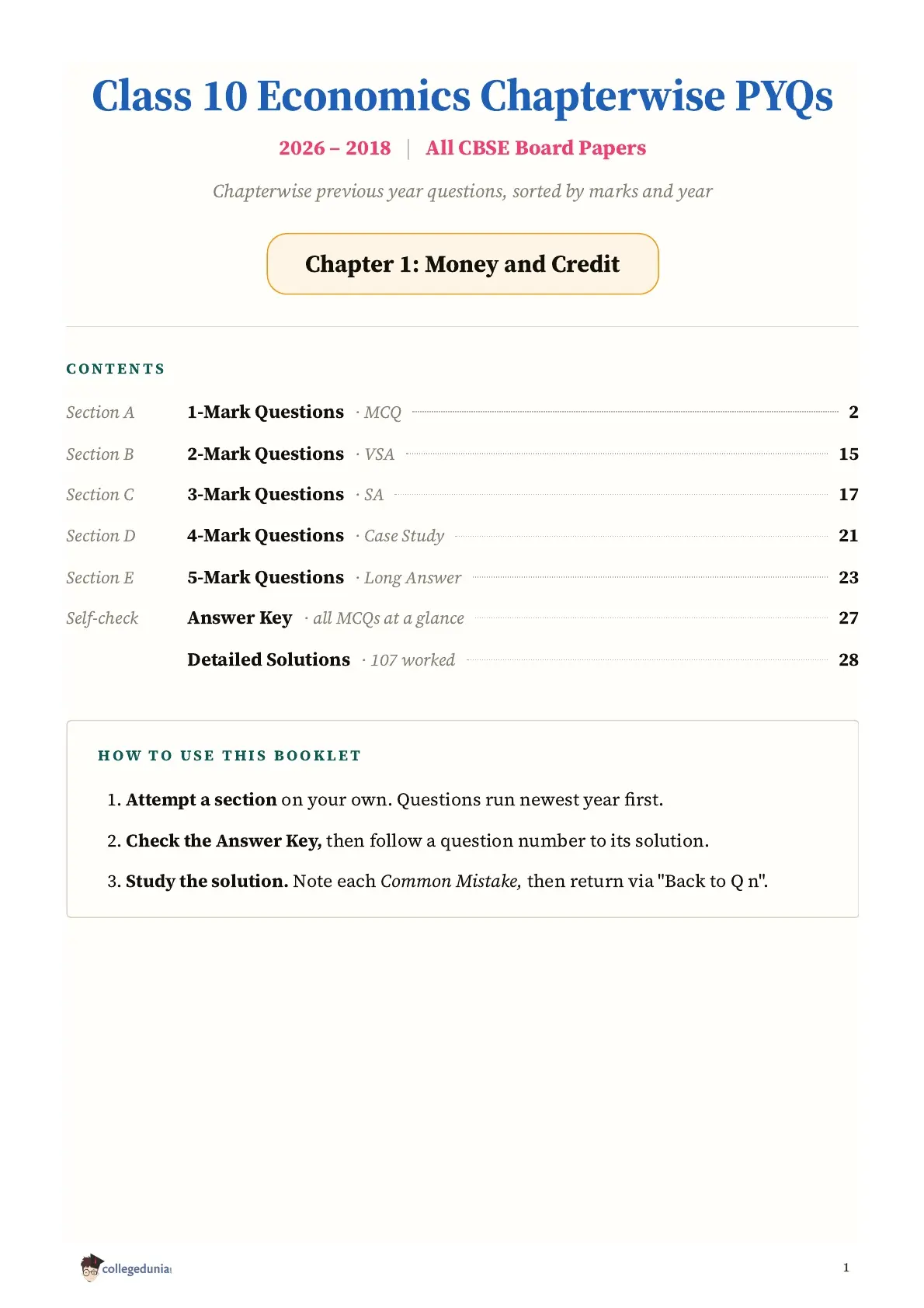
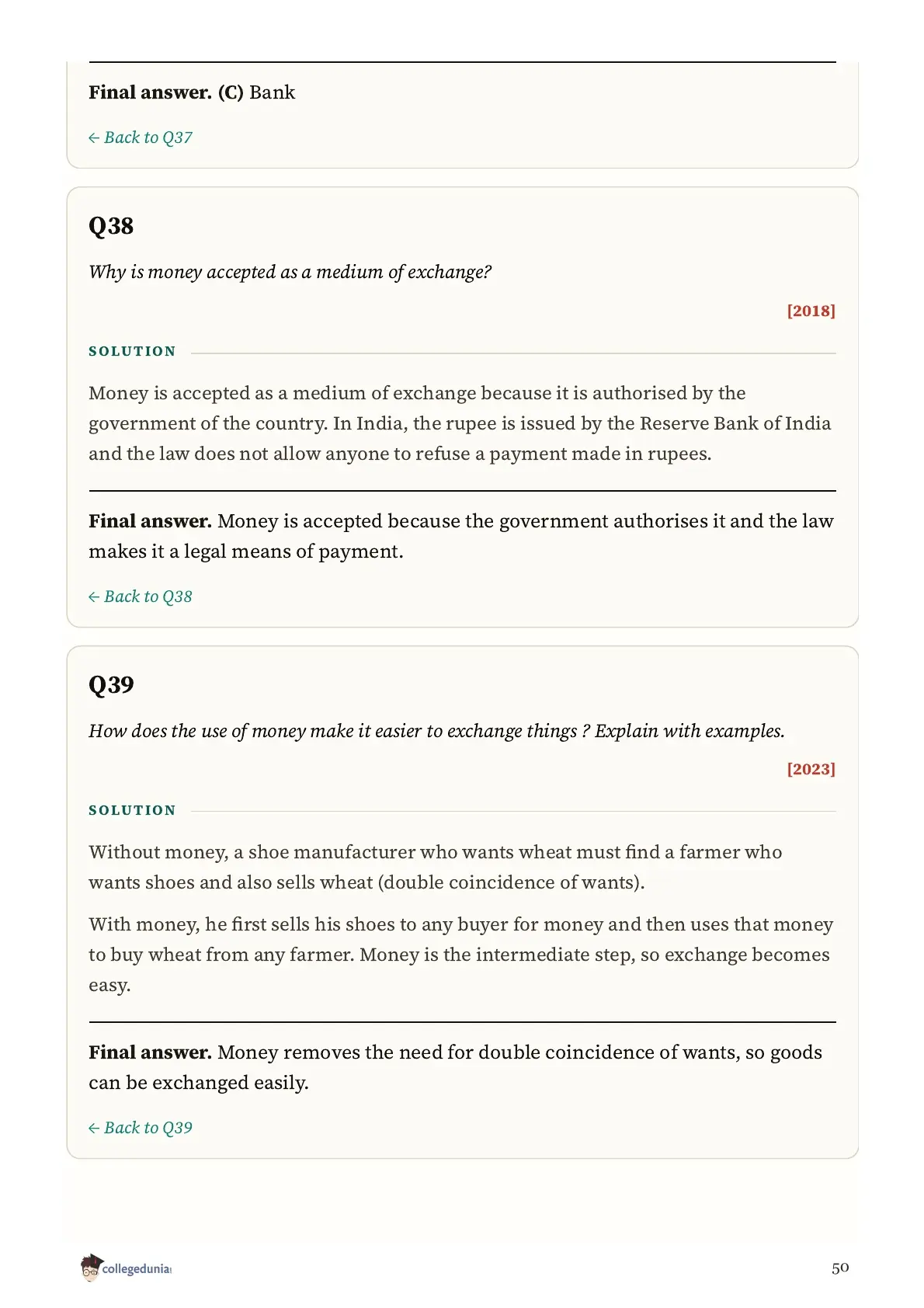
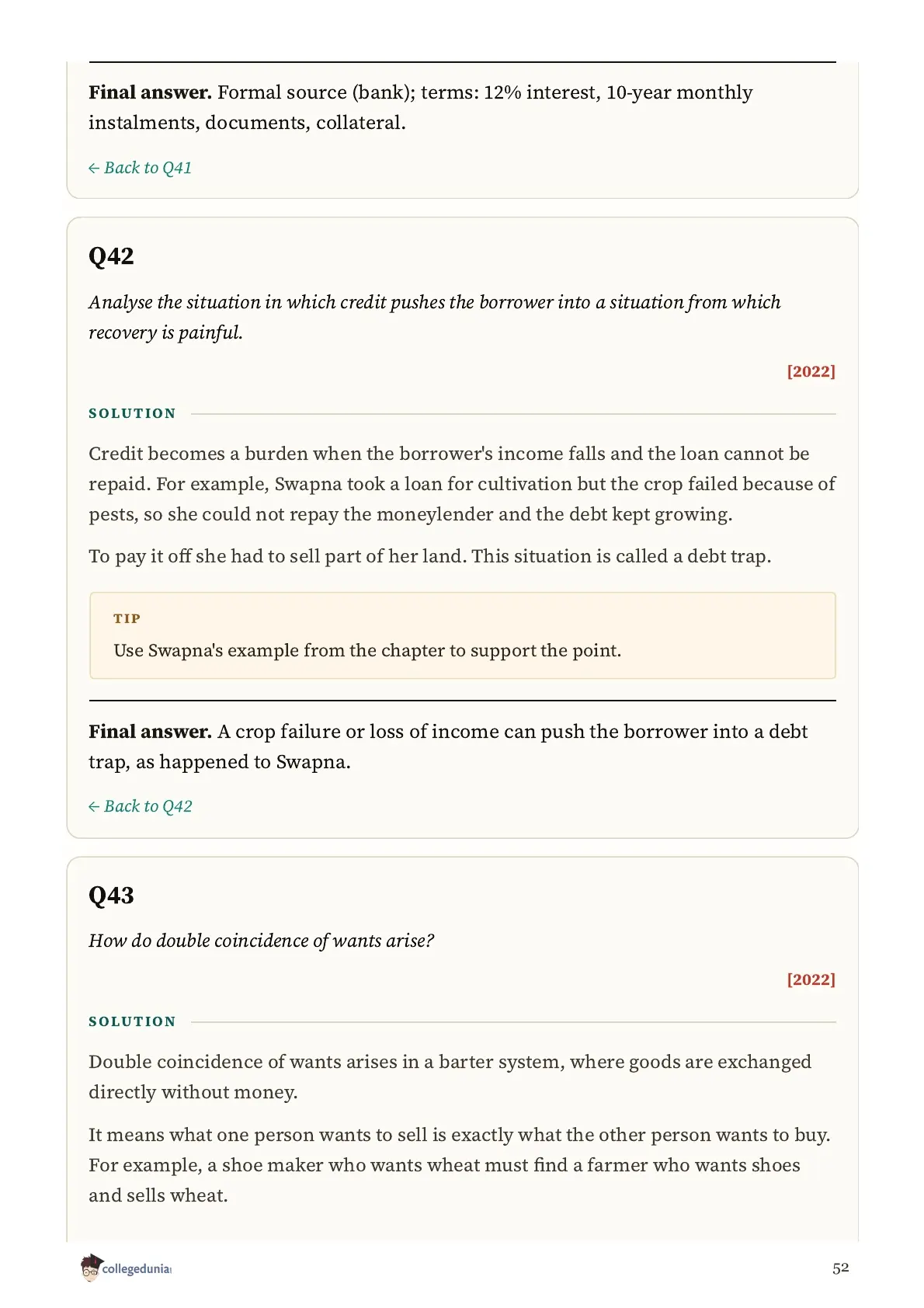
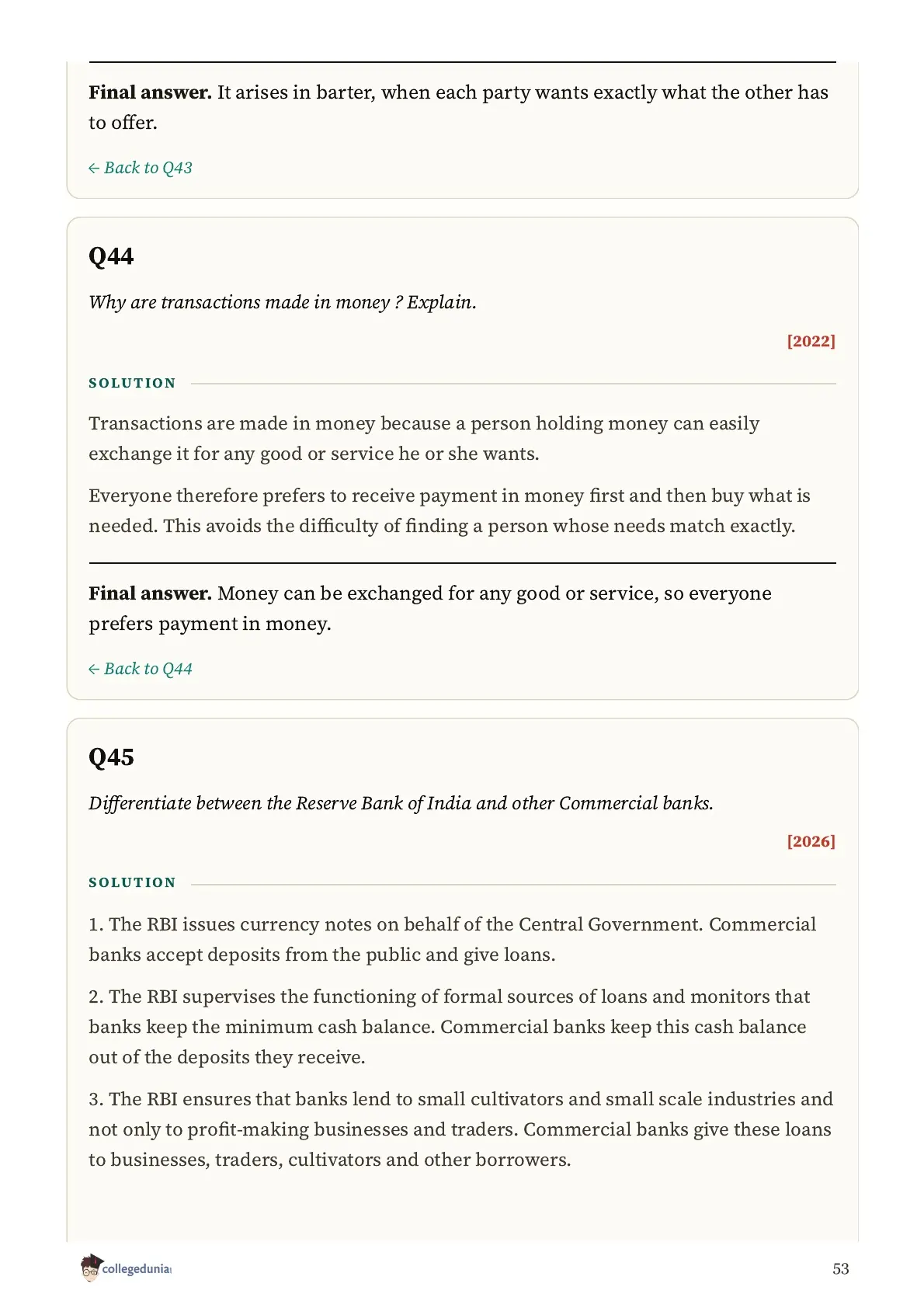
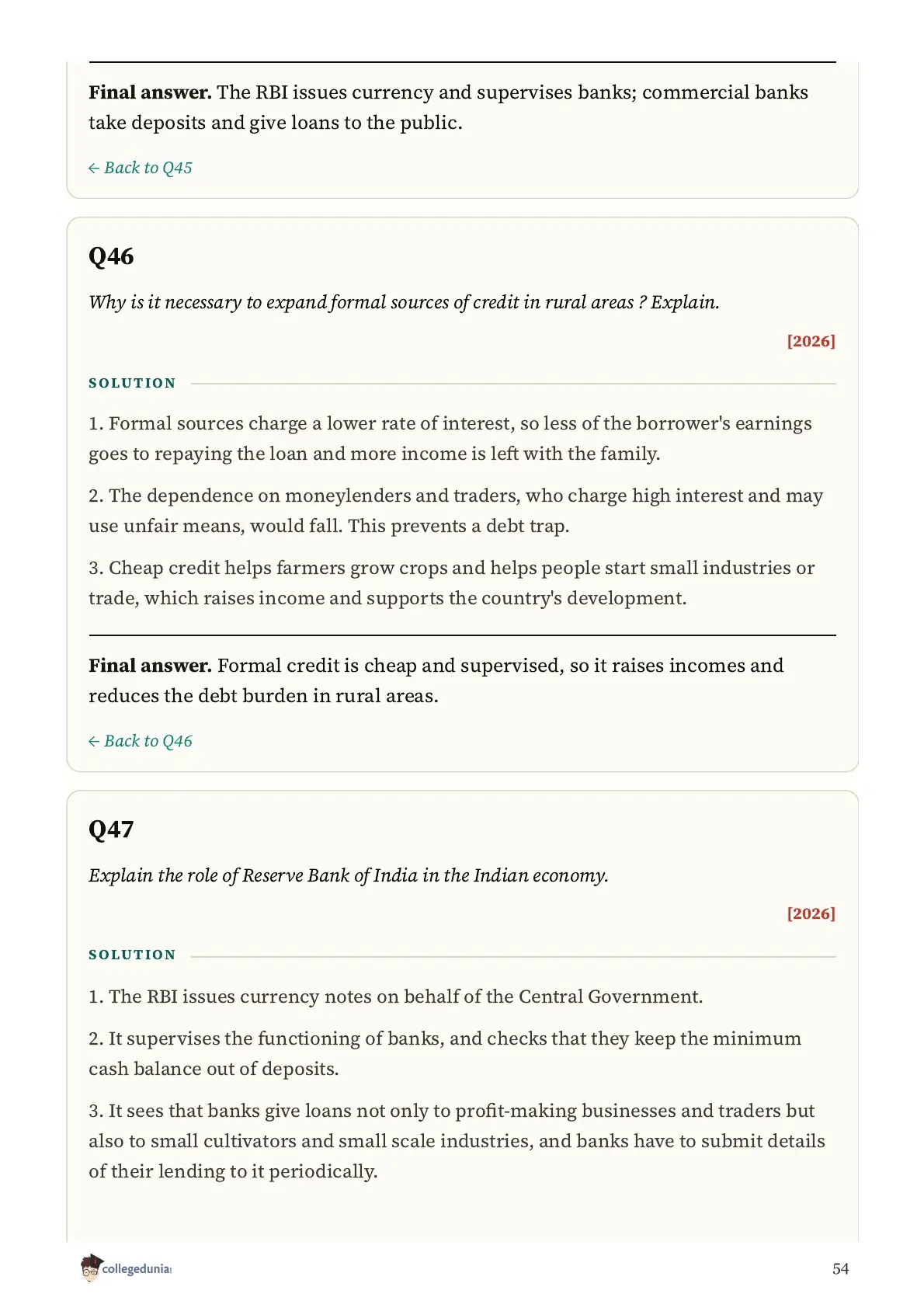
Class 10 Economics Money and Credit PYQ, free to download as a 90-page PDF with 107 solved board questions from the 2018 to 2026 papers. Money and Credit is Chapter 3 of the NCERT Class 10 Economics book and one of the chapters behind the 20-mark Economics section of the Social Science paper.
The questions keep returning to banks (45 questions), credit (44), loans (27), formal and informal sources of credit (26), self-help groups (16) and collateral (11).
On this page you get:
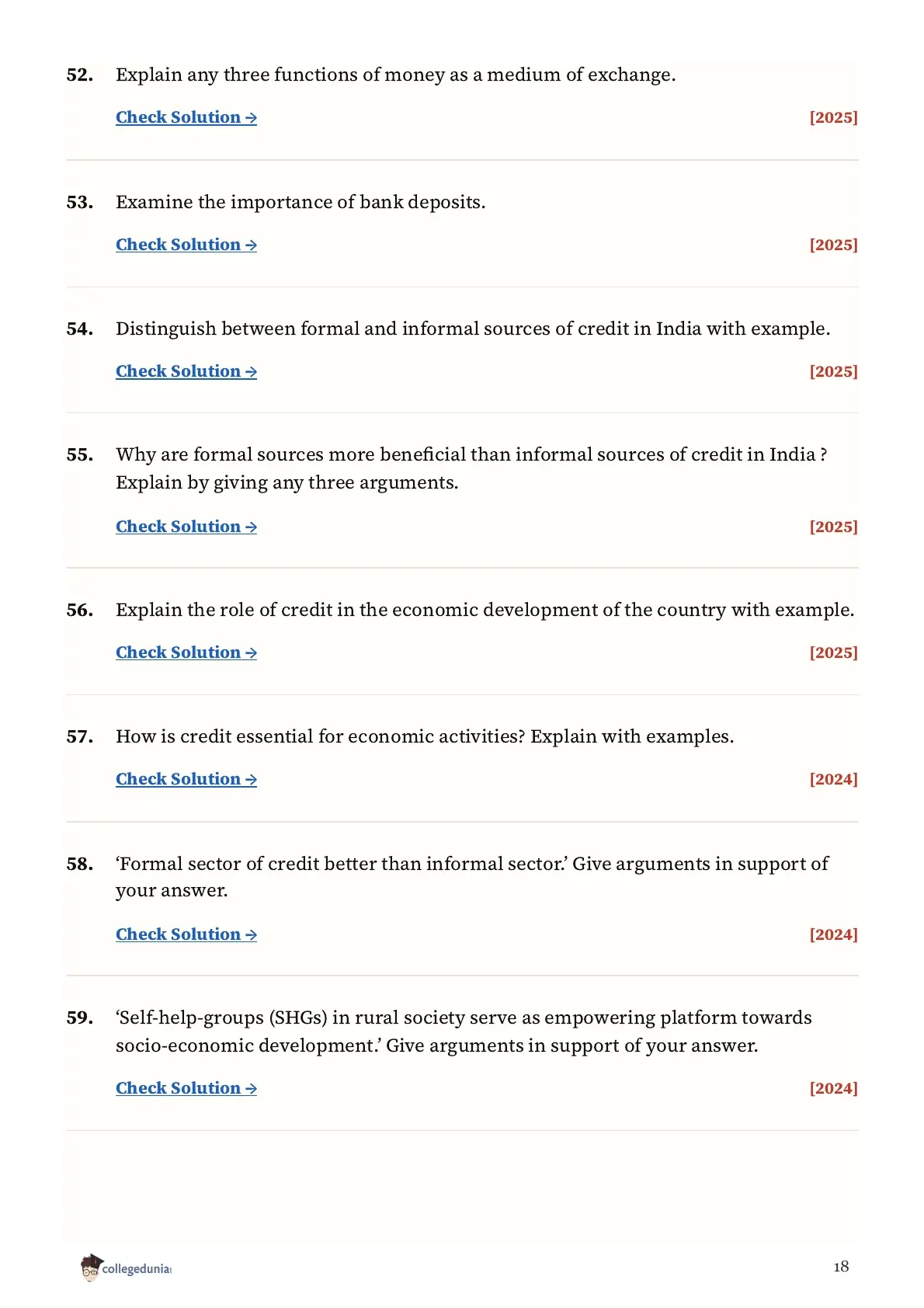
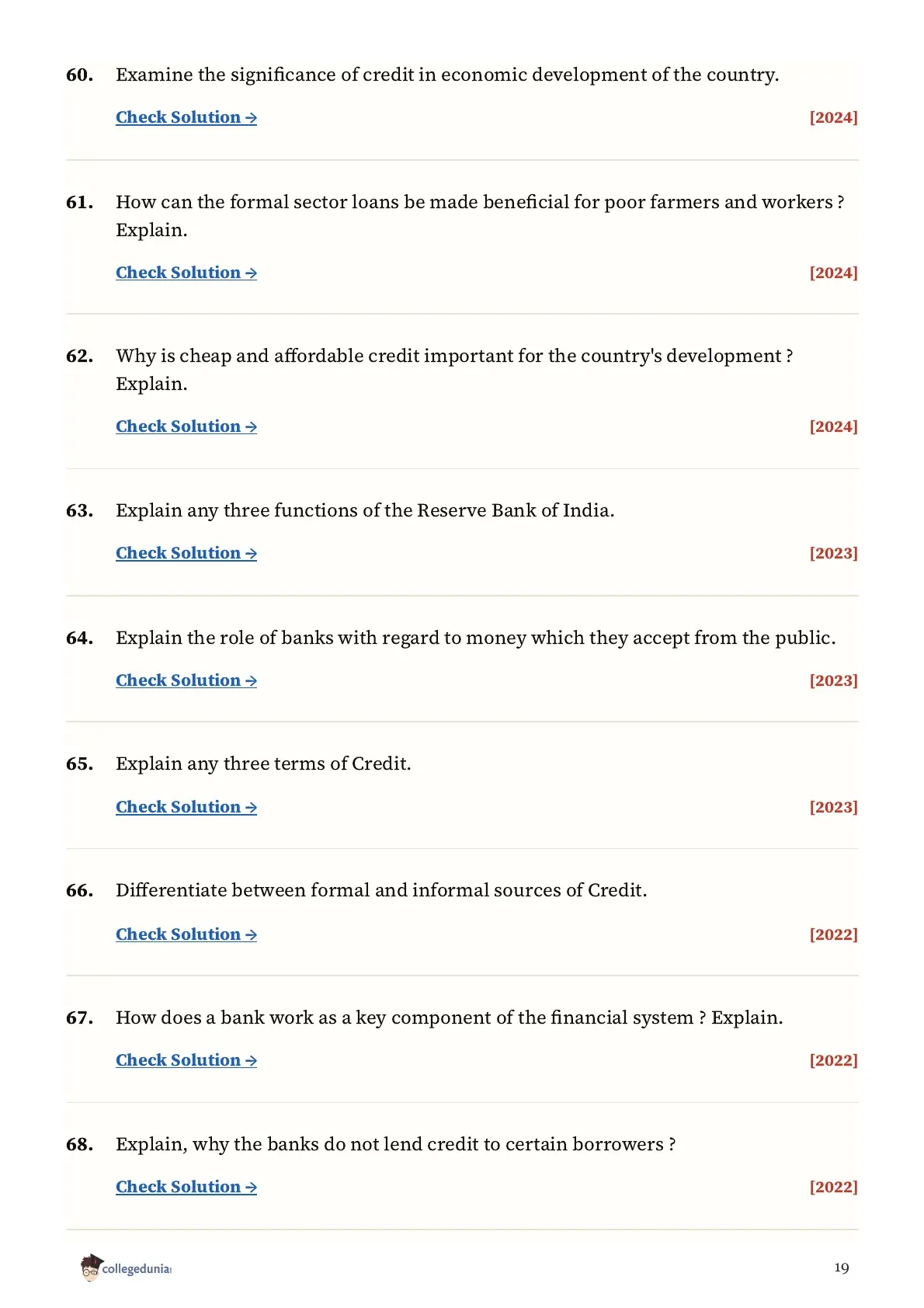
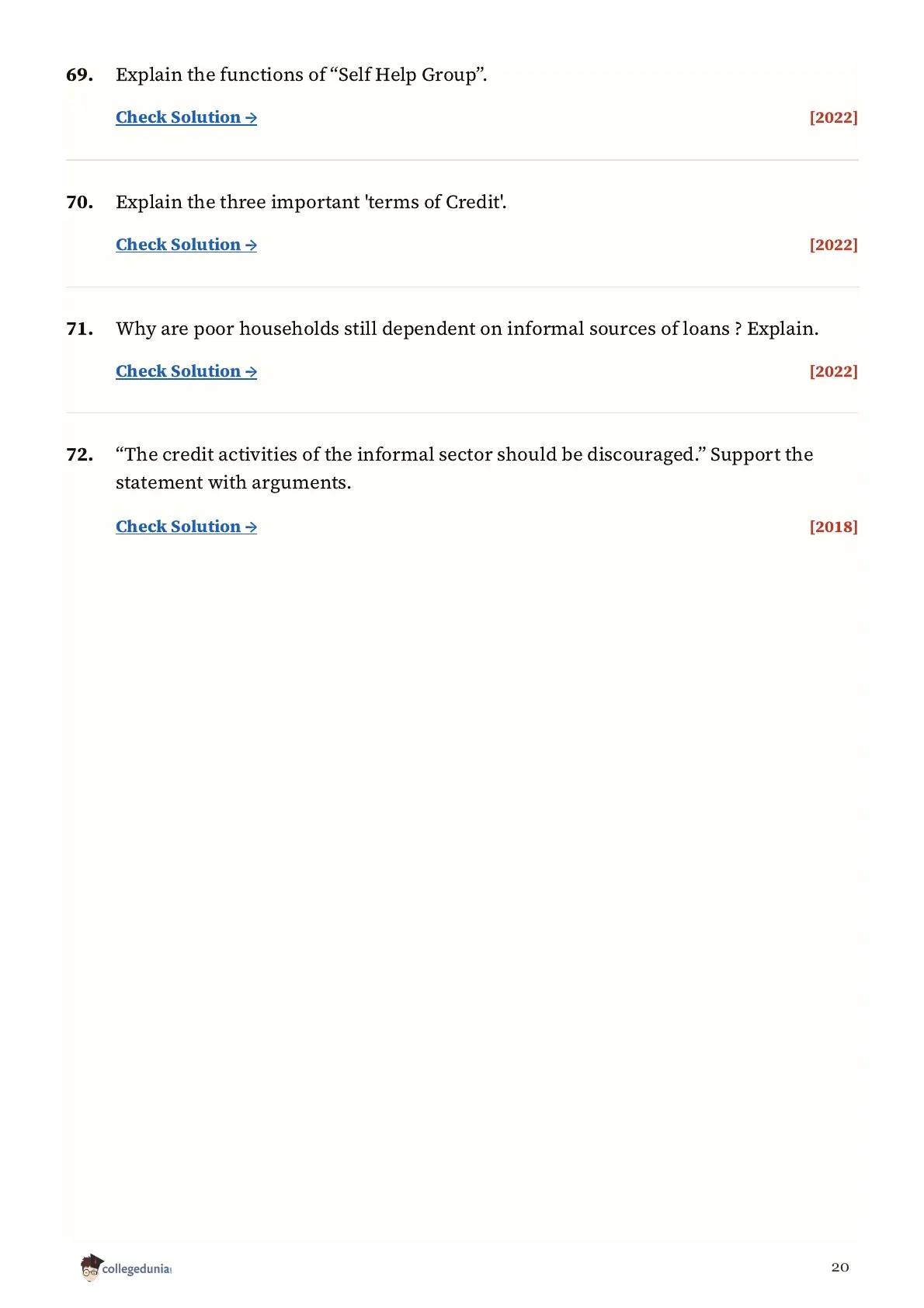
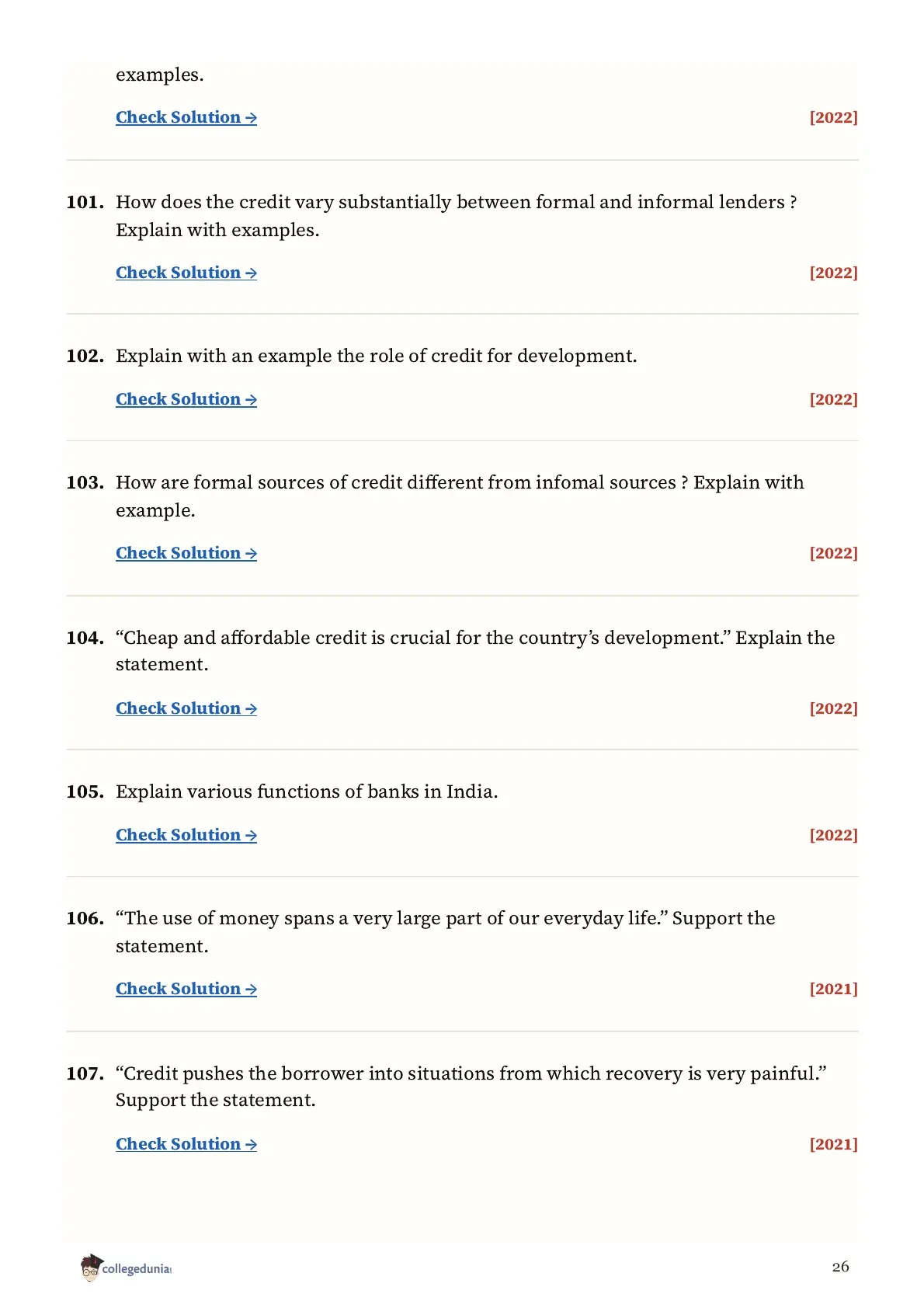
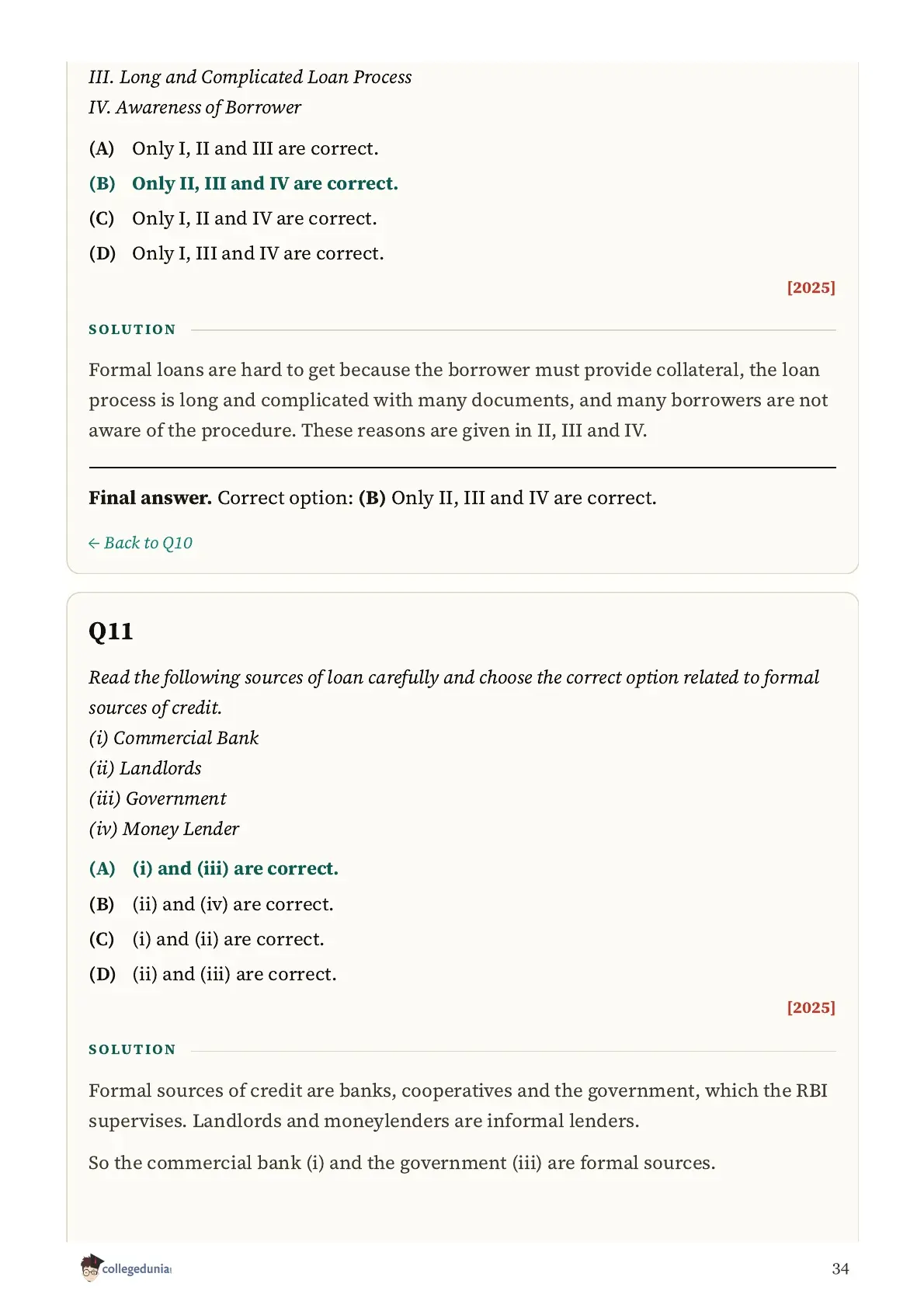
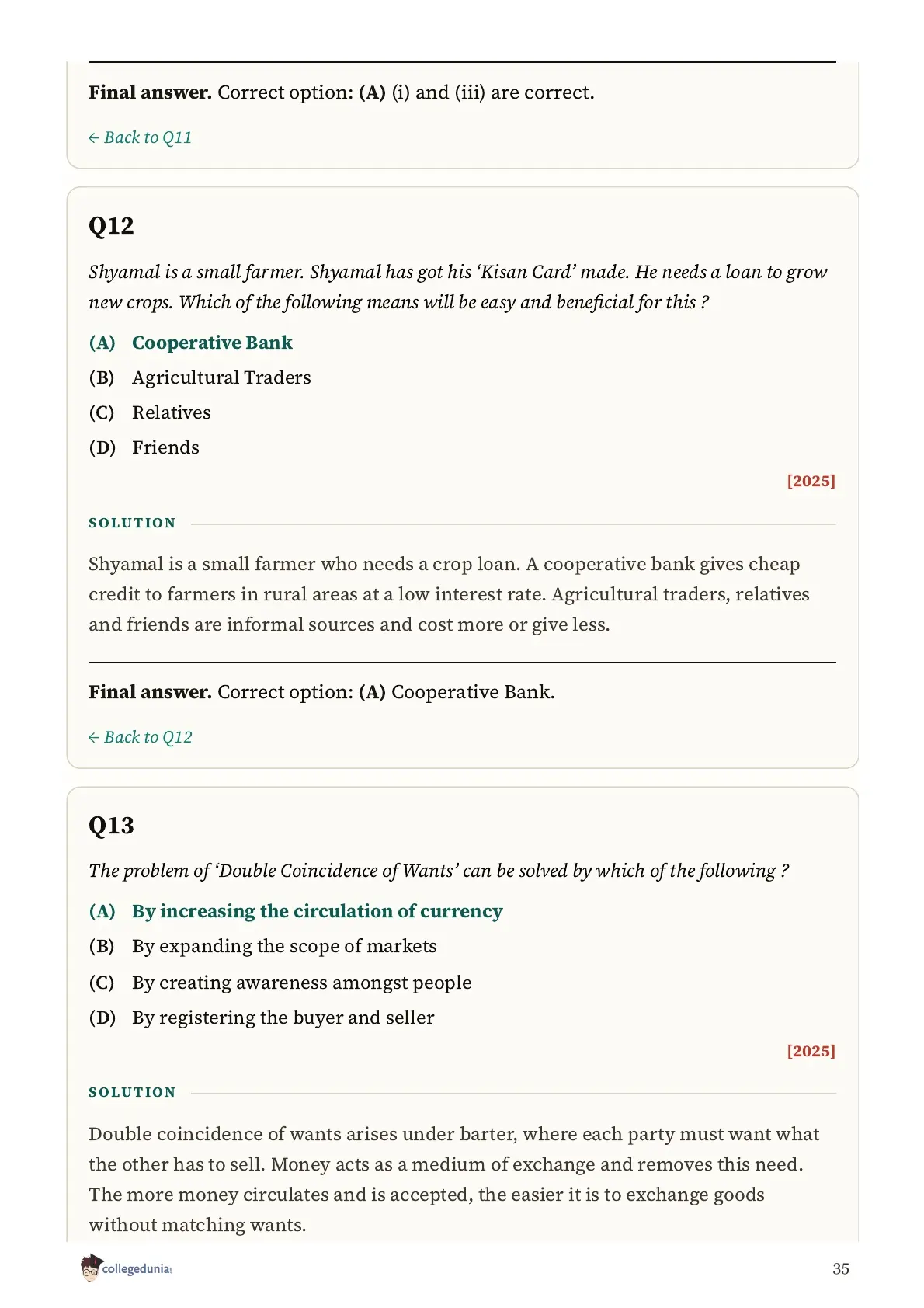
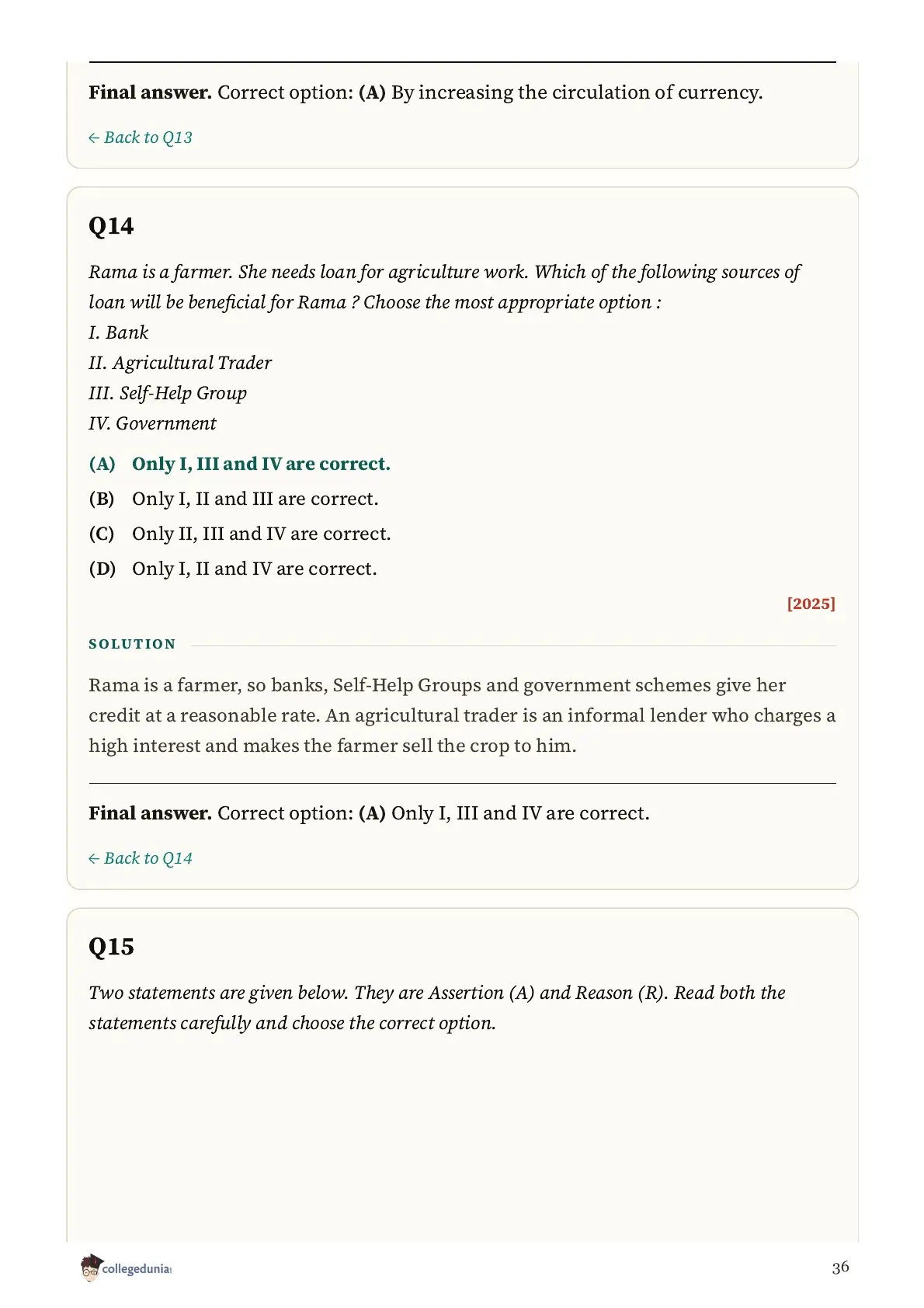
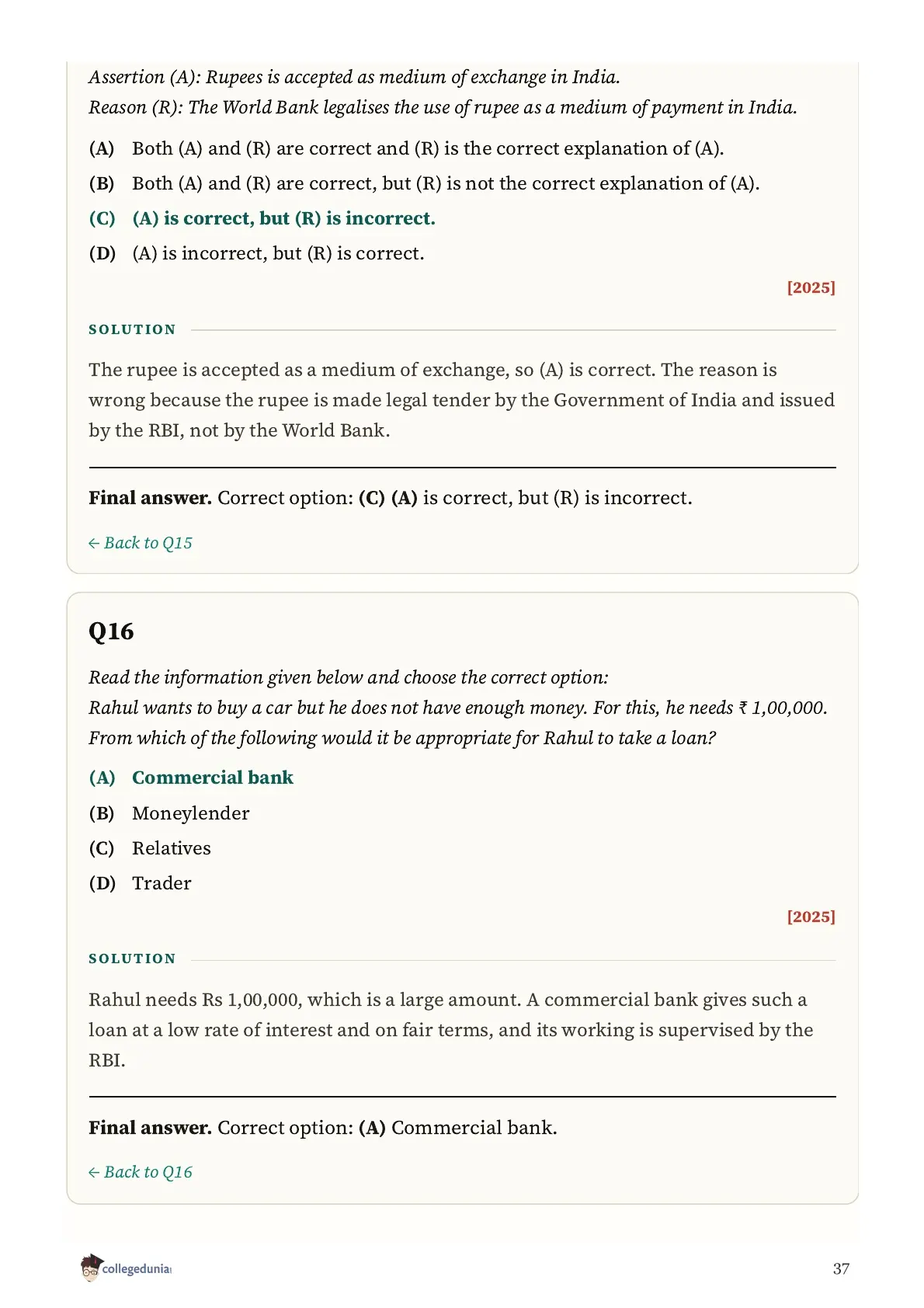
- 107 questions with a worked solution each: 37 MCQs, 35 short answers of 1 to 3 marks and 35 long answers or source-based questions of 4 and 5 marks
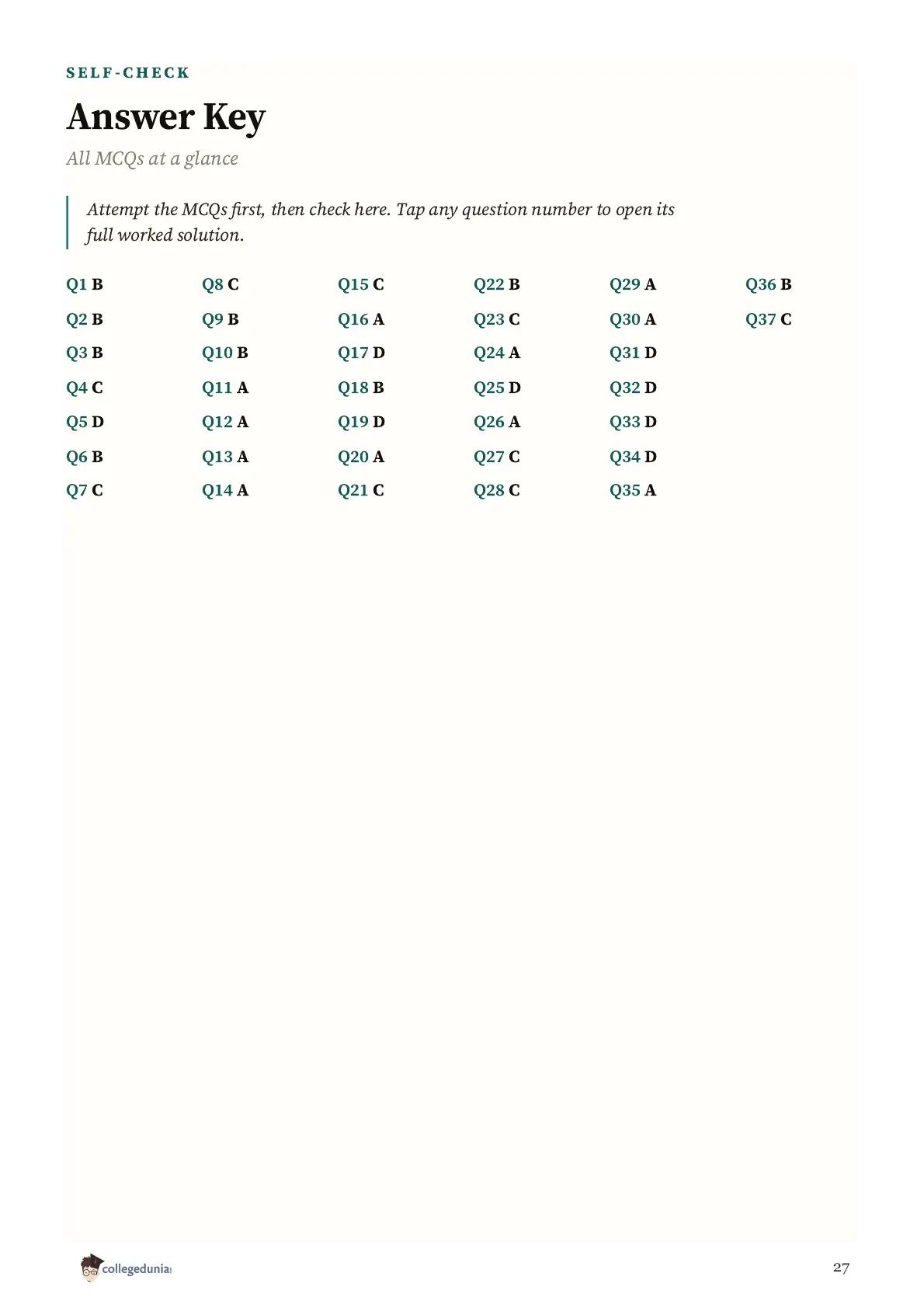
- An Answer Key that lists all 37 MCQs at a glance
- Question counts by topic, so you know whether to start with banks, self-help groups or collateral
- A marks-wise table of questions (1, 2, 3, 4 and 5 mark)
- The common mistakes students make, such as saying the rupee is accepted because the State Bank of India issues it, and a short FAQ
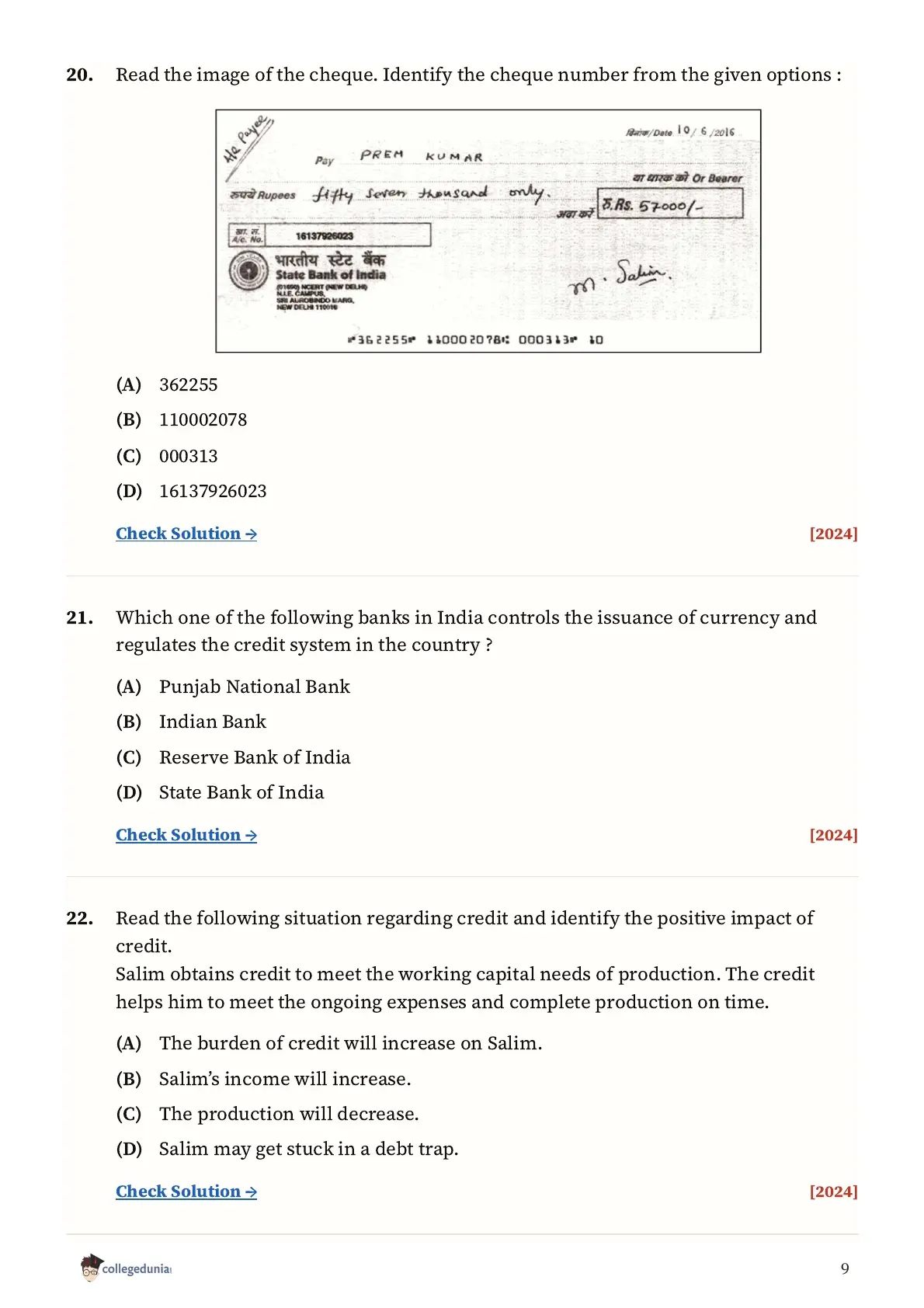





Money and Credit Weightage in the Class 10 Social Science Paper
CBSE does not publish marks per chapter. The Social Science paper is 80 marks and, as the 2026 papers print it, Economics is a 20-mark section shared by the chapters of the NCERT book Understanding Economic Development. Money and Credit is a regular source of both MCQs and long answers: the 5-mark explanation is the commonest written form here, with 32 of the 107 questions.
The table shows how many questions the set holds at each mark value.
| Marks per Question | Questions in the Set |
|---|---|
| 1 mark | 38 |
| 2 marks | 6 |
| 3 marks | 28 |
| 4 marks | 3 |
| 5 marks | 32 |
Money and Credit Questions by Topic
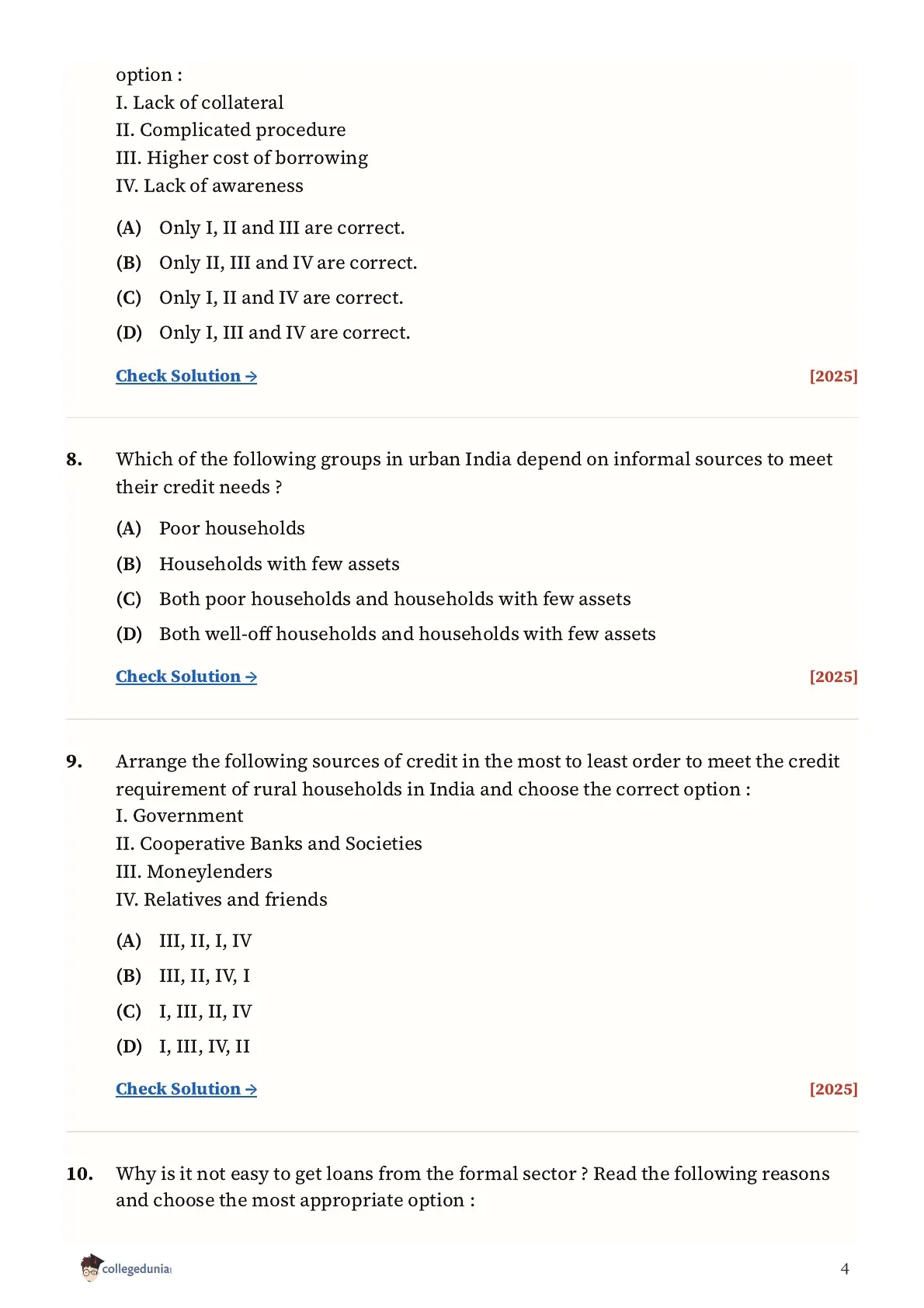
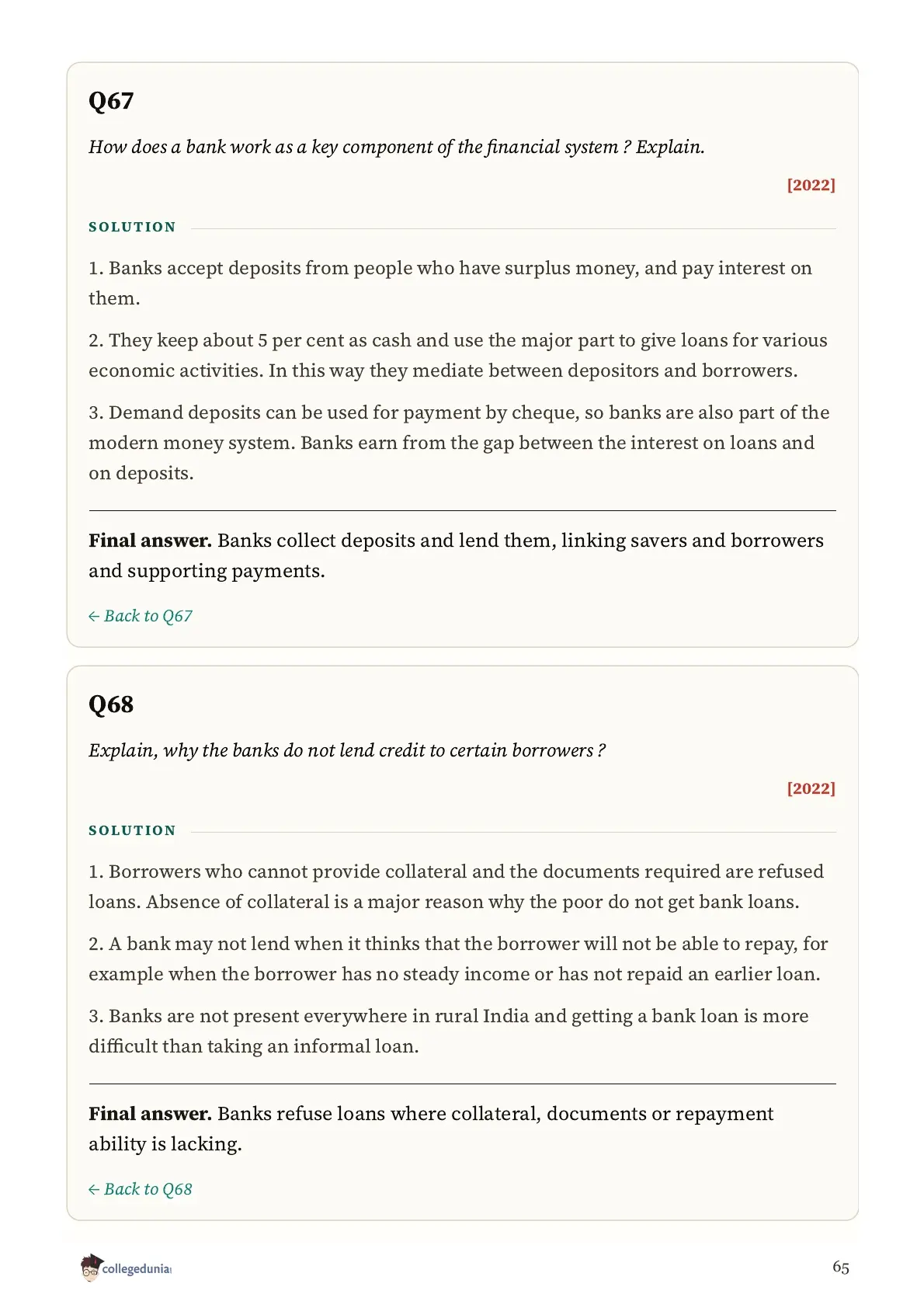
Banks and credit carry the set. 45 questions name a bank in the stem or the options, 44 mention credit and 27 mention a loan, while money, the medium of exchange, double coincidence of wants and demand deposits appear in 30. Formal and informal sources of credit come up in 26, and the Reserve Bank of India is named in 12.
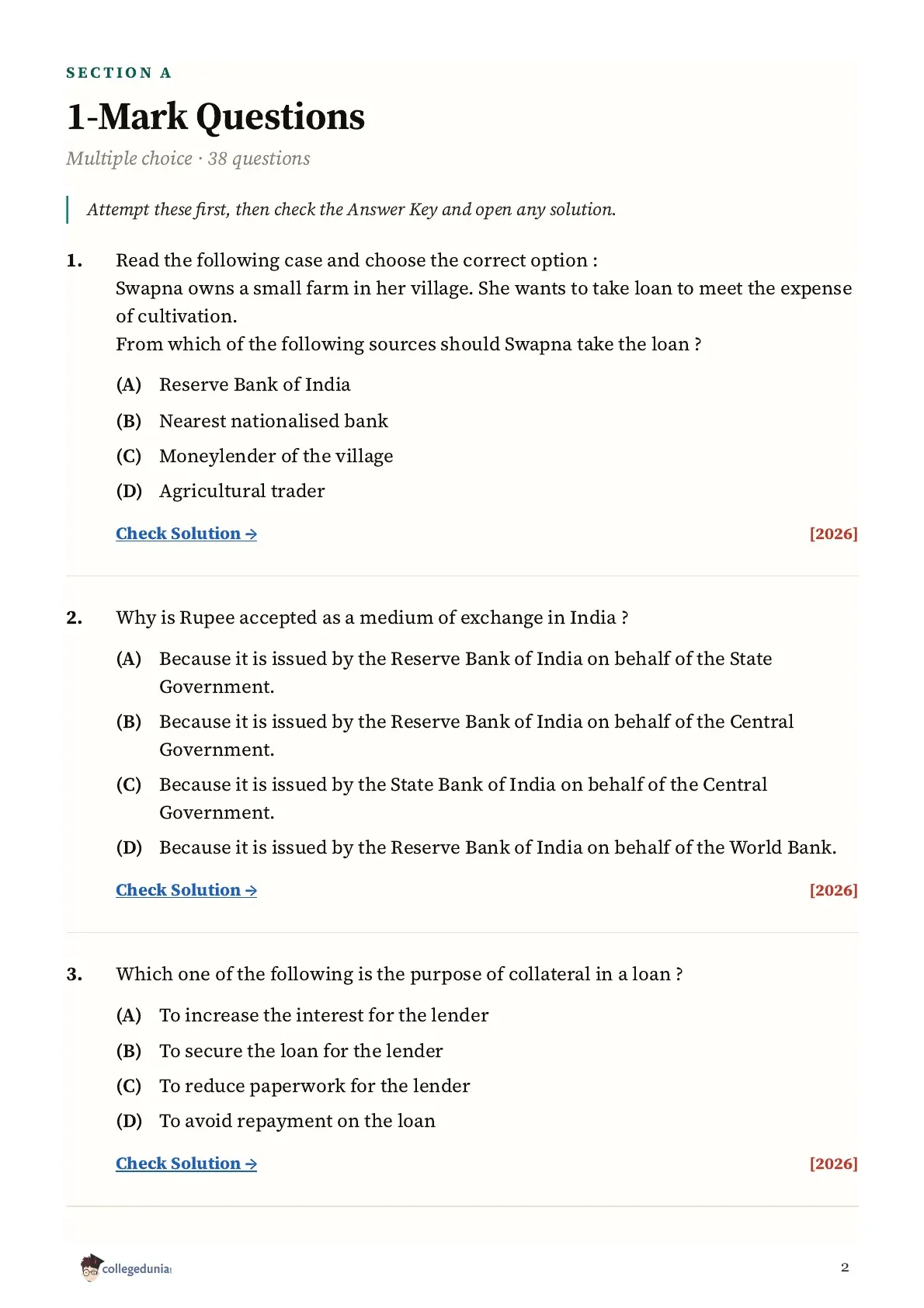
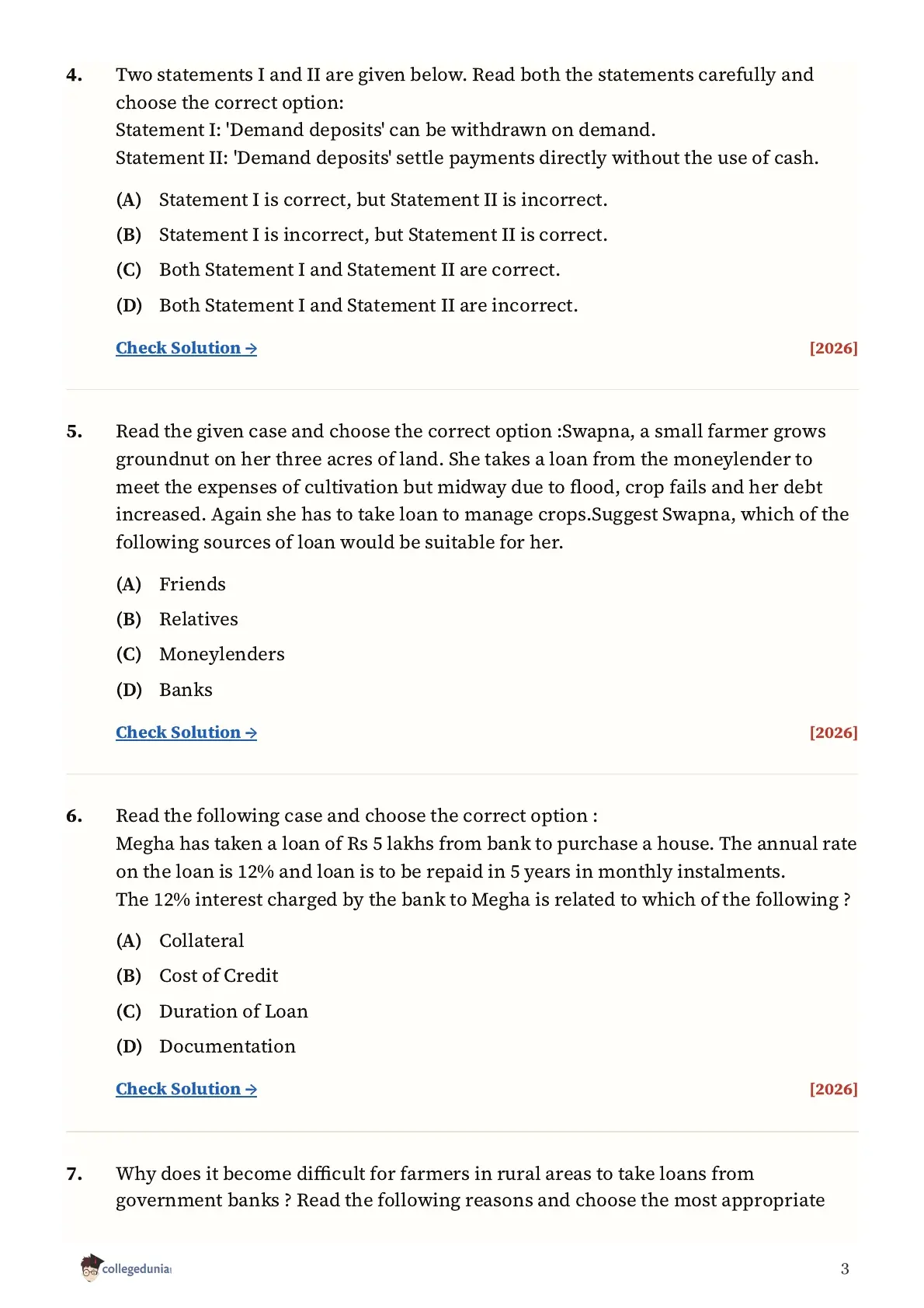
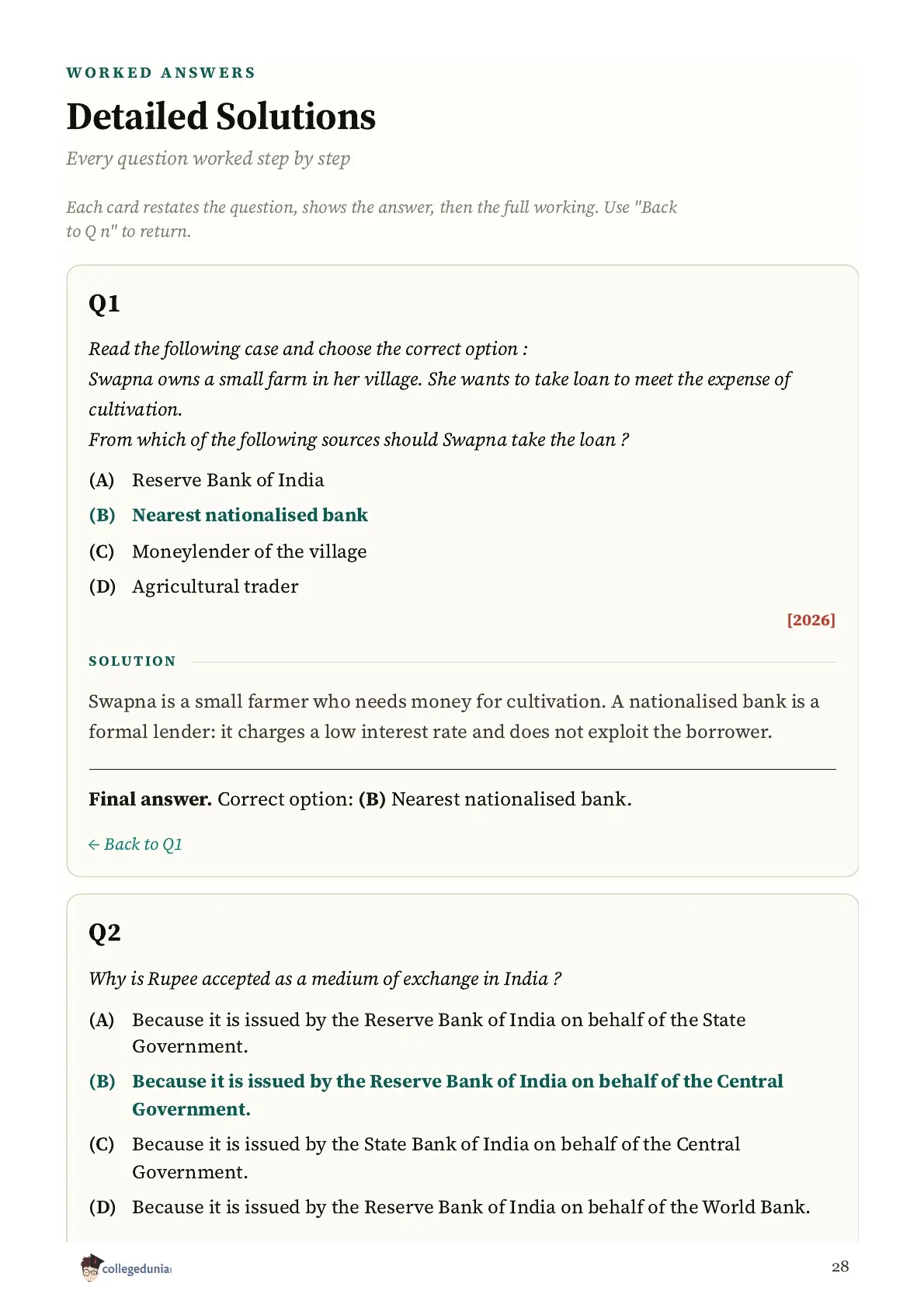
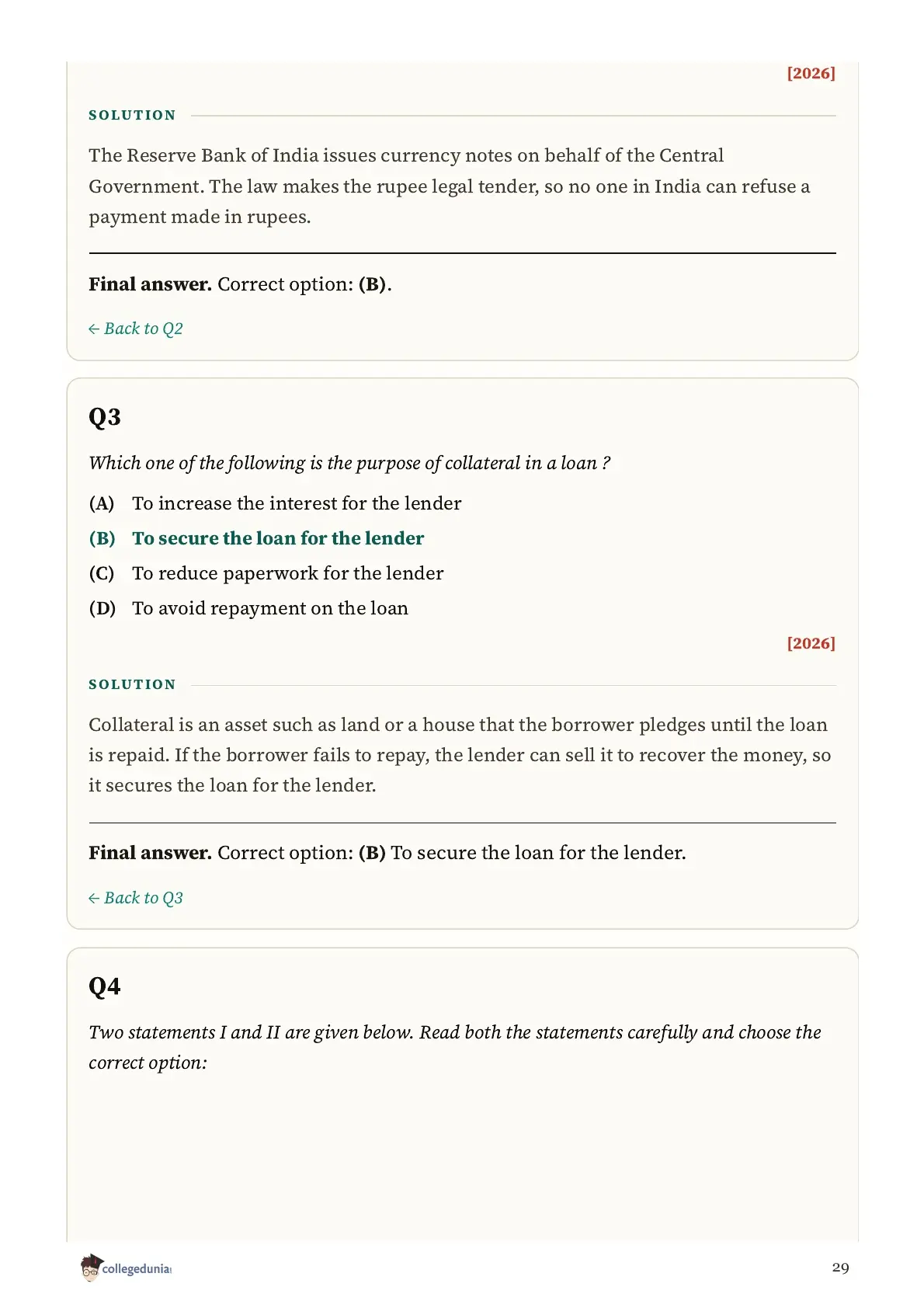
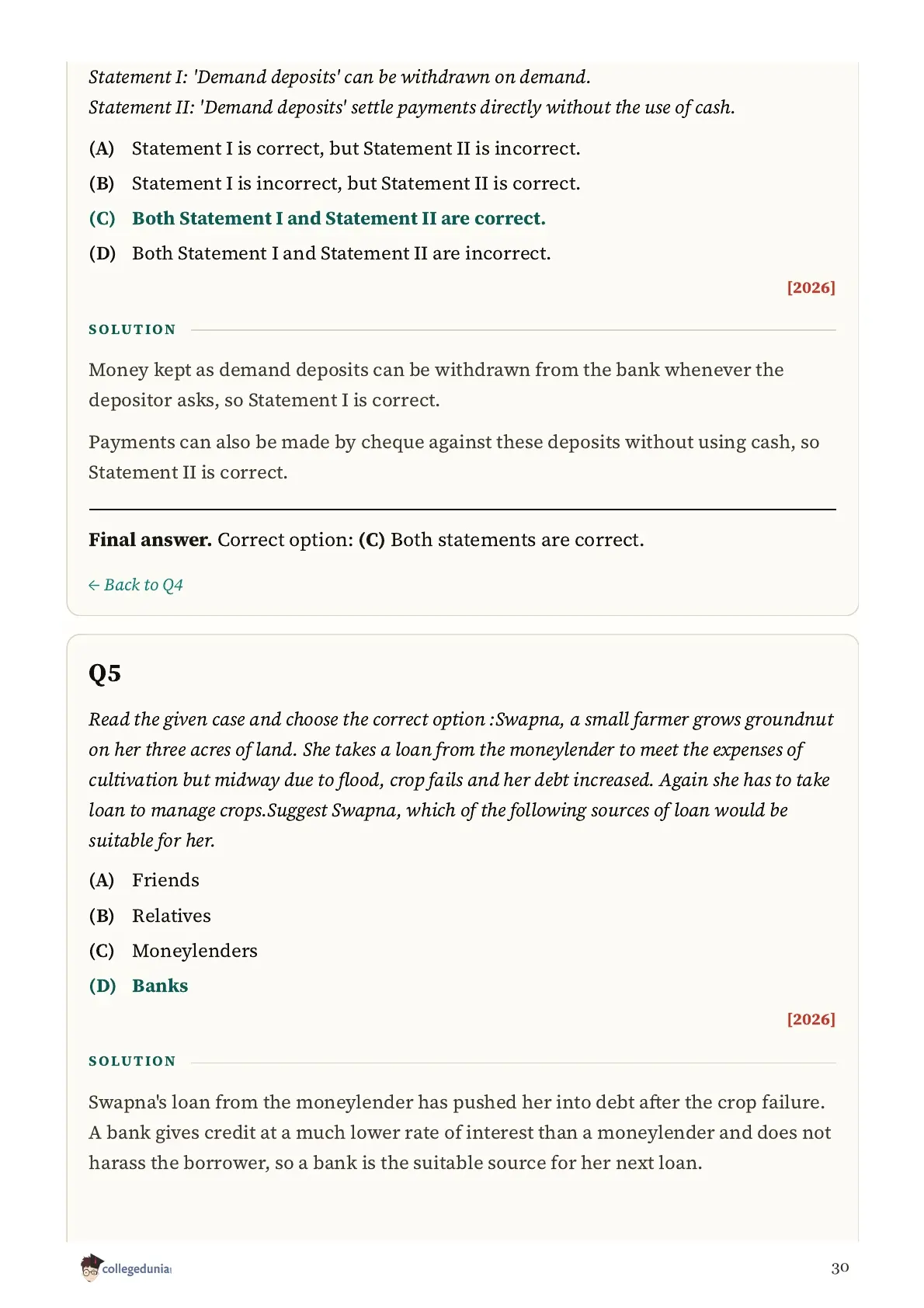
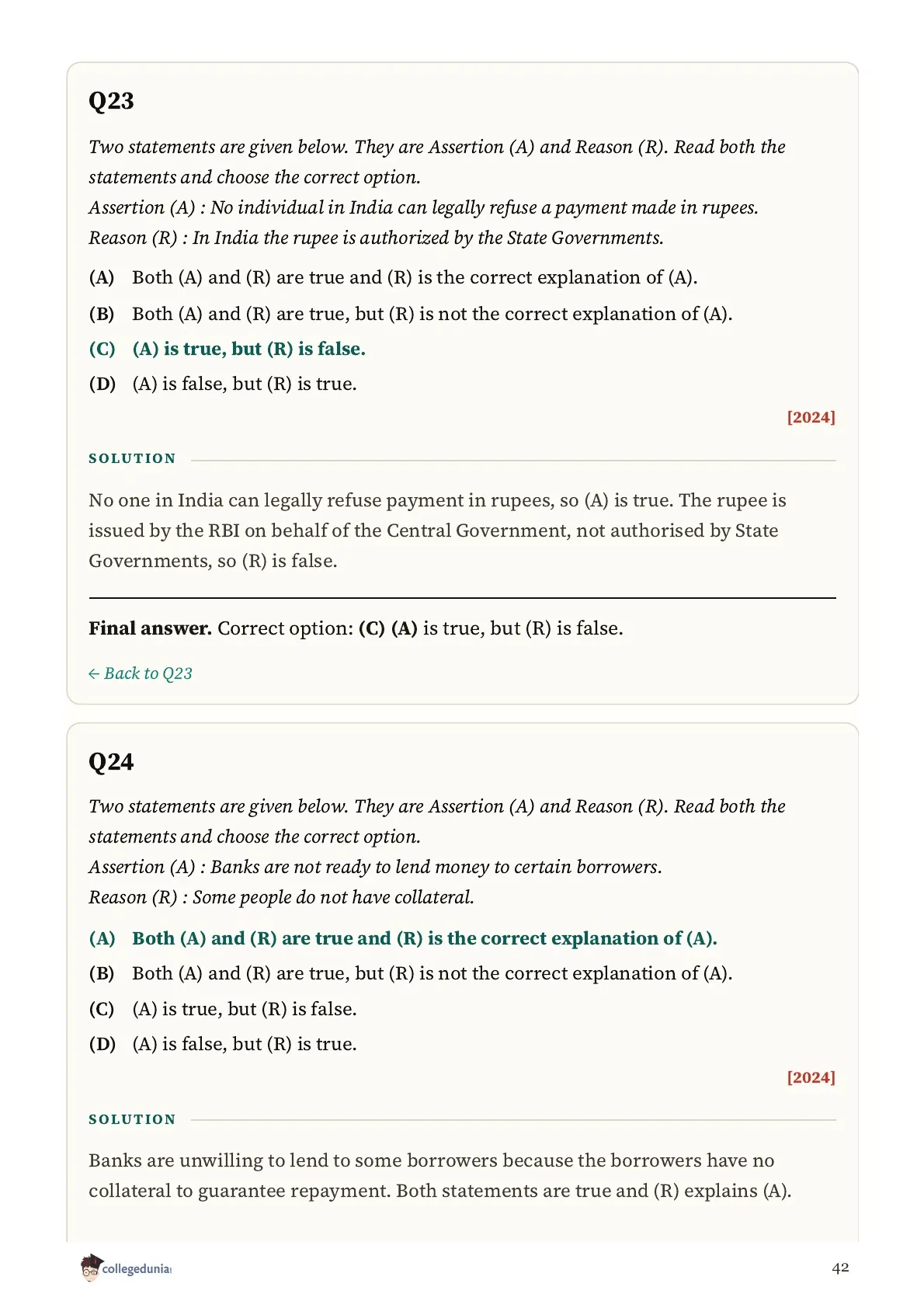
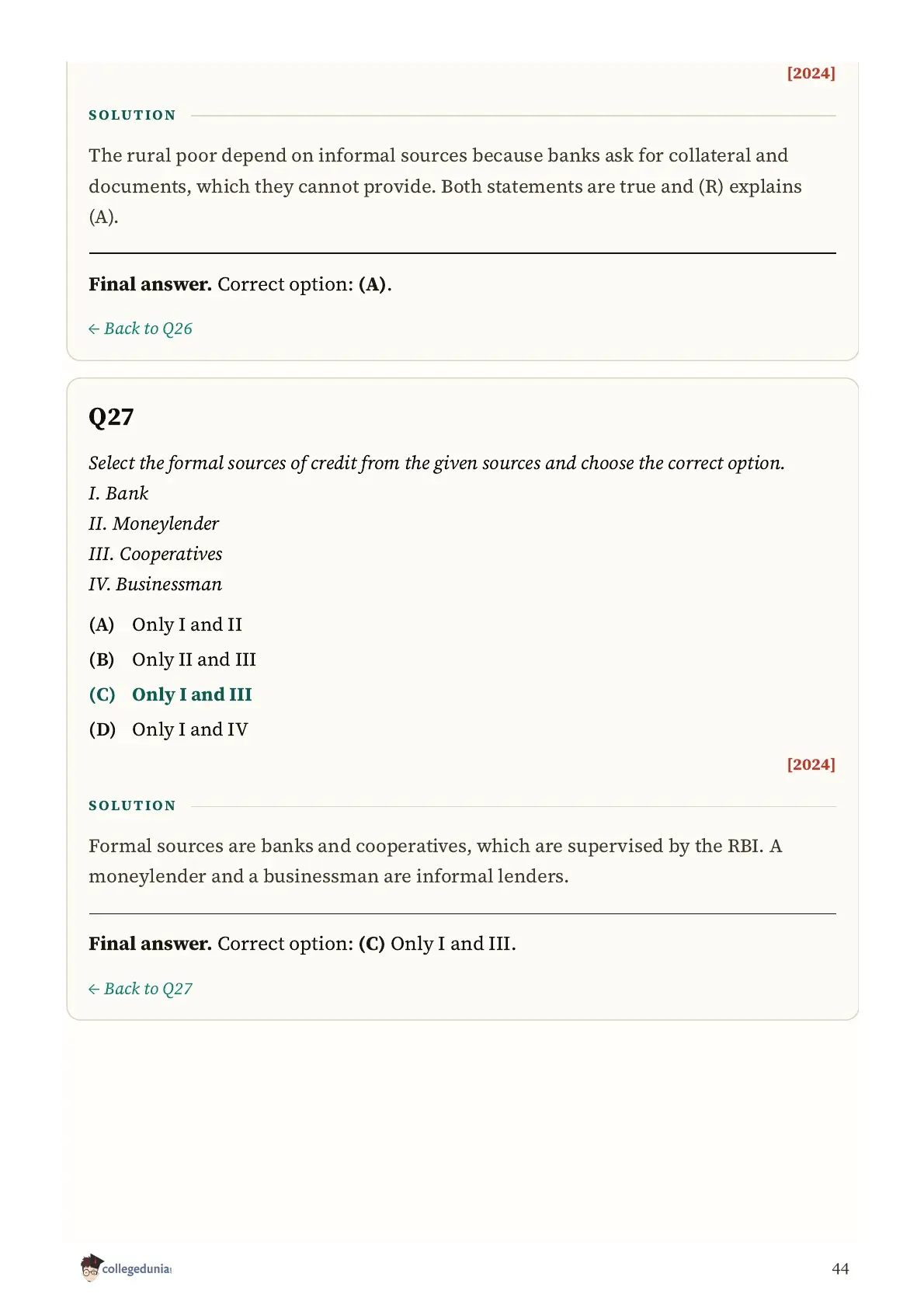
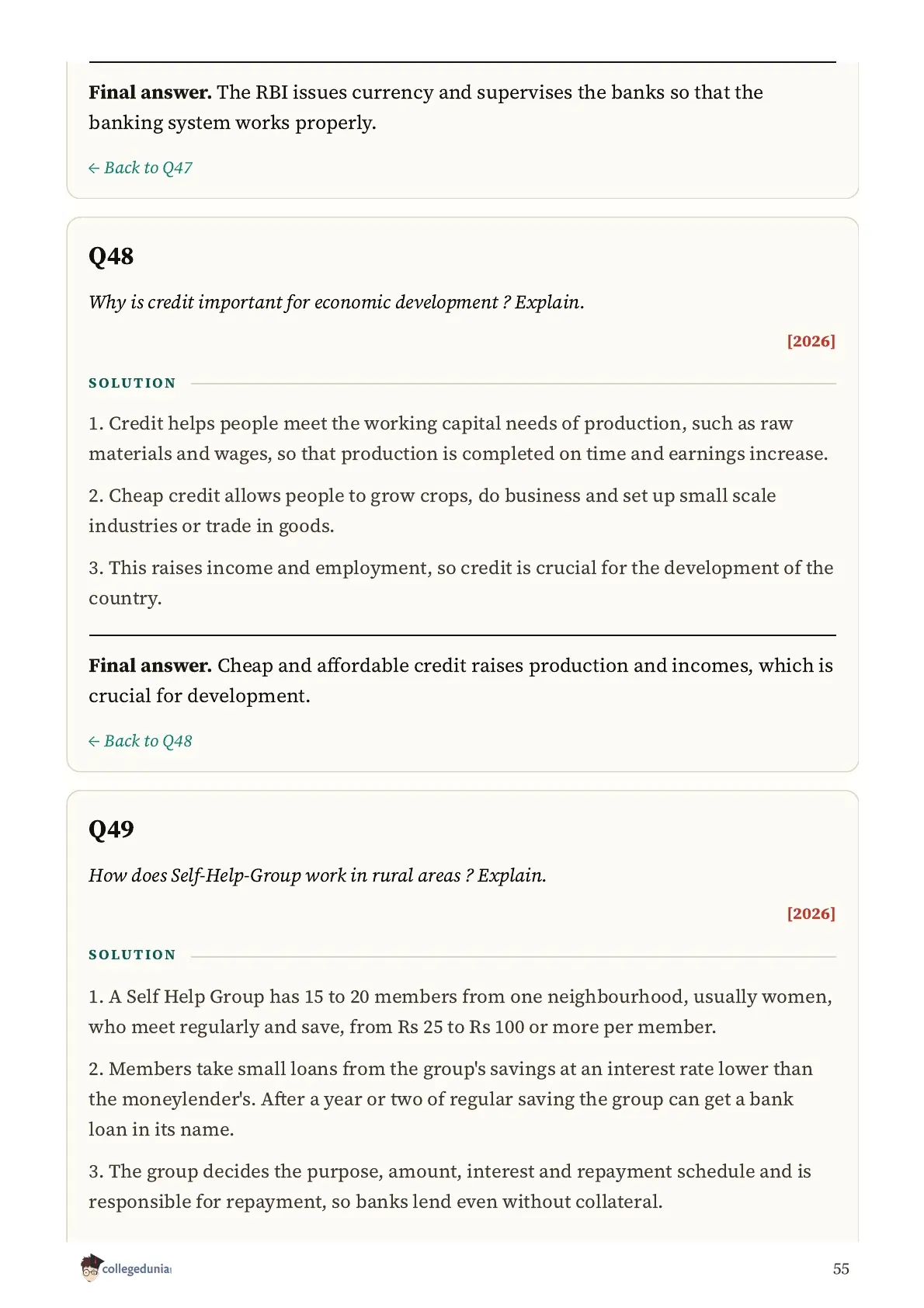
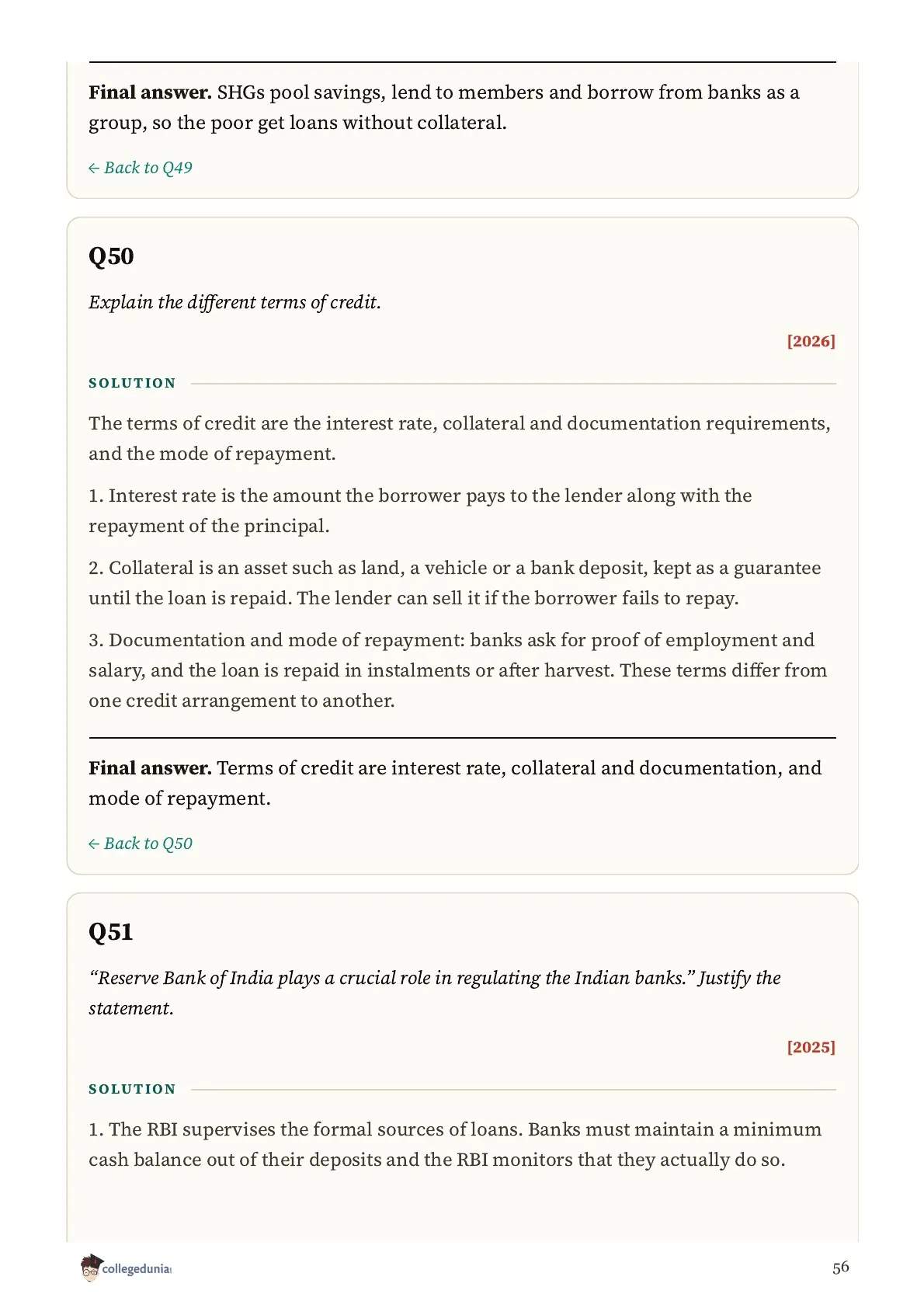
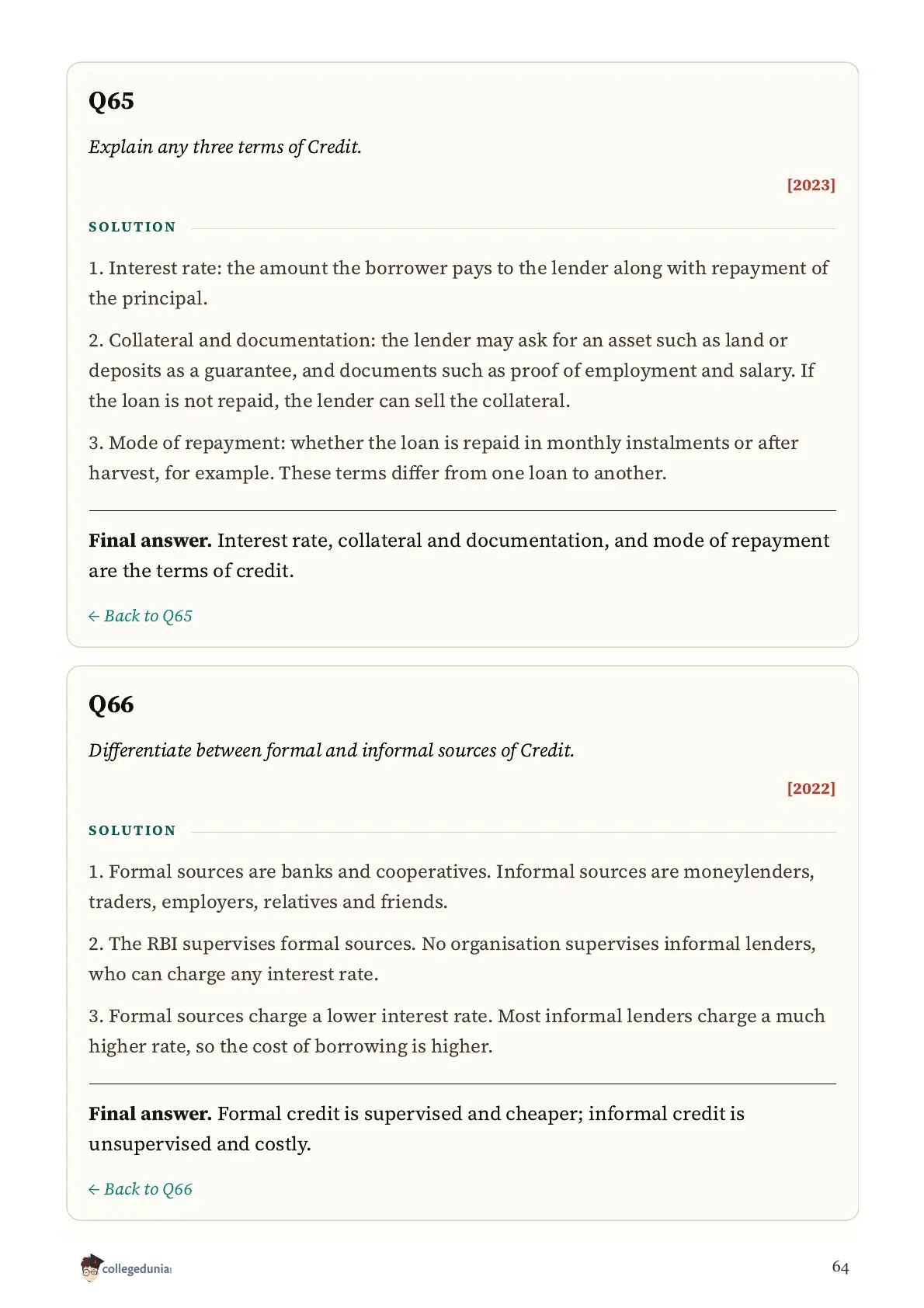
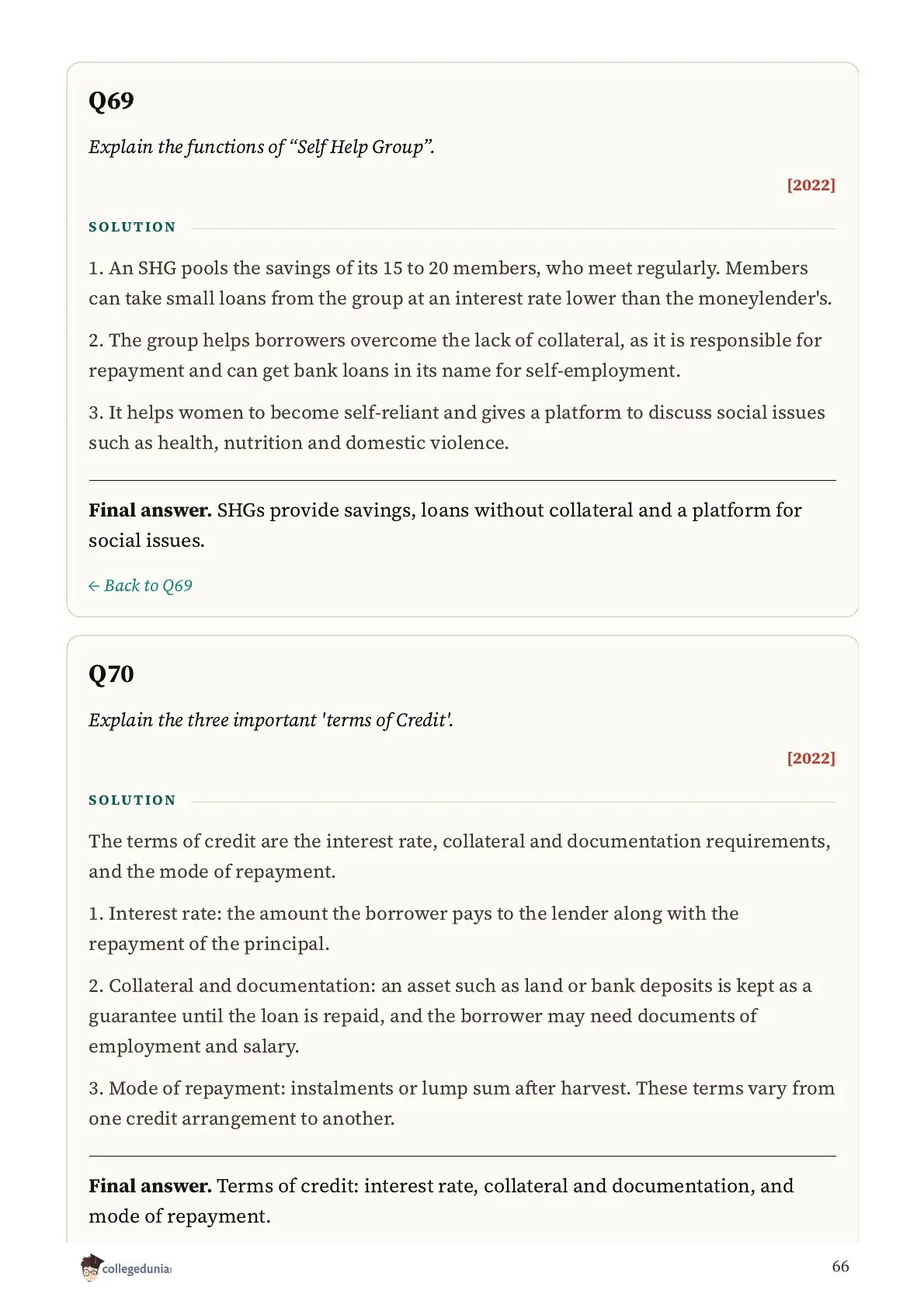
Collateral and the terms of credit (interest, repayment, security) appear in 18 questions, and self-help groups in 16. Typical cases are a farmer, Swapna, choosing where to borrow for cultivation (2026), the reason the rupee is accepted as a medium of exchange, the purpose of collateral in a loan, and a 3-mark question on how a self-help group works in rural areas (2026).
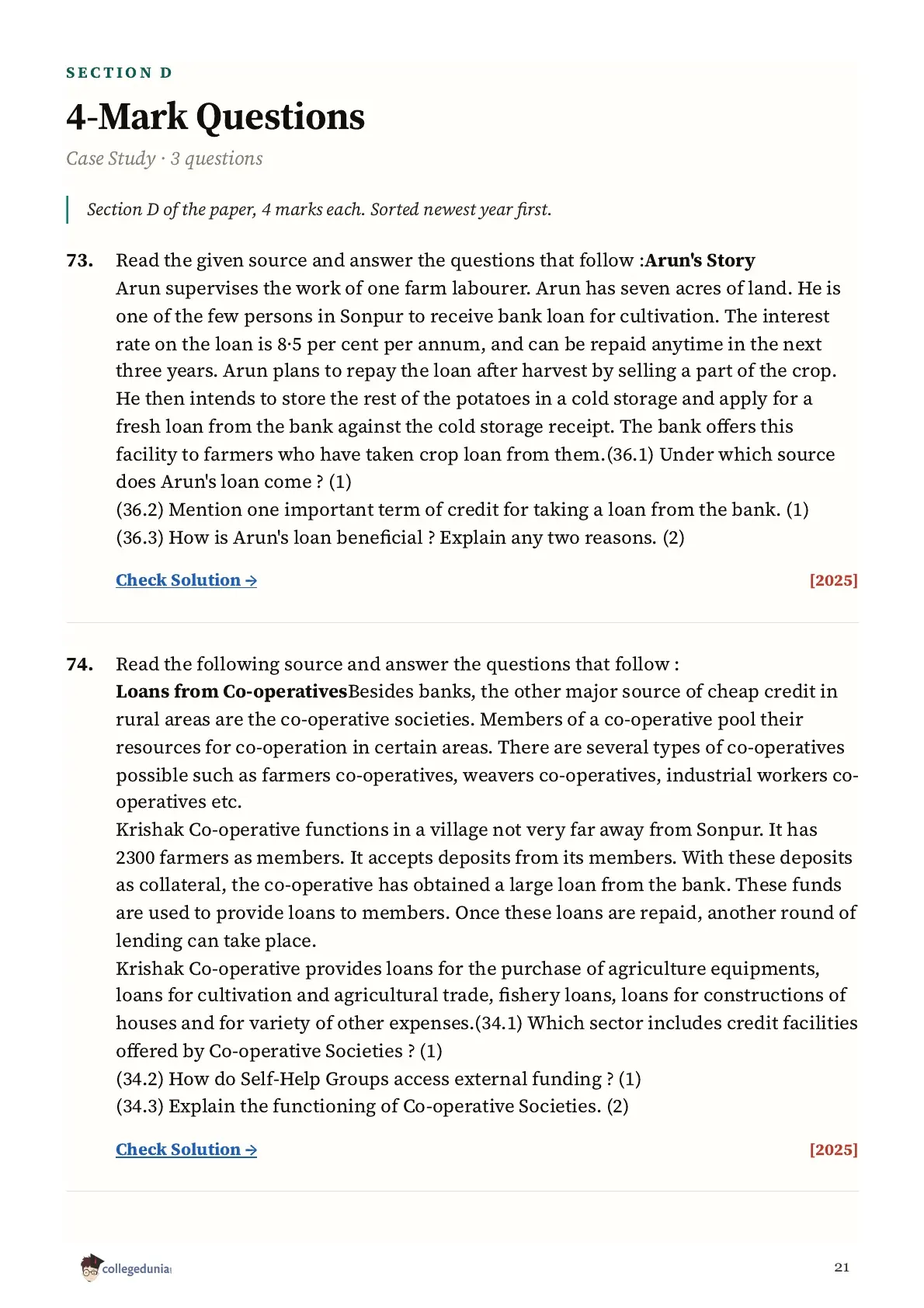
Eight questions are source-based: four 1-mark case MCQs, one 2-mark house loan source, and three 4-mark sources on Arun's loan from a bank or on loans from cooperatives. The topic counts come from keyword matches over the question text and options, so a question that names two things is counted under both.
Source: Physics Wallah Foundation
How to Approach the Set
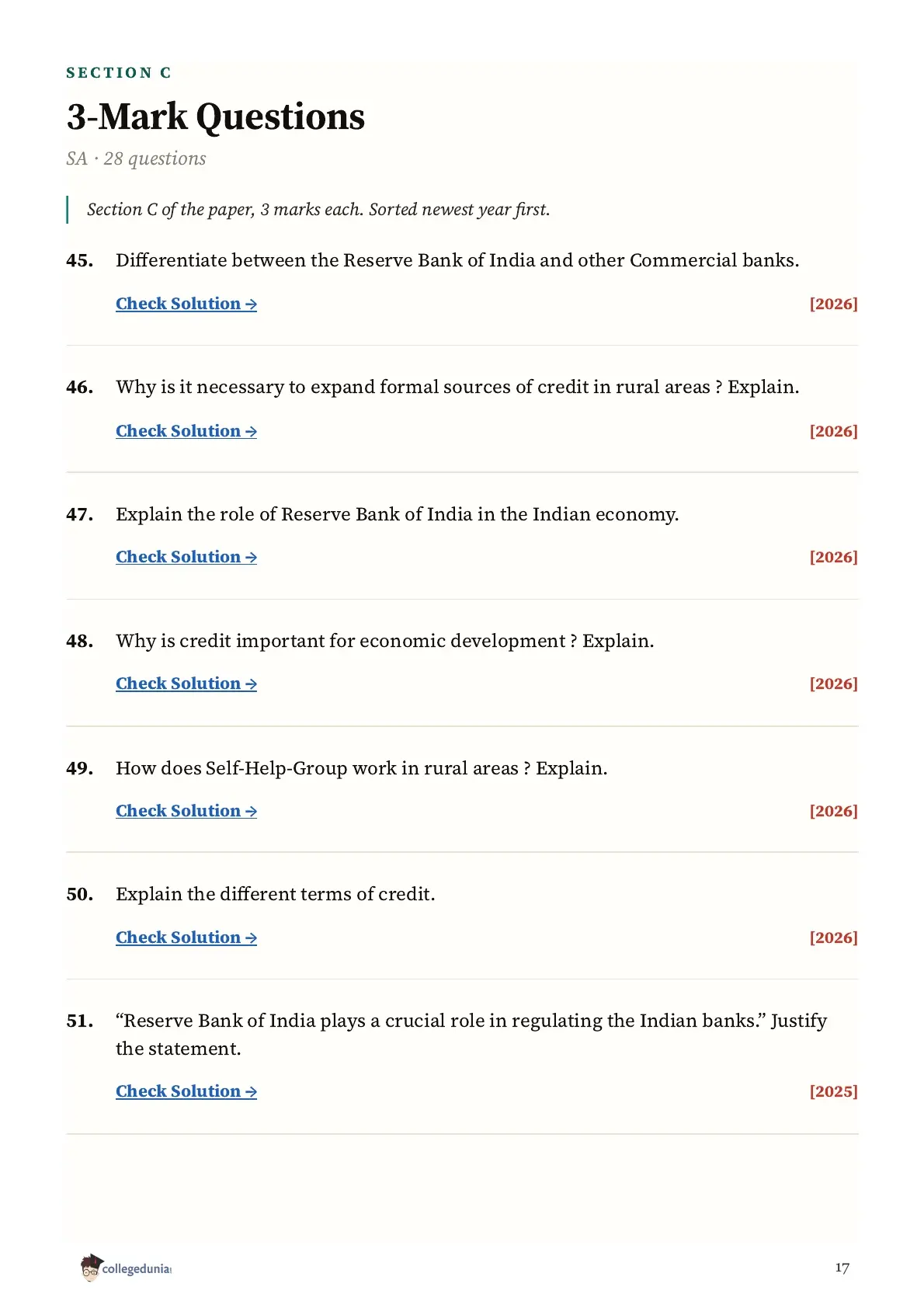
Start with the 37 MCQs, which test one fact each, such as who issues the rupee or what collateral is for. Then take the 28 three-mark questions, most of which ask you to explain a single idea in a few points, for example the role of the Reserve Bank of India or why credit matters for economic development. The 32 five-mark questions follow, and these usually compare formal and informal lenders or ask you to support a statement with examples. Save the three 4-mark source-based questions for when you can read a passage and pick out the interest rate, the lender and the terms. Practise the 2024 to 2026 papers closely, as they hold 68 of the 107 questions.
Common Mistakes in Money and Credit Questions
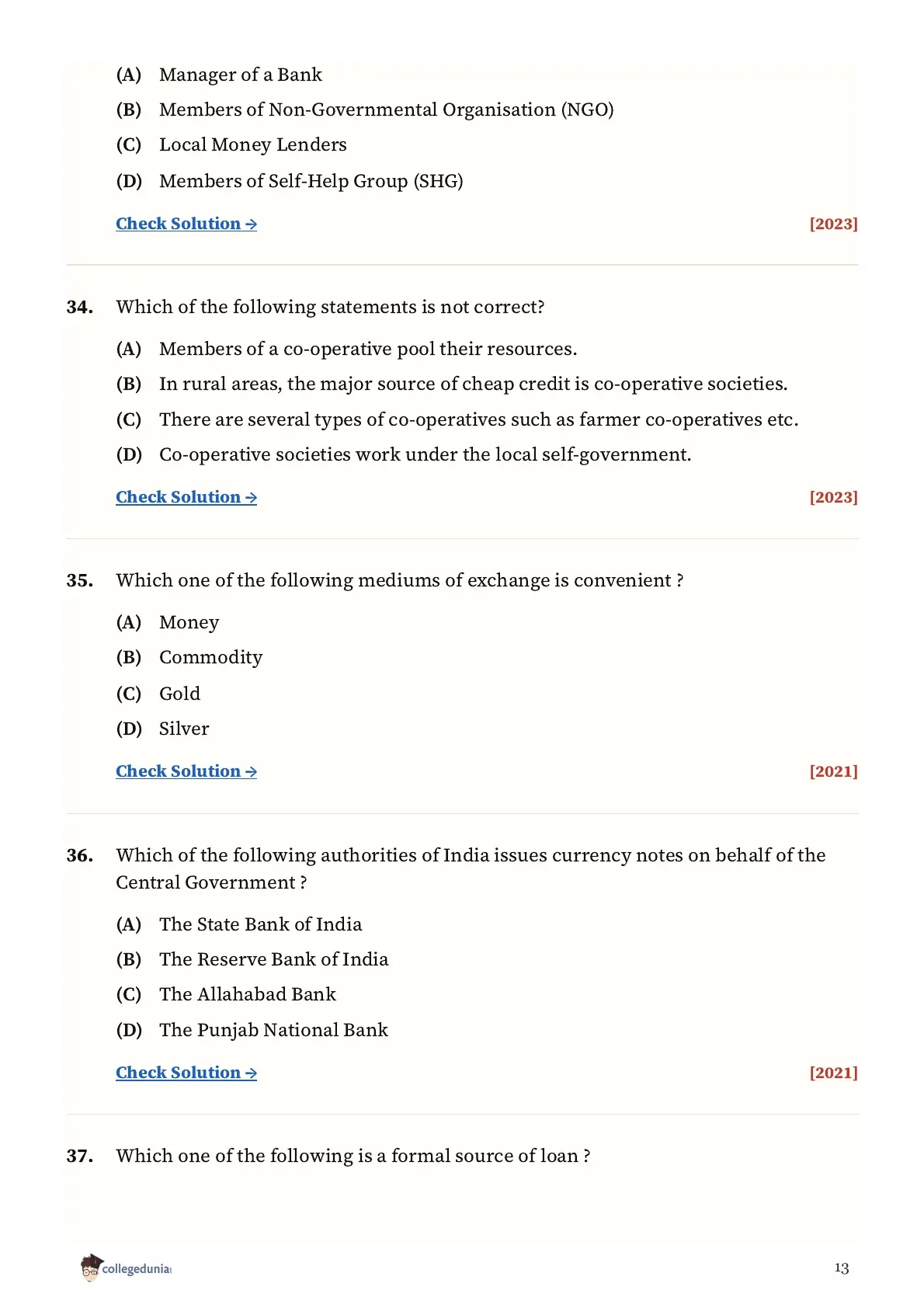
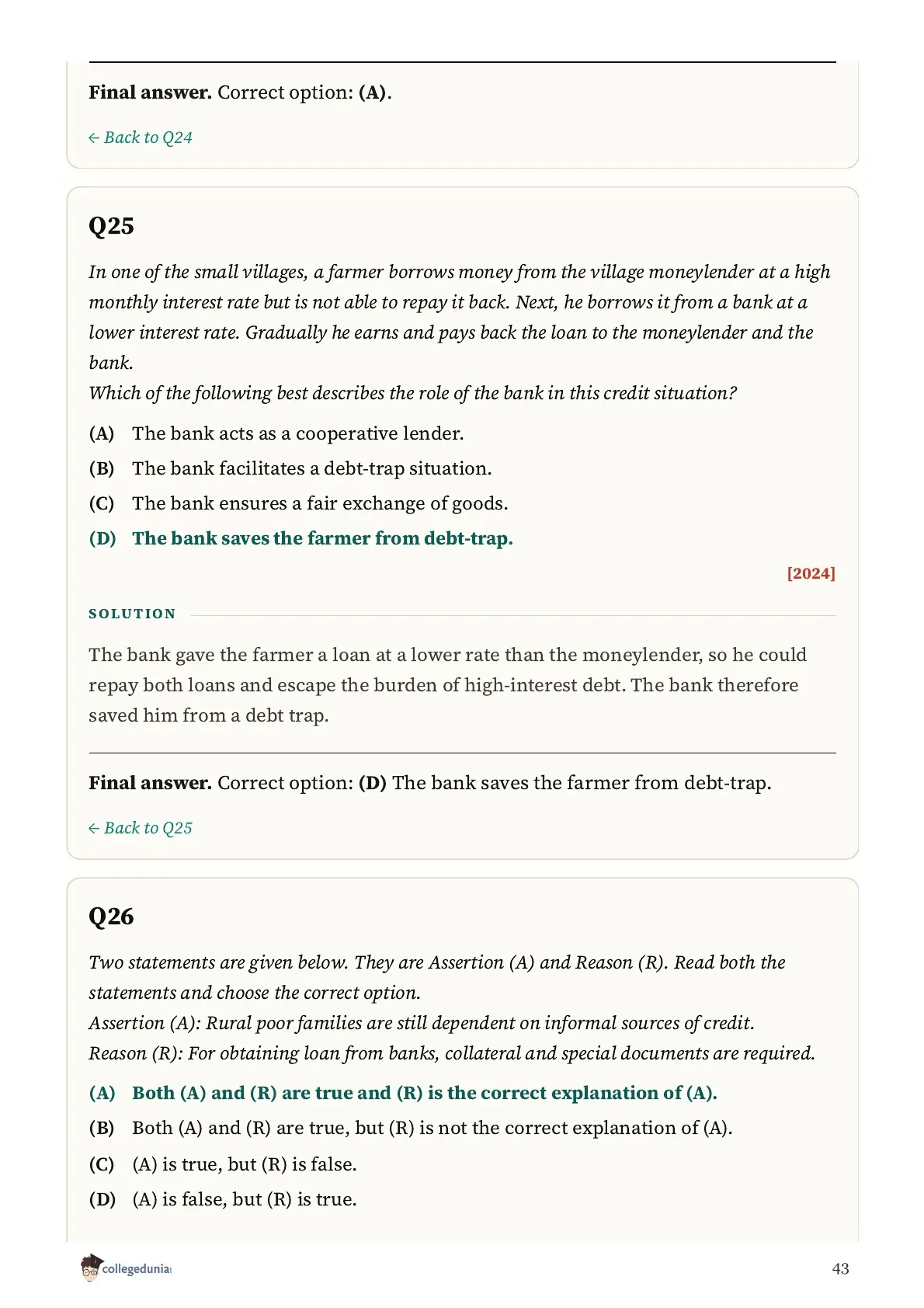
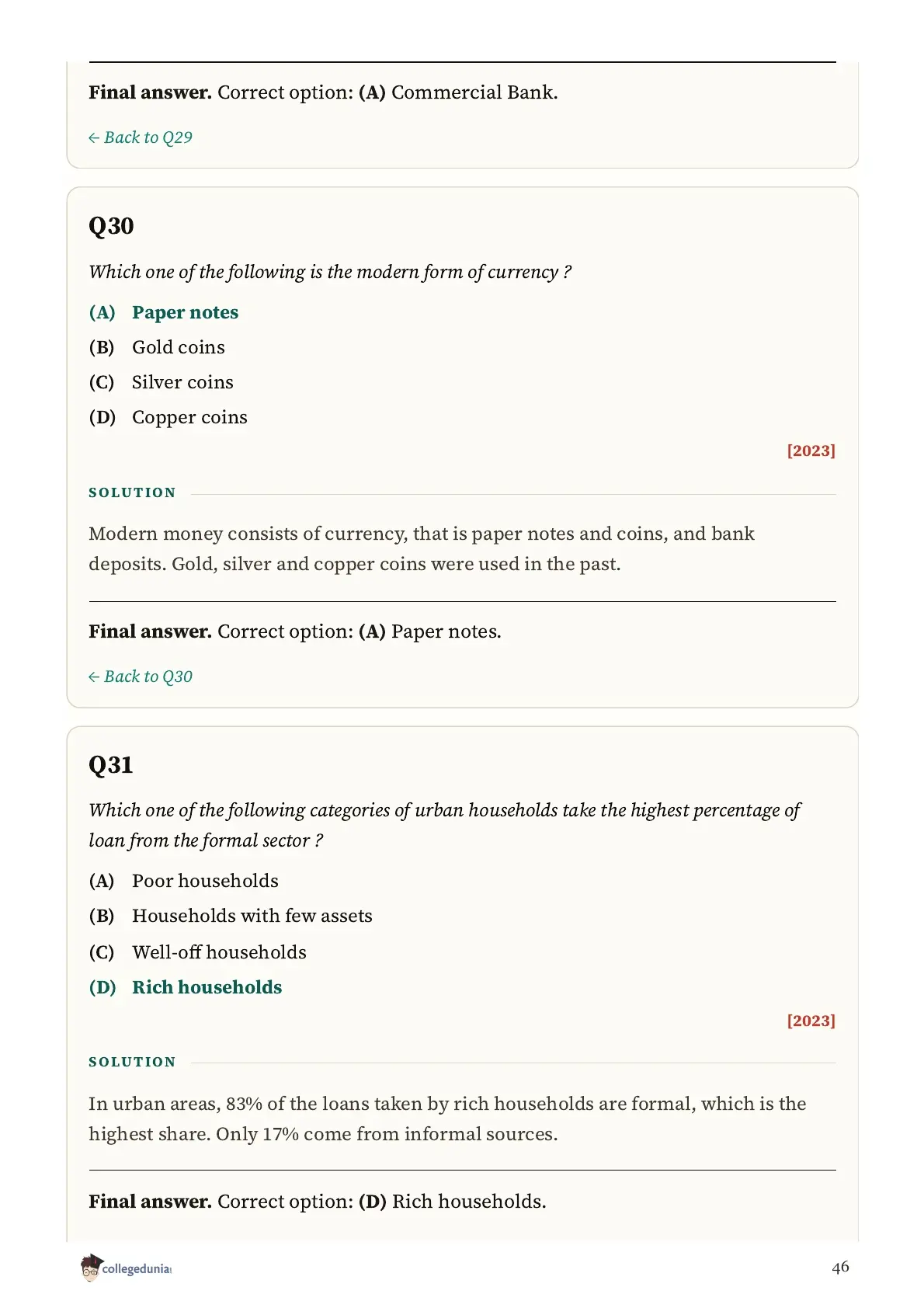
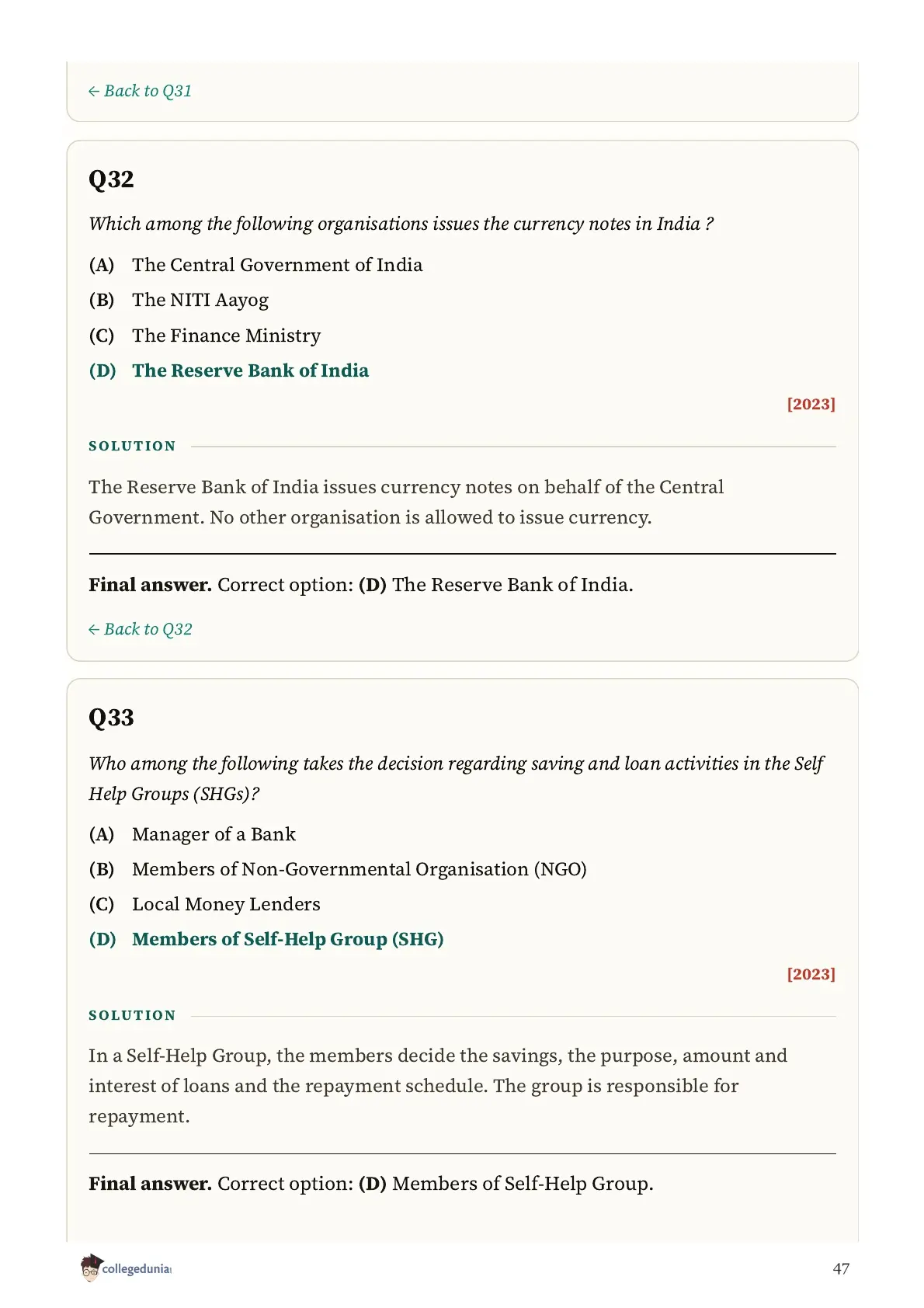
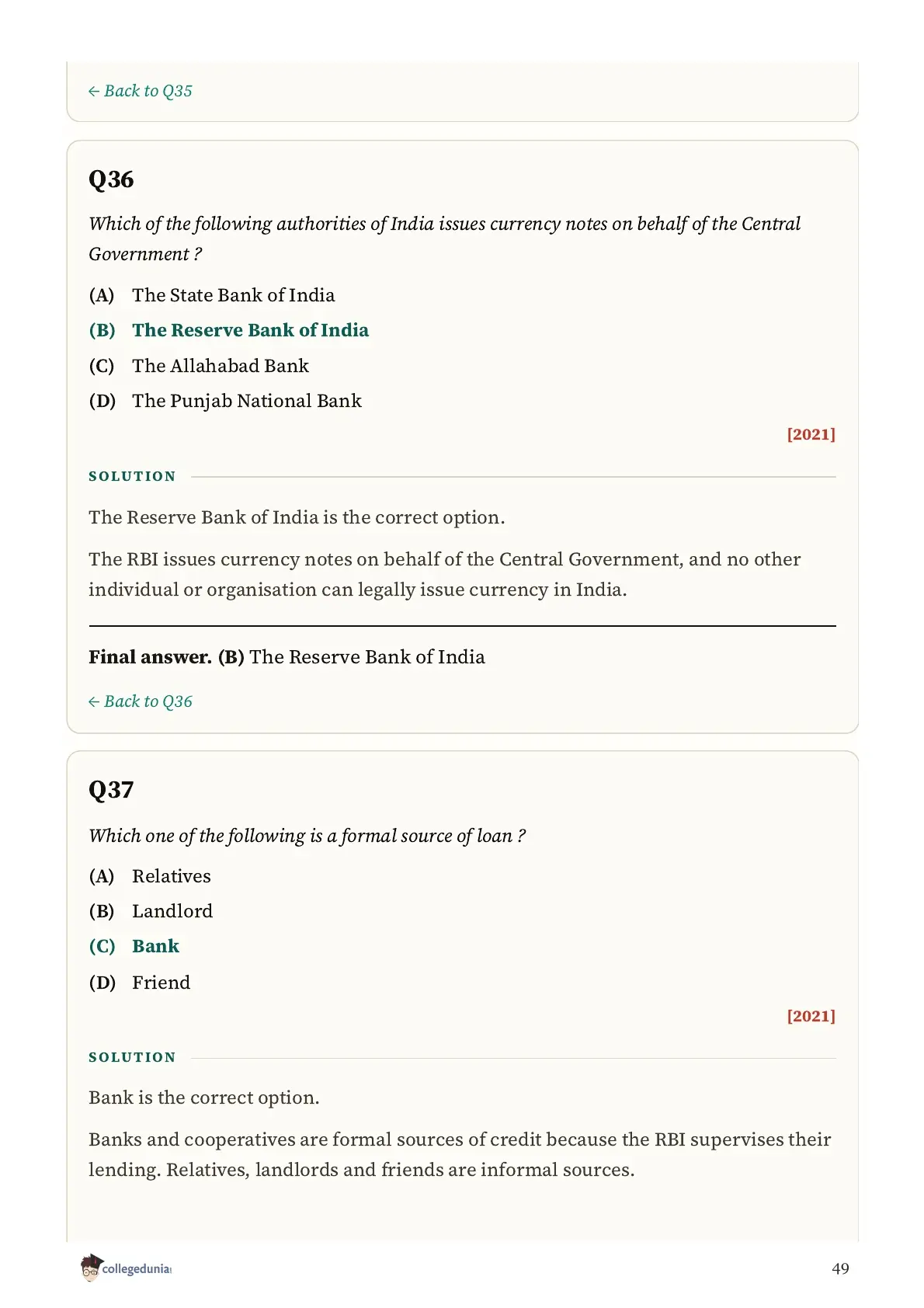
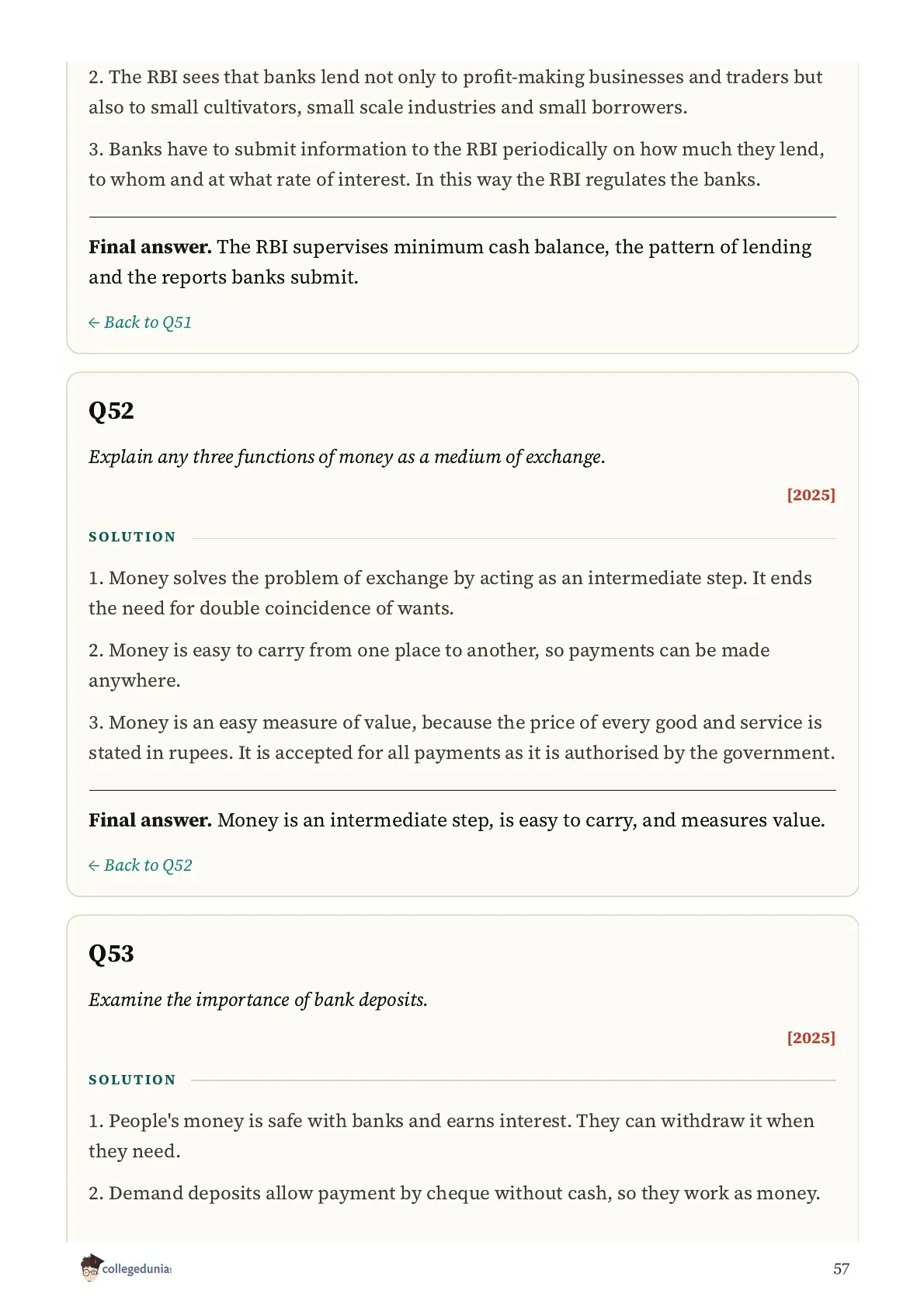
- Saying the rupee is accepted because the State Bank of India issues it. The Reserve Bank of India issues it on behalf of the Central Government.
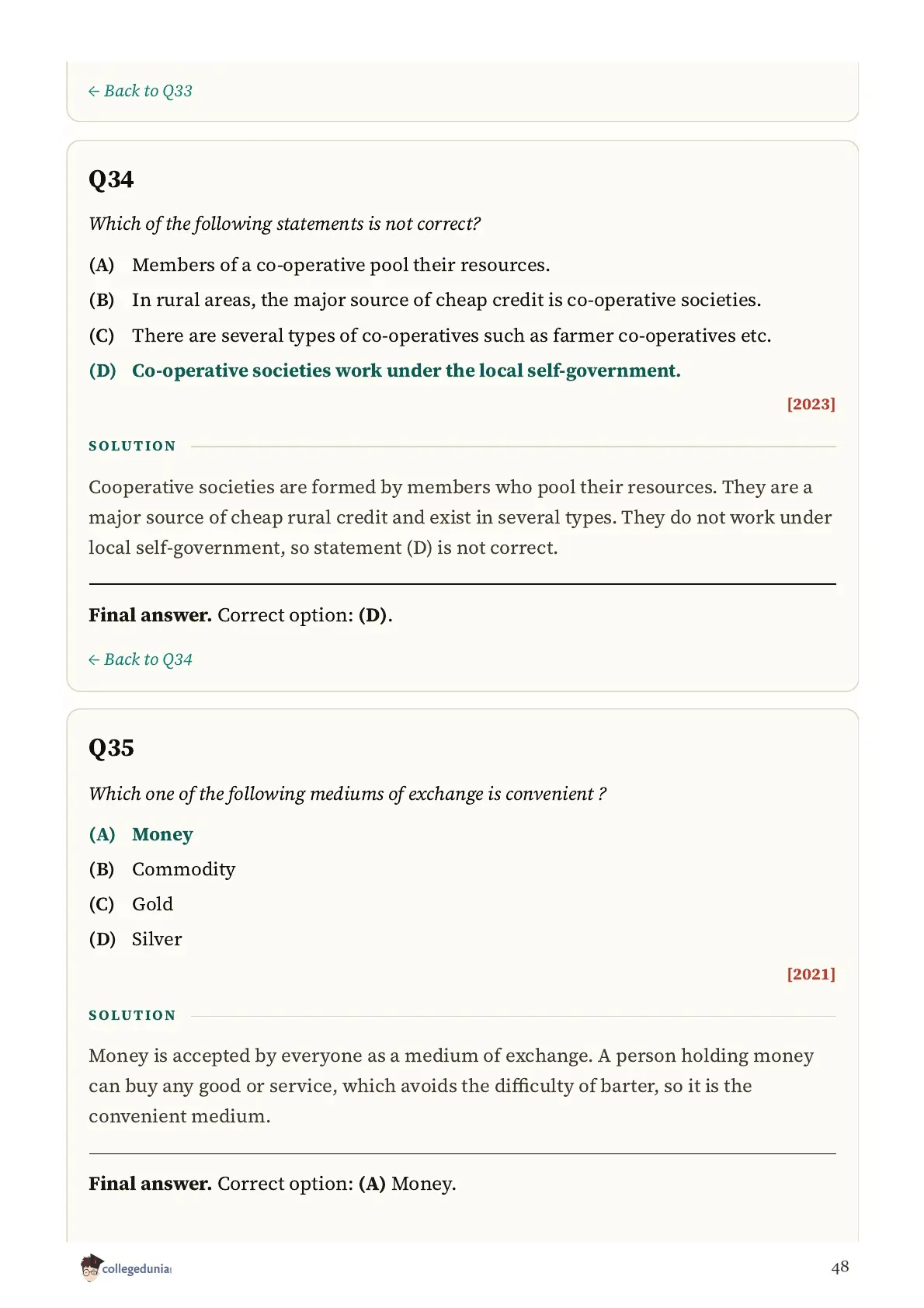
- Describing collateral as a fee or a penalty. It is an asset the borrower pledges as a guarantee, which the lender can sell if the loan is not repaid.
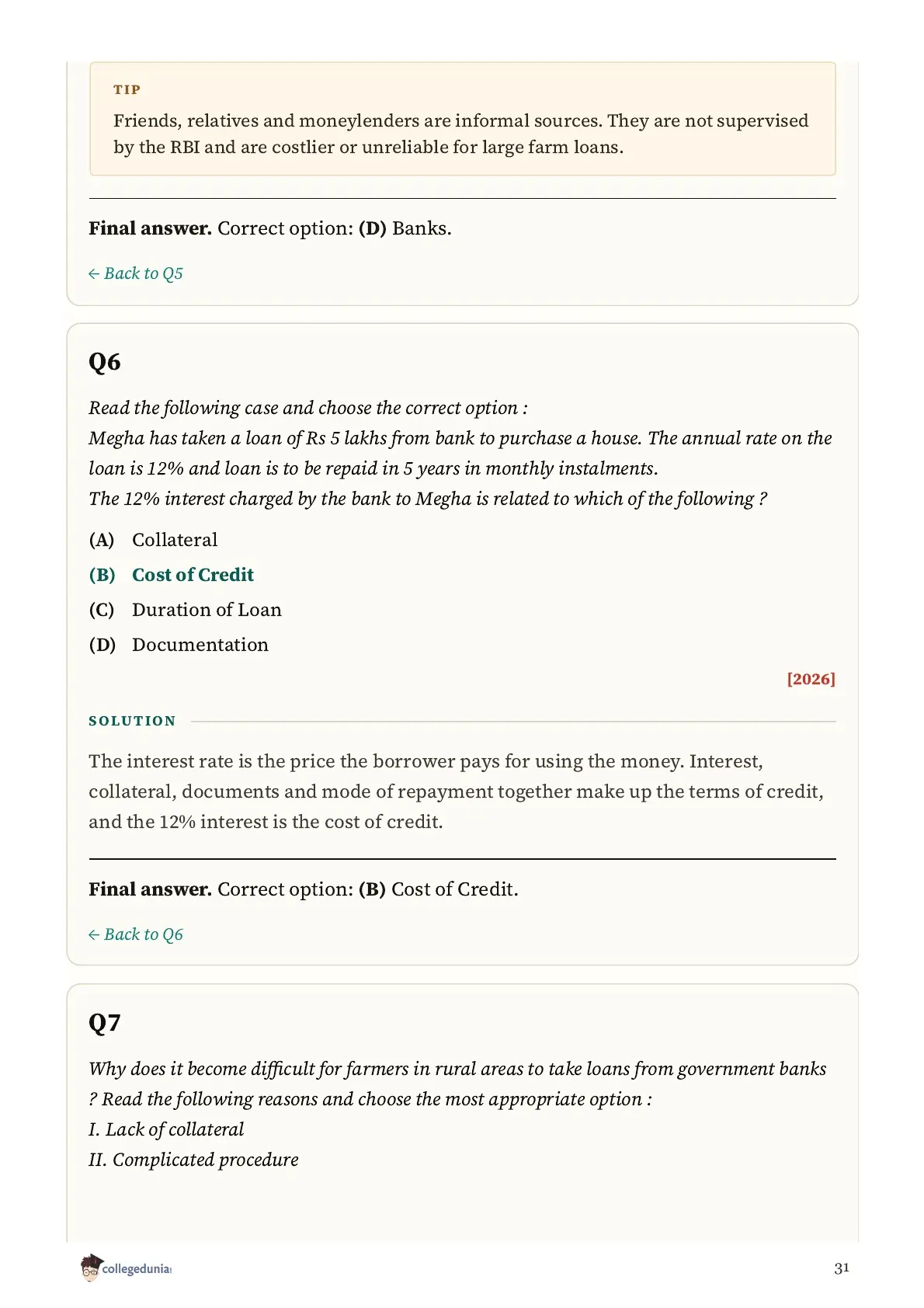
- Advising a small farmer like Swapna to borrow from the moneylender because it is nearby. The better source is the nearest nationalised bank, at a lower rate of interest.
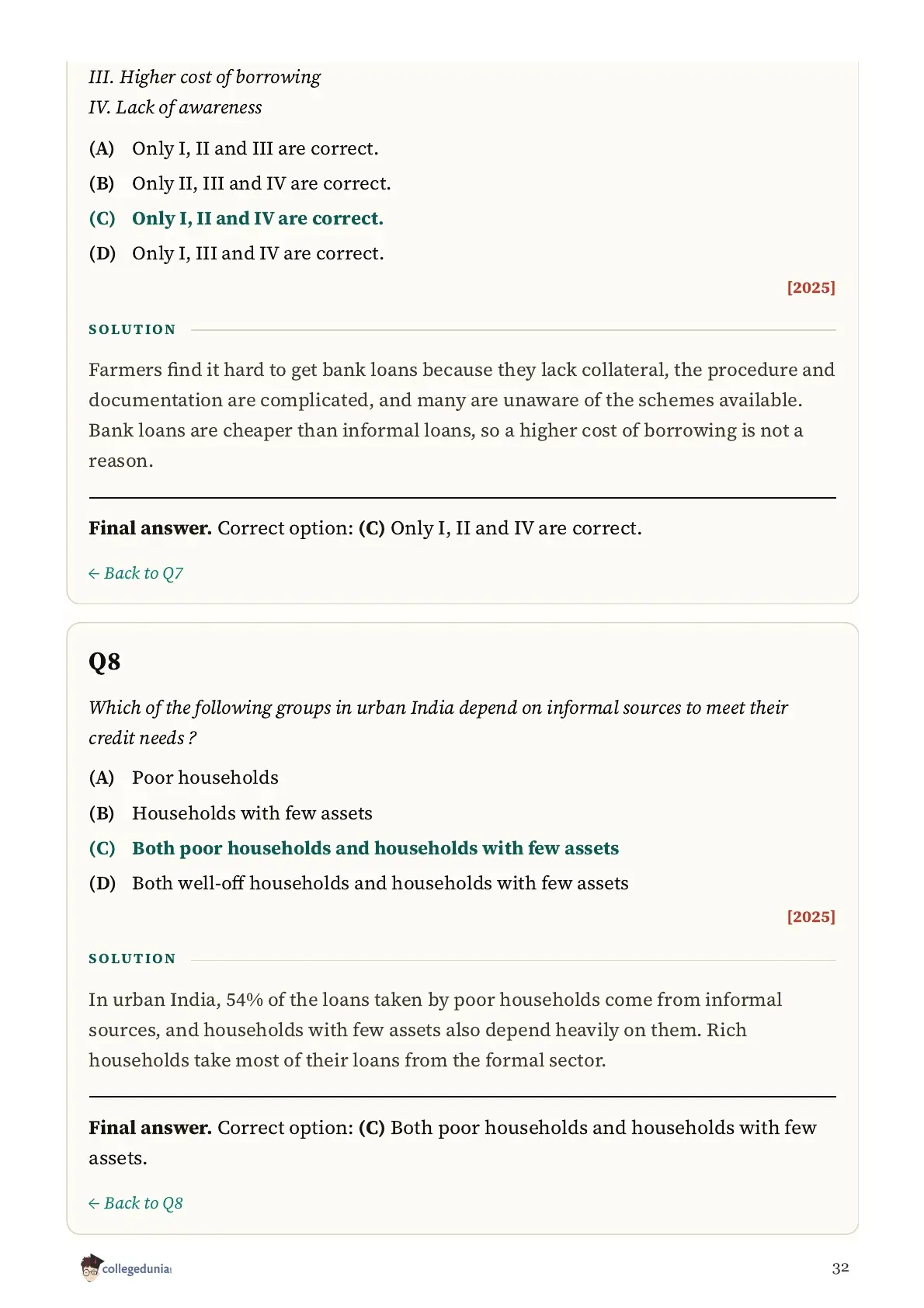
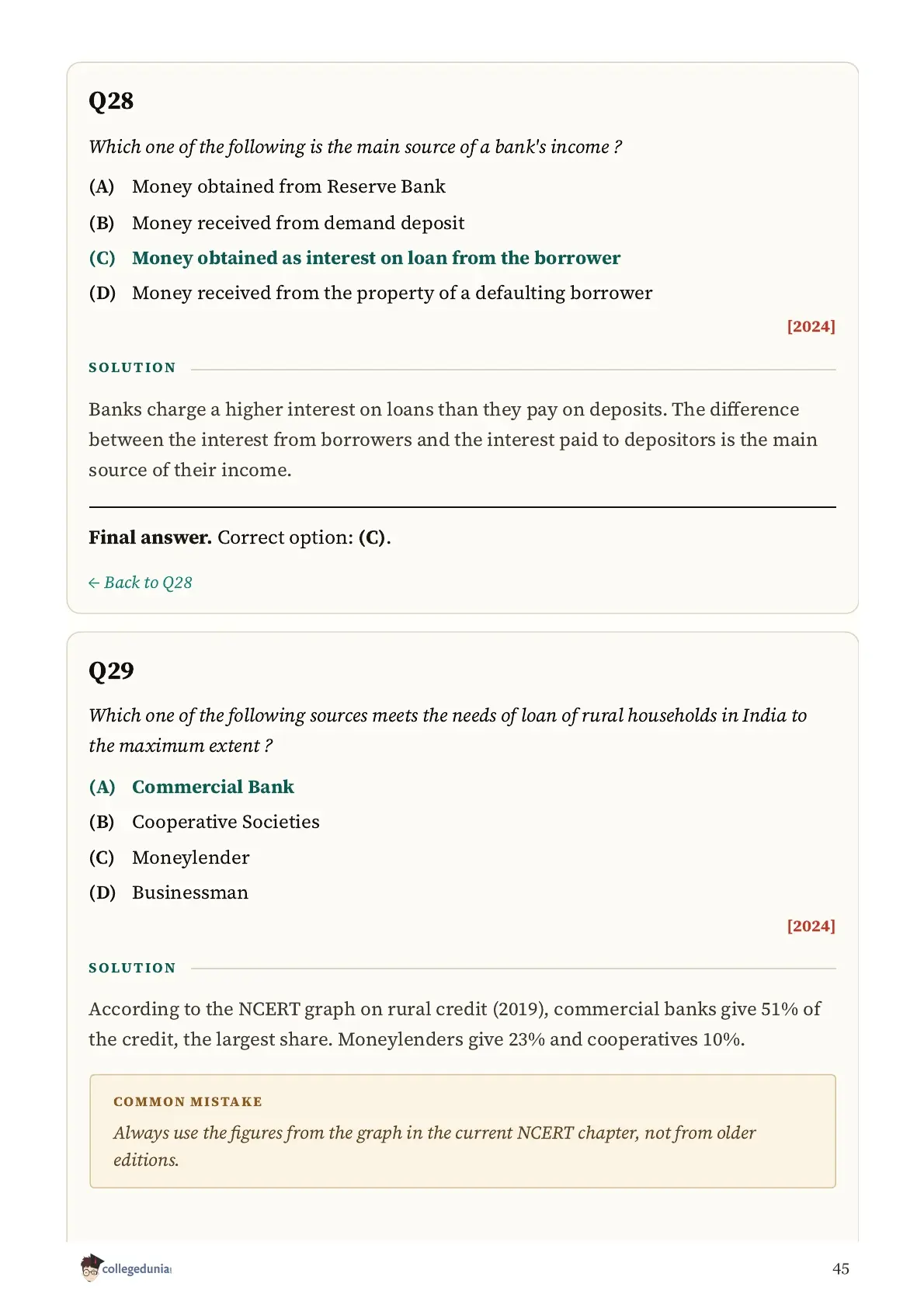
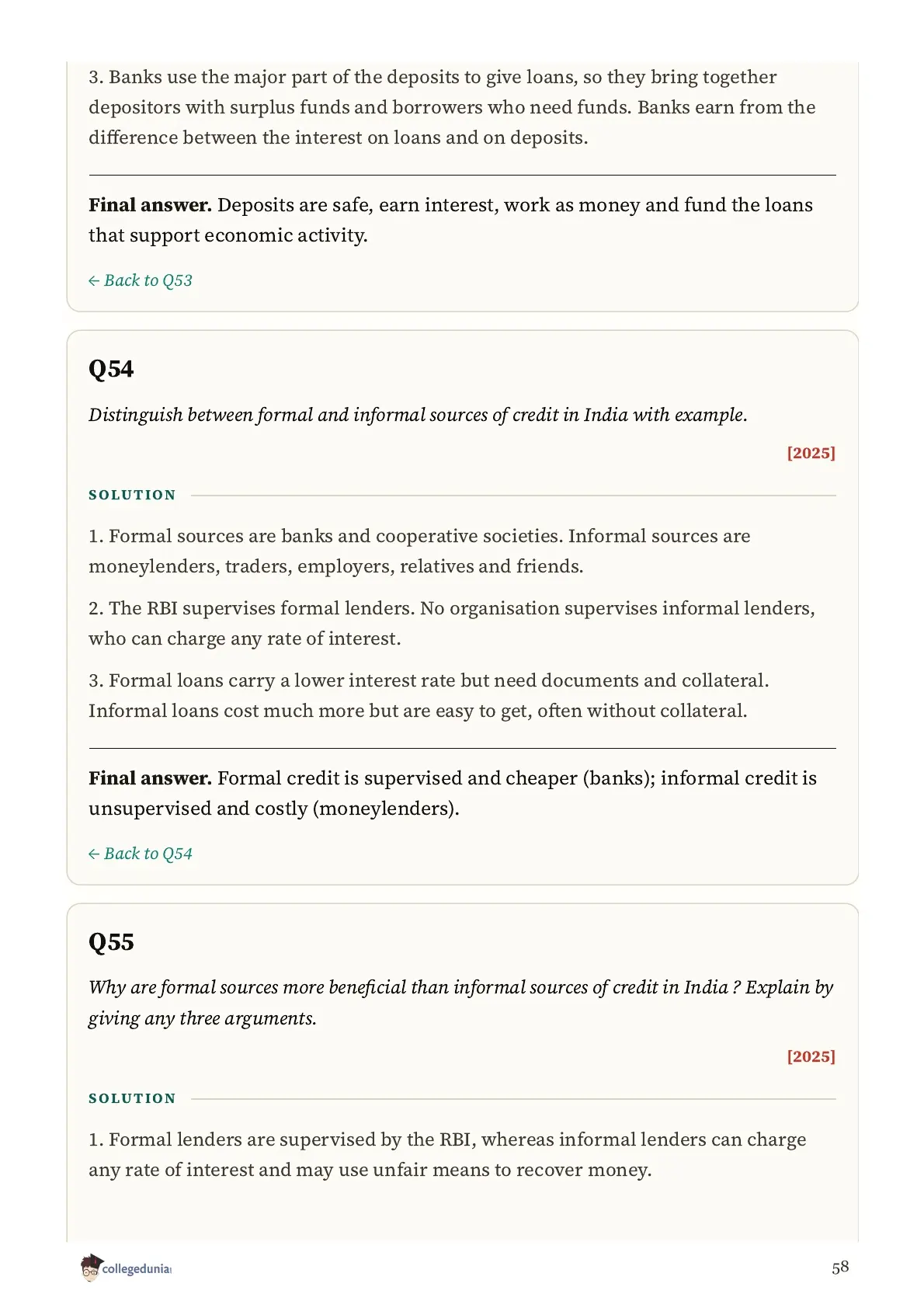
- Answering a formal versus informal question with one side only. Give at least 3 points of difference, such as rate of interest, supervision by the RBI and the documents asked.
- Treating the rate of interest as the whole cost of a loan. Collateral, documentation and the repayment schedule are also terms of credit.
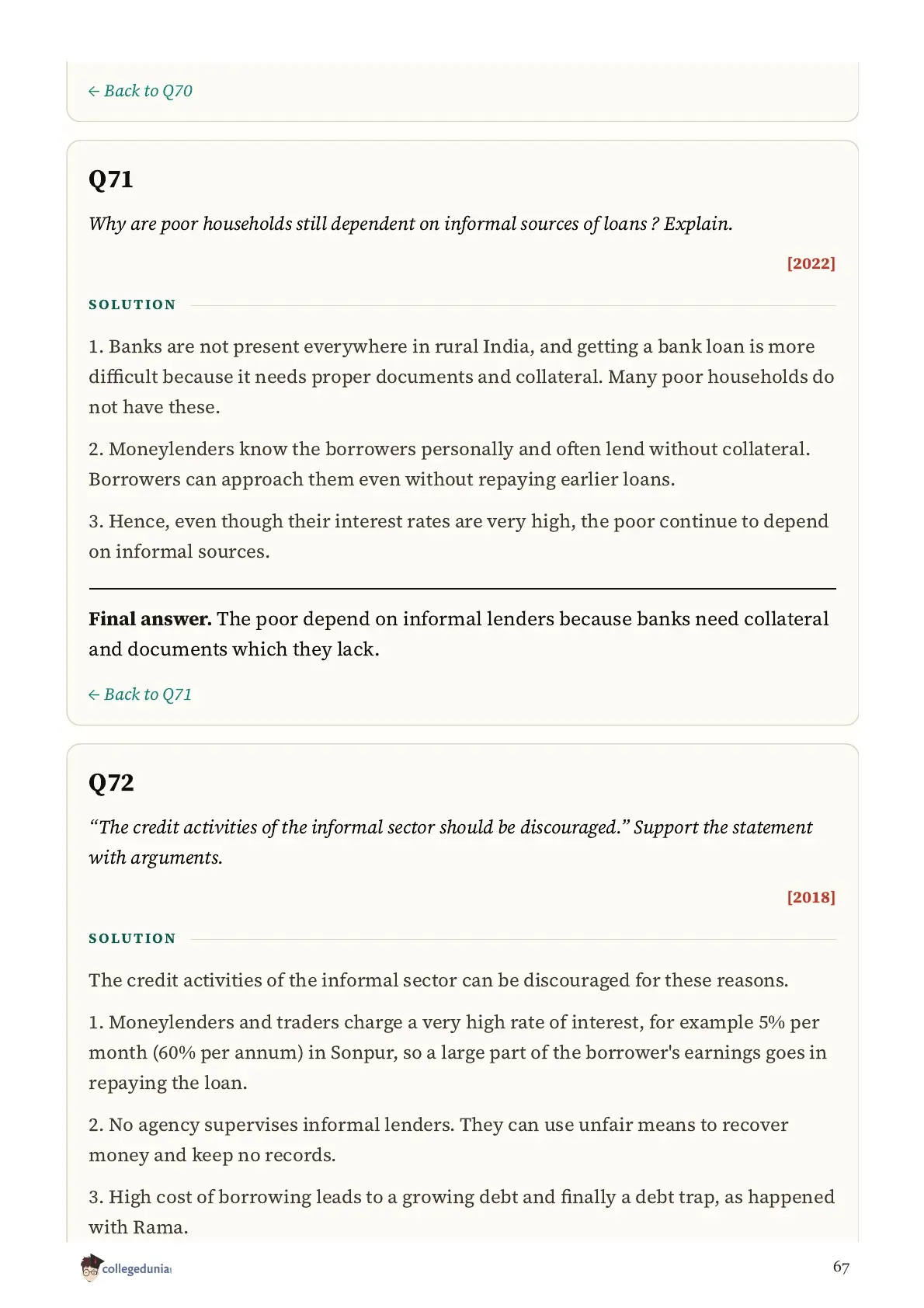
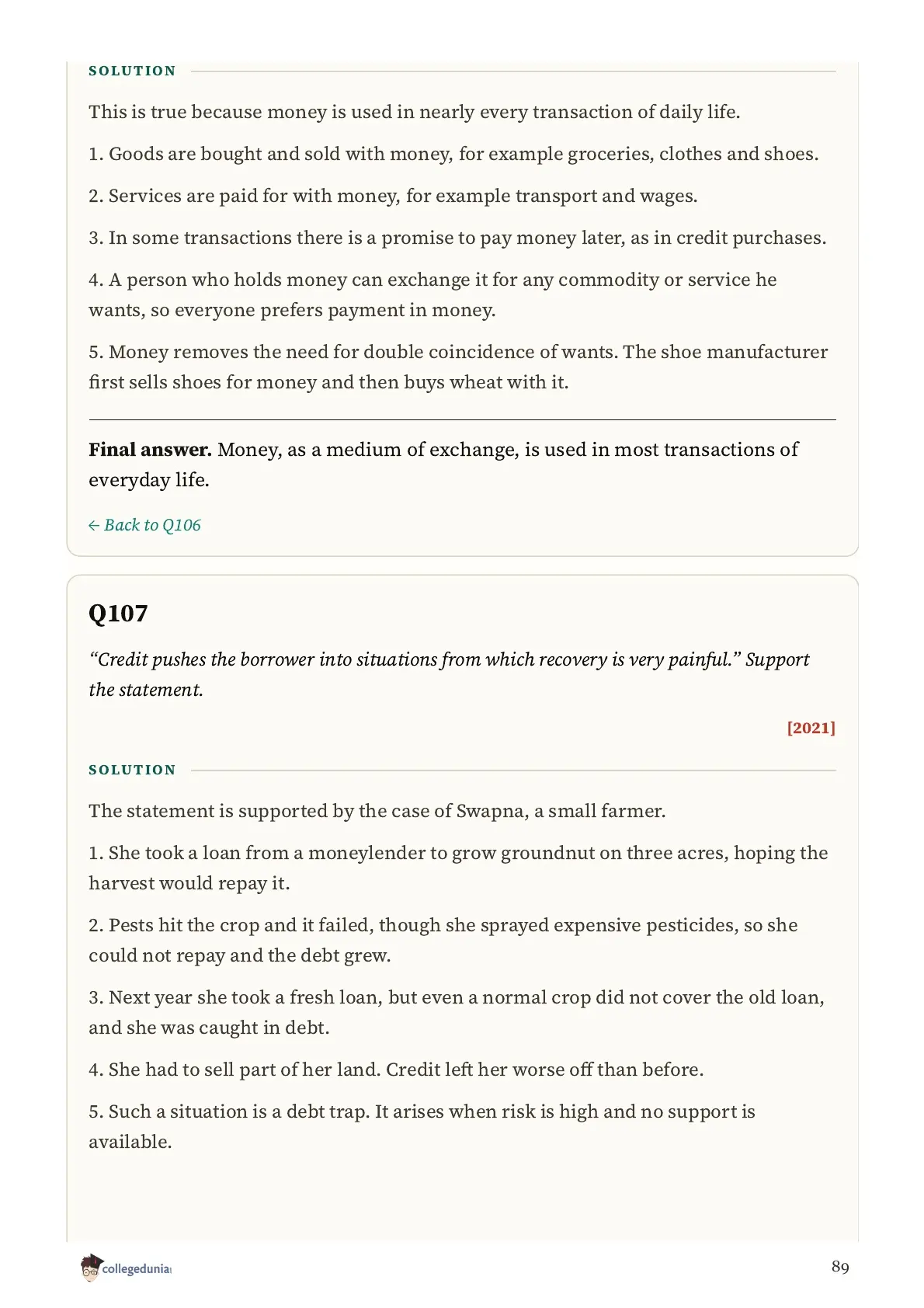
- Writing that credit is always good for the borrower. The 2022 question on credit pushing the borrower into painful recovery asks you to describe the debt trap.
Using the Answer Key and Solutions
The PDF is 90 pages and free to download. Each section is sorted newest year first, the Answer Key lists the 37 MCQs at a glance, and each question links to its worked solution and back. Attempt a 5-mark answer yourself first, check the key, then read the solution. The solutions are written by Collegedunia's Social Science experts and are not official CBSE marking schemes.
Class 10 Economics PYQs by Chapter
| Unit | PYQ Page |
|---|---|
| Understanding Economic Development | Development Class 10 Economics PYQ |
| Understanding Economic Development | Sectors of the Indian Economy Class 10 Economics PYQ |
| Understanding Economic Development | Money and Credit Class 10 Economics PYQ |
| Understanding Economic Development | Globalisation and the Indian Economy Class 10 Economics PYQ |
Money and Credit Class 10 Economics PYQ FAQs
Ques. How many questions are in the Money and Credit Class 10 Economics PYQ PDF?
Ans. The PDF has 107 questions from the 2018 and 2021 to 2026 board papers: 38 at 1 mark, 6 at 2 marks, 28 at 3 marks, 3 at 4 marks and 32 at 5 marks.
Ques. Does this PYQ PDF include solutions, or only the questions?
Ans. All 107 questions have a worked solution in the PDF. The 37 MCQs are also listed in the Answer Key before the solutions.
Ques. Are the solutions official?
Ans. No. They are written by Collegedunia's Social Science experts and checked against the NCERT chapter and, for the 2022 to 2026 main papers, against CBSE's published marking schemes. Compartment, 2018 and 2021 answers are checked against the NCERT text. They are not an official CBSE marking scheme, so the board's wording of an answer may differ.
Ques. How many marks does Money and Credit carry in the Class 10 Social Science paper?
Ans. CBSE does not publish marks per chapter. The Social Science paper is 80 marks and, in the 2026 papers, Economics is a 20-mark section. Money and Credit is one of the chapters that fill it, and 32 of the 107 questions in this set are 5-mark answers.
Ques. What kind of questions are asked from Money and Credit?
Ans. MCQs on collateral, the Reserve Bank of India and the rupee as a medium of exchange, 3-mark explanations such as how a self-help group works, 5-mark comparisons of formal and informal sources of credit, and source-based questions on loans from banks and cooperatives.
Ques. Which years does the set cover?
Ans. The questions come from 7 board years: 2018 and 2021 to 2026. 2025 has the most questions (30), followed by 2024 (20) and 2026 (18).
Ques. Is Consumer Rights asked in the Class 10 board paper?
Ans. The chapter is in the NCERT book, but none of the Economics questions in the 2021 to 2026 papers used for this series is on it, so there is no separate page.



Comments