NCERT Solutions for Class 11 Legal Studies Chapter 7 Classification of Laws cover all textbook questions for the 2026-27 CBSE syllabus. The PDF explains international law, municipal law, public law, private law, procedural law and branch-identification examples in short school-answer form.
Includes 11 solved question cards with detailed solution and expert solution tabs.
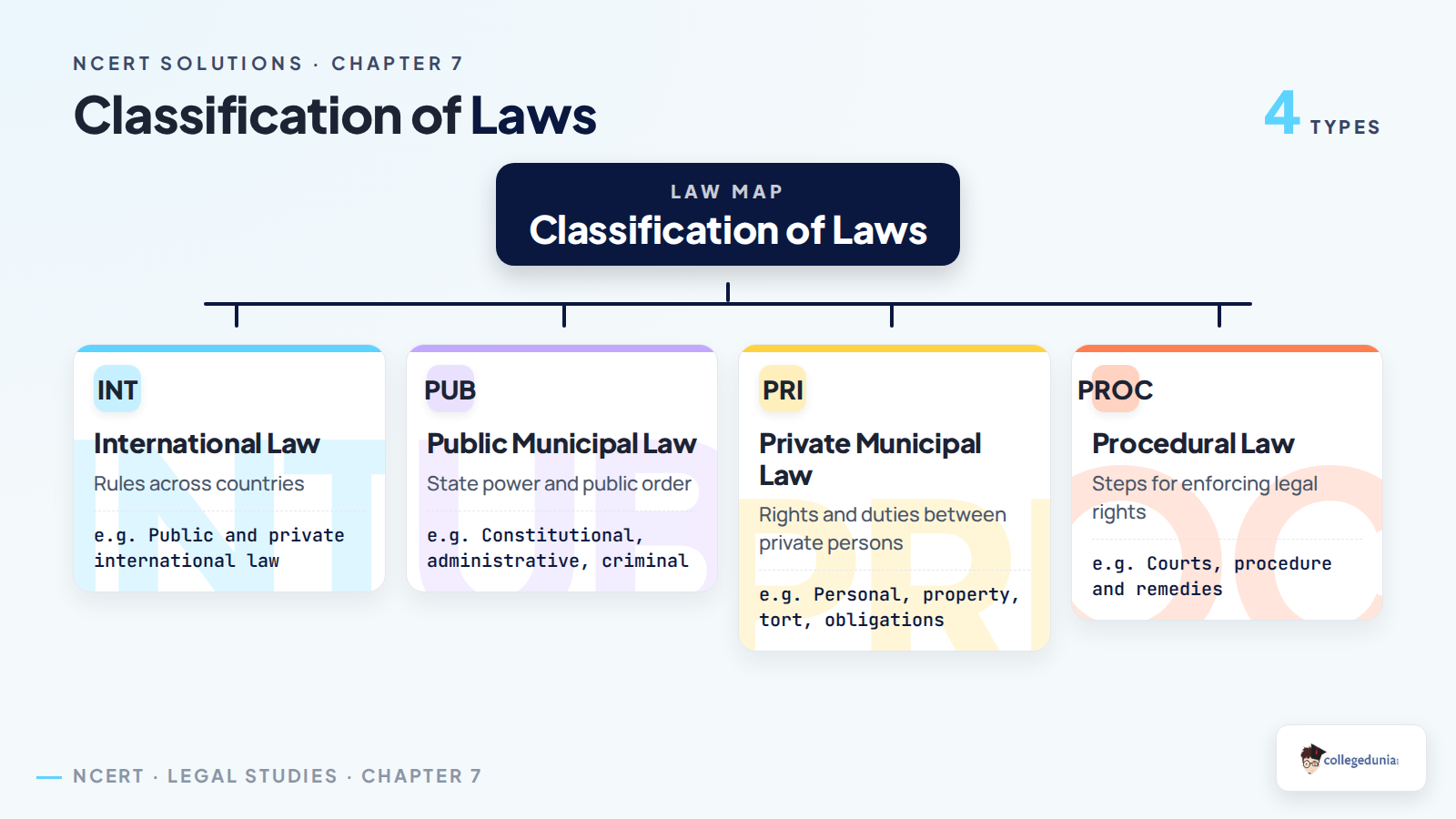
Covers international law, public municipal law, private municipal law and procedural law.
Uses tables, branch clues and final-answer boxes for quick revision.
Classification of Laws Class 11 Legal Studies NCERT Solutions PDF
Student Feedback: In a Collegedunia poll of 10,860 Class 11 Legal Studies students, 73 percent said Classification of Laws became easier when public, private, municipal and international branches were revised in one chart.
These Class 11 Legal Studies Chapter 7 solutions are checked against the official NCERT chapter and written for the 2026-27 CBSE syllabus.
Classification of Laws asks students to identify the branch of law from a legal situation. Most answers need the branch name first, then the reason from the facts.
The chapter first divides law by where it operates and who it governs. The safest revision method is to ask whether the dispute is international, domestic, public, private or procedural.
International law: legal rules involving nations or foreign elements.
Municipal law: domestic law operating inside one State.
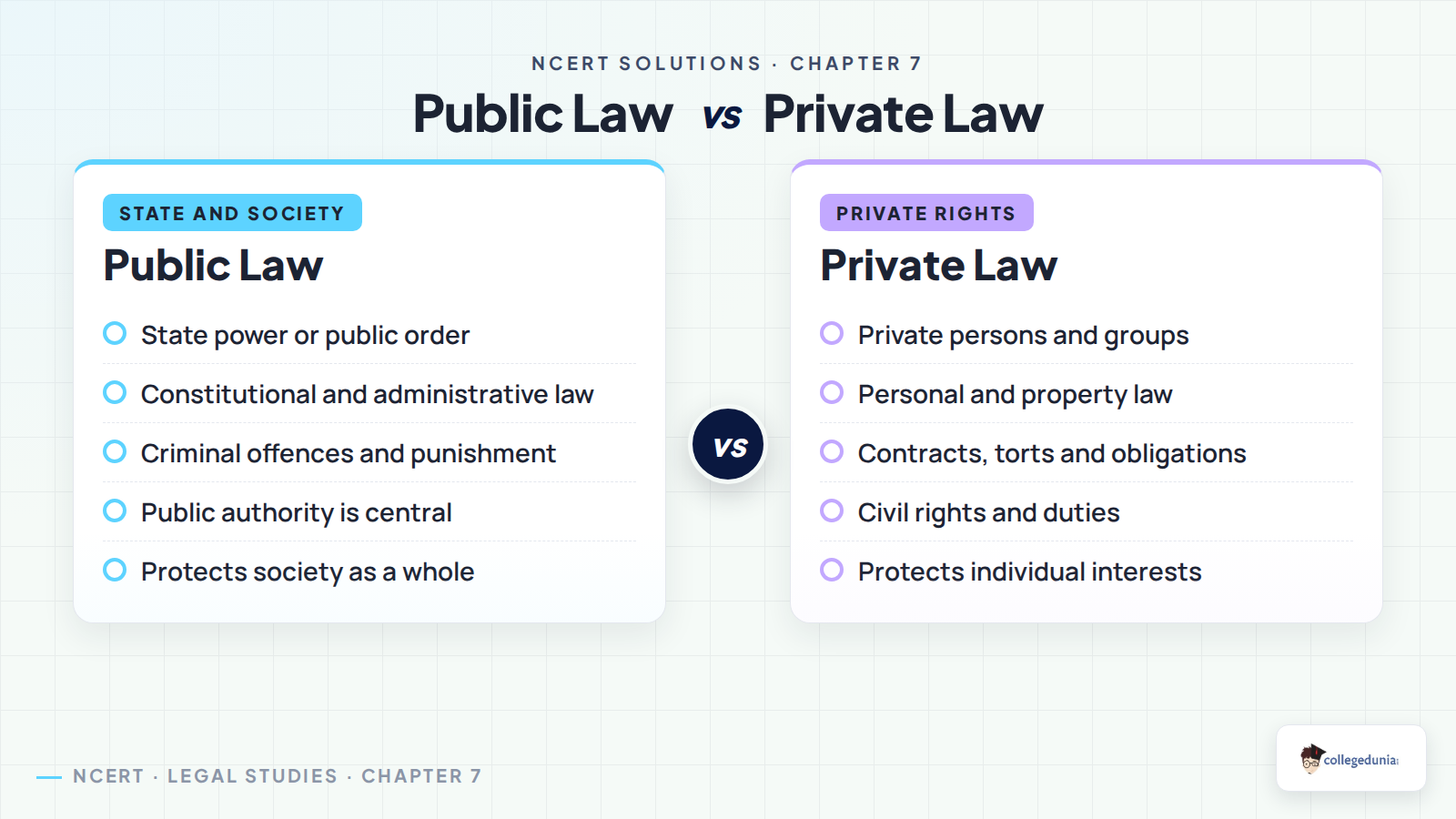
Public municipal law: State power, public order and society-wide interests.
Private municipal law: private rights and duties between persons.
Procedural law: the method used to enforce rights and duties.
International Law and Municipal Law Difference
International law applies when the legal issue crosses the boundary of one State. It may involve countries directly, or private persons whose facts connect with more than one country.
Basis
International law
Municipal law
Scope
Across countries or legal systems
Inside one State
Parties
Nations, or private persons with a foreign element
The table below links the Class 11 Legal Studies NCERT Solutions sequence. Chapter 7 sits after Jurisprudence, Nature and Meaning of Law and before Sources of Laws.
All NCERT Solutions for Class 11 Legal Studies Chapter 7 Classification of Laws with Step-by-Step Solutions
Textbook Question 1: Core Concepts
Q 7.1
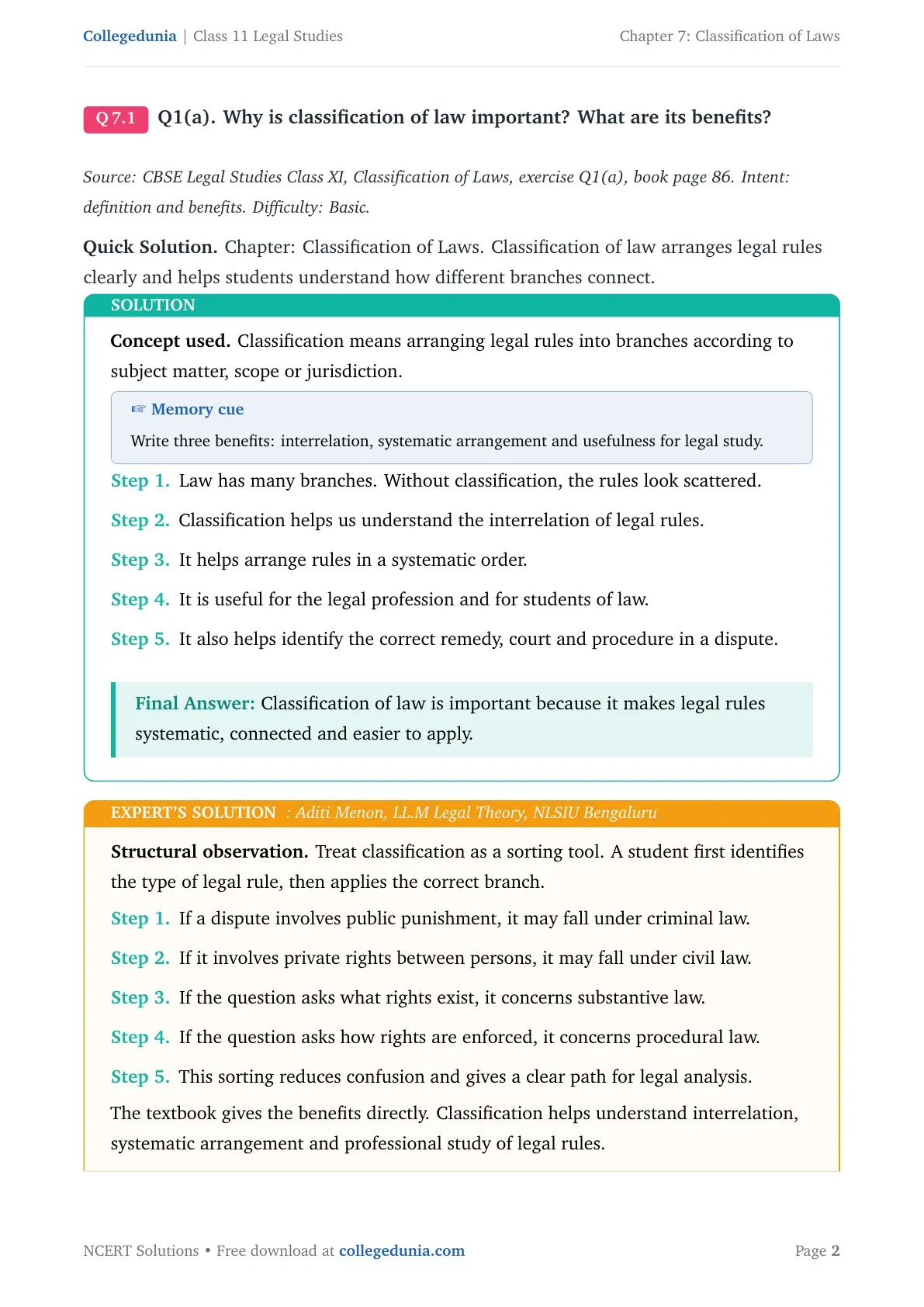
Q1(a). Why is classification of law important? What are its benefits?
Concept used. Classification means arranging legal rules into branches according to subject matter, scope or jurisdiction.
Memory cue
Write three benefits: interrelation, systematic arrangement and usefulness for legal study.
Law has many branches. Without classification, the rules look scattered.
Classification helps us understand the interrelation of legal rules.
It helps arrange rules in a systematic order.
It is useful for the legal profession and for students of law.
It also helps identify the correct remedy, court and procedure in a dispute.
Classification of law is important because it makes legal rules systematic, connected and easier to apply.
AM
Aditi Menon
LL.M Legal Theory, NLSIU Bengaluru
Verified Expert
Structural observation. Treat classification as a sorting tool. A student first identifies the type of legal rule, then applies the correct branch.
If a dispute involves public punishment, it may fall under criminal law.
If it involves private rights between persons, it may fall under civil law.
If the question asks what rights exist, it concerns substantive law.
If the question asks how rights are enforced, it concerns procedural law.
This sorting reduces confusion and gives a clear path for legal analysis.
The textbook gives the benefits directly. Classification helps understand interrelation, systematic arrangement and professional study of legal rules.
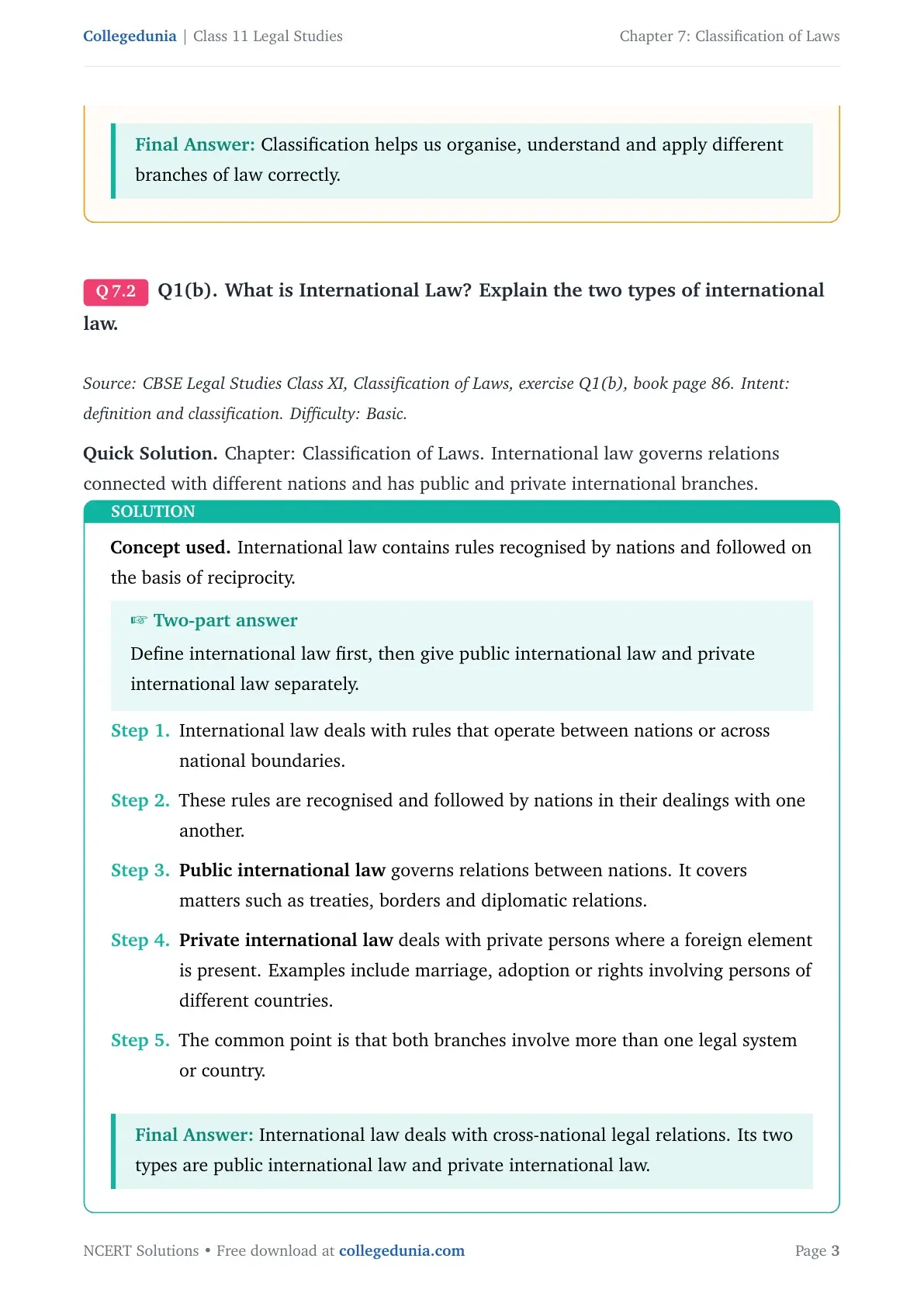
Classification helps us organise, understand and apply different branches of law correctly.
Q 7.2
Q1(b). What is International Law? Explain the two types of international law.
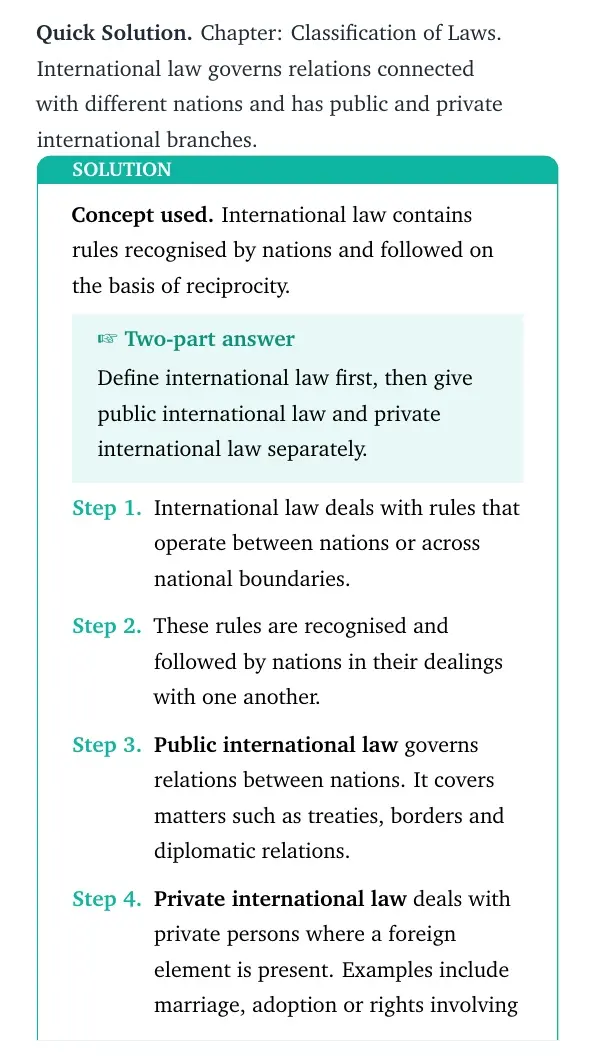
Concept used. International law contains rules recognised by nations and followed on the basis of reciprocity.
Two-part answer
Define international law first, then give public international law and private international law separately.
International law deals with rules that operate between nations or across national boundaries.
These rules are recognised and followed by nations in their dealings with one another.
Public international law governs relations between nations.
It covers matters such as treaties, borders and diplomatic relations.
Private international law deals with private persons where a foreign element is present.
Examples include marriage, adoption or rights involving persons of different countries.
The common point is that both branches involve more than one legal system or country.
International law deals with cross-national legal relations. Its two types are public international law and private international law.
RK
Rohan Kapur
LL.M International Law, JNU Delhi
Verified Expert
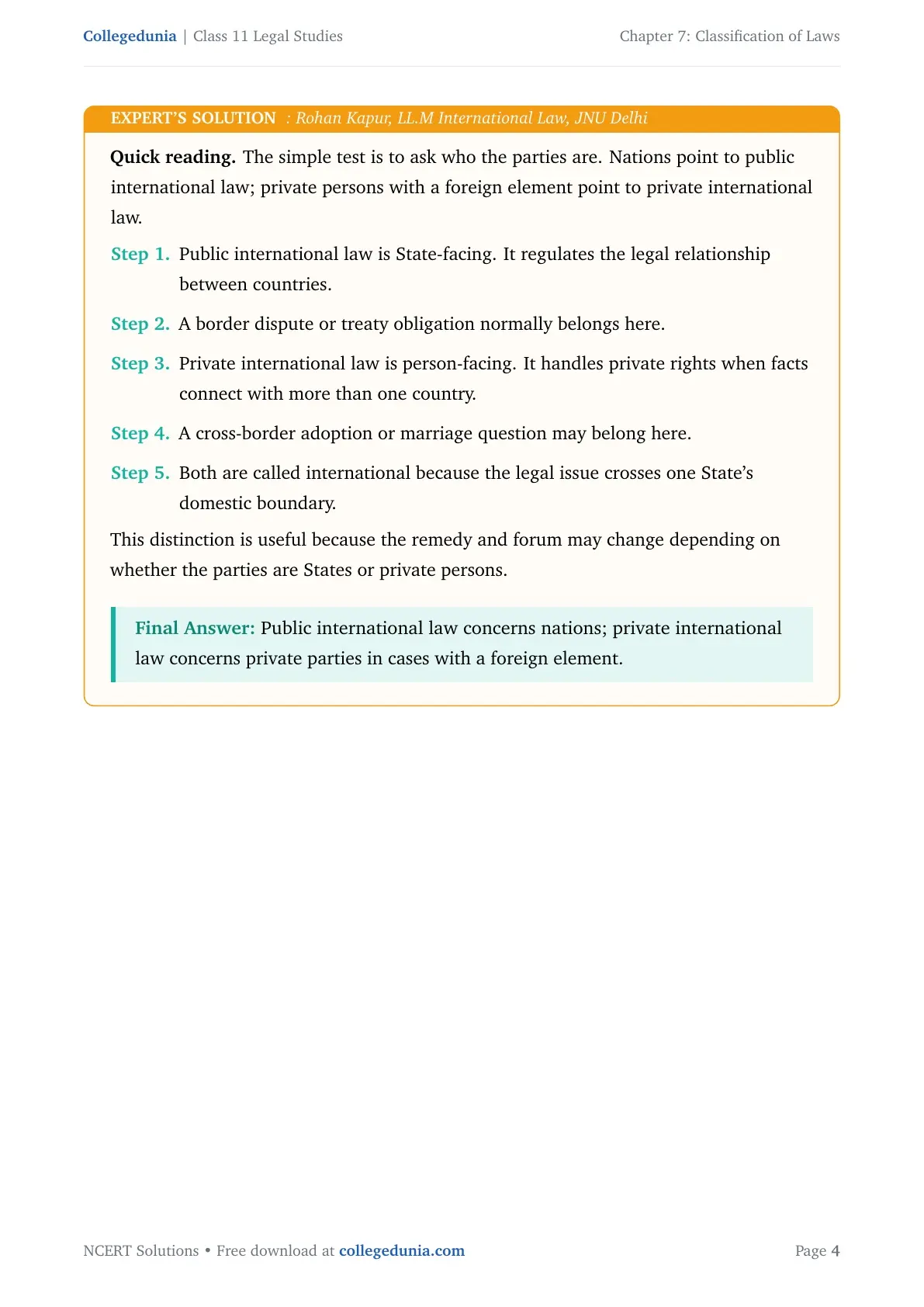
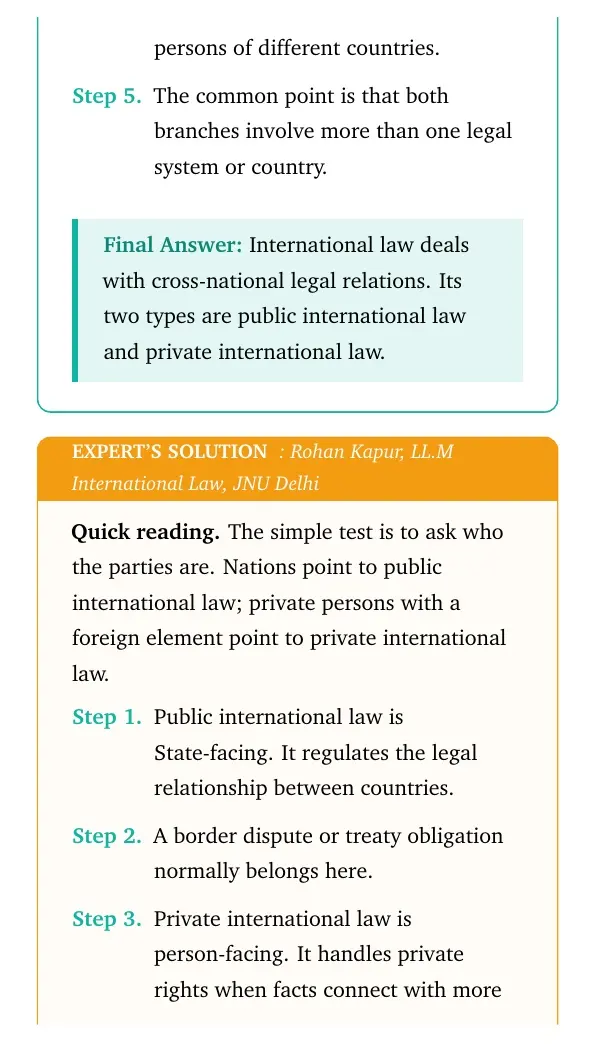
Quick reading. The simple test is to ask who the parties are. Nations point to public international law; private persons with a foreign element point to private international law.
Public international law is State-facing.
It regulates the legal relationship between countries.
A border dispute or treaty obligation normally belongs here.
Private international law is person-facing.
It handles private rights when facts connect with more than one country.
A cross-border adoption or marriage question may belong here.
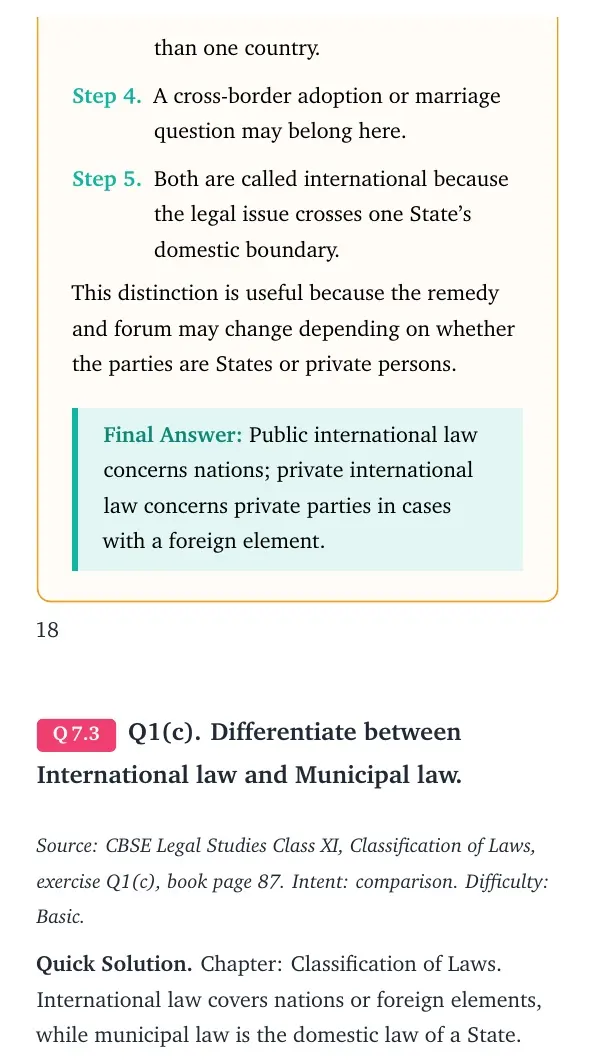
Both are called international because the legal issue crosses one State's domestic boundary.
This distinction is useful because the remedy and forum may change depending on whether the parties are States or private persons.
Public international law concerns nations; private international law concerns private parties in cases with a foreign element.
Q 7.3
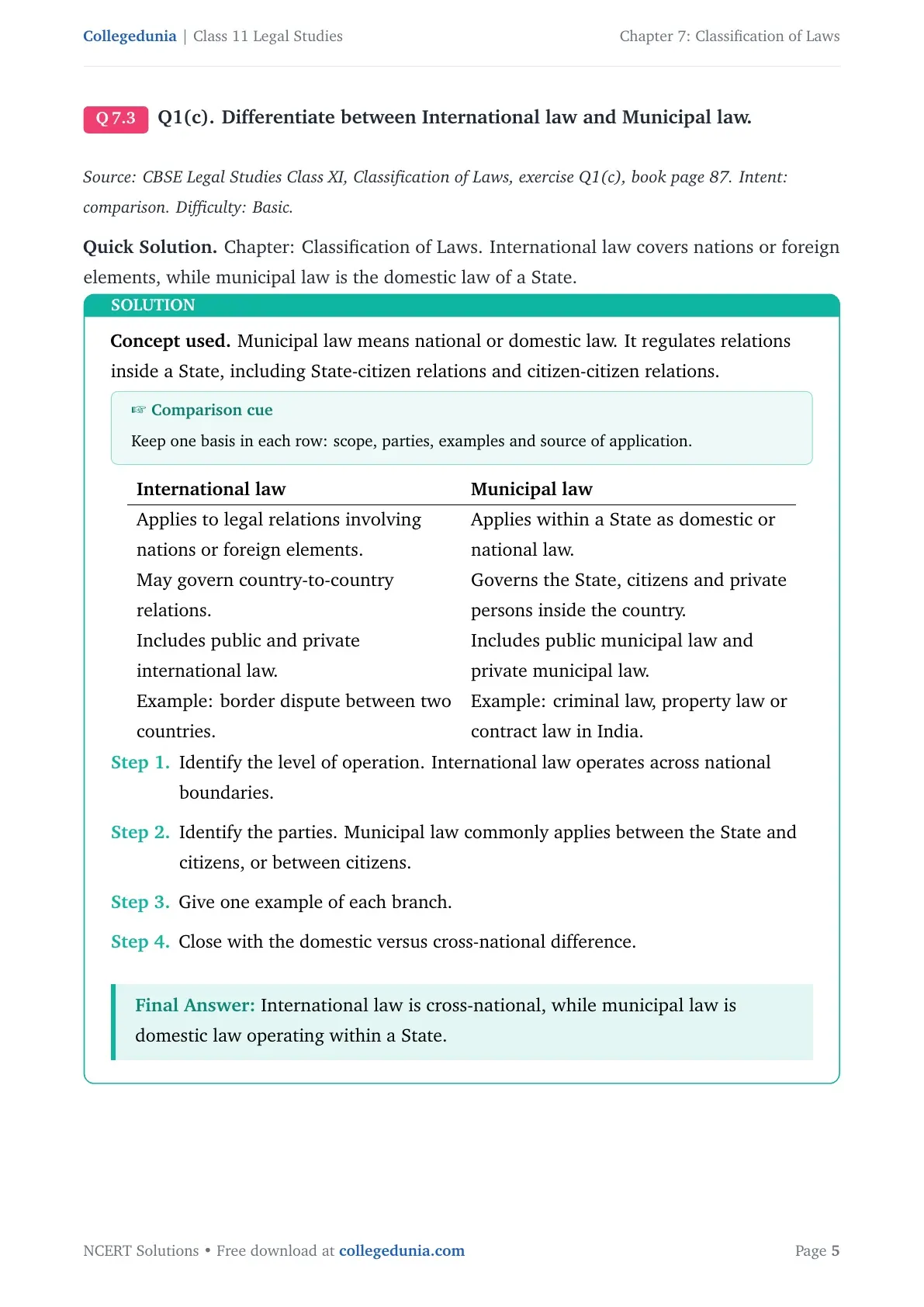
Q1(c). Differentiate between International law and Municipal law.
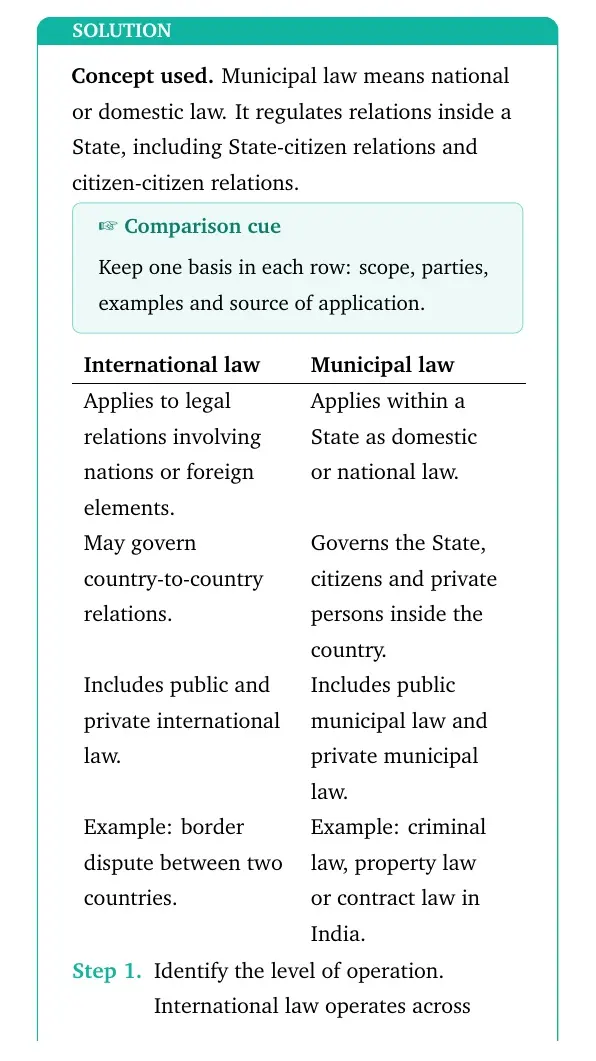
Concept used. Municipal law means national or domestic law. It regulates relations inside a State, including State-citizen relations and citizen-citizen relations.
Comparison cue
Keep one basis in each row: scope, parties, examples and source of application.
International law
Municipal law
Applies to legal relations involving nations or foreign elements.
Applies within a State as domestic or national law.
May govern country-to-country relations.
Governs the State, citizens and private persons inside the country.
Includes public and private international law.
Includes public municipal law and private municipal law.
Example: border dispute between two countries.
Example: criminal law, property law or contract law in India.
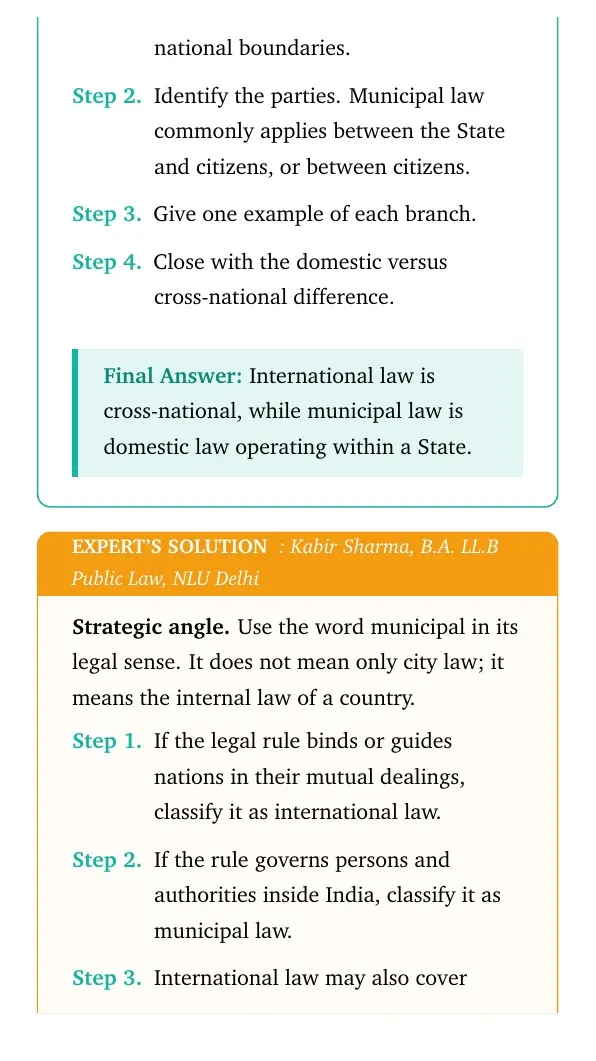
Identify the level of operation.
International law operates across national boundaries.
Identify the parties.
Municipal law commonly applies between the State and citizens, or between citizens.
Give one example of each branch.
Close with the domestic versus cross-national difference.
International law is cross-national, while municipal law is domestic law operating within a State.
KS
Kabir Sharma
B.A. LL.B Public Law, NLU Delhi
Verified Expert
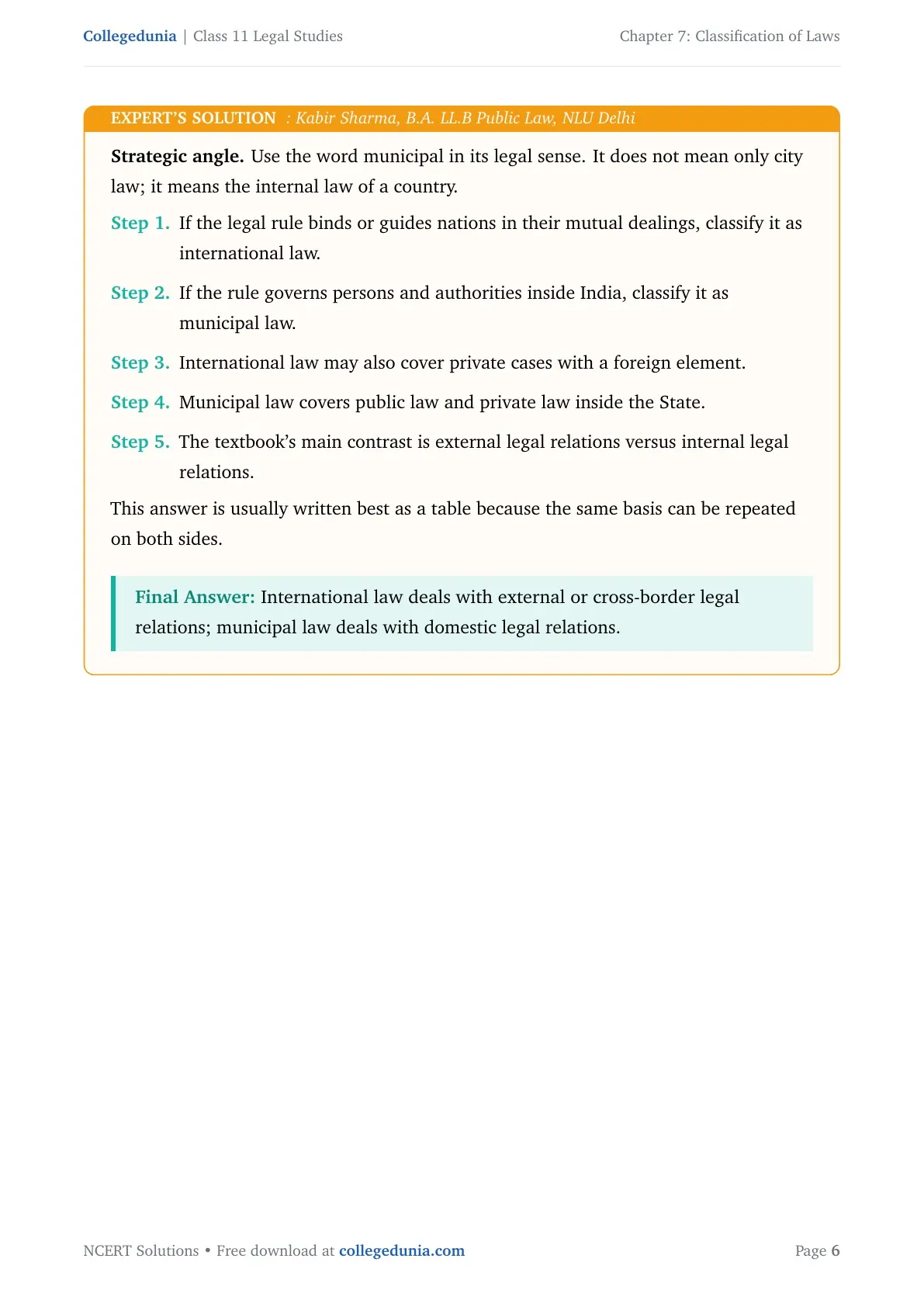
Strategic angle. Use the word municipal in its legal sense. It does not mean only city law; it means the internal law of a country.
If the legal rule binds or guides nations in their mutual dealings, classify it as international law.
If the rule governs persons and authorities inside India, classify it as municipal law.
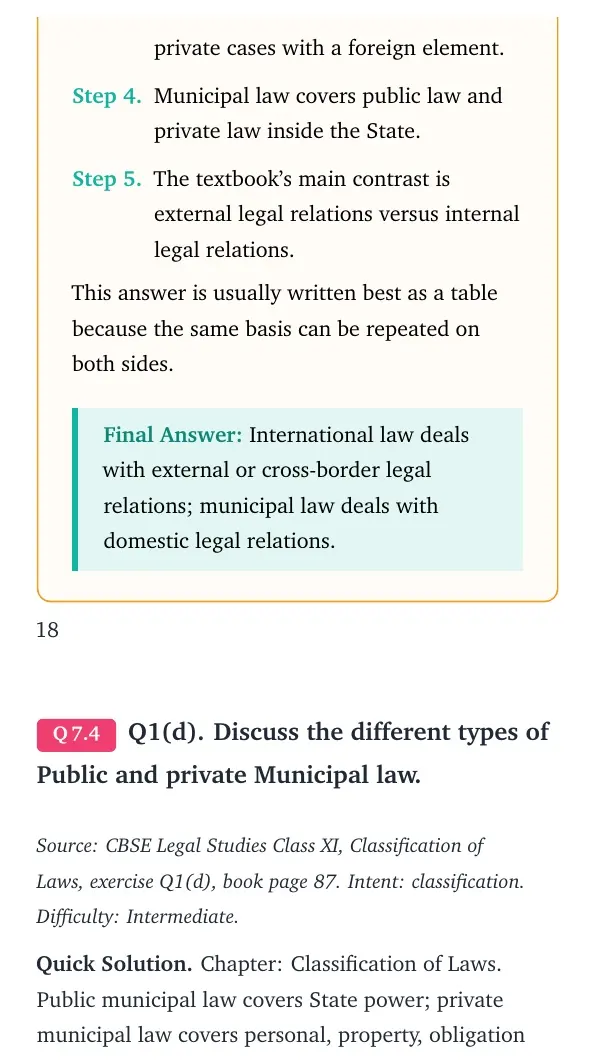
International law may also cover private cases with a foreign element.
Municipal law covers public law and private law inside the State.
The textbook's main contrast is external legal relations versus internal legal relations.
This answer is usually written best as a table because the same basis can be repeated on both sides.
International law deals with external or cross-border legal relations; municipal law deals with domestic legal relations.
Q 7.4
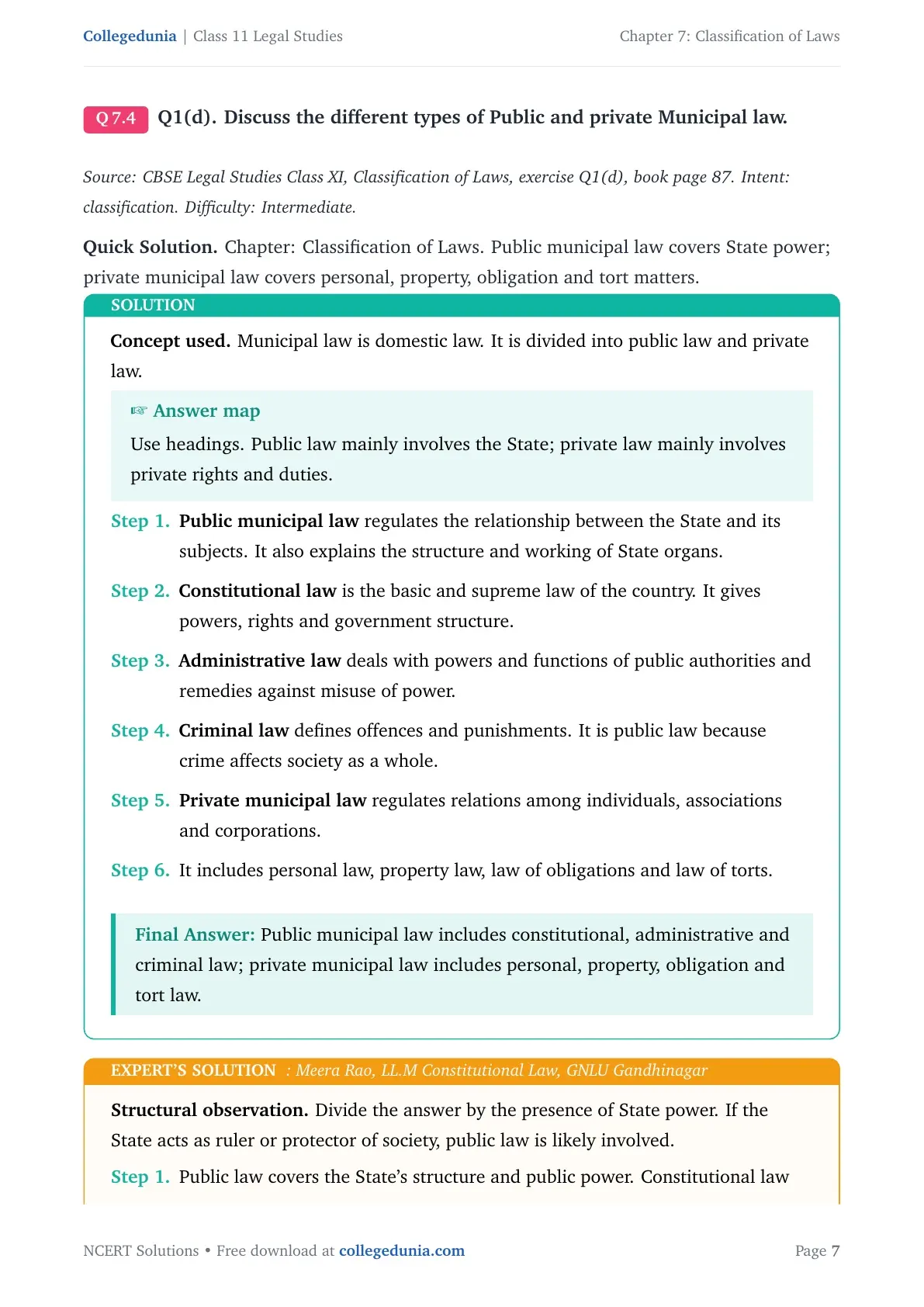
Q1(d). Discuss the different types of Public and private Municipal law.
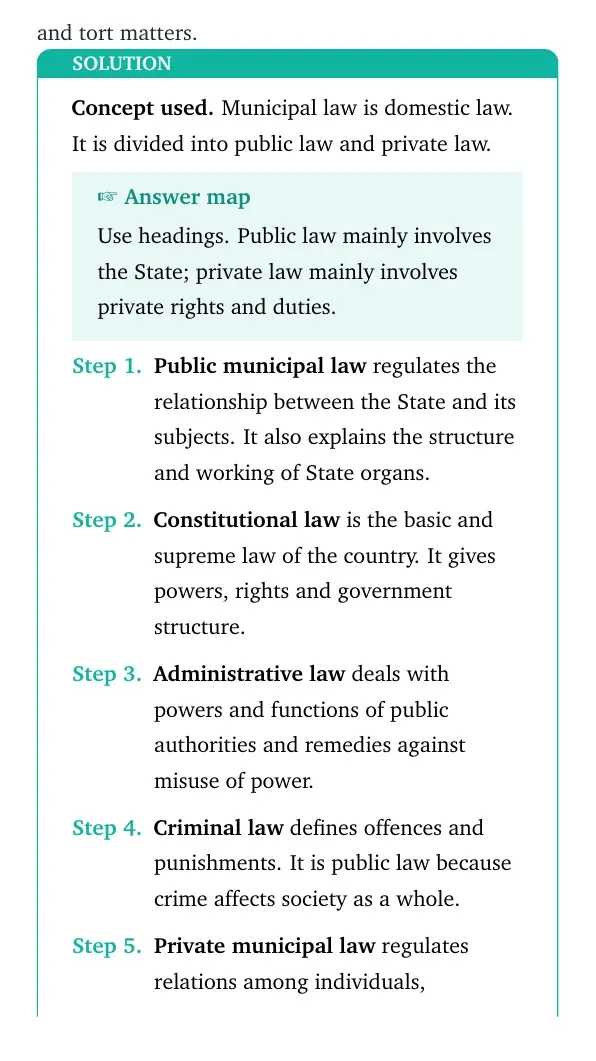
Concept used. Municipal law is domestic law. It is divided into public law and private law.
Answer map
Use headings. Public law mainly involves the State; private law mainly involves private rights and duties.
Public municipal law regulates the relationship between the State and its subjects.
It also explains the structure and working of State organs.
Constitutional law is the basic and supreme law of the country.
It gives powers, rights and government structure.
Administrative law deals with powers and functions of public authorities and remedies against misuse of power.
Criminal law defines offences and punishments.
It is public law because crime affects society as a whole.
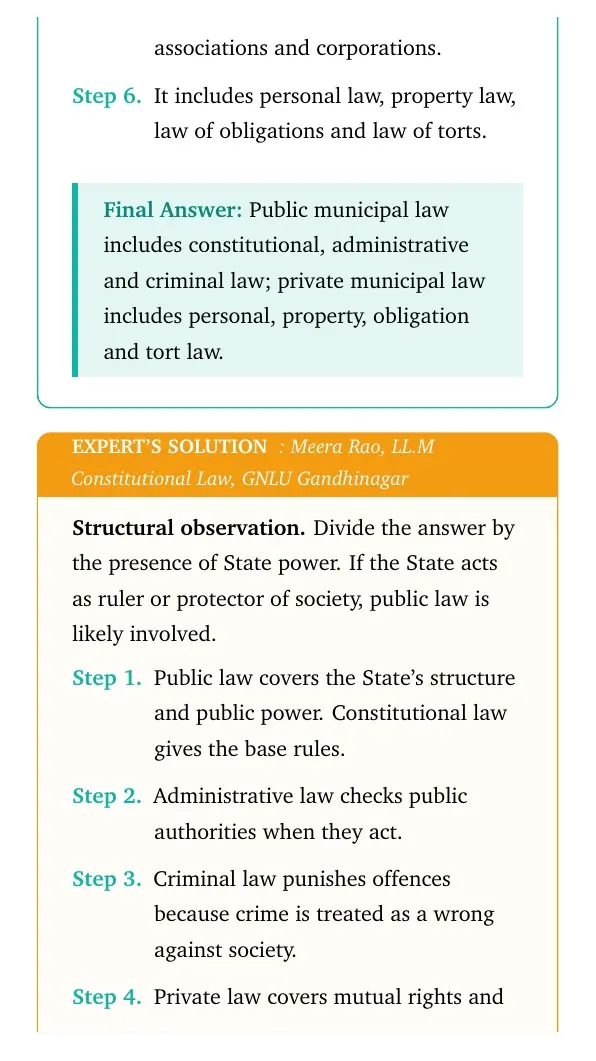
Private municipal law regulates relations among individuals, associations and corporations.
It includes personal law, property law, law of obligations and law of torts.
Public municipal law includes constitutional, administrative and criminal law; private municipal law includes personal, property, obligation and tort law.
MR
Meera Rao
LL.M Constitutional Law, GNLU Gandhinagar
Verified Expert
Structural observation. Divide the answer by the presence of State power. If the State acts as ruler or protector of society, public law is likely involved.
Public law covers the State's structure and public power.
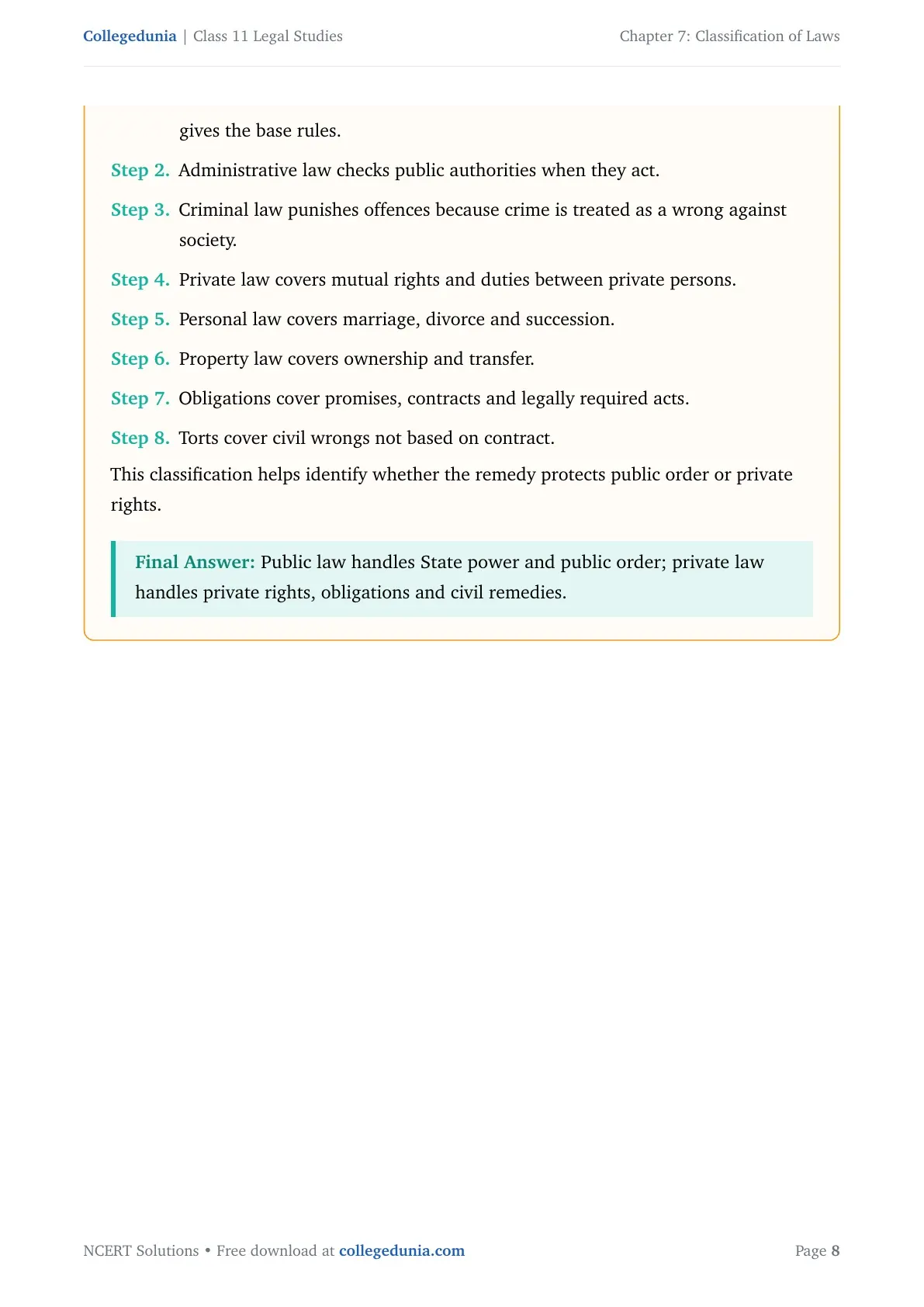
Constitutional law gives the base rules.
Administrative law checks public authorities when they act.
Criminal law punishes offences because crime is treated as a wrong against society.
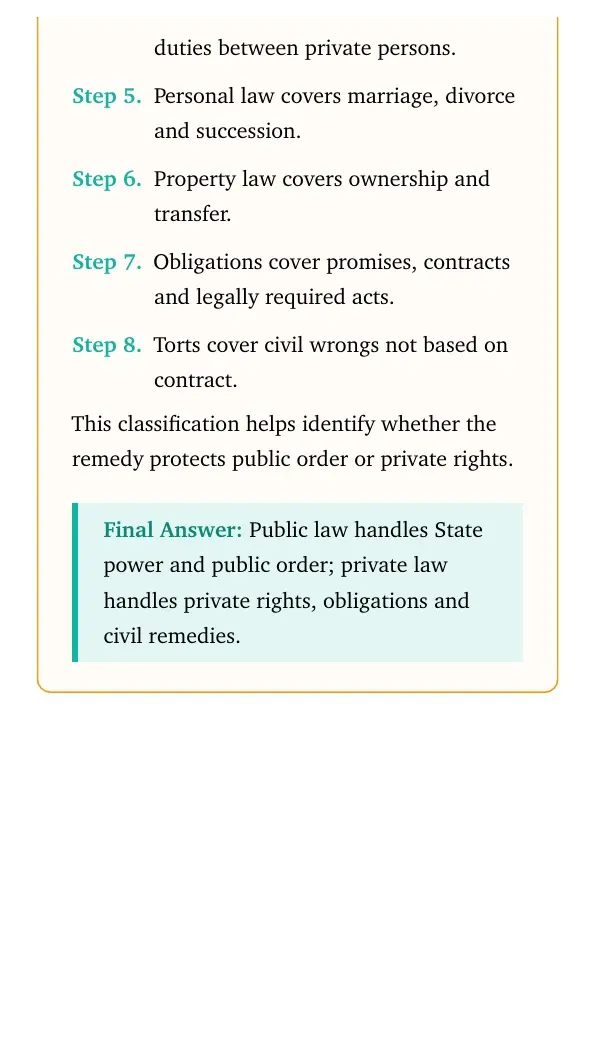
Private law covers mutual rights and duties between private persons.
Personal law covers marriage, divorce and succession.
Property law covers ownership and transfer.
Obligations cover promises, contracts and legally required acts.
Torts cover civil wrongs not based on contract.
This classification helps identify whether the remedy protects public order or private rights.
Public law handles State power and public order; private law handles private rights, obligations and civil remedies.
Textbook Question 2: Identify the Branch
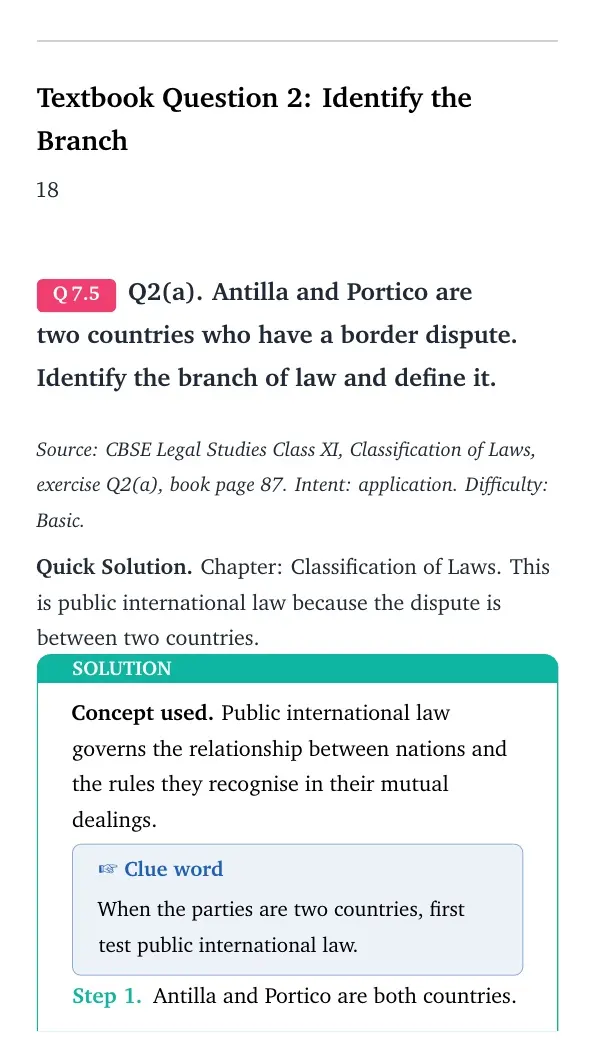
Q 7.5
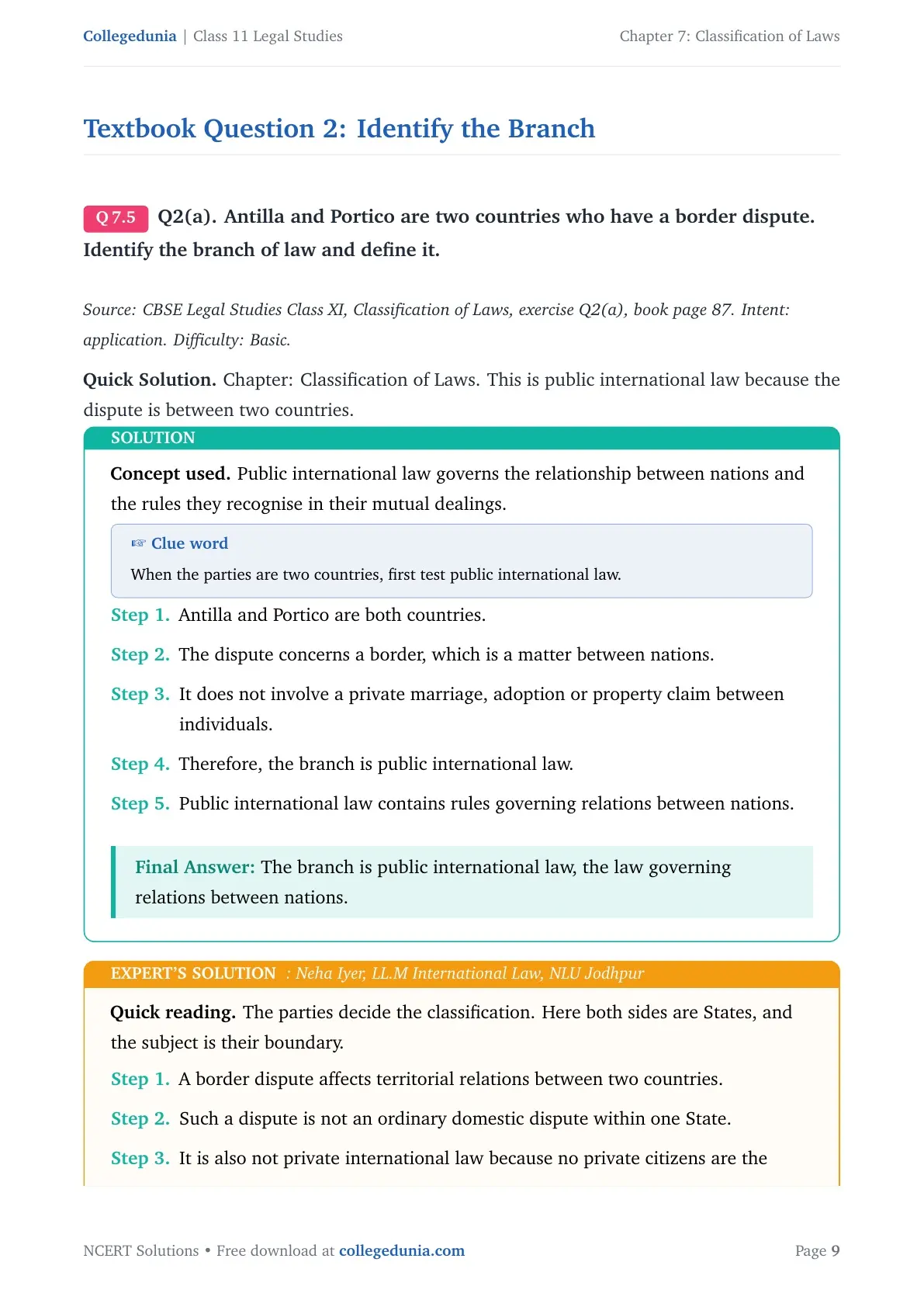
Q2(a). Antilla and Portico are two countries who have a border dispute. Identify the branch of law and define it.
Concept used. Public international law governs the relationship between nations and the rules they recognise in their mutual dealings.
Clue word
When the parties are two countries, first test public international law.
Antilla and Portico are both countries.
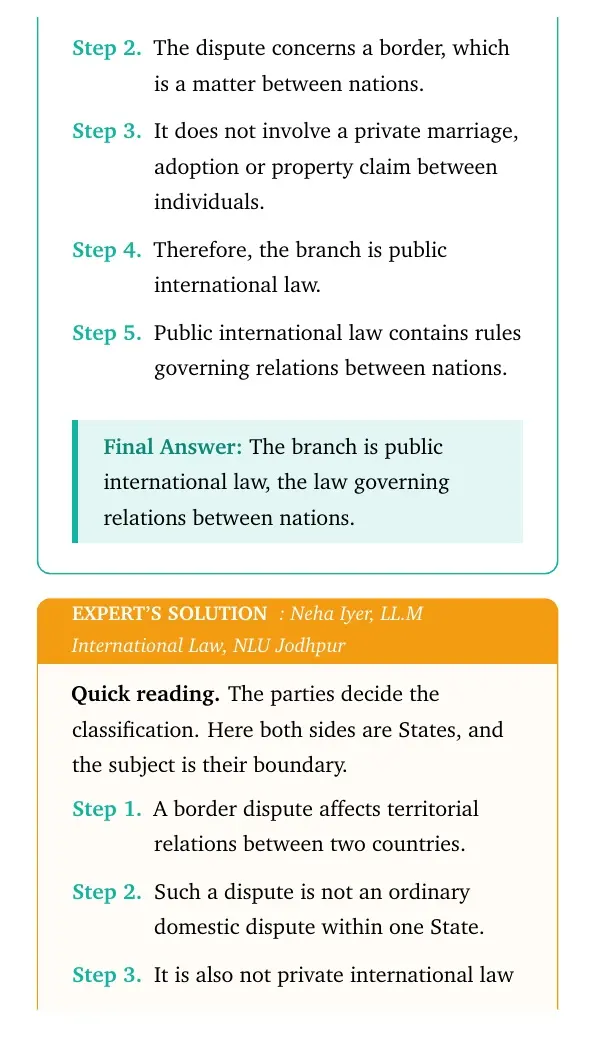
The dispute concerns a border, which is a matter between nations.
It does not involve a private marriage, adoption or property claim between individuals.
Therefore, the branch is public international law.
Public international law contains rules governing relations between nations.
The branch is public international law, the law governing relations between nations.
NI
Neha Iyer
LL.M International Law, NLU Jodhpur
Verified Expert
Quick reading. The parties decide the classification. Here both sides are States, and the subject is their boundary.
A border dispute affects territorial relations between two countries.
Such a dispute is not an ordinary domestic dispute within one State.
It is also not private international law because no private citizens are the direct parties.
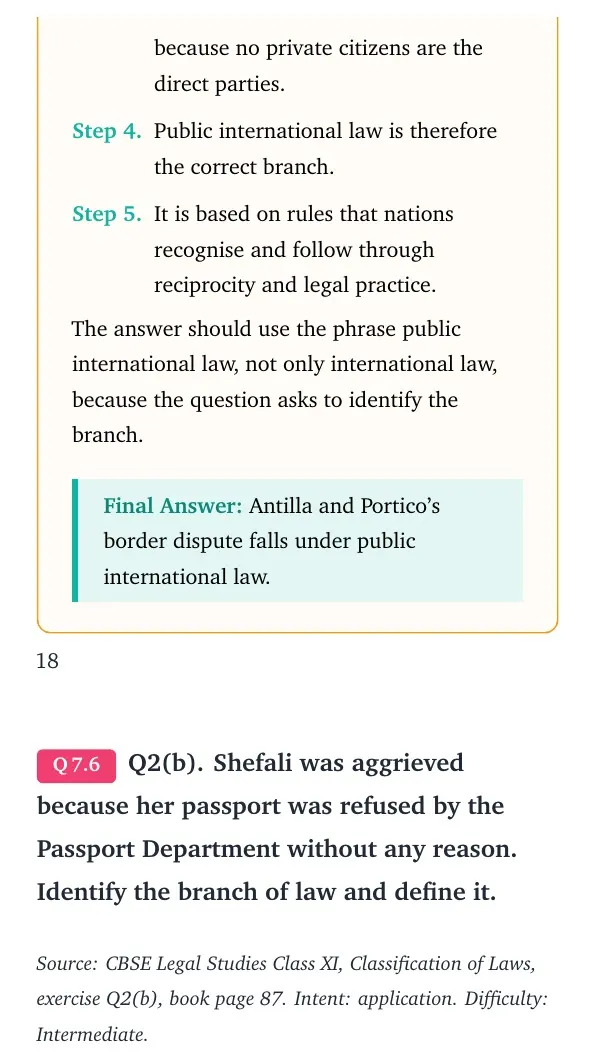
Public international law is therefore the correct branch.
It is based on rules that nations recognise and follow through reciprocity and legal practice.
The answer should use the phrase public international law, not only international law, because the question asks to identify the branch.
Antilla and Portico's border dispute falls under public international law.
Q 7.6
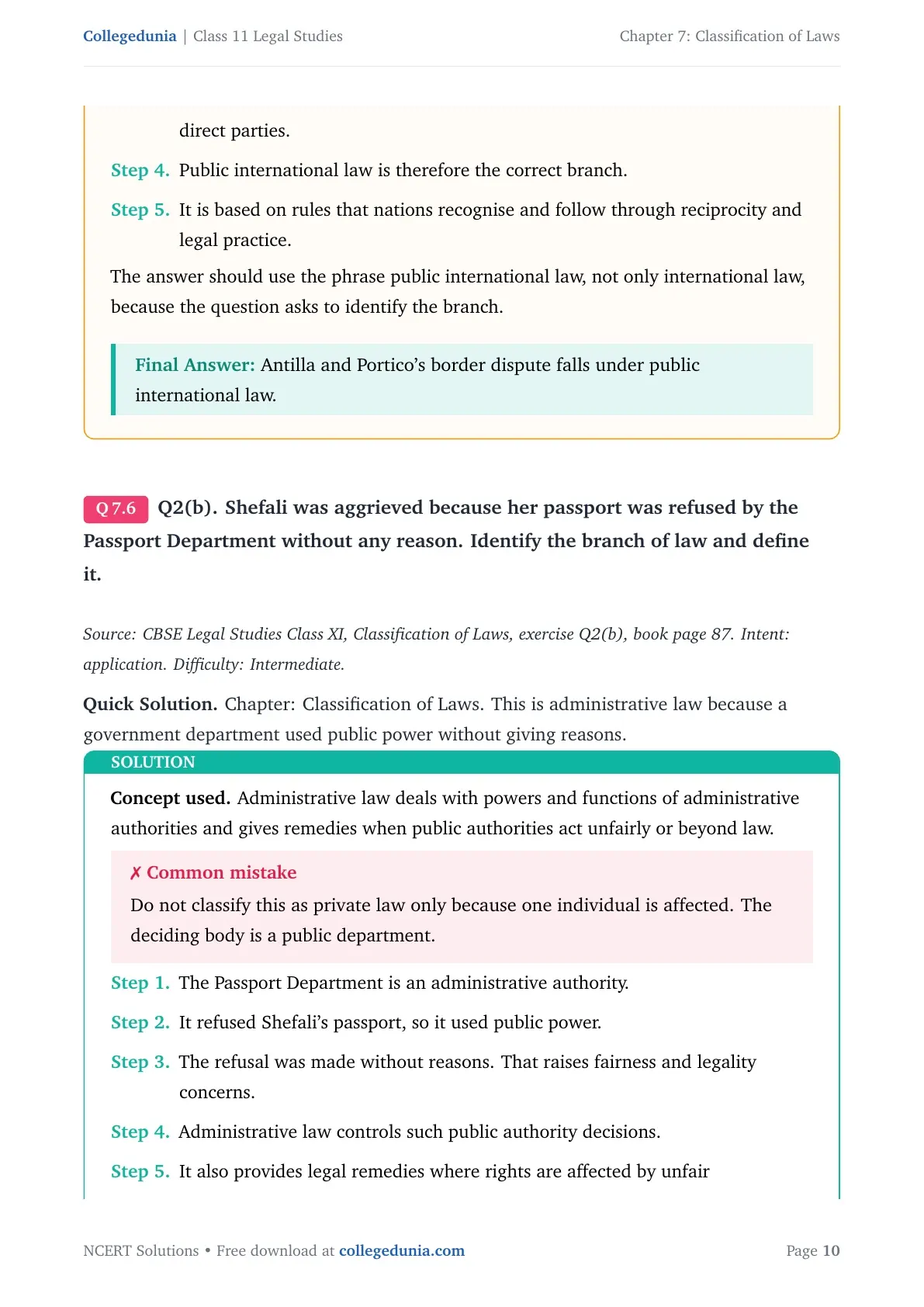
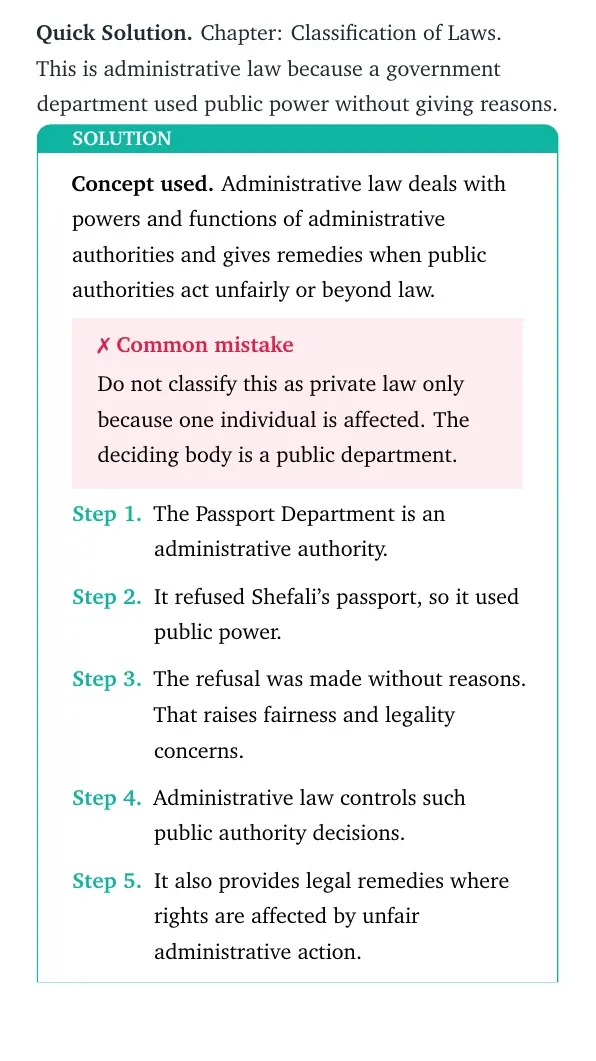
Q2(b). Shefali was aggrieved because her passport was refused by the Passport Department without any reason. Identify the branch of law and define it.
Concept used. Administrative law deals with powers and functions of administrative authorities and gives remedies when public authorities act unfairly or beyond law.
Common mistake
Do not classify this as private law only because one individual is affected. The deciding body is a public department.
The Passport Department is an administrative authority.
It refused Shefali's passport, so it used public power.
The refusal was made without reasons.
That raises fairness and legality concerns.
Administrative law controls such public authority decisions.
It also provides legal remedies where rights are affected by unfair administrative action.
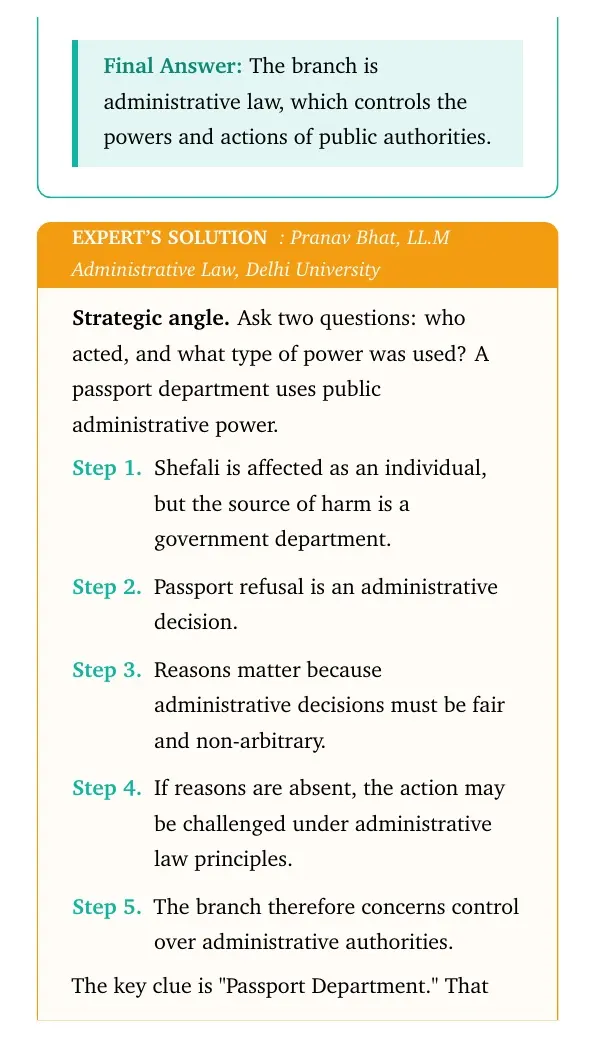
The branch is administrative law, which controls the powers and actions of public authorities.
PB
Pranav Bhat
LL.M Administrative Law, Delhi University
Verified Expert
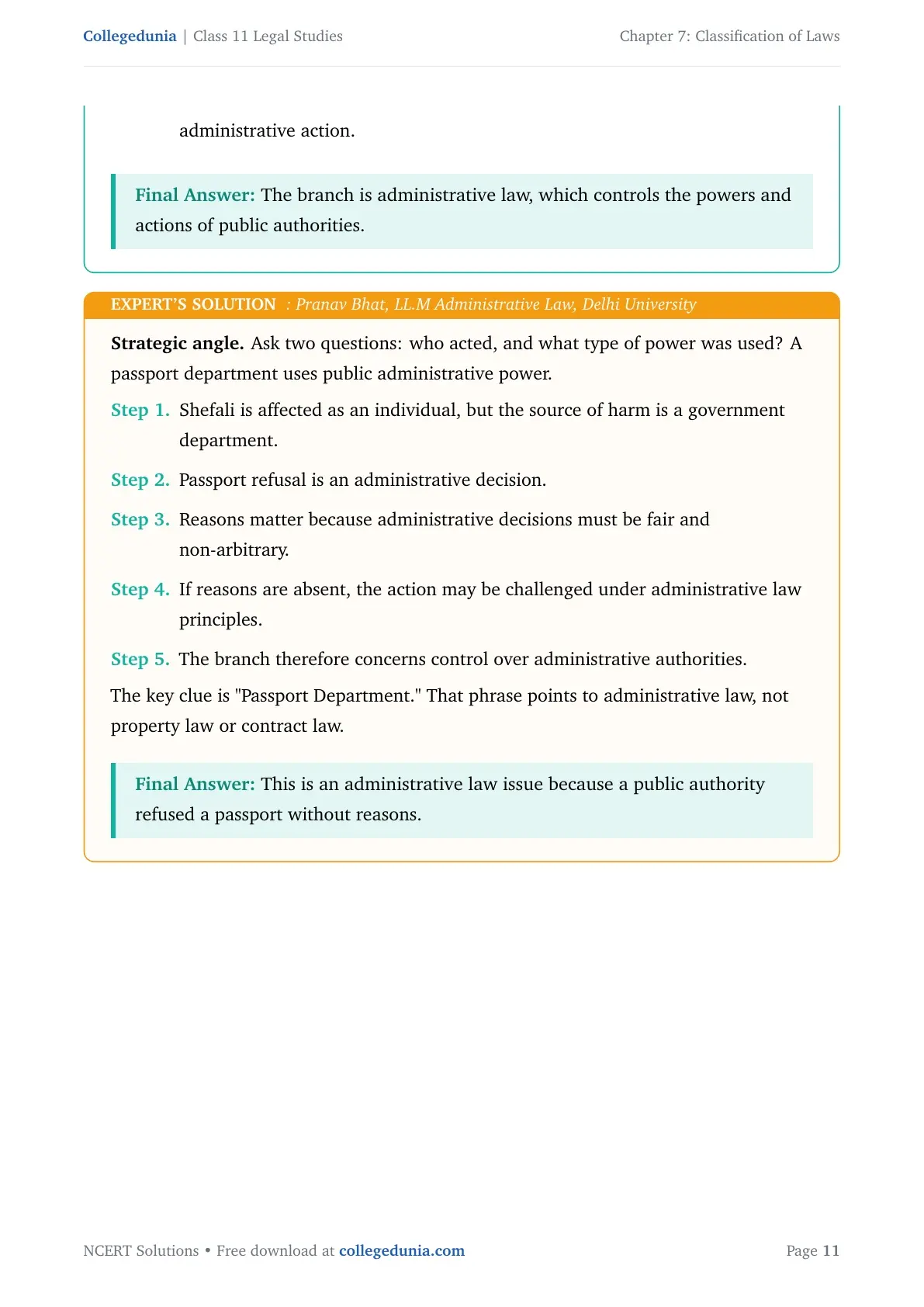
Strategic angle. Ask two questions: who acted, and what type of power was used? A passport department uses public administrative power.
Shefali is affected as an individual, but the source of harm is a government department.
Passport refusal is an administrative decision.
Reasons matter because administrative decisions must be fair and non-arbitrary.
If reasons are absent, the action may be challenged under administrative law principles.
The branch therefore concerns control over administrative authorities.
The key clue is "Passport Department." That phrase points to administrative law, not property law or contract law.
This is an administrative law issue because a public authority refused a passport without reasons.
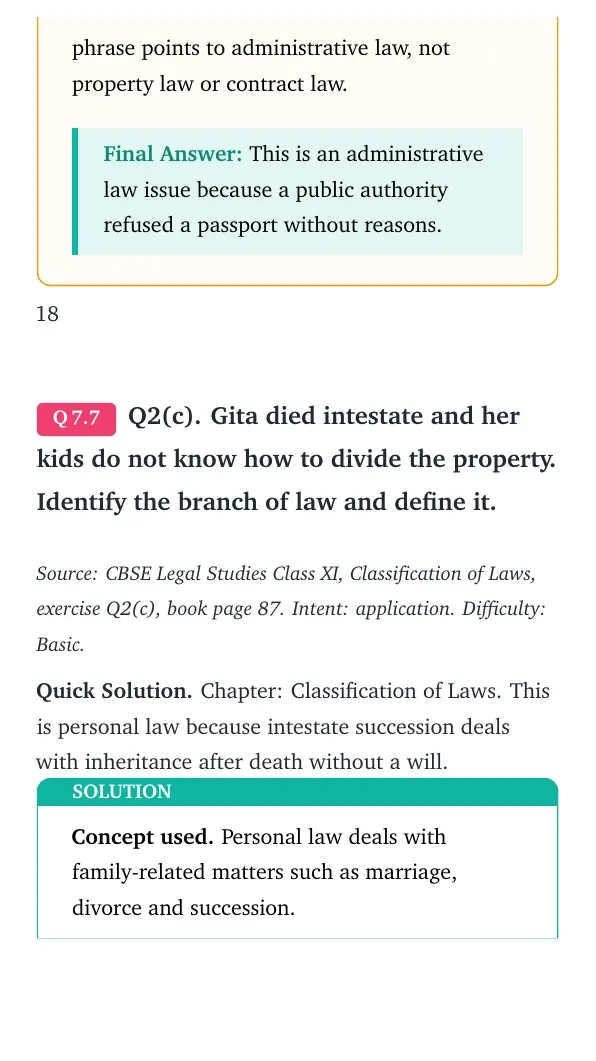
Q 7.7
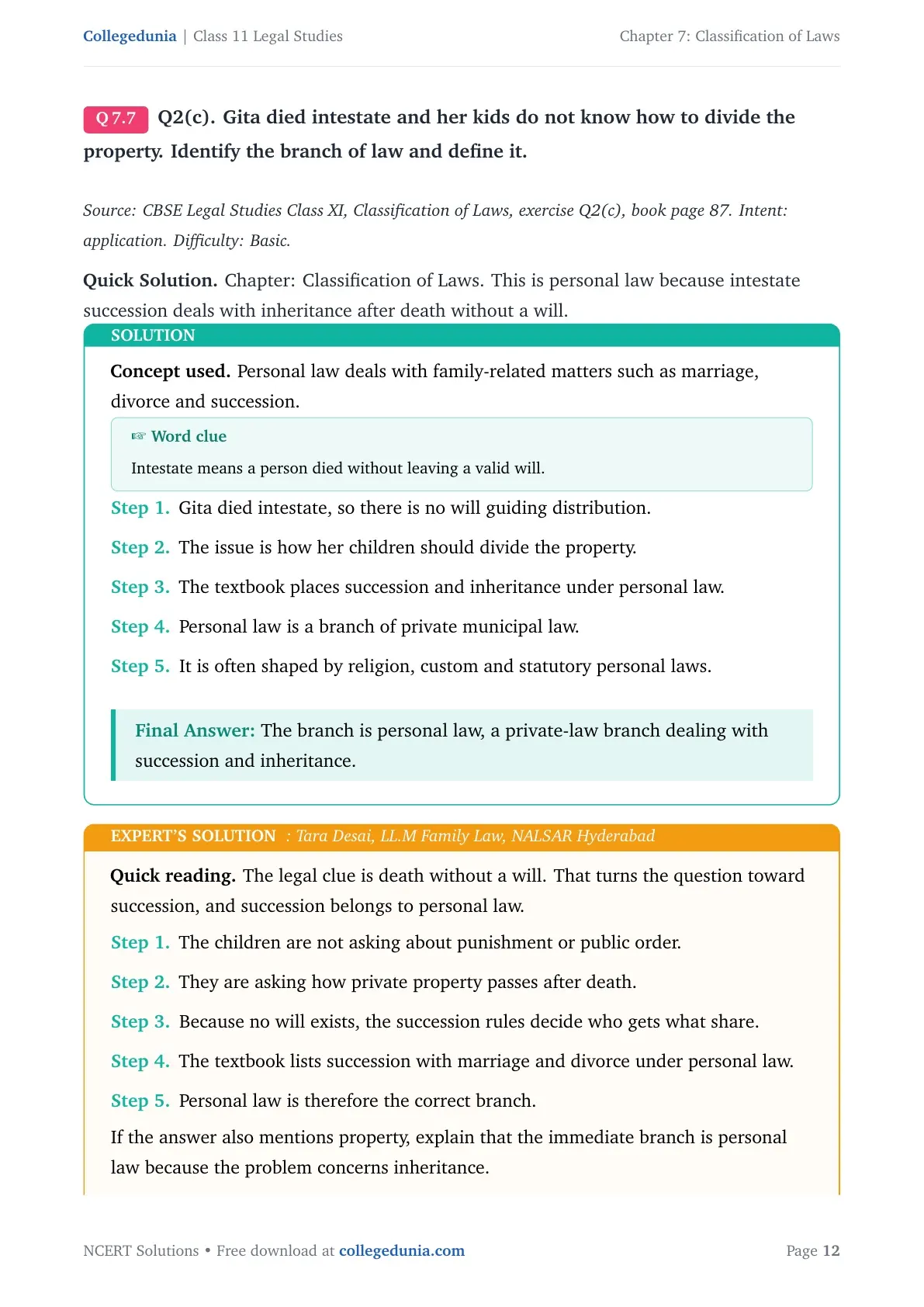
Q2(c). Gita died intestate and her kids do not know how to divide the property. Identify the branch of law and define it.
Concept used. Personal law deals with family-related matters such as marriage, divorce and succession.
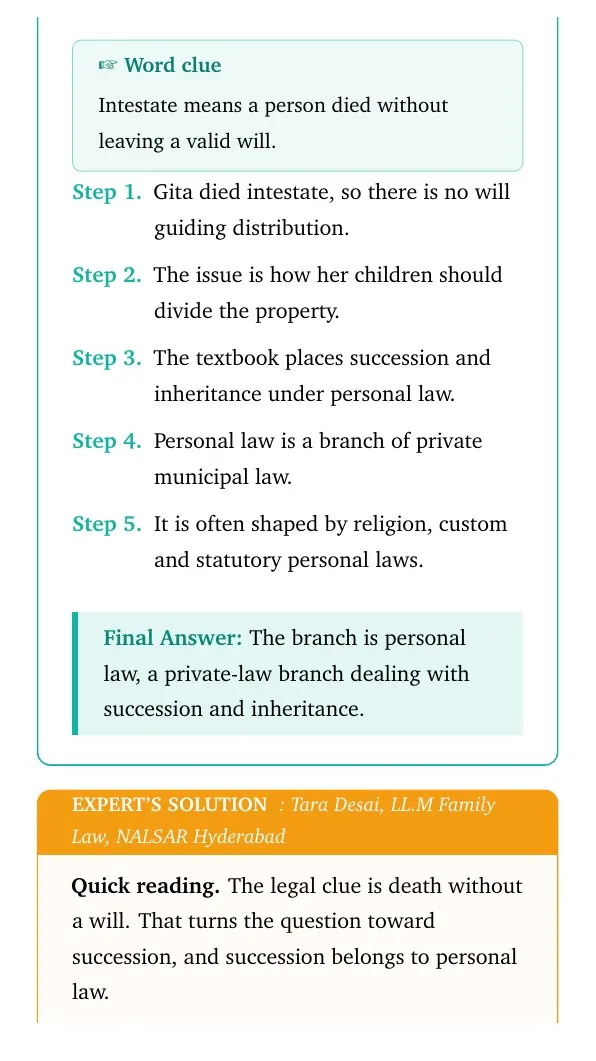
Word clue
Intestate means a person died without leaving a valid will.
Gita died intestate, so there is no will guiding distribution.
The issue is how her children should divide the property.
The textbook places succession and inheritance under personal law.
Personal law is a branch of private municipal law.
It is often shaped by religion, custom and statutory personal laws.
The branch is personal law, a private-law branch dealing with succession and inheritance.
TD
Tara Desai
LL.M Family Law, NALSAR Hyderabad
Verified Expert
Quick reading. The legal clue is death without a will. That turns the question toward succession, and succession belongs to personal law.
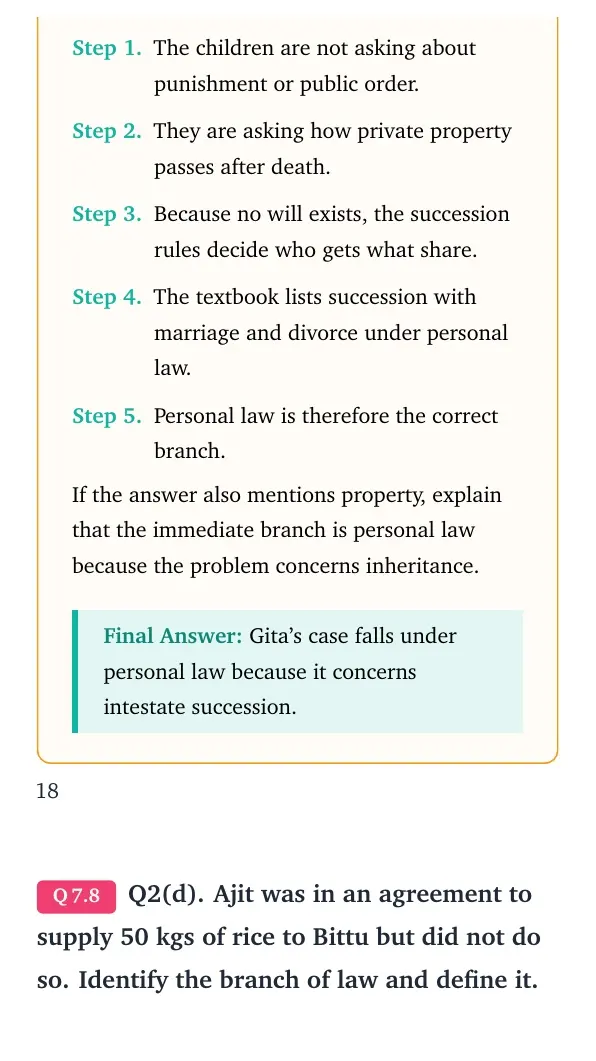
The children are not asking about punishment or public order.
They are asking how private property passes after death.
Because no will exists, the succession rules decide who gets what share.
The textbook lists succession with marriage and divorce under personal law.
Personal law is therefore the correct branch.
If the answer also mentions property, explain that the immediate branch is personal law because the problem concerns inheritance.
Gita's case falls under personal law because it concerns intestate succession.
Q 7.8
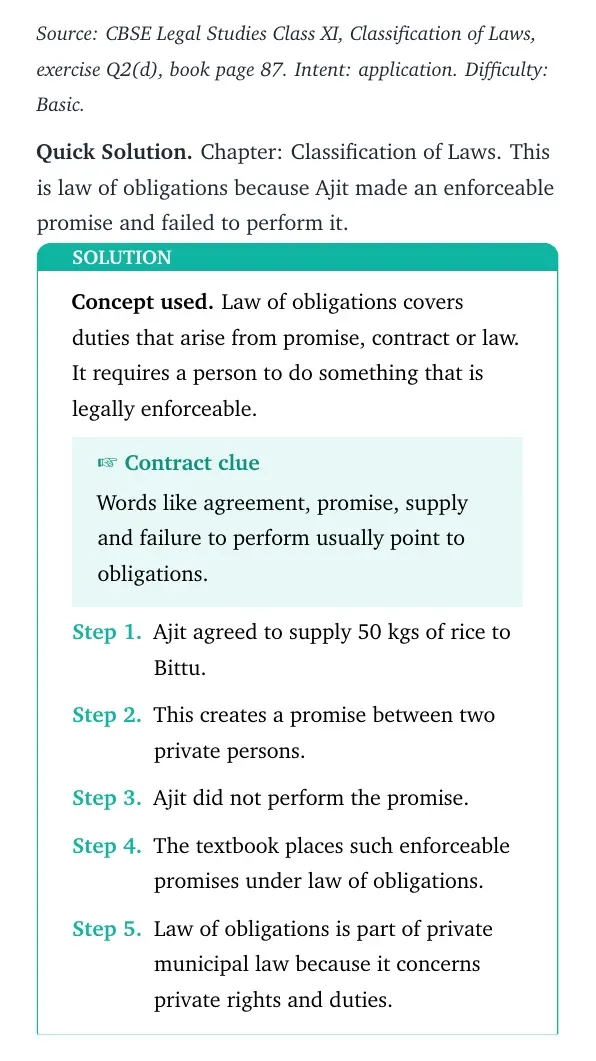
Q2(d). Ajit was in an agreement to supply 50 kgs of rice to Bittu but did not do so. Identify the branch of law and define it.
Concept used. Law of obligations covers duties that arise from promise, contract or law. It requires a person to do something that is legally enforceable.
Contract clue
Words like agreement, promise, supply and failure to perform usually point to obligations.
Ajit agreed to supply 50 kgs of rice to Bittu.
This creates a promise between two private persons.
Ajit did not perform the promise.
The textbook places such enforceable promises under law of obligations.
Law of obligations is part of private municipal law because it concerns private rights and duties.
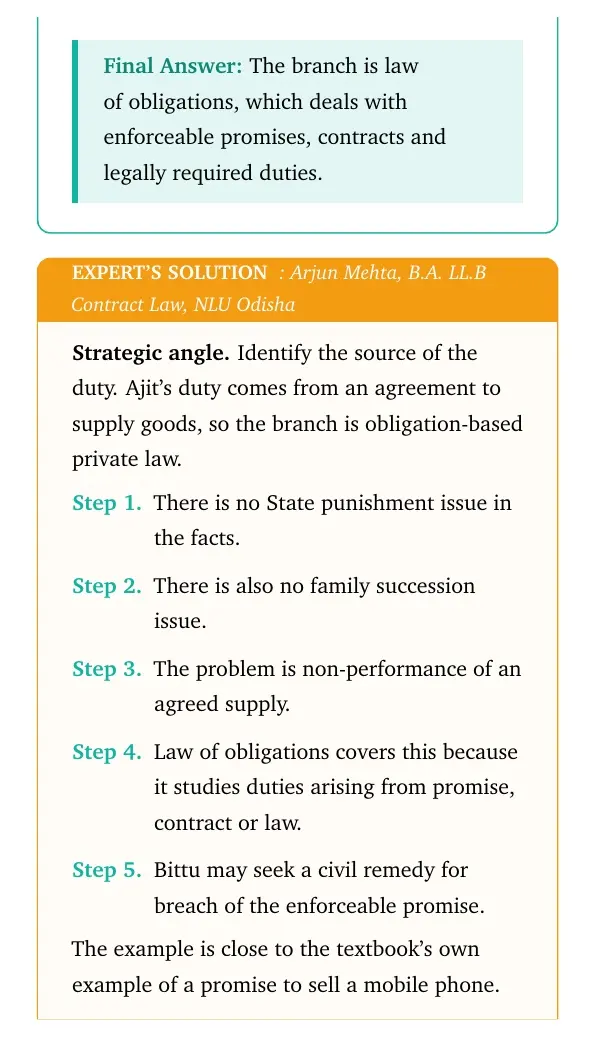
The branch is law of obligations, which deals with enforceable promises, contracts and legally required duties.
AM
Arjun Mehta
B.A. LL.B Contract Law, NLU Odisha
Verified Expert
Strategic angle. Identify the source of the duty. Ajit's duty comes from an agreement to supply goods, so the branch is obligation-based private law.
There is no State punishment issue in the facts.
There is also no family succession issue.
The problem is non-performance of an agreed supply.
Law of obligations covers this because it studies duties arising from promise, contract or law.
Bittu may seek a civil remedy for breach of the enforceable promise.
The example is close to the textbook's own example of a promise to sell a mobile phone.
Ajit and Bittu's dispute falls under law of obligations.
Textbook Questions 3 to 5: Application Answers
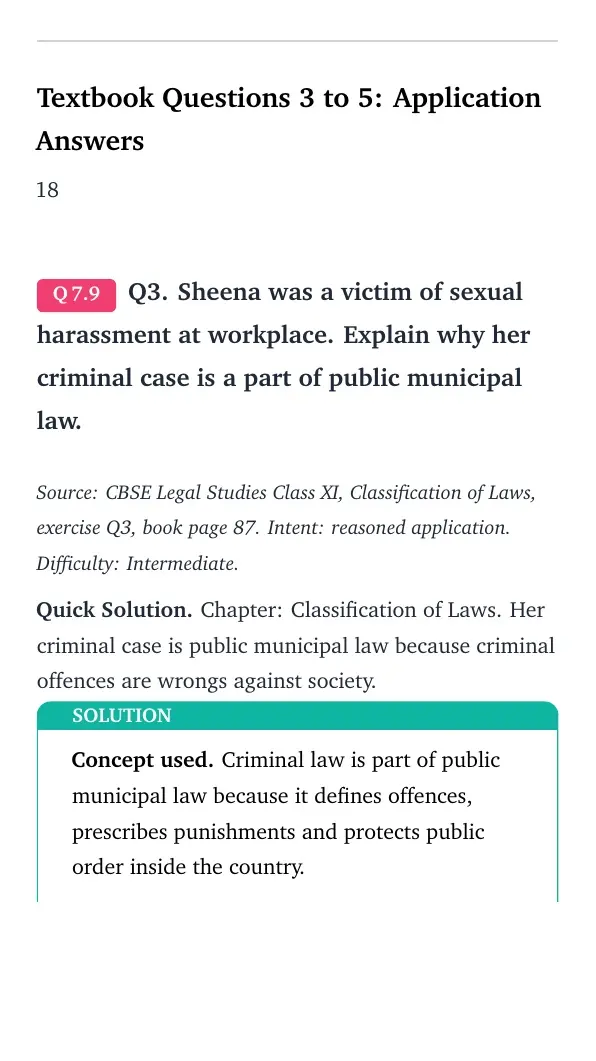
Q 7.9
Q3. Sheena was a victim of sexual harassment at workplace. Explain why her criminal case is a part of public municipal law.
Concept used. Criminal law is part of public municipal law because it defines offences, prescribes punishments and protects public order inside the country.
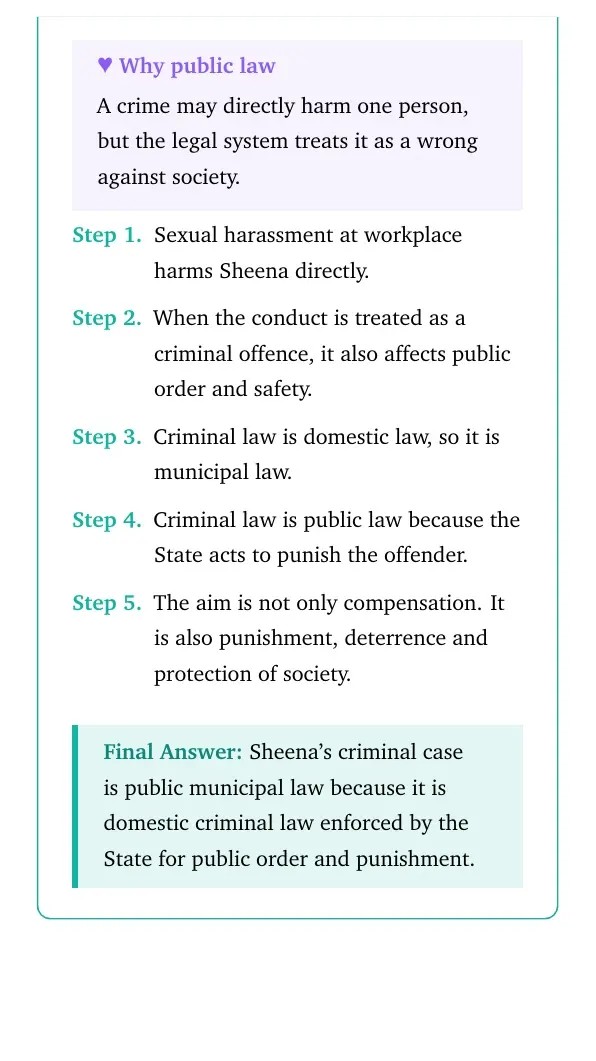
Why public law
A crime may directly harm one person, but the legal system treats it as a wrong against society.
Sexual harassment at workplace harms Sheena directly.
When the conduct is treated as a criminal offence, it also affects public order and safety.
Criminal law is domestic law, so it is municipal law.
Criminal law is public law because the State acts to punish the offender.
The aim is not only compensation.
It is also punishment, deterrence and protection of society.
Sheena's criminal case is public municipal law because it is domestic criminal law enforced by the State for public order and punishment.
SV
Sanya Verma
LL.M Criminal Law, NLU Delhi
Verified Expert
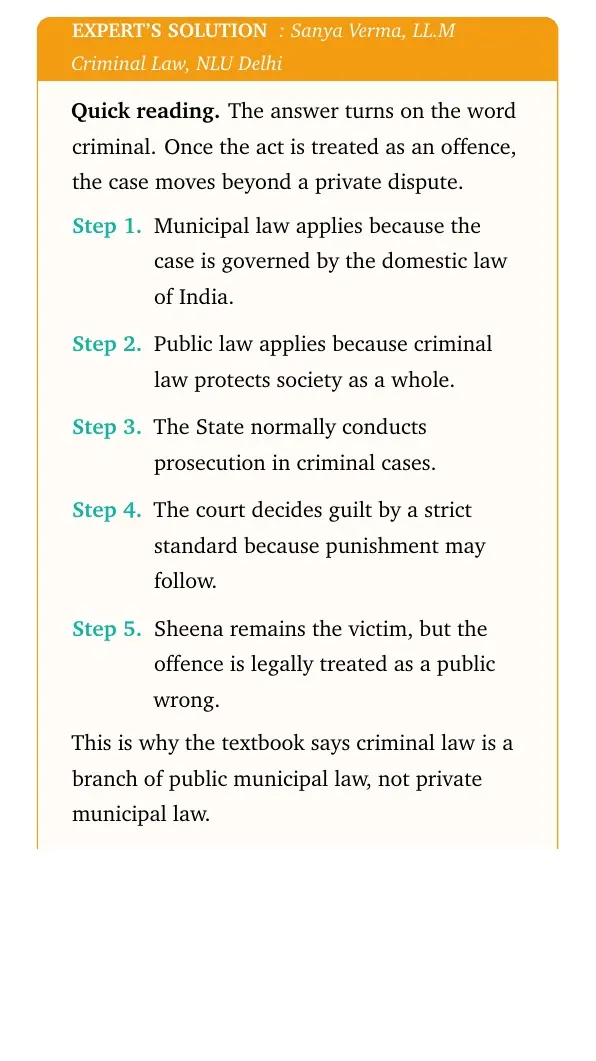
Quick reading. The answer turns on the word criminal. Once the act is treated as an offence, the case moves beyond a private dispute.
Municipal law applies because the case is governed by the domestic law of India.
Public law applies because criminal law protects society as a whole.
The State normally conducts prosecution in criminal cases.
The court decides guilt by a strict standard because punishment may follow.
Sheena remains the victim, but the offence is legally treated as a public wrong.
This is why the textbook says criminal law is a branch of public municipal law, not private municipal law.
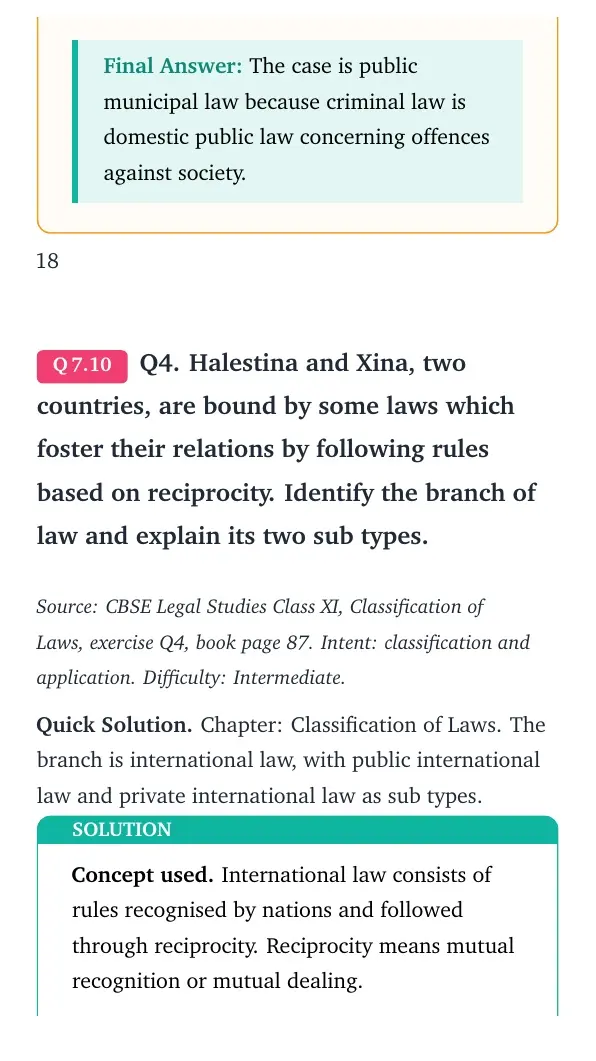
The case is public municipal law because criminal law is domestic public law concerning offences against society.
Q 7.10
Q4. Halestina and Xina, two countries, are bound by some laws which foster their relations by following rules based on reciprocity. Identify the branch of law and explain its two sub types.
Concept used. International law consists of rules recognised by nations and followed through reciprocity. Reciprocity means mutual recognition or mutual dealing.
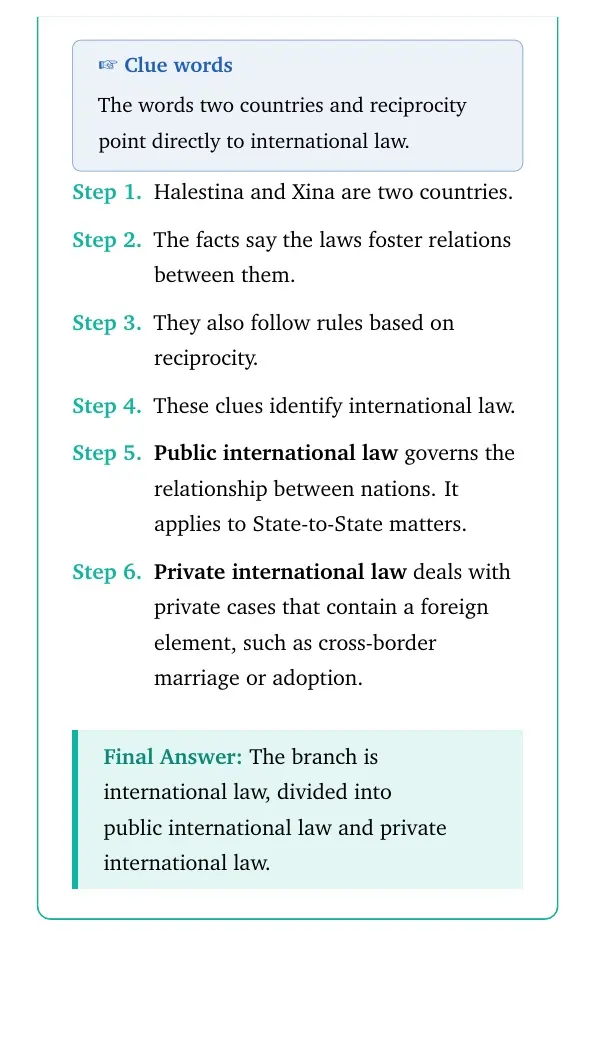
Clue words
The words two countries and reciprocity point directly to international law.
Halestina and Xina are two countries.
The facts say the laws foster relations between them.
They also follow rules based on reciprocity.
These clues identify international law.
Public international law governs the relationship between nations.
It applies to State-to-State matters.
Private international law deals with private cases that contain a foreign element, such as cross-border marriage or adoption.
The branch is international law, divided into public international law and private international law.
IG
Ishaan Gupta
LL.M International Law, South Asian University
Verified Expert
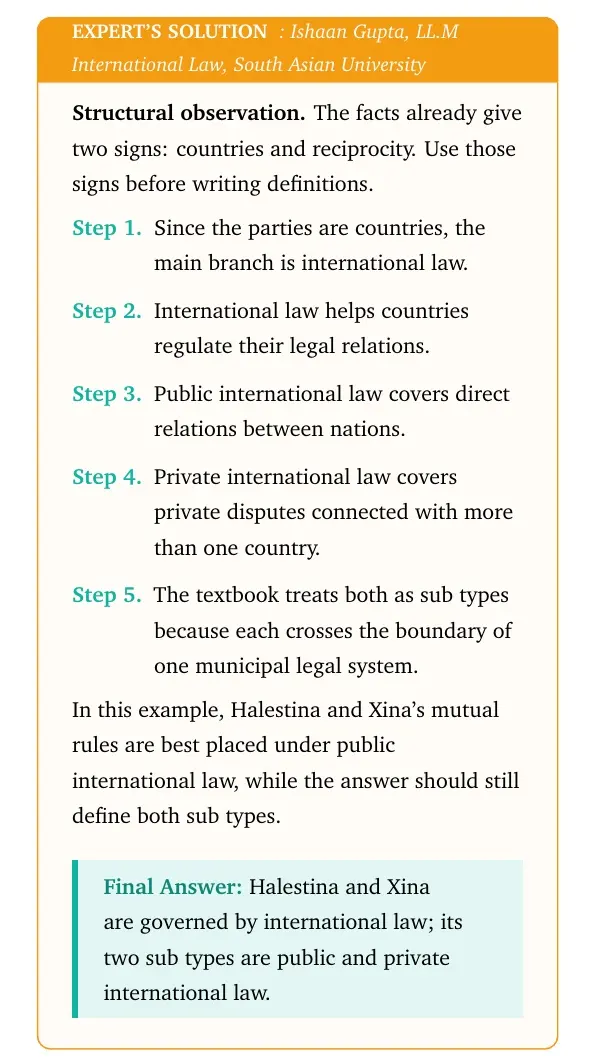
Structural observation. The facts already give two signs: countries and reciprocity. Use those signs before writing definitions.
Since the parties are countries, the main branch is international law.
International law helps countries regulate their legal relations.
Public international law covers direct relations between nations.
Private international law covers private disputes connected with more than one country.
The textbook treats both as sub types because each crosses the boundary of one municipal legal system.
In this example, Halestina and Xina's mutual rules are best placed under public international law, while the answer should still define both sub types.
Halestina and Xina are governed by international law; its two sub types are public and private international law.
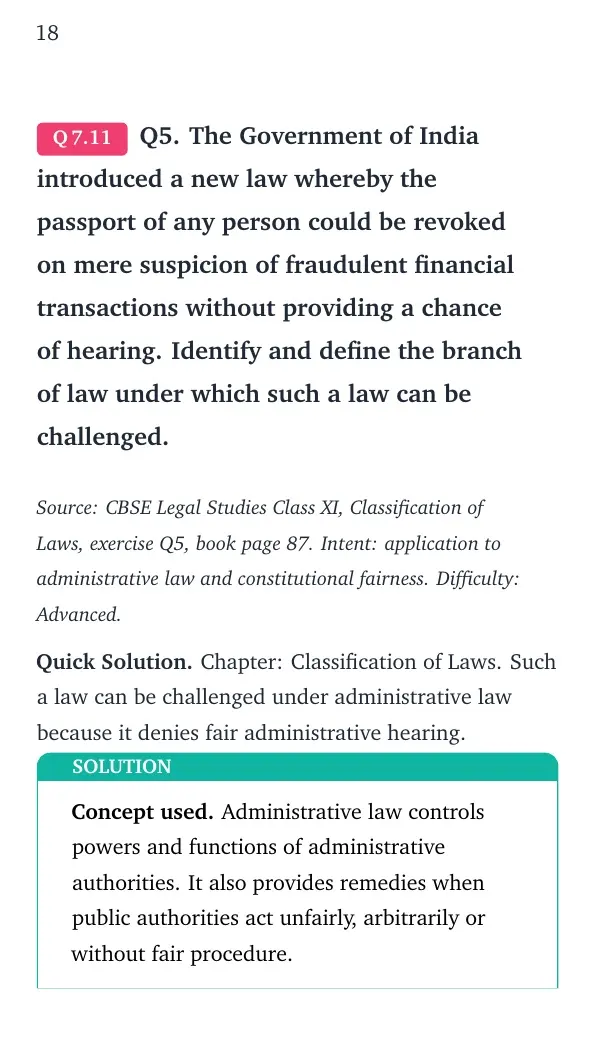
Q 7.11
Q5. The Government of India introduced a new law whereby the passport of any person could be revoked on mere suspicion of fraudulent financial transactions without providing a chance of hearing. Identify and define the branch of law under which such a law can be challenged.
Concept used. Administrative law controls powers and functions of administrative authorities. It also provides remedies when public authorities act unfairly, arbitrarily or without fair procedure.
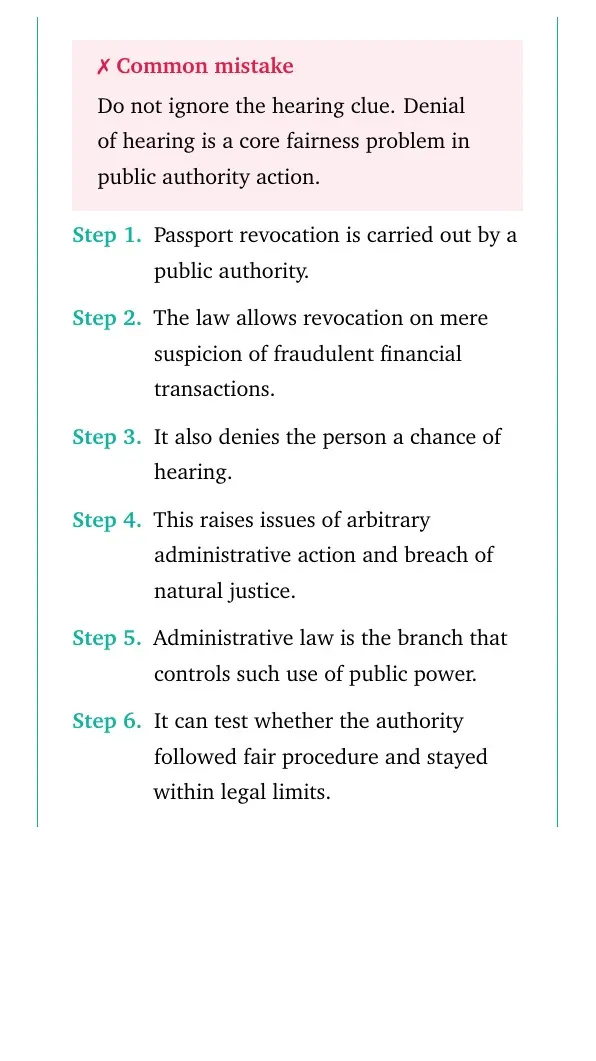
Common mistake
Do not ignore the hearing clue. Denial of hearing is a core fairness problem in public authority action.
Passport revocation is carried out by a public authority.
The law allows revocation on mere suspicion of fraudulent financial transactions.
It also denies the person a chance of hearing.
This raises issues of arbitrary administrative action and breach of natural justice.
Administrative law is the branch that controls such use of public power.
It can test whether the authority followed fair procedure and stayed within legal limits.
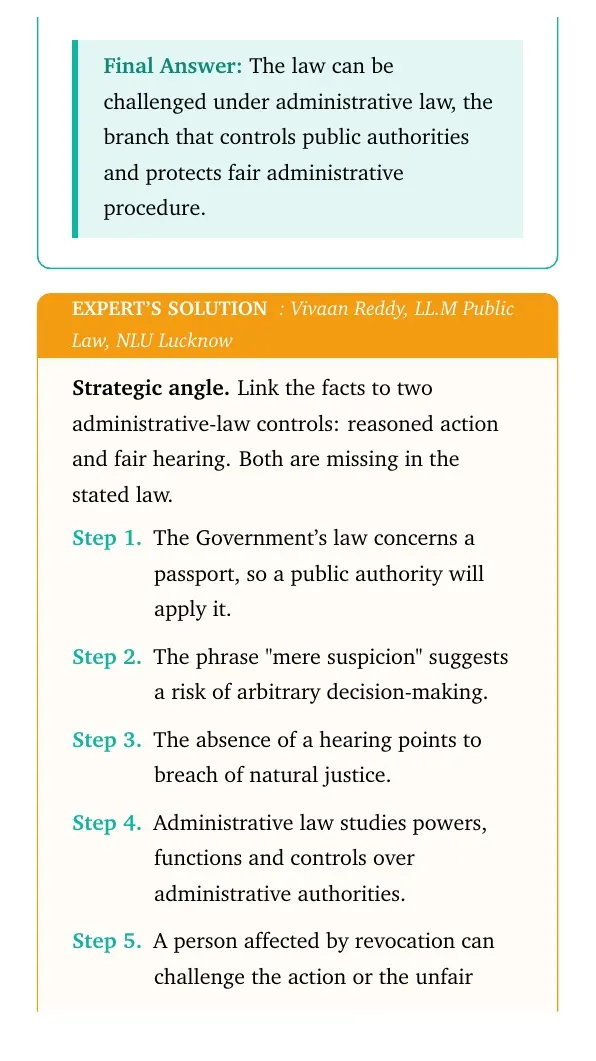
The law can be challenged under administrative law, the branch that controls public authorities and protects fair administrative procedure.
VR
Vivaan Reddy
LL.M Public Law, NLU Lucknow
Verified Expert
Strategic angle. Link the facts to two administrative-law controls: reasoned action and fair hearing. Both are missing in the stated law.
The Government's law concerns a passport, so a public authority will apply it.
The phrase "mere suspicion" suggests a risk of arbitrary decision-making.
The absence of a hearing points to breach of natural justice.
Administrative law studies powers, functions and controls over administrative authorities.
A person affected by revocation can challenge the action or the unfair procedure.
The challenge may also connect with constitutional equality and personal liberty principles.
The direct answer should name administrative law first. Constitutional values may support the challenge, but the branch asked here is administrative law.
This is an administrative law challenge because it concerns unfair public authority action without hearing.
Classification of Laws Class 11 Legal Studies NCERT Solutions FAQs
Ques. What does Classification of Laws cover in Class 11 Legal Studies?
Ans. It covers international law, municipal law, public law, private law, procedural law and branch identification through legal examples.
Ques. How many questions are solved in the Class 11 Legal Studies Chapter 7 PDF?
Ans. The PDF solves 11 textbook subpart questions with detailed solutions, expert solutions and final answer boxes.
Ques. What is the difference between international law and municipal law?
Ans. International law applies across countries or legal systems, while municipal law is domestic law that operates inside one State.
Ques. Why is a passport refusal example linked with administrative law?
Ans. A passport department uses public power. Refusal without reasons or hearing raises fairness issues under administrative law.
Ques. Which branch covers death without a will and property division?
Ans. Personal law covers succession and inheritance. It is a branch of private municipal law.








Comments