The NCERT Solutions for Class 11 Legal Studies Chapter 2 Forms and Organs of Government cover all 5 exercise prompts from the latest 2026-27 syllabus. Each answer explains monarchy, democracy, legislature, executive, judiciary, financial control and direct democracy in a clean exam-ready format.
Exercise count: 5 solved prompts with detailed solution and expert solution blocks.
Most-tested idea: how government power is divided among legislature, executive and judiciary.
Best revision method: revise the comparison tables before writing long answers.
Forms and Organs of Government Class 11 Legal Studies NCERT Solutions PDF
Student Feedback: Students usually find this chapter easier after they separate form of government questions from organ of government questions. Use who decides, who executes and who checks as the quick recall frame.
Exercise Pattern for Forms and Organs of Government Class 11 Legal Studies
Forms and Organs of Government has definition, difference, example and case-based prompts. The chapter does not ask for calculations. It checks whether students can identify a government form and then explain the institution that performs a public function.
Question type
What to write
Useful answer cue
Difference
Compare two terms on one basis
Authority, accountability, number of houses
Example
Name a matching country and one reason
Bangladesh, United States, Switzerland
Brief note
Meaning plus identifying feature
Money Bill, budget, democracy, unitary government
Case-based
Read the decision-maker in the example
Citizens decide directly or representatives decide
Legislature Executive and Judiciary Roles in Class 11 Legal Studies
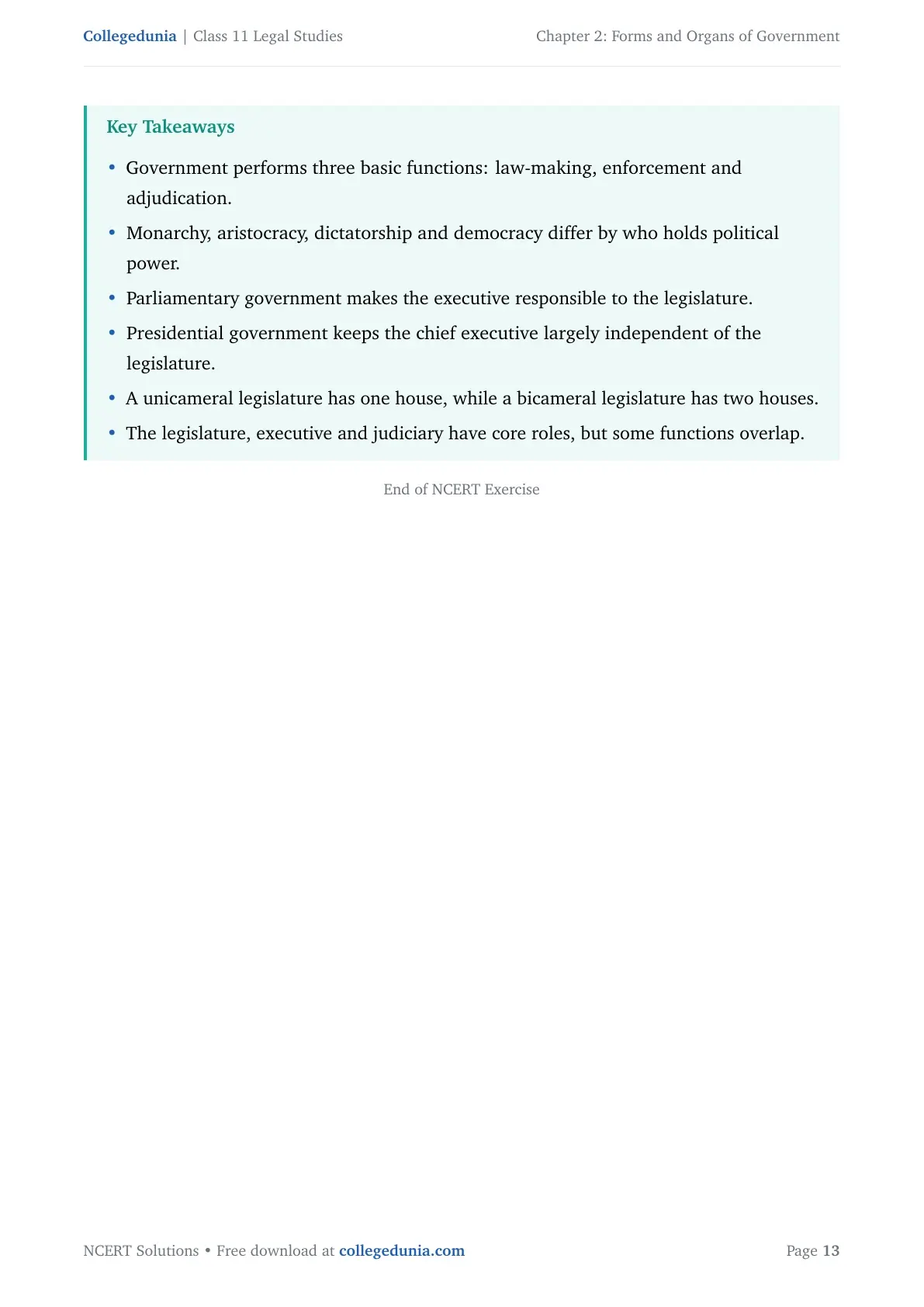
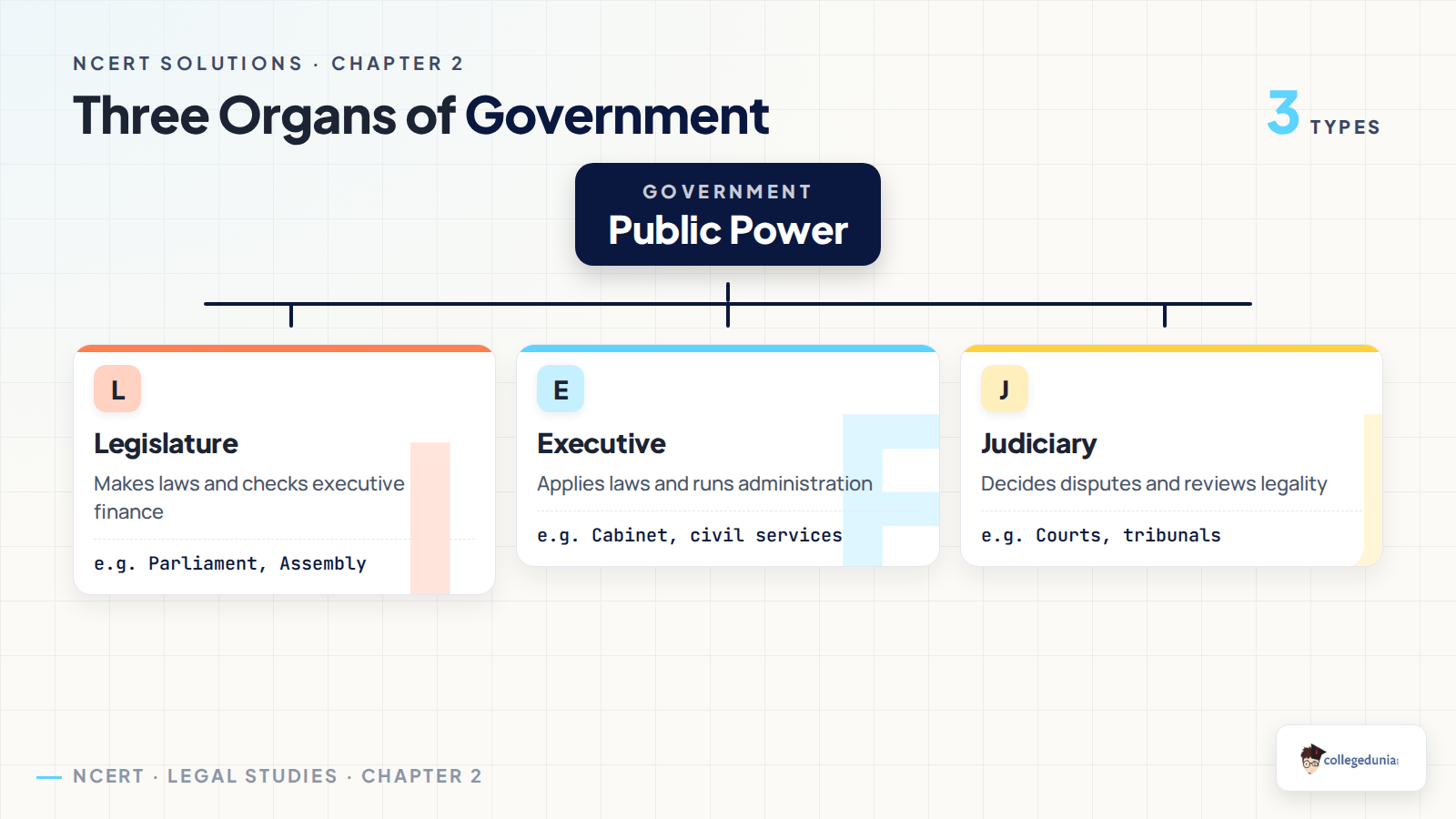
The chapter explains that government works through three main organs. Legislature makes laws, executive implements laws, and judiciary decides disputes. A strong answer also shows that these functions sometimes overlap under constitutional limits.
Legislature: passes laws, debates public policy, controls finance and checks the executive.
Executive: runs administration, maintains order, prepares the budget and applies laws.
Judiciary: settles disputes, interprets law, protects rights and reviews unconstitutional action.
Three Organs of Government Explained for NCERT Solutions
Students should not write the three organs as isolated definitions only. The scoring answer connects each organ with a public function and a checking role. For example, Parliament makes laws, but courts may test those laws against the Constitution. The executive runs administration, but the legislature can ask questions and control public finance.
Direct and Indirect Democracy Difference in Chapter 2
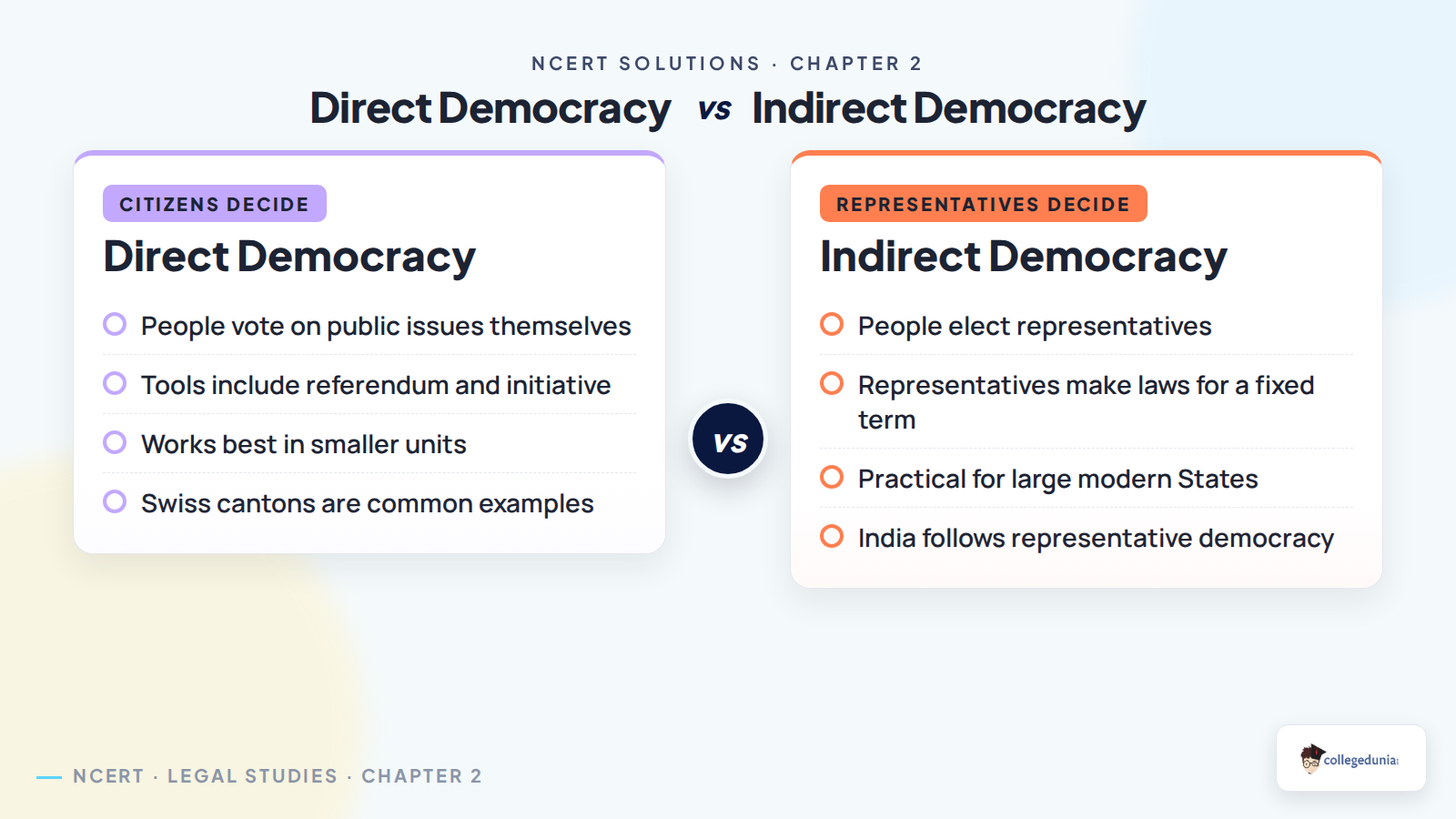
Direct democracy means citizens take public decisions themselves. Indirect democracy, also called representative democracy, means citizens elect representatives who govern on their behalf. The case-based question in this chapter uses the same clue: Amerintina is representative democracy because representatives govern, while Plicia is direct democracy because citizens govern themselves.
Use direct democracy when the people vote directly on public issues.
Use indirect democracy when elected representatives make decisions for the people.
Write referendum, initiative, plebiscite and recall as tools linked with direct participation.
Parliamentary and Presidential Government Comparison
The difference between parliamentary and presidential government turns on the relation between the legislature and the executive. In a parliamentary system, the executive is responsible to the legislature. In a presidential system, the executive has a separate position and normally has a fixed tenure.
Basis
Parliamentary government
Presidential government
Executive link
Executive is drawn from and answerable to legislature
Executive is separate from legislature
Tenure
Depends on legislative confidence
Fixed tenure in normal conditions
Common example
India or United Kingdom
United States of America
Money Bill and Annual Financial Statement in Legal Studies
A Money Bill deals with taxation, public funds and related financial matters. It can be introduced only in the Lok Sabha. The Annual Financial Statement is the constitutional name for the yearly budget statement of estimated receipts and expenditure placed before Parliament under Article 112.
For Money Bill, mention Lok Sabha and financial subject matter.
For Annual Financial Statement, mention yearly receipts, expenditure and Article 112.
For executive financial role, mention preparation of the budget, tax collection and public spending.
Forms and Organs of Government Explained by Magnet Brains
Answer Writing Tips for Forms and Organs of Government
The safest answer style is definition, basis and example. This chapter rewards clean distinction more than long storytelling. In difference questions, use a table. In example questions, name the country and the exact feature for which it is cited. In organ-of-government questions, write the main function first and then the checking function.
Use authority as the basis for monarchy and democracy.
Use responsibility as the basis for parliamentary and presidential forms.
Use public participation as the basis for direct and indirect democracy.
Use number of houses as the basis for unicameral and bicameral legislatures.
Common Mistakes in Class 11 Legal Studies Chapter 2
Students usually lose marks when they mix similar terms. Do not call every monarchy absolute monarchy, and do not write direct democracy when the facts say representatives govern. Another frequent mistake is writing only the legislature's law-making role and skipping its control over the executive and finance.
Do not write Lok Sabha and Rajya Sabha as if both represent the same unit.
Do not confuse a constitutional monarch with an absolute monarch.
Do not write the executive as only the Prime Minister or President; include administration.
Do not skip judicial review while explaining the judiciary.
Forms and Organs of Government Cross-Resource Study Links
Use these Class 11 Legal Studies resources together. Read the official chapter first, revise the notes, then solve the exercise using the PDF on this page.
Class 11 Legal Studies NCERT Solutions All Chapters
The same Legal Studies solution format is used across the Class 11 chapters. These chapter links help students move from the idea of State to the working structure of government and constitutional law.
All NCERT Solutions for Class 11 Legal Studies Chapter 2 Forms and Organs of Government with Step-by-Step Solutions
Use Check Solution for the direct answer first.
Use Expert Solution for a fuller legal framing and exam presentation.
Revise the comparison tables before attempting Question 1 and Question 5.
Full question set: This section embeds all 5 solved question cards from the PDF, including every source exercise prompt.
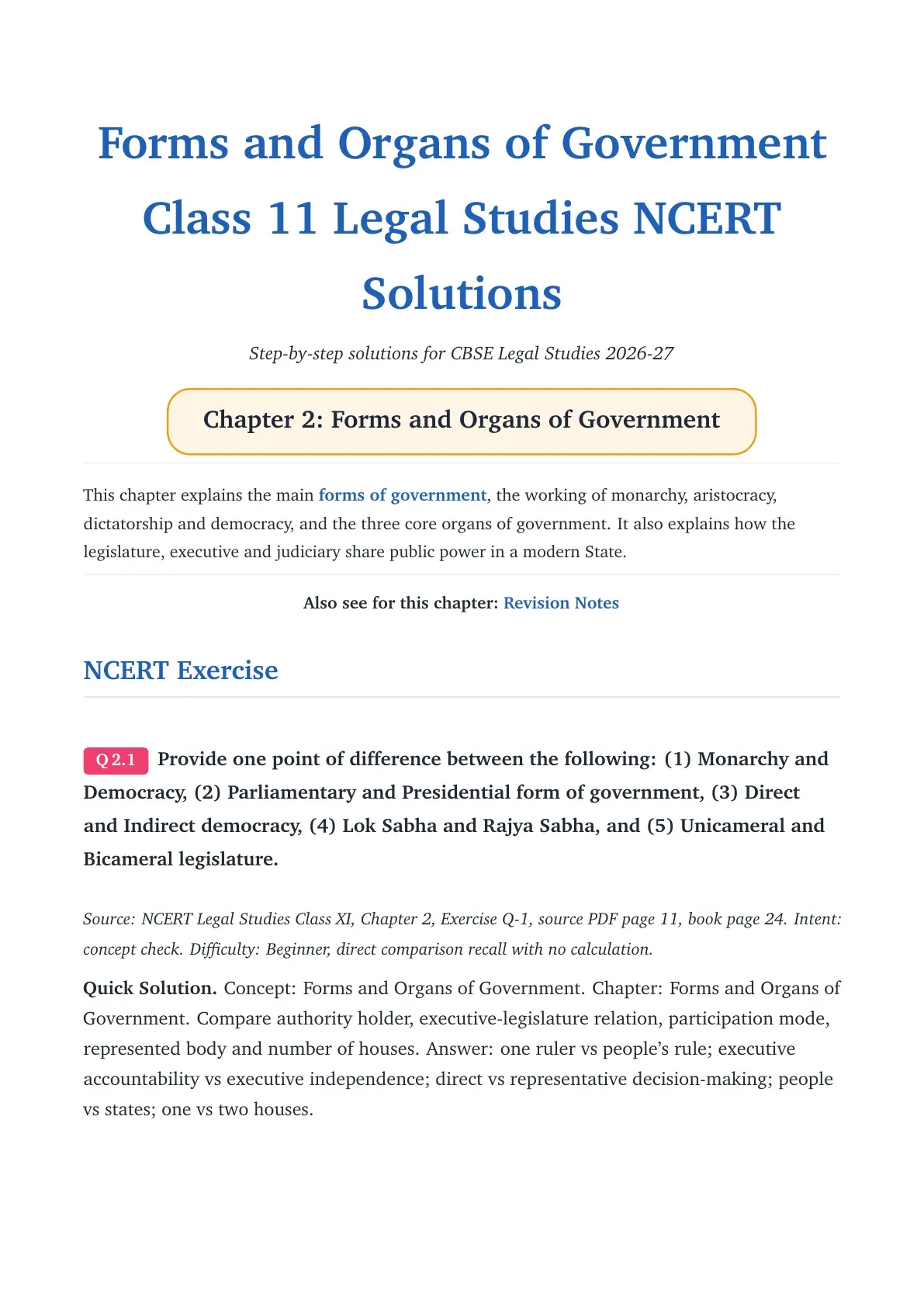
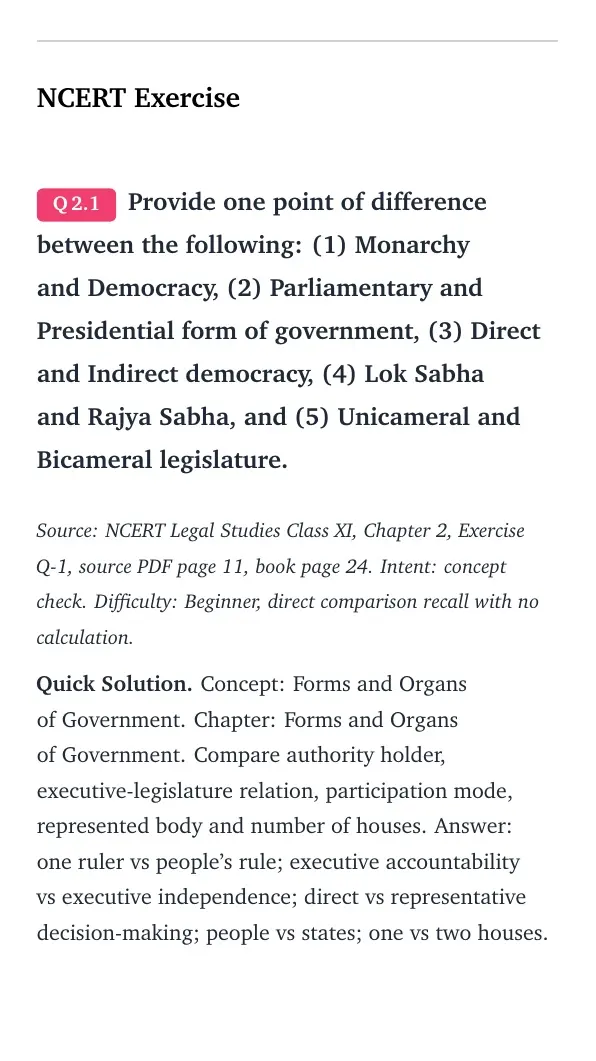
Q 2.1
Provide one point of difference between the following: (1) Monarchy and Democracy, (2) Parliamentary and Presidential form of government, (3) Direct and Indirect democracy, (4) Lok Sabha and Rajya Sabha, and (5) Unicameral and Bicameral legislature.
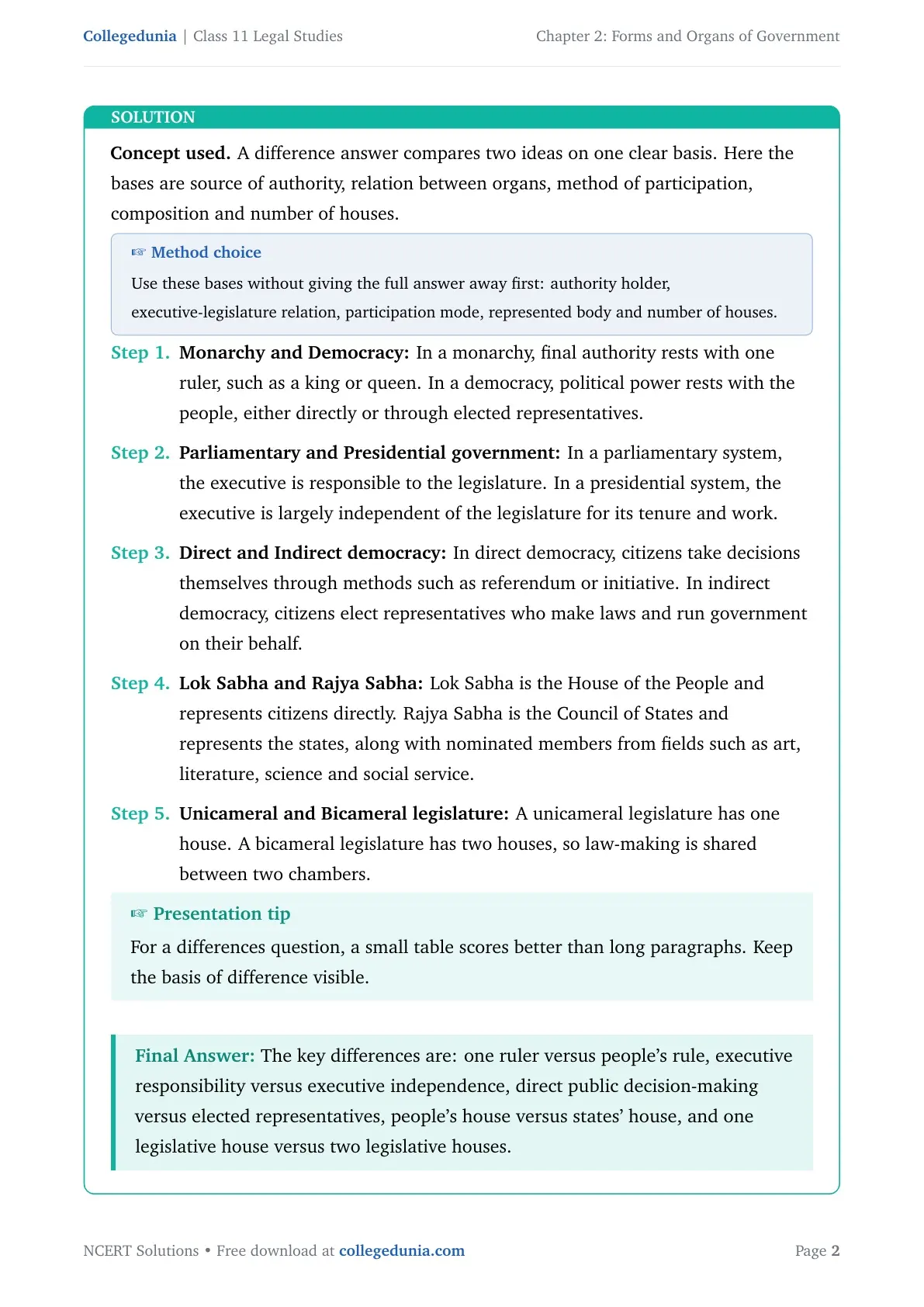
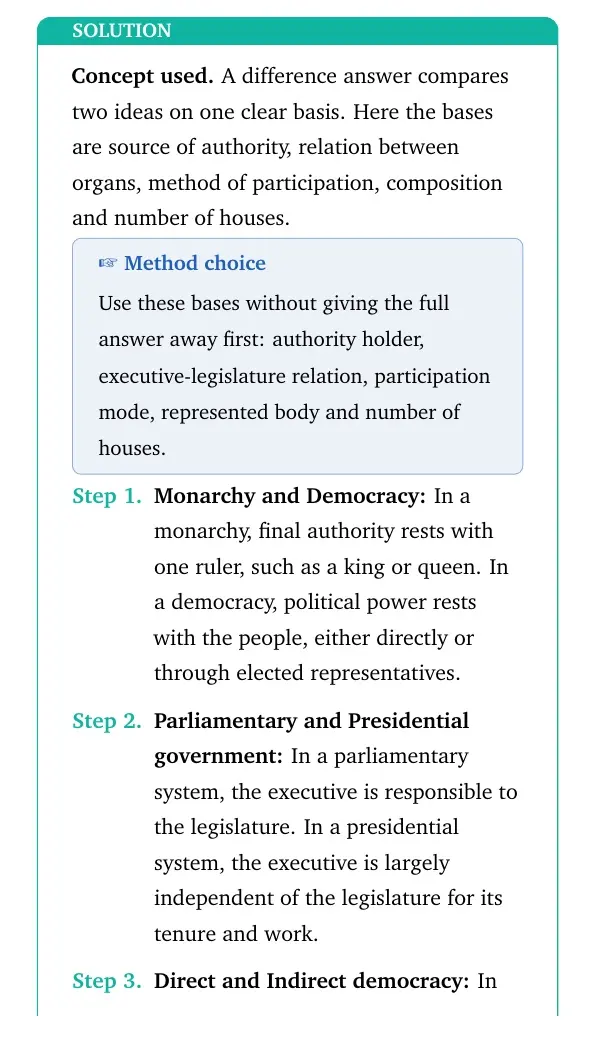
Concept used. A difference answer compares two ideas on one clear basis. Here the bases are source of authority, relation between organs, method of participation, composition and number of houses.
Method choice
Use these bases without giving the full answer away first: authority holder, executive-legislature relation, participation mode, represented body and number of houses.
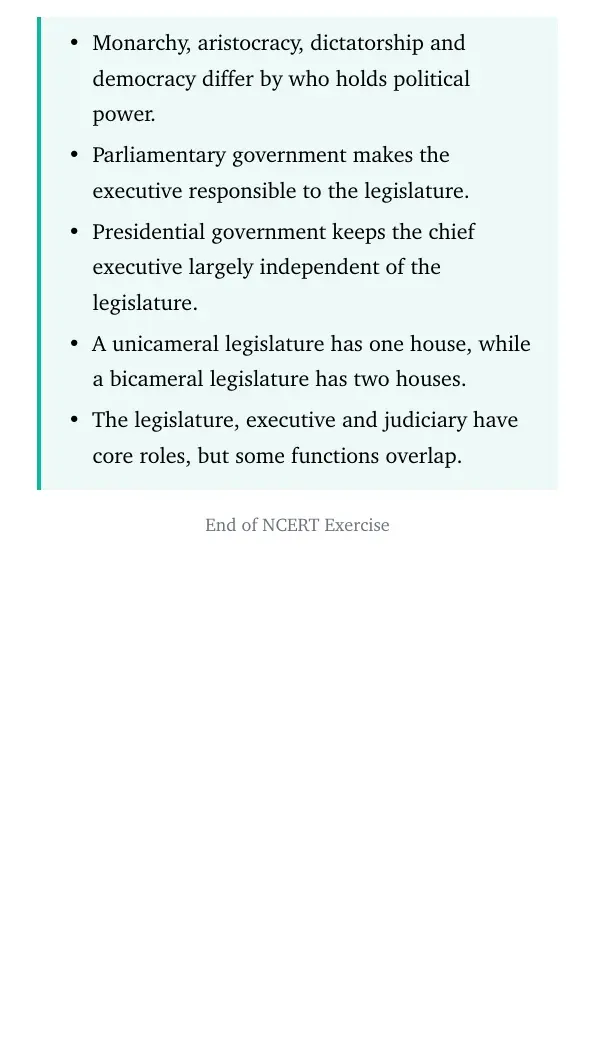
Monarchy and Democracy: In a monarchy, final authority rests with one ruler, such as a king or queen. In a democracy, political power rests with the people, either directly or through elected representatives.
Parliamentary and Presidential government: In a parliamentary system, the executive is responsible to the legislature. In a presidential system, the executive is largely independent of the legislature for its tenure and work.
Direct and Indirect democracy: In direct democracy, citizens take decisions themselves through methods such as referendum or initiative. In indirect democracy, citizens elect representatives who make laws and run government on their behalf.
Lok Sabha and Rajya Sabha: Lok Sabha is the House of the People and represents citizens directly. Rajya Sabha is the Council of States and represents the states, along with nominated members from fields such as art, literature, science and social service.
Unicameral and Bicameral legislature: A unicameral legislature has one house. A bicameral legislature has two houses, so law-making is shared between two chambers.
Presentation tip
For a differences question, a small table scores better than long paragraphs. Keep the basis of difference visible.
The key differences are: one ruler versus people's rule, executive responsibility versus executive independence, direct public decision-making versus elected representatives, people's house versus states' house, and one legislative house versus two legislative houses.
AR
Aditi Rao
LL.M Constitutional Law, NLU Delhi
Verified Expert
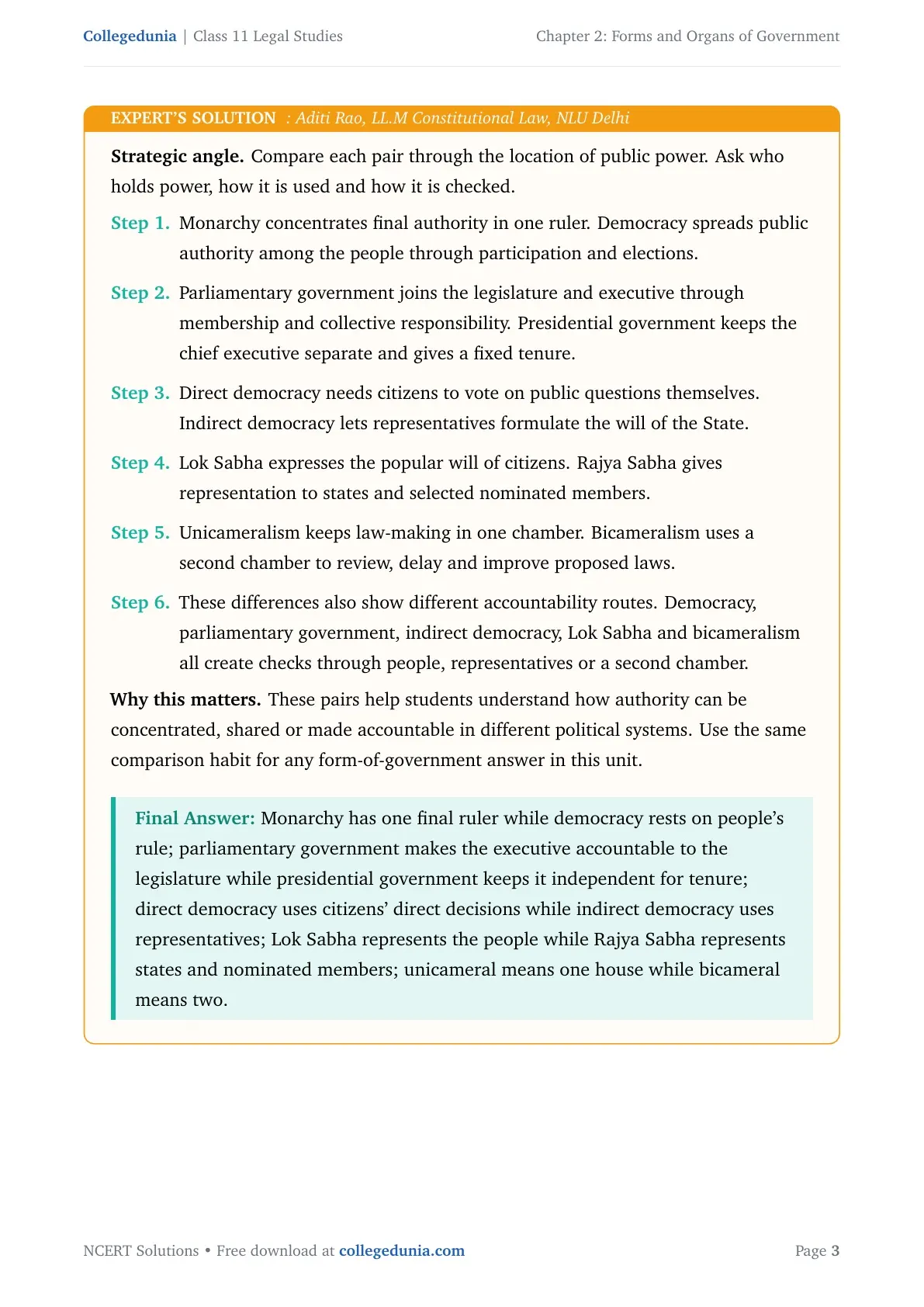
Strategic angle. Compare each pair through the location of public power. Ask who holds power, how it is used and how it is checked.
Monarchy concentrates final authority in one ruler. Democracy spreads public authority among the people through participation and elections.
Parliamentary government joins the legislature and executive through membership and collective responsibility. Presidential government keeps the chief executive separate and gives a fixed tenure.
Direct democracy needs citizens to vote on public questions themselves. Indirect democracy lets representatives formulate the will of the State.
Lok Sabha expresses the popular will of citizens. Rajya Sabha gives representation to states and selected nominated members.
Unicameralism keeps law-making in one chamber. Bicameralism uses a second chamber to review, delay and improve proposed laws.
These differences also show different accountability routes. Democracy, parliamentary government, indirect democracy, Lok Sabha and bicameralism all create checks through people, representatives or a second chamber.
Why this matters. These pairs help students understand how authority can be concentrated, shared or made accountable in different political systems. Use the same comparison habit for any form-of-government answer in this unit.
Monarchy has one final ruler while democracy rests on people's rule; parliamentary government makes the executive accountable to the legislature while presidential government keeps it independent for tenure; direct democracy uses citizens' direct decisions while indirect democracy uses representatives; Lok Sabha represents the people while Rajya Sabha represents states and nominated members; unicameral means one house while bicameral means two.
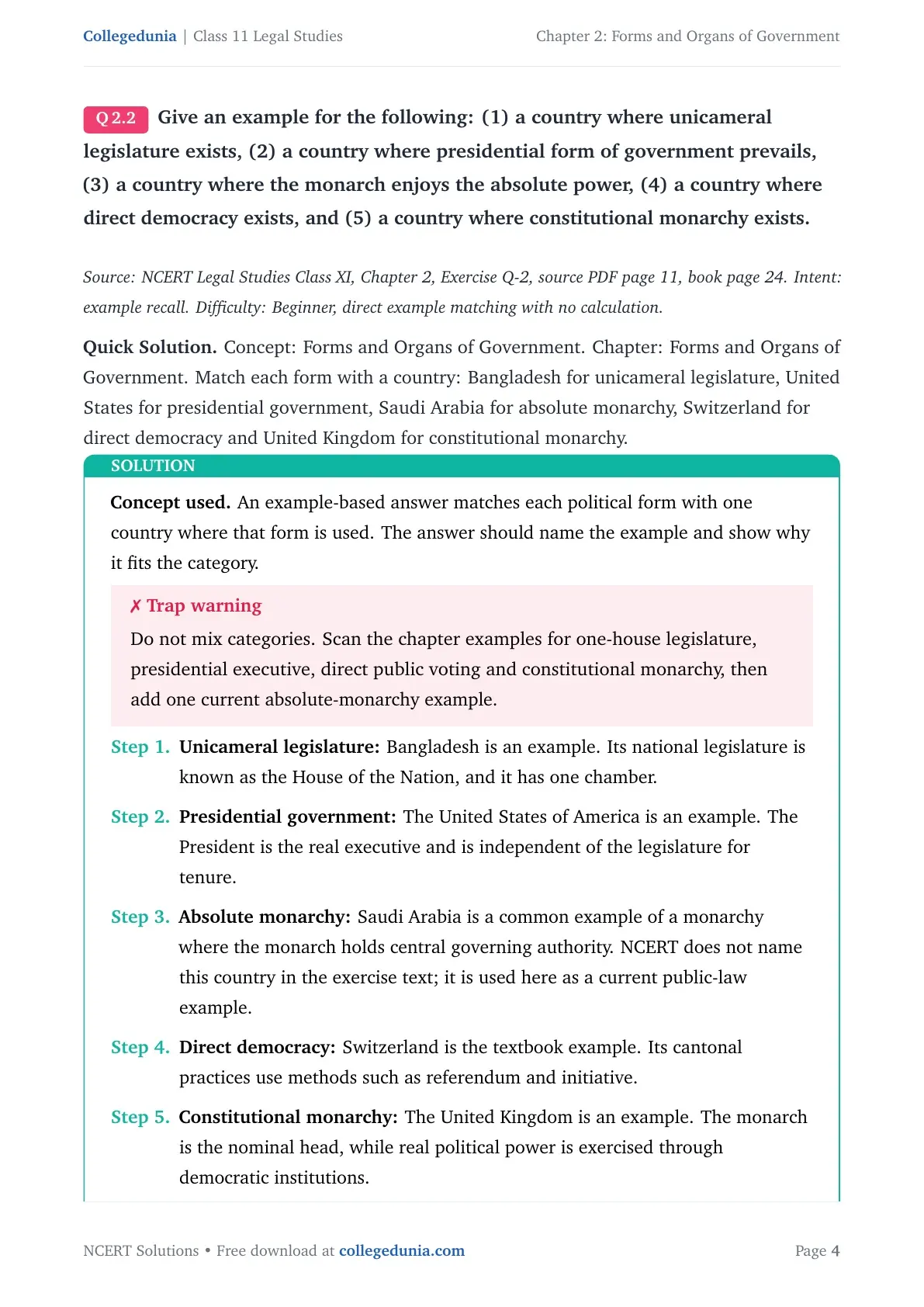
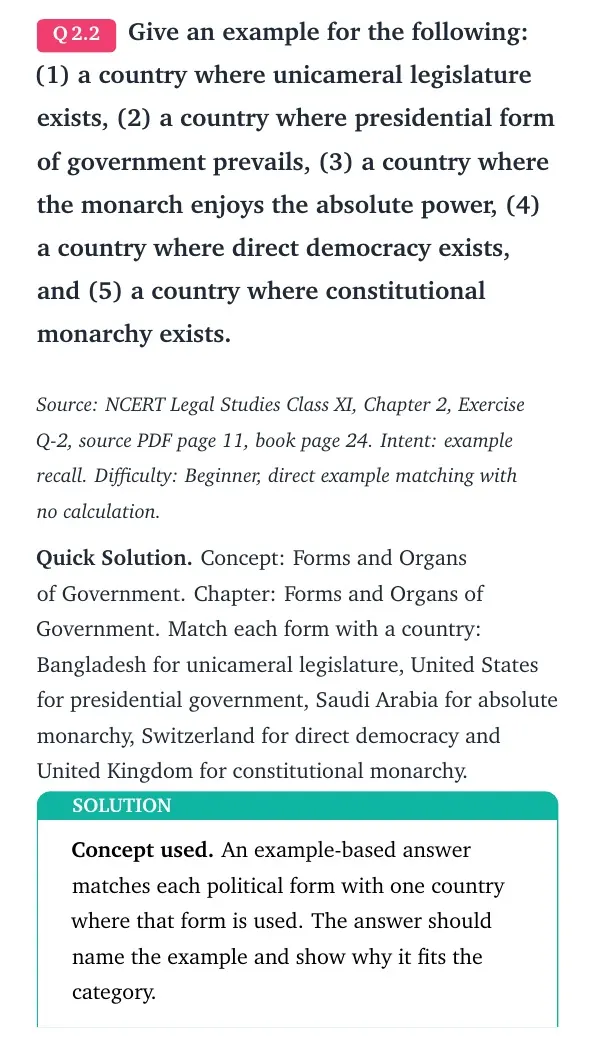
Q 2.2
Give an example for the following: (1) a country where unicameral legislature exists, (2) a country where presidential form of government prevails, (3) a country where the monarch enjoys the absolute power, (4) a country where direct democracy exists, and (5) a country where constitutional monarchy exists.
Concept used. An example-based answer matches each political form with one country where that form is used. The answer should name the example and show why it fits the category.
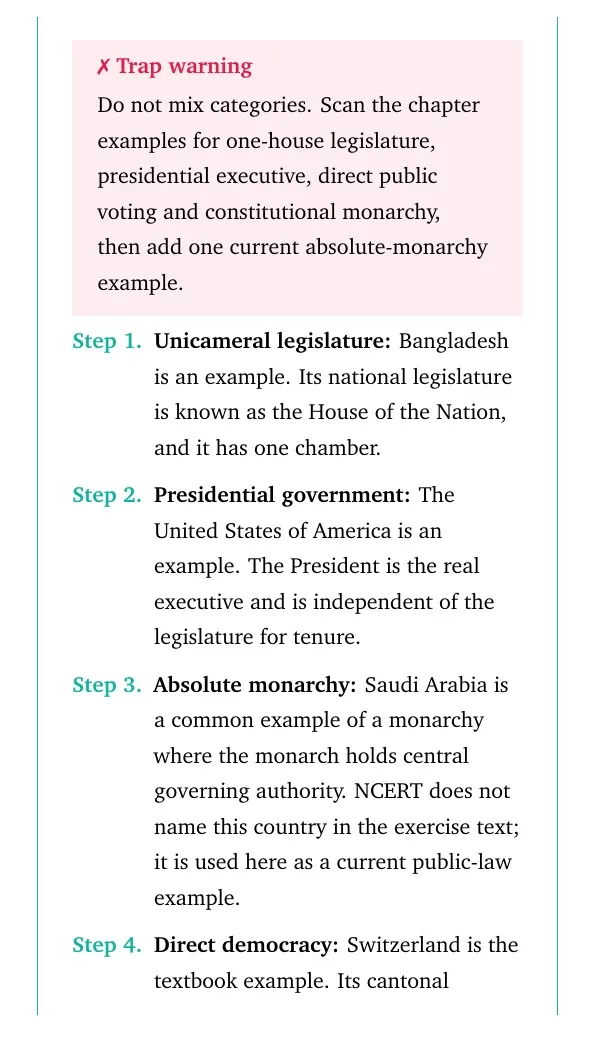
Trap warning
Do not mix categories. Scan the chapter examples for one-house legislature, presidential executive, direct public voting and constitutional monarchy, then add one current absolute-monarchy example.
Unicameral legislature: Bangladesh is an example. Its national legislature is known as the House of the Nation, and it has one chamber.
Presidential government: The United States of America is an example. The President is the real executive and is independent of the legislature for tenure.
Absolute monarchy: Saudi Arabia is a common example of a monarchy where the monarch holds central governing authority. NCERT does not name this country in the exercise text; it is used here as a current public-law example.
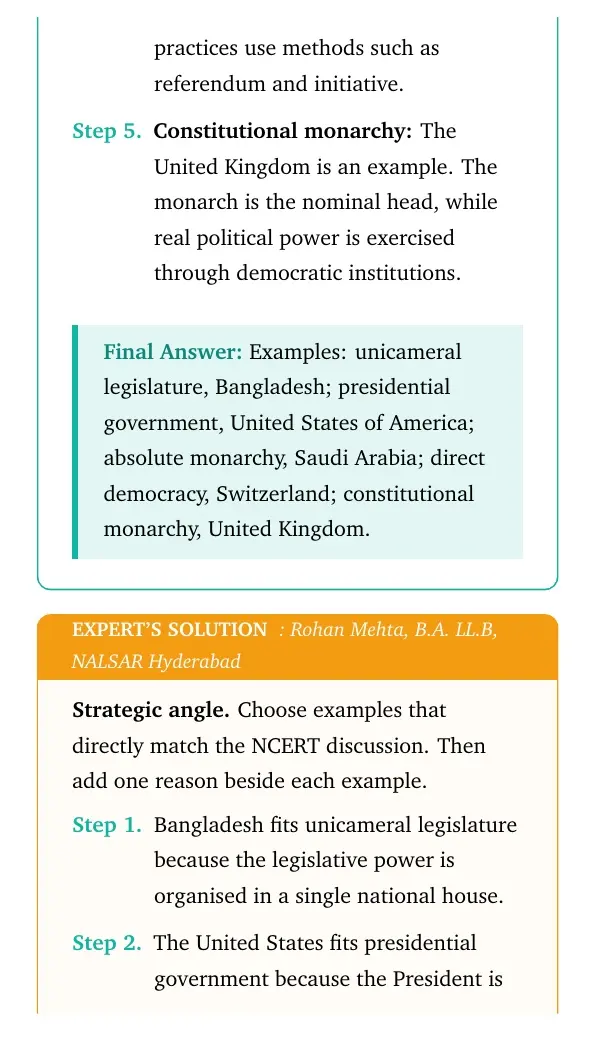
Direct democracy: Switzerland is the textbook example. Its cantonal practices use methods such as referendum and initiative.
Constitutional monarchy: The United Kingdom is an example. The monarch is the nominal head, while real political power is exercised through democratic institutions.
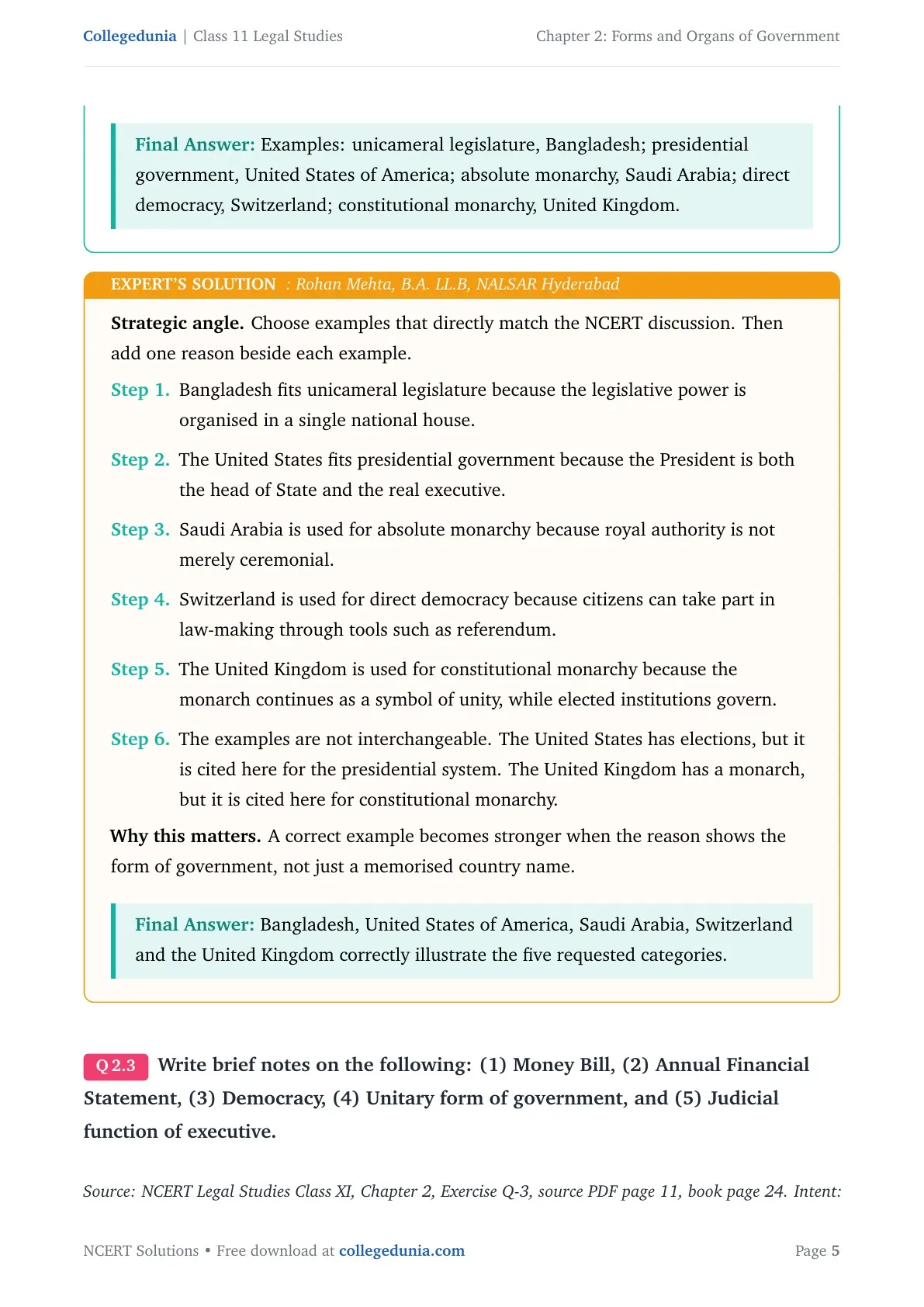
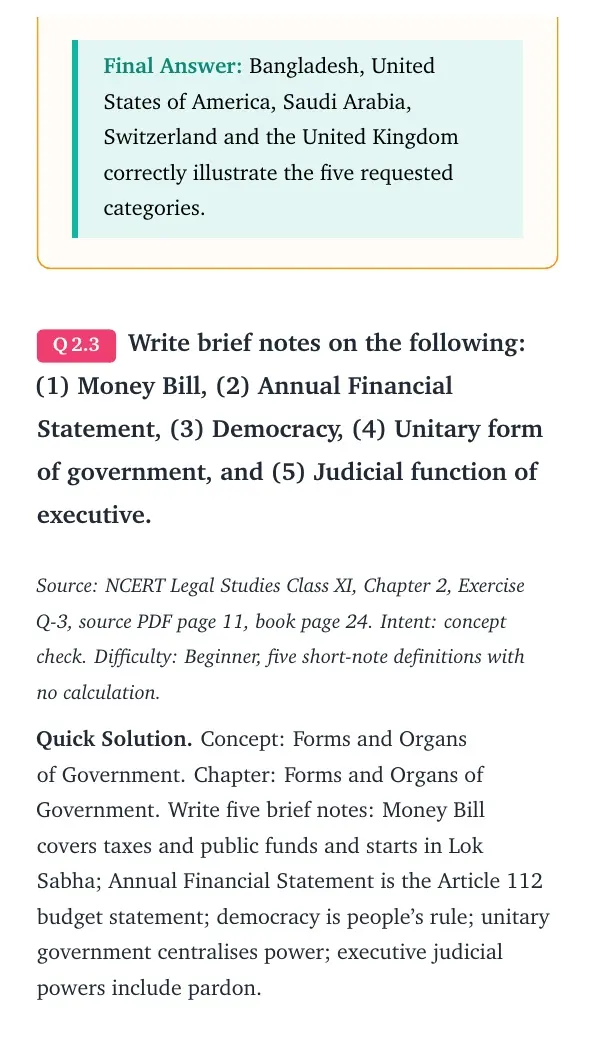
Examples: unicameral legislature, Bangladesh; presidential government, United States of America; absolute monarchy, Saudi Arabia; direct democracy, Switzerland; constitutional monarchy, United Kingdom.
RM
Rohan Mehta
B.A. LL.B, NALSAR Hyderabad
Verified Expert
Strategic angle. Choose examples that directly match the NCERT discussion. Then add one reason beside each example.
Bangladesh fits unicameral legislature because the legislative power is organised in a single national house.
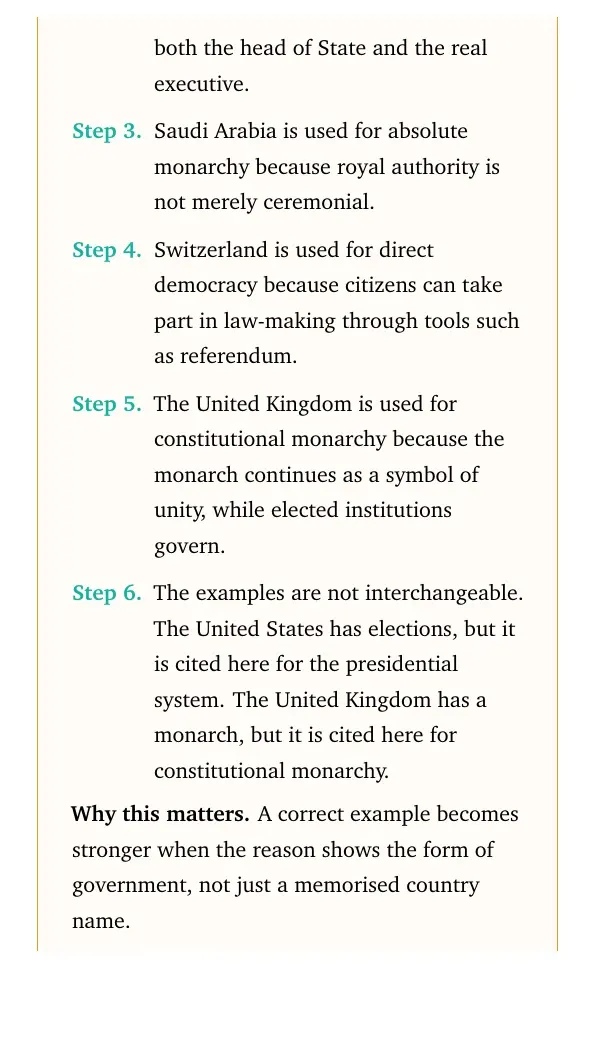
The United States fits presidential government because the President is both the head of State and the real executive.
Saudi Arabia is used for absolute monarchy because royal authority is not merely ceremonial.
Switzerland is used for direct democracy because citizens can take part in law-making through tools such as referendum.
The United Kingdom is used for constitutional monarchy because the monarch continues as a symbol of unity, while elected institutions govern.
The examples are not interchangeable. The United States has elections, but it is cited here for the presidential system. The United Kingdom has a monarch, but it is cited here for constitutional monarchy.
Why this matters. A correct example becomes stronger when the reason shows the form of government, not just a memorised country name.
Bangladesh, United States of America, Saudi Arabia, Switzerland and the United Kingdom correctly illustrate the five requested categories.
Q 2.3
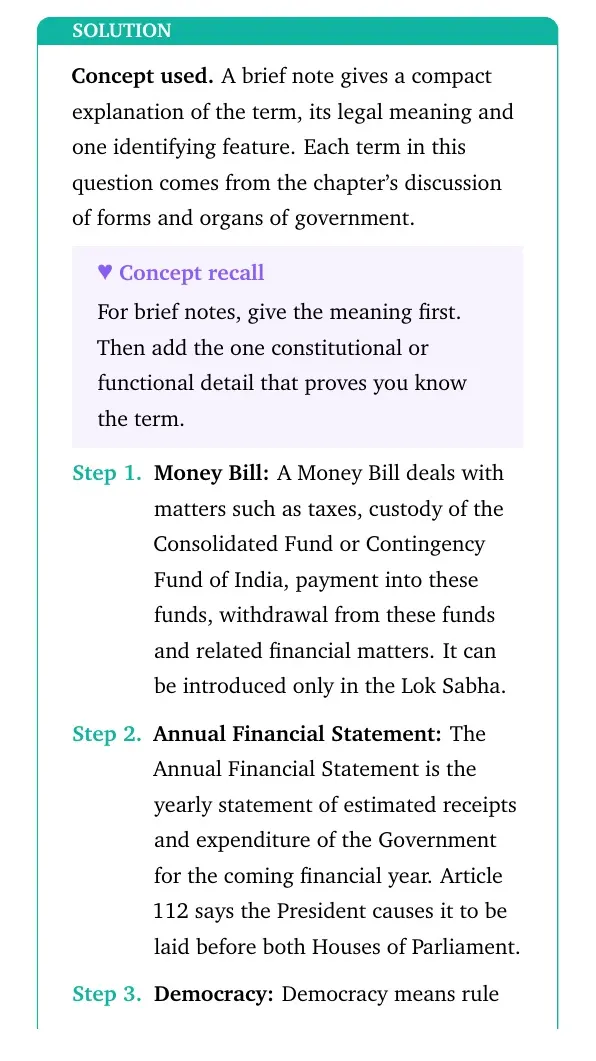
Write brief notes on the following: (1) Money Bill, (2) Annual Financial Statement, (3) Democracy, (4) Unitary form of government, and (5) Judicial function of executive.
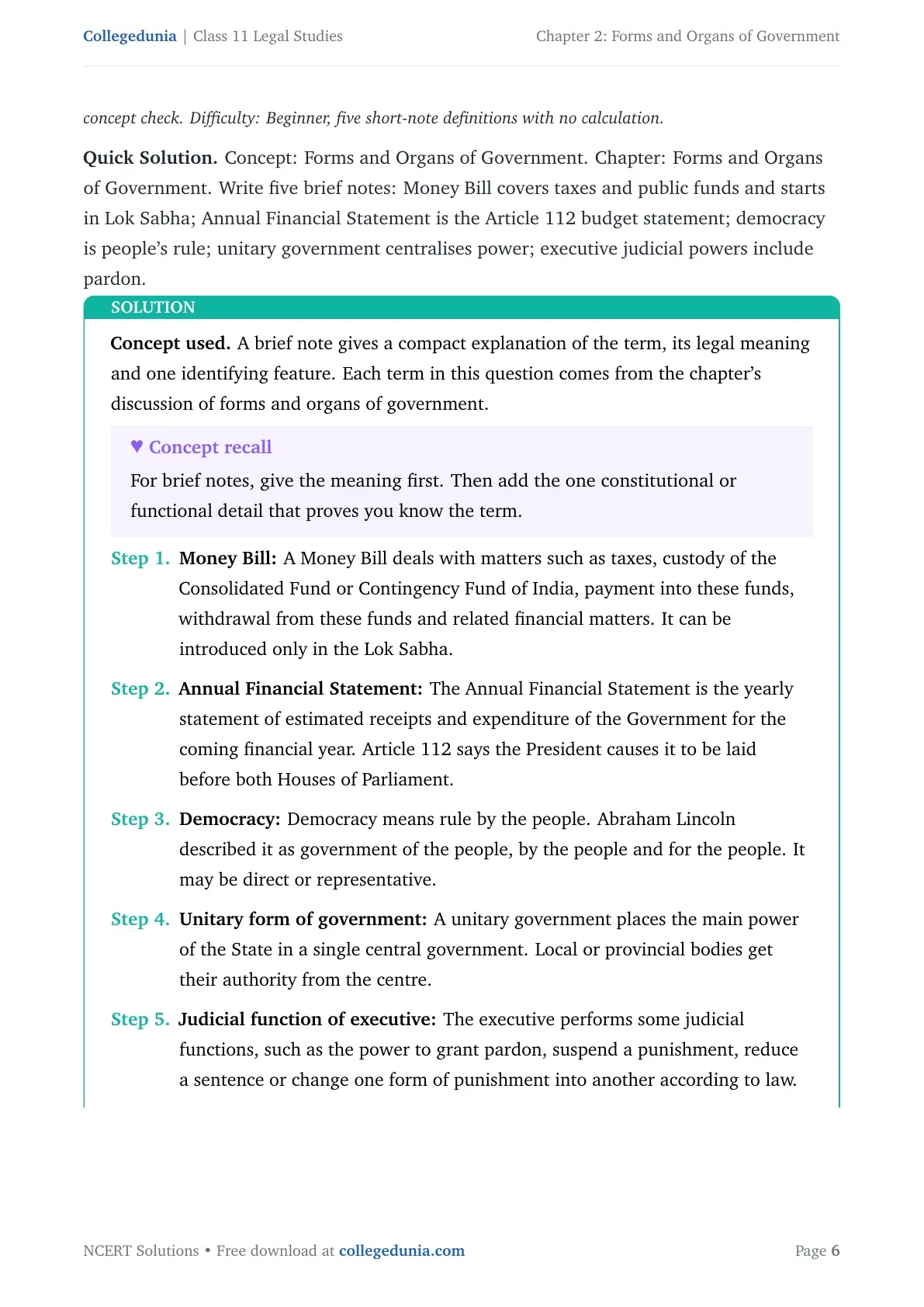
Concept used. A brief note gives a compact explanation of the term, its legal meaning and one identifying feature. Each term in this question comes from the chapter's discussion of forms and organs of government.
Concept recall
For brief notes, give the meaning first. Then add the one constitutional or functional detail that proves you know the term.
Money Bill: A Money Bill deals with matters such as taxes, custody of the Consolidated Fund or Contingency Fund of India, payment into these funds, withdrawal from these funds and related financial matters. It can be introduced only in the Lok Sabha.
Annual Financial Statement: The Annual Financial Statement is the yearly statement of estimated receipts and expenditure of the Government for the coming financial year. Article 112 says the President causes it to be laid before both Houses of Parliament.
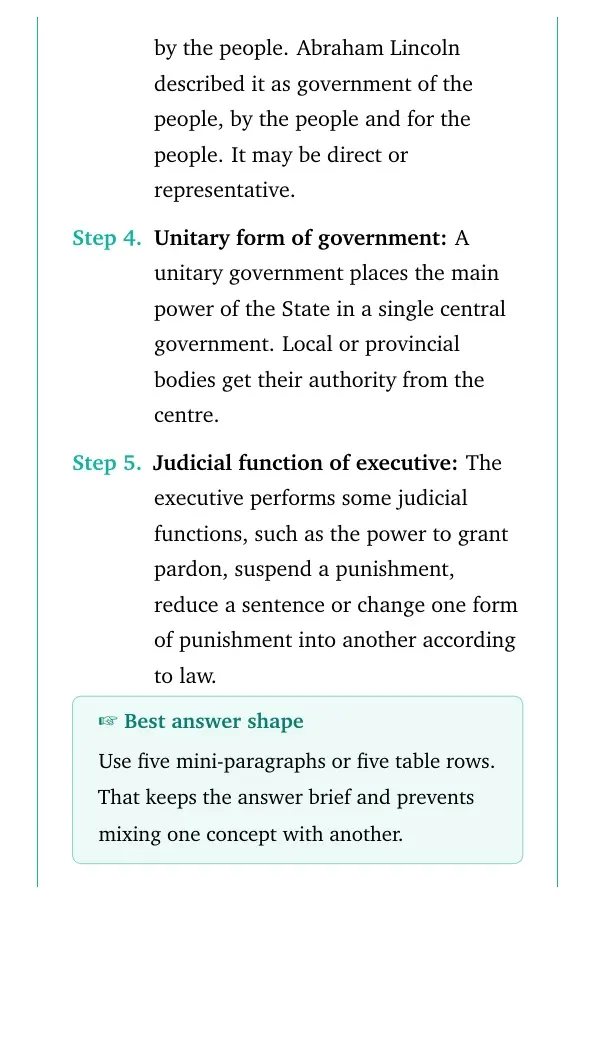
Democracy: Democracy means rule by the people. Abraham Lincoln described it as government of the people, by the people and for the people. It may be direct or representative.
Unitary form of government: A unitary government places the main power of the State in a single central government. Local or provincial bodies get their authority from the centre.
Judicial function of executive: The executive performs some judicial functions, such as the power to grant pardon, suspend a punishment, reduce a sentence or change one form of punishment into another according to law.
Best answer shape
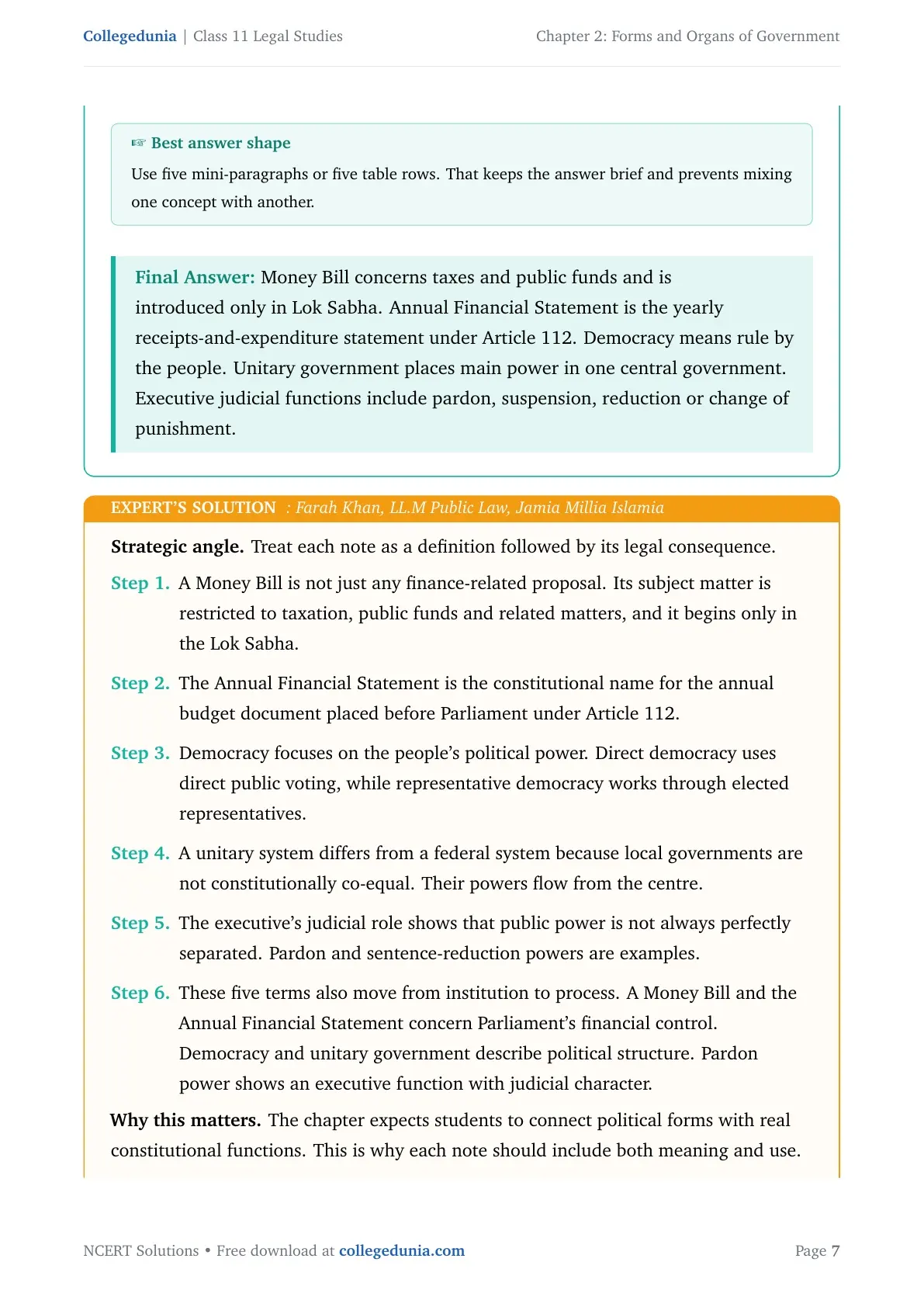
Use five mini-paragraphs or five table rows. That keeps the answer brief and prevents mixing one concept with another.
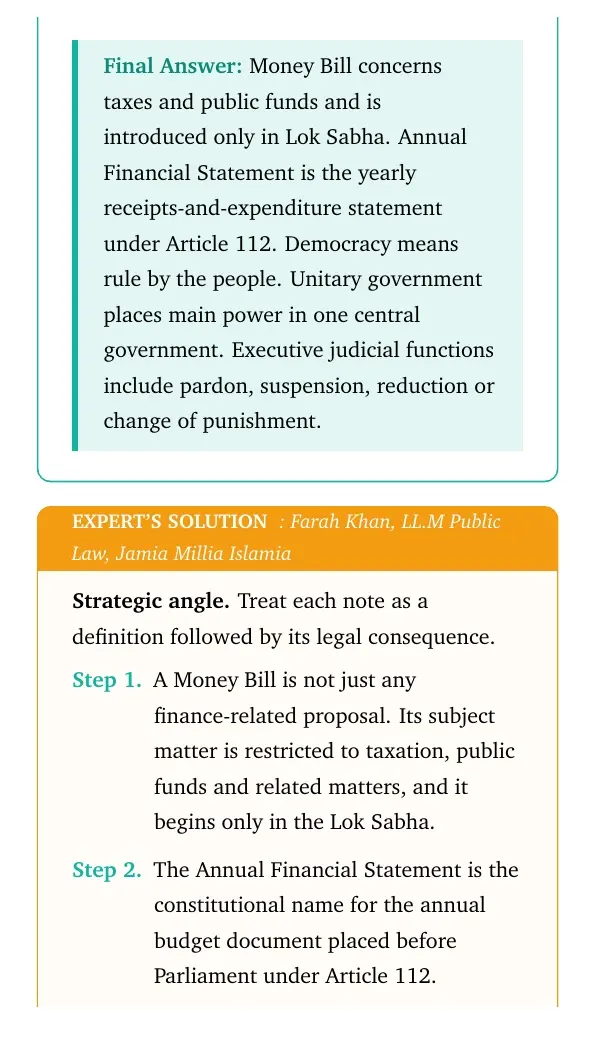
Money Bill concerns taxes and public funds and is introduced only in Lok Sabha. Annual Financial Statement is the yearly receipts-and-expenditure statement under Article 112. Democracy means rule by the people. Unitary government places main power in one central government. Executive judicial functions include pardon, suspension, reduction or change of punishment.
FK
Farah Khan
LL.M Public Law, Jamia Millia Islamia
Verified Expert
Strategic angle. Treat each note as a definition followed by its legal consequence.
A Money Bill is not just any finance-related proposal. Its subject matter is restricted to taxation, public funds and related matters, and it begins only in the Lok Sabha.
The Annual Financial Statement is the constitutional name for the annual budget document placed before Parliament under Article 112.
Democracy focuses on the people's political power. Direct democracy uses direct public voting, while representative democracy works through elected representatives.
A unitary system differs from a federal system because local governments are not constitutionally co-equal. Their powers flow from the centre.
The executive's judicial role shows that public power is not always perfectly separated. Pardon and sentence-reduction powers are examples.
These five terms also move from institution to process. A Money Bill and the Annual Financial Statement concern Parliament's financial control. Democracy and unitary government describe political structure. Pardon power shows an executive function with judicial character.
Why this matters. The chapter expects students to connect political forms with real constitutional functions. This is why each note should include both meaning and use.
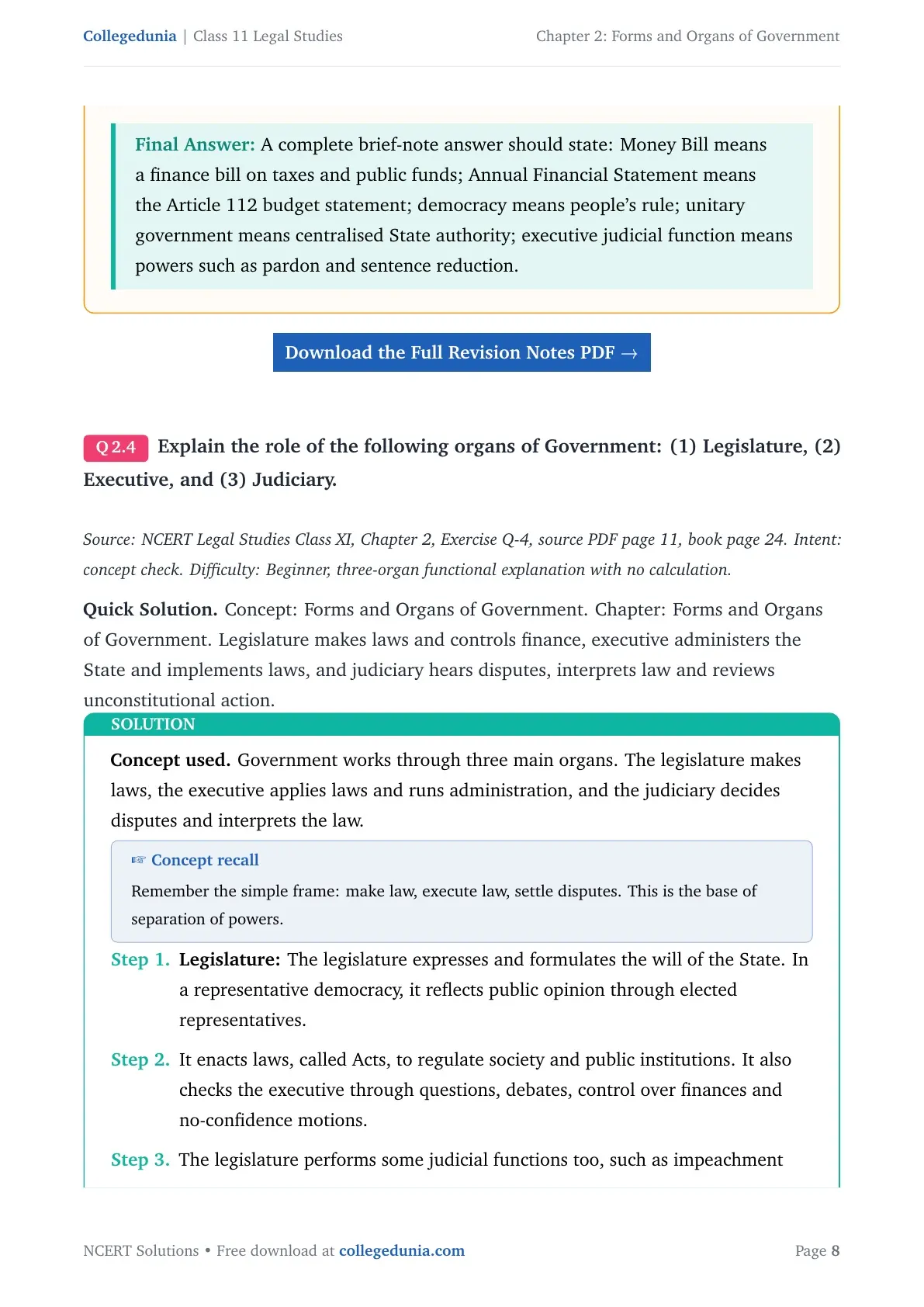
A complete brief-note answer should state: Money Bill means a finance bill on taxes and public funds; Annual Financial Statement means the Article 112 budget statement; democracy means people's rule; unitary government means centralised State authority; executive judicial function means powers such as pardon and sentence reduction.
Q 2.4
Explain the role of the following organs of Government: (1) Legislature, (2) Executive, and (3) Judiciary.
Concept used. Government works through three main organs. The legislature makes laws, the executive applies laws and runs administration, and the judiciary decides disputes and interprets the law.
Concept recall
Remember the simple frame: make law, execute law, settle disputes. This is the base of separation of powers.
Legislature: The legislature expresses and formulates the will of the State. In a representative democracy, it reflects public opinion through elected representatives.
It enacts laws, called Acts, to regulate society and public institutions. It also checks the executive through questions, debates, control over finances and no-confidence motions.
The legislature performs some judicial functions too, such as impeachment proceedings and deciding questions of legislative privilege.
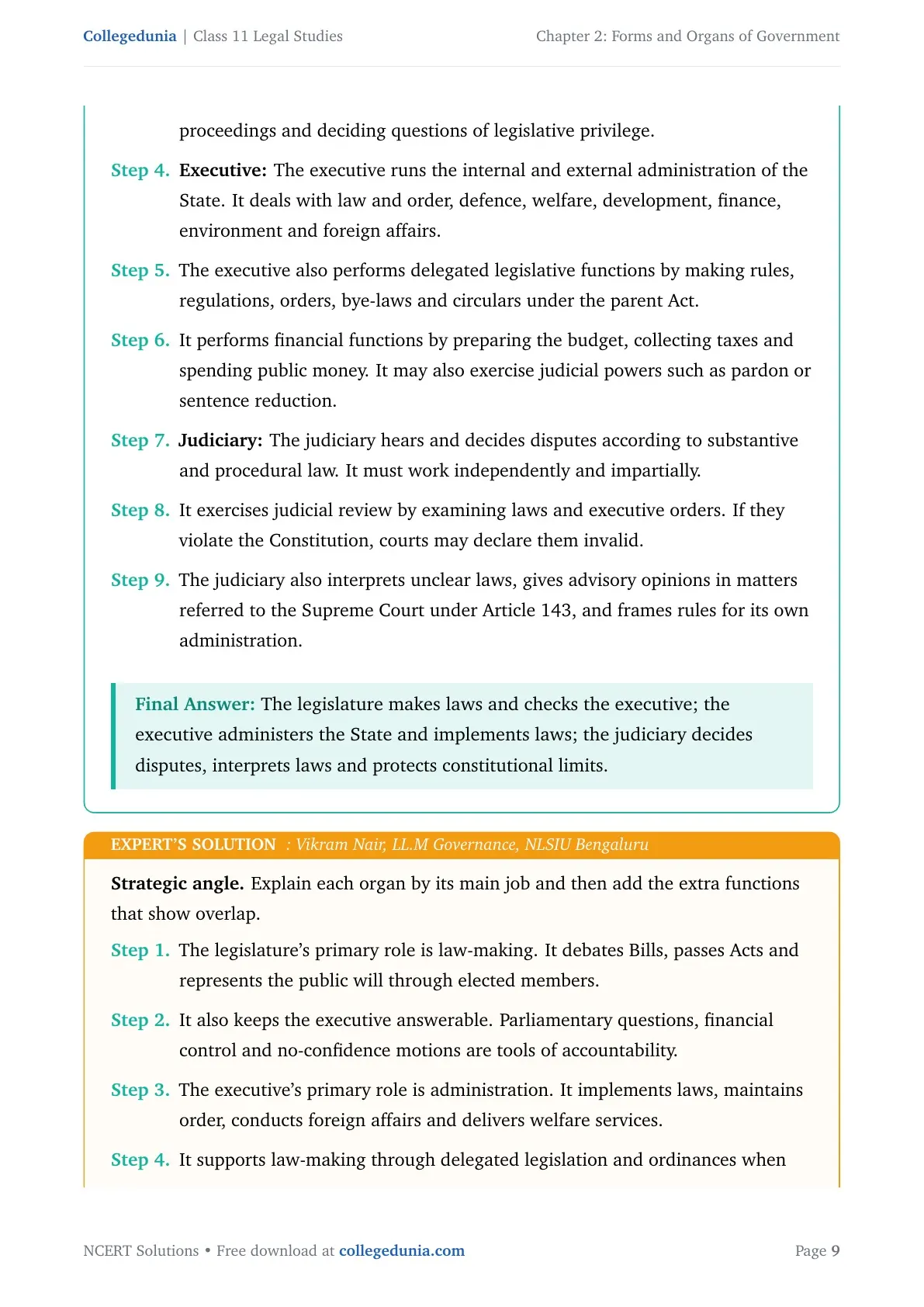
Executive: The executive runs the internal and external administration of the State. It deals with law and order, defence, welfare, development, finance, environment and foreign affairs.
The executive also performs delegated legislative functions by making rules, regulations, orders, bye-laws and circulars under the parent Act.
It performs financial functions by preparing the budget, collecting taxes and spending public money. It may also exercise judicial powers such as pardon or sentence reduction.
Judiciary: The judiciary hears and decides disputes according to substantive and procedural law. It must work independently and impartially.
It exercises judicial review by examining laws and executive orders. If they violate the Constitution, courts may declare them invalid.
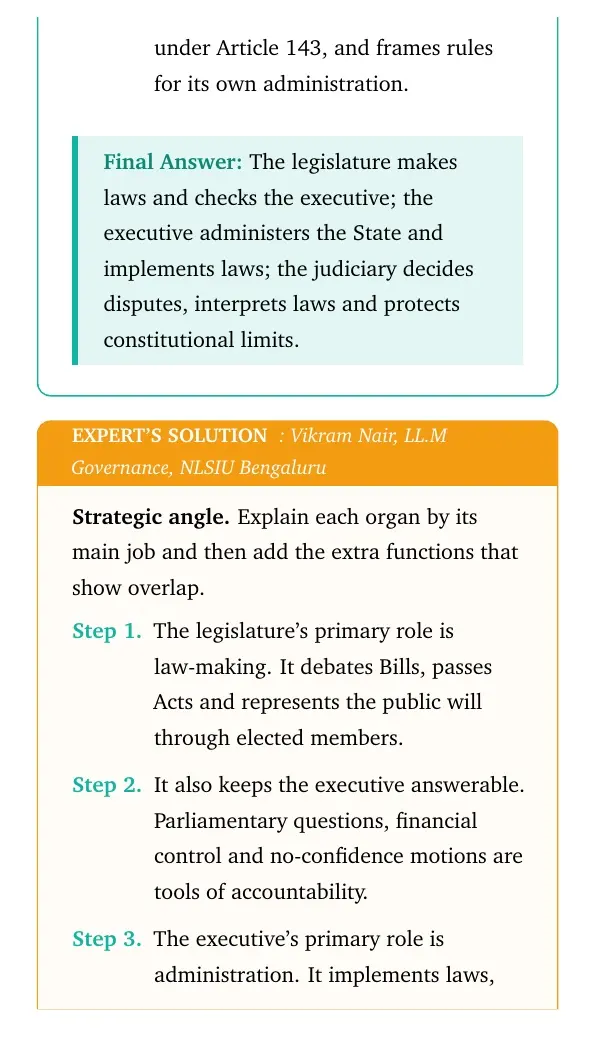
The judiciary also interprets unclear laws, gives advisory opinions in matters referred to the Supreme Court under Article 143, and frames rules for its own administration.
The legislature makes laws and checks the executive; the executive administers the State and implements laws; the judiciary decides disputes, interprets laws and protects constitutional limits.
VN
Vikram Nair
LL.M Governance, NLSIU Bengaluru
Verified Expert
Strategic angle. Explain each organ by its main job and then add the extra functions that show overlap.
The legislature's primary role is law-making. It debates Bills, passes Acts and represents the public will through elected members.
It also keeps the executive answerable. Parliamentary questions, financial control and no-confidence motions are tools of accountability.
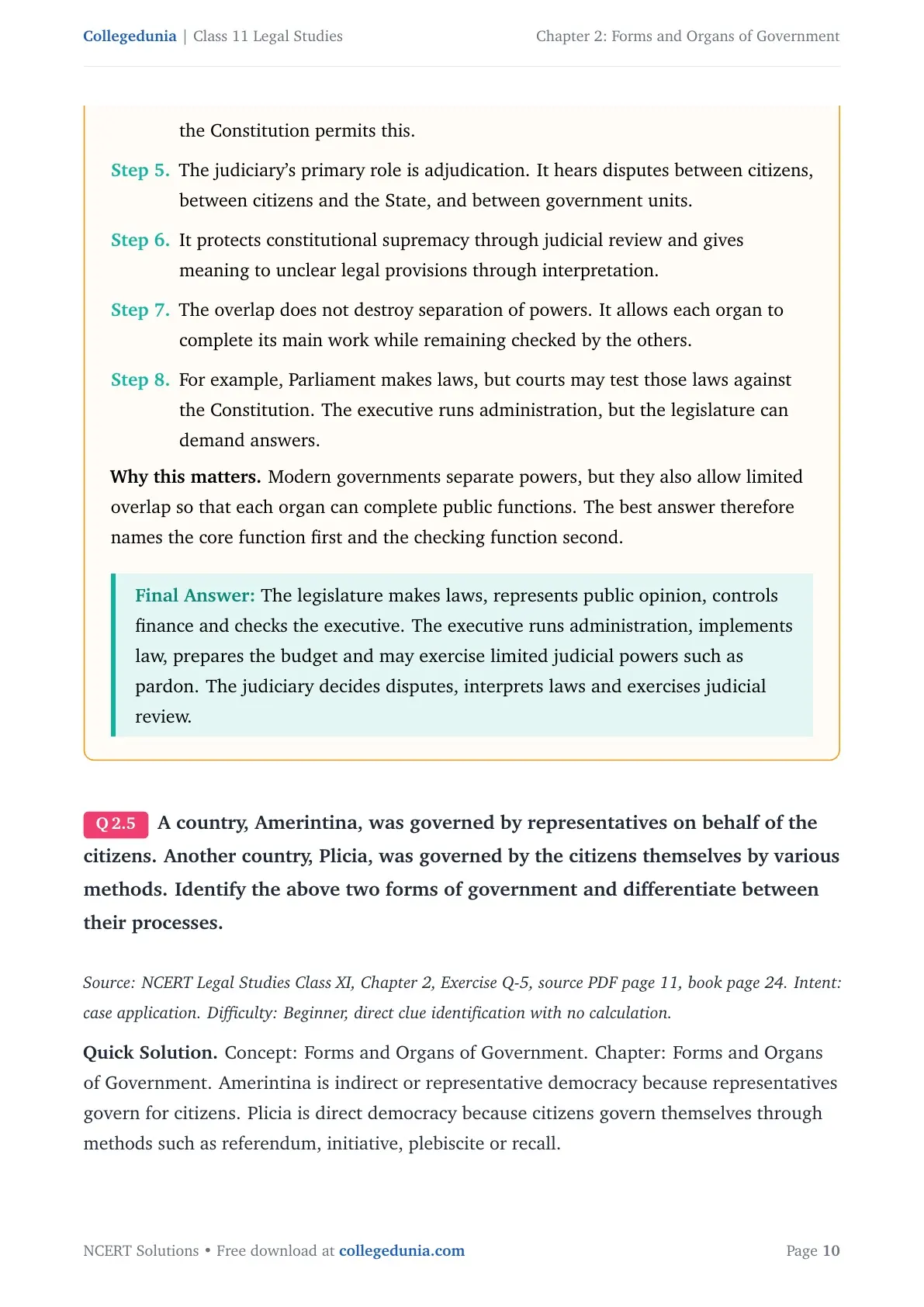
The executive's primary role is administration. It implements laws, maintains order, conducts foreign affairs and delivers welfare services.
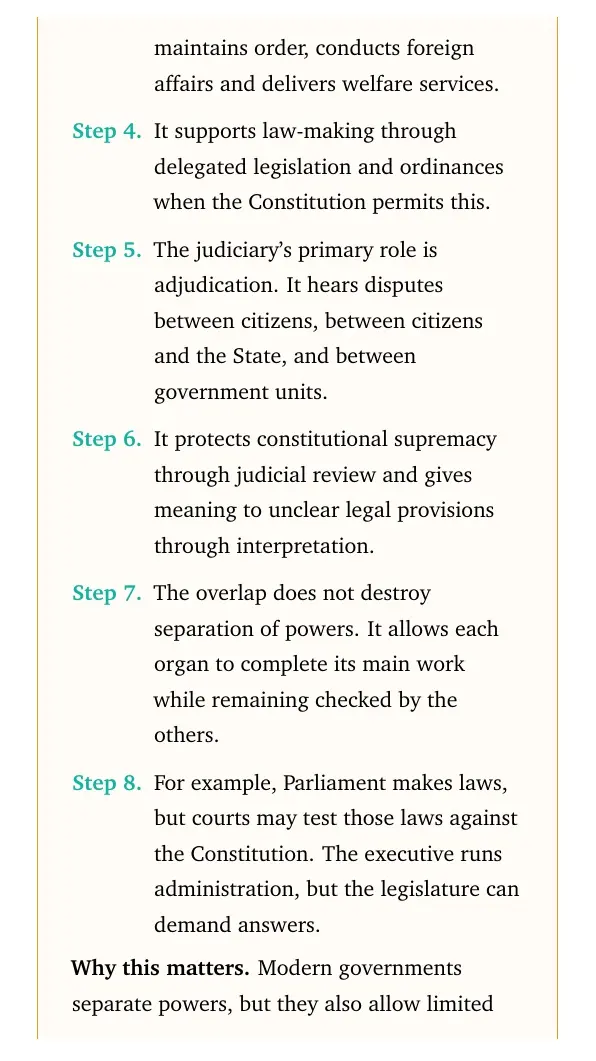
It supports law-making through delegated legislation and ordinances when the Constitution permits this.
The judiciary's primary role is adjudication. It hears disputes between citizens, between citizens and the State, and between government units.
It protects constitutional supremacy through judicial review and gives meaning to unclear legal provisions through interpretation.
The overlap does not destroy separation of powers. It allows each organ to complete its main work while remaining checked by the others.
For example, Parliament makes laws, but courts may test those laws against the Constitution. The executive runs administration, but the legislature can demand answers.
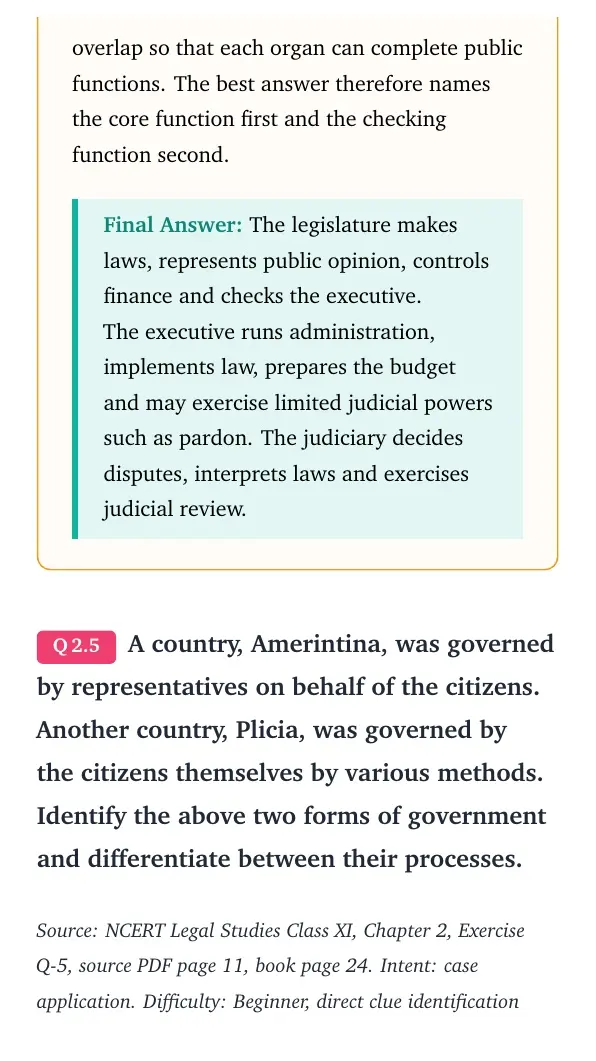
Why this matters. Modern governments separate powers, but they also allow limited overlap so that each organ can complete public functions. The best answer therefore names the core function first and the checking function second.
The legislature makes laws, represents public opinion, controls finance and checks the executive. The executive runs administration, implements law, prepares the budget and may exercise limited judicial powers such as pardon. The judiciary decides disputes, interprets laws and exercises judicial review.
Q 2.5
A country, Amerintina, was governed by representatives on behalf of the citizens. Another country, Plicia, was governed by the citizens themselves by various methods. Identify the above two forms of government and differentiate between their processes.
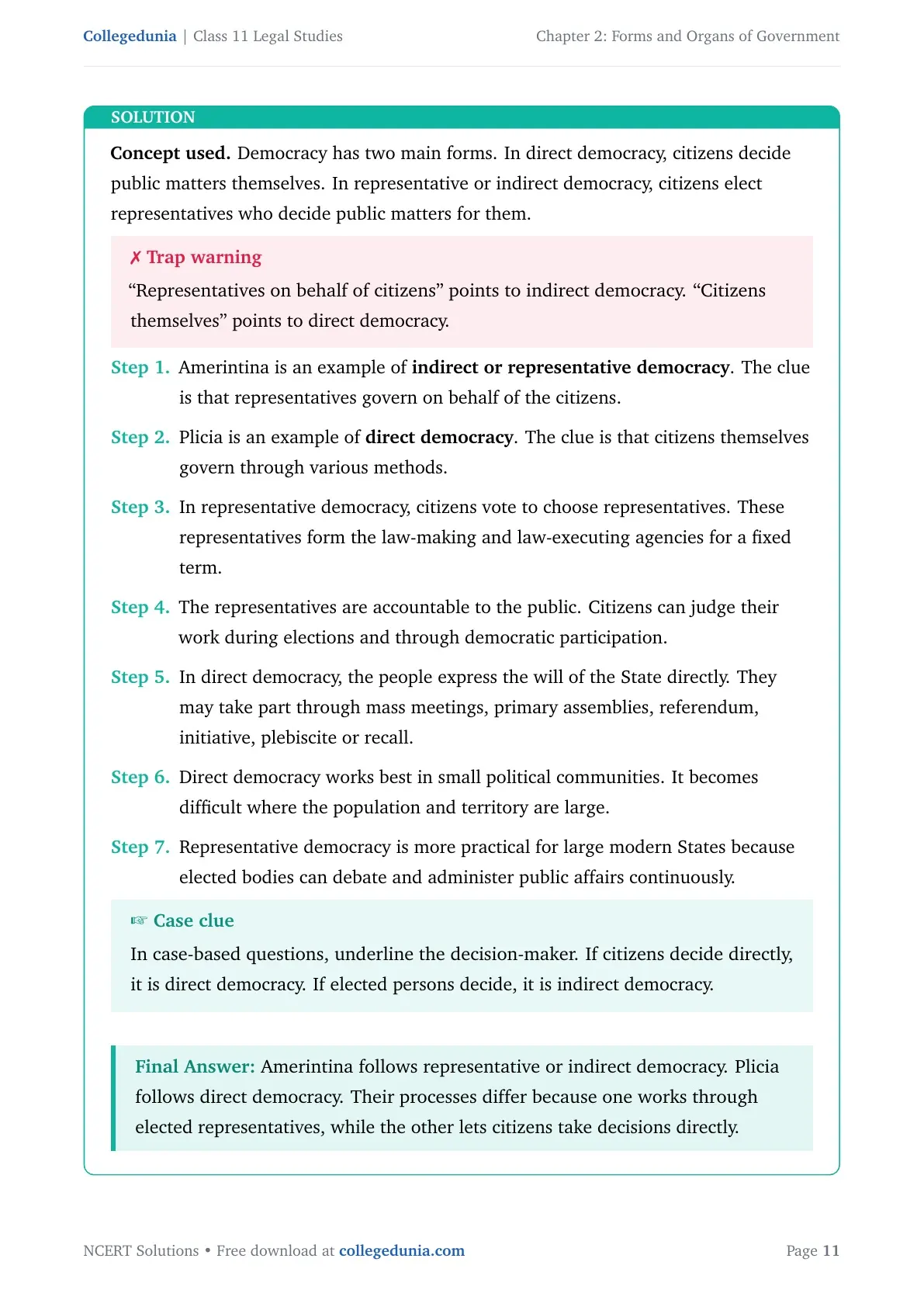
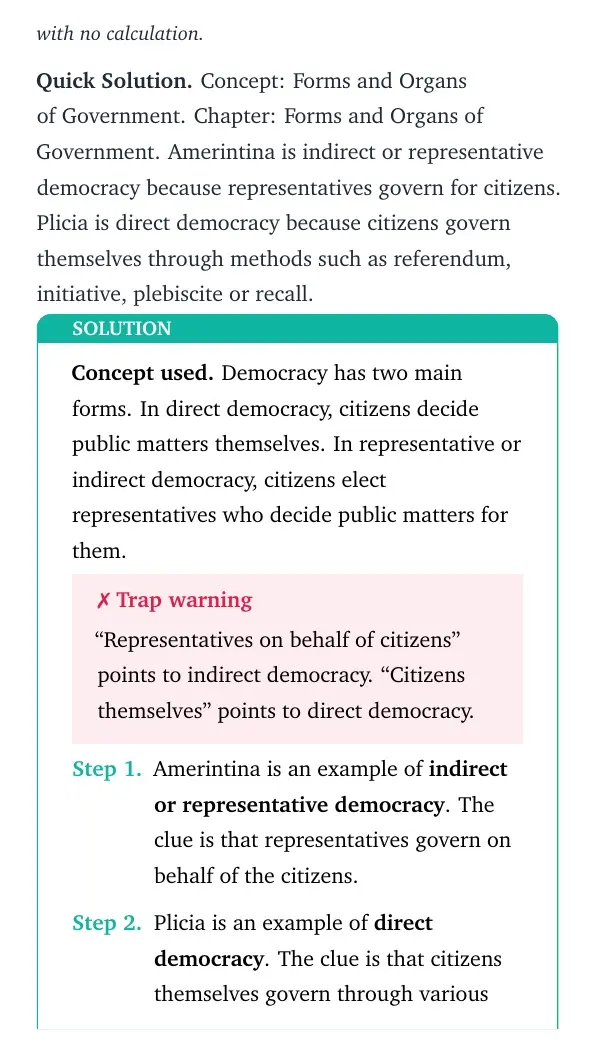
Concept used. Democracy has two main forms. In direct democracy, citizens decide public matters themselves. In representative or indirect democracy, citizens elect representatives who decide public matters for them.
Trap warning
``Representatives on behalf of citizens'' points to indirect democracy. ``Citizens themselves'' points to direct democracy.
Amerintina is an example of indirect or representative democracy. The clue is that representatives govern on behalf of the citizens.
Plicia is an example of direct democracy. The clue is that citizens themselves govern through various methods.
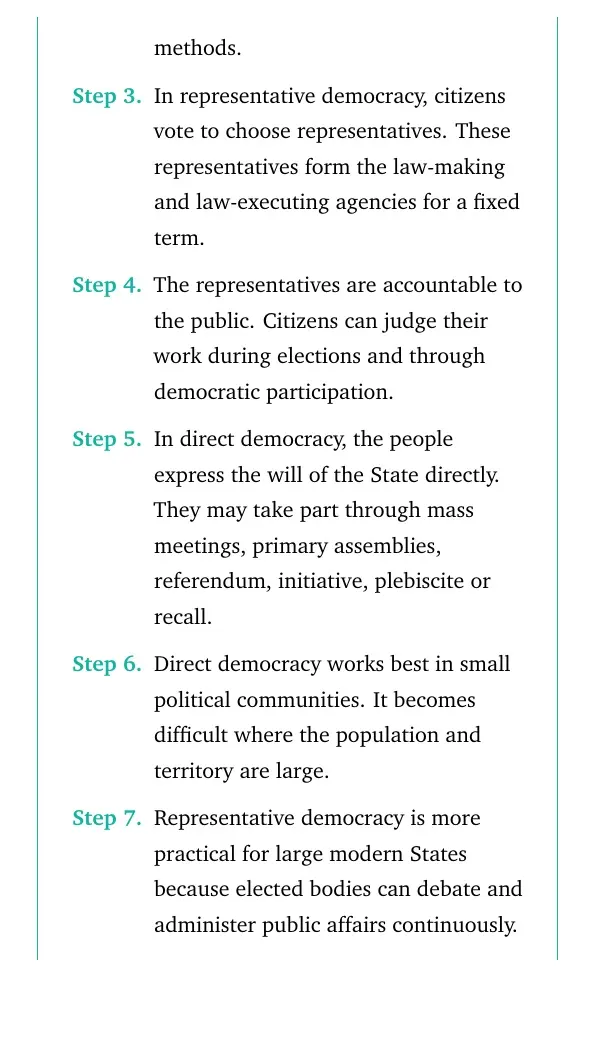
In representative democracy, citizens vote to choose representatives. These representatives form the law-making and law-executing agencies for a fixed term.
The representatives are accountable to the public. Citizens can judge their work during elections and through democratic participation.
In direct democracy, the people express the will of the State directly. They may take part through mass meetings, primary assemblies, referendum, initiative, plebiscite or recall.
Direct democracy works best in small political communities. It becomes difficult where the population and territory are large.
Representative democracy is more practical for large modern States because elected bodies can debate and administer public affairs continuously.
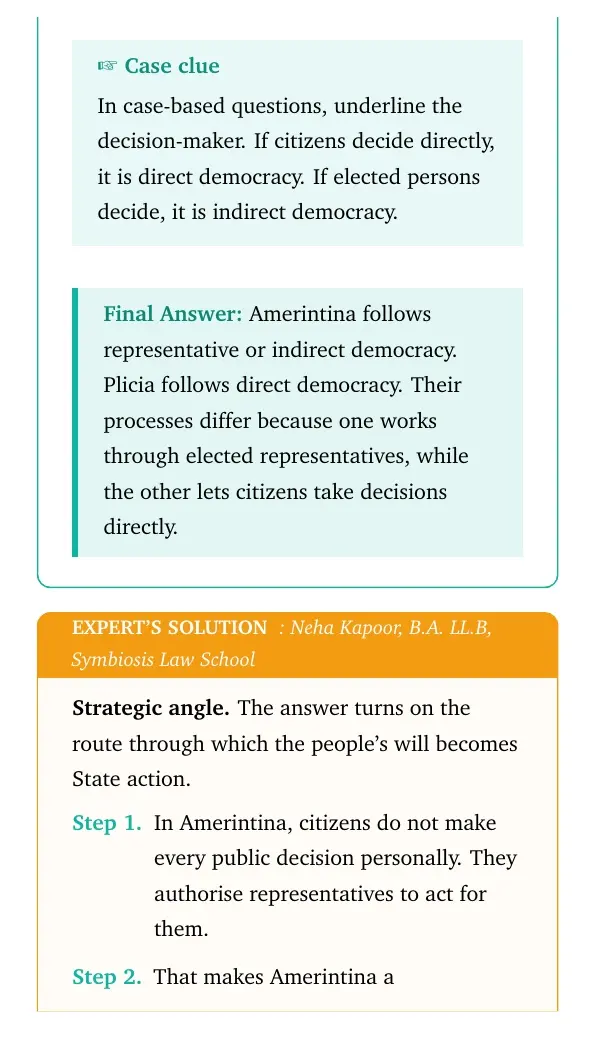
Case clue
In case-based questions, underline the decision-maker. If citizens decide directly, it is direct democracy. If elected persons decide, it is indirect democracy.
Amerintina follows representative or indirect democracy. Plicia follows direct democracy. Their processes differ because one works through elected representatives, while the other lets citizens take decisions directly.
NK
Neha Kapoor
B.A. LL.B, Symbiosis Law School
Verified Expert
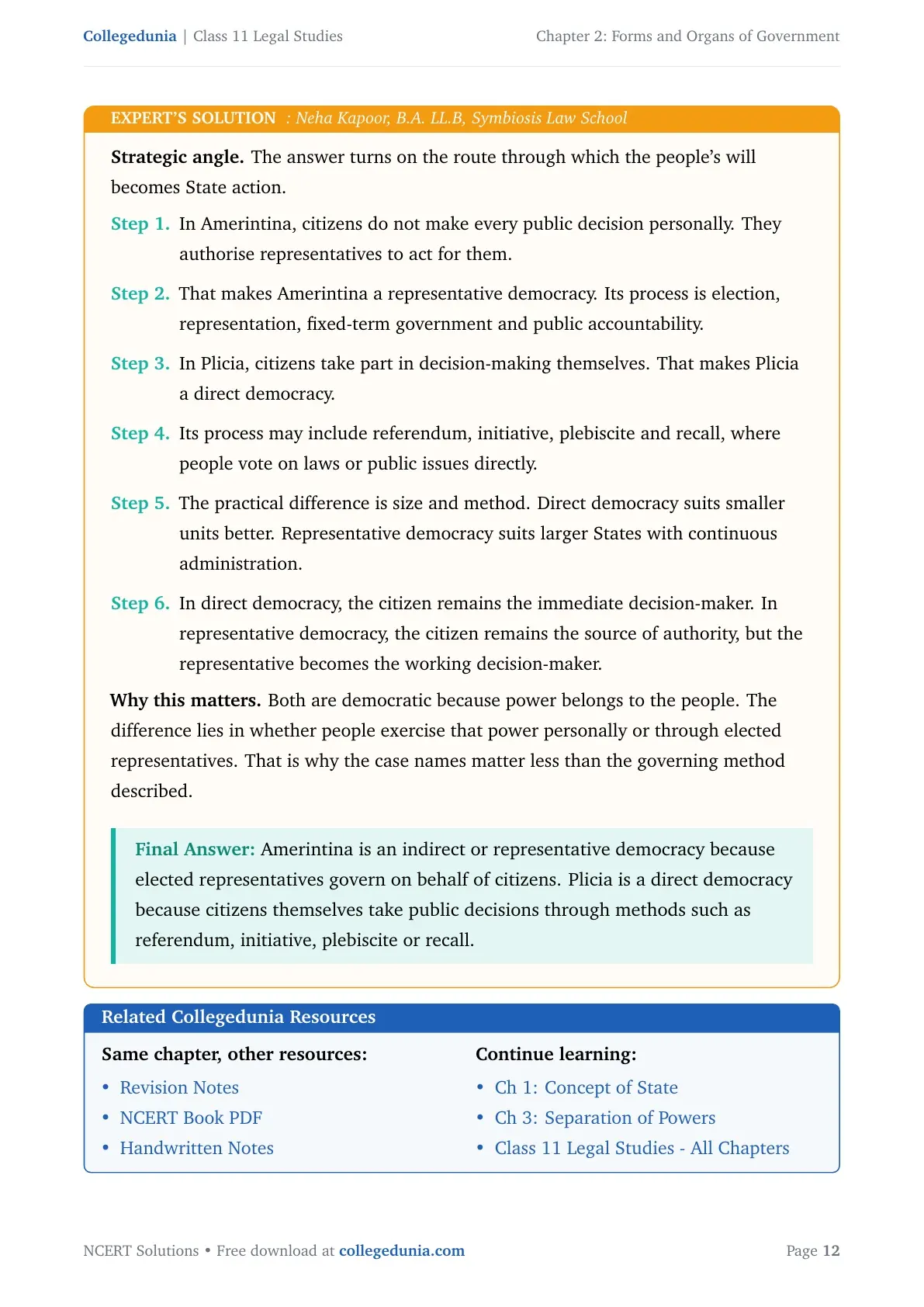
Strategic angle. The answer turns on the route through which the people's will becomes State action.
In Amerintina, citizens do not make every public decision personally. They authorise representatives to act for them.
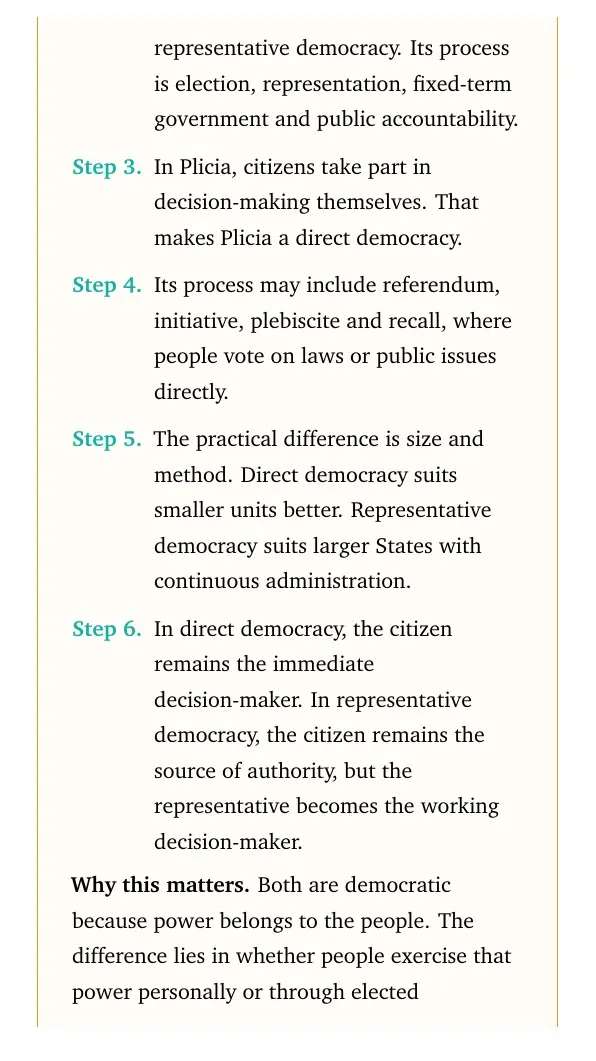
That makes Amerintina a representative democracy. Its process is election, representation, fixed-term government and public accountability.
In Plicia, citizens take part in decision-making themselves. That makes Plicia a direct democracy.
Its process may include referendum, initiative, plebiscite and recall, where people vote on laws or public issues directly.
The practical difference is size and method. Direct democracy suits smaller units better. Representative democracy suits larger States with continuous administration.
In direct democracy, the citizen remains the immediate decision-maker. In representative democracy, the citizen remains the source of authority, but the representative becomes the working decision-maker.
Why this matters. Both are democratic because power belongs to the people. The difference lies in whether people exercise that power personally or through elected representatives. That is why the case names matter less than the governing method described.
Amerintina is an indirect or representative democracy because elected representatives govern on behalf of citizens. Plicia is a direct democracy because citizens themselves take public decisions through methods such as referendum, initiative, plebiscite or recall.
Frequently Asked Questions
Forms and Organs of Government Help
Ques. How many exercise questions are solved in Forms and Organs of Government Class 11 Legal Studies?
Ans. The PDF solves 5 exercise prompts with a main solution and an expert solution for each question card.
Ques. What is the main difference between direct and indirect democracy?
Ans. Direct democracy lets citizens decide public issues themselves. Indirect democracy works through elected representatives.
Ques. What are the three organs of government in this chapter?
Ans. The three organs are legislature, executive and judiciary. They mainly make laws, implement laws and decide disputes.
Ques. Which financial topics are important in this chapter?
Ans. Money Bill and Annual Financial Statement are important because they show Parliament's control over public finance.







Comments