




NCERT Handwritten Notes for Class 11 Legal Studies Chapter 2 Forms and Organs of Government help students revise government forms, bicameral and unicameral legislatures, and the functions of legislature, executive and judiciary for the 2026-27 session.
- Resource: topper-style handwritten revision notes PDF for Legal Studies Forms and Organs of Government.
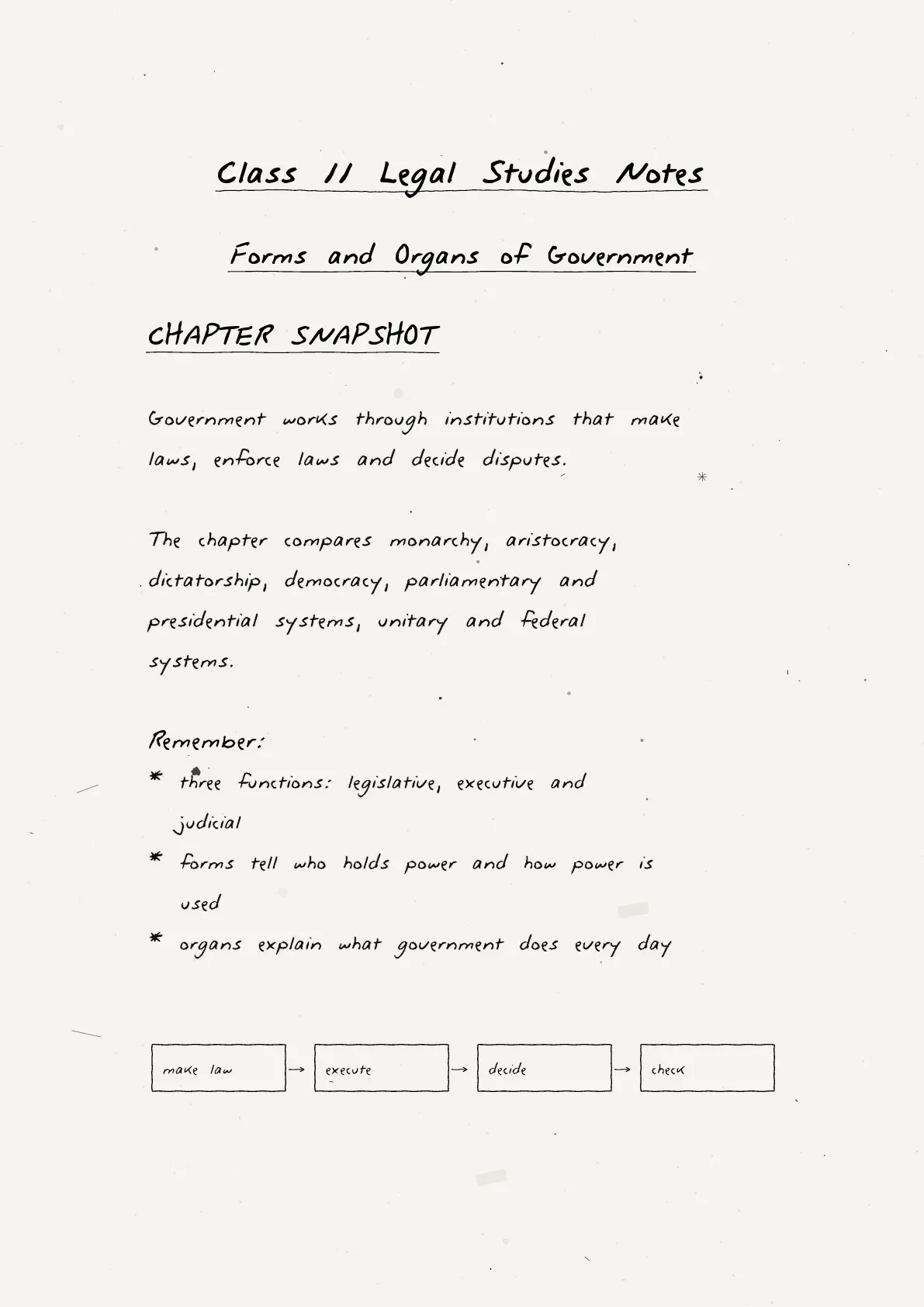
- Chapter focus: monarchy, democracy, parliamentary system, federal system, Bills, ordinances and judicial review.
- Revision use: quick comparison tables, answer frames and common mistakes before tests.
Student Feedback: In a Collegedunia survey of 12,460 students, 73% said comparison tables helped them revise this chapter faster.
Forms and Organs of Government Handwritten Notes Overview
The Forms and Organs of Government handwritten notes turn a long theory chapter into short revision pages. Students can revise the forms of government first, then move to the three organs and their constitutional examples.
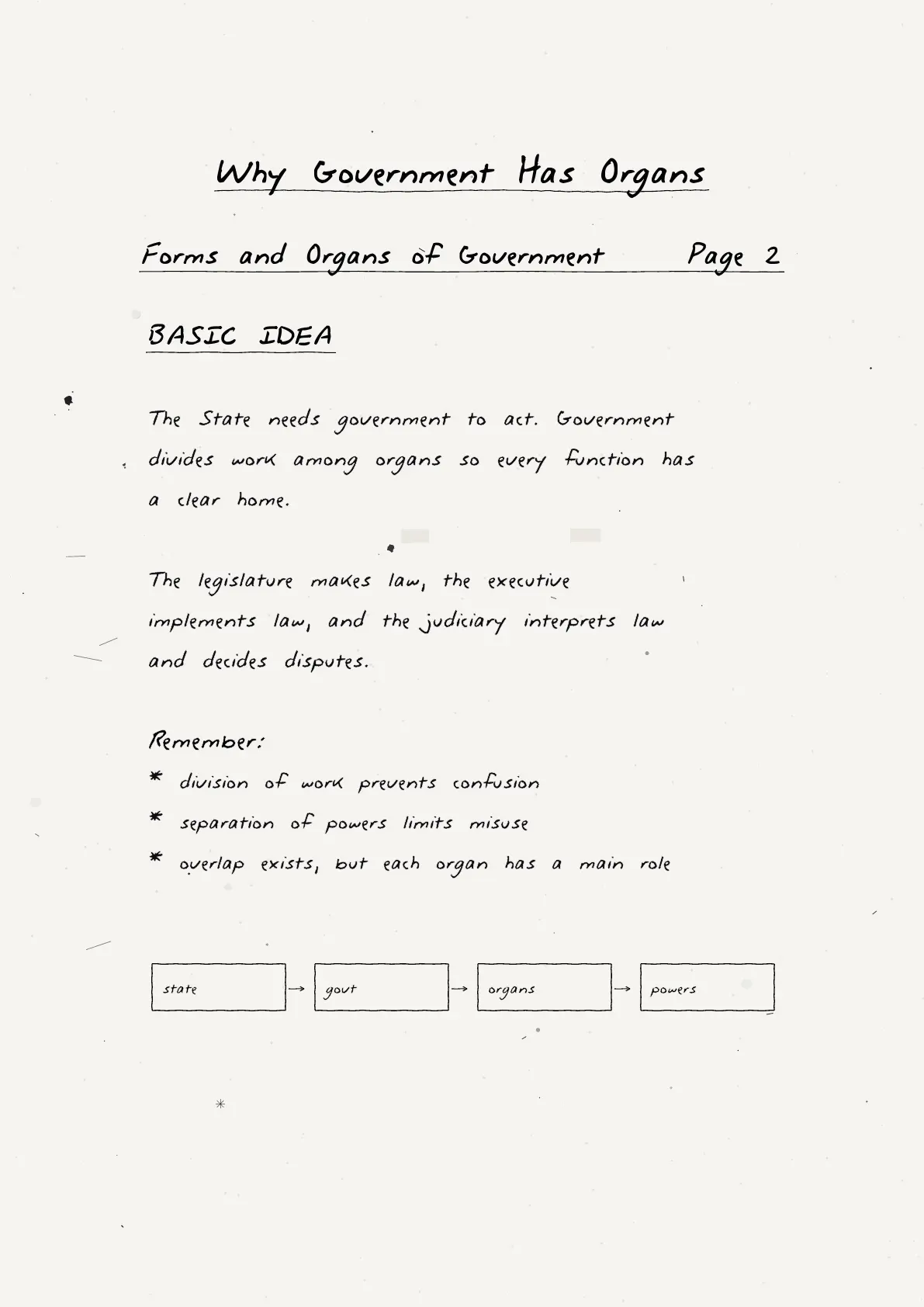
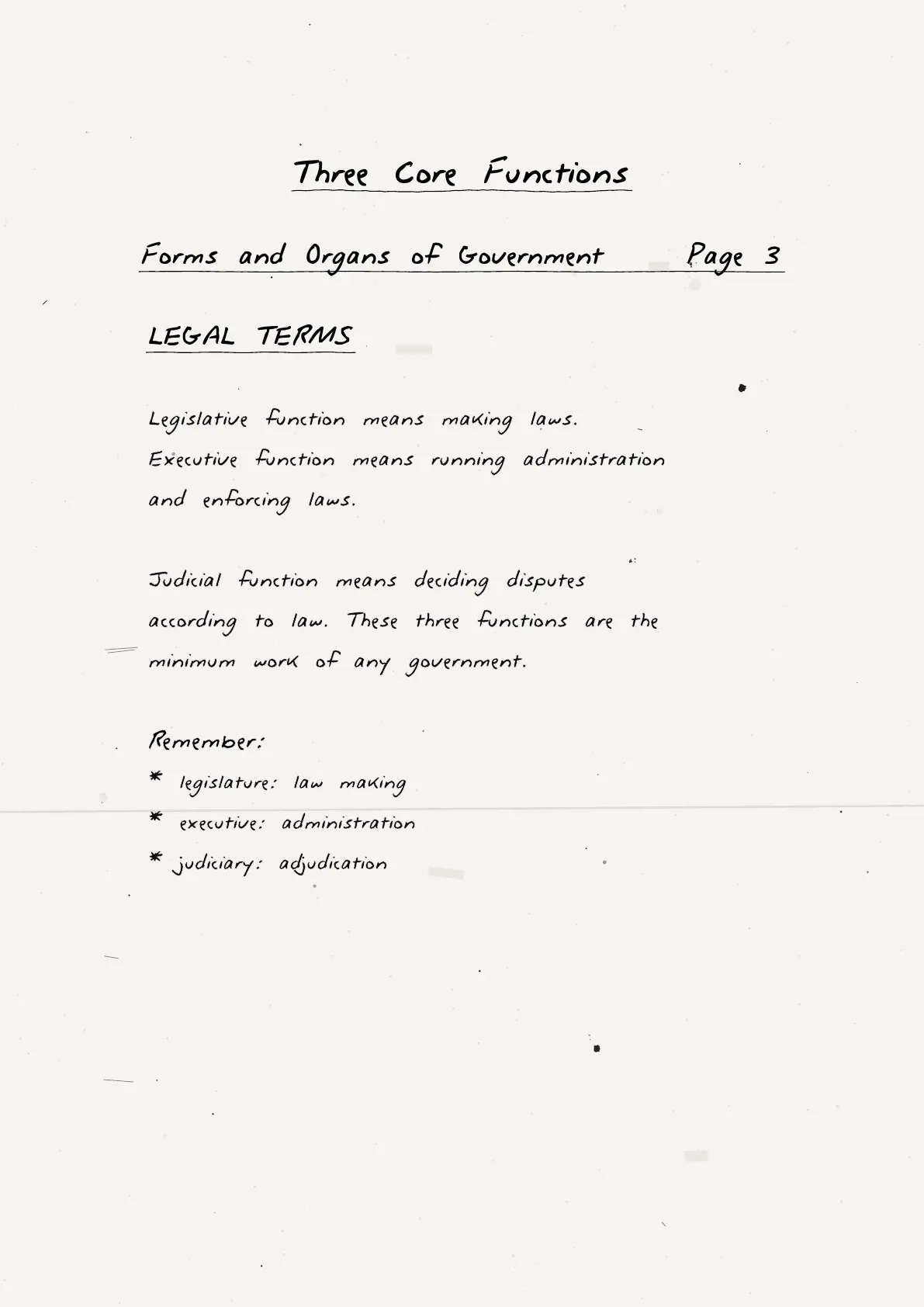
- Best starting point: remember that government performs legislative, executive and judicial functions.
- Scoring area: direct differences between monarchy and democracy, parliamentary and presidential government, and unicameral and bicameral legislature.
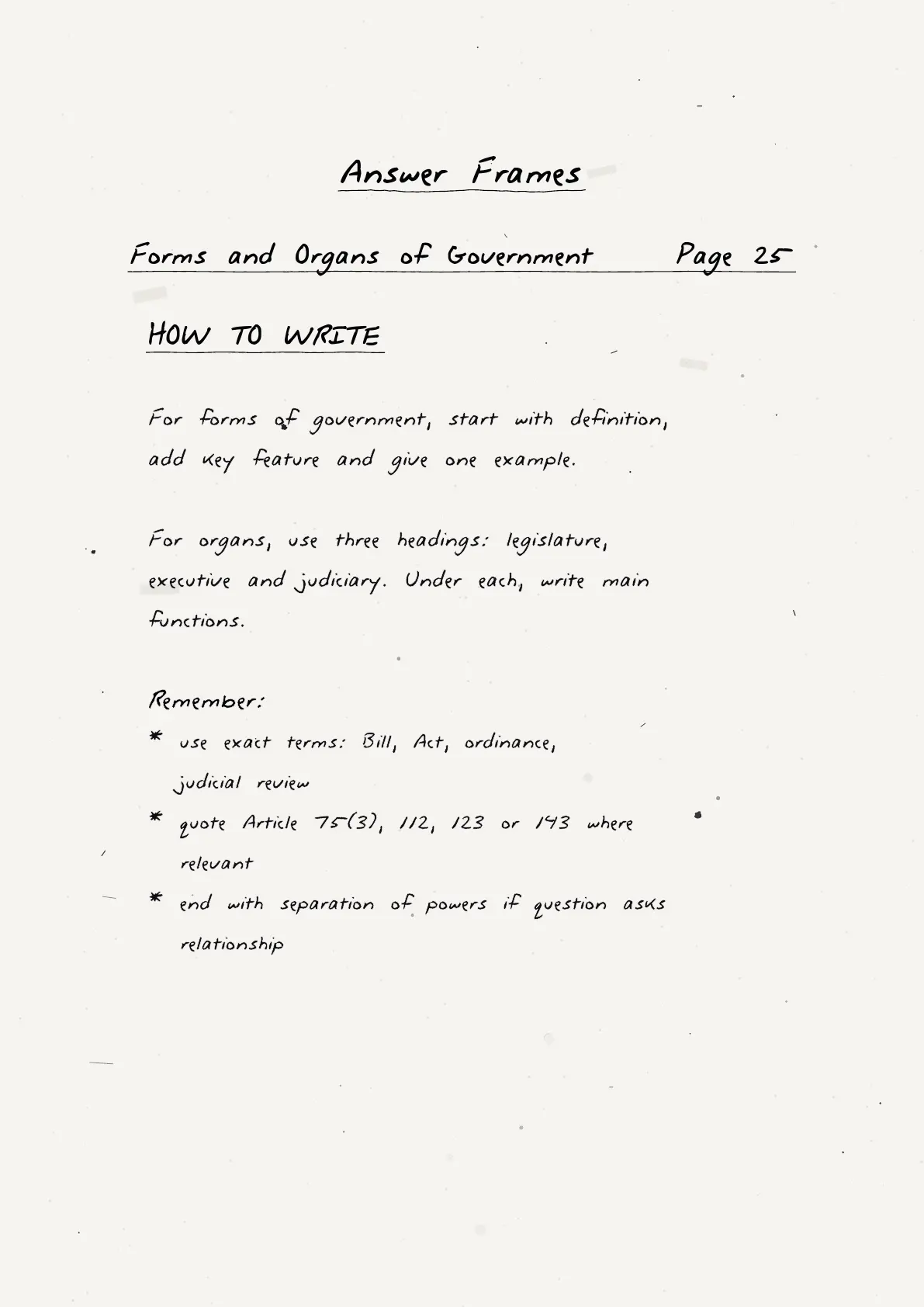
- Long-answer route: define the organ, list functions and add one Indian constitutional example.
Forms of Government in Legal Studies
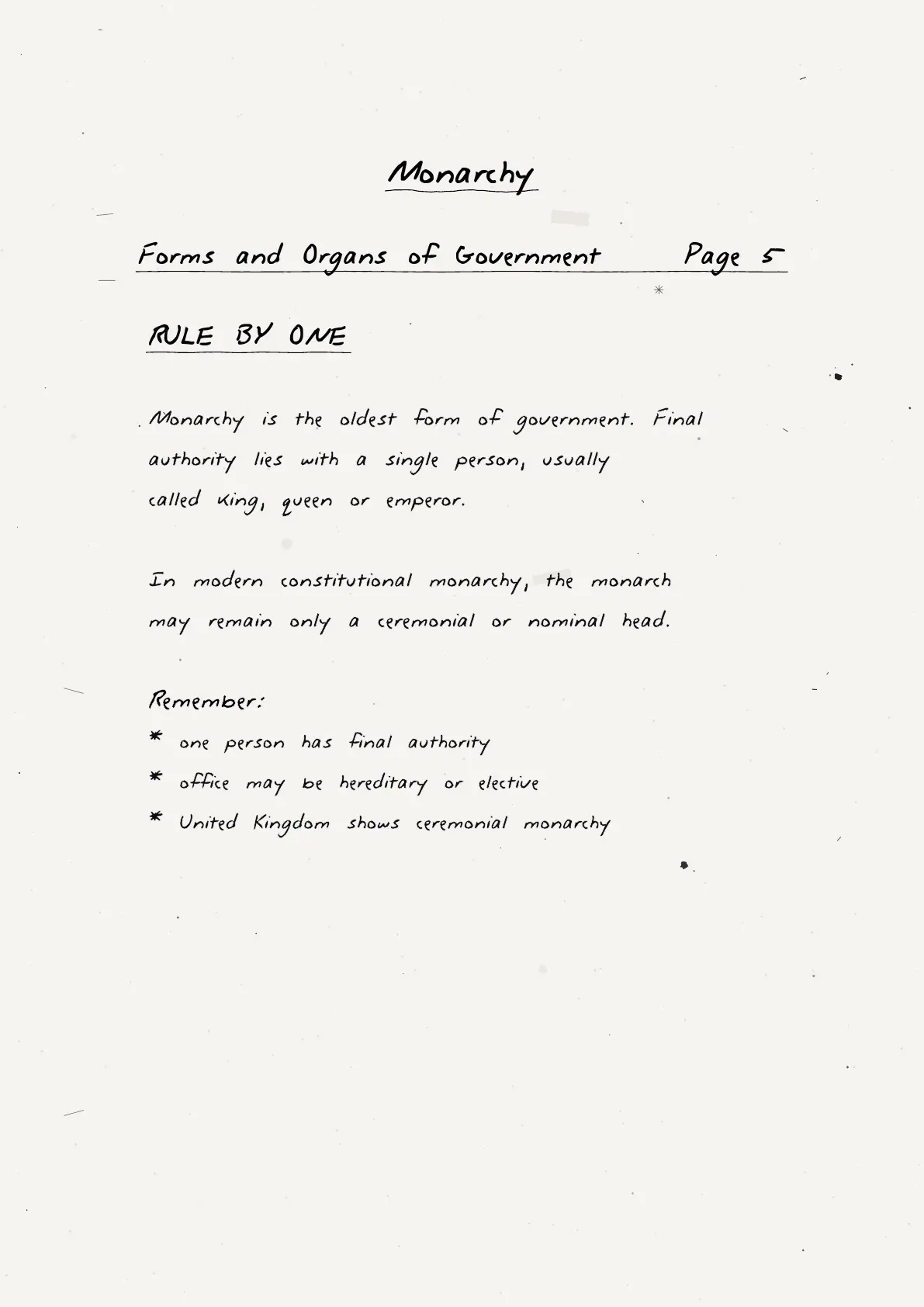
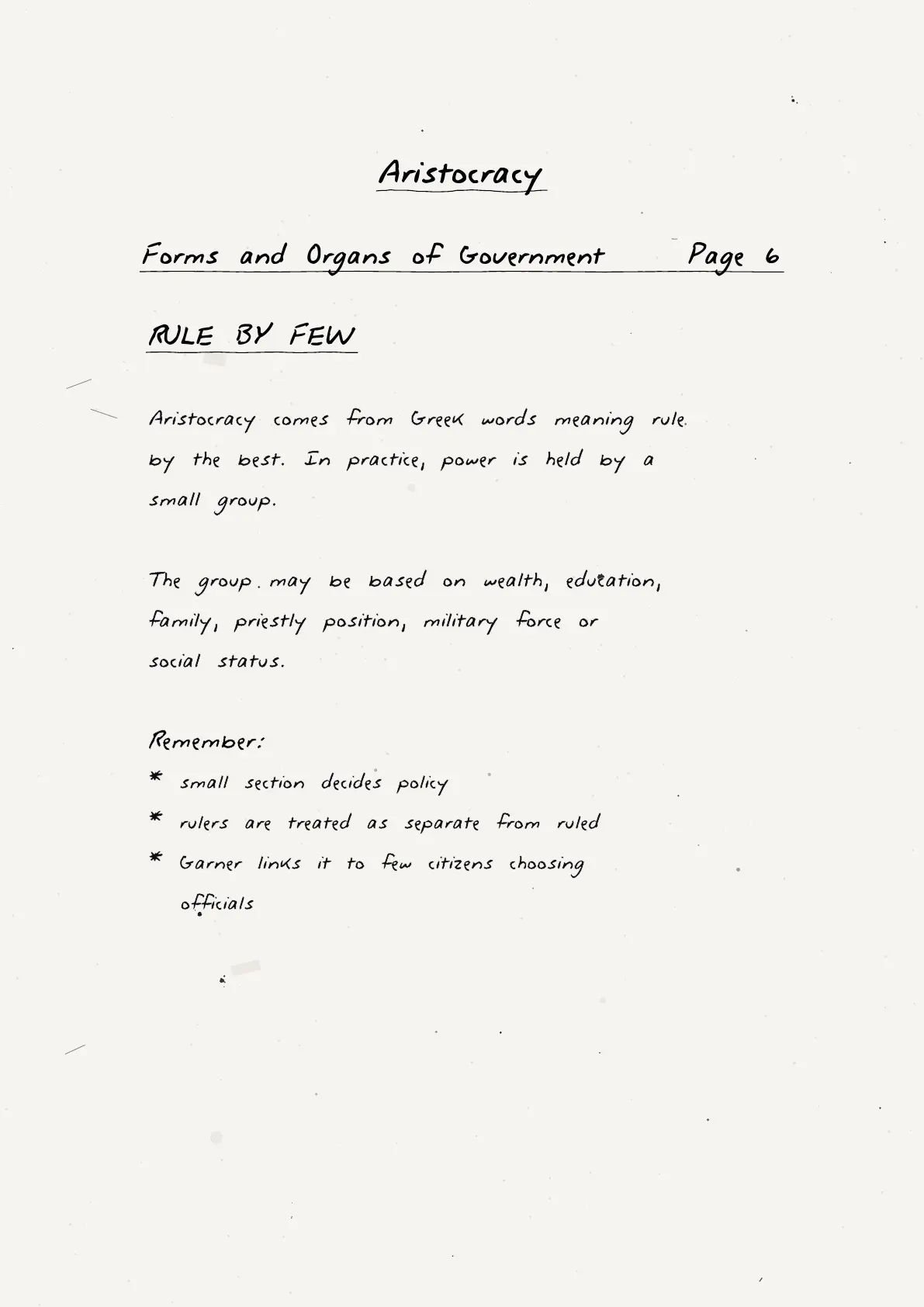
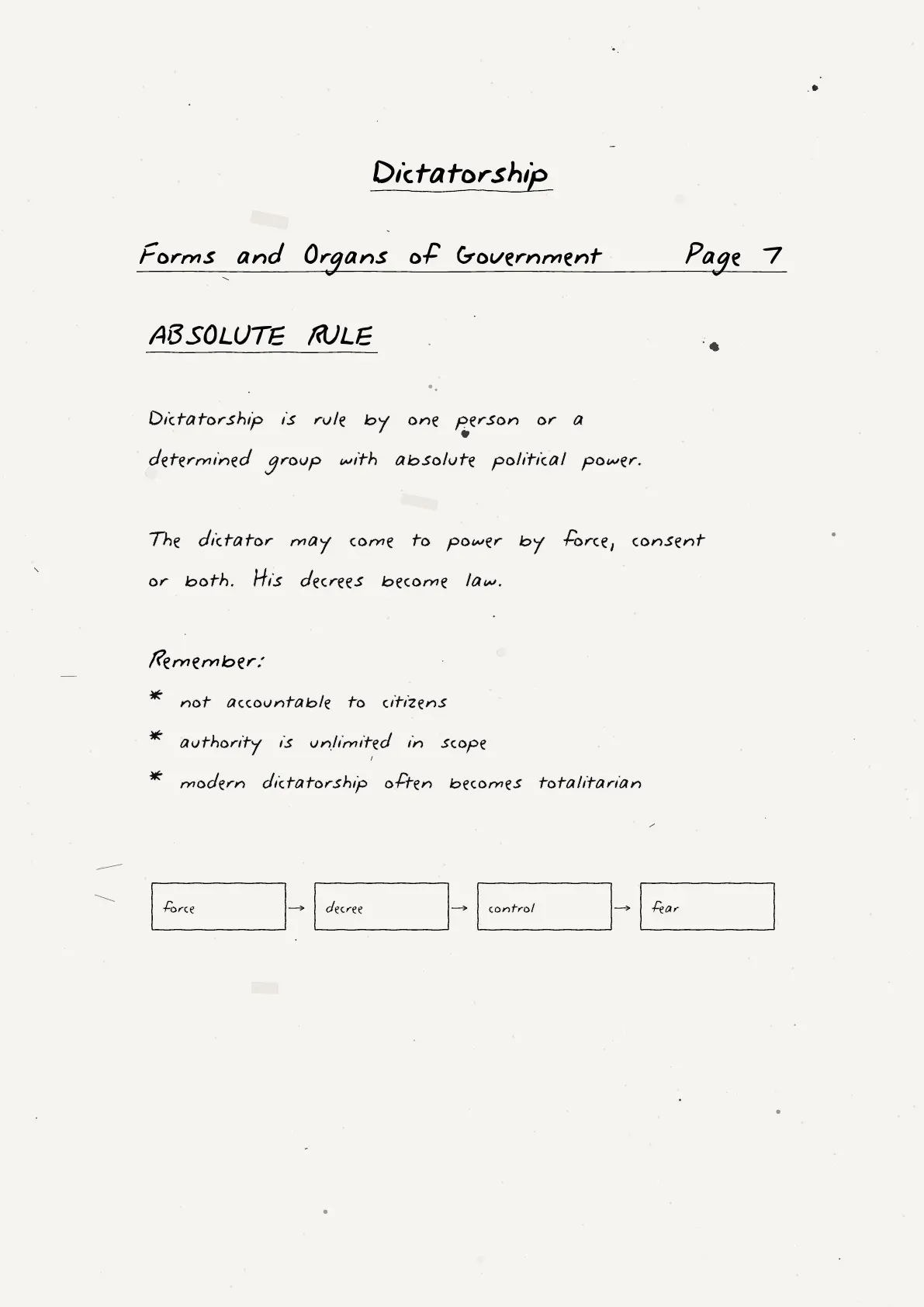
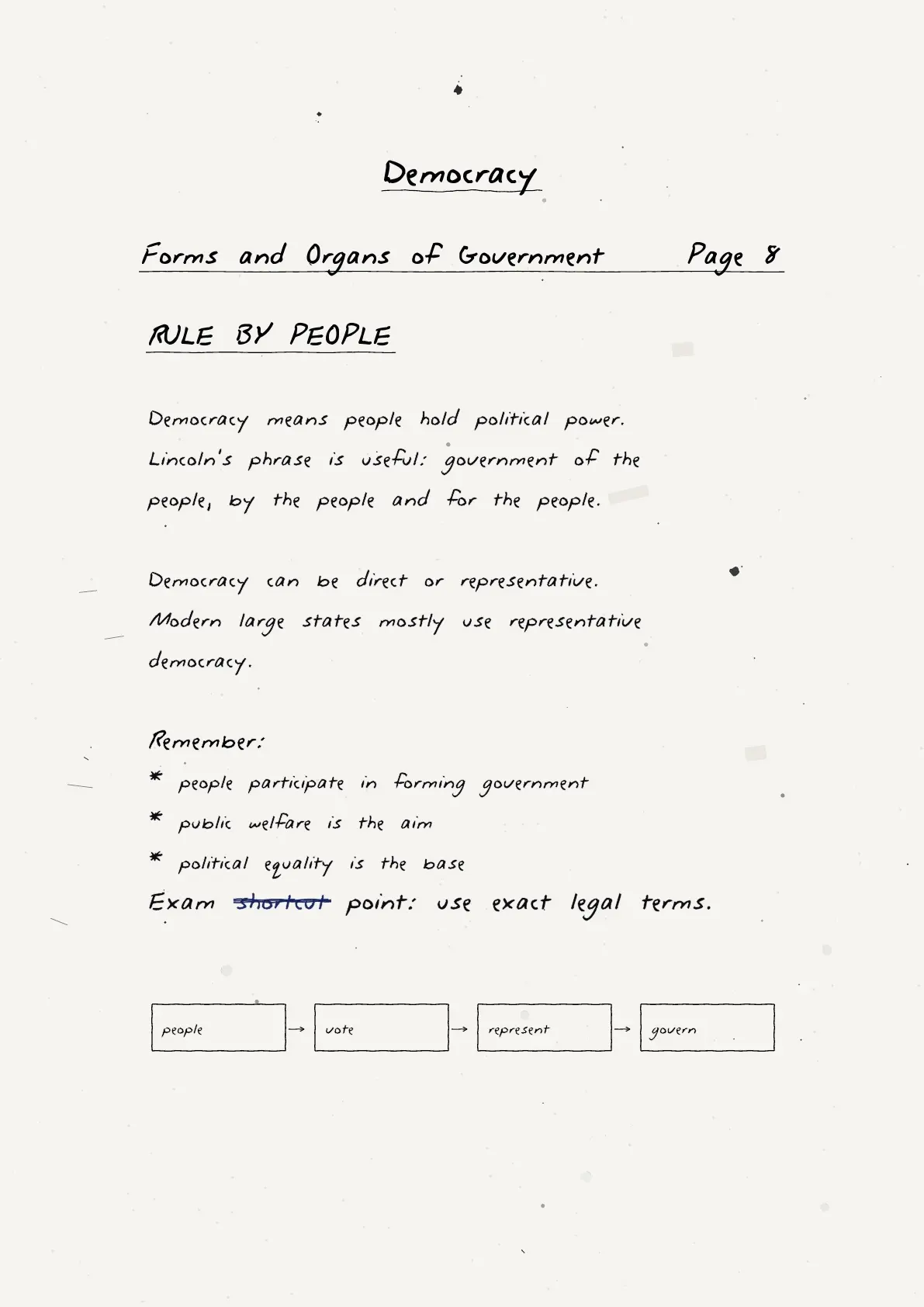
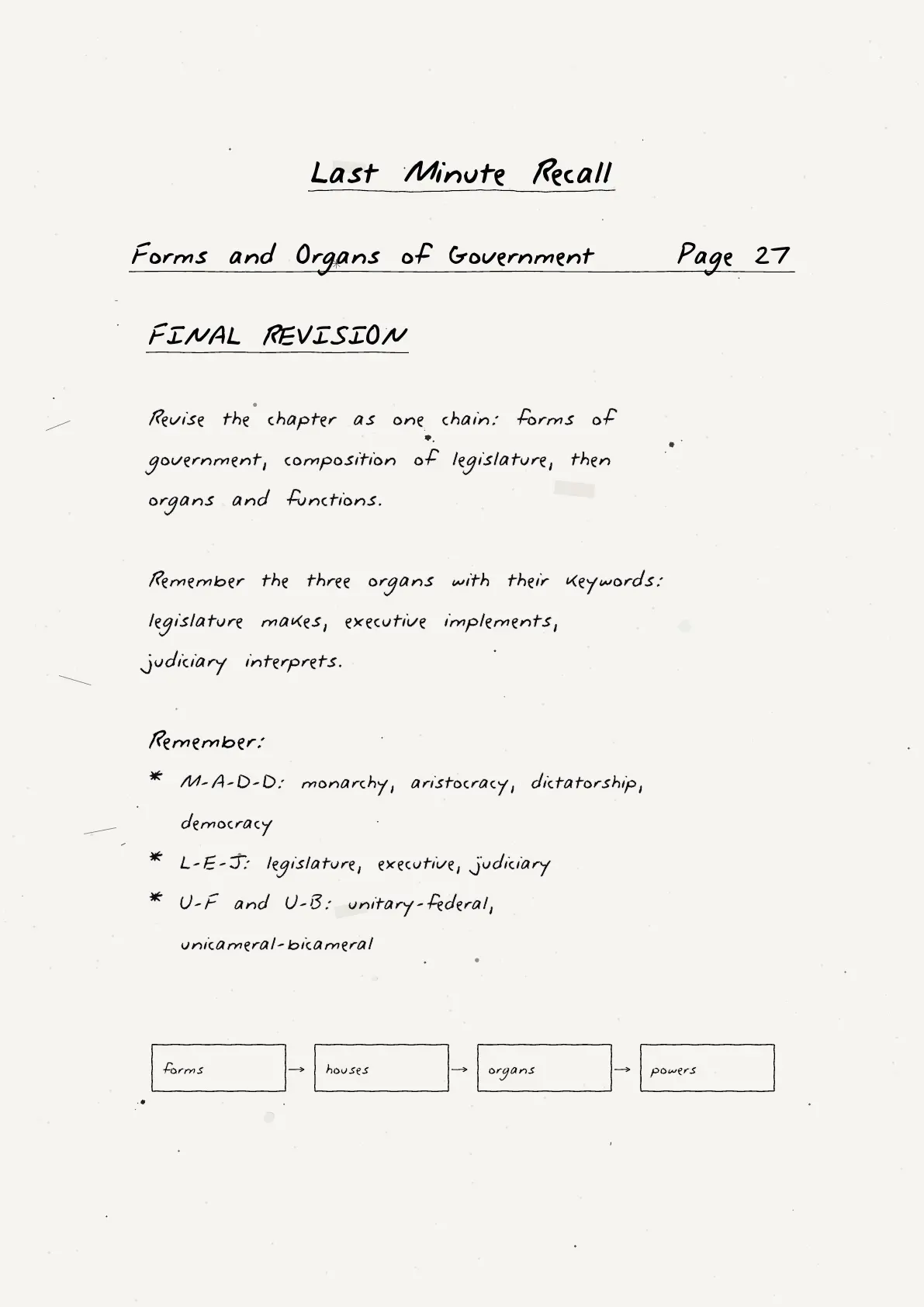
The chapter explains monarchy, aristocracy, dictatorship and democracy as major forms of government. Each form answers one question: who finally holds political power?
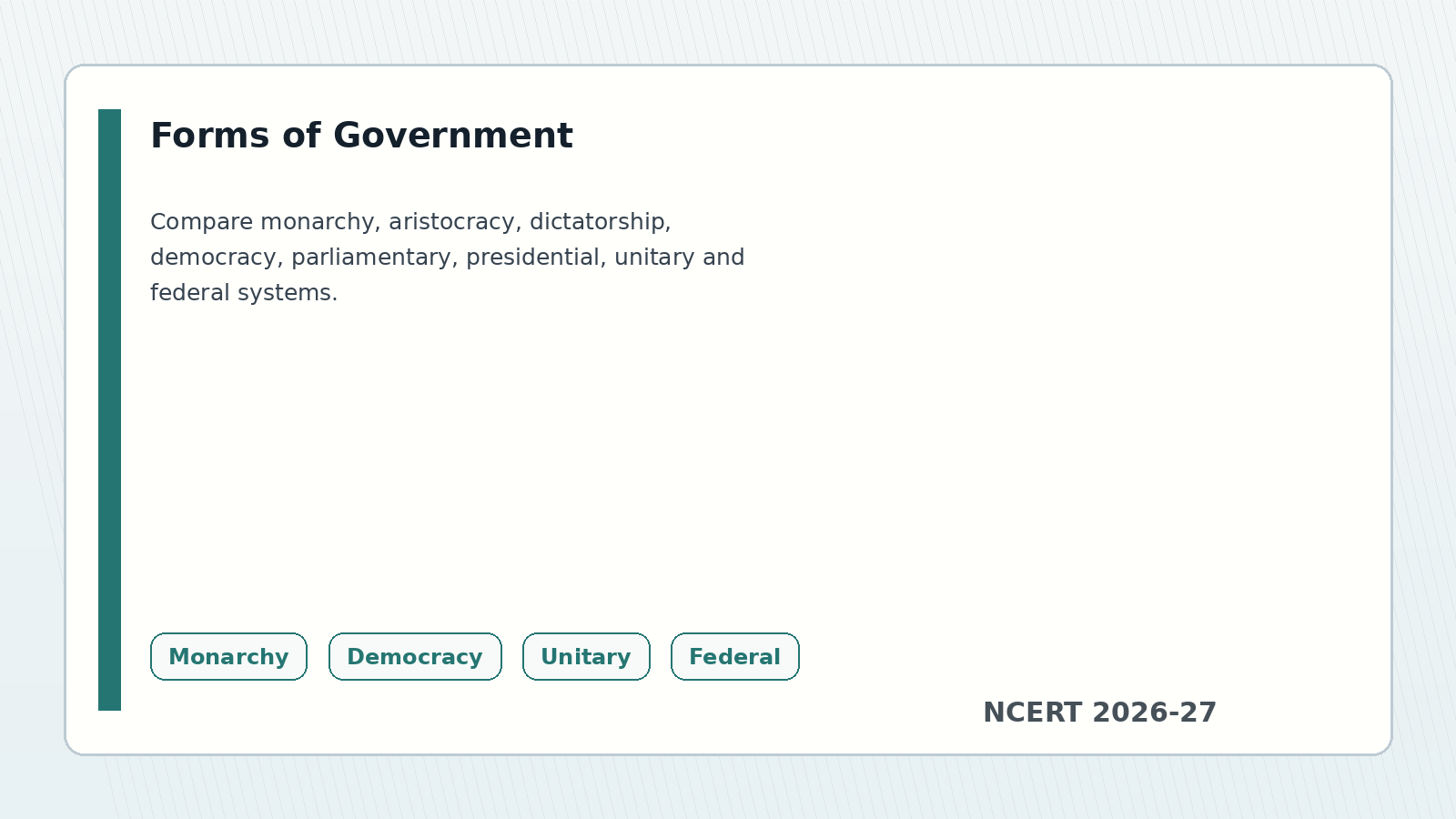
| Form | Plain meaning | Exam cue |
|---|---|---|
| Monarchy | Final authority is held by one crowned person. | Can be ceremonial in a constitutional monarchy. |
| Aristocracy | Political power is held by a small group. | Group may be based on wealth, education or family. |
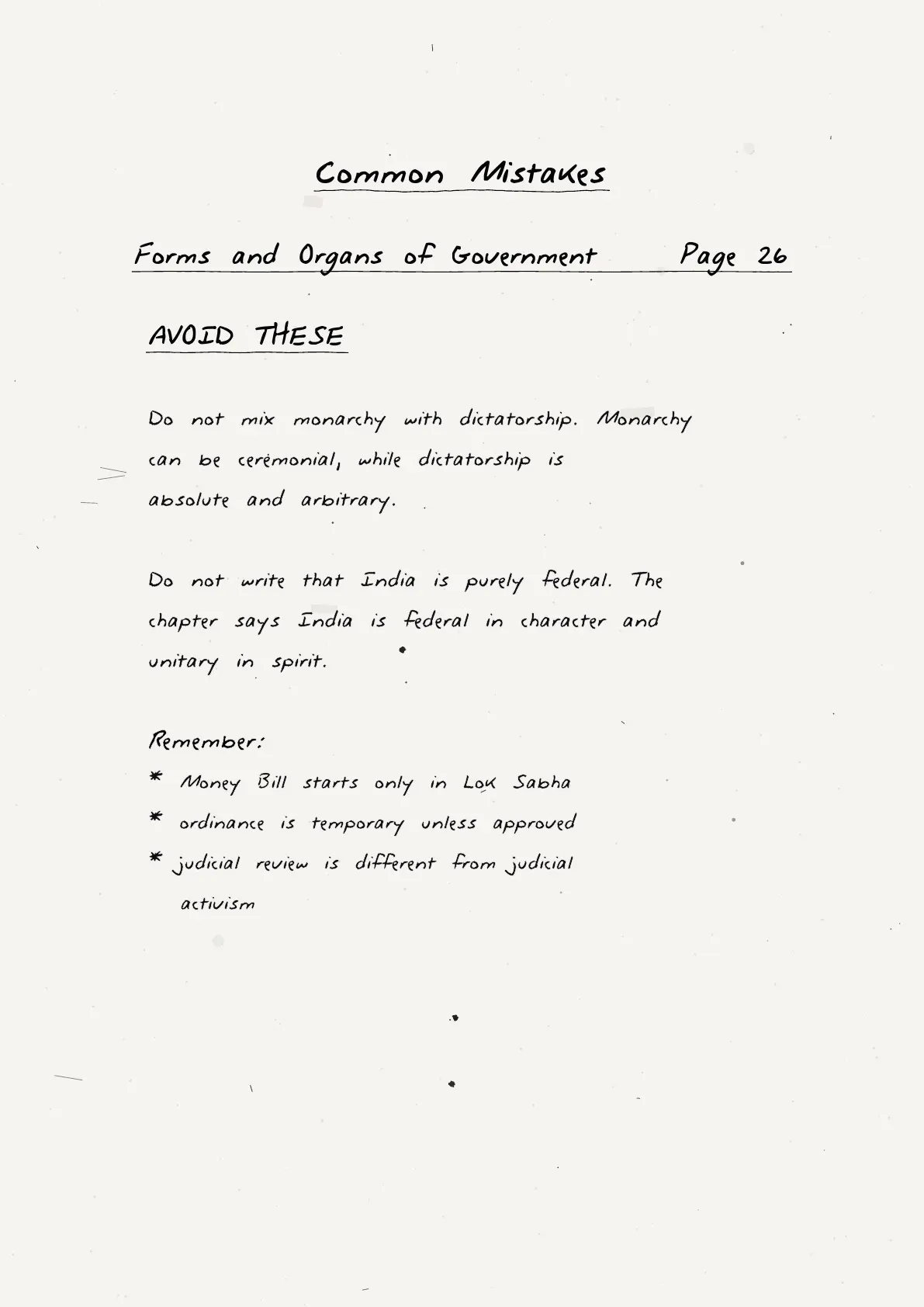
| Dictatorship | One person or group exercises absolute power. | Power is arbitrary and not accountable. |
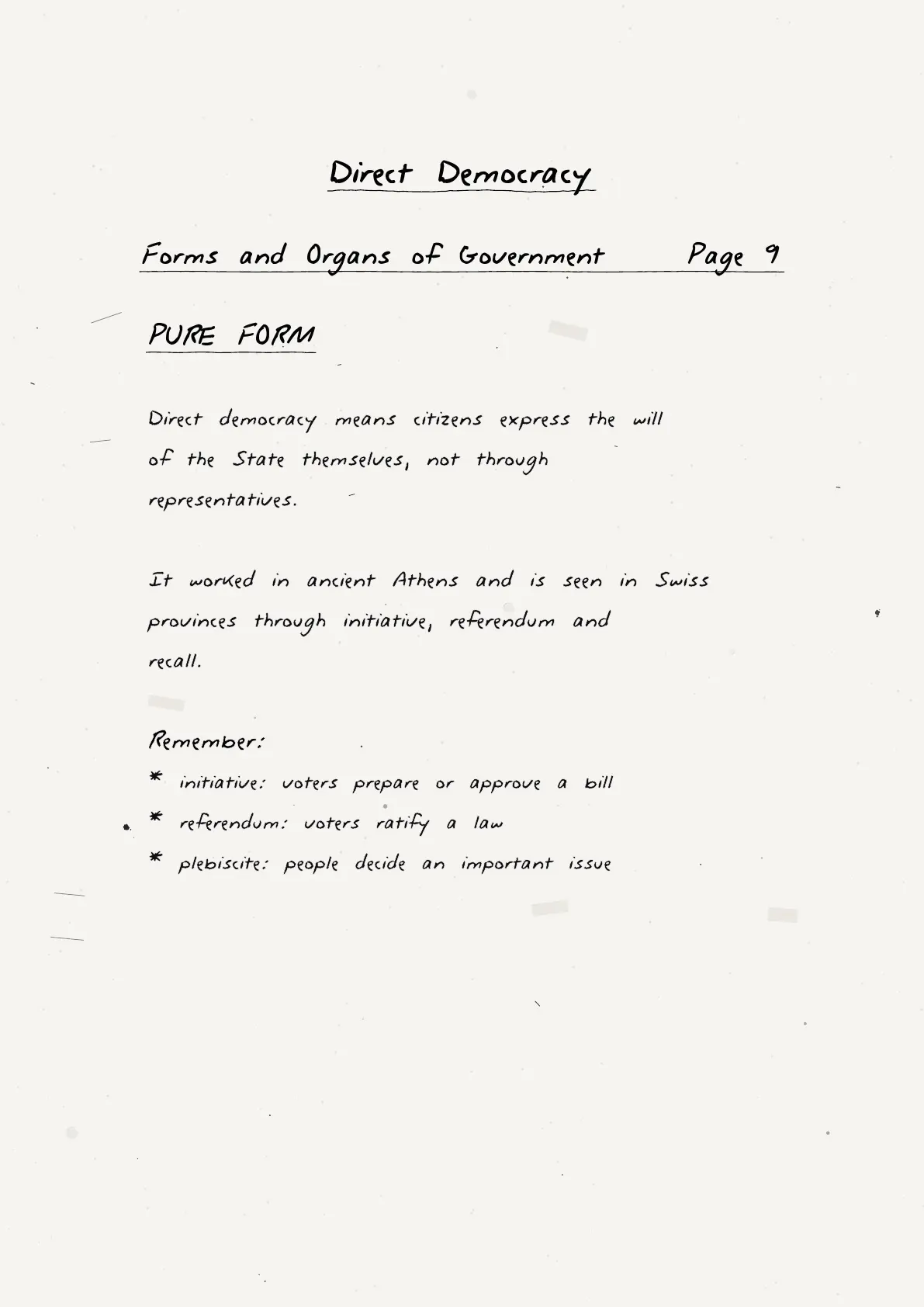
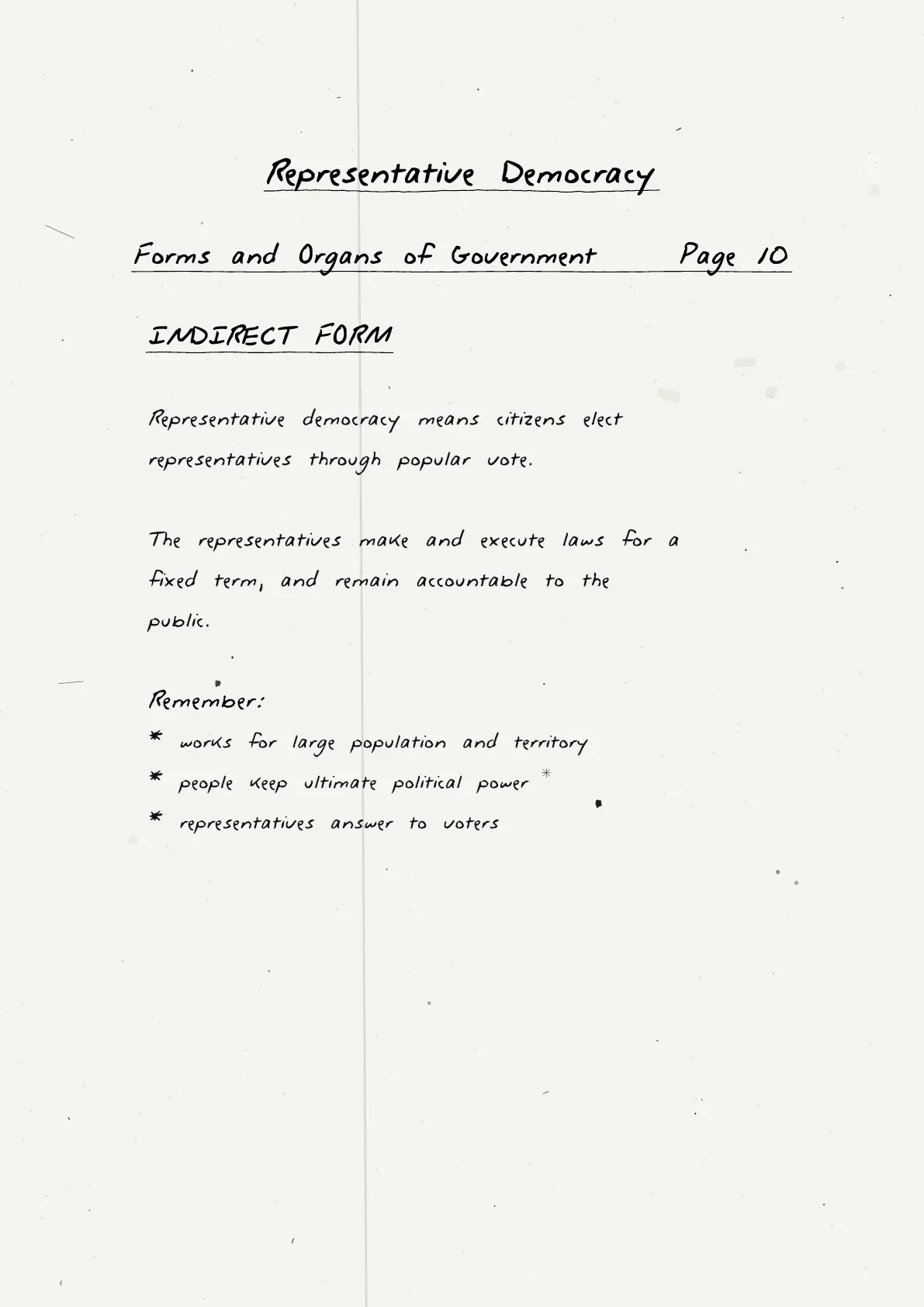
| Democracy | People hold political power directly or through representatives. | Lincoln phrase is useful for answers. |
Forms and Organs of Government Video for Class 11 Legal Studies
Source: Magnet Brains on YouTube
Parliamentary, Presidential, Unitary and Federal Systems
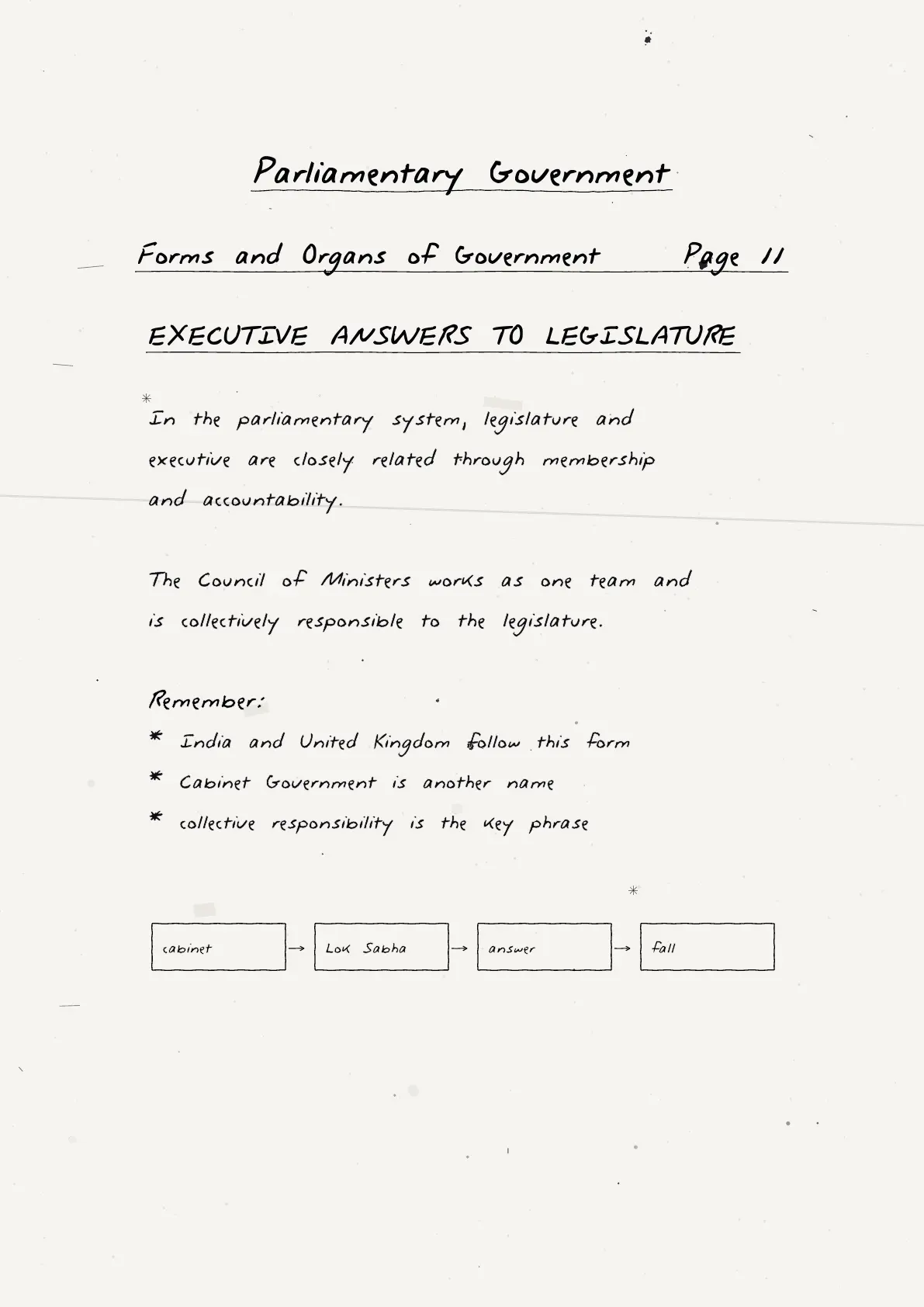
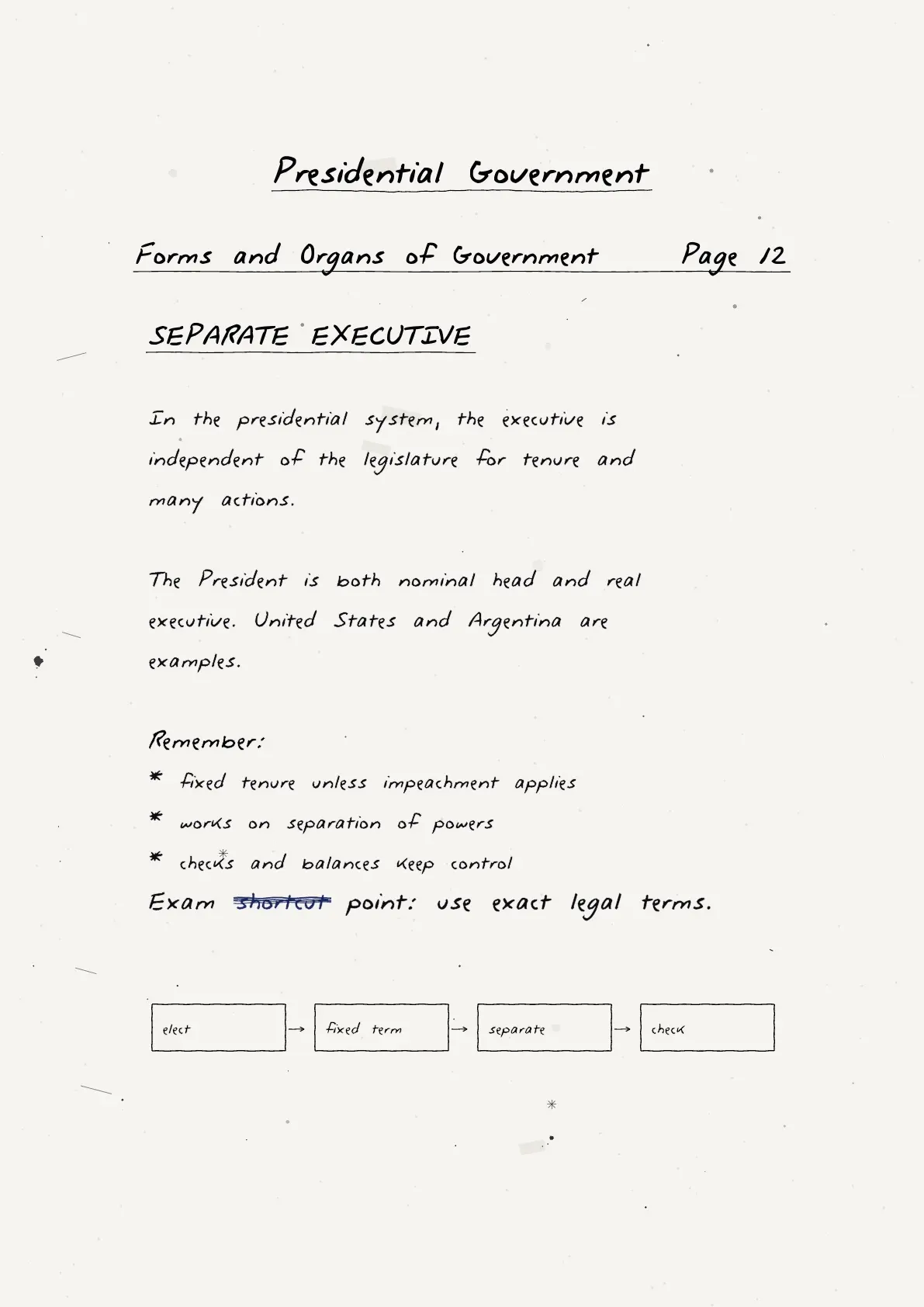
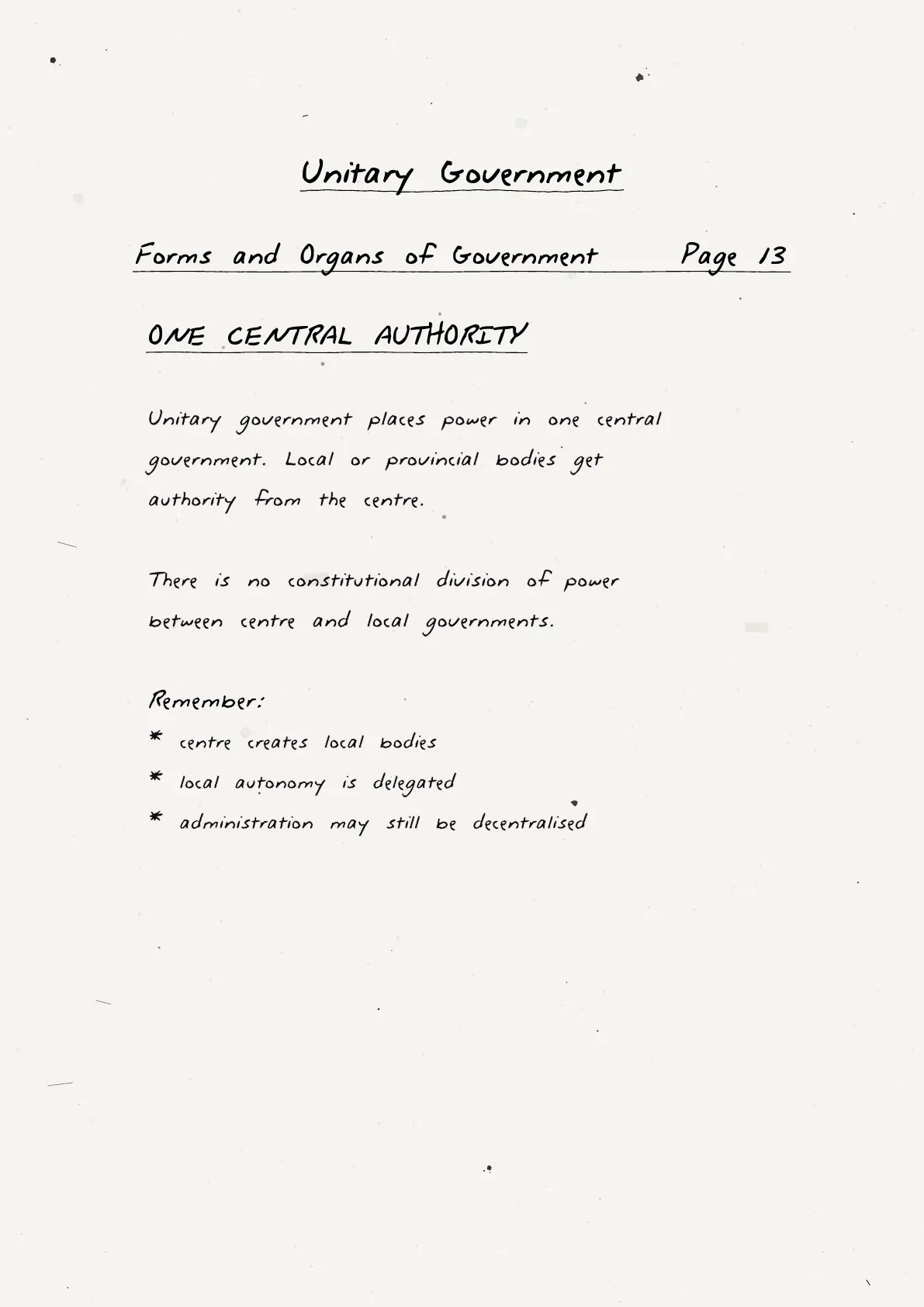
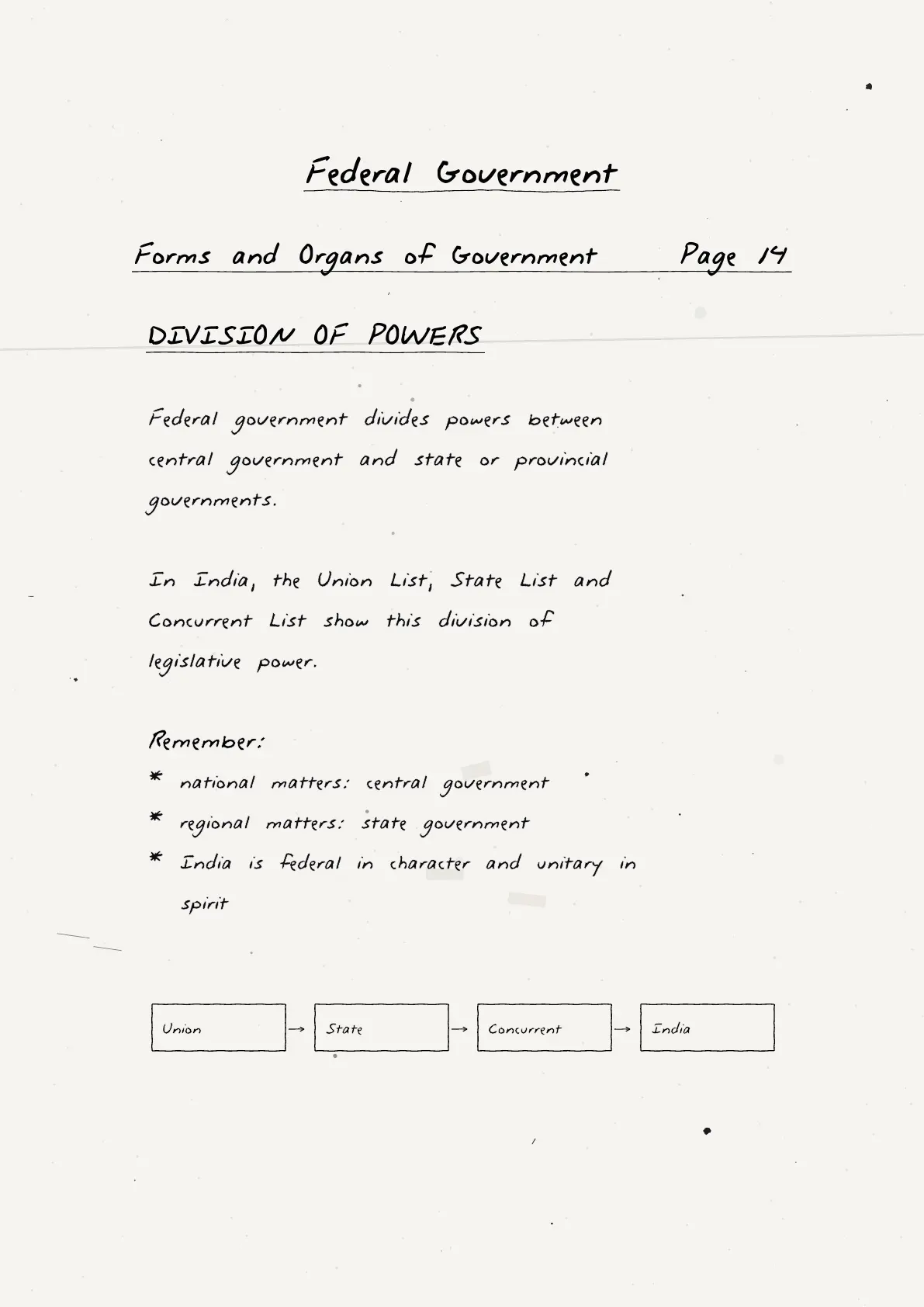
Parliamentary and presidential systems compare the relation between legislature and executive. Unitary and federal systems compare the distribution of powers between central and local or state governments.
| System | Core idea | Example cue |
|---|---|---|
| Parliamentary | Executive is responsible to the legislature. | India and United Kingdom. |
| Presidential | Executive has separate fixed tenure. | United States and Argentina. |
| Unitary | Power is concentrated in one central government. | Local bodies receive delegated authority. |
| Federal | Power is divided between central and state governments. | India has Union, State and Concurrent Lists. |
Legislature in Class 11 Legal Studies Chapter 2
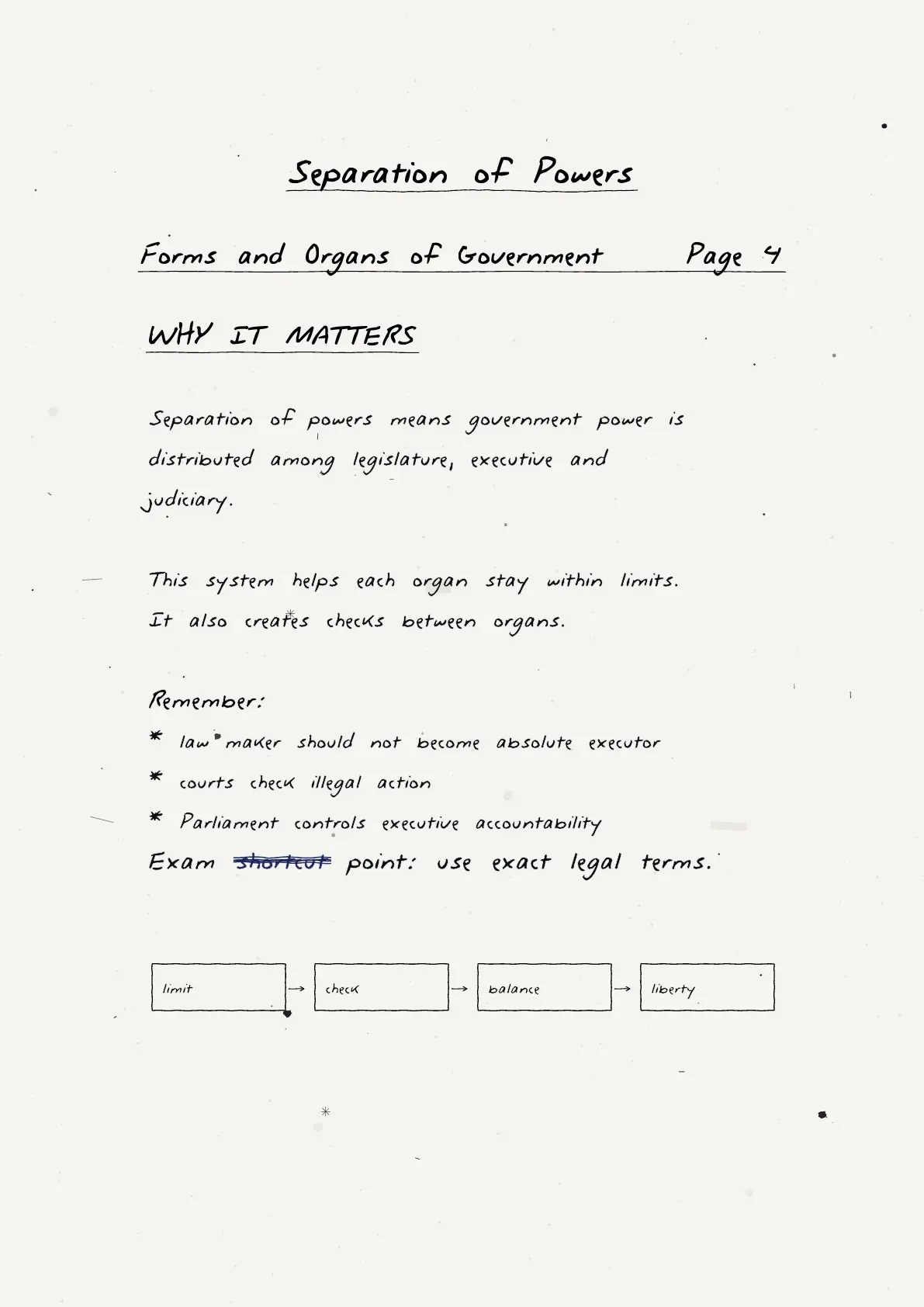
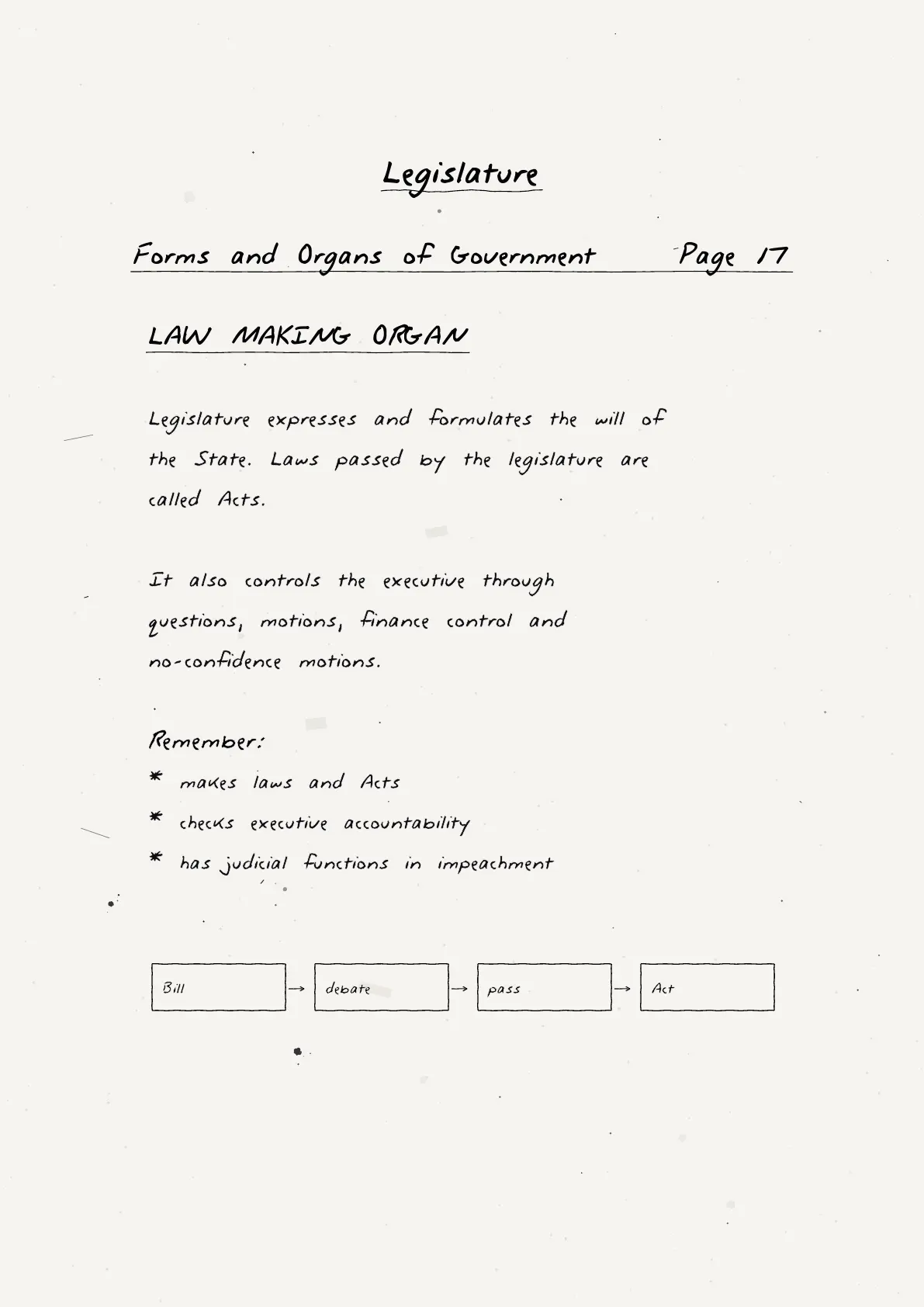
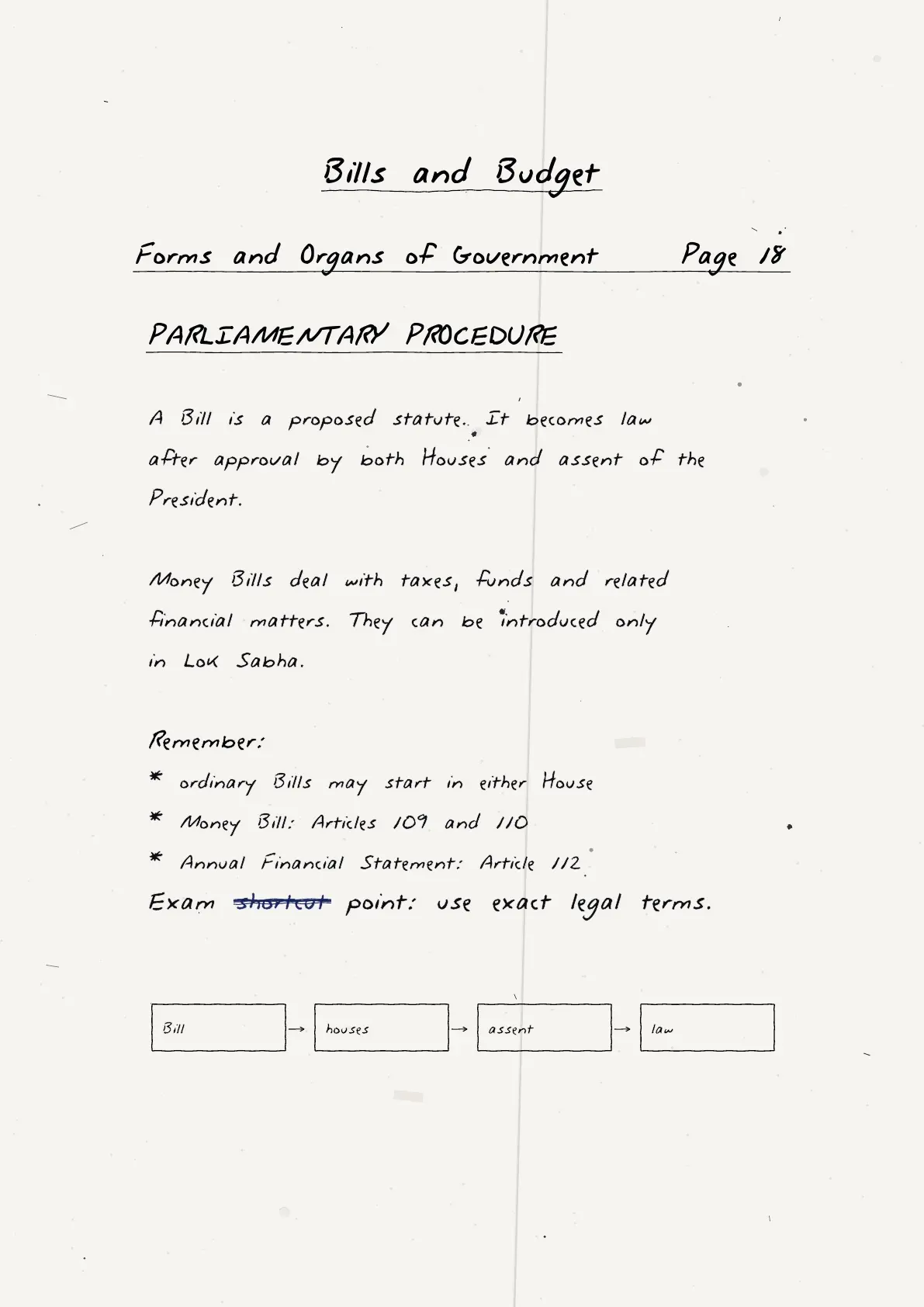
The legislature expresses the will of the State and makes laws. A Bill becomes an Act after approval by both Houses and assent of the President. Parliament also checks the executive through finance control, questions and no-confidence motions.
Money Bills can be introduced only in the House of the People, Lok Sabha.
| Term | Meaning | Why it matters |
|---|---|---|
| Bill | Proposed statute before it becomes law. | Needs legislative approval and assent. |
| Act | Law after proper enactment. | Direct source of legal rules. |
| Money Bill | Bill linked to taxes, funds and payments. | Starts only in Lok Sabha. |
| Annual Financial Statement | Estimated receipts and expenditure. | Article 112 reference. |
Executive and Judiciary Functions
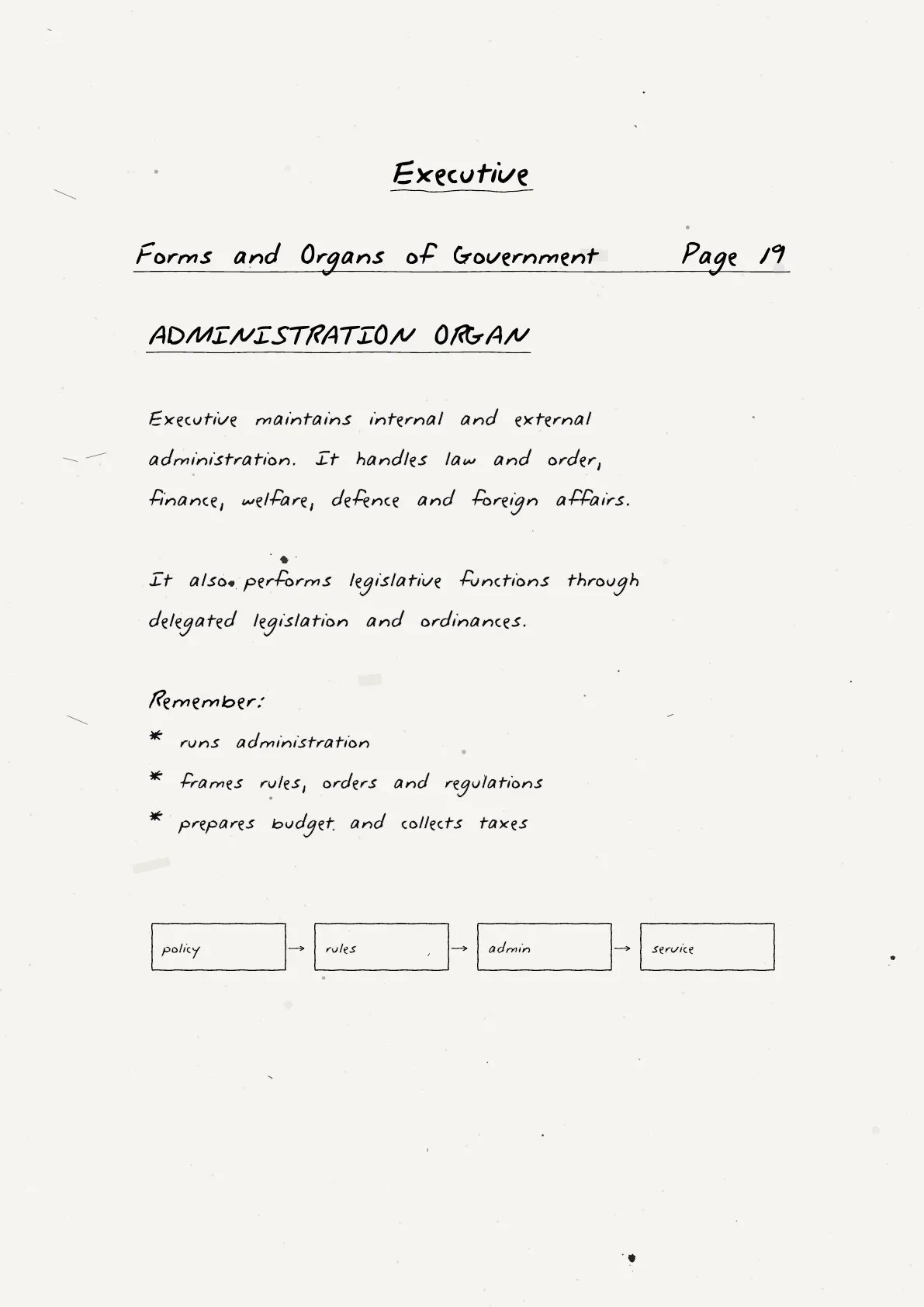
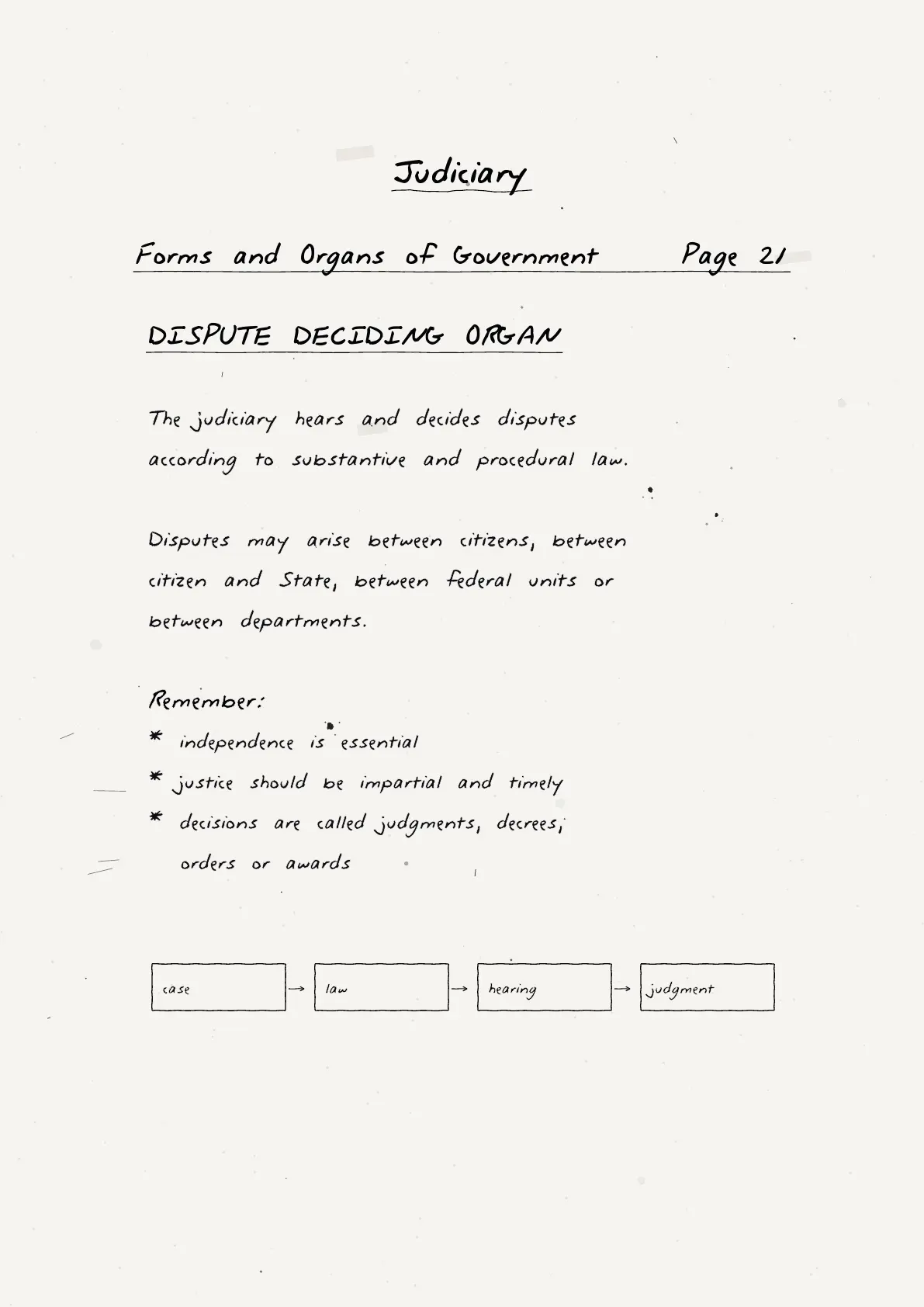
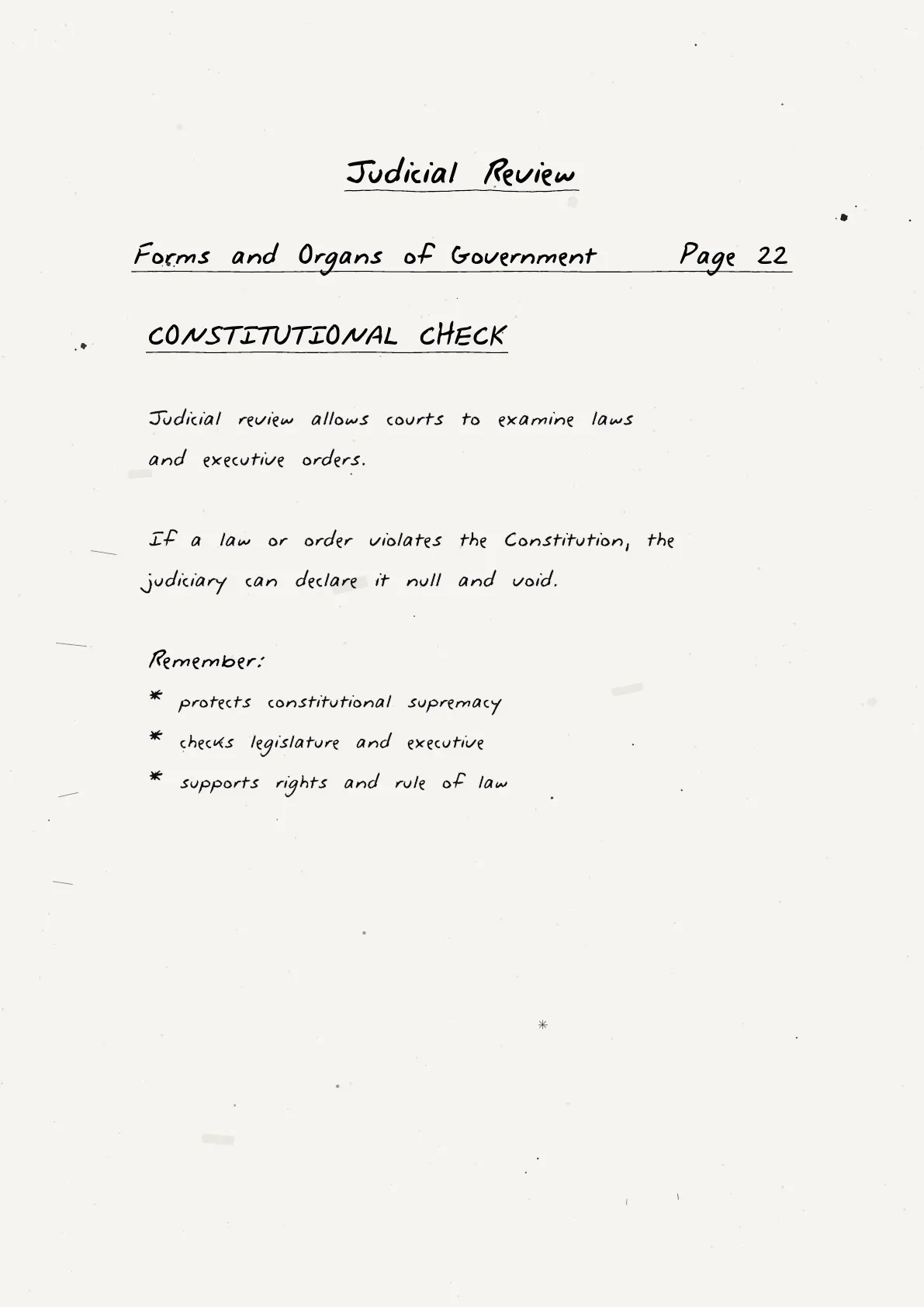
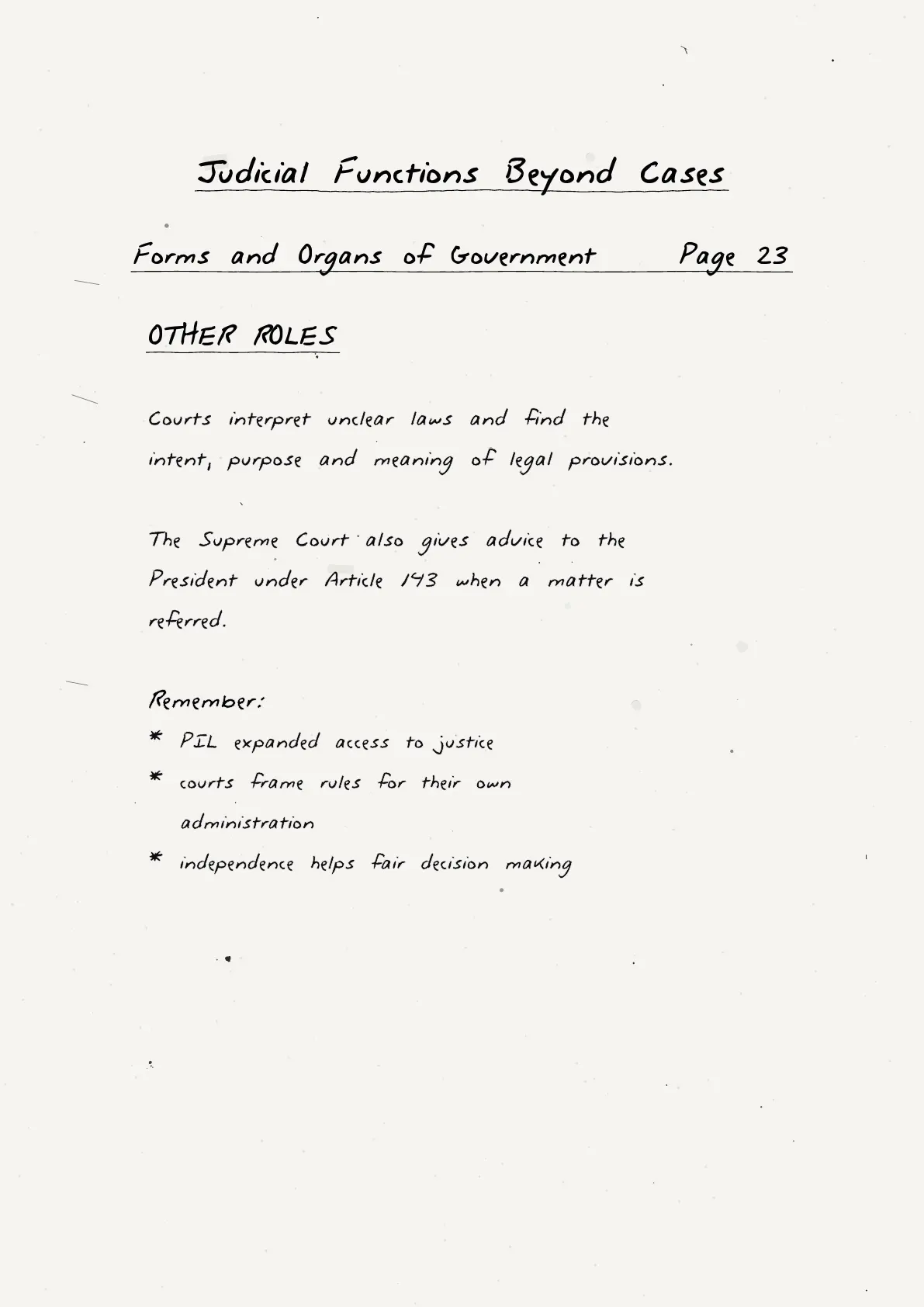
The executive runs administration and enforces law. The judiciary hears disputes, interprets law and uses judicial review to test laws and executive orders against the Constitution.
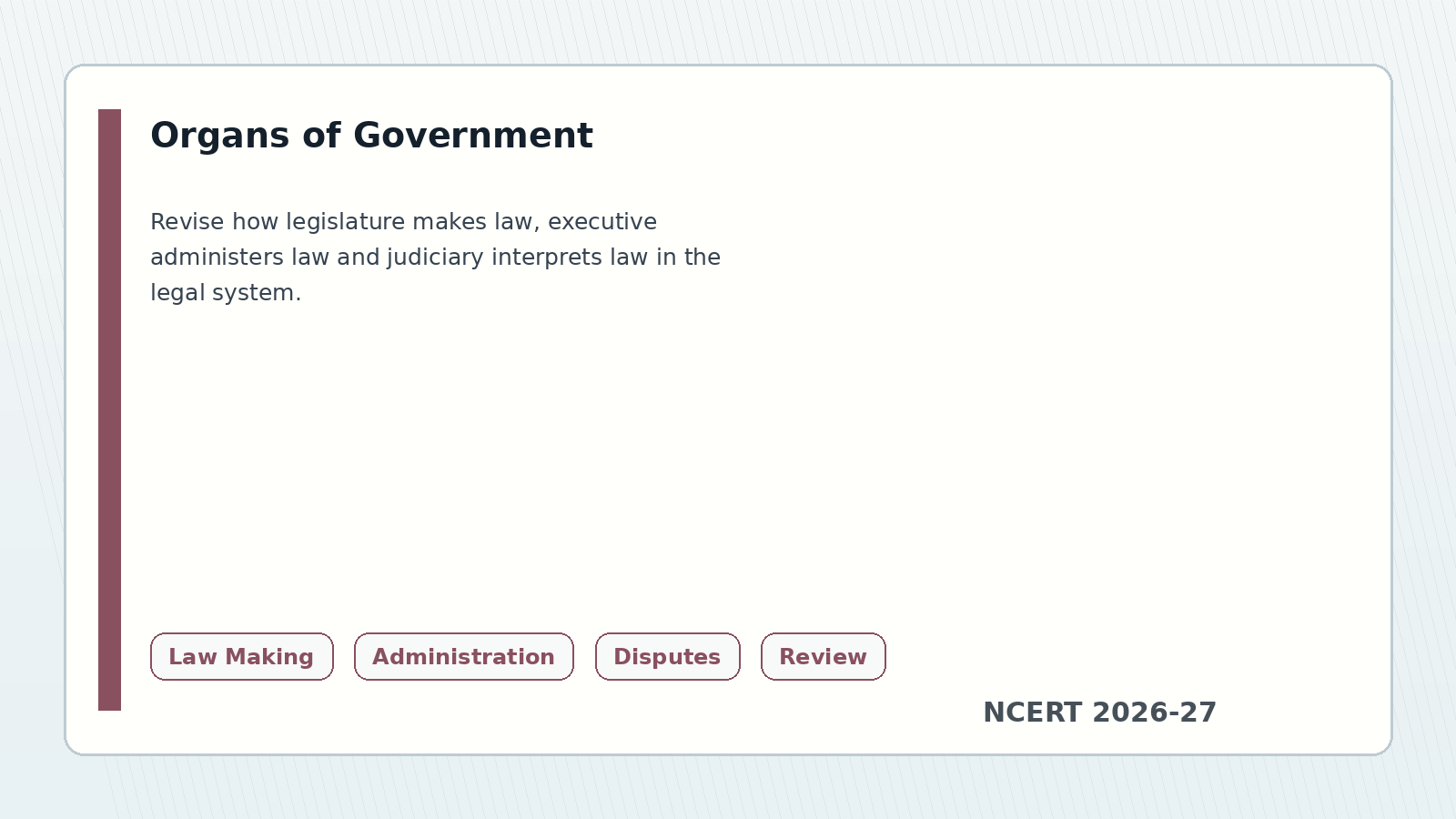
| Organ | Main function | Important example |
|---|---|---|
| Legislature | Makes laws and checks executive. | No-confidence motion and impeachment role. |
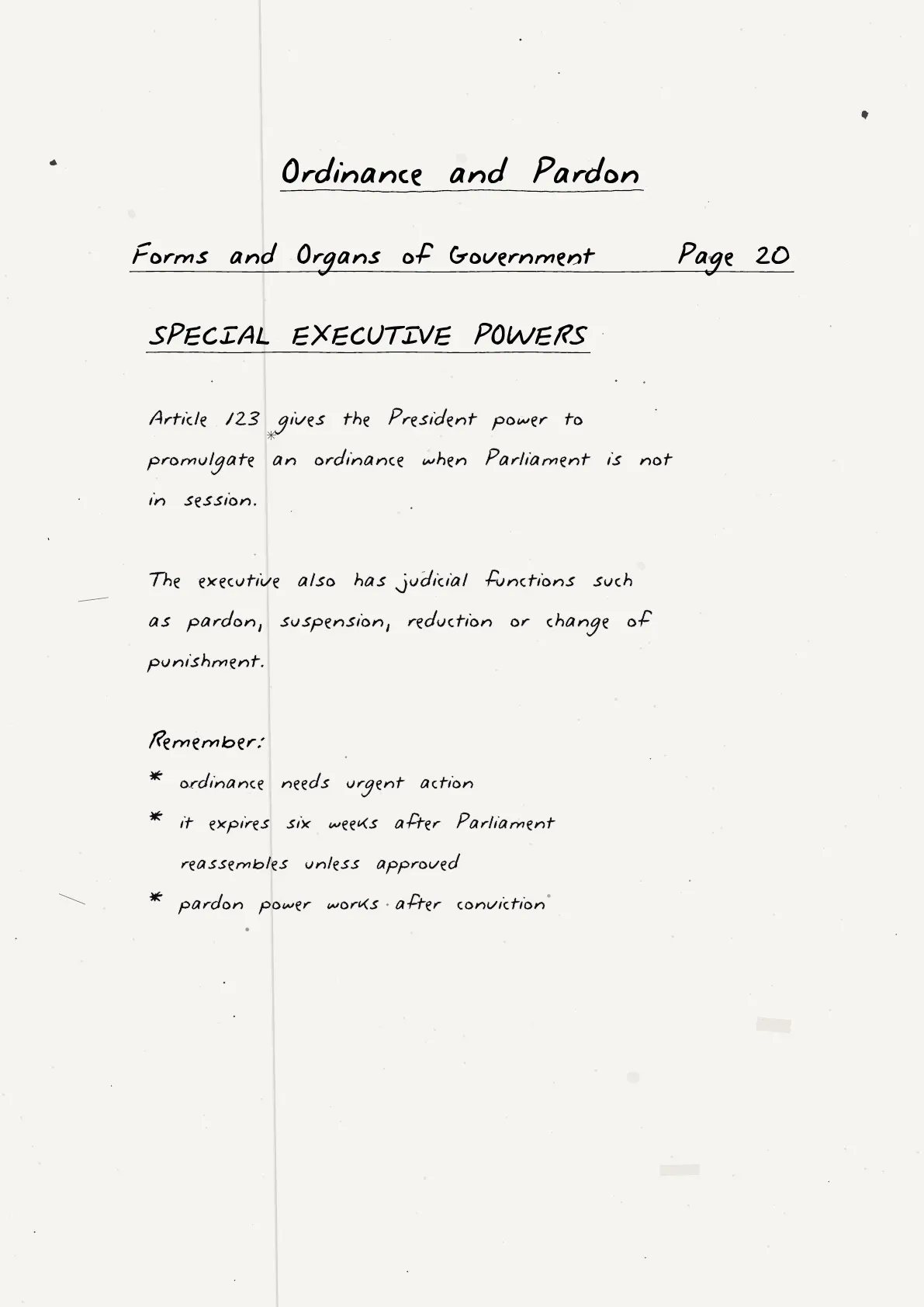
| Executive | Runs administration and implements law. | Ordinance under Article 123. |
| Judiciary | Decides disputes and interprets law. | Judicial review and advisory opinion under Article 143. |
Important Differences for Exam Revision
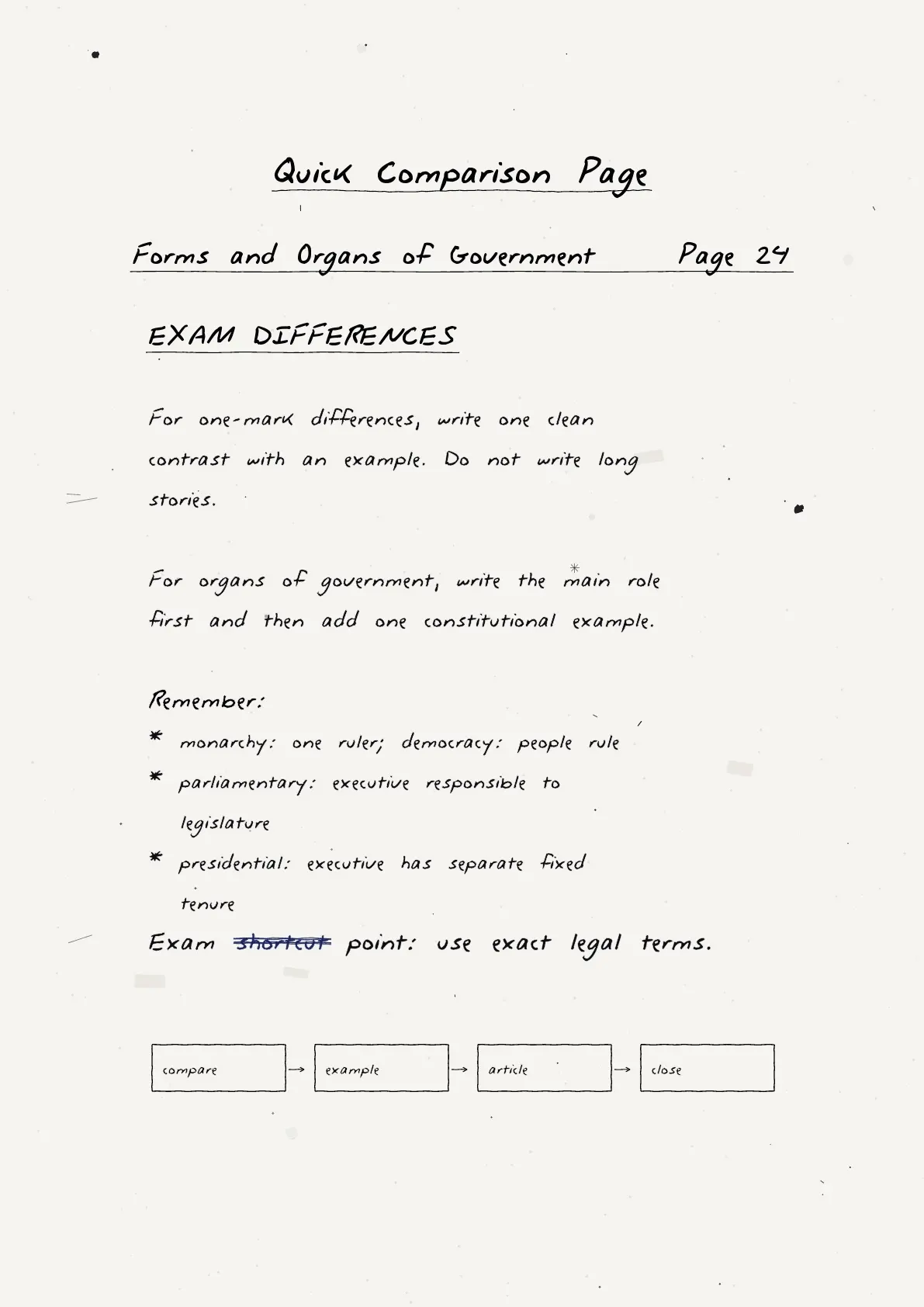
Most short questions from this chapter ask for one clean difference. Students should write the basis of difference first, then put each side in simple words.
- Monarchy vs Democracy: monarchy has final power with one ruler, while democracy gives power to people.
- Parliamentary vs Presidential: parliamentary executive is responsible to legislature, while presidential executive is independent for tenure.
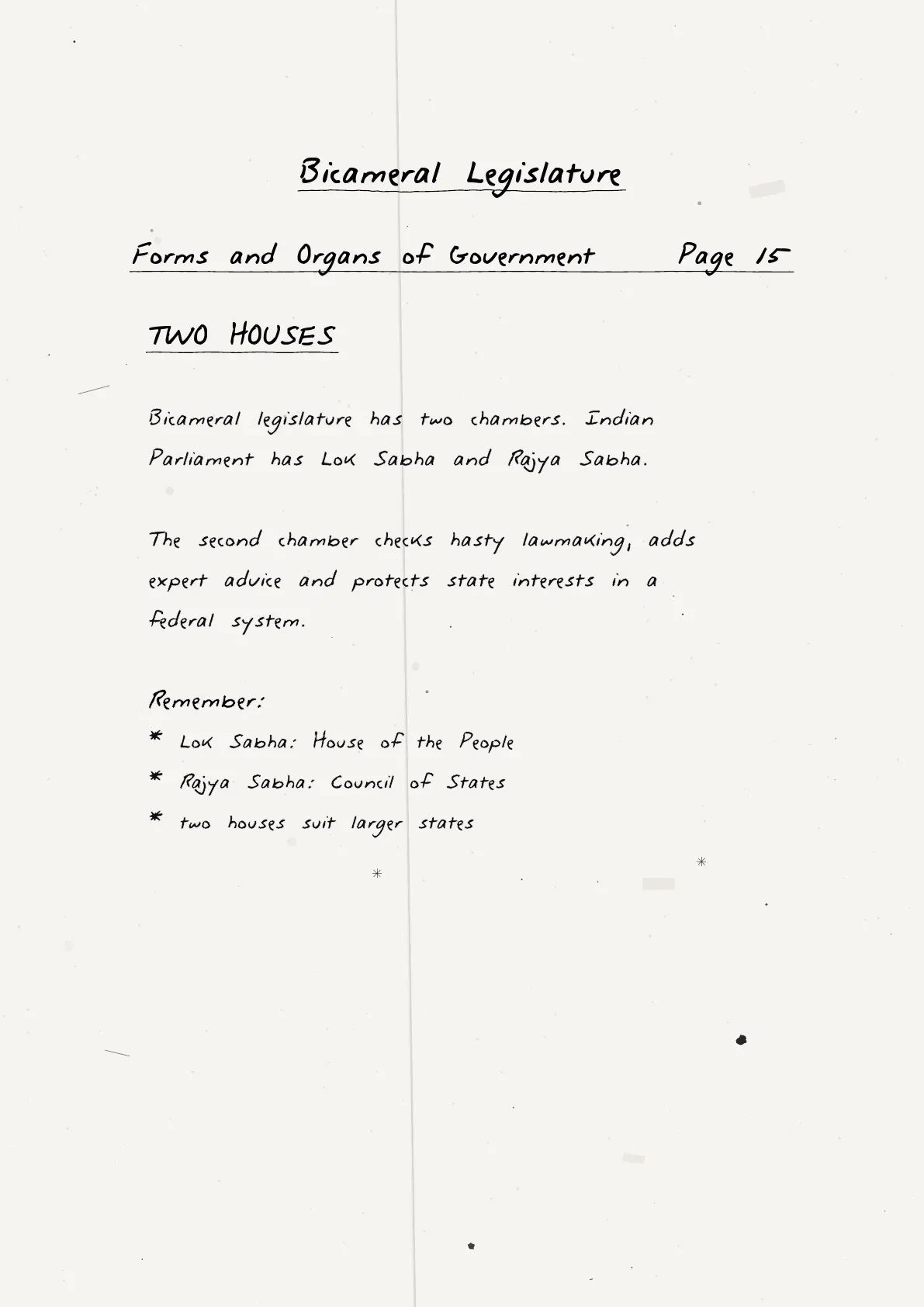
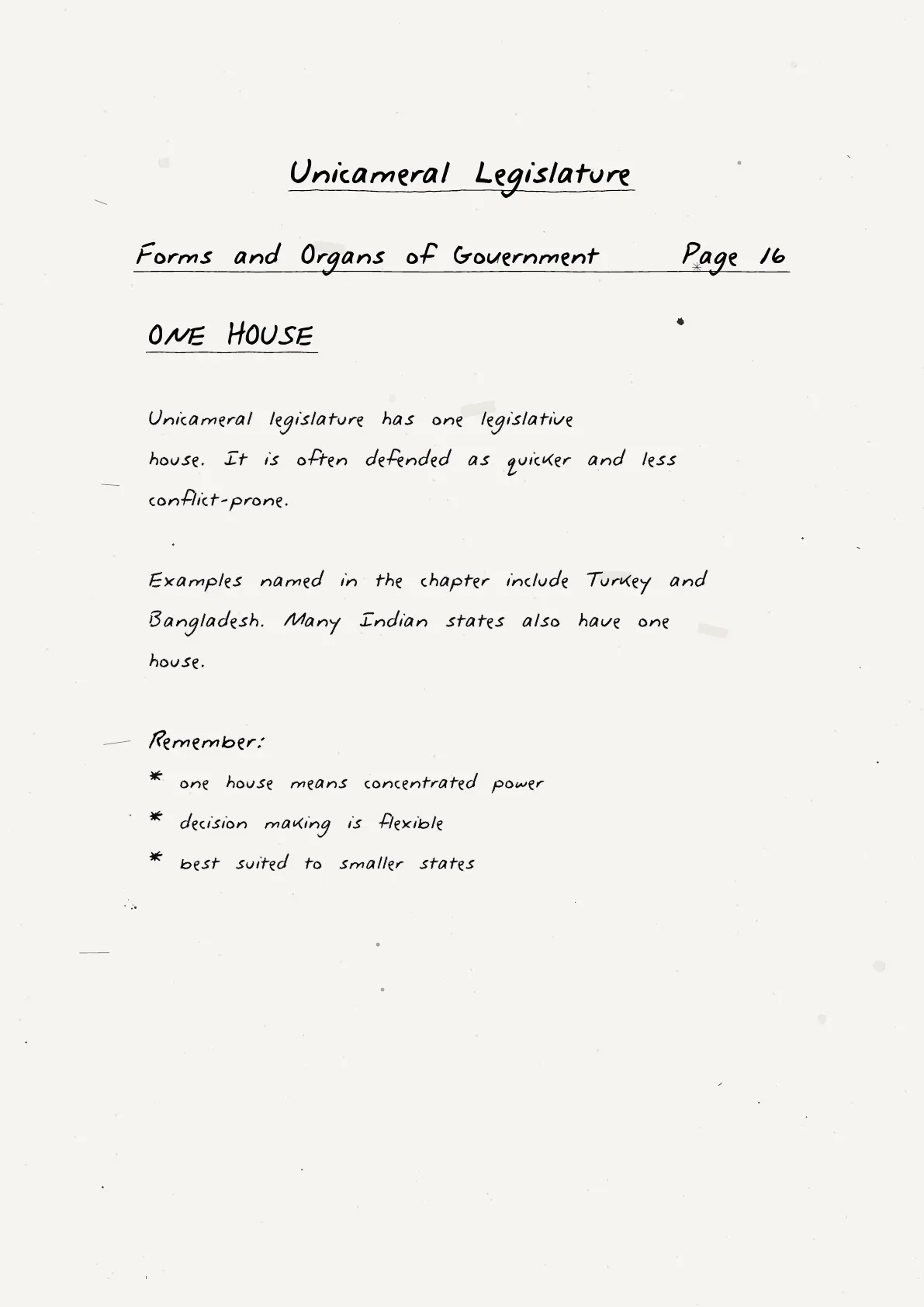
- Unicameral vs Bicameral: unicameral has one house, while bicameral has two houses.
- Lok Sabha vs Rajya Sabha: Lok Sabha represents people directly, while Rajya Sabha represents states.
Related Class 11 Legal Studies Resources
| Resource | Use it for | Link |
|---|---|---|
| NCERT Solutions | Exercise answers for Forms and Organs of Government. | Class 11 Legal Studies Forms and Organs of Government Solutions |
| NCERT Book PDF | Original textbook reading and source examples. | Class 11 Legal Studies Forms and Organs of Government Book PDF |
| Handwritten Notes | Quick one-shot revision before tests. | Class 11 Legal Studies Forms and Organs of Government Handwritten Notes |
All Class 11 Legal Studies Handwritten Notes
| Chapter | Title | Handwritten Notes |
|---|---|---|
| Chapter 1 | Concept of State | Open handwritten notes |
| Chapter 2 | Forms and Organs of Government | Open handwritten notes |
| Chapter 3 | Separation of Powers | Open handwritten notes |
| Chapter 4 | Salient Features of the Constitution of India | Open handwritten notes |
| Chapter 5 | Administrative Law | Open handwritten notes |
| Chapter 6 | Jurisprudence, Nature and Meaning of Law | Open handwritten notes |
| Chapter 7 | Classification of Laws | Open handwritten notes |
| Chapter 8 | Sources of Laws | Open handwritten notes |
Class 11 Legal Studies Forms and Organs of Government Handwritten Notes FAQs
Ques. What is covered in Class 11 Legal Studies Forms and Organs of Government handwritten notes?
Ans. The PDF covers government forms, parliamentary and presidential systems, unitary and federal systems, legislature, executive and judiciary.
Ques. What are the three main organs of government?
Ans. The three main organs are legislature, executive and judiciary. Legislature makes laws, executive implements them and judiciary interprets them.
Ques. What is the difference between unicameral and bicameral legislature?
Ans. Unicameral legislature has one house. Bicameral legislature has two houses, such as Lok Sabha and Rajya Sabha in Indian Parliament.
Ques. Why is judicial review important in this chapter?
Ans. Judicial review allows courts to check laws and executive orders against the Constitution and declare invalid actions null and void.



Comments