NCERT Solutions for Class 11 Legal Studies Chapter 4 Salient Features of the Constitution of India cover all textbook exercise questions from the 2026-27 syllabus. The solutions explain case observations, Fundamental Rights, Directive Principles, writ remedies, emergency powers, basic structure and the making of the Constitution in a student-friendly answer format.
Includes all 9 NCERT exercise answers with expert solution tabs.
Covers Fundamental Rights, Directive Principles, writs, emergency provisions and basic structure.
Uses tables and short answer cues for quick school revision before tests.
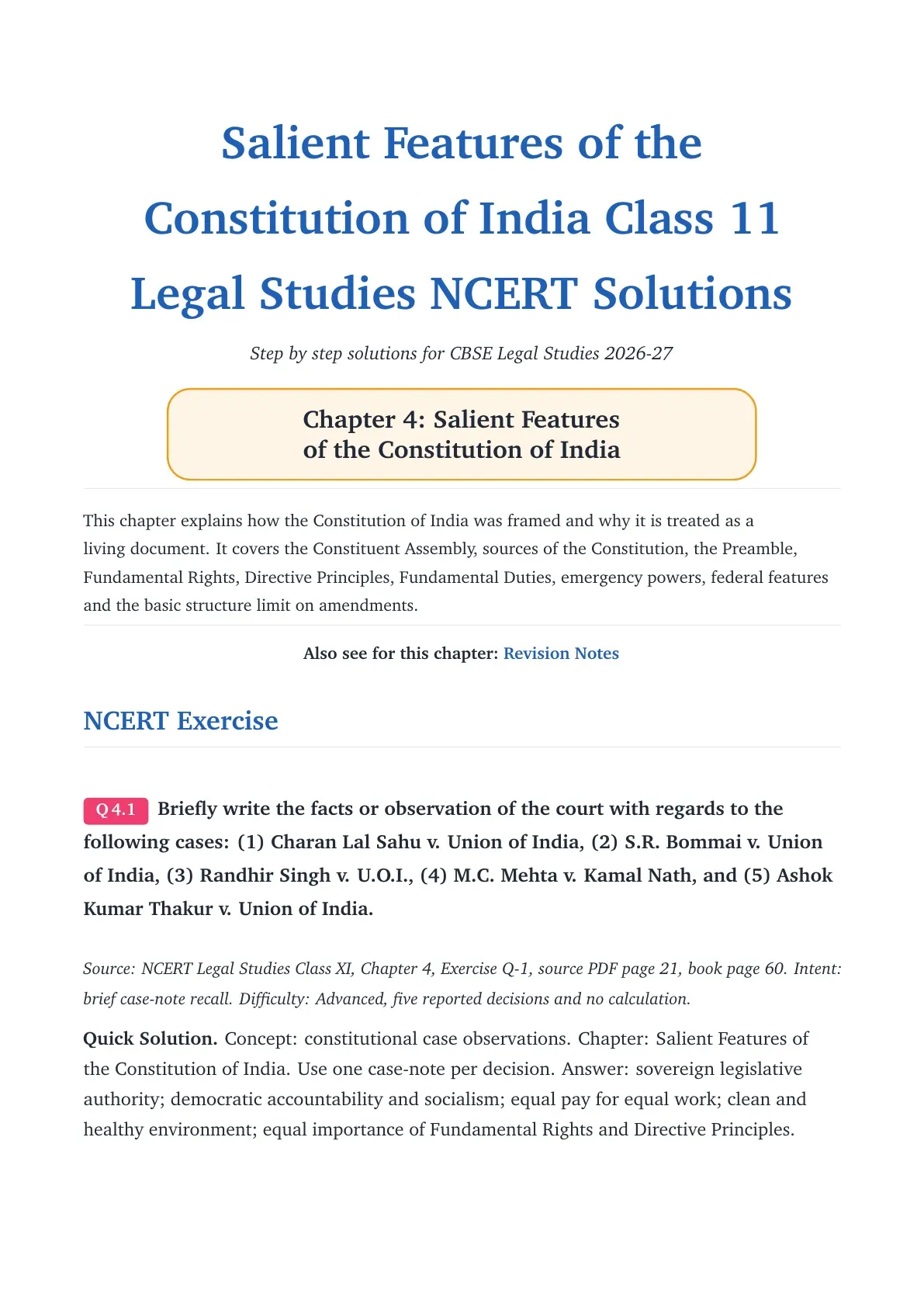
Salient Features of the Constitution of India Class 11 Legal Studies NCERT Solutions PDF
Student Feedback: In a Collegedunia poll of 10,420 Class 11 Legal Studies students, 69 percent said writ remedies, basic structure and the Fundamental Rights versus Directive Principles relationship were the hardest parts of this chapter to revise without solved answers.
These Class 11 Legal Studies Chapter 4 solutions are checked against the official NCERT chapter and written for the 2026-27 CBSE syllabus.
Exercise Pattern for Salient Features of the Constitution of India
Salient Features of the Constitution of India has case-note, short-note, difference, brief-answer, long-answer and application-based questions. The chapter does not require calculations. It checks whether students can connect textbook facts with constitutional terms and Supreme Court decisions.
Question type
What to write
Scoring cue
Case notes
Facts plus court observation
Name the case principle clearly
Brief notes
Meaning, location and function
Part III, Part IV, Part IVA, Preamble
Differences
One direct contrast per pair
Use a table or numbered format
Application
Identify the remedy or constitutional rule
Habeas corpus, Articles 32 and 226
Sources and Salient Features of the Constitution of India
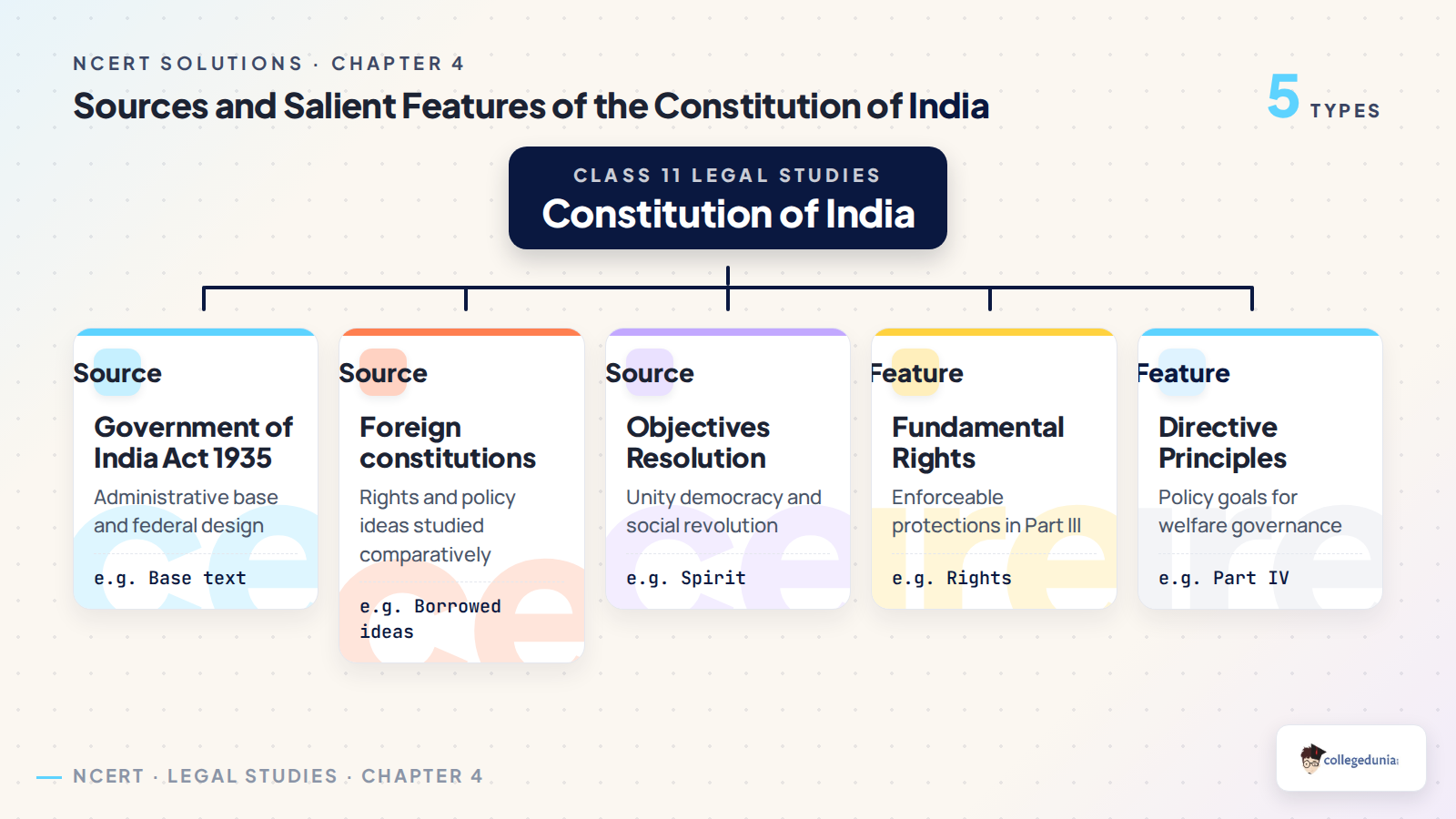
The chapter identifies three sources of the Constitution of India. The Government of India Act, 1935 worked as the base text for many administrative and federal details. Foreign constitutions helped the framers study rights, policy principles and institutional choices. The Objectives Resolution gave the Constitution its spirit of unity, democracy and social revolution.
Government of India Act, 1935: useful for administrative structure and federal design.
Foreign constitutions: useful for tested ideas on rights, institutions and policy goals.
Objectives Resolution: useful for the philosophy behind justice, equality and democracy.
Salient Features of the Constitution Explained by Magnet Brains
Fundamental Rights, Directive Principles and Duties
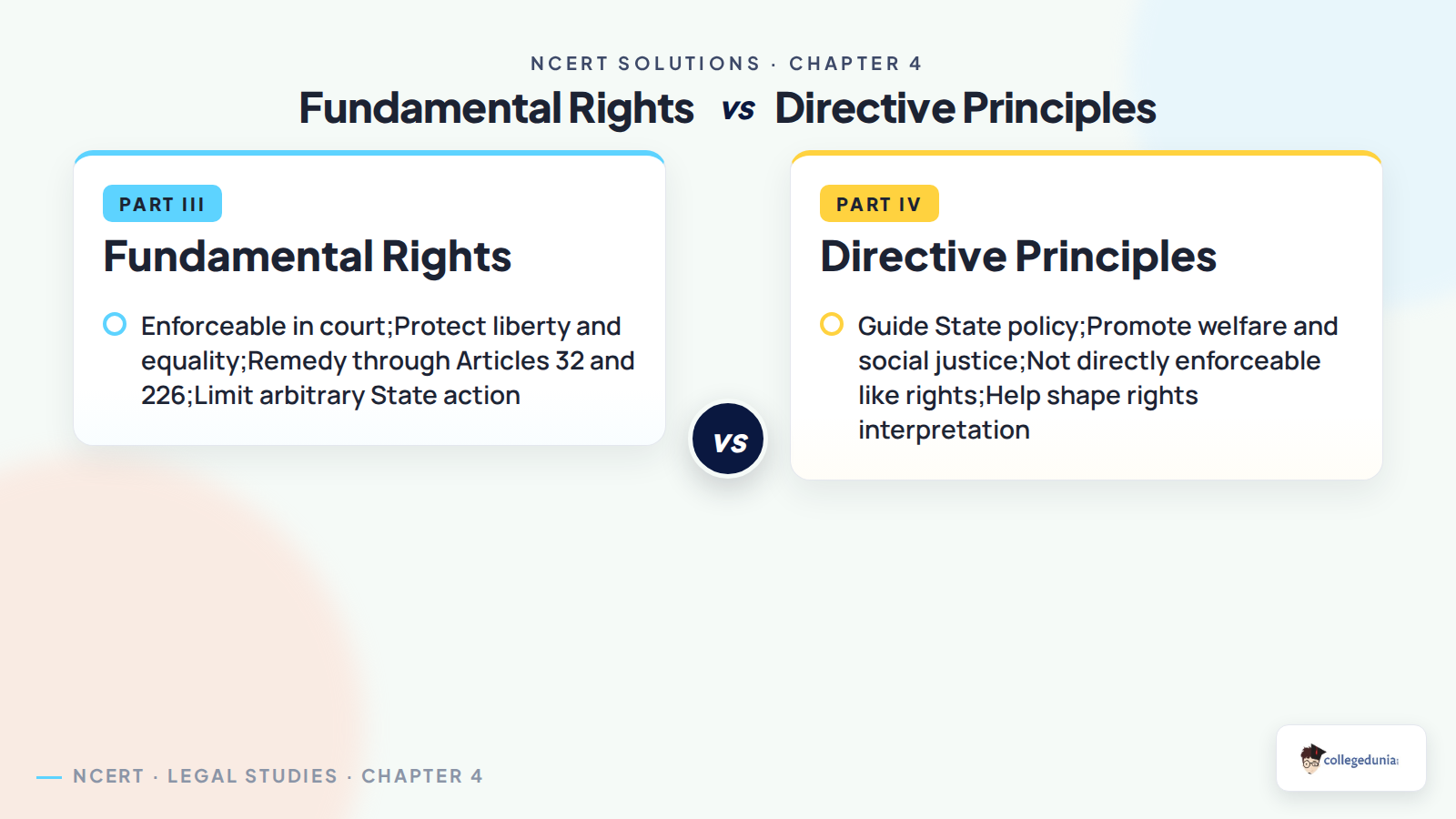
The chapter treats Fundamental Rights, Directive Principles and Fundamental Duties as connected parts of constitutional citizenship. Fundamental Rights protect enforceable freedoms. Directive Principles guide the State toward welfare and social justice. Fundamental Duties remind citizens that democracy also needs responsible conduct.
Part
Location
Use in answers
Fundamental Rights
Part III
Enforceable freedoms and remedies
Directive Principles
Part IV
Policy goals for welfare governance
Fundamental Duties
Part IVA, Article 51A
Civic responsibilities of citizens
Writ Remedies in Class 11 Legal Studies Chapter 4
The writ questions in this chapter should be answered by matching the wrong with the remedy. If a person is detained illegally, the remedy is habeas corpus. If a public authority refuses a legal duty, mandamus may apply. If a tribunal acts outside jurisdiction, certiorari or prohibition may apply depending on whether the order is already passed or the proceeding is still going on.
Article 32: Supreme Court remedy for enforcement of Fundamental Rights.
Article 226: High Court writ power for Fundamental Rights and other legal rights.
Habeas corpus: the core remedy for Ajit's illegal detention problem in the exercise.
Emergency Provisions and Federal Character
India is federal in form in ordinary times, but the Constitution allows a temporary unitary shift during emergency. The textbook lists three situations: war, external aggression or armed rebellion under Article 352; failure of constitutional machinery in a State under Articles 356 and 365; and financial emergency under Article 360. In such situations, the Centre becomes stronger and State powers can come under tighter central control.
Emergency type
Article
Answer point
National emergency
Article 352
War, external aggression or armed rebellion
State emergency
Articles 356 and 365
Failure of State constitutional machinery
Financial emergency
Article 360
Threat to financial stability or credit
Basic Structure and Living Constitution
The Constitution is called a living document because it can adapt through amendment and interpretation. Article 368 gives Parliament amendment power, but that power is not unlimited. The Supreme Court's basic structure doctrine protects the identity of the Constitution. Features such as constitutional supremacy, democracy, secularism, judicial review, equality, rule of law, federalism and separation of powers cannot be destroyed by amendment.
Use living document for adaptability through amendment and interpretation.
Use basic structure for the limit on destructive amendment.
Use Kesavananda Bharati when explaining why Parliament's amendment power is controlled.
Common Mistakes in Legal Studies Chapter 4
Students usually lose marks when they mix enforceable rights with non-justiciable policy goals. Another common mistake is naming the wrong writ for unlawful detention. A third mistake is saying basic structure can never be touched in any way. The correct answer is narrower: Parliament can amend provisions, but it cannot destroy the basic identity of the Constitution.
Mistake
Better answer
Calling Directive Principles enforceable like rights
They guide the State but are not directly enforceable like Part III rights
Writing mandamus for Ajit's detention
Use habeas corpus first
Ignoring Articles 32 and 226
Always name the court remedy for writ questions
Writing only definitions in difference questions
Write one clear contrast per pair
Salient Features of the Constitution Cross-Resource Study Links
Use these Class 11 Legal Studies resources together. Read the official chapter first, revise the notes, then solve the exercise using the PDF on this page.
After finishing Chapter 4, revise the surrounding Legal Studies solution pages in order. The first eight scheduled chapters build the Class 11 Legal Studies foundation for public law and legal reasoning.
All NCERT Solutions for Class 11 Legal Studies Chapter 4 Salient Features of the Constitution of India with Step-by-Step Solutions
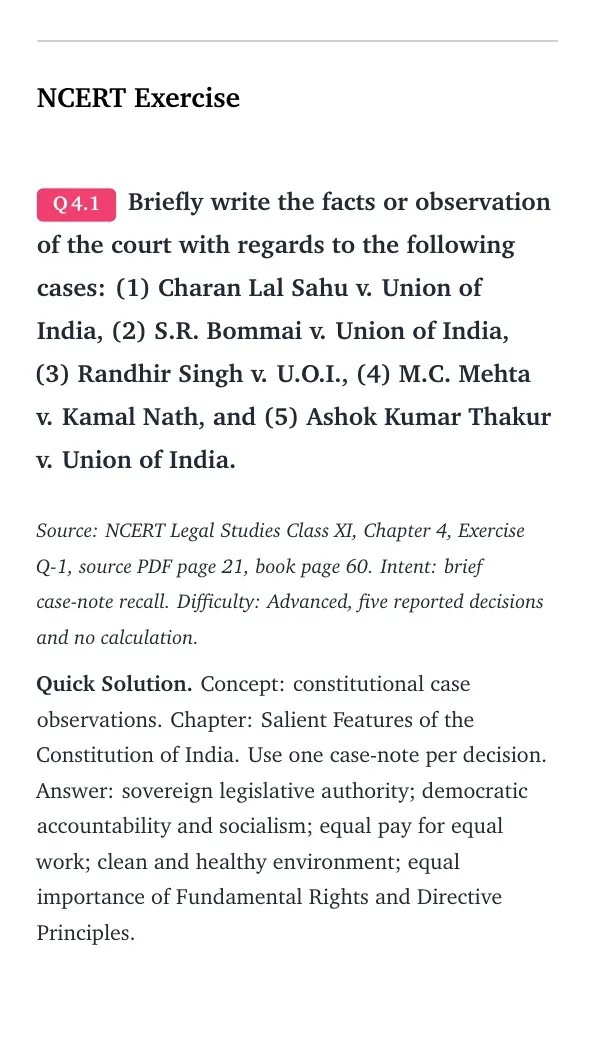
Q 4.1
Briefly write the facts or observation of the court with regards to the following cases: (1) Charan Lal Sahu v. Union of India, (2) S.R. Bommai v. Union of India, (3) Randhir Singh v. U.O.I., (4) M.C. Mehta v. Kamal Nath, and (5) Ashok Kumar Thakur v. Union of India.
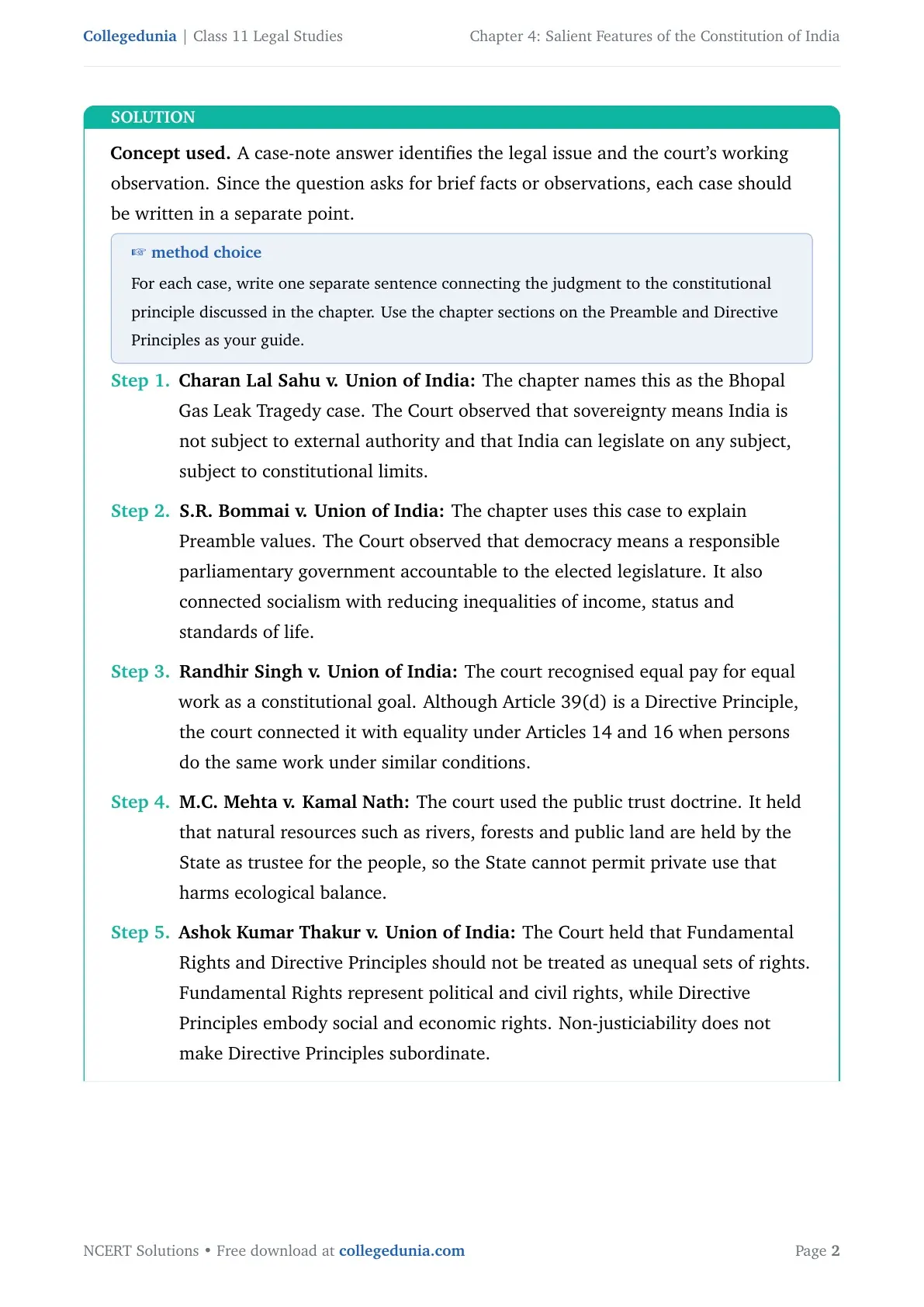
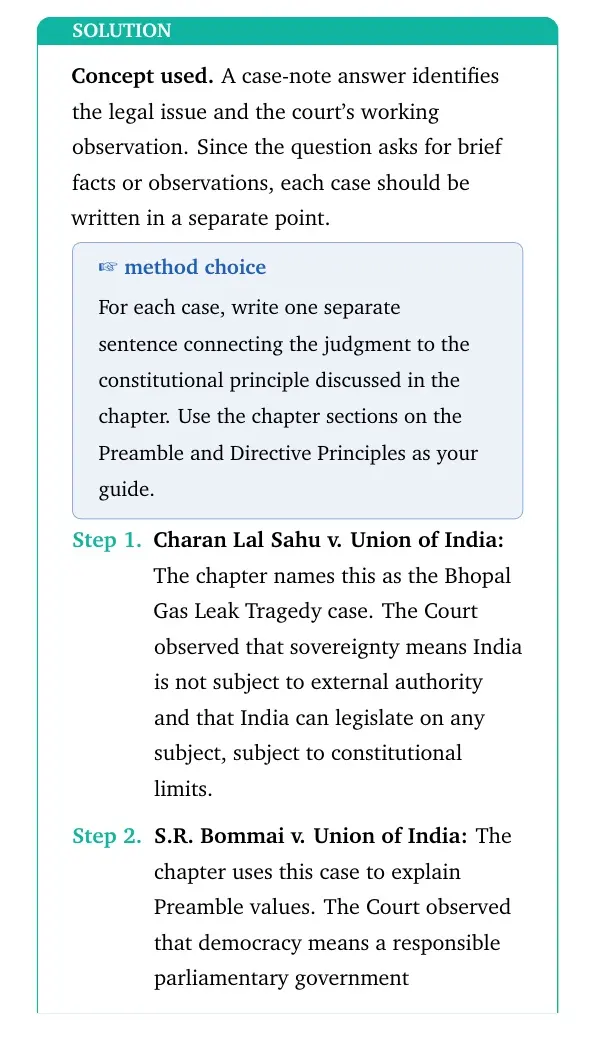
Concept used. A case-note answer identifies the legal issue and the court's working observation. Since the question asks for brief facts or observations, each case should be written in a separate point.
method choice
For each case, write one separate sentence connecting the judgment to the constitutional principle discussed in the chapter. Use the chapter sections on the Preamble and Directive Principles as your guide.
Charan Lal Sahu v. Union of India: The chapter names this as the Bhopal Gas Leak Tragedy case. The Court observed that sovereignty means India is not subject to external authority and that India can legislate on any subject, subject to constitutional limits.
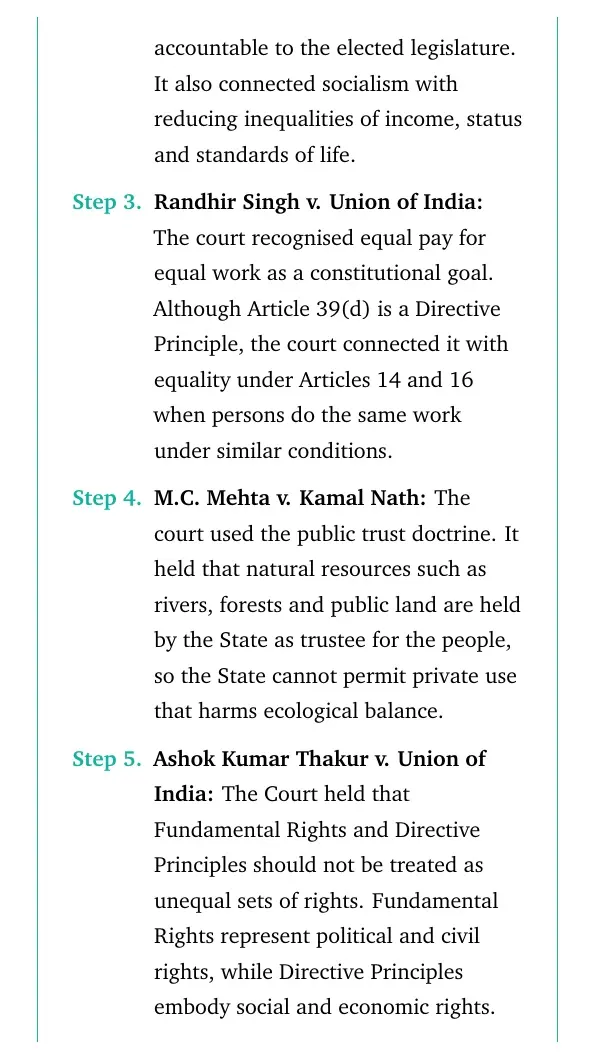
S.R. Bommai v. Union of India: The chapter uses this case to explain Preamble values. The Court observed that democracy means a responsible parliamentary government accountable to the elected legislature. It also connected socialism with reducing inequalities of income, status and standards of life.
Randhir Singh v. Union of India: The court recognised equal pay for equal work as a constitutional goal. Although Article 39(d) is a Directive Principle, the court connected it with equality under Articles 14 and 16 when persons do the same work under similar conditions.
M.C. Mehta v. Kamal Nath: The court used the public trust doctrine. It held that natural resources such as rivers, forests and public land are held by the State as trustee for the people, so the State cannot permit private use that harms ecological balance.
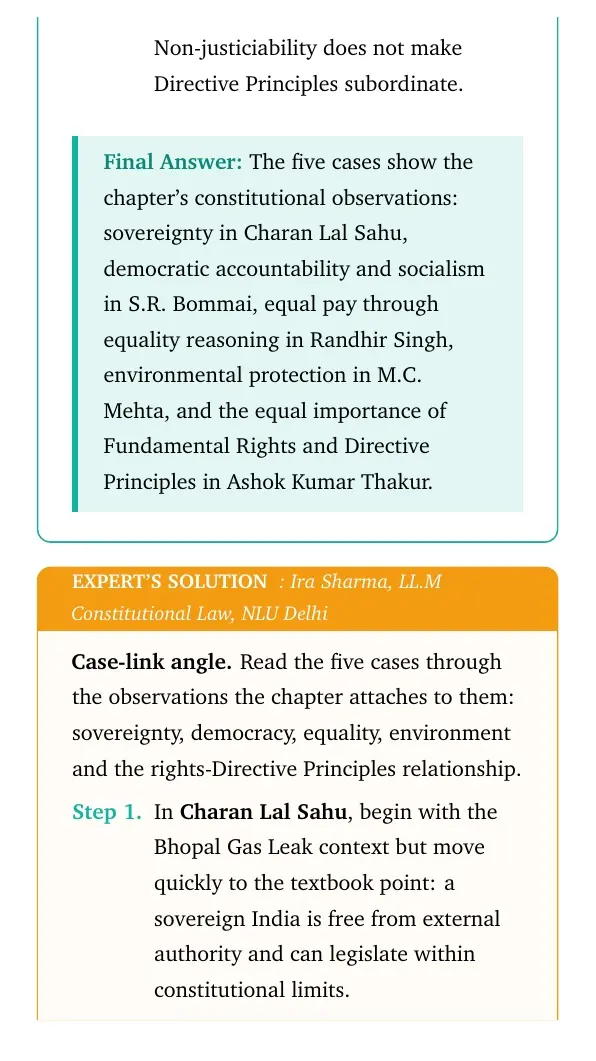
Ashok Kumar Thakur v. Union of India: The Court held that Fundamental Rights and Directive Principles should not be treated as unequal sets of rights. Fundamental Rights represent political and civil rights, while Directive Principles embody social and economic rights. Non-justiciability does not make Directive Principles subordinate.
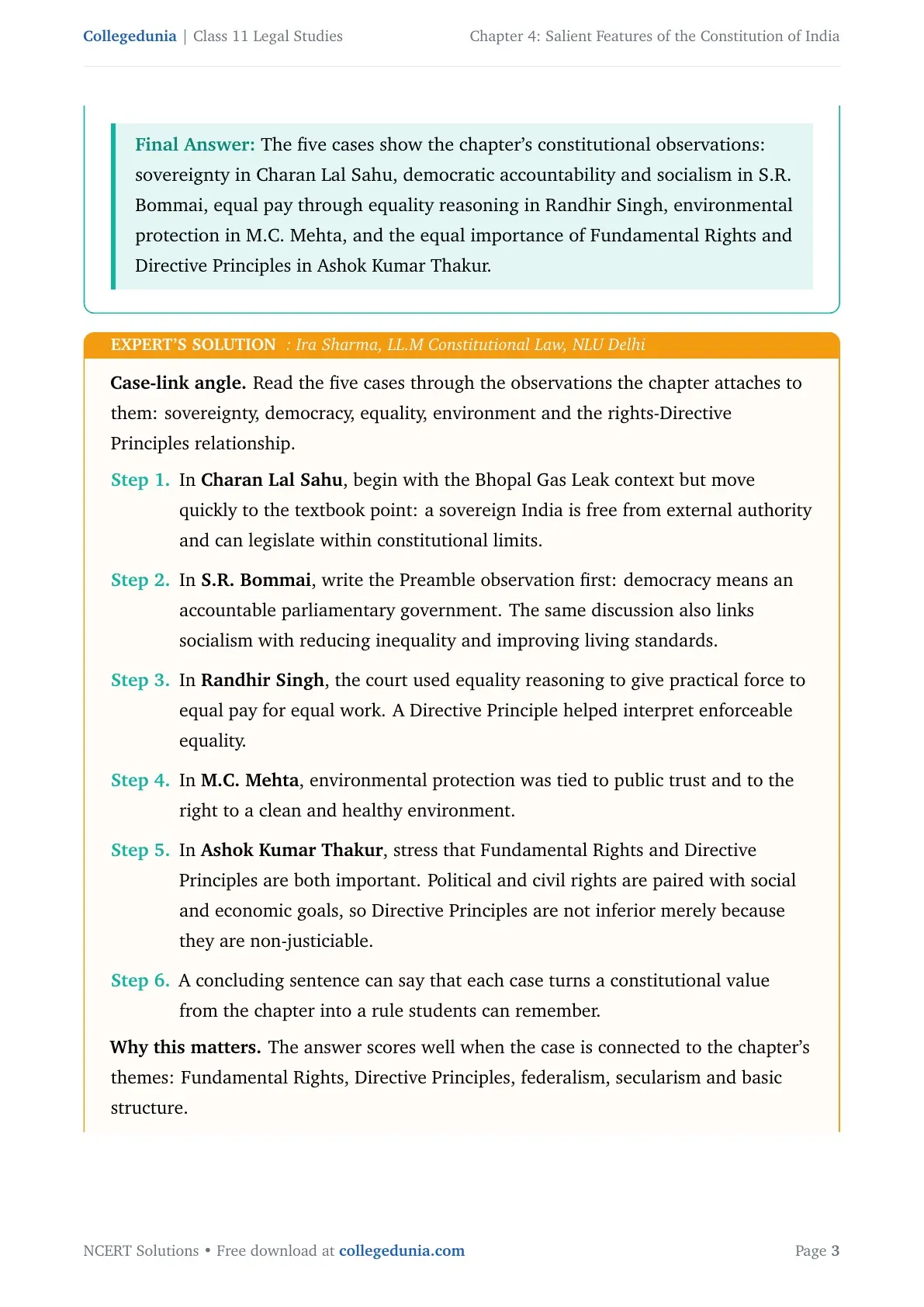
The five cases show the chapter's constitutional observations: sovereignty in Charan Lal Sahu, democratic accountability and socialism in S.R. Bommai, equal pay through equality reasoning in Randhir Singh, environmental protection in M.C. Mehta, and the equal importance of Fundamental Rights and Directive Principles in Ashok Kumar Thakur.
IS
Ira Sharma
LL.M Constitutional Law, NLU Delhi
Verified Expert
Case-link angle. Read the five cases through the observations the chapter attaches to them: sovereignty, democracy, equality, environment and the rights-Directive Principles relationship.
In Charan Lal Sahu, begin with the Bhopal Gas Leak context but move quickly to the textbook point: a sovereign India is free from external authority and can legislate within constitutional limits.
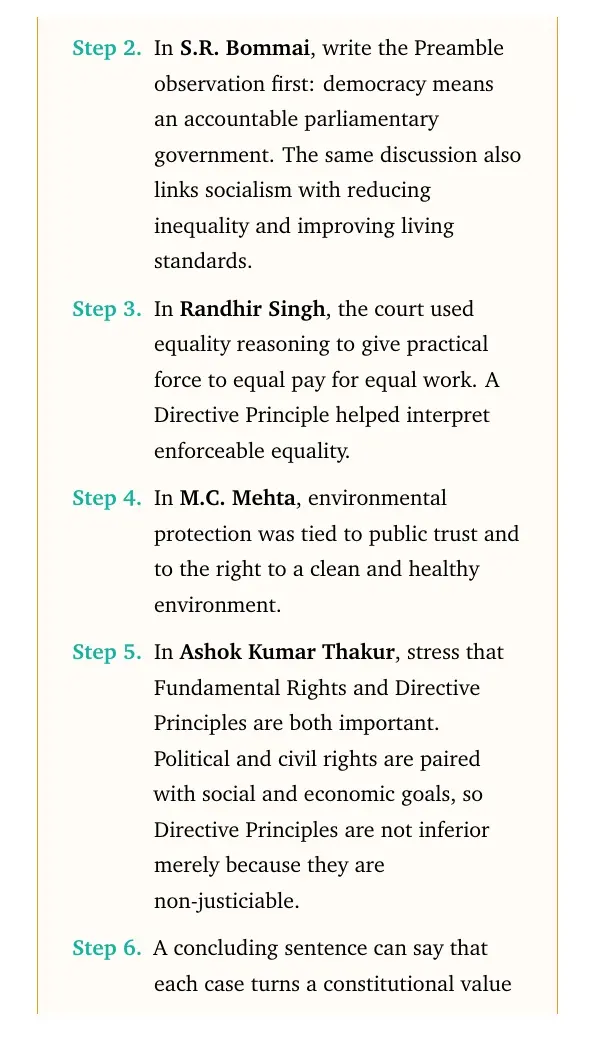
In S.R. Bommai, write the Preamble observation first: democracy means an accountable parliamentary government. The same discussion also links socialism with reducing inequality and improving living standards.
In Randhir Singh, the court used equality reasoning to give practical force to equal pay for equal work. A Directive Principle helped interpret enforceable equality.
In M.C. Mehta, environmental protection was tied to public trust and to the right to a clean and healthy environment.
In Ashok Kumar Thakur, stress that Fundamental Rights and Directive Principles are both important. Political and civil rights are paired with social and economic goals, so Directive Principles are not inferior merely because they are non-justiciable.
A concluding sentence can say that each case turns a constitutional value from the chapter into a rule students can remember.
Why this matters. The answer scores well when the case is connected to the chapter's themes: Fundamental Rights, Directive Principles, federalism, secularism and basic structure.
Together, the cases show sovereignty, accountable democracy, socialism, equality through equal pay, environmental protection and harmony between Fundamental Rights and Directive Principles.
Q 4.2
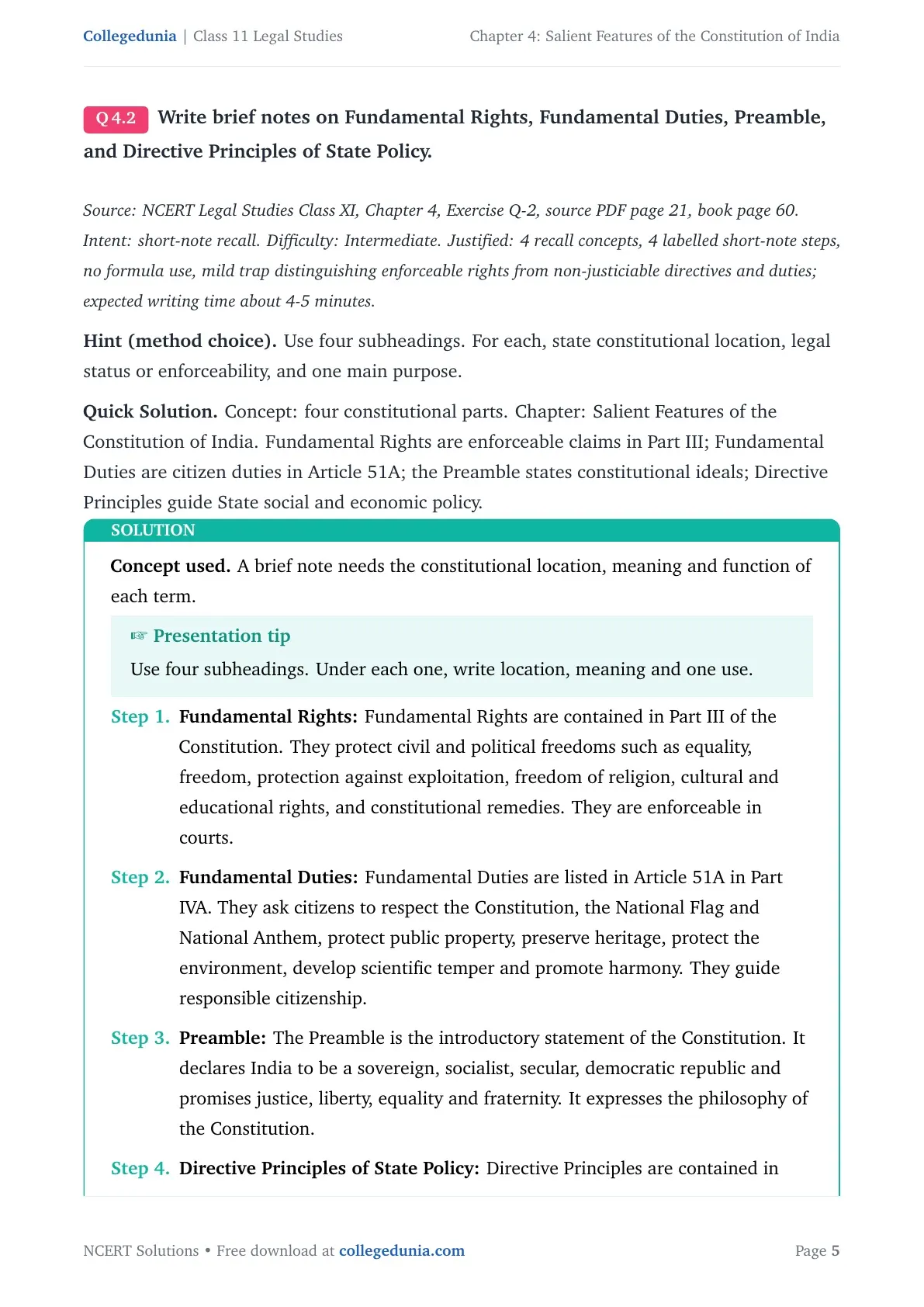
Write brief notes on Fundamental Rights, Fundamental Duties, Preamble, and Directive Principles of State Policy.
Concept used. A brief note needs the constitutional location, meaning and function of each term.
Presentation tip
Use four subheadings. Under each one, write location, meaning and one use.
Fundamental Rights: Fundamental Rights are contained in Part III of the Constitution. They protect civil and political freedoms such as equality, freedom, protection against exploitation, freedom of religion, cultural and educational rights, and constitutional remedies. They are enforceable in courts.
Fundamental Duties: Fundamental Duties are listed in Article 51A in Part IVA. They ask citizens to respect the Constitution, the National Flag and National Anthem, protect public property, preserve heritage, protect the environment, develop scientific temper and promote harmony. They guide responsible citizenship.
Preamble: The Preamble is the introductory statement of the Constitution. It declares India to be a sovereign, socialist, secular, democratic republic and promises justice, liberty, equality and fraternity. It expresses the philosophy of the Constitution.
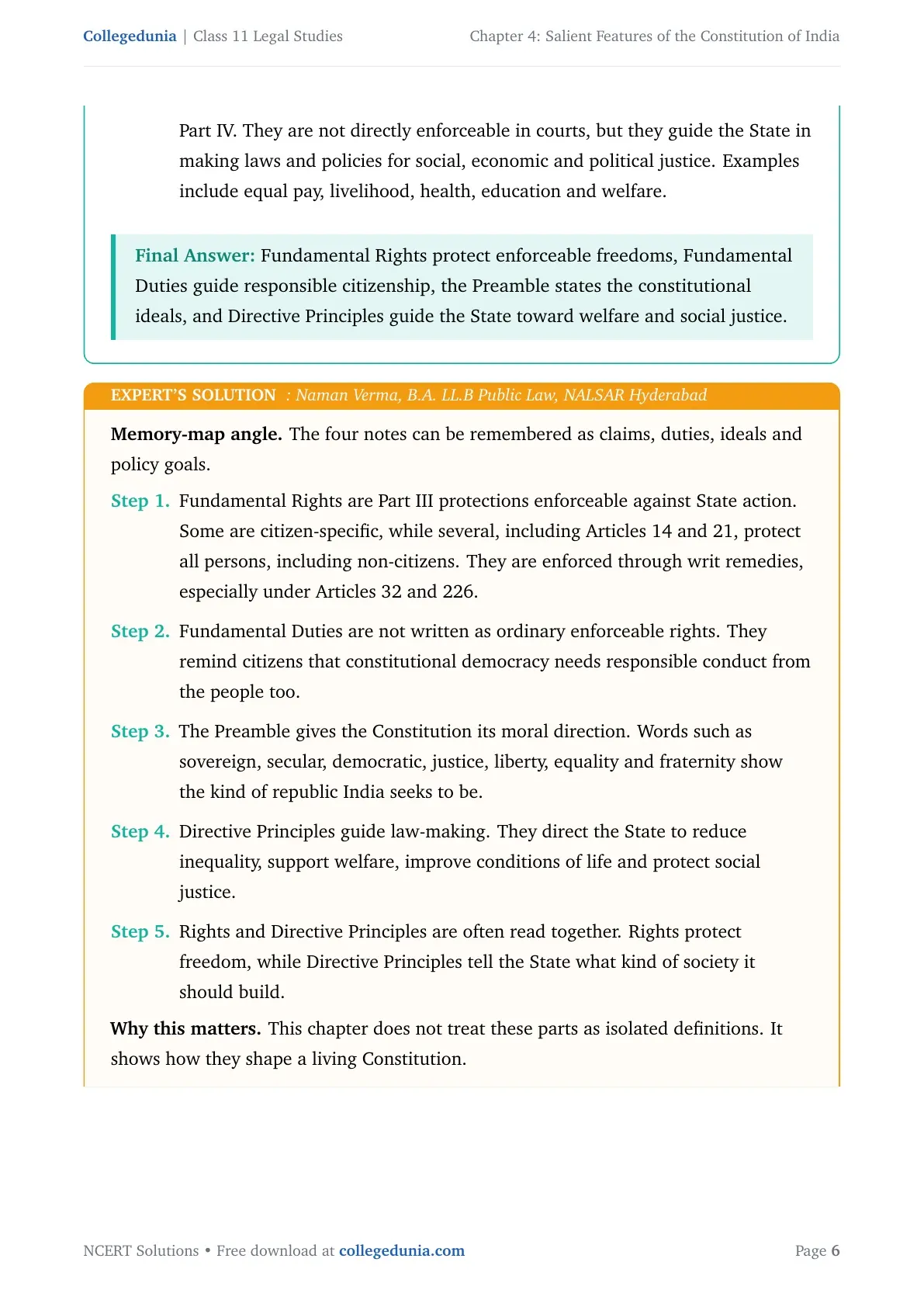
Directive Principles of State Policy: Directive Principles are contained in Part IV. They are not directly enforceable in courts, but they guide the State in making laws and policies for social, economic and political justice. Examples include equal pay, livelihood, health, education and welfare.
Fundamental Rights protect enforceable freedoms, Fundamental Duties guide responsible citizenship, the Preamble states the constitutional ideals, and Directive Principles guide the State toward welfare and social justice.
NV
Naman Verma
B.A. LL.B Public Law, NALSAR Hyderabad
Verified Expert
Memory-map angle. The four notes can be remembered as claims, duties, ideals and policy goals.
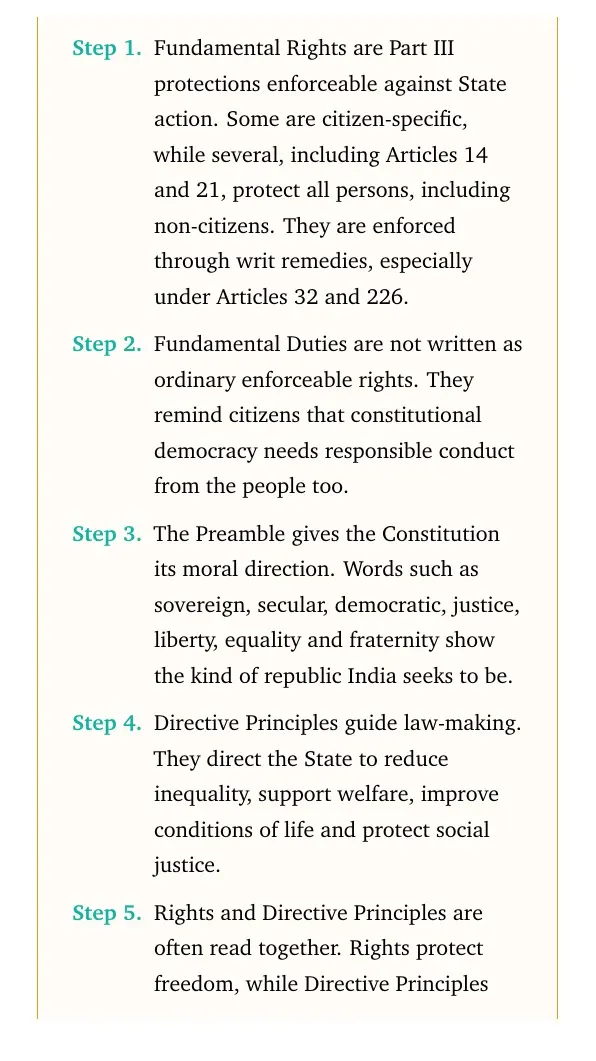
Fundamental Rights are Part III protections enforceable against State action. Some are citizen-specific, while several, including Articles 14 and 21, protect all persons, including non-citizens. They are enforced through writ remedies, especially under Articles 32 and 226.
Fundamental Duties are not written as ordinary enforceable rights. They remind citizens that constitutional democracy needs responsible conduct from the people too.
The Preamble gives the Constitution its moral direction. Words such as sovereign, secular, democratic, justice, liberty, equality and fraternity show the kind of republic India seeks to be.
Directive Principles guide law-making. They direct the State to reduce inequality, support welfare, improve conditions of life and protect social justice.
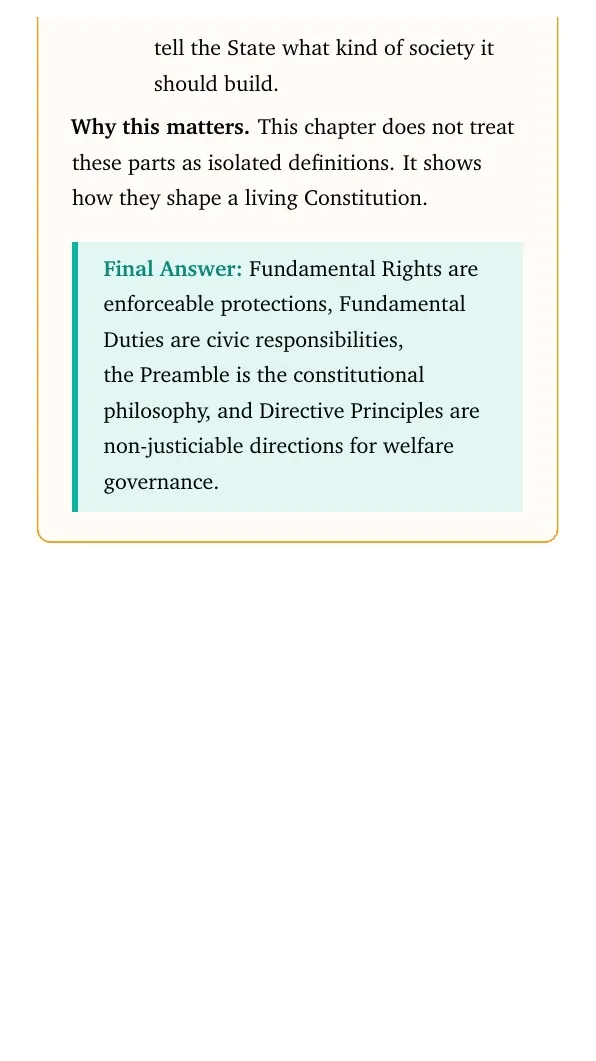
Rights and Directive Principles are often read together. Rights protect freedom, while Directive Principles tell the State what kind of society it should build.
Why this matters. This chapter does not treat these parts as isolated definitions. It shows how they shape a living Constitution.
Fundamental Rights are enforceable protections, Fundamental Duties are civic responsibilities, the Preamble is the constitutional philosophy, and Directive Principles are non-justiciable directions for welfare governance.
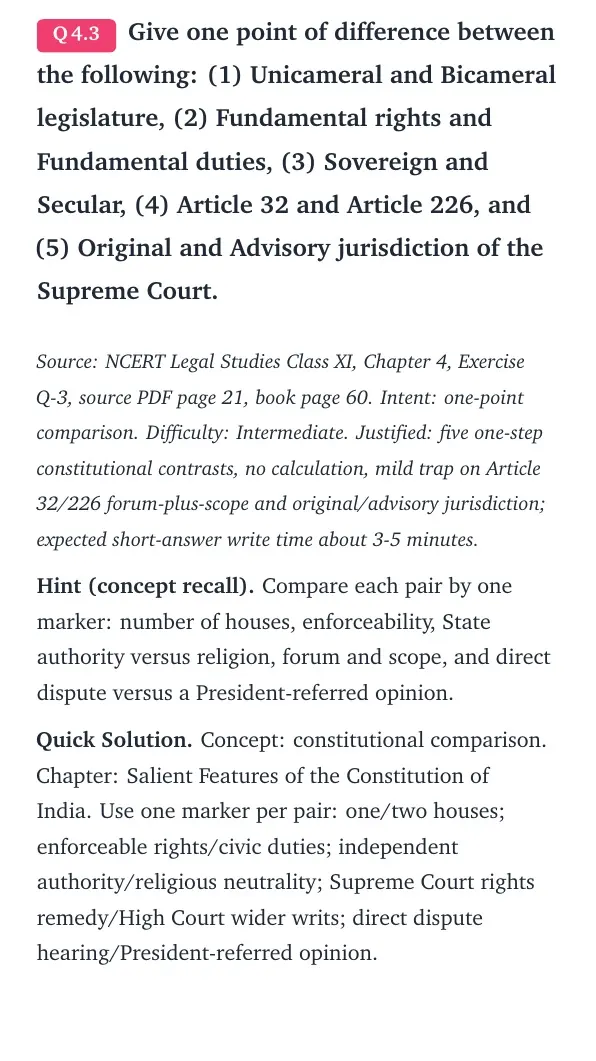
Q 4.3
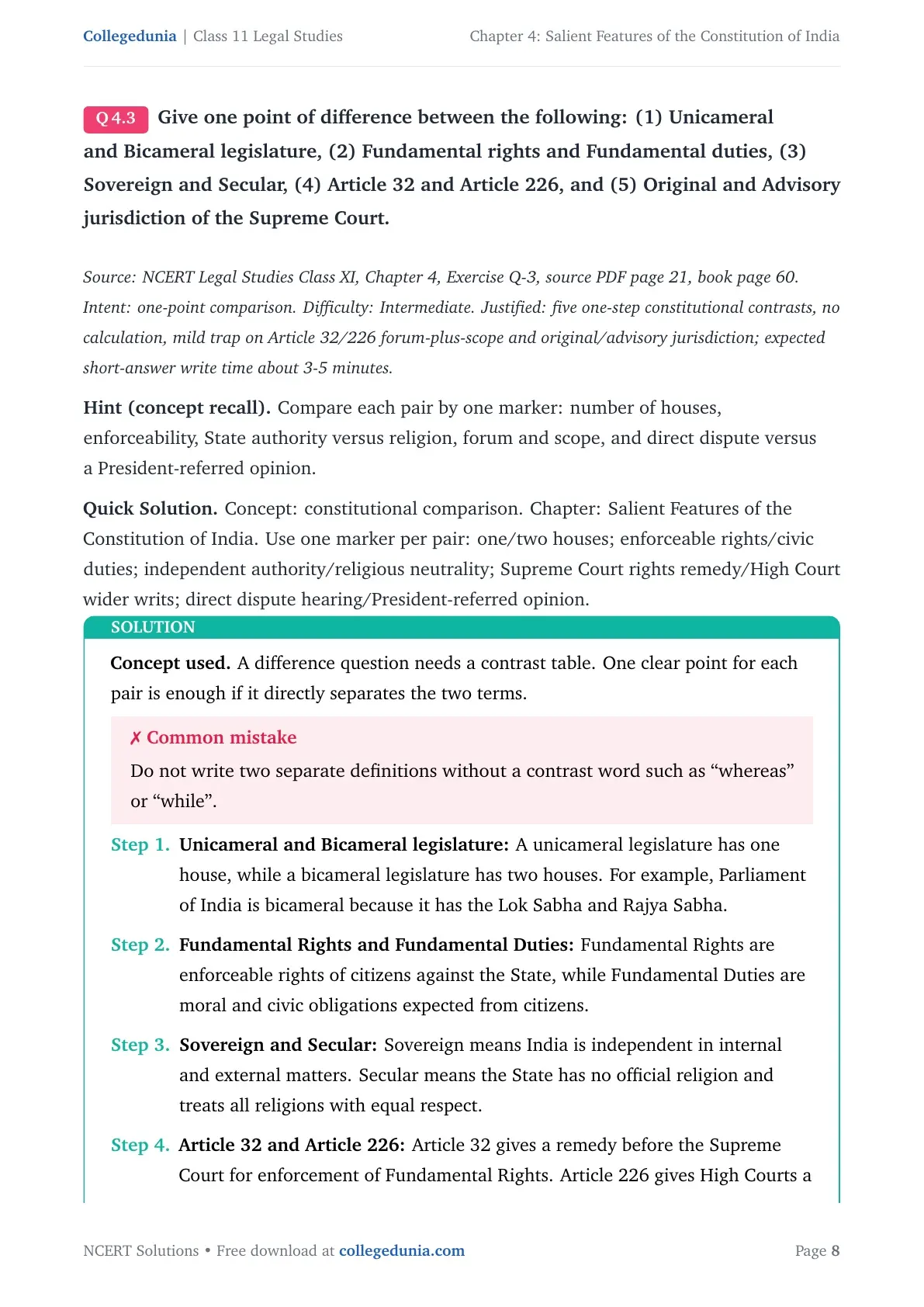
Give one point of difference between the following: (1) Unicameral and Bicameral legislature, (2) Fundamental rights and Fundamental duties, (3) Sovereign and Secular, (4) Article 32 and Article 226, and (5) Original and Advisory jurisdiction of the Supreme Court.
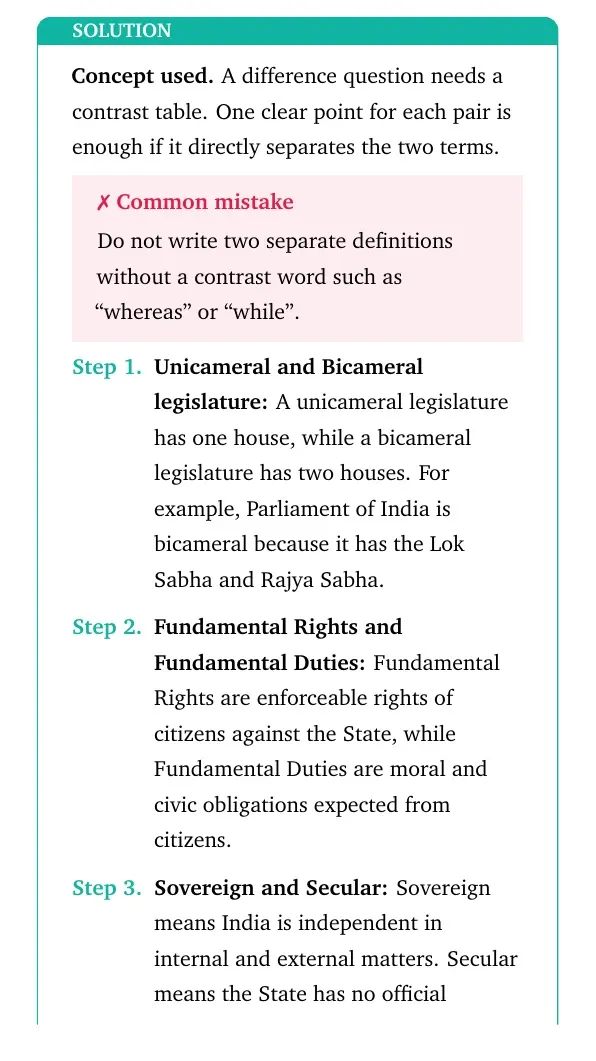
Concept used. A difference question needs a contrast table. One clear point for each pair is enough if it directly separates the two terms.
Common mistake
Do not write two separate definitions without a contrast word such as ``whereas'' or ``while''.
Unicameral and Bicameral legislature: A unicameral legislature has one house, while a bicameral legislature has two houses. For example, Parliament of India is bicameral because it has the Lok Sabha and Rajya Sabha.
Fundamental Rights and Fundamental Duties: Fundamental Rights are enforceable rights of citizens against the State, while Fundamental Duties are moral and civic obligations expected from citizens.
Sovereign and Secular: Sovereign means India is independent in internal and external matters. Secular means the State has no official religion and treats all religions with equal respect.
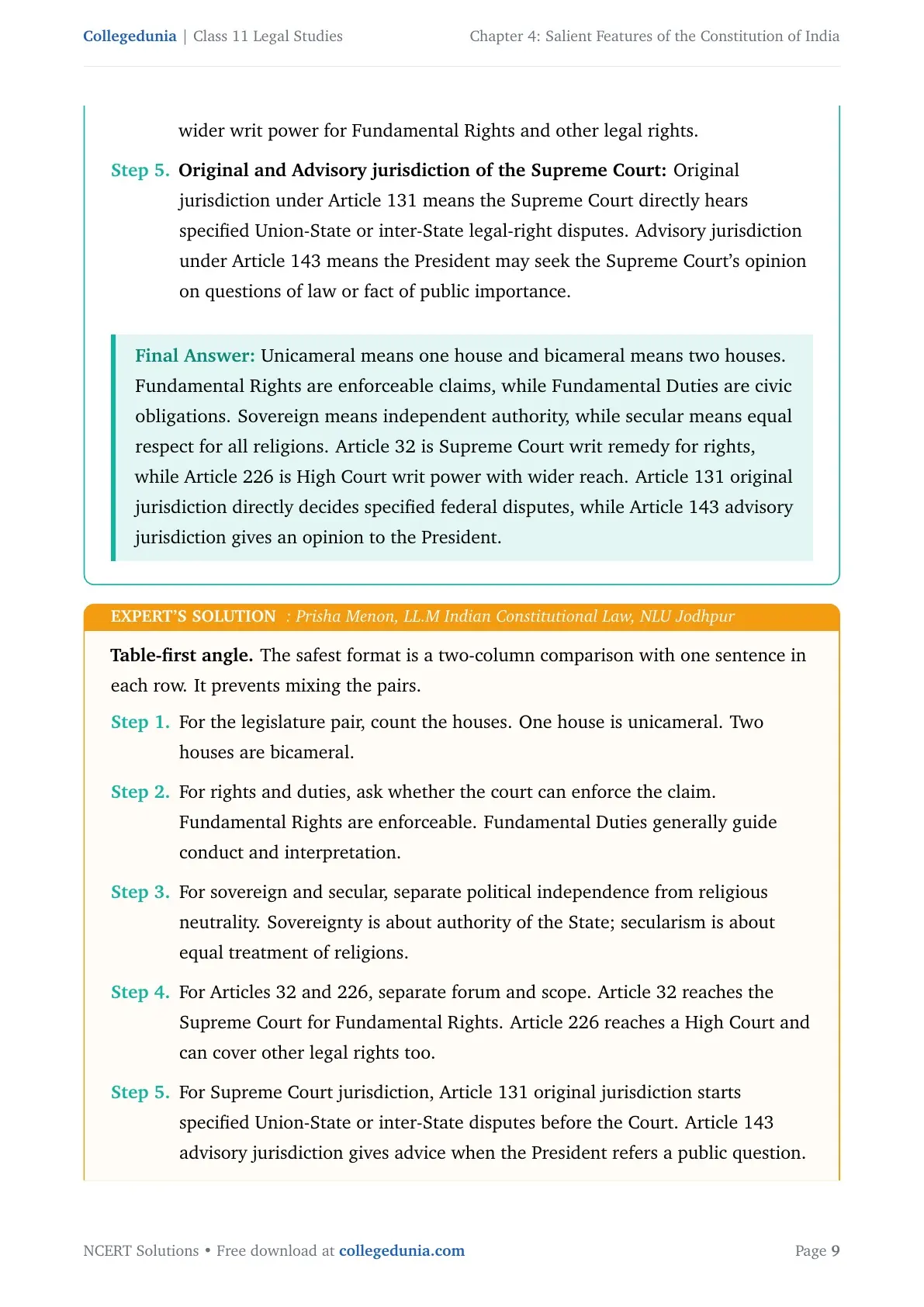
Article 32 and Article 226: Article 32 gives a remedy before the Supreme Court for enforcement of Fundamental Rights. Article 226 gives High Courts a wider writ power for Fundamental Rights and other legal rights.
Original and Advisory jurisdiction of the Supreme Court: Original jurisdiction under Article 131 means the Supreme Court directly hears specified Union-State or inter-State legal-right disputes. Advisory jurisdiction under Article 143 means the President may seek the Supreme Court's opinion on questions of law or fact of public importance.
Unicameral means one house and bicameral means two houses. Fundamental Rights are enforceable claims, while Fundamental Duties are civic obligations. Sovereign means independent authority, while secular means equal respect for all religions. Article 32 is Supreme Court writ remedy for rights, while Article 226 is High Court writ power with wider reach. Article 131 original jurisdiction directly decides specified federal disputes, while Article 143 advisory jurisdiction gives an opinion to the President.
PM
Prisha Menon
LL.M Indian Constitutional Law, NLU Jodhpur
Verified Expert
Table-first angle. The safest format is a two-column comparison with one sentence in each row. It prevents mixing the pairs.
For the legislature pair, count the houses. One house is unicameral. Two houses are bicameral.
For rights and duties, ask whether the court can enforce the claim. Fundamental Rights are enforceable. Fundamental Duties generally guide conduct and interpretation.
For sovereign and secular, separate political independence from religious neutrality. Sovereignty is about authority of the State; secularism is about equal treatment of religions.
For Articles 32 and 226, separate forum and scope. Article 32 reaches the Supreme Court for Fundamental Rights. Article 226 reaches a High Court and can cover other legal rights too.
For Supreme Court jurisdiction, Article 131 original jurisdiction starts specified Union-State or inter-State disputes before the Court. Article 143 advisory jurisdiction gives advice when the President refers a public question.
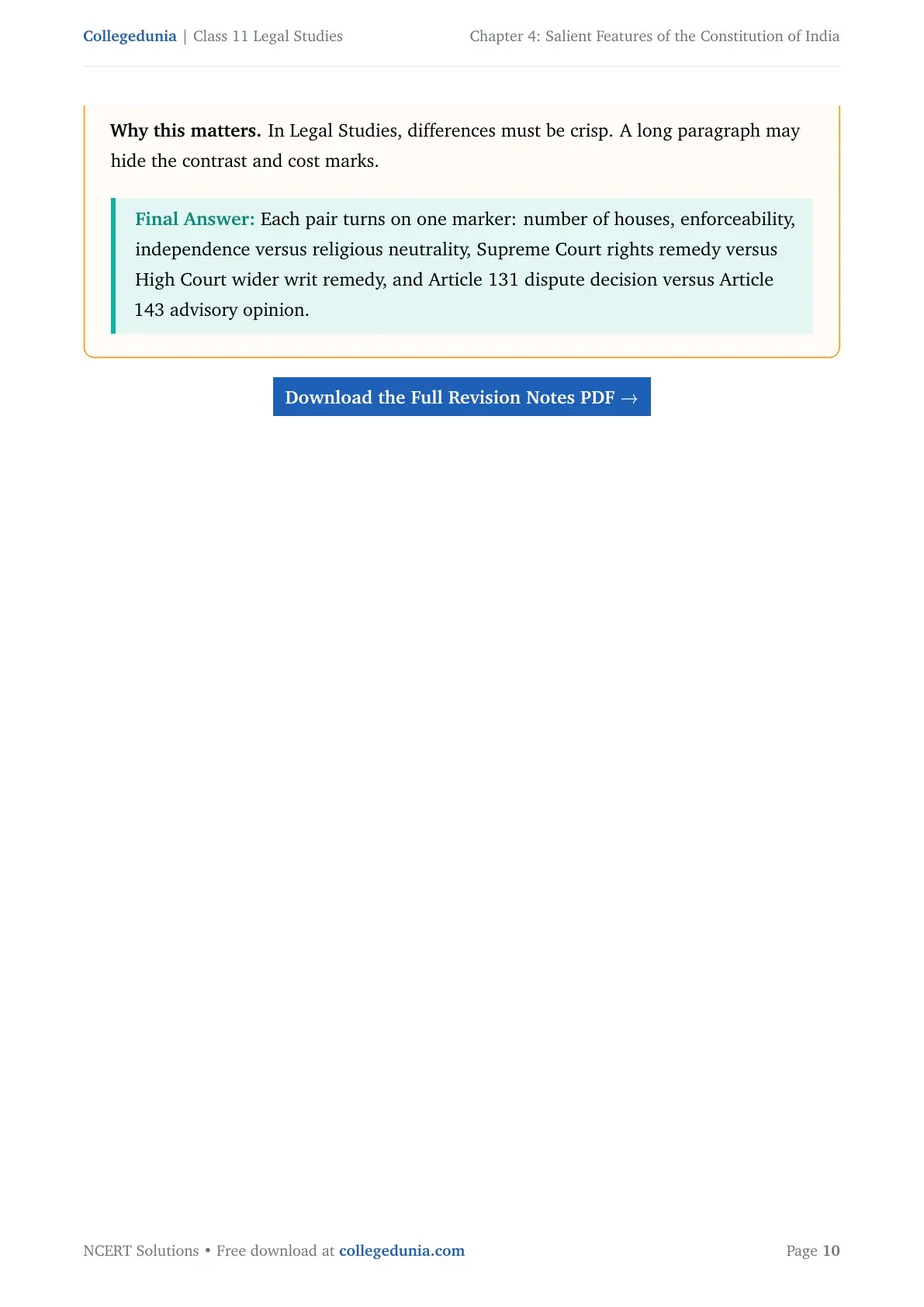
Why this matters. In Legal Studies, differences must be crisp. A long paragraph may hide the contrast and cost marks.
Each pair turns on one marker: number of houses, enforceability, independence versus religious neutrality, Supreme Court rights remedy versus High Court wider writ remedy, and Article 131 dispute decision versus Article 143 advisory opinion.
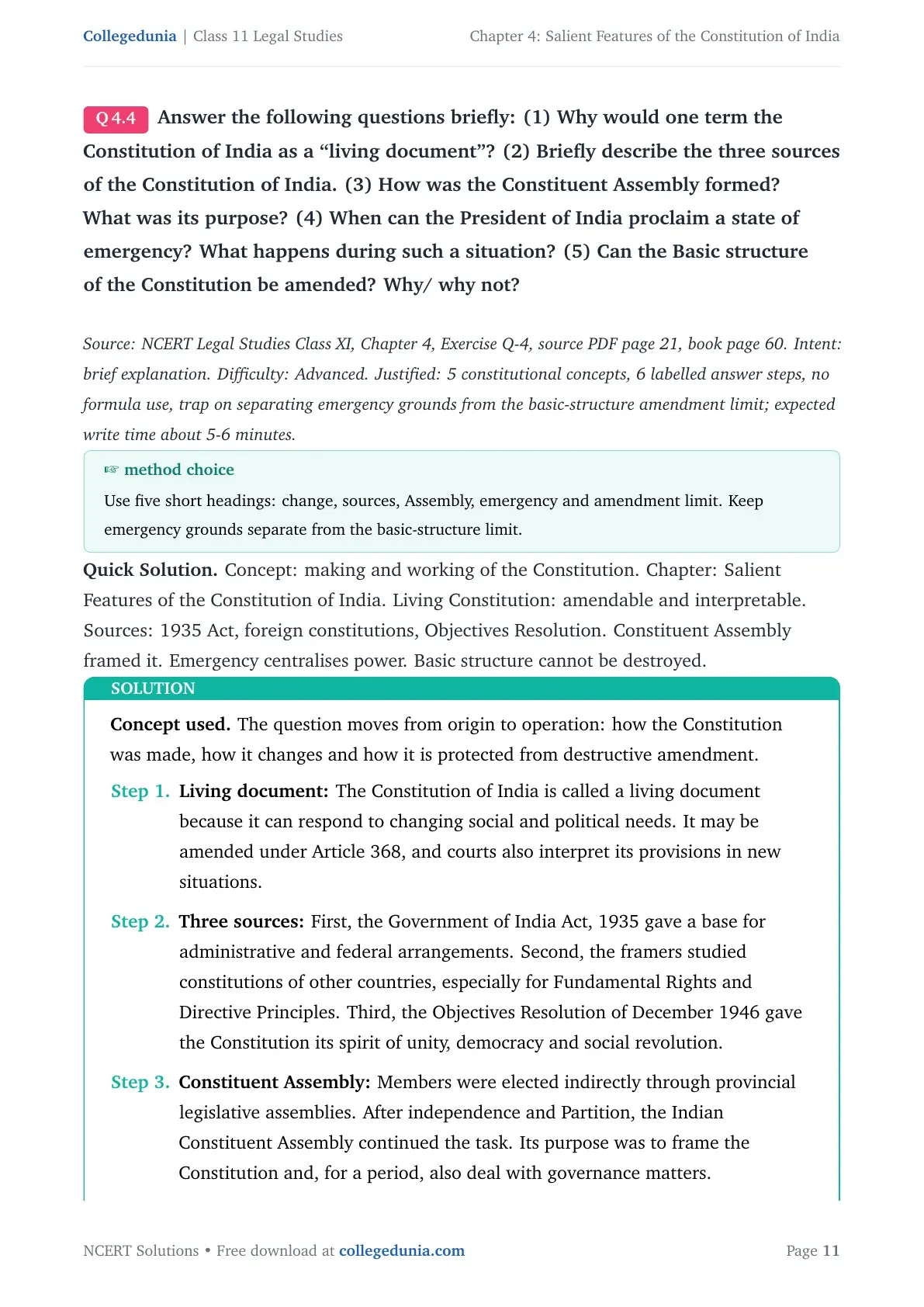
Q 4.4
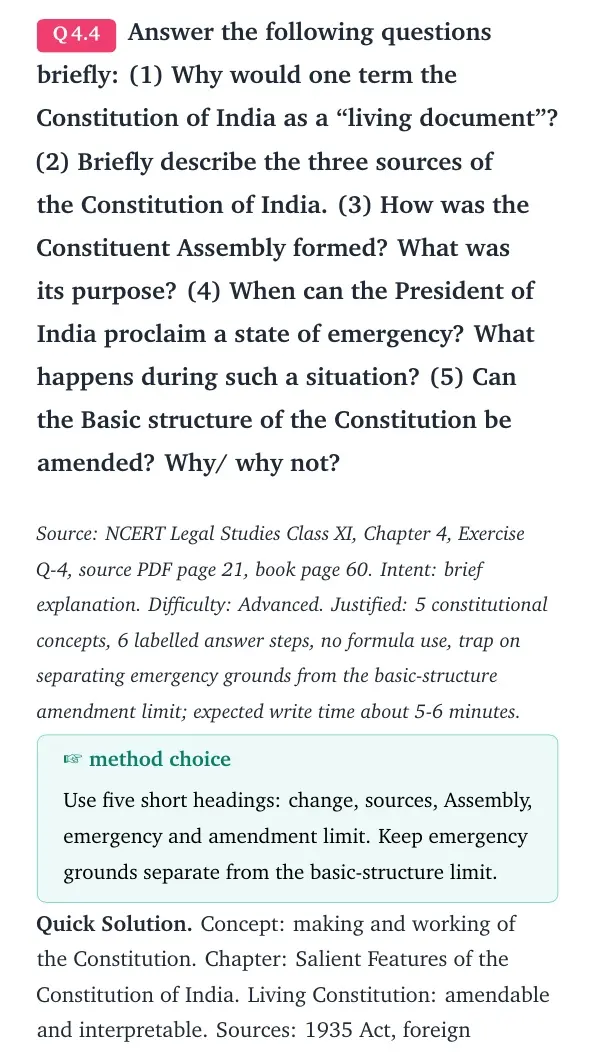
Answer the following questions briefly: (1) Why would one term the Constitution of India as a ``living document''? (2) Briefly describe the three sources of the Constitution of India. (3) How was the Constituent Assembly formed? What was its purpose? (4) When can the President of India proclaim a state of emergency? What happens during such a situation? (5) Can the Basic structure of the Constitution be amended? Why/ why not?
Concept used. The question moves from origin to operation: how the Constitution was made, how it changes and how it is protected from destructive amendment.
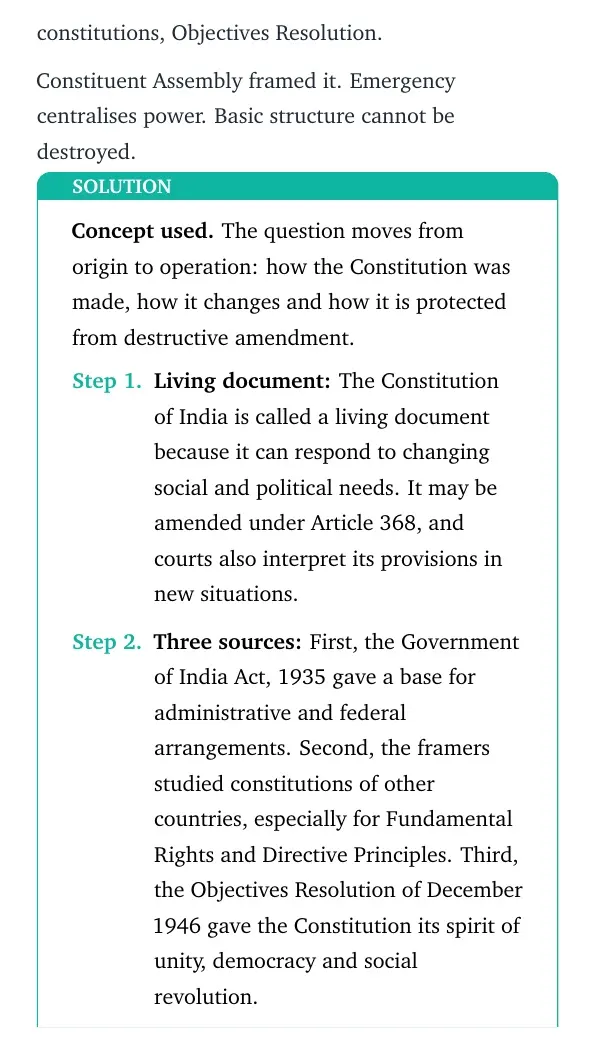
Living document: The Constitution of India is called a living document because it can respond to changing social and political needs. It may be amended under Article 368, and courts also interpret its provisions in new situations.
Three sources: First, the Government of India Act, 1935 gave a base for administrative and federal arrangements. Second, the framers studied constitutions of other countries, especially for Fundamental Rights and Directive Principles. Third, the Objectives Resolution of December 1946 gave the Constitution its spirit of unity, democracy and social revolution.
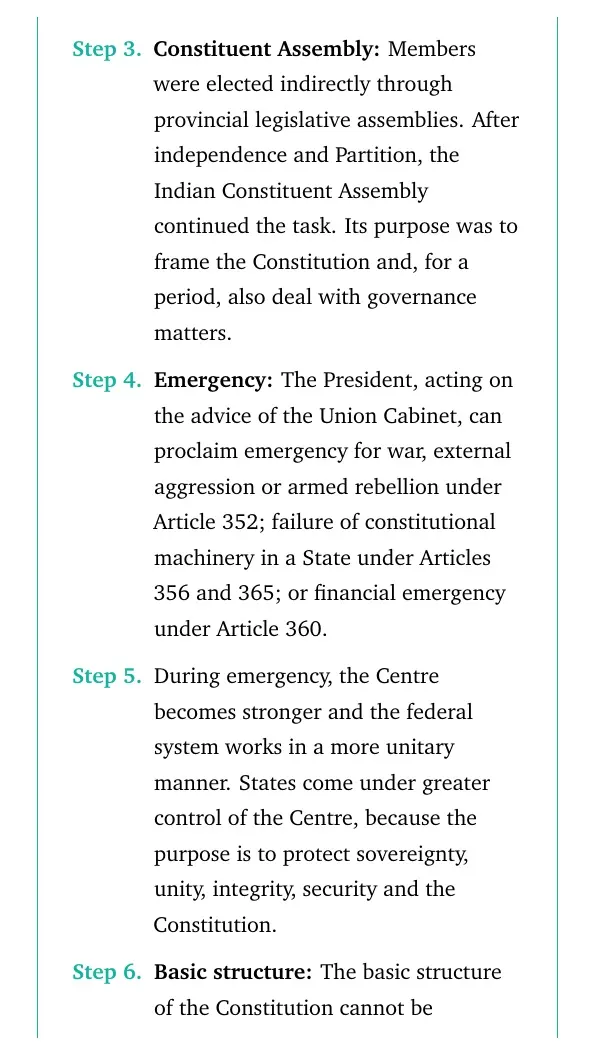
Constituent Assembly: Members were elected indirectly through provincial legislative assemblies. After independence and Partition, the Indian Constituent Assembly continued the task. Its purpose was to frame the Constitution and, for a period, also deal with governance matters.
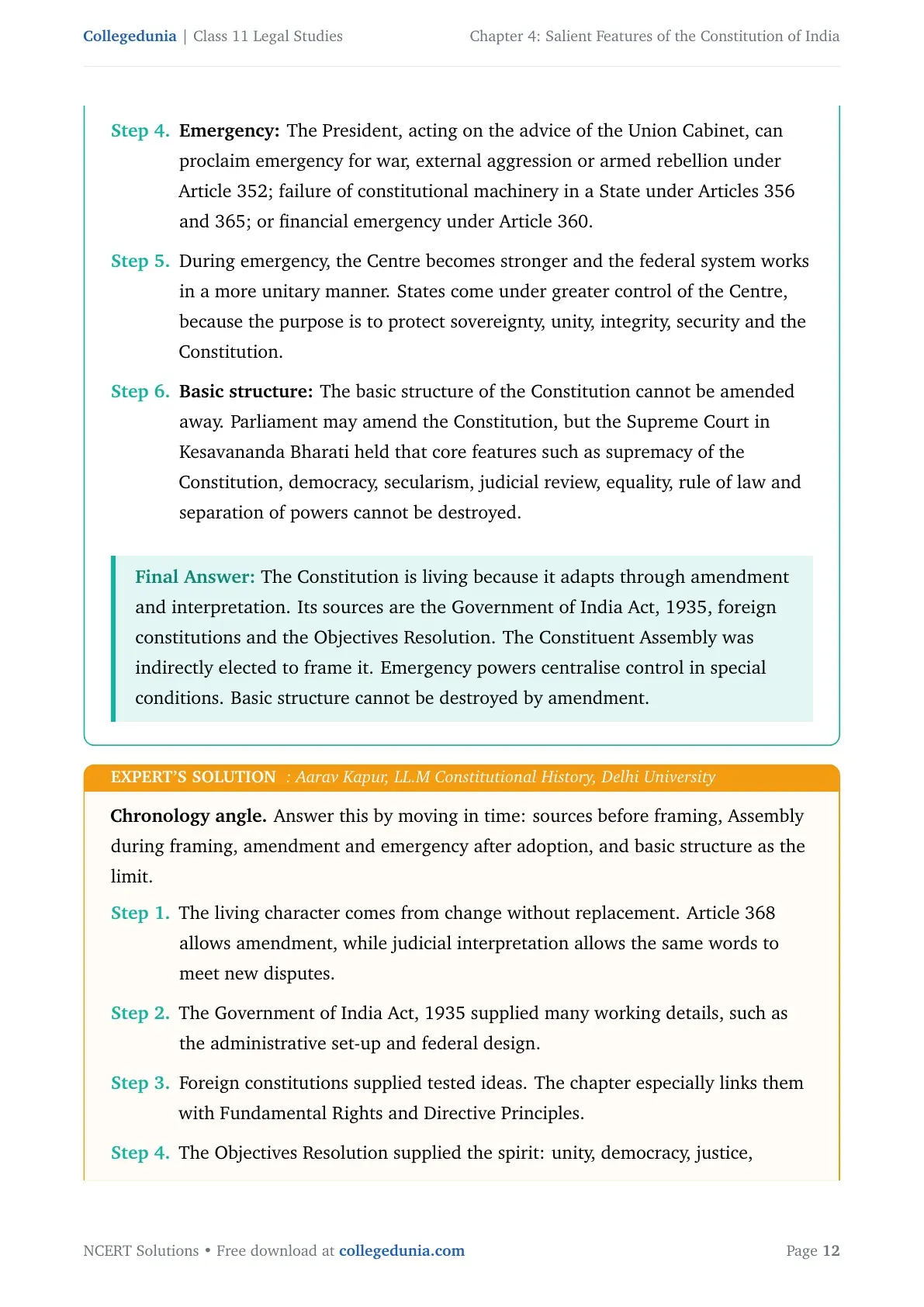
Emergency: The President, acting on the advice of the Union Cabinet, can proclaim emergency for war, external aggression or armed rebellion under Article 352; failure of constitutional machinery in a State under Articles 356 and 365; or financial emergency under Article 360.
During emergency, the Centre becomes stronger and the federal system works in a more unitary manner. States come under greater control of the Centre, because the purpose is to protect sovereignty, unity, integrity, security and the Constitution.
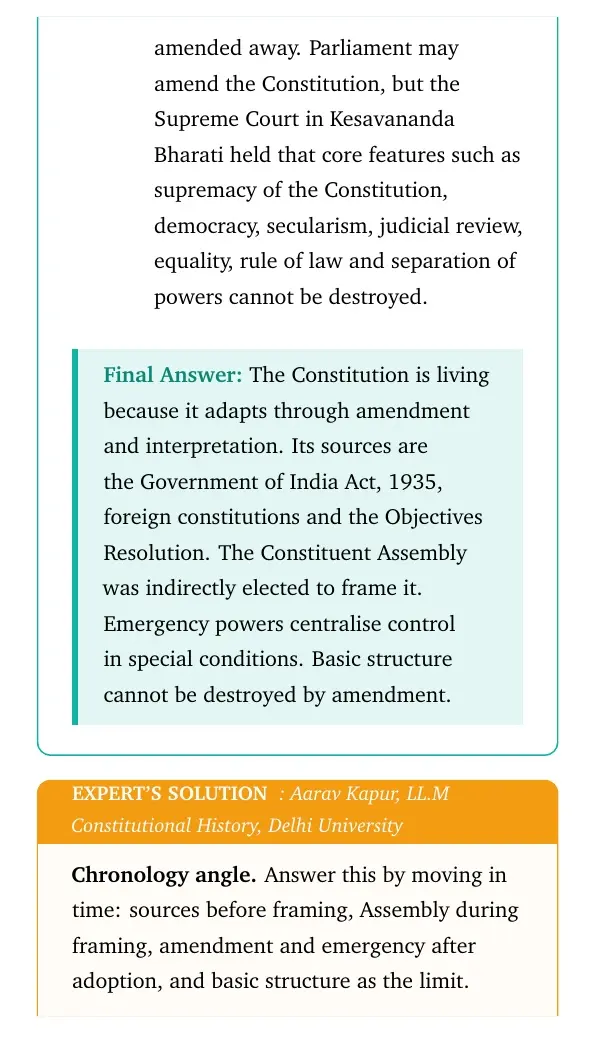
Basic structure: The basic structure of the Constitution cannot be amended away. Parliament may amend the Constitution, but the Supreme Court in Kesavananda Bharati held that core features such as supremacy of the Constitution, democracy, secularism, judicial review, equality, rule of law and separation of powers cannot be destroyed.
The Constitution is living because it adapts through amendment and interpretation. Its sources are the Government of India Act, 1935, foreign constitutions and the Objectives Resolution. The Constituent Assembly was indirectly elected to frame it. Emergency powers centralise control in special conditions. Basic structure cannot be destroyed by amendment.
AK
Aarav Kapur
LL.M Constitutional History, Delhi University
Verified Expert
Chronology angle. Answer this by moving in time: sources before framing, Assembly during framing, amendment and emergency after adoption, and basic structure as the limit.
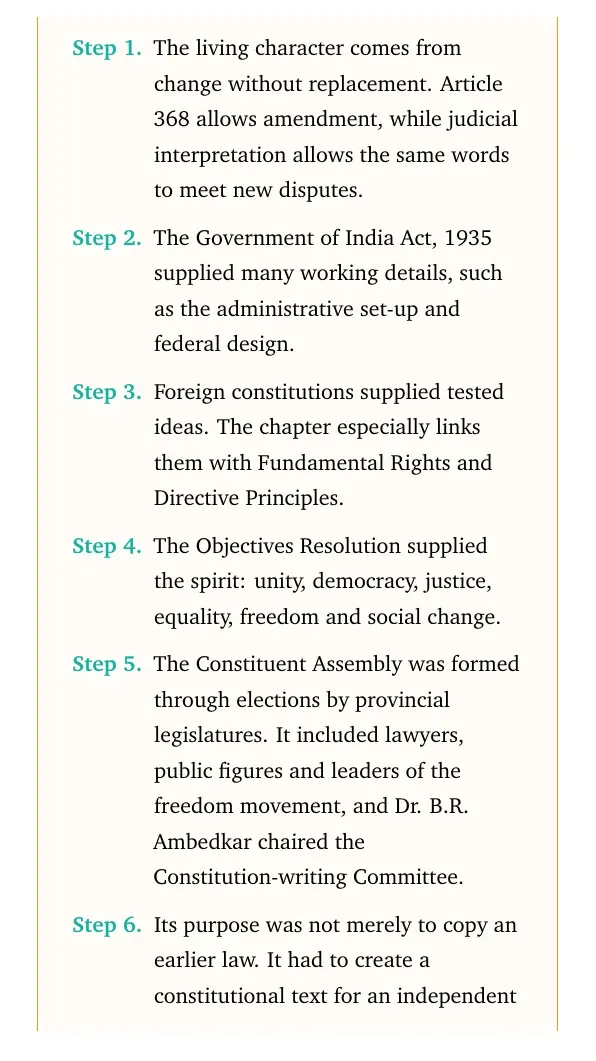
The living character comes from change without replacement. Article 368 allows amendment, while judicial interpretation allows the same words to meet new disputes.
The Government of India Act, 1935 supplied many working details, such as the administrative set-up and federal design.
Foreign constitutions supplied tested ideas. The chapter especially links them with Fundamental Rights and Directive Principles.
The Objectives Resolution supplied the spirit: unity, democracy, justice, equality, freedom and social change.
The Constituent Assembly was formed through elections by provincial legislatures. It included lawyers, public figures and leaders of the freedom movement, and Dr. B.R. Ambedkar chaired the Constitution-writing Committee.
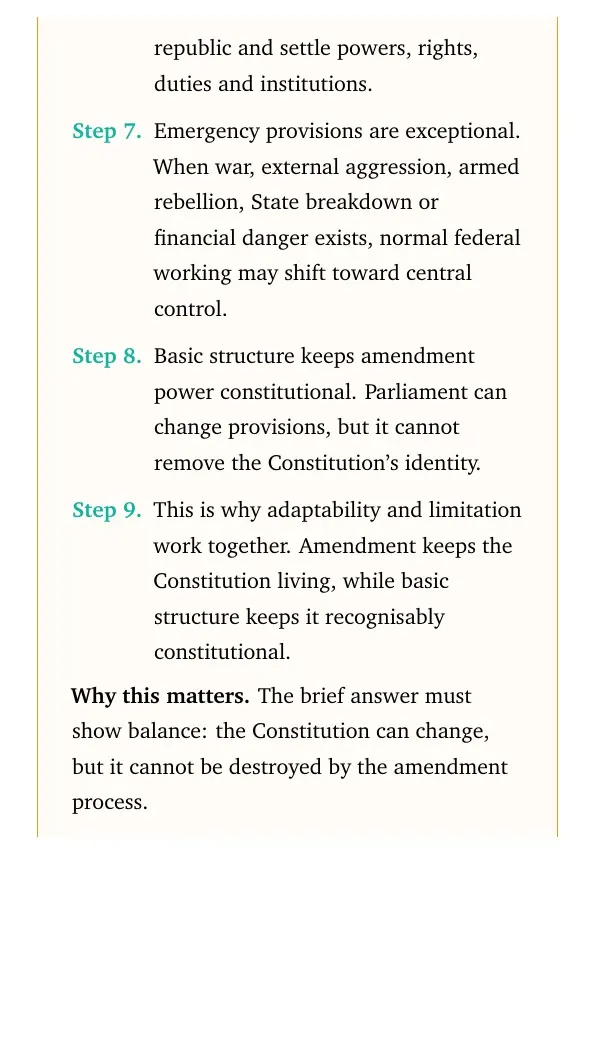
Its purpose was not merely to copy an earlier law. It had to create a constitutional text for an independent republic and settle powers, rights, duties and institutions.
Emergency provisions are exceptional. When war, external aggression, armed rebellion, State breakdown or financial danger exists, normal federal working may shift toward central control.
Basic structure keeps amendment power constitutional. Parliament can change provisions, but it cannot remove the Constitution's identity.
This is why adaptability and limitation work together. Amendment keeps the Constitution living, while basic structure keeps it recognisably constitutional.
Why this matters. The brief answer must show balance: the Constitution can change, but it cannot be destroyed by the amendment process.
The Constitution is adaptable but protected. It came from the 1935 Act, foreign constitutional examples and the Objectives Resolution; it was framed by the Constituent Assembly; emergency centralises power in listed conditions; and basic structure is beyond destructive amendment.
Q 4.5
Answer the following in about 200 words: (1) Describe any six features of the Constitution of India. (2) What is the importance of Fundamental Rights in a democratic country like India?
Concept used. A 200-word answer should select six features and explain their importance briefly. The second part should link Fundamental Rights with democracy, dignity and judicial remedy.
Written and detailed Constitution: India has one of the lengthiest written constitutions. It covers institutions, powers, rights, duties, emergency provisions, language, citizenship and many administrative details.
Preamble: The Preamble states the ideals of sovereignty, socialism, secularism, democracy, republic, justice, liberty, equality and fraternity. It gives direction to constitutional interpretation.
Parliamentary democracy: India follows a parliamentary system. The executive is responsible to the legislature, and the Council of Ministers works under the leadership of the Prime Minister.
Fundamental Rights: These rights protect individual liberty and equality. Citizens can approach courts when these rights are violated.
Directive Principles: These principles guide the State toward welfare, social justice, equal pay, livelihood, health and better living conditions.
Independent judiciary: Courts interpret the Constitution, protect rights and review unconstitutional laws and executive action.
Importance of Fundamental Rights: In a democracy, rights stop majority power from becoming arbitrary. They protect dignity, free speech, equality, religious freedom and minority interests.
Fundamental Rights also make the Constitution enforceable. Article 32 lets a person approach the Supreme Court, and Article 226 lets a person approach a High Court for writ remedies.
Six features are a written and detailed Constitution, Preamble, parliamentary democracy, Fundamental Rights, Directive Principles and an independent judiciary. Fundamental Rights are vital because they protect liberty, equality, dignity and minority interests, and they give citizens court remedies against unconstitutional State action.
DS
Devika Suri
LL.M Human Rights Law, NLSIU Bengaluru
Verified Expert
Rights-first angle. Use six features to show the Constitution's design, then explain Fundamental Rights as the part that lets citizens enforce that design.
A written Constitution creates certainty because powers and limits are recorded in one constitutional text.
The Preamble supplies values. It tells courts, lawmakers and citizens the goals behind the text.
Parliamentary democracy keeps the executive answerable to elected representatives.
Fundamental Rights protect the citizen against arbitrary State action. Equality before law, freedom and remedies are central to democracy.
Directive Principles widen the idea of justice by directing the State toward welfare and social change.
An independent judiciary makes these promises meaningful by reviewing laws and executive decisions.
Fundamental Rights matter in India because democracy is not only rule by majority. It also requires limits on power, respect for dignity and protection for groups that may be vulnerable.
The right to constitutional remedies gives rights real force. A right without remedy would be only a moral claim.
Why this matters. A strong answer connects rights with the democratic promise in the Preamble: justice, liberty, equality and fraternity.
Fundamental Rights are important because they turn democratic ideals into enforceable limits on State power. They protect dignity, liberty and equality, while courts provide remedies when those rights are violated.
Q 4.6
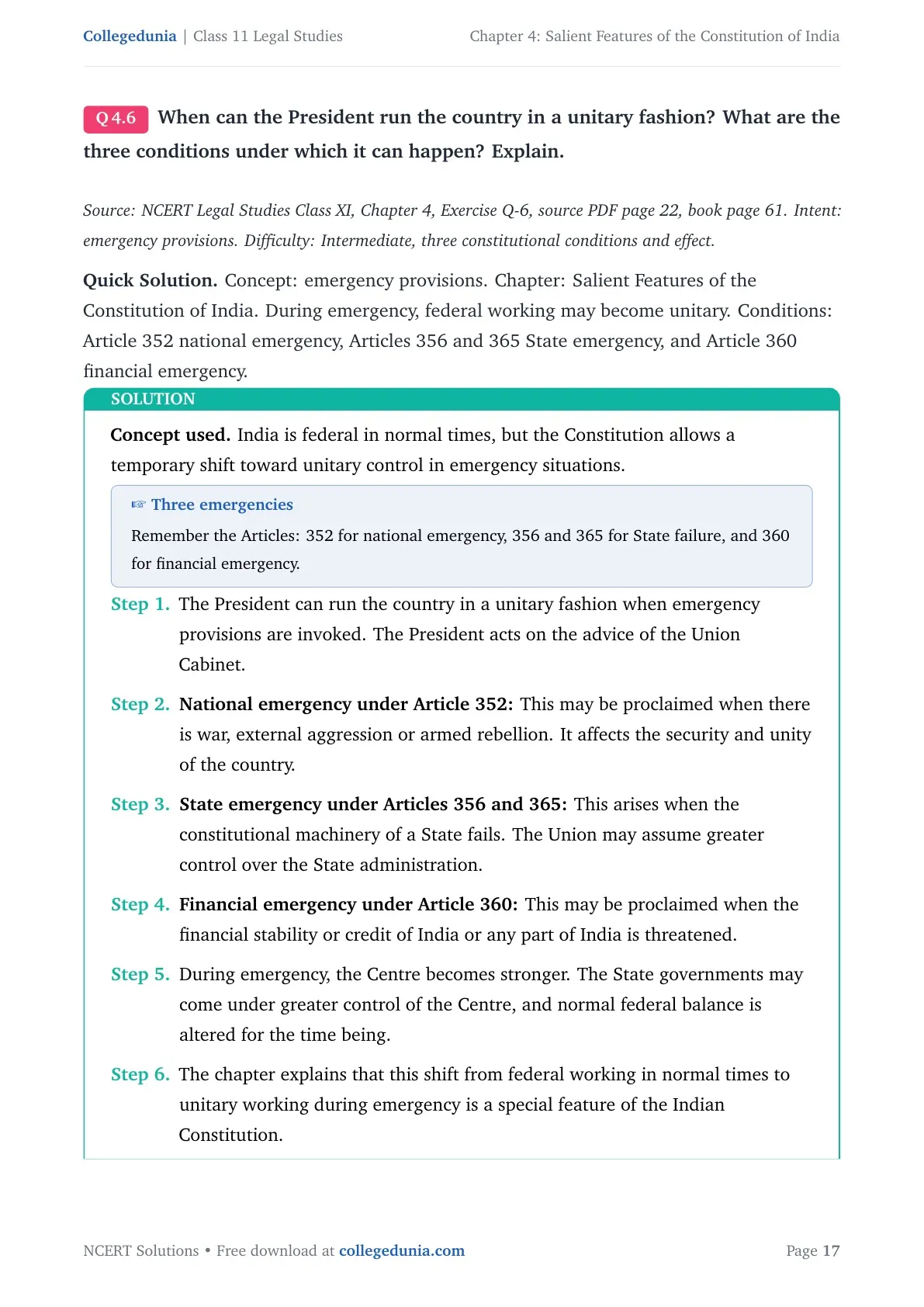
When can the President run the country in a unitary fashion? What are the three conditions under which it can happen? Explain.
Concept used. India is federal in normal times, but the Constitution allows a temporary shift toward unitary control in emergency situations.
Three emergencies
Remember the Articles: 352 for national emergency, 356 and 365 for State failure, and 360 for financial emergency.
The President can run the country in a unitary fashion when emergency provisions are invoked. The President acts on the advice of the Union Cabinet.
National emergency under Article 352: This may be proclaimed when there is war, external aggression or armed rebellion. It affects the security and unity of the country.
State emergency under Articles 356 and 365: This arises when the constitutional machinery of a State fails. The Union may assume greater control over the State administration.
Financial emergency under Article 360: This may be proclaimed when the financial stability or credit of India or any part of India is threatened.
During emergency, the Centre becomes stronger. The State governments may come under greater control of the Centre, and normal federal balance is altered for the time being.
The chapter explains that this shift from federal working in normal times to unitary working during emergency is a special feature of the Indian Constitution.
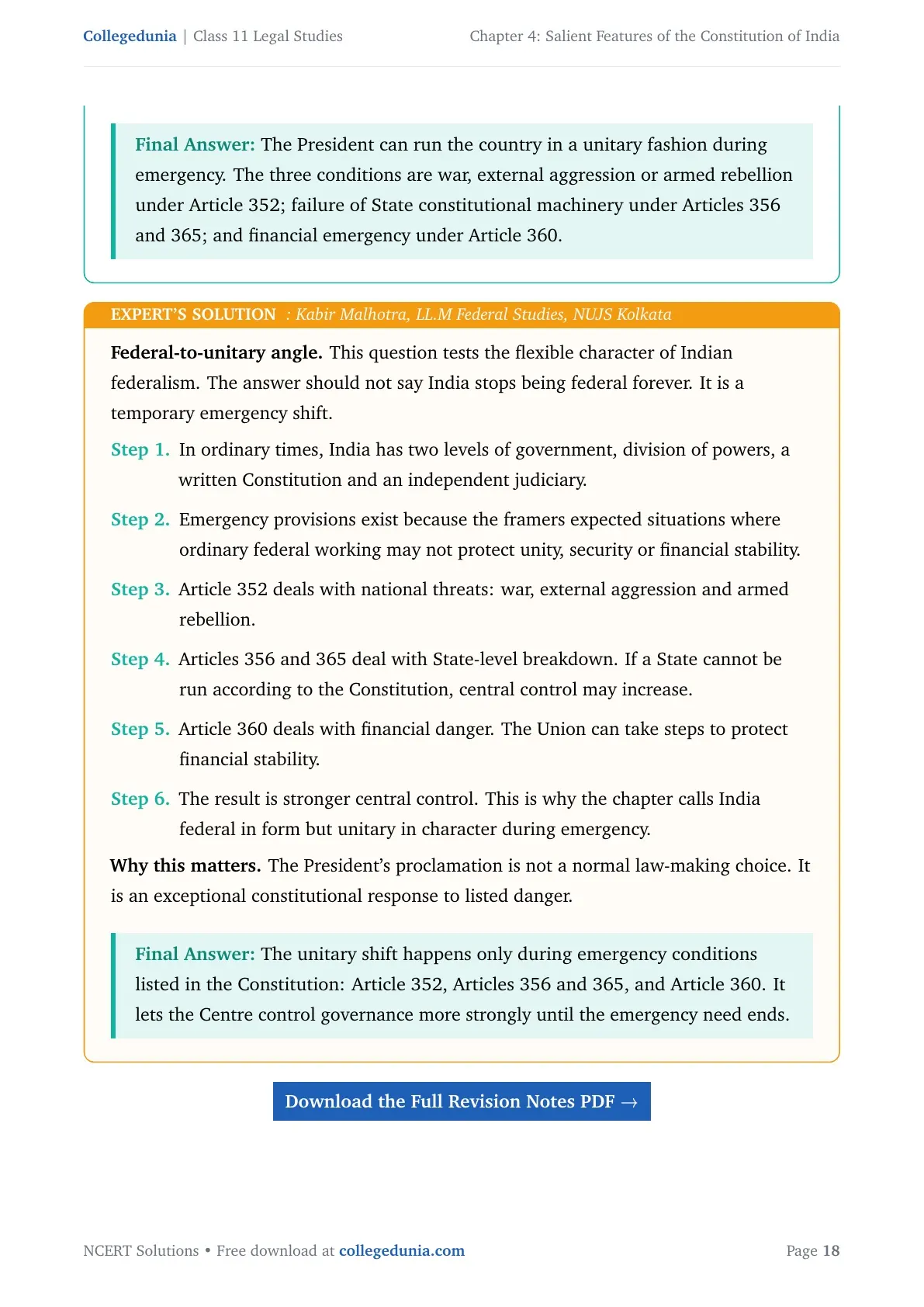
The President can run the country in a unitary fashion during emergency. The three conditions are war, external aggression or armed rebellion under Article 352; failure of State constitutional machinery under Articles 356 and 365; and financial emergency under Article 360.
KM
Kabir Malhotra
LL.M Federal Studies, NUJS Kolkata
Verified Expert
Federal-to-unitary angle. This question tests the flexible character of Indian federalism. The answer should not say India stops being federal forever. It is a temporary emergency shift.
In ordinary times, India has two levels of government, division of powers, a written Constitution and an independent judiciary.
Emergency provisions exist because the framers expected situations where ordinary federal working may not protect unity, security or financial stability.
Article 352 deals with national threats: war, external aggression and armed rebellion.
Articles 356 and 365 deal with State-level breakdown. If a State cannot be run according to the Constitution, central control may increase.
Article 360 deals with financial danger. The Union can take steps to protect financial stability.
The result is stronger central control. This is why the chapter calls India federal in form but unitary in character during emergency.
Why this matters. The President's proclamation is not a normal law-making choice. It is an exceptional constitutional response to listed danger.
The unitary shift happens only during emergency conditions listed in the Constitution: Article 352, Articles 356 and 365, and Article 360. It lets the Centre control governance more strongly until the emergency need ends.
Q 4.7
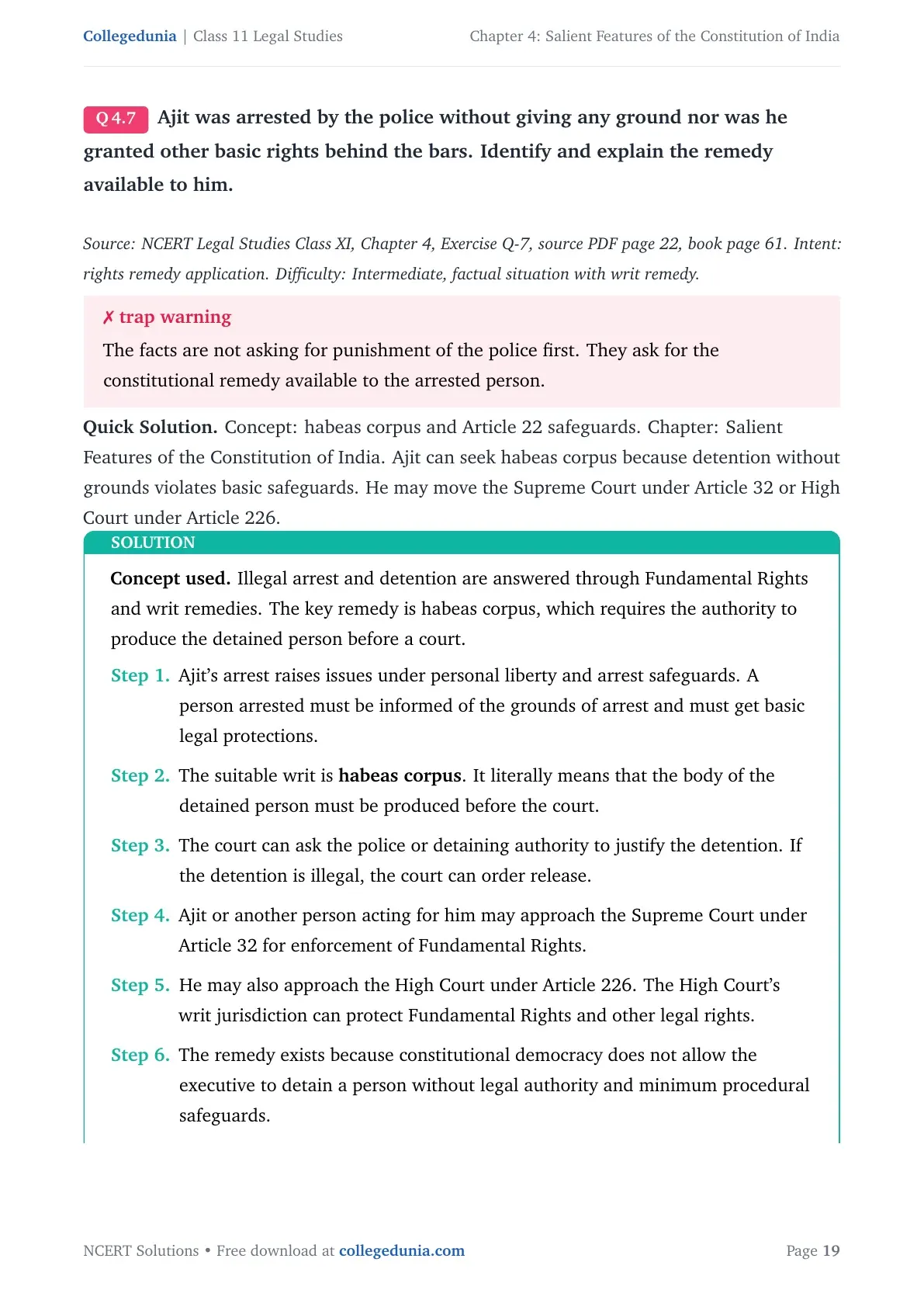
Ajit was arrested by the police without giving any ground nor was he granted other basic rights behind the bars. Identify and explain the remedy available to him.
Concept used. Illegal arrest and detention are answered through Fundamental Rights and writ remedies. The key remedy is habeas corpus, which requires the authority to produce the detained person before a court.
Ajit's arrest raises issues under personal liberty and arrest safeguards. A person arrested must be informed of the grounds of arrest and must get basic legal protections.
The suitable writ is habeas corpus. It literally means that the body of the detained person must be produced before the court.
The court can ask the police or detaining authority to justify the detention. If the detention is illegal, the court can order release.
Ajit or another person acting for him may approach the Supreme Court under Article 32 for enforcement of Fundamental Rights.
He may also approach the High Court under Article 226. The High Court's writ jurisdiction can protect Fundamental Rights and other legal rights.
The remedy exists because constitutional democracy does not allow the executive to detain a person without legal authority and minimum procedural safeguards.
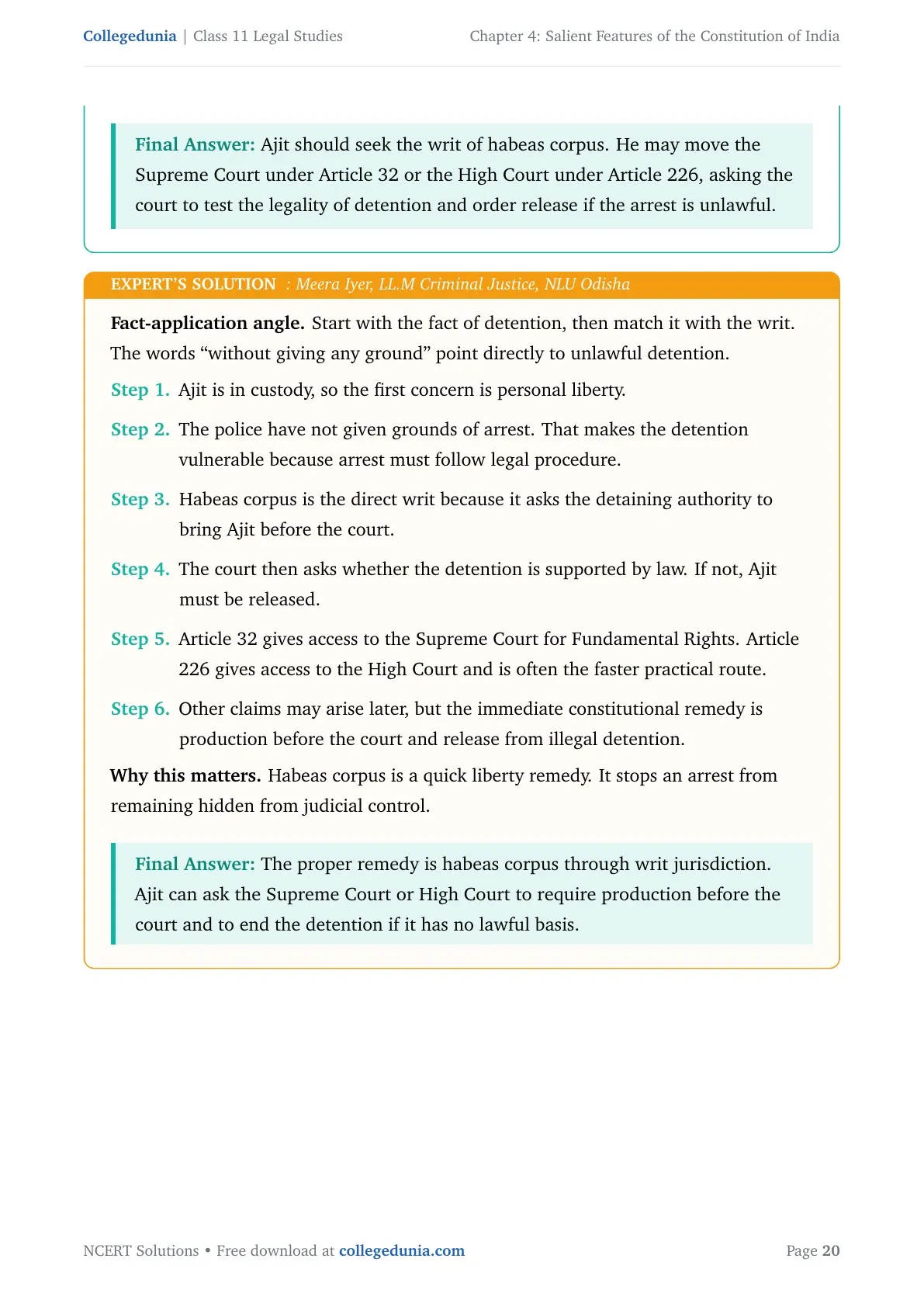
Ajit should seek the writ of habeas corpus. He may move the Supreme Court under Article 32 or the High Court under Article 226, asking the court to test the legality of detention and order release if the arrest is unlawful.
MI
Meera Iyer
LL.M Criminal Justice, NLU Odisha
Verified Expert
Fact-application angle. Start with the fact of detention, then match it with the writ. The words ``without giving any ground'' point directly to unlawful detention.
Ajit is in custody, so the first concern is personal liberty.
The police have not given grounds of arrest. That makes the detention vulnerable because arrest must follow legal procedure.
Habeas corpus is the direct writ because it asks the detaining authority to bring Ajit before the court.
The court then asks whether the detention is supported by law. If not, Ajit must be released.
Article 32 gives access to the Supreme Court for Fundamental Rights. Article 226 gives access to the High Court and is often the faster practical route.
Other claims may arise later, but the immediate constitutional remedy is production before the court and release from illegal detention.
Why this matters. Habeas corpus is a quick liberty remedy. It stops an arrest from remaining hidden from judicial control.
The proper remedy is habeas corpus through writ jurisdiction. Ajit can ask the Supreme Court or High Court to require production before the court and to end the detention if it has no lawful basis.
Q 4.8
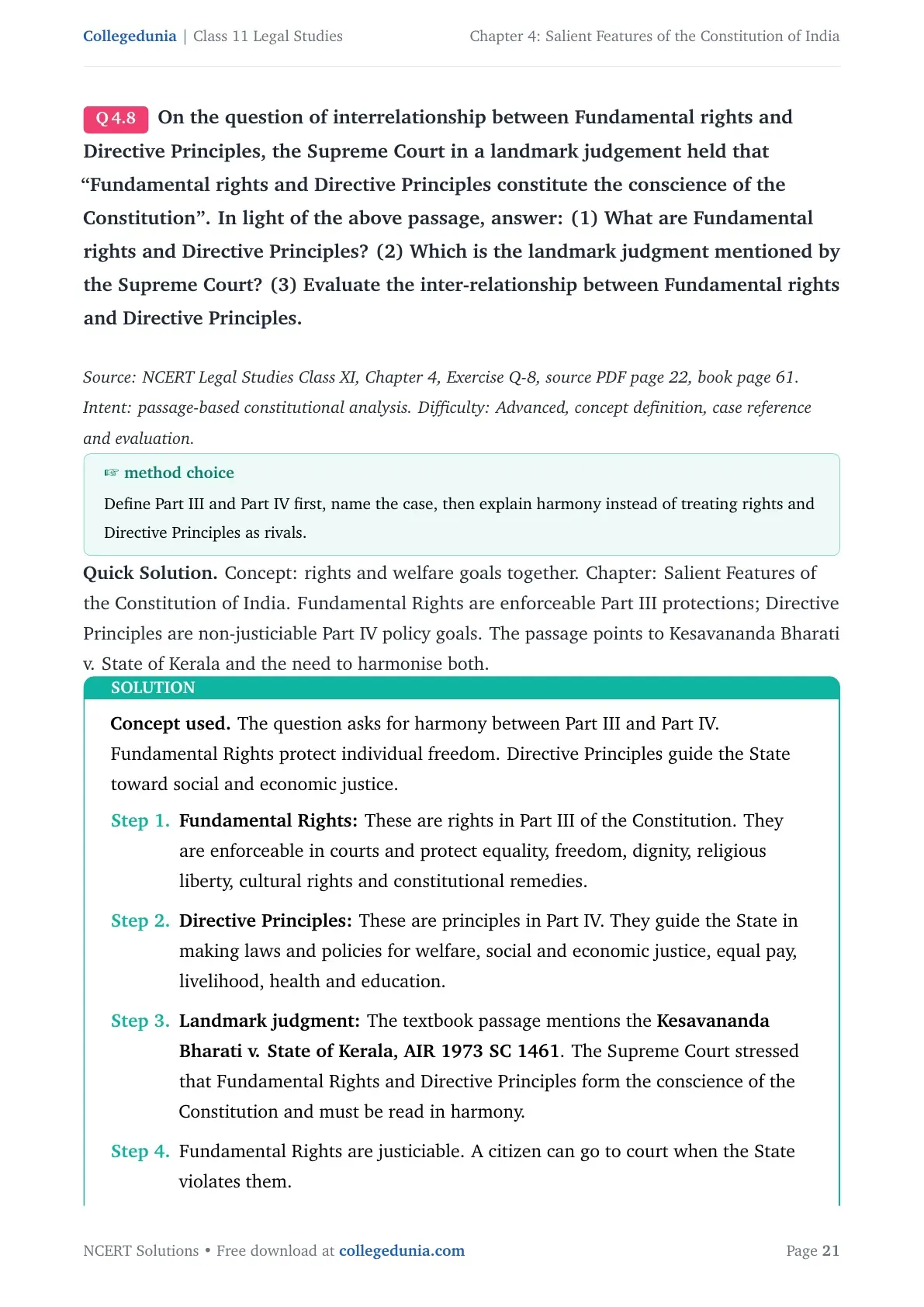
On the question of interrelationship between Fundamental rights and Directive Principles, the Supreme Court in a landmark judgement held that ``Fundamental rights and Directive Principles constitute the conscience of the Constitution''. In light of the above passage, answer: (1) What are Fundamental rights and Directive Principles? (2) Which is the landmark judgment mentioned by the Supreme Court? (3) Evaluate the inter-relationship between Fundamental rights and Directive Principles.
Concept used. The question asks for harmony between Part III and Part IV. Fundamental Rights protect individual freedom. Directive Principles guide the State toward social and economic justice.
Fundamental Rights: These are rights in Part III of the Constitution. They are enforceable in courts and protect equality, freedom, dignity, religious liberty, cultural rights and constitutional remedies.
Directive Principles: These are principles in Part IV. They guide the State in making laws and policies for welfare, social and economic justice, equal pay, livelihood, health and education.
Landmark judgment: The textbook passage mentions the Kesavananda Bharati v. State of Kerala, AIR 1973 SC 1461. The Supreme Court stressed that Fundamental Rights and Directive Principles form the conscience of the Constitution and must be read in harmony.
Fundamental Rights are justiciable. A citizen can go to court when the State violates them.
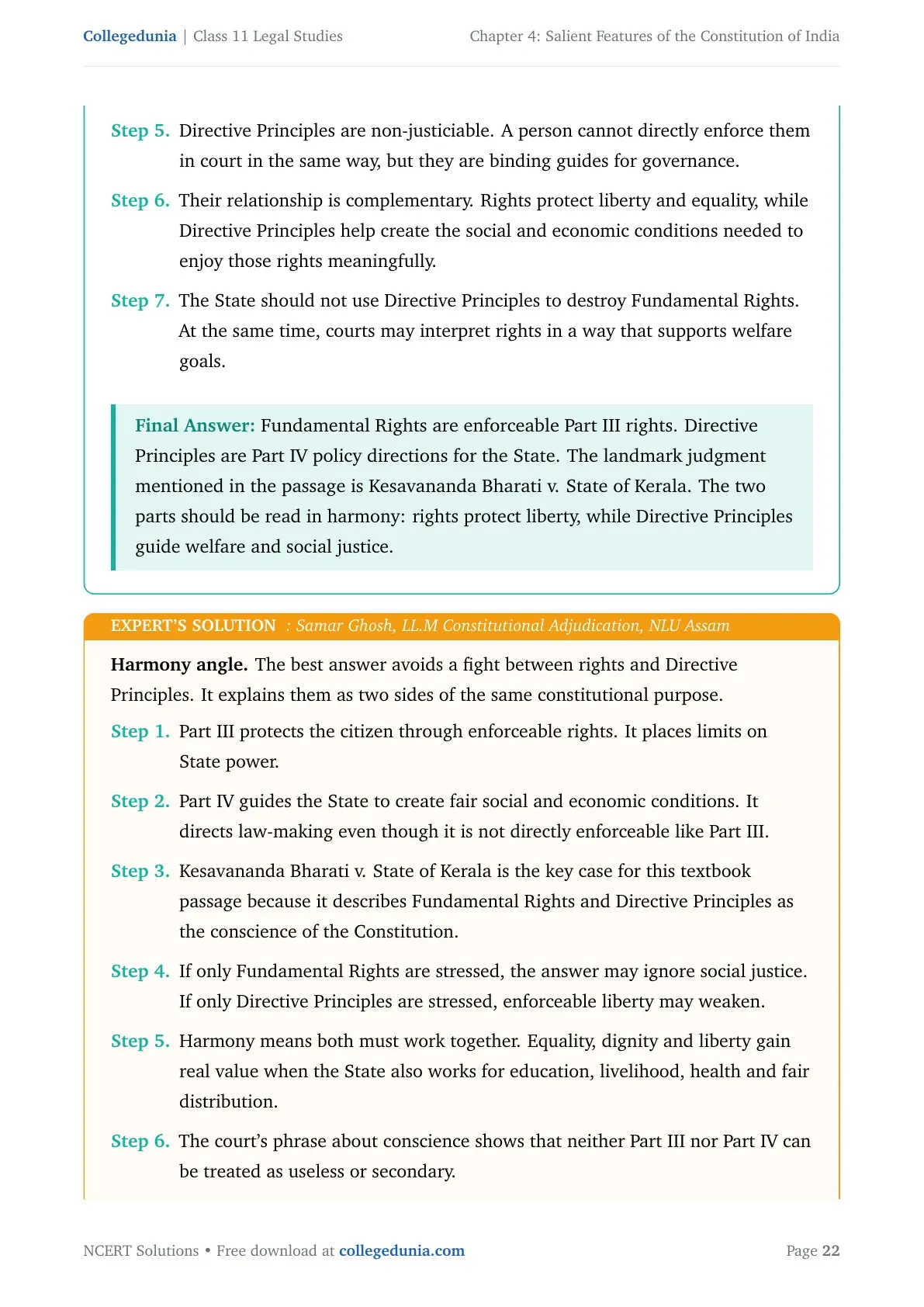
Directive Principles are non-justiciable. A person cannot directly enforce them in court in the same way, but they are binding guides for governance.
Their relationship is complementary. Rights protect liberty and equality, while Directive Principles help create the social and economic conditions needed to enjoy those rights meaningfully.
The State should not use Directive Principles to destroy Fundamental Rights. At the same time, courts may interpret rights in a way that supports welfare goals.
Fundamental Rights are enforceable Part III rights. Directive Principles are Part IV policy directions for the State. The landmark judgment mentioned in the passage is Kesavananda Bharati v. State of Kerala. The two parts should be read in harmony: rights protect liberty, while Directive Principles guide welfare and social justice.
SG
Samar Ghosh
LL.M Constitutional Adjudication, NLU Assam
Verified Expert
Harmony angle. The best answer avoids a fight between rights and Directive Principles. It explains them as two sides of the same constitutional purpose.
Part III protects the citizen through enforceable rights. It places limits on State power.
Part IV guides the State to create fair social and economic conditions. It directs law-making even though it is not directly enforceable like Part III.
Kesavananda Bharati v. State of Kerala is the key case for this textbook passage because it describes Fundamental Rights and Directive Principles as the conscience of the Constitution.
If only Fundamental Rights are stressed, the answer may ignore social justice. If only Directive Principles are stressed, enforceable liberty may weaken.
Harmony means both must work together. Equality, dignity and liberty gain real value when the State also works for education, livelihood, health and fair distribution.
The court's phrase about conscience shows that neither Part III nor Part IV can be treated as useless or secondary.
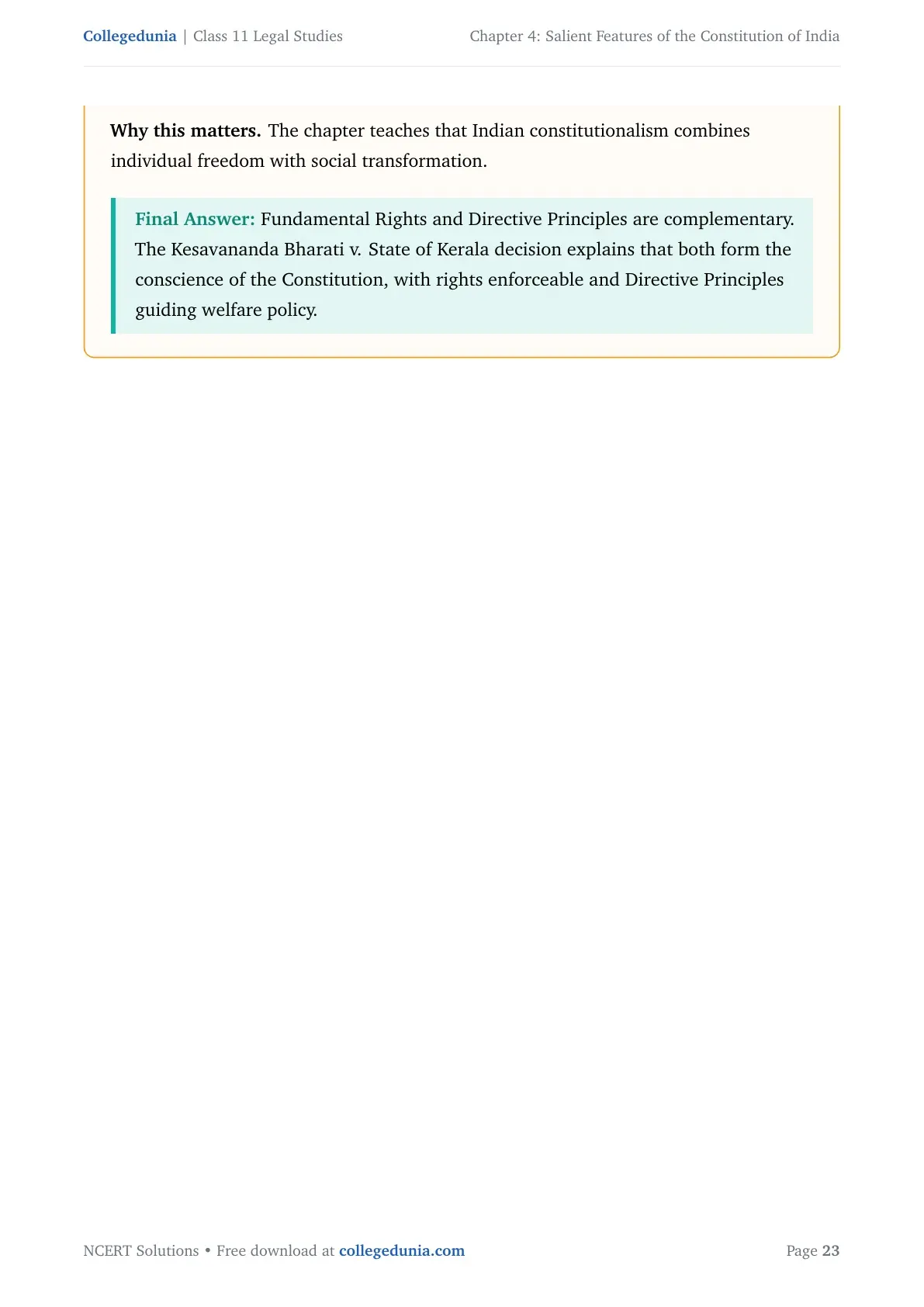
Why this matters. The chapter teaches that Indian constitutionalism combines individual freedom with social transformation.
Fundamental Rights and Directive Principles are complementary. The Kesavananda Bharati v. State of Kerala decision explains that both form the conscience of the Constitution, with rights enforceable and Directive Principles guiding welfare policy.
Q 4.9
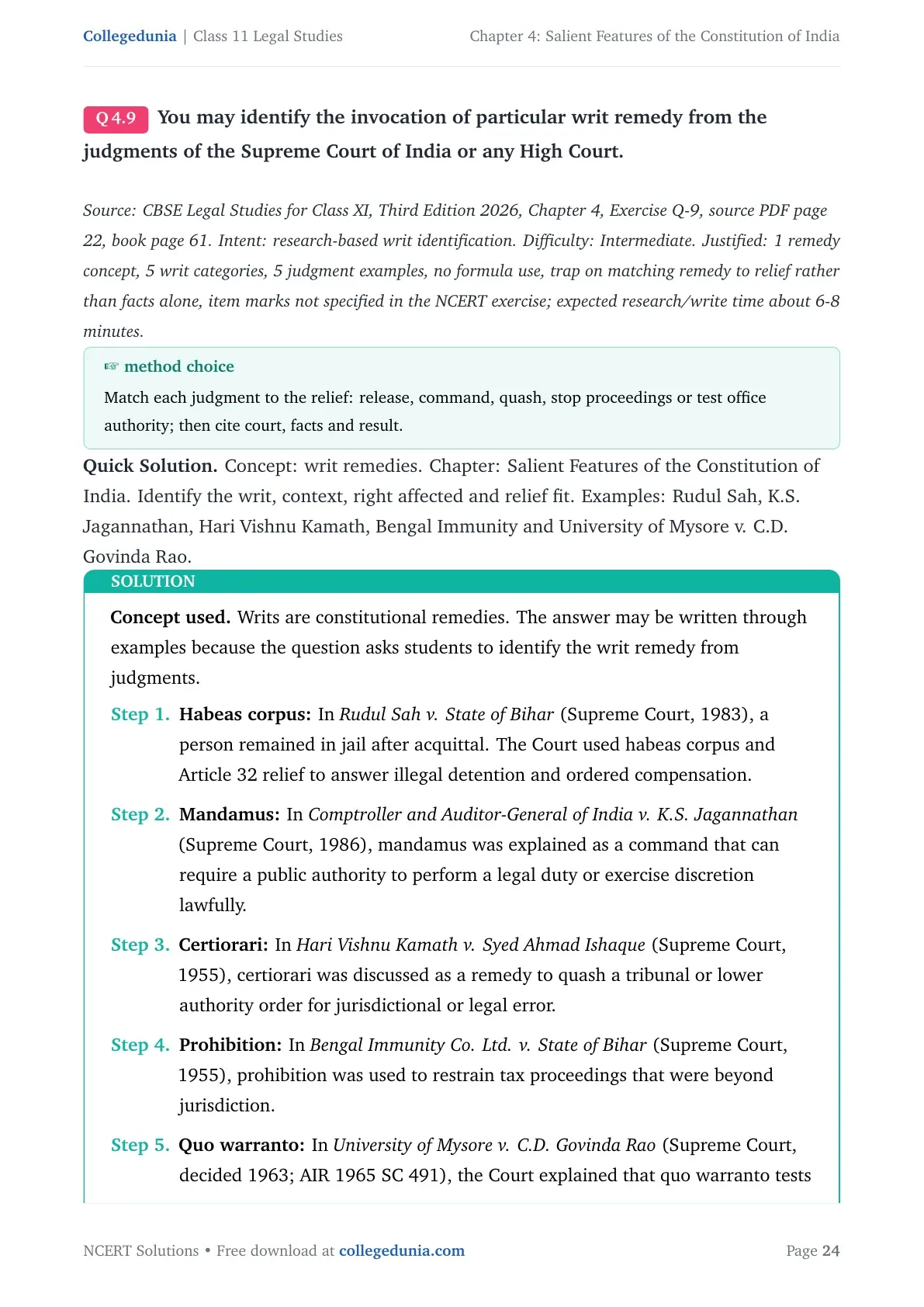
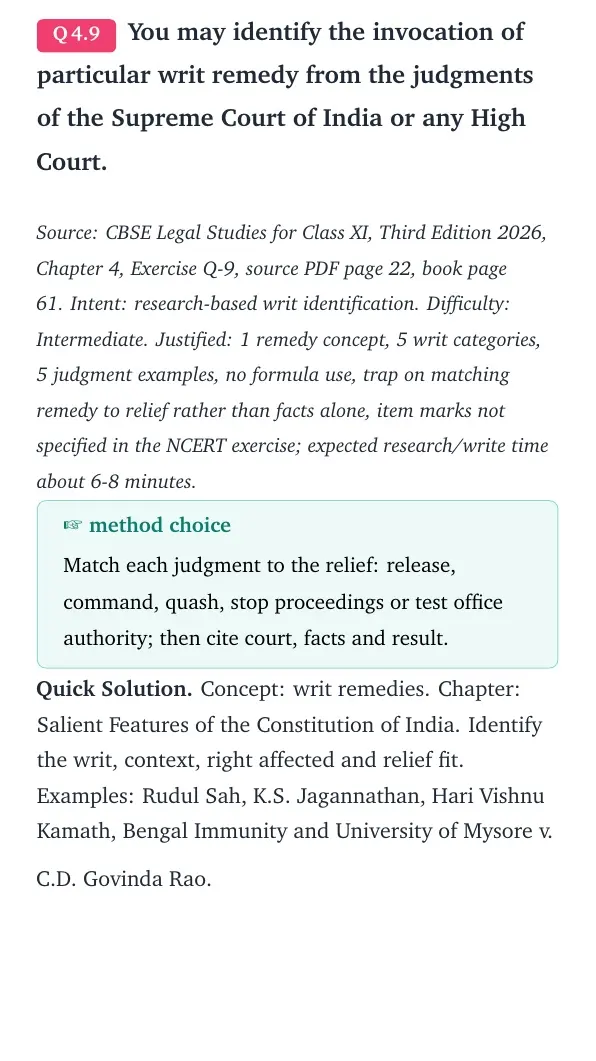
You may identify the invocation of particular writ remedy from the judgments of the Supreme Court of India or any High Court.
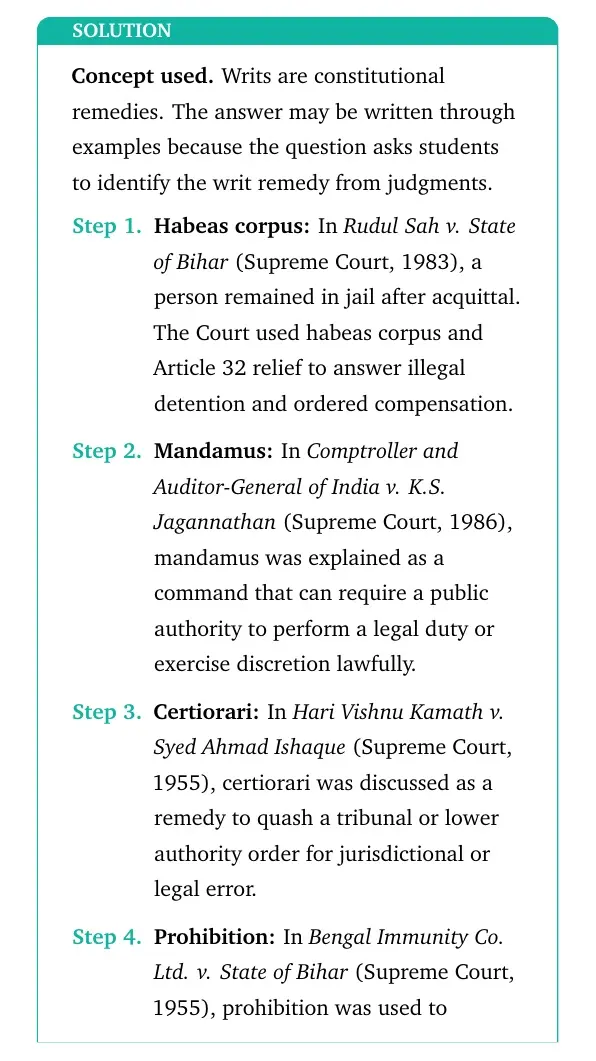
Concept used. Writs are constitutional remedies. The answer may be written through examples because the question asks students to identify the writ remedy from judgments.
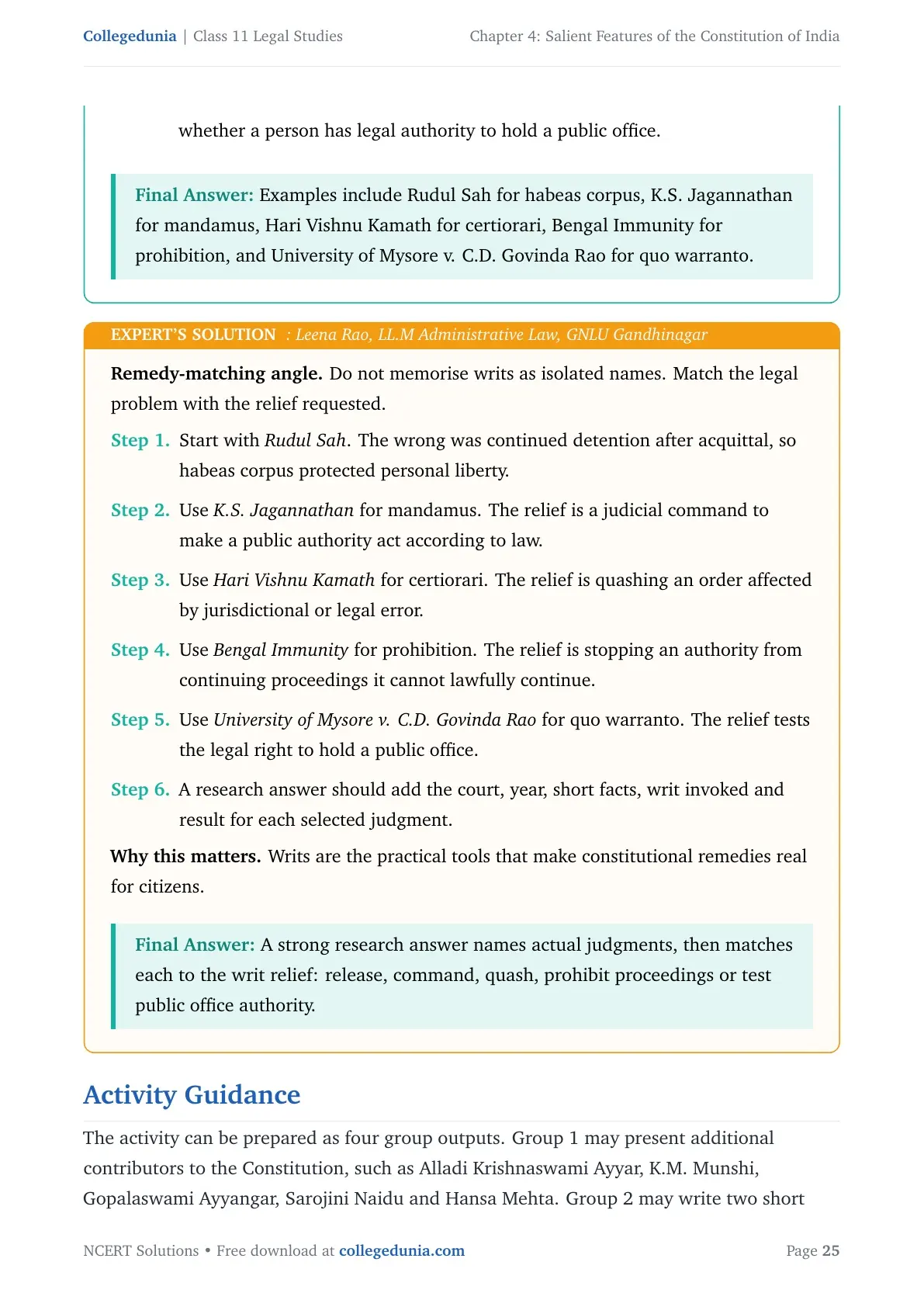
Habeas corpus: In Rudul Sah v. State of Bihar (Supreme Court, 1983), a person remained in jail after acquittal. The Court used habeas corpus and Article 32 relief to answer illegal detention and ordered compensation.
Mandamus: In Comptroller and Auditor-General of India v. K.S. Jagannathan (Supreme Court, 1986), mandamus was explained as a command that can require a public authority to perform a legal duty or exercise discretion lawfully.
Certiorari: In Hari Vishnu Kamath v. Syed Ahmad Ishaque (Supreme Court, 1955), certiorari was discussed as a remedy to quash a tribunal or lower authority order for jurisdictional or legal error.
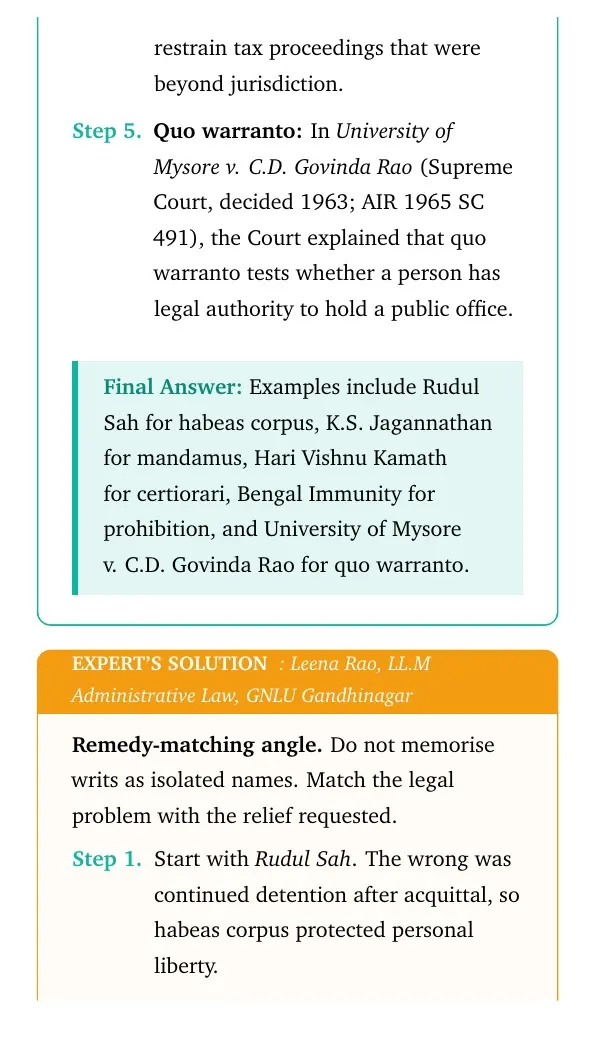
Prohibition: In Bengal Immunity Co. Ltd. v. State of Bihar (Supreme Court, 1955), prohibition was used to restrain tax proceedings that were beyond jurisdiction.
Quo warranto: In University of Mysore v. C.D. Govinda Rao (Supreme Court, decided 1963; AIR 1965 SC 491), the Court explained that quo warranto tests whether a person has legal authority to hold a public office.
Examples include Rudul Sah for habeas corpus, K.S. Jagannathan for mandamus, Hari Vishnu Kamath for certiorari, Bengal Immunity for prohibition, and University of Mysore v. C.D. Govinda Rao for quo warranto.
LR
Leena Rao
LL.M Administrative Law, GNLU Gandhinagar
Verified Expert
Remedy-matching angle. Do not memorise writs as isolated names. Match the legal problem with the relief requested.
Start with Rudul Sah. The wrong was continued detention after acquittal, so habeas corpus protected personal liberty.
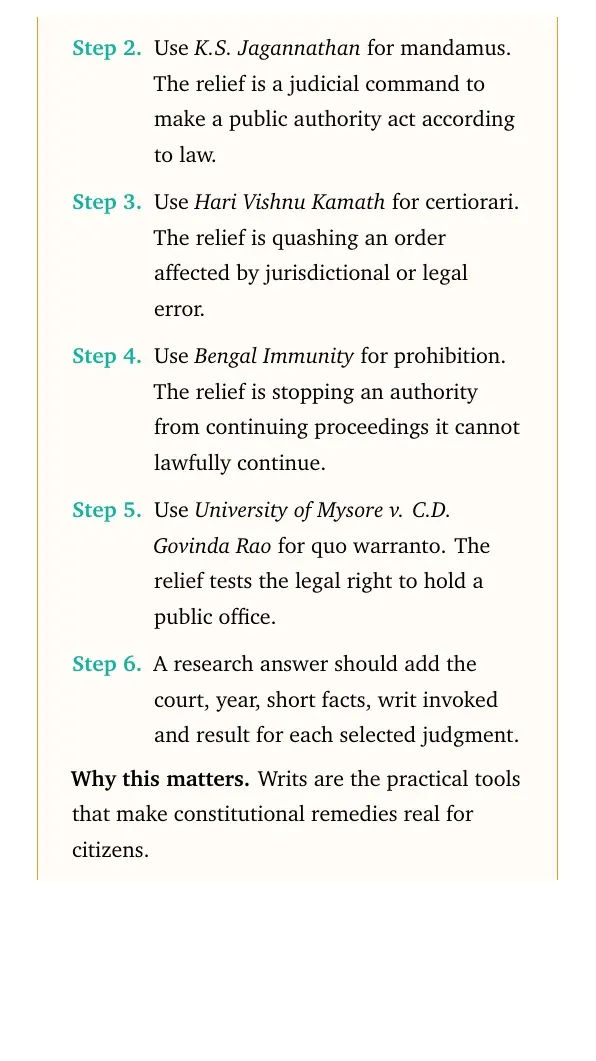
Use K.S. Jagannathan for mandamus. The relief is a judicial command to make a public authority act according to law.
Use Hari Vishnu Kamath for certiorari. The relief is quashing an order affected by jurisdictional or legal error.
Use Bengal Immunity for prohibition. The relief is stopping an authority from continuing proceedings it cannot lawfully continue.
Use University of Mysore v. C.D. Govinda Rao for quo warranto. The relief tests the legal right to hold a public office.
A research answer should add the court, year, short facts, writ invoked and result for each selected judgment.
Why this matters. Writs are the practical tools that make constitutional remedies real for citizens.
A strong research answer names actual judgments, then matches each to the writ relief: release, command, quash, prohibit proceedings or test public office authority.
Frequently Asked Questions
Legal Studies Chapter 4 Help
Ques. What is covered in NCERT Solutions for Class 11 Legal Studies Chapter 4?
Ans. The solutions cover all 9 exercise prompts from Salient Features of the Constitution of India, including case notes, Fundamental Rights, Directive Principles, writs, emergency provisions and basic structure.
Ques. Which writ remedy applies to Ajit's illegal detention question?
Ans. The main remedy is habeas corpus. Ajit may approach the Supreme Court under Article 32 or a High Court under Article 226 to test the legality of detention.
Ques. Which case explains the relationship between Fundamental Rights and Directive Principles?
Ans. Kesavananda Bharati v. State of Kerala is the chapter's cited case for harmony between Fundamental Rights and Directive Principles. The answer should explain that both parts form the conscience of the Constitution.







Comments