The NCERT Solutions for Class 11 Legal Studies Chapter 3 Separation of Powers cover all 6 exercise prompts from the latest 2026-27 syllabus. Each answer explains Article 368, Montesquieu's doctrine, checks and balances, the USA model, the British parliamentary model and India's flexible constitutional practice in an exam-ready format.
Exercise count: 6 solved prompts with detailed solution and expert solution blocks.
Most-tested idea: how law-making, law-executing and law-interpreting powers are divided and checked.
Best revision method: revise the country comparison table before writing long answers.
Separation of Powers Class 11 Legal Studies NCERT Solutions PDF
Student Feedback: Students usually score better in this chapter when they write both parts of the doctrine: separation of functions and checks on misuse of power. Use who makes law, who executes law and who reviews law as the quick recall frame.
Exercise Pattern for Separation of Powers Class 11 Legal Studies
Separation of Powers has short-note, brief-answer, 200-word, comparison and application-based prompts. The chapter does not require calculations. It checks whether students can connect a legal doctrine with actual constitutional practice in India, the United Kingdom and the United States of America.
Question type
What to write
Useful answer cue
Short note
Meaning plus identifying feature
Article 368, Britain, USA, doctrine
Brief answer
List points under separate subheadings
Basic structure, Wade and Phillips, Montesquieu
Evaluation
Give advantages, defects and conclusion
Liberty, accountability, coordination, delay
Application
Apply the doctrine to a country or quoted case
Strict separation or flexible checks
Separation of Powers Concept in Class 11 Legal Studies
The concept means that the three main functions of government should not be concentrated in one authority. The legislature makes laws, the executive implements them, and the judiciary interprets law and decides disputes. A strong NCERT answer also states that modern constitutions use checks and balances so that separation does not become complete isolation.
Legislature: frames laws, debates public policy and controls public finance.
Executive: administers the State, enforces law and carries out public policy.
Judiciary: interprets law, protects legal rights and reviews unconstitutional action.
Article 368 gives Parliament the formal power to amend the Constitution of India. The chapter links this power with the basic structure doctrine because Parliament's amendment power is not unlimited. The Supreme Court has held that basic features such as supremacy of the Constitution, democratic government, judicial review, separation of powers, independent judiciary, equality and rule of law cannot be destroyed through amendment.
Term
Meaning for answer writing
Scoring point
Article 368
Procedure and power to amend the Constitution
Parliament can amend but cannot destroy basic structure
Basic structure
Core identity of the Constitution
Includes judicial review, rule of law and separation of powers
Judicial review
Court power to test legality
Works as a check on legislative and executive action
Wade and Phillips Interpretation of Separation of Powers
Wade and Phillips explain the doctrine through three connected rules. The same persons should not form part of more than one organ of government. One organ should not control the functions of another organ. One organ should not exercise the functions of another organ. In the NCERT exercise, these three points should be written as a numbered list because the question asks for a brief answer.
Membership should remain distinct as far as the constitutional system allows.
Control over another organ's essential function should be avoided.
Exercise of another organ's core function should be constitutionally limited.
USA, India and United Kingdom Separation of Powers Compared
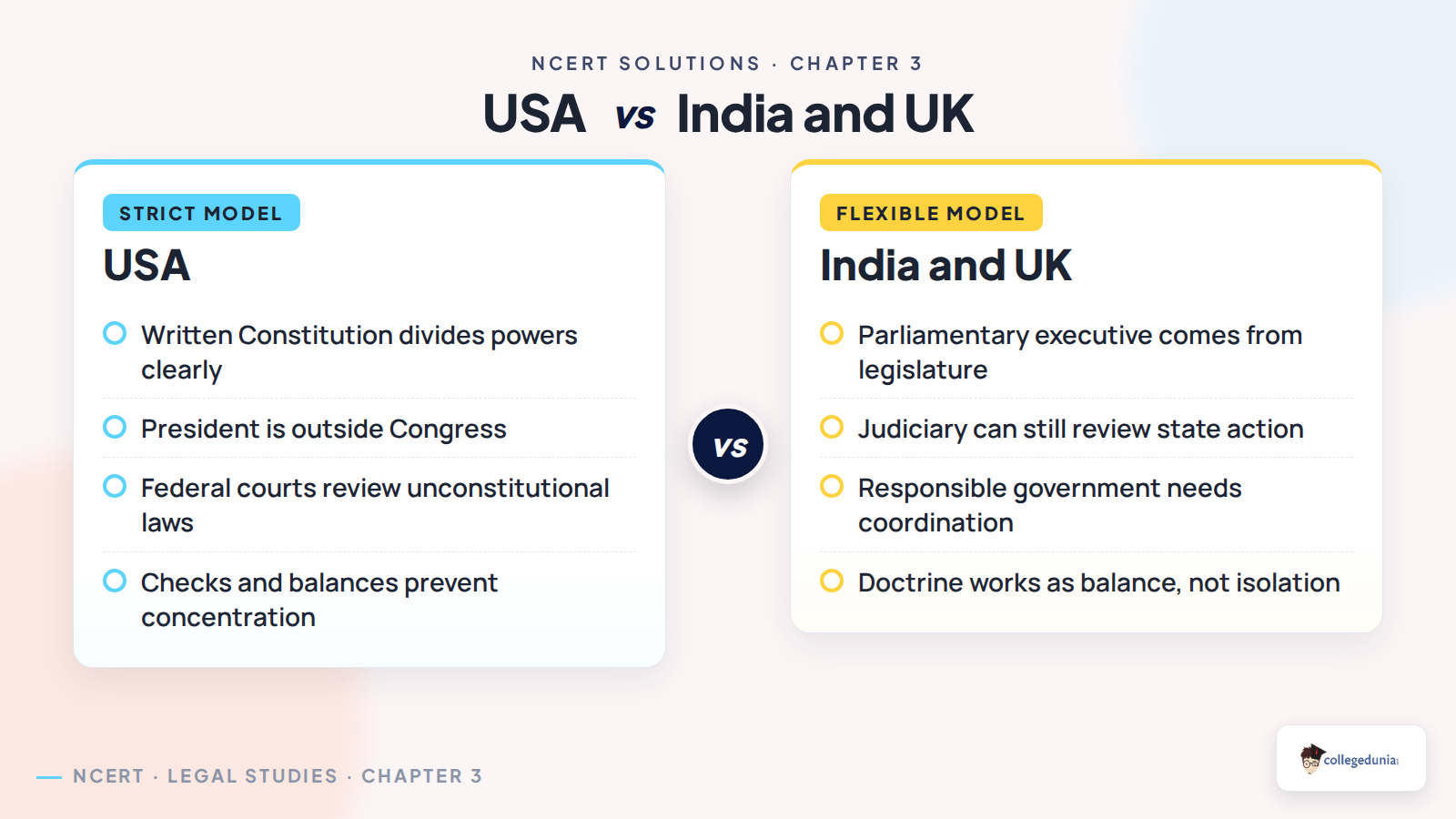
The United States is the clearest example because Congress, the President and the Supreme Court have separate institutional identities. India and the United Kingdom follow a more flexible model. In India, ministers are part of Parliament, but courts still protect constitutional limits through judicial review. In the United Kingdom, the parliamentary executive shows fusion, yet conventions and institutions still restrain power.
Country
Model
How to use in answer
United States of America
Strict separation with checks
Use for the best example question
India
Flexible separation with constitutional review
Use for modified application of the doctrine
United Kingdom
Parliamentary fusion of legislature and executive
Use to show strict separation is not fully applied
Checks and Balances in Separation of Powers
Checks and balances prevent one organ from using its main power without constitutional restraint. The USA example is useful because the President may veto legislation, the Senate participates in key appointments, Congress can impeach, and courts can review unconstitutional laws. The case-based quote about a lion's share of powers means that each organ gets its main function, while smaller checking powers are given to the other organs.
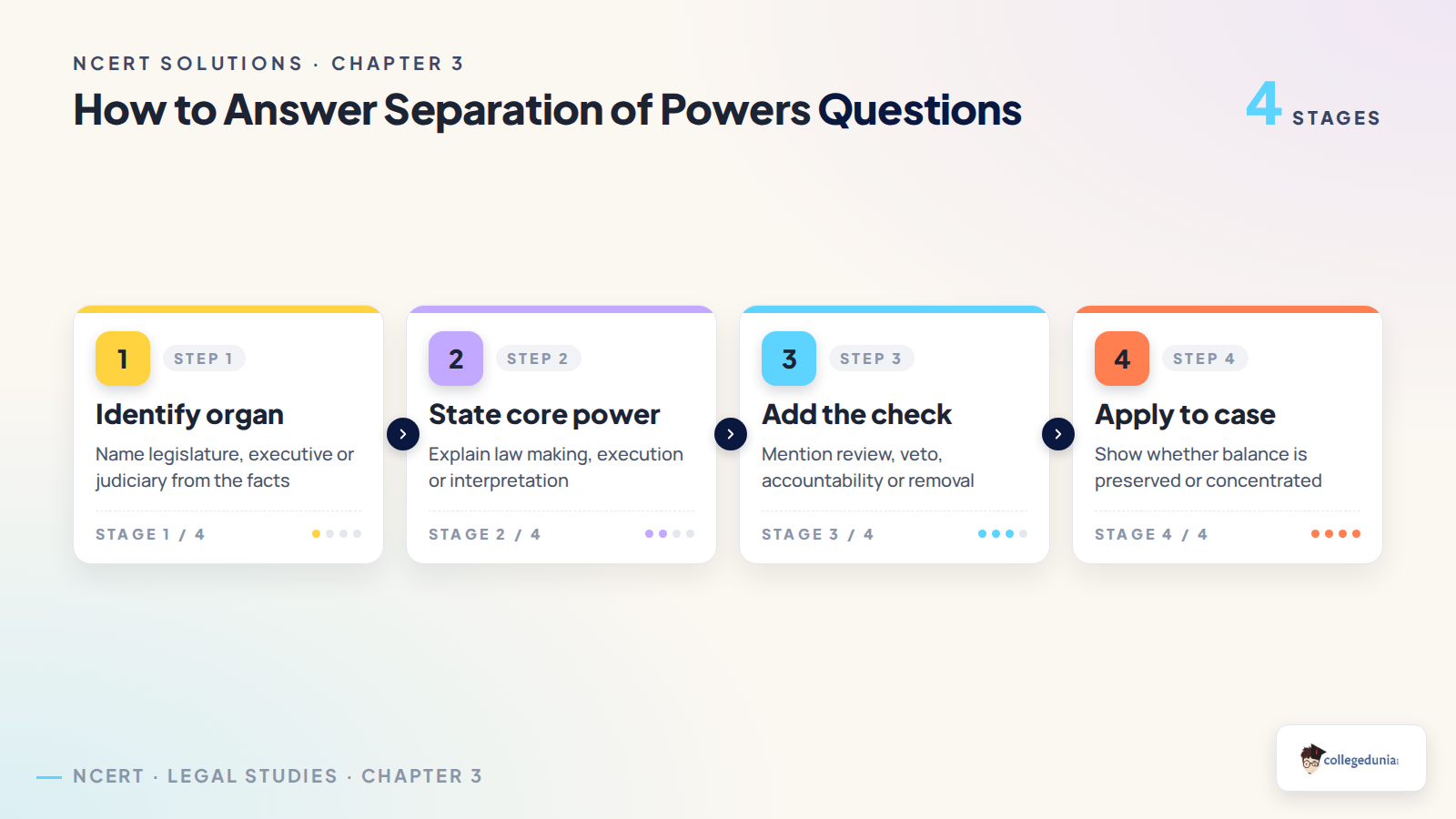
Write main power first: law-making, execution or adjudication.
Write checking power second: veto, impeachment, approval, review or accountability.
Conclude that constitutional liberty depends on both division and restraint.
Answer Writing Tips for Separation of Powers
The safest answer style is doctrine, country example and constitutional result. In short notes, use compact subheadings. In 200-word answers, give two advantages, two defects and one balanced conclusion. In case-based answers, quote the phrase from the question and explain how it shows a main power plus a checking power.
Prompt word
Expected structure
Final line to add
Evaluate
Advantages plus defects
The doctrine is useful but cannot be applied in absolute form
Explain why
Reason plus example
The USA is strongest because the organs are institutionally distinct
Can it apply
Qualified answer
India and UK apply the principle in modified form
Common Mistakes in Class 11 Legal Studies Chapter 3
Students usually lose marks when they write separation as complete non-cooperation. The doctrine is not a rule that organs never interact. It is a constitutional method for distributing power and preventing concentration. Another common mistake is calling India a strict separation model. India follows a flexible model with overlap, accountability and judicial review.
Do not write the British system as the same as the American system.
Do not treat Article 368 as unlimited amendment power.
Do not skip checks and balances while explaining the USA.
Do not use only one paragraph for multi-part questions.
Separation of Powers Cross-Resource Study Links
Use these Class 11 Legal Studies resources together. Read the official chapter first, revise the notes, then solve the exercise using the PDF on this page.
After finishing Separation of Powers, revise the surrounding Legal Studies solution pages in order. The first three chapters build the foundation for later constitutional law topics.
All NCERT Solutions for Class 11 Legal Studies Chapter 3 Separation of Powers with Step-by-Step Solutions
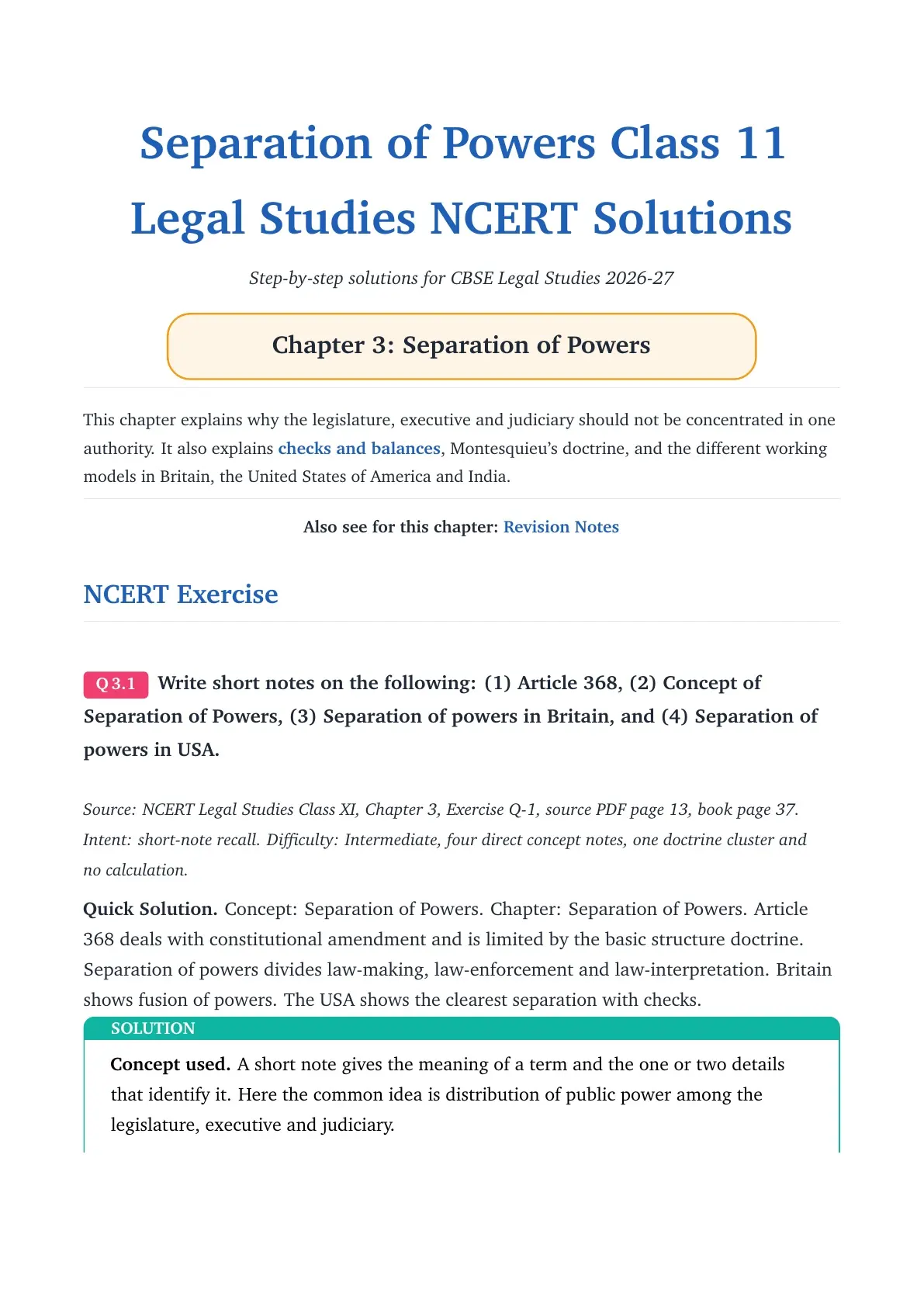
Q 3.1
Write short notes on the following: (1) Article 368, (2) Concept of Separation of Powers, (3) Separation of powers in Britain, and (4) Separation of powers in USA.
Concept used. A short note gives the meaning of a term and the
one or two details that identify it. Here the common idea is distribution of
public power among the legislature, executive and judiciary.
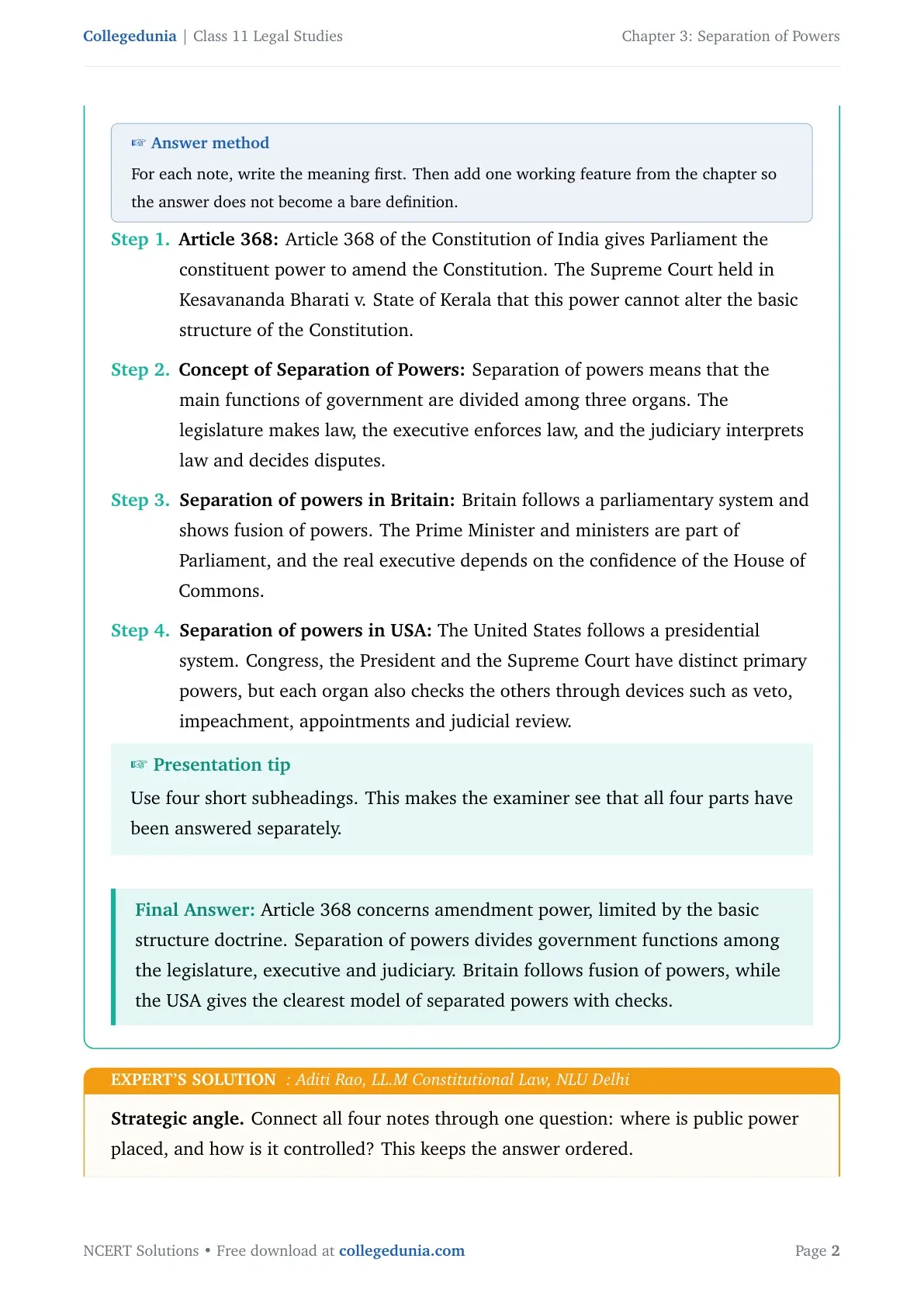
Answer method
For each note, write the meaning first. Then add one working feature from the
chapter so the answer does not become a bare definition.
Article 368: Article 368 of the Constitution of India gives
Parliament the constituent power to amend the Constitution. The Supreme
Court held in Kesavananda Bharati v. State of Kerala that this power
cannot alter the basic structure of the Constitution.
Concept of Separation of Powers: Separation of powers means
that the main functions of government are divided among three organs.
The legislature makes law, the executive enforces law, and the judiciary
interprets law and decides disputes.
Separation of powers in Britain: Britain follows a
parliamentary system and shows fusion of powers. The Prime Minister and
ministers are part of Parliament, and the real executive depends on the
confidence of the House of Commons.
Separation of powers in USA: The United States follows a
presidential system. Congress, the President and the Supreme Court have
distinct primary powers, but each organ also checks the others through
devices such as veto, impeachment, appointments and judicial review.
Presentation tip
Use four short subheadings. This makes the examiner see that all four parts
have been answered separately.
Article 368 concerns amendment power, limited by the basic structure
doctrine. Separation of powers divides government functions among the
legislature, executive and judiciary. Britain follows fusion of powers, while
the USA gives the clearest model of separated powers with checks.
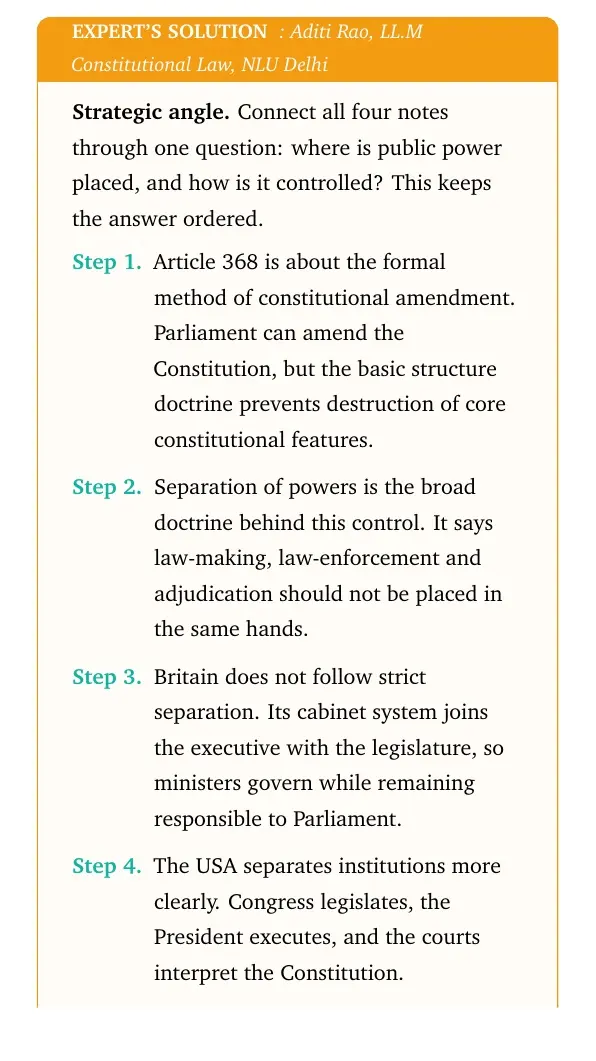
AR
Aditi Rao
LL.M Constitutional Law, NLU Delhi
Verified Expert
Strategic angle. Connect all four notes through one question: where
is public power placed, and how is it controlled? This keeps the answer
ordered.
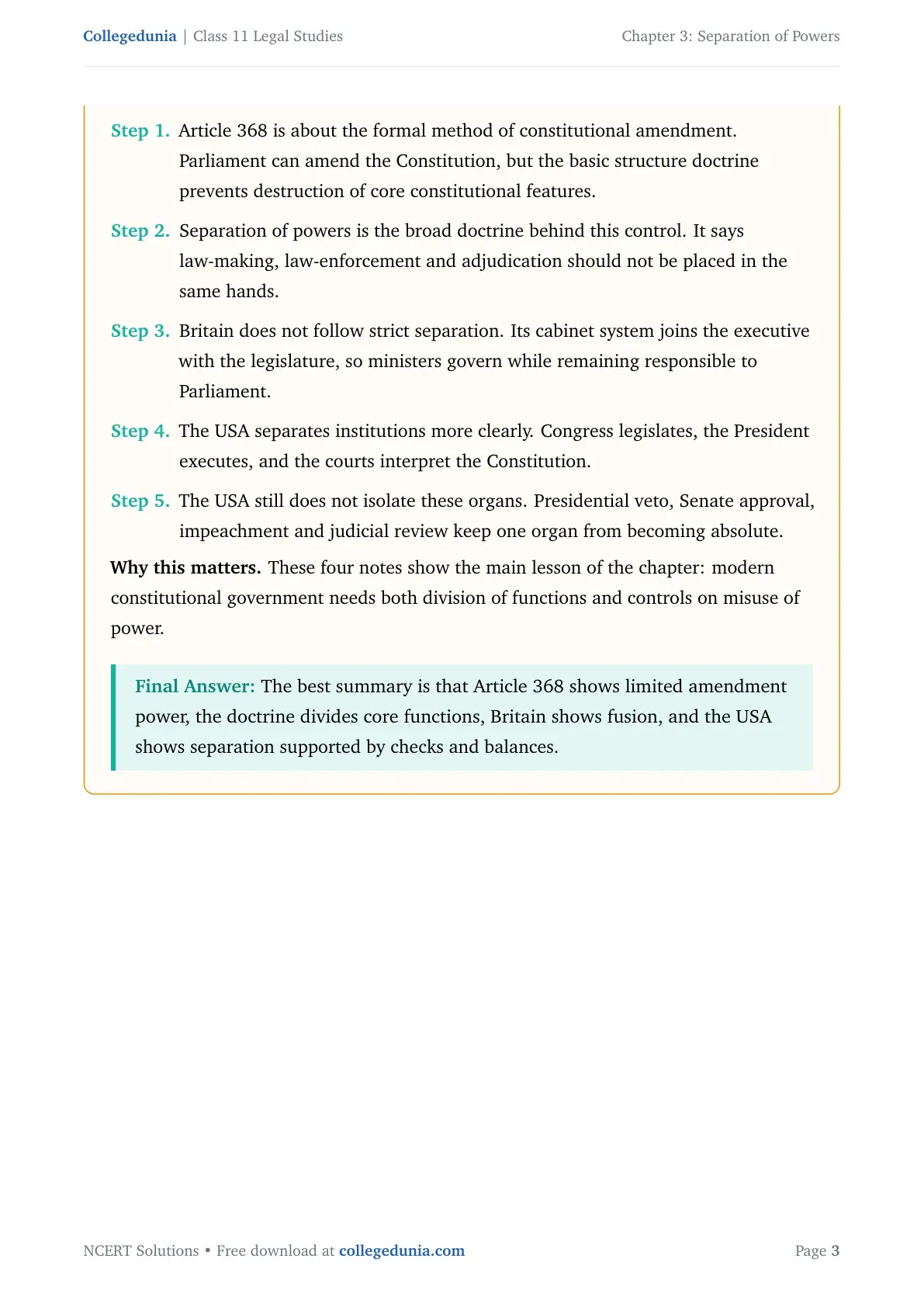
Article 368 is about the formal method of constitutional amendment.
Parliament can amend the Constitution, but the basic structure doctrine
prevents destruction of core constitutional features.
Separation of powers is the broad doctrine behind this control. It
says law-making, law-enforcement and adjudication should not be placed
in the same hands.
Britain does not follow strict separation. Its cabinet system joins
the executive with the legislature, so ministers govern while remaining
responsible to Parliament.
The USA separates institutions more clearly. Congress legislates, the
President executes, and the courts interpret the Constitution.
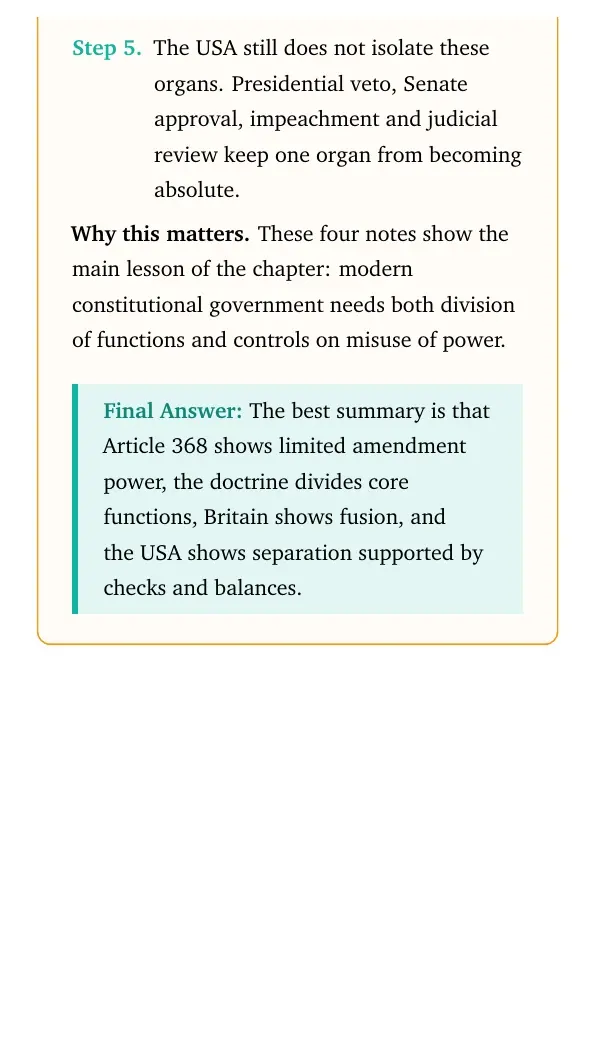
The USA still does not isolate these organs. Presidential veto,
Senate approval, impeachment and judicial review keep one organ from
becoming absolute.
Why this matters. These four notes show the main lesson of the
chapter: modern constitutional government needs both division of functions and
controls on misuse of power.
The best summary is that Article 368 shows limited amendment power,
the doctrine divides core functions, Britain shows fusion, and the USA shows
separation supported by checks and balances.
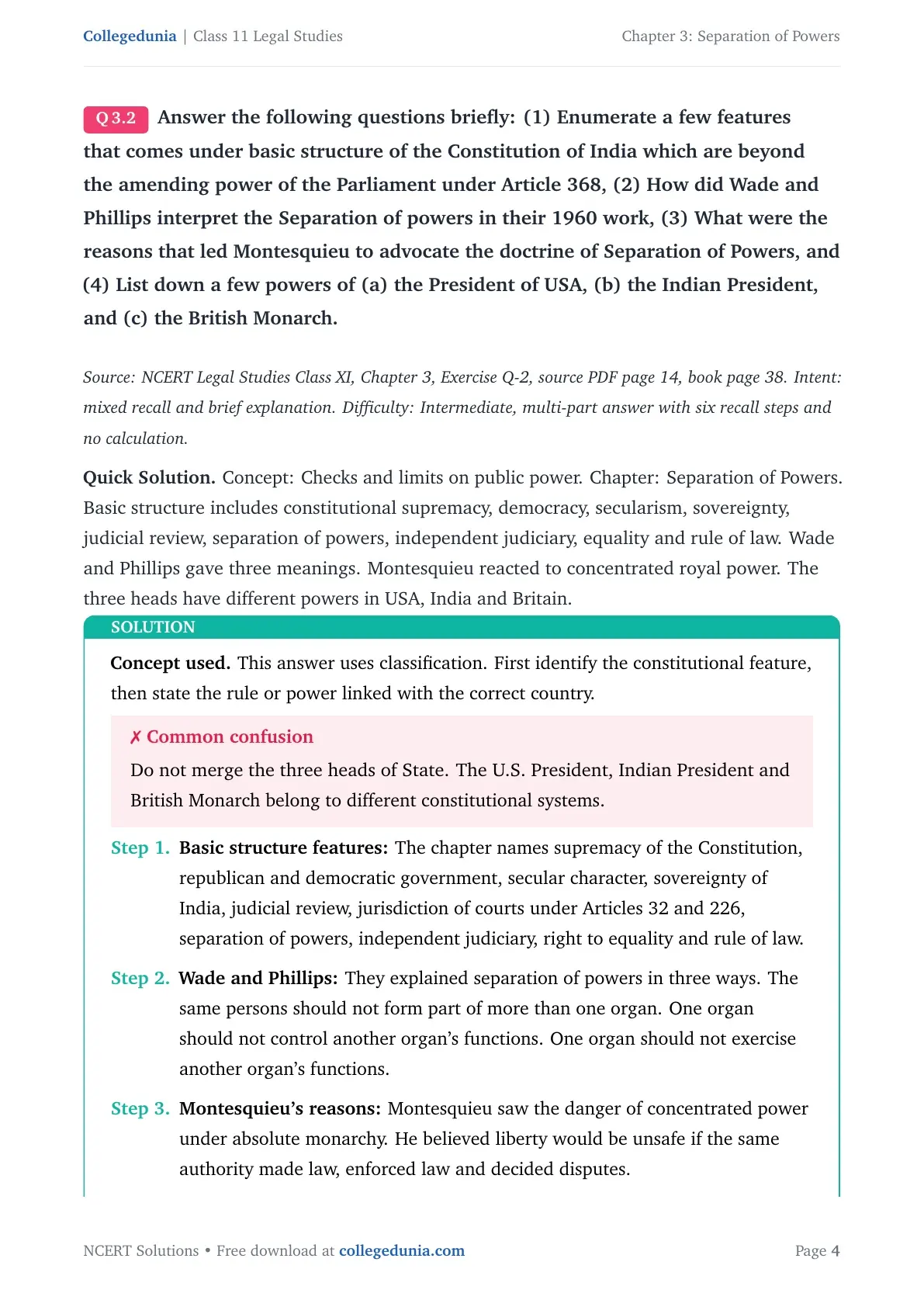
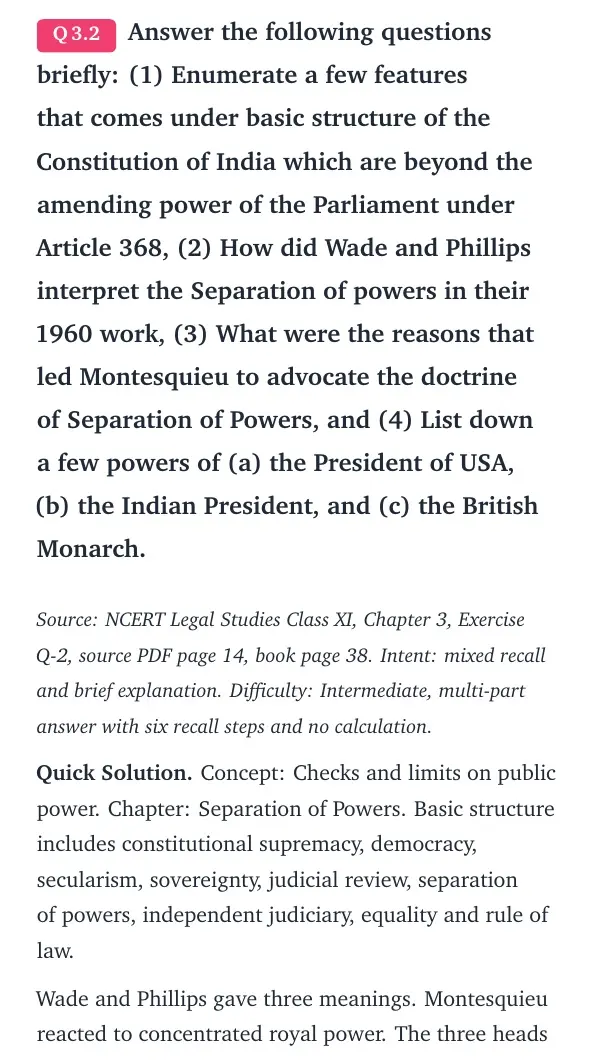
Q 3.2
Answer the following questions briefly: (1) Enumerate a few features that comes under basic structure of the Constitution of India which are beyond the amending power of the Parliament under Article 368, (2) How did Wade and Phillips interpret the Separation of powers in their 1960 work, (3) What were the reasons that led Montesquieu to advocate the doctrine of Separation of Powers, and (4) List down a few powers of (a) the President of USA, (b) the Indian President, and (c) the British Monarch.
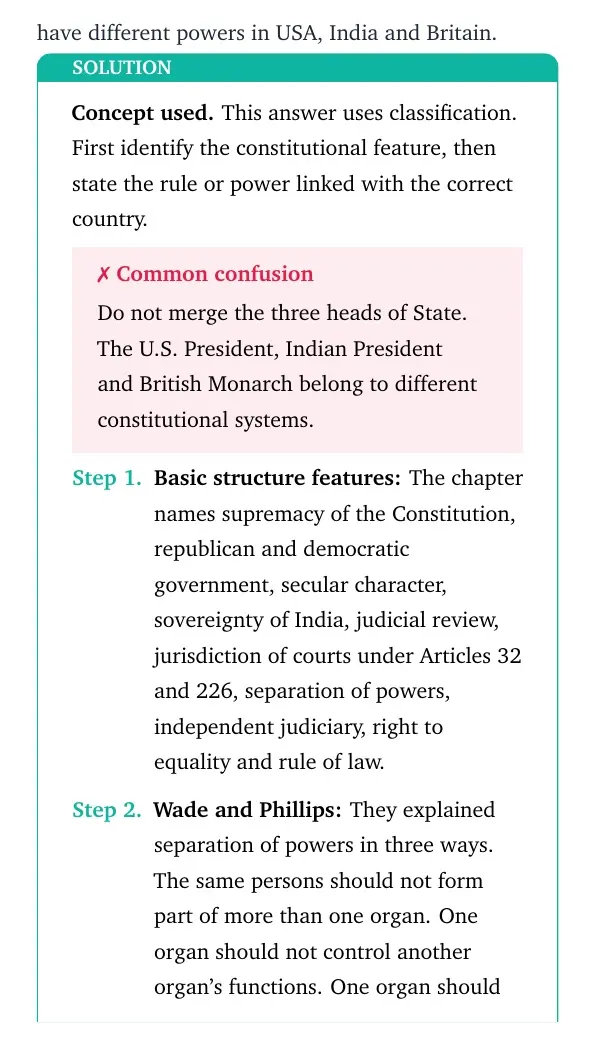
Concept used. This answer uses classification. First identify the
constitutional feature, then state the rule or power linked with the correct
country.
Common confusion
Do not merge the three heads of State. The U.S. President, Indian President
and British Monarch belong to different constitutional systems.
Basic structure features: The chapter names supremacy of the
Constitution, republican and democratic government, secular character,
sovereignty of India, judicial review, jurisdiction of courts under
Articles 32 and 226, separation of powers, independent judiciary, right
to equality and rule of law.
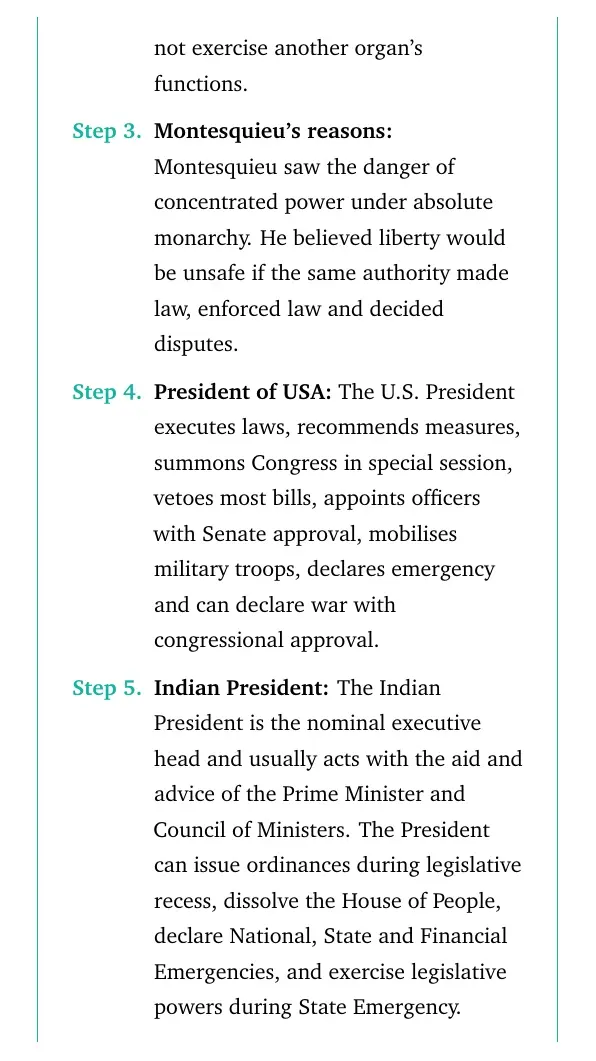
Wade and Phillips: They explained separation of powers in
three ways. The same persons should not form part of more than one
organ. One organ should not control another organ's functions. One
organ should not exercise another organ's functions.
Montesquieu's reasons: Montesquieu saw the danger of
concentrated power under absolute monarchy. He believed liberty would
be unsafe if the same authority made law, enforced law and decided
disputes.
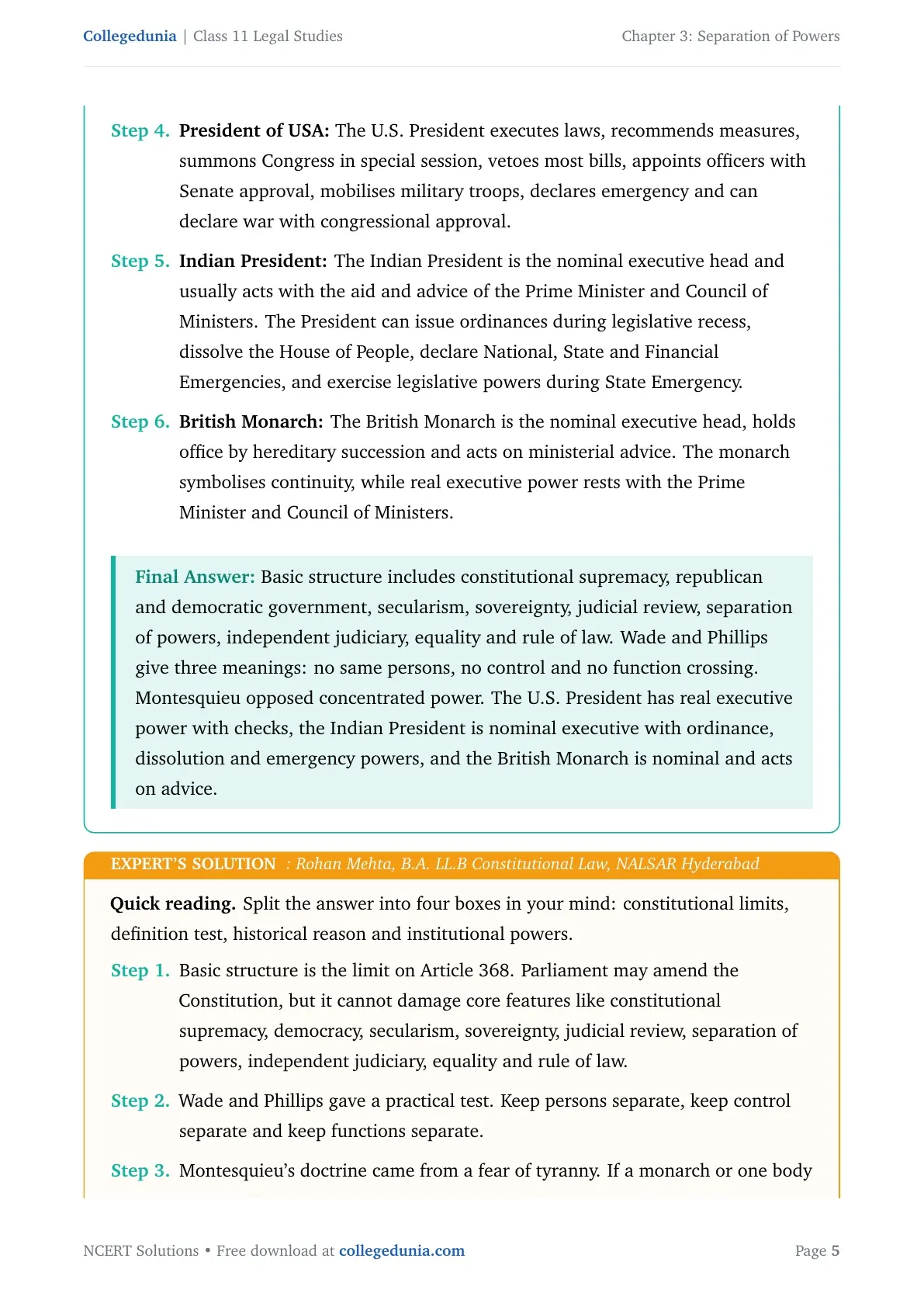
President of USA: The U.S. President executes laws, recommends
measures, summons Congress in special session, vetoes most bills,
appoints officers with Senate approval, mobilises military troops,
declares emergency and can declare war with congressional approval.
Indian President: The Indian President is the nominal
executive head and usually acts with the aid and advice of the Prime
Minister and Council of Ministers. The President can issue ordinances
during legislative recess, dissolve the House of People, declare
National, State and Financial Emergencies, and exercise legislative
powers during State Emergency.
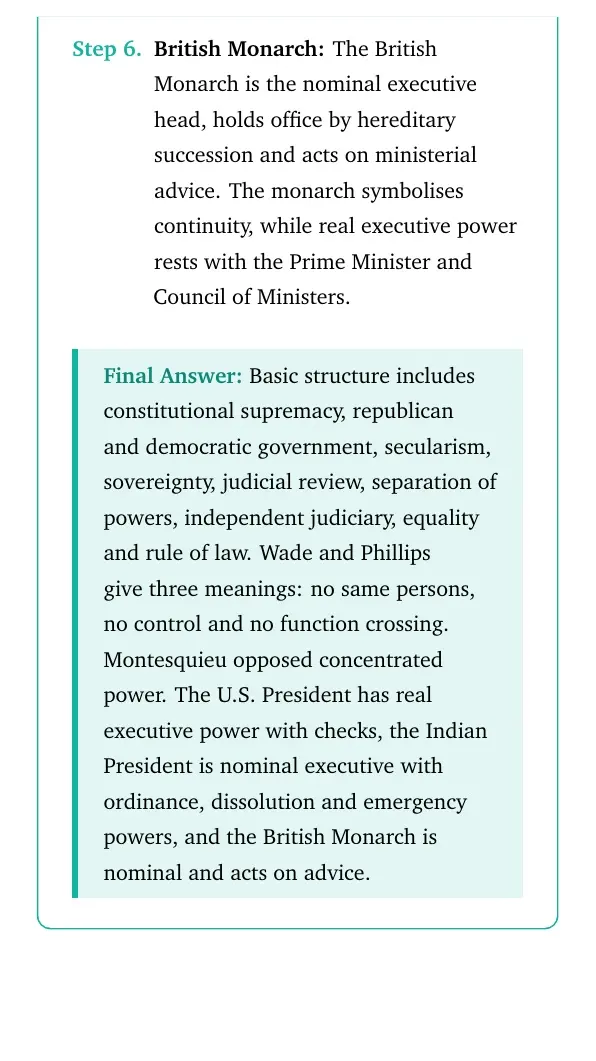
British Monarch: The British Monarch is the nominal executive
head, holds office by hereditary succession and acts on ministerial
advice. The monarch symbolises continuity, while real executive power
rests with the Prime Minister and Council of Ministers.
Basic structure includes constitutional supremacy, republican and
democratic government, secularism, sovereignty, judicial review, separation of
powers, independent judiciary, equality and rule of law. Wade and Phillips
give three meanings: no same persons, no control and no function crossing.
Montesquieu opposed concentrated power. The U.S. President has real executive
power with checks, the Indian President is nominal executive with ordinance,
dissolution and emergency powers, and the British Monarch is nominal and acts
on advice.
RM
Rohan Mehta
B.A. LL.B Constitutional Law, NALSAR Hyderabad
Verified Expert
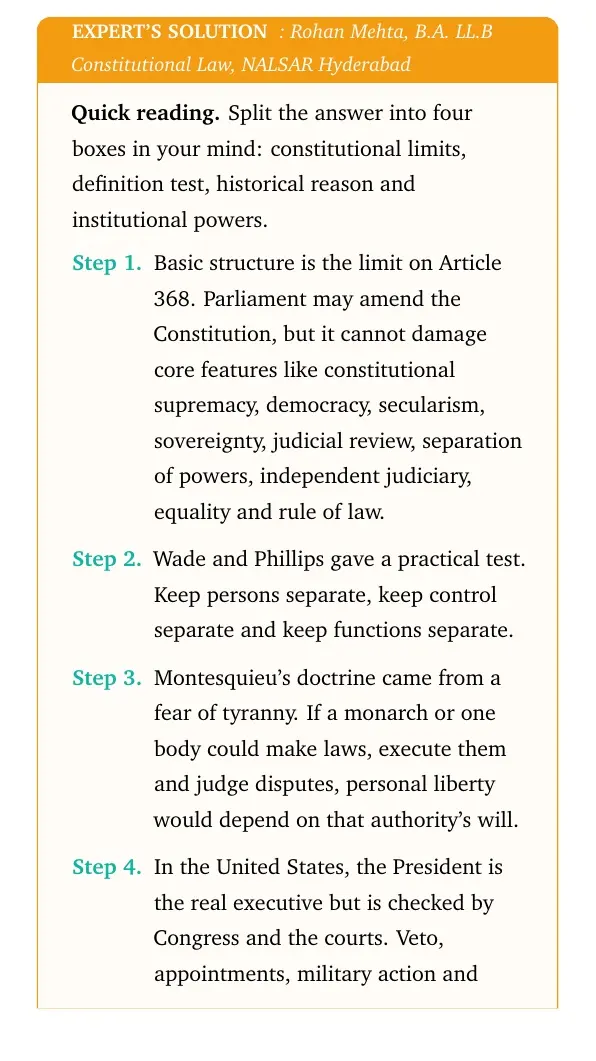
Quick reading. Split the answer into four boxes in your mind:
constitutional limits, definition test, historical reason and institutional
powers.
Basic structure is the limit on Article 368. Parliament may amend the
Constitution, but it cannot damage core features like constitutional
supremacy, democracy, secularism, sovereignty, judicial review,
separation of powers, independent judiciary, equality and rule of law.
Wade and Phillips gave a practical test. Keep persons separate, keep
control separate and keep functions separate.
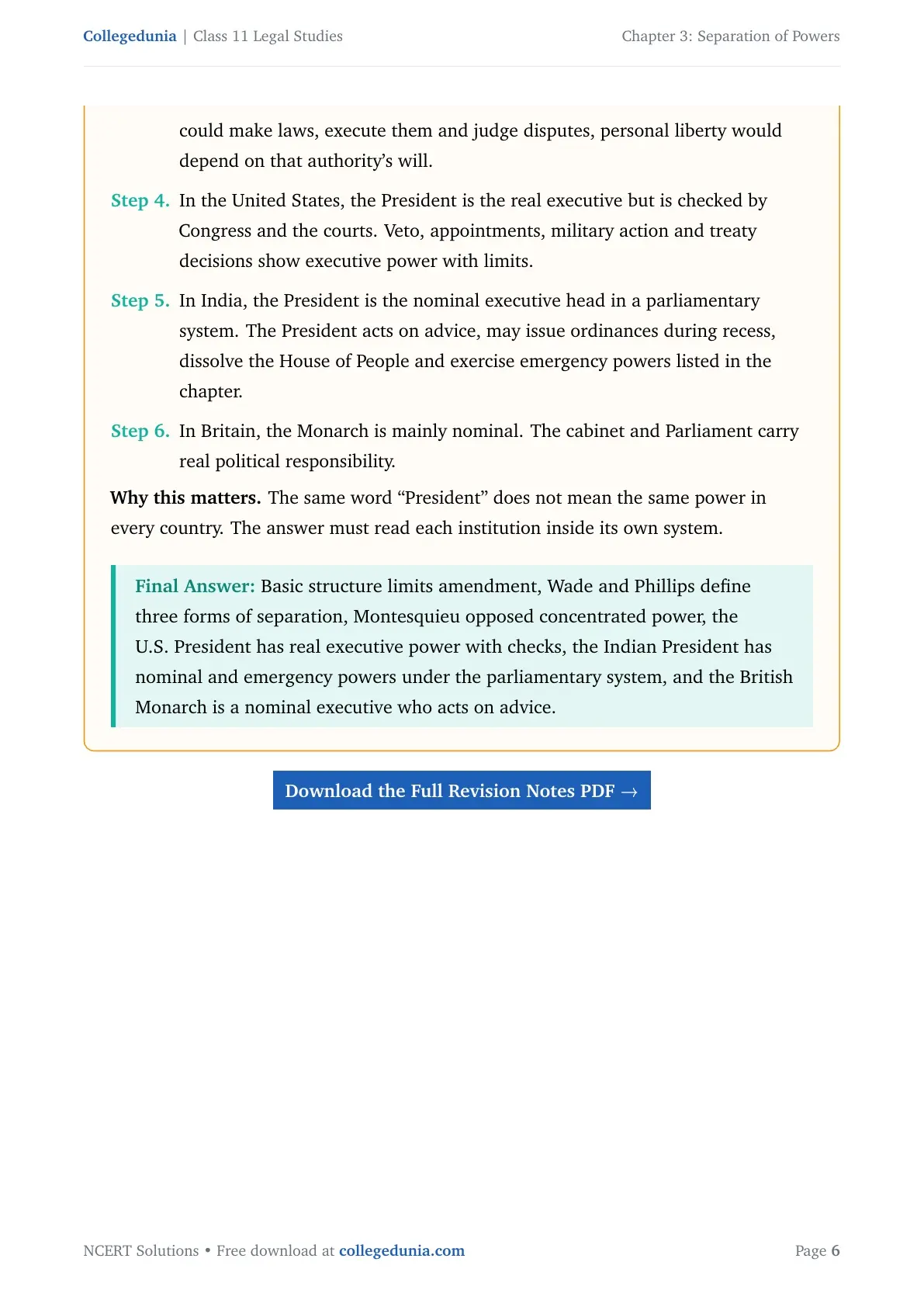
Montesquieu's doctrine came from a fear of tyranny. If a monarch or
one body could make laws, execute them and judge disputes, personal
liberty would depend on that authority's will.
In the United States, the President is the real executive but is checked
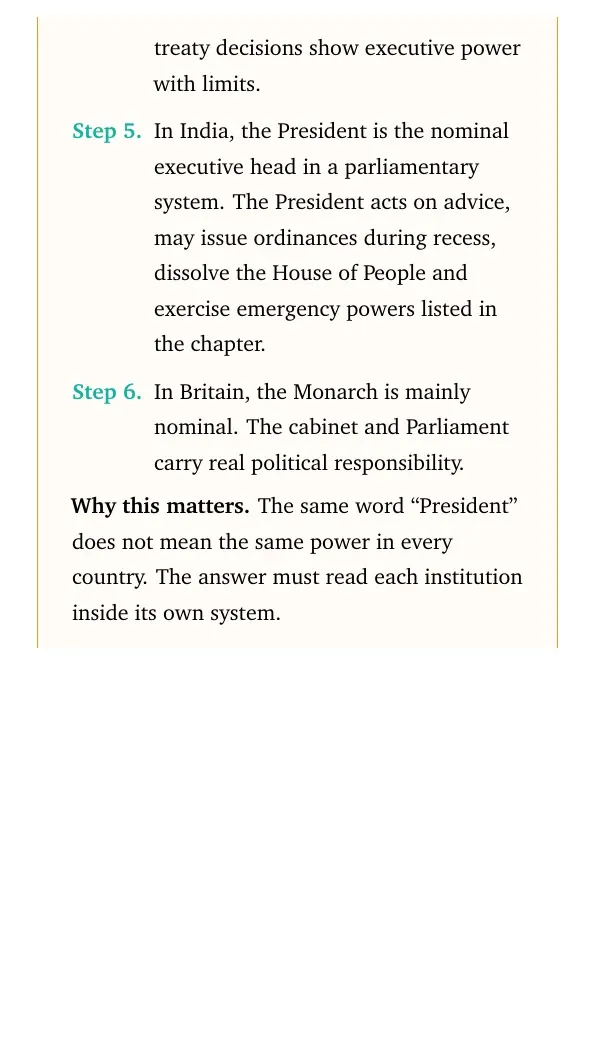
by Congress and the courts. Veto, appointments, military action and
treaty decisions show executive power with limits.
In India, the President is the nominal executive head in a
parliamentary system. The President acts on advice, may issue
ordinances during recess, dissolve the House of People and exercise
emergency powers listed in the chapter.
In Britain, the Monarch is mainly nominal. The cabinet and Parliament
carry real political responsibility.
Why this matters. The same word ``President'' does not mean the same
power in every country. The answer must read each institution inside its own
system.
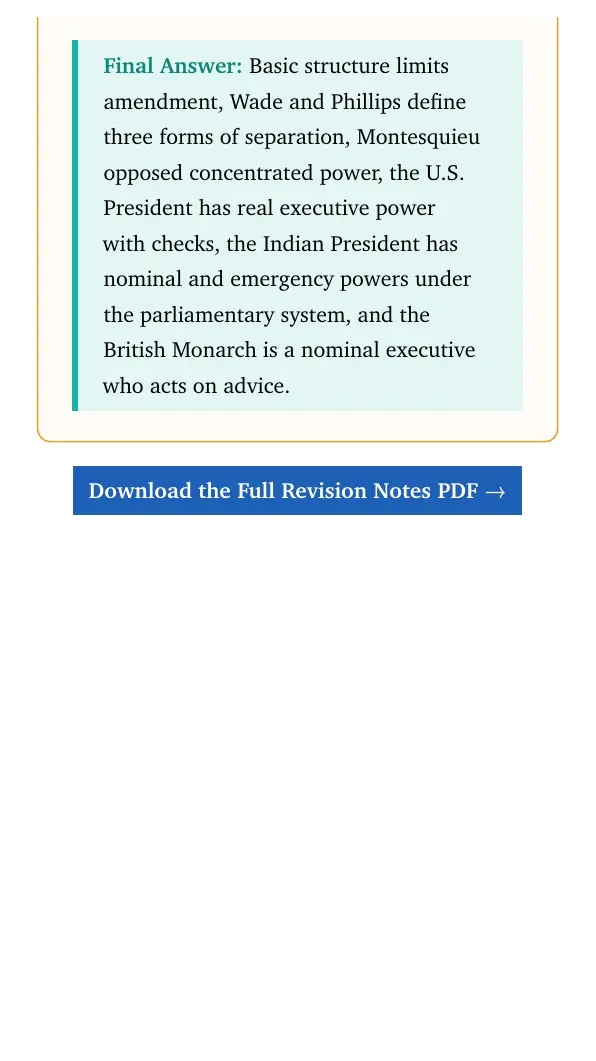
Basic structure limits amendment, Wade and Phillips define three
forms of separation, Montesquieu opposed concentrated power, the U.S. President
has real executive power with checks, the Indian President has nominal and
emergency powers under the parliamentary system, and the British Monarch is a
nominal executive who acts on advice.
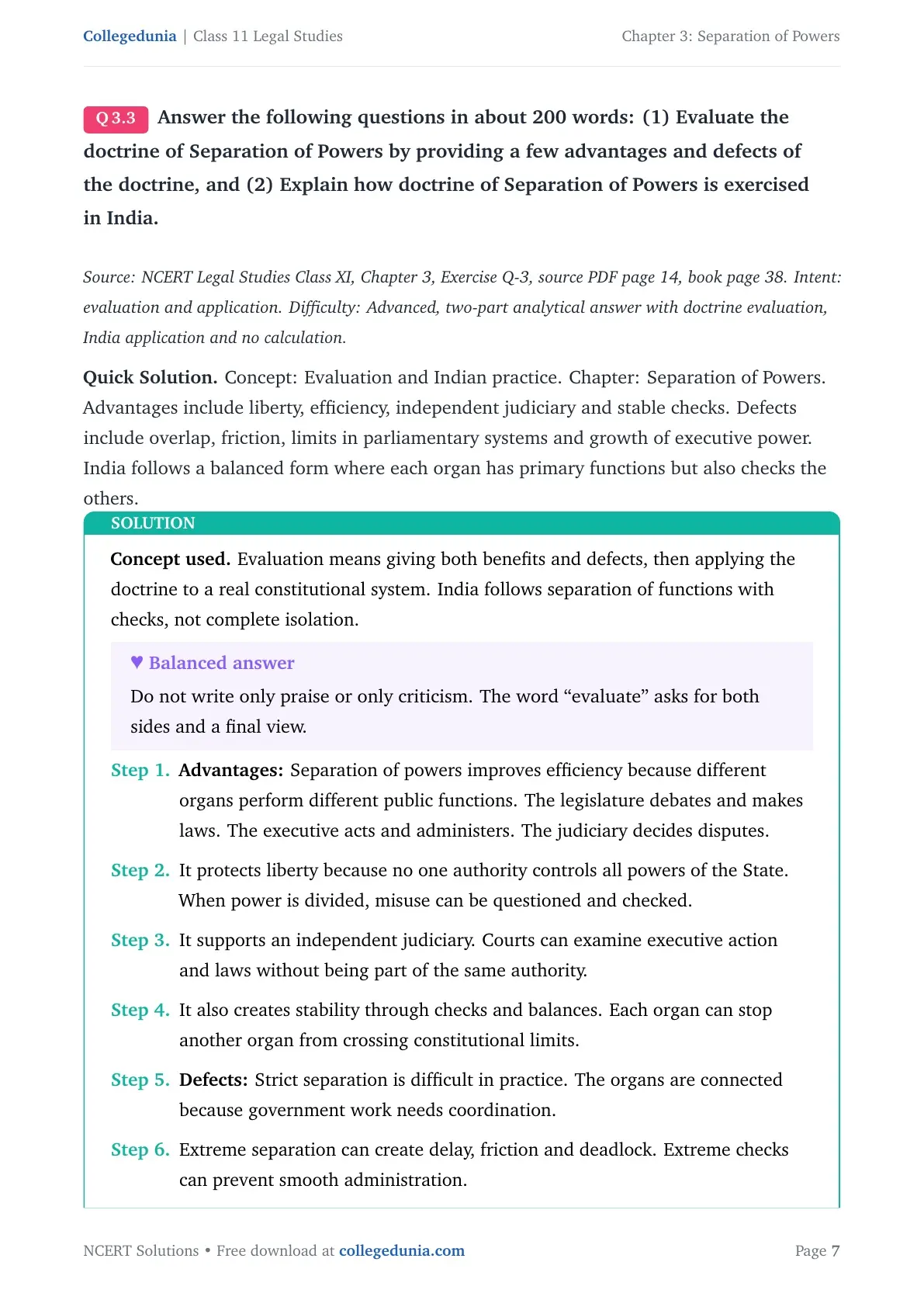
Q 3.3
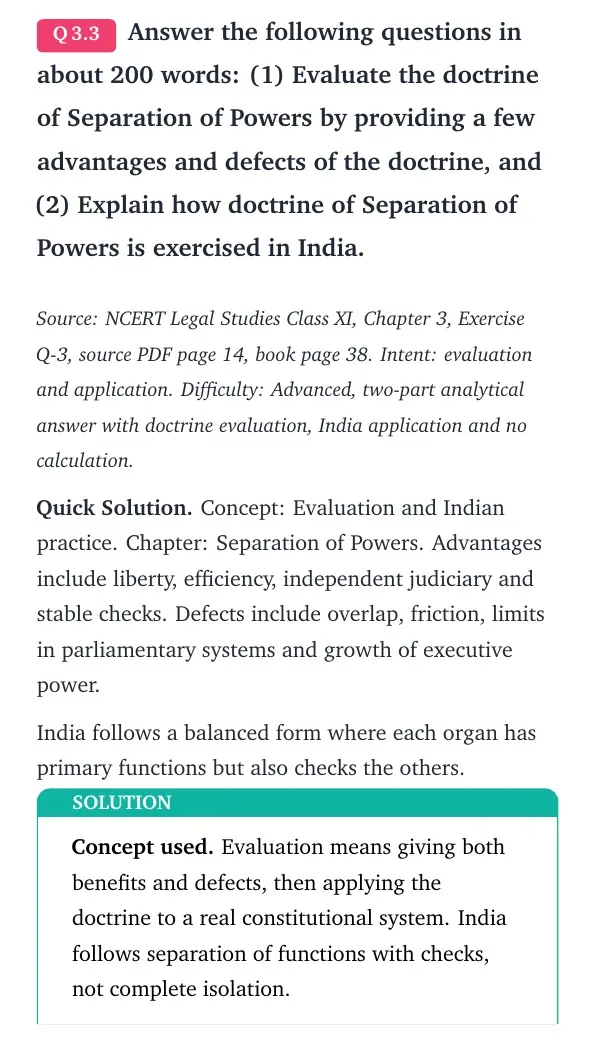
Answer the following questions in about 200 words: (1) Evaluate the doctrine of Separation of Powers by providing a few advantages and defects of the doctrine, and (2) Explain how doctrine of Separation of Powers is exercised in India.
Concept used. Evaluation means giving both benefits and defects, then
applying the doctrine to a real constitutional system. India follows separation
of functions with checks, not complete isolation.
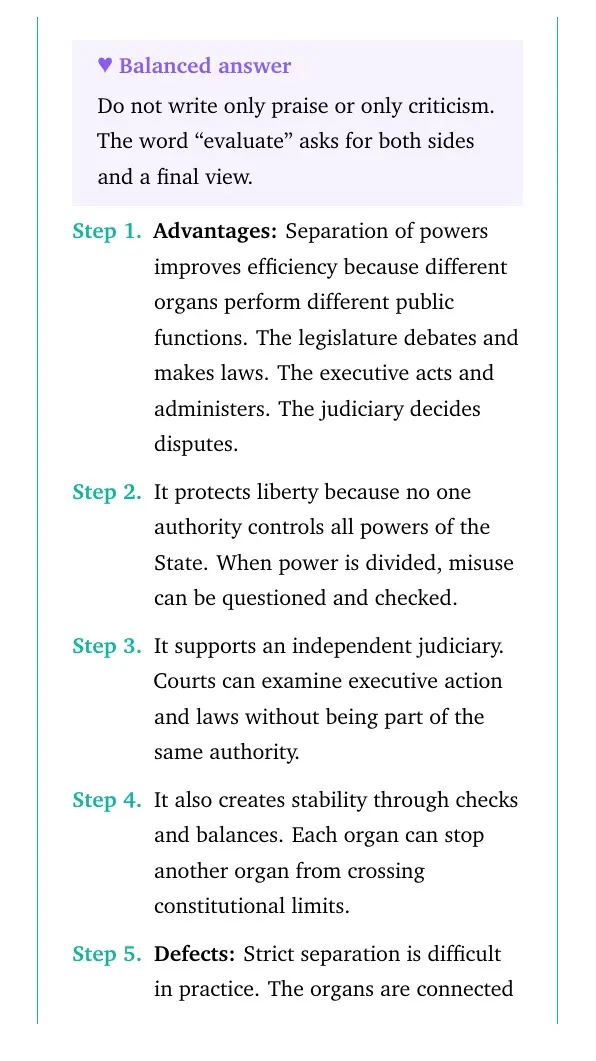
Balanced answer
Do not write only praise or only criticism. The word ``evaluate'' asks for both
sides and a final view.
Advantages: Separation of powers improves efficiency because
different organs perform different public functions. The legislature
debates and makes laws. The executive acts and administers. The
judiciary decides disputes.
It protects liberty because no one authority controls all powers of the
State. When power is divided, misuse can be questioned and checked.
It supports an independent judiciary. Courts can examine executive
action and laws without being part of the same authority.
It also creates stability through checks and balances. Each organ can
stop another organ from crossing constitutional limits.
Defects: Strict separation is difficult in practice. The organs
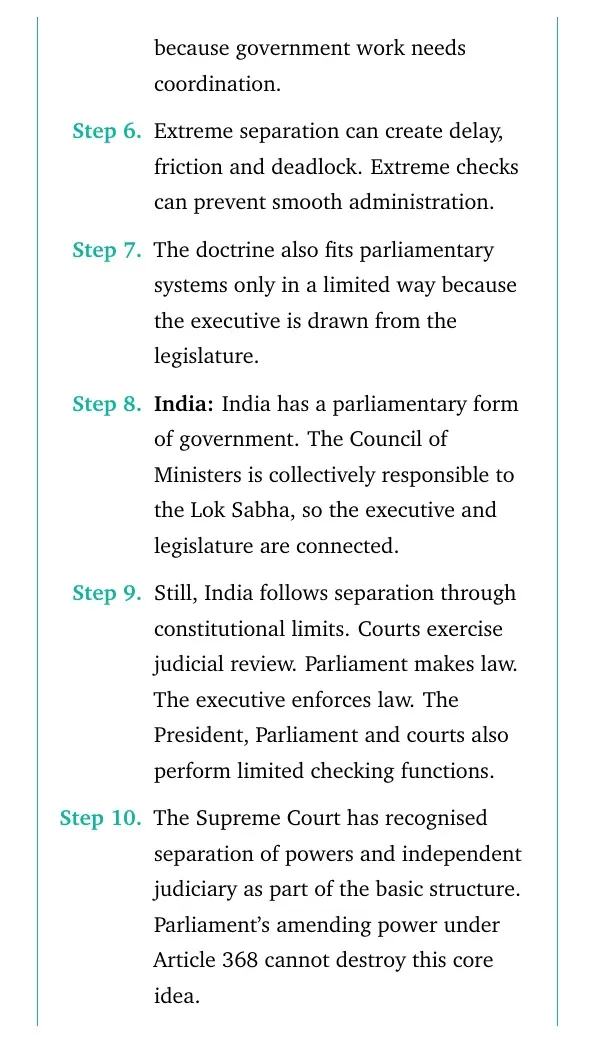
are connected because government work needs coordination.
Extreme separation can create delay, friction and deadlock. Extreme
checks can prevent smooth administration.
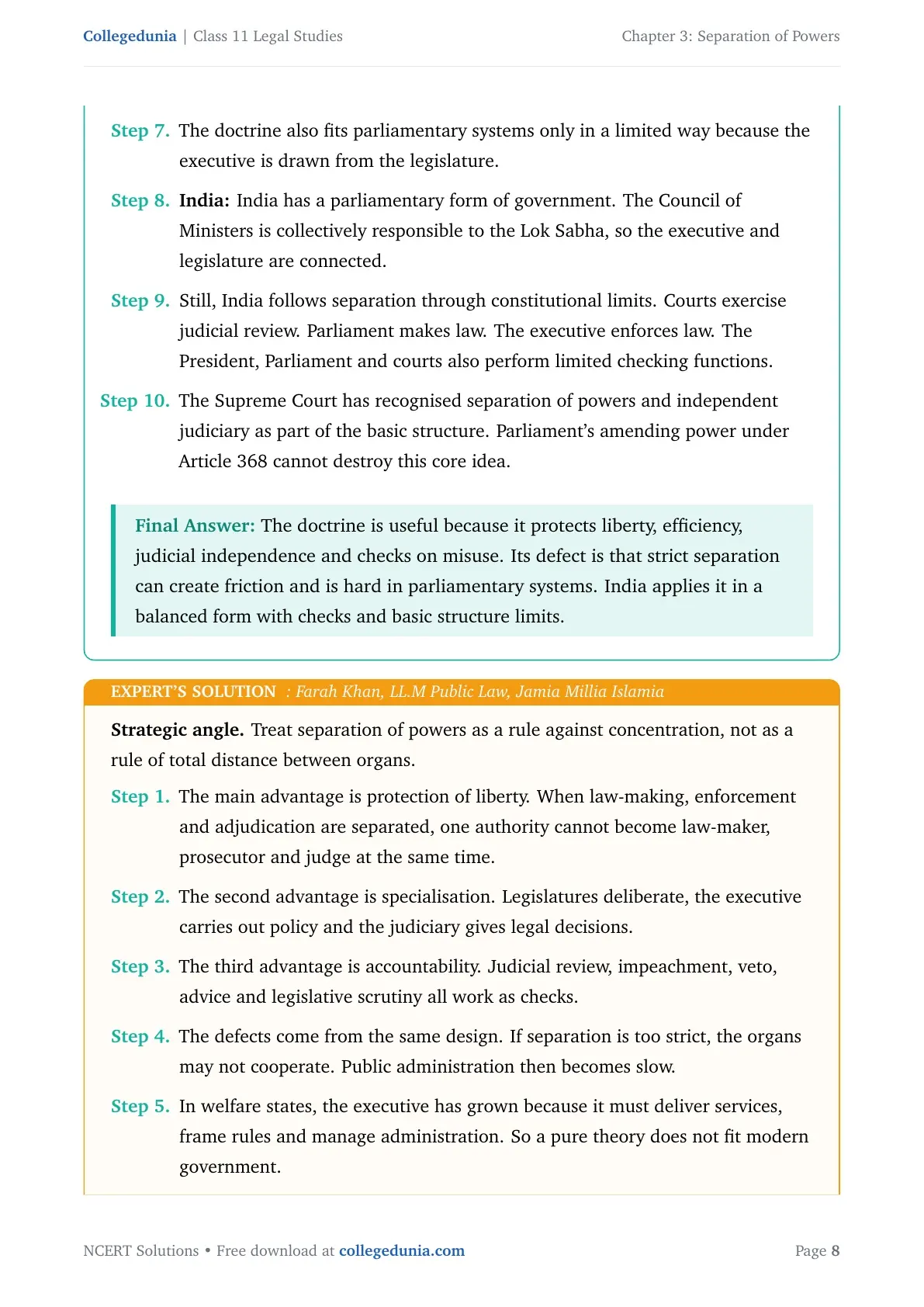
The doctrine also fits parliamentary systems only in a limited way
because the executive is drawn from the legislature.
India: India has a parliamentary form of government. The
Council of Ministers is collectively responsible to the Lok Sabha, so
the executive and legislature are connected.
Still, India follows separation through constitutional limits. Courts
exercise judicial review. Parliament makes law. The executive enforces
law. The President, Parliament and courts also perform limited checking
functions.
The Supreme Court has recognised separation of powers and independent
judiciary as part of the basic structure. Parliament's amending power
under Article 368 cannot destroy this core idea.
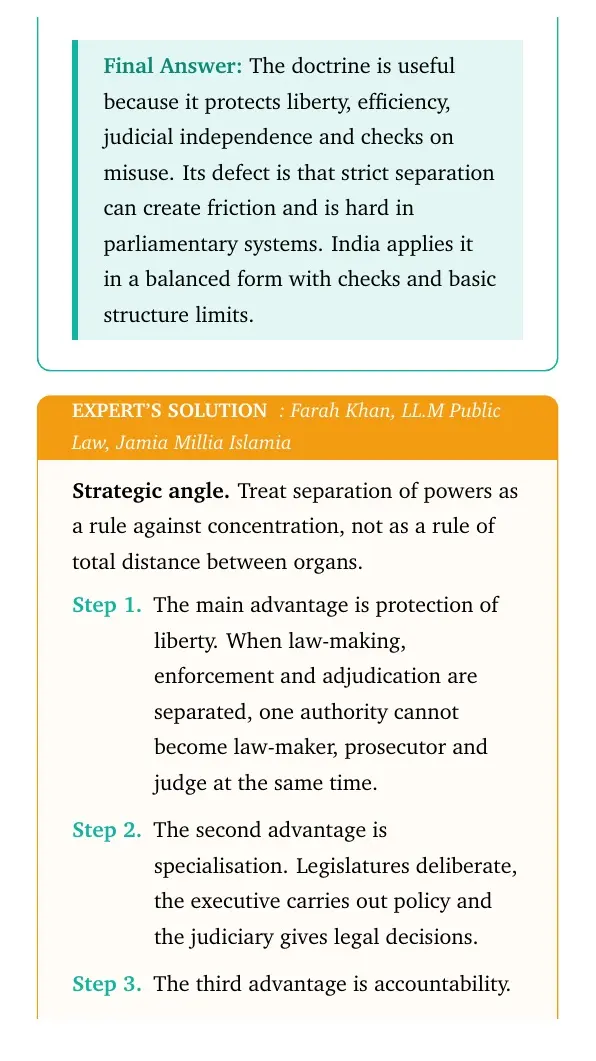
The doctrine is useful because it protects liberty, efficiency,
judicial independence and checks on misuse. Its defect is that strict separation
can create friction and is hard in parliamentary systems. India applies it in a
balanced form with checks and basic structure limits.
FK
Farah Khan
LL.M Public Law, Jamia Millia Islamia
Verified Expert
Strategic angle. Treat separation of powers as a rule against
concentration, not as a rule of total distance between organs.
The main advantage is protection of liberty. When law-making,
enforcement and adjudication are separated, one authority cannot become
law-maker, prosecutor and judge at the same time.
The second advantage is specialisation. Legislatures deliberate, the
executive carries out policy and the judiciary gives legal decisions.
The third advantage is accountability. Judicial review, impeachment,
veto, advice and legislative scrutiny all work as checks.
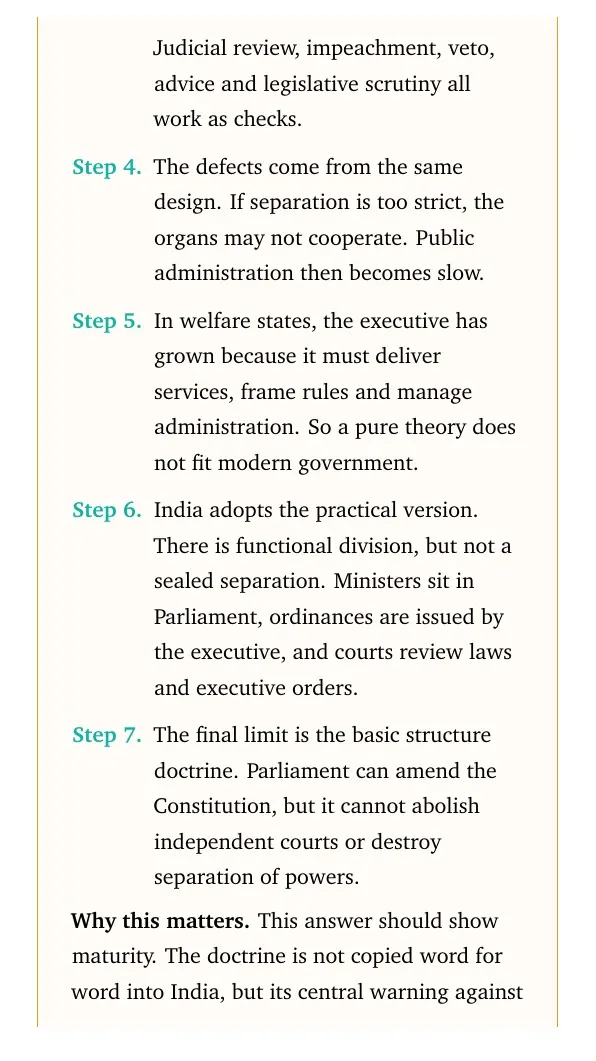
The defects come from the same design. If separation is too strict,
the organs may not cooperate. Public administration then becomes slow.
In welfare states, the executive has grown because it must deliver
services, frame rules and manage administration. So a pure theory does
not fit modern government.
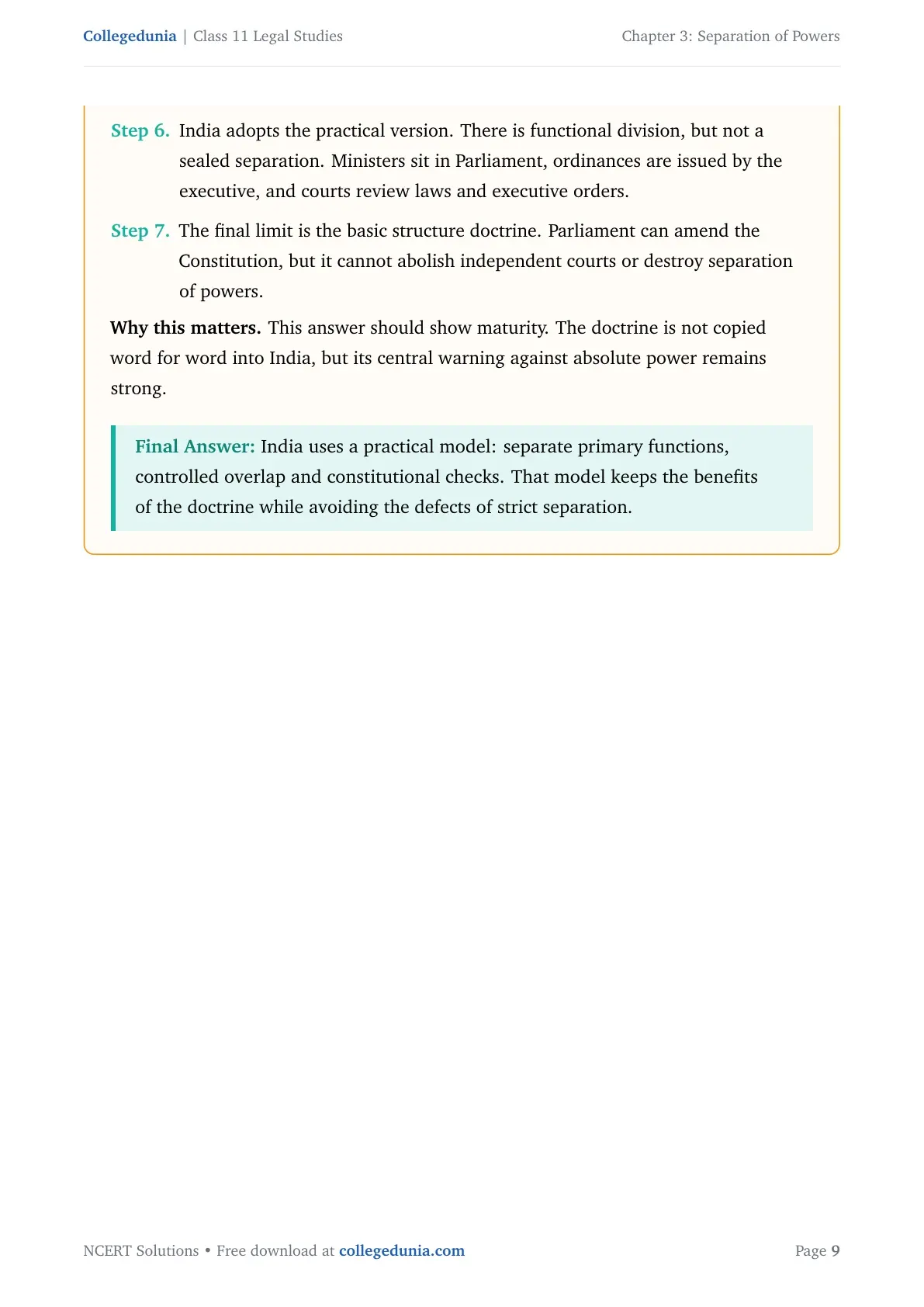
India adopts the practical version. There is functional division, but
not a sealed separation. Ministers sit in Parliament, ordinances are
issued by the executive, and courts review laws and executive orders.
The final limit is the basic structure doctrine. Parliament can amend
the Constitution, but it cannot abolish independent courts or destroy
separation of powers.
Why this matters. This answer should show maturity. The doctrine is
not copied word for word into India, but its central warning against absolute
power remains strong.
India uses a practical model: separate primary functions, controlled
overlap and constitutional checks. That model keeps the benefits of the
doctrine while avoiding the defects of strict separation.
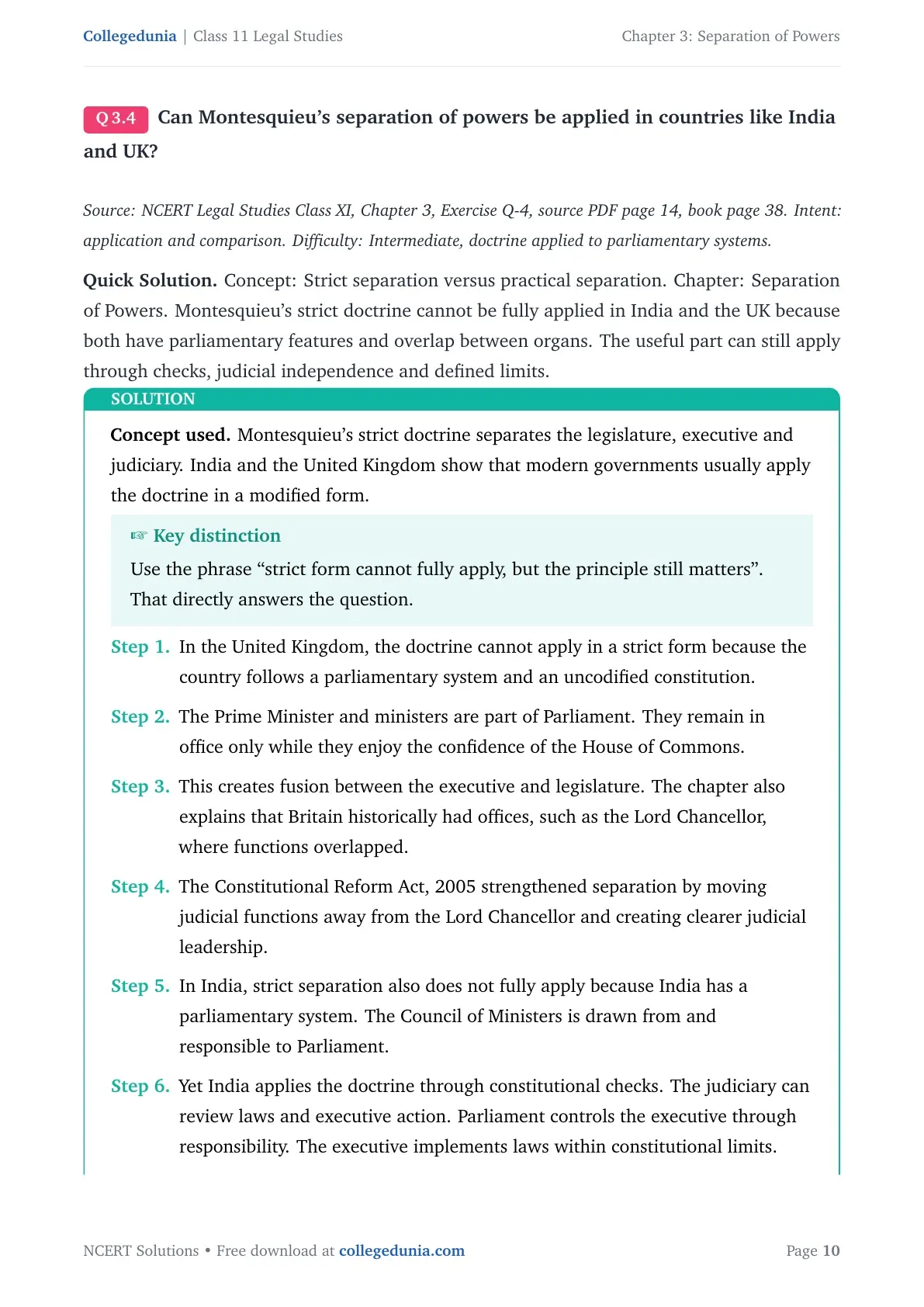
Q 3.4
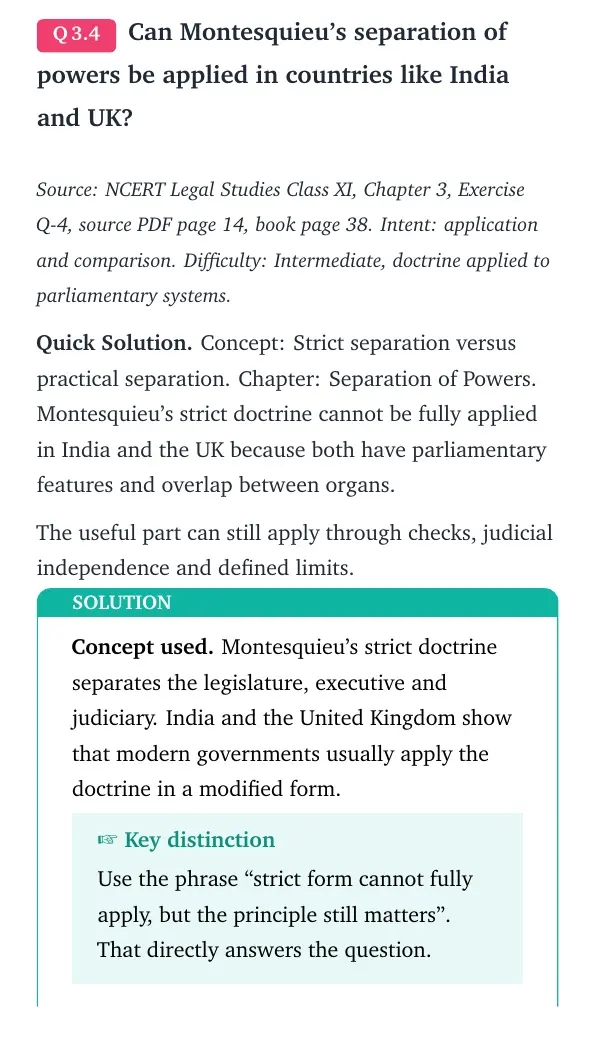
Can Montesquieu's separation of powers be applied in countries like India and UK?
Concept used. Montesquieu's strict doctrine separates the legislature,
executive and judiciary. India and the United Kingdom show that modern
governments usually apply the doctrine in a modified form.
Key distinction
Use the phrase ``strict form cannot fully apply, but the principle still
matters''. That directly answers the question.
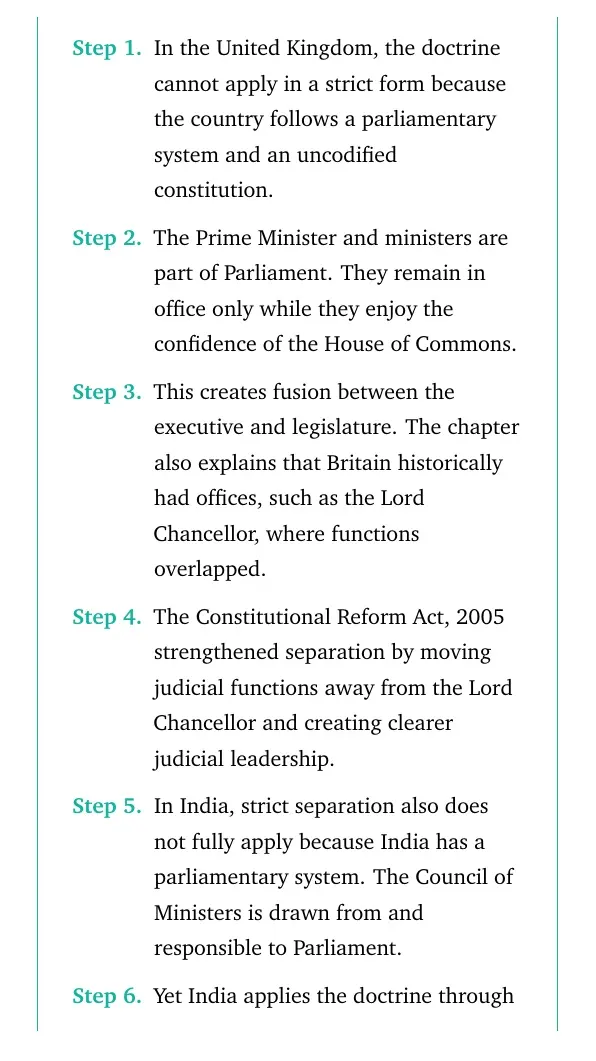
In the United Kingdom, the doctrine cannot apply in a strict form
because the country follows a parliamentary system and an uncodified
constitution.
The Prime Minister and ministers are part of Parliament. They remain in
office only while they enjoy the confidence of the House of Commons.
This creates fusion between the executive and legislature. The chapter
also explains that Britain historically had offices, such as the Lord
Chancellor, where functions overlapped.
The Constitutional Reform Act, 2005 strengthened separation by moving
judicial functions away from the Lord Chancellor and creating clearer
judicial leadership.
In India, strict separation also does not fully apply because India has
a parliamentary system. The Council of Ministers is drawn from and
responsible to Parliament.
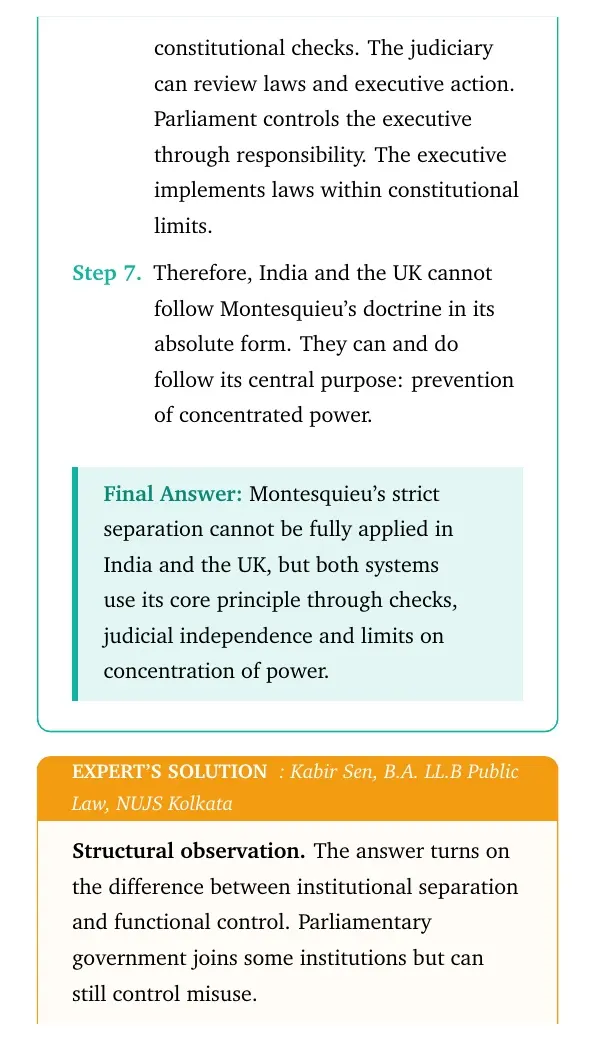
Yet India applies the doctrine through constitutional checks. The
judiciary can review laws and executive action. Parliament controls the
executive through responsibility. The executive implements laws within
constitutional limits.
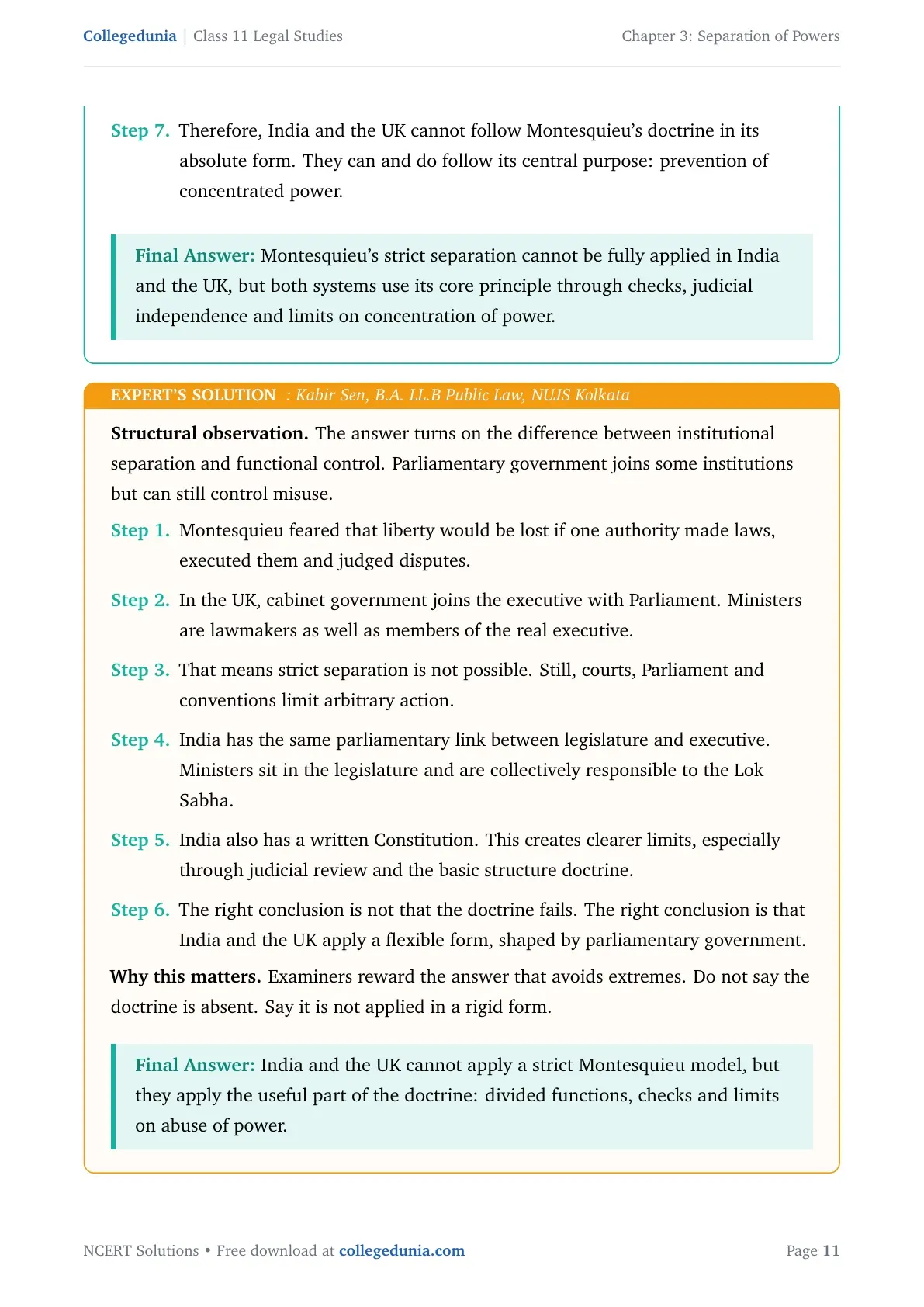
Therefore, India and the UK cannot follow Montesquieu's doctrine in its
absolute form. They can and do follow its central purpose: prevention
of concentrated power.
Montesquieu's strict separation cannot be fully applied in India and
the UK, but both systems use its core principle through checks, judicial
independence and limits on concentration of power.
KS
Kabir Sen
B.A. LL.B Public Law, NUJS Kolkata
Verified Expert
Structural observation. The answer turns on the difference between
institutional separation and functional control. Parliamentary government
joins some institutions but can still control misuse.
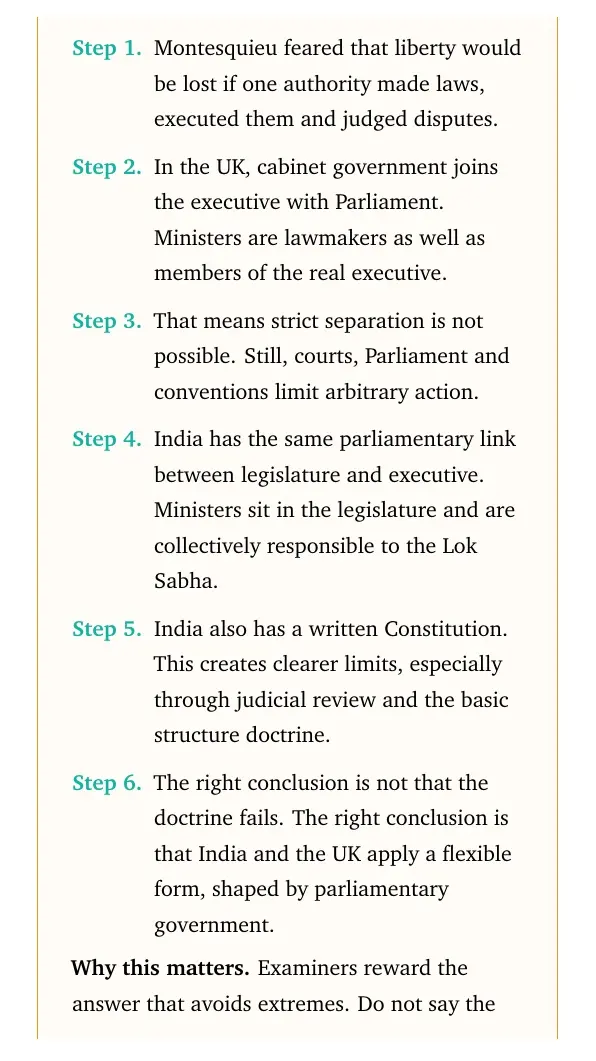
Montesquieu feared that liberty would be lost if one authority made
laws, executed them and judged disputes.
In the UK, cabinet government joins the executive with Parliament.
Ministers are lawmakers as well as members of the real executive.
That means strict separation is not possible. Still, courts, Parliament
and conventions limit arbitrary action.
India has the same parliamentary link between legislature and
executive. Ministers sit in the legislature and are collectively
responsible to the Lok Sabha.
India also has a written Constitution. This creates clearer limits,
especially through judicial review and the basic structure doctrine.
The right conclusion is not that the doctrine fails. The right
conclusion is that India and the UK apply a flexible form, shaped by
parliamentary government.
Why this matters. Examiners reward the answer that avoids extremes.
Do not say the doctrine is absent. Say it is not applied in a rigid form.
India and the UK cannot apply a strict Montesquieu model, but they
apply the useful part of the doctrine: divided functions, checks and limits on
abuse of power.
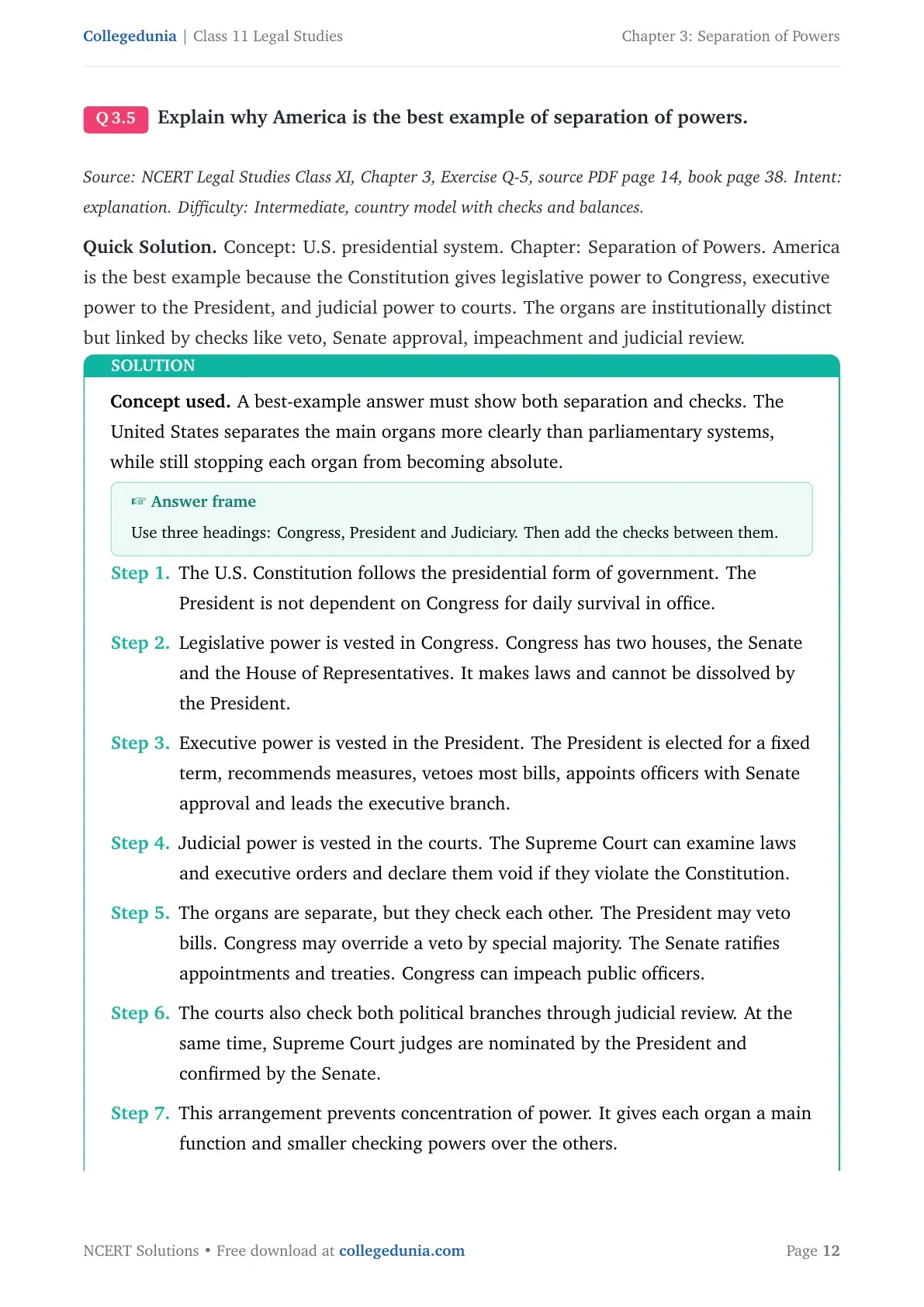
Q 3.5
Explain why America is the best example of separation of powers.
Concept used. A best-example answer must show both separation and
checks. The United States separates the main organs more clearly than
parliamentary systems, while still stopping each organ from becoming absolute.
Answer frame
Use three headings: Congress, President and Judiciary. Then add the checks
between them.
The U.S. Constitution follows the presidential form of government. The
President is not dependent on Congress for daily survival in office.
Legislative power is vested in Congress. Congress has two houses, the
Senate and the House of Representatives. It makes laws and cannot be
dissolved by the President.
Executive power is vested in the President. The President is elected
for a fixed term, recommends measures, vetoes most bills, appoints
officers with Senate approval and leads the executive branch.
Judicial power is vested in the courts. The Supreme Court can examine
laws and executive orders and declare them void if they violate the
Constitution.
The organs are separate, but they check each other. The President may
veto bills. Congress may override a veto by special majority. The
Senate ratifies appointments and treaties. Congress can impeach public
officers.
The courts also check both political branches through judicial review.
At the same time, Supreme Court judges are nominated by the President
and confirmed by the Senate.
This arrangement prevents concentration of power. It gives each organ a
main function and smaller checking powers over the others.
America is the best example because Congress, the President and the
courts have distinct constitutional powers, fixed roles and strong checks on
each other through veto, confirmation, impeachment and judicial review.
SP
Sneha Pillai
LL.M Comparative Constitutional Law, NLU Jodhpur
Verified Expert
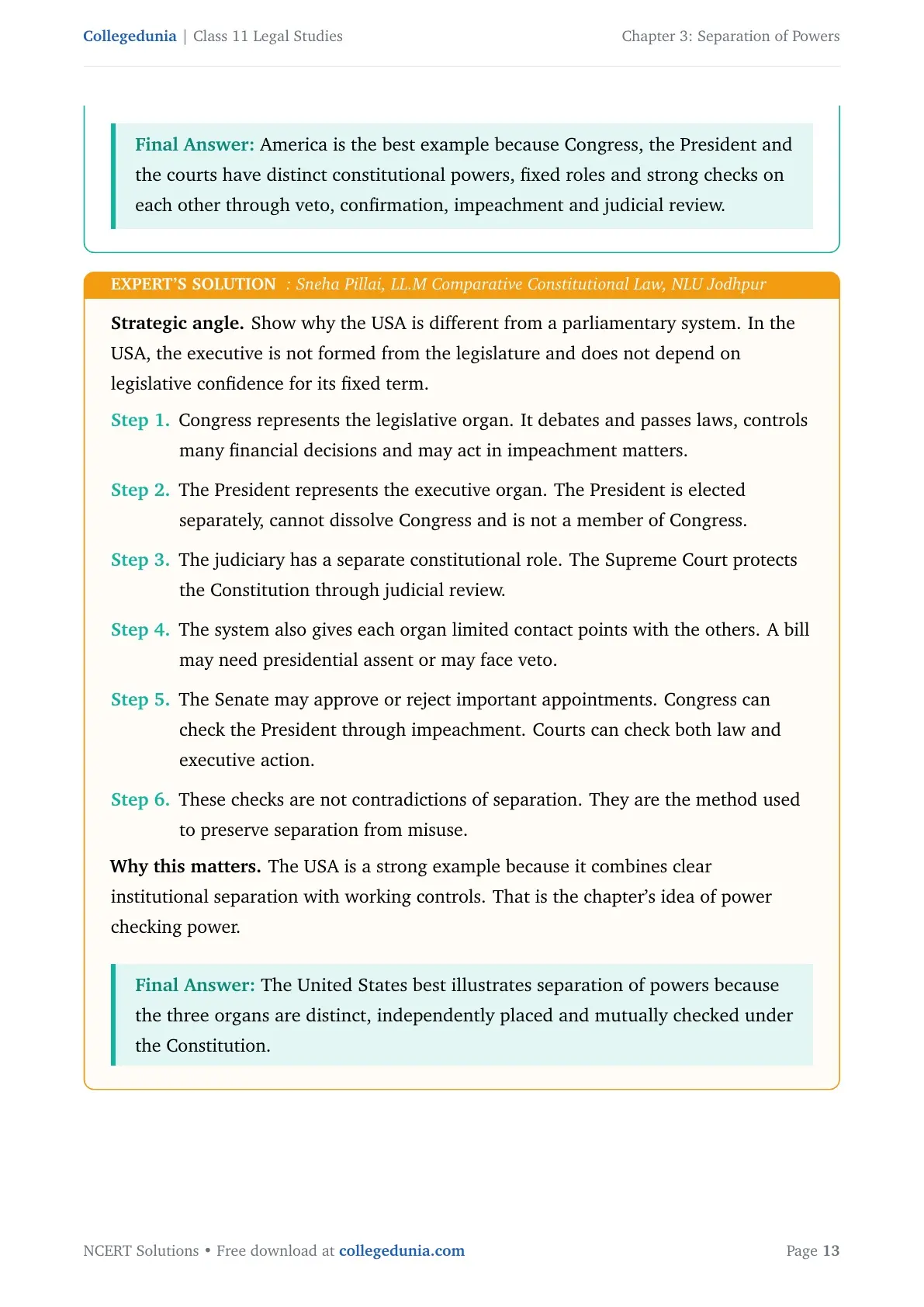
Strategic angle. Show why the USA is different from a parliamentary
system. In the USA, the executive is not formed from the legislature and does
not depend on legislative confidence for its fixed term.
Congress represents the legislative organ. It debates and passes laws,
controls many financial decisions and may act in impeachment matters.
The President represents the executive organ. The President is elected
separately, cannot dissolve Congress and is not a member of Congress.
The judiciary has a separate constitutional role. The Supreme Court
protects the Constitution through judicial review.
The system also gives each organ limited contact points with the
others. A bill may need presidential assent or may face veto.
The Senate may approve or reject important appointments. Congress can
check the President through impeachment. Courts can check both law and
executive action.
These checks are not contradictions of separation. They are the method
used to preserve separation from misuse.
Why this matters. The USA is a strong example because it combines
clear institutional separation with working controls. That is the chapter's
idea of power checking power.
The United States best illustrates separation of powers because the
three organs are distinct, independently placed and mutually checked under the
Constitution.
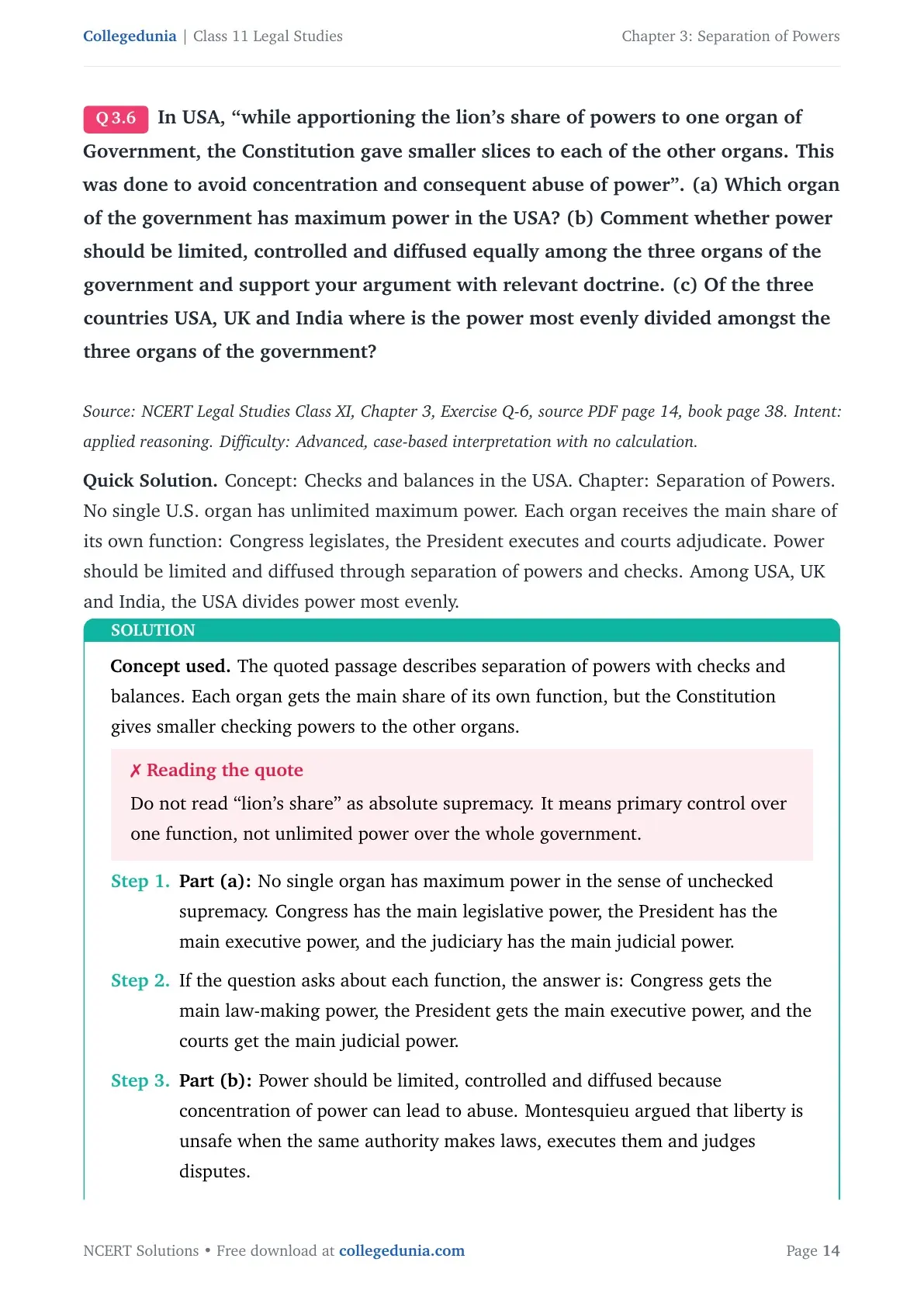
Q 3.6
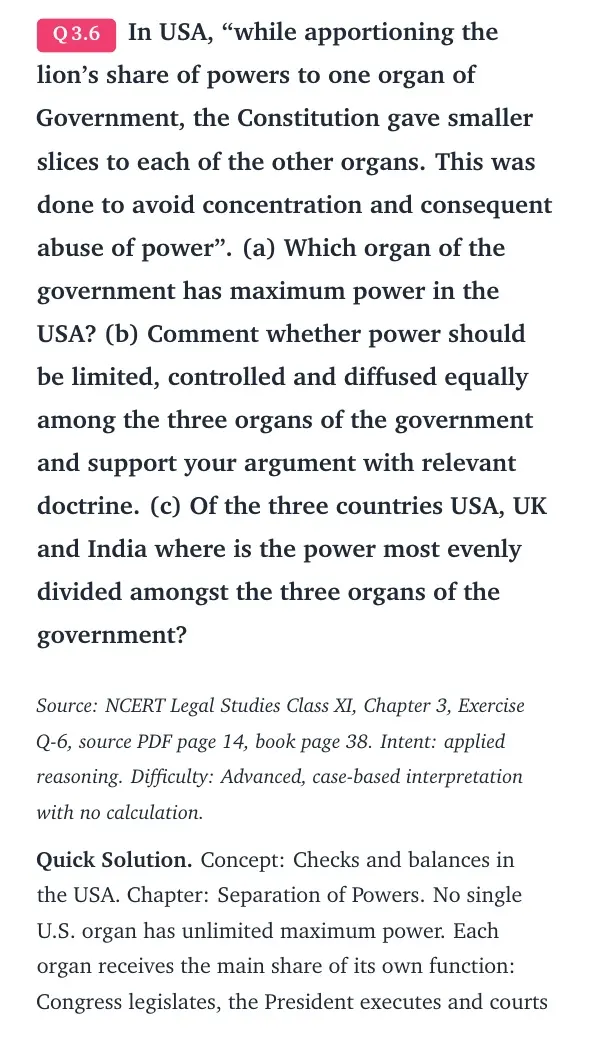
In USA, ``while apportioning the lion's share of powers to one organ of Government, the Constitution gave smaller slices to each of the other organs. This was done to avoid concentration and consequent abuse of power''. (a) Which organ of the government has maximum power in the USA? (b) Comment whether power should be limited, controlled and diffused equally among the three organs of the government and support your argument with relevant doctrine. (c) Of the three countries USA, UK and India where is the power most evenly divided amongst the three organs of the government?
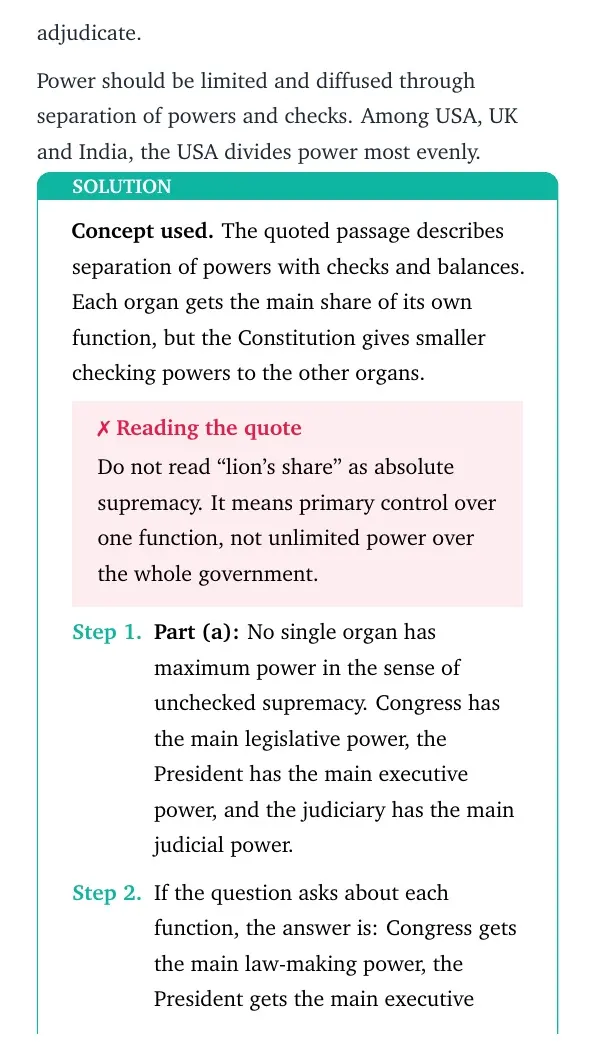
Concept used. The quoted passage describes separation of powers with
checks and balances. Each organ gets the main share of its own function, but
the Constitution gives smaller checking powers to the other organs.
Reading the quote
Do not read ``lion's share'' as absolute supremacy. It means primary control
over one function, not unlimited power over the whole government.
Part (a): No single organ has maximum power in the sense of
unchecked supremacy. Congress has the main legislative power, the
President has the main executive power, and the judiciary has the main
judicial power.
If the question asks about each function, the answer is: Congress gets
the main law-making power, the President gets the main executive power,
and the courts get the main judicial power.
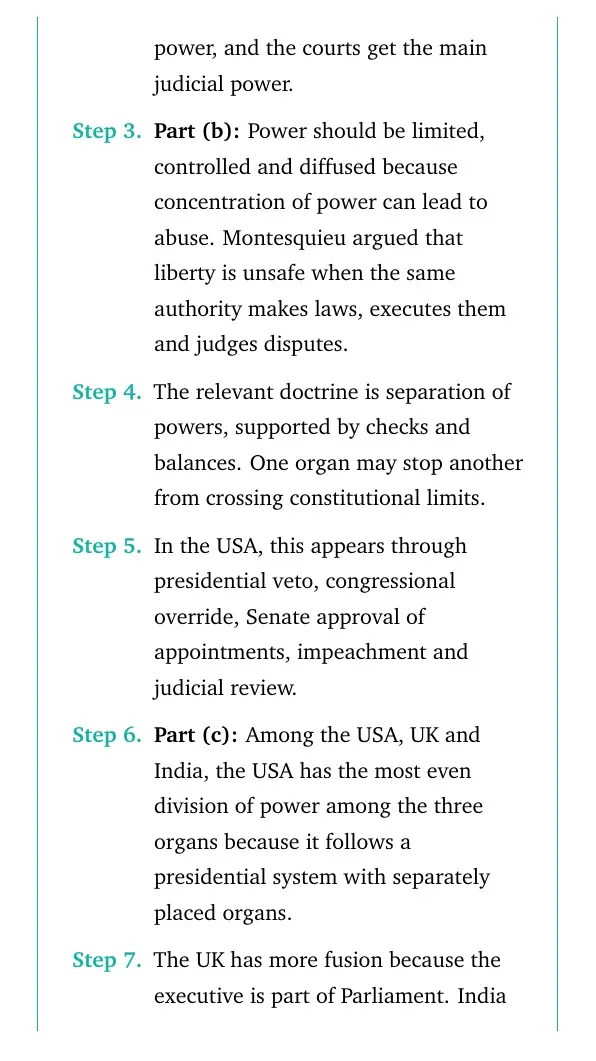
Part (b): Power should be limited, controlled and diffused
because concentration of power can lead to abuse. Montesquieu argued
that liberty is unsafe when the same authority makes laws, executes
them and judges disputes.
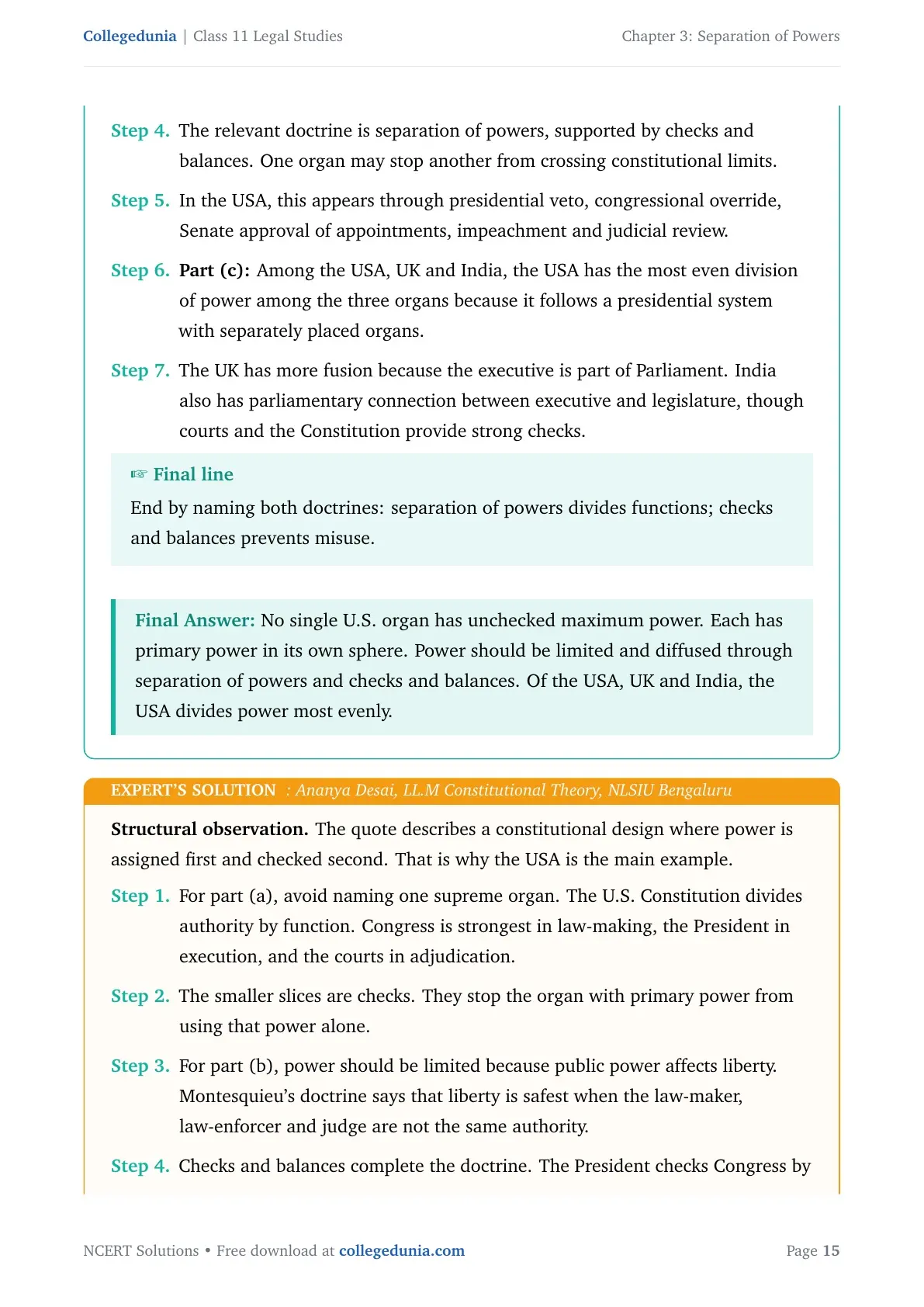
The relevant doctrine is separation of powers, supported by checks and
balances. One organ may stop another from crossing constitutional
limits.
In the USA, this appears through presidential veto, congressional
override, Senate approval of appointments, impeachment and judicial
review.
Part (c): Among the USA, UK and India, the USA has the most
even division of power among the three organs because it follows a
presidential system with separately placed organs.
The UK has more fusion because the executive is part of Parliament.
India also has parliamentary connection between executive and
legislature, though courts and the Constitution provide strong checks.
Final line
End by naming both doctrines: separation of powers divides functions; checks
and balances prevents misuse.
No single U.S. organ has unchecked maximum power. Each has primary
power in its own sphere. Power should be limited and diffused through
separation of powers and checks and balances. Of the USA, UK and India, the
USA divides power most evenly.
AD
Ananya Desai
LL.M Constitutional Theory, NLSIU Bengaluru
Verified Expert
Structural observation. The quote describes a constitutional design
where power is assigned first and checked second. That is why the USA is the
main example.
For part (a), avoid naming one supreme organ. The U.S. Constitution
divides authority by function. Congress is strongest in law-making, the
President in execution, and the courts in adjudication.
The smaller slices are checks. They stop the organ with primary power
from using that power alone.
For part (b), power should be limited because public power affects
liberty. Montesquieu's doctrine says that liberty is safest when the
law-maker, law-enforcer and judge are not the same authority.
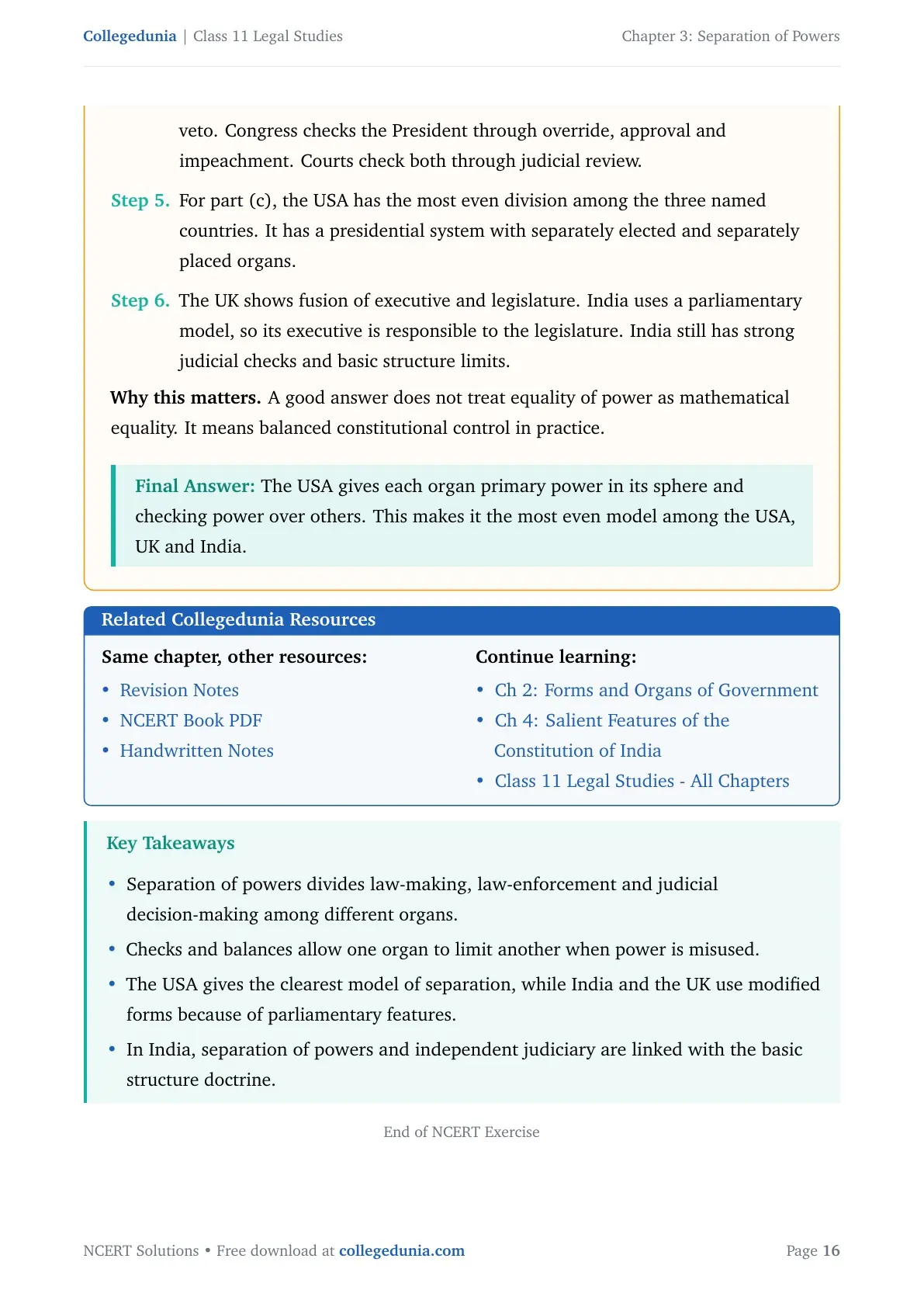
Checks and balances complete the doctrine. The President checks
Congress by veto. Congress checks the President through override,
approval and impeachment. Courts check both through judicial review.
For part (c), the USA has the most even division among the three named
countries. It has a presidential system with separately elected and
separately placed organs.
The UK shows fusion of executive and legislature. India uses a
parliamentary model, so its executive is responsible to the legislature.
India still has strong judicial checks and basic structure limits.
Why this matters. A good answer does not treat equality of power as
mathematical equality. It means balanced constitutional control in practice.
The USA gives each organ primary power in its sphere and checking
power over others. This makes it the most even model among the USA, UK and
India.
Frequently Asked Questions
Separation of Powers Help
Ques. What is covered in NCERT Solutions for Class 11 Legal Studies Chapter 3 Separation of Powers?
Ans. The solutions cover Article 368, basic structure, Montesquieu's doctrine, Wade and Phillips, separation of powers in Britain, the USA and India, and all 6 NCERT exercise prompts.
Ques. Why is the USA called the best example of separation of powers?
Ans. The USA is treated as the best example because Congress, the President and the Supreme Court have separate primary powers, while veto, impeachment, appointments and judicial review provide checks.
Ques. Can Montesquieu's separation of powers apply in India and the United Kingdom?
Ans. It cannot apply in a strict form because India and the United Kingdom use parliamentary systems with overlap between legislature and executive, but both still use checks and limits to prevent concentrated power.







Comments