



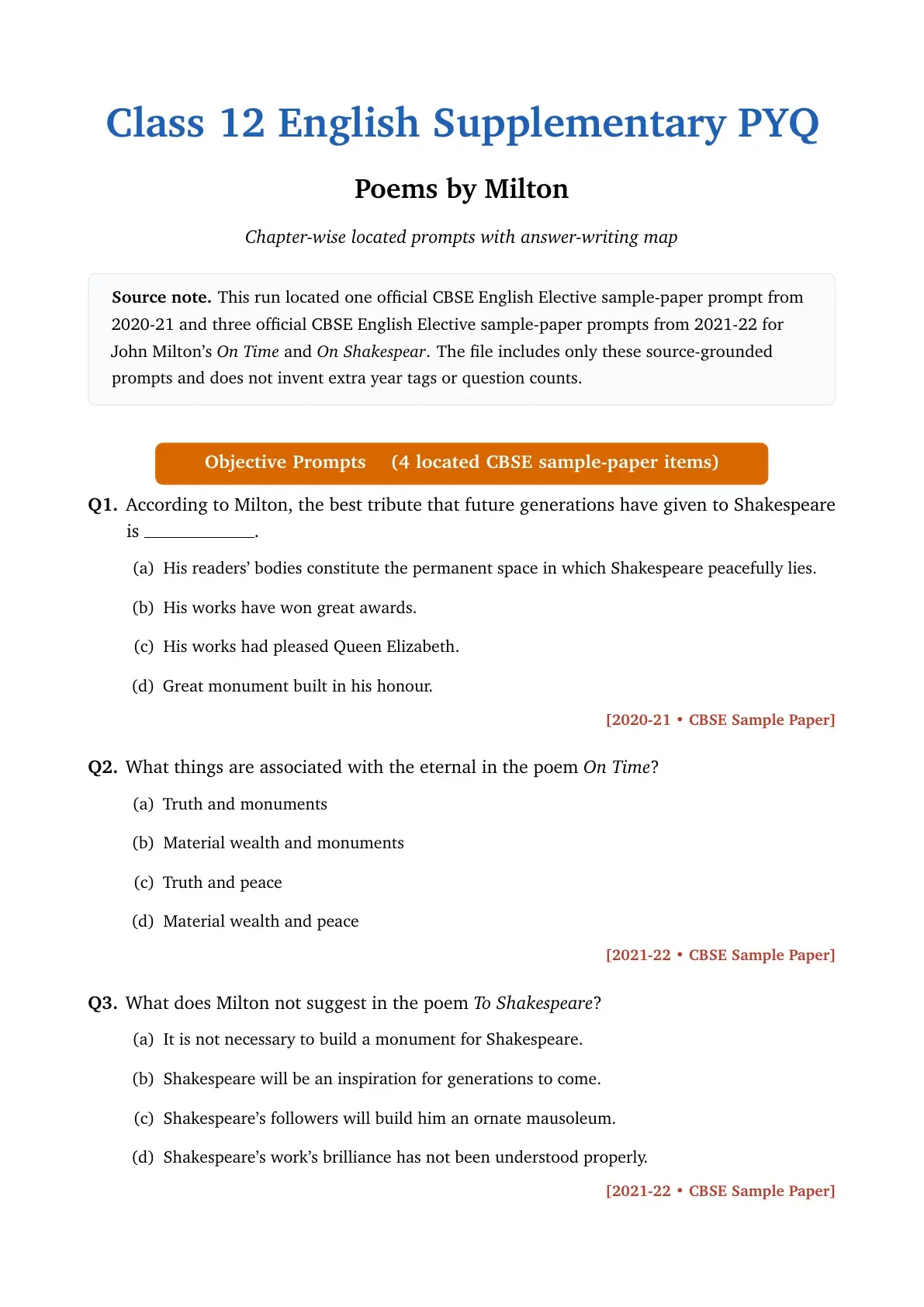
The Class 12 English Supplementary Poems by Milton PYQ PDF is available for free download. This chapter-wise file gives students the located CBSE sample-paper prompts for John Milton's poems from Kaleidoscope, with a focused answer map for 2026-27 revision.
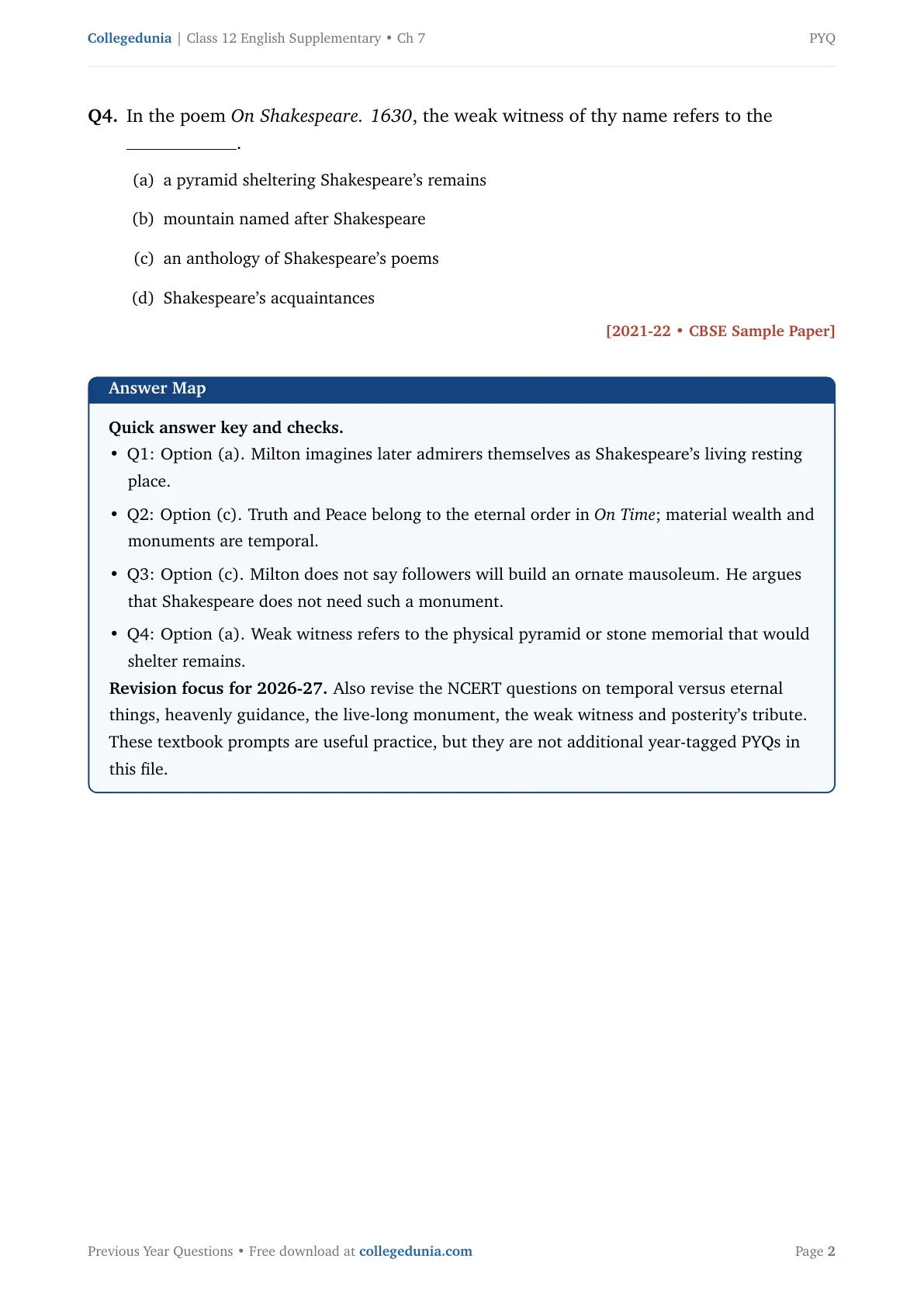
- Includes source-grounded CBSE English Elective sample-paper prompts from 2020-21 and 2021-22.
- Covers On Time and On Shakespear through objective practice.
- Useful for revising eternity, temporal values, weak witness and Shakespeare's living monument.
Student Feedback: Students can use this PYQ PDF to practise compact literature answers on Milton's treatment of time, eternity, poetic fame and monument imagery.
Class 12 English Poems by Milton PYQ PDF
The PDF contains located prompts for Poems by Milton. The available archive check found official CBSE sample-paper questions, so this page avoids unsupported broad question counts and keeps the file source-limited.
- Chapter: Chapter 7 Kaleidoscope: Poems by Milton
- Poems: On Time and On Shakespear
- Located source years: 2020-21 and 2021-22 CBSE sample papers
- Best use: practise objective answers before revising NCERT explanation questions
Questions Covered in Poems by Milton PYQ PDF
The located questions test whether students can separate the eternal from the temporal and understand Milton's monument argument for Shakespeare. A strong answer should connect each option to the exact image in the poem.
| Source | Question Focus | Answer Skill |
|---|---|---|
| 2020-21 CBSE SQP | Best tribute to Shakespeare | Identify later admirers as the living monument |
| 2021-22 CBSE SQP | Eternal values in On Time | Pair Truth and Peace with eternity |
| 2021-22 CBSE SQP | What Milton does not suggest | Eliminate the ornate mausoleum claim |
| 2021-22 CBSE SQP | Weak witness of Shakespeare's name | Read the pyramid or stone memorial image |
Revision Focus for Poems by Milton PYQs
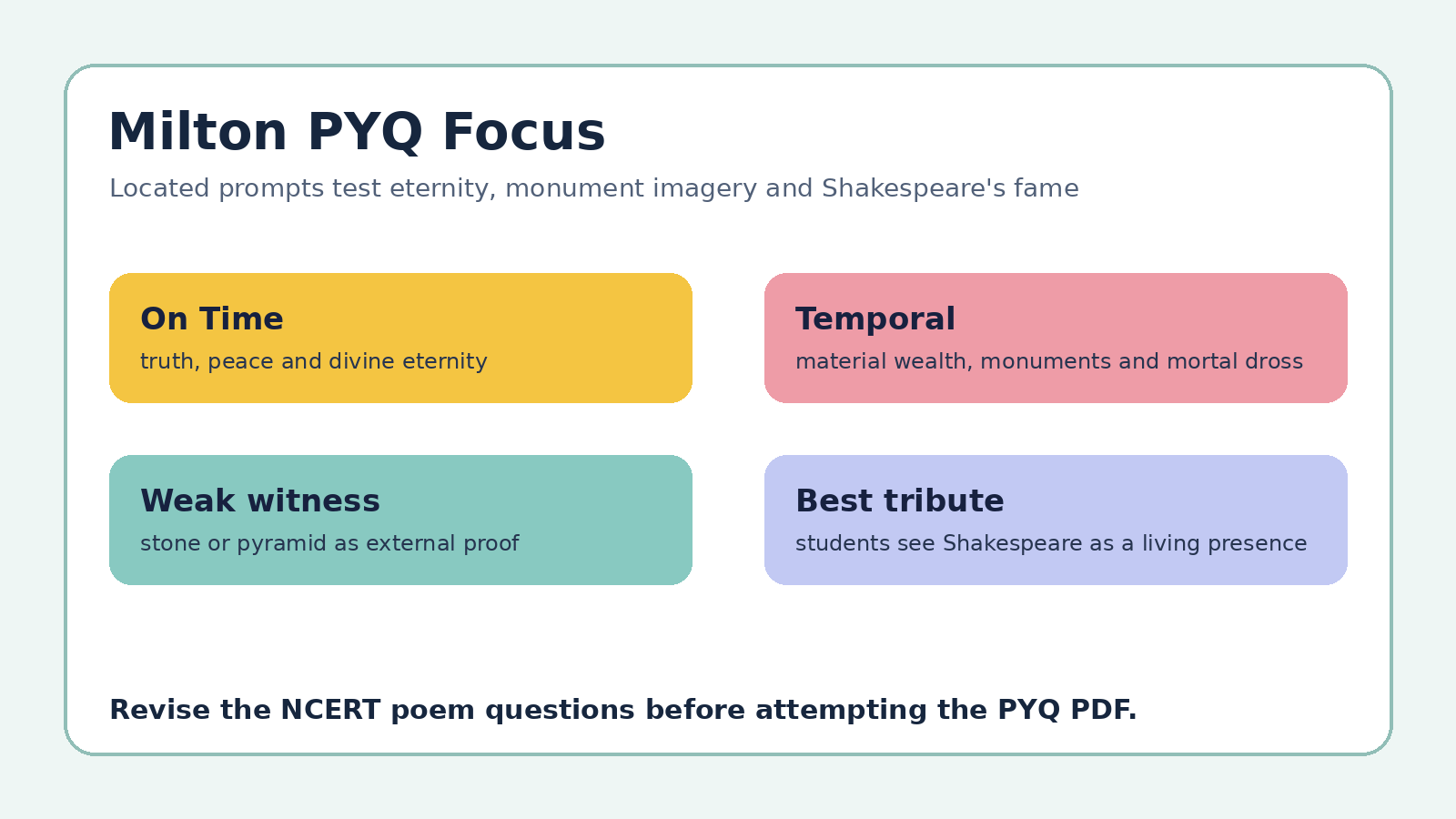
Before solving the PDF, revise how Milton contrasts earthly decay with divine permanence. The answer should not become a general note on Milton; it should stay tied to the poem images printed in NCERT.
- On Time: Truth, Peace and Love belong to the eternal order.
- Temporal side: material things, monuments, death, chance and mortal dross do not last.
- On Shakespear: stone memorials are weaker than the life of Shakespeare's words.
- Best tribute: students preserve Shakespeare through wonder, memory and repeated reading.
Answer Writing Map for Poems by Milton PYQs
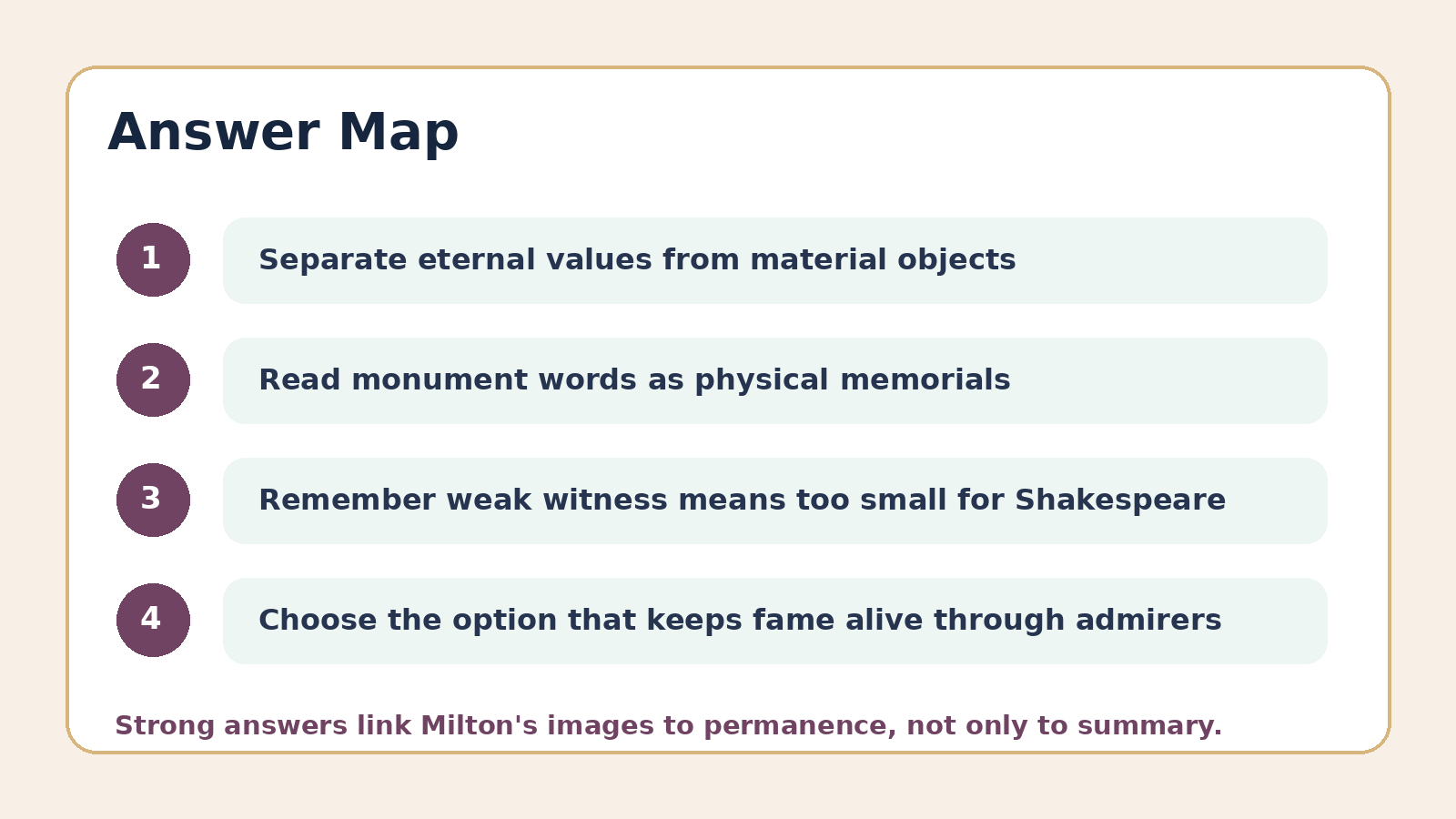
Write short explanations in four moves: identify the poem, name the image, connect it to temporal or eternal value, and choose the option that matches Milton's argument. Useful phrases include Truth and Peace, weak witness, live-long Monument, posterity and students' wonder.
All Class 12 English Supplementary PYQ Chapters
| Resource | Link |
|---|---|
| Poems by Milton PYQ | Chapter 7 PYQ PDF |
| Poems by Milton Notes | Chapter 7 Notes |
| Poems by Milton NCERT Solutions | Chapter 7 NCERT Solutions |
| Poems by Blake PYQ | Chapter 8 PYQ PDF |
| A Lecture upon the Shadow PYQ | Chapter 6 PYQ PDF |
Class 12 English Poems by Milton PYQ FAQs
Ques. Where can I download Class 12 English Poems by Milton PYQ PDF?
Ans. You can download the chapter-wise PYQ PDF from the table and PDF viewer above. The file includes the located source-grounded CBSE sample-paper prompts for this chapter.
Ques. Does the Poems by Milton PYQ PDF include many year-wise questions?
Ans. No. The archive check located official CBSE sample-paper prompts from 2020-21 and 2021-22, so the PDF includes only those verified items.
Ques. Which topics are most important for Poems by Milton PYQs?
Ans. Focus on eternal values in On Time, the weak witness image, the live-long monument and Milton's idea that students preserve Shakespeare through repeated reading.
Ques. How should students answer the objective PYQs from Poems by Milton?
Ans. First identify whether the question is from On Time or On Shakespear, then match the option to the exact poem image instead of choosing a general-sounding statement.



Comments