



The Class 12 Political Science Contemporary Centres of Power PYQ PDF is available for free download. This chapter-wise file gives students previous-year style practice for Contemporary World Politics Chapter 2, with source-noted board trends and a compact answer map for 2026-27 revision.
- Covers the European Union, ASEAN, China's rise and India's relations with new centres of power.
- Includes 6-mark, short-answer and concept-check prompts based on public PYQ archives and CBSE sample-paper pattern.
- Useful for quick Political Science board revision before solving full-length papers.
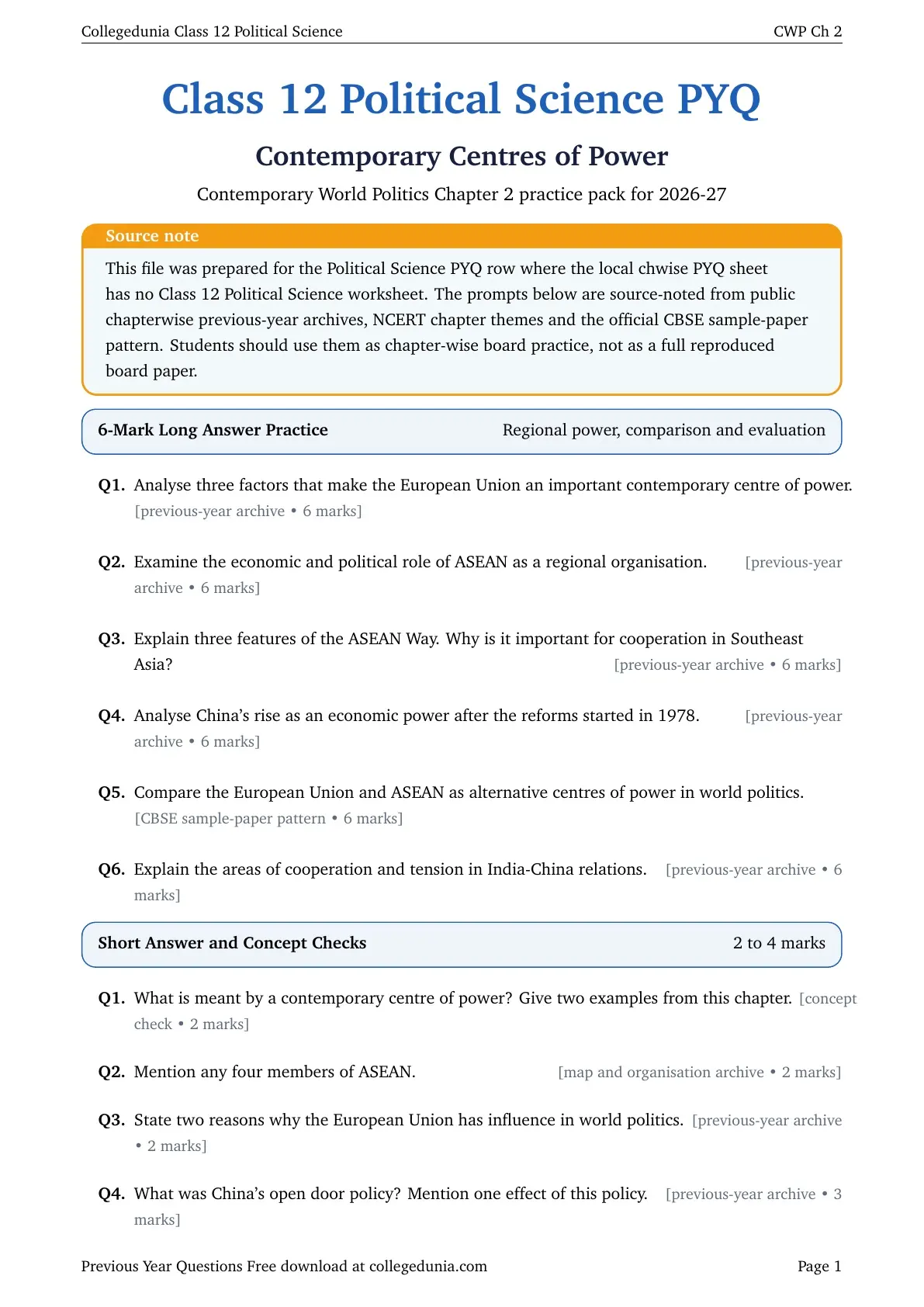
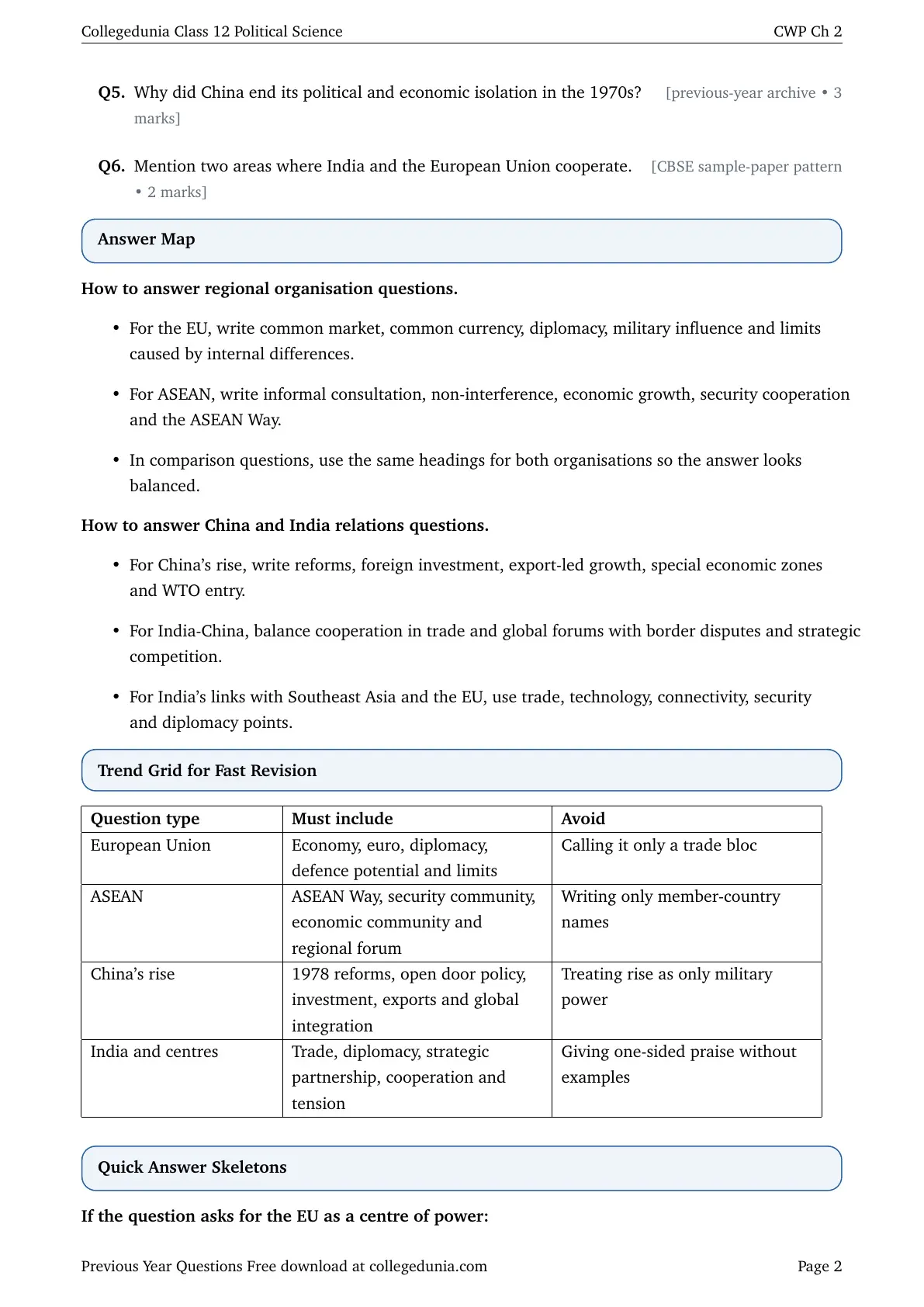
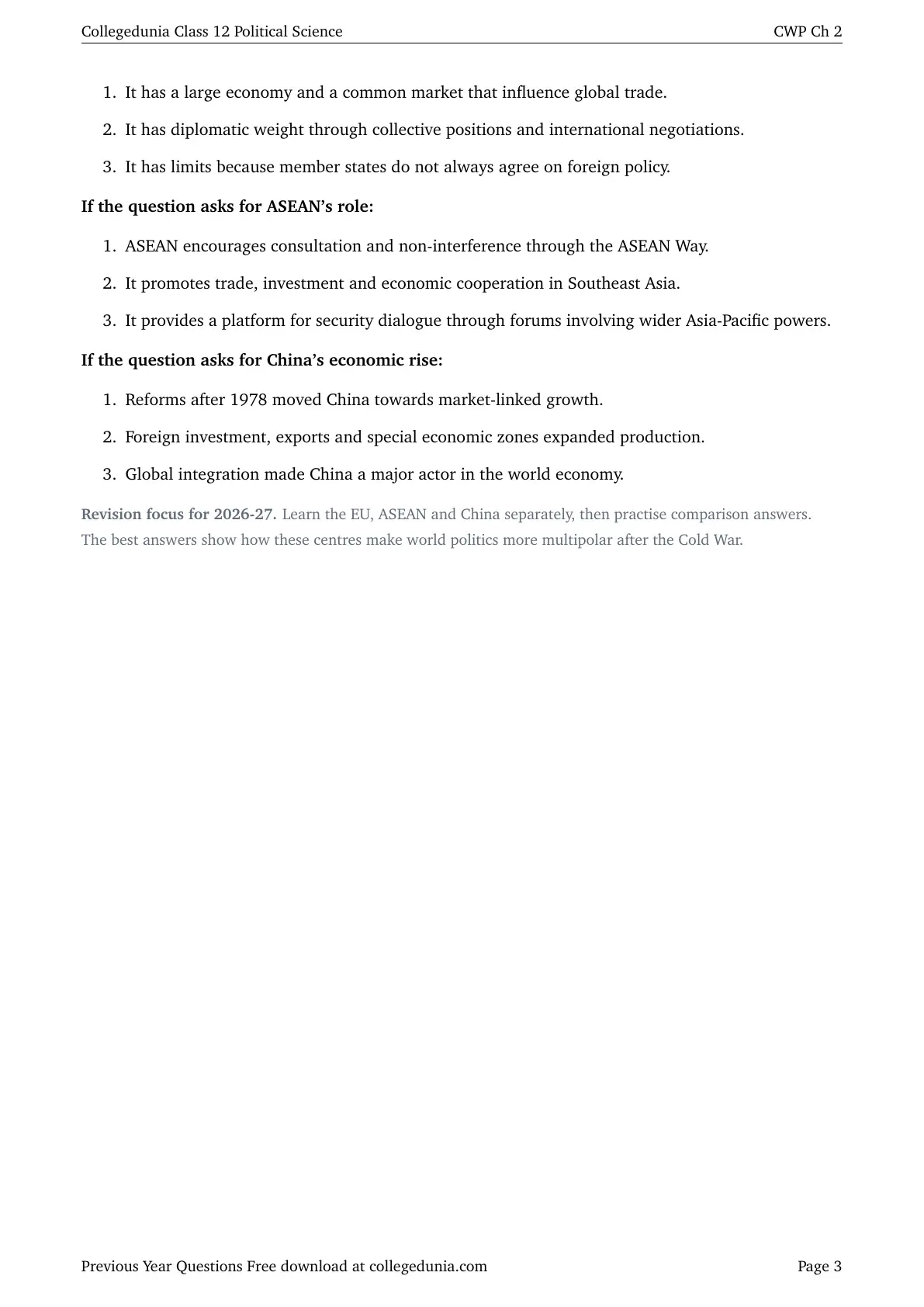
Student Feedback: Students can use this PYQ PDF to practise repeated board themes from Contemporary Centres of Power without mixing the EU, ASEAN and China answer points.
Class 12 Political Science Contemporary Centres of Power PYQ PDF
The PDF focuses on the second chapter of Contemporary World Politics. The local PYQ sheet did not contain a Political Science worksheet, so this article keeps the provenance transparent and uses source-noted public previous-year archives plus the official CBSE sample-paper pattern.
- Chapter: Chapter 2 CWP: Contemporary Centres of Power
- Main theme: alternative centres of power after the Cold War
- Practice type: long-answer, short-answer and concept-check questions
- Best use: revise EU, ASEAN, China and India's relations before attempting board papers
Questions Covered in Contemporary Centres of Power PYQ PDF
The repeated question clusters usually ask students to explain how regional organisations and rising economies affect world politics. Comparison questions are common, so answer points should stay balanced and example-based.
| PYQ Cluster | Question Focus | Answer Skill |
|---|---|---|
| European Union | Economic, diplomatic and strategic influence | Use economy, euro, diplomacy, defence potential and limits |
| ASEAN | Regional cooperation and ASEAN Way | Explain non-interference, consultation and economic growth |
| China | Rise after 1978 reforms | Link reforms, open door policy, investment and exports |
| India and new centres | Cooperation and tensions | Balance trade, technology, security and diplomacy points |
Revision Focus for Contemporary Centres of Power PYQs
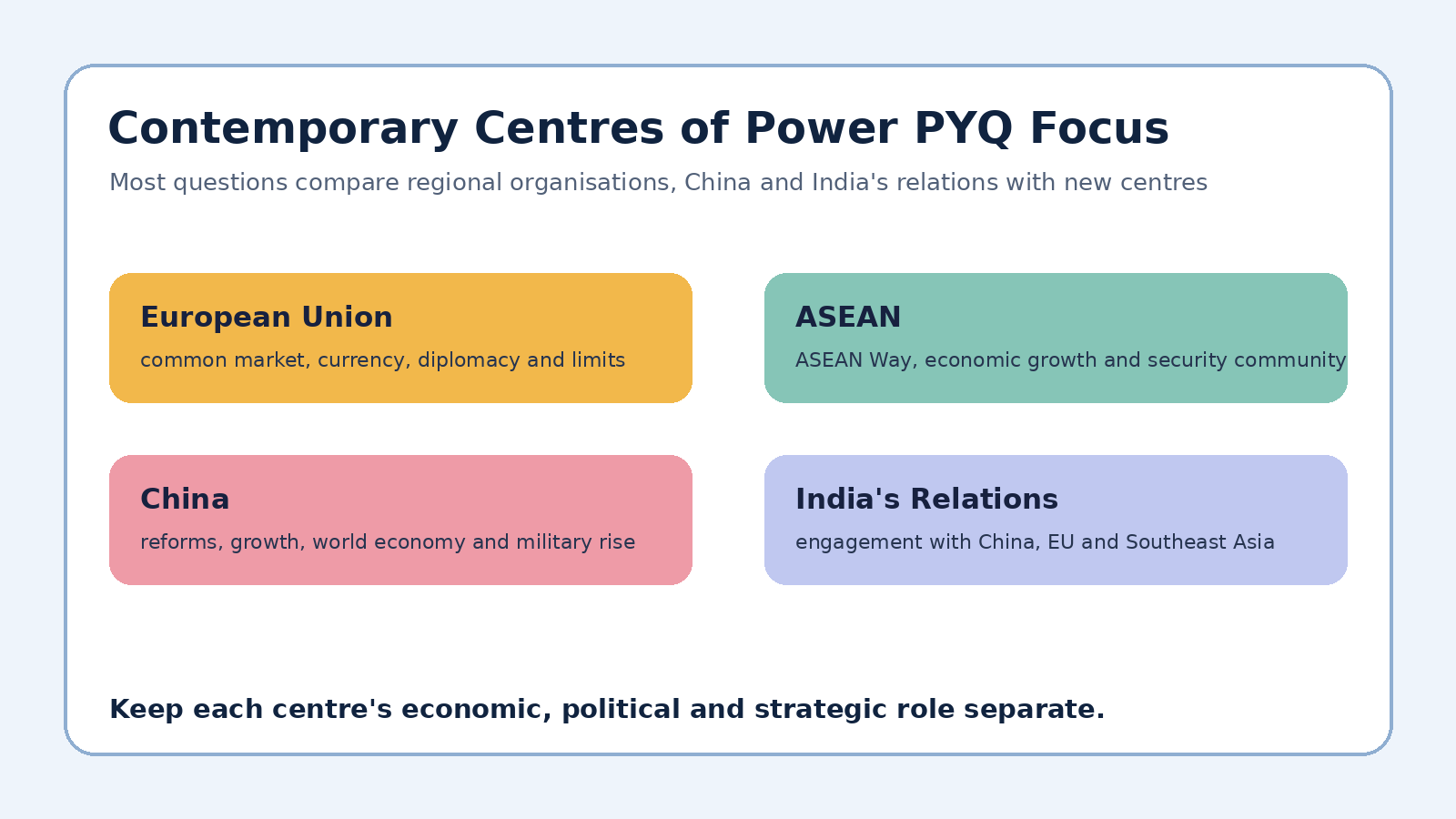
Start revision by treating the EU, ASEAN and China as separate case studies. The EU is useful for economic and diplomatic power, ASEAN for regional cooperation and China for rapid economic transformation.
- European Union: common market, euro, diplomacy, security role and internal limits
- ASEAN: ASEAN Way, economic community, regional forum and non-interference
- China: 1978 reforms, open door policy, foreign investment and export-led growth
- India: trade, technology, security cooperation and unresolved tensions
Answer Writing Map for Contemporary Centres of Power PYQs
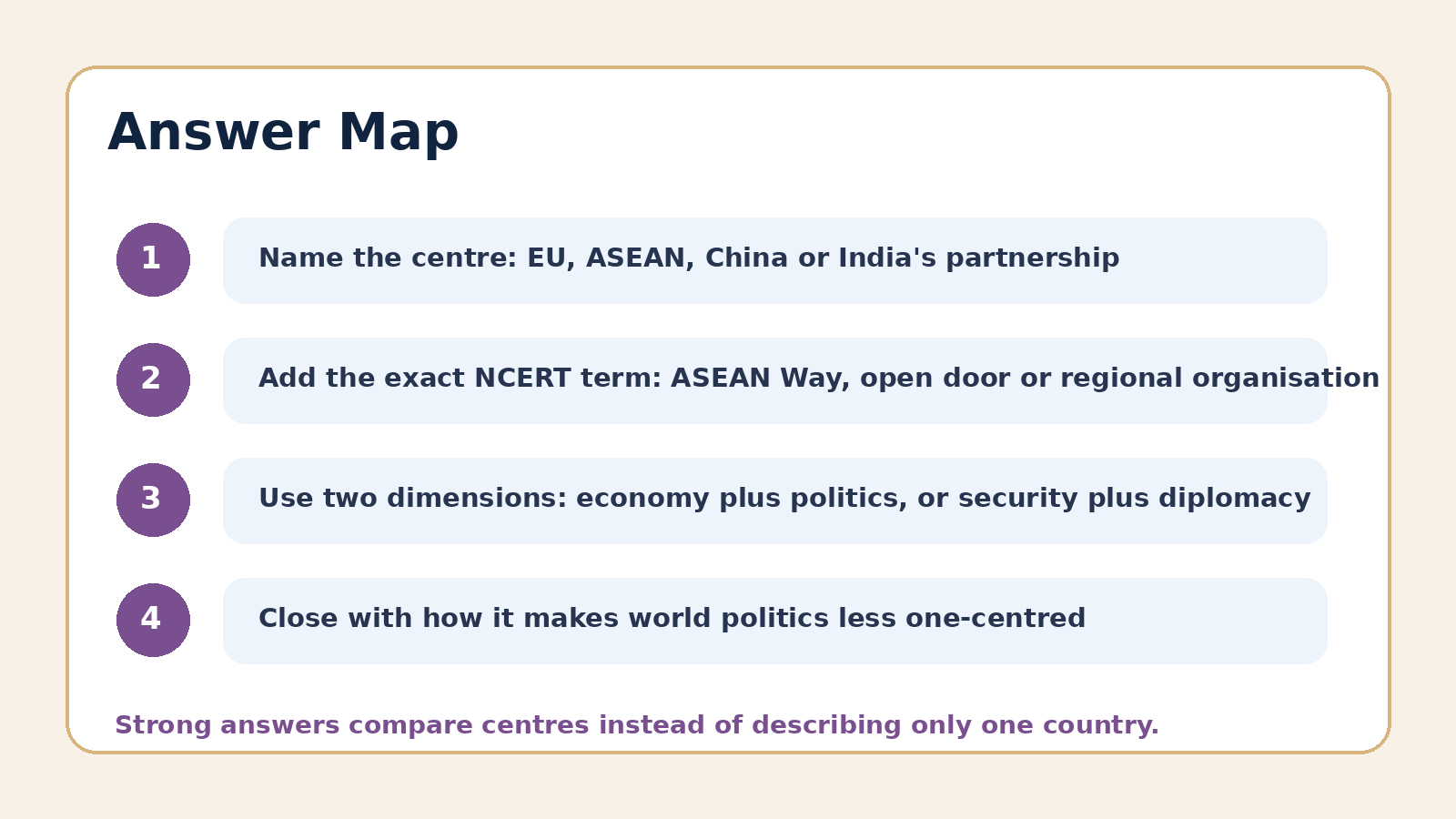
Write each long answer with two clear dimensions. For example, use economy plus diplomacy for the EU, consultation plus trade for ASEAN, and reforms plus global integration for China. In comparison answers, keep the same headings for both sides so the answer reads like a comparison rather than two separate notes.
Class 12 Political Science Contemporary Centres of Power Related Resources
| Resource | Link |
|---|---|
| Contemporary Centres of Power NCERT Solutions | Chapter 2 NCERT Solutions |
| Contemporary Centres of Power Handwritten Notes | Chapter 2 Handwritten Notes |
| Contemporary Centres of Power NCERT Book PDF | Chapter 2 Book PDF |
All Class 12 Political Science PYQ Chapters
| Resource | Link |
|---|---|
| The End of Bipolarity PYQ | Chapter 1 PYQ PDF |
| Contemporary Centres of Power PYQ | Chapter 2 PYQ PDF |
| Contemporary South Asia PYQ | Chapter 3 PYQ PDF |
| International Organisations PYQ | Chapter 4 PYQ PDF |
Class 12 Political Science Contemporary Centres of Power PYQ FAQs
Ques. Where can I download Class 12 Political Science Contemporary Centres of Power PYQ PDF?
Ans. You can download the chapter-wise PYQ PDF from the PDF viewer and download link above.
Ques. Which topics are important for Contemporary Centres of Power PYQs?
Ans. Focus on the European Union, ASEAN, China's rise, the ASEAN Way, open door policy and India's relations with new centres of power.
Ques. How should students answer ASEAN questions?
Ans. Define ASEAN briefly, then explain the ASEAN Way, non-interference, economic cooperation, security dialogue and regional forum role.
Ques. Is this PDF a full Political Science board paper?
Ans. No. It is a chapter-wise PYQ practice PDF for Contemporary Centres of Power, prepared for focused revision before full-paper practice.



Comments