Political Science Editor, 7 Yrs | Updated on - Jul 14, 2026
The NCERT Solutions for Political Science Class 12 Chapter 2 Contemporary Centres of Power answer every textbook question on the European Union, ASEAN and the rise of China, set to the latest 2026-27 CBSE syllabus. Each answer explains how these new centres of power grew and how they limit the dominance of the United States. These solutions help students prepare for the Class 12 Political Science board paper and the UPSC foundation in 2026-27.
Covers all 14 exercise questions from Contemporary World Politics Chapter 2, with full point-wise answers.
This Class 12 Political Science chapter usually carries 5 to 6 marks per board paper.
Pairs with the Notes, Handwritten Notes and NCERT Book PDF linked lower on this page.
Every solution for Class 12 Political Science Chapter 2 in this Collegedunia compilation is written by subject experts from the official NCERT Contemporary World Politics textbook, and checked against the last five years of CBSE board papers.
Student Feedback: In a Collegedunia poll of 9,040 Class 12 Political Science students taken before the 2026 boards, 71% of students rated the European Union question as the hardest part of Contemporary Centres of Power. Most students said a clear split into economic, diplomatic and military influence made the answer easy to recall.
Source: 2026-27 Class 12 Political Science student poll. Sample of 9,040 students from CBSE schools across 13 states.
What the Contemporary Centres of Power Class 12 Chapter Is About
Contemporary Centres of Power is the second chapter of Contemporary World Politics. After the bipolar order ended in the early 1990s, new centres of power rose to limit the dominance of the United States. This chapter studies three of them: the European Union, ASEAN and the rising economy of China.
The chapter answers three big questions that students must keep in mind:
How did each centre grow? The EU step by step, ASEAN through the ASEAN Way, China through 1978 reforms.
How do they cooperate? Through regional organisations built on shared peace and prosperity.
How does India deal with them? Through trade, dialogue and managing its issues with China.
So the chapter is really about how regional groupings now shape world politics. A student who keeps these three threads in mind can connect almost any question in Contemporary Centres of Power class 12 back to one of them. Sort each fact under "EU", "ASEAN" or "China" first, and revision becomes far faster.
The European Union as a Centre of Power
After the Second World War, Europe had to choose between old rivalries and rebuilding on shared institutions. It chose integration, joining its economies step by step until the European Union was born in 1992. To answer the EU questions well, students must know both how it grew and where its influence comes from.
Marshall Plan and OEEC: US aid rebuilt Europe; the OEEC was set up in 1948.
EEC, 1957: the Treaties of Rome created the European Economic Community.
Maastricht Treaty, 1992: turned the community into the European Union.
Influence: the EU has economic, diplomatic and military power across the world.
The most-asked EU question is why it is a highly influential regional organisation. The answer splits into three parts: a huge economy with the euro, real diplomatic weight (France holds a permanent UN Security Council seat), and the world's second-largest combined armed forces. A full answer also notes the limits, since members keep their own foreign and defence policies and Euro-skepticism runs deep in places.
ASEAN and the ASEAN Way
The Association of South East Asian Nations was set up by the Bangkok Declaration of 1967. Unlike the EU, ASEAN builds no supranational structures. It moves by consensus and quiet consultation, a soft style the chapter calls the ASEAN Way. Students should learn its founding, its method and its structure as a clear list.
The ASEAN Way: a form of interaction that is informal, non-confrontationist and cooperative.
Vision 2020: sets an outward-looking role for ASEAN and prefers negotiation over conflict.
Three pillars: the Security Community, the Economic Community and the Socio-Cultural Community.
ARF, 1994: the ASEAN Regional Forum is the body that deals with security.
A key insight for the exam is that ASEAN's success rests on this soft, cooperative style. The MCQ on the ASEAN Way turns on three words: informal, non-confrontationist and cooperative. The pillars question wants all three named with one objective each. Linking the ARF to both its 1994 founding and its security role answers two fill-in-the-blank parts at once.
The Rise of the Chinese Economy
China's economic rise is the third centre of power in the chapter. The shift from a closed command economy to a fast-growing market economy is a long-answer favourite, so students should learn it as a clear before-and-after contrast rather than a story. The table below sorts the change for fast revision.
Feature
Command economy then vs market economy now
Ownership
State owned everything; now private farms and firms operate after 1982 and 1998 reforms.
Openness
Closed and self-reliant; now open through Special Economic Zones and WTO entry in 2001.
Driver of growth
State-run heavy industry; now foreign trade, foreign direct investment and rural industry.
Result
Slow growth and short of foreign exchange; now the world's fastest growing economy.
A sharp point for the exam is that China opened step by step, not through shock therapy. Deng Xiaoping announced the open door policy in 1978, then agriculture was privatised in 1982 and industry in 1998. Saying China switched overnight is wrong and loses marks. The key date to pin is the 1978 open door policy, which is the hinge of China's whole rise.
India-China Relations and Contentious Issues
The chapter closes with India-China relations, which carry both contentious issues and growing cooperation. This topic links the chapter to India's foreign policy, so it is a regular long answer. The table keeps the disputes and the ways to resolve them side by side.
Contentious issue
How it can be resolved
Border dispute
The 1962 war over Arunachal Pradesh and Aksai Chin; continue boundary talks running since 1981.
Tibet
Differences from the 1950 takeover; manage through patient dialogue.
China-Pakistan ties
Nuclear help, the CPEC and UN blocking; ease through diplomacy and shared forums.
One sharp point for the India-China question: growing trade is the glue that keeps both sides at the table. Bilateral trade rose from USD 338 million in 1992 to over USD 84 billion in 2017, which raises the cost of conflict. The chapter notes that none of these issues is likely to lead to war, because economic interdependence keeps pulling the two back to talks.
Why Regional Organisations Are Formed
The chapter also asks why states form regional organisations at all. This is a short and long answer favourite, so students should learn the aims as a list. The objectives fold neatly into two ideas: peace and prosperity.
Economic growth: faster trade and development, as ASEAN was set up to accelerate growth.
Peace and stability: neighbours who once fought wars choose cooperation instead.
Social and cultural progress: members work to raise living standards across the region.
A stronger joint voice: a bloc bargains harder than a lone state in bodies like the WTO.
Geographical proximity matters too, because nearby countries share the same problems, trade routes and security concerns. So closeness makes it natural and useful for them to band together. A useful contrast is that South Asia is just as close-knit on the map, yet SAARC has done far less than ASEAN, because political trust was missing. So proximity is a strong push but not a guarantee.
Contemporary Centres of Power Class 12 Exercise-wise Coverage
The chapter exercise has 14 questions. The table maps each one to its topic so students can plan revision and find the right NCERT answer fast. The full point-wise solution for each sits in the question set lower on this page.
Question
Topic it tests
Q 1
Chronological order of EEC, EU, ARF and China's WTO entry
Q 2
What the ASEAN Way means (MCQ)
Q 3
Which nation adopted the open door policy (MCQ)
Q 4
Fill in the blanks on the 1962 border, ARF, China-US ties and the Marshall Plan
Q 5
Objectives of establishing regional organisations
Q 6
How geographical proximity influences regional organisations
Q 7
Components of the ASEAN Vision 2020
Q 8
Pillars and objectives of the ASEAN Community
Q 9
How the present Chinese economy differs from its command economy
Q 10
How Europe resolved post-war problems and formed the EU
Q 11
What makes the EU a highly influential regional organisation
Q 12
Whether China and India can challenge a unipolar world
Q 13
Peace and prosperity through regional economic organisations
Q 14
Contentious issues between China and India and how to resolve them
Questions 9, 11, 12 and 14 are the most-asked long answers, so students preparing Contemporary Centres of Power class 12 important questions should learn those first. The MCQs and fill-in-the-blanks (Q1 to Q4) are quick marks, so revise the founding dates of the EU, ASEAN and the ARF to secure them.
Students who want the offline copy can save the class 12 political science chapter 2 pdf from the download card above and tick off each question as they finish it.
Contemporary Centres of Power Important Questions and Previous Year Trends
CBSE sets a steady mix of MCQ, short and long answers from this chapter. Knowing the pattern helps students decide how much to write. The chapter is a regular source of one 4-mark or 6-mark question, which is why a focused list of Contemporary Centres of Power important questions saves a lot of revision time.
Long answer (5 to 6 marks): what makes the EU influential, or how China's economy changed.
Short answer (4 marks): the ASEAN pillars, or the objectives of regional organisations.
Source-based: a passage on European integration or India-China relations, with sub-parts.
Objective and MCQ: the ASEAN Way, the open door policy, and the founding dates.
For quick recall before the exam, students often practise the class 12 political science chapter 2 mcq set and a list of Contemporary Centres of Power class 12 important questions. The most repeated items are the sources of EU influence and the China economy contrast, so keep those answer points ready in your own words.
Working through the ncert solutions class 12 political science chapter 2 set twice, once open-book and once from memory, fixes the dates and names well before the board exam.
Common Mistakes Students Make in This Chapter
A few errors cost marks every year in this chapter. Most come from mixing up the founding dates or giving only one side of the EU question. Avoiding them is the fastest way to lift a score.
Saying China used shock therapy - it did not; it opened step by step from 1978.
Confusing the EEC (1957) with the EU (1992) - keep the two founding years clearly separate.
Naming only one border area for 1962 - both Arunachal Pradesh and Aksai Chin are needed.
Forgetting the EU's limits - members keep their own foreign and defence policies.
Describing the ASEAN Way as a defence policy or a road - it is an informal style of interaction.
Students who fix these five points usually move from average to high marks on the long answers. The exam rewards a balanced view, so always give both the strength and the limit of the EU before you judge it.
Contemporary Centres of Power PDF Download Formats and Languages
The solutions are free to download in more than one format, so students can pick what suits their device and revision style. The download card at the top of the page carries each option for this chapter.
Normal and HD PDF: the class 12 political science chapter 2 pdf comes in a normal size for quick downloads and an HD version for clear printing.
English medium: all 14 answers are written in simple English for the CBSE board paper.
Question-only set: a print-and-practise sheet of Contemporary Centres of Power extra questions for self-testing.
Whole-book pack: the solutions sit in one set that runs through every Contemporary World Politics chapter, so you can revise from Chapter 1 onwards in one place.
Many students search for class 12 political science chapter 2 answers on their phone the night before a test, so a saved PDF means you can revise even without internet. Keep both the question set and the solved version handy for a full self-check.
How the Contemporary Centres of Power Solutions Pair with Notes and the Book PDF
These NCERT Solutions answer the back-exercise questions. To revise the full chapter, students should use them alongside the other resources for the same chapter, all linked in the table below.
Reading the original NCERT chapter text and figures
Tip: read the Notes first, then attempt these solutions on your own, and only then check the model answers here. That order builds memory faster than copying answers straight away.
All NCERT Solutions for Class 12 Political Science
The table links the NCERT Solutions for every chapter in both Class 12 Political Science books, so students can move across the course in one click. Contemporary Centres of Power is highlighted.
All NCERT Solutions for Contemporary Centres of Power with Step-by-Step Solutions
Below are all 14 NCERT exercise questions for this chapter, exactly as they appear in the textbook. Tap Check Solution for the model answer or Expert Solution for the topper-style approach.
Q 2.1
Arrange the following in chronological order.
a. China's accession to WTO b. Establishment of the EEC
c. Establishment of the EU d. Birth of ARF
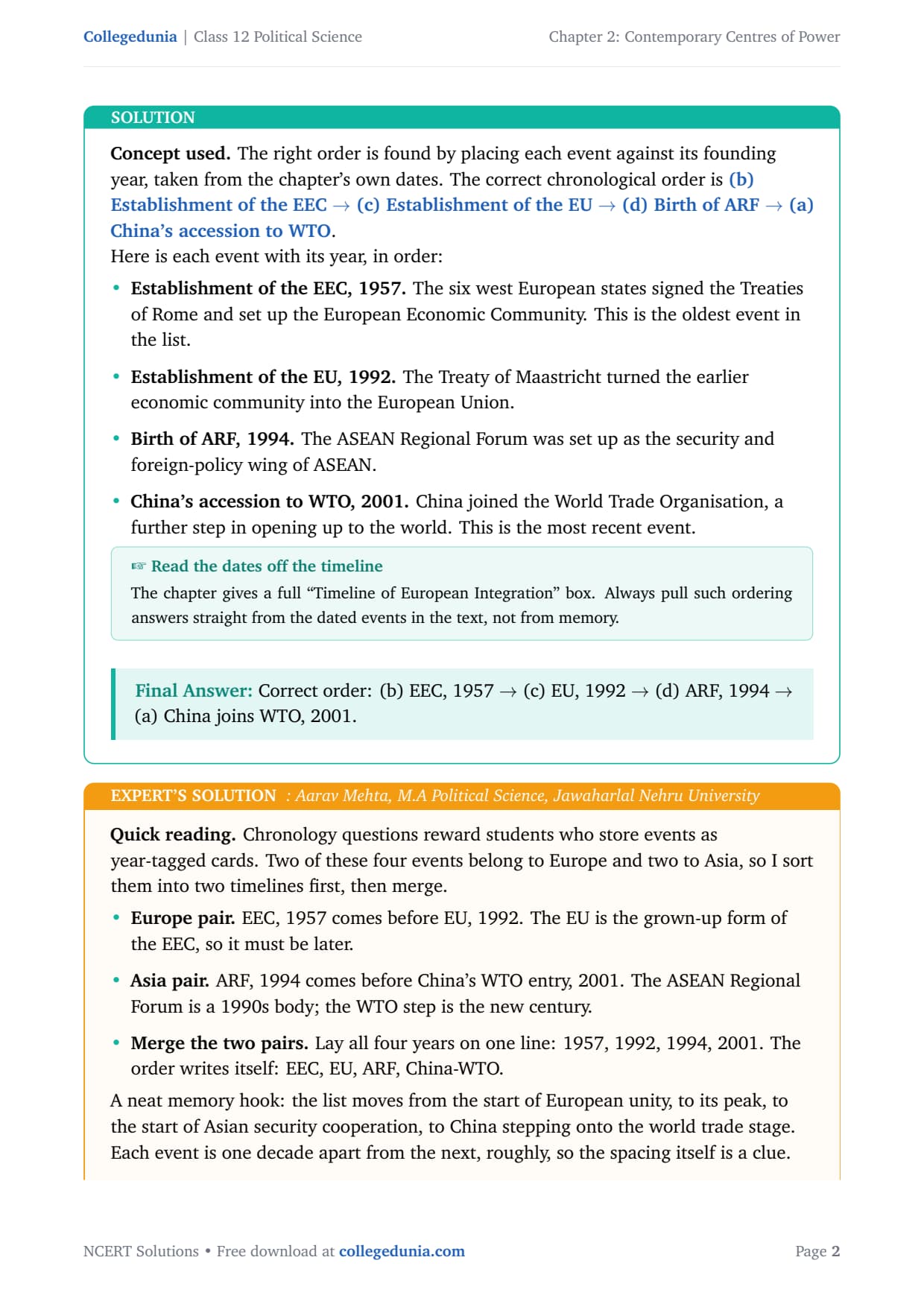
Concept used. The right order is found by placing each event
against its founding year, taken from the chapter's own dates. The
correct chronological order is (b) Establishment of the EEC
→ (c) Establishment of the EU → (d) Birth of
ARF → (a) China's accession to WTO.
Here is each event with its year, in order:
Establishment of the EEC, 1957. The six west European
states signed the Treaties of Rome and set up the European
Economic Community. This is the oldest event in the list.
Establishment of the EU, 1992. The Treaty of Maastricht
turned the earlier economic community into the European Union.
Birth of ARF, 1994. The ASEAN Regional Forum was set up
as the security and foreign-policy wing of ASEAN.
China's accession to WTO, 2001. China joined the World
Trade Organisation, a further step in opening up to the world.
This is the most recent event.
Read the dates off the timeline
The chapter gives a full ``Timeline of European Integration'' box.
Always pull such ordering answers straight from the dated events in the
text, not from memory.
M.A Political Science, Jawaharlal Nehru University
Verified Expert
Quick reading. Chronology questions reward students who store
events as year-tagged cards. Two of these four events belong to Europe
and two to Asia, so I sort them into two timelines first, then merge.
Europe pair. EEC, 1957 comes before EU, 1992. The EU is
the grown-up form of the EEC, so it must be later.
Asia pair. ARF, 1994 comes before China's WTO entry,
2001. The ASEAN Regional Forum is a 1990s body; the WTO step is
the new century.
Merge the two pairs. Lay all four years on one line:
1957, 1992, 1994, 2001. The order writes itself: EEC, EU, ARF,
China-WTO.
A neat memory hook: the list moves from the start of European unity, to
its peak, to the start of Asian security cooperation, to China stepping
onto the world trade stage. Each event is one decade apart from the next,
roughly, so the spacing itself is a clue.
(b) → (c) → (d) → (a),
that is EEC 1957, EU 1992, ARF 1994, China joins WTO 2001.
Q 2.2
The `ASEAN Way'
a. Reflects the life style of ASEAN members
b. A form of interaction among ASEAN members that is informal and cooperative
c. The defence policy followed by the ASEAN members
d. The road that connects all the ASEAN members
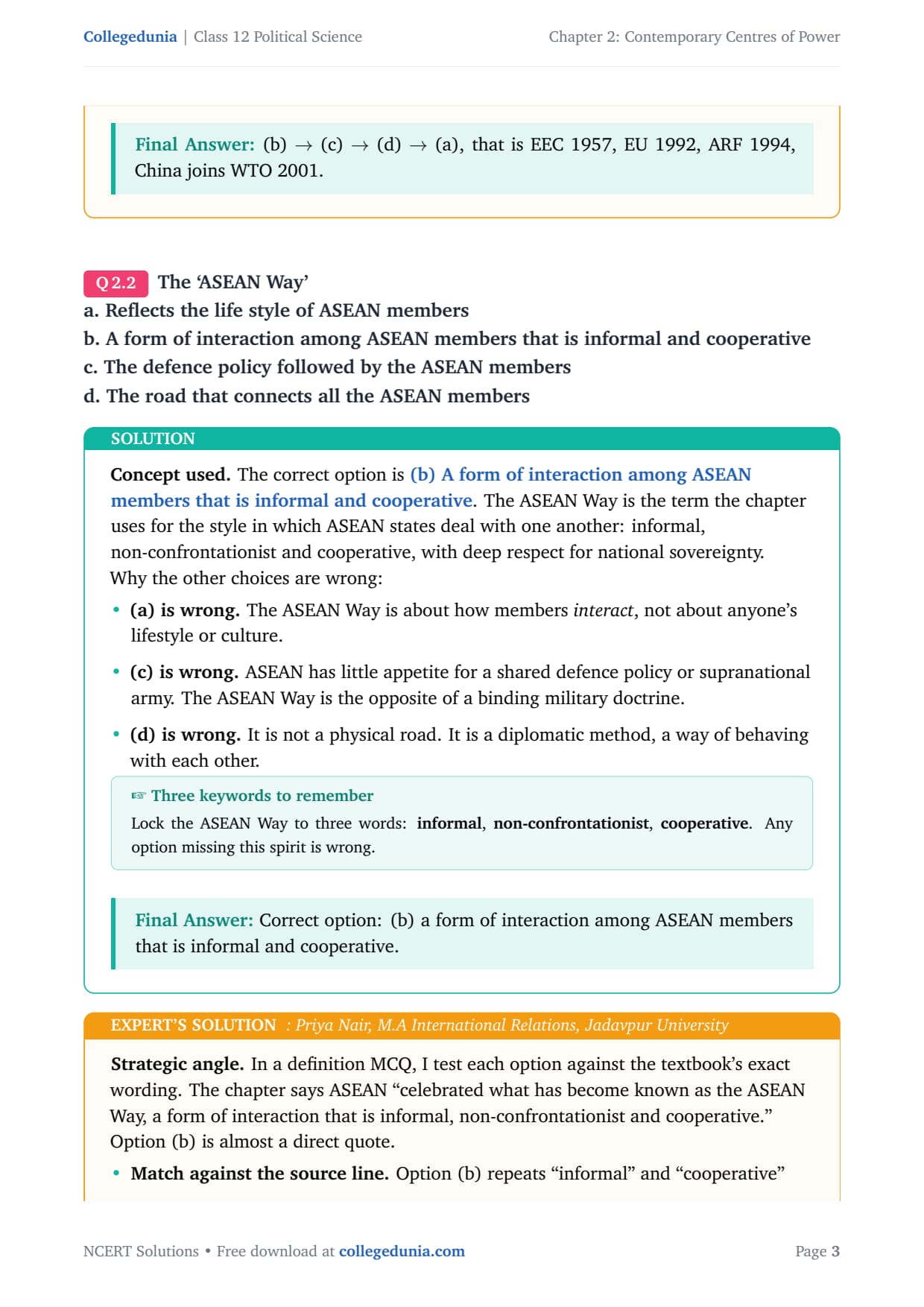
Concept used. The correct option is (b) A form of
interaction among ASEAN members that is informal and cooperative. The
ASEAN Way is the term the chapter uses for the style in which ASEAN
states deal with one another: informal, non-confrontationist and
cooperative, with deep respect for national sovereignty.
Why the other choices are wrong:
(a) is wrong. The ASEAN Way is about how members
interact, not about anyone's lifestyle or culture.
(c) is wrong. ASEAN has little appetite for a shared
defence policy or supranational army. The ASEAN Way is the
opposite of a binding military doctrine.
(d) is wrong. It is not a physical road. It is a
diplomatic method, a way of behaving with each other.
Three keywords to remember
Lock the ASEAN Way to three words: informal,
non-confrontationist, cooperative. Any option missing
this spirit is wrong.
Correct option: (b) a form of interaction among ASEAN members
that is informal and cooperative.
PN
Priya Nair
M.A International Relations, Jadavpur University
Verified Expert
Strategic angle. In a definition MCQ, I test each option against
the textbook's exact wording. The chapter says ASEAN ``celebrated what
has become known as the ASEAN Way, a form of interaction that is
informal, non-confrontationist and cooperative.'' Option (b) is almost a
direct quote.
Match against the source line. Option (b) repeats
``informal'' and ``cooperative'' word for word. That alone marks
it as correct.
Reject distractors by theme. Lifestyle (a), defence
policy (c) and a literal road (d) each pull the idea in a
direction the chapter never takes. They are classic trap
options.
The wider point: ASEAN's success rests on this soft style. Unlike the EU,
it builds no supranational structures. It moves by consensus and quiet
consultation, which is exactly what option (b) captures.
(b), the informal and cooperative method of interaction among
ASEAN members.
Q 2.3
Which of the following nations adopted an `open door' policy?
a. China b. South Korea c. Japan d. USA
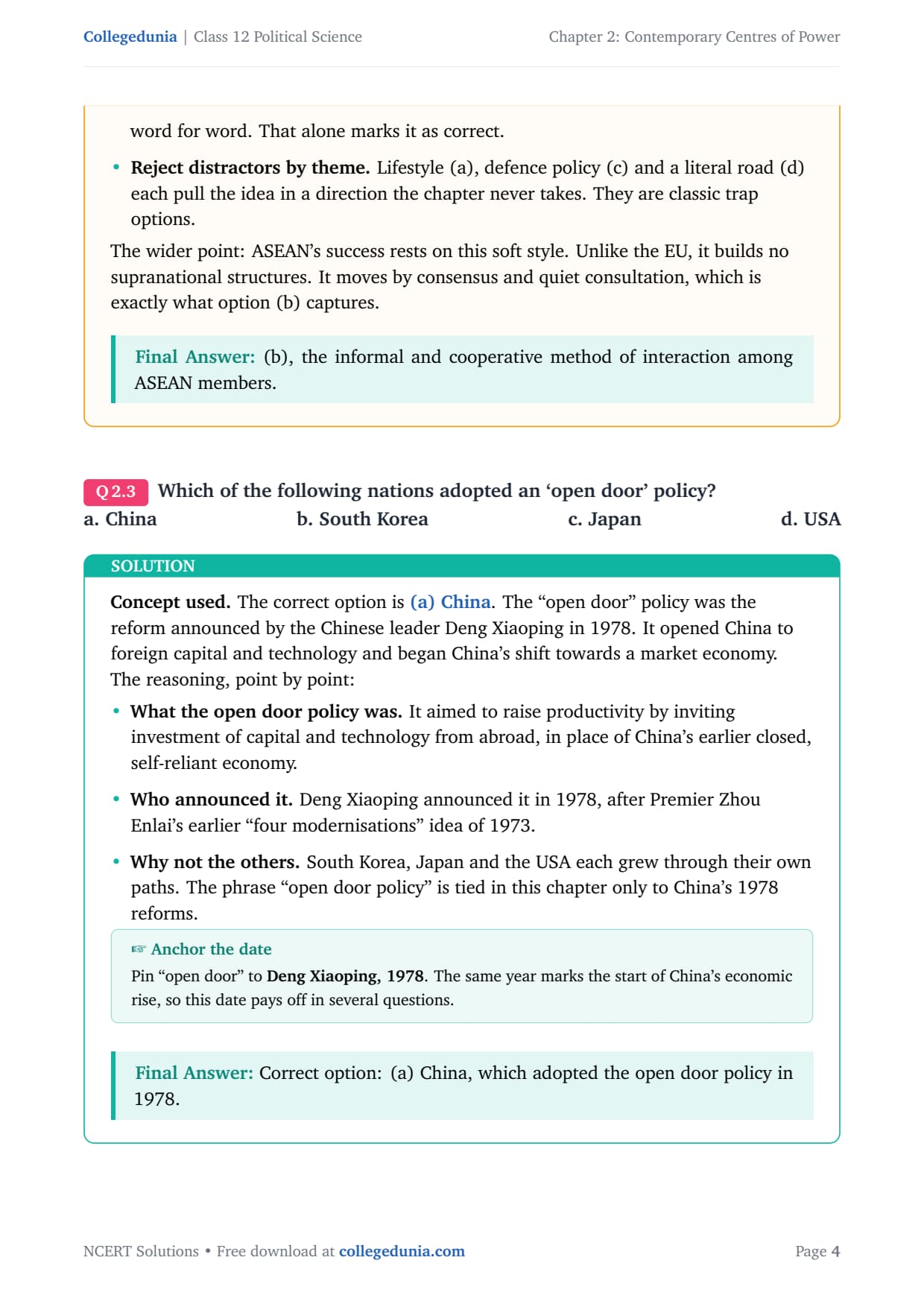
Concept used. The correct option is (a) China. The
``open door'' policy was the reform announced by the Chinese leader Deng
Xiaoping in 1978. It opened China to foreign capital and technology and
began China's shift towards a market economy.
The reasoning, point by point:
What the open door policy was. It aimed to raise
productivity by inviting investment of capital and technology
from abroad, in place of China's earlier closed, self-reliant
economy.
Who announced it. Deng Xiaoping announced it in 1978,
after Premier Zhou Enlai's earlier ``four modernisations'' idea
of 1973.
Why not the others. South Korea, Japan and the USA each
grew through their own paths. The phrase ``open door policy'' is
tied in this chapter only to China's 1978 reforms.
Anchor the date
Pin ``open door'' to Deng Xiaoping, 1978. The same year marks
the start of China's economic rise, so this date pays off in several
questions.
Correct option: (a) China, which adopted the open door policy
in 1978.
AR
Arjun Reddy
M.A Chinese Studies, University of Delhi
Verified Expert
Strategic angle. I treat ``open door'' as a labelled term, like
a tag in the textbook. Whenever a term is tied to one country in the
chapter, the MCQ answer is that country. Here the tag belongs to China.
Locate the term in the text. The chapter states that by
1978 Deng Xiaoping ``announced the open door policy and economic
reforms in China.'' The country is named directly.
Confirm no overlap. No other listed country, South
Korea, Japan or the USA, is described with this exact phrase.
So there is only one valid answer.
The deeper lesson: the open door was the hinge of China's whole rise.
Special Economic Zones, foreign direct investment and WTO entry all flow
from this 1978 decision, which is why examiners come back to it again and
again.
(a) China, under Deng Xiaoping's open door policy of 1978.
Q 2.4
Fill in the blanks:
a. The border conflict between China and India in 1962 was principally over 2.5cm0.4pt and 3cm0.4pt region.
b. ARF was established in the year 2.5cm0.4pt.
c. China entered into bilateral relations with 2cm0.4pt (a major country) in 1972.
d. 2.5cm0.4pt Plan influenced the establishment of the Organisation for European Economic Cooperation in 1948.
e. 2cm0.4pt is the organisation of ASEAN that deals with security.
Concept used. Each blank is filled from a named fact in the
chapter. The answers are: (a) Arunachal Pradesh and Aksai Chin (Ladakh);
(b) 1994; (c) the United States; (d) Marshall; (e) ARF (ASEAN Regional
Forum).
The filled statements read:
(a) The border conflict of 1962 was principally over
Arunachal Pradesh and the Aksai Chin region
of Ladakh, the two areas of competing territorial claims.
(b) ARF was established in the year 1994, as
the body that coordinates ASEAN's security and foreign policy.
(c) China ended its isolation and entered into bilateral
relations with the United States in 1972.
(d) The Marshall Plan, America's aid programme
for reviving Europe, led to the Organisation for European
Economic Cooperation in 1948.
(e) The ARF (ASEAN Regional Forum) is the
organisation of ASEAN that deals with security.
Do not mix up the two border areas
Arunachal Pradesh lies in the east; Aksai Chin lies in the west, in
Ladakh. Both were disputed in 1962. Naming only one loses you the mark.
M.A Geopolitics, Manipal Academy of Higher Education
Verified Expert
Quick reading. Fill-in-the-blanks reward precise nouns and
years. I scan each blank for the single fact the chapter pins to it,
then write that fact exactly, with no padding.
Border areas (a). The 1962 war is tied to two named
regions in the text: Arunachal Pradesh in the east and Aksai
Chin of Ladakh in the west. Both go in.
Years and country (b, c). ARF is a mid-1990s body, set
up in 1994. China's 1972 opening was specifically with the United
States, a fact the chapter states plainly.
Europe and security (d, e). The 1948 OEEC grew out of
the Marshall Plan. ASEAN's security wing is the ARF, the same
body as in blank (b).
The pattern to notice: blanks (b) and (e) both point to the ARF, once by
its founding year and once by its function. Recognising that one body
answers two blanks saves time and removes doubt.
Arunachal Pradesh and Aksai Chin; 1994; United States;
Marshall; ARF.
Q 2.5
What are the objectives of establishing regional organisations?
Concept used. A regional organisation is a grouping of
neighbouring states that join hands to solve shared problems. States set
them up to gain together what they cannot gain alone: faster economic
growth, peace within the region, and a louder voice in world affairs.
The chapter's two main examples, the EU and ASEAN, show these aims in
action.
The main objectives are:
Economic growth and prosperity. The first aim is to
speed up trade and development. ASEAN was set up ``to accelerate
economic growth'' and the EU grew from an economic community into
a single market with a common currency, the euro.
Peace and stability in the region. Neighbours who once
fought wars choose cooperation instead. The EU rebuilt Europe
after the Second World War; ASEAN promotes ``regional peace and
stability based on the rule of law.''
Social and cultural development. Beyond money, members
work for social progress and cultural ties, raising living
standards across the whole region.
A stronger collective voice. Acting as one bloc gives
members more weight in bodies like the WTO than any single
country would have on its own.
Resolving disputes peacefully. They build forums and
mechanisms, such as the ASEAN Dispute Settlement Mechanism, to
settle quarrels by talk rather than force.
Two-word memory aid
Sum the aims as peace and prosperity. Almost every
objective folds into one of these two ideas, so they make a safe spine
for your answer.
Regional organisations are set up to speed economic growth,
keep peace and stability, aid social and cultural development, give
members a stronger joint voice, and settle disputes peacefully.
RB
Rohit Banerjee
M.A Political Science, University of Hyderabad
Verified Expert
Strategic angle. I answer ``objectives'' questions with a clear
list, each point backed by a real example from the chapter. Examiners
reward a named instance over a vague claim, so I attach the EU or ASEAN
to each aim.
Economic objective. Faster growth and shared markets:
ASEAN's whole founding goal was economic acceleration; the EU
built a single market and the euro.
Security objective. Turning old enemies into partners:
the EU healed post-war Europe; ASEAN's Vision 2020 pushes
negotiation over conflict.
Voice objective. A bloc bargains harder than a lone
state. The EU's share of world trade lets it stand up to the US
and China in trade disputes.
The wider lesson: regional bodies exist because problems like trade,
security and the environment cross national borders. No single country
can fix them alone, so neighbours pool their strength. That pooling is
the true purpose behind every objective on the list.
To boost economic growth, secure peace, advance social and
cultural progress, win a stronger collective voice, and resolve disputes
through dialogue.
Q 2.6
How does geographical proximity influence the formation of regional organisations?
Concept used.Geographical proximity means simply
being close together on the map, as neighbours. Closeness shapes
regional organisations because nearby countries share the same
opportunities and the same problems, so it makes sense for them to act
together.
The map of East Asia and the Pacific below shows how the ASEAN members
sit side by side in one corner of the world, which is what made their
grouping natural.
Proximity influences these groupings in several ways:
Shared problems push neighbours together. Countries in
one region face the same history. Southeast Asia, for example,
had suffered colonialism, poverty and Cold War pressure, so its
states had common reasons to cooperate.
Trade is easier between neighbours. Goods, labour and
services move cheaply over short distances. A free-trade area is
far more useful among countries that are next door.
Security is linked. A conflict in one country quickly
affects its neighbours. Nearby states therefore have a shared
stake in keeping the region peaceful.
Culture and contact already exist. Neighbours often
share languages, customs and old links, which makes
cooperation feel natural rather than forced.
Use the example you are given
The chapter literally asks you to ``take a look at the political map''
and locate Southeast Asia. Mentioning the ASEAN cluster on the map turns
an abstract point into a concrete, scoring answer.
Nearby countries share the same history, problems, trade routes
and security concerns, so geographical closeness makes it natural and
useful for them to band together into a regional organisation.
KJ
Karan Joshi
M.A Geography, Banaras Hindu University
Verified Expert
Picture-first. I start from the map. When I see a tight cluster
of countries, like ASEAN in the southeast, I read off the reasons they
would want to group: shared trade, shared threats, shared culture. The
map does half the answer for me.
Distance and trade. Short distances mean low transport
cost. That is why a Free Trade Area works best among neighbours,
as ASEAN's own FTA shows.
Distance and security. Trouble spreads fast across a
shared border. Neighbours must manage security jointly, which the
ASEAN Regional Forum was built to do.
Distance and identity. People near each other often
share customs and history, giving the grouping a ready-made sense
of ``us.''
The broader idea: geography sets the stage, but it does not act alone.
Proximity gives neighbours the reason and the ease to
cooperate; leaders still have to choose to build the institutions. ASEAN
shows both the geographic pull and the political will at work together.
A useful contrast sharpens the point. South Asia is just as close-knit on
the map, yet SAARC has done far less than ASEAN, because political trust
was missing. So proximity is a strong push but not a guarantee. It lowers
the cost of cooperation and raises the reward, which is why almost every
major regional body, the EU in Europe, ASEAN in Southeast Asia, is built
among neighbours rather than far-flung states. When you write this answer,
lead with the map, then name the three pulls of trade, security and
culture, and you cover the question fully.
Closeness lowers trade and contact costs, links security, and
builds shared identity, so geographical proximity strongly pushes
neighbouring states to form regional organisations.
Q 2.7
What are the components of the ASEAN Vision 2020?
Concept used.ASEAN Vision 2020 is the long-term plan
that ASEAN drew up for itself. Its core idea is to define an
outward-looking role for ASEAN in the wider world, while keeping peace
inside the region through negotiation rather than force.
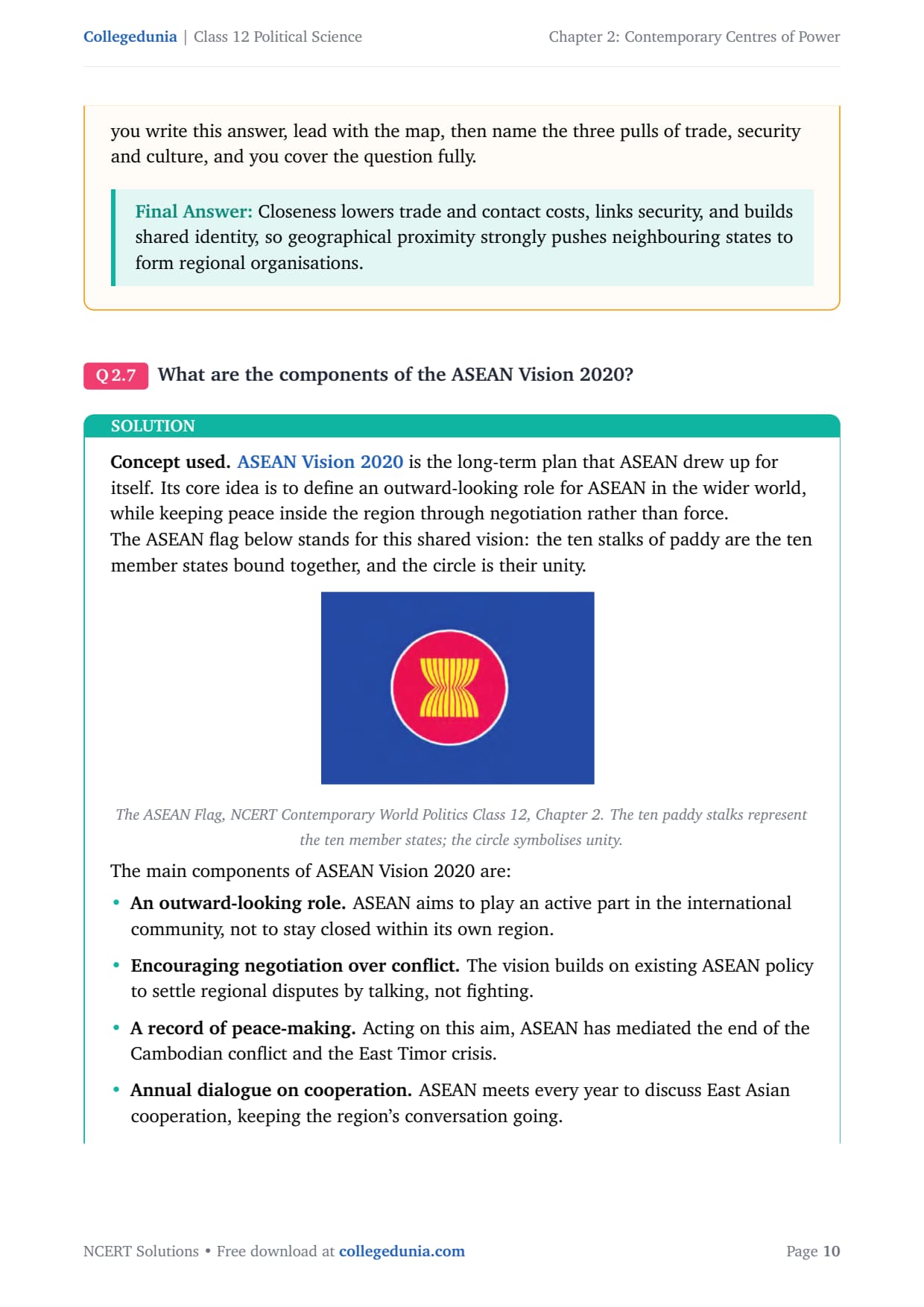
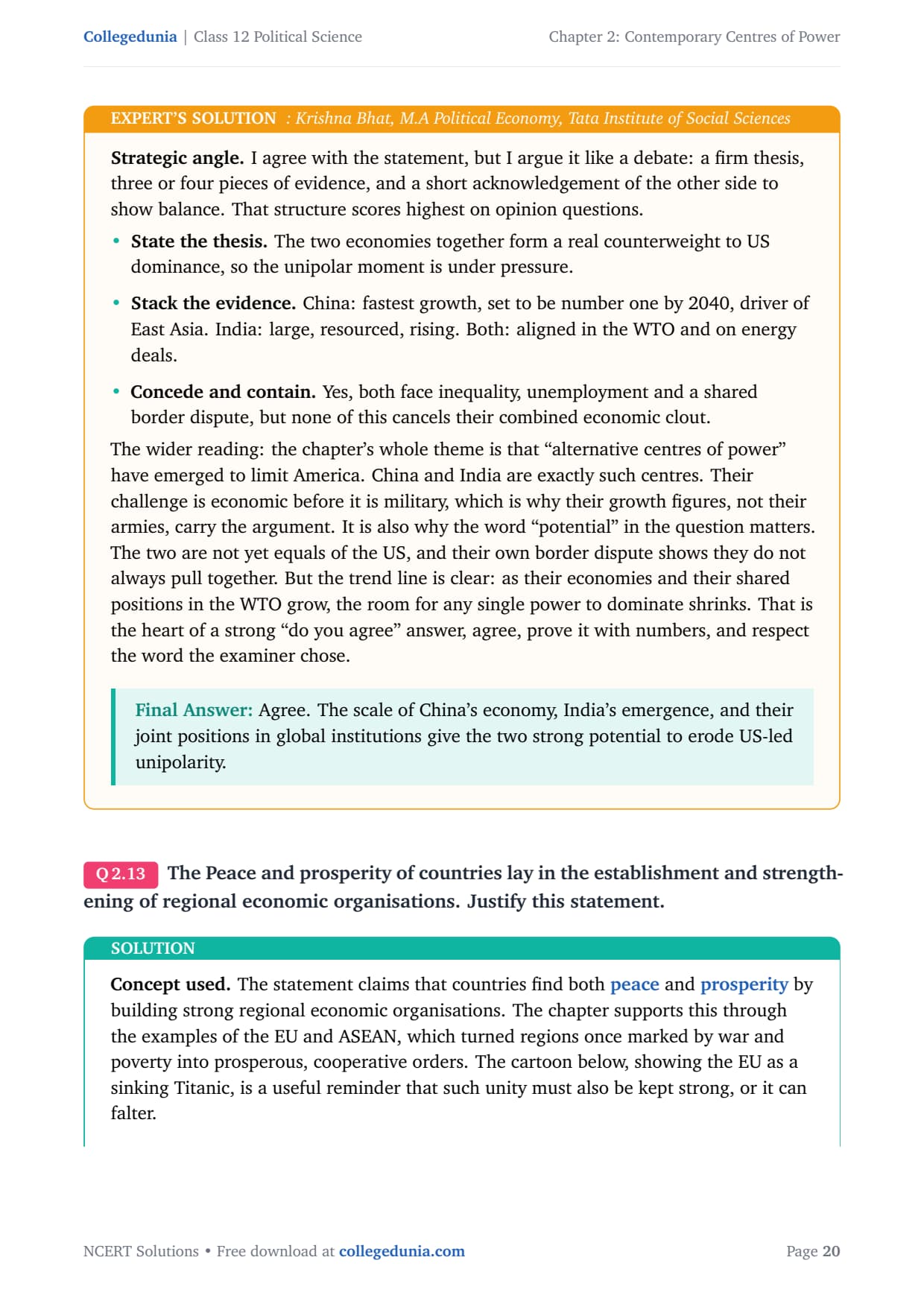
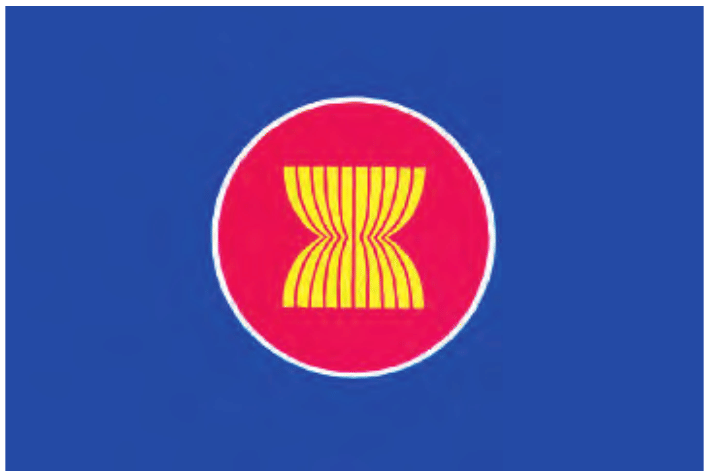
The ASEAN flag below stands for this shared vision: the ten stalks of
paddy are the ten member states bound together, and the circle is their
unity.
The ASEAN Flag, NCERT Contemporary World Politics Class 12, Chapter 2. The ten paddy stalks represent the ten member states; the circle symbolises unity.
The main components of ASEAN Vision 2020 are:
An outward-looking role. ASEAN aims to play an active
part in the international community, not to stay closed within
its own region.
Encouraging negotiation over conflict. The vision builds
on existing ASEAN policy to settle regional disputes by talking,
not fighting.
A record of peace-making. Acting on this aim, ASEAN has
mediated the end of the Cambodian conflict and the East Timor
crisis.
Annual dialogue on cooperation. ASEAN meets every year
to discuss East Asian cooperation, keeping the region's
conversation going.
Vision 2020 is about looking outward
The single phrase to remember is ``outward-looking role.'' That
is the heart of Vision 2020: ASEAN engaging the world while keeping its
own house peaceful.
ASEAN Vision 2020 sets an outward-looking role for ASEAN in the
world, encourages settling conflicts by negotiation, builds on its record
of mediating disputes, and keeps up annual talks on East Asian
cooperation.
SR
Siddharth Rao
M.A Southeast Asian Studies, Jawaharlal Nehru University
Verified Expert
Structural observation. Vision 2020 has two halves: an
outward half (engaging the world) and an inward half
(keeping peace at home). Splitting the answer this way makes it tidy and
complete.
Outward half. ASEAN takes on an outward-looking role in
the international community, raising its profile beyond its own
borders.
Inward half. It encourages negotiation over regional
conflicts, the same method that ended the Cambodian and East
Timor crises.
Keeping it alive. Yearly meetings on East Asian
cooperation turn the vision from a document into a habit.
The takeaway: Vision 2020 marks the moment ASEAN stopped being a purely
inward economic club and chose a confident role on the world stage. It is
the diplomatic companion to the economic ambition of the ASEAN Community.
One more reading helps in the exam. Notice how the outward role and the
inward peace-making support each other. ASEAN can only speak with weight
abroad if its own region is calm, and the habit of yearly dialogue is what
keeps it calm. That is why the mediation record matters: ending the
Cambodian conflict and the East Timor crisis proved ASEAN could deliver
peace at home, which in turn earned it a real voice in the wider
international community. Frame the answer as these linked parts, not a loose
list, and it reads like a topper's response.
An outward-looking global role, a preference for negotiation
over conflict, a proven record of mediation, and annual East Asian
cooperation talks.
Q 2.8
Name the pillars and the objectives of the ASEAN Community.
Concept used. The ASEAN Community is the deeper union
that ASEAN agreed to build in 2003, moving a little along the EU's path.
It rests on three pillars: the ASEAN Security Community, the
ASEAN Economic Community, and the ASEAN Socio-Cultural Community. Each
pillar has its own objectives.
The three pillars and their objectives are:
ASEAN Security Community. Its objective is to make sure
that outstanding territorial disputes do not escalate into armed
confrontation. Members promise to uphold peace, neutrality,
cooperation, non-interference and respect for one another's
sovereign rights.
ASEAN Economic Community. Its objectives are to create a
common market and production base within ASEAN states, to aid
social and economic development in the region, and to improve the
ASEAN Dispute Settlement Mechanism for economic quarrels.
ASEAN Socio-Cultural Community. Its objective is to
advance social progress and cultural development, binding the
peoples of the region closer together.
Three pillars, one roof
Picture a temple with three pillars: Security,
Economic, Socio-Cultural. Naming all three, with one
objective each, is exactly what this question wants.
Three pillars: the ASEAN Security Community (prevent disputes
becoming war), the ASEAN Economic Community (a common market and shared
development), and the ASEAN Socio-Cultural Community (social and cultural
progress).
AK
Aditi Kapoor
M.A International Studies, Symbiosis Pune
Verified Expert
Structural observation. The word ``pillars'' is a gift: it tells
me the answer has exactly three named parts. I write the three names
first, then hang one clear objective on each. Naming without objectives,
or objectives without names, is half an answer.
Security pillar. Keep territorial disputes from turning
into armed conflict; members pledge peace, non-interference and
respect for sovereignty.
Economic pillar. Build a single market and production
base, aid regional development, and sharpen the dispute
settlement mechanism.
Socio-Cultural pillar. Promote social progress and
cultural development across member societies.
The bigger picture: with these three pillars, ASEAN signalled in 2003
that it wanted to be more than a trade club. It chose to knit security,
economy and culture together, the way the EU had done in Europe, while
still keeping its informal ASEAN Way.
The Security Community (no disputes turning to war), the
Economic Community (common market and development), and the
Socio-Cultural Community (social and cultural progress).
Q 2.9
In what ways does the present Chinese economy differ from its command economy?
Concept used. A command economy is one in which the
state owns the industries and decides what is produced, as China did
under Mao on the Soviet model. The present Chinese economy is a
market economy, where private firms, foreign investment and trade play a
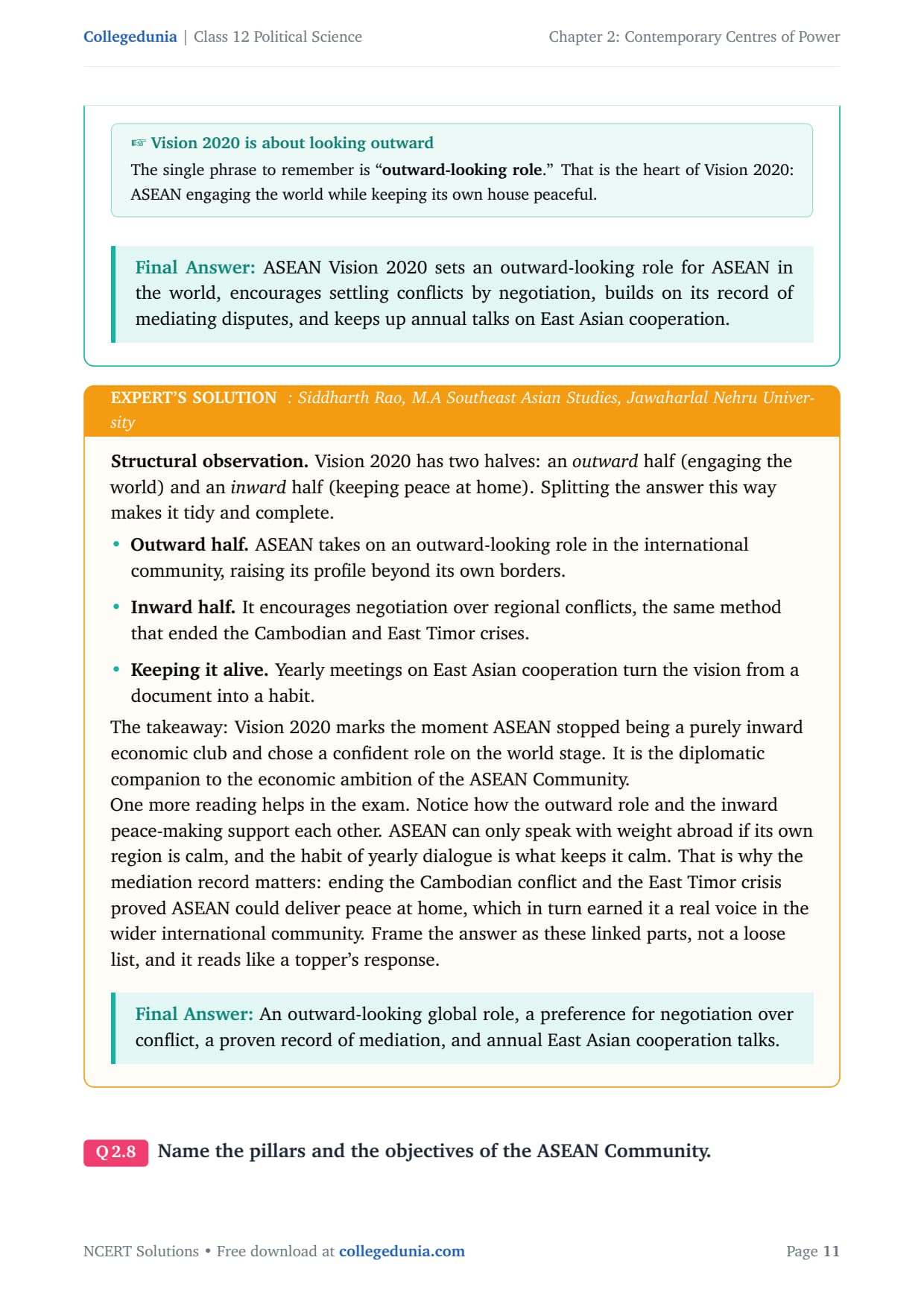
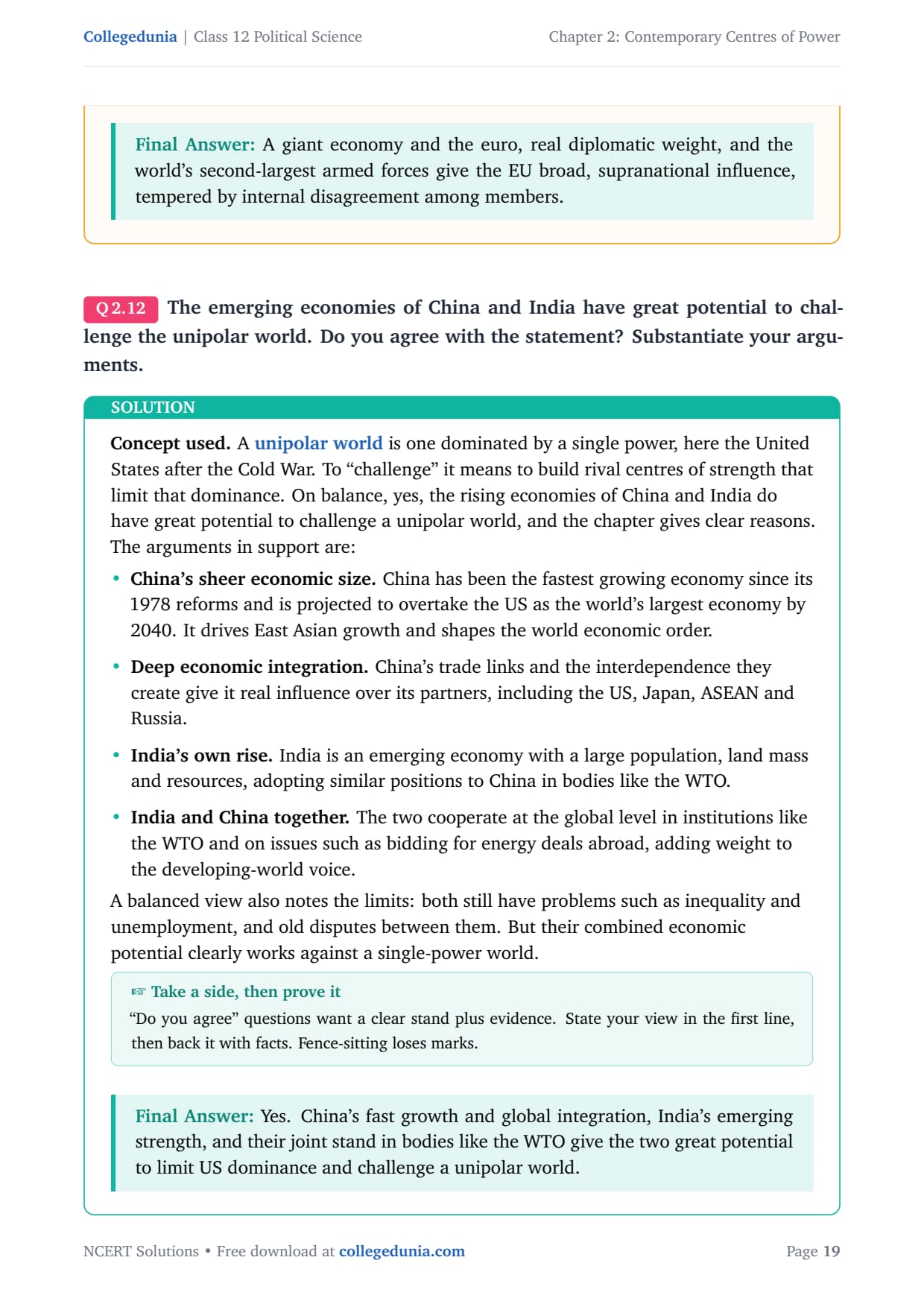
large part, even though the state still guides it. The cartoon below
captures this dramatic change in China's direction.
The key differences are:
Ownership. The old command economy was state-owned. The
present economy has private farms and private industry,
following the privatisation of agriculture in 1982 and of
industry in 1998.
Openness to the world. The command economy cut its links
with the capitalist world and relied on its own resources. The
present economy is open: Special Economic Zones invite foreign
investors, and China joined the WTO in 2001.
Driver of growth. Earlier, growth came from state-run
heavy industry. Now it comes from foreign trade, foreign direct
investment and fast-growing rural industry.
Result. The command economy grew slowly and ran short of
foreign exchange. The reformed economy has become the fastest
growing in the world, with large foreign-exchange reserves.
Reforms were gradual, not sudden
China did not use ``shock therapy.'' It opened ``step by step'':
agriculture first in 1982, then industry in 1998. Saying China switched
overnight is wrong.
The command economy was state-owned, closed and slow-growing;
the present economy is privatised, open to foreign investment and trade
through SEZs and the WTO, and is the world's fastest growing.
VD
Vivaan Desai
M.A Economics, Delhi School of Economics
Verified Expert
Quick reading. I answer ``how does X differ from Y'' with a
two-column contrast in my head: old command model on the left, new market
model on the right. Then I write the differences as clean pairs.
Who owns and decides. Then: the state owned everything
and planned output. Now: private farms and firms operate, after
the 1982 and 1998 privatisations, with the state still setting
the frame.
In or out. Then: closed, self-reliant, short of foreign
exchange. Now: open through SEZs, the top destination for foreign
direct investment, and a WTO member since 2001.
Speed. Then: a respectable but insufficient 5 to 6 per
cent, eaten up by population growth. Now: the fastest-growing
major economy, on course to be the world's largest.
The deeper insight: China kept the political control of a command system
but borrowed the engine of a market system. That hybrid, a state-steered
market, is exactly what makes its economy so different from the pure
command model it left behind.
Shift from state ownership, closure and slow growth to private
enterprise, openness via SEZs and the WTO, and the fastest growth in the
world, all under continued state guidance.
Q 2.10
How did the European countries resolve their post-Second World War problem? Briefly outline the attempts that led to the formation of the European Union.
Concept used. After the Second World War, Europe faced the
``Question of Europe'': whether to fall back into old rivalries or to
rebuild on shared institutions. European states chose
integration, joining their economies step by step until this
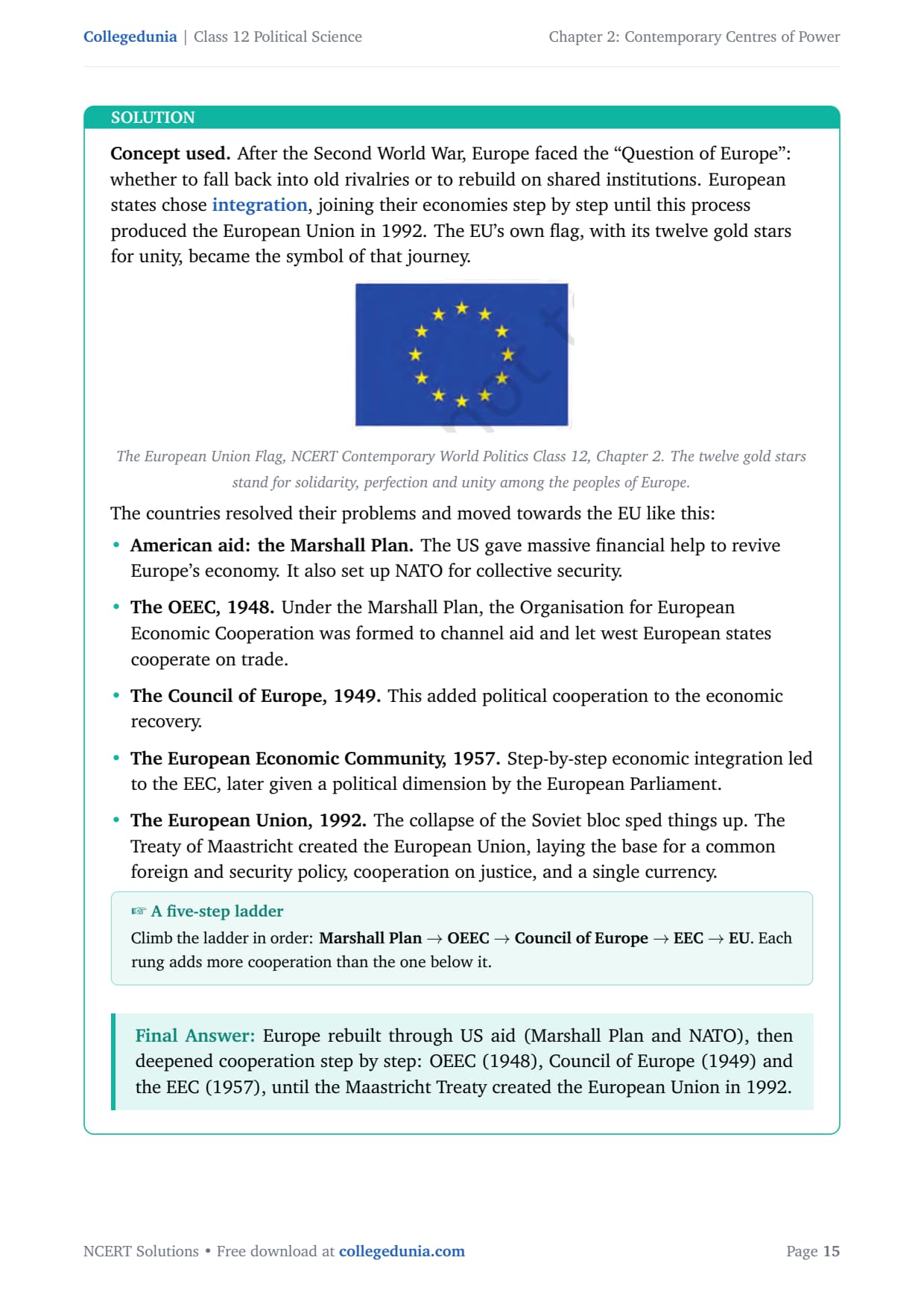
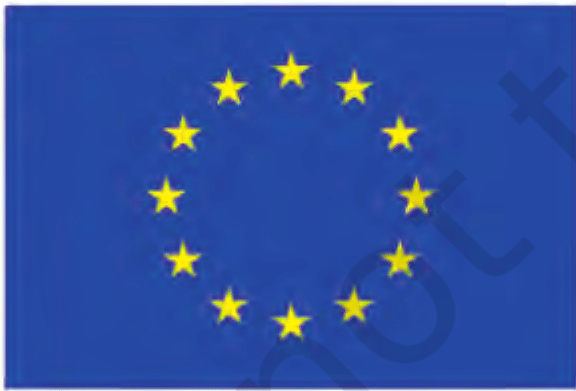
process produced the European Union in 1992. The EU's own flag, with its
twelve gold stars for unity, became the symbol of that journey.
The European Union Flag, NCERT Contemporary World Politics Class 12, Chapter 2. The twelve gold stars stand for solidarity, perfection and unity among the peoples of Europe.
The countries resolved their problems and moved towards the EU like this:
American aid: the Marshall Plan. The US gave massive
financial help to revive Europe's economy. It also set up NATO
for collective security.
The OEEC, 1948. Under the Marshall Plan, the
Organisation for European Economic Cooperation was formed to
channel aid and let west European states cooperate on trade.
The Council of Europe, 1949. This added political
cooperation to the economic recovery.
The European Economic Community, 1957. Step-by-step
economic integration led to the EEC, later given a political
dimension by the European Parliament.
The European Union, 1992. The collapse of the Soviet
bloc sped things up. The Treaty of Maastricht created the
European Union, laying the base for a common foreign and security
policy, cooperation on justice, and a single currency.
A five-step ladder
Climb the ladder in order: Marshall Plan → OEEC
→ Council of Europe → EEC → EU. Each
rung adds more cooperation than the one below it.
Europe rebuilt through US aid (Marshall Plan and NATO), then
deepened cooperation step by step: OEEC (1948), Council of Europe (1949)
and the EEC (1957), until the Maastricht Treaty created the European
Union in 1992.
IV
Ishaan Verma
M.A European Studies, University of Delhi
Verified Expert
Picture-first. The chapter gives a dated ``Timeline of European
Integration.'' I lean on it. I walk down the timeline and pick the
milestones that turn a ruined continent into a union, keeping strictly to
the order of years.
Heal the economy first. The Marshall Plan poured US
money in; NATO handled defence. Recovery had to come before
union.
Build the early institutions. The OEEC (1948) and the
Council of Europe (1949) gave Europe its first habits of working
together on economics and politics.
Deepen into a community. The EEC of 1957, born of the
Treaties of Rome, fused the economies of the six founders and
later gained a parliament.
Crown it with the EU. When the Soviet bloc fell, the
1992 Maastricht Treaty completed the journey, creating the
European Union with a common currency to follow.
The lesson worth carrying: Europe answered the danger of renewed war not
with armies but with integration. Each treaty tied the old rivals a
little tighter, until war between them became almost unthinkable. That is
the real achievement behind the dates.
By rebuilding with US aid, then layering ever-closer
institutions, OEEC, Council of Europe, EEC, before the 1992 Maastricht
Treaty turned the process into the European Union.
Q 2.11
What makes the European Union a highly influential regional organisation?
Concept used. The European Union is influential because it has
grown from an economic union into something that acts almost like a
single nation state. Its power runs across three areas:
economic, political and diplomatic, and
military. Together these let the EU shape events far beyond its
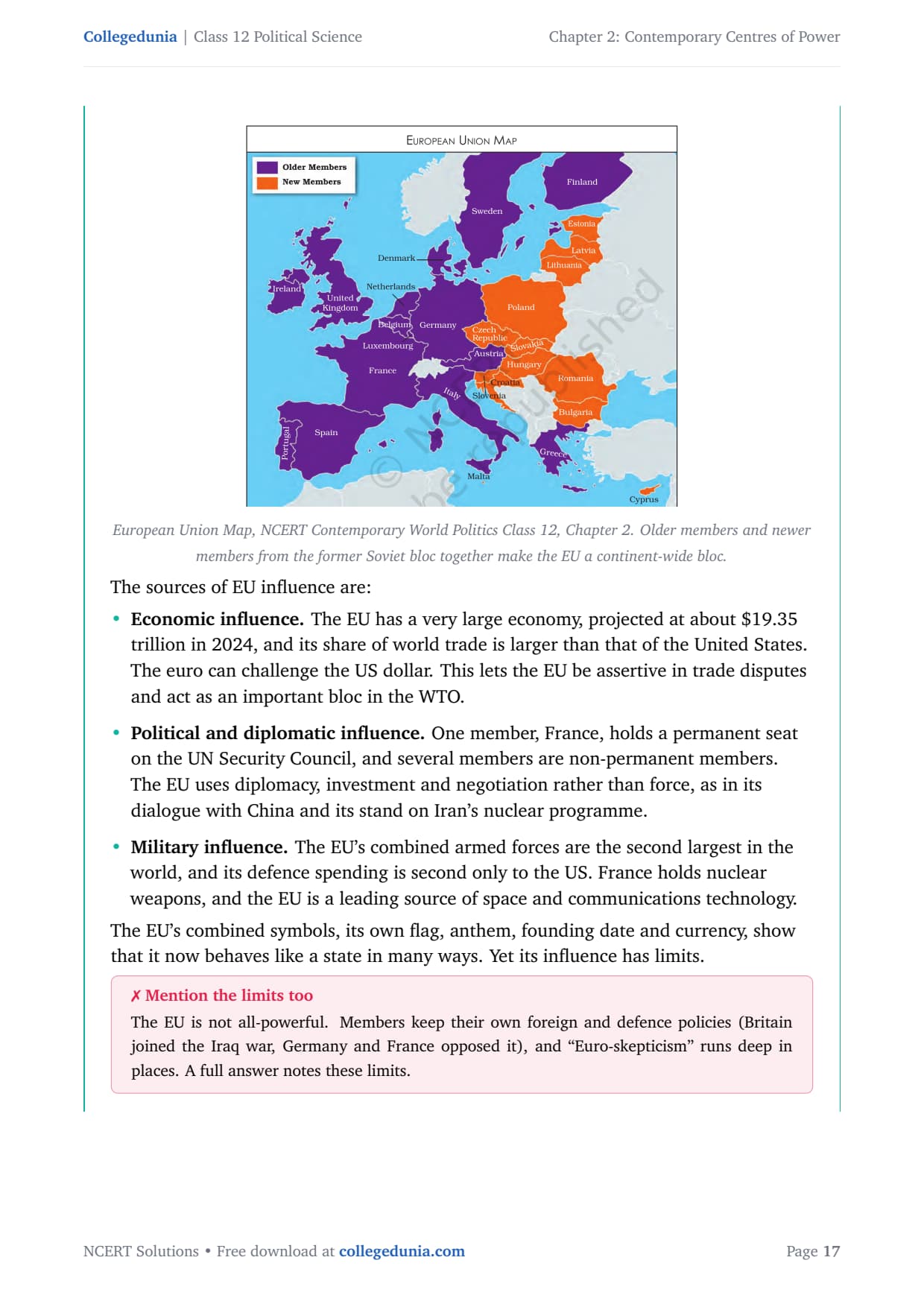
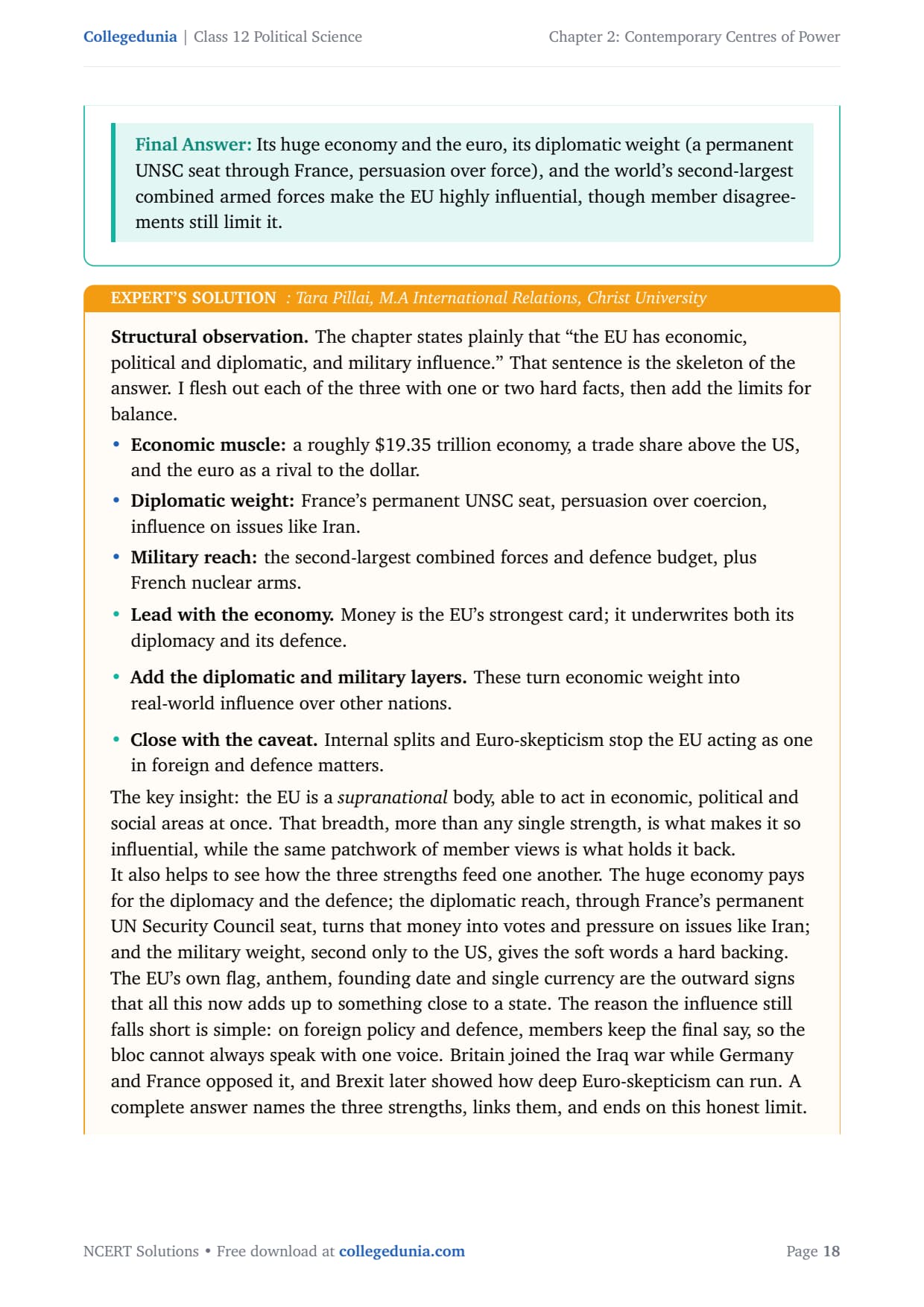
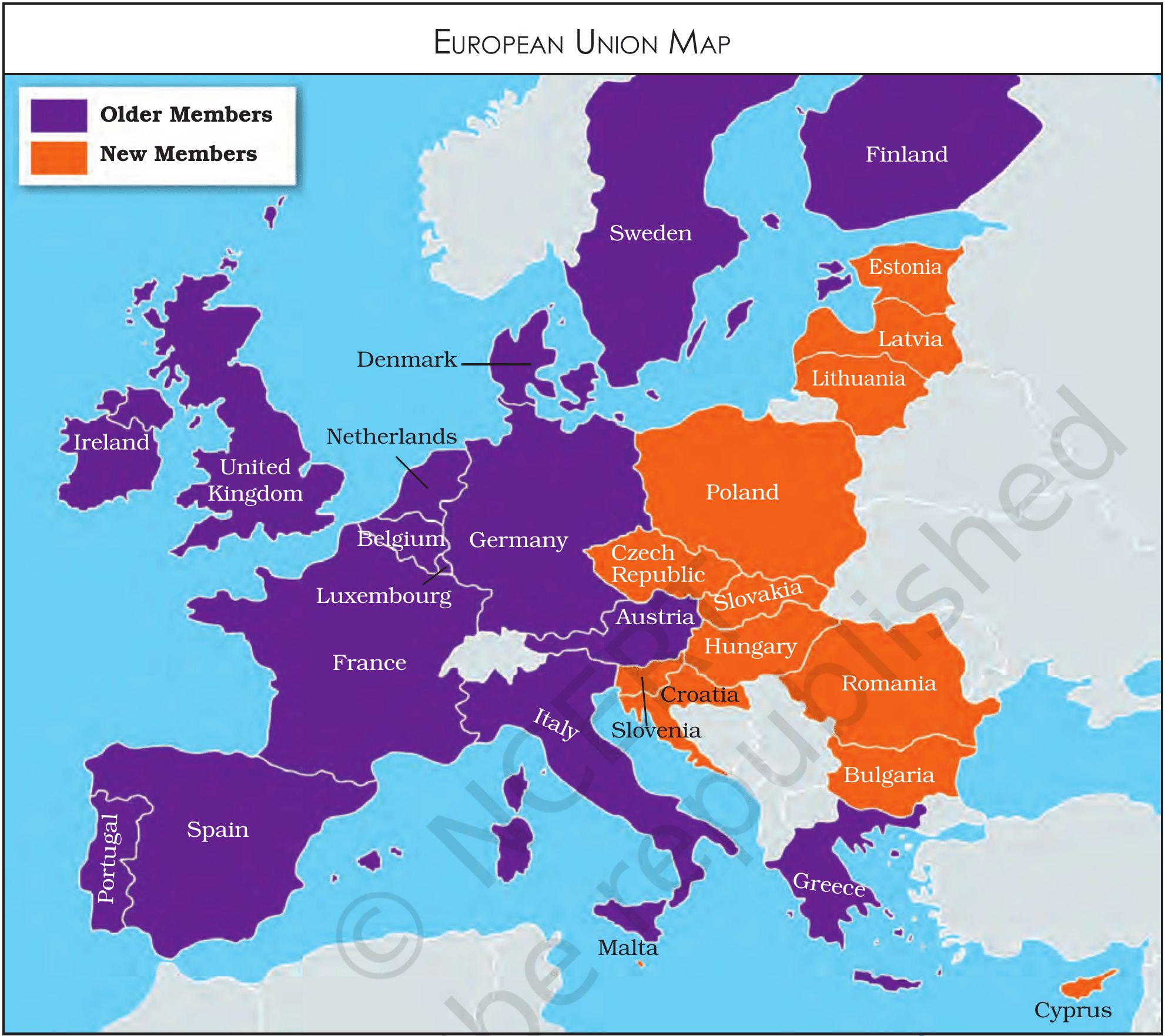
own borders, even as some internal doubts limit it. The map below shows
how widely the EU spread, taking in older and newer members across the
continent.
European Union Map, NCERT Contemporary World Politics Class 12, Chapter 2. Older members and newer members from the former Soviet bloc together make the EU a continent-wide bloc.
The sources of EU influence are:
Economic influence. The EU has a very large economy,
projected at about $19.35 trillion in 2024, and its share of
world trade is larger than that of the United States. The euro
can challenge the US dollar. This lets the EU be assertive in
trade disputes and act as an important bloc in the WTO.
Political and diplomatic influence. One member, France,
holds a permanent seat on the UN Security Council, and several
members are non-permanent members. The EU uses diplomacy,
investment and negotiation rather than force, as in its dialogue
with China and its stand on Iran's nuclear programme.
Military influence. The EU's combined armed forces are
the second largest in the world, and its defence spending is
second only to the US. France holds nuclear weapons, and the EU
is a leading source of space and communications technology.
The EU's combined symbols, its own flag, anthem, founding date and
currency, show that it now behaves like a state in many ways. Yet its
influence has limits.
Mention the limits too
The EU is not all-powerful. Members keep their own foreign and defence
policies (Britain joined the Iraq war, Germany and France opposed it),
and ``Euro-skepticism'' runs deep in places. A full answer notes these
limits.
Its huge economy and the euro, its diplomatic weight (a
permanent UNSC seat through France, persuasion over force), and the
world's second-largest combined armed forces make the EU highly
influential, though member disagreements still limit it.
TP
Tara Pillai
M.A International Relations, Christ University
Verified Expert
Structural observation. The chapter states plainly that ``the EU
has economic, political and diplomatic, and military influence.'' That
sentence is the skeleton of the answer. I flesh out each of the three
with one or two hard facts, then add the limits for balance.
Economic muscle: a roughly $19.35 trillion economy, a
trade share above the US, and the euro as a rival to the dollar.
Diplomatic weight: France's permanent UNSC seat,
persuasion over coercion, influence on issues like Iran.
Military reach: the second-largest combined forces and
defence budget, plus French nuclear arms.
Lead with the economy. Money is the EU's strongest card;
it underwrites both its diplomacy and its defence.
Add the diplomatic and military layers. These turn
economic weight into real-world influence over other nations.
Close with the caveat. Internal splits and
Euro-skepticism stop the EU acting as one in foreign and defence
matters.
The key insight: the EU is a supranational body, able to act in
economic, political and social areas at once. That breadth, more than any
single strength, is what makes it so influential, while the same
patchwork of member views is what holds it back.
It also helps to see how the three strengths feed one another. The huge
economy pays for the diplomacy and the defence; the diplomatic reach,
through France's permanent UN Security Council seat, turns that money into
votes and pressure on issues like Iran; and the military weight, second
only to the US, gives the soft words a hard backing. The EU's own flag,
anthem, founding date and single currency are the outward signs that all
this now adds up to something close to a state. The reason the influence
still falls short is simple: on foreign policy and defence, members keep
the final say, so the bloc cannot always speak with one voice. Britain
joined the Iraq war while Germany and France opposed it, and Brexit later
showed how deep Euro-skepticism can run. A complete answer names the three
strengths, links them, and ends on this honest limit.
A giant economy and the euro, real diplomatic weight, and the
world's second-largest armed forces give the EU broad, supranational
influence, tempered by internal disagreement among members.
Q 2.12
The emerging economies of China and India have great potential to challenge the unipolar world. Do you agree with the statement? Substantiate your arguments.
Concept used. A unipolar world is one dominated by a
single power, here the United States after the Cold War. To
``challenge'' it means to build rival centres of strength that limit that
dominance. On balance, yes, the rising economies of China and India do
have great potential to challenge a unipolar world, and the chapter
gives clear reasons.
The arguments in support are:
China's sheer economic size. China has been the fastest
growing economy since its 1978 reforms and is projected to
overtake the US as the world's largest economy by 2040. It drives
East Asian growth and shapes the world economic order.
Deep economic integration. China's trade links and the
interdependence they create give it real influence over its
partners, including the US, Japan, ASEAN and Russia.
India's own rise. India is an emerging economy with a
large population, land mass and resources, adopting similar
positions to China in bodies like the WTO.
India and China together. The two cooperate at the
global level in institutions like the WTO and on issues such as
bidding for energy deals abroad, adding weight to the
developing-world voice.
A balanced view also notes the limits: both still have problems such as
inequality and unemployment, and old disputes between them. But their
combined economic potential clearly works against a single-power world.
Take a side, then prove it
``Do you agree'' questions want a clear stand plus evidence. State your
view in the first line, then back it with facts. Fence-sitting loses
marks.
Yes. China's fast growth and global integration, India's
emerging strength, and their joint stand in bodies like the WTO give the
two great potential to limit US dominance and challenge a unipolar
world.
KB
Krishna Bhat
M.A Political Economy, Tata Institute of Social Sciences
Verified Expert
Strategic angle. I agree with the statement, but I argue it like
a debate: a firm thesis, three or four pieces of evidence, and a short
acknowledgement of the other side to show balance. That structure scores
highest on opinion questions.
State the thesis. The two economies together form a real
counterweight to US dominance, so the unipolar moment is under
pressure.
Stack the evidence. China: fastest growth, set to be
number one by 2040, driver of East Asia. India: large, resourced,
rising. Both: aligned in the WTO and on energy deals.
Concede and contain. Yes, both face inequality,
unemployment and a shared border dispute, but none of this
cancels their combined economic clout.
The wider reading: the chapter's whole theme is that ``alternative
centres of power'' have emerged to limit America. China and India are
exactly such centres. Their challenge is economic before it is military,
which is why their growth figures, not their armies, carry the argument.
It is also why the word ``potential'' in the question matters. The two are
not yet equals of the US, and their own border dispute shows they do not
always pull together. But the trend line is clear: as their economies and
their shared positions in the WTO grow, the room for any single power to
dominate shrinks. That is the heart of a strong ``do you agree'' answer,
agree, prove it with numbers, and respect the word the examiner chose.
Agree. The scale of China's economy, India's emergence, and
their joint positions in global institutions give the two strong
potential to erode US-led unipolarity.
Q 2.13
The Peace and prosperity of countries lay in the establishment and strengthening of regional economic organisations. Justify this statement.
Concept used. The statement claims that countries find both
peace and prosperity by building strong regional
economic organisations. The chapter supports this through the examples of
the EU and ASEAN, which turned regions once marked by war and poverty
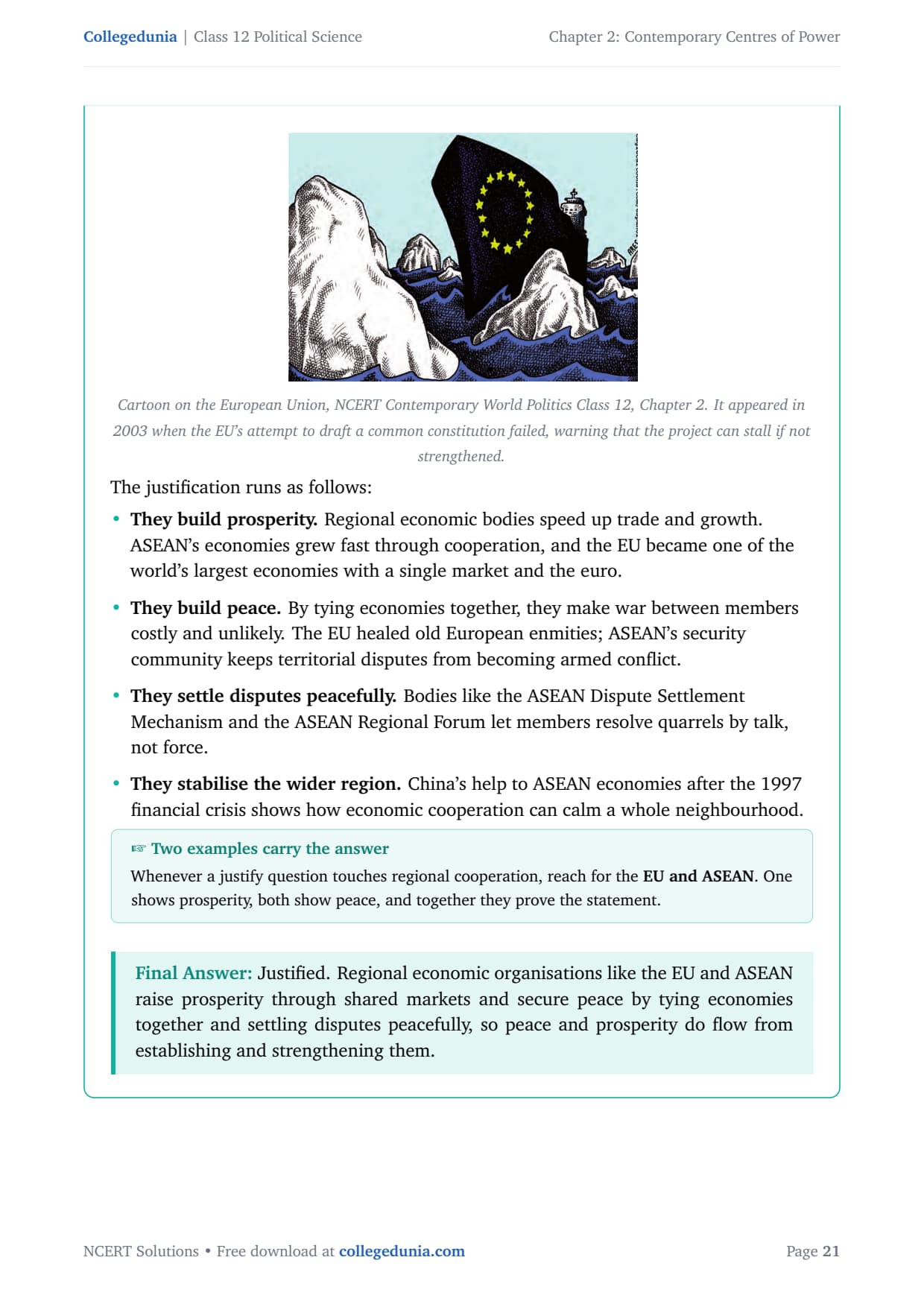
into prosperous, cooperative orders. The cartoon below, showing the EU as
a sinking Titanic, is a useful reminder that such unity must also be kept
strong, or it can falter.
The justification runs as follows:
They build prosperity. Regional economic bodies speed up
trade and growth. ASEAN's economies grew fast through cooperation,
and the EU became one of the world's largest economies with a
single market and the euro.
They build peace. By tying economies together, they make
war between members costly and unlikely. The EU healed old
European enmities; ASEAN's security community keeps territorial
disputes from becoming armed conflict.
They settle disputes peacefully. Bodies like the ASEAN
Dispute Settlement Mechanism and the ASEAN Regional Forum let
members resolve quarrels by talk, not force.
They stabilise the wider region. China's help to ASEAN
economies after the 1997 financial crisis shows how economic
cooperation can calm a whole neighbourhood.
Two examples carry the answer
Whenever a justify question touches regional cooperation, reach for the
EU and ASEAN. One shows prosperity, both show peace, and together
they prove the statement.
Justified. Regional economic organisations like the EU and
ASEAN raise prosperity through shared markets and secure peace by tying
economies together and settling disputes peacefully, so peace and
prosperity do flow from establishing and strengthening them.
NC
Neha Chatterjee
M.A Development Studies, Ambedkar University Delhi
Verified Expert
Strategic angle. The statement bundles two claims, peace and
prosperity. I prove each one separately with a named body, then show how
they reinforce each other. Proving both halves is what ``justify'' demands.
Prosperity half. Shared markets lift growth: ASEAN's fast
rise and the EU's single market and euro are the proof.
Peace half. Economic ties raise the cost of conflict:
the EU ended centuries of European war, and ASEAN's mechanisms
keep disputes off the battlefield.
The loop between them. Prosperity gives members a stake
in peace; peace lets prosperity grow. China steadying ASEAN after
1997 shows the loop in action.
The deeper point: peace and prosperity are not separate goals here, they
feed each other. A region that trades together is a region that finds war
too expensive. That mutual reinforcement is the strongest justification
for building and strengthening these organisations.
Notice the second half of the statement too, the word ``strengthening.''
The Titanic cartoon is a warning that these bodies can stall, as the EU
did when its common constitution failed in 2003. So the answer is not just
that regional organisations bring peace and prosperity, but that members
must keep investing in them for the gains to last. The EU healing
centuries of European war and ASEAN calming its neighbourhood after the
1997 crisis are the two examples to quote. Together they show that the
statement holds: peace and prosperity really do lie in building these
organisations and in keeping them strong.
Justified. The EU and ASEAN show that regional economic
organisations create prosperity through shared markets and peace through
deep interdependence, with each strengthening the other.
Q 2.14
Identify the contentious issues between China and India. How could these be resolved for greater cooperation? Give your suggestions.
Concept used.Contentious issues are the disputes that
strain India-China relations. The chapter names several, rooted in
borders, history and third countries. Greater cooperation depends on
managing these through dialogue, trade and confidence-building, which the
two have already begun.
The main contentious issues are:
The border dispute. The 1962 war was fought over
competing claims in Arunachal Pradesh and the Aksai Chin region
of Ladakh, and the boundary question is still unsettled.
Tibet. Differences arose from the Chinese takeover of
Tibet in 1950.
China and Pakistan. China is seen as helping Pakistan's
nuclear programme, and the China-Pakistan Economic Corridor and
China's support to Pakistan at the UN against India's
counter-terrorism moves are sore points.
Military ties in the neighbourhood. China's military
links with Bangladesh and Myanmar are viewed as hostile to Indian
interests in South Asia.
These can be resolved, and partly already are, by the following steps:
Keep talking on the boundary. The two have continued
boundary talks without interruption since 1981; this should
continue patiently.
Grow trade and economic ties. Bilateral trade rose from
338 million in 1992 to over 84 billion in 2017; deeper
economic links raise the cost of conflict.
Build military and cultural confidence. Military-to-
military cooperation, more frequent high-level visits, and
cultural and scientific exchanges build trust.
Cooperate where interests meet. Both can work together in
bodies like the WTO and on shared concerns such as energy deals,
turning rivalry into partnership.
Issues then suggestions
This question has two clear parts. List the contentious issues first,
then give your suggestions. Answering only one half is a common way to
lose marks.
Contentious issues: the unsettled border (Arunachal Pradesh and
Aksai Chin), Tibet, China's support for Pakistan and the CPEC, and its
military ties with India's neighbours. These can be eased through ongoing
boundary talks, growing trade, military and cultural confidence-building,
and cooperation in forums like the WTO.
DS
Dev Sharma
M.A Strategic Studies, Pondicherry University
Verified Expert
Strategic angle. A two-part question needs a two-part answer. I
draw a clear line: first the problems, then the cures, with each cure
aimed at a specific problem so the suggestions feel earned rather than
generic.
Name the disputes. Border (1962, Arunachal and Aksai
Chin, still open), Tibet, the China-Pakistan axis (nuclear help,
CPEC, UN blocking), and China's ties with Bangladesh and Myanmar.
Match cures to disputes. Border: continue the talks
running since 1981. China-Pakistan friction: manage through
diplomacy and shared forums. Neighbourhood ties: build trust by
transparency and dialogue.
Use trade as glue. Trade leapt from 338 million in
1992 to over 84 billion in 2017. Rising economic stakes make
both sides prefer peace to conflict.
The wider reading: the chapter notes that none of these issues is likely
to lead to war, because economic interdependence keeps pulling the two
back to the table. The smartest resolution, then, is to deepen that
interdependence while patiently working the border talks. Recent friction
over the border, the CPEC and UN votes shows the work is far from done.
Disputes: border, Tibet, the China-Pakistan link (CPEC, nuclear,
UN), and China's ties with India's neighbours. Resolve them through
steady boundary talks, deeper trade, military and cultural confidence-
building, and cooperation in global forums.
FAQs on Contemporary Centres of Power Class 12 NCERT Solutions
Contemporary Centres of Power Class 12 Political Science Common Questions
Ques. Where can I get the class 12 political science chapter 2 NCERT Solutions PDF?
Ans. You can download the Contemporary Centres of Power Class 12 Political Science NCERT Solutions PDF directly from this page. It is free, follows the 2026-27 NCERT, and answers all 14 exercise questions step by step.
Ques. How many questions are there in Contemporary Centres of Power class 12 questions and answers?
Ans. The chapter has 14 exercise questions. The first four are chronology, MCQ and fill-in-the-blank items, while Questions 5 to 14 are short and long written answers on the EU, ASEAN, China and India-China relations.
Ques. What makes the European Union a highly influential regional organisation?
Ans. The EU has economic, diplomatic and military influence. Its huge economy and the euro, France's permanent UN Security Council seat, and the world's second-largest combined armed forces make it powerful, though members keep their own foreign and defence policies, which limits it.
Ques. What is the ASEAN Way in Contemporary Centres of Power?
Ans. The ASEAN Way is the term the chapter uses for how ASEAN states deal with one another: informal, non-confrontationist and cooperative, with deep respect for national sovereignty. It is a diplomatic method, not a defence policy or a road.
Ques. How does the present Chinese economy differ from its command economy?
Ans. The old command economy was state-owned, closed and slow-growing. The present economy is privatised, open to foreign investment through Special Economic Zones and the WTO, and is the world's fastest growing. China opened step by step from 1978, not through shock therapy.
Ques. Is class 12 political science chapter 2 easy to score in the board exam?
Ans. Yes. It is a high-scoring chapter if you keep the founding dates straight and give a balanced view on the EU. Practise the MCQs and the China economy contrast, and keep the India-China point ready for the long answer.









Comments