



The NCERT Class 8 Maths Notes Chapter 1 Fractions in Disguise cover every percentage idea in Ganita Prakash Part 2, from per cent as a fraction with denominator 100 to compounding and depreciation. Inside you get the fraction, decimal and percentage conversion table, the cost price, marked price and selling price chain, and the multiplier shortcut that turns two steps into one, according to the latest 2026-27 NCERT syllabus.
- Exam weight: percentage sums carry 8 to 10 marks in the Class 8 annual paper, the heaviest block in Part 2.
- Formula load: 9 core formulas covering percentage change, profit, loss, discount, tax and compounding.
- Also on this page: a solved example, a trap list, and links to the Solutions, Formula Sheet and Book PDF.
Every worked example in these Fractions in Disguise notes is curated by subject experts, checked against the 2026-27 Ganita Prakash Part 2 print, and matched to the question styles Class 8 papers actually use.
Student Feedback: In a Collegedunia survey of 11,540 Class 8 students, 68% of students named successive discounts the hardest part of this chapter. Toppers reported one habit that helped: write cost price, marked price and selling price in a column before starting any sum.
Source: 2026-27 Class 8 Mathematics student survey. Sample of 11,540 students from CBSE schools across 14 states.
What a Percentage Really Means in the Fractions in Disguise Chapter
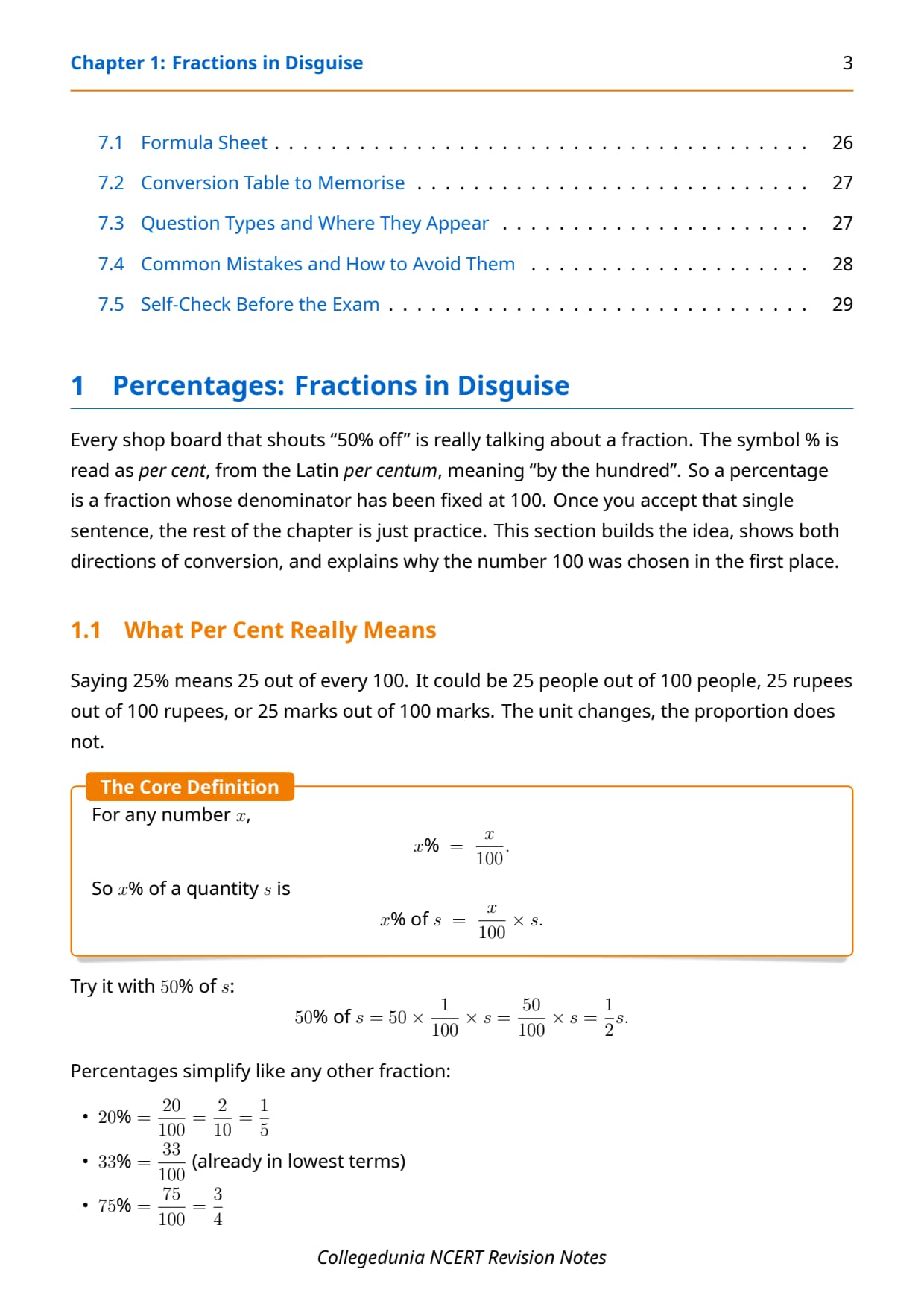
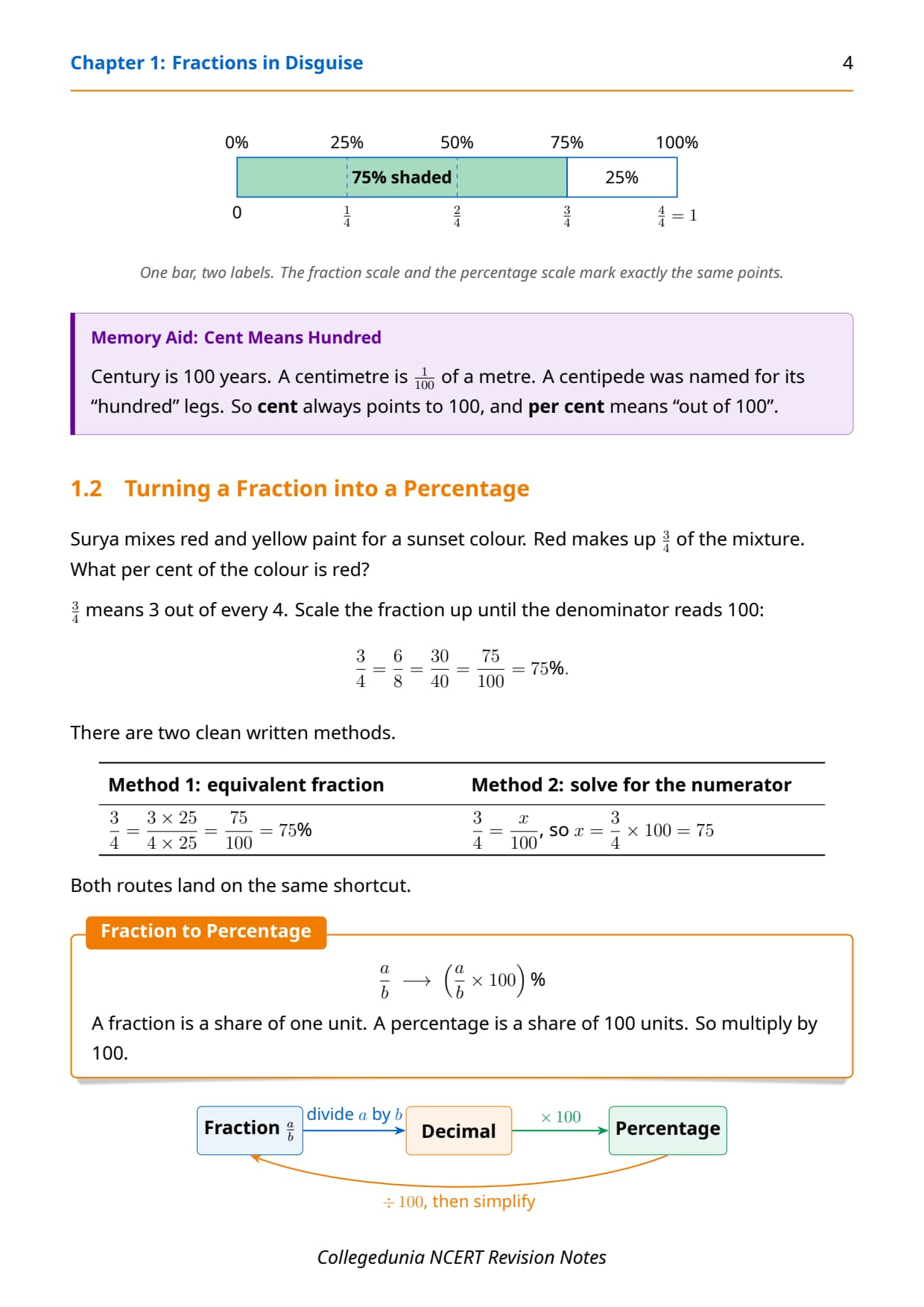
The chapter title says it plainly. A percentage is a fraction wearing a costume. The symbol % is read as per cent, from the Latin per centum, meaning by the hundred. So x% = x/100, always. Once you accept that one line, the rest of the chapter is practice.
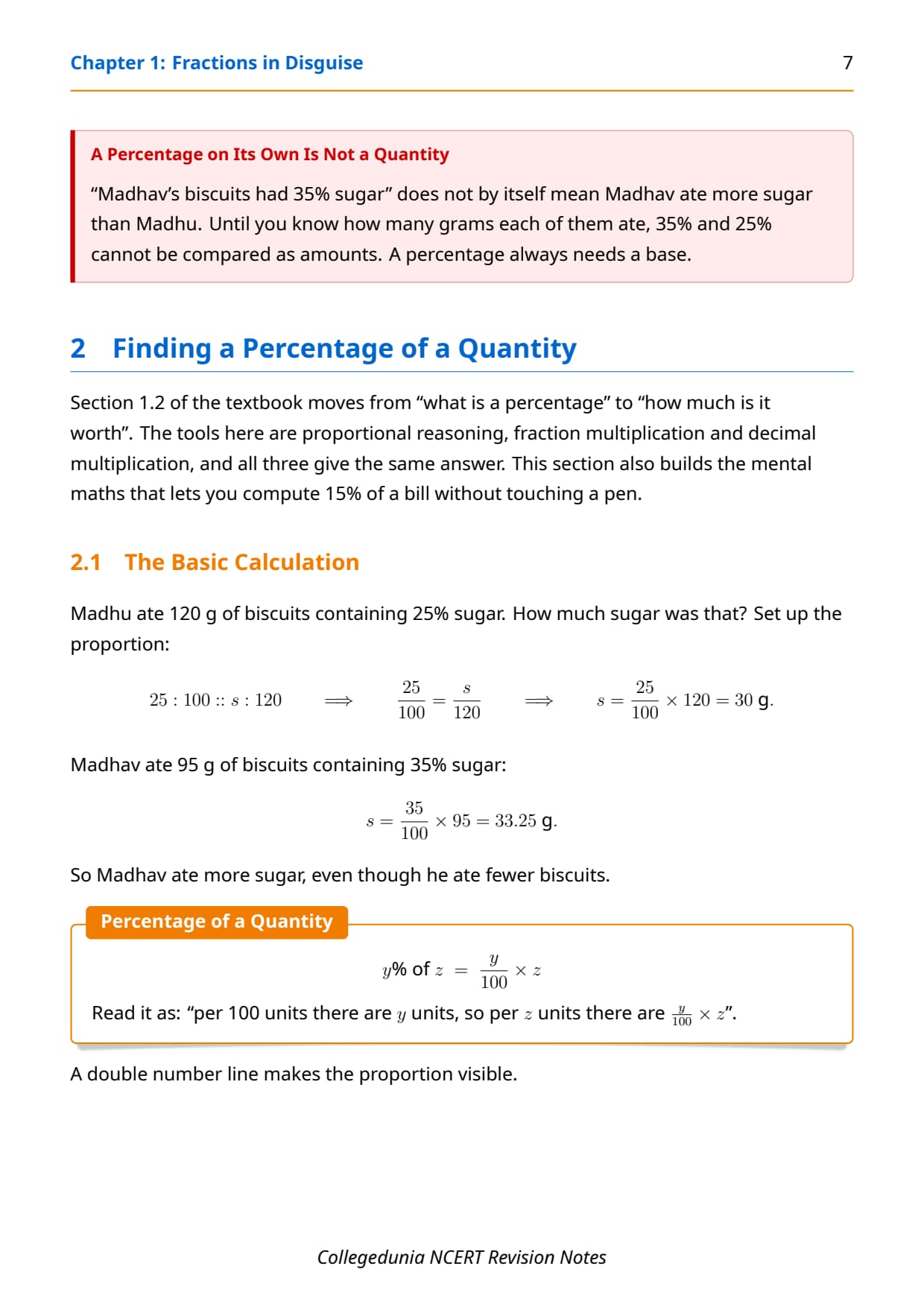
Saying 25% means 25 out of every 100. It could be 25 rupees out of 100 rupees or 25 marks out of 100 marks. The unit changes, the share does not. And because a percentage is a fraction, it simplifies like one.
- 20% = 20/100 = 1/5, so 20% of a number is that number divided by 5.
- 75% = 75/100 = 3/4, which is why a 75% score feels like three quarters of the paper.
- 33% = 33/100 is already in lowest terms and does not simplify further.
- x% of s = (x/100) × s, so 50% of s works out to half of s.
Why 100 and not 10 or 1000? Because 100 has many factors, so most everyday shares land on whole numbers or short decimals. A base of 100 keeps comparison easy without forcing long division.
Percentages Explained in Simple Language for Class 8
Source: Magnet Brains on YouTube
Fractions, Decimals and Percentages: The Conversion Table to Memorise
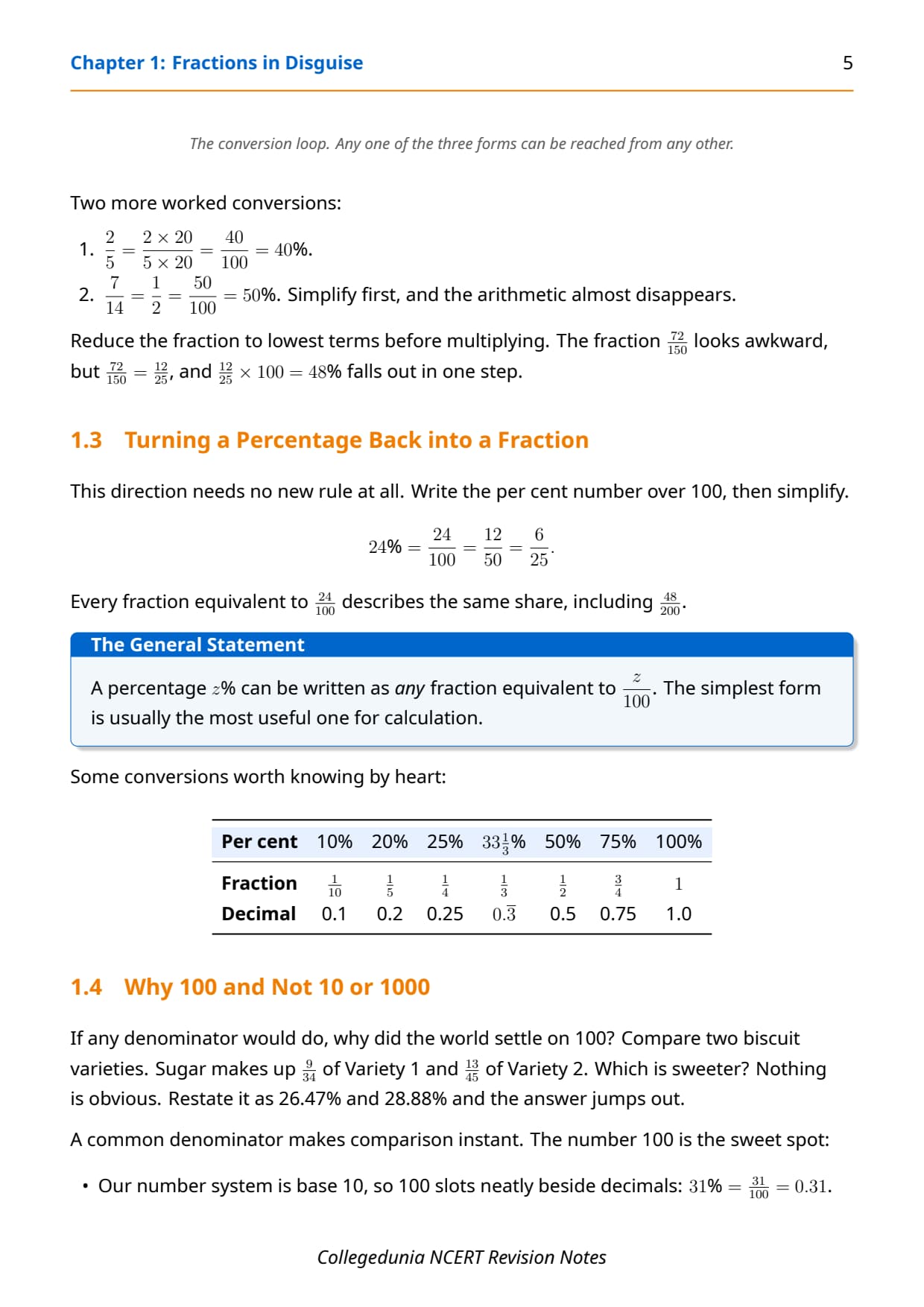
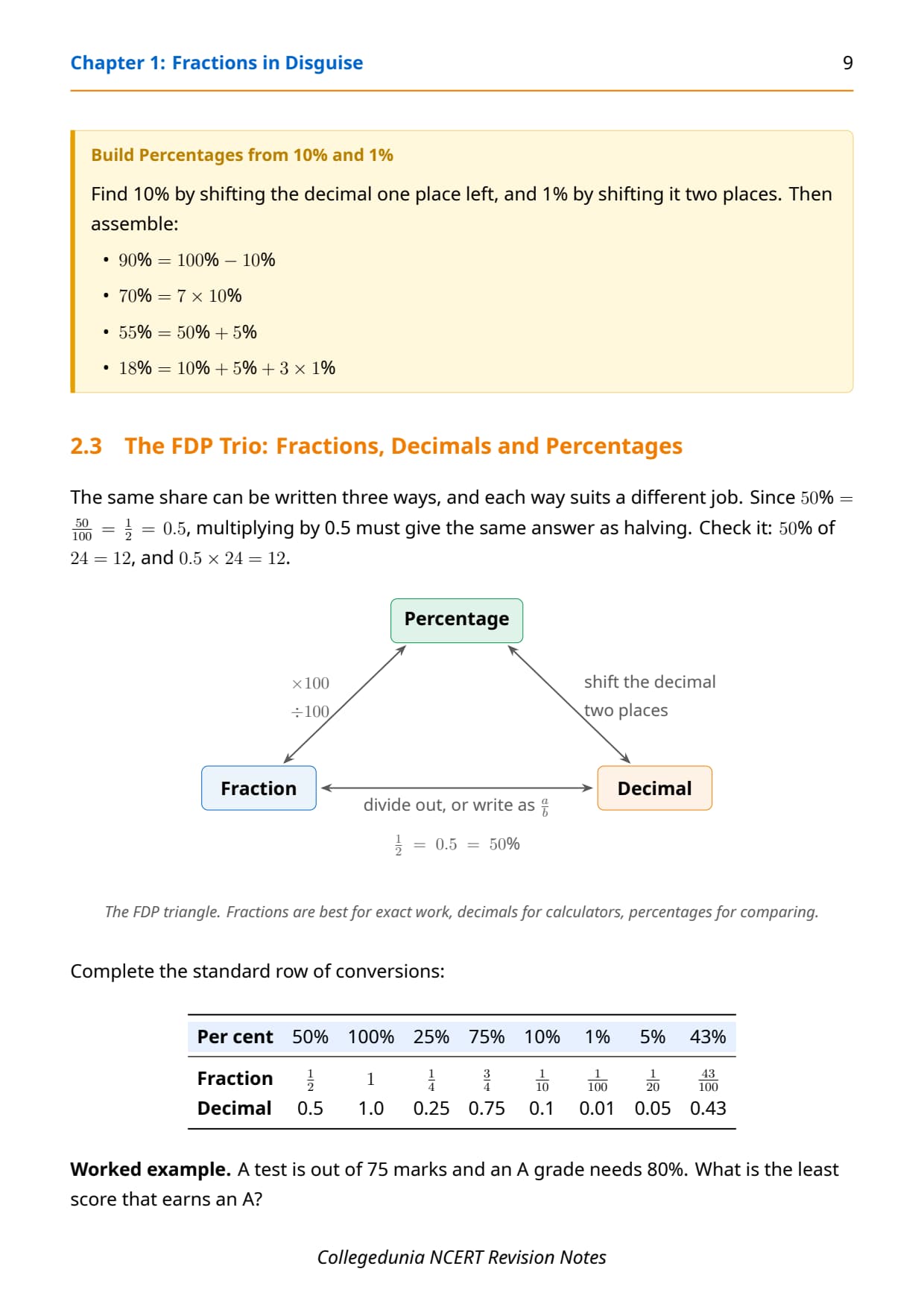
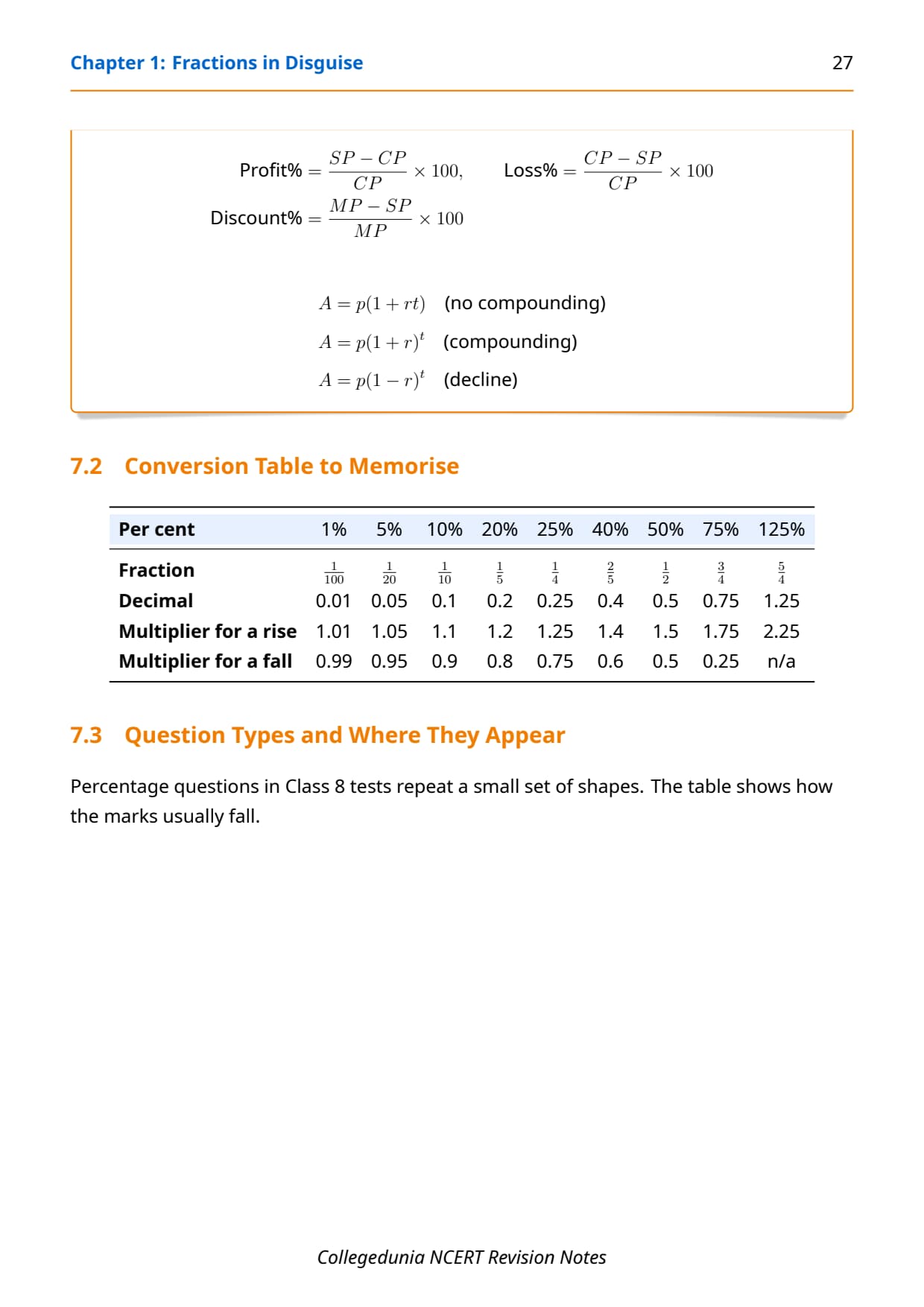
The same share can be written three ways, and each way suits a different job. Fractions are best for exact work, decimals for calculator work, and percentages for comparing. Learn to hop between them and half the chapter solves itself.
| Per cent | Fraction | Decimal | Rise multiplier | Fall multiplier |
|---|---|---|---|---|
| 1% | 1/100 | 0.01 | 1.01 | 0.99 |
| 5% | 1/20 | 0.05 | 1.05 | 0.95 |
| 10% | 1/10 | 0.10 | 1.10 | 0.90 |
| 25% | 1/4 | 0.25 | 1.25 | 0.75 |
| 50% | 1/2 | 0.50 | 1.50 | 0.50 |
| 75% | 3/4 | 0.75 | 1.75 | 0.25 |
| 100% | 1 | 1.00 | 2.00 | 0.00 |
To go from fraction to percentage, multiply by 100. To go back, divide by 100. To move between decimal and percentage, shift the decimal point two places. Since 50% = 1/2 = 0.5, multiplying by 0.5 must give the same answer as halving, and it does.
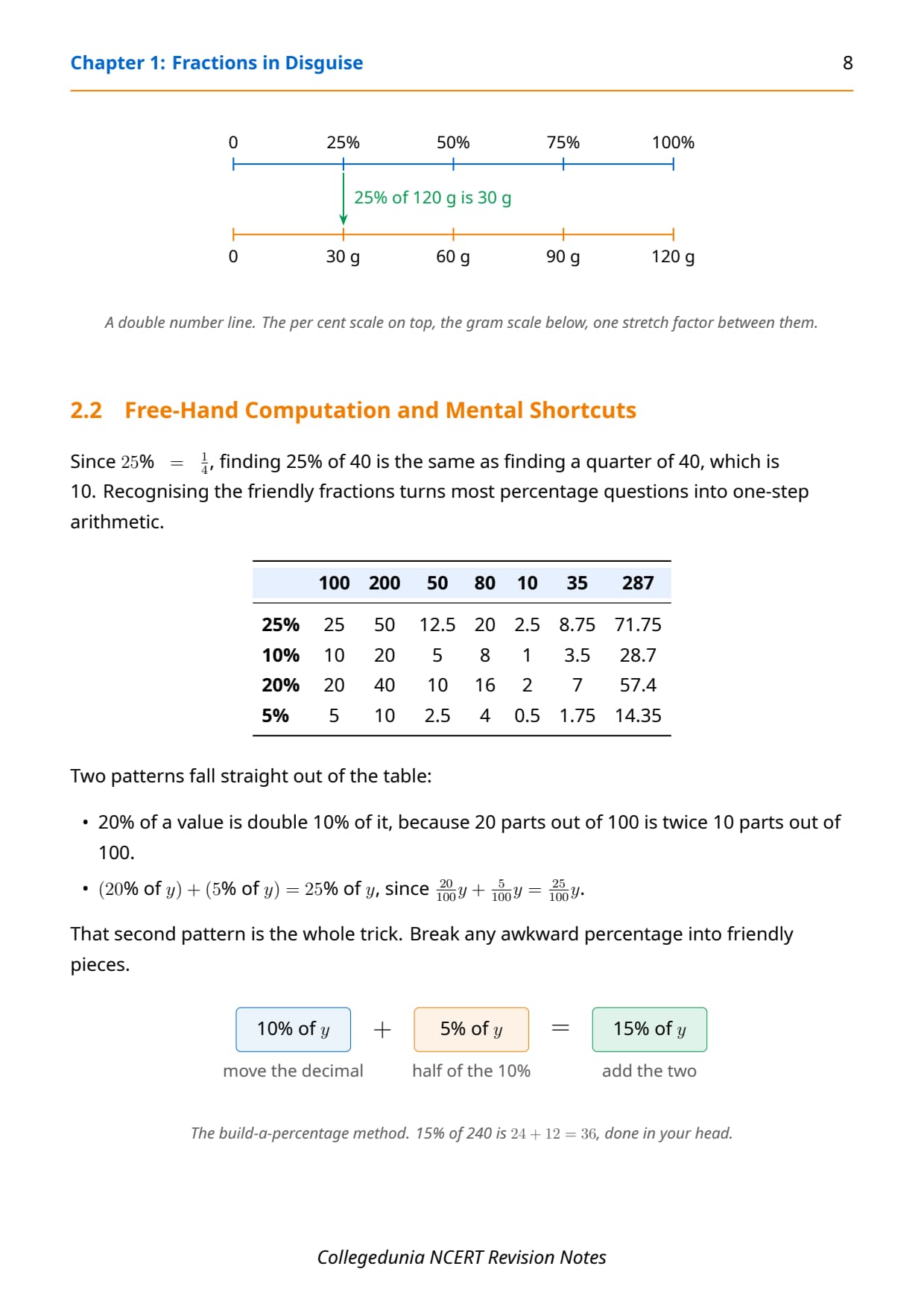
Mental Shortcuts: Build Any Percentage from 10% and 1%
Class 8 papers reward speed here. Find 10% by shifting the decimal one place left and 1% by shifting it two places. Then assemble the percentage you actually need from those two blocks.
- 90% = 100% minus 10%, so 90% of 640 is 640 minus 64, which is 576.
- 70% = 7 × 10%, so 70% of 640 is 7 × 64, which is 448.
- 55% = 50% + 5%, so 55% of 640 is 320 + 32, which is 352.
- 18% = 10% + 5% + 3 × 1%, so 18% of 640 is 64 + 32 + 19.2, which is 115.2.
One more shortcut saves time in almost every paper: x% of y equals y% of x. So 12% of 25 is the same as 25% of 12, which is simply 3. Swap the awkward calculation for the easy one whenever the numbers allow it.
Turning Ratios into Percentages Without Picking the Wrong Base
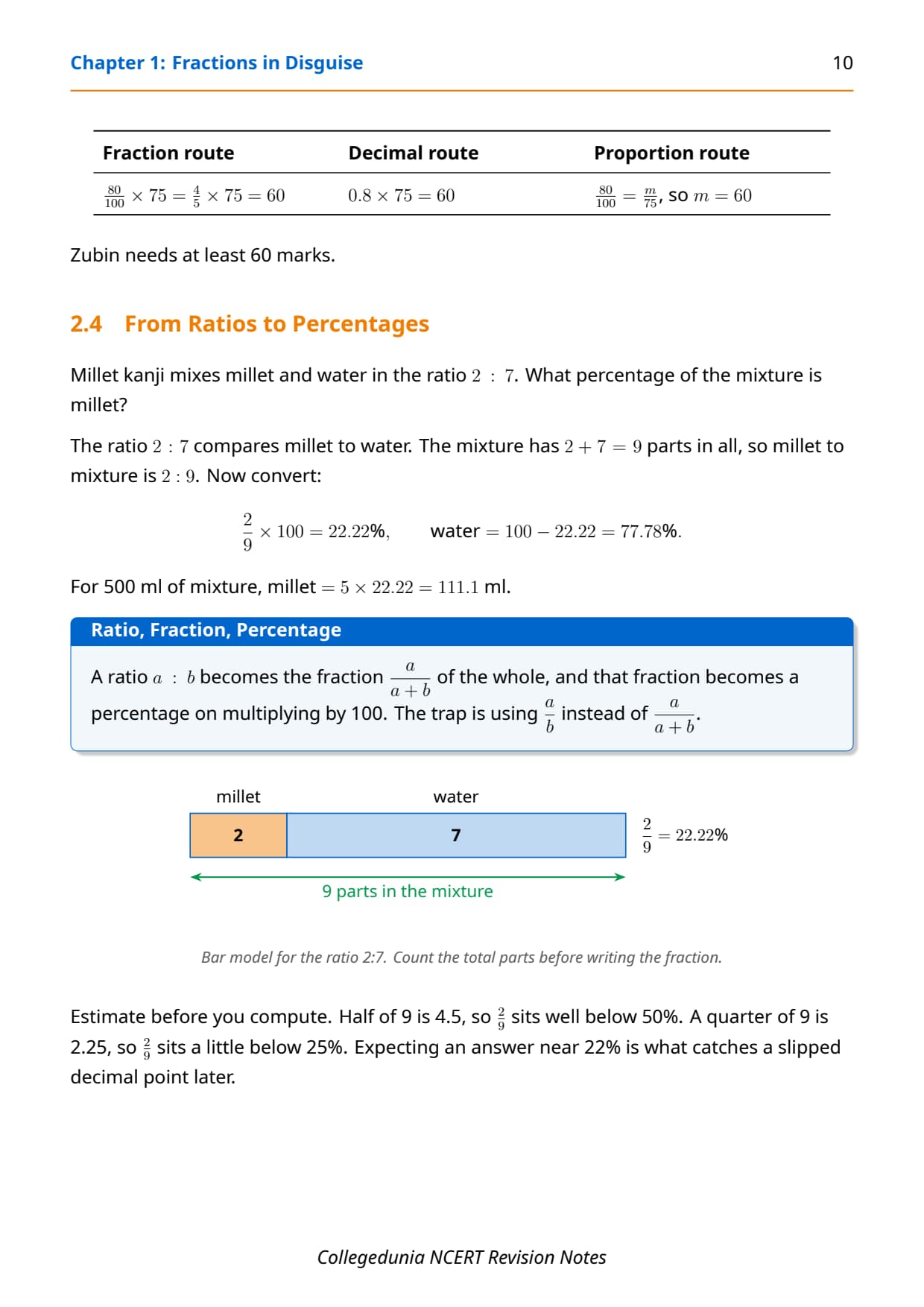
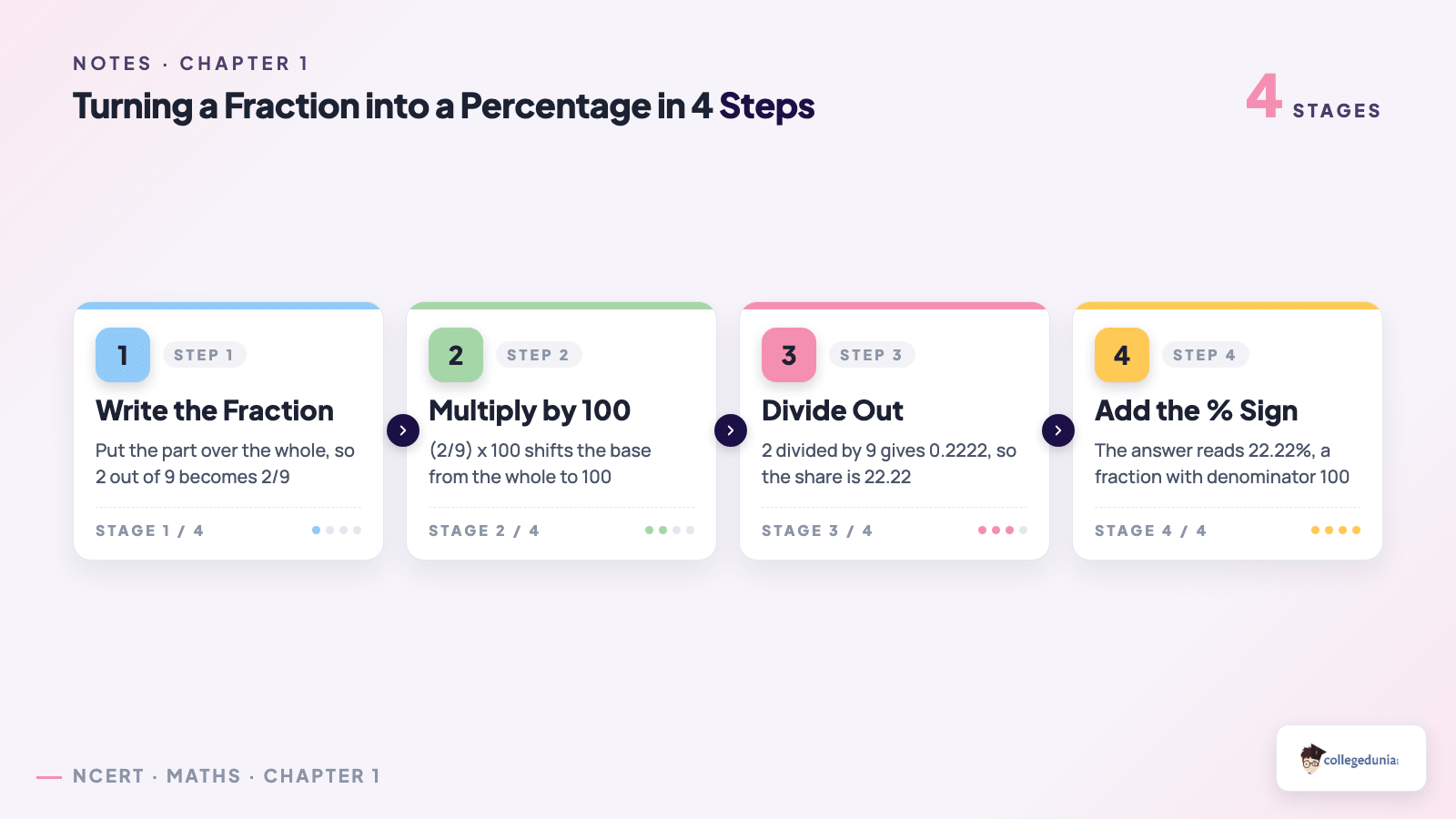
Millet kanji mixes millet and water in the ratio 2 : 7. What share of the mixture is millet? Count the total parts first. The mixture has 2 + 7 = 9 parts, so millet compared with the mixture is 2 : 9, not 2 : 7.
- Millet share = (2/9) × 100 = 22.22% of the mixture.
- Water share = 100 minus 22.22 = 77.78%, so the two shares add to 100.
- For 500 ml of mixture, millet works out to 5 × 22.22, which is 111.1 ml.
- General rule: a ratio a : b gives the fraction a/(a + b), then multiply by 100.
The trap is writing a/b instead of a/(a + b). Estimate before you compute. Half of 9 is 4.5, so 2/9 must sit well below 50%. A quarter of 9 is 2.25, so 2/9 sits a little below 25%. Expecting an answer near 22% is what catches a slipped decimal point later.
Percentages Above 100 and Comparing Scores with Different Totals
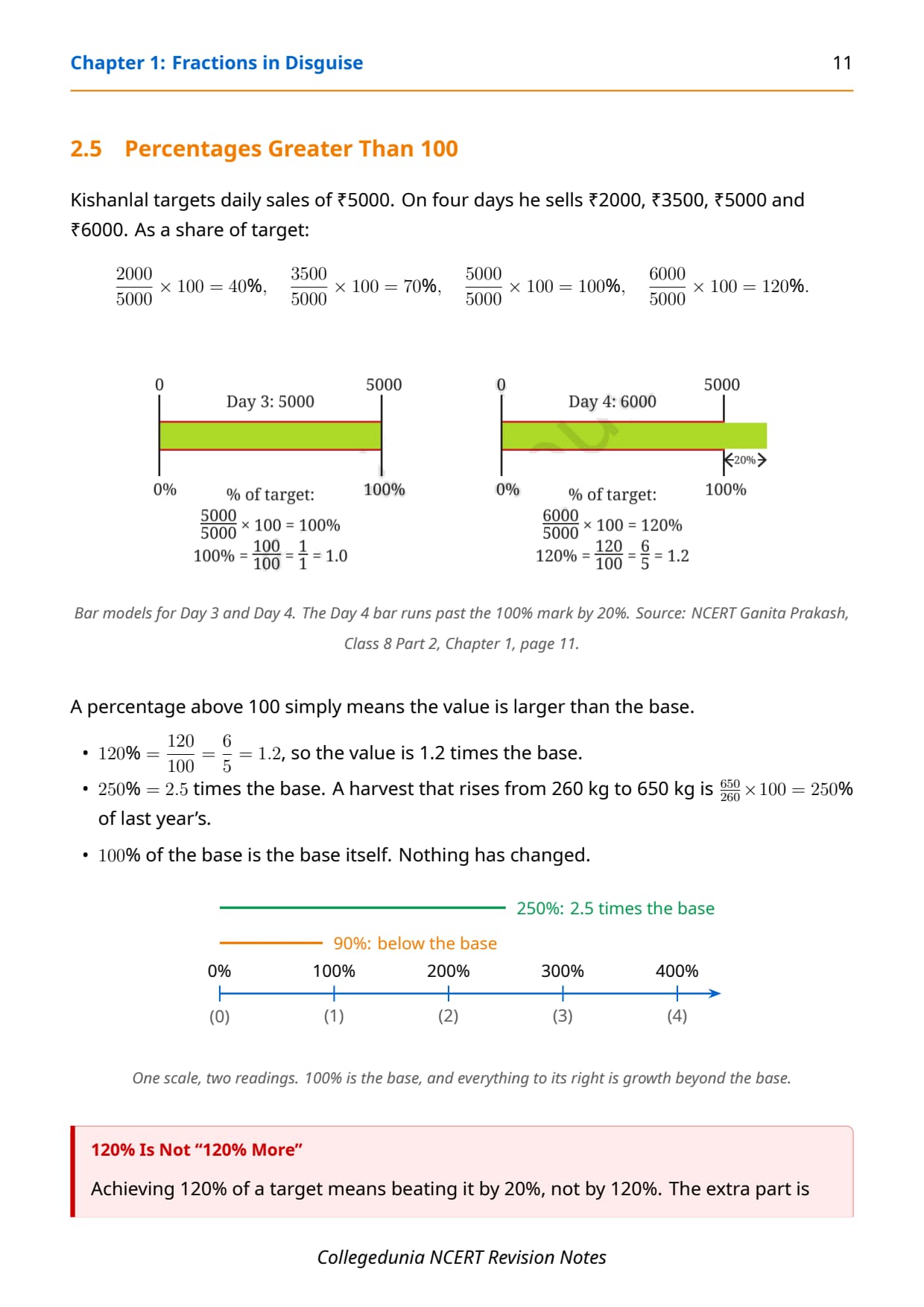
Kishanlal targets daily sales of ₹5000. One day he sells ₹6000, which is (6000/5000) × 100 = 120% of target. A percentage above 100 simply means the value is larger than the base. 120% of a target means beating it by 20%, not by 120%.
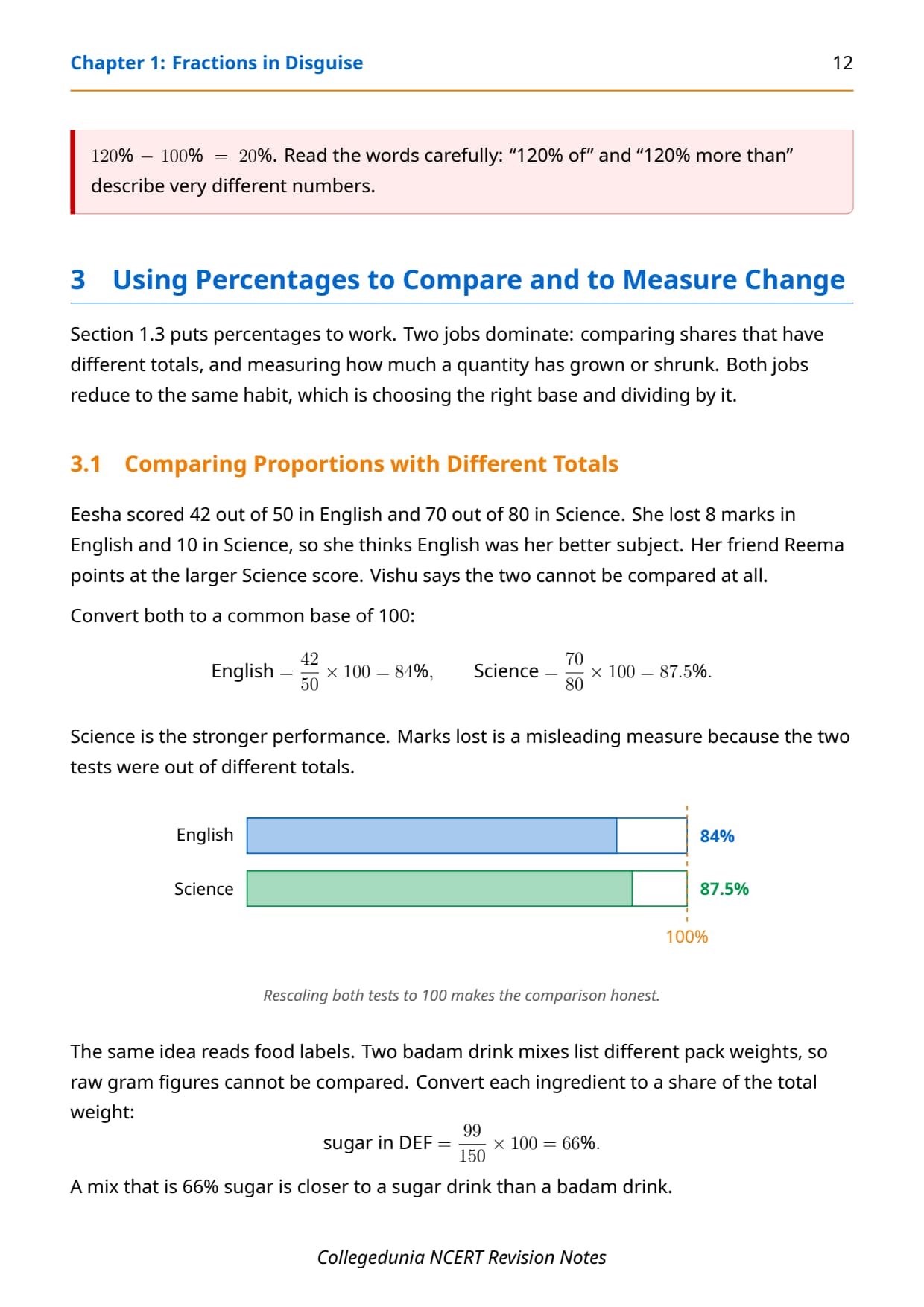
Percentages also make unfair comparisons fair. Eesha scored 42 out of 50 in English and 70 out of 80 in Science. She lost 8 marks in one and 10 in the other, so she thinks English went better. Rescale both to a base of 100 and the truth appears.
| Situation | Working | Result |
|---|---|---|
| English marks | (42 / 50) × 100 | 84% |
| Science marks | (70 / 80) × 100 | 87.5%, the stronger score |
| Sales of ₹6000 on a ₹5000 target | (6000 / 5000) × 100 | 120% of target |
| Harvest rising from 260 kg to 650 kg | (650 / 260) × 100 | 250% of last year |
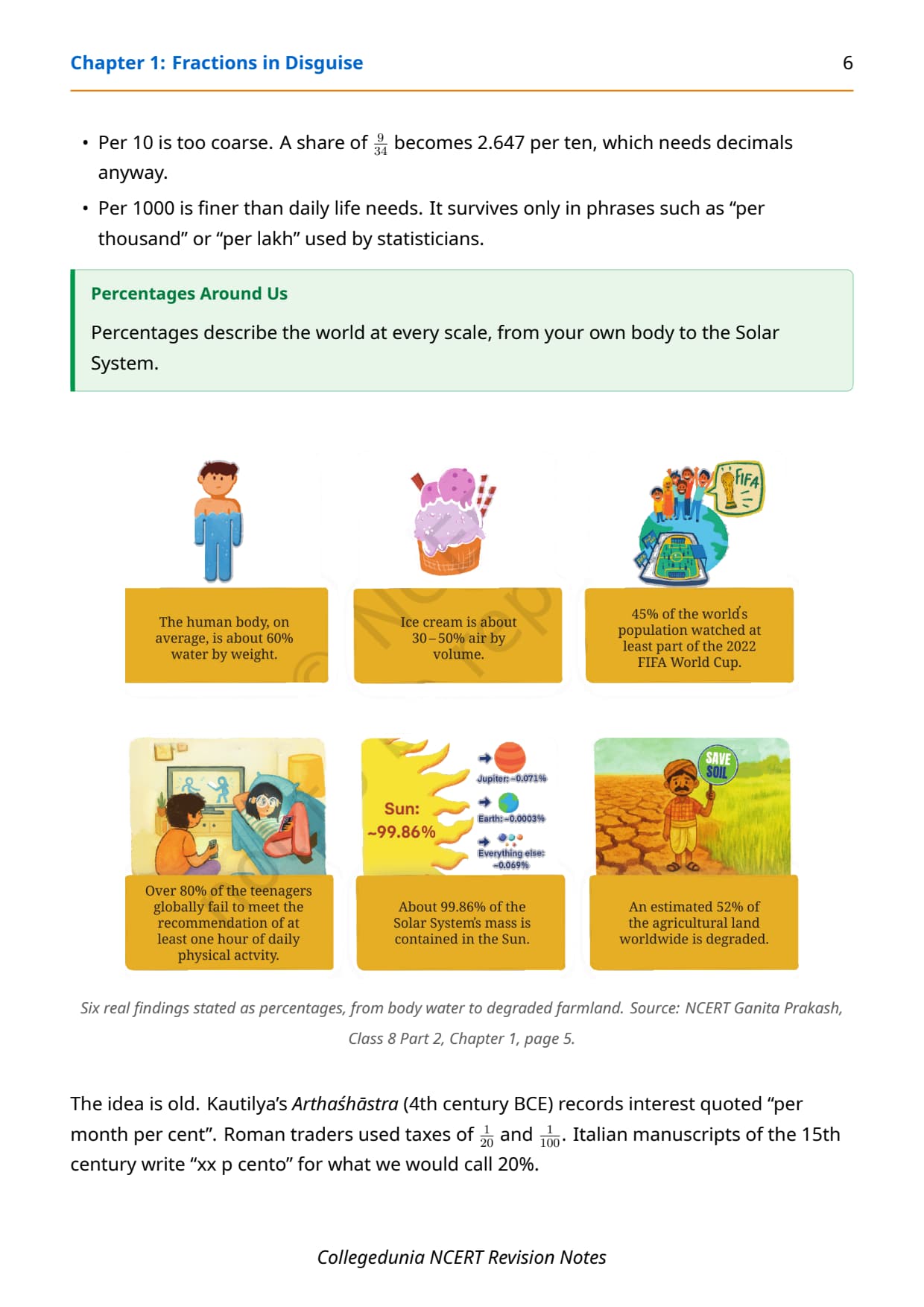
| Sugar of 99 g in a 150 g pack | (99 / 150) × 100 | 66% sugar by weight |
Marks lost is a misleading measure because the two tests were out of different totals. The same idea reads a food label: turning each ingredient into a share of pack weight tells you what you are really buying.
Percentage Increase, Percentage Decrease and the Multiplier Shortcut
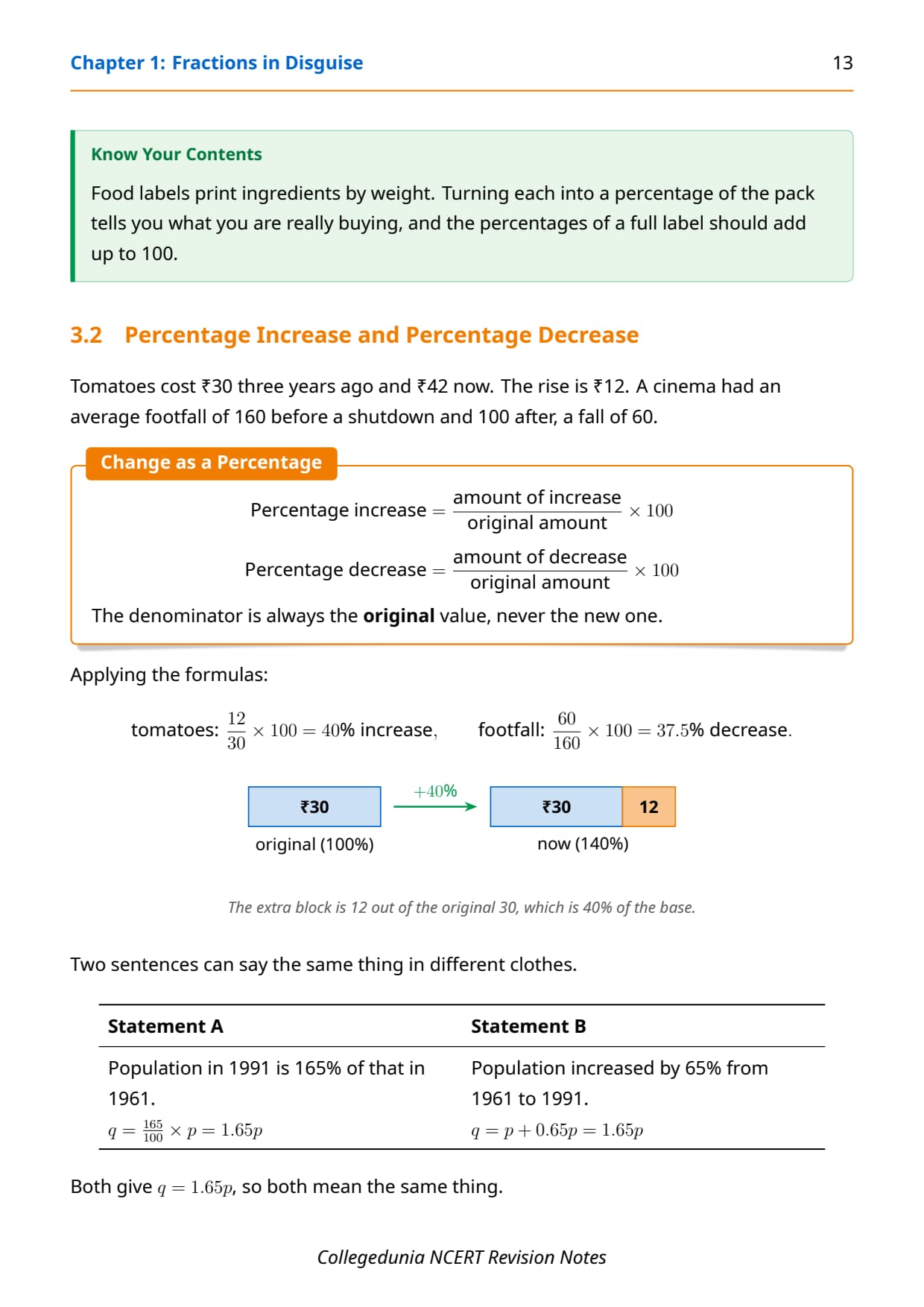
Tomatoes cost ₹30 three years ago and ₹42 now. The rise is ₹12 on an original of ₹30, so the increase is (12 / 30) × 100 = 40%. A cinema footfall falling from 160 to 100 is a drop of 60 on 160, which is 37.5%.
- Percentage increase = (amount of increase / original amount) × 100.
- Percentage decrease = (amount of decrease / original amount) × 100.
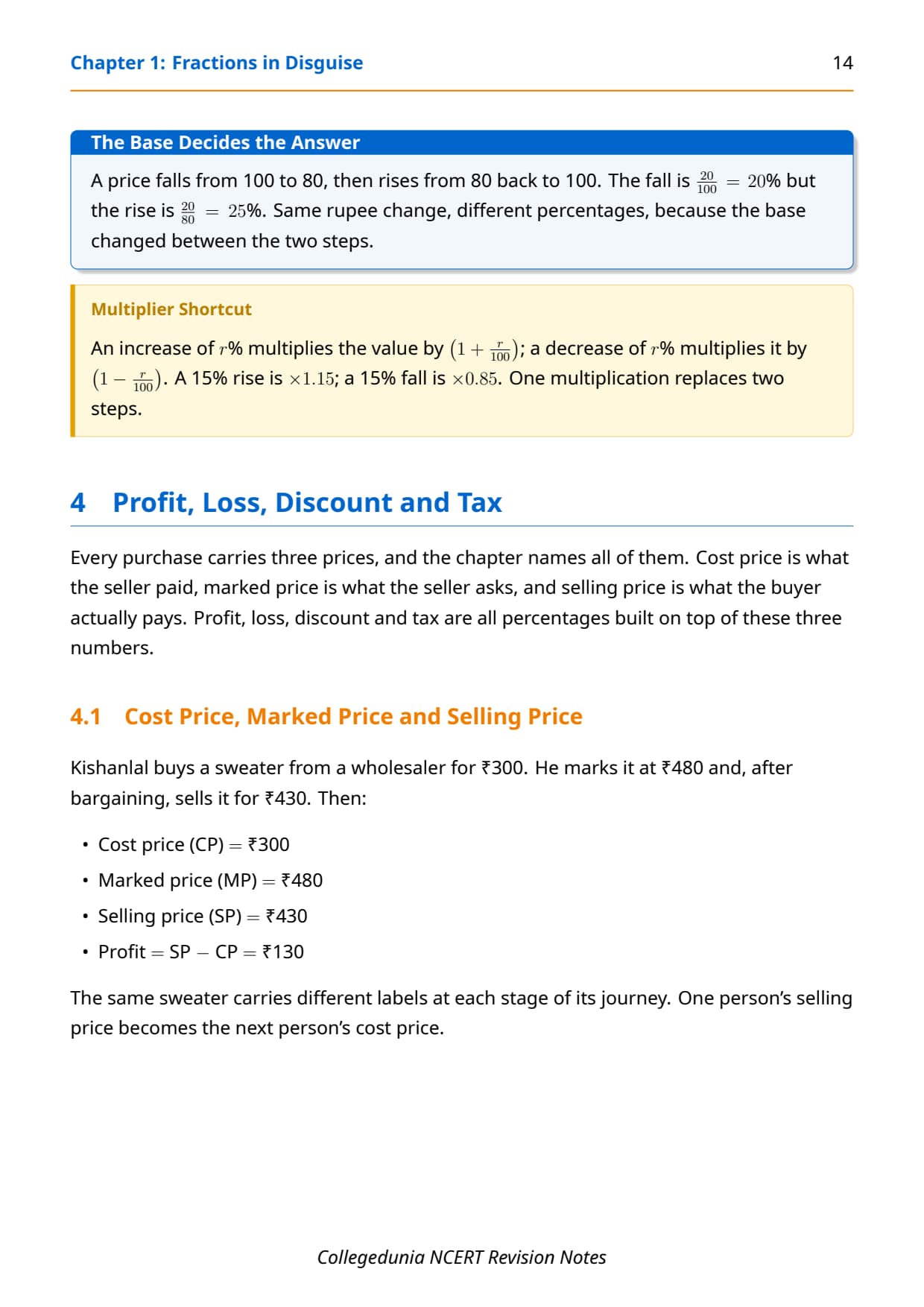
- A rise of r% multiplies the value by (1 + r/100), so a 15% rise is × 1.15.
- A fall of r% multiplies the value by (1 - r/100), so a 15% fall is × 0.85.
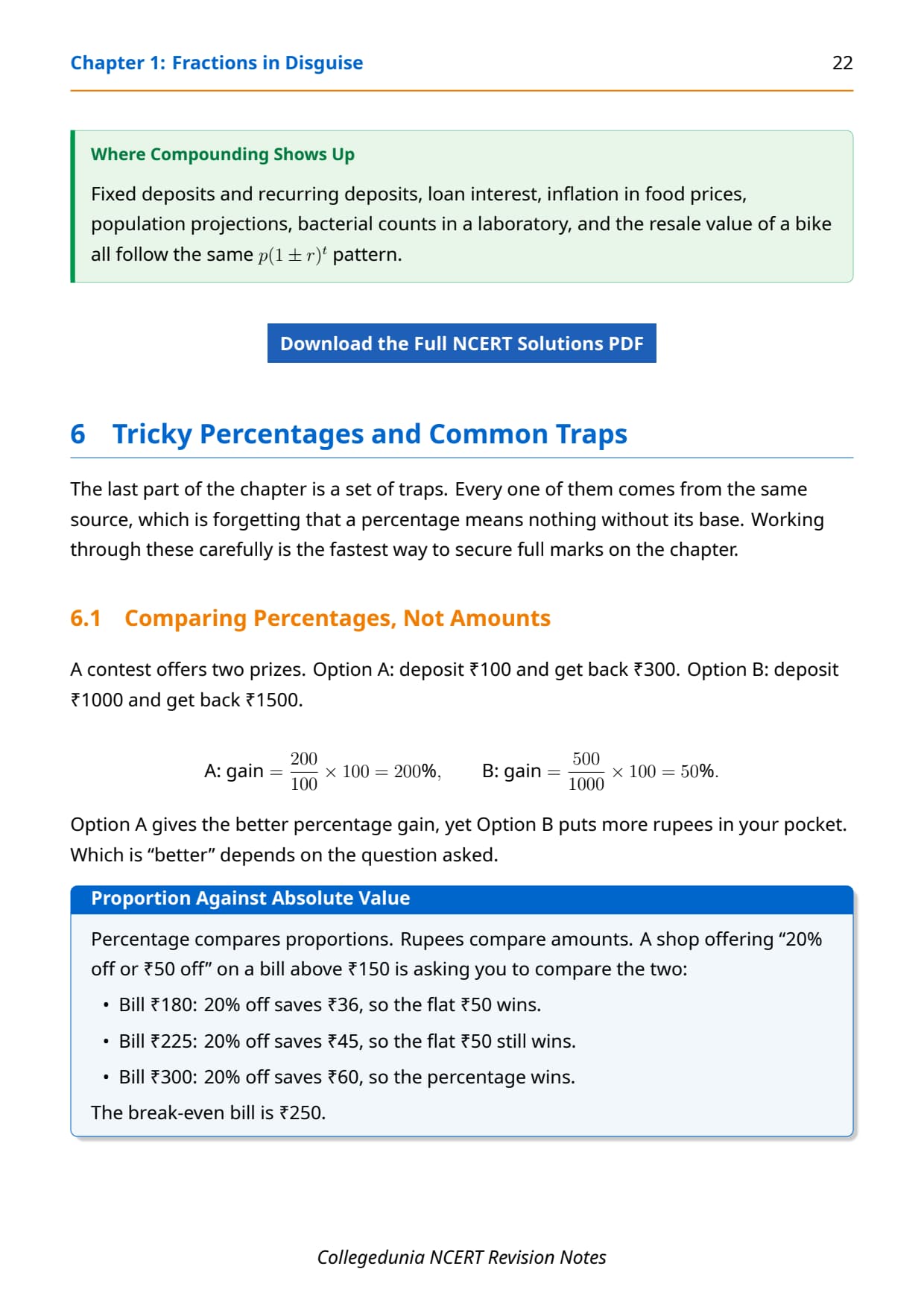
The base decides the answer. A price falling from 100 to 80 is a 20% fall, but climbing from 80 back to 100 is a 25% rise. Same rupee change, different percentages, because the base changed between the two steps.
Cost Price, Marked Price and Selling Price: Profit, Loss, Discount and Tax
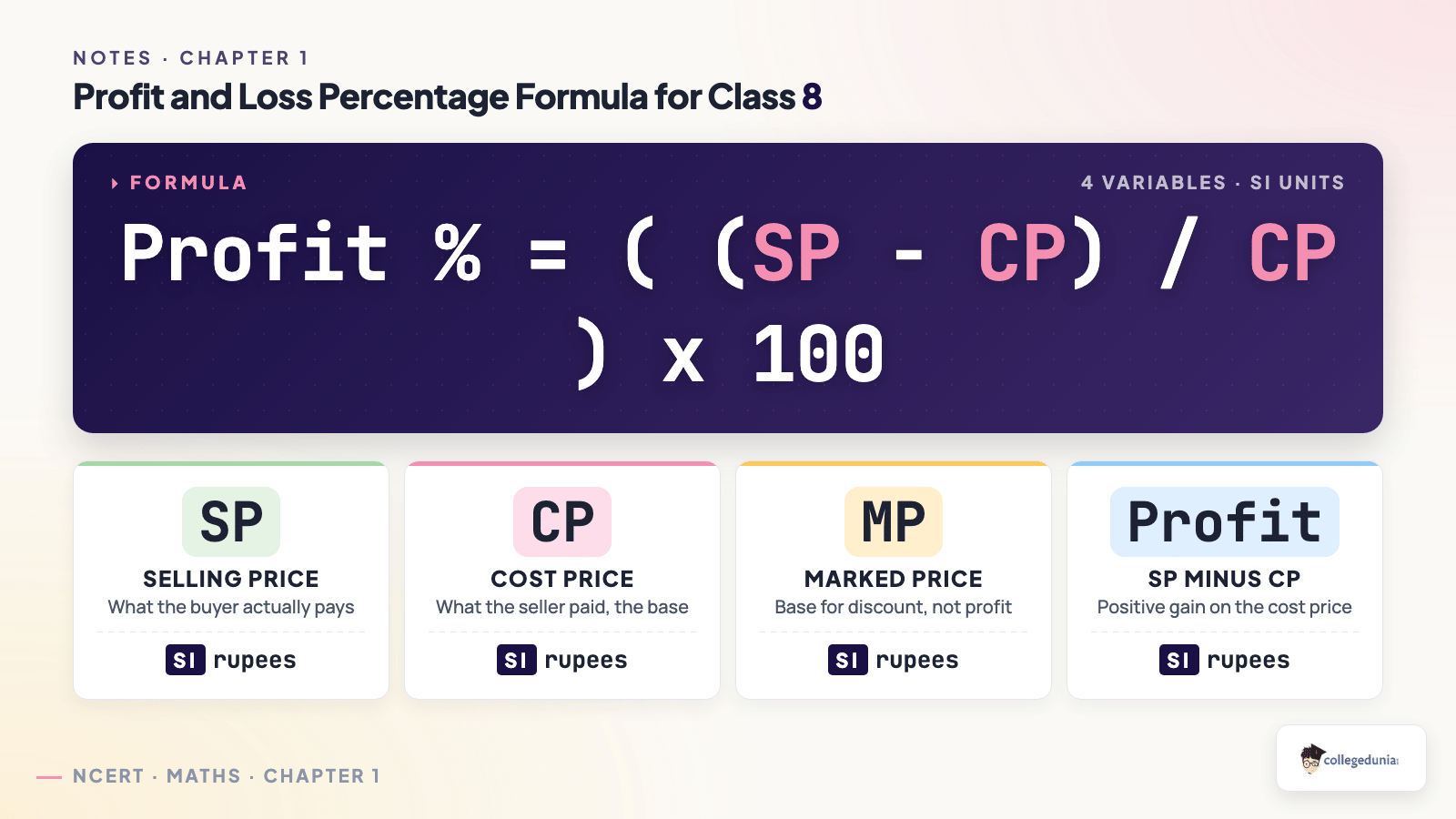
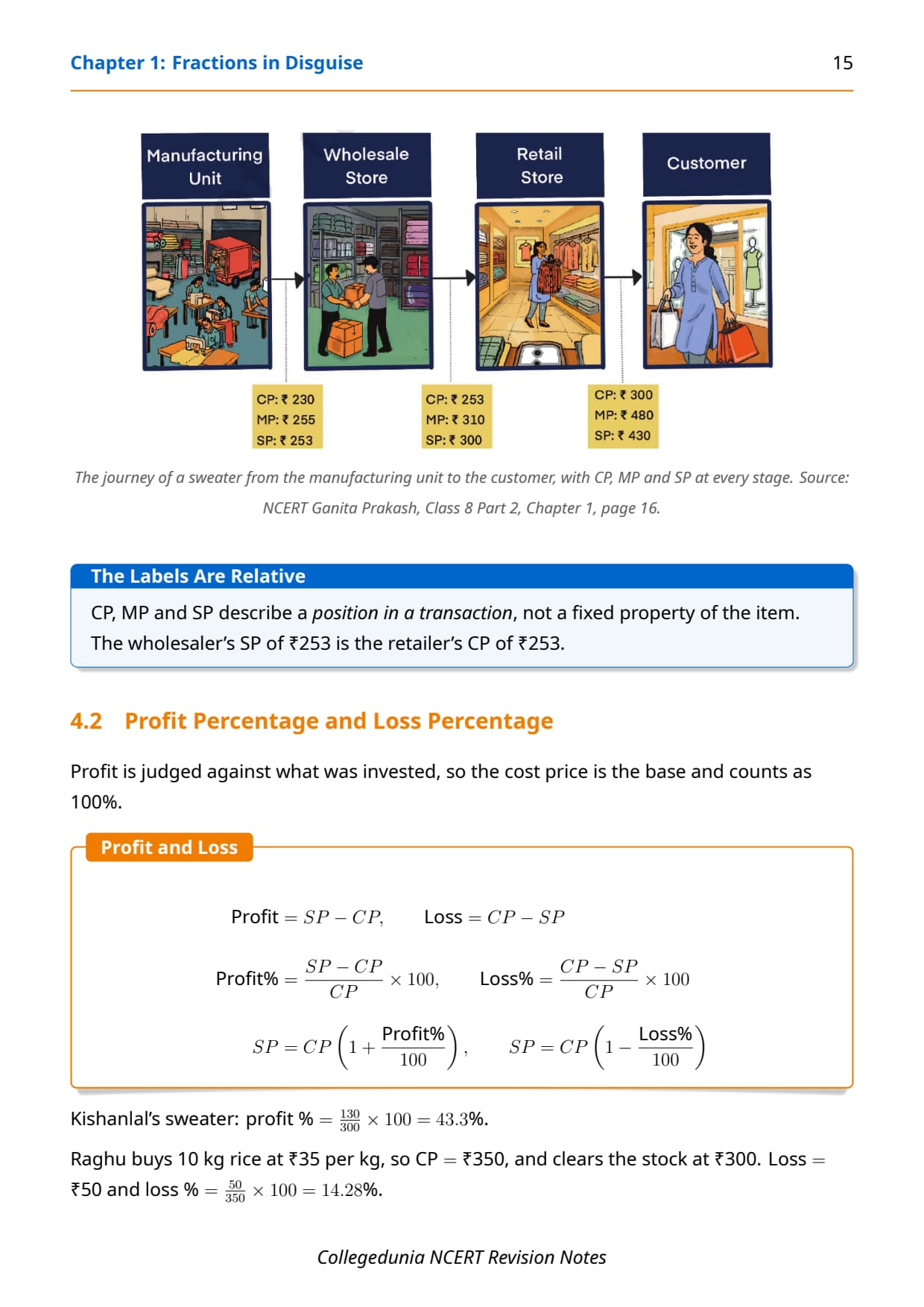
Every purchase carries three prices. Cost price (CP) is what the seller paid, marked price (MP) is what the seller asks, and selling price (SP) is what the buyer actually pays. Profit, loss, discount and tax are all percentages built on these three numbers.
Kishanlal buys a sweater for ₹300, marks it at ₹480, and sells it for ₹430 after bargaining. So CP is ₹300, MP is ₹480, SP is ₹430 and the profit is ₹130. These labels describe a position in a deal, not a fixed property: the wholesaler's selling price becomes the retailer's cost price.
| Quantity | Formula | Base it sits on |
|---|---|---|
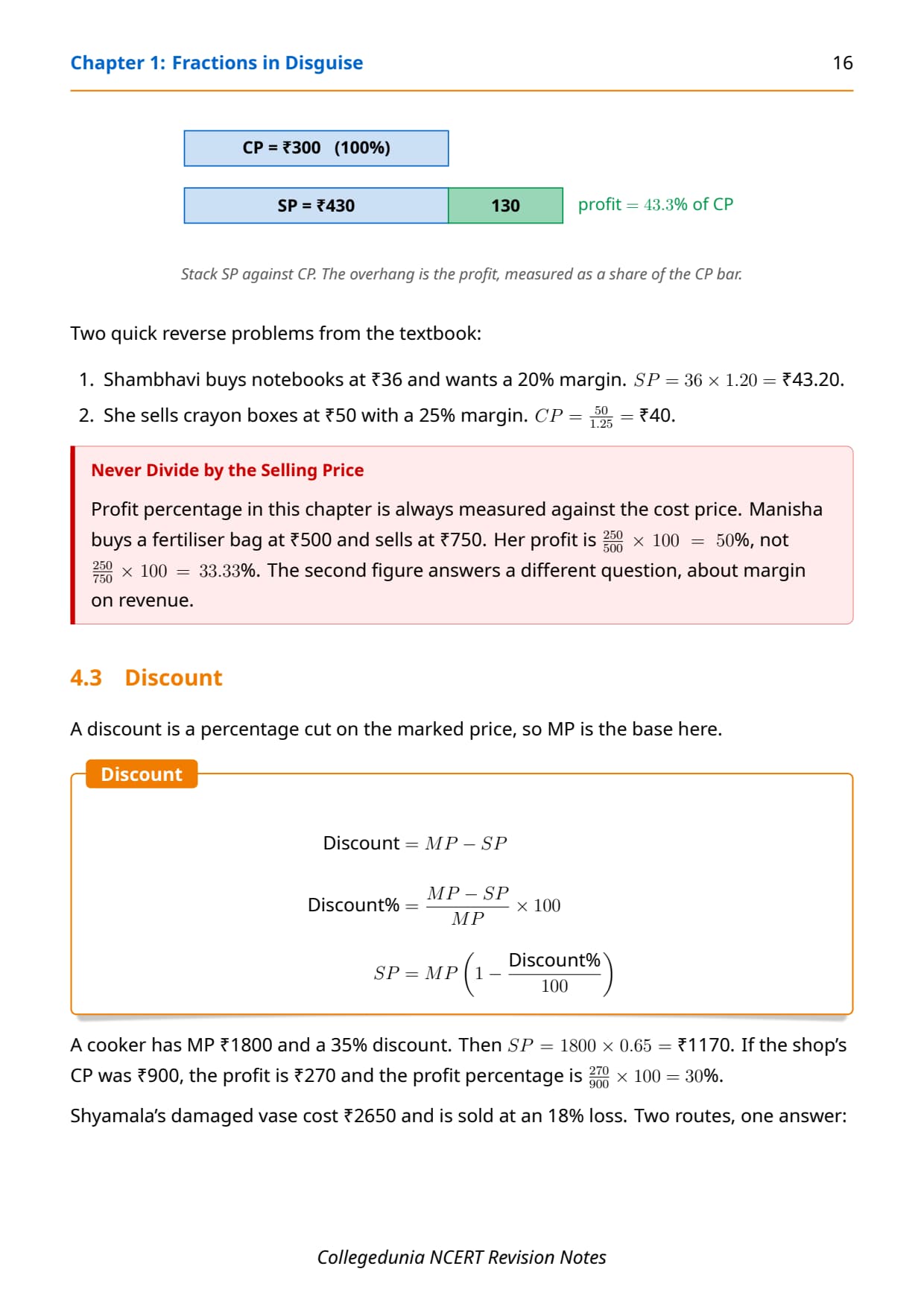
| Profit % | ((SP - CP) / CP) × 100 | Cost price |
| Loss % | ((CP - SP) / CP) × 100 | Cost price |
| Selling price from margin | SP = CP × (1 + Profit%/100) | Cost price |
| Discount % | ((MP - SP) / MP) × 100 | Marked price |
| Selling price after discount | SP = MP × (1 - Discount%/100) | Marked price |
| Price with GST | Final = Listed × (1 + GST%/100) | Listed price |
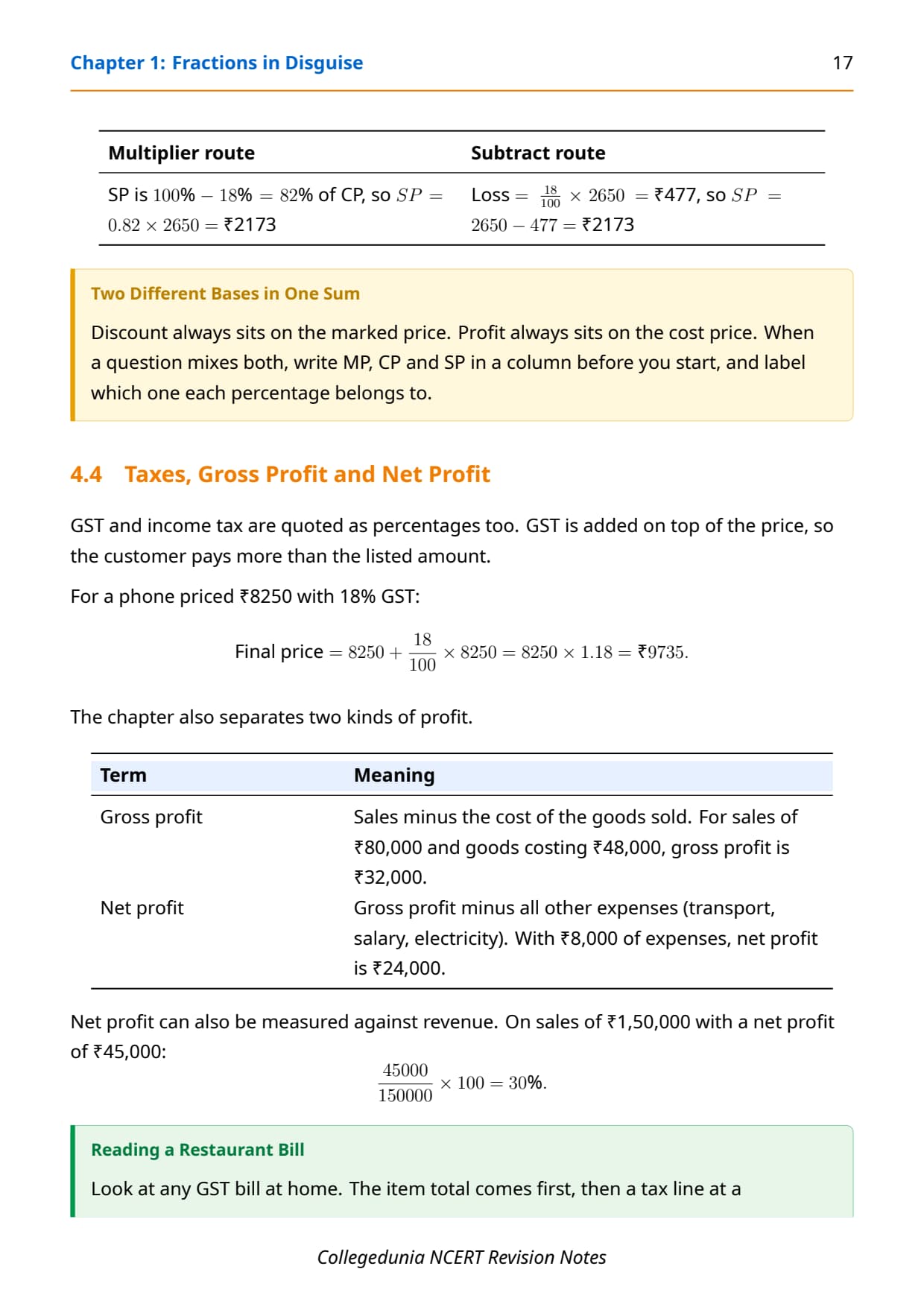
Two quick checks from the textbook. A cooker marked ₹1800 with a 35% discount sells at 1800 × 0.65 = ₹1170. A phone listed at ₹8250 with 18% GST costs 8250 × 1.18 = ₹9735, because tax is added on top of the listed price.
The chapter also splits profit in two. Gross profit is sales minus the cost of goods sold, so ₹80,000 of sales on ₹48,000 of goods gives ₹32,000. Net profit takes away transport, salary and electricity too, so ₹8,000 of expenses leaves ₹24,000.
Simple Growth, Compounding and Depreciation with Rupee Examples
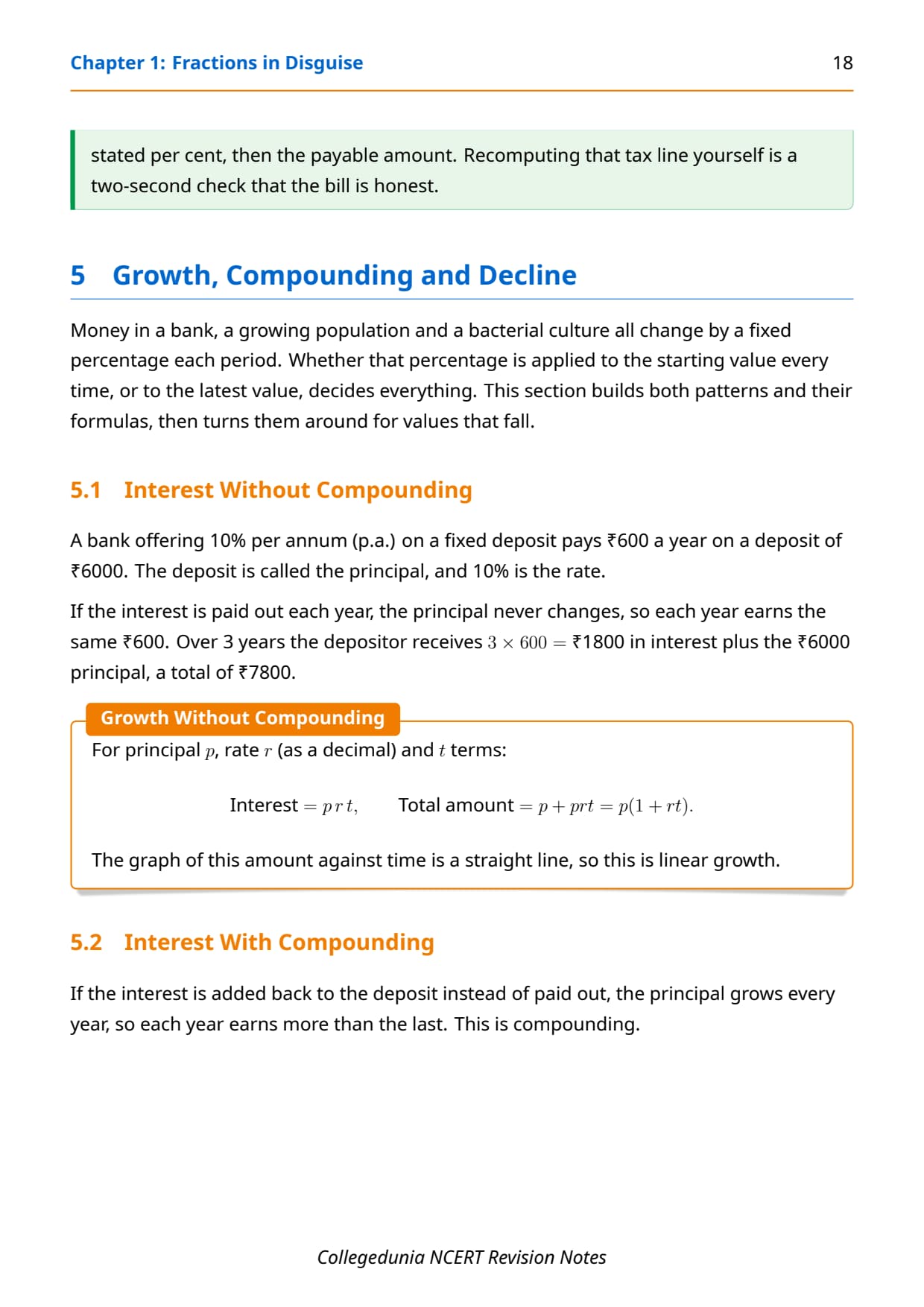
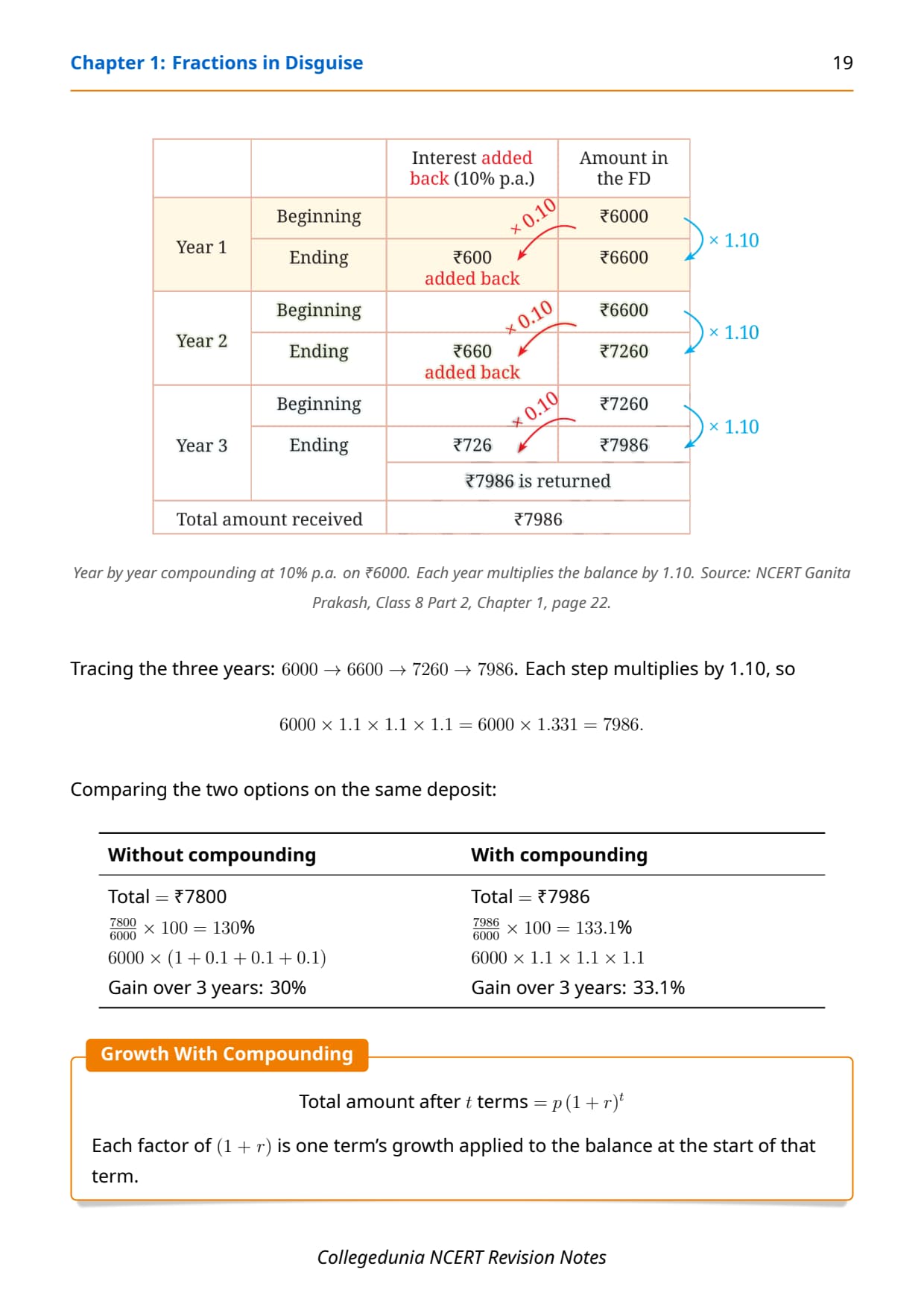
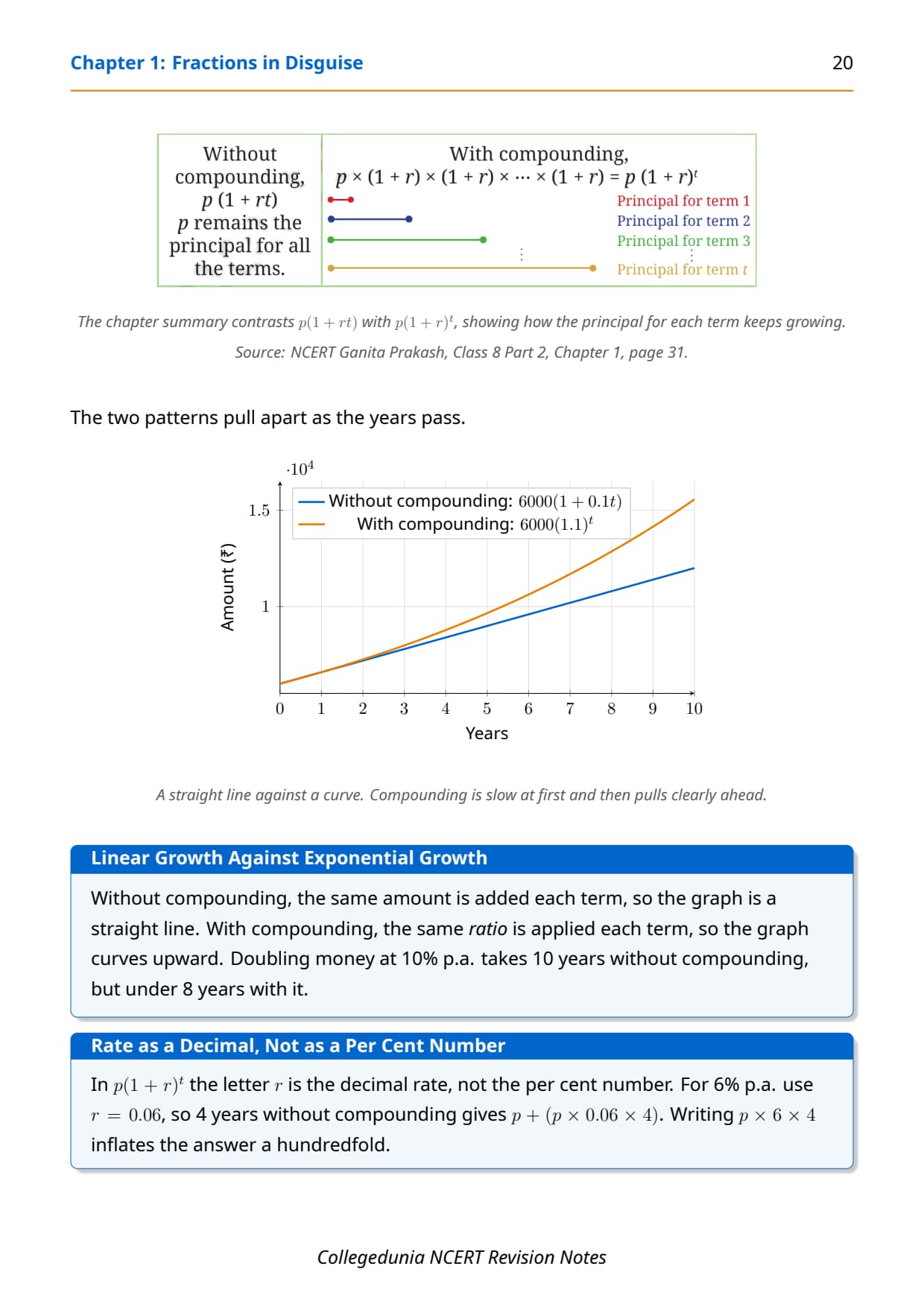
Money grows in two different shapes, and the chapter wants you to tell them apart. Without compounding, the same amount is added each term, so the graph is a straight line. With compounding, the same ratio is applied each term, so the graph curves upward.
| Pattern | Formula | Worked value |
|---|---|---|
| Growth without compounding | A = p(1 + rt) | ₹6000 at 10% for 5 years gives ₹9000 |
| Growth with compounding | A = p(1 + r)t | ₹6000 at 10% for 5 years gives ₹9663 |
| Decline or depreciation | A = p(1 - r)t | ₹21,000 falling 5% a year gives ₹19,950 |
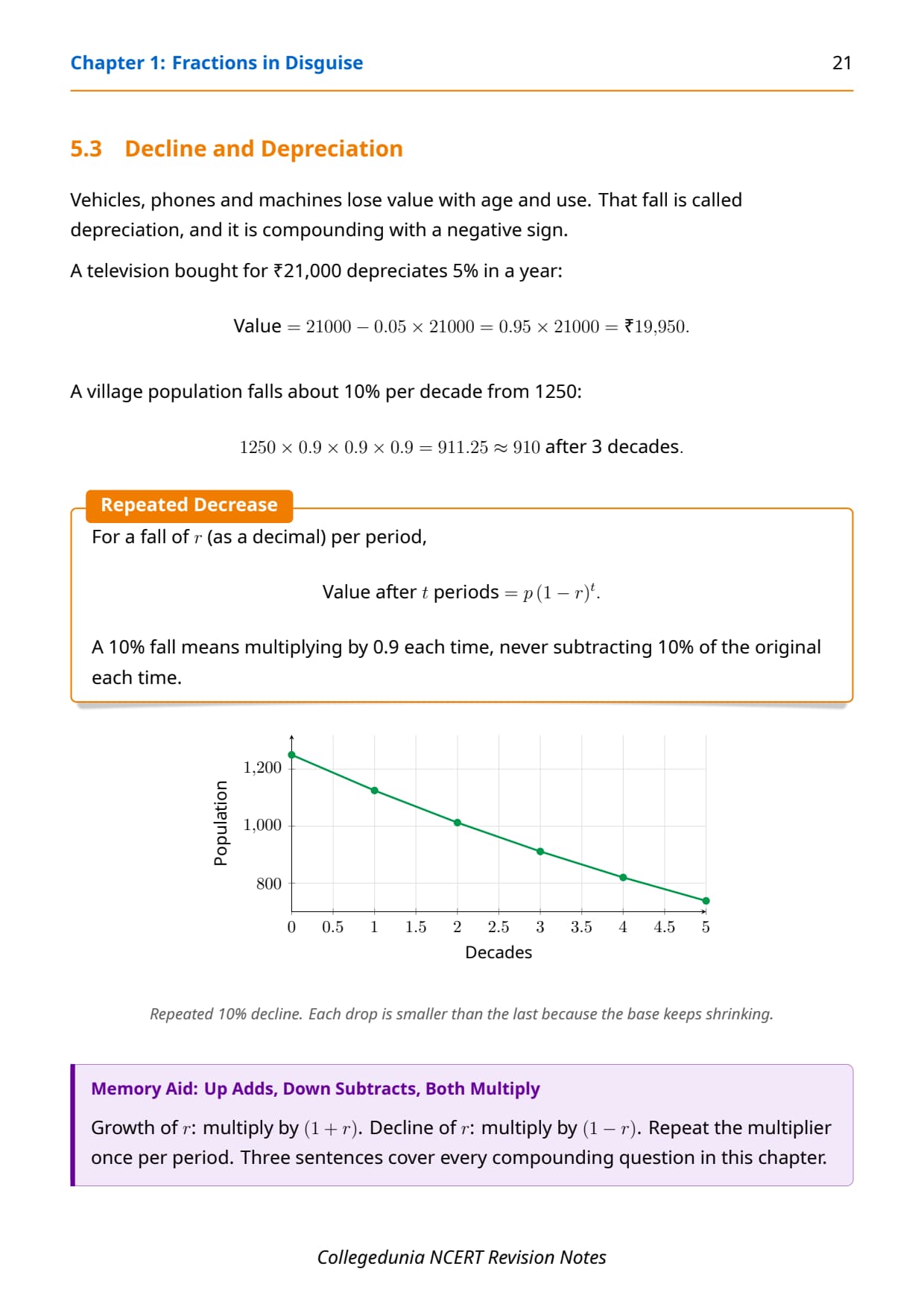
| Population decline | 1250 × 0.9 × 0.9 × 0.9 | About 910 after 3 decades |
In every one of these formulas, r is the decimal rate, not the per cent number. For 6% per year use r = 0.06. Writing 6 in place of 0.06 inflates the answer a hundred times over, and it is the single most common slip in this section.
A three-line memory aid covers the whole block: growth of r multiplies by (1 + r), decline of r multiplies by (1 - r), and you repeat the multiplier once per period. Doubling money at 10% a year takes 10 years without compounding but under 8 years with it.
Common Mistakes Students Make in the Fractions in Disguise Chapter
Read this list twice before the exam. Every trap below comes from the same place: forgetting that a percentage means nothing without its base.
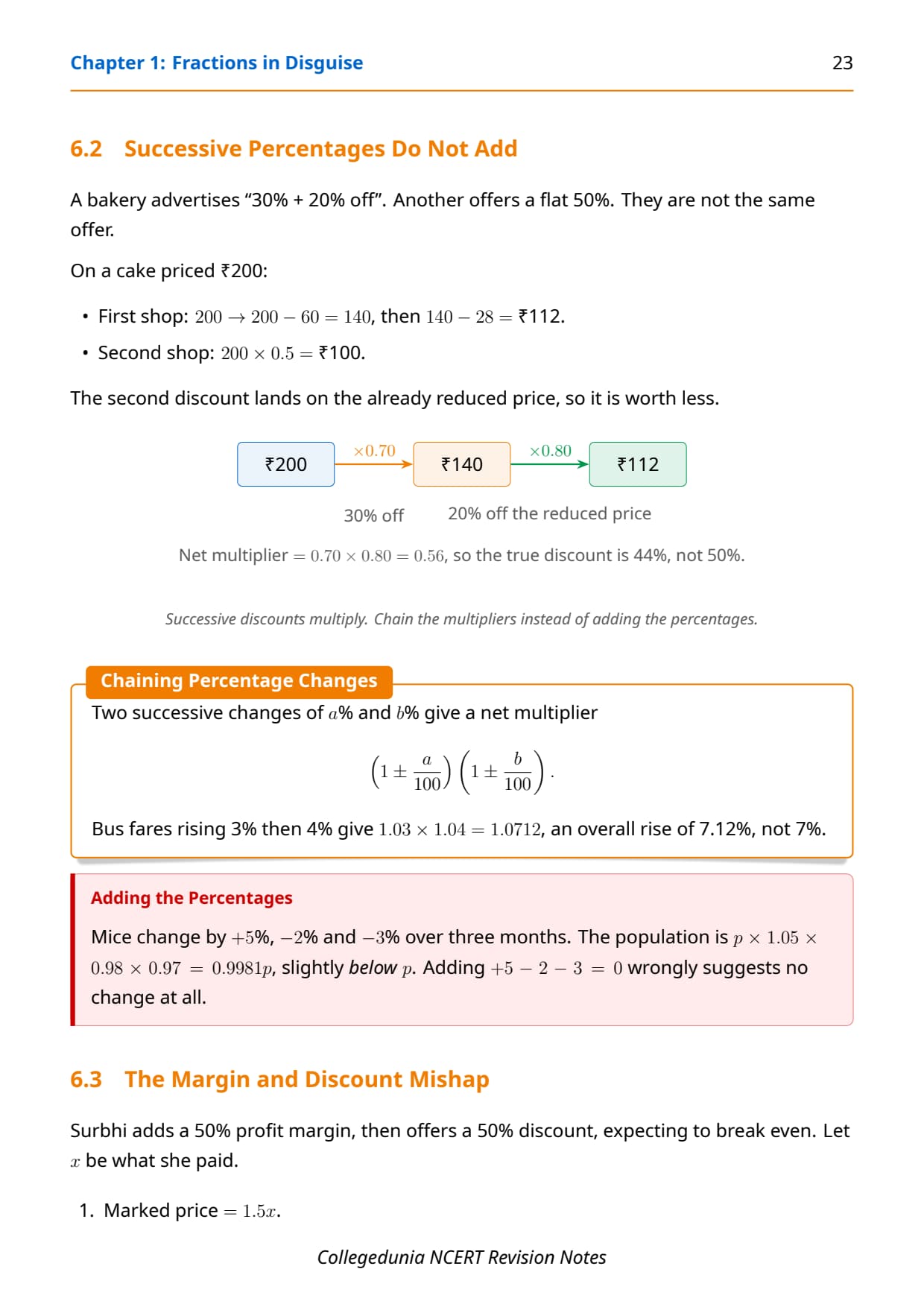
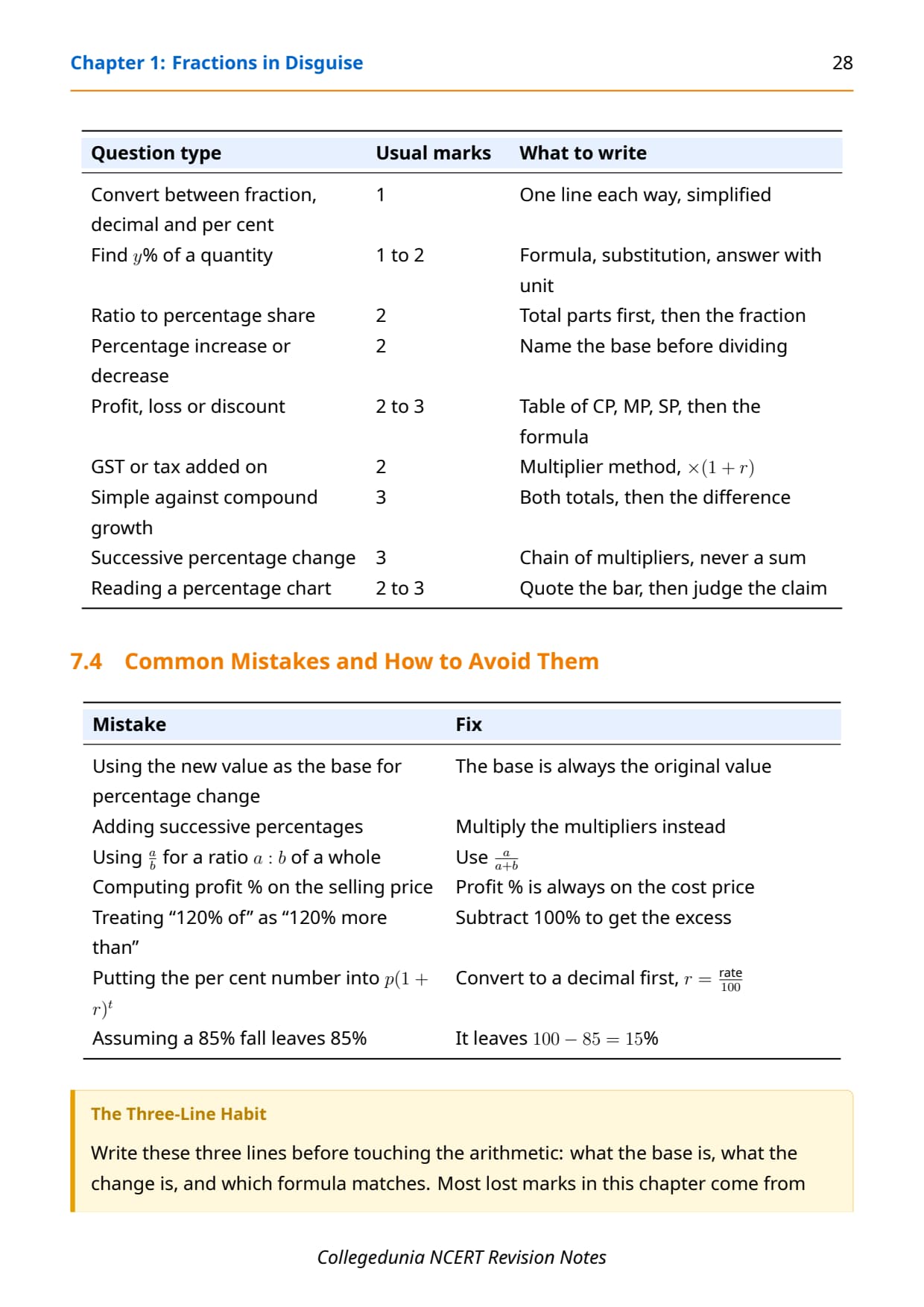
- Adding successive discounts. A 30% then 20% offer gives 0.70 × 0.80 = 0.56, a true cut of 44%, not 50%.
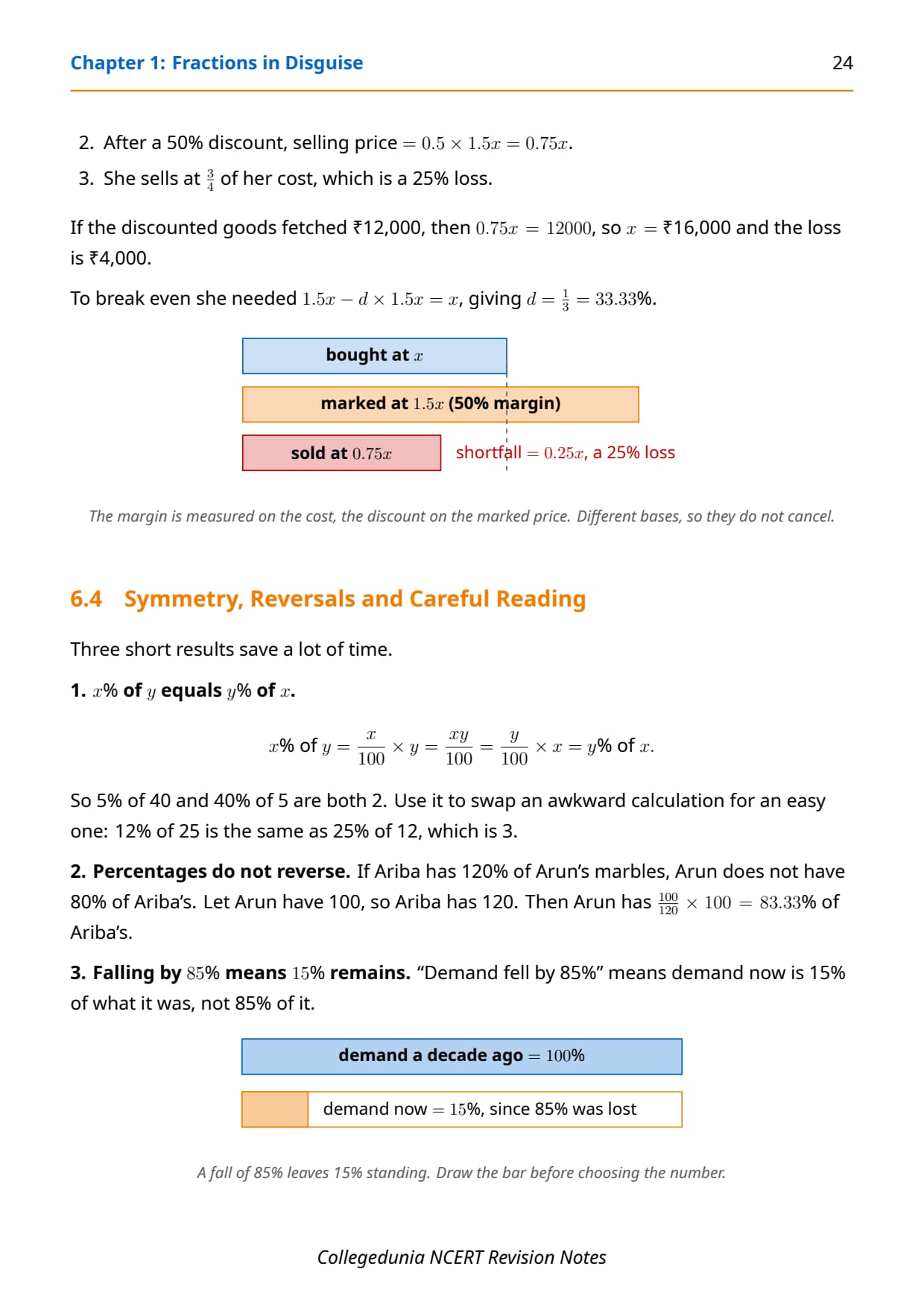
- Assuming a margin cancels a discount. A 50% margin followed by a 50% discount gives 0.5 × 1.5 = 0.75 of cost, which is a 25% loss.
- Dividing profit by the selling price. Buying at ₹500 and selling at ₹750 is a 50% profit on cost, not 33.33%.
- Reversing a percentage. If Ariba has 120% of Arun's marbles, Arun has 83.33% of Ariba's, not 80%.
- Misreading a fall. Demand falling by 85% leaves 15% standing, not 85%.
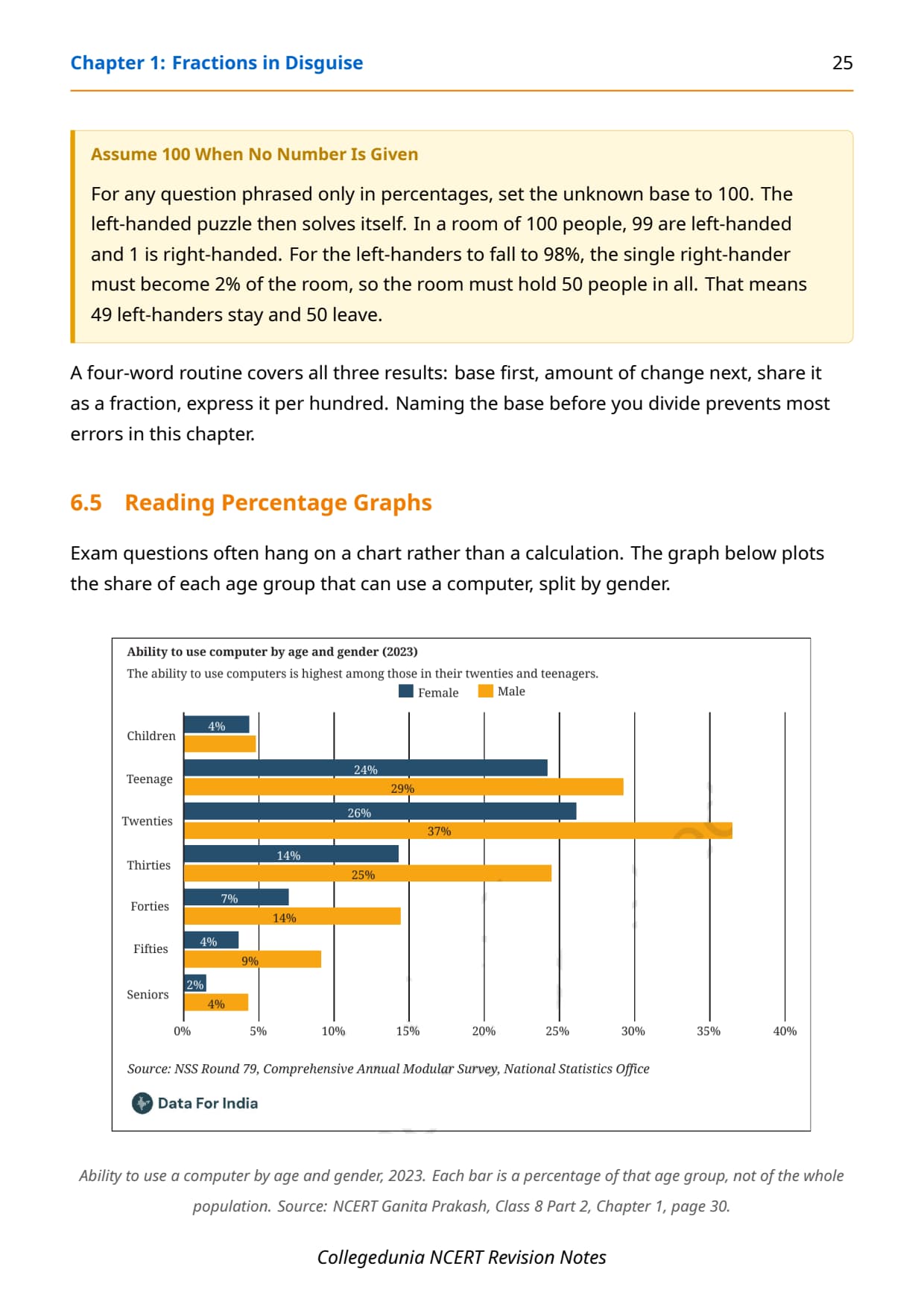
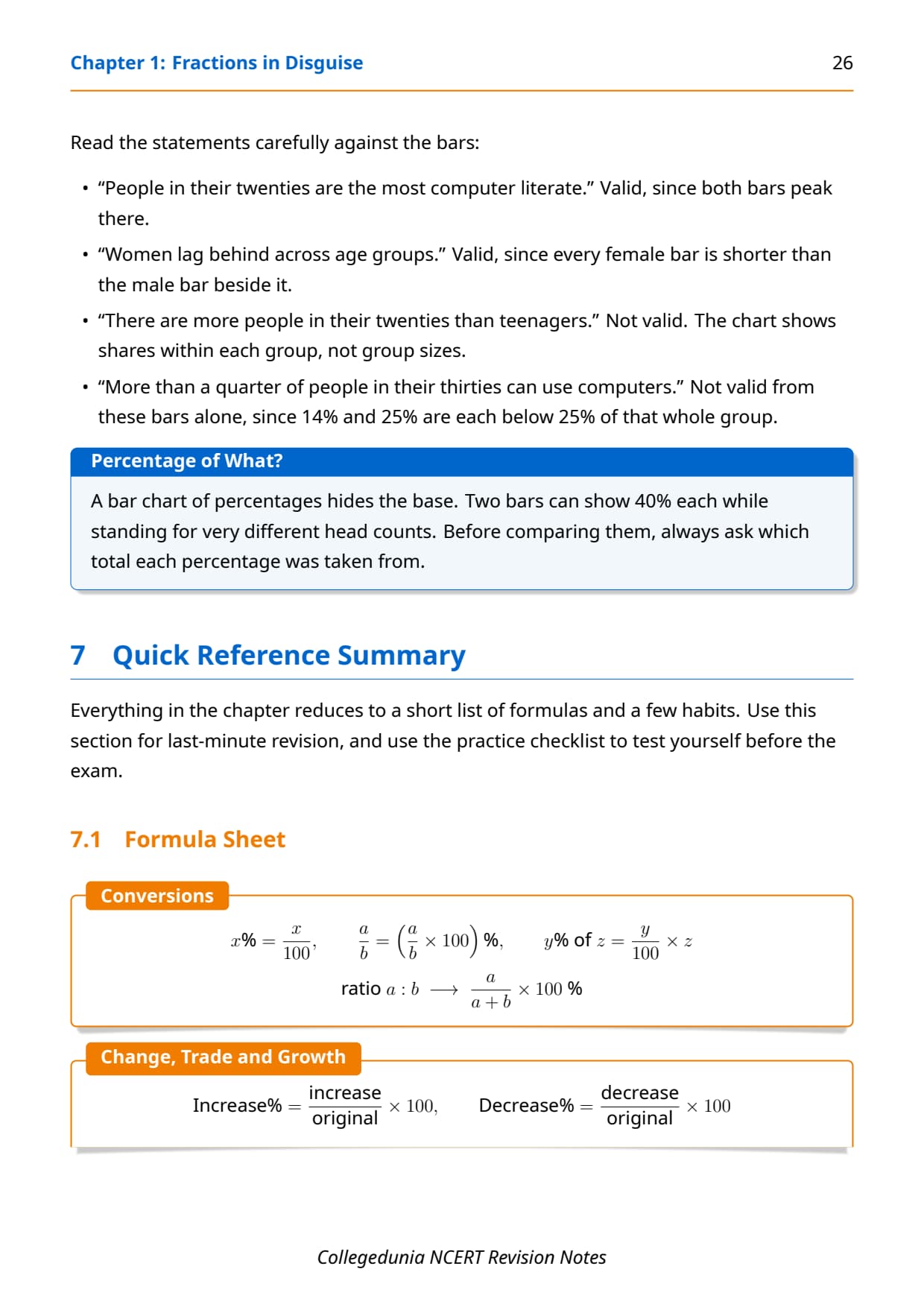
- Comparing bars on a percentage chart. Two bars can both read 40% and stand for very different head counts.
When a question is phrased only in percentages with no number given, set the unknown base to 100 and the sum usually unlocks itself. Then follow a four-step routine: name the base, find the amount of change, write it as a fraction, and express it per hundred.
Solved Example from Fractions in Disguise with Step-by-Step Working
Surbhi adds a 50% profit margin to what she paid, then offers a 50% discount, expecting to break even. The discounted goods fetch ₹12,000. Find what she paid and her actual loss.
- Let x be the cost price. Marked price = 1.5x, because the margin sits on cost.
- After a 50% discount, selling price = 0.5 × 1.5x = 0.75x, because the discount sits on the marked price.
- So she sells at three quarters of her cost, which is a 25% loss, not a break-even.
- Given 0.75x = 12000, the cost price x = ₹16,000.
- Loss = 16000 minus 12000 = ₹4,000, matching the 25% figure.
- To truly break even she needed 1.5x minus d × 1.5x = x, giving d = 1/3, that is 33.33% discount.
The whole sum turns on one line: the margin is measured on the cost and the discount on the marked price. Different bases, so they never cancel.
Fractions in Disguise Topic-wise Weightage for Class 8 Maths Exams
Percentages are the most examined block in Ganita Prakash Part 2 because the questions are easy to ask and easy to score. This split follows the pattern Class 8 school papers have used across recent sessions.
| Sub-topic | Weightage | How often it appears |
|---|---|---|
| Profit, loss and discount | High | Almost every paper |
| Percentage increase and decrease | High | Almost every paper |
| Fraction, decimal and percentage conversion | Medium | 3 out of 5 papers |
| Compounding and depreciation | Medium | 3 out of 5 papers |
| Ratio to percentage | Low | 1 out of 5 papers |
| Reading percentage bar graphs | Low | 1 out of 5 papers |
What the Fractions in Disguise Class 8 Notes PDF Contains
The download is a printable revision file built from the 2026-27 Ganita Prakash Part 2 text. It runs section by section in the same order as the book, so you can keep it open beside the textbook.
- Definition boxes for per cent, ratio conversion, profit, loss, discount and tax.
- Colour bar models for ratios, percentages above 100 and repeated decline.
- A one-page formula sheet plus the fraction, decimal and percentage table to memorise.
- A trap list with the successive discount and margin errors worked out in full.
- A self-check strip to run through the night before the exam.
Important Question Types from Fractions in Disguise and Where They Appear
Sorting questions by type is faster than sorting them by page number. Use this map to decide what to practise first if you have only one evening left.
| Question type | What it tests | Typical marks |
|---|---|---|
| Convert and compare | Fraction to decimal to percentage, then rank | 1 to 2 |
| Find the selling price | Margin or discount applied to the right base | 2 to 3 |
| Reverse the percentage | Given SP and profit %, find CP | 2 to 3 |
| Successive change | Chaining two multipliers correctly | 3 |
| Compounding sum | Applying p(1 + r)t over 2 or 3 periods | 3 to 4 |
| Graph reading | Judging statements against a percentage bar chart | 2 to 4 |
How These Notes Pair with the Solutions, Formula Sheet and Book PDF
Also Check: the same chapter is available in four other formats on Collegedunia. Read the notes first, then work the exercises, then keep the formula sheet for the last week.
| Resource | Best used for | Open it |
|---|---|---|
| NCERT Solutions | Step-by-step answers to every exercise in the chapter | Fractions in Disguise Class 8 NCERT Solutions |
| Formula Sheet | All 9 percentage formulas on a single printable page | Fractions in Disguise Class 8 Formula Sheet |
| Handwritten Notes | Quick one-sitting revision in clear handwriting | Fractions in Disguise Class 8 Handwritten Notes |
| NCERT Book PDF | The official Ganita Prakash Part 2 chapter text | Class 8 Maths Part 2 Chapter 1 Book PDF |
How to Use the Fractions in Disguise Notes Page Most Effectively
Three short blocks beat one long sitting. Students who split the chapter this way reported finishing it in about four hours in total.
- Block 1, 60 minutes. Read the per cent definition and the conversion table, then write the table out from memory.
- Block 2, 90 minutes. Work every profit, loss, discount and tax sum, labelling CP, MP and SP before you calculate.
- Block 3, 60 minutes. Do the compounding and depreciation sums, then read the trap list twice.
- Night before, 20 minutes. Formula sheet only, plus the six common mistakes.
NCERT Notes for Class 8 Maths Part 2: All Chapters
Related Links: revision notes for every chapter of Ganita Prakash Part 2, written to the 2026-27 syllabus.
| Chapter | Class 8 Maths Part 2 Notes |
|---|---|
| Chapter 1 | Fractions in Disguise Class 8 Notes (this page) |
| Chapter 2 | The Baudhayana Pythagoras Theorem Class 8 Notes |
| Chapter 3 | Proportional Reasoning 2 Class 8 Notes |
| Chapter 4 | Exploring Some Geometric Themes Class 8 Notes |
| Chapter 5 | Tales by Dots and Lines Class 8 Notes |
| Chapter 6 | Algebra Play Class 8 Notes |
| Chapter 7 | Area Class 8 Notes |
Fractions in Disguise Class 8 Notes FAQs
Questions Students Ask About the Fractions in Disguise Notes
Ques. Why is the chapter called Fractions in Disguise?
Ans. Because every percentage is a fraction whose denominator has been fixed at 100. Writing 25% is the same as writing 25/100, which simplifies to 1/4. The chapter builds the whole of profit, loss, discount and compounding on top of that single idea.
Ques. What is a percentage in Class 8 Maths?
Ans. A percentage is a share out of 100. For any number x, x% = x/100, so x% of a quantity s equals (x/100) × s. The unit can be rupees, marks or people, but the share stays the same.
Ques. How do you convert a ratio into a percentage?
Ans. Add the parts first. A ratio a : b has a + b parts in total, so the first quantity is a/(a + b) of the whole. Multiply that fraction by 100. For 2 : 7 the answer is (2/9) × 100 = 22.22%, not (2/7) × 100.
Ques. Are two successive discounts of 30% and 20% the same as one 50% discount?
Ans. No. Successive discounts multiply, so the net multiplier is 0.70 × 0.80 = 0.56. That is a true cut of 44%, not 50%. On a ₹200 cake the two-step offer leaves ₹112 while a flat 50% offer leaves ₹100.
Ques. How is profit percentage defined in this chapter?
Ans. Profit percentage is always measured against the cost price. Profit % = ((SP - CP) / CP) × 100. Buying at ₹500 and selling at ₹750 is a 50% profit, because the ₹250 gain is compared with the ₹500 cost, never with the ₹750 selling price.
Ques. What are the compounding formulas in the Class 8 notes?
Ans. Three formulas cover the whole block. Growth without compounding is A = p(1 + rt). Growth with compounding is A = p(1 + r)t. Decline or depreciation is A = p(1 - r)t. In each one, r is the decimal rate, so 6% becomes 0.06.
Ques. Where can I download the Class 8 Maths Part 2 Chapter 1 notes PDF?
Ans. Use the download button at the top of this page. The file is free, printable, and follows the 2026-27 Ganita Prakash Part 2 chapter order, so it can sit beside the textbook while you revise.
Ques. How many marks do percentage questions carry in the Class 8 exam?
Ans. Percentage sums usually carry 8 to 10 marks in the annual paper. Profit, loss and discount questions appear in almost every paper, while compounding and graph reading appear in roughly three papers out of five.
Ques. What does it mean when a value is 120% of the target?
Ans. It means the value is 1.2 times the base, so the target has been beaten by 20%. Sales of ₹6000 against a ₹5000 target are 120% of target. The phrases 120% of and 120% more than describe very different numbers.
Ques. Which mistake costs students the most marks in this chapter?
Ans. Mixing up the base. Discount sits on the marked price and profit sits on the cost price, so a 50% margin followed by a 50% discount ends in a 25% loss. Writing CP, MP and SP in a column before starting prevents it.



Comments