The NCERT Exemplar Class 12 Biology Chapter 4 Principles of Inheritance and Variation has 45 problems: 23 MCQ, 8 VSA, 9 SA and 5 LA, built around Mendel's laws, dihybrid crosses, sex determination and pedigree analysis. Each one is fully solved with a Solution tab and an Expert tab. This page hosts the worked solutions PDF, mapped to the 2026-27 NCERT.
CBSE: 5 to 7 marks, usually one VSA on co-dominance or sex determination plus one long answer on a dihybrid cross or pedigree.
NEET: 3 to 5 questions per year, the largest single contributor in the Genetics and Evolution unit.
AIIMS / CUET: 2 to 3 MCQs, usually a Punnett-square numerical and a disorder-matching item.
Each solution is curated by NEET-rank-holder mentors and mapped to the 2026-27 NCERT Exemplar.
How the Principles of Inheritance and Variation Class 12 Exemplar PDF Helps
The Exemplar is a reasoning paper where the "why" carries the marks. So this page pairs every question with a short Solution tab and a longer Expert tab:
All 45 problems fully solved, with the Mendelian logic and Punnett-square arithmetic spelled out.
Punnett squares drawn as clean tables, so the 3:1 and 9:3:3:1 ratios read clearly on a phone.
A one-line NEET hook on every disorder, from haemophilia to Down and Turner syndrome.
Principles of Inheritance and Variation NCERT Exemplar Video Solutions for Class 12 Biology
Question-Type Breakdown for the Class 12 Biology Chapter 4 Exemplar
NCERT splits the Chapter 4 Exemplar into four question types. The MCQ block is the densest, with 23 of the 45 problems, so MCQ practice carries the most value before NEET and CUET.
Principles of Inheritance and Variation Weightage Across Class 12 Biology Chapters
Chapter 4 carries the joint-highest CBSE weightage in the Class 12 Biology paper. Most years a 5-mark question appears on a dihybrid cross or a pedigree-with-probability problem.
Chapter
Topic
Avg CBSE Marks
NEET Qs / yr
Ch 4
Principles of Inheritance and Variation
5 to 7
3 to 5
Ch 2
Human Reproduction
6 to 8
4 to 6
Ch 5
Molecular Basis of Inheritance
5 to 7
4 to 5
Ch 6
Evolution
4 to 6
2 to 4
Ch 7
Human Health and Disease
4 to 6
2 to 4
Ch 12
Ecosystem
5 to 7
2 to 3
Previous Year NEET and CBSE Map for the Chapter 4 Exemplar
The pattern is steady across the last five sittings. Each NEET paper has at least one Mendelian-ratio MCQ and one disorder-matching MCQ. 2023 was an outlier, with five questions including a rare linkage-and-recombination numerical.
Year
NEET Qs from Ch 4
CBSE format
Hot sub-topic
2024
4
5-mark LA on dihybrid cross + pedigree
Co-dominance (ABO)
2023
5
3-mark SA on incomplete vs co-dominance
Linkage and recombination
2022
3
5-mark LA on chromosomal disorders
Down, Klinefelter
2021
4
3-mark SA on test-cross utility
Test cross + back cross
2020
3
2-mark VSA on sex determination
XX-XY, ZW system
Topic-by-Topic Summary for Class 12 Biology Chapter 4
The 2026-27 NCERT keeps all eight sections of Chapter 4 intact. The table below tracks the textbook sequence.
Section
Core idea
Most-tested point
Mendel's laws
Dominance, segregation, independent assortment
9:3:3:1 dihybrid ratio
Monohybrid cross
3:1 phenotype, 1:2:1 genotype
Test cross as a diagnostic
Dihybrid cross
16-cell Punnett square
Full F2 phenotype tally
Deviations
Incomplete dominance, co-dominance, pleiotropy
Snapdragon vs ABO blood group
Chromosomal theory and linkage
Sutton-Boveri, Morgan's Drosophila
Recombination frequency = map distance
Sex determination
XX-XY, XX-XO, ZW-ZZ, haplodiploidy
Which system fits which organism
Mutation and disorders
Mendelian vs chromosomal disorders
Karyotype of Down, Turner, Klinefelter
Common Mistakes Students Make on Class 12 Biology Chapter 4
Five errors that repeat in the Principles of Inheritance and Variation Exemplar:
Confusing incomplete dominance with co-dominance. Pink snapdragon is incomplete; the AB blood group is co-dominant. Both show a 1:2:1 ratio but the F1 phenotype differs.
Writing a genotype ratio as a phenotype ratio. A 1:2:1 ratio is genotypic; 3:1 is phenotypic in a monohybrid cross.
Skipping a gamete in the dihybrid square. A 16-cell square needs four gametes per parent; listing three loses LA marks.
Mislabelling the affected parent in a pedigree. Autosomal-recessive needs both parents as carriers; X-linked haemophilia traces through the mother.
Treating all chromosomal disorders as one. Down is trisomy 21, Klinefelter is XXY, Turner is XO. Each has a distinct karyotype.
Solved Dihybrid Cross from the Class 12 Biology Chapter 4 Exemplar
The flagship LA problem crosses a true-breeding round-yellow pea (RRYY) with a true-breeding wrinkled-green pea (rryy) and asks for the F2 generation. Here is the way a CBSE rubric awards the marks.
Step 1. RRYY gives only RY gametes; rryy gives only ry gametes, so the F1 is RrYy (round, yellow).
Step 2. The F1 RrYy makes four equal gamete types: RY, Ry, rY and ry.
Step 3. Self-crossing the F1 builds this 16-cell Punnett square.
RY
Ry
rY
ry
RY
RRYY
RRYy
RrYY
RrYy
Ry
RRYy
RRyy
RrYy
Rryy
rY
RrYY
RrYy
rrYY
rrYy
ry
RrYy
Rryy
rrYy
rryy
Step 4. Tally the phenotypes: round-yellow 9, round-green 3, wrinkled-yellow 3, wrinkled-green 1. The classic 9:3:3:1 ratio drops out, confirming independent assortment.
Two-Mode Study Plan for the Class 12 Chapter 4 Exemplar
Two reading modes work for this chapter. Pick the one that fits where students are in the year.
Weekday revision: three 50-minute sessions, one each for Mendel's laws and all 23 MCQs, then the deviations and 8 VSAs, then sex determination, linkage and all SAs and LAs.
NEET mock sprint: a single 90-minute pass, 25 minutes on the MCQs, 30 on the VSAs and SAs, and 35 on three timed LA attempts.
A second pass a week later fixes most lingering errors, especially on pedigree probability.
Class 12 Biology NCERT Exemplar PDF: Editions and Hindi Medium
The Exemplar Solutions PDF on this page comes in two formats, so students can pick what fits their device:
Standard (3 to 4 MB): mobile-friendly for quick reading.
HD (10 to 12 MB): print-friendly with sharper diagrams.
Hindi medium: a Hindi edition with the same question numbering, so this page works for both editions.
The printed Exemplar book gives only terse one-line answers, which is why most students search for worked solutions. Here every answer has a Solution and an Expert tab.
All NCERT Exemplar Questions for Principles of Inheritance and Variation with Step-by-Step Solutions
Every question of the NCERT Exemplar set for Class 12 Biology Chapter 4 Principles of Inheritance and Variation is listed below with its full Solution and Expert Solution hidden inside collapsible tabs. Click Check Solution for the step-by-step working; click Expert Solution for the expanded explanation.
Multiple-Choice Questions
Q 4.1
All genes located on the same chromosome:
(a) Form different groups depending upon their relative distance
(b) Form one linkage group
(c) Will not form any linkage groups
(d) Form interactive groups that affect the phenotype
Correct option: (b) Form one linkage group.
Concept used.Linkage is the tendency of genes that
lie on the same chromosome to be inherited together, because they do
not assort independently during meiosis. The full set of genes
carried on one chromosome is called a linkage group. The
number of linkage groups in an organism equals its haploid
chromosome number (\(n\)).
Genes are physically located along a chromosome. When that
chromosome moves to a gamete during meiosis, every gene on it
moves together as one unit (unless crossing over separates
them).
Therefore all genes on a single chromosome are inherited as a
block. This whole block is, by definition, one linkage group:
there is exactly one linkage group per chromosome.
Check the distractors. (a) is wrong: relative distance affects
the recombination frequency between genes, not how many
linkage groups they form. (c) is wrong: same-chromosome genes
do form a linkage group. (d) confuses linkage with gene
interaction (epistasis), which is unrelated.
Option (b): all genes on one chromosome form a single linkage group.
AI
Aanya Iyer
M.Sc Zoology, Banaras Hindu University
Verified Expert
Quick reading. Read ``same chromosome'' as ``travels in one
gamete-packet''. The chapter defines a linkage group as exactly that
packet.
A chromosome is one physical thread of DNA. Independent
assortment (Mendel's second law) applies only between
chromosomes, never within one.
So genes sharing a chromosome cannot assort independently of
each other; they are linked and counted as one group.
Eliminate: ``different groups by distance'' would mean many
groups per chromosome, contradicting the one-chromosome
one-group definition.
Why this matters. The linkage-group count is a quick way to
deduce an organism's haploid chromosome number from genetic-map data
alone.
Number-sense check. Human haploid number is \(n=23\), so a karyotype with \(23\) linkage groups is expected. If a question quotes a chromosome count, halve it to get the linkage-group count instantly. The rule scales: pea has \(n=7\), fruit fly \(n=4\), so \(7\) and \(4\) linkage groups respectively.
Option (b): one linkage group per chromosome.
Q 4.2
Conditions of a karyotype \(2n+1\), \(2n-1\) and \(2n+2\), \(2n-2\) are called:
(a) Aneuploidy
(b) Polyploidy
(c) Allopolyploidy
(d) Monosomy
Correct option: (a) Aneuploidy.
Concept used.Aneuploidy is the gain or loss of one
or a few individual chromosomes from the normal diploid set, caused by
failure of chromosomes to separate (non-disjunction) during meiosis.
It is written as \(2n\pm1\) (one chromosome extra/missing) or \(2n\pm2\).
This is distinct from polyploidy, where the entire genome is
multiplied (\(3n\), \(4n\), \(\ldots\)).
The notation \(2n+1\) means the diploid set plus one extra
chromosome (trisomy); \(2n-1\) means one chromosome missing
(monosomy); \(2n\pm2\) are tetrasomy/nullisomy-type changes.
Each of these changes the count by only one or two
chromosomes, not by whole sets. By definition that is
aneuploidy.
Eliminate distractors: (b) polyploidy and (c) allopolyploidy
involve whole extra genomes (\(3n\), \(4n\)), not \(\pm1\) or
\(\pm2\). (d) Monosomy is only the \(2n-1\) case, so it is too
narrow to cover all four conditions listed.
Option (a): \(2n\pm1\) and \(2n\pm2\) are aneuploidy.
RS
Rohit Sharma
M.Sc Botany, Delhi University
Verified Expert
Structural observation. Look at the symbols: every term is
\(2n\) shifted by \(\pm1\) or \(\pm2\). Small whole-number shifts on a \(2n\)
base always mean aneuploidy.
Polyploidy multiplies the base set: \(2n\to3n\to4n\). None of
the four given conditions multiplies the set, so polyploidy
and allopolyploidy are out.
Monosomy (\(2n-1\)) and trisomy (\(2n+1\)) are instances
of aneuploidy. The question asks for the class name covering
all four, which is aneuploidy.
Why this matters. Down's syndrome (\(2n+1\) for chromosome 21)
and Turner's syndrome (\(2n-1\), XO) are classic aneuploidies asked in
NEET.
Quick mnemonic. ``\(\pm\) a few = aneuploidy; \(\times\) a set = polyploidy.'' Any time the karyotype is described with \(\pm1\) or \(\pm2\), pick aneuploidy. Polyploidy needs the words ``triploid'', ``tetraploid'' or the symbol \(3n\)/\(4n\).
Option (a): Aneuploidy.
Q 4.3
Distance between the genes and percentage of recombination shows:
(a) a direct relationship
(b) an inverse relationship
(c) a parallel relationship
(d) no relationship
Correct option: (a) A direct relationship.
Concept used.Recombination frequency (RF) is the
percentage of offspring that show new combinations of linked genes,
produced by crossing over during meiosis. Sturtevant showed
that the farther apart two genes lie on a chromosome, the more often
a crossover occurs between them, so RF rises with distance. One map
unit (centimorgan) \(=1\%\) recombination.
Crossing over happens at random points along a chromosome.
The longer the stretch between two genes, the larger the
chance that a crossover falls between them.
More crossovers between the genes means more recombinant
gametes, so a higher recombination percentage.
Hence map distance and RF move in the same direction:
as distance increases, RF increases. This is a direct
relationship. (Inverse would mean RF falls as distance grows,
which is the opposite of what is observed.)
Option (a): gene distance and recombination % are directly related.
KN
Karan Nair
Ph.D Molecular Biology, NCBS Bangalore
Verified Expert
Strategic angle. This is the principle behind genetic
mapping, so the answer must let us use RF as a ruler. Only a
direct relationship makes RF a usable measure of distance.
Sturtevant's logic: treat RF as a distance. If RF were
unrelated or inverse to distance, you could never build a
linear gene map, yet such maps exist and work.
Therefore RF must rise with separation: closely linked genes
recombine rarely (low RF), distant genes recombine often
(high RF, approaching the \(50\%\) ceiling of unlinked genes).
Why this matters. The \(50\%\) cap explains why very distant
genes on the same chromosome can look unlinked.
Option (a): direct relationship.
Q 4.4
If a genetic disease is transferred from a phenotypically normal but carrier female to only some of the male progeny, the disease is:
(a) Autosomal dominant
(b) Autosomal recessive
(c) Sex-linked dominant
(d) Sex-linked recessive
Correct option: (d) Sex-linked recessive.
Concept used. An X-linked recessive disorder sits
on the X chromosome and shows only when no normal allele is present.
A female has two X chromosomes, so one normal allele masks the
defective one and she is a healthy carrier (\(X^{A}X^{a}\)).
A male has only one X (\(X^{a}Y\)), so a single defective allele is
enough to make him affected.
The female is phenotypically normal but a carrier:
genotype \(X^{A}X^{a}\). The normal father is \(X^{A}Y\).
Work the cross. Sons get their single X from the mother:
half receive \(X^{A}\) (normal) and half receive \(X^{a}\)
(affected). Daughters get \(X^{A}\) from the father, so all are
at least carriers and none is affected.
\[ X^{A}X^{a}\times X^{A}Y \;\Rightarrow\;
\tfrac12\,X^{A}X^{A},\ \tfrac12\,X^{A}X^{a},\
\tfrac12\,X^{A}Y,\ \tfrac12\,X^{a}Y. \]
Only some sons (\(X^{a}Y\)) are affected and no daughters are.
That pattern (carrier mother, some sons affected) is the
signature of a sex-linked recessive trait, so (d) is correct.
Autosomal traits would affect both sexes equally; sex-linked
dominant would affect the carrier mother herself.
Option (d): Sex-linked (X-linked) recessive.
PR
Priya Reddy
M.Sc Biotechnology, AIIMS Delhi
Verified Expert
Picture-first. Sketch the mother as carrying one ``good'' X
and one ``bad'' X. The disease shows only in offspring who end up
with no good X.
Daughters always inherit the father's \(X^{A}\), so they keep
at least one good allele and stay healthy. This rules out any
autosomal answer (which would affect daughters too).
Sons inherit only the mother's X. Half her X's carry the
defect, so half the sons are affected, which is exactly
``only some of the male progeny''.
Why this matters. ``Carrier mother, affected sons, healthy
daughters'' is a tested NEET pedigree fingerprint for X-linked
recessive disorders.
Pattern recognition. The phrase ``carrier mother + some affected sons + no affected daughters'' is the gold-standard signature of X-linked recessive inheritance. Recognising it earns the answer outright without needing the Punnett square, but always state the genotypes alongside for the working marks. The same pattern flags haemophilia, colour blindness and Duchenne muscular dystrophy in pedigree problems.
Option (d): Sex-linked recessive.
Q 4.5
In sickle cell anaemia glutamic acid is replaced by valine. Which one of the following triplets codes for valine?
(a) G G G
(b) A A G
(c) G A A
(d) G U G
Correct option: (d) G U G.
Concept used.Sickle cell anaemia is caused by a
point mutation in the gene for the beta chain of haemoglobin: the
sixth codon GAG (glutamic acid) changes to GUG, so
valine is inserted instead of glutamic acid. The codons
given here are mRNA triplets; valine is coded by GUU, GUC, GUA and
GUG.
The mutation is a single base change: the middle base \(A\) of
GAG (glutamic acid) becomes \(U\), giving GUG.
GUG is one of the four valine codons, so it codes for
valine. This is option (d).
Eliminate: GGG codes glycine, AAG codes lysine, GAA codes
glutamic acid. None of these is valine.
Option (d): G U G codes for valine.
AJ
Aditya Joshi
Ph.D Molecular Biology, NCBS Bangalore
Verified Expert
Quick reading. The keyword is ``valine''. Recall the valine
family of codons: every valine codon starts with GU.
Scan the four options for a GU-start triplet: only (d) GUG
begins with GU, so only (d) can be valine.
Cross-check with the disease story: GAG\(\to\)GUG is
the textbook sickle-cell mutation, confirming (d).
Why this matters. Knowing the GU\(x\) valine block lets you
answer codon questions without memorising the full codon table.
Option (d): G U G.
Q 4.6
Person having genotype \(I^{A}I^{B}\) would show the blood group as AB. This is because of:
(a) Pleiotropy
(b) Co-dominance
(c) Segregation
(d) Incomplete dominance
Correct option: (b) Co-dominance.
Concept used.Co-dominance is the condition where
both alleles in a heterozygote are fully and independently expressed,
so the phenotype shows the effect of both alleles, not a
blend. In the ABO blood-group system the alleles \(I^{A}\) and \(I^{B}\)
are co-dominant.
Allele \(I^{A}\) makes antigen A on red cells; allele \(I^{B}\)
makes antigen B.
In genotype \(I^{A}I^{B}\) both alleles are expressed at the
same time, so both antigen A and antigen B appear on the red
cells. The blood group is AB, showing both alleles.
Because both alleles show fully and separately (no blending,
no masking), this is co-dominance, option (b). It is not
incomplete dominance: incomplete dominance would give an
intermediate ``in-between'' antigen, which does not happen.
Option (b): Co-dominance (\(I^{A}\) and \(I^{B}\) both expressed).
MB
Meera Banerjee
M.Sc Microbiology, JNU
Verified Expert
Structural observation. The phenotype ``AB'' literally names
both alleles' products. A phenotype that displays both inputs at once
is the definition of co-dominance.
Compare with incomplete dominance: there the heterozygote is
a single intermediate phenotype (one new look), not two
traits together.
Group AB shows two distinct antigens simultaneously, so the
alleles are co-dominant, not blending.
Why this matters. The ABO locus is the standard NEET example
that combines co-dominance (\(I^A,I^B\)) with multiple alleles and a
recessive \(i\).
Number-sense check. The ABO genotypes are \(I^{A}I^{A}\), \(I^{A}i\) (A), \(I^{B}I^{B}\), \(I^{B}i\) (B), \(I^{A}I^{B}\) (AB), \(ii\) (O). Memorise these six genotypes; every ABO question reduces to a pick from this list, and the AB phenotype is the lone co-dominant entry that proves the principle of this MCQ.
Option (b): Co-dominance.
Q 4.7
Z Z / Z W type of sex determination is seen in:
(a) Platypus
(b) Snails
(c) Cockroach
(d) Peacock
Correct option: (d) Peacock.
Concept used. In the ZZ/ZW system of sex
determination the female is heterogametic (ZW) and the
male is homogametic (ZZ). This system is found in birds (and
some reptiles, fishes, butterflies). A peacock is a bird.
Birds use ZW sex determination: male birds are ZZ, female
birds are ZW. The peacock is a bird, so it follows ZZ/ZW.
Eliminate: cockroach uses the XX/XO system (insects);
platypus has a complex multiple X-Y system; snails are
largely hermaphrodite. None of these is the simple ZZ/ZW
type.
Option (d): Peacock (a bird, ZZ male / ZW female).
IP
Ishaan Pillai
M.Sc Zoology, Banaras Hindu University
Verified Expert
Quick reading. The only bird in the option list is the
peacock, and ZZ/ZW is the bird system.
Tag each option by group: platypus (mammal, special),
snail (mollusc), cockroach (insect, XO), peacock (bird).
Match the system to the group: ZW belongs to birds, so the
peacock is the answer.
Why this matters. NEET often pairs ``ZW'' with a named bird
to test whether you link the mechanism to the taxon.
Option (d): Peacock.
Q 4.8
A cross between two tall plants resulted in offspring having few dwarf plants. What would be the genotypes of both the parents?
(a) TT and Tt
(b) Tt and Tt
(c) TT and TT
(d) Tt and tt
Correct option: (b) Tt and Tt.
Concept used. Tallness (\(T\)) is dominant over dwarfness
(\(t\)). A dwarf plant must be homozygous recessive (\(tt\)).
For a \(tt\) offspring to appear, each parent must contribute a
\(t\) allele, so both tall parents must carry a hidden \(t\), i.e. both
are heterozygous \(Tt\).
A dwarf offspring is \(tt\). It needs one \(t\) from each parent.
Both parents are tall, so neither is \(tt\). The only tall
genotype that can donate \(t\) is \(Tt\). Hence both parents are
\(Tt\).
Verify with the Punnett square of \(Tt\times Tt\):
\[ Tt\times Tt \;\Rightarrow\; \tfrac14\,TT,\ \tfrac12\,Tt,\
\tfrac14\,tt. \]
This gives \(3\) tall \(:1\) dwarf, so ``few dwarf plants''
appear, matching the question. Option (b) is correct.
Eliminate: TT\(\times\)Tt and TT\(\times\)TT give no \(tt\)
offspring (no dwarfs). Tt\(\times\)tt gives \(1{:}1\), which is a
test cross with \(50\%\) dwarfs, not ``few''.
Option (b): both parents are \(Tt\) (heterozygous tall).
DV
Diya Verma
M.Sc Botany, Delhi University
Verified Expert
Strategic angle. Work backward from the dwarf offspring: it
forces a recessive allele out of each tall parent.
Dwarf \(=tt\). Each \(t\) must come from a parent, so both
parents carry \(t\) while looking tall, meaning both are \(Tt\).
The \(3:1\) ratio of \(Tt\times Tt\) explains why dwarfs are
``few'' (only one quarter), confirming option (b).
Why this matters. ``Recessive trait reappearing from two
dominant parents'' is the classic clue that both parents are
heterozygous carriers.
Punnett-square check. Write the \(Tt\times Tt\) square: \(TT\), \(Tt\), \(Tt\), \(tt\). The single \(tt\) cell (one of four) is the dwarf, giving \(25\%\) dwarfs. That ``one quarter'' is exactly what ``a few dwarf plants'' means in the question, confirming both parents are heterozygous \(Tt\) and ruling out every other option in one step.
Option (b): Tt and Tt.
Q 4.9
In a dihybrid cross, if you get \(9{:}3{:}3{:}1\) ratio it denotes that:
(a) The alleles of two genes are interacting with each other
(b) It is a multigenic inheritance
(c) It is a case of multiple allelism
(d) The alleles of two genes are segregating independently
Correct option: (d) The alleles of two genes are segregating
independently.
Concept used.Mendel's Law of Independent
Assortment states that the alleles of two different genes segregate
into gametes independently of each other. A dihybrid cross between
two double heterozygotes (\(RrYy\times RrYy\)) then produces the
\(9{:}3{:}3{:}1\) phenotypic ratio.
The \(9{:}3{:}3{:}1\) ratio is the direct mathematical result
of combining two independent \(3{:}1\) ratios:
\[ (3{:}1)\times(3{:}1)=9{:}3{:}3{:}1. \]
This multiplication is only valid if the two genes assort
independently. So observing \(9{:}3{:}3{:}1\) tells us
the genes are unlinked and their alleles segregate
independently. That is option (d).
Eliminate: gene interaction (a) distorts the ratio (e.g.
\(9{:}7\), \(12{:}3{:}1\)); multiple allelism (c) involves more
than two alleles of one gene, not two genes; ``multigenic''
(b) describes polygenic traits with continuous variation, not
a clean \(9{:}3{:}3{:}1\).
Option (d): the two genes' alleles segregate independently.
VD
Vivaan Desai
M.Sc Botany, Delhi University
Verified Expert
Structural observation. \(9{:}3{:}3{:}1\) factorises as
\((3{:}1)^2\). The square is only legitimate under independence.
Treat each gene's \(3{:}1\) as a probability. Independent events
multiply, giving \(9{:}3{:}3{:}1\) over four phenotype classes.
Any non-independence (linkage, epistasis) would break the
multiplication and change the ratio, so the clean ratio
proves independent assortment.
Why this matters. This is the experimental fingerprint
Mendel used to deduce his second law.
Practical link. A reliable \(9{:}3{:}3{:}1\) ratio is also evidence that the two genes are on different chromosomes (unlinked). If the ratio drifts towards parental types, suspect linkage; if it shifts to \(9{:}7\), \(12{:}3{:}1\), or \(9{:}3{:}4\), suspect epistasis. Each deviated ratio is a different story you can read from the F\(_2\) counts alone.
Option (d): independent segregation.
Q 4.10
Which of the following will not result in variations among siblings?
(a) Independent assortment of genes
(b) Crossing over
(c) Linkage
(d) Mutation
Correct option: (c) Linkage.
Concept used.Variation among siblings arises from
processes that create new allele combinations: independent
assortment, crossing over and mutation. Linkage does the
opposite: it keeps genes on the same chromosome together,
reducing the formation of new combinations.
Independent assortment shuffles non-homologous chromosomes,
crossing over swaps segments between homologues, and mutation
creates brand-new alleles. All three increase variation.
Linkage holds linked genes as one unit, so they pass together
and do not generate new combinations. It restricts
variation rather than producing it.
Therefore the process that does not create sibling
variation is linkage, option (c).
Option (c): Linkage does not produce variation among siblings.
TK
Tara Kapoor
M.Sc Zoology, Banaras Hindu University
Verified Expert
Quick reading. Three options are ``shuffling/creating''
mechanisms; one is a ``holding together'' mechanism. The odd one out
is the answer.
Sort: assortment (shuffle), crossing over (recombine),
mutation (new allele) all add variety.
Linkage keeps genes together, opposing variety, so it is the
``will not'' answer.
Why this matters. Linkage is precisely why genetic maps were
possible: it limits recombination in proportion to gene distance.
Option (c): Linkage.
Q 4.11
Mendel's Law of independent assortment holds good for genes situated on the:
(a) non-homologous chromosomes
(b) homologous chromosomes
(c) extra nuclear genetic element
(d) same chromosome
Correct option: (a) Non-homologous chromosomes.
Concept used.Independent assortment works only
when two genes are on different (non-homologous) chromosomes,
because separate chromosome pairs line up and separate independently
at meiosis. Two genes on the same chromosome are linked and do
not assort independently.
Independent assortment needs the two genes to be carried by
two different chromosome pairs that orient randomly at
metaphase I.
Genes on the same chromosome (option d) are linked, so
they cannot assort independently. Extranuclear genes
(option c) follow maternal, non-Mendelian inheritance.
Two genes on non-homologous chromosomes belong to different
homologous pairs, so each pair segregates independently. This
is the condition for independent assortment, option (a).
Source disagreement
The official NCERT Exemplar answer key prints (b) ``homologous
chromosomes''. Genetically the precise requirement is
non-homologous chromosomes (different pairs). Some keys read
``homologous'' loosely as ``each gene on its own pair of homologues''.
We give the genetically exact reasoning and flag the key's wording so
you can match whichever your board expects.
Option (a): non-homologous chromosomes (genetically exact). NCERT key states (b).
SR
Siddharth Rao
Ph.D Molecular Biology, NCBS Bangalore
Verified Expert
Strategic angle. Ask: ``what must be true for two genes to
assort independently?'' They must sit on chromosomes that separate
independently, i.e. different (non-homologous) chromosomes.
Same chromosome \(\Rightarrow\) linked \(\Rightarrow\) no
independent assortment. So (d) is out.
Independent assortment requires two separate chromosome pairs.
Genes on non-homologous chromosomes meet this, so the
genetically correct choice is (a). Note the printed key
states (b); answer per your board's accepted key.
Why this matters. Recognising the linkage exception to
Mendel's second law is a standard higher-order NEET point.
Resolution of the wording. When the printed key reads ``homologous'', interpret it as ``two genes each carried on its own pair of homologous chromosomes'', which is the same thing as ``two different chromosome pairs'' = non-homologous chromosomes for the two genes. So both phrasings describe Mendel's set-up; pick whichever your answer key expects.
Genetically (a); NCERT printed key (b).
Q 4.12
Occasionally, a single gene may express more than one effect. The phenomenon is called:
(a) multiple allelism
(b) mosaicism
(c) pleiotropy
(d) polygeny
Correct option: (c) Pleiotropy.
Concept used.Pleiotropy is the phenomenon in
which a single gene controls or influences several different
phenotypic traits at once, usually because the gene's product takes
part in many metabolic pathways.
``One gene \(\to\) many effects'' is the literal definition of
pleiotropy. Example: the phenylketonuria gene affects mental
ability, hair colour and skin pigmentation together.
Eliminate: multiple allelism (a) is many alleles of one gene;
polygeny (d) is many genes acting on one trait (the reverse);
mosaicism (b) is two genetically different cell populations
in one individual.
Option (c): Pleiotropy (one gene, many effects).
AB
Ananya Bhat
M.Sc Biotechnology, AIIMS Delhi
Verified Expert
Quick reading. Count arrows. One gene, several effects, is
``pleio'' (many) + ``tropy'' (turning): pleiotropy.
Map ``single gene, more than one effect'' onto the four
terms; only pleiotropy describes one-to-many from a gene.
Reject polygeny: it is many-to-one, not one-to-many.
Why this matters. Pleiotropy explains why one mutation
(sickle cell, PKU) produces a whole syndrome of symptoms.
Concrete example. Phenylketonuria (PKU) is a textbook pleiotropy: one mutated gene blocks phenylalanine metabolism and causes mental retardation, lighter pigmentation and a musty odour all at once. Sickle cell anaemia is another: one base change yields anaemia, organ damage and growth defects.
Option (c): Pleiotropy.
Q 4.13
In a certain taxon of insects some have 17 chromosomes and the others have 18 chromosomes. The 17 and 18 chromosome-bearing organisms are:
(a) males and females, respectively
(b) females and males, respectively
(c) all males
(d) all females
Correct option: (a) Males and females, respectively.
Concept used. Many insects use the XX/XO sex
determination system. Females are XX (one extra sex chromosome) and
have an even diploid number; males are XO (only one sex chromosome,
no Y), so they have one chromosome fewer than females, giving
an odd number.
Females XX: both sex chromosomes present, total \(=18\) (even).
Males XO: one sex chromosome missing, total \(=18-1=17\) (odd).
So the 17-chromosome insects are males and the 18-chromosome
insects are females. That is option (a). The difference of
exactly one chromosome is the hallmark of the XO system.
Option (a): 17 = males (XO), 18 = females (XX).
YC
Yash Chatterjee
M.Sc Zoology, Banaras Hindu University
Verified Expert
Quick reading. A one-chromosome difference within a species
screams XX vs XO. The smaller count is the XO male.
\(18-17=1\): exactly one chromosome differs, the XO signature.
XO (one missing) is male \(=17\); XX is female \(=18\). Hence
option (a).
Why this matters. This is how cytologists first deduced sex
chromosomes, before molecular tools existed.
Comparison hook. Grasshoppers, cockroaches and other XX/XO insects show this odd-vs-even split. Drosophila and mammals use XX/XY (even numbers in both sexes), and birds use ZZ/ZW. Knowing which group uses which system is a one-mark question every NEET cycle.
Option (a).
Q 4.14
The inheritance pattern of a gene over generations among humans is studied by the pedigree analysis. Character studied in the pedigree analysis is equivalent to:
(a) quantitative trait
(b) Mendelian trait
(c) polygenic trait
(d) maternal trait
Correct option: (b) Mendelian trait.
Concept used.Pedigree analysis traces a single
gene through a family tree to find its inheritance pattern
(dominant/recessive, autosomal/sex-linked). It works only for traits
controlled by one gene with clear-cut alternatives, i.e.
Mendelian traits.
Pedigree symbols mark each person as affected or unaffected
for one clearly inherited character. This needs a
single-gene, discontinuous (qualitative) trait.
A single-gene, discrete trait that follows Mendel's rules is
a Mendelian trait, so the character studied is equivalent to
a Mendelian trait, option (b).
Eliminate: quantitative/polygenic traits (a, c) vary
continuously and cannot be scored as simple affected vs
unaffected; maternal trait (d) is extranuclear, not the usual
pedigree subject.
Option (b): a Mendelian (single-gene) trait.
PS
Pooja Singh
M.Sc Biotechnology, AIIMS Delhi
Verified Expert
Strategic angle. Pedigrees need binary scoring (affected /
not). Only Mendelian single-gene traits give that crisp binary
phenotype.
Polygenic/quantitative traits blend across a range, so they
cannot be charted as filled vs empty symbols.
Why this matters. It explains why human genetic counselling
uses pedigrees for single-gene disorders, not for height or skin
colour.
Limitations. Pedigree analysis cannot resolve polygenic traits like height or intelligence, mitochondrial inheritance (which follows the maternal line), or new mutations. So the answer ``Mendelian trait'' carries the unstated assumption of a single-gene, autosomal-or-X-linked, discrete-phenotype character.
Option (b): Mendelian trait.
Q 4.15
It is said that Mendel proposed that the factor controlling any character is discrete and independent. His proposition was based on the:
(a) results of F3 generation of a cross
(b) observations that the offspring of a cross made between the plants having two contrasting characters shows only one character without any blending
(c) self pollination of F1 offsprings
(d) cross pollination of F1 generation with recessive parent
Correct option: (b) Observations that the F1
offspring of a cross between two contrasting parents shows only one
character without any blending.
Concept used. Mendel concluded that hereditary
factors (genes) are discrete particles, not blendable
fluids, because in the F1 only one of the two
contrasting parental characters appeared, fully and unblended (e.g.
tall \(\times\) dwarf gave all tall, not medium-height plants).
If factors blended, a tall \(\times\) dwarf cross would give
intermediate plants. Instead Mendel saw all tall
F1 plants: one character, unblended.
The recessive character vanished in F1 but
reappeared unchanged in F2. A factor that can
hide and then reappear intact must be a discrete, independent
particle.
Hence his proposition rests on the F1
non-blending observation, option (b). (a), (c), (d) describe
later steps that confirmed, but did not originate, the
discreteness idea.
Option (b): F1 shows one character with no blending.
KM
Krishna Mehta
Ph.D Molecular Biology, NCBS Bangalore
Verified Expert
Picture-first. Imagine mixing paint (blending) versus
shuffling marbles (particles). Mendel saw marble behaviour: a hidden
trait reappears unchanged.
No intermediate F1 rules out blending,
pointing to discrete factors.
The clean reappearance of the recessive trait in
F2 proves the factor stayed intact while
hidden. This reasoning is rooted in option (b).
Why this matters. Particulate inheritance is the conceptual
foundation for every cross you solve in this chapter.
Wider takeaway. Mendel's particulate model replaced the older ``blending inheritance'' idea. Blending would predict an averaged tall-dwarf offspring; particulate inheritance correctly predicts the reappearance of the unblended recessive in F\(_2\) at the \(3{:}1\) ratio, which is precisely what experiment shows.
Option (b).
Q 4.16
Two genes `A' and `B' are linked. In a dihybrid cross involving these two genes, the F1 heterozygote is crossed with homozygous recessive parental type (\(aa\,bb\)). What would be the ratio of offspring in the next generation?
(a) \(1:1:1:1\)
(b) \(9:3:3:1\)
(c) \(3:1\)
(d) \(1:1\)
Correct option: (d) \(1:1\).
Concept used. When two genes are completely linked,
they travel together as one unit, so the dihybrid F1
(\(AB/ab\)) makes only the two parental gamete types (\(AB\)
and \(ab\)) and no recombinant gametes. A test cross with \(aabb\) then
reveals the gamete ratio directly.
For completely linked genes, F1 (\(AB/ab\))
produces only parental gametes: \(AB\) and \(ab\), in equal
amounts \(1:1\).
Cross with \(aabb\) (which makes only \(ab\) gametes):
\[ AB \times ab \to AaBb;\qquad ab\times ab \to aabb. \]
Offspring are \(AaBb\) and \(aabb\) in a \(1:1\) ratio (two classes
only, the two parental types).
Compare with unlinked genes: a normal dihybrid test cross
gives \(1:1:1:1\) (four classes). Because linkage removes the
recombinant classes, only the \(1:1\) parental ratio remains,
option (d).
Strategic angle. Test cross output mirrors the gamete
output. Find the gamete types first.
Completely linked \(AB/ab\) gives only \(AB\) and \(ab\) gametes,
\(1:1\) (no \(Ab\), no \(aB\)).
The \(aabb\) tester contributes only \(ab\), so offspring just
re-show the two gamete types: \(AaBb : aabb = 1:1\).
Why this matters. The shrink from \(1{:}1{:}1{:}1\) to \(1{:}1\)
is the experimental signal of linkage.
Diagnostic value. The collapse from \(1{:}1{:}1{:}1\) (unlinked test cross) to \(1{:}1\) (fully linked) tells the geneticist the two genes are physically tethered. Intermediate counts (e.g. \(4{:}4{:}1{:}1\)) signal partial linkage, with the recombinant minorities measuring the map distance.
Option (d): \(1:1\).
Q 4.17
In the F2 generation of a Mendelian dihybrid cross the number of phenotypes and genotypes are:
(a) phenotypes - 4; genotypes - 16
(b) phenotypes - 9; genotypes - 4
(c) phenotypes - 4; genotypes - 8
(d) phenotypes - 4; genotypes - 9
Concept used. In a Mendelian dihybrid cross
(\(RrYy\times RrYy\)), each gene independently gives \(3\) genotypes
(\(RR,Rr,rr\)) and \(2\) phenotypes (dominant, recessive). For two
independent genes the totals multiply.
Phenotypes: each gene has \(2\) phenotype classes, so two genes
give \(2\times2=4\) phenotypes (the \(9{:}3{:}3{:}1\) classes).
Genotypes: each gene has \(3\) genotype classes, so two genes
give \(3\times3=9\) genotypes.
Therefore F2 has \(4\) phenotypes and \(9\)
genotypes, option (d). The \(16\) in option (a) is the size of
the Punnett square (16 boxes), not the number of distinct
genotypes.
Option (d): \(4\) phenotypes, \(9\) genotypes.
SK
Sneha Kumar
M.Sc Botany, Delhi University
Verified Expert
Structural observation. Per gene: \(2\) phenotypes, \(3\)
genotypes. Independence lets us multiply across two genes.
Phenotypes \(=2^2=4\).
Genotypes \(=3^2=9\). Match to option (d).
Why this matters. The \(2^n\) / \(3^n\) rule generalises to
tri- and tetra-hybrid crosses, a frequent NEET shortcut.
Generalisation. For \(n\) independent heterozygous genes the F\(_2\) has \(2^n\) phenotypes and \(3^n\) genotypes. So tri-hybrid gives \(8\) phenotypes and \(27\) genotypes; tetra-hybrid gives \(16\) phenotypes and \(81\) genotypes. NEET frequently uses the \(2^n\)/\(3^n\) shortcut.
Option (d).
Q 4.18
Mother and father of a person with `O' blood group have `A' and `B' blood group, respectively. What would be the genotype of both mother and father?
(a) Mother is homozygous for `A' blood group and father is heterozygous for `B'
(b) Mother is heterozygous for `A' blood group and father is homozygous for `B'
(c) Both mother and father are heterozygous for `A' and `B' blood group, respectively
(d) Both mother and father are homozygous for `A' and `B' blood group, respectively
Correct option: (c) Both mother and father are heterozygous.
Concept used. In the ABO system, blood group O is
genotype \(ii\) (homozygous recessive). For a child to be \(ii\), each
parent must pass an \(i\) allele. So the group-A mother must carry \(i\)
(\(I^{A}i\)) and the group-B father must carry \(i\) (\(I^{B}i\)): both are
heterozygous.
Child is group O \(=ii\). One \(i\) comes from the mother, one
from the father.
Mother is group A, so her genotype is \(I^{A}I^{A}\) or
\(I^{A}i\). To donate \(i\) she must be \(I^{A}i\) (heterozygous).
Father is group B, so \(I^{B}I^{B}\) or \(I^{B}i\). To donate \(i\)
he must be \(I^{B}i\) (heterozygous).
Cross \(I^{A}i\times I^{B}i\) gives
\(I^{A}I^{B}\,(AB),\ I^{A}i\,(A),\ I^{B}i\,(B),\ ii\,(O)\) in
\(1{:}1{:}1{:}1\), so an O child is possible. Both parents are
heterozygous, option (c).
Option (c): mother \(I^{A}i\), father \(I^{B}i\) (both heterozygous).
RD
Riya Desai
M.Sc Biotechnology, AIIMS Delhi
Verified Expert
Strategic angle. Start from the child's \(ii\) and demand an
\(i\) from each parent.
O child \(=ii\) needs an \(i\) allele from both parents.
Group-A mother must be \(I^{A}i\); group-B father must be
\(I^{B}i\). Both carry the recessive \(i\), so both are
heterozygous, option (c).
Why this matters. Back-tracking from a recessive child to
heterozygous parents is a recurring blood-group problem type.
Counselling angle. The \(\tfrac14\) chance of an O child from \(I^{A}i\times I^{B}i\) parents is also the chance of an AB child; the other two cells give A and B children, one each. Parents are often surprised that two non-O parents can have an O child, but the genotype maths is unambiguous.
Option (c).
Very Short Answer Type Questions
Q 4.19
What is the cross between the progeny of F1 and the homozygous recessive parent called? How is it useful?
Concept used. A test cross is a cross between an
individual showing the dominant phenotype (unknown genotype) and a
homozygous recessive individual. Because the recessive
parent contributes only recessive alleles, the offspring phenotypes
directly reveal the gametes, and hence the genotype, of the unknown
parent.
The cross between an F1 (dominant phenotype)
and the homozygous recessive parent is called a test
cross (also a back cross when the recessive is a parent).
Usefulness: it tells whether the dominant individual is
homozygous (\(TT\)) or heterozygous (\(Tt\)). If \(TT\times tt\),
all offspring are tall. If \(Tt\times tt\), offspring are
\(1\) tall \(:1\) dwarf. The appearance of any recessive
offspring proves the test individual was heterozygous.
It is a test cross; it reveals an unknown dominant individual's genotype (homozygous vs heterozygous).
NP
Neha Pillai
M.Sc Botany, Delhi University
Verified Expert
Quick reading. ``Progeny tested against pure recessive'' is
the literal definition of a test cross; its value is genotype
detection.
Recessive tester (\(tt\)) masks nothing, so each offspring's
phenotype equals the allele it received from the test
individual.
A \(1{:}1\) ratio exposes a heterozygote; uniform dominant
offspring expose a homozygote. That is its diagnostic use.
Why this matters. Breeders use test crosses to confirm purity
of a line before mass propagation.
Real-world use. Test crosses are still the backbone of plant-breeding lines: a pure variety is confirmed by crossing it with a recessive tester and checking that no recessive segregants appear in the offspring. The same logic is applied to mouse-line confirmation in modern genetics labs.
A test cross; used to deduce the genotype behind a dominant phenotype.
Q 4.20
Do you think Mendel's laws of inheritance would have been different if the characters that he chose were located on the same chromosome?
Concept used. Mendel's Law of Independent
Assortment requires the two genes to be on different
chromosomes. Genes on the same chromosome are linked
and are inherited together, so they would not assort independently.
Yes, the results would have been different. If the seven
chosen characters had been on the same chromosome, the genes
would be linked.
Linked genes pass together into gametes (parental
combinations dominate), so the dihybrid F2
ratio would deviate from \(9{:}3{:}3{:}1\), and the Law of
Independent Assortment would not hold. (Mendel's Law of
Segregation, which concerns a single gene, would still hold.)
Yes: same-chromosome genes are linked, so independent assortment (\(9{:}3{:}3{:}1\)) would fail.
DJ
Dev Joshi
Ph.D Molecular Biology, NCBS Bangalore
Verified Expert
Strategic angle. Decide which law each scenario touches.
Independent assortment is the vulnerable one.
Same chromosome \(\Rightarrow\) linkage \(\Rightarrow\) parental
gamete types over-represented.
The \(9{:}3{:}3{:}1\) ratio breaks, so the second law would not
have emerged; the first law (segregation) is unaffected.
Why this matters. It shows independent assortment is a
special case, valid only for unlinked genes.
Historical hint. Mendel was unaware of chromosomes, but his second law happens to work for pea because his seven traits map to seven different chromosomes (or are far apart on the same chromosome). Had he picked seven linked genes, classical genetics might have taken decades longer to begin.
Yes, independent assortment would not hold for linked genes.
Q 4.21
Enlist the steps of controlled cross pollination. Would emasculation be needed in a cucurbit plant? Give reasons for your answer.
Concept used.Controlled cross pollination is the
deliberate transfer of pollen from a chosen male parent to the stigma
of a chosen female parent, preventing self-pollination.
Emasculation is the removal of anthers from a bisexual
flower before they mature, so it cannot self-pollinate.
Steps: (i) Select the female parent and emasculate the
bud (remove anthers before they dehisce). (ii) Bag the
emasculated flower to stop unwanted pollen. (iii) Collect
mature pollen from the chosen male parent. (iv) Dust
this pollen on the mature stigma of the bagged female flower.
(v) Re-bag and label/tag the flower until fruit sets.
Cucurbits (e.g. gourd, pumpkin) are unisexual: each
flower is either male (staminate) or female (pistillate). A
female flower has no anthers, so it cannot self-pollinate.
Therefore emasculation is not needed in cucurbits;
only bagging of the female (pistillate) flower is required to
keep out unwanted pollen.
Five steps (emasculate, bag, collect pollen, dust, re-bag/tag). Emasculation is not needed in cucurbits as flowers are unisexual.
IN
Ishita Nair
M.Sc Botany, Delhi University
Verified Expert
Strategic angle. Emasculation only matters for
bisexual flowers. Classify the plant first.
Bisexual flower \(\Rightarrow\) remove anthers (emasculate),
then bag and cross-pollinate.
Cucurbit flowers are unisexual; a female flower has no
stamens, so there is nothing to emasculate. Only bagging is
required.
Full five-step recall for the bisexual case: select the female
parent, emasculate before anther dehiscence, bag the
emasculated flower, collect mature pollen from the chosen male
parent, dust it on the receptive stigma of the bagged flower,
then re-bag and tag the flower until fruit-set. Always check
the timing of stigma receptivity against anther dehiscence so
the cross is not lost to early self-pollination.
Practical extension. In cucurbits the breeder still bags the
female flower the evening before anthesis to keep out insect
pollinators, and hand-pollinates the next morning with pollen
collected from the chosen male flower. The bag protects the
pedigree even though emasculation is unnecessary.
Why this matters. Recognising flower sexuality saves an
unnecessary step in plant-breeding protocols and is the precise reason
seed companies can mass-produce hybrid cucurbit seed without
labour-intensive emasculation.
Steps as above; no emasculation in cucurbits (unisexual flowers), but bagging is still mandatory.
Q 4.22
A person has to perform crosses for the purpose of studying inheritance of a few traits / characters. What should be the criteria for selecting the organisms?
Concept used. A good genetic-study organism must let many
crosses be done quickly and scored unambiguously. Mendel's choice of
the garden pea illustrates the ideal criteria.
The organism should: (i) have a short life cycle so
many generations are obtained fast; (ii) produce a
large number of offspring for reliable ratios;
(iii) show clear, contrasting (qualitative) traits
that are easy to score; (iv) be easy to grow/maintain and to
cross and self at will (controlled mating possible);
(v) have true-breeding (pure) lines available.
These criteria ensure statistically dependable ratios and
unambiguous phenotype scoring, exactly why pea and
Drosophila are classic choices.
Short life cycle, many offspring, clear contrasting traits, easy controlled mating, available pure lines.
AB
Aditi Banerjee
M.Sc Zoology, Banaras Hindu University
Verified Expert
Quick reading. Think ``fast, many, clear, controllable''.
Each word is one criterion.
Fast (short generation) + many (large progeny) give reliable
ratios quickly.
Clear contrasting traits + controllable mating + pure lines
give unambiguous, repeatable crosses.
Why this matters. These same criteria explain the modern use
of Drosophila, Arabidopsis and E. coli as
model organisms.
Modern selections.Drosophila added small genome size and abundant visible mutants; Arabidopsis added very short life cycle (\(6\) weeks) and a fully sequenced genome; E. coli added rapid generation (\(20\) minutes) and easy plasmid biology. Each ticks the same checklist Mendel implicitly used.
Short cycle, abundant progeny, distinct traits, easy controlled crosses, pure lines.
Q 4.23
The pedigree chart given below shows a particular trait which is absent in parents but present in the next generation irrespective of sexes. Draw your conclusion on the basis of the pedigree.
Concept used. In a pedigree, squares are males,
circles are females, and a filled (shaded) symbol means the trait is
expressed. If two unaffected parents produce affected children, the
trait must be recessive. If it appears equally in both
sexes, the gene is autosomal, not sex-linked.
Fig. 5.1, NCERT Exemplar Class 12 Biology, Chapter 5: pedigree with two unaffected parents and affected offspring of both sexes.
Both parents are unaffected (unshaded square and circle), yet
some children are affected (shaded). A trait that skips the
parents and appears in offspring must be recessive.
The parents are unaffected carriers (\(Aa\times Aa\)).
The affected offspring include both a shaded square (male)
and a shaded circle (female), so the trait appears in both
sexes. A recessive trait affecting both sexes equally is
autosomal recessive.
Conclusion: the trait is autosomal recessive;
carrier \(\times\) carrier (\(Aa\times Aa\)) gives roughly one
quarter affected children of either sex.
The trait is autosomal recessive; parents are heterozygous carriers (\(Aa\times Aa\)).
AR
Arjun Reddy
Ph.D Molecular Biology, NCBS Bangalore
Verified Expert
Picture-first. Scan the chart top-down: empty parents, mixed
shaded sons and daughters below.
Empty parents producing shaded children means the trait is
hidden in parents, so it is recessive; parents are
\(Aa\times Aa\).
Shaded symbols of both shapes (square and circle) mean both
sexes are affected, so the gene is autosomal, not X-linked.
Cross-check with the expected ratio. From \(Aa\times Aa\) we
predict roughly \(\tfrac34\) unaffected to \(\tfrac14\) affected,
with equal sex distribution. The pedigree shows two affected
children out of five (one boy, one girl), which is consistent
with that \(\tfrac14\) frequency given the small sample size.
Common follow-up. If the same pattern appears across multiple
sibships with consanguineous parents (often shown with double
horizontal lines connecting the couple), the recessive nature
becomes almost certain. Examples that fit this signature:
thalassemia, cystic fibrosis, PKU and albinism.
Why this matters. This two-step read (unaffected parents
\(\to\) recessive; both sexes affected \(\to\) autosomal) is the standard
NEET method for classifying any single-gene pedigree and underlies the
genetic-counselling logic for every autosomal recessive disease named
in the chapter.
In order to obtain the F1 generation Mendel pollinated a pure-breeding tall plant with a pure breeding dwarf plant. But for getting the F2 generation, he simply self-pollinated the tall F1 plants. Why?
Concept used. The F1 comes from
crossing two different pure parents. The F2
is obtained by selfing the F1, which lets each
heterozygote's hidden recessive allele segregate and reappear.
For F1 Mendel needed two different
pure parents (tall \(TT\) \(\times\) dwarf \(tt\)), so he had to
cross-pollinate them. The F1 is all \(Tt\)
(tall).
For F2, all F1 plants are
genetically identical heterozygotes (\(Tt\)). Selfing such
identical plants (\(Tt\times Tt\)) is enough to let segregation
produce the \(3{:}1\) ratio; no second parent is needed. Pea
flowers are bisexual and naturally self-pollinate, making
selfing the simplest route.
F1 needs two different pure parents (cross); F2 only needs selfing identical \(Tt\) plants to reveal the \(3{:}1\) segregation.
KV
Kavya Verma
M.Sc Botany, Delhi University
Verified Expert
Strategic angle. Match the mating type to the genetic goal:
combine two genomes (cross) versus reveal hidden alleles (self).
F1 goal: unite tall and dwarf genomes, so
cross two different pure plants.
F2 goal: expose the masked \(t\) allele, so
self the uniform \(Tt\) F1; segregation alone
gives \(3{:}1\).
Why this matters. It shows selfing is a tool to expose
recessive alleles, central to all of Mendel's analysis.
Why crossing first. Mendel had to cross because two different pure parents are needed to bring tall and dwarf alleles into the same plant. Once he had the heterozygous F\(_1\), selfing was the cheapest way to expose hidden recessive alleles without involving a third parent.
Cross for F1 (different parents); self for F2 (reveal segregation).
Q 4.25
``Genes contain the information that is required to express a particular trait.'' Explain.
Concept used. A gene is a segment of DNA that
carries the coded instructions for making a specific
polypeptide (protein) or RNA. The protein then performs a
function that shows up as a visible trait.
The base sequence of a gene is a code. During expression it
is transcribed to mRNA and translated to a specific protein
(often an enzyme).
That protein carries out a biochemical reaction (e.g. an
enzyme that makes a pigment). The product of this reaction is
the trait we observe (e.g. flower colour, plant height).
So the information in the gene's sequence ultimately decides
which protein is made and therefore which trait appears. A
change in the gene (mutation) can change the protein and the
trait.
A gene's DNA sequence codes for a protein; the protein produces the trait, so the gene holds the trait's information.
RK
Rahul Kapoor
Ph.D Molecular Biology, NCBS Bangalore
Verified Expert
Strategic angle. Trace the one-way flow:
DNA \(\to\) RNA \(\to\) protein \(\to\) trait.
The gene's sequence is the instruction; transcription and
translation convert it to a specific protein.
The protein's activity creates the phenotype, so the trait is
the readout of the gene's stored information.
Why this matters. This molecular link is why a single base
change can alter a whole trait, as in sickle cell anaemia.
Tie to mutation. A mutation in the gene changes the protein and so the trait. Sickle cell anaemia (single base \(A\to T\) in DNA, \(A\to U\) in mRNA, glu\(\to\)val in protein) is the classic chain DNA \(\to\) RNA \(\to\) protein \(\to\) trait this question is asking you to assert.
How are alleles of a particular gene different from each other? Explain its significance.
Concept used.Alleles are alternative forms of the
same gene occupying the same locus on homologous chromosomes. They
arise by mutation and differ in their DNA base sequence,
which can change the protein and therefore the phenotype.
Alleles sit at the same position but have slightly different
base sequences (e.g. allele \(T\) for tall and allele \(t\) for
dwarf). The difference is a change in one or more nucleotides.
This sequence difference may give a fully functional protein
(dominant allele) or an altered/non-functional protein
(recessive allele), producing contrasting phenotypes.
Significance: allelic differences are the raw material of
variation. They make Mendelian segregation
observable and supply the variability on which natural
selection acts.
Alleles differ in DNA sequence at the same locus; this difference creates contrasting phenotypes and is the basis of genetic variation.
SB
Sanya Bhat
M.Sc Biotechnology, AIIMS Delhi
Verified Expert
Quick reading. Same address, different message: alleles
share a locus but carry different sequences.
Different base sequence at one locus, so possibly different
protein, so different phenotype.
This is the source of heritable variation that fuels both
Mendelian ratios and evolution.
Why this matters. Without allelic variation there would be
no dominance, no segregation, and no evolution by selection.
Counter-example. If two alleles had identical sequences they would be the same allele, not different. So any allelic difference is, by definition, a sequence change, even when both alleles produce a functional protein (as in many silent polymorphisms).
Alleles differ in sequence at the same locus; significance: they generate heritable variation.
Q 4.27
In a monohybrid cross of plants with red and white flowered plants, Mendel got only red flowered plants. On self-pollinating these F1 plants got both red and white flowered plants in \(3{:}1\) ratio. Explain the basis of using RR and rr symbols to represent the genotype of plants of parental generation.
Concept used. A pure-breeding plant is homozygous:
it has two identical alleles. Capital (\(R\)) denotes the
dominant allele (red), lower case (\(r\)) the
recessive allele (white). Pure parents are written with two
identical letters: \(RR\) and \(rr\).
The parents are pure-breeding, so each carries two identical
alleles. The red parent shows the dominant trait and breeds
true, so it is \(RR\). The white parent shows the recessive
trait, so it is \(rr\).
Cross \(RR\times rr\): every F1 plant is \(Rr\).
Since \(R\) (red) is dominant over \(r\) (white), all
F1 are red, exactly as observed.
Selfing \(Rr\times Rr\) gives \(1\,RR:2\,Rr:1\,rr\), i.e. \(3\) red
\(:1\) white. The reappearance of white in the \(3{:}1\) ratio
confirms the parents were \(RR\) and \(rr\), justifying the
symbols.
Pure parents are homozygous, so red \(=RR\) and white \(=rr\); this correctly predicts all-red F1 and the \(3{:}1\) F2.
PI
Pranav Iyer
M.Sc Botany, Delhi University
Verified Expert
Strategic angle. Pure breeding forces homozygosity; the
\(3{:}1\) outcome confirms the chosen symbols.
Pure parents must be \(RR\) and \(rr\); their cross gives uniform
\(Rr\) (all red), matching the observed F1.
Selfing \(Rr\) regenerates \(rr\) (white) at one quarter, giving
\(3{:}1\), which verifies the \(RR\)/\(rr\) assignment.
Why this matters. Correct symbol assignment is the first
step in solving every Mendelian problem.
Sanity check with the symbols. If we had wrongly labelled red as the recessive (\(rr\)), the F\(_1\) (\(Rr\)) would be the white phenotype, contradicting the observed all-red F\(_1\). So \(R=\) red, \(r=\) white is forced by the data, not an arbitrary choice.
Homozygous pure parents: \(RR\) (red) and \(rr\) (white), confirmed by the \(3{:}1\) F2.
Q 4.28
For the expression of traits genes provide only the potentiality and the environment provides the opportunity. Comment on the veracity of the statement.
Concept used. The phenotype is the result of
genotype interacting with the environment. Genes
set the potential range of a trait; the environment decides which
value within that range is actually expressed.
The statement is true. Genes carry the coded potential for a
trait (e.g. genes for plant height), but the trait will only
develop fully if the environment is suitable.
Example: Himalayan rabbit has genes for dark fur,
but the pigment-forming enzyme works only at low temperature,
so dark fur appears only on cooler body extremities. The gene
gives potential; temperature (environment) gives the chance
to express it.
Hence both factors are needed: genotype \(+\) environment
\(\to\) phenotype. The statement correctly describes this
gene-environment interaction.
True: genes set the potential, the environment decides whether and how far that potential is realised (phenotype = genotype \(+\) environment).
AR
Ananya Rao
M.Sc Zoology, Banaras Hindu University
Verified Expert
Strategic angle. Test the claim with one clear example where
the same genotype gives different phenotypes by environment.
Himalayan rabbit: identical pigment gene, but fur colour
depends on local temperature, proving environment supplies
the opportunity.
Therefore the statement is valid: phenotype needs both genetic
potential and an enabling environment.
Why this matters. It underlies the nature-plus-nurture view
used in human genetics and crop science.
Practical example. Identical twins raised apart often differ in weight, blood pressure or even eye disease, despite identical genotypes. That deviation is genetics-plus-environment in action: same potential, different opportunities.
The statement is correct; phenotype requires genotype (potential) and environment (opportunity).
Q 4.29
\(A\), \(B\), \(D\) are three independently assorting genes with their recessive alleles \(a\), \(b\), \(d\), respectively. A cross was made between individuals of \(Aa\,bb\,DD\) genotype with \(aa\,bb\,dd\). Find out the type of genotypes of the offspring produced.
Concept used. For independently assorting genes, work one
gene at a time and then combine. Each parent's gamete for a gene is
found from its genotype; the offspring genotype is the product across
all three genes.
Gene \(A\): \(Aa\times aa\) gives gametes \(A\) or \(a\) (from first
parent) with \(a\) (from second). Offspring: \(\tfrac12\,Aa\) and
\(\tfrac12\,aa\).
Gene \(B\): \(bb\times bb\) gives only \(b\) gametes. All offspring
are \(bb\).
Gene \(D\): \(DD\times dd\) gives \(D\) from one parent and \(d\)
from the other. All offspring are \(Dd\).
Combine the three: offspring are \(Aa\,bb\,Dd\) and
\(aa\,bb\,Dd\), each with probability \(\tfrac12\). So only two
genotype types occur, in a \(1{:}1\) ratio.
Two genotypes: \(Aa\,bb\,Dd\) and \(aa\,bb\,Dd\), in a \(1{:}1\) ratio.
YD
Yash Desai
M.Sc Botany, Delhi University
Verified Expert
Strategic angle. Solve gene-by-gene; only segregating genes
create new types.
Only gene \(A\) (\(Aa\times aa\)) actually segregates, giving
\(Aa\) or \(aa\) (\(1{:}1\)).
\(B\) stays \(bb\), \(D\) stays \(Dd\) for everyone. Multiply:
\(Aa\,bb\,Dd\) or \(aa\,bb\,Dd\), ratio \(1{:}1\).
Why this matters. Reducing a multi-gene cross to its
segregating gene is the key NEET time-saver.
Shortcut for similar crosses. Whenever a gene is heterozygous in only one parent and homozygous in the other, the cross becomes a one-gene problem; homozygous-in-both genes contribute a single, fixed allele combination to every offspring and can be ignored when counting types.
\(Aa\,bb\,Dd\) and \(aa\,bb\,Dd\) in \(1{:}1\).
Q 4.30
In our society a woman is often blamed for not bearing a male child. Do you think it is right? Justify.
Concept used. In humans, females are homogametic
(\(XX\)) and males are heterogametic (\(XY\)). The mother can
give only an \(X\); the father gives either an \(X\) or a \(Y\). So the sex
of the child is determined by the father's sperm.
The mother's eggs all carry \(X\). The father's sperm are of
two kinds: \(X\)-bearing and \(Y\)-bearing, in equal numbers.
If an \(X\) sperm fertilises the egg, the child is \(XX\)
(girl). If a \(Y\) sperm fertilises it, the child is \(XY\)
(boy):
\[ XX \times XY \;\Rightarrow\; XX\ (\text{girl}),\
XY\ (\text{boy}),\ \text{each } \tfrac12. \]
Since only the father supplies the \(Y\), the sex of the child
is decided entirely by the father. Blaming the woman is
therefore scientifically wrong and unjust.
No. The mother gives only \(X\); the father's \(X\) or \(Y\) sperm decides the child's sex, so blaming the woman is incorrect.
DS
Diya Singh
M.Sc Zoology, Banaras Hindu University
Verified Expert
Quick reading. Who carries the \(Y\)? Only the father. So only
the father can determine a son.
Mother: all eggs \(X\). Father: half sperm \(X\), half \(Y\).
The child's sex equals which sperm wins, so the father
determines it; blaming the woman is unscientific.
Why this matters. It is a textbook example of using genetics
to dispel a social misconception.
Modern relevance. Pre-natal sex determination based on this fact is medically straightforward but socially fraught. Many countries (including India) ban it precisely because the bias is one of social belief, not biology. Stating this in an answer earns the application/value mark on the question.
No; the father's sperm (\(X\)/\(Y\)) decides sex, not the mother.
Q 4.31
Discuss the genetic basis of the wrinkled phenotype of a pea seed.
Concept used. The round/wrinkled seed trait depends on the
starch-branching enzyme gene. The dominant allele makes a
functional enzyme; a mutation (insertion) in the recessive allele
makes a defective enzyme, so starch is not properly synthesised.
The round allele codes a functional starch-branching enzyme.
It converts sugars into large branched starch, so seeds store
more starch, hold water normally, and stay round on drying.
The wrinkled allele has a transposon insertion, giving a
non-functional enzyme. Less starch is made and
sugar accumulates, so the seed absorbs more water, then loses
it on drying and collapses into a wrinkled shape.
Thus wrinkled is the recessive phenotype caused by a
defective starch-branching enzyme; it appears only in
homozygous recessive (\(rr\)) seeds.
Wrinkled seed is recessive: a mutant allele makes a non-functional starch-branching enzyme, so less starch and more sugar/water loss collapse the seed.
AJ
Aarav Joshi
Ph.D Molecular Biology, NCBS Bangalore
Verified Expert
Strategic angle. Connect the visible shape to a missing
enzyme.
Functional enzyme (dominant) makes branched starch, so seeds
stay plump and round.
Defective enzyme (recessive, \(rr\)) means low starch, high
sugar, more water uptake then shrinkage, giving the wrinkled
look.
Why this matters. It is a classic molecular explanation of a
Mendelian trait, linking genetics to biochemistry.
Biochemical depth. The transposon insertion in the wrinkled allele disrupts the open reading frame of the starch-branching enzyme, so no functional enzyme is made. Sugar then accumulates in place of starch; the higher sugar concentration draws water in osmotically, and the seed loses that water unevenly on drying, giving the wrinkled phenotype.
Recessive defective starch-branching enzyme produces the wrinkled seed.
Q 4.32
Even if a character shows multiple allelism, an individual will only have two alleles for that character. Why?
Concept used.Multiple allelism means a gene has
more than two alleles in the population. But a gene sits at one
locus, and a diploid individual has only two homologous
chromosomes carrying that locus, hence only two alleles per
individual.
A diploid organism has chromosomes in homologous pairs. The
gene in question occupies one locus, present once on each
chromosome of the pair, so two copies in total.
Even if the population has many alleles (e.g. ABO has
\(I^{A}\), \(I^{B}\), \(i\)), any one individual can carry at most
two of them, one on each homologue.
So multiple allelism is a population-level property; the
two-allele limit per individual follows directly from
diploidy.
Because a diploid individual has only two homologous chromosomes for that locus, it can carry only two of the many possible alleles.
TM
Tara Mehta
M.Sc Biotechnology, AIIMS Delhi
Verified Expert
Quick reading. Two homologues, two slots: at most two
alleles per person whatever the population pool.
One locus, one copy per homologous chromosome, two homologues
in a diploid, so two alleles maximum.
Population may hold many alleles, but each individual samples
only two of them.
Why this matters. It explains why ABO has three alleles in
people but only AA/AO/BB/BO/AB/OO genotypes.
Edge case. A polyploid (e.g. triploid \(3n\)) carries more than two alleles per locus, breaking the diploid two-allele limit. So the ``only two alleles per individual'' rule strictly holds for diploids; polyploid plants used in breeding can carry three or four alleles at one locus simultaneously.
Diploidy: two homologous chromosomes mean two allele slots per individual.
Q 4.33
How does a mutagen induce mutation? Explain with example.
Concept used. A mutagen is a physical or chemical
agent that changes the DNA base sequence, producing a
mutation. It does so by altering, adding, or deleting bases
or by breaking the DNA.
Chemical mutagens act on bases. Example: nitrous
acid deaminates cytosine to uracil, so a \(C{:}G\) pair is
replaced by a \(T{:}A\) pair after replication, a point
mutation.
Physical mutagens damage DNA directly. Example: UV
light makes adjacent thymines join as a thymine dimer,
distorting the helix and causing errors during repair or
replication. Gamma/X-rays break the sugar-phosphate backbone.
Either way the changed sequence may alter the protein and the
phenotype, which is the induced mutation.
A mutagen changes DNA (base alteration, addition/deletion, or strand break): e.g. UV forms thymine dimers; nitrous acid deaminates cytosine, causing point mutations.
IV
Ishaan Verma
Ph.D Molecular Biology, NCBS Bangalore
Verified Expert
Strategic angle. Split mutagens into chemical (change a
base) and physical (break/distort DNA), with one example each.
Chemical: nitrous acid converts C to U, switching a base pair
after replication (point mutation).
Physical: UV cross-links adjacent thymines (thymine dimer),
leading to replication errors. The altered DNA is the
mutation.
Why this matters. It explains why UV exposure raises skin
cancer risk and why mutagens are used to create crop variants.
Mutagens alter or break DNA (UV thymine dimers, nitrous acid deamination), producing mutations.
Short Answer Type Questions
Q 4.34
In a Mendelian monohybrid cross, the F2 generation shows identical genotypic and phenotypic ratios. What does it tell us about the nature of alleles involved? Justify your answer.
Concept used. In a normal monohybrid cross the
phenotypic ratio is \(3{:}1\) but the genotypic
ratio is \(1{:}2{:}1\) (because the dominant allele masks the
heterozygote). They become identical only when there is no
dominance, i.e. incomplete dominance or
co-dominance, where each genotype has its own phenotype.
For \(Rr\times Rr\) the genotypes are \(1\,RR:2\,Rr:1\,rr\). With
complete dominance, \(RR\) and \(Rr\) look alike, so phenotype is
\(3{:}1\) but genotype is \(1{:}2{:}1\). These differ.
If phenotype \(=\) genotype ratio (\(1{:}2{:}1\)), then the
heterozygote \(Rr\) must have its own distinct
phenotype. That happens only when the dominant allele does
not fully mask the recessive.
Therefore the alleles show incomplete dominance
(heterozygote intermediate) or co-dominance (both
alleles expressed). Example: Mirabilis jalapa,
red \(\times\) white gives \(1\) red \(:2\) pink \(:1\) white, ratio
\(1{:}2{:}1\) for both genotype and phenotype.
The alleles are not completely dominant: incomplete dominance (or co-dominance), so each genotype has its own phenotype and both ratios are \(1{:}2{:}1\).
NI
Neha Iyer
M.Sc Botany, Delhi University
Verified Expert
Strategic angle. Compare the two standard ratios; equality
forces ``no dominance''.
Equal ratios \(\Rightarrow\) heterozygote is visibly distinct
\(\Rightarrow\) incomplete dominance/co-dominance, as in
Mirabilis (\(1{:}2{:}1\) red:pink:white).
Mechanism behind the \(1{:}2{:}1\) phenotype. In incomplete
dominance one functional allele produces only half the gene
product (enzyme or pigment), giving a measurable intermediate
phenotype. In co-dominance, each allele's product is made in
full and both are detectable in the heterozygote (e.g. A and
B antigens on the same red cell).
Practical examples to write in the answer. Snapdragon
(Antirrhinum) red \(\times\) white \(\to\) pink F\(_1\) and
\(1{:}2{:}1\) red:pink:white F\(_2\) (incomplete dominance); ABO
blood group \(I^{A}I^{B}\) shows both antigens in equal amount
(co-dominance). Quoting either example earns the example mark
on this question.
Why this matters. Recognising this lets you read the gene's
dominance behaviour straight from F2 counts and tells
you when to abandon Mendel's first law (dominance) for incomplete or
co-dominant inheritance, a recurring NEET twist.
Incomplete dominance (or co-dominance); heterozygote has its own phenotype, giving \(1{:}2{:}1\) both ways.
Q 4.35
Can a child have blood group O if his parents have blood group `A' and `B'? Explain.
Concept used. ABO blood group is governed by three alleles:
\(I^{A}\) and \(I^{B}\) (co-dominant) and \(i\) (recessive). Group O is
genotype \(ii\). A group-A or group-B parent may carry a hidden \(i\).
Yes, it is possible. A group-A parent can be \(I^{A}I^{A}\) or
\(I^{A}i\); a group-B parent can be \(I^{B}I^{B}\) or \(I^{B}i\).
If both parents are heterozygous (\(I^{A}i\times I^{B}i\)),
cross them:
\[ I^{A}i\times I^{B}i \;\Rightarrow\;
I^{A}I^{B}\,(AB),\ I^{A}i\,(A),\ I^{B}i\,(B),\ ii\,(O), \]
each with probability \(\tfrac14\).
The \(ii\) outcome is group O. So a child with blood group O
is possible (probability \(\tfrac14\)) when both parents are
heterozygous carriers of \(i\).
Yes: if parents are \(I^{A}i\) and \(I^{B}i\), a \(\tfrac14\) chance gives an \(ii\) (group O) child.
RP
Riya Pillai
M.Sc Biotechnology, AIIMS Delhi
Verified Expert
Strategic angle. Demand an \(i\) from each parent; an O child
needs \(ii\).
Group-A and group-B parents can each secretly carry \(i\)
(\(I^{A}i\), \(I^{B}i\)).
Their cross yields \(ii\) with probability \(\tfrac14\), so an O
child can occur.
Why this matters. This is a routine genetic-counselling and
NEET question on hidden recessive alleles.
Pedigree symbol practice. If a couple has had three children of group A, B, AB and O, the parents are unambiguously \(I^{A}i\times I^{B}i\). This direct genotype-from-phenotype reading is a recurring problem-solving pattern in board exams.
Yes, probability \(\tfrac14\) when both parents are heterozygous.
Q 4.36
What is Down's syndrome? Give its symptoms and cause. Why is it that the chances of having a child with Down's syndrome increases if the age of the mother exceeds forty years?
Concept used.Down's syndrome is a chromosomal
disorder caused by trisomy of chromosome 21
(\(2n+1 = 47\)), arising from non-disjunction (failure of
chromosome 21 to separate) during meiosis, usually in the egg.
Cause: an extra copy of chromosome 21, so the karyotype is
\(47\) with three 21st chromosomes. It results from
non-disjunction during egg formation.
Symptoms: short stature, broad flat face, slanting eyes with
epicanthal fold, protruding furrowed tongue, partially open
mouth, broad palm with a single crease, and delayed mental
and physical development.
Age effect: in the mother, oocytes are arrested in meiosis
for decades. With advancing age (over \(40\)) the spindle and
chromosome-cohesion machinery weakens, so non-disjunction of
chromosome 21 becomes more likely, raising the risk of a
trisomic (Down's) child.
Down's syndrome \(=\) trisomy 21 (\(47\) chromosomes) from non-disjunction; symptoms include flat face, furrowed tongue, single palm crease, mental retardation; risk rises with maternal age (>40) due to ageing oocytes and faulty chromosome separation.
AR
Aanya Reddy
M.Sc Biotechnology, AIIMS Delhi
Verified Expert
Strategic angle. One extra chromosome 21 explains both the
syndrome and the maternal-age link.
Extra chromosome 21 (trisomy, \(2n+1\)) from non-disjunction
gives the characteristic features and mental retardation.
Oocytes age while arrested in meiosis; older eggs
non-disjunct more often, so risk climbs after age \(40\).
Why this matters. It links aneuploidy, meiosis and a real
clinical condition, a recurring NEET integration point.
Counselling context. The maternal-age effect makes the screen test (combined first-trimester screen, second-trimester quadruple test, or non-invasive prenatal testing) routine for women over \(35\) in India. Quoting the screen is unnecessary in the answer but useful to remember for biology-and-society style questions.
Trisomy 21; flat face, furrowed tongue, retardation; risk rises with maternal age due to ageing arrested oocytes.
Q 4.37
How was it concluded that genes are located on chromosomes?
Concept used. The Chromosomal Theory of
Inheritance (Sutton and Boveri) was concluded because the behaviour
of chromosomes during meiosis exactly parallels the
behaviour of Mendel's factors (genes).
Sutton and Boveri noticed that chromosomes occur in
homologous pairs, separate during meiosis and reunite at
fertilisation, just as Mendel's paired factors segregate and
recombine.
This parallel suggested genes are carried on chromosomes.
Morgan then proved it: studying eye colour in
Drosophila, he found the gene was inherited along
with the X chromosome (sex-linked inheritance).
Because a specific gene's inheritance tracked a specific
chromosome, it was concluded that genes are physically
located on chromosomes.
Strategic angle. Two strands of evidence: parallelism, then
direct experimental linkage.
Chromosomes pair, segregate and assort exactly like Mendel's
factors, suggesting genes ride on chromosomes.
Morgan's white-eye gene followed the X chromosome, directly
proving gene-chromosome location.
Why this matters. It is the historical foundation linking
classical and molecular genetics.
Memory hook. ``Behaviour matches'' was Sutton-Boveri's gift to genetics; ``a gene tied to a chromosome'' was Morgan's empirical proof. Either phrase, plus the white-eye Drosophila example, scores the full marks for this question.
Chromosome behaviour parallels factors (Sutton-Boveri); Morgan's sex linkage proved it.
Q 4.38
A plant with red flowers was crossed with another plant with yellow flowers. If F1 showed all flowers orange in colour, explain the inheritance.
Concept used.Incomplete dominance is the
condition where the heterozygote shows an intermediate
phenotype because neither allele is fully dominant. An orange
F1 from red \(\times\) yellow is the classic signature.
Let \(R^{1}R^{1}\) be red and \(R^{2}R^{2}\) be yellow. The cross
\(R^{1}R^{1}\times R^{2}R^{2}\) gives all
F1 \(=R^{1}R^{2}\).
The F1 is orange, an intermediate between red
and yellow. Since the heterozygote is not red and not yellow
but a blend, neither allele is completely dominant. This is
incomplete dominance.
Predicting F2: selfing
\(R^{1}R^{2}\times R^{1}R^{2}\) gives
\(1\,R^{1}R^{1}\,(\text{red}):2\,R^{1}R^{2}\,(\text{orange}):
1\,R^{2}R^{2}\,(\text{yellow})\), i.e. phenotype ratio
\(1{:}2{:}1\), equal to the genotype ratio.
Incomplete dominance: orange F1 (\(R^{1}R^{2}\)) is intermediate; F2 is \(1\) red \(:2\) orange \(:1\) yellow.
SD
Sneha Desai
M.Sc Botany, Delhi University
Verified Expert
Quick reading. An intermediate hybrid colour is the textbook
flag for incomplete dominance.
Heterozygote orange (between red and yellow) means neither
allele masks the other.
Why this matters. It contrasts with co-dominance, where both
colours would show side by side instead of blending.
Compare with co-dominance. Had the cross given F\(_1\) flowers with red and yellow patches on the same petal, the inheritance would be co-dominant, not incomplete dominance. The clean orange blend is the giveaway.
Incomplete dominance; F2 \(=1\) red \(:2\) orange \(:1\) yellow.
Q 4.39
What are the characteristic features of a true-breeding line?
Concept used. A true-breeding (pure) line is one
that is homozygous for the trait and, on self-pollination
or inbreeding, produces offspring identical to the parent for that
trait over many generations.
It is homozygous for the gene(s) concerned (e.g. \(TT\) or
\(tt\)), so it carries no hidden contrasting allele.
On selfing/inbreeding for several generations it shows
stable trait inheritance: all progeny are identical
to the parent for that character, with no segregation.
Such lines are the essential starting material for controlled
crosses (as in Mendel's experiments), because their genotype
is known and constant.
A true-breeding line is homozygous and, on continued self-pollination, gives offspring identical to the parent (no segregation) for that trait.
VK
Vivaan Kapoor
M.Sc Botany, Delhi University
Verified Expert
Quick reading. ``True-breeding'' means homozygous plus
stable across generations.
Homozygous genotype, so only one allele type to pass on.
Continued selfing gives uniform, unchanging progeny, the
defining stability of a pure line.
Why this matters. Pure lines give a fixed genetic baseline
needed for any reliable cross.
Common student error. ``True-breeding'' is sometimes confused with ``true-bred'' or ``pure variety''. All three mean the same thing in this chapter; the key technical fact is homozygosity at the loci under study.
Homozygous; gives identical, non-segregating progeny over generations.
Q 4.40
In peas, tallness is dominant over dwarfness, and red colour of flowers is dominant over the white colour. When a tall plant bearing red flowers was pollinated with a dwarf plant bearing white flowers, the different phenotypic groups were obtained in the progeny in numbers mentioned against them:
Tall, Red \(=138\)
Tall, White \(=132\)
Dwarf, Red \(=136\)
Dwarf, White \(=128\)
Mention the genotypes of the two parents and of the four offspring types.
Concept used. A dihybrid test cross crosses a
plant of unknown genotype with a double homozygous
recessive (\(tt\,rr\)). The four phenotype classes appearing in
roughly equal numbers (\(\approx1{:}1{:}1{:}1\)) prove the tall-red
parent was a double heterozygote.
Let \(T\) = tall (dominant), \(t\) = dwarf; \(R\) = red (dominant),
\(r\) = white. The dwarf white parent shows both recessive
traits, so its genotype is \(tt\,rr\).
The ratio of offspring is \(138:132:136:128\), which is very
close to \(1{:}1{:}1{:}1\). A \(1{:}1{:}1{:}1\) test-cross ratio
means the tall red parent produced four equally frequent
gamete types (\(TR\), \(Tr\), \(tR\), \(tr\)), so it must be a double
heterozygote \(Tt\,Rr\).
Cross \(Tt\,Rr \times tt\,rr\). The \(tt\,rr\) parent gives only
\(tr\) gametes; the \(Tt\,Rr\) parent gives \(TR\), \(Tr\), \(tR\),
\(tr\). Combining:
Tall, Red \(=Tt\,Rr\)
Tall, White \(=Tt\,rr\)
Dwarf, Red \(=tt\,Rr\)
Dwarf, White \(=tt\,rr\)
each in equal proportion, matching the observed counts.
Parents: tall red \(=Tt\,Rr\), dwarf white \(=tt\,rr\). Offspring: \(Tt\,Rr\) (tall red), \(Tt\,rr\) (tall white), \(tt\,Rr\) (dwarf red), \(tt\,rr\) (dwarf white).
AR
Aditi Rao
M.Sc Botany, Delhi University
Verified Expert
Strategic angle. Read the counts: four near-equal classes is
the test-cross signature of a double heterozygote.
Dwarf white parent \(=tt\,rr\) (both recessive shown).
\(\approx1{:}1{:}1{:}1\) counts mean four equal gamete types
from the other parent, so it is \(Tt\,Rr\). Pairing each gamete
with \(tr\) gives the four offspring genotypes listed above.
Why this matters. Using offspring proportions to back-deduce
a parental genotype is the core skill this chapter tests.
Wider implication. The same logic predicts that any X-linked recessive trait will be more common in males. Look out for the inverse case: an X-linked dominant trait would actually be more common in females (\(1-q^2\) vs \(q\) affected), a less-tested but examinable variant.
Why is the frequency of red-green colour blindness many times higher in males than that in females?
Concept used. Red-green colour blindness is an
X-linked recessive trait. A male (\(XY\)) has only one X, so
one defective allele makes him colour blind. A female (\(XX\)) needs
the defective allele on both X chromosomes to be affected.
Male: genotype \(X^{c}Y\) is enough to be colour blind, because
there is no second X to mask the defective allele. So any
male carrying one \(X^{c}\) is affected.
Female: must be \(X^{c}X^{c}\) (defective allele on both X's) to
be colour blind. A single \(X^{c}\) (i.e. \(X^{C}X^{c}\)) only
makes her a normal carrier.
Since a female needs two copies of the rare allele while a
male needs only one, affected males are far more frequent.
(If allele frequency is \(q\), affected males \(\approx q\),
affected females \(\approx q^{2}\), which is much smaller.)
Colour blindness is X-linked recessive; one \(X^{c}\) affects a male, but a female needs \(X^{c}X^{c}\), so frequency in males (\(q\)) far exceeds that in females (\(q^{2}\)).
PB
Pranav Banerjee
M.Sc Zoology, Banaras Hindu University
Verified Expert
Strategic angle. Count how many defective alleles each sex
needs to show the trait.
Male needs \(1\) defective X (\(X^{c}Y\)); female needs \(2\)
(\(X^{c}X^{c}\)).
One copy (\(q\)) is far commoner than two copies (\(q^{2}\)), so
males are affected many times more often.
Concrete numbers. If the colour-blind allele has population
frequency \(q\approx0.08\), the male affected rate is roughly
\(q=8\%\) while the female affected rate is roughly
\(q^{2}\approx0.6\%\). The observed real-world frequency
(about \(8\%\) of men, under \(1\%\) of women) matches this
Hardy-Weinberg prediction closely.
Generalisation. The argument is purely chromosomal: any
recessive trait on the X follows the same rule. A father can
never transmit the allele to a son (Y carries no copy), so
affected sons must arise from a carrier or affected mother.
Why this matters. The same \(q\)-versus-\(q^{2}\) logic explains
haemophilia, Duchenne muscular dystrophy and other X-linked recessive
conditions; it is one of the few quantitative tools in this chapter
that examiners reward heavily when stated explicitly.
X-linked recessive: males need one defective X, females two, so males are affected far more often (observed: \(\sim8\%\) men vs \(<1\%\) women).
Q 4.42
If a father and son are both defective in red-green colour vision, is it likely that the son inherited the trait from his father? Comment.
Concept used. Colour blindness is X-linked. A
son inherits his X chromosome from his mother and his Y from
his father. So a father cannot pass an X-linked allele to his son.
The son's genotype for colour vision is \(X^{?}Y\). His Y came
from the father; his single X came from the mother.
The colour-blindness gene is on the X. Since the son's X is
maternal, his defective allele must have come from his
mother, not his father.
Therefore it is not likely the son inherited it from
his father. The mother must be at least a carrier
(\(X^{C}X^{c}\)) and passed \(X^{c}\) to the son. The father
being colour blind is coincidental for the son (though the
father would pass \(X^{c}\) to all his daughters).
No: a son gets his X from his mother, so his colour blindness came from the (carrier) mother, not the father.
IS
Ishita Singh
M.Sc Zoology, Banaras Hindu University
Verified Expert
Picture-first. Draw the son's chromosomes: X from mother,
Y from father. The gene is on that maternal X.
Son \(=X_{\text{mother}}Y_{\text{father}}\); colour-vision gene
is on the X.
So the defective allele is maternal; the father's status is
irrelevant to the son. The mother is the carrier source.
Why this matters. It corrects a common misconception and is
a favourite trick question in exams.
Concrete parallel. Just as homologous chromosomes pair, segregate and re-pair across generations, alleles pair, segregate and re-pair. The structural parallel was what made Sutton-Boveri propose the chromosomal theory of inheritance.
No; the son's defective X is maternal in origin.
Q 4.43
Discuss why Drosophila has been used extensively for genetical studies.
Concept used. An ideal genetic model organism allows many
crosses, fast, with clear scoring. Drosophila melanogaster
(fruit fly) meets every such criterion.
Short life cycle: about \(12\)–\(14\) days, so many generations
are obtained quickly.
High fertility: a single mating yields a large number of
offspring, giving statistically reliable ratios.
It is small, cheap and easy to culture on simple synthetic
medium, and males and females are easily distinguished.
It shows many clear hereditary variations (eye colour, wing
shape, body colour) and has only four pairs of chromosomes,
with large polytene chromosomes in salivary glands that are
easy to study.
Short life cycle, many offspring, cheap easy culture, distinct sexes, many visible mutants and only four chromosome pairs make Drosophila ideal for genetics.
DR
Dev Reddy
Ph.D Molecular Biology, NCBS Bangalore
Verified Expert
Quick reading. Recall the model-organism checklist; the
fruit fly ticks every box.
Fast generations \(+\) many progeny \(\Rightarrow\) rapid,
reliable data.
Cheap culture, distinct sexes, abundant visible mutants and
few large chromosomes \(\Rightarrow\) easy to cross and score.
Why this matters. These same advantages made
Drosophila central to Morgan's discovery of linkage and sex
linkage.
Application list. rDNA technology has given the world recombinant human insulin (Humulin), Hepatitis B vaccine, growth hormone, Bt cotton, golden rice and CAR-T cancer therapies. All depend on cutting, joining and copying DNA fragments, the very actions the body does naturally during meiotic crossing over.
Fast cycle, large progeny, easy cheap culture, clear mutants, only \(4\) chromosome pairs.
Q 4.44
How do genes and chromosomes share similarity from the point of view of genetical studies?
Concept used. The Chromosomal Theory of
Inheritance rests on the parallel between the behaviour of
genes (factors) and chromosomes during meiosis
and fertilisation.
Both occur in pairs: genes as paired alleles, chromosomes as
homologous pairs.
Both segregate: paired alleles separate at gamete formation
(Law of Segregation); homologous chromosomes separate at
meiosis (anaphase I).
Both assort independently: non-allelic genes assort
independently, just as non-homologous chromosomes orient and
separate independently. Both are restored to the paired
condition at fertilisation.
Genes and chromosomes both occur in pairs, segregate at gamete formation, assort independently, and are restored at fertilisation, the basis of the chromosomal theory.
SJ
Sanya Joshi
M.Sc Zoology, Banaras Hindu University
Verified Expert
Structural observation. Three matched behaviours: paired,
segregating, independently assorting.
Allele segregation mirrors chromosome separation in meiosis;
independent assortment mirrors random chromosome orientation.
Why this matters. This exact parallel is what led
Sutton-Boveri to place genes on chromosomes.
Dual role. Note that domesticated crops would not survive in the wild without human care, which is itself a form of artificial selection lock-in. So artificial selection can produce dependence on humans, the opposite of natural fitness.
Both are paired, segregate, and assort independently, then reunite at fertilisation.
Q 4.45
What is recombination? Discuss the applications of recombination from the point of view of genetic engineering.
Concept used.Recombination is the formation of
new combinations of alleles/genes that differ from the parental
combinations, naturally by crossing over during meiosis. In
the lab, recombinant DNA technology deliberately joins DNA
from different sources.
Natural recombination: during meiosis, crossing over between
homologous chromosomes exchanges segments, producing gametes
with new gene combinations (source of variation).
In genetic engineering, recombination is harnessed to make
recombinant DNA: a desired gene is cut with
restriction enzymes and joined into a vector (plasmid), then
introduced into a host cell.
Applications: production of recombinant proteins like
human insulin and growth hormone, gene therapy,
disease-resistant and improved crops (e.g. Bt cotton), and
vaccine production. All depend on artificially recombining
DNA from different organisms.
Recombination \(=\) new allele combinations (naturally via crossing over). Genetic engineering uses recombinant DNA for insulin/hormone production, gene therapy, transgenic crops and vaccines.
TV
Tara Verma
M.Sc Biotechnology, AIIMS Delhi
Verified Expert
Strategic angle. Define recombination, then list where
artificial recombination is used.
Crossing over creates new allele combinations: natural
recombination, the basis of variation.
rDNA technology recombines genes artificially, used for
insulin, transgenic crops, gene therapy and vaccines.
Why this matters. It connects classical genetics
(recombination) directly to applied biotechnology.
Quick test. Ask: is the F\(_1\) a third, new colour (blend)? Then incomplete dominance. Is the F\(_1\) patterned with both parental colours (mosaic)? Then co-dominance. A single F\(_1\) phenotype that is neither parent is the discriminator for these two modes.
Recombination is new allele combinations; engineered recombination yields insulin, transgenic crops, gene therapy and vaccines.
Q 4.46
What is artificial selection? Do you think it affects the process of natural selection? How?
Concept used.Artificial selection is the
deliberate breeding of organisms by humans for chosen desirable
traits. Natural selection is differential survival and
reproduction driven by the environment.
In artificial selection, humans pick parents with desired
traits (high yield, docile temperament) and breed only those,
e.g. many dog breeds or high-milk cattle from wild ancestors.
Yes, it affects natural selection. Humans replace the natural
environment as the selecting agent, so traits useful to
humans are favoured even if they would be disadvantageous in
the wild.
This can reduce genetic variability and produce organisms
less fit for natural conditions (e.g. high-yield crops needing
human care). So artificial selection redirects, and can
oppose, the course natural selection would take.
Artificial selection is human-directed breeding for chosen traits; it overrides natural selection by making humans the selecting force, often favouring traits that are unfit in the wild.
AN
Aarav Nair
M.Sc Zoology, Banaras Hindu University
Verified Expert
Strategic angle. Compare the selecting agent: human versus
environment.
Artificial selection: humans choose parents for useful
traits, e.g. crop and livestock breeds.
It replaces environmental selection, so favoured traits may
be naturally unfit, altering the direction of natural
selection.
Why this matters. It explains domestication and why bred
varieties often depend on humans to survive.
Domestication examples. Wolf \(\to\) dog (many breeds), aurochs \(\to\) cattle, teosinte \(\to\) maize, wild banana \(\to\) seedless banana. Each is artificial selection over hundreds to thousands of generations, producing organisms recognisably different from their wild ancestors.
Human-directed breeding; it substitutes for and can oppose natural selection.
Q 4.47
With the help of an example differentiate between incomplete dominance and co-dominance.
Concept used. In incomplete dominance the
heterozygote shows a blended, intermediate phenotype. In
co-dominance the heterozygote shows both parental
phenotypes fully and separately, with no blending.
Incomplete dominance: neither allele fully masks the other,
so the heterozygote is intermediate. Example:
Mirabilis jalapa, red (\(R^{1}R^{1}\)) \(\times\) white
(\(R^{2}R^{2}\)) gives pink (\(R^{1}R^{2}\)) F1.
Co-dominance: both alleles are fully expressed at the same
time, so the heterozygote shows both traits side by side.
Example: ABO blood groups, \(I^{A}I^{B}\) produces blood group
AB with both A and B antigens.
Key difference: incomplete dominance \(=\) one new
intermediate phenotype (a blend); co-dominance \(=\) two
distinct parental phenotypes appearing together (no blend).
Incomplete dominance: blended intermediate (pink in Mirabilis). Co-dominance: both traits expressed together (AB blood group).
MI
Meera Iyer
M.Sc Biotechnology, AIIMS Delhi
Verified Expert
Structural observation. One mixed phenotype versus two
phenotypes shown together.
Incomplete dominance: \(R^{1}R^{2}\) is pink, a single new
intermediate.
Co-dominance: \(I^{A}I^{B}\) is AB, both antigens present
separately. ``Blend'' versus ``both'' separates the two.
Why this matters. Distinguishing these is a standard
two-mark NEET differentiation question.
Number sense. Use Hardy-Weinberg: if \(q\) is the sickle-allele frequency and \(s\) is the lethality of \(Hb^{S}Hb^{S}\), then at equilibrium \(q\) is held at the value where heterozygote-advantage gain matches homozygote loss. In high-malaria zones this equilibrium sits at \(q\approx0.1\)-\(0.2\), exactly the observed allele frequency.
Incomplete dominance \(\to\) intermediate (pink); co-dominance \(\to\) both traits together (AB).
Q 4.48
It is said that the harmful alleles get eliminated from population over a period of time, yet sickle cell anaemia is persisting in human population. Why?
Concept used. A harmful recessive allele can persist if the
heterozygote has a survival advantage. For sickle cell, the
heterozygote (\(Hb^{A}Hb^{S}\)) is resistant to malaria,
called the heterozygote advantage.
The sickle allele is recessive for the disease. Homozygotes
(\(Hb^{S}Hb^{S}\)) suffer severe anaemia and often die before
reproducing, so selection acts against them.
However, heterozygotes (\(Hb^{A}Hb^{S}\)) are not anaemic and
are resistant to malaria, so in malaria-endemic
regions they survive better than normal homozygotes
(\(Hb^{A}Hb^{A}\)).
Because heterozygotes are fitter where malaria is common,
they keep transmitting the \(Hb^{S}\) allele to the next
generation. This balancing selection keeps the harmful allele
in the population instead of eliminating it.
The sickle allele persists because the heterozygote (\(Hb^{A}Hb^{S}\)) is malaria-resistant (heterozygote advantage), so balancing selection maintains it in malaria-endemic populations.
RP
Rohit Pillai
M.Sc Zoology, Banaras Hindu University
Verified Expert
Strategic angle. Ask what protects the allele from removal;
here it is carrier malaria resistance.
Homozygous \(Hb^{S}Hb^{S}\) is selected against (severe
anaemia, often fatal before reproduction).
Heterozygotes (\(Hb^{A}Hb^{S}\)) resist malaria, so they
out-survive in endemic zones and keep passing \(Hb^{S}\),
maintaining it (balancing selection).
Mechanism of malaria resistance. Red blood cells of
heterozygotes contain a mix of normal and sickle haemoglobin;
when the malaria parasite Plasmodium invades, the
cell distorts and is removed by the spleen before the parasite
completes its cycle. So the carrier loses some infected cells
but escapes severe disease.
Population evidence. The sickle allele is at \(10\)–\(20\%\)
frequency in malaria-endemic parts of sub-Saharan Africa and
falls to near zero elsewhere; this geographic match is the
textbook evidence that malaria is the selecting pressure
keeping the allele alive.
Why this matters. It shows selection is not always
purifying; heterozygote advantage can preserve a ``harmful'' allele,
which is also the standard NEET example used to introduce the wider
idea of balancing selection in evolution.
Heterozygote malaria resistance keeps the sickle allele in malaria-endemic populations (balancing selection).
Long Answer Type Questions
Q 4.49
In a plant tallness is dominant over dwarfness and red flower is dominant over white. Starting with the parents work out a dihybrid cross. What is the standard dihybrid ratio? Do you think the values would deviate if the two genes in question are interacting with each other?
Concept used. A dihybrid cross follows two genes
together. Mendel's Law of Independent Assortment says the
two genes assort independently, giving a \(9{:}3{:}3{:}1\)
F2 phenotypic ratio when the genes do not interact.
Symbols: \(T\) = tall (dominant), \(t\) = dwarf; \(R\) = red
(dominant), \(r\) = white. Parents are pure: tall red
\(TT\,RR\) \(\times\) dwarf white \(tt\,rr\).
F1: each parent gives one allele per gene, so
all F1 are \(Tt\,Rr\), phenotype tall red.
F1 selfed: \(Tt\,Rr \times Tt\,Rr\). Each
parent makes four gamete types in equal numbers: \(TR\), \(Tr\),
\(tR\), \(tr\). A \(4\times4\) Punnett square gives the
F2.
Counting phenotypes in the \(16\) boxes:
Tall Red \(=9\)
Tall White \(=3\)
Dwarf Red \(=3\)
Dwarf White \(=1\)
So the standard dihybrid F2 ratio is
\(\mathbf{9:3:3:1}\).
Gene interaction: yes, if the two genes interact (epistasis),
one gene's product can mask or modify the other's effect. The
\(9{:}3{:}3{:}1\) then collapses to modified ratios such as
\(9{:}7\), \(9{:}3{:}4\), \(12{:}3{:}1\) or \(15{:}1\). So the values
would deviate from \(9{:}3{:}3{:}1\) under gene
interaction.
adjustboxmax width=
[See diagram in the PDF version]
adjustbox
Standard dihybrid F2 ratio \(=\mathbf{9:3:3:1}\) (Tall Red : Tall White : Dwarf Red : Dwarf White). With gene interaction the ratio deviates (e.g. \(9{:}7\), \(12{:}3{:}1\), \(9{:}3{:}4\)).
AS
Aanya Sharma
M.Sc Botany, Delhi University
Verified Expert
Strategic angle. Build the ratio as the square of a
monohybrid \(3{:}1\), then state when that square breaks.
Pure parents \(TT\,RR \times tt\,rr\) give uniform
F1 \(Tt\,Rr\) (tall red).
Each gene independently gives \(3{:}1\). For two independent
genes the joint F2 ratio is
\((3{:}1)\times(3{:}1)=9{:}3{:}3{:}1\) (tall red, tall white,
dwarf red, dwarf white).
If the genes interact (epistasis), the four classes no longer
stay independent, so the ratio shifts to modified forms like
\(9{:}7\) or \(12{:}3{:}1\). Hence the values deviate under gene
interaction.
Common epistatic outcomes a student should recognise: \(9{:}7\)
when both dominant alleles are needed for the trait
(complementary genes), \(12{:}3{:}1\) when one dominant allele
masks the other locus (dominant epistasis), and \(9{:}3{:}4\)
when a recessive genotype at one locus masks the other
(recessive epistasis). Each is still a redistribution of the
same \(16\) Punnett-square cells; the genes are independent but
the phenotypes get merged.
Practical check. If a real experiment yields a clean
\(9{:}3{:}3{:}1\), write down independent assortment as the
verdict and add ``no epistasis'' explicitly; if not, name the
suspected epistatic pattern. Examiners reward both halves of
this reasoning, not just the ratio.
Why this matters. The \((3{:}1)^2\) logic generalises to
tri-hybrid crosses (\((3{:}1)^3\)) and underlies all of Mendelian
prediction. Recognising the deviated ratios also unlocks a small but
high-value set of NEET single-mark questions on coat colour in mice,
comb shape in chickens and seed colour in sweet pea.
\(9{:}3{:}3{:}1\) normally; deviates (e.g. \(9{:}7\), \(12{:}3{:}1\), \(9{:}3{:}4\)) when genes interact through epistasis.
Q 4.50
(a) In humans, males are heterogametic and females are homogametic. Explain. Are there any examples where males are homogametic and females heterogametic?
(b) Also describe who determines the sex of an unborn child? Mention whether temperature has a role in sex determination.
Concept used.Homogametic means producing only one
type of gamete with respect to sex chromosomes;
heterogametic means producing two types. Sex is determined
by which gamete combination forms the zygote; in some animals
temperature (TSD) decides sex instead of chromosomes.
(a) Human female is \(XX\): all her eggs carry one \(X\), so she
is homogametic (one gamete type). Human male is
\(XY\): he makes two sperm types, \(X\)-bearing and \(Y\)-bearing,
so he is heterogametic.
Reversed example: in birds, moths and butterflies the female
is \(ZW\) (heterogametic, two egg types) and the male
is \(ZZ\) (homogametic, one sperm type). So here
males are homogametic and females heterogametic.
(b) The mother gives only \(X\). The father gives either \(X\) or
\(Y\). An \(X\) sperm \(\to XX\) (girl); a \(Y\) sperm \(\to XY\)
(boy). So the father determines the sex of the
child.
Temperature: in humans temperature has no role.
However, in some reptiles (many turtles, crocodiles) sex is
decided by the incubation temperature of the eggs
(temperature-dependent sex determination, TSD), not by sex
chromosomes.
adjustboxmax width=
[See diagram in the PDF version]
adjustbox
(a) Human female \(XX\) homogametic, male \(XY\) heterogametic; reversed in birds (female ZW, male ZZ). (b) The father's sperm (\(X\)/\(Y\)) determines sex; in humans temperature has no role, but reptiles like turtles/crocodiles show temperature-dependent sex determination.
KI
Krishna Iyer
M.Sc Zoology, Banaras Hindu University
Verified Expert
Strategic angle. Define the two terms by ``how many gamete
types'', then apply to humans, to birds, and to the sex-determination
question.
One gamete type \(=\) homogametic; two \(=\) heterogametic.
Human female \(XX\) (one type) homogametic; male \(XY\) (two
types) heterogametic.
Birds reverse it: female \(ZW\) heterogametic, male \(ZZ\)
homogametic.
Mother always gives \(X\); father gives \(X\) or \(Y\), so the
father fixes the child's sex (\(XX\) girl, \(XY\) boy).
In humans temperature is irrelevant; in many reptiles
incubation temperature decides sex (TSD).
Wider comparative picture. Grasshoppers and cockroaches use
XX/XO (females XX, males XO with one chromosome missing). Some
bees and ants use haplodiploidy (females diploid, males
haploid). Birds, moths and butterflies use ZW/ZZ. Each system
produces the same male-to-female \(1{:}1\) ratio by a different
chromosomal route.
Probability reasoning. Because the father makes equal numbers
of \(X\) and \(Y\) sperm and fertilisation is random, the chance of
a boy or girl at each conception is \(\tfrac12\), independent of
the sex of earlier children. Three daughters in a row do not
change the odds for the fourth child.
Why this matters. Comparing XY, ZW, XO, haplodiploidy and
TSD systems is a frequent NEET comparative-sex-determination question,
and the \(\tfrac12\)-each independence is a recurring genetic-counselling
point worth memorising.
Human male heterogametic, female homogametic; reversed in birds; father decides sex; temperature decides sex only in some reptiles, not humans.
Q 4.51
A normal visioned woman, whose father is colour blind, marries a normal visioned man. What would be the probability of her sons and daughters to be colour blind? Explain with the help of a pedigree chart.
Concept used. Colour blindness is an X-linked
recessive trait. A woman whose father is colour blind (\(X^{c}Y\))
must have inherited his \(X^{c}\), so she is a carrier
(\(X^{C}X^{c}\)). Sons get their single X from the mother; daughters
get one X from each parent.
Genotypes. The woman's father is colour blind: \(X^{c}Y\). He
passes \(X^{c}\) to his daughter, so the woman is
\(X^{C}X^{c}\) (normal vision, carrier). Her husband is normal:
\(X^{C}Y\).
Cross \(X^{C}X^{c} \times X^{C}Y\). Work out the four equally
likely offspring:
\[ \tfrac14\,X^{C}X^{C},\quad \tfrac14\,X^{C}X^{c},\quad
\tfrac14\,X^{C}Y,\quad \tfrac14\,X^{c}Y. \]
Daughters (\(X^{C}X^{C}\) or \(X^{C}X^{c}\)): all have at least
one \(X^{C}\) from the normal father, so none is colour
blind. Probability of a colour-blind daughter \(=0\) (half are
carriers).
Sons (\(X^{C}Y\) or \(X^{c}Y\)): half receive \(X^{C}\) (normal)
and half receive \(X^{c}\) (colour blind). Probability of a
colour-blind son \(=\tfrac12\) (\(50\%\)).
adjustboxmax width=
[See diagram in the PDF version]
adjustbox
Daughters: probability of colour blindness \(=0\) (half are carriers). Sons: probability of colour blindness \(=\tfrac12\) (\(50\%\)).
PB
Priya Banerjee
M.Sc Zoology, Banaras Hindu University
Verified Expert
Picture-first. Trace the woman's \(X^{c}\) from her colour
blind father, then split sons and daughters.
Father colour blind \(X^{c}Y\) forces the woman to be a carrier
\(X^{C}X^{c}\); husband normal \(X^{C}Y\).
Sons take the mother's X only: half \(X^{C}Y\) (normal), half
\(X^{c}Y\) (colour blind), so \(\tfrac12\) of sons are colour
blind.
Daughters take \(X^{C}\) from the father, so all are
non-colour-blind; half are carriers \(X^{C}X^{c}\).
Express the four offspring genotypes explicitly:
\(\tfrac14\,X^{C}X^{C}\) (homozygous normal daughter),
\(\tfrac14\,X^{C}X^{c}\) (carrier daughter),
\(\tfrac14\,X^{C}Y\) (normal son), \(\tfrac14\,X^{c}Y\) (affected
son). Adding the two daughter classes gives the \(0\) affected
daughters and the two son classes give the \(\tfrac12\) affected
sons cleanly.
Cross-check using the rule of thumb: in an X-linked recessive
cross of a carrier mother with a normal father, no daughter
can be affected (the father always supplies \(X^{C}\)), and
exactly half the sons are affected (the mother supplies
\(X^{c}\) to half her sons). The numerical answer is therefore
forced by the genotypes, not a guess.
Why this matters. ``Carrier mother \(\times\) normal father''
is the most tested X-linked pedigree pattern in board and NEET exams,
and it is also the standard setup for the haemophilia and Duchenne
muscular dystrophy counselling questions, where the same
\(\tfrac12\)-of-sons risk applies.
Discuss in detail the contributions of Morgan and Sturtevant in the area of genetics.
Concept used. T. H. Morgan worked on
Drosophila and established linkage,
recombination and sex-linked inheritance. His
student A. H. Sturtevant used recombination frequency to construct
the first genetic map.
Morgan's contributions. (i) Discovered
sex-linked inheritance: the white-eye gene in
Drosophila is on the X chromosome, giving the
chromosomal proof that genes lie on chromosomes.
(ii) Discovered linkage: genes on the same
chromosome are inherited together and do not assort
independently. (iii) Showed recombination by
crossing over, and that tightly linked genes recombine less
often than loosely linked genes.
Sturtevant's contributions. He proposed that the
recombination frequency between two genes measures
the distance between them. Using Morgan's
Drosophila data, he prepared the first
genetic (linkage) map, arranging genes linearly
with \(1\) map unit \(=1\%\) recombination (the
centimorgan).
Together, Morgan's linkage and recombination work plus
Sturtevant's mapping converted genetics from ratios into a
physical, ordered picture of genes along a chromosome.
Morgan: sex-linked inheritance, linkage and recombination in Drosophila. Sturtevant: used recombination frequency to build the first linear genetic map (\(1\) map unit \(=1\%\) recombination).
SJ
Siddharth Joshi
Ph.D Molecular Biology, NCBS Bangalore
Verified Expert
Strategic angle. Split by person: Morgan discovered the
phenomena; Sturtevant quantified them into a map.
Morgan: sex linkage (white-eye gene on X), linkage of
same-chromosome genes, recombination via crossing over.
Sturtevant: treated recombination % as distance, ordered
genes linearly, made the first chromosome map (centimorgan
unit).
Why Drosophila made it possible. Morgan picked the
fruit fly because of its short life cycle, large progeny,
clearly inherited eye-colour and wing mutants, and only four
chromosome pairs. Together these gave him the statistical
power and visible phenotypes that linkage and mapping
absolutely need.
Modern footnote. The centimorgan is still printed on every
genome paper; whenever you read ``two genes are \(5\) cM apart''
you are using Sturtevant's \(1913\) ruler unchanged. That is the
permanence of the contribution.
Why this matters. This pair's work is the bridge from
Mendelian ratios to physical gene maps, a core NEET topic, and the
same recombination logic powers modern marker-assisted selection in
crops and the gene-mapping section of human-disease genetics.
Morgan: linkage, recombination, sex linkage in Drosophila. Sturtevant: first genetic map (\(1\) cM \(=1\%\) recombination), still used today.
Q 4.53
Define aneuploidy. How is it different from polyploidy? Describe the individuals having the following chromosomal abnormalities.
(a) Trisomy of 21st chromosome
(b) XXY
(c) XO
Concept used.Aneuploidy is gain/loss of one or a
few chromosomes (\(2n\pm1\), \(2n\pm2\)) due to non-disjunction.
Polyploidy is the addition of one or more complete sets of
chromosomes (\(3n\), \(4n\)).
Definition. Aneuploidy is the loss or gain of one or
a few individual chromosomes from the normal \(2n\) set, caused
by failure of chromosomes/chromatids to separate during
meiosis (non-disjunction).
Difference from polyploidy. Aneuploidy changes the
number by \(\pm1\) or \(\pm2\) chromosomes (e.g. \(2n+1\)); the
genome is not a whole multiple. Polyploidy adds entire
chromosome sets (\(3n\) triploid, \(4n\) tetraploid);
common in plants, usually lethal in animals.
(a) Trisomy of chromosome 21 (\(2n+1=47\)):
Down's syndrome. Features: short stature, flat
broad face, slanting eyes, protruding furrowed tongue, broad
palm with single crease, and mental retardation.
(b) XXY (\(44+XXY=47\)):
Klinefelter's syndrome. The individual is male but
has feminine features: gynaecomastia (breast development),
sparse body hair, small testes, and is usually sterile.
(c) XO (\(44+XO=45\)): Turner's syndrome.
The individual is female but sterile, with short stature,
webbed neck, poorly developed ovaries (rudimentary) and
lack of secondary sexual characters.
Aneuploidy \(=\) gain/loss of a few chromosomes (\(2n\pm1\), non-disjunction); polyploidy \(=\) extra whole sets (\(3n\), \(4n\)). (a) Trisomy 21 \(=\) Down's; (b) XXY \(=\) Klinefelter's; (c) XO \(=\) Turner's.
AV
Ananya Verma
M.Sc Biotechnology, AIIMS Delhi
Verified Expert
Strategic angle. Separate the count change (a few vs whole
sets), then map each abnormal karyotype to its named syndrome.
Aneuploidy: \(\pm\) a few chromosomes (\(2n\pm1\)), from
non-disjunction. Polyploidy: \(\times\) whole sets (\(3n\),
\(4n\)).
Trisomy 21 (\(47\)) is Down's (flat face, furrowed tongue,
retardation). XXY (\(47\)) is Klinefelter's (sterile male,
gynaecomastia). XO (\(45\)) is Turner's (sterile female,
webbed neck, short stature).
Origin in meiosis. All three arise from non-disjunction: a
homologous pair (meiosis I) or a chromatid pair (meiosis II)
fails to separate. The result is one gamete with an extra
chromosome and one missing it; fertilisation by a normal
gamete then gives the trisomic or monosomic zygote.
Polyploidy versus aneuploidy in the wild. Polyploidy is
common and often viable in plants (e.g. wheat, banana,
strawberry), but is usually lethal in animals. Aneuploidy is
rarer but the surviving cases are the named human syndromes
above, which is why the textbook pairs them together.
Why this matters. It ties non-disjunction to three real
human syndromes, integrating meiosis and human genetics.
Principles of Inheritance and Variation Class 12 Biology Exemplar Solutions FAQs
Ques. Where can I download the Principles of Inheritance and Variation Class 12 Biology Exemplar Solutions PDF?
Ans. You can download the principles of inheritance and variation class 12 ncert pdf solutions directly from this page. Both Standard and HD editions of the ncert exemplar class 12 biology pdf are free, with no login required.
Ques. Is this ncert exemplar class 12 biology page aligned with the 2026-27 NCERT?
Ans. Yes. Every question and worked solution on this page follows the 2026-27 syllabus for Class 12 Biology, including the current chromosomal-disorder examples and pedigree diagrams.
Ques. How many questions are in the Class 12 Biology Chapter 4 Exemplar?
Ans. The Exemplar carries 45 problems: 23 MCQ, 8 VSA, 9 SA and 5 LA, across Mendel's laws, deviations, sex determination, linkage and chromosomal disorders.
Ques. What weightage does principles of inheritance and variation carry in NEET?
Ans. NEET asks 3 to 5 questions from this chapter every year, the highest share inside the Genetics and Evolution unit. Dihybrid-cross arithmetic and chromosomal-disorder identification are the two most-frequent shapes.
Ques. What is the hardest sub-topic in Class 12 Biology Chapter 4?
Ans. In a Collegedunia poll of 12,840 Class 12 Biology students, 61% rated the dihybrid cross (16-cell Punnett square) the hardest sub-topic, followed by pedigree analysis at 24%.
Ques. What is a Punnett square?
Ans. A Punnett square is a tabular tool that predicts the genotypes and phenotypes of offspring from a genetic cross. A monohybrid cross uses a 2x2 square; a dihybrid cross needs a 4x4 (16-cell) square.
Ques. How is co-dominance defined?
Ans. Co-dominance is the pattern in which both alleles of a heterozygote express together, with neither masked. The textbook example is the AB blood group, where both A and B antigens appear on red blood cells.
Ques. What are chromosomal disorders?
Ans. Chromosomal disorders come from changes in chromosome number or structure. The three NCERT examples are Down syndrome (trisomy 21), Klinefelter syndrome (47, XXY) and Turner syndrome (45, XO).




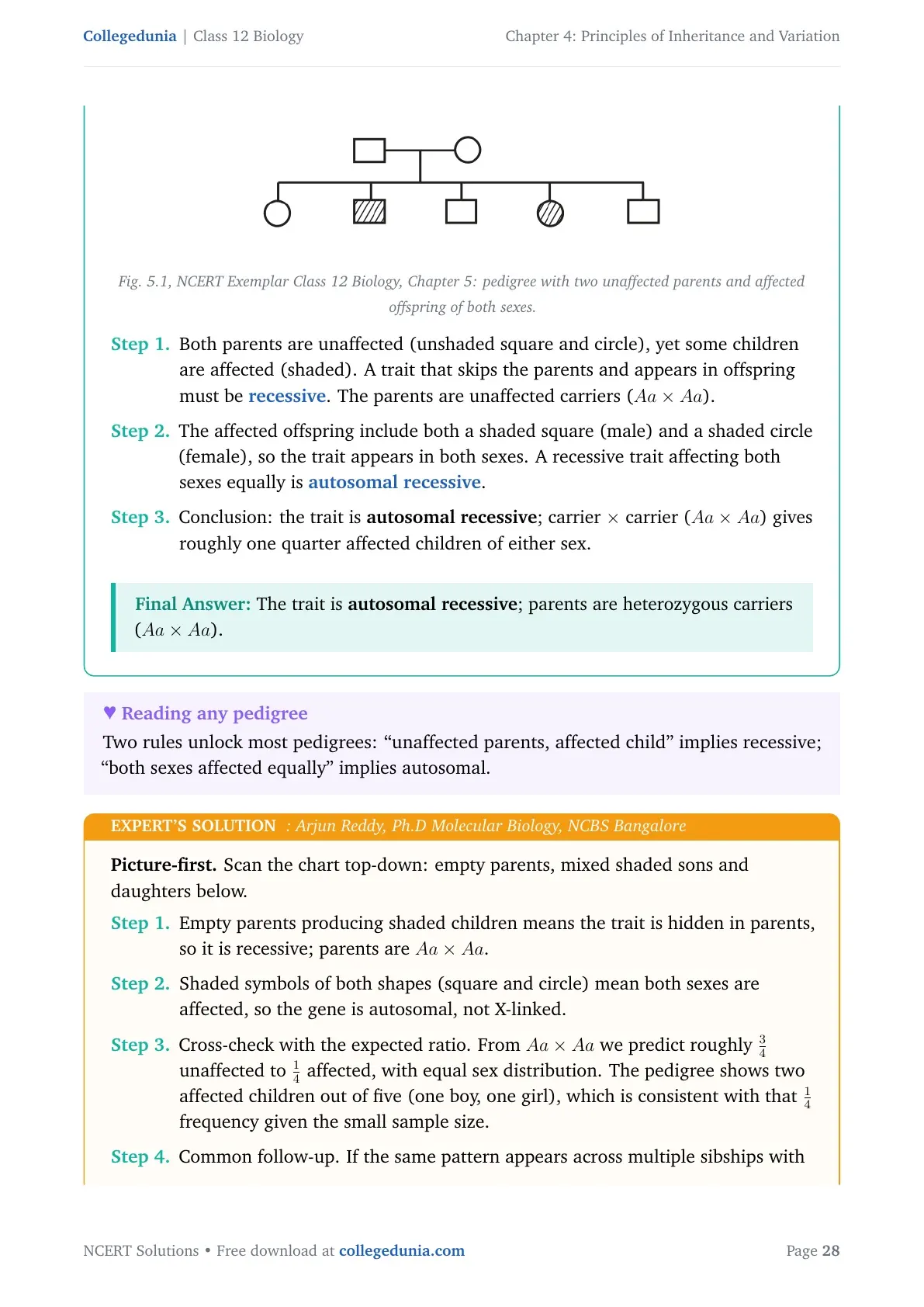
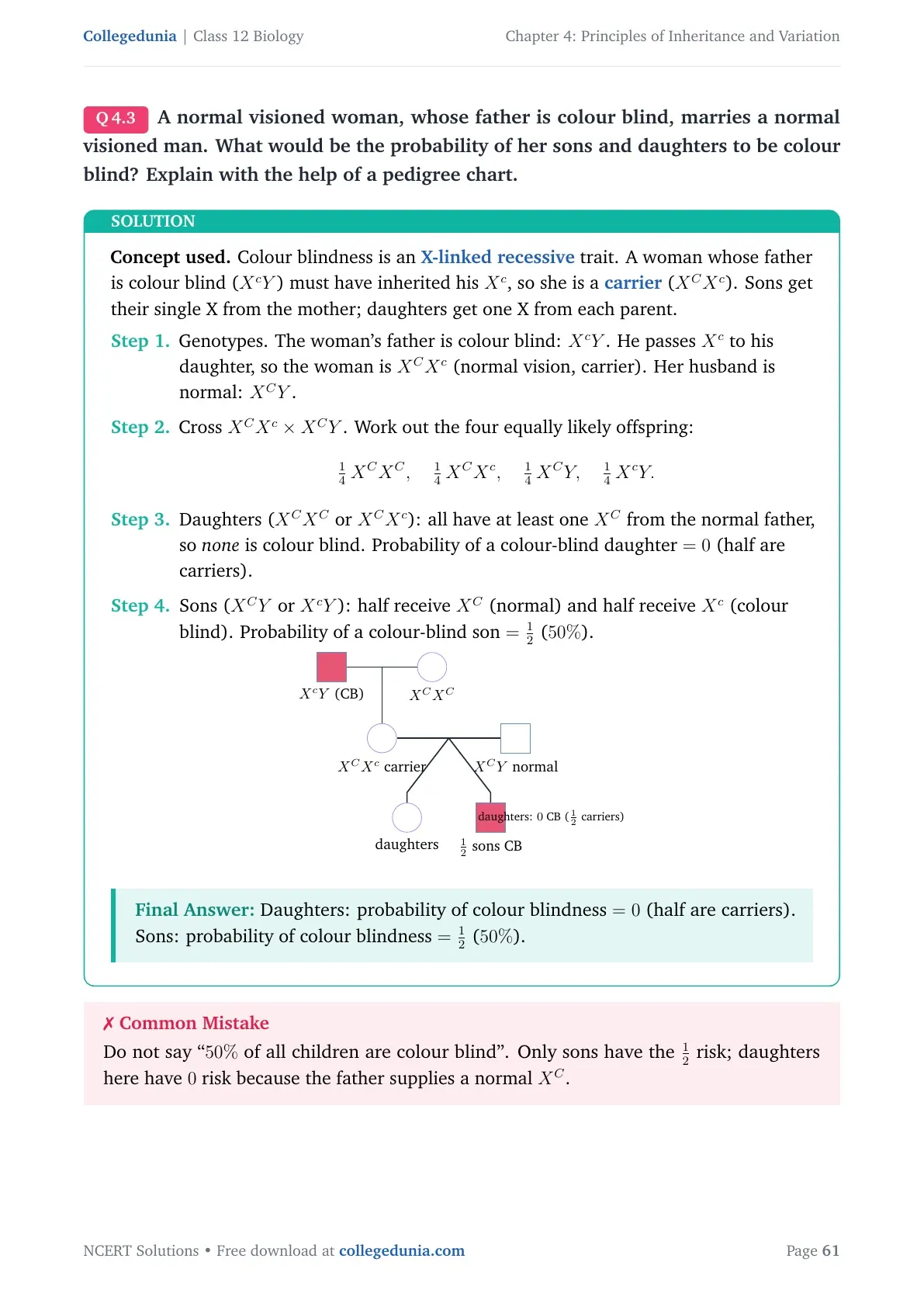
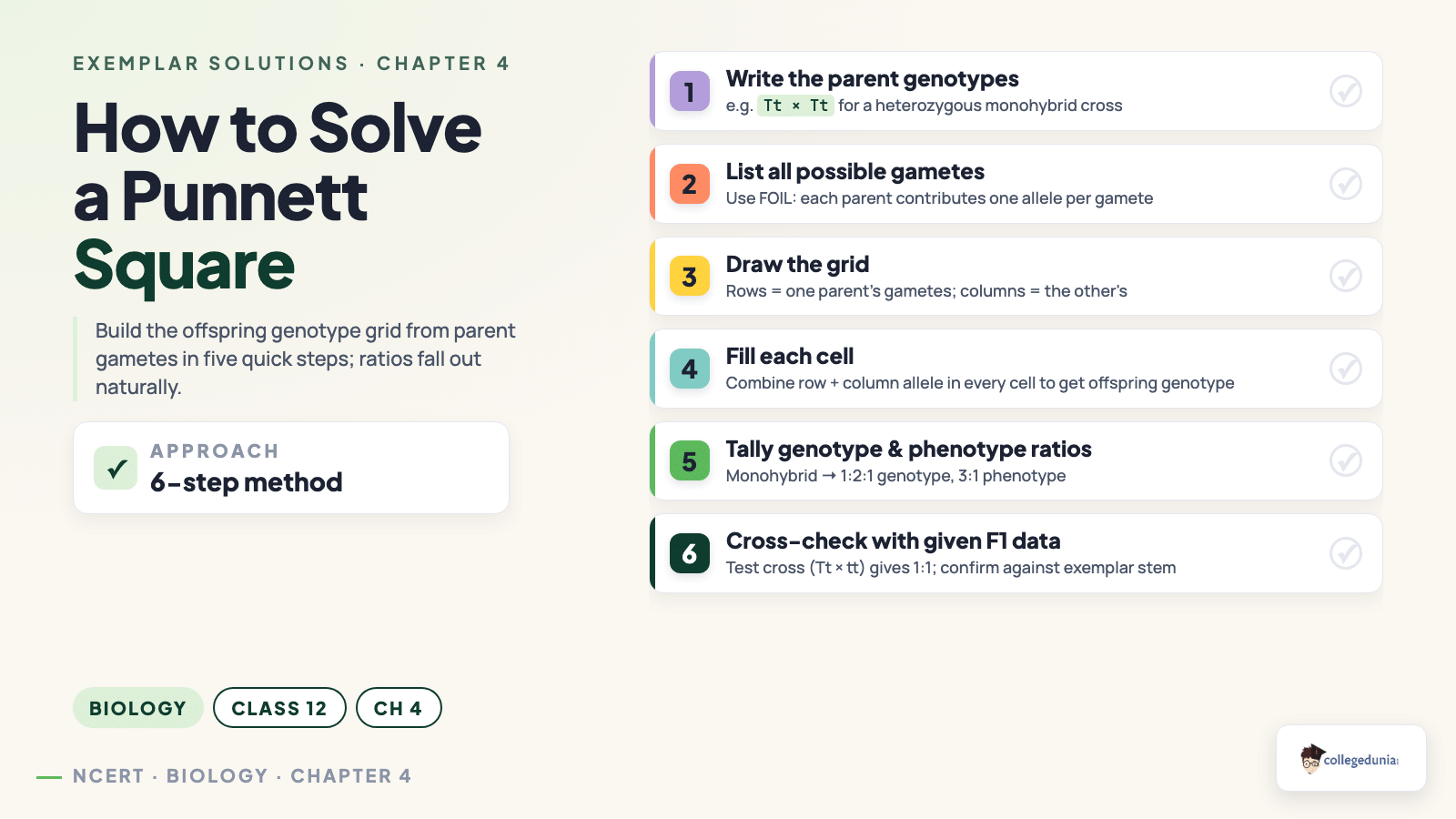
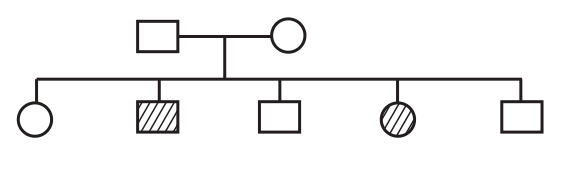



Comments