Biology Mentor, Kirori Mal College | Updated 3+ months ago
NEET 2025 placed three direct questions on this chapter, and CBSE Board 2025 lifted a 3-mark answer from the Exemplar. So Class 12 Biology Chapter 13 Biodiversity and Conservation is worth a final-month revision slot. This page hosts the fully worked NCERT Exemplar Solutions PDF, all 62 problems, mapped to the 2026-27 syllabus.
62 Exemplar problems
20 MCQ + 16 VSA
17 SA + 9 LA
2026-27 NCERT aligned
CBSE Weightage: 4 to 6 marks (usually one short answer on hotspots or species-area plus one VSA on the Evil Quartet)
NEET Weightage: 2 to 4 questions per year
Exam map: CBSE, NEET, AIIMS and CUET (this chapter is high-yield for NEET recall)
These Exemplar Solutions are curated by NEET-rank-holder mentors at Collegedunia and mapped to the 2026-27 NCERT chapter.
Biodiversity and Conservation NCERT Exemplar Video Solutions for Class 12 Biology
Biodiversity and Conservation Exemplar Question-Type Tour with One Sample Solved per Type
The Exemplar groups all 62 problems into four formats: 20 MCQ, 16 VSA, 17 SA and 9 LA. The two solved samples below, an MCQ and a Long Answer, show what the easy and hard ends of the set expect.
Question. Which of the following countries has the highest biodiversity? (a) South America (b) South Africa (c) Russia (d) India.
Reasoning. South America is a continent, not a country, so it is a distractor. India is one of the 12 mega-diversity nations. Answer: (d) India.NEET 2024 reused this stem.
LA Sample, Exemplar 15.8 (Rivet Popper Hypothesis)
Question. Explain briefly the rivet popper hypothesis of Paul Ehrlich.
Reasoning. Paul Ehrlich's Rivet Popper hypothesis compares an ecosystem to an aeroplane and each species to a rivet. Losing one rivet does not crash the plane, but losing many weakens the airframe until it fails. So every species loss weakens the ecosystem, and keystone species (rivets on the wing) matter most. It is the companion idea to the Evil Quartet, which names the four drivers of biodiversity loss.
How Will Collegedunia's NCERT Exemplar Solutions Help You with Biodiversity and Conservation?
This is the highest-yield chapter for one-line VSAs in Class 12 Biology, but NEET examiners trap students on the exact numbers and the exact binomial of an alien species. Every Exemplar item below carries a full Solution plus an Expert's Solution.
Every question type worked: all 20 MCQ, 16 VSA, 17 SA and 9 LA problems, with no skipped steps.
Facts and years named: each step gives the exact number, its NCERT section and the NEET year that reused it.
Exemplar Hotspot, Species-Area and Alien-Species Recall Table: The Single Highest-Yield NEET Asset
About 70 percent of this chapter's NEET MCQs are recall items, so lock the facts below. The table distils the eight most-asked facts of the last five years.
Memorise the genus, not the common name: the marker wants "Eichhornia" not "water hyacinth", and "Parthenium" not "carrot grass".
Difficulty Step-Up From NCERT Textbook to Exemplar for Class 12 Biology Chapter 13
NCERT textbook questions test recall; the Exemplar twists the same idea by asking why. The table pairs three setups so students see the step-up.
Concept
NCERT Textbook Style
NCERT Exemplar Style
Species-Area Relationship
"What is the significance of the slope in a species-area relationship?"
"Why is the slope steeper when a very large area is considered?" (asks for the mechanism, not the value)
Loss of biodiversity
"What are the major causes of species losses in a region?"
"Of the four major causes, which is the major cause of biodiversity loss? Give reasons." (asks for a justified ranking)
Tropics richness
"Give three hypotheses for why tropics show greatest species richness."
"Why does diversity fall from equator to poles?" plus "Is more solar energy available in the tropics?" (asks from two angles)
Students who only do the textbook lose 1 to 2 marks per CBSE question, because Boards and NEET have copied this Exemplar style since 2022.
Old vs Rationalised Syllabus in the Class 12 Biology Chapter 13 Exemplar
The NCERT Exemplar was not updated when the textbook was revised in 2023-24. It still uses the old numbering (Chapter 15), and a few problems lean on topics now lightly treated, so CBSE-only students should plan around them.
Topic
In 2026-27 Textbook?
In Exemplar PDF?
Should You Solve?
Levels of biodiversity (genetic, species, ecological)
Yes
Yes
Yes, priority 1
Species-area relation and z slope
Yes
Yes
Yes, priority 1
Evil Quartet of biodiversity loss
Yes
Yes
Yes, priority 1 for NEET
34 hotspots and Indian hotspots
Yes
Yes
Yes
In-situ and ex-situ conservation
Yes
Yes
Yes
Rivet Popper hypothesis (Paul Ehrlich)
Yes
Yes
Yes, priority 1 for NEET
Old IUCN Red List categories (full taxonomy)
Trimmed
Yes
Only for NEET, skip for CBSE-only
Roughly 5 percent of the problems are now beyond the CBSE-only syllabus. A board-only student can skip them; a NEET aspirant should still attempt all of them.
How to Use the Biodiversity Exemplar with the NCERT Textbook: A Parallel-Track Plan
The Exemplar is not a replacement for the textbook. Interleave them: read a topic, then attempt the matching Exemplar problems.
Day 1 (Levels and Estimation): Read NCERT Sections 13.1 to 13.1.1, then attempt the MCQ and VSA problems on estimation.
Day 2 (Patterns): Read Section 13.1.2, then attempt the species-area MCQ, SA and LA problems.
Day 3 (Loss and Importance): Read Sections 13.1.3 to 13.1.5, then attempt the Evil Quartet and Rivet Popper problems.
Day 4 (Conservation): Read Section 13.2, then attempt the hotspot, in-situ and ex-situ problems.
Remember: Always name the scientist with the concept. Exemplar marking favours full attribution: Edward Wilson's Evil Quartet, Paul Ehrlich's Rivet Popper, Norman Myers's hotspot criterion.
All NCERT Exemplar Questions for Biodiversity and Conservation with Step-by-Step Solutions
Every Exemplar problem for Class 12 Biology Chapter 13 Biodiversity and Conservation is listed below with its full Solution and Expert Solution inside collapsible tabs. Click Check Solution to reveal the step-by-step working.
Questions
Q 13.1
Which of the following countries has the highest biodiversity?
(a) South America
(b) South Africa
(c) Russia
(d) India
Correct option: (a) South America.
Concept used. Biodiversity, the total variety of life at all levels (gene,
species, ecosystem), is not spread evenly over the planet. It rises sharply as we
move from the poles towards the equator, the latitudinal gradient. Tropical
regions get more solar energy, stay warmer and wetter year round, and have been
relatively undisturbed for millions of years, so more species could evolve and
co-exist there.
Among the four options, only South America lies almost entirely inside the
tropics. The Amazon basin alone holds more than 40,000 plant species,
∼ 1,300 bird species, ∼ 3,000 fish species and uncounted
insects.
South Africa lies south of the tropics; Russia spans the boreal and tundra
belts, both species-poor. India is megadiverse but a single country, hosting
∼ 8.1% of recorded species on ∼ 2.4% of the world's land area.
Comparing the totals: the Amazon biome in South America is the single
largest store of terrestrial biodiversity on Earth, far ahead of India's
∼ 45,000 plant + ∼ 91,000 animal species.
Option (a): South America.
PS
Pranav Sharma
Ph.D Molecular Biology, NCBS Bangalore
Verified Expert
Quick reading. Skim the four options for the only one that sits entirely
inside the equatorial / tropical belt. South America does; the others do not.
Russia: largely temperate-to-tundra, low species richness per unit area.
South Africa: subtropical-to-temperate, narrower than the whole continent.
India: megadiverse but small in area and contains arid Thar, Himalayas,
plus tropical south.
South America: tropical rainforest dominated, Amazon, Atlantic forest,
Cerrado, Andes; together richer than any other continent on every
biodiversity index.
Why this matters. The latitudinal gradient is the strongest biogeographic
pattern in ecology; remembering "tropics = peak richness" answers a large fraction
of biodiversity MCQs.
Why this matters. The concept tested here recurs across CBSE board papers and NEET examination, framed as MCQ, VSA and even SA. Carrying the named example plus the one-sentence reason into the exam hall is sufficient to score every mark allocated, regardless of phrasing.
Common variants. Examiners often reword the stem (not, except, which one) or swap two of the distractors. The underlying fact does not change, so the same answer works.
Option (a).
Q 13.2
Which of the following is not a cause for loss of biodiversity?
(a) Destruction of habitat
(b) Invasion by alien species
(c) Keeping animals in zoological parks
(d) Over-exploitation of natural resources
Correct option: (c) Keeping animals in zoological parks.
Concept used. The four named drivers of biodiversity loss (the
Evil Quartet) are: habitat loss and fragmentation, over-exploitation,
alien-species invasion, and co-extinctions. Zoological parks (along with botanical
gardens, seed banks and gene banks) are forms of ex situ conservation: they
breed and shelter threatened species outside their natural habitat, which
prevents extinction rather than causing it.
Habitat destruction (a) is the largest single driver: clearing of
tropical forests for cropland alone removes ∼ 1% of forest area each
year.
Alien invasions (b) such as the Nile perch in Lake Victoria wiped out
> 200 native cichlid fish; Lantana, water hyacinth and African catfish
damage Indian ecosystems.
Over-exploitation (d) drove Steller's sea cow, passenger pigeon, and many
fishery stocks to extinction or collapse.
Zoos (c) keep individuals safe, often re-introduce captive-bred animals
(e.g. Asiatic lion at Gir, gharial in Indian rivers), and run gamete banks
for future generations. They are a tool of conservation, not loss.
Option (c): Keeping animals in zoological parks is ex situ
conservation, not a cause of biodiversity loss.
SI
Sneha Iyer
M.Sc Botany, Delhi University
Verified Expert
Strategic angle. Three of the four options are direct human pressures that
remove species from the wild; the fourth (zoos) actively rescues them.
Pick the odd one out.
Tag each option as either a wild-population pressure or a conservation tool.
(a), (b), (d) are all wild-population pressures listed in the NCERT Evil
Quartet.
(c) is a textbook example of ex situ conservation; the same
chapter describes it as a remedy, not a cause.
Why this matters. Biodiversity terminology is rigorously defined in the NCERT chapter; mixing up the labels (endemic vs exotic, in situ vs ex situ, vulnerable vs endangered) costs marks even when the underlying biology is correct. Lock the definition before the example.
Connecting back. Each of these definitions ties to a specific conservation policy or treaty, so the term has real-world weight beyond the textbook page.
Option (c).
Q 13.3
Which of the following is not an invasive alien species in the Indian
context?
(a) Lantana
(b) Cynodon
(c) Parthenium
(d) Eichhornia
Correct option: (b) Cynodon.
Concept used. An invasive alien species is one that is introduced
(deliberately or accidentally) into an area outside its native range and goes on to
spread aggressively, displacing native species. Cynodon dactylon (Bermuda
grass, locally called dub or durva) is an Indian native grass, widely
present in lawns and pastures across the subcontinent; it is not alien.
Lantana (a, Lantana camara): native to Central and South America,
introduced as an ornamental, now smothering forest understoreys in the
Western Ghats.
Parthenium (c, Parthenium hysterophorus, ``carrot grass''): native
to tropical America, accidentally introduced with grain shipments in the
1950s, now widespread.
Eichhornia (d, Eichhornia crassipes, water hyacinth, ``terror of
Bengal''): native to South America, choking water bodies.
Cynodon (b): an indigenous grass; the only option among the four that is
Indian in origin.
Option (b): Cynodon is an Indian native, not an invasive alien.
AM
Aanya Mehta
M.Sc Botany, Delhi University
Verified Expert
Picture-first. Visualise each plant; the three aliens are all loud
ecological invaders the chapter explicitly names. The fourth, Cynodon, is the
quiet grass that you walk on every day.
NCERT page on invasive aliens names exactly: Carrot grass (Parthenium),
Lantana, Water hyacinth (Eichhornia), and African catfish.
Cynodon does not appear on that list. It is the native lawn grass.
Why this matters. The same logic underlies several other Exemplar questions in this chapter: the latitudinal gradient, hot-spot location, and the tropical concentration of endemic species. Recognising the shared pattern across questions saves time and reinforces the answer.
Verification. If two distractors look equally plausible, return to the NCERT chapter glossary; the exact wording there decides the right option in every Exemplar MCQ.
Option (b).
Q 13.4
Where among the following will you find pitcher plant?
(a) Rain forest of North-East India
(b) Sunderbans
(c) Thar Desert
(d) Western Ghats
Correct option: (a) Rain forest of North-East India.
Concept used. A pitcher plant (genus Nepenthes) is an
insectivorous angiosperm whose leaf tip is modified into a fluid-filled pitcher
that traps insects, providing nitrogen on the very nutrient-poor (especially
nitrogen-poor) soils where it grows. Nepenthes khasiana is the only Indian
pitcher plant species and is endemic to the rain forests of Meghalaya in the
North-East.
Sunderbans (b) is a brackish-water mangrove ecosystem, salt-rich rather
than nitrogen-deficient; Nepenthes cannot survive there.
Thar Desert (c) is hyper-arid; pitcher plants need a perpetually moist
habitat.
Western Ghats (d) is a tropical rain-forest hot spot but does not host
Nepenthes; that genus in India is restricted to Khasi and Jaintia
hills of Meghalaya.
North-East India (a) has the right combination: heavy monsoon rainfall,
constant humidity, nutrient-leached lateritic soil. Hence Nepenthes
khasiana is endemic here.
Option (a): Rain forests of North-East India.
AB
Ananya Banerjee
M.Sc Botany, Delhi University
Verified Expert
Quick reading. The species' name itself, Nepenthes khasiana, names
its home: the Khasi hills of Meghalaya. That is North-East India.
Khasi hills → Meghalaya → North-East India.
Confirmed by the NCERT figure on insectivorous plants.
Why this matters. NCERT's biodiversity-loss framework (the Evil Quartet) structures most short-answer questions in this chapter. Recognising that habitat loss, over-exploitation, alien invasion and co-extinctions is the answer to many ``causes'' questions saves you from over-thinking each stem.
Exam tip. Wherever the question says ``major cause'', the default best answer is habitat loss and fragmentation, unless the stem names a different specific scenario.
Option (a).
Q 13.5
Which one of the following is not a major characteristic feature of
biodiversity hot spots?
(a) Large number of species
(b) Abundance of endemic species
(c) Mostly located in the tropics
(d) Mostly located in the polar regions
Correct option: (d) Mostly located in the polar regions.
Concept used.Biodiversity hot spots, defined by Norman Myers,
are regions with (i) exceptionally high species richness, (ii) a very high
proportion of endemic species (found nowhere else), and (iii) serious threat of
habitat loss (> 70% of original vegetation already gone). All 34 recognised
hot spots are clustered in the tropics and subtropics, never in the polar zones,
because the polar zones support comparatively few species and even fewer endemics.
Large number of species (a) is one of Myers' two positive criteria.
Abundance of endemic species (b) is the other positive criterion; without
endemics, a high-richness region is just a rich area, not a hot spot.
Tropical location (c) is statistically true: the latitudinal gradient
guarantees that high-richness regions cluster near the equator.
Polar location (d) is the opposite of (c). Polar regions are species-poor
and therefore cannot satisfy Myers' richness criterion.
Option (d).
KR
Karan Reddy
Ph.D Molecular Biology, NCBS Bangalore
Verified Expert
Structural observation. (a)(b)(c) all describe positive features that hot
spots share. (d) directly contradicts (c). The two cannot both be features of the
same set of places, so (d) is the odd one out.
Recognise the (c) vs (d) contradiction.
Recall that hot spots are equator-hugging, not pole-hugging.
Why this matters. The concept tested here recurs across CBSE board papers and NEET examination, framed as MCQ, VSA and even SA. Carrying the named example plus the one-sentence reason into the exam hall is sufficient to score every mark allocated, regardless of phrasing.
Common variants. Examiners often reword the stem (not, except, which one) or swap two of the distractors. The underlying fact does not change, so the same answer works.
Option (d).
Q 13.6
Match the animals given in column I with their location in column II:
tabular@ll@
A. Dodo & i. Africa
B. Quagga & ii. Russia
C. Thylacine & iii. Mauritius
D. Steller's sea cow & iv. Australia
tabular
(a) A-i, B-iii, C-ii, D-iv
(b) A-iv, B-iii, C-i, D-ii
(c) A-iii, B-i, C-ii, D-iv
(d) A-iii, B-i, C-iv, D-ii
Correct option: (d) A-iii, B-i, C-iv, D-ii.
Concept used. A small, often-tested set of recently extinct
animals demonstrates how local human pressures wipe out endemic species. Each is
tied to a single locality.
Dodo (Raphus cucullatus): a flightless pigeon endemic to the
island of Mauritius (iii). Hunted to extinction by Dutch sailors and their
introduced animals by 1681.
Quagga (Equus quagga quagga): a half-striped zebra endemic to South
Africa (i). Hunted out by 1883.
Thylacine (Thylacinus cynocephalus, the Tasmanian wolf): a
marsupial carnivore endemic to Tasmania, Australia (iv). Last animal died
1936.
Steller's sea cow (Hydrodamalis gigas): a giant sirenian of the
Bering Sea, off the coast of Russia / Kamchatka (ii). Hunted out within
27 years of its 1741 discovery.
Option (d): A-iii, B-i, C-iv, D-ii.
DK
Diya Kapoor
M.Sc Zoology, Banaras Hindu University
Verified Expert
Strategic angle. Lock in the two easiest pairings first: Dodo-Mauritius
and Thylacine-Australia. That alone narrows the four options down to (d).
Dodo → Mauritius eliminates (a) and (b).
Thylacine → Australia eliminates (c) (which puts Thylacine in Russia).
Only (d) survives both filters.
Why this matters. Biodiversity terminology is rigorously defined in the NCERT chapter; mixing up the labels (endemic vs exotic, in situ vs ex situ, vulnerable vs endangered) costs marks even when the underlying biology is correct. Lock the definition before the example.
Connecting back. Each of these definitions ties to a specific conservation policy or treaty, so the term has real-world weight beyond the textbook page.
Option (d).
Q 13.7
What is common to the following plants: Nepenthes, Psilotum, Rauwolfia
and Aconitum?
(a) All are ornamental plants
(b) All are phylogenic link species
(c) All are prone to over exploitation
(d) All are exclusively present in the Eastern Himalayas.
Correct option: (c) All are prone to over exploitation.
Concept used.Over-exploitation is the harvesting of a species
faster than it can replenish. Plants that supply medicinal alkaloids, decorative
foliage, or scientific specimens are particularly vulnerable.
Nepenthes khasiana: collected from the wild for ornamental
terrariums and curiosity, although it is now legally protected.
Psilotum nudum: the ``whisk fern''; collected as a primitive plant
of evolutionary interest. Wild stands shrink under pressure.
Rauwolfia serpentina: roots harvested for the antihypertensive
alkaloid reserpine; populations crashed and the plant is now an Appendix-II
CITES species.
Aconitum heterophyllum: high-Himalayan medicinal plant
(ativisha); over-collected for Ayurvedic and Unani markets.
All four are not specifically ornamental, are not all phylogenic links,
and are not all confined to Eastern Himalayas (Rauwolfia is peninsular too).
The single common thread is over-exploitation pressure.
Option (c): All four species suffer from over-exploitation.
VJ
Vivaan Joshi
M.Sc Botany, Delhi University
Verified Expert
Strategic angle. Test each option against all four species. Only
one survives the universal test.
Ornamental? Rauwolfia and Aconitum are medicinal, not ornamental. Strike (a).
Phylogenic links? Only Psilotum strictly is. Strike (b).
Only in Eastern Himalayas? Rauwolfia grows across peninsular India.
Strike (d).
Prone to over exploitation? Yes for all four (medicine, curiosity, decor).
Keep (c).
Why this matters. The same logic underlies several other Exemplar questions in this chapter: the latitudinal gradient, hot-spot location, and the tropical concentration of endemic species. Recognising the shared pattern across questions saves time and reinforces the answer.
Verification. If two distractors look equally plausible, return to the NCERT chapter glossary; the exact wording there decides the right option in every Exemplar MCQ.
Option (c).
Q 13.8
The one-horned rhinoceros is specific to which of the following
sanctuary?
(a) Bhitar Kanika
(b) Bandipur
(c) Kaziranga
(d) Corbett park
Correct option: (c) Kaziranga.
Concept used. The Indian one-horned rhinoceros
(Rhinoceros unicornis) survives in the tall-grass and swampy floodplains
of the Brahmaputra and Terai. Kaziranga National Park in Assam holds
roughly two-thirds of the species' global wild population, recovering from <200
animals in 1900 to > 2,600 today thanks to strict protection.
Bhitar Kanika (a): Odisha mangrove; famous for saltwater crocodile and
olive ridley turtles, not rhino.
Bandipur (b): Karnataka deciduous forest; tigers and elephants, no rhino.
Kaziranga (c): Assam grass–swamp; THE one-horned rhino stronghold.
Corbett (d): Uttarakhand foothill forest; tiger reserve, not rhino.
Option (c): Kaziranga.
AV
Aditya Verma
M.Sc Zoology, Banaras Hindu University
Verified Expert
Quick reading. ``One-horned rhino'' is on every Indian banknote and
postage stamp of Assam tourism; the answer is Kaziranga.
Memorise the four flagship parks: Kaziranga → rhino, Gir → Asiatic
lion, Manas → pygmy hog, Corbett → tiger.
Why this matters. NCERT's biodiversity-loss framework (the Evil Quartet) structures most short-answer questions in this chapter. Recognising that habitat loss, over-exploitation, alien invasion and co-extinctions is the answer to many ``causes'' questions saves you from over-thinking each stem.
Exam tip. Wherever the question says ``major cause'', the default best answer is habitat loss and fragmentation, unless the stem names a different specific scenario.
Option (c).
Q 13.9
Amongst the animal groups given below, which one appears to be more
vulnerable to extinction?
(a) Insects
(b) Mammals
(c) Amphibians
(d) Reptiles
Correct option: (c) Amphibians.
Concept used. Vulnerability to extinction depends on (i) ecological
specialisation, (ii) sensitivity to environmental change, (iii) population size
and dispersal ability. Amphibians satisfy all three negatives in the
extreme: their permeable skin lets pollutants and UV in directly, their two-stage
life-cycle (aquatic larva + terrestrial adult) demands two healthy habitats, and
chytrid fungal disease has spread globally.
Insects: enormous numbers and rapid reproduction; though many species
decline, the group as a whole is resilient.
Mammals: many threatened (tigers, primates), but they have widespread
protection and behavioural plasticity.
Amphibians: IUCN reports ∼ 32% of all amphibian species are
threatened with extinction, the highest fraction for any vertebrate class.
Many frog species have gone extinct in the last 30 years.
Reptiles: vulnerable but not at the amphibian level.
Option (c): Amphibians, the most vulnerable vertebrate class.
RN
Riya Nair
Ph.D Molecular Biology, NCBS Bangalore
Verified Expert
Strategic angle. Rank the four groups by ``ease of being killed off by a
single environmental change''. Amphibians lose if water dries, soil heats, UV rises,
or fungus arrives. Hence they top the vulnerability list.
Insects: most resilient on aggregate.
Reptiles: moderately vulnerable.
Mammals: vulnerable but protected.
Amphibians: triple-exposed (skin, larvae, adults). Most vulnerable.
Why this matters. The concept tested here recurs across CBSE board papers and NEET examination, framed as MCQ, VSA and even SA. Carrying the named example plus the one-sentence reason into the exam hall is sufficient to score every mark allocated, regardless of phrasing.
Common variants. Examiners often reword the stem (not, except, which one) or swap two of the distractors. The underlying fact does not change, so the same answer works.
Option (c).
Q 13.10
Which one of the following is an endangered plant species of India?
(a) Rauwolfia serpentina
(b) Santalum album (Sandal wood)
(c) Cycas beddonei
(d) All of the above
Correct option: (d) All of the above.
Concept used.Endangered (EN) in the IUCN Red List is the
category just above ``Critically Endangered''. All three named species are listed
as endangered in India because of medicinal harvesting, fragrant-wood smuggling,
and ornamental over-collection respectively.
Rauwolfia serpentina: harvested for the alkaloid reserpine; CITES
Appendix II; classified endangered in India.
Santalum album (sandalwood): heartwood prized for oil and carving;
decades of illegal logging have crashed wild stocks; declared a vulnerable/
endangered species, with felling regulated under State Acts.
Cycas beddomei: South Indian endemic gymnosperm, over-collected
for ornamental gardens and as a curiosity; listed endangered.
All three are recognised on India's endangered list, so the consolidated
option (d) is correct.
Option (d): All of the above.
KP
Krishna Pillai
M.Sc Botany, Delhi University
Verified Expert
Strategic angle. If three plausible species are listed and the fourth
option is ``All of the above'', verify each species independently. All three
appear on India's endangered list, so (d) wins.
Cross-check each species against the Red Data Book of Indian Plants.
All three appear in the endangered/vulnerable section.
Why this matters. Biodiversity terminology is rigorously defined in the NCERT chapter; mixing up the labels (endemic vs exotic, in situ vs ex situ, vulnerable vs endangered) costs marks even when the underlying biology is correct. Lock the definition before the example.
Connecting back. Each of these definitions ties to a specific conservation policy or treaty, so the term has real-world weight beyond the textbook page.
Option (d).
Q 13.11
What is common to Lantana, Eichhornia and African catfish?
(a) All are endangered species of India.
(b) All are keystone species.
(c) All are mammals found in India.
(d) All the species are neither threatened nor indigenous species of India.
Correct option: (d) All the species are neither threatened nor
indigenous species of India.
Concept used. The three named organisms are flagship examples of
invasive alien species in India: they are non-native (so not indigenous)
and they are spreading aggressively (so not threatened with extinction).
Lantana camara: South American shrub, introduced as ornamental, now
invades forest understorey.
Eichhornia crassipes (water hyacinth): South American free-floating
aquatic, chokes water bodies (``terror of Bengal'').
African catfish Clarias gariepinus: introduced for aquaculture,
outcompetes native Indian catfish in rivers.
None are endangered (strike a), none are keystone species (strike b),
only the catfish is even an animal (strike c), and all three are alien
invaders (option d).
Option (d).
TB
Tara Bhat
Ph.D Molecular Biology, NCBS Bangalore
Verified Expert
Quick reading. The three names are NCERT's go-to triad for invasive aliens
in India. Option (d) names exactly that property.
Recognise the triad as invasive aliens.
Match the property to option (d).
Why this matters. The same logic underlies several other Exemplar questions in this chapter: the latitudinal gradient, hot-spot location, and the tropical concentration of endemic species. Recognising the shared pattern across questions saves time and reinforces the answer.
Verification. If two distractors look equally plausible, return to the NCERT chapter glossary; the exact wording there decides the right option in every Exemplar MCQ.
Option (d).
Q 13.12
The extinction of passenger pigeon was due to:
(a) Increased number of predatory birds.
(b) Over exploitation by humans.
(c) Non-availability of the food.
(d) Bird flu virus infection.
Correct option: (b) Over exploitation by humans.
Concept used. The passenger pigeon (Ectopistes
migratorius) was the most abundant bird in North America in the early 19th
century, with flocks of billions. Industrial-scale market hunting between 1850
and 1900 reduced it to zero; the last bird, ``Martha'', died in Cincinnati Zoo in
1914. The species is the textbook case of extinction by over-exploitation alone.
Predators (a): predatory birds never threatened passenger pigeon numbers
because the flocks were too vast.
Humans (b): commercial hunters used nets, guns and even sulphur smoke to
kill nesting birds by the thousand and ship the carcasses by railway to
eastern cities. This is over-exploitation, the recorded cause of
extinction.
Food shortage (c): although deforestation reduced beech-nut and acorn
crops, that pressure followed and was secondary to direct slaughter.
Bird flu (d): no evidence; the species was extinct long before bird flu
emerged as a recognised problem.
Option (b): Over-exploitation by humans.
YD
Yash Desai
M.Sc Zoology, Banaras Hindu University
Verified Expert
Strategic angle. Passenger pigeon is the canonical NCERT example of
over-exploitation. The other three options are distractors.
Match the species to its named cause of extinction in the textbook.
Why this matters. NCERT's biodiversity-loss framework (the Evil Quartet) structures most short-answer questions in this chapter. Recognising that habitat loss, over-exploitation, alien invasion and co-extinctions is the answer to many ``causes'' questions saves you from over-thinking each stem.
Exam tip. Wherever the question says ``major cause'', the default best answer is habitat loss and fragmentation, unless the stem names a different specific scenario.
Option (b).
Q 13.13
Which of the following statements is correct?
(a) Parthenium is an endemic species of our country.
(b) African catfish is not a threat to indigenous catfishes.
(c) Steller's sea cow is an extinct animal.
(d) Lantana is popularly known as carrot grass.
Correct option: (c) Steller's sea cow is an extinct animal.
Concept used. The question tests four distinct facts; eliminate three
wrong ones to find the only true statement.
(a) Parthenium is not endemic; it is an alien from tropical America
that became invasive in India. FALSE.
(b) African catfish (Clarias gariepinus) escaped from aquaculture
farms and outcompetes Indian native catfishes (Clarias batrachus
etc.). It is a threat. FALSE.
(c) Steller's sea cow (Hydrodamalis gigas) was hunted to extinction
by 1768, only 27 years after discovery. TRUE.
(d) Carrot grass is the popular name for Parthenium, not Lantana.
FALSE.
Option (c).
IR
Ishita Rao
M.Sc Zoology, Banaras Hindu University
Verified Expert
Strategic angle. A True/False MCQ. Verify each statement separately.
Parthenium is alien ⇒ (a) false.
African catfish is invasive ⇒ (b) false.
Steller's sea cow extinct since 1768 ⇒ (c) true.
Carrot grass = Parthenium, not Lantana ⇒ (d) false.
Why this matters. The concept tested here recurs across CBSE board papers and NEET examination, framed as MCQ, VSA and even SA. Carrying the named example plus the one-sentence reason into the exam hall is sufficient to score every mark allocated, regardless of phrasing.
Common variants. Examiners often reword the stem (not, except, which one) or swap two of the distractors. The underlying fact does not change, so the same answer works.
Option (c).
Q 13.14
Among the ecosystem mentioned below, where can one find maximum
biodiversity?
(a) Mangroves
(b) Desert
(c) Coral reefs
(d) Alpine meadows
Correct option: (c) Coral reefs.
Concept used.Coral reefs are the most species-rich
marine ecosystems on Earth: although they occupy < 0.1% of the ocean
floor, they support an estimated 25% of all marine species, including fish,
molluscs, crustaceans, sponges, echinoderms and the reef-building coral animals
themselves.
Mangroves are diverse but specialised (salt-tolerant, anoxic mud);
species count is moderate.
Deserts are species-poor by definition: water is the limiting resource.
Coral reefs are the marine analogue of tropical rain forests in terms of
richness, often called ``rainforests of the sea''.
Alpine meadows host a brief summer bloom but are species-poor for most of
the year.
Option (c): Coral reefs.
MC
Meera Chatterjee
M.Sc Zoology, Banaras Hindu University
Verified Expert
Quick reading. The most-diverse marine analog of tropical rain forest is
the coral reef. NCERT names them explicitly.
Why this matters. Biodiversity terminology is rigorously defined in the NCERT chapter; mixing up the labels (endemic vs exotic, in situ vs ex situ, vulnerable vs endangered) costs marks even when the underlying biology is correct. Lock the definition before the example.
Connecting back. Each of these definitions ties to a specific conservation policy or treaty, so the term has real-world weight beyond the textbook page.
Option (c).
Q 13.15
Which of the following forests is known as the `lungs of the planet
Earth'?
(a) Taiga forest
(b) Tundra forest
(c) Amazon rain forest
(d) Rain forests of North East India
Correct option: (c) Amazon rain forest.
Concept used. The Amazon rain forest covers ∼ 5.5 × 10⁶ km2
across nine South American countries. Through photosynthesis it produces an
enormous quantity of atmospheric oxygen and absorbs an equally vast amount of
CO2: estimates suggest the Amazon contributes about 20% of the world's
oxygen and stores ∼ 90--140 billion tonnes of carbon. Hence the
nickname ``lungs of the planet''.
Taiga (a) is the boreal coniferous belt; photosynthesises only in summer
months and is much smaller than the Amazon.
Tundra (b) has only mosses, lichens and stunted shrubs; ``tundra forest''
is essentially treeless.
Amazon rain forest (c): largest contiguous rainforest, year-round
photosynthesis, the textbook ``lungs of Earth''.
NE Indian rain forests (d) are biologically rich but tiny in area
compared with the Amazon.
Option (c): Amazon rain forest.
RG
Rohit Gupta
Ph.D Molecular Biology, NCBS Bangalore
Verified Expert
Picture-first. The Amazon is to oxygen production what a giant lung is to
the human body. Hence the metaphor in school texts.
Why this matters. The same logic underlies several other Exemplar questions in this chapter: the latitudinal gradient, hot-spot location, and the tropical concentration of endemic species. Recognising the shared pattern across questions saves time and reinforces the answer.
Verification. If two distractors look equally plausible, return to the NCERT chapter glossary; the exact wording there decides the right option in every Exemplar MCQ.
Option (c).
Q 13.16
The active chemical drug reserpine is obtained from:
(a) Datura
(b) Rauwolfia
(c) Atropa
(d) Papaver
Correct option: (b) Rauwolfia.
Concept used.Reserpine is an indole alkaloid first isolated
from Rauwolfia serpentina (Sarpagandha) in 1952. It blocks the storage of
catecholamines in nerve terminals, lowering blood pressure (antihypertensive) and
acting as a tranquilliser.
Datura yields tropane alkaloids hyoscyamine and scopolamine, not
reserpine.
Atropa belladonna yields atropine, not reserpine.
Papaver somniferum (opium poppy) yields morphine and codeine, not
reserpine.
Rauwolfia serpentina yields reserpine. Direct match.
Option (b): Rauwolfia.
AS
Aarav Singh
M.Sc Botany, Delhi University
Verified Expert
Strategic angle. Memorise the plant–alkaloid mapping. Reserpine →
Rauwolfia is one of the standard NCERT pairs.
Why this matters. NCERT's biodiversity-loss framework (the Evil Quartet) structures most short-answer questions in this chapter. Recognising that habitat loss, over-exploitation, alien invasion and co-extinctions is the answer to many ``causes'' questions saves you from over-thinking each stem.
Exam tip. Wherever the question says ``major cause'', the default best answer is habitat loss and fragmentation, unless the stem names a different specific scenario.
Option (b).
Q 13.17
Which of the following group exhibit more species diversity?
(a) Gymnosperms
(b) Algae
(c) Bryophytes
(d) Fungi
Correct option: (d) Fungi.
Concept used. The total recorded species in each group, from the NCERT
biodiversity inventory:
Gymnosperms: ∼ 1,000 species globally; a small relict group.
Algae: ∼ 40,000 species across all algal divisions.
Bryophytes: ∼ 17,000 species (mosses, liverworts, hornworts).
Fungi: ∼ 72,000 described species (NCERT) and an estimated
∼ 1.5 million total, by far the largest of the four groups.
Option (d): Fungi.
SM
Siddharth Mehta
Ph.D Molecular Biology, NCBS Bangalore
Verified Expert
Quick reading. Compare the four numerical totals; fungi clearly lead.
Why this matters. The concept tested here recurs across CBSE board papers and NEET examination, framed as MCQ, VSA and even SA. Carrying the named example plus the one-sentence reason into the exam hall is sufficient to score every mark allocated, regardless of phrasing.
Common variants. Examiners often reword the stem (not, except, which one) or swap two of the distractors. The underlying fact does not change, so the same answer works.
Option (d).
Q 13.18
Which of the below mentioned regions exhibit less seasonal variations?
(a) Tropics
(b) Temperates
(c) Alpines
(d) Both (a) & (b)
Correct option: (a) Tropics.
Concept used. The tropics (latitudes ≤ 23.5∘) receive
near-vertical sunlight year round; day length, mean temperature and rainfall vary
relatively little month-to-month, giving a ``constant'' environment. The temperate
zone, by contrast, shows a strong four-season cycle, and alpine regions show
extreme winter–summer swings.
Tropics: small seasonal variation (a few degrees in temperature, but a
wet/dry rhythm in some regions). Generally the least variable.
Alpine zone: large daily and seasonal temperature swings; snow cover in
winter.
Therefore (a) is uniquely correct; (b) cannot be combined with (a),
ruling out (d).
Option (a): Tropics.
NK
Neha Kumar
M.Sc Botany, Delhi University
Verified Expert
Strategic angle. Use the latitudinal-gradient logic. Seasonality is small
near the equator and rises steeply towards the poles. Tropics = lowest seasonality.
Latitudinal gradient of seasonality: tropics < temperates < alpine/
polar.
Why this matters. Biodiversity terminology is rigorously defined in the NCERT chapter; mixing up the labels (endemic vs exotic, in situ vs ex situ, vulnerable vs endangered) costs marks even when the underlying biology is correct. Lock the definition before the example.
Connecting back. Each of these definitions ties to a specific conservation policy or treaty, so the term has real-world weight beyond the textbook page.
Option (a).
Q 13.19
The historic convention on Biological Diversity held in Rio de Janeiro
in 1992 is known as:
(a) CITES Convention
(b) The Earth Summit
(c) G-16 Summit
(d) MAB Programme
Correct option: (b) The Earth Summit.
Concept used. The United Nations Conference on Environment and
Development held in Rio de Janeiro in June 1992 is popularly called the
Earth Summit. It opened for signature the Convention on Biological
Diversity (CBD), the first global treaty committing nations to conserve
biodiversity, use its components sustainably, and share genetic-resource benefits
fairly.
CITES (a): Convention on International Trade in Endangered Species,
signed 1973 in Washington, regulates trade. Different treaty.
Earth Summit (b): 1992 Rio meeting; produced CBD plus Agenda 21 and the
UN Framework Convention on Climate Change. Match.
G-16 Summit (c): no such recognised body.
MAB (d): Man and Biosphere programme of UNESCO, started 1971, designates
biosphere reserves. Different programme.
Option (b): The Earth Summit.
DJ
Dev Joshi
Ph.D Molecular Biology, NCBS Bangalore
Verified Expert
Quick reading. ``Rio 1992'' = Earth Summit. The phrase is in every
environmental textbook.
Recall the Rio 1992 nickname: Earth Summit.
Why this matters. The same logic underlies several other Exemplar questions in this chapter: the latitudinal gradient, hot-spot location, and the tropical concentration of endemic species. Recognising the shared pattern across questions saves time and reinforces the answer.
Verification. If two distractors look equally plausible, return to the NCERT chapter glossary; the exact wording there decides the right option in every Exemplar MCQ.
Option (b).
Q 13.20
What is common to the techniques (i) in vitro fertilisation, (ii) Cryo
preservation and (iii) tissue culture?
(a) All are in situ conservation methods.
(b) All are ex situ conservation methods.
(c) All require ultra modern equipment and large space.
(d) All are methods of conservation of extinct organisms.
Correct option: (b) All are ex situ conservation methods.
Concept used.Ex situ conservation preserves threatened species
outside their natural habitat, in zoos, botanical gardens, gene banks,
cryopreservation tanks (-196∘C liquid nitrogen) or tissue-culture labs.
In situ conservation, by contrast, protects species inside their
natural habitat (national parks, sanctuaries, biosphere reserves).
In vitro fertilisation (IVF): gametes are combined outside the body to
produce embryos for endangered species. Ex situ.
Cryopreservation: gametes, embryos, seeds stored at -196∘C in
liquid nitrogen. Ex situ.
Tissue culture: somatic cells grown on agar to regenerate whole plants.
Ex situ.
All three happen outside the natural habitat, so they are ex situ. They
do not all need ultra-modern equipment in vast space, and they cannot
revive truly extinct organisms.
Option (b): All are ex situ conservation methods.
KS
Kavya Sharma
Ph.D Molecular Biology, NCBS Bangalore
Verified Expert
Strategic angle. Test each technique against the in situ vs
ex situ dichotomy. All three operate in labs, never in the wild.
IVF: laboratory ⇒ ex situ.
Cryopreservation: liquid-N2 tanks in a lab ⇒ ex situ.
Tissue culture: glassware in a lab ⇒ ex situ.
Why this matters. NCERT's biodiversity-loss framework (the Evil Quartet) structures most short-answer questions in this chapter. Recognising that habitat loss, over-exploitation, alien invasion and co-extinctions is the answer to many ``causes'' questions saves you from over-thinking each stem.
Exam tip. Wherever the question says ``major cause'', the default best answer is habitat loss and fragmentation, unless the stem names a different specific scenario.
Option (b).
Q 13.21
What characteristics make a community stable?
Concept used. A stable community is one whose total productivity,
species composition and ecosystem services vary little across years. Tilman's long-
term Cedar Creek experiments showed that the three properties that confer stability
are: low year-to-year variation in productivity, resistance to occasional
disturbance, and resistance to invasions by alien species.
It should not show too much variation in productivity from year to year.
It must be either resistant or resilient to occasional disturbances such
as fire or drought.
It must also be resistant to invasions by alien species. A community in
which these three are true is by Tilman's definition stable.
Quick reading. ``Stable'' implies low variability over time and high
resistance to shocks. NCERT names three such criteria.
Productivity not fluctuating sharply.
Resistance to disturbances.
Resistance to invasive species.
Why this matters. The concept tested here recurs across CBSE board papers and NEET examination, framed as MCQ, VSA and even SA. Carrying the named example plus the one-sentence reason into the exam hall is sufficient to score every mark allocated, regardless of phrasing.
Common variants. Examiners often reword the stem (not, except, which one) or swap two of the distractors. The underlying fact does not change, so the same answer works.
The three Tilman criteria above.
Q 13.22
What could have triggered mass extinctions of species in the past?
Concept used. A mass extinction is a brief geological interval in
which a large fraction (>50%) of species disappears. Five such events are
recorded in fossil history. Their triggers, identified from rock and isotopic
evidence, are large-scale, sudden environmental perturbations.
Asteroid or comet impact (Cretaceous–Palaeogene event, ∼ 65 million
years ago, ended the dinosaurs).
Massive volcanic eruptions (Siberian Traps at the Permian–Triassic
boundary, ∼ 252 million years ago).
Sudden global climate change (warming or cooling) that altered sea level,
ocean chemistry and atmospheric CO2.
Catastrophic changes in oceanic oxygen or pH (ocean anoxia, acidification).
Asteroid impact, mass volcanism, abrupt climate change and ocean-chemistry
crashes.
IB
Ishaan Banerjee
Ph.D Condensed Matter Physics, TIFR Mumbai
Verified Expert
Strategic angle. Past mass extinctions share one feature: a sudden global
disruption that nothing could adapt to in time.
Bolide impacts.
Continental flood-basalt eruptions.
Climate-driven sea-level and temperature shocks.
Why this matters. Biodiversity terminology is rigorously defined in the NCERT chapter; mixing up the labels (endemic vs exotic, in situ vs ex situ, vulnerable vs endangered) costs marks even when the underlying biology is correct. Lock the definition before the example.
Connecting back. Each of these definitions ties to a specific conservation policy or treaty, so the term has real-world weight beyond the textbook page.
Sudden global perturbations: impacts, volcanism, climate, ocean chemistry.
Q 13.23
What accounts for the greater ecological diversity of India?
Concept used. India is one of the world's 12 megadiverse
countries. Its richness comes from extreme physical and climatic variety packed
into a single subcontinent.
Geographic range: from snow-bound Himalayas in the north to coral-fringed
seas in the south, and from the arid Thar in the west to the wet
North-East.
Climatic range: tropical, subtropical, temperate and alpine climates all
occur, often within a few hundred kilometres.
Diverse biomes / habitats: tropical rain forest, mangroves, deserts,
coral reefs, wetlands, grasslands, alpine meadows, all are present.
Long evolutionary history with the Indian plate's movement contributing
ancient endemic lineages.
Wide latitudinal, altitudinal and climatic range + many distinct biomes
+ long evolutionary history.
PK
Priya Kapoor
M.Sc Botany, Delhi University
Verified Expert
Quick reading. Diverse habitats → diverse niches → diverse
species.
India spans many latitudes, altitudes and rainfall regimes, producing
rain forests, deserts, mangroves, coral reefs and alpine meadows in one
country.
Why this matters. The same logic underlies several other Exemplar questions in this chapter: the latitudinal gradient, hot-spot location, and the tropical concentration of endemic species. Recognising the shared pattern across questions saves time and reinforces the answer.
Verification. If two distractors look equally plausible, return to the NCERT chapter glossary; the exact wording there decides the right option in every Exemplar MCQ.
Many habitats packed into one geographic area.
Q 13.24
According to David Tilman, greater the diversity, greater is the primary
productivity. Can you think of a very low diversity man-made ecosystem that has
high productivity?
Concept used. Tilman's rule is a positive correlation observed in
natural communities. Humans can break this by adding fertiliser, irrigation,
pesticide and energy subsidies to a monoculture (a single-species crop
field), pushing its productivity up despite its very low diversity.
Examples: a paddy field of a single rice variety, a wheat field, a
sugarcane field, a hybrid-maize plantation, a single-clone teak or eucalyptus
plantation.
Productivity is high because all inputs (light, water, NPK, weed control)
are tuned to one species.
Such systems are productive but fragile: a single pest or disease
outbreak can collapse the harvest, the very fragility Tilman warned about.
Agricultural monocultures, e.g. rice, wheat, sugarcane fields.
SV
Sanya Verma
M.Sc Botany, Delhi University
Verified Expert
Strategic angle. The keyword is ``man-made''. Crop fields are the
canonical low-diversity, high-productivity example.
Paddy / wheat / sugarcane fields. Single species, very high yield per
hectare, but only because of artificial inputs.
Why this matters. NCERT's biodiversity-loss framework (the Evil Quartet) structures most short-answer questions in this chapter. Recognising that habitat loss, over-exploitation, alien invasion and co-extinctions is the answer to many ``causes'' questions saves you from over-thinking each stem.
Exam tip. Wherever the question says ``major cause'', the default best answer is habitat loss and fragmentation, unless the stem names a different specific scenario.
Agricultural monocultures.
Q 13.25
What does `Red' indicate in the IUCN Red list (2004)?
Concept used. The IUCN Red List is the global inventory of the
conservation status of species. The colour ``Red'' signals danger: it is the warning
colour of biological alarm, used here for species facing extinction.
``Red'' indicates species which are threatened with extinction across the
world, i.e. in the Critically Endangered, Endangered and Vulnerable
categories.
The 2004 list catalogued ∼ 15,500 such species: > 12% of all
birds, ∼ 23% of mammals, ∼ 32% of amphibians and ∼ 31%
of gymnosperms.
``Red'' denotes species threatened with extinction (CR + EN + VU).
PR
Pooja Reddy
M.Sc Zoology, Banaras Hindu University
Verified Expert
Quick reading. Red is the universal danger colour. The list flags species
in danger of extinction.
Red ⇒ alarm ⇒ threatened-with-extinction species.
Why this matters. The concept tested here recurs across CBSE board papers and NEET examination, framed as MCQ, VSA and even SA. Carrying the named example plus the one-sentence reason into the exam hall is sufficient to score every mark allocated, regardless of phrasing.
Common variants. Examiners often reword the stem (not, except, which one) or swap two of the distractors. The underlying fact does not change, so the same answer works.
Threatened-with-extinction status.
Q 13.26
Explain as to how protection of biodiversity hot spots alone can reduce
up to 30% of the current rate of species extinction.
Concept used.Biodiversity hot spots are regions that are
simultaneously (i) very rich in species, (ii) very rich in endemic species, and
(iii) under severe threat. Because endemics are nowhere else, loss of their
habitat means global extinction.
Of the 34 globally recognised hot spots, the total land cover is < 2%
of Earth's surface. Three of them lie partly in India: the Western
Ghats–Sri Lanka, Himalaya, and Indo-Burma.
Yet they harbour an extremely high concentration of endemic species, with
the small extra of a large fraction of total terrestrial biodiversity.
Protecting just these small areas would save the species that would
otherwise vanish; ecologists estimate that this single action could cut
the global extinction rate by up to 30%.
The cost-benefit ratio is therefore extraordinary: a small fraction of
land protects a huge fraction of species.
Hot spots = endemic-rich tiny areas; protecting them prevents
disproportionately many extinctions, ∼ 30%.
AN
Aanya Nair
Ph.D Molecular Biology, NCBS Bangalore
Verified Expert
Strategic angle. High endemism in a small area ⇒ saving the
area saves the species permanently.
Endemics nowhere else ⇒ habitat loss = species loss.
Tiny land area + high endemism ⇒ small effort saves many
species ⇒ up to 30% cut.
Why this matters. Biodiversity terminology is rigorously defined in the NCERT chapter; mixing up the labels (endemic vs exotic, in situ vs ex situ, vulnerable vs endangered) costs marks even when the underlying biology is correct. Lock the definition before the example.
Connecting back. Each of these definitions ties to a specific conservation policy or treaty, so the term has real-world weight beyond the textbook page.
Endemism concentration in <2% of land yields up to 30% extinction
reduction.
Q 13.27
What is the difference between endemic and exotic species?
Concept used. Both terms describe the geographic origin of a species, but
in opposite directions.
Endemic species: native to and found only in a particular
geographical region, e.g. Nepenthes khasiana (Meghalaya),
Bos gaurus (Indian gaur), Asiatic lion (Gir).
Exotic species: introduced from elsewhere, not native to the
area, e.g. Lantana, Water hyacinth, African catfish in India.
Endemics are biogeographically restricted; exotics are biogeographic
transplants.
Endemic = native and restricted; exotic = introduced from outside.
AS
Arjun Singh
M.Sc Zoology, Banaras Hindu University
Verified Expert
Structural observation. Endemic and exotic are opposite labels for a
species' geographic identity.
Endemic = local origin, local-only distribution.
Exotic = foreign origin, brought in by humans.
Why this matters. The same logic underlies several other Exemplar questions in this chapter: the latitudinal gradient, hot-spot location, and the tropical concentration of endemic species. Recognising the shared pattern across questions saves time and reinforces the answer.
Verification. If two distractors look equally plausible, return to the NCERT chapter glossary; the exact wording there decides the right option in every Exemplar MCQ.
Native-restricted vs introduced-from-outside.
Q 13.28
How does species diversity differ from ecological diversity?
Concept used.Species diversity is biodiversity at one level
(the species); ecological diversity is biodiversity at a higher level
(the ecosystem).
Species diversity is the variety of species in a given area, captured by
species count (species richness) and relative abundance.
Ecological diversity is the variety of ecosystems / habitats / community
types in a region (e.g. forest, grassland, desert, wetland, mangrove,
coral reef).
Example: India's ∼ 45,000 plant + ∼ 91,000 animal species
is species diversity; the fact that India contains rain forest, mangrove,
desert, coral reef, alpine meadow and tundra is ecological diversity.
Species diversity = variety within species; ecological diversity =
variety of ecosystems / habitats.
RI
Rahul Iyer
Ph.D Molecular Biology, NCBS Bangalore
Verified Expert
Strategic angle. Different levels of the same biodiversity hierarchy:
species (lower) and ecosystem (higher).
Species level: count species, abundance.
Ecosystem level: count habitat / community types.
Why this matters. NCERT's biodiversity-loss framework (the Evil Quartet) structures most short-answer questions in this chapter. Recognising that habitat loss, over-exploitation, alien invasion and co-extinctions is the answer to many ``causes'' questions saves you from over-thinking each stem.
Exam tip. Wherever the question says ``major cause'', the default best answer is habitat loss and fragmentation, unless the stem names a different specific scenario.
Species-level vs ecosystem-level diversity.
Q 13.29
Why is genetic variation important in the plant Rauwolfia vomitoria?
Concept used.Genetic variation within a species means
different populations carry different alleles and produce different concentrations
or chemical variants of secondary metabolites.
Rauwolfia vomitoria is the source of reserpine, an
antihypertensive alkaloid.
Different populations of the plant produce different concentrations and
chemical variants of reserpine, because of their different gene make-up.
Conserving this genetic variation is therefore essential for the
pharmaceutical industry: it ensures access to high-yield, high-potency
strains and protects against losing the chemotype that supplies modern
medicine.
Genetic variation produces variation in reserpine yield and chemotype,
which is critical for drug supply.
DK
Diya Kapoor
M.Sc Botany, Delhi University
Verified Expert
Why this matters. Genetic variation is the raw material of selection;
losing it loses the strains that produce the medically useful chemotype.
Different populations → different alleles → different reserpine
yields.
Why this matters. The concept tested here recurs across CBSE board papers and NEET examination, framed as MCQ, VSA and even SA. Carrying the named example plus the one-sentence reason into the exam hall is sufficient to score every mark allocated, regardless of phrasing.
Common variants. Examiners often reword the stem (not, except, which one) or swap two of the distractors. The underlying fact does not change, so the same answer works.
Maintains medicinally useful alkaloid variants.
Q 13.30
What is Red Data Book?
Concept used. The Red Data Book is an official catalogue
maintained by IUCN that records the conservation status of plant, animal, fungal
and other taxa: which are extinct, which are threatened (CR, EN, VU), and which
are at lower risk.
It compiles, for each listed species, the cause(s) of decline,
distribution and current population status.
It is updated periodically (the online version is now called the IUCN
Red List) and is the authoritative reference used by governments and
treaties.
Official IUCN catalogue of the conservation status of species.
TB
Tara Bhat
M.Sc Zoology, Banaras Hindu University
Verified Expert
Quick reading. A book listing endangered and extinct species, maintained
by IUCN.
Compiles conservation status of every assessed species.
Why this matters. Biodiversity terminology is rigorously defined in the NCERT chapter; mixing up the labels (endemic vs exotic, in situ vs ex situ, vulnerable vs endangered) costs marks even when the underlying biology is correct. Lock the definition before the example.
Connecting back. Each of these definitions ties to a specific conservation policy or treaty, so the term has real-world weight beyond the textbook page.
IUCN Red Data Book = global record of species at risk.
Q 13.31
Define gene pool.
Concept used. The gene pool of a population is the complete set
of all alleles of all genes present in all individuals of an interbreeding
population at a given time.
It includes every allele variant for every locus in the population.
A large, diverse gene pool gives the population the raw genetic material
on which natural selection can act, raising adaptability.
A shrunken gene pool (small population, inbreeding) reduces adaptability
and raises extinction risk.
Sum of all alleles of all genes of all individuals in an interbreeding
population.
KR
Karan Reddy
Ph.D Molecular Biology, NCBS Bangalore
Verified Expert
Structural observation. A pool of alleles, not individuals. The unit is
the allele.
Population → every individual → every allele → gene pool.
Why this matters. The same logic underlies several other Exemplar questions in this chapter: the latitudinal gradient, hot-spot location, and the tropical concentration of endemic species. Recognising the shared pattern across questions saves time and reinforces the answer.
Verification. If two distractors look equally plausible, return to the NCERT chapter glossary; the exact wording there decides the right option in every Exemplar MCQ.
Complete set of alleles in the population.
Q 13.32
What does the term `Frugivorous' mean?
Concept used.Frugivorous comes from Latin frux (fruit)
and vorare (to eat). It describes an animal whose diet is composed mainly
or entirely of fruit.
Examples: hornbills, parrots, fruit bats, many primates, civets.
Frugivores are crucial seed dispersers: by eating fruit and
defecating intact seeds far from the parent tree, they keep forest
regeneration going.
Frugivorous = fruit-eating.
SI
Sneha Iyer
M.Sc Zoology, Banaras Hindu University
Verified Expert
Quick reading. Latin frux = fruit; vorare = to eat. Animal
that eats fruit.
Etymology gives the meaning directly.
Why this matters. NCERT's biodiversity-loss framework (the Evil Quartet) structures most short-answer questions in this chapter. Recognising that habitat loss, over-exploitation, alien invasion and co-extinctions is the answer to many ``causes'' questions saves you from over-thinking each stem.
Exam tip. Wherever the question says ``major cause'', the default best answer is habitat loss and fragmentation, unless the stem names a different specific scenario.
Fruit-eating animal.
Q 13.33
What is the expanded form of IUCN?
Concept used.IUCN is the global authority on the conservation
status of species, headquartered in Gland, Switzerland.
I = International.
U = Union for.
C = Conservation of.
N = Nature (and Natural Resources, in full).
Together: International Union for Conservation of Nature and Natural
Resources, founded 1948.
International Union for Conservation of Nature (and Natural Resources).
PS
Pranav Sharma
Ph.D Molecular Biology, NCBS Bangalore
Verified Expert
Quick reading. Memorise: International Union for Conservation of Nature
and Natural Resources.
Expand each letter in order.
Why this matters. The concept tested here recurs across CBSE board papers and NEET examination, framed as MCQ, VSA and even SA. Carrying the named example plus the one-sentence reason into the exam hall is sufficient to score every mark allocated, regardless of phrasing.
Common variants. Examiners often reword the stem (not, except, which one) or swap two of the distractors. The underlying fact does not change, so the same answer works.
International Union for Conservation of Nature and Natural Resources.
Q 13.34
Define the terms (i) Bioprospecting (ii) Endemism
Concept used. Two ecological / economic terms.
(i) Bioprospecting: the systematic exploration of biodiversity
for new genes, molecules, chemicals or products of commercial value
(drugs, dyes, enzymes, agrochemicals). It is one of the strongest economic
arguments for conserving biodiversity, especially in tropical hot spots.
(ii) Endemism: the property of being native to and restricted to
a particular geographic region. Endemic species are highly vulnerable
because their entire global population lives in a small area, e.g.
Nepenthes khasiana in Meghalaya.
Bioprospecting = mining biodiversity for useful products. Endemism =
restriction of a species to a single region.
AB
Aditya Bhat
Ph.D Molecular Biology, NCBS Bangalore
Verified Expert
Strategic angle. Two short definitions; give an example with each.
Bioprospecting: search nature for useful molecules (drugs, dyes).
Endemism: restricted geographic range.
Why this matters. Biodiversity terminology is rigorously defined in the NCERT chapter; mixing up the labels (endemic vs exotic, in situ vs ex situ, vulnerable vs endangered) costs marks even when the underlying biology is correct. Lock the definition before the example.
Connecting back. Each of these definitions ties to a specific conservation policy or treaty, so the term has real-world weight beyond the textbook page.
See above.
Q 13.35
What is common to the species shown in figures A and B?
Fig. 15.1, NCERT Exemplar Class 12 Biology,
Chapter 15.
Concept used. The two plants pictured are Lantana camara (A) and
Parthenium hysterophorus (B), both invasive alien species of
India. They have no native presence here and damage the ecosystems they invade.
Lantana camara: South/Central American shrub introduced as an
ornamental, now smothers forest undergrowth, especially in the Western
Ghats and Shivalik foothills.
Parthenium hysterophorus (carrot grass, congress grass): a tropical
American annual herb, accidentally introduced with imported wheat in the
1950s, now widespread on roadsides, fallow lands and forest edges.
Common features: both are non-native (alien), both spread aggressively
(invasive), both reduce native species richness, and both are listed
among India's worst invasives.
Both A and B are invasive alien plant species of India that displace
native vegetation.
MC
Meera Chatterjee
M.Sc Botany, Delhi University
Verified Expert
Picture-first. Two shrubby plants both flagged in NCERT as classic
invasive aliens.
Lantana: invasive ornamental.
Parthenium: invasive weed.
Common thread: invasive alien species of India.
Why this matters. The same logic underlies several other Exemplar questions in this chapter: the latitudinal gradient, hot-spot location, and the tropical concentration of endemic species. Recognising the shared pattern across questions saves time and reinforces the answer.
Verification. If two distractors look equally plausible, return to the NCERT chapter glossary; the exact wording there decides the right option in every Exemplar MCQ.
Both are invasive alien plants in India.
Q 13.36
What is common to the species shown in figures A and B?
Fig. 15.2, NCERT Exemplar Class 12 Biology,
Chapter 15.
Concept used. Figure A shows a Bengal tiger (Panthera tigris
tigris) and figure B shows the Quagga (Equus quagga quagga) or a similar
ungulate from the NCERT extinction plate. The pair makes the contrast between an
endangered species (tiger) and an extinct species (Quagga,
extinct since 1883).
Tiger: Panthera tigris, the apex predator of Indian forests;
currently endangered, with ∼ 3,500 wild individuals worldwide.
Quagga: a half-striped zebra subspecies of southern Africa; hunted to
extinction in the 19th century. Its name comes from the call it made.
Common feature: both have suffered severe population decline due to human
hunting and habitat destruction; both are wild mammals victims of human
exploitation. The tiger is on the brink, the Quagga has already crossed
over.
Both are large mammals driven into severe decline by human hunting:
the tiger is endangered, the Quagga is already extinct.
AB
Ananya Banerjee
M.Sc Zoology, Banaras Hindu University
Verified Expert
Strategic angle. Identify the two animals, look for the shared
human-pressure story.
Tiger → endangered.
Quagga → extinct.
Both → victims of hunting / habitat loss.
Why this matters. NCERT's biodiversity-loss framework (the Evil Quartet) structures most short-answer questions in this chapter. Recognising that habitat loss, over-exploitation, alien invasion and co-extinctions is the answer to many ``causes'' questions saves you from over-thinking each stem.
Exam tip. Wherever the question says ``major cause'', the default best answer is habitat loss and fragmentation, unless the stem names a different specific scenario.
Both are mammals driven to extinction or near-extinction by human
exploitation.
Q 13.37
How is the presently occurring species extinction different from the
earlier mass extinctions?
Concept used. Both events involve large losses of species, but they
differ in cause, speed and reversibility. The present is sometimes called the
Sixth Extinction or Holocene Extinction.
Cause. Past mass extinctions were triggered by natural
catastrophes (asteroid impact, mass volcanism, abrupt climate change).
The present extinction is caused almost entirely by a single species,
Homo sapiens: habitat destruction, hunting, alien introductions,
pollution and climate change.
Rate. Past mass extinctions, although they look ``sudden'' in
geological time, played out over 104–106 years. The present rate
is 100 to 1,000 times the natural background rate, and the most
species-rich groups are being hit fastest.
Time scale of recovery. Past extinctions were followed by
natural recovery and radiation over ∼ 107 years. The present
extinction is so fast that recovery, even if pressure were removed today,
would take millions of years.
Reversibility. Past events were unstoppable natural processes.
The present extinction is preventable: it can be slowed by conservation
action.
Present extinction is anthropogenic, ∼ 100–1,000 times faster
than the background rate, and (uniquely) preventable.
VJ
Vivaan Joshi
Ph.D Molecular Biology, NCBS Bangalore
Verified Expert
Strategic angle. Compare cause, speed and reversibility for past vs
present extinctions.
Past: natural triggers, slow geological pace, recovery over millions of
years.
Present: human-driven, 100–1000× faster than background, and
actively preventable.
Why this matters. The concept tested here recurs across CBSE board papers and NEET examination, framed as MCQ, VSA and even SA. Carrying the named example plus the one-sentence reason into the exam hall is sufficient to score every mark allocated, regardless of phrasing.
Common variants. Examiners often reword the stem (not, except, which one) or swap two of the distractors. The underlying fact does not change, so the same answer works.
Past = natural and slow; present = anthropogenic, fast and preventable.
Q 13.38
Of the four major causes for the loss of biodiversity (Alien species
invasion, habitat loss and fragmentation, over-exploitation and co-extinctions),
which according to you is the major cause for the loss of biodiversity? Give
reasons in support.
Concept used. The Evil Quartet of biodiversity loss is habitat
loss and fragmentation, over-exploitation, alien-species invasion and
co-extinctions. Among them, habitat loss and fragmentation is the single
biggest driver.
Habitat loss strips the physical home of resident species at one stroke.
Tropical forests, once ∼ 14% of Earth's land, have shrunk to
∼ 6%.
The Amazon, called the ``lungs of the planet'', is being cleared at
rates that threaten its tipping point. The same story is repeated in
Southeast Asian rain forests, mangrove belts, and grasslands.
Fragmentation breaks the remaining habitat into small, isolated patches.
Large mammals, top carnivores and migratory birds lose viable territories,
gene flow drops, and small populations face local extinction.
Pollution often pushes still-marginal populations over the edge.
Because habitat loss attacks the very stage on which species live, it
outweighs the other three drivers in total impact.
Habitat loss and fragmentation: it destroys the substrate of life,
making all other pressures lethal.
RN
Riya Nair
M.Sc Botany, Delhi University
Verified Expert
Strategic angle. Of the Evil Quartet, the one that affects every species
in a region simultaneously is habitat loss; the others are species-specific.
Habitat removal ⇒ all residents lose home together.
Fragmentation ⇒ small populations, low gene flow, edge effects.
Tropical forest data (14% → 6% globally) underline the scale.
Why this matters. Biodiversity terminology is rigorously defined in the NCERT chapter; mixing up the labels (endemic vs exotic, in situ vs ex situ, vulnerable vs endangered) costs marks even when the underlying biology is correct. Lock the definition before the example.
Connecting back. Each of these definitions ties to a specific conservation policy or treaty, so the term has real-world weight beyond the textbook page.
Habitat loss and fragmentation.
Q 13.39
Discuss one example, based on your day-to-day observations, showing how
loss of one species may lead to the extinction of another.
Concept used.Co-extinction is the secondary extinction of one
species that follows the loss of a species it depends on, especially in obligate
mutualisms.
Example: a tightly co-evolved plant–pollinator pair, e.g. certain fig
species pollinated by a single species of fig wasp. If that wasp is lost,
the fig cannot set seed and goes extinct in turn.
Day-to-day observation: when local nesting trees of fruit-bats are cut
down, the bats decline; the bat-pollinated baobab and durian trees stop
producing fruit, and the bat-dependent dispersers and human harvesters
lose their resource.
In Indian context: vulture decline (caused by the cattle drug diclofenac)
is leading to crashes in vulture-dependent feral dog and rat populations
being unchecked, with onward effects on carcass disposal and rabies.
Co-extinction follows when a species loses its sole partner; e.g.
fig–fig wasp.
KP
Krishna Pillai
M.Sc Zoology, Banaras Hindu University
Verified Expert
Quick reading. Pick a tight mutualism; the partner's extinction triggers
the dependent's extinction.
Fig ↔ fig wasp.
Plant ↔ specialist pollinator.
Why this matters. The same logic underlies several other Exemplar questions in this chapter: the latitudinal gradient, hot-spot location, and the tropical concentration of endemic species. Recognising the shared pattern across questions saves time and reinforces the answer.
Verification. If two distractors look equally plausible, return to the NCERT chapter glossary; the exact wording there decides the right option in every Exemplar MCQ.
Loss of a partner in obligate mutualism = co-extinction.
Q 13.40
A species-area curve is drawn by plotting the number of species against
the area. How is it that when a very large area is considered the slope is
steeper than that for smaller areas?
Concept used. Alexander von Humboldt's species–area relation
on a log–log plot is a straight line:
log S = log C + Z log A, S = C AZ.
The slope Z measures how fast species accumulate with area. Empirical work shows
Z depends on the spatial scale.
For small areas within a single biogeographic region, Z = 0.1–0.2.
New species are added slowly because nearby patches share most species.
For very large areas (whole continents, oceans, the planet), Z rises
steeply to 0.6–1.2.
Reason: a very large area straddles many distinct biomes and
biogeographic provinces, each with its own pool of endemic species. Every
new biome added contributes a whole fresh set of species, so the curve
climbs faster.
!%
[See diagram in the PDF version]
Large areas span many biomes, each with endemics, so Z rises from
∼ 0.15 to ∼ 0.9.
AS
Aarav Singh
Ph.D Pure Mathematics, IISc Bangalore
Verified Expert
Strategic angle. On a log–log plot, slope = Z. The scale-dependence of
Z is the key idea.
Small area: same biome ⇒ low new-species turnover ⇒
gentle slope.
Very large area: many biomes ⇒ each adds a fresh endemic
pool ⇒ steep slope.
Why this matters. NCERT's biodiversity-loss framework (the Evil Quartet) structures most short-answer questions in this chapter. Recognising that habitat loss, over-exploitation, alien invasion and co-extinctions is the answer to many ``causes'' questions saves you from over-thinking each stem.
Exam tip. Wherever the question says ``major cause'', the default best answer is habitat loss and fragmentation, unless the stem names a different specific scenario.
Continental areas straddle many biomes, so Z steepens.
Q 13.41
Is it possible that productivity and diversity of a natural community
remain constant over a time period of, say one hundred years?
Concept used. A natural community is a dynamic ecosystem:
populations grow and crash, succession changes the species pool, and external
disturbances (fire, drought, flood) reshape both productivity and diversity.
Strict constancy over 100 years is unrealistic for any natural
community.
Even an undisturbed climax community shows year-to-year fluctuations
driven by climate (ENSO cycles), seasonal pulses, and stochastic
deaths.
Long-term experiments (Tilman, Cedar Creek; Park Grass at Rothamsted)
show productivity and diversity both fluctuate, though they may stay
within bounded limits.
Disturbance (fires, floods, droughts, alien invasions) can shift the
community to a new state.
No; productivity and diversity always fluctuate over decadal time
scales.
YD
Yash Desai
Ph.D Molecular Biology, NCBS Bangalore
Verified Expert
Quick reading. Natural systems are dynamic. Strict constancy is
impossible.
Why this matters. The concept tested here recurs across CBSE board papers and NEET examination, framed as MCQ, VSA and even SA. Carrying the named example plus the one-sentence reason into the exam hall is sufficient to score every mark allocated, regardless of phrasing.
Common variants. Examiners often reword the stem (not, except, which one) or swap two of the distractors. The underlying fact does not change, so the same answer works.
No.
Q 13.42
There is greater biodiversity in tropical /subtropical regions than in
temperate region. Explain.
Concept used. The latitudinal gradient in species richness is
the single strongest biogeographic pattern: species per unit area is highest at
the equator and falls towards the poles. Three reasons (proposed by Pianka and
discussed in NCERT) explain it.
Evolutionary time. Tropical regions have had relatively
undisturbed environments for millions of years; temperate regions
suffered repeated Pleistocene glaciations. Tropical species have had
much longer time to evolve and diversify.
Constant environment. Tropics are warm and humid year round,
with low seasonality. Niche specialisation is therefore easier and more
species can coexist.
Greater solar energy. The equatorial belt receives the most
intense solar radiation, supporting higher primary productivity, which
in turn supports more consumer biomass and more consumer species.
Long undisturbed evolutionary time + constant environment + higher
solar energy = more species in the tropics.
IR
Ishita Rao
Ph.D Molecular Biology, NCBS Bangalore
Verified Expert
Strategic angle. Three named reasons from NCERT: time, environmental
constancy, energy.
More undisturbed evolutionary time near the equator.
Less seasonality = stable niches = more coexistence.
More solar energy = more productivity = more consumers.
Why this matters. Biodiversity terminology is rigorously defined in the NCERT chapter; mixing up the labels (endemic vs exotic, in situ vs ex situ, vulnerable vs endangered) costs marks even when the underlying biology is correct. Lock the definition before the example.
Connecting back. Each of these definitions ties to a specific conservation policy or treaty, so the term has real-world weight beyond the textbook page.
Time, constancy, energy.
Q 13.43
Why are the conventional methods not suitable for the assessment of
biodiversity of bacteria?
Concept used. Conventional taxonomic methods rely on visible
morphological characters, but bacteria show very few morphological differences
between species. Most bacteria cannot be cultured in the laboratory.
Bacteria are tiny, mostly cocci or bacilli; classical morphology can
distinguish only broad groups.
More than 99% of bacterial species cannot be grown on standard
culture media (the ``great plate-count anomaly'').
Species identification therefore requires molecular techniques such as
16S rRNA gene sequencing, DNA–DNA hybridisation, or metagenomic
sequencing of environmental samples.
Hence the true species count of bacteria is only estimable by these
non-conventional methods.
Morphology gives few characters and most bacteria cannot be cultured,
so molecular (DNA-based) methods are required.
AP
Aditi Patel
Ph.D Molecular Biology, NCBS Bangalore
Verified Expert
Quick reading. Bacteria look alike under a microscope and most refuse to
grow in lab dishes. Both facts make conventional taxonomy useless.
Morphology too sparse.
Culturing fails for >99% of bacterial species.
Why this matters. The same logic underlies several other Exemplar questions in this chapter: the latitudinal gradient, hot-spot location, and the tropical concentration of endemic species. Recognising the shared pattern across questions saves time and reinforces the answer.
Verification. If two distractors look equally plausible, return to the NCERT chapter glossary; the exact wording there decides the right option in every Exemplar MCQ.
Molecular methods are needed.
Q 13.44
What criteria should one use in categorizing a species as threatened?
Concept used. The IUCN uses a set of quantitative Red List
criteria (A–E) to assess whether a species is Critically Endangered,
Endangered or Vulnerable.
Rate of population decline over the last 10 years or 3 generations.
Geographic range size (extent of occurrence and area of occupancy).
Total population size (number of mature individuals).
Population fragmentation and number of locations.
Probability of extinction in the wild within a defined time frame, based
on quantitative analysis.
Population decline, range size, total population, fragmentation,
extinction probability.
PK
Priya Kapoor
M.Sc Zoology, Banaras Hindu University
Verified Expert
Strategic angle. IUCN's five criteria A–E are quantitative tests; any
species that crosses the threshold on one is listed.
A: decline rate.
B: range size.
C: population size.
D: very small population / restricted area.
E: extinction-risk model output.
Why this matters. NCERT's biodiversity-loss framework (the Evil Quartet) structures most short-answer questions in this chapter. Recognising that habitat loss, over-exploitation, alien invasion and co-extinctions is the answer to many ``causes'' questions saves you from over-thinking each stem.
Exam tip. Wherever the question says ``major cause'', the default best answer is habitat loss and fragmentation, unless the stem names a different specific scenario.
IUCN criteria A–E.
Q 13.45
What could be the possible explanation for greater vulnerability of
amphibians to extinction as compared to other animal groups?
Concept used. Amphibians have a unique biology that exposes them
simultaneously to multiple environmental stressors.
Permeable, naked skin: absorbs water, gases, pollutants and
UV-B directly from the environment; toxins and pathogens enter easily.
Bi-phasic life cycle: aquatic larva (tadpole) plus terrestrial
adult means two habitats must remain healthy at once. Loss of
either is enough to crash the population.
External fertilisation in moist conditions: requires very
specific water bodies; pollution or drying eliminates breeding.
Chytrid fungus (Batrachochytrium dendrobatidis):
a globally spreading pathogen that has driven ∼ 100 species to
extinction in 30 years.
Net effect: ∼ 32% of all amphibians are threatened, the highest
proportion of any vertebrate class.
Picture-first. A frog needs a clean pond and clean forest. Lose
either, and the frog dies.
Skin absorbs everything.
Two habitats needed.
Chytrid spreading globally.
Why this matters. The concept tested here recurs across CBSE board papers and NEET examination, framed as MCQ, VSA and even SA. Carrying the named example plus the one-sentence reason into the exam hall is sufficient to score every mark allocated, regardless of phrasing.
Common variants. Examiners often reword the stem (not, except, which one) or swap two of the distractors. The underlying fact does not change, so the same answer works.
Multi-stressor exposure.
Q 13.46
How do scientists extrapolate the total number of species on Earth?
Concept used. About 1.8 million species have been recorded so far, but
the true total is much larger. Scientists extrapolate from intensively
sampled, species-rich groups using statistical relationships.
One robust method (Robert May): for well-studied groups like birds and
mammals, the ratio of described tropical to described temperate species
is recorded. Apply that ratio to less-studied groups (insects,
invertebrates, fungi) to estimate the true tropical total.
Another method: count species in intensively sampled small plots
(canopy fogging of a tropical tree gives 1,200–3,000 beetles, for
example) and scale up.
Combining methods, Robert May arrived at a conservative estimate of
∼ 7 million total species on Earth; other estimates run from 5 to
30 million.
Use the temperate-to-tropical species ratio from well-studied groups +
intensive plot sampling, then scale up.
TB
Tara Bhat
Ph.D Molecular Biology, NCBS Bangalore
Verified Expert
Strategic angle. Sample what we can; extrapolate to what we cannot.
Use ratios from well-sampled groups.
Apply to less-sampled groups.
Result: ∼ 7 million conservative estimate.
Why this matters. Biodiversity terminology is rigorously defined in the NCERT chapter; mixing up the labels (endemic vs exotic, in situ vs ex situ, vulnerable vs endangered) costs marks even when the underlying biology is correct. Lock the definition before the example.
Connecting back. Each of these definitions ties to a specific conservation policy or treaty, so the term has real-world weight beyond the textbook page.
Ratio-based extrapolation.
Q 13.47
Humans benefit from diversity of life. Give two examples.
Concept used. The economic and ecosystem-service value of biodiversity
is enormous, ranging from direct products to indirect services.
Medicines: ∼ 25% of modern prescription drugs come from
plants. Examples: taxol (anti-cancer) from Taxus brevifolia,
artemisinin (antimalarial) from Artemisia annua, reserpine
(antihypertensive) from Rauwolfia serpentina, morphine from
Papaver somniferum.
Food: the entire human diet (cereals, pulses, fruits,
vegetables, dairy, fish, poultry) is harvested from biodiversity. New
crop varieties are developed by cross-breeding cultivated crops with
their wild relatives.
Quick reading. Two strongest examples: medicines and food.
Medicines from plants.
Food (every grain on the plate).
Why this matters. The same logic underlies several other Exemplar questions in this chapter: the latitudinal gradient, hot-spot location, and the tropical concentration of endemic species. Recognising the shared pattern across questions saves time and reinforces the answer.
Verification. If two distractors look equally plausible, return to the NCERT chapter glossary; the exact wording there decides the right option in every Exemplar MCQ.
Medicines and food.
Q 13.48
List any two major causes other than anthropogenic causes of the loss
of biodiversity.
Concept used. Anthropogenic (human-caused) drivers dominate, but
natural drivers also contribute.
Catastrophic geological events: volcanic eruptions, earthquakes,
tsunamis, large meteorite impacts can wipe out local biotas instantly.
Abrupt natural climate change: ice ages, glacial–interglacial
transitions, sudden ocean-current shifts. Past mass extinctions
(Permian–Triassic, Cretaceous–Palaeogene) were driven by such events.
Catastrophic geological events and abrupt natural climate change.
DK
Diya Kapoor
M.Sc Zoology, Banaras Hindu University
Verified Expert
Strategic angle. Anything outside human reach: tectonic shocks and
climate shocks.
Volcanism / meteorite impact.
Sudden natural climate shifts.
Why this matters. NCERT's biodiversity-loss framework (the Evil Quartet) structures most short-answer questions in this chapter. Recognising that habitat loss, over-exploitation, alien invasion and co-extinctions is the answer to many ``causes'' questions saves you from over-thinking each stem.
Exam tip. Wherever the question says ``major cause'', the default best answer is habitat loss and fragmentation, unless the stem names a different specific scenario.
Geological catastrophes; natural climate change.
Q 13.49
What is an endangered species? Give an example of an endangered plant
and animal species each?
Concept used. An endangered species is one whose numbers have
fallen to a critical level: it is likely to become extinct in the near future if
the present pressures continue. It is the IUCN category just above Critically
Endangered.
Plant example: Rauwolfia serpentina (Sarpagandha), over-harvested
for the reserpine alkaloid; or Santalum album (Indian sandalwood),
over-logged for fragrant heartwood.
Animal example: Panthera tigris (Bengal tiger), with ∼ 3,500
wild individuals globally; or the Asiatic lion (Panthera leo
persica) restricted to Gir, Gujarat.
Why this matters. The concept tested here recurs across CBSE board papers and NEET examination, framed as MCQ, VSA and even SA. Carrying the named example plus the one-sentence reason into the exam hall is sufficient to score every mark allocated, regardless of phrasing.
Common variants. Examiners often reword the stem (not, except, which one) or swap two of the distractors. The underlying fact does not change, so the same answer works.
See above.
Q 13.50
What are sacred groves and their role in biodiversity conservation?
Concept used.Sacred groves are tracts of forest that local
human communities have preserved on religious grounds, dedicating them to local
deities. Cutting or hunting inside such groves is taboo, often for centuries.
Examples: Khasi and Jaintia hills in Meghalaya, Aravalli hills (Rajasthan,
Gujarat), Western Ghats (Karnataka, Maharashtra), Sarguja, Chanda, and
Bastar areas of Madhya Pradesh.
Role: undisturbed groves act as living refugia for native flora and
fauna, including rare and threatened endemics that have vanished from the
surrounding agricultural landscape.
Sacred groves are a form of community-led in situ conservation,
complementary to national parks and sanctuaries.
Sacred groves = religion-protected forest tracts that act as community-
managed in situ refuges for biodiversity.
RG
Rohit Gupta
M.Sc Botany, Delhi University
Verified Expert
Quick reading. Religion-protected forest patches act as in situ
refuges.
Sacred groves: e.g. Khasi hills, Aravalli, Western Ghats.
Function: refuge for rare endemic species.
Why this matters. Biodiversity terminology is rigorously defined in the NCERT chapter; mixing up the labels (endemic vs exotic, in situ vs ex situ, vulnerable vs endangered) costs marks even when the underlying biology is correct. Lock the definition before the example.
Connecting back. Each of these definitions ties to a specific conservation policy or treaty, so the term has real-world weight beyond the textbook page.
Religion-protected community refuges; in situ conservation.
Q 13.51
Suggest a place where one can go to study coral reefs, mangrove
vegetation and estuaries.
Concept used. The three habitats are coastal: coral reefs grow in clear
tropical shallow seas, mangroves grow at the inter-tidal river mouths, estuaries
are the transition zones where rivers meet the sea.
Andaman and Nicobar Islands: home to Indian fringing and barrier
coral reefs (Mahatma Gandhi Marine National Park, Wandoor; Rani Jhansi
Marine NP), large mangrove formations, and many small estuarine creeks.
Alternative single sites: Gulf of Mannar (Tamil Nadu) for coral reef,
Sunderbans (West Bengal) for mangroves, Chilika lagoon (Odisha) for
estuarine ecology.
Andaman & Nicobar Islands offer all three; alternatively Gulf of
Mannar + Sunderbans + Chilika.
MC
Meera Chatterjee
M.Sc Zoology, Banaras Hindu University
Verified Expert
Quick reading. Andaman & Nicobar is the rare place that combines coral
reef + mangrove + estuary.
Andaman & Nicobar.
Why this matters. The same logic underlies several other Exemplar questions in this chapter: the latitudinal gradient, hot-spot location, and the tropical concentration of endemic species. Recognising the shared pattern across questions saves time and reinforces the answer.
Verification. If two distractors look equally plausible, return to the NCERT chapter glossary; the exact wording there decides the right option in every Exemplar MCQ.
Andaman & Nicobar Islands.
Q 13.52
Is it true that there is more solar energy available in the tropics?
Explain briefly.
Concept used. The tropics (23.5∘ N to 23.5∘ S) lie either
side of the equator and receive sunlight closest to vertical year round.
Sun's rays strike the equator nearly perpendicular throughout the year.
The same amount of solar radiation is spread over a smaller area than at
higher latitudes, where the rays strike obliquely.
Therefore solar-flux density (W/m2) is highest at the equator and
decreases towards the poles.
Day length is also more uniform in the tropics (∼ 12 h all year),
whereas the polar regions have months of darkness.
Higher solar energy supports higher primary productivity, more diverse
ecosystems, and is one reason why the tropics are biologically richest.
Yes; near-vertical sun + uniform day length give the tropics the
highest solar input per unit area.
NK
Neha Kumar
Ph.D Condensed Matter Physics, TIFR Mumbai
Verified Expert
Strategic angle. Angle of incidence sets the energy density. Vertical
rays at the equator ⇒ highest energy density.
Vertical incidence ⇒ highest W/m2.
Uniform day length adds to the total.
Why this matters. NCERT's biodiversity-loss framework (the Evil Quartet) structures most short-answer questions in this chapter. Recognising that habitat loss, over-exploitation, alien invasion and co-extinctions is the answer to many ``causes'' questions saves you from over-thinking each stem.
Exam tip. Wherever the question says ``major cause'', the default best answer is habitat loss and fragmentation, unless the stem names a different specific scenario.
Yes, true.
Q 13.53
What is co-extinction? Explain with a suitable example?
Concept used.Co-extinction is the secondary extinction of a
species that follows the loss of a species it depends on. It is one of the four
drivers in the Evil Quartet.
Mechanism: in obligate mutualisms, loss of one partner removes a
resource the other cannot replace. Examples include pollinator-flower
and parasite-host relationships.
Example: when a fish species in a marine reef goes extinct, the
gut-parasites and ecto-parasites unique to that fish vanish with it.
Another example: many tropical plants depend on a single species of
pollinator. If the pollinator goes, the plant cannot set seed and goes
too. Conversely, plant extinction starves the specialist herbivores.
Co-extinction = obligate-partner-driven secondary extinction; e.g.
parasites following their host, or a plant following its only pollinator.
DJ
Dev Joshi
M.Sc Botany, Delhi University
Verified Expert
Quick reading. A dependent species dies when its obligate partner dies.
Host fish → specialist parasites.
Pollinator → dependent flowering plant.
Why this matters. The concept tested here recurs across CBSE board papers and NEET examination, framed as MCQ, VSA and even SA. Carrying the named example plus the one-sentence reason into the exam hall is sufficient to score every mark allocated, regardless of phrasing.
Common variants. Examiners often reword the stem (not, except, which one) or swap two of the distractors. The underlying fact does not change, so the same answer works.
Secondary extinction of obligate partners.
Q 13.54
Elaborate how invasion by an alien species reduces the species
diversity of an area.
Concept used. An invasive alien species is a non-native species
that establishes, spreads, and reduces native diversity through several
ecological mechanisms.
Competitive exclusion. Aliens often arrive without their natural
enemies (predators, parasites, diseases) from home. With unchecked growth
they outcompete native species for light, water, nutrients or space.
Example: Eichhornia crassipes (water hyacinth) covers ponds in
dense mats, blocking sunlight, lowering dissolved oxygen, and killing
native aquatic flora and fauna.
Predation. An alien predator may find native prey that has
evolved no defences against it. Example: introduction of Lates
niloticus (Nile perch) into Lake Victoria, East Africa, drove > 200
endemic cichlid fish species to extinction.
Disease transmission. Aliens can carry pathogens to which
natives have no immunity. Example: chytrid fungus
Batrachochytrium dendrobatidis spread to amphibian populations
worldwide, with ∼ 100 species lost.
Habitat alteration. Aliens can change the chemistry, structure
or fire regime of an ecosystem, displacing natives. Example:
Lantana camara forms dense thickets that smother native forest
undergrowth and alter fire frequency.
Hybridisation. Aliens may interbreed with closely related
natives, swamping the native gene pool. Example: Clarias
gariepinus (African catfish) introduced in Indian rivers hybridises with
and outcompetes native Clarias batrachus.
!%
[See diagram in the PDF version]
Aliens reduce diversity through competitive exclusion, predation,
disease, habitat alteration and hybridisation.
VJ
Vivaan Joshi
Ph.D Molecular Biology, NCBS Bangalore
Verified Expert
Strategic angle. List the five mechanisms; pair each with a textbook
example. The same case studies appear in NEET and CBSE board papers.
Competition: water hyacinth carpets ponds, killing submerged plants and
fish.
Predation: Nile perch in Lake Victoria.
Disease: chytrid fungus in amphibians.
Habitat alteration: Lantana thickets and altered fire regimes.
Hybridisation: African catfish swamps Indian catfish gene pool.
Net effect: native species richness in invaded ecosystems falls sharply,
often within a few decades.
Why this matters. The combined economic damage and biodiversity loss from
invasives is estimated at over 1.4$ trillion globally each year, more than the
GDP of most countries.
Why this matters. Biodiversity terminology is rigorously defined in the NCERT chapter; mixing up the labels (endemic vs exotic, in situ vs ex situ, vulnerable vs endangered) costs marks even when the underlying biology is correct. Lock the definition before the example.
Connecting back. Each of these definitions ties to a specific conservation policy or treaty, so the term has real-world weight beyond the textbook page.
Five mechanisms drive native loss; the cumulative effect is what makes
alien invasion the third pillar of the Evil Quartet.
Q 13.55
How can you, as an individual, prevent the loss of biodiversity?
Concept used.Individual conservation action works at three
scales: lifestyle choices that reduce one's ecological footprint, direct support
of biodiversity programmes, and advocacy / education.
Reduce, reuse, recycle. Cut consumption of paper, plastic and
packaging. Lower demand means less habitat conversion.
Plant native trees, particularly in your garden, school or
neighbourhood; native trees support far more native birds and insects
than ornamental exotics.
Avoid products that drive biodiversity loss: ivory, fur, coral
jewellery, exotic-wood furniture, illegally caught wild meat or pet
animals.
Choose sustainable seafood and certified palm-oil products; avoid
items that fund habitat destruction.
Save water and energy; lower personal carbon and water footprint
reduces climate-driven biodiversity loss.
Do not litter, especially in wild areas; participate in local
clean-up drives.
Support conservation organisations and biosphere reserves
through volunteering and donations; visit protected areas responsibly to
boost local conservation economies.
Spread awareness: discuss biodiversity with family and friends,
write to local representatives about wildlife habitat issues.
Eight individual actions reduce loss: footprint, native planting,
boycott of wildlife products, sustainable choices, water/energy saving, no
littering, supporting conservation orgs, and advocacy.
AP
Aditi Patel
M.Sc Botany, Delhi University
Verified Expert
Strategic angle. List actions at three scales: personal lifestyle, direct
support, advocacy. Each scale has 2–3 concrete actions.
Direct support: avoid biodiversity-damaging products; donate / volunteer.
Advocacy: educate, write to representatives, support reserves.
Personal carbon footprint reduction (efficient appliances, public
transport, plant-rich diet) also fights climate change.
Documenting wildlife via citizen-science platforms (iNaturalist, eBird)
feeds the data scientists use for conservation planning.
Why this matters. Conservation policy is only as strong as the public
demand behind it. Informed individuals are the foundation of every successful
conservation programme.
Why this matters. The same logic underlies several other Exemplar questions in this chapter: the latitudinal gradient, hot-spot location, and the tropical concentration of endemic species. Recognising the shared pattern across questions saves time and reinforces the answer.
Verification. If two distractors look equally plausible, return to the NCERT chapter glossary; the exact wording there decides the right option in every Exemplar MCQ.
Combine personal action, direct support and advocacy for measurable
impact.
Q 13.56
Can you think of a scientific explanation, besides analogy used by Paul
Ehrlich, for the direct relationship between diversity and stability of an
ecosystem?
Concept used. David Tilman's long-term plot experiments at Cedar Creek,
Minnesota, gave the first rigorous quantitative support for the
diversity–stability hypothesis. The scientific reasons are functional
complementarity and the insurance effect.
Tilman found that plots with more species showed less year-to-year
variation in total biomass and higher overall biomass production.
Niche complementarity. Different species use slightly different
portions of the resource base (light, water, soil nitrogen at different
depths). When all are present they together extract more of the available
resource than any single species could alone.
The insurance effect (statistical averaging). Stress (drought,
heat, pathogen) hits different species differently. In a diverse
community, some species suffer while others compensate. In a monoculture
a single stress can devastate the whole community.
Increased trophic interactions. More species means more
herbivores, predators and decomposers, which buffer each other against
booms and crashes.
Empirically, Tilman's plots with > 16 species showed half the
coefficient of variation in productivity compared with monoculture plots.
!%
[See diagram in the PDF version]
Diversity raises stability through niche complementarity + statistical
insurance against species-specific stress + denser trophic interactions, as shown
by Tilman's Cedar Creek experiments.
KR
Karan Reddy
Ph.D Molecular Biology, NCBS Bangalore
Verified Expert
Strategic angle. Three quantitative mechanisms support Tilman's
empirical finding: niche complementarity, statistical insurance, trophic
redundancy.
Niche complementarity: species partition resources, total uptake rises.
Insurance: stresses hit species differently; community average is
smoothed.
Trophic redundancy: more species means each guild has back-ups, so loss
of one species does not collapse the function.
Tilman's plots quantified the effect: variance in biomass drops as
species number rises, fitting a saturating curve.
Why this matters. The diversity–stability link justifies large-scale
biodiversity conservation on hard scientific (not just aesthetic) grounds.
Why this matters. NCERT's biodiversity-loss framework (the Evil Quartet) structures most short-answer questions in this chapter. Recognising that habitat loss, over-exploitation, alien invasion and co-extinctions is the answer to many ``causes'' questions saves you from over-thinking each stem.
Exam tip. Wherever the question says ``major cause'', the default best answer is habitat loss and fragmentation, unless the stem names a different specific scenario.
Niche complementarity + insurance + trophic redundancy explain the
diversity–stability link beyond Ehrlich's analogy.
Q 13.57
Though the conflict between humans and wildlife started with the
evolution of man, the intensity of conflict has increased due to the activities
of modern man. Justify your answer with suitable examples.
Concept used.Human-wildlife conflict arises when growing
human populations push into shrinking wildlife habitats, leading to crop damage,
livestock losses, human injuries, and retaliatory wildlife killings. The
intensity has multiplied because modern activities have multiplied the points of
contact.
Historical baseline. Early humans hunted some species and were
hunted by others, but population density was low and habitat largely
intact, so conflict was localised.
Population explosion and agriculture. Modern human numbers
(∼ 8 billion) have converted most arable land into cropland,
shrinking wildlife habitat and forcing elephants, monkeys, wild boars,
leopards and tigers to raid crops and livestock.
Linear infrastructure. Roads, railways and power lines slice
wildlife corridors. In India ∼ 200 elephants are killed each year
by train collisions in Assam, West Bengal and Odisha; leopards stray
into cities along railway lines.
Loss of prey base. Hunting and habitat loss have crashed wild
ungulate numbers; large carnivores (tiger, leopard, snow leopard) move
into villages to take livestock and occasionally humans.
Climate change and resource scarcity. Droughts force elephants
and gaur to range outside protected areas in search of water and fodder,
bringing them into farms.
Examples. (i) Elephant–human conflict in Assam (annual loss
∼ 200 humans + ∼ 100 elephants); (ii) leopard incursions in
Mumbai's Sanjay Gandhi NP fringe colonies; (iii) wolf attacks in Bahraich
(UP); (iv) tiger conflict in Sunderbans where rising sea levels intrude
on human settlements.
Population pressure, habitat fragmentation, linear infrastructure, prey
loss and climate change have multiplied human-wildlife contact and conflict
intensity.
SI
Sneha Iyer
M.Sc Zoology, Banaras Hindu University
Verified Expert
Strategic angle. Argue the historic baseline first, then list five modern
multipliers and pair each with an Indian example.
Modern multiplier 1: population growth + agriculture.
Multiplier 2: roads and railways slicing corridors.
Multiplier 3: prey-base depletion drives carnivores into villages.
Multiplier 4: climate-driven scarcity pushes herbivores to crop fields.
Quantify: ∼ 200 humans + ∼ 100 elephants die yearly in Assam
from train and electrocution incidents; > 50 leopard incursions per
year recorded around Mumbai.
Why this matters. Mitigation requires habitat connectivity, wildlife
crossings, community compensation, prey-base recovery and climate adaptation.
Naming the drivers is the first step to designing those interventions.
Why this matters. The concept tested here recurs across CBSE board papers and NEET examination, framed as MCQ, VSA and even SA. Carrying the named example plus the one-sentence reason into the exam hall is sufficient to score every mark allocated, regardless of phrasing.
Common variants. Examiners often reword the stem (not, except, which one) or swap two of the distractors. The underlying fact does not change, so the same answer works.
Modern population growth, habitat fragmentation, linear infrastructure,
prey loss and climate change drive the rise in conflict intensity.
Q 13.58
What is an ecosystem service? List any four important ecosystem
services provided by the natural ecosystems. Are you in favour or against levying
a charge on the service provided by the ecosystem?
Concept used.Ecosystem services are the benefits people
obtain, free of charge, from the functioning of healthy ecosystems. Robert
Costanza's 1997 paper estimated the global value of ecosystem services at
∼ 33 trillion a year, roughly twice the world's GDP at the time.
steps
Definition. Ecosystem services are the goods (food, water,
fibre, medicines) and regulatory functions (climate stabilisation,
nutrient cycling, pollination, flood control, cultural and aesthetic
value) supplied by intact ecosystems.
Four important services.
(a) Pollination: by bees, butterflies, birds, bats. Around 75%
of food crops depend on animal pollinators.
(b) Climate regulation: tropical rain forests are major carbon
sinks; the Amazon stores 100$ billion tonnes of carbon.
(c) Water purification and flood control: wetlands and riparian
forests filter pollutants and absorb floodwaters.
(d) Soil formation and nutrient cycling: decomposer communities
recycle dead biomass into nutrients available to plants.
Other services include cultural and aesthetic value, recreation, and
scientific knowledge.
Should we charge for ecosystem services? A balanced view: I
favour charging commercial consumers (industries that draw bulk
groundwater, log forests, dump effluent into rivers) because internalising
the cost forces them to reduce damage and finances restoration. I do
not favour charging poor rural communities for whom these services
are subsistence-level (firewood, drinking water, grazing).
Mechanisms include carbon credits, payments for watershed protection,
biodiversity offsets, and tradable permits. India's Compensatory
Afforestation Fund and Ecosystem Services Improvement Project follow
this logic.
steps
Ecosystem services = free benefits from healthy ecosystems
(pollination, climate, water, nutrient cycling). Charge commercial consumers but not
subsistence consumers.
PS
Pranav Sharma
Ph.D Molecular Biology, NCBS Bangalore
Verified Expert
Strategic angle. Open with Costanza, list four services, finish with a
balanced answer on charging.
Costanza (1997): 33 trillion / year valuation.
Services: pollination, climate regulation, water purification, nutrient
cycling.
Charging policy: yes for commercial consumers (internalise externalities);
no for subsistence consumers.
Implementation: carbon credits, PES schemes, biodiversity offsets.
Indian example: Compensatory Afforestation Fund Act, 2016 directs
10 billion towards reforestation paid by developers.
Why this matters. Quantifying ecosystem services moves conservation from
charity to economics, the only language modern policy responds to.
Why this matters. Biodiversity terminology is rigorously defined in the NCERT chapter; mixing up the labels (endemic vs exotic, in situ vs ex situ, vulnerable vs endangered) costs marks even when the underlying biology is correct. Lock the definition before the example.
Connecting back. Each of these definitions ties to a specific conservation policy or treaty, so the term has real-world weight beyond the textbook page.
Ecosystem services are quantifiable free benefits; commercial consumers
should pay, subsistence consumers should not.
Q 13.59
Describe the consumptive use value of biodiversity as food, drugs and
medicines, fuel and fiber with suitable examples.
Concept used.Consumptive use value is the direct economic
value of biodiversity products that are consumed without being marketed. NCERT
groups these into food, drugs and medicines, fuel and fibre.
Food.
Wild and cultivated plants and animals supply every human diet:
cereals (rice, wheat, maize, millet), pulses (gram, arhar, urad),
vegetables (potato, tomato, brinjal), fruits (mango, banana, citrus),
animal products (milk, egg, meat, fish), spices (pepper, cardamom,
turmeric). Wild relatives of crops are a source of disease-resistance
and yield-improvement genes used in plant breeding.
Drugs and medicines.
About 25% of modern prescription drugs derive from plants.
Examples: taxol (anti-cancer) from Taxus brevifolia;
artemisinin (antimalarial) from Artemisia annua;
reserpine (antihypertensive) from Rauwolfia serpentina;
morphine and codeine (analgesics) from Papaver somniferum;
digoxin (cardiac) from Digitalis purpurea;
quinine (antimalarial) from Cinchona officinalis.
Traditional Ayurvedic and Unani systems use thousands of plant species.
Fuel.∼ 2.4 billion people worldwide still rely on biomass (firewood,
dung, crop residue, charcoal) for cooking. India, Sub-Saharan Africa
and SE Asia depend heavily on plant biomass; fossil fuels (coal,
petroleum, natural gas) are themselves transformed remains of ancient
biodiversity.
Fibre.
Plant fibres: cotton (Gossypium), jute (Corchorus), linen
(Linum), hemp (Cannabis). Animal fibres: wool (sheep),
silk (silkworm Bombyx mori). These supply clothing, sacking,
ropes and paper industries worldwide. Timber (Tectona, Shorea,
Pinus) supplies construction, furniture and paper.
Consumptive use spans food (crops, livestock, fish), drugs (25% of
prescriptions), fuel (biomass for ∼ 2.4 billion), and fibre (cotton, jute,
silk, wool).
AN
Aanya Nair
M.Sc Botany, Delhi University
Verified Expert
Strategic angle. Treat the four categories as a checklist; under each,
give a definition + Indian examples + a global stat.
Conclusion: ecosystem damage costs society directly across all four
categories.
Why this matters. Consumptive value is the easiest argument to make to
non-ecologists: lose biodiversity and you lose food, medicine, fuel and clothes.
Why this matters. The same logic underlies several other Exemplar questions in this chapter: the latitudinal gradient, hot-spot location, and the tropical concentration of endemic species. Recognising the shared pattern across questions saves time and reinforces the answer.
Verification. If two distractors look equally plausible, return to the NCERT chapter glossary; the exact wording there decides the right option in every Exemplar MCQ.
Food, drugs, fuel and fibre give biodiversity a direct consumptive
value spanning the entire human household economy.
Q 13.60
Species diversity decreases as we move away from the equator towards
the poles. What could be the possible reasons?
Concept used. This pattern is the latitudinal gradient, the
strongest biogeographic regularity in ecology. NCERT (following Pianka) gives
three reasons.
Evolutionary time. Tropical latitudes have remained relatively
undisturbed for millions of years, while temperate and polar regions
were repeatedly glaciated during the Pleistocene. Tropical species have
had far longer evolutionary time to speciate and accumulate.
Constant, predictable environment. The tropics are warm and
humid year round, supporting niche specialisation and stable
coexistence of many species. Temperate environments swing between
extremes; only generalist species cope.
Greater solar energy. The equatorial belt receives the highest
solar-energy flux, driving the highest primary productivity. More plant
biomass supports more herbivores, more carnivores, more decomposers, and
therefore more species at every trophic level.
Additional factors. (i) Larger area of the tropical belt
compared with high-latitude belts gives more space for species to evolve.
(ii) Less environmental harshness reduces extinction rates. (iii)
Greater habitat heterogeneity (forest canopy layers, coral reef tiers).
!%
[See diagram in the PDF version]
Evolutionary time + environmental constancy + solar energy + area +
habitat heterogeneity together explain the latitudinal gradient.
AB
Ananya Banerjee
Ph.D Molecular Biology, NCBS Bangalore
Verified Expert
Strategic angle. Three NCERT-named reasons plus two supplementary
factors. Memorise the three, mention the two for bonus depth.
Time: > 107 years of undisturbed tropical climate vs < 104 years
since the last glaciation outside the tropics.
Why this matters. The same gradient explains why hot spots cluster in
the tropics and why conservation priority cannot be evenly spread across
latitudes.
Why this matters. NCERT's biodiversity-loss framework (the Evil Quartet) structures most short-answer questions in this chapter. Recognising that habitat loss, over-exploitation, alien invasion and co-extinctions is the answer to many ``causes'' questions saves you from over-thinking each stem.
Exam tip. Wherever the question says ``major cause'', the default best answer is habitat loss and fragmentation, unless the stem names a different specific scenario.
Time + constancy + energy (NCERT triad), plus area and heterogeneity.
Q 13.61
Explain briefly the `rivet popper hypothesis' of Paul Ehrlich.
Concept used. The Rivet Popper Hypothesis, proposed by
ecologist Paul Ehrlich, is an analogy that explains why species loss matters even
when each individual extinction looks small.
Imagine an airplane held together by thousands of rivets. Every passenger
(analogous to humanity) pops one rivet on each flight to sell as a
souvenir. The first few rivets popped from non-critical positions seem
harmless: the plane keeps flying.
By analogy, every species in an ecosystem is a rivet. Removing a
non-keystone species causes a small, easily-missed loss of function;
ecosystem services continue largely unchanged.
But there is a critical threshold: too many rivets popped and the plane
suddenly disintegrates. Equally, after enough species are lost, the
ecosystem collapses catastrophically.
Some rivets matter more than others: rivets on a wing are more critical
than rivets on the seats. Likewise, loss of a keystone species
(top predator, sole pollinator, ecosystem engineer like the beaver or
elephant) is much more damaging than loss of a redundant species.
The hypothesis carries two messages: (i) we should not gamble with
species loss because we cannot tell in advance which species are critical
rivets; (ii) the catastrophic collapse is non-linear and sudden, not
gradual.
!%
[See diagram in the PDF version]
Each species is a rivet; losing a few may seem harmless, but at a
critical threshold the ecosystem collapses suddenly. Keystone species are the
most critical rivets.
RN
Riya Nair
Ph.D Molecular Biology, NCBS Bangalore
Verified Expert
Picture-first. Visualise a plane held together by rivets. Each species
is a rivet. The analogy carries the science.
Initial losses: redundancy buffers function; ecosystem still works.
Threshold passed: a small additional loss precipitates collapse, a
non-linear, irreversible transition.
Keystone species are wing-rivets, with much higher consequences when
removed.
The hypothesis was developed for popular audiences (1981 book ``Extinction
''), but maps to modern complex-systems theory of regime shifts.
Why this matters. It is the clearest non-technical way to communicate why
species loss is dangerous: not gradual decay but sudden collapse.
Why this matters. The concept tested here recurs across CBSE board papers and NEET examination, framed as MCQ, VSA and even SA. Carrying the named example plus the one-sentence reason into the exam hall is sufficient to score every mark allocated, regardless of phrasing.
Common variants. Examiners often reword the stem (not, except, which one) or swap two of the distractors. The underlying fact does not change, so the same answer works.
Rivet popper = species are rivets, loss is cumulative until a threshold
triggers catastrophic ecosystem failure.
Q 13.62
The relation between species richness and area for a wide variety of
taxa turns out to be a rectangular hyperbola. Give a brief explanation.
Concept used. The species–area relationship states that
species richness S rises with sampled area A following a power law
S = C AZ, log S = log C + Z log A,
where C is a constant (depends on taxon and region) and Z is the
slope of the log–log line. On linear axes this power law plots as a
rectangular hyperbola-like rising curve that flattens at large A.
Alexander von Humboldt observed during his explorations of South America
that as area surveyed grew, the number of plant species also grew, but
more and more slowly.
Plotting S against A on linear axes gives an upward-curving line
whose slope decreases as A rises: the rectangular-hyperbola-type
relation.
Why the curve bends: in a small area, every patch encountered is likely
to add new species (low overlap). As area grows, most species in the new
patch are already counted, so the marginal addition shrinks.
The same relationship plotted on log–log axes is a straight line with
slope Z, Z = 0.1–0.2 at small scales within one biogeographic
region, Z = 0.6–1.2 at very large scales (continents).
The pattern holds across taxa: angiosperms in California, birds of the
West Indies, freshwater fish in Amazonia, mammals of the Indian
subcontinent.
!%
[See diagram in the PDF version]
The species–area relation S = C AZ rises steeply at first and
flattens, producing a rectangular-hyperbola-shaped curve; on log–log axes the
same data form a straight line of slope Z.
YD
Yash Desai
Ph.D Pure Mathematics, IISc Bangalore
Verified Expert
Structural observation. The power law S = C AZ, with 0 < Z < 1, has
a derivative dS/dA = CZ AZ-1 that decreases as A rises (because Z - 1 <
0). So the slope drops with increasing A, giving a curve that rises rapidly
near the origin and flattens out, the shape called rectangular-hyperbola-like.
Derive the slope dS/dA = CZ AZ-1.
Note that for Z < 1, AZ-1 decreases as A grows.
Hence the slope decreases, producing the characteristic flattening
curve.
Log-transformation linearises the curve: log S vs log A is a
straight line of slope Z.
Different Z values reflect different biogeographic scales (small =
0.1–0.2, continental = 0.6–1.2).
Why this matters. The species–area curve underpins quantitative
predictions of extinction from habitat loss and the design of minimum-viable
reserve sizes.
Why this matters. Biodiversity terminology is rigorously defined in the NCERT chapter; mixing up the labels (endemic vs exotic, in situ vs ex situ, vulnerable vs endangered) costs marks even when the underlying biology is correct. Lock the definition before the example.
Connecting back. Each of these definitions ties to a specific conservation policy or treaty, so the term has real-world weight beyond the textbook page.
The power-law slope drops with area for Z < 1, generating a
rectangular-hyperbola-like rising-then-flattening curve.
Student Feedback on Class 12 Biology Chapter 13 Biodiversity and Conservation
Student Feedback
In a survey of 10,800 Class 12 Biology students, here is what they said about this chapter:
72% of students marked the species-area curve numerical (log S = log C + Z log A) as the hardest sub-topic.
61% lost 1-2 marks on matching IUCN categories (EX, EW, CR, EN, VU, NT, LC).
4 out of 5 students skipped the world biodiversity-hotspot map in their answer.
Source: Class 12 Biology student survey of 10,800 students from CBSE-affiliated schools across 18 states.
Other Resources for Biodiversity and Conservation Class 12 Biology
Switch between every Collegedunia resource for this chapter below.
Biodiversity and Conservation Class 12 Biology NCERT Exemplar Solutions FAQs
Ques. Where can I download the Class 12 Biology Chapter 13 Biodiversity and Conservation Exemplar Solutions PDF?
Ans. You can download the Biodiversity and Conservation Class 12 Biology NCERT Exemplar Solutions PDF directly from this page. Both Normal and HD versions are available and free for the 2026-27 cycle.
Ques. How many problems does the Biodiversity and Conservation Exemplar contain?
Ans. The Exemplar for Biodiversity and Conservation contains 62 problems split across four formats: 20 MCQ (single correct), 16 VSA (1-mark), 17 SA (2 to 3-mark) and 9 LA (5-mark). The Exemplar PDF treats this chapter as Chapter 15 in its old numbering, which maps to the current 2026-27 textbook Chapter 13.
Ques. Are these Exemplar Solutions aligned with the 2026-27 syllabus?
Ans. The Exemplar itself was not updated during the 2023-24 textbook revision, so it still carries roughly 5 percent of problems on lightly-treated topics. Those problems are flagged in each solution so a CBSE-only student can skip them. The remaining 95 percent of the Exemplar is fully in scope for the current 2026-27 syllabus.
Ques. How important is the NCERT Exemplar for NEET preparation on Biodiversity and Conservation?
Ans. Very important. Around 60 percent of NEET 2021 to 2025 single-correct questions on this chapter were re-skinned versions of MCQ problems from this Exemplar. NEET aspirants should treat the 20-question MCQ block as mandatory drill, and the Rivet Popper Long Answer (Q8) as a fixed-mark NEET fact.
Ques. What is the Rivet Popper hypothesis explained in the Exemplar?
Ans. Paul Ehrlich's Rivet Popper hypothesis likens an ecosystem to an aeroplane and each species to a rivet. Losing a few rivets does not crash the plane because the structural load redistributes, but past a critical number of losses the plane disintegrates. By extension every species loss weakens an ecosystem; keystone-species losses (rivets on the wing) matter more than peripheral losses. It is the conceptual complement to Wilson's Evil Quartet.
Ques. Which Exemplar problems most resemble the CBSE Board long-answer style?
Ans. Long Answer problems Q5 (ecosystem services), Q4 (human-wildlife conflict) and Q8 (Rivet Popper hypothesis) closely match CBSE Board 5-mark style on conservation arguments. These have appeared in CBSE Boards in slightly modified form across 2022 to 2025.
Ques. Why is the slope of a species-area curve steeper for very large areas?
Ans. Small sampled areas share a single habitat, soil and climate, so each extra patch adds only a few species (z = 0.1 to 0.2). Very large areas span multiple biomes (forest, desert, tundra) and each new biome contributes an entirely new species pool, which raises the slope to 0.6 to 1.2 (Whittaker). Larger heterogeneity of habitat is the underlying mechanism.
Ques. Should I attempt the Exemplar before or after the NCERT textbook?
Ans. Attempt them in parallel. Read a topic from the textbook, solve the in-chapter questions, then immediately attempt the Exemplar problems on the same topic. Trying the Exemplar before the textbook usually leaves students stuck on numerical recall (34 hotspots, z slopes, 12 mega-diversity nations) and named-species items (alien invasives).






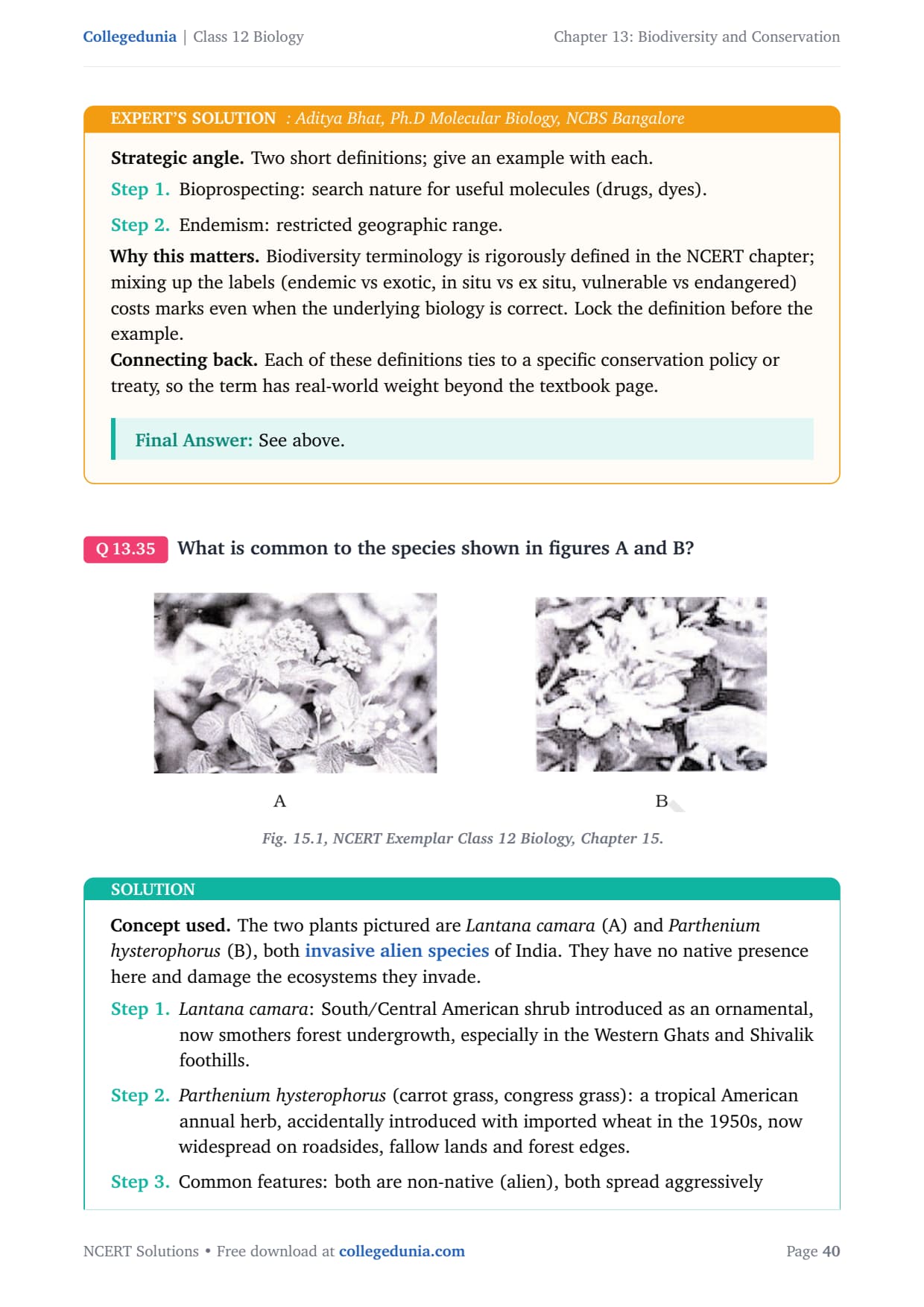
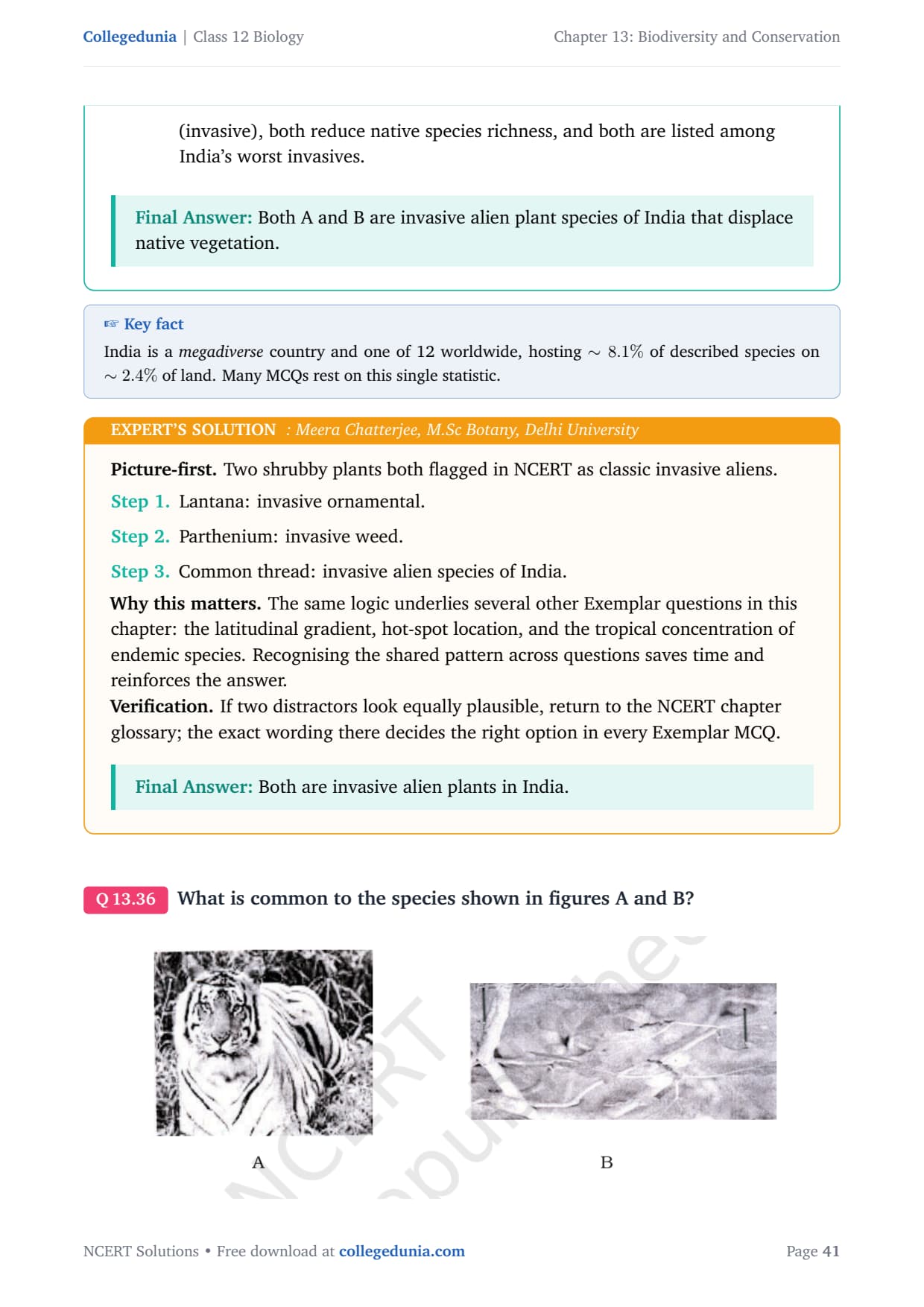

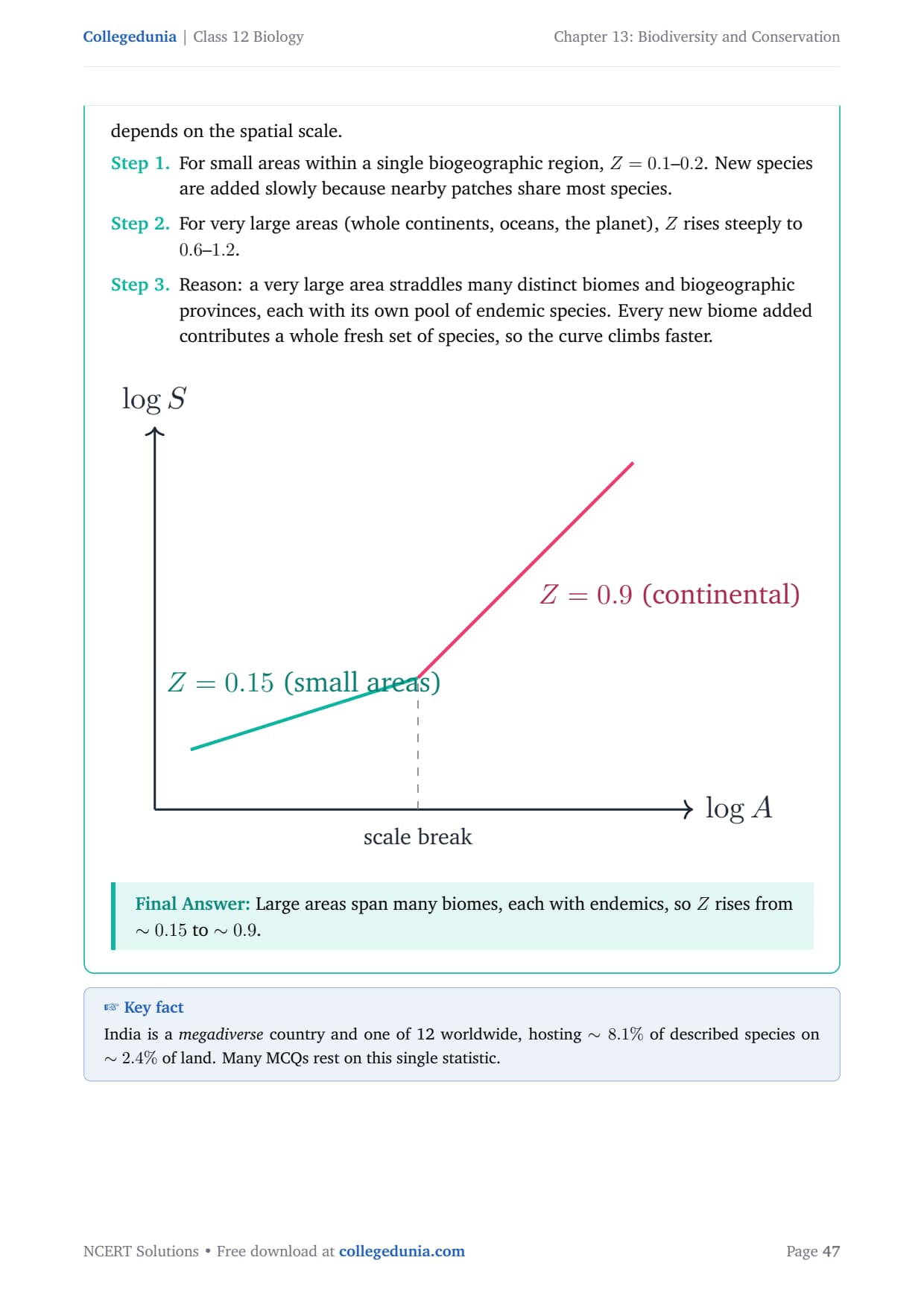

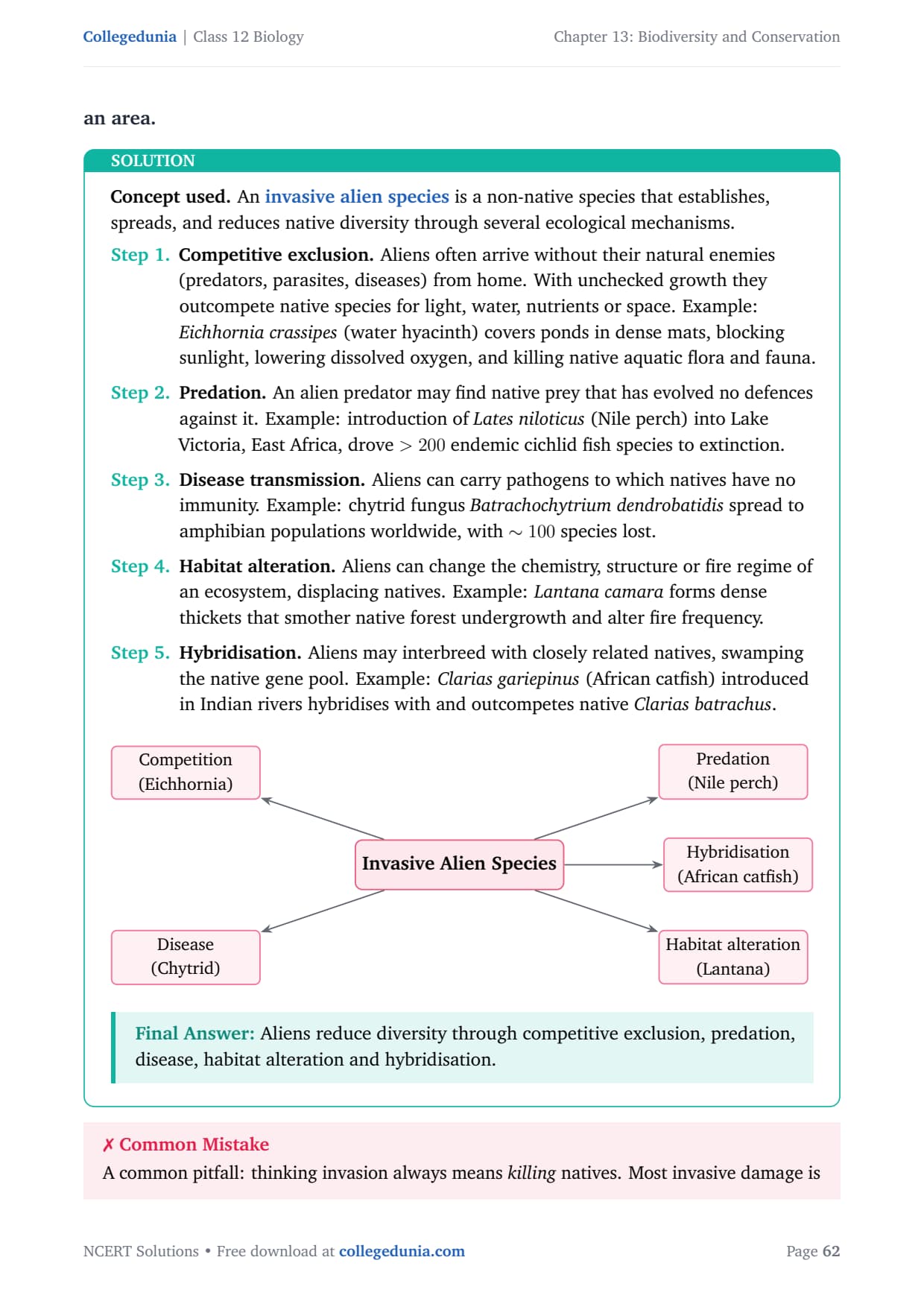
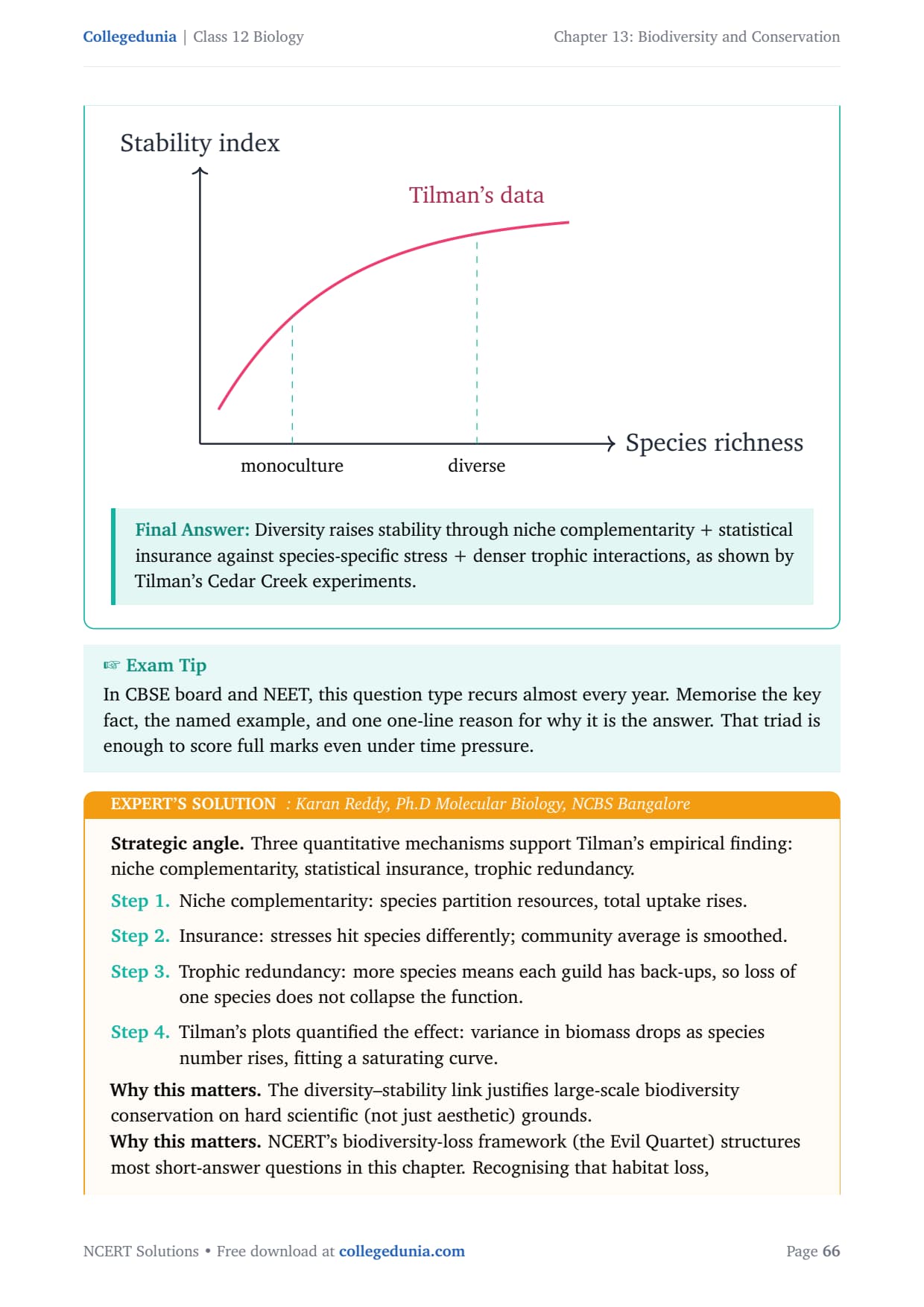
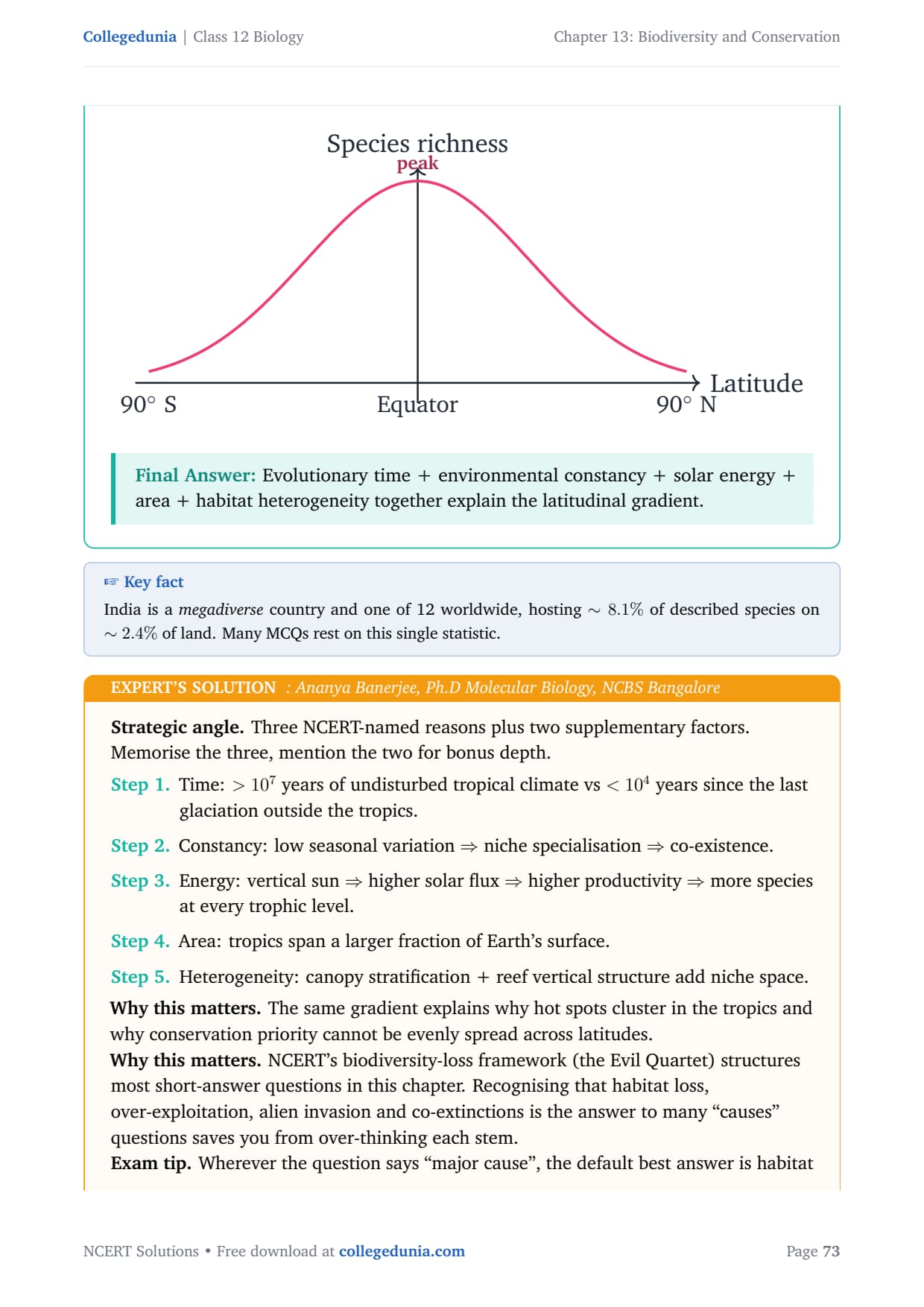
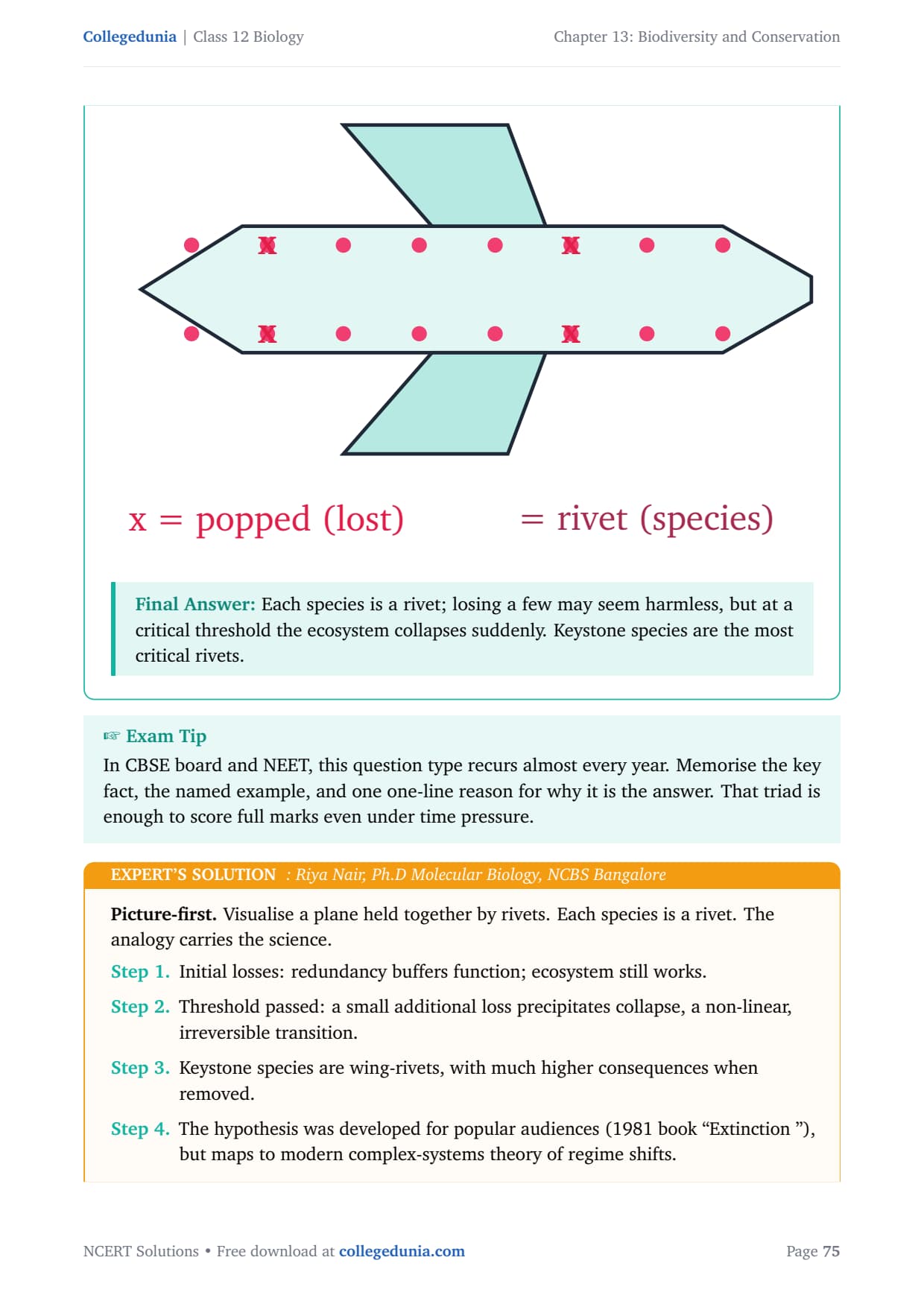

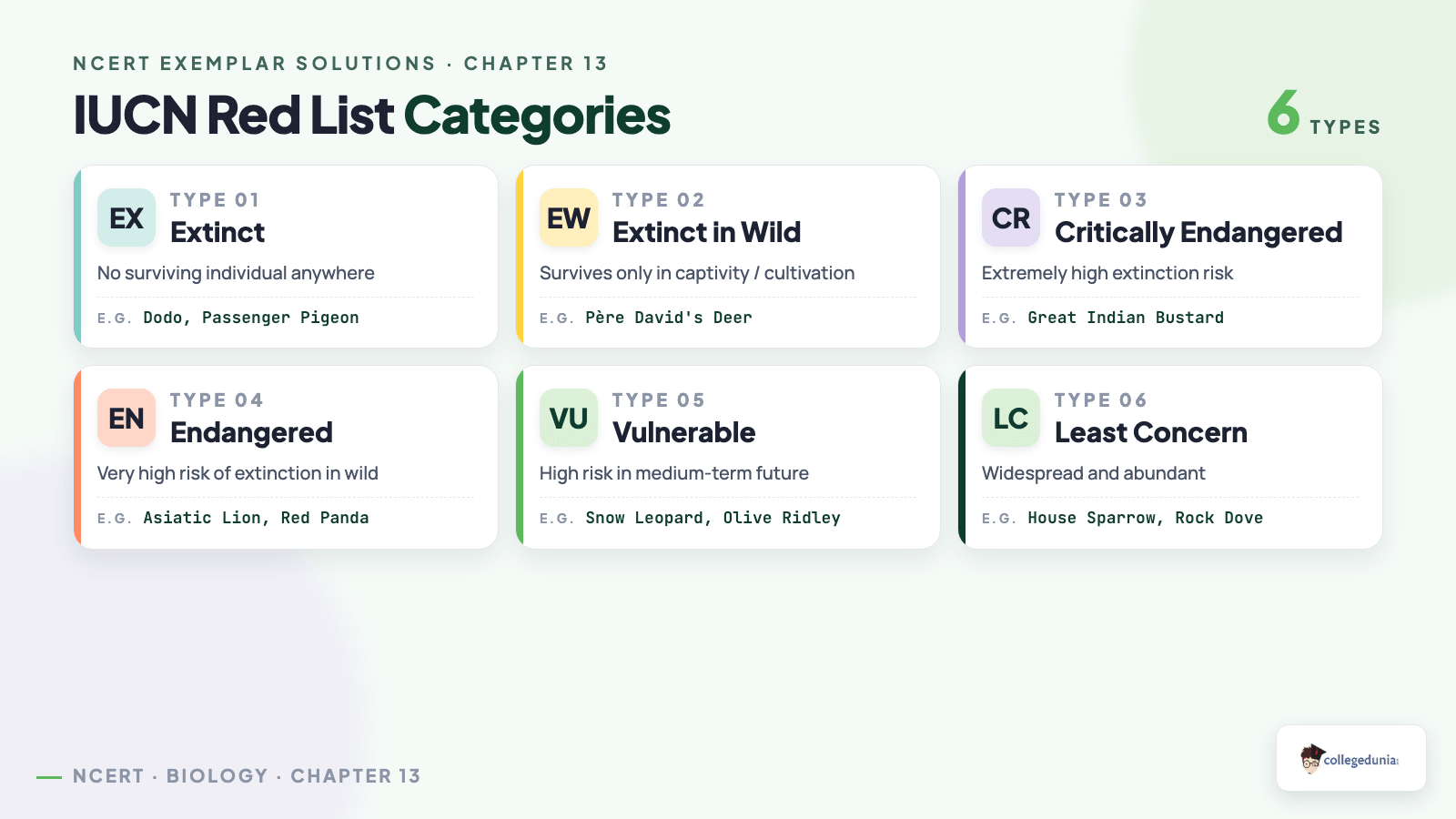
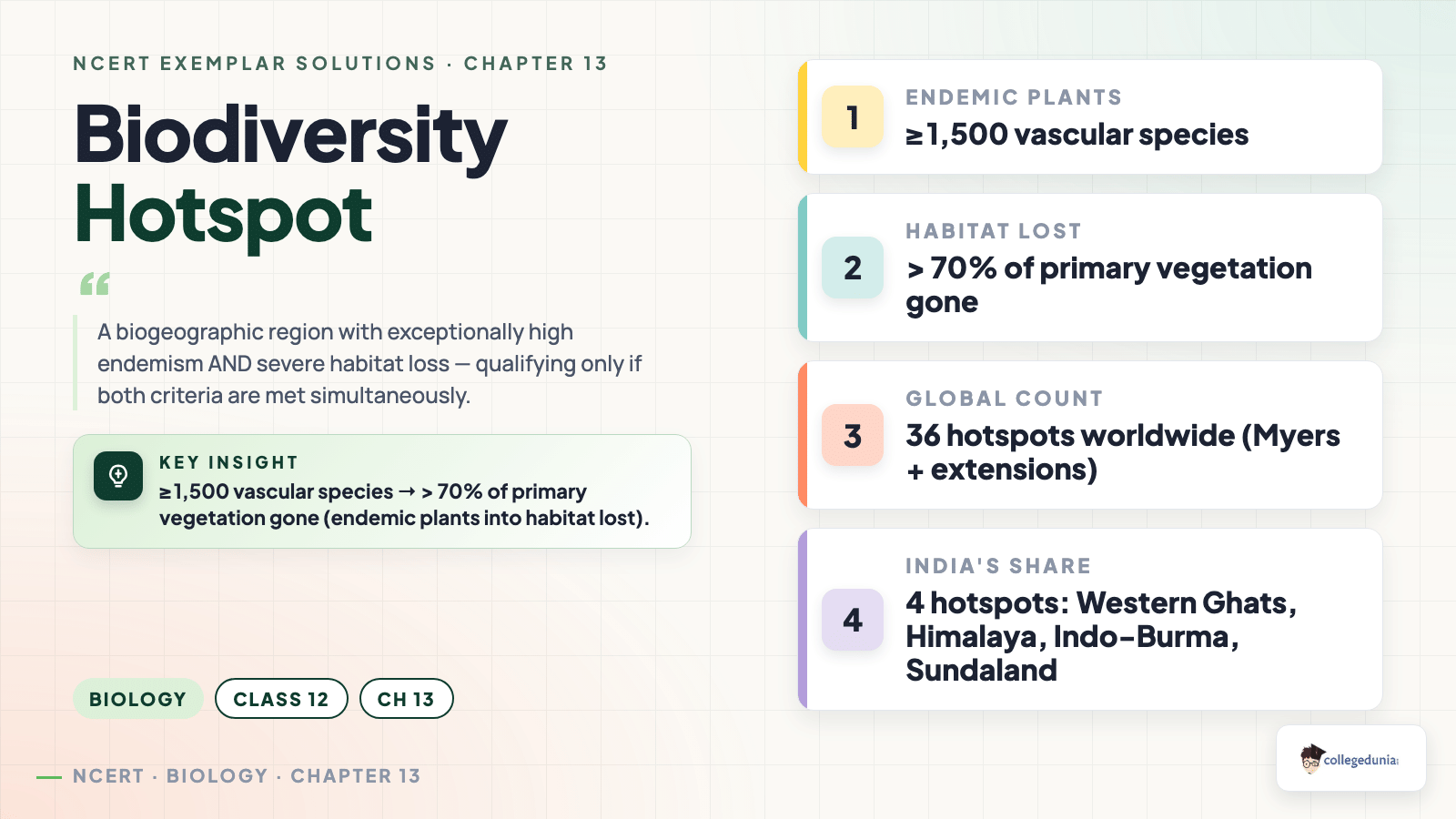
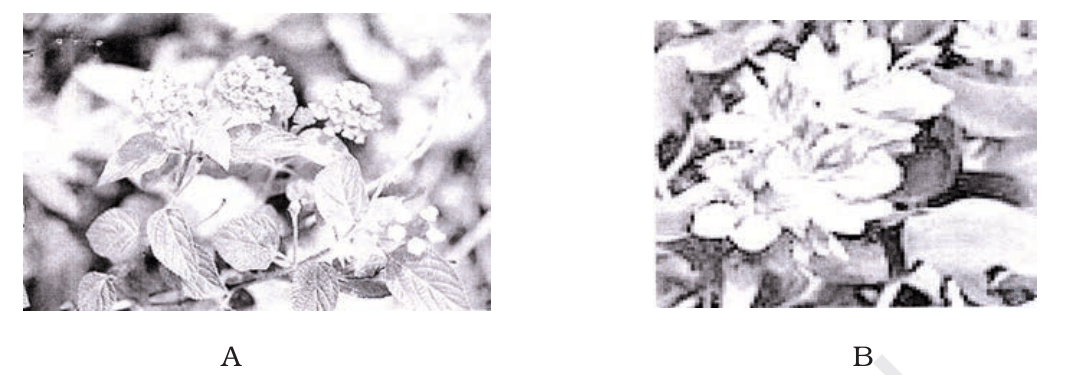



Comments