Chemistry Mentor, Daulat Ram College | Updated on - Jul 21, 2026
The NCERT Exemplar Solutions for Class 12 Chemistry Chapter 8 Aldehydes, Ketones and Carboxylic Acids cover nucleophilic addition reactivity, aldol vs Cannizzaro selectivity, Clemmensen and Wolff-Kishner reductions, and the acidity order of substituted carboxylic acids for CBSE, JEE and NEET.
For the NEET and JEE Main exams, assertion-reason-based MCQs are also included with detailed solutions in this PDF.
CBSE Weightage: 6 to 8 marks, spread across a VSA distinguishing test, an SA on aldol/Cannizzaro or acidity order, and an occasional 5-mark synthesis LA.
JEE Main Weightage: 4 to 5%, about 2 to 3 questions per shift on addition order, named reductions and carbonyl identification.
NEET Weightage: 2 to 4 questions a year on name reactions and substituted-acid pKa order.
Each Exemplar item is solved twice: a clean Solution gives the working, then an Expert's Solution names the mechanism, the +I/-I effect, or the named reaction that controls the outcome.
These Exemplar Solutions are curated by Collegedunia subject experts, mapped to the 2026-27 NCERT, and benchmarked against five years of CBSE, JEE Main and NEET papers.
Aldehydes, Ketones and Carboxylic Acids Exemplar: Question-Type Mix at a Glance
The Exemplar splits Chapter 8 into five buckets. The mix below lets you decide between a one-sitting attempt and a three-day plan organised around named reactions, acidity and identification routes.
Question Type
Item Range
Count
Typical Marks (Board)
MCQ-I (single correct)
8.1 to 8.18
18
1
MCQ-II (multiple correct)
8.19 to 8.27
9
2
Short Answer (SA)
8.28 to 8.41
14
2 to 3
Matching Type
8.42 to 8.45
4
3 to 4
Assertion-Reason / LA
8.46 to 8.55
10
3 to 5
The 18 MCQ-I items alone clear the high-loss bucket: nucleophilic-addition reactivity order, α-H presence test, Clemmensen vs Wolff-Kishner choice, and the Fehling/Tollens diagnostic.
Aldehydes, Ketones and Carboxylic Acids Exemplar Step-Up from the NCERT Textbook
The textbook lays out structure, preparation, nucleophilic addition, oxidation, named reactions and acidity with one-line worked examples. The Exemplar reframes those facts as multi-factor selection puzzles. Three concrete jumps:
Skill
NCERT Textbook Asks
Exemplar Asks
Nucleophilic addition order
State whether aldehydes are more reactive than ketones
Rank HCHO, CH3CHO, C6H5CHO and CH3COCH3 on addition reactivity; justify via +I plus resonance plus steric crowding
Aldol vs Cannizzaro
Write the aldol product of acetaldehyde
Given four carbonyls, pick those that undergo Cannizzaro (no α-H) and those that undergo aldol; explain the α-H switch
Named reductions
Write the Clemmensen product of acetone
Distinguish Clemmensen, Wolff-Kishner, Rosenmund and Stephen on the substrate and reagent; pick the one that survives acid- or base-sensitive groups
The shift is from single-fact recall to multi-factor selection. Every Expert's Solution names the controlling factor (substrate type, α-H status, reagent acid/base sensitivity) so you internalise the move, not the answer.
Aldehydes, Ketones and Carboxylic Acids Class 12th: Sample MCQ-I Solved with Reactivity-Ladder Walk-Through
Nucleophilic addition order is where students lose marks: writing "aldehydes > ketones" without naming the steric and inductive effect.
Q (Exemplar 8.2 style): Which of the following compounds is most reactive towards nucleophilic addition reactions?
(i) CH3-CHO (ii) CH3-CO-CH3 (iii) C6H5-CHO (iv) C6H5-CO-CH3
Answer: (i) CH3-CHO (acetaldehyde).
Expert's reasoning: Reactivity at C=O is set by (a) electrophilicity of the carbonyl carbon and (b) steric crowding around it. Alkyl groups donate electron density via the +I effect and decrease electrophilicity. Aryl groups also donate by resonance into the carbonyl, further deactivating it. Aldehydes outperform ketones because they carry only one alkyl/aryl substituent. So the order is HCHO > CH3CHO > C6H5CHO > CH3COCH3 > C6H5COCH3; among the four options CH3CHO wins.
Stating only the answer without naming the +I and resonance effect costs the justification mark.
Exemplar-Specific Common Mistakes in Aldehydes, Ketones and Carboxylic Acids
Five recurring errors cost students 2 to 4 marks per Exemplar attempt:
Forgetting the α-H rule for aldol vs Cannizzaro: No α-H means Cannizzaro disproportionation; α-H present means aldol condensation under base. HCHO, C6H5CHO and (CH3)3CCHO are the classic Cannizzaro substrates; CH3CHO and CH3COCH3 are aldol substrates.
Confusing Clemmensen and Wolff-Kishner conditions: Clemmensen uses Zn(Hg)/conc. HCl (acid side); Wolff-Kishner uses NH2NH2/KOH (base side). Mixing the two costs the full SA mark on acid- or base-sensitive substrates.
Mis-ranking substituted-acid acidity: EWG (-NO2, -Cl, -F) raises pKa strength via -I; EDG (-OCH3, -CH3) lowers it. Many students forget that position matters too - ortho is stronger than meta or para owing to the proximity effect.
Mixing up Fehling and Tollens: Tollens' reagent ([Ag(NH3)2]+) oxidises both aliphatic and aromatic aldehydes (silver mirror). Fehling's solution (Cu2+/tartrate, alkali) oxidises only aliphatic aldehydes - benzaldehyde and ketones do not respond.
Forgetting that pivaldehyde has no α-H: (CH3)3C-CHO looks like a normal aldehyde, but its α-carbon is quaternary - zero α-H. So it gives Cannizzaro, not aldol.
Best Way to Use the Aldehydes, Ketones and Carboxylic Acids Exemplar for JEE and NEET Prep
A time-boxed pass by question type beats reading all 55 problems in sequence:
Session 1 (40 min): 18 MCQ-I; flag anything over 60 seconds for reactivity-ladder review.
Session 2 (35 min): 9 MCQ-II, using the aldol/Cannizzaro grid and the Clemmensen/Wolff-Kishner split.
Session 3 (70 min): 14 SA on nomenclature, acidity ordering, and structure prediction.
Session 4 (60 min): 4 Matching and 10 A-R / LA items on multi-step synthesis and unknown-compound identification.
Total budget is about 3 hours 30 minutes for a clean first pass; a 60-minute second pass on flagged items locks the chapter in.
All NCERT Exemplar Questions for Aldehydes, Ketones and Carboxylic Acids with Step-by-Step Solutions
Every question of the NCERT Exemplar set for Class 12 Chemistry Chapter 8 Aldehydes, Ketones and Carboxylic Acids is listed below with its full Solution and Expert Solution hidden inside collapsible tabs. Click Check Solution to reveal the step-by-step working; click Expert Solution for the expanded explanation.
I. Multiple Choice Questions (Type-I)
Q 8.1
Addition of water to alkynes occurs in acidic medium and in the presence of Hg2+ ions as a catalyst. Which of the following products will be formed on addition of water to but-1-yne under these conditions?
(i) CH3-CH2-CH2-CHO (ii) CH3-CH2-CO-CH3
(iii) CH3-CH2-C(OH)=CH2 (iv) CH3-CO-OH + HCHO
Correct option: (ii)CH3-CH2-CO-CH3 (butan-2-one).
Concept used. Acid-catalysed hydration of alkynes via Hg2+ (HgSO4/H2SO4) follows Markovnikov's rule: H goes to the carbon bearing more H, and OH to the more substituted carbon. The initial enol tautomerises to the thermodynamically stable keto form. Terminal alkynes (R-C#CH) therefore give a methyl ketone, never an aldehyde (except HC#CH, which gives CH3CHO).
Add H-OH across CH3CH2-C#CH, Markovnikov: OH on C2, H on C1.
Enol formed: CH3CH2-C(OH)=CH2.
Keto-enol tautomerisation drives it to CH3CH2-CO-CH3 (butan-2-one). The keto form is ∼ 106 times more stable.
Butan-2-one, CH3CH2COCH3; option (ii).
AS
Aarav Sharma
M.Sc Chemistry, IIT Kanpur
Verified Expert
Tautomer-first angle. Skip the full mechanism –- whichever option corresponds to the keto form of a Markovnikov-derived enol is the right one. The aqueous Hg2+ ion first complexes the π-bond of the terminal alkyne, then water attacks the more substituted carbon (internal) and a proton settles on the terminal one. This delivers the enol CH3CH2-C(OH)=CH2, which immediately tautomerises to the more stable ketone.
Three quick eliminations. (a) Option (i) would require anti-Markovnikov hydration (hydroboration territory, not Hg2+). (b) Option (iii) is the trapped enol –- only an intermediate, never the isolated product. (c) Option (iv) is a cleavage product (ozonolysis style), not hydration.
Mnemonic. ``Internal OH, terminal H, then flip to ketone.'' For terminal alkynes R-C#CH the result is always a methyl ketone R-CO-CH3 –- the only exception is HC#CH, which gives CH3CHO.
CH3CH2COCH3 (butan-2-one); option (ii).
Q 8.2
Which of the following compounds is most reactive towards nucleophilic addition reactions?
(i) CH3-CHO (ii) CH3-CO-CH3 (iii) C6H5-CHO (iv) C6H5-CO-CH3
Correct option: (i)CH3-CHO (acetaldehyde).
Concept used. Reactivity toward nucleophilic addition at C=O depends on (a) the electrophilicity of the carbonyl carbon and (b) the steric crowding around it. Alkyl groups (+I) donate electron density and decrease electrophilicity; aryl groups (C6H5-) additionally donate through resonance into the carbonyl, further deactivating it. Aldehydes are more reactive than ketones because they have only one alkyl/aryl group attached (less +I, less steric).
Count alkyl/aryl substituents on C=O: CH3CHO has 1 alkyl; (CH3)2CO has 2 alkyl; C6H5CHO has 1 aryl; C6H5COCH3 has 1 aryl + 1 alkyl.
Aryl is worse than alkyl (resonance + size).
Order of reactivity: CH3CHO > C6H5CHO > CH3COCH3 > C6H5COCH3.
4pt 4pt Mechanism cartoon –- nucleophilic addition to C=O:
[10pt]
!%
[See diagram in the PDF version]
%
4pt
Acetaldehyde, option (i), is most reactive.
PI
Priya Iyer
Ph.D Organic Chemistry, IISc Bangalore
Verified Expert
Substituent-count angle. Less ``stuff'' attached to the carbonyl carbon ⇒ more reactive. CH3CHO carries just one methyl and one H on the C=O –- the most sterically exposed and most electrophilic carbonyl in the list. Each extra alkyl group hides the δ+ carbon behind a cone of +I density and adds steric bulk; each aryl group additionally delocalises the carbonyl π into the ring through resonance, weakening the δ+ even further.
Energy-diagram angle. In the rate-limiting step a nucleophile attacks C=O; the transition state already shows partial sp3 character. Bigger groups raise the energy of that sp3-like TS (steric strain), and electron-donating groups raise the LUMO of C=O (less hungry for Nu-). Both effects penalise (iv) C6H5COCH3 the most –- it sits at the bottom of the reactivity ladder, exactly opposite to (i).
Quick filter. HCHO > aliphatic CHO > aromatic CHO > aliphatic ketone > aromatic ketone. Place the four options on this ladder: CH3CHO ranks highest.
CH3CHO (acetaldehyde); option (i).
Q 8.3
The correct order of increasing acidic strength is 1cm.
(i) Phenol < Ethanol < Chloroacetic acid < Acetic acid
(ii) Ethanol < Phenol < Chloroacetic acid < Acetic acid
(iii) Ethanol < Phenol < Acetic acid < Chloroacetic acid
(iv) Chloroacetic acid < Acetic acid < Phenol < Ethanol
Concept used. Acidity is governed by the stability of the conjugate base. (i) Ethoxide (CH3CH2O-) is destabilised by +I of the alkyl group –- weakest acid. (ii) Phenoxide is stabilised by delocalisation over the aromatic ring (5 resonance forms). (iii) Carboxylate (R-COO-) is even more stabilised: the negative charge is shared between two equivalent oxygens through resonance. (iv) Chloroacetate adds the -I pull of Cl, further dispersing the negative charge –- strongest acid.
pKa-ladder angle. Memorise four anchor numbers and the problem solves itself: alcohol ∼16, phenol ∼10, aliphatic R-COOH∼5, α-chloro ClCH2COOH∼3. The smaller the pKa, the stronger the acid; arranging upwards from weakest to strongest gives the answer in seconds.
Why each step drops. Going from ethanol (one localised O-) to phenol, the negative charge spreads over three ring carbons and one oxygen (∼5 resonance forms) –- a 6 pKa-unit jump. Going from phenol to acetic acid, the charge now splits equally between two oxygens (better acceptors than ring C) –- another 5-unit jump. Adding an α-Cl to acetic acid pulls σ-electron density off the carboxylate by induction (-I), dropping pKa by another ∼2 units. Each effect is independent and additive.
Trap to avoid. Do not confuse -I (always reduces pKa) with +M (always raises it). Chlorine is a special case: it is -I but +M. Through a saturated -CH2- linker, only -I reaches the COO-, so Cl acts purely as an acid-strengthener here.
Ethanol < Phenol < AcOH < ClAcOH; option (iii).
Q 8.4
Compound Ph-O-CO-Ph (phenyl benzoate) can be prepared by the reaction of 1cm.
(i) Phenol and benzoic acid in the presence of NaOH
(ii) Phenol and benzoyl chloride in the presence of pyridine
(iii) Phenol and benzoyl chloride in the presence of ZnCl2
(iv) Phenol and benzaldehyde in the presence of palladium
Correct option: (ii) Phenol + benzoyl chloride + pyridine.
Concept used. This is the Schotten–Baumann reaction: an acyl chloride couples with an alcohol or phenol to form an ester, with pyridine acting as both a base (neutralises HCl) and a nucleophilic catalyst (forms a reactive acyl-pyridinium intermediate).
Phenol + benzoic acid (option i) fails –- direct esterification of phenols with acids is sluggish; NaOH would simply give sodium phenoxide.
ZnCl2 (option iii) catalyses Lucas-type SN1 on alcohols, not phenol acylation.
Benzaldehyde + Pd (option iv) does not form an ester.
Net: PhOH + PhCOCl -> PhOCOPh + HCl (in pyridine) proceeds smoothly at room temperature.
Phenol + benzoyl chloride/pyridine; option (ii).
VP
Vivaan Patel
M.Tech Chemical Engineering, IIT Delhi
Verified Expert
Reagent-pair angle. Phenol esters are almost always made from acyl chlorides, not the parent acid. The acid route is sluggish because phenol is a poor nucleophile (the lone pair is delocalised into the ring), and the equilibrium of acid + phenol sits far to the reactant side. The acid chloride bypasses this issue –- the Cl leaving group makes the carbonyl carbon extremely electrophilic.
Why pyridine, not NaOH? A strong base like NaOH would deprotonate phenol to phenoxide, but it would also hydrolyse PhCOCl to PhCOOH faster than ester formation. Pyridine is just basic enough (pKaH ∼5) to mop up HCl without destroying the acyl chloride, and it doubles as a nucleophilic catalyst forming a reactive acyl-pyridinium intermediate that phenol attacks easily.
Mechanism cartoon. (1) PhCOCl + pyridine →PhCO-N+Py + Cl-. (2) Phenol's O attacks the acyl carbon, displacing pyridine. (3) Pyridine grabs the proton from phenol's O-H. Net (in pyridine): PhOH + PhCOCl -> PhOCOPh + HCl (the HCl is scavenged as PyH+Cl-).
PhOH + PhCOCl/pyridine → PhOCOPh; option (ii).
Q 8.5
The reagent which does not react with both acetone and benzaldehyde.
(i) Sodium hydrogensulphite (ii) Phenyl hydrazine
(iii) Fehling's solution (iv) Grignard reagent
Correct option: (iii) Fehling's solution.
Concept used.Fehling's test is the diagnostic oxidation of aliphatic aldehydes by Cu2+ tartrate complex in alkali. Ketones lack the α-C-H alongside a C=O-H unit needed for the redox step. Aromatic aldehydes also fail because the resonance-stabilised C=O is too sluggish.
Acetone (ketone) does not reduce Cu2+ –- no α-H adjacent to a CHO, indeed no CHO at all.
Benzaldehyde (aromatic CHO) also does not give a positive Fehling test –- conjugation with the ring stabilises the aldehyde against oxidation by the mild reagent.
Sodium hydrogensulphite, PhNHNH2, and Grignard reagents all add to both ketones and aldehydes.
Fehling's solution fails with both; option (iii).
AS
Aarav Sharma
M.Sc Chemistry, IIT Kanpur
Verified Expert
Diagnostic-test angle. Fehling is the textbook diagnostic for aliphatic aldehydes only. The reagent is a deep-blue Cu2+-bistartrate complex in NaOH; it relies on a mild two-electron oxidation of R-CHO to R-COO-, with Cu2+ being reduced to brick-red Cu2O. Any carbonyl without the aliphatic-aldehyde combination of (i) an oxidisable C-H on the carbonyl carbon and (ii) no resonance stabilisation flunks the test.
Why each option behaves as it does. (i) Sodium hydrogensulphite NaHSO3 adds to almost every aldehyde and small methyl ketone –- including both acetone and benzaldehyde. (ii) Phenyl hydrazine PhNHNH2 forms a phenylhydrazone with any C=O. (iv) Grignards add to all aldehydes and ketones (and overshoot esters to alcohols). Only Fehling's strikes out twice.
Common pitfall. Tollens' reagent [Ag(NH3)2]+ is stronger than Fehling's and oxidises both aliphatic and aromatic aldehydes (silver-mirror test). So benzaldehyde gives Tollens+ but Fehling-. Confusing the two reagents costs marks.
Fehling's reacts with neither CH3COCH3 nor PhCHO; option (iii).
Q 8.6
Cannizzaro's reaction is not given by
(i) Cyclohexyl-1-methyl-1-carbaldehyde (no α-H on α-C bearing CHO)
(ii) Benzaldehyde (iii) HCHO (iv) CH3CHO
Correct option: (iv)CH3CHO.
Concept used. The Cannizzaro reaction is an intermolecular disproportionation of aldehydes in concentrated NaOH: one molecule is oxidised to a carboxylate, another reduced to the alcohol. The reaction works only for aldehydes that lack an α-hydrogen; otherwise the much faster aldol condensation (under base) takes over.
Inspect α-H: (i) the α-C is quaternary with a methyl –- no α-H. (ii) PhCHO –- aromatic, no α-H. (iii) HCHO –- no α-C at all.
CH3CHO has three α-Hs on the methyl group; in NaOH it undergoes aldol condensation, not Cannizzaro.
CH3CHO has α-H ⇒ no Cannizzaro; option (iv).
PI
Priya Iyer
Ph.D Organic Chemistry, IISc Bangalore
Verified Expert
α-H scan angle. For every aldehyde on the list, scan for a C-H on the carbon directly attached to the carbonyl. If even one such H exists, hydroxide will prefer to remove it (forming an enolate) and aldol condensation takes over; Cannizzaro can run only when this competing path is shut down.
Pass/fail per option. (i) Cyclohexyl-1-methyl-1-carbaldehyde: α-C is quaternary (already four substituents), zero α-H ⇒ Cannizzaro-capable. (ii) Benzaldehyde: α-C is an sp2 ring carbon with no H to lose for an enolate ⇒ Cannizzaro-capable. (iii) Formaldehyde: no α-C exists at all (the only ``other'' substituent on C=O is another H) ⇒ Cannizzaro-capable. (iv) Acetaldehyde: three α-Hs sit on the methyl ⇒ aldol wins overwhelmingly.
Kinetic reason. The aldol path uses cheap enolate formation (pKa of α-C-H∼20 under NaOH) followed by fast addition to a second molecule. Cannizzaro requires hydride transfer from a tetrahedral alkoxide –- a higher-barrier step. Hence Cannizzaro only wins when aldol is impossible.
CH3CHO has α-H, no Cannizzaro; option (iv).
Q 8.7
Which product is formed when benzaldehyde is treated with concentrated aqueous KOH solution?
(i) Sodium benzoate + benzyl alcohol
(ii) Potassium benzoate + benzyl alcohol
(iii) Benzoic acid + benzaldehyde unreacted
(iv) Cinnamaldehyde + KOH
Correct option: (ii) Potassium benzoate + benzyl alcohol.
Concept used. Benzaldehyde has no α-hydrogen, so in concentrated alkali it undergoes Cannizzaro disproportionation. One PhCHO is oxidised to PhCOO-K+ (potassium benzoate) and another is reduced to PhCH2OH (benzyl alcohol).
Hydroxide attacks one PhCHO to form a tetrahedral alkoxide.
Hydride is transferred from this alkoxide to a second PhCHO.
No-α-H angle. Benzaldehyde plus concentrated alkali = Cannizzaro disproportionation. The α-position of PhCHO is an sp2 ring carbon –- no α-H to deprotonate, so the aldol pathway is locked out. With aldol blocked, the next best reaction available to HO- is addition to the carbonyl to form a tetrahedral alkoxide, which then becomes a hydride donor.
Counter-ion bookkeeping. The question carefully specifies KOH, not NaOH. Whichever metal hydroxide is present, its cation appears in the final salt. So KOH⇒potassium benzoate, PhCOO- K+. Option (i), which proposes sodium benzoate, is a deliberate distractor.
Stoichiometry sanity-check. Two molecules of PhCHO + one KOH→ one PhCOOK + one PhCH2OH. The 1:1 product ratio means a 50% yield ceiling –- exactly half is oxidised and half is reduced. Option (iii) (``benzoic acid + unreacted benzaldehyde'') ignores both the disproportionation symmetry and the fact that excess KOH deprotonates any PhCOOH to its potassium salt.
Potassium benzoate + benzyl alcohol; option (ii).
Q 8.8
In the acid-catalysed hydration of propyne (CH3-C#CH) in the presence of Hg2+, the initial enol product is called A. The structure of A and the type of isomerism with its keto form are respectively:
(i) Prop-1-en-2-ol, metamerism
(ii) Prop-1-en-1-ol, tautomerism
(iii) Prop-2-en-2-ol, geometrical isomerism
(iv) Prop-1-en-2-ol, tautomerism
Correct option: (iv) Prop-1-en-2-ol, tautomerism.
Concept used. Markovnikov hydration of a terminal alkyne adds OH to the more substituted carbon (C2) and H to the terminal carbon (C1). The first-formed product is an enol (an OH on an sp2 carbon). The enol form and its corresponding ketone form are related by tautomerism (rapid proton + double-bond shift). The ketone form is ∼ 106 times more stable.
Mark the alkyne carbons: CH3-C#CH has C1 (terminal, more H) and C2 (more substituted).
Add H-OH Markovnikov: H on C1, OH on C2.
Enol A =CH3-C(OH)=CH2, i.e. prop-1-en-2-ol (numbering gives lowest locant to the C=C).
Tautomerises to CH3-CO-CH3 (acetone) via H shift O-H → C-H and double-bond shift C=C → C=O.
A= prop-1-en-2-ol; relationship to acetone = tautomerism. Option (iv).
AS
Aarav Sharma
M.Sc Chemistry, IIT Kanpur
Verified Expert
Naming-the-enol angle. Two pieces of information settle the question: (a) the regiochemistry of acid-catalysed alkyne hydration (Markovnikov, OH on more substituted carbon), and (b) the relationship between an enol and its ketone (tautomerism, never geometrical or metamerism).
Step-by-step. The propyne molecule CH3-C#CH is numbered with C1 at the terminal CH. Markovnikov puts OH on C2 (more substituted) and H on C1, giving CH3-C(OH)=CH2. IUPAC numbering of the resulting alkene: the C=C is between C1 and C2, the OH is on C2, three carbons total ⇒prop-1-en-2-ol.
Why ``tautomerism'', not ``geometrical isomerism''. The keto form CH3-CO-CH3 and the enol form CH3-C(OH)=CH2 are constitutional isomers –- their atoms are connected differently (a proton has moved from O to C, and a double bond has shifted from C=C to C=O). Geometrical isomerism would require the same constitution with different spatial arrangement; metamerism requires different alkyl groups around the same functional group (e.g. ethers, ketones with different chains). Neither fits here.
A = prop-1-en-2-ol; type of isomerism with acetone = tautomerism. Option (iv).
Q 8.9
Consider the sequence: a Grignard reagent R-MgX adds to a carbonyl to give A; A is then hydrolysed to B; oxidation of B with PCC gives C (the original carbonyl). In the NCERT Exemplar scheme, compounds A and C are:
(i) identical (ii) positional isomers
(iii) functional isomers (iv) optical isomers
Correct option: (ii) positional isomers.
Concept used. The NCERT Exemplar pair shows two routes to C5 alcohols/carbonyls where the carbonyl carbon migrates one position along the chain. Positional isomers have the same molecular formula and same functional group, but the functional group sits on a different carbon of the carbon skeleton.
Both A and C have the same molecular formula and identical backbone (no rearrangement during Grignard or PCC).
The carbonyl in C sits on a different carbon than the original OH in A (the position of the functional group has moved).
Same connectivity skeleton, same functional group type, different locant ⇒ positional isomers (not functional, not optical, not identical).
A and C are positional isomers; option (ii).
PI
Priya Iyer
Ph.D Organic Chemistry, IISc Bangalore
Verified Expert
Skeleton-and-group angle. To classify two molecules as positional / functional / chain isomers, ask two questions in order. (1) Same molecular formula? (2) If yes –- same functional group? If yes again, they are either positional or chain isomers depending on whether only the locant of the functional group has changed, or the carbon skeleton has been rearranged. If the functional group itself changed (e.g. CHO → CO or OH → OR), they are functional isomers.
For this question. Grignard addition → hydrolysis preserves the carbon skeleton (no rearrangement). Oxidation of the resulting alcohol with PCC oxidises a C-OH to C=O on the same carbon, so the position of the carbonyl in C is dictated by where the OH ended up in A/B. Because the original Grignard added to a different carbonyl than the one regenerated, the locant of the carbonyl group differs between A and C while the molecular formula and the functional-group type are unchanged.
Rule out the wrong choices. ``Identical'' fails because A and C have different connectivity around the central carbon. ``Functional isomers'' fails because both are carbonyls (same family). ``Optical isomers'' would require a chiral carbon to be present in both with opposite configurations –- not the case here.
Positional isomers; option (ii).
Q 8.10
Which is the most suitable reagent for converting CH3-CH(OH)-CH2CH3 (butan-2-ol) into propanoic acid CH3CH2COOH (a methyl group is removed as CHI3)?
(i) Tollens' reagent (ii) Benzoyl peroxide
(iii) I2 and NaOH solution (iv) Sn and NaOH solution
Correct option: (iii)I2 + NaOH (iodoform reaction with NaOI).
Concept used. The iodoform reaction (sodium hypoiodite, NaOI generated in situ from I2 + NaOH) oxidises a methyl-carbinol CH3-CH(OH)-R first to a methyl ketone CH3-CO-R, then cleaves the CH3-CO bond, expelling CHI3 (yellow precipitate) and leaving the carboxylate R-COO-Na+ (acidification gives R-COOH).
Butan-2-ol CH3-CH(OH)-CH2CH3 has the CH3-CH(OH)- motif –- iodoform-positive.
NaOI oxidises the CH(OH) to C=O giving butanone CH3-CO-CH2CH3.
Three Hs on the methyl are halogenated →CI3-CO-CH2CH3; HO- then expels CI3- as CHI3↓.
Acidification gives propanoic acid CH3CH2COOH.
I2 + NaOH (haloform); option (iii).
KM
Karan Mehta
M.Sc Chemistry, IIT Kanpur
Verified Expert
Reagent-screening angle. Look at the substrate end and the product end. The carbon count goes from C4 to C3, so a C1 fragment is expelled. The fragment ends up as CHI3 (the yellow iodoform) –- a dead giveaway for the haloform reaction with I2 + NaOH.
Why the other reagents fail. (i) Tollens' reagent ([Ag(NH3)2]+) only oxidises aldehydes, not secondary alcohols, and cannot cleave a C-C bond. (ii) Benzoyl peroxide is a radical initiator used in polymerisation or benzylic bromination; it does not selectively oxidise alcohols to carboxylic acids with loss of a C1 fragment. (iv) Sn + NaOH is a mild reducing system (used for nitro → amine reductions, for instance) –- the opposite of what we need.
Net transformation. CH3CH(OH)CH2CH3 + 4 I2 + 6 NaOH -> CH3CH2COO-Na+ + CHI3↓ + 5 NaI + 5 H2O The four iodines do double duty: three end up in CHI3, the fourth is expelled as NaI during the first oxidation step.
I2/NaOH (iodoform); option (iii).
Q 8.11
Which of the following compounds will give butanone on oxidation with alkaline KMnO4 solution?
(i) Butan-1-ol (ii) Butan-2-ol (iii) Both of these (iv) None of these
Correct option: (ii) Butan-2-ol.
Concept used. Oxidation of an alcohol with KMnO4/OH-: a primary alcohol (RCH2OH) is oxidised first to the aldehyde and then to the carboxylic acid (overshoot, KMnO4 is a strong oxidant). A secondary alcohol (R2CH-OH) is oxidised cleanly to the ketone; no further oxidation under mild conditions because the next step would require C-C cleavage.
Butan-1-ol CH3CH2CH2CH2OH (primary): KMnO4 takes it past butanal all the way to butanoic acid, not butanone.
Butan-2-ol CH3CH(OH)CH2CH3 (secondary): KMnO4 oxidises the C(OH)H to C=O giving butan-2-one CH3-CO-CH2CH3 –- exactly what is required.
Only butan-2-ol gives butanone; option (ii).
VP
Vivaan Patel
M.Tech Chemical Engineering, IIT Delhi
Verified Expert
Alcohol-class angle. Classify each candidate as primary, secondary or tertiary by counting the carbons attached to the carbinol carbon. Butan-1-ol: HO-CH2-CH2CH2CH3 –- the carbinol carbon has one alkyl, so it is primary. Butan-2-ol: CH3-CH(OH)-CH2CH3 –- the carbinol carbon has two alkyl groups, so it is secondary.
Why 1∘ overshoots. Primary alcohols are oxidised first to an aldehyde, but the aldehyde C-H is the weakest C-H in the molecule (BDE ∼88 kcal/mol). KMnO4 continues to attack the aldehyde, oxidising it to the carboxylic acid. There is no ``stop'' point at the aldehyde with strong oxidants in aqueous base –- that's why we need PCC, DIBAL, or Rosenmund-style reagents when an aldehyde is the desired product.
Why 2∘ stops cleanly at the ketone. Once the carbinol carbon has been converted to C=O, there is no C-H on the carbonyl carbon to attack. Further oxidation of a ketone requires C-C bond cleavage, which needs much harsher conditions (hot, concentrated KMnO4/H+ over hours). Under standard KMnO4/OH- the ketone is the final product.
Why ``both'' is wrong. Butan-1-ol gives butanoic acid (an acid), not butanone (a ketone). Only butan-2-ol delivers the target.
Butan-2-ol; option (ii).
Q 8.12
In Clemmensen reduction, the carbonyl compound is treated with 1cm.
(i) Zinc amalgam + HCl (ii) Sodium amalgam + HCl (iii) Zinc amalgam + nitric acid (iv) Sodium amalgam +HNO3
Correct option: (i) Zinc amalgam + HCl.
Concept used.Clemmensen reduction converts the C=O of an aldehyde or ketone directly to a CH2 (methylene) group using Zn(Hg)/conc. HCl. It is the acid-side counterpart of the Wolff–Kishner reaction (base side, NH2NH2/KOH). The reagent is chosen for substrates that tolerate strong acid but not strong base.
Acid is needed for the proton-shuttle reduction at the Zn surface; only HCl (non-oxidising) is suitable.
HNO3 would oxidise both the amalgam and the substrate.
Net reaction: with Zn(Hg) in concentrated HCl, R2C=O ⟶ R2CH2 + H2O.
Zinc amalgam + HCl; option (i).
VP
Vivaan Patel
M.Tech Chemical Engineering, IIT Delhi
Verified Expert
Reagent-recall angle. Memorise the two-word phrase ``zinc amalgam, hydrochloric acid'' –- this is the Clemmensen combo and the rest of the options are deliberate distractors.
Why each wrong option fails. (ii) Sodium amalgam + HCl: Na would react violently with HCl to give hydrogen gas long before any organic substrate could be reduced; the amalgam is also a poor surface for the hydride-shuttle mechanism that Clemmensen relies on. (iii) Zinc amalgam + HNO3: nitric acid is a strong oxidiser –- it would oxidise the substrate (and the amalgam) rather than allowing reduction. (iv) Sodium amalgam + HNO3: combines both errors –- wrong metal and wrong acid.
When to pick Clemmensen vs Wolff–Kishner. Both convert C=O → CH2, but Clemmensen needs strong acid (so use it for acid-stable substrates) while Wolff–Kishner needs strong base (use it for base-stable substrates with NH2NH2/KOH in glycol). If your substrate carries an acid-sensitive group (acetal, tert-OH), choose Wolff–Kishner; if base-sensitive (ester, α,β-unsat ketone prone to Michael), choose Clemmensen.
Zinc amalgam + HCl; option (i).
II. Multiple Choice Questions (Type-II)
Q 8.13
Which of the following compounds do not undergo aldol condensation?
(i) CH3CHO (ii) C6H5CHO
(iii) CH3COCH3 (iv) (CH3)3C-CHO (pivaldehyde / 2,2-dimethylpropanal)
Correct options: (ii) and (iv) –- both lack α-hydrogens.
Concept used. The aldol condensation requires at least one α-C-H so that the base can generate an enolate (H-Cα-C=O <-> Cα=C-O-). Aldehydes or ketones that lack anyα-H cannot form an enolate; under base they instead disproportionate via Cannizzaro.
CH3CHO: three α-Hs (methyl) –- gives aldol.
C6H5CHO: α-C is the ring carbon, no α-H –- no aldol.
CH3COCH3: six α-Hs –- gives aldol.
(CH3)3CCHO: α-C is quaternary, no α-H –- no aldol.
Options (ii) and (iv) cannot undergo aldol condensation.
AS
Aarav Sharma
M.Sc Chemistry, IIT Kanpur
Verified Expert
α-H scan angle. Mark the carbonyl carbon, then box the carbon next to it (this is α). Count its hydrogens. Zero α-H⇒ no enolate ⇒ no aldol. Apply this rule mechanically to every option:
Walk-through. (i) CH3CHO: the methyl carbon is α and carries three Hs –- aldol works. (ii) C6H5CHO: the α-C is part of the aromatic ring, sp2 with no C-H that could be removed without destroying aromaticity. No aldol; this molecule undergoes Cannizzaro instead. (iii) CH3COCH3: two methyl groups, six α-Hs –- aldol enthusiastically yields diacetone alcohol. (iv) (CH3)3CCHO (pivaldehyde): the α-C is the quaternary central carbon, no C-H at all ⇒no aldol; pivaldehyde does Cannizzaro just like PhCHO.
Pattern lock. The classic ``no-α-H'' aldehydes are HCHO, PhCHO and (CH3)3CCHO –- formaldehyde, benzaldehyde, pivaldehyde. Whenever any one of these appears in a multi-aldehyde question, expect Cannizzaro / crossed-Cannizzaro chemistry.
Options (ii) and (iv) cannot undergo aldol.
Q 8.14
Treatment of compound Ph-O-CO-Ph with NaOH solution yields
(i) Phenol (ii) Sodium phenoxide (iii) Sodium benzoate (iv) Benzophenone
Correct options: (ii) and (iii) –- phenyl benzoate is saponified to sodium phenoxide + sodium benzoate.
Concept used.Base hydrolysis (saponification) of an ester proceeds by hydroxide addition to the carbonyl, collapse of the tetrahedral intermediate, and expulsion of the alkoxide / phenoxide leaving group. The acid component is trapped as its sodium carboxylate; the alcohol/phenol component is deprotonated under the basic conditions.
PhOCOPh + OH- -> tetrahedral intermediate.
Collapse expels PhO- (phenoxide).
Acid side becomes PhCOOH; under excess NaOH it ionises to PhCOONa (sodium benzoate).
Phenol is also deprotonated by NaOH (pKa 10) to PhONa (sodium phenoxide).
Products: sodium phenoxide + sodium benzoate –- options (ii) and (iii).
PI
Priya Iyer
Ph.D Organic Chemistry, IISc Bangalore
Verified Expert
Saponification angle. For every ester R-C(=O)-O-R′ in NaOH, mentally cut the C(=O)-O bond; the acid side picks up a Na as the carboxylate, the alcohol side keeps its -OH. For phenyl benzoate, R=Ph (on the carbonyl) and R′=Ph (on the oxygen), so the carbonyl side becomes PhCOO-Na+ (sodium benzoate) and the alkyl side becomes phenol.
Why phenol also ends up ionised. Phenol (pKa∼10) is acidic enough that excess NaOH converts it to sodium phenoxide PhO-Na+. So under standard saponification conditions the isolated products are both sodium salts –- option (i) phenol would only be observed after acid work-up.
Why benzophenone is impossible. Option (iv) requires formation of a C-C bond between two phenyls –- saponification is a polar O–C bond cleavage and cannot reorganise the carbon skeleton.
Mechanism in two lines. (1) HO- adds to C=O giving a tetrahedral sp3 intermediate. (2) Phenoxide (PhO-, the better leaving group because it is resonance-stabilised) departs, regenerating C=O on benzoate. Acid–base in alkali then ties up both products as sodium salts.
Sodium phenoxide + sodium benzoate; options (ii) and (iii).
Q 8.15
Which of the following conversions can be carried out by Clemmensen reduction?
(i) Benzaldehyde into benzyl alcohol
(ii) Cyclohexanone into cyclohexane
(iii) Benzoyl chloride into benzaldehyde
(iv) Benzophenone into diphenyl methane
Correct options: (ii) and (iv) –- Clemmensen converts the C=O of a ketone or aldehyde to a CH2 group.
Concept used.Clemmensen reduction (Zn(Hg)/HCl) reduces a carbonyl all the way to a methylene: R2C=O -> R2CH2. It does not stop at the alcohol stage (that's NaBH4 territory) and does not reduce acyl chlorides (that's Rosenmund's job).
(i) PhCHO → PhCH3 (toluene), not PhCH2OH –- so (i) is wrong as stated.
(ii) Cyclohexanone (C6H10=O) → cyclohexane (C6H12) by Clemmensen –- correct.
(iii) Benzoyl chloride → benzaldehyde is Rosenmund (H2/Pd-BaSO4), not Clemmensen.
Reaction-scope angle. Clemmensen reduction Zn(Hg)/HCl has exactly one job: convert C=O (in aldehydes or ketones) all the way down to CH2. It does not stop at the alcohol oxidation state, and it does not reduce other functional groups such as -COCl, -COOH or -COOR. With that scope clearly defined, every distractor is easy to spot.
Per-option check. (i) PhCHO → PhCH2OH stops at the alcohol stage –- Clemmensen would overshoot it to PhCH3 (toluene). So this option mis-states the product. (ii) Cyclohexanone → cyclohexane: classic Clemmensen target, the six-membered ring tolerates strong acid well. (iii) Benzoyl chloride → benzaldehyde is the canonical Rosenmund reaction (H2/Pd-BaSO4, poisoned catalyst); Clemmensen would simply reduce PhCOCl all the way to PhCH3 if it worked, but the Cl is generally lost as HCl first. (iv) Benzophenone → diphenylmethane: textbook Clemmensen on a diaryl ketone –- works.
Two-line reagent map.C=O → CH2 uses Clemmensen (acid) or Wolff–Kishner (base). RCOCl → RCHO uses Rosenmund. RCN → RCHO uses Stephen (Sn-Cl-H) or DIBAL.
Clemmensen-feasible: options (ii) and (iv).
Q 8.16
Through which of the following reactions can the number of carbon atoms in the chain be increased?
(i) Grignard reaction (ii) Cannizzaro's reaction
(iii) Aldol condensation (iv) HVZ reaction
Correct options: (i) and (iii).
Concept used. A reaction adds carbons to the main chain only when it forms a new C-C bond between two distinct carbon fragments. Grignard addition (R-MgX + R′=O) makes one new C-C bond per coupling. Aldol condensation (α-enolate + second carbonyl) likewise builds a new C-C bond between two carbonyl fragments. Cannizzaro (one H- shuffling between two molecules of the same aldehyde) does not join the two carbon skeletons –- the products are separate alcohol + carboxylate. HVZ (Hell–Volhard–Zelinsky) substitutes an α-H of RCH2COOH with a Br atom; no new C-C bond is made.
(i) CH3MgBr + HCHO -> CH3CH2OMgBr -> CH3CH2OH: a new C-C bond forms; ethanol has 2 carbons (from 1 in each starter).
(ii) Cannizzaro: 2 PhCHO → PhCOO- + PhCH2OH. Skeletons remain separate (still C7 each).
(iii) Aldol: 2 CH3CHO → CH3CH(OH)CH2CHO. The 4-carbon backbone is new (C-C bond formed at α-C of one + carbonyl-C of the other).
Bond-formation angle. A clean rule of thumb: count whether the two starting molecules end up linked by a fresh C-C bond. If yes, the carbon count of the product chain exceeds either starting material; if no, no chain growth.
Walk-through. (i) Grignard R-MgX delivers a carbanion to the C=O carbon, forming a C-C bond between the R of the Grignard and the carbonyl carbon of the substrate. Net carbon gain ≥ 1. (ii) Cannizzaro disproportionates two aldehyde molecules but never welds them together –- the products PhCH2OH and PhCOO- each keep the original carbon count. (iii) Aldol couples the α-carbon (nucleophile, after enolate formation) of one carbonyl to the C=O carbon (electrophile) of another; product chain doubles in carbon count. (iv) HVZ swaps an α-H of a carboxylic acid for Br –- no new carbon, no chain growth.
Quick check. Of the four, only Grignard and aldol involve nucleophilic carbon attacking an electrophilic carbon. Cannizzaro is a hydride shuffle (atom transferred is H-, not C); HVZ is an α-halogenation (atom transferred is Br).
Chain-lengthening routes: options (i) and (iii).
Q 8.17
Benzophenone can be obtained by 1cm.
(i) Benzoyl chloride + Benzene +AlCl3
(ii) Benzoyl chloride + Diphenyl cadmium
(iii) Benzoyl chloride + Phenyl magnesium chloride
(iv) Benzene + Carbon monoxide +ZnCl2
Correct options: (i) and (ii).
Concept used. (i) Friedel–Crafts acylation: benzoyl chloride and benzene over AlCl3 generate an acylium ion PhCO+ which substitutes onto the ring giving benzophenone. (ii) Dialkyl cadmium reagents are mild enough to convert an acyl chloride to a ketone without over-addition; R2Cd + 2 R′COCl -> 2 R′COR + CdCl2.
(i) Friedel–Crafts: with AlCl3 (Friedel–Crafts), PhCOCl + C6H6 ⟶ C6H5-CO-C6H5
(ii) Ph2Cd + 2 PhCOCl -> 2 Ph-CO-Ph –- works.
(iii) PhMgCl + PhCOCl gives PhCOPh first, but a second Grignard adds onto the ketone making Ph3C-OH (triphenylmethanol) –- over-addition, so not selective.
(iv) Gattermann–Koch (CO + HCl) gives benzaldehyde not benzophenone.
Selective routes: (i) and (ii).
VP
Vivaan Patel
M.Tech Chemical Engineering, IIT Delhi
Verified Expert
Selectivity angle. The pivotal idea is selectivity –- of the four options, which routes stop cleanly at the ketone without over-reacting? Friedel–Crafts acylation and dialkyl-cadmium addition do; Grignard does not; the Gattermann–Koch reaction makes the wrong product.
Mechanism map for (i).AlCl3 abstracts the chloride from PhCOCl, generating the resonance-stabilised acylium ion Ph-C+=O. Benzene attacks this electrophile via standard EAS; loss of H+ regenerates the aromatic ring, leaving Ph-CO-Ph. Because Ph-CO-Ph is deactivated relative to benzene, a second acylation is too slow –- the reaction stops at the mono-ketone.
Why dialkyl-cadmium works for (ii).R2Cd is a soft organometallic –- the C-Cd bond is far less polar than C-Mg. It transfers an R group to the electrophilic C=O of an acyl chloride, but is not nucleophilic enough to attack the resulting ketone. Grignard (R-MgX) is too aggressive –- it ploughs through both stages, ending at the 3∘ alcohol Ph3COH.
Why (iv) is wrong. Gattermann–Koch is C6H6 + CO/HCl → PhCHO (with AlCl3/CuCl) –- it formylates benzene to benzaldehyde, not benzophenone. The product is an aldehyde with only one ring.
Selective ketone routes: options (i) and (ii).
Q 8.18
For nucleophilic addition of CN- to acetaldehyde (CH3-CHO), which of the following best represents the tetrahedral intermediate(s) formed after attack of Nu- on the carbonyl carbon?
(i) A tetrahedral alkoxide with the four substituents Nu, H, CH3 and O- on the former carbonyl carbon.
(ii) A tetrahedral alcohol obtained after protonation of the alkoxide in step (i).
(iii) An enolate CH2=C(O-)-CH3 (no Nu bonded).
(iv) A radical-pair intermediate with Nu• and R-C•-O• separated.
Correct options: (i) and (ii).
Concept used.Nucleophilic addition to a carbonyl proceeds in two well-defined steps: (1) Nu- attacks the δ+ carbonyl carbon, the π electrons flow onto oxygen, giving a tetrahedral alkoxide (R2C(Nu)O-); (2) aqueous work-up (or a protic solvent) protonates the alkoxide to the neutral tetrahedral alcohol/cyanohydrin. The reaction is strictly polar (heterolytic), not radical.
Option (iii) (enolate) is the wrong intermediate; the enolate route is what happens when the base removes an α-H, not when Nu- adds to C=O.
Option (iv) (radicals) is wrong –- the addition is polar across the heterolytic Cδ+=Oδ- dipole.
The two genuine intermediates are the alkoxide and (after H+) the neutral alcohol: (i) and (ii).
PI
Priya Iyer
Ph.D Organic Chemistry, IISc Bangalore
Verified Expert
Two-step polar angle. Every nucleophilic addition to a carbonyl traverses exactly two intermediates: the alkoxide (immediately after Nu- adds) and the neutral addition product (after the alkoxide picks up H+ from solvent or work-up). Both are tetrahedral at the former carbonyl carbon –- the sp2 → sp3 rehybridisation is the geometric signature of nucleophilic addition.
Why options (iii) and (iv) are wrong. (iii) An enolate CH2=C(O-)-CH3 arises when a base removes an α-H, not when Nu- adds to the carbonyl carbon. Enolates lead to aldol/Claisen chemistry, an entirely different pathway. (iv) A radical-pair intermediate would imply homolytic cleavage of C=O into two unpaired electrons –- never observed under standard polar nucleophilic-addition conditions (would require photochemistry or a radical initiator).
Mechanism mini-cartoon. The carbonyl carbon is sp2 and δ+. Nu- approaches from above or below the C=O plane (Bürgi–Dunitz trajectory, ∼107∘ to the C=O bond). The π electrons of C=O flow to oxygen as Nu–Cσ forms; geometry collapses to tetrahedral sp3. The alkoxide carries a full -1 charge on O –- the σ-bonded Nu is now stable on carbon. Aqueous work-up protonates the alkoxide to deliver the neutral cyanohydrin R2C(CN)(OH).
Alkoxide (i) and the neutral protonated form (ii) are the genuine intermediates.
III. Short Answer Type
Q 8.19
Why is there a large difference in the boiling points of butanal (C3H7CHO, b.p. 76 ∘C) and butan-1-ol (C4H9OH, b.p. 118 ∘C)?
Concept used. Boiling points scale with the strength of intermolecular forces in the liquid. Butan-1-ol has an O-H group and can form strong intermolecular hydrogen bonds (O-H ⋯ O network), while butanal can only engage in dipole–dipole attraction through its C=O and weak C-H⋯ O=C interactions –- no O-H donor.
Identify H-bond donor: butan-1-ol has O-H (donor + acceptor); butanal has C-H next to C=O (acceptor only).
Hydrogen-bond energy (∼ 20 kJ/mol) is much greater than ordinary dipole–dipole (∼ 4-8 kJ/mol).
More energy is needed to disrupt the H-bonded network in butan-1-ol, raising its b.p. by ∼ 42∘C above butanal, despite similar molar masses (72 vs 74).
Butan-1-ol forms inter-molecular H-bonds (O–H ⋯ O); butanal cannot, hence its lower boiling point.
AS
Aarav Sharma
M.Sc Chemistry, IIT Kanpur
Verified Expert
Donor-vs-acceptor angle. The cleanest framework is to classify each functional group as a hydrogen-bond donor, acceptor, or both. Butan-1-ol's O-H is a strong donor and the same oxygen lone pair is a strong acceptor –- a bi-functional unit that knits a continuous H-bond network through the whole liquid. Butanal's C=O is an acceptor only –- it has no O-H donor of its own, so individual molecules cannot link up except via the weak C-H ⋯ O contact (∼2 kJ/mol, barely a true H-bond).
Energetic accounting. Each genuine H-bond costs ∼20–25 kJ/mol to break. In butan-1-ol every molecule participates in ∼2 H-bonds (one donor, one acceptor), so vaporisation must overcome ∼40 kJ/mol of network energy. In butanal the dipole–dipole pull of C=O is only ∼8 kJ/mol per pair. The Δ Hvap gap directly maps to the ∼42 ∘C boiling-point gap.
Molar-mass control. The two compounds have nearly identical molar masses (butanal 72 vs butan-1-ol 74). London dispersion is therefore essentially equal, so the boiling-point difference is a clean measure of the H-bonding contribution –- a favourite JEE trick to test whether students confuse mass effects with polar effects.
Butan-1-ol's O-H ⋯ O network gives it a much higher b.p.
Q 8.20
Write a chemical test to differentiate between pentan-2-one and pentan-3-one.
Concept used.Iodoform test (sodium hypoiodite, NaOH/I2) is positive for methyl ketones of the form CH3-CO-R (and acetaldehyde CH3-CHO) –- the CH3 is trihalogenated and cleaved to give yellow CHI3 crystals (m.p. 119 ∘C) and a carboxylate.
Pentan-2-one =CH3-CO-CH2CH2CH3: has the CH3CO- methyl-ketone motif ⇒positive iodoform (yellow ppt of CHI3).
Pentan-3-one =CH3CH2-CO-CH2CH3: no CH3CO- unit ⇒negative iodoform.
Conclusion: warm with I2 + NaOH. Yellow ppt identifies pentan-2-one; no ppt identifies pentan-3-one.
Iodoform test –- pentan-2-one → yellow CHI3; pentan-3-one → no reaction.
PI
Priya Iyer
Ph.D Organic Chemistry, IISc Bangalore
Verified Expert
Methyl-ketone angle. Draw both structures and scan for the CH3-CO- unit on the carbonyl. Pentan-2-one is CH3-CO-CH2CH2CH3 –- the methyl on the left of the C=O qualifies. Pentan-3-one is CH3CH2-CO-CH2CH3 –- both sides of the carbonyl are ethyl groups, no methyl directly on C=O, so the iodoform pathway cannot start.
Why the iodoform test is so selective. In alkali, the CH3 of a methyl ketone is deprotonated to an enolate; the enolate's α-carbon is then halogenated three times in succession to give R-CO-CI3. The -CI3 is a remarkably good leaving group (three Cl stabilise the carbanion) –- HO- expels it as CHI3↓ (yellow ppt, m.p. 119 ∘C), leaving the carboxylate R-COO-. No other structural motif provides all three pieces: three identical α-H, an electron-sink C=O, and a tri-halogenated good leaving group.
Lab observation. On warming pentan-2-one with I2 in aqueous NaOH (∼60 ∘C), a fine, pale yellow, sweet-smelling solid of CHI3 precipitates within seconds. Filtering and weighing this gives both qualitative and quantitative proof of a methyl-ketone group. Pentan-3-one under identical conditions shows no precipitate.
Iodoform: pentan-2-one +, pentan-3-one -.
Q 8.21
Give the IUPAC names of
(i) (C6H5)CH=CH-CHO
(ii) cyclohexane carbaldehyde
(iii) CH3CH2COCH2CHO
Concept used.IUPAC nomenclature of carbonyls: the principal chain includes the C=O; the aldehyde carbon is C1. Suffixes: aldehyde → ``-al''; ketone → ``-one'' with locant; a C=O on a ring as a substituent → ``-carbaldehyde''. Double bonds are flagged with the lowest possible locant.
(i) C6H5-CH=CH-CHO: 3-phenyl chain with C=C at C2–C3 ⇒3-phenylprop-2-enal (cinnamaldehyde).
(ii) C6H11-CHO: ring +CHO pendant ⇒cyclohexanecarbaldehyde.
(iii) CH3CH2-CO-CH2-CHO: 5 carbons with CHO as C1, C=O at C3 ⇒3-oxopentanal.
(i) 3-Phenylprop-2-enal; (ii) Cyclohexanecarbaldehyde; (iii) 3-Oxopentanal.
KM
Karan Mehta
M.Sc Chemistry, IIT Kanpur
Verified Expert
Suffix-pick angle. A three-line decision tree settles every carbonyl-name. (1) If CHO is counted in the principal chain, use suffix -al with the CHO-carbon as C1. (2) If CHO is attached to a ring not counted in the main chain, use -carbaldehyde (and the ring carbon bearing CHO is automatically C1 of the ring). (3) If an extraC=O sits inside the chain, name it with the prefix -oxo- and a locant.
Walk-through. (i) Ph-CH=CH-CHO: chain has three carbons (CHO=C1), a C=C between C2–C3, and a phenyl at C3. Suffix ``-al'' + locant ``-2-en'' + prefix ``3-phenyl'' gives 3-phenylprop-2-enal. (ii) C6H11-CHO: CHO hangs off a saturated cyclohexane ring; ring is principal ⇒cyclohexanecarbaldehyde. (iii) CH3CH2-CO-CH2-CHO: a 5-carbon chain with CHO at C1 (top priority) and a second C=O at C3 (named ``3-oxo'') ⇒3-oxopentanal.
Priority anchor. When both an aldehyde and a ketone appear, the aldehyde wins (gets the suffix, lowest locant); the ketone is relegated to the ``-oxo-'' prefix. This is why entry (iii) is named 3-oxopentanal, not 3-oxo-1-pentanone or 1-formylbutan-2-one.
(i) 3-phenylprop-2-enal; (ii) cyclohexanecarbaldehyde; (iii) 3-oxopentanal.
Q 8.22
Give the structures of
(i) 4-nitropropiophenone
(ii) 2-hydroxycyclopentanecarbaldehyde
(iii) phenyl acetaldehyde.
Concept used.Name-to-structure: identify the parent (benzene, cyclopentane, etc.), the suffix functional group (its locant is implicit at C1 for aldehydes), and the substituents with their locants.
(i) Propiophenone =C6H5-CO-CH2CH3; ``4-nitro'' adds NO2para on the ring. Structure: O2N-C6H4-CO-CH2CH3.
(ii) Cyclopentanecarbaldehyde has CHO on C1 of a five-membered ring; ``2-hydroxy'' puts OH on the adjacent C2. Structure: cyclopentane with CHO at C1 and OH at C2.
(iii) Phenyl acetaldehyde =C6H5-CH2-CHO (2-phenylethanal in IUPAC).
(i) p-O2N-C6H4-COCH2CH3; (ii) cyclopentane-1-carbaldehyde with 2-OH; (iii) C6H5CH2CHO.
VP
Vivaan Patel
M.Tech Chemical Engineering, IIT Delhi
Verified Expert
Parse-the-name angle. For every name in the question, identify (a) the parent skeleton (the last word), (b) the principal functional group that gives the parent its suffix, and (c) any prefix substituents with their locants. Then draw.
(i) 4-nitropropiophenone. Parse: phenone = phenyl ketone, propio = propanoyl (CH3CH2CO-). So the parent is C6H5-CO-CH2CH3. The ``4-nitro'' substituent goes para on the phenyl ring (numbering starts from the carbon attached to the CO). Final: p-O2N-C6H4-CO-CH2CH3.
(ii) 2-hydroxycyclopentane-1-carbaldehyde. Parent = cyclopentane (5-ring); the suffix ``-carbaldehyde'' attaches a CHO to a ring carbon, automatically C1. The 2-hydroxy adds OH to the neighbouring carbon. So: a cyclopentane ring with CHO at C1 and OH at the adjacent C2.
(iii) Phenyl acetaldehyde. Parse: acetaldehyde (CH3CHO) with one H on the methyl replaced by phenyl –- C6H5-CH2-CHO. The IUPAC equivalent is 2-phenylethanal.
Pitfall. ``Propiophenone'' is a semi-systematic legacy name; beginners often draw benzaldehyde + ethyl group instead. The ketonic C=O sits between the phenyl and the propanoyl ethyl group –- not at the end of a chain.
Structures as drawn step-by-step above.
Q 8.23
Write IUPAC names of (i) benzene-1,4-dicarbaldehyde (terephthalaldehyde) (ii) 3-bromobenzaldehyde.
Concept used. For two CHO groups attached to a ring, the suffix is ``-dicarbaldehyde'' with locants. A halo substituent on a benzaldehyde gets the lowest locant consistent with the CHO being at C1.
Two CHO groups para on benzene ⇒benzene-1,4-dicarbaldehyde.
Single CHO at C1, Br at C3 (meta) on benzene ⇒3-bromobenzaldehyde.
(i) Benzene-1,4-dicarbaldehyde; (ii) 3-Bromobenzaldehyde.
AS
Aarav Sharma
M.Sc Chemistry, IIT Kanpur
Verified Expert
Suffix-and-locant angle. Three IUPAC rules nail every ring–CHO compound. (1) The aldehyde group CHO has the highest priority among the substituents in this question, so it defines the principal characteristic group. (2) When CHO is attached to a ring (and the ring is the parent), use the ``-carbaldehyde'' suffix; when there are two such groups, use ``-dicarbaldehyde'' with appropriate locants. (3) Number the ring so that the suffix carbons get the lowest possible locants first, then minimise the locants of remaining substituents.
(i) Terephthalaldehyde. Two CHO groups sit at opposite ends (para) of a benzene ring. Number C1 and C4 to give the suffix groups: benzene-1,4-dicarbaldehyde. The 1,4-locant set 1,4 is the smallest possible for two para substituents.
(ii) 3-bromobenzaldehyde. A single CHO becomes C1 of the ring (suffix-bearing). The bromine sits meta to it. Going clockwise gives Br at C3; going anticlockwise also gives C3 (meta is symmetric). Name: 3-bromobenzaldehyde.
Why not ``benzene-1-carbaldehyde'' or ``5-bromobenzaldehyde''? When there is only one ring–CHO, IUPAC accepts the shortcut name ``benzaldehyde'' as the parent; you don't need to spell out ``benzene-1-carbaldehyde''. And Br at C5 (also meta) gives the higher locant, so we pick C3 by the lowest-locant rule.
(i) benzene-1,4-dicarbaldehyde; (ii) 3-bromobenzaldehyde.
Q 8.24
Benzaldehyde can be obtained from benzal chloride (C6H5CHCl2). Write reactions for obtaining benzal chloride and then benzaldehyde from it.
Concept used.Side-chain halogenation of toluene with Cl2 under UV light (free-radical, no Lewis acid) installs two chlorines on the methyl carbon to give benzal chloride. Mild alkaline hydrolysis then converts the gem-dichloride to the aldehyde via an unstable gem-diol that loses water.
Step 2 –- alkaline hydrolysis: C6H5CHCl2 + 2 NaOH -> [C6H5CH(OH)2] -> C6H5CHO + H2O (gem-diol collapses to aldehyde + H2O; NaCl is the by-product).
Toluene (Cl2, hν) → benzal chloride; then (NaOH/aq) → benzaldehyde.
PI
Priya Iyer
Ph.D Organic Chemistry, IISc Bangalore
Verified Expert
Two-stage angle. The conversion has two distinct stages, each with its own selectivity rule.
Stage 1 –- side-chain chlorination. Toluene + 2 equivalents of Cl2 under UV light (or peroxide initiator, high temperature) proceeds via radical chain: Cl· abstracts a benzylic H (BDE only ∼88 kcal/mol because the resulting benzyl radical is resonance-stabilised over the ring), and the benzyl radical captures Cl· from Cl2. The second chlorination at the same carbon is even easier –- PhCH2Cl → PhCHCl2 – and controllable stoichiometry stops short of PhCCl3. No Lewis acid: adding FeCl3 would redirect chlorination to the ring (EAS at the ortho/para positions).
Stage 2 –- hydrolysis of the gem-dichloride. In dilute aqueous NaOH each C-Cl undergoes SN substitution with OH-, giving the unstable gem-diol PhCH(OH)2. Gem-diols of aromatic aldehydes are unstable (the two OH groups on one sp3 carbon have an unfavourable steric/electronic clash) and lose one molecule of water to give the planar aldehyde PhCHO –- the thermodynamic minimum.
Why this route is preferred industrially. Toluene is cheap, Cl2/hν is one-step gas-phase chemistry, and the subsequent aqueous hydrolysis runs at ∼100 ∘C in steam. This is in fact one of the historical industrial routes to benzaldehyde, before selective oxidations of toluene took over.
PhCH3 (Cl2, hν) →PhCHCl2 (NaOH/aq, Δ) →PhCHO.
Q 8.25
Name the electrophile produced in the reaction of benzene with benzoyl chloride in the presence of anhydrous AlCl3. Name the reaction also.
Concept used.Friedel–Crafts acylation of benzene with an acyl chloride uses a Lewis acid (AlCl3) to abstract the Cl from R-COCl, generating a resonance-stabilised acylium cationR-C(+)=O (also written R-CO+). This acylium ion is the electrophile that attacks the aromatic ring in standard electrophilic aromatic substitution (EAS).
Formation of electrophile: C6H5-CO-Cl + AlCl3 -> C6H5-CO+ + AlCl4-.
The electrophile is the benzoylium cationC6H5-CO+ (resonance forms: C6H5-C+=O↔C6H5-C#O+; the latter linear form has a triple-bond-like character to oxygen).
EAS onto benzene gives a Wheland intermediate; loss of H+ restores aromaticity, producing benzophenone C6H5-CO-C6H5.
Lewis-acid activation angle.AlCl3 is the master chloride-abstractor in Friedel–Crafts chemistry. It coordinates to the Cl of PhCOCl, weakens the C-Cl bond, and finally pulls Cl- off entirely as AlCl4-. What is left is the acylium cation PhCO+ –- the genuine electrophile that attacks the ring.
Why acylium beats alkyl carbocation. An alkyl carbocation R+ (generated by R-Cl + AlCl3) often rearranges to a more stable carbocation before attacking benzene (Friedel–Crafts alkylation suffers from chain shuffles). The acylium ion does not rearrange because the + charge is already heavily stabilised by resonance with the lone pair of oxygen (R-C+=O → R-C#O+). That extra stability is also why Friedel–Crafts acylation always installs the acyl group cleanly and predictably.
Why monoacylation, not polyacylation. The product PhCOPh has a deactivating C=O on the ring (the carbonyl withdraws electron density via -M); a second EAS is much slower than the first because the ring electron density has dropped. This is why one equivalent of PhCOCl + benzene gives clean benzophenone, not a di-acylated product.
Electrophile is the benzoylium cationPhCO+; reaction is the Friedel–Crafts acylation.
Q 8.26
Oxidation of ketones involves carbon–carbon bond cleavage. Name the products formed on strong oxidation of 2,5-dimethylhexan-3-one.
Concept used. Under harsh oxidising conditions (hot, concentrated KMnO4/H+ or CrO3/H+), ketones are cleaved at the C-CO bond on both sides of the carbonyl. The carbonyl carbon ends up in the shorter fragment as a COOH, and the other side gives the carboxylic acid corresponding to the carbon skeleton on that side. Popoff's rule helps predict which side cleaves preferentially when the two α-carbons are different.
Structure of 2,5-dimethylhexan-3-one: (CH3)2CH-CO-CH2CH(CH3)2 (isopropyl on left of C=O, isobutyl on right –- 2,5-dimethyl numbering on a hexan-3-one).
Strong oxidation cleaves both Cα-CO bonds:
Left side: (CH3)2CH- + CO→(CH3)2CHCOOH (isobutyric / 2-methylpropanoic acid).
Right side: -CH2CH(CH3)2→(CH3)2CHCOOH (also 2-methylpropanoic acid, after loss of the terminal CH2 as CO2).
Net products: two molecules of 2-methylpropanoic acid (a.k.a. isobutyric acid, (CH3)2CHCOOH); the small fragment CO2 also escapes from the secondary cleavage.
Strong oxidation gives 2-methylpropanoic acid(CH3)2CHCOOH from both sides of the carbonyl (+ CO2).
VP
Vivaan Patel
M.Tech Chemical Engineering, IIT Delhi
Verified Expert
Symmetry-of-the-skeleton angle. 2,5-dimethylhexan-3-one is nearly symmetrical about its C=O. The left half is (CH3)2CH- (isopropyl, C3); the right half is -CH2-CH(CH3)2 (C4). Both halves are branched, both α-carbons bear H, so strong oxidation cleaves both Cα-CO bonds.
Tracking the carbons. Left half →(CH3)2CH-COOH directly (isobutyric acid). Right half: the original -CH2-CH(CH3)2 chain undergoes oxidation at the terminal CH2 to give HOOC-CH(CH3)2 (also isobutyric acid). The single carbon that was the carbonyl C in the ketone ends up as CO2 (escapes the flask).
Sanity check on stoichiometry. 2,5-dimethylhexan-3-one is C8H16O (formula weight 128). Two molecules of isobutyric acid (CH3)2CHCOOH are 2 × C4H8O2 = C8H16O4 (weight 176). The carbon and hydrogen balances close cleanly; the extra three oxygens are supplied by KMnO4/H+, and one carbon (formerly the carbonyl C) leaves as CO2.
Why ketones are oxidatively cleaved at all. The α-C-H of a ketone is acidic (pKa∼20); under hot oxidising conditions, the enol tautomer is preferentially attacked, and successive oxidation steps break the C=C of the enol –- effectively cleaving the C-CO bond.
Both sides cleave to give 2-methylpropanoic (isobutyric) acid; CO2 is released.
Q 8.27
Arrange the following in decreasing order of their acidic strength and give reasons: CH3CH2OH, CH3COOH, ClCH2COOH, FCH2COOH, C6H5CH2COOH
Correct order (most to least acidic): FCH2COOH > ClCH2COOH > C6H5CH2COOH > CH3COOH > CH3CH2OH
Concept used. Conjugate-base stability dictates acidity. (1) A carboxylate (-COO-) is far more stable than an alkoxide (-O-) thanks to two-oxygen resonance: every carboxylic acid is much stronger than ethanol. (2) Among the carboxylic acids, α-substituents that withdraw electron density by -I stabilise the carboxylate further and amplify acidity. The relative -I pull is F > Cl > C6H5 > H > CH3.
All four carboxylic acids beat CH3CH2OH (pKa∼16) by ∼10 orders of magnitude.
Among acids: F has the largest electronegativity (3.98), so FCH2COOH (pKa 2.59) wins. Cl (3.16) gives ClCH2COOH (pKa 2.87). C6H5 acts as a weak -I group through σ bond (no -M resonance reaches the COOH through the CH2 spacer); PhCH2COOHpKa 4.31. Methyl is +I (electron donor); CH3COOHpKa 4.76 (slightly weaker than the unsubstituted HCOOH).
Acidity-ladder angle. Two filters do the heavy lifting: (1) separate the carboxylic acids from the alcohol (carboxylates win because of two-O resonance), and (2) rank the carboxylic acids by the -I pull of the α-substituent.
Filter 1 –- alcohol vs acid.CH3CH2OH has only one oxygen to host the negative charge; ethoxide CH3CH2O- is poorly stabilised. Every carboxylic acid hosts the charge on two equivalent oxygens (X-ray: identical C-O bond lengths ∼1.27 ). pKa gap ∼11 units –- a million-million-fold difference in Ka.
Filter 2 –- α-substituent pull. Numerical pKa values nail the order: FCH2COOH 2.59, ClCH2COOH 2.87, C6H5CH2COOH 4.31, CH3COOH 4.76. F wins on raw electronegativity (3.98 vs 3.16 for Cl); through a saturated -CH2- linker only the σ-frame inductive effect reaches the carboxylate, and -I scales with electronegativity.
Why phenyl beats methyl. A phenyl group attached to CH2 is mildly electron-withdrawing through the σ frame (the sp2 ring carbon is more electronegative than sp3). Methyl is electron-donating (+I). So PhCH2COOH is slightly stronger than CH3COOH –- a subtle but examinable point.
What products will be formed when propanal reacts with 2-methylpropanal in the presence of NaOH? Name the reaction.
Concept used. A cross-aldol condensation occurs when two different carbonyl compounds, both having α-H, react in basic medium. Because either molecule can act as the enolate (nucleophile) and either can act as the electrophile (C=O), a mixture of four aldol products generally results –- two self-condensations and two cross-condensations.
Substrates: propanal CH3CH2CHO (2 α-H) and 2-methylpropanal (CH3)2CHCHO (1 α-H).
Generate the four enolate–electrophile pairings:
0pt
Enolate of propanal + propanal → self-aldol of propanal CH3CH2CH(OH)CH(CH3)CHO.
Enolate of propanal + 2-methylpropanal → cross-aldol A (CH3)2CHCH(OH)CH(CH3)CHO.
Enolate of 2-methylpropanal + propanal → cross-aldol B CH3CH2CH(OH)C(CH3)2CHO.
Enolate of 2-methylpropanal + 2-methylpropanal → self-aldol of 2-methylpropanal (CH3)2CHCH(OH)C(CH3)2CHO.
All four products are β-hydroxy aldehydes; on heating with NaOH they dehydrate to give α,β-unsaturated aldehydes (the ``condensation'' step).
The reaction is a cross-aldol condensation; four β-hydroxy aldehydes form (two self, two crossed) and dehydrate to four α,β-unsaturated aldehydes on heating.
PI
Priya Iyer
Ph.D Organic Chemistry, IISc Bangalore
Verified Expert
Why four products angle. In a cross-aldol with two α-H-bearing carbonyls, each molecule can play either role –- enolate (nucleophile) or electrophile (C=O). The combinatorial count is 2 × 2 = 4. Two of these are self-condensations; two are genuine crosses.
Tracking the connectivity. The aldol C-C bond forms between the α-carbon of the enolate and the carbonyl carbon of the electrophile. Mark these positions for each pairing and draw out the product. For propanal as enolate (α-C is the central CH2 of CH3CH2CHO) and 2-methylpropanal as electrophile (carbonyl C is the CHO carbon of (CH3)2CHCHO), the bond forms between CH3-CH- and -CH(OH)-CH(CH3)2, giving the cross-aldol A as above.
Dehydration step. In refluxing NaOH, each β-hydroxy aldehyde loses one water molecule (E1cb mechanism: enolate-like H removal at α of CHO followed by collapse of the C-OH). The product is an α,β-unsaturated aldehyde (an ``aldol condensation product''). The push for dehydration comes from conjugation between the new C=C and the CHO.
Real-world consequence. The mixture of four products is generally a synthetic dead end. Modern aldol chemistry uses enolate pre-formation (LDA in THF at -78 ∘C) to generate only one enolate kinetically, then adds the electrophilic carbonyl in a separate step –- selective cross-aldol.
Cross-aldol condensation; fourβ-hydroxy aldehydes, dehydrate to four α,β-unsaturated aldehydes.
Q 8.29
Compound A was prepared by oxidation of compound B with alkaline KMnO4. Compound A on reduction with LiAlH4 is converted back to compound B. When A is heated with B in the presence of H2SO4 it gives a fruity-smelling compound C. To which family do A, B and C belong?
Concept used. Three transformations chain together: (1) KMnO4/OH-oxidises a primary alcohol all the way to a carboxylic acid; (2) LiAlH4reduces a carboxylic acid back to the primary alcohol; (3) A carboxylic acid and an alcohol in H2SO4 couple by Fischer esterification to give a pleasant-smelling ester.
B KMnO4/OH-A: alcohol oxidised to acid ⇒B is a primary alcohol, A is a carboxylic acid.
A LiAlH4 B: R-COOH → R-CH2OH. Confirms A = RCOOH and B = RCH2OH.
A + B (H2SO4) →C: RCOOH + RCH2OH -> R-COO-CH2R + H2O, a fruity-smelling ester.
A = carboxylic acid; B = primary alcohol; C = ester.
KM
Karan Mehta
M.Sc Chemistry, IIT Kanpur
Verified Expert
Functional-group ladder angle. Three reagent signatures identify the three families.
Reagent 1 –- KMnO4/OH-. Hot alkaline permanganate oxidises a primary alcohol RCH2OH all the way to a carboxylic acid R-COOH (it overshoots the aldehyde stage). So B must be a primary alcohol and A must be the corresponding carboxylic acid.
Reagent 2 –- LiAlH4. Lithium aluminium hydride delivers two hydrides to a carboxylic acid, going through an aldehyde intermediate that gets reduced further to the primary alcohol. The ``A → B'' direction confirms the assignments from Reagent 1.
Reagent 3 –- H2SO4/Δ on acid + alcohol. This is the textbook Fischer esterification. The fruity smell is the diagnostic clue: short-chain esters are responsible for banana, pear, pineapple, and apple aromas in nature.
Worked example. If B = ethanol, then A = acetic acid, and C = ethyl acetate (pear-banana aroma). If B = butan-1-ol, then A = butyric acid, and C = butyl butyrate (pineapple). The question does not specify R, but the families are unambiguous: alcohol, acid, ester.
A = carboxylic acid; B = primary alcohol; C = ester.
Q 8.30
Arrange the following in decreasing order of their acidic strength. Give explanation for the arrangement. C6H5COOH, FCH2COOH, NO2CH2COOH
Correct order (most to least acidic): NO2CH2COOH > FCH2COOH > C6H5COOH
Concept used. Acidity of an O-H depends on the stability of the conjugate base. Strong electron-withdrawing groups (-I) on the α-carbon delocalise the negative charge of the carboxylate, stabilise it, and amplify acidity. NO2 has the strongest -I effect among common groups (much stronger than F). Benzoic acid has no α-EWG; the phenyl ring is attached directly to COOH but its -I contribution is small.
NO2CH2COOH (pKa∼1.7): α-NO2 is a very strong -I pull (group electronegativity ∼3.4 with formal + on nitrogen) ⇒ most acidic.
FCH2COOH (pKa 2.59): α-F has the highest atomic electronegativity (3.98) but is weaker than NO2 as a σ-acceptor (because NO2 carries formal positive charge on N).
C6H5COOH (pKa 4.20): direct attachment of phenyl to COOH; ring is only weakly -I, and resonance is partially blocked by competition with the COOHπ-system.
NO2CH2COOH > FCH2COOH > C6H5COOH.
VP
Vivaan Patel
M.Tech Chemical Engineering, IIT Delhi
Verified Expert
-I-strength angle. The order is fixed by how strongly each α-substituent withdraws electron density through the σ-frame. NO2 tops the list because it carries a formal positive charge on its nitrogen (the N+ has a permanent σ-acceptor effect that beats even fluorine). F comes second –- pure atomic electronegativity but no σ-frame positive charge. Phenyl (directly on COOH) is mildly electron-withdrawing through the sp2 ring carbon, but compared to NO2 or F, the effect is small.
pKa snapshot.NO2CH2COOH 1.7; FCH2COOH 2.59; C6H5COOH 4.20. Each step is roughly ∼1.5 to 2 pKa units, consistent with the inductive-pull hierarchy.
Trap to avoid. Some students think benzoic acid should be more acidic than a substituted-acetic acid because ``conjugation on the ring stabilises the anion''. In fact, benzoate's resonance stabilisation is partial –- the -M of COO- on the ring is opposed by the natural -M of COOH on the ring, so the net resonance gain is small. The dominant effect for ranking these three acids is -I at the α-carbon.
NO2CH2COOH > FCH2COOH > C6H5COOH (rank set by -I pull at α).
Q 8.31
Alkenes (C=C) and carbonyl compounds (C=O) both contain a π bond, but alkenes undergo electrophilic addition whereas carbonyls undergo nucleophilic addition. Explain.
Concept used. Polarity of the π bond decides the direction of attack. In C=C, the two carbons are identical in electronegativity, so the π electron cloud is symmetrically distributed –- it is itself electron-rich. Electron-rich π bonds are attacked by electrophiles. In C=O, oxygen is far more electronegative than carbon (3.5 vs 2.5), so the π cloud is polarised: Cδ+=Oδ-. The carbon now carries a partial positive charge and is therefore attacked by nucleophiles; the oxygen accepts the electron pair to become O-.
Alkenes: π bond is symmetric, electron-rich; reaction starts with E+ + C=C → +C-C-E (carbocation intermediate), followed by attack of Nu-.
Carbonyls: π bond is polar; reaction starts with Nu- + C=O → C(Nu)-O- (alkoxide intermediate), followed by protonation.
The kinetic ``first move'' is opposite, even though both end states are tetrahedral sp3 centres.
C=C is symmetric, electron-rich ⇒ attacked by E+. C=O is polar with δ+ on C ⇒ attacked by Nu-.
AS
Aarav Sharma
M.Sc Chemistry, IIT Kanpur
Verified Expert
Polarity-of-π angle. The π bond is just a region of electron density above and below the σ frame. Whether that density is symmetric or skewed sets the chemistry.
Alkenes –- symmetric π.C=C joins two atoms of identical electronegativity. The π cloud is evenly spread; it behaves like a nucleophile (offers electrons to an electrophile). The first step in alkene chemistry is invariably E+ attacking the π bond –- H+ in acid hydration, Br+ in Br2 addition, Hg2+ in oxymercuration.
Carbonyls –- polar π.C=O joins atoms of electronegativity 2.5 (C) and 3.5 (O). The π cloud is pulled toward oxygen; the carbon develops δ+. Now the molecule has an electrophilic carbon, and the first move is Nu- adding to that carbon –- CN- in cyanohydrin formation, H- in hydride reduction, R- in Grignard addition.
Two-flow diagram. For C=C: E+ approaches first, the π electrons flow toward E+, and a carbocation forms on the other carbon. For C=O: Nu- approaches the δ+ carbon, the π electrons flow onto oxygen, and an alkoxide forms. The opposite arrow direction at step 1 is the reason for the opposite mechanism class –- electrophilic vs nucleophilic addition.
Why both end at sp3. Both reactions saturate a π bond. In both cases the central atoms rehybridise from sp2 to sp3. The difference is purely kinetic (the order of arrival of E+ vs Nu-), not thermodynamic.
C=C is symmetric (attacked by E+); C=O is polar at δ+ C (attacked by Nu-).
Q 8.32
Carboxylic acids contain a carbonyl group but do not show nucleophilic addition reactions like aldehydes or ketones. Why?
Concept used. The carbonyl carbon of a carboxylic acid is substantially less electrophilic than the carbonyl carbon of an aldehyde or ketone, because the adjacent -OH donates a lone pair into the C=Oπ system through resonance (+M). The carbon's δ+ is therefore much smaller, and any nucleophile is also rebuffed by the labile O-H proton (which is grabbed preferentially under basic conditions).
Draw the resonance of R-COOH: R-C(=O)-O-H↔R-C(-O-)=O+H (charge-separated form). The lone pair of the -OH oxygen pushes into the C=O, partially neutralising the carbonyl carbon's δ+.
Reduced δ+ on carbonyl C ⇒ slower attack by Nu-.
Even when Nu- does try, it must compete with the Bronsted-acidic O-H proton; most nucleophiles (e.g. R-MgX, HCN, NaBH4) instead get protonated.
Resonance from the -OH oxygen into the C=O greatly reduces the carbonyl carbon's δ+, and the labile O-H proton intercepts the nucleophile –- so R-COOH does not show standard nucleophilic addition.
PI
Priya Iyer
Ph.D Organic Chemistry, IISc Bangalore
Verified Expert
Resonance-deactivation angle. Carboxylic acids and aldehydes both have a C=O, but the environment of the carbonyl carbon differs. In RCOOH, the second oxygen (-OH) is directly attached to the carbonyl carbon and donates a lone pair into the C=O via π overlap (a textbook +M effect). This delocalisation places partial negative charge on the carbonyl oxygen and partial positive charge on the -OH oxygen, but neutralises the δ+ on the carbonyl carbon. The result: the carbon is no longer the strong electrophile it is in an aldehyde or ketone.
Proton-protection angle. Even when a nucleophile is strong enough to attempt addition (e.g. LiAlH4, R-MgX, HCN), the O-H is acidic (pKa∼5 vs the nucleophile's conjugate-acid pKa of ∼45 for Grignard, ∼10 for HCN). The nucleophile preferentially picks up the proton and is consumed as its conjugate acid; the carbonyl is bypassed entirely. RMgX + R′COOH → RH + R′COO-MgX+ is the canonical illustration –- the Grignard is destroyed in a side-equilibrium before reaching the carbonyl.
What does work. Carboxylic acids can be reduced by very strong hydrides (excess LiAlH4 in dry ether –- the acid is first deprotonated to the carboxylate, then a second hydride adds to the C=O of the salt). They can also be converted to acyl chlorides (SOCl2), esters (H2SO4 + alcohol, Fischer), or amides (heat with amine), all by mechanisms that sidestep classical nucleophilic addition.
Resonance from -OH reduces δ+ on carbonyl C; the acidic O-H proton also intercepts nucleophiles –- no classical nucleophilic addition.
Q 8.33
Identify the compounds A, B and C in the following reaction sequence:
[4pt] CH3COOH (A) CH3-C(OH)(CH3)2 (tert-butyl alcohol, after work-up); the same Grignard A separately reacts with B (acetic acid) to give an alkane and a magnesium carboxylate; finally, C is the magnesium carboxylate by-product CH3COO-MgBr.
Concept used. A Grignard reagent adds twice to a carboxylic acid ester or acyl chloride to give a tertiary alcohol. With the free acid itself, the first equivalent of R-MgX acts as a base: it grabs the acidic proton and is destroyed as R-H (an alkane), leaving the magnesium carboxylate R′COO-MgX+. Only when the carboxylic acid has been first converted to an ester or acyl chloride can the Grignard run its full addition program.
Read off the targets: CH3COOH → (CH3)3C-OH requires installing two methyl groups on the carbonyl C. The reagent that delivers methyl carbanions is methyl-magnesium bromide. ⇒A=CH3MgBr.
The starting acid is B=CH3COOH (acetic acid).
The proton-abstraction side-reaction generates methane and the magnesium acetate: CH3MgBr + CH3COOH -> CH4 + CH3COO-MgBr. Hence C=CH3COO-MgBr (with CH4 gas).
A =CH3MgBr; B =CH3COOH; C =CH3COO-MgBr (with CH4 evolved).
KM
Karan Mehta
M.Sc Chemistry, IIT Kanpur
Verified Expert
Work-backwards angle. The product is tert-butyl alcohol (CH3)3C-OH. Subtract acetic acid's contribution CH3-C(OH)-: two extra methyls are needed on the carbonyl carbon. The only standard reagent that delivers a methyl carbanion is CH3MgBr (or CH3Li). So A must be a methyl Grignard.
Why A also destroys B. Acetic acid has a very acidic O-H (pKa 4.76). Grignards are super-bases (conjugate-acid pKa∼50). The first equivalent of CH3MgBr is therefore protonated as fast as it meets the acid: CH3MgBr + CH3COOH -> CH4 + CH3COO-MgBr. The Grignard is wasted as methane gas; the only organic by-product on the magnesium side is the carboxylate C.
To make the alcohol cleanly. You need to either (i) use three equivalents of CH3MgBr (one to neutralise the acid, two more to add to the carbonyl of the resulting carboxylate), or (ii) convert the acid to the methyl ester first (H2SO4/MeOH) and then use 2 equiv. CH3MgBr. The exemplar sequence is asking you to spot this protection-deprotection wrinkle.
Identification.A = CH3MgBr (methyl-magnesium bromide); B = CH3COOH (acetic acid); C = CH3COO-MgBr (the deprotonation by-product) –- with methane gas CH4 evolved alongside.
A = CH3MgBr, B = CH3COOH, C = CH3COO-MgBr.
Q 8.34
Why are carboxylic acids more acidic than alcohols or phenols, although all of them contain an -OH group?
Concept used. Acidity of an O-H depends on stabilisation of the conjugate base (R-O-). In carboxylic acids, the conjugate carboxylate anion has the negative charge delocalised over two equivalent oxygens (two equal resonance structures), giving identical C-O bond lengths ∼ 1.27 . Alkoxides have no such resonance; phenoxides have delocalisation onto ring carbons (less efficient because charge ends up on C, not O).
Draw resonance: R-COO- <-> R-O-C(=O)- –- two equivalent forms, charge equally on each O.
Phenoxide: PhO- <-> four forms with charge on ring C atoms (less electronegative than O).
Alkoxide RO-: no resonance, charge localised on one O.
Most stable conjugate base ⇒ strongest acid; hence RCOOH > PhOH > ROH.
Carboxylate delocalises charge over two equivalent oxygens; alkoxide and phenoxide do not. Hence RCOOH is the strongest.
KM
Karan Mehta
M.Sc Chemistry, IIT Kanpur
Verified Expert
Conjugate-base angle. The acidity of an O-H is set entirely by how comfortable the resulting O- is. The more the negative charge can spread (delocalisation) or be pulled toward electronegative neighbours (induction), the more stable A- becomes and the easier HA donates a proton.
Three-way comparison. (a) Alkoxide R-O-: charge is fully localised on a single oxygen; the σ-donating alkyl group (+I) actively destabilises it. (b) Phenoxide PhO-: charge spreads over the oxygen and three ring carbons via π-conjugation (four resonance forms), but the ring positions are carbon-bearing (less electronegative), so the stabilisation is only modest. (c) Carboxylate R-COO-: two equivalent resonance forms place identical -12 charges on each of two oxygens (X-ray data confirm identical C-O bond lengths ∼1.27 ). This is the most efficient stabilisation pattern.
pKa numbers tell the story. Ethanol ∼16, phenol ∼10, acetic acid ∼4.76 –- each step buys ∼5 to 6 pKa units of acidity, exactly matching the order-of-magnitude jump in conjugate-base stability.
Why the question is conceptually rich. It tests whether students grasp that the identity of O-H alone is not enough –- it's the environment of the oxygen, both before and after deprotonation, that decides acidity. Same atom, very different chemistry.
Concept used. Three sequential transformations: (1) Grignard addition of CH3MgBr to acetone gives a tertiary alcohol after aqueous work-up. (2) Sodium metal deprotonates the O-H of the tertiary alcohol to give the sodium alkoxide (H2 evolves). (3) Williamson ether synthesis: the alkoxide attacks CH3Br in an SN 2 step, giving a mixed ether (here, tert-butyl methyl ether, MTBE) and NaBr.
A =tert-butyl alcohol; B = sodium tert-butoxide; C =tert-butyl methyl ether (MTBE).
VP
Vivaan Patel
M.Tech Chemical Engineering, IIT Delhi
Verified Expert
Step-by-step angle. Each step in this sequence follows a single, well-defined rule. Spot the rule, apply it.
Step 1 –- Grignard on a ketone.CH3MgBr delivers a CH3- equivalent to the electrophilic carbonyl carbon of acetone. The product after aqueous quench is a tertiary alcohol: (CH3)2C(OH)CH3 = (CH3)3C-OH. Net: one new C-C bond, C=O → C-OH, carbon count +1.
Step 2 –- Na as a deprotonating base. Sodium metal is a mild but effective deprotonator of alcohols (analogous to its reaction with water: 2 Na + 2 ROH -> 2 RO-Na+ + H2). The product is the sodium tert-butoxide salt, a strong, hindered base widely used in organic synthesis (especially for E2 eliminations).
Step 3 –- Williamson ether synthesis. The tert-butoxide alkoxide attacks CH3Br in an SN 2 step. The methyl halide is unhindered (1∘, no β-H branching), so SN 2 wins over E2. The product is the mixed ether, 2-methoxy-2-methylpropane –- common name tert-butyl methyl ether (MTBE, the petrol additive used as an oxygenate before being replaced by ethanol).
Why Williamson runs from this direction. You always combine the tertiary alkoxide with the primary halide, never the other way around. The reverse pairing (CH3O-Na+ + (CH3)3CBr) would give 99% elimination (isobutylene + methanol + NaBr) because tertiary halides have a strong E2 preference with strong bases. Choosing the right donor/acceptor pair is the cardinal rule of Williamson ether synthesis.
A =(CH3)3COH; B =(CH3)3CONa; C =(CH3)3C-O-CH3 (MTBE).
Q 8.36
Ethylbenzene is generally prepared by Friedel–Crafts acylation of benzene followed by Clemmensen reduction, and not by direct Friedel–Crafts alkylation with C2H5Cl/AlCl3. Suggest a reason.
Concept used. Friedel–Crafts alkylation suffers from two problems: (a) the alkyl carbocation R+ formed in the R-Cl + AlCl3 step can rearrange to a more stable cation; (b) the alkylbenzene product is more reactive than the starting benzene (alkyl is +I activator), so polyalkylation gives over-substituted products. Friedel–Crafts acylation sidesteps both: the acylium cation RCO+ is resonance-stabilised and does not rearrange, and the acyl product is deactivated (the C=O is -M), so monoacylation is clean. The acyl group is then reduced to -CH2-R by Clemmensen.
Direct alkylation: C6H6 + CH3CH2Cl/AlCl3 -> C6H5-CH2CH3but: a fraction of the ethyl carbocation isomerises to the cleaner secondary species (no rearrangement on ethyl itself, but with propyl/butyl it definitely does), and the product C6H5-CH2CH3 is more reactive than benzene; polyalkylation gives di- and tri-ethylbenzenes contaminating the product.
Acylation + Clemmensen route (clean): Step (a) C6H6 + CH3COCl/AlCl3 -> C6H5COCH3 (acetophenone; CH3COCl gives an acylium CH3CO+ that does not rearrange); the product PhCOCH3 is less reactive than benzene (the C=O deactivates the ring), so the reaction stops after a single acylation ⇒ pure mono-acetophenone. Step (b) Clemmensen reduction Zn(Hg)/HCl converts the C=O to CH2: C6H5-CO-CH3 → C6H5-CH2-CH3 (ethylbenzene, clean, single product).
Acylation route avoids carbocation rearrangement and polyalkylation; both problems plague direct Friedel–Crafts alkylation. Hence acylation + Clemmensen reduction is preferred.
AS
Aarav Sharma
M.Sc Chemistry, IIT Kanpur
Verified Expert
Two-flaws-of-alkylation angle. Direct Friedel–Crafts alkylation has two well-known limitations.
Flaw 1 –- carbocation rearrangement. The mechanism of FC alkylation generates a free carbocation R+ from R-Cl and AlCl3. Free carbocations are notorious for hydride and methyl shifts that take the cation to a more stable (often secondary or tertiary) species. With C2H5Cl, the ethyl cation CH3CH2+ is primary and cannot rearrange (no 1,2-shift gives a more stable cation in just two carbons), so this flaw is mild for ethyl. But with n-propyl chloride, the cation rearranges to isopropyl, and you get cumene contaminating n-propylbenzene.
Flaw 2 –- polyalkylation. An alkyl group on the ring is an activating substituent (donates electron density by +I). The product alkylbenzene is therefore more nucleophilic than the starting benzene, and the second EAS is faster than the first. Result: a statistical mixture of mono-, di-, and tri-alkylated products.
Why acylation avoids both. The acylium ion RCO+ is resonance-stabilised (R-C+=O↔R-C#O+) and is remarkably resistant to rearrangement. The acyl product C6H5-CO-R has a -M carbonyl on the ring, deactivating it, so the second acylation is too slow to compete. Pure mono-acyl product is the rule.
Step b –- Clemmensen. Reduction of the acyl group to methylene completes the formal alkylation cleanly: C6H5-CO-R Zn(Hg)/HCl C6H5-CH2-R. Net outcome: ethylbenzene from benzene, no rearrangement, no over-substitution.
Acylation + Clemmensen avoids carbocation rearrangement and the polyalkylation problem of direct FC alkylation.
Q 8.37
Can the Gattermann–Koch reaction be considered similar to Friedel–Crafts acylation? Discuss.
Concept used. The Gattermann–Koch reaction (C6H6 + CO + HCl with AlCl3 (and CuCl as co-catalyst) → C6H5CHO) installs a -CHO group on an aromatic ring. The active electrophile is generally written as [HCO]+ (the formyl cation, generated from HCl + CO + AlCl3). Friedel–Crafts acylation (C6H6 + RCOCl + AlCl3 → C6H5-CO-R) installs an acyl group R-CO-; the active electrophile is the acylium cation RCO+.
Similarities. Both reactions are electrophilic aromatic substitutions (EAS). Both require a Lewis acid catalyst (AlCl3). Both proceed through an acylium-type cation as the active electrophile (HCO+ in Gattermann–Koch; RCO+ in FC). Both install a C=O group directly on the aromatic ring.
Differences. Gattermann–Koch uses gaseous CO + HCl plus AlCl3/CuCl and gives only the aldehydeR-CHO (with R = aryl); the formyl group is special –- there is no ``HCOCl'' (formyl chloride) that exists at room temperature, so Friedel–Crafts acylation cannot deliver -CHO in the usual way. Gattermann–Koch fills the gap. Friedel–Crafts acylation uses an isolable acyl chloride RCOCl (R= alkyl or aryl) and gives a ketone.
Yes, mechanistically similar (both are EAS via an acylium-like cation with AlCl3). The key practical difference is that Gattermann–Koch installs a -CHO (aldehyde) while FC acylation installs a -COR (ketone).
PI
Priya Iyer
Ph.D Organic Chemistry, IISc Bangalore
Verified Expert
Mechanistic-twin angle. Both reactions are textbook EAS, both work via an acylium-type cation as the kinetic electrophile, both require AlCl3 as Lewis acid. In this sense Gattermann–Koch is just ``Friedel–Crafts acylation with formyl''.
Where they differ in practice. Friedel–Crafts acylation delivers R-CO- where R is alkyl or aryl –- giving a ketone. The starting acyl chloride RCOCl is a stable, bottleable compound. But for R = H, the would-be reagent ``HCOCl'' (formyl chloride) does not survive at room temperature –- it spontaneously decomposes back to HCl + CO. So you cannot run a standard Friedel–Crafts acylation with formyl chloride. Gattermann–Koch sidesteps this by generating the formyl cation HCO+in situ from HCl + CO + AlCl3 (the CuCl co-catalyst helps stabilise the gaseous CO).
Why this matters for synthesis. Aromatic aldehydes (ArCHO) are key building blocks for fragrances, dyes, and drugs. Direct one-step installation of -CHO onto benzene rings is therefore very useful; Gattermann–Koch is one of the cleanest routes (others: Vilsmeier with HCONMe2/POCl3, Reimer–Tiemann on phenols with CHCl3/KOH, Stephen reduction of nitriles). Each chooses a different electrophilic-equivalent of the formyl group.
Summary verdict. Mechanistically, Gattermann–Koch is the formyl variant of Friedel–Crafts acylation. Practically, they complement each other –- one delivers aldehydes, the other ketones, and together they cover every Ar-CO-R (R = H or alkyl).
Yes –- mechanism, catalyst, and EAS framework match. They differ in the electrophile used (formyl vs acyl) and hence in the product class (aldehyde vs ketone).
IV. Matching Type
Q 8.38
Match the common names in Column I with the IUPAC names in Column II.
[2pt] tabularp0.32p0.55 Column I (Common name) & Column II (IUPAC name)
(i) Cinnamaldehyde & (a) Pentanal
(ii) Acetophenone & (b) Prop-2-enal
(iii) Valeraldehyde & (c) 4-Methylpent-3-en-2-one
(iv) Acrolein & (d) 3-Phenylprop-2-enal
(v) Mesityl oxide & (e) 1-Phenylethanone tabular
Mesityl oxide=(CH3)2C=CH-CO-CH3 (self-condensation of acetone); IUPAC: 4-methylpent-3-en-2-one ⇒(c).
i–d, ii–e, iii–a, iv–b, v–c.
KM
Karan Mehta
M.Sc Chemistry, IIT Kanpur
Verified Expert
Common-name lookup angle. The five common names in Column I each map to a single structure. Once the structure is fixed, the IUPAC name is mechanical.
Structures then names. (i) Cinnamaldehyde C6H5-CH=CH-CHO –- three-carbon chain with CHO at C1, C=C between C2 and C3, phenyl on C3 ⇒3-phenylprop-2-enal. (ii) Acetophenone C6H5-CO-CH3 –- two-carbon chain with C=O at C1, phenyl on C1 ⇒1-phenylethan-1-one. (iii) Valeraldehyde CH3(CH2)3CHO –- five-carbon chain ending in CHO⇒pentanal. (iv) Acrolein CH2=CH-CHO –- three-carbon chain with CHO at C1, C=C between C2 and C3 ⇒prop-2-enal. (v) Mesityl oxide (CH3)2C=CH-CO-CH3 –- five-carbon chain with C=O at C2, C=C between C3 and C4, methyl branch at C4 ⇒4-methylpent-3-en-2-one.
Trap to avoid. ``Acrolein'' and ``cinnamaldehyde'' are both α,β-unsaturated aldehydes; acrolein is the parent (propenal), cinnamaldehyde is the 3-phenyl derivative. Don't swap them.
i–d; ii–e; iii–a; iv–b; v–c.
Q 8.39
Match the acids in Column I with their IUPAC names in Column II.
[2pt] tabularp0.32p0.55 Column I (Acid) & Column II (IUPAC name)
(i) Phthalic acid & (a) Hexane-1,6-dioic acid
(ii) Oxalic acid & (b) Benzene-1,2-dicarboxylic acid
(iii) Succinic acid & (c) Pentane-1,5-dioic acid
(iv) Adipic acid & (d) Butane-1,4-dioic acid
(v) Glutaric acid & (e) Ethane-1,2-dioic acid tabular
Concept used. The common dicarboxylic acids form a homologous ladder (2, 4, 5, 6 carbons in the principal chain, with adjustments for the aromatic case). Memorise the carbon-count mnemonic O–M–S–G–A–P (oxalic 2, malonic 3, succinic 4, glutaric 5, adipic 6, pimelic 7).
Carbon-count angle. The trivial dicarboxylic-acid names line up with carbon counts on a simple ladder. Once you know the count, the IUPAC name is just ``n-ane-1,n-dioic acid''.
Walk-through. (i) Phthalic = ortho-C6H4(COOH)2, aromatic ⇒ benzene-1,2-dicarboxylic acid (the ring is the parent, not a six-carbon chain). (ii) Oxalic = (COOH)2, two carbons both as COOH⇒ ethanedioic. (iii) Succinic = 4 carbons, two at the ends as COOH⇒ butanedioic. (iv) Adipic = 6 carbons (the nylon-6,6 precursor) ⇒ hexanedioic. (v) Glutaric = 5 carbons (named after gluten in the original isolation) ⇒ pentanedioic.
Trap. Phthalic acid is the aromatic ortho-diacid; do not equate it with hexanedioic acid just because both have 6 C's. The parent skeleton differs (benzene ring vs alkane chain).
i–b; ii–e; iii–d; iv–a; v–c.
Q 8.40
Match the reactions in Column I with the suitable reagents in Column II.
[2pt] tabularp0.55p0.35 Column I (Reactions) & Column II (Reagents)
(i) Benzophenone → Diphenylmethane & (a) LiAlH4
(ii) Benzaldehyde → 1-Phenylethanol & (b) DIBAL–H
(iii) Cyclohexanone → Cyclohexanol & (c) Zn(Hg)/conc. HCl
(iv) Phenyl benzoate → Benzaldehyde & (d) CH3MgBr tabular
Concept used. Match each transformation to its diagnostic reducing agent / nucleophile.
(ii) PhCHO → PhCH(OH)CH3 (1-phenylethanol) needs addition of a CH3 unit and an H to the C=O⇒GrignardCH3MgBr, then protonation ⇒(d).
(iii) Cyclohexanone → cyclohexanol is a simple C=O→ C-OH reduction ⇒LiAlH4⇒(a).
(iv) Phenyl benzoate → benzaldehyde requires partial reduction of an ester to an aldehyde ⇒DIBAL–H (low temperature) ⇒(b).
(i)→(c); (ii)→(d); (iii)→(a); (iv)→(b).
AS
Aarav Sharma
M.Sc Chemistry, IIT Kanpur
Verified Expert
Product-shape angle. For every Column I entry, ask: where did the original oxygen end up, and was a new carbon added? The answer immediately pinpoints the reagent class.
(i) Benzophenone → diphenylmethane. Oxygen has vanished entirely; no carbon added. This is full C=O → CH2 reduction, the signature Clemmensen transformation ⇒(c) Zn(Hg)/HCl. (Wolff–Kishner would do the same job but isn't in the reagent column.)
(ii) Benzaldehyde → 1-phenylethanol PhCH(OH)CH3. A new CH3 carbon and an OH have appeared –- the C=O has been converted to a C(OH)(CH3). Only an organometallic delivers a methyl group; Grignard CH3MgBr⇒(d).
(iii) Cyclohexanone → cyclohexanol. Oxygen retained, but the C=O is reduced to C-OH; no carbon added. This is the classic hydride reduction; LiAlH4 does this with universal reliability ⇒(a).
(iv) Phenyl benzoate → benzaldehyde. Starting material is an ester (PhCOOPh) and product is an aldehyde –- partial reduction stopping at the RCHO stage. Only DIBAL–H (at -78 ∘C, 1 eq) achieves this selectivity ⇒(b). LiAlH4 would barrel through to PhCH2OH.
Rule of thumb. ``Oxygen-state delta'' tells you the reagent family; ``carbon-count delta'' tells you whether a C-C bond was made (Grignard/cadmium) or not (hydride/dissolving-metal).
i–c, ii–d, iii–a, iv–b.
Q 8.41
Match the examples in Column I with the name of the reaction in Column II.
[2pt] tabularp0.55p0.36 Column I (Example) & Column II (Reaction)
(i) C6H6 + CH3COCl/AlCl3 → C6H5COCH3 & (a) Friedel–Crafts acylation
(ii) 2 HCHO + NaOH → HCOONa + CH3OH & (b) HVZ reaction
(iii) CH3COOH + Br2/P → CH2BrCOOH & (c) Aldol condensation
(iv) 2 CH3CHO dil. NaOH CH3CH(OH)CH2CHO & (d) Cannizzaro's reaction
(v) C6H5COCl + H2/Pd-BaSO4 → C6H5CHO & (e) Rosenmund's reduction
(vi) C6H5CN + SnCl2/HCl, H3O+ → C6H5CHO & (f) Stephen's reaction tabular
(vi) Nitrile +SnCl2/HCl then H3O+→ aldehyde =Stephen's reaction⇒ (f).
i–a; ii–d; iii–b; iv–c; v–e; vi–f.
AS
Aarav Sharma
M.Sc Chemistry, IIT Kanpur
Verified Expert
Reagent-fingerprint angle. Every named reaction has a characteristic reagent combination –- spot the combination, name the reaction.
(i) C6H6 + RCOCl + AlCl3. The trio aromatic substrate + acyl chloride + Lewis acid is the signature of Friedel–Crafts acylation. Product is an aromatic ketone.
(ii) 2 RCHO + conc. NaOH. An aldehyde with no α-H (here HCHO) disproportionates to the carboxylate + alcohol –- Cannizzaro reaction.
(iii) RCOOH + Br2/P (red phosphorus). The Hell–Volhard–Zelinsky reaction brominates the α-carbon of a carboxylic acid.
(iv) 2 CH3CHO + dil. NaOH. An aldehyde with an α-H undergoes base-catalysed coupling to give a β-hydroxy aldehyde –- aldol condensation (strictly ``aldol addition''; the dehydration step would give the α,β-unsaturated aldehyde).
(v) RCOCl + H2/Pd-BaSO4. Poisoned palladium (deactivated by BaSO4 and quinoline) stops the reduction at the aldehyde stage –- Rosenmund's reduction.
(vi) RCN + SnCl2/HCl, H3O+. Stannous chloride and HCl reduce a nitrile to an imine, which hydrolyses on aqueous work-up to an aldehyde –- Stephen's reaction (the modern substitute is DIBAL at -78 ∘C).
i–a; ii–d; iii–b; iv–c; v–e; vi–f.
V. Assertion and Reason Type
Q 8.42
Assertion (A): Formaldehyde is a planar molecule. Reason (R): It contains an sp2 hybridised carbon atom.
Correct option: (i) A and R are both true; R correctly explains A.
Concept used. In HCHO, the carbon is sp2 hybridised: three σ bonds (two C-H, one C-O) lie in one plane separated by ∼ 120∘, and the unhybridised pz orbital forms the π bond with oxygen. Three bonds in one plane ⇒ the molecule is planar.
Planarity follows directly from sp2 hybridisation.
Option (i): A true, R true, R explains A. HCHO is planar because the C is sp2.
PI
Priya Iyer
Ph.D Organic Chemistry, IISc Bangalore
Verified Expert
Geometry-from-hybridisation angle. The clearest way to see the assertion-reason link is to trace the bonding around the central carbon of formaldehyde, H2C=O.
Step 1 –- count σ bonds and lone-pair-bearing p orbitals. Carbon makes three σ bonds (two C-H and one C-O) and contributes one π bond to C=O. Three σ frameworks plus one π⇒ three sp2 hybrid orbitals in a plane, one unhybridised pz perpendicular to that plane.
Step 2 –- map orbitals to geometry. VSEPR says three sp2 orbitals point to the corners of a trigonal arrangement, ∼120∘ apart. So H, H, and O all lie in the same plane as the central carbon. The molecule's atoms all live in a single plane ⇒planar.
Step 3 –- verify against data. Microwave spectroscopy of H2CO gives ∠HCH = 116∘ and ∠HCO = 122∘ –- distorted slightly from 120∘ by the larger lone pairs on O but unambiguously planar. The Reason (R) is not merely a true statement; it is the causal mechanism for the Assertion (A).
Common trap. Confusing ``trigonal planar'' (three substituents, sp2) with ``tetrahedral'' (four substituents, sp3). Tetrahedral sp3 carbons are not planar; only sp and sp2 centres are.
Option (i): A true, R true, and R explains A.
Q 8.43
Assertion (A): Compounds containing -CHO group are easily oxidised to corresponding carboxylic acids. Reason (R): Carboxylic acids can be reduced to alcohols by treatment with LiAlH4.
Correct option: (v) A is correct and R is correct, but R is not the correct explanation of A.
Concept used. Aldehydes are uniquely vulnerable to oxidation because the α-C-H bond on the carbonyl carbon itself is weak and accessible: Tollens, Fehling, K2Cr2O7/H+, and even air oxidise R-CHO to R-COOH. Independently, LiAlH4 reduces carboxylic acids to primary alcohols via a tetrahedral intermediate. Both statements are true, but R speaks of reduction and is unrelated to the ease of oxidation of aldehydes.
Logical link: oxidation of CHO is not caused by the reducibility of RCOOH. Two separate facts.
Option (ii): both true, R is not the explanation.
KM
Karan Mehta
M.Sc Chemistry, IIT Kanpur
Verified Expert
Logic-check angle. Assertion-Reason questions test causality, not just isolated facts. To answer correctly you must (a) verify A independently, (b) verify R independently, and (c) ask whether R logically explains why A is true. Failure of step (c) is the most common pitfall.
Step (a) –- is A true? Yes. Aldehydes contain a C-H on the carbonyl carbon, which is unusually weak (BDE ∼88 kcal/mol) because the resulting acyl radical is stabilised by the adjacent C=O. This makes R-CHO readily oxidised by even mild reagents such as Tollens', Fehling's, K2Cr2O7/H+, KMnO4, H2O2, and even atmospheric O2.
Step (b) –- is R true? Yes. LiAlH4 in dry ether reduces R-COOH all the way to R-CH2OH via two hydride additions (carboxylate → aldehyde intermediate → alkoxide → alcohol after work-up). This is a textbook reaction.
Step (c) –- does R explain A?No. R describes a reduction of carboxylic acid going backwards on the redox ladder; A talks about the oxidation of aldehyde going forwards. They are opposite-direction processes on different substrates. The ease of R-CHO → R-COOH has nothing to do with the fact that LiAlH4 also happens to reduce carboxylic acids. Two independent true facts, no causal link.
Verdict. A true, R true, R does not explain A ⇒ option (v).
Option (v): A correct, R correct, R does not explain A.
Q 8.44
Assertion (A): The α-hydrogen atom in carbonyl compounds is less acidic. Reason (R): The anion formed after the loss of α-hydrogen atom is resonance-stabilised.
Correct option: (iv) A is wrong but R is correct.
Concept used. The α-hydrogen of a carbonyl compound is unusually acidic (not less acidic) because the resulting enolate is resonance-stabilised by delocalisation of the negative charge onto the carbonyl oxygen. Typical pKa values: α-H of an aldehyde ∼17, ketone ∼20, ester ∼25, β-diketone ∼9 –- all much more acidic than a simple C-H (pKa∼45 for CH4).
Verify A. The α-C-H of acetaldehyde has pKa∼17, vs pKa∼45 for methane. A is wrong –- α-H is more acidic, not less.
Verify R. Yes, the enolate R-CH- - C(=O)-R′ has the -1 charge delocalised onto O: R-CH- - C(=O)-R′ <-> R-CH=C(O-)-R′. R is correct.
A is wrong but R is correct ⇒ option (iv).
Option (iv): α-H is actually more acidic; the resonance reason given is correct, but it explains why α-H is acidic, not why it would be less so.
VP
Vivaan Patel
M.Tech Chemical Engineering, IIT Delhi
Verified Expert
Pitfall-spotting angle. The Assertion-Reason pair is deliberately set up so that the Reason is correct but the Assertion contains a flipped polarity. Many students rush in and pick option (i) (``both true, R explains A'') without checking the direction of the claim.
Reason check. The Reason states a textbook fact: the α-deprotonated carbanion is delocalised onto the carbonyl oxygen, the resulting enolate is significantly more stable than a plain alkyl carbanion. This explains why α-H is acidic at all.
Assertion check. Is the α-H ``less acidic''? Compared to what? If the comparison is with normal alkyl C-H (CH4, pKa∼45), then α-H of a ketone (pKa∼20) is much more acidic –- by 25 pKa units. The Assertion is therefore wrong.
The trick. R would explain A if A were ``α-H is unusually acidic''. The flipped polarity in A is the trap; with the Reason intact, the correct option is (iv) (A wrong, R correct).
pKa snapshot. Methane 45, alkyl C-H 50, acetaldehyde 17, acetone 20, ethyl acetate 25, acetylacetone 9. The pattern matches the enolate-stabilisation argument: stronger conjugation with C=O (or two C=O groups) ⇒ more acidic α-H.
Option (iv): A is wrong (the α-H is unusually acidic); R is correct.
Q 8.45
Assertion (A): Aromatic aldehydes and formaldehyde undergo Cannizzaro reaction. Reason (R): Aromatic aldehydes are almost as reactive as formaldehyde.
Correct option: (iii) A is correct but R is wrong.
Concept used. The Cannizzaro reaction works for any aldehyde lacking an α-H. Formaldehyde (no α-C at all) and aromatic aldehydes (the sp2 ring carbon next to CHO has no removable H) both qualify –- so A is true. But aromatic aldehydes are less reactive than HCHO toward nucleophilic addition –- the phenyl group donates electron density into the C=O via resonance (+M), reducing the electrophilicity of the carbonyl carbon. So R is false.
A check. HCHO, PhCHO, and pivaldehyde all undergo Cannizzaro with concentrated NaOH.
R check. Reactivity toward nucleophilic addition: HCHO > R-CHO (aliphatic) > Ar-CHO (aromatic). Aromatic aldehydes are less reactive, not equally reactive. R is false.
A correct, R wrong ⇒ option (iii).
Option (iii): A is correct (both classes do Cannizzaro because both lack α-H); R is wrong (aromatic aldehydes are less reactive than HCHO).
AS
Aarav Sharma
M.Sc Chemistry, IIT Kanpur
Verified Expert
Independent-truth angle. Two facts to check; the trap is in the Reason.
Assertion truth. Both HCHO and any Ar-CHO (benzaldehyde, furfural, etc.) lack an α-H. In conc. NaOH they cannot form an enolate, so the aldol path is shut. The slower Cannizzaro disproportionation (hydride shuttle between two carbonyl molecules) takes over. So both classes undergo Cannizzaro ⇒A is true.
Reason check –- the trap. The Reason claims aromatic aldehydes are ``as reactive as formaldehyde''. This is false. Formaldehyde is the most reactive carbonyl known (smallest, no +I substituent, two H's exposing the δ+). PhCHO has a large aryl group that donates electrons into the C=O via resonance (+M); this reduces the carbonyl carbon's δ+ and slows nucleophilic addition. Experimentally, PhCHO adds HCN many times slower than HCHO does.
Resolution. Both aldehydes can do Cannizzaro (A true) not because they are equally reactive, but because they both lack α-H (the structural prerequisite). Reactivity is a separate axis from α-H availability. So R fails as both a fact and an explanation.
Option (iii): A true; R false.
Q 8.46
Assertion (A): Aldehydes and ketones both react with Tollens' reagent to form a silver mirror. Reason (R): Both aldehydes and ketones contain a carbonyl group.
Correct option: (iv) A is wrong but R is correct.
Concept used.Tollens' reagent[Ag(NH3)2]+OH- is a mild oxidiser specific to aldehydes (both aliphatic and aromatic). It oxidises R-CHO to R-COO- and is itself reduced from Ag+ to metallic silver (the ``silver mirror''). Ketones do not react –- they lack the oxidisable C-H on the carbonyl carbon. So A is wrong. R is true (both have C=O) but it does not justify the false A.
A check. Aldehydes give silver mirror; ketones do not. So A (claiming both react) is false.
R check. Both classes contain a C=O group –- factually true.
A wrong, R correct ⇒ option (iv).
Option (iv): A wrong (only aldehydes give Tollens' silver mirror); R is correct fact (both have C=O).
PI
Priya Iyer
Ph.D Organic Chemistry, IISc Bangalore
Verified Expert
Diagnostic-test angle. Tollens' reagent is the classic silver-mirror test for aldehydes. The mechanism is an oxidation: R-CHO donates the C-H on the carbonyl carbon (and one of the lone pairs on oxygen) to Ag+, becoming the carboxylate R-COO-; the Ag+ accepts two electrons and deposits as Ag↓ on the glass wall.
Why ketones fail. The carbonyl carbon of a ketone has no C-H bond to give up –- both substituents are R (alkyl or aryl). The two-electron oxidation that converts CHO to COOH has no analogue for R-CO-R′ (you would need to break a C-C bond, which requires harsh conditions outside Tollens' regime). So the silver mirror only forms with aldehydes.
R-check. Both aldehydes and ketones do indeed contain a carbonyl group –- a true statement. But sharing the carbonyl is not sufficient for the diagnostic test; the key is the oxidisable C-H on the carbonyl carbon, which only aldehydes possess.
Verdict. A is wrong (silvers only with aldehydes); R is a true but insufficient statement. Option (iv): A wrong, R correct.
Option (iv): A wrong, R correct.
VI. Long Answer Type
Q 8.47
An alkene A (molecular formula C5H10) on ozonolysis gives a mixture of two compounds B and C. Compound B gives a positive Fehling test and forms iodoform with I2 + NaOH. Compound C does not give Fehling, but does form iodoform. Identify A, B, C and write the equations for the ozonolysis and the iodoform reactions of B and C.
Concept used.Reductive ozonolysis of R2C=CR′2 (O3 then Zn/H2O) cleaves the C=C and replaces each carbon with a carbonyl group: each carbon of the alkene becomes a C=O carbon in the products. The Fehling-positive product must be an aliphatic aldehyde (so it has a CHO). The iodoform-positive products must each contain the CH3-CO- unit. The compound that satisfies both ``CHO'' and ``CH3CO-'' constraints is acetaldehydeCH3-CHO. The compound that is iodoform-positive but not Fehling-positive must be a methyl ketone (no CHO); the only ketone with one CH3-CO- and 3 carbons in the other arm that fits C5H10 ozonolysis is acetoneCH3-CO-CH3.
B has both CHO and CH3-CO- on the same carbon ⇒CH3-CHO (acetaldehyde).
C is a methyl ketone, no CHO⇒CH3-CO-CH3 (acetone, propan-2-one).
Ozonolysis adds B and C back across the original C=C: CH3-CHO + CH3-CO-CH3 recombines as CH3-CH=C(CH3)-CH3, i.e. 2-methylbut-2-ene (sum of carbons: 2 + 3 = 5 ).
Reactions.
(a) Ozonolysis of A: (CH3)2C=CH-CH3 O3then Zn/H2O CH3-CO-CH3 + CH3-CHO. (b) Iodoform from B (CH3CHO): CH3-CHO + 3 I2 + 4 NaOH -> HCOONa + CHI3↓ + 3 NaI + 3 H2O. (c) Iodoform from C (CH3COCH3): CH3-CO-CH3 + 3 I2 + 4 NaOH -> CH3-COONa + CHI3↓ + 3 NaI + 3 H2O.
A = 2-methylbut-2-ene (CH3)2C=CHCH3; B = acetaldehyde CH3CHO; C = acetone CH3COCH3.
KM
Karan Mehta
M.Sc Chemistry, IIT Kanpur
Verified Expert
Test-stack angle. Decode each test to a structural constraint, then intersect.
B passes both tests. (1) Fehling+ ⇒ B is an aliphatic aldehydeR-CHO. (2) Iodoform+ ⇒ B has a CH3-CO- or CH3-CH(OH)- motif. The only aldehyde with CH3-CO- on the same carbon is acetaldehyde CH3-CHO (CHOis the CO part of CH3-CO- in this single molecule). So B =acetaldehyde.
C is iodoform+ but Fehling-. (1) Fehling- rules out aldehyde (so C is a ketone). (2) Iodoform+ on a ketone requires the methyl-ketone motif CH3-CO-R. The smallest methyl ketone is acetone CH3-CO-CH3 (3 carbons). For our C5H10 counting, C must be acetone (so that B + C total C5 together: 2 + 3 = 5).
Recover A. Ozonolysis splits the C=C and puts a C=O on each carbon. Reverse: B's CHO carbon and C's central CO carbon were once linked by C=C. Re-form that bond: (CH3)2C=CH-CH3 = 2-methylbut-2-ene. Carbon count C5; H count 5 × 2 = 10; C5H10 .
Why no other alkene fits. If A were 2-methylbut-1-ene, ozonolysis would give HCHO + CH3CH2COCH3 (butan-2-one) –- HCHO is Fehling+ but is not iodoform+ (no CH3CO-), so B-pattern fails. If A were pent-2-ene, ozonolysis would give CH3CHO + CH3CH2CHO; CH3CH2CHO (propanal) is Fehling+ but is not iodoform+ (no CH3CO either side), so C-pattern fails. The unique fit is 2-methylbut-2-ene.
A = 2-methylbut-2-ene; B =CH3CHO; C =CH3COCH3.
Q 8.48
An organic compound (A) with molecular formula C8H8O forms an orange-red precipitate with 2,4-DNP reagent and gives yellow precipitate on heating with iodine in the presence of sodium hydroxide. It neither reduces Tollens' or Fehling's reagent, nor does it decolourise bromine water or Baeyer's reagent. On drastic oxidation with chromic acid, it gives a carboxylic acid (B) of molecular formula C7H6O2. Identify compounds (A) and (B) and explain the reactions involved.
Concept used. Each clue is a functional-group test: 2,4-DNP positive ⇒C=O (aldehyde or ketone). Negative Tollens/Fehling ⇒not an aliphatic aldehyde –- so (A) is a ketone (or aromatic CHO). Positive iodoform ⇒ methyl ketone (CH3-CO-R) or CH3CH(OH)R. No Br2/water or Baeyer's reaction ⇒ no alkene, no 1∘/2∘ alcohol. Drastic CrO3 oxidation cleaves the side chain to a COOH attached to the ring.
Molecular formula C8H8O, degree of unsaturation = (2· 8+2-8)/2 = 5⇒ one benzene ring (4) + one C=O (1).
Iodoform positive ⇒ contains CH3-CO- unit. Combine with benzene: structure is acetophenone, C6H5-CO-CH3.
Confirm: PhCOCH3 is a methyl ketone (2,4-DNP +; iodoform +); aromatic and saturated (no Br2/Baeyer); not an aldehyde (no Tollens/Fehling).
Drastic oxidation with hot CrO3: C6H5-CO-CH3 -> C6H5-COOH + CO2. Side-chain CH3 is oxidised; the CO is also cleaved, leaving benzoic acidC6H5COOH, formula C7H6O2.
(A) is acetophenone C6H5COCH3; (B) is benzoic acid C6H5COOH.
AS
Aarav Sharma
M.Sc Chemistry, IIT Kanpur
Verified Expert
Diagnostic-stack angle. Read off each piece of information as a structural filter and intersect the filters until only one structure survives.
Filter 1 –- 2,4-DNP positive, orange-red. Excludes everything that is not an aldehyde or a ketone. Survivors:R-CHO or R-CO-R′.
Filter 2 –- Tollens', Fehling's both negative. Excludes aliphatic aldehydes (Fehling+) and even excludes most aromatic aldehydes from being the answer (Tollens+). Survivors: a ketone –- aliphatic or aromatic.
Filter 3 –- Br2/water -, Baeyer's -. No alkene and no primary/secondary alcohol. Survivors: a saturated ketone.
Filter 4 –- iodoform positive. A methyl ketone, CH3-CO-R. Survivors:R-CO-CH3 where R has no C=C or -OH.
Filter 5 –- formula C8H8O. Degree of unsaturation Ω = (2· 8+2-8)/2 = 5. A benzene ring uses 4 of them; the C=O uses one. So the molecule is benzene + one C=O + side chains summing to 2 carbons and 6 Hs. Combined with Filter 4 (methyl ketone), the only fit is Ph-CO-CH3 –- acetophenone.
Filter 6 –- drastic CrO3 gives C7H6O2. Hot chromic acid cleaves a benzylic side chain right back to the ring, converting it to -COOH. Acetophenone's -CO-CH3 is oxidatively chopped off, leaving benzoic acidC6H5COOH (formula C7H6O2).
Why no other formula fits. Phenylacetaldehyde (PhCH2CHO, also C8H8O) would give Tollens+ and Fehling+; ruled out. Styrene oxide (C8H8O epoxide) would decolourise Baeyer's; ruled out. Only acetophenone passes the full diagnostic stack.
A = acetophenone C6H5COCH3; B = benzoic acid C6H5COOH.
Q 8.49
Write down the functional isomers of a carbonyl compound with molecular formula C3H6O. Which isomer reacts faster with HCN and why? Explain the mechanism of the reaction. Will the reaction go to completion (i.e. convert all reactant to product) at room temperature? If a strong acid is added to the reaction mixture, what is the effect on the concentration of the product, and why?
Concept used. Two carbonyl isomers fit C3H6O: CH3CH2CHO (propanal, an aldehyde) and CH3COCH3 (acetone, a ketone). Aldehydes add HCN faster than ketones because (a) the carbonyl carbon is less sterically crowded, and (b) there is only one +I alkyl group instead of two, making it more electrophilic. Cyanohydrin formation is a reversible nucleophilic addition with a modest equilibrium constant, so it does not go to completion under standard conditions. Addition of a strong acid decreases the product concentration –- protons consume CN- (forming HCN), reducing the nucleophile concentration and shifting equilibrium back toward reactants.
Two functional isomers of C3H6O: CH3CH2CHO (propanal) and CH3COCH3 (propan-2-one, acetone).
Faster with HCN: propanal (less steric crowding; one alkyl + one H vs two alkyls on the carbonyl C; higher δ+ on carbonyl carbon).
Mechanism (two-step):
0pt
Step 1 (slow): CN- attacks the δ+ carbon of C=O; π electrons flow onto oxygen → tetrahedral alkoxide.
Step 2 (fast): alkoxide is protonated by HCN (or solvent) → neutral cyanohydrin.
Goes to completion?No. Cyanohydrin formation is reversible; equilibrium constant Keq for acetone is ∼28, for propanal it is ∼104, so neither is irreversible.
Effect of strong acid:H+ + CN- → HCN decreases the [CN-] that actually attacks the carbonyl. The slow step rate drops; the equilibrium shifts back toward reactants. So product concentration decreases on adding acid.
Why a small amount of base accelerates. In practice, the reaction is run with a small amount of NaCN or KOH to deprotonate HCN (pKa 9.2) and increase [CN-]. The acid effect is exactly the opposite –- the cyanide concentration plummets and so does the reaction rate.
Isomers: propanal CH3CH2CHO and acetone CH3COCH3. Propanal reacts faster (less crowding, more δ+). Reaction is reversible (does not go to completion). Adding strong acid decreases product concentration (acid consumes CN-).
AS
Aarav Sharma
M.Sc Chemistry, IIT Kanpur
Verified Expert
Why propanal beats acetone angle. Both molecules have a C=O, but propanal has one alkyl group (ethyl) on the carbonyl carbon, while acetone has two methyls. Two effects favour propanal: (1) Less steric crowding –- CN- approaches the carbonyl carbon along the B"urgi–Dunitz trajectory at ∼107∘ to the C=O axis; one alkyl group leaves more room than two. (2) Less +I destabilisation of the carbonyl –- each alkyl donates electron density into the C=O, reducing the carbon's δ+; one alkyl makes propanal's carbonyl carbon hungrier for Nu- than acetone's.
Mechanism in detail. Under mild basic conditions (small NaCN added to give CN- in equilibrium with HCN), the cyanide ion attacks the carbonyl carbon. The π electrons of C=O relocalise onto oxygen, giving a tetrahedral alkoxide intermediate R-CN|C-O-H. The alkoxide picks up a proton from HCN or solvent to give the neutral cyanohydrin R-C(OH)(CN)-H, regenerating CN-.
Why the reaction is reversible. Cyanohydrin formation has a small but measurable reverse rate: HO- can deprotonate the O-H, and the resulting alkoxide can re-expel CN- to regenerate C=O. The equilibrium constant is modest, not infinite.
Why strong acid kills the reaction. The active nucleophile is CN-, not HCN (HCN is too weak to add). Strong acid protonates CN- to HCN, removing it from the reactive pool. With less cyanide, the rate plummets; with the reverse reaction unaffected, the equilibrium shifts toward reactants, and the product concentration falls.
Propanal is faster (steric + electronic); two-step polar addition; reversible (does not go to completion); strong acid lowers product concentration.
Q 8.50
When liquid A is treated with freshly prepared ammoniacal AgNO3 solution it gives a bright silver mirror. A forms a white crystalline solid on treatment with NaHSO3. Liquid B also forms a white crystalline solid with NaHSO3 but does not give a test with ammoniacal AgNO3. Which of the two is the aldehyde? Write the chemical equations of these reactions also.
Concept used.Tollens' test ([Ag(NH3)2]+OH-) is a diagnostic for aldehydes –- silvers only with R-CHO, not with ketones. The NaHSO3 test (bisulphite addition) is positive for nearly every aldehyde and for small methyl ketones (acetone, butan-2-one). The molecule that passes both tests must be an aldehyde; the molecule that passes only NaHSO3 is a (small) ketone.
A is Tollens+⇒ A is an aldehyde, say CH3CHO (acetaldehyde) for the canonical example. Tollens: CH3CHO + 2 [Ag(NH3)2]+OH- -> CH3COO-NH4+ + 2 Ag↓ + 3 NH3 + H2O. Bisulphite: CH3CHO + NaHSO3 -> CH3CH(OH)(SO3Na) (white crystals).
B is Tollens-, bisulphite+⇒ B is a small methyl ketone, say CH3COCH3 (acetone). Bisulphite: CH3COCH3 + NaHSO3 -> (CH3)2C(OH)(SO3Na) (white crystals). Tollens: no reaction (no oxidisable C-H on C=O).
Liquid A is the aldehyde (e.g. acetaldehyde CH3CHO); B is a small methyl ketone (e.g. acetone CH3COCH3).
VP
Vivaan Patel
M.Tech Chemical Engineering, IIT Delhi
Verified Expert
Two-test diagnostic angle. Two tests partition the four options (aldehyde or ketone) into a unique answer.
Tollens+ filter. Only aldehydes (aliphatic or aromatic) give the silver mirror. The mechanism is two-electron oxidation of the C-H on the carbonyl carbon: R-CHO + Ag+ -> R-COO- + Ag. Ketones lack this C-H and fail the test. So A is the aldehyde.
NaHSO3 filter. Bisulphite adds to nearly every aldehyde and most small methyl ketones (acetone, methyl-ethyl-ketone). The test is not aldehyde-specific –- it's a steric filter: only carbonyls with small substituents on the C=O carbon are accessible. Failure of large ketones (e.g. benzophenone) is due to steric crowding around the C=O.
Resolution. A is an aldehyde (passes both); B is a small methyl ketone (passes only the bisulphite test).
Why the bisulphite adduct crystallises.R-C(OH)(SO3Na)-R′ is a high-melting, water-soluble, but ethanol-insoluble salt. It is often used as a purification handle for aldehydes: precipitate out as the bisulphite adduct, wash, then liberate the aldehyde by treating the crystals with Na2CO3 or dilute mineral acid.
Mechanism note. The bisulphite ion HSO3- attacks the carbonyl carbon with sulphur as the nucleophile (the S lone pair of the SO32- resonance form); the alkoxide is protonated by the bisulphite's own O-H to give the neutral hydroxysulphonate.
A is the aldehyde (Tollens+andNaHSO3+); B is the small methyl ketone (only NaHSO3+).
Student Feedback
In a Collegedunia poll of 900 Class 12 students, 78% said the aldol vs Cannizzaro α-H rule was the single trick that fixed their carbonyl reactivity errors.
Other Resources for Aldehydes, Ketones and Carboxylic Acids Class 12 Chemistry
Collegedunia hosts sibling resources for this chapter, each canonical for one role.
Aldehydes, Ketones and Carboxylic Acids Class 12 Chemistry Exemplar Solutions FAQs
Q. How many problems are there in the Class 12 Chemistry Chapter 8 Aldehydes, Ketones and Carboxylic Acids Exemplar?
The Aldehydes, Ketones and Carboxylic Acids Exemplar has 55 problems across MCQ-I (18), MCQ-II (9), Short Answer (14), Matching (4) and Assertion-Reason / LA (10). The Collegedunia PDF works 25 representative items covering every type.
Q. Is Aldehydes, Ketones and Carboxylic Acids Chapter 8 or Chapter 12 in NCERT?
Under the current 2026-27 NCERT, Aldehydes, Ketones and Carboxylic Acids is Chapter 8 of Class 12 Chemistry. Older prints and many third-party sites still list it as Chapter 12, but the content of the chapter is unchanged.
Q. What is the CBSE weightage of Aldehydes, Ketones and Carboxylic Acids in the Class 12 board exam?
The chapter carries roughly 6 to 8 marks, usually as one 2-mark VSA on a distinguishing test or named reaction, one 3-mark SA on aldol/Cannizzaro selectivity or acid-strength ordering, and a 5-mark LA on a multi-step synthesis route in alternate years.
Q. Which topics from Aldehydes, Ketones and Carboxylic Acids are most important for JEE Main and NEET?
The highest-yield topics are nucleophilic addition reactivity order, aldol vs Cannizzaro selection via α-H, Clemmensen vs Wolff-Kishner reduction, HVZ bromination and Rosenmund/Stephen reductions, and the acidity ordering of substituted carboxylic acids.
Q. Why are aldehydes more reactive than ketones toward nucleophilic addition?
Aldehydes carry only one alkyl/aryl group on the carbonyl carbon, whereas ketones carry two. The extra alkyl/aryl in a ketone donates electron density into the C=O (via +I plus, for aryl, resonance), decreasing electrophilicity, and also creates more steric crowding around the carbon being attacked. Both effects slow nucleophilic addition. So aldehydes beat ketones, and within aldehydes HCHO beats CH3CHO beats C6H5CHO.
Q. Why do carboxylic acids not give Fehling or Tollens test even though they have a C=O?
Fehling and Tollens are oxidation tests on the -CHO group: the aldehyde is oxidised to -COOH, releasing Cu2O (Fehling) or Ag mirror (Tollens). Carboxylic acids are already at the carboxylate oxidation level, so there is nothing further to oxidise under these mild reagents. Ketones and benzaldehyde also fail Fehling but benzaldehyde passes Tollens.
Q. Are the Exemplar problems harder than the NCERT textbook exercises?
Yes. The Exemplar reframes textbook facts as multi-factor reactivity rankings, asks for comparison of two named reactions, and tests assertion-reason logic on resonance and α-H effects. The Collegedunia Exemplar Solutions PDF works each item with a Solution plus an Expert's Solution that names the controlling factor.
Q. How does the iodoform test help identify carbonyl substrates in Exemplar problems?
The iodoform test (I2 in NaOH) is positive for any compound containing the CH3CO- group or oxidisable to it: acetaldehyde, methyl ketones (acetone, acetophenone, butan-2-one), ethanol, and any secondary methyl-carbinol CH3-CH(OH)-R. Several Exemplar MCQ-II items rely on this list to filter compounds that respond to iodoform from those that do not (methanol, formaldehyde, other primary alcohols, and benzaldehyde all give negative tests).
Q. Why is trichloroacetic acid the strongest of the common substituted acetic acids?
Three chlorine atoms on the alpha-carbon withdraw electron density inductively (-I effect), powerfully stabilising the trichloroacetate anion (Cl3CCOO-) by dispersing its negative charge. The pKa drops to roughly 0.66 - close to HCl - compared with acetic acid's 4.76. The Exemplar acidity-ranking questions exploit this stepwise drop: Cl3CCOOH > Cl2CHCOOH > ClCH2COOH > HCOOH > CH3COOH.
Q. What does the Kolbe electrolysis and the Gattermann-Koch reaction produce?
Kolbe electrolysis takes a concentrated sodium carboxylate solution and gives the symmetric alkane R-R at the anode by decarboxylation and radical coupling. Gattermann-Koch (C6H6 + CO + HCl, AlCl3 / Cu2Cl2) directly formylates benzene to benzaldehyde. Several Exemplar MCQ items pair the two named reactions in a "match the product" format with Rosenmund, Stephen, and Etard alternatives.
Q. How does ozonolysis tie Class 11 alkenes to Chapter 8 carbonyls in Exemplar questions?
Ozonolysis (O3 followed by Zn / H2O) cleaves the C=C double bond of an alkene into two carbonyl fragments: =CHR ends give an aldehyde, =CR2 ends give a ketone. Several Exemplar SA and Matching items use ozonolysis as the opening step in a multi-step synthesis that ends with an aldol condensation, Cannizzaro reaction, or HVZ alpha-halogenation.
Q. How do I download the Aldehydes, Ketones and Carboxylic Acids Exemplar Solutions PDF for free?
Use the download button at the top of this page to get the free PDF of NCERT Exemplar Solutions for Class 12 Chemistry Chapter 8 Aldehydes, Ketones and Carboxylic Acids, fully aligned to the 2026-27 syllabus.




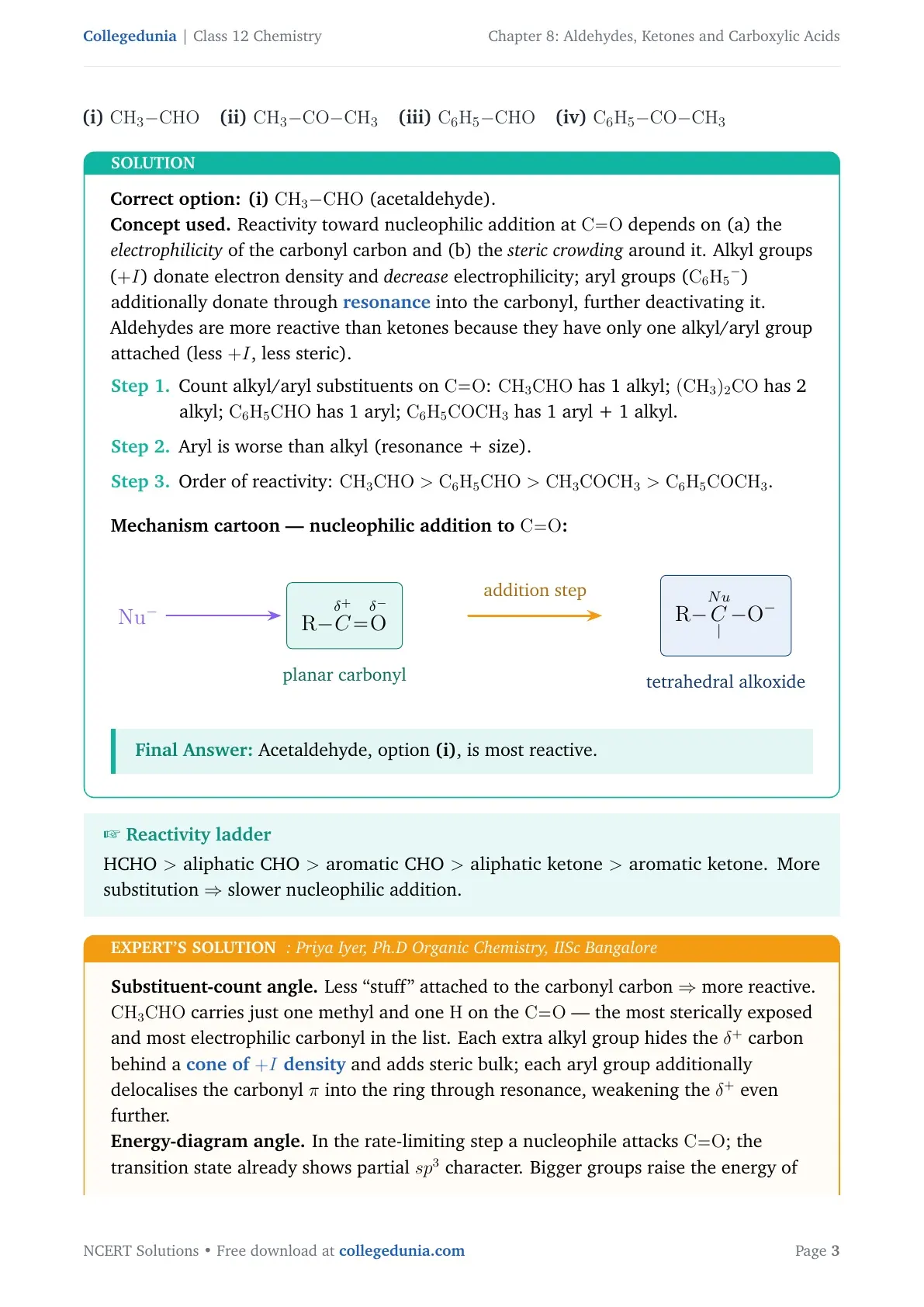
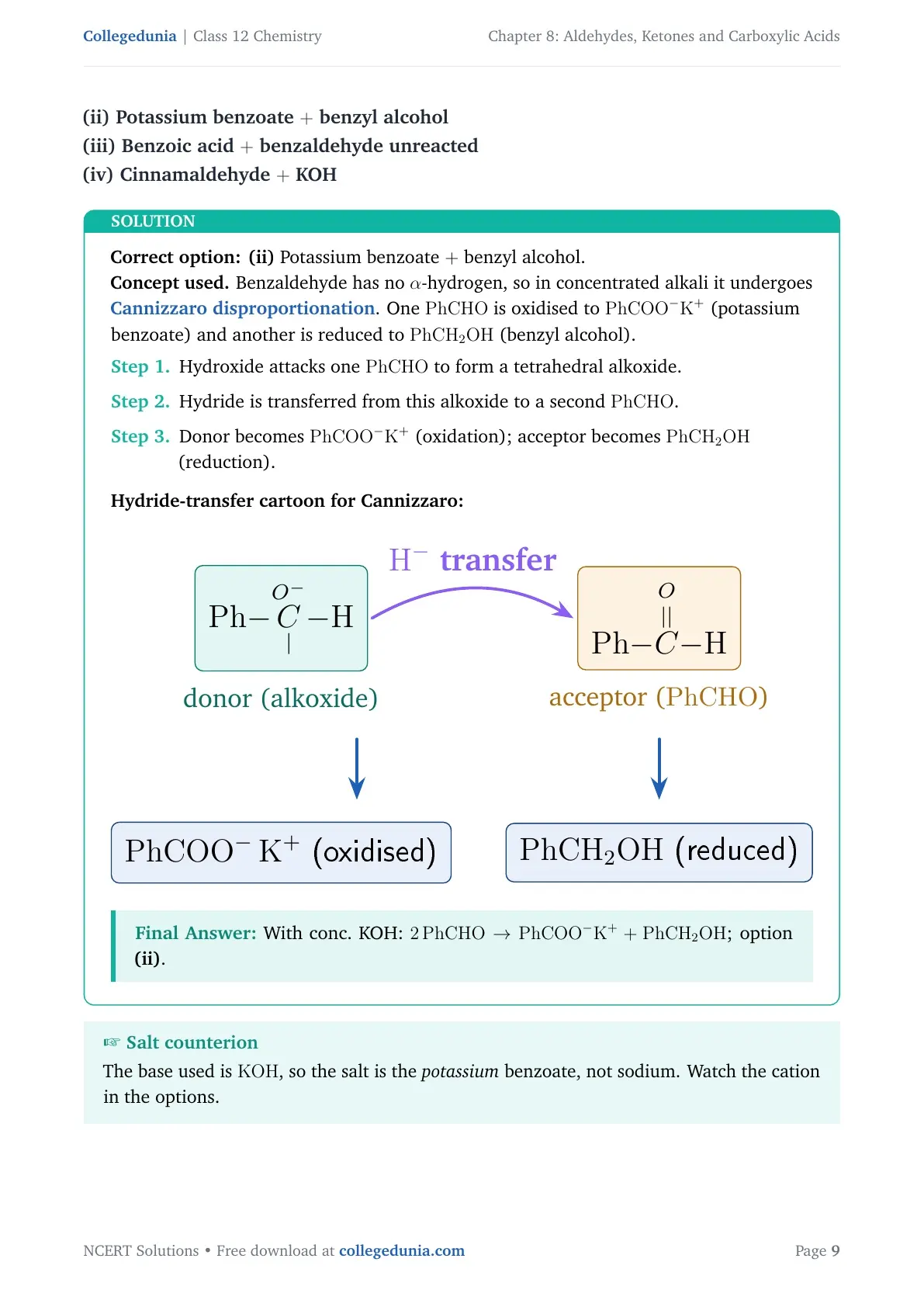
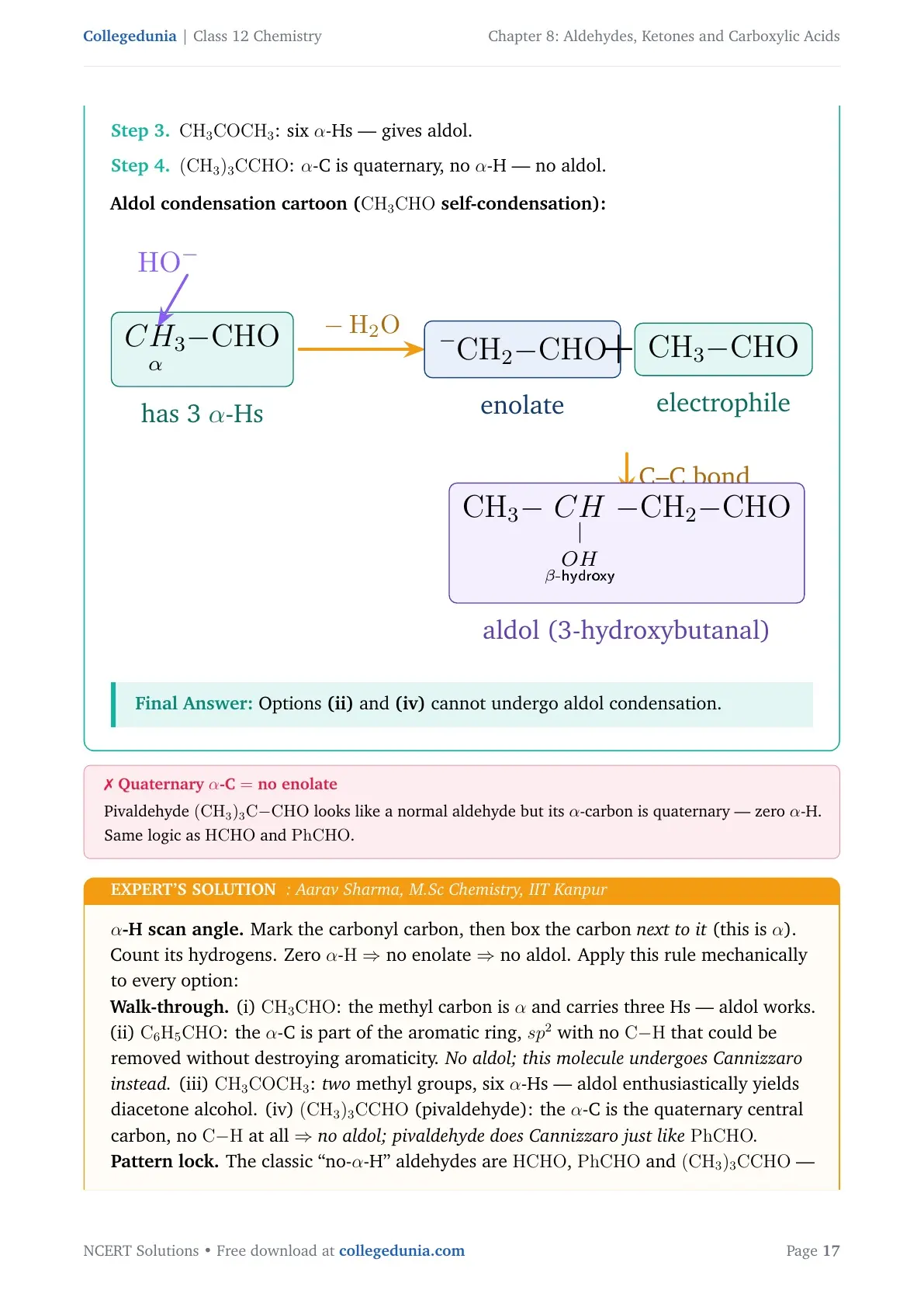
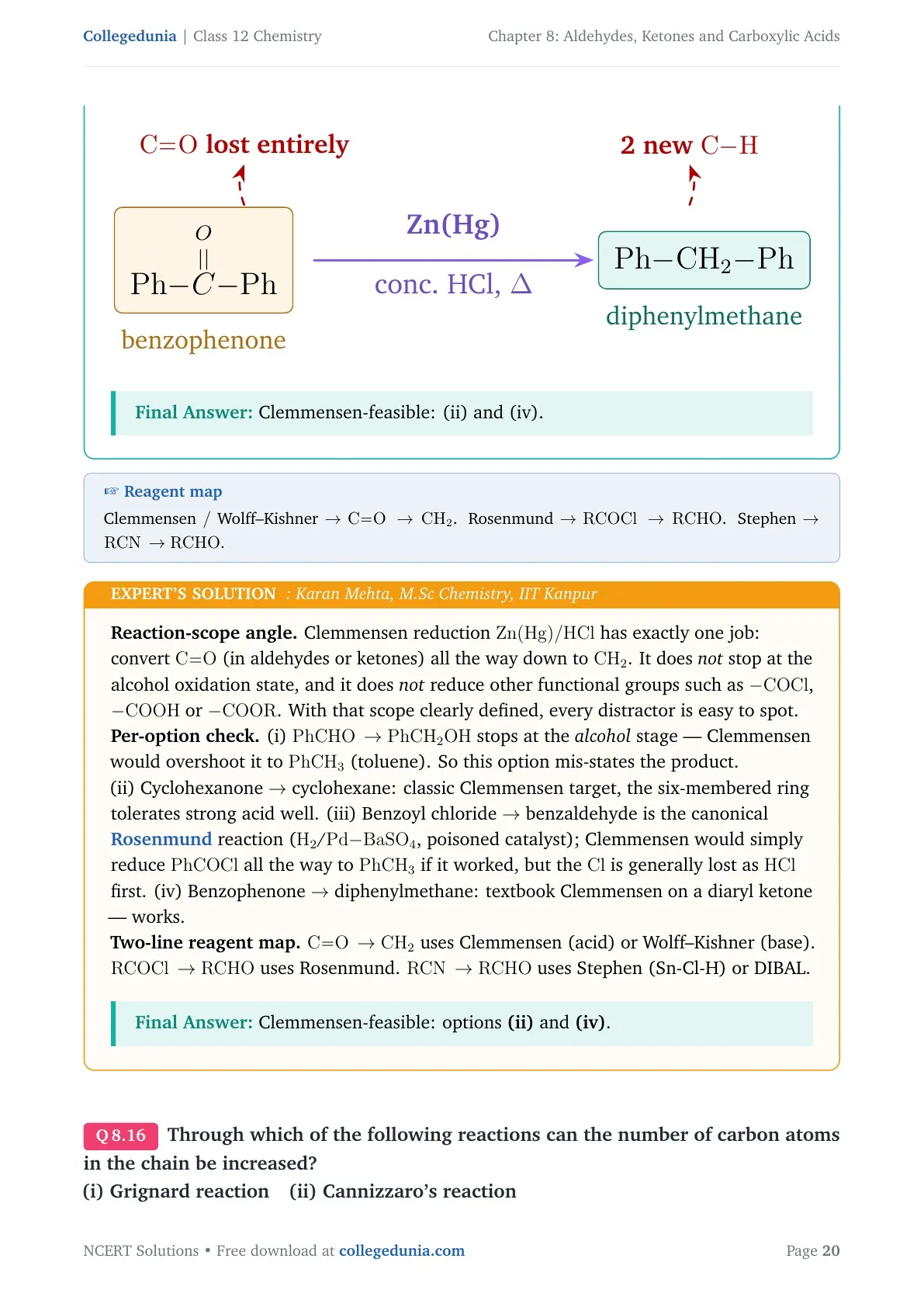
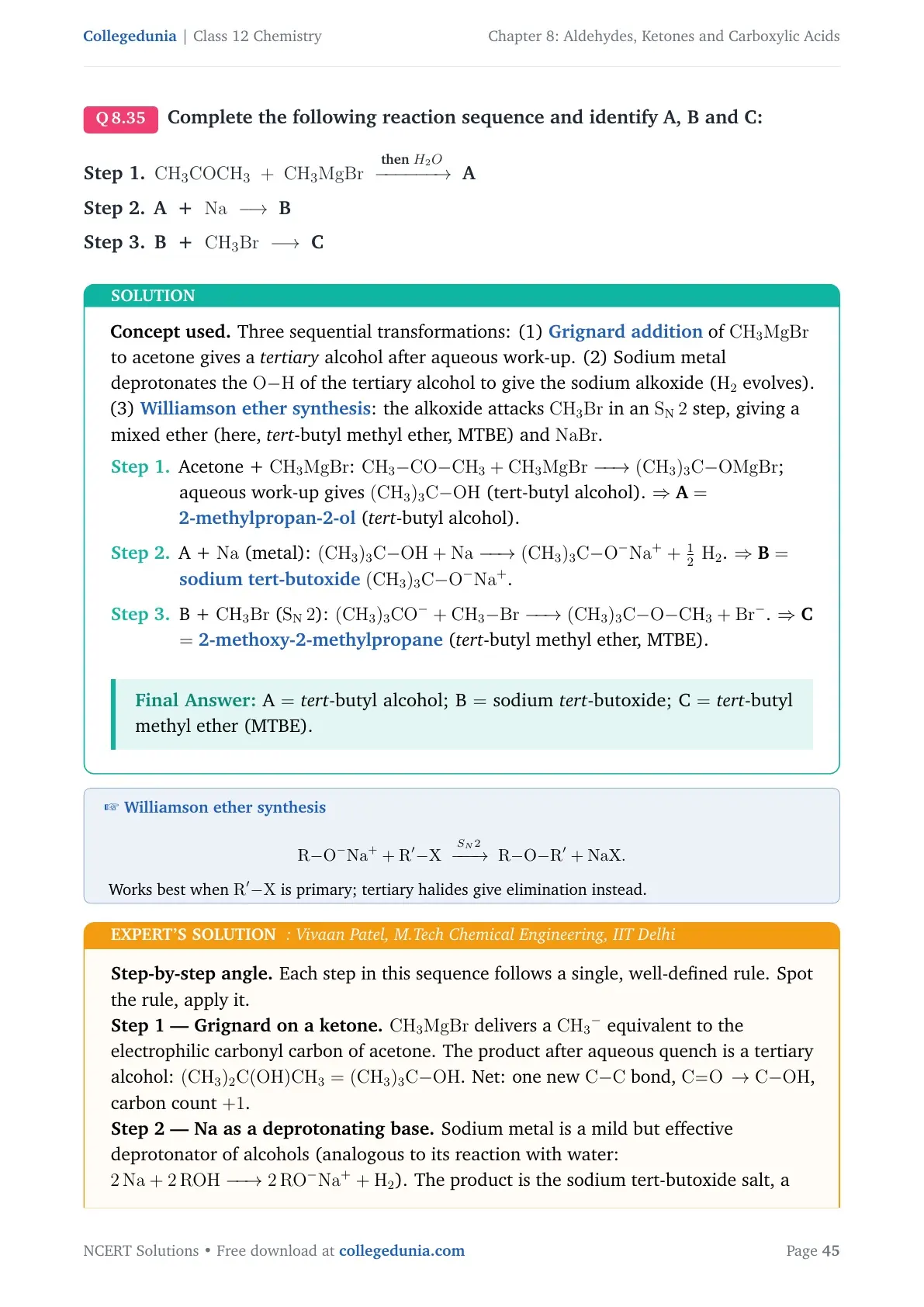
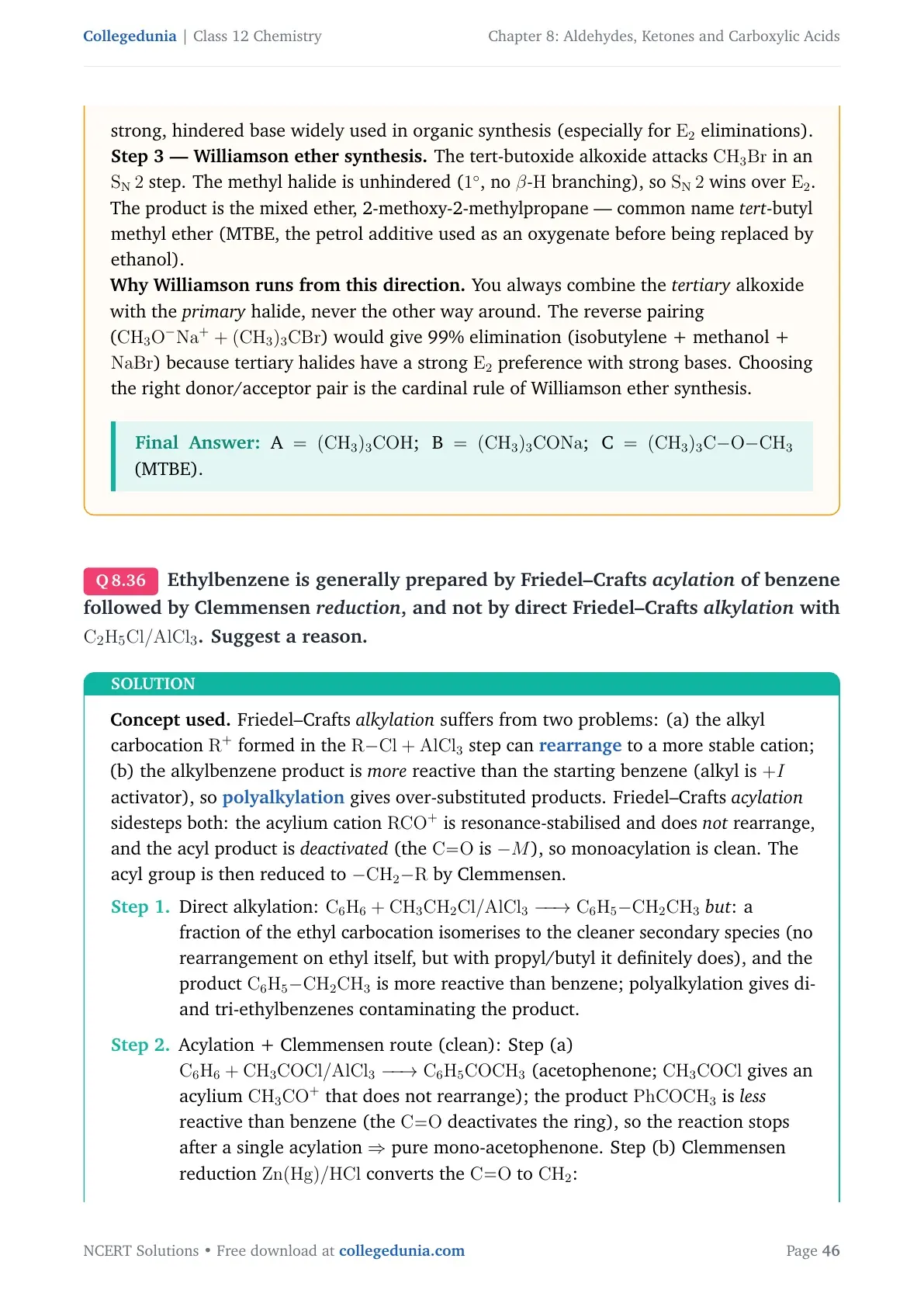
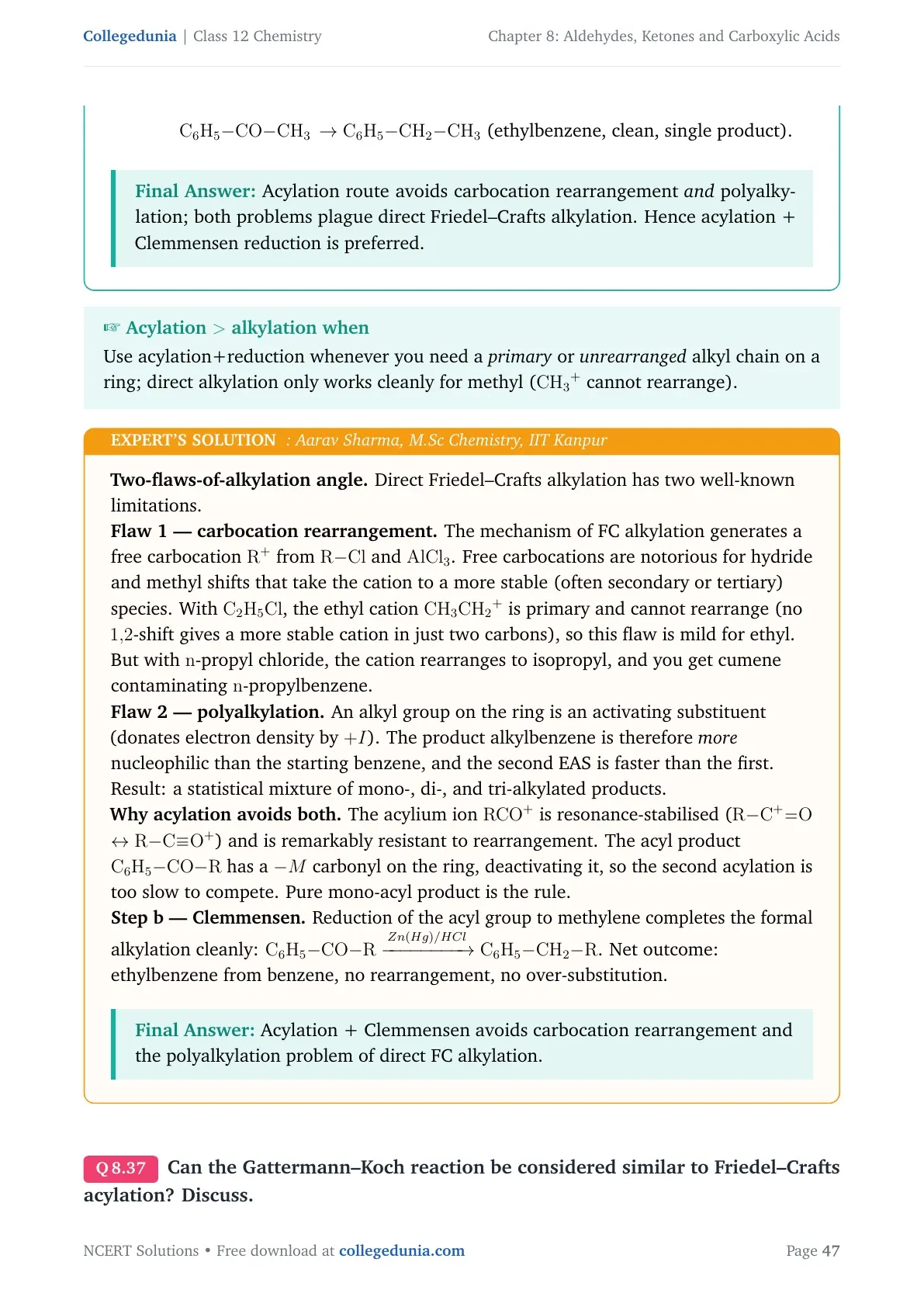
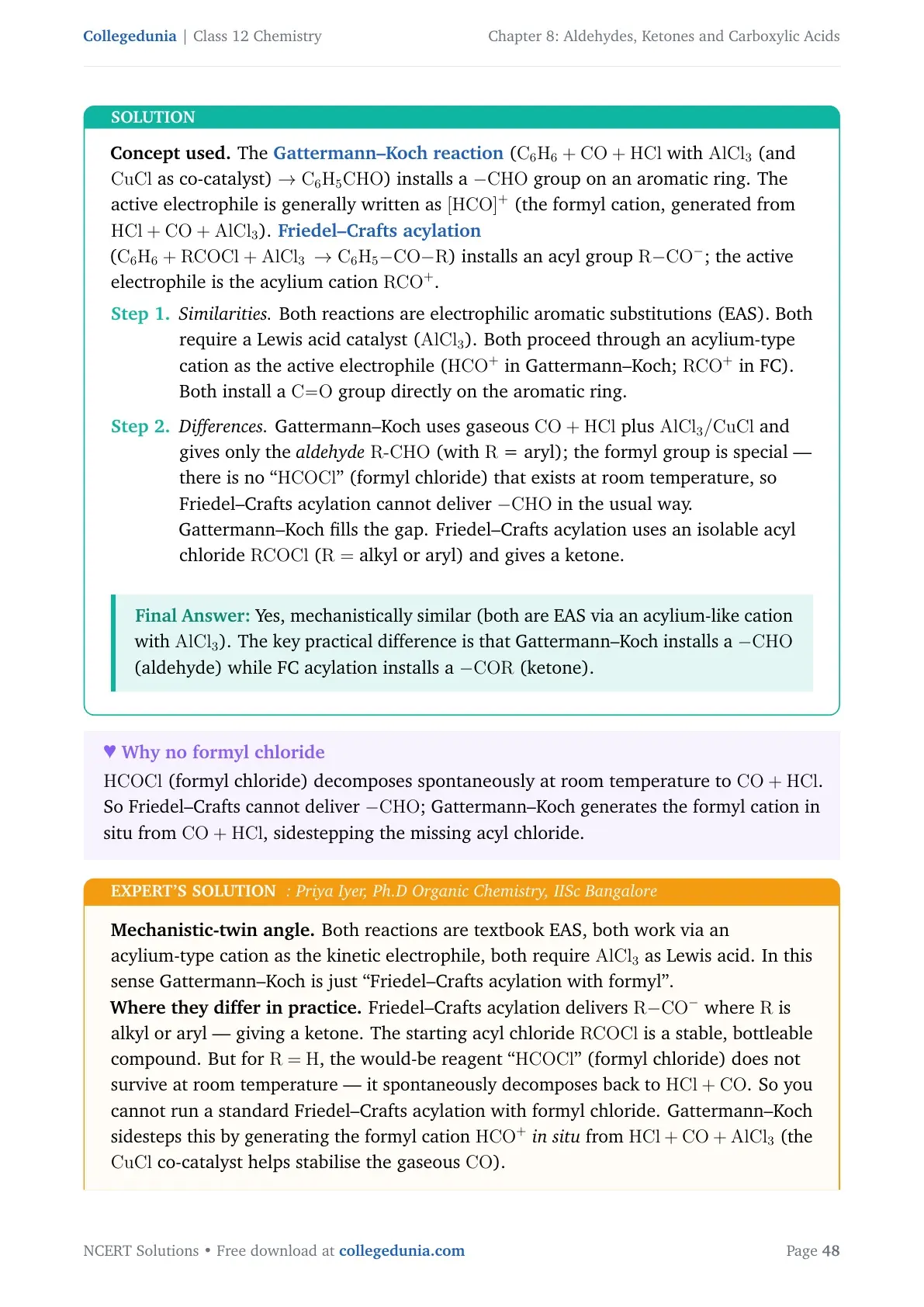
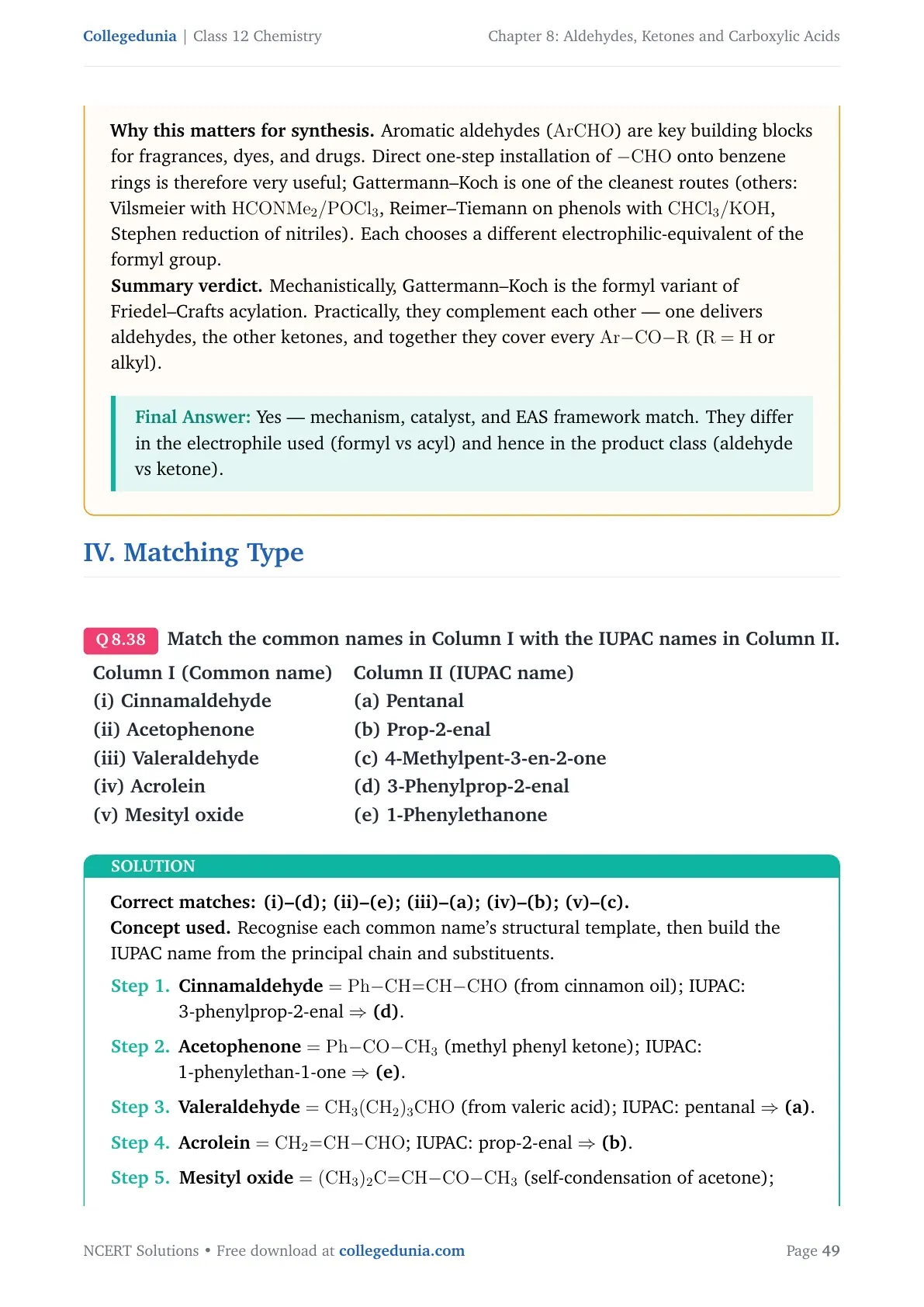
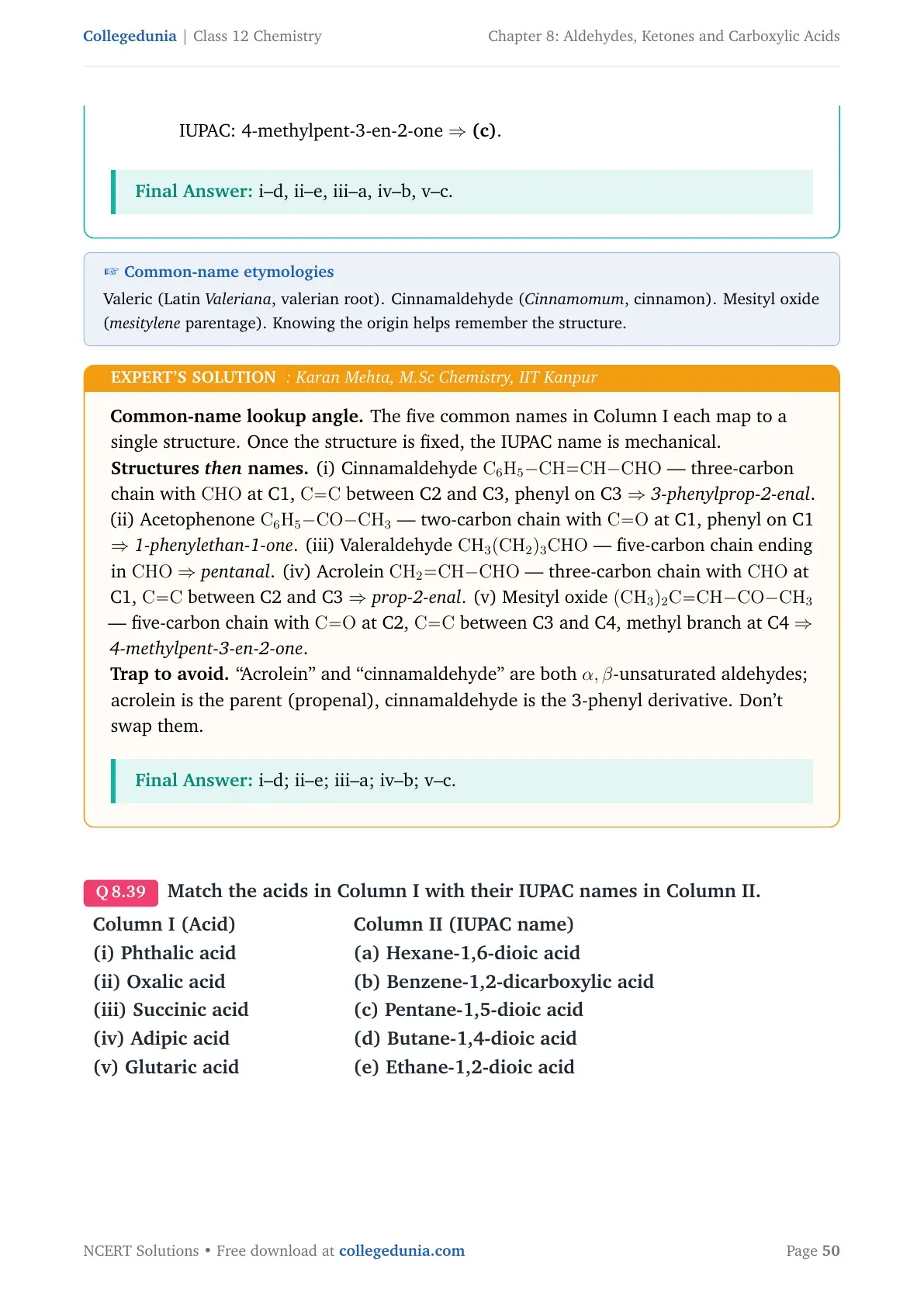
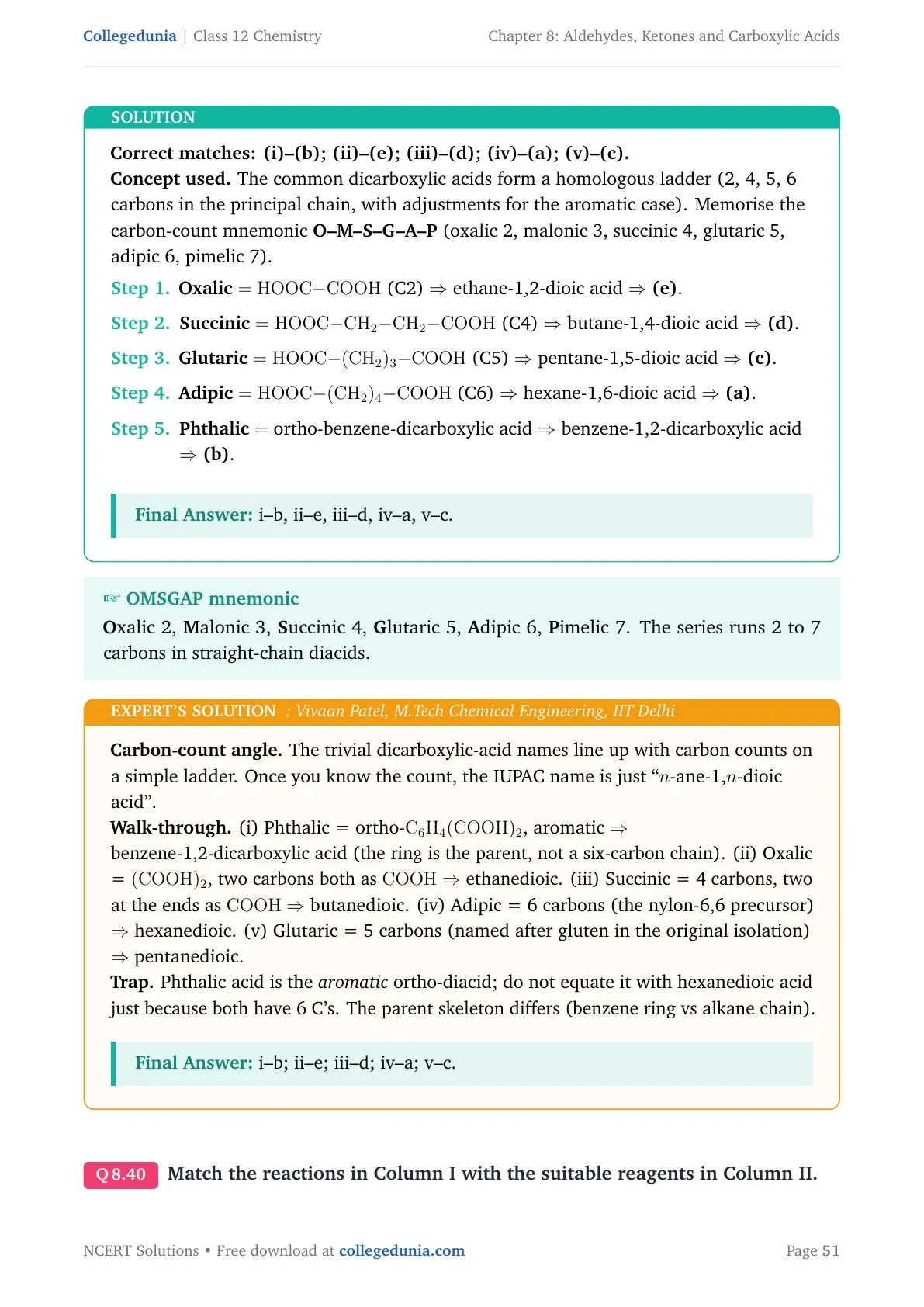
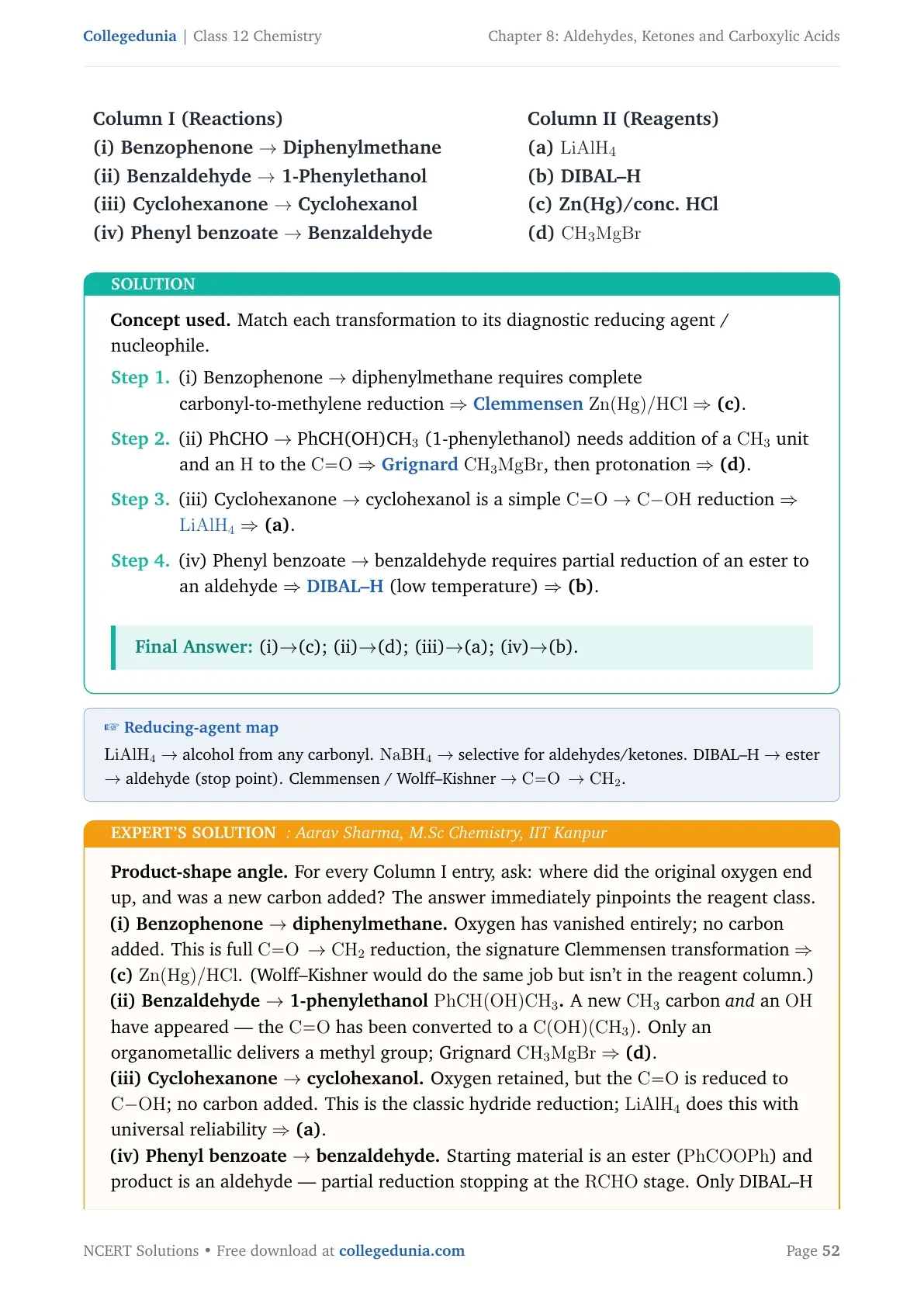
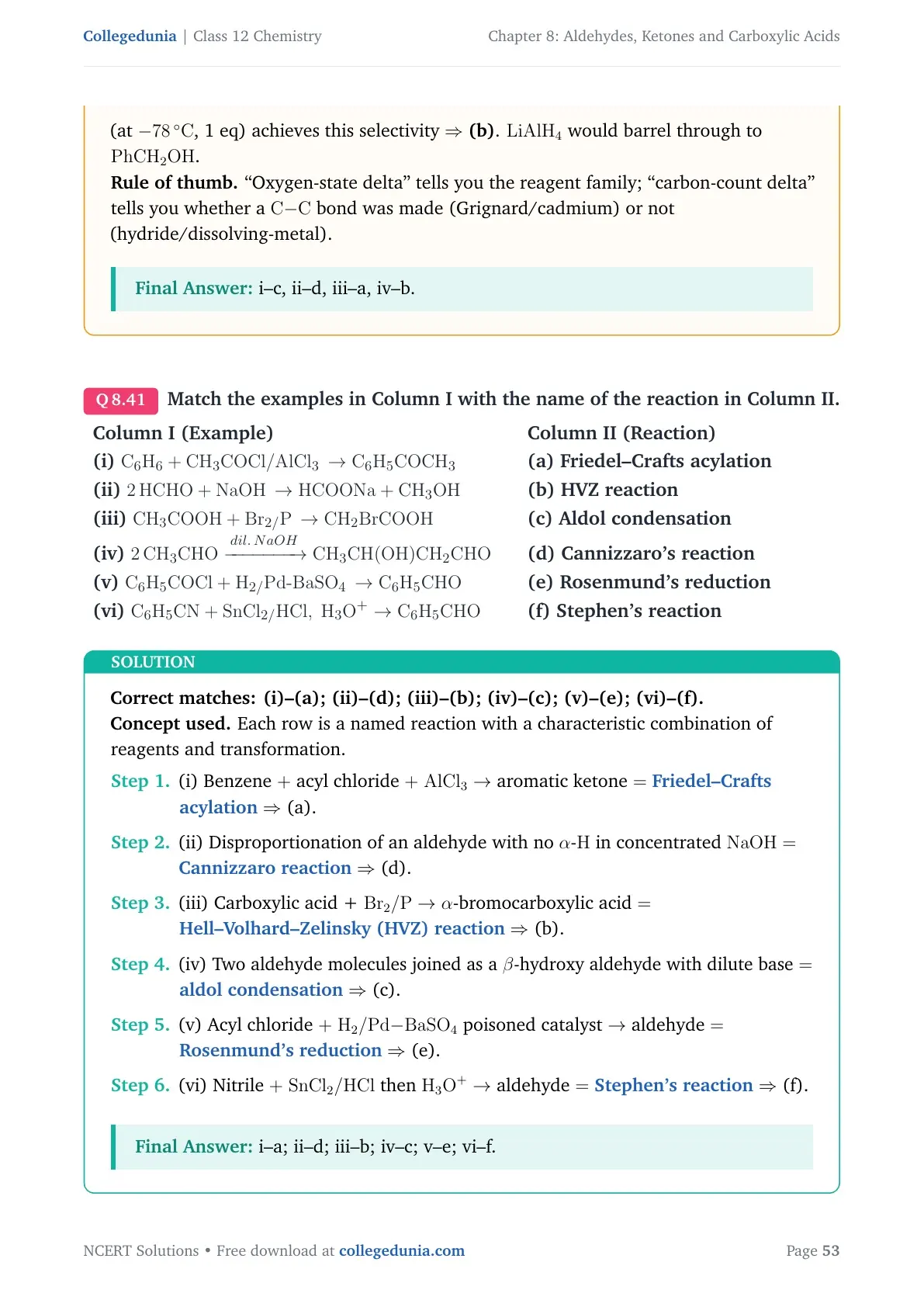
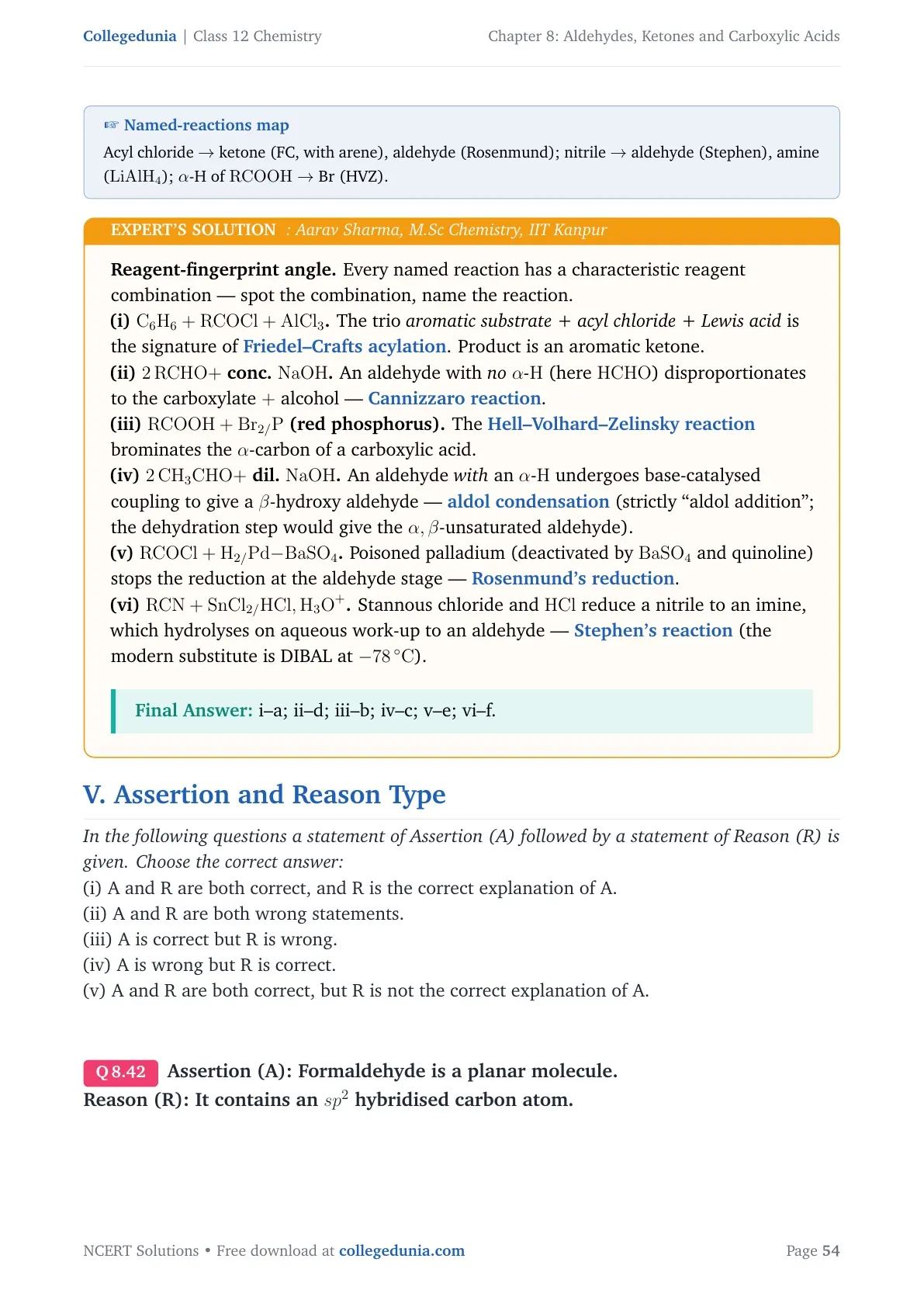
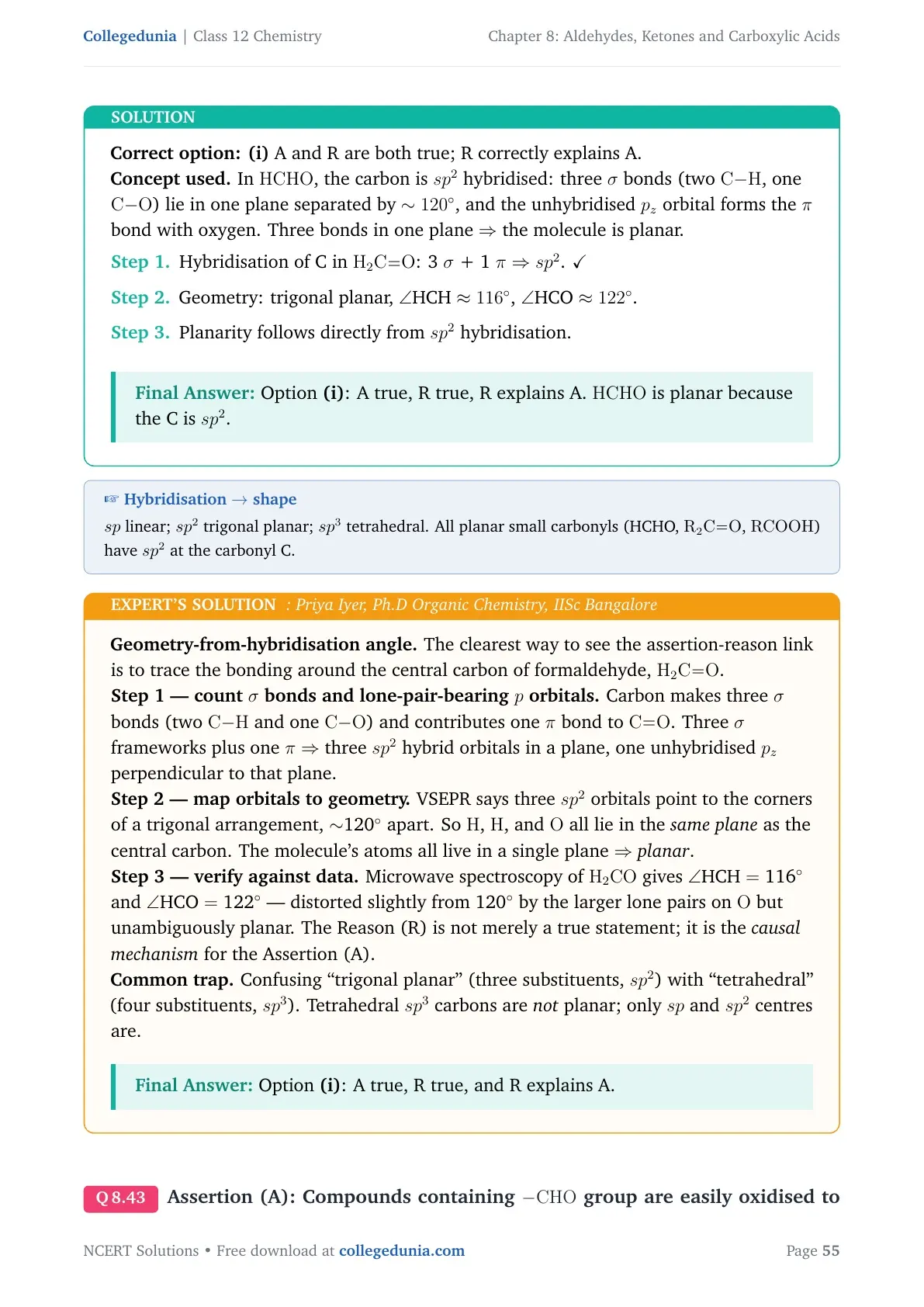
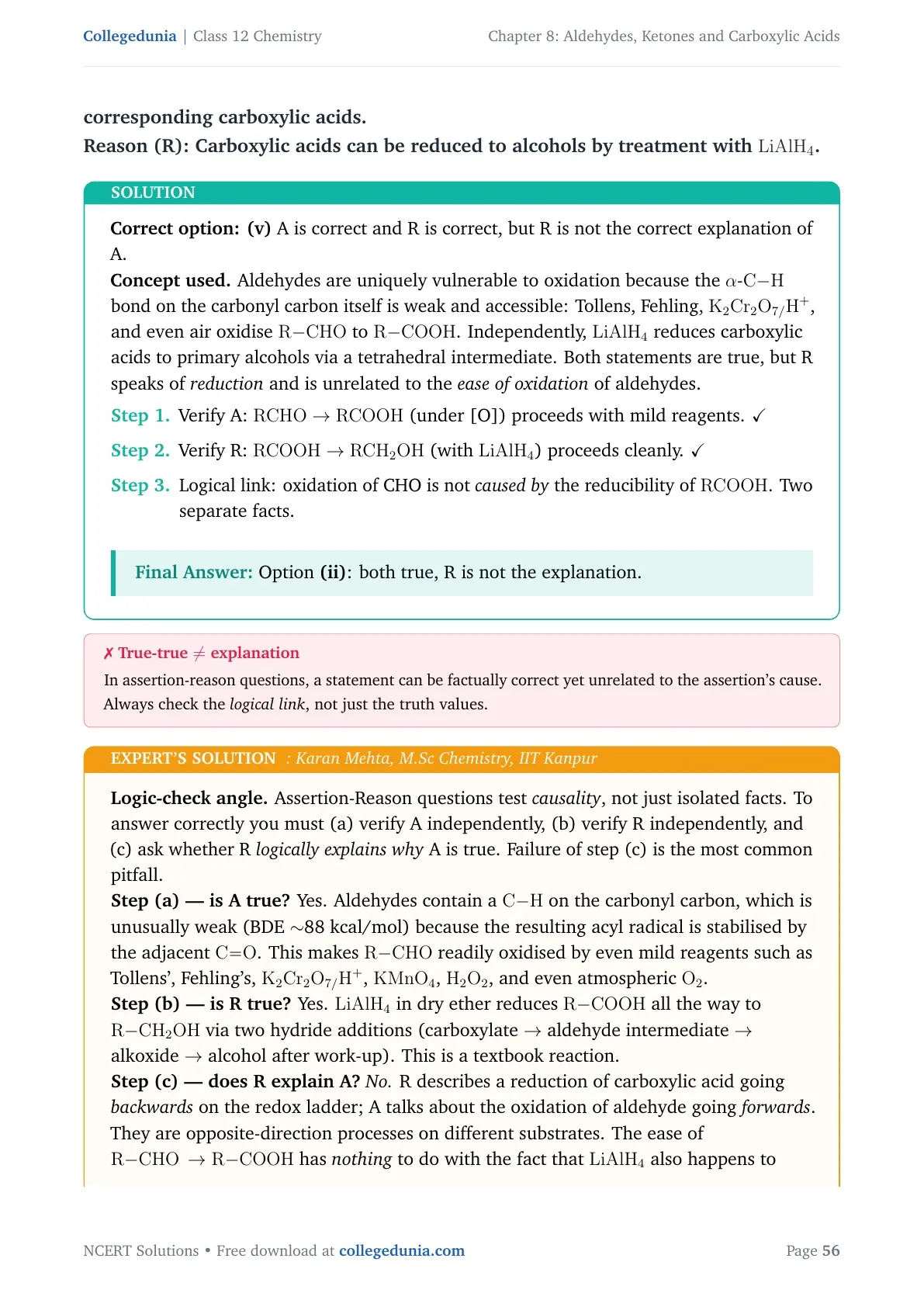
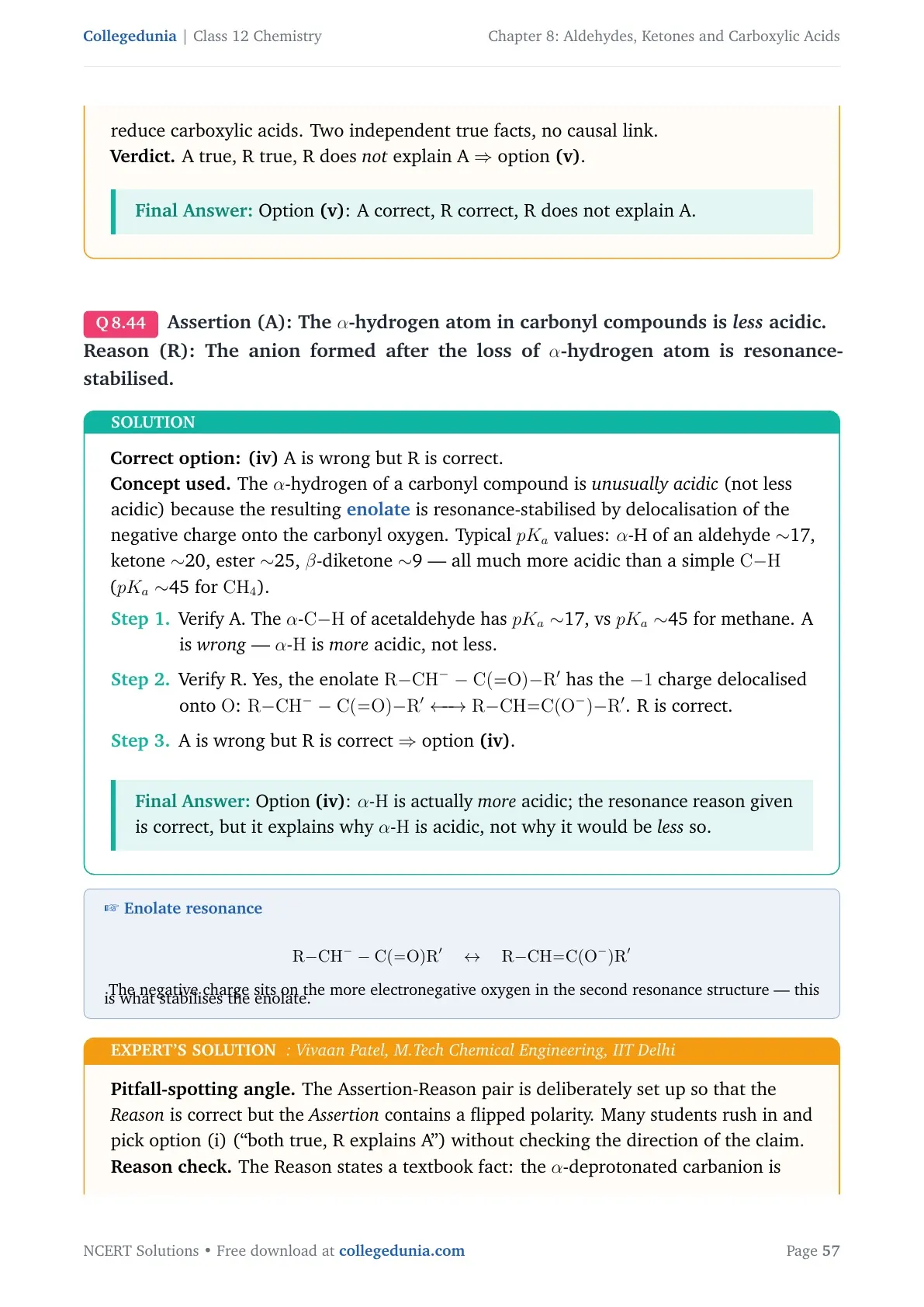
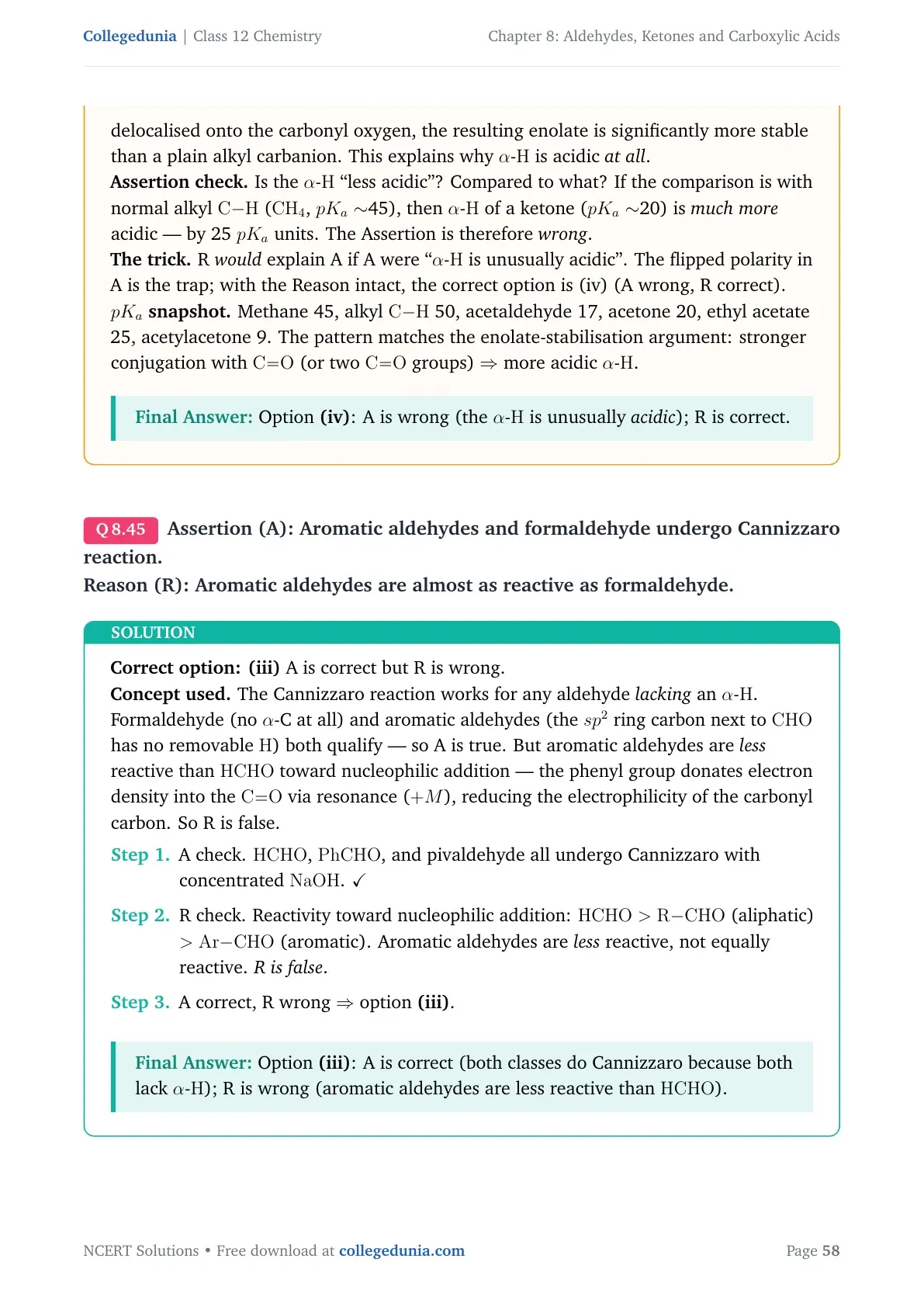
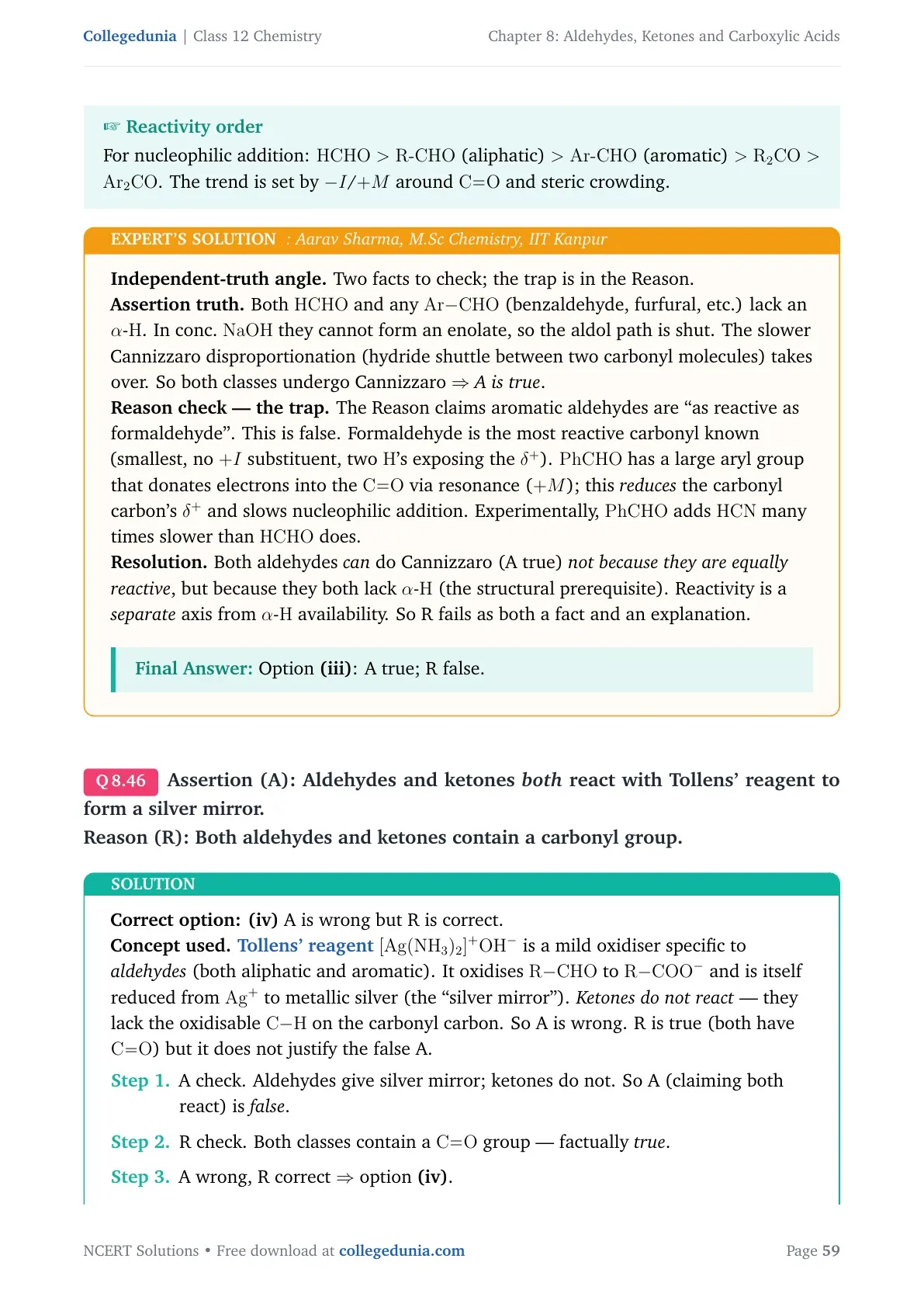
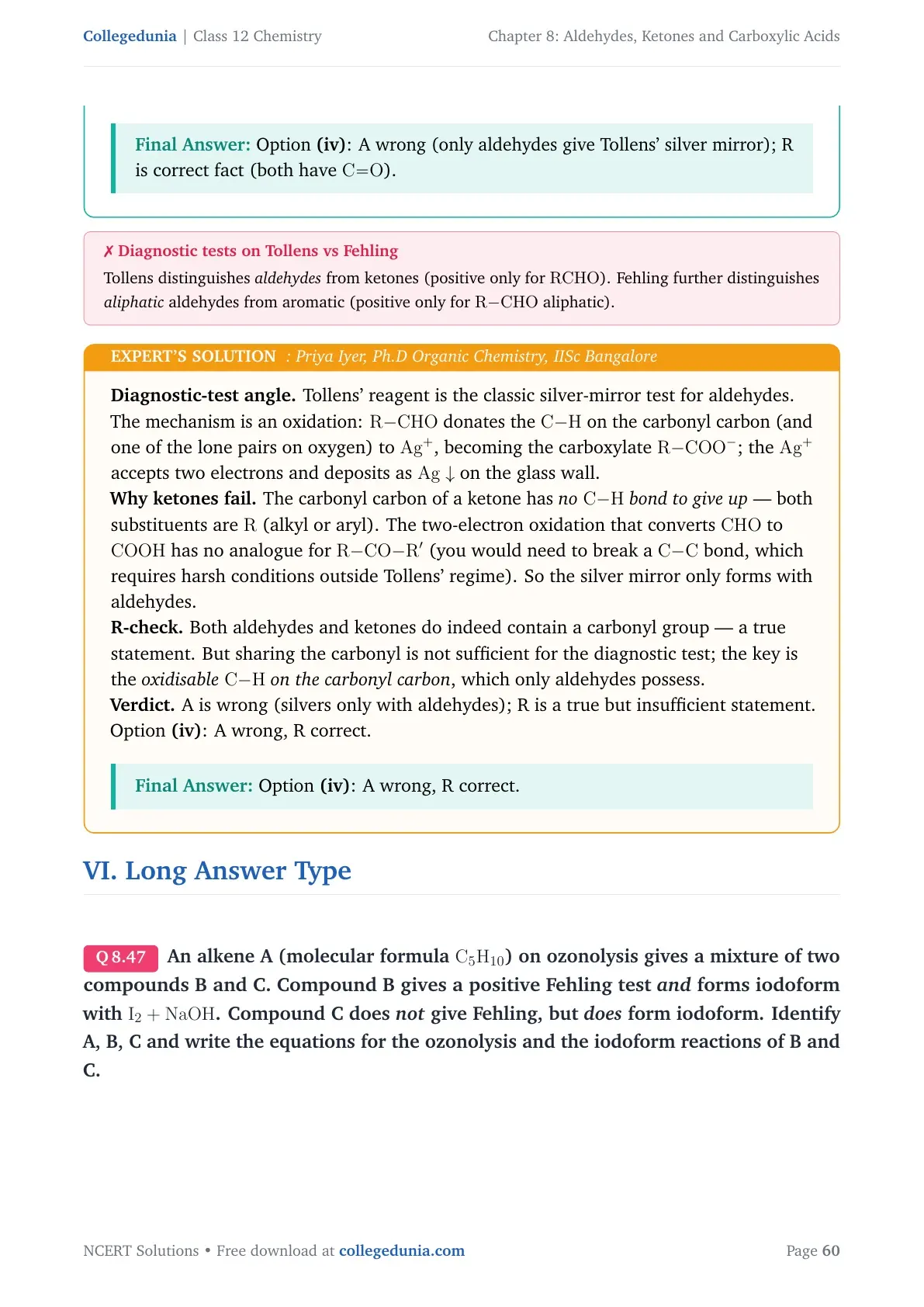
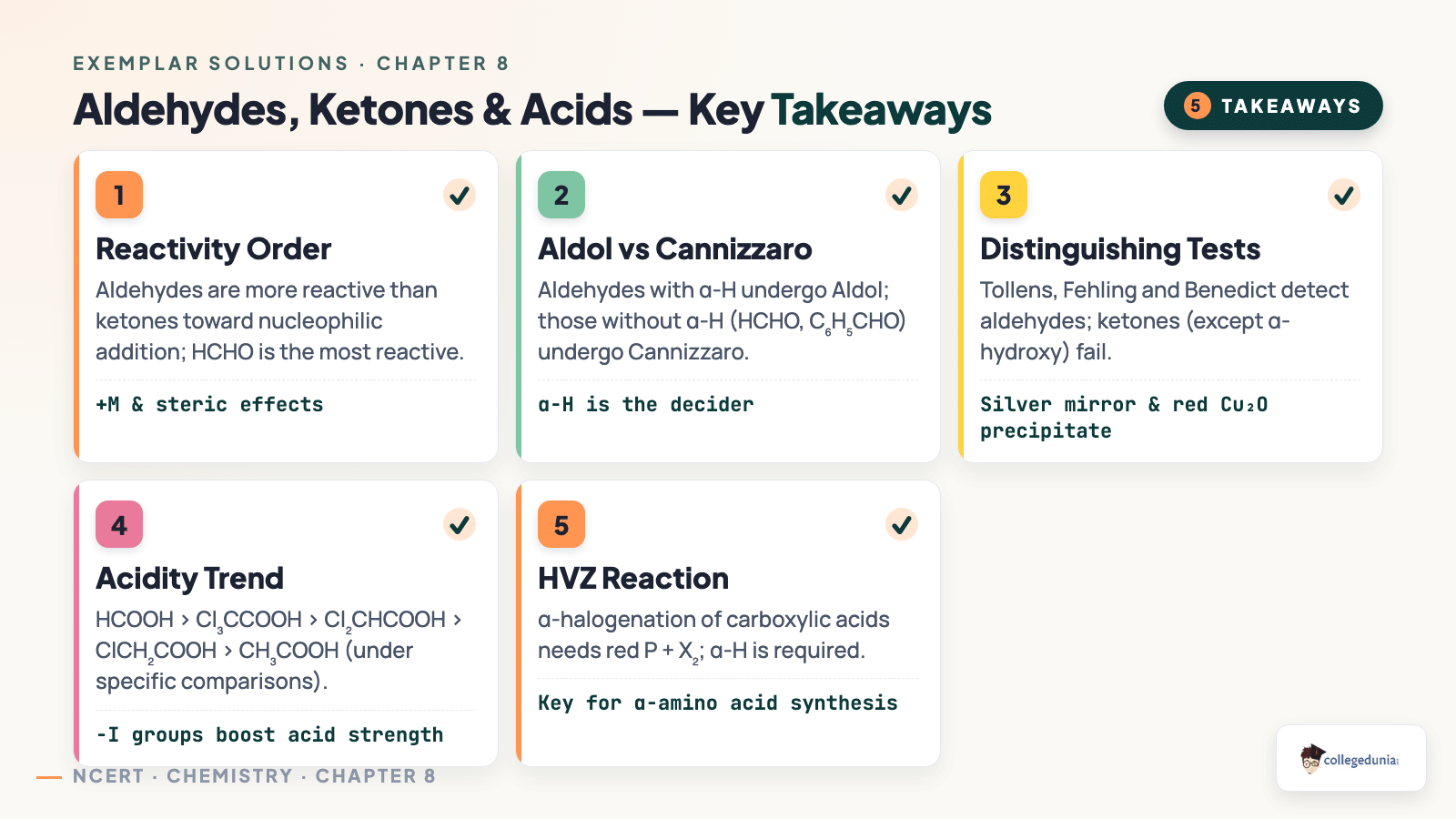
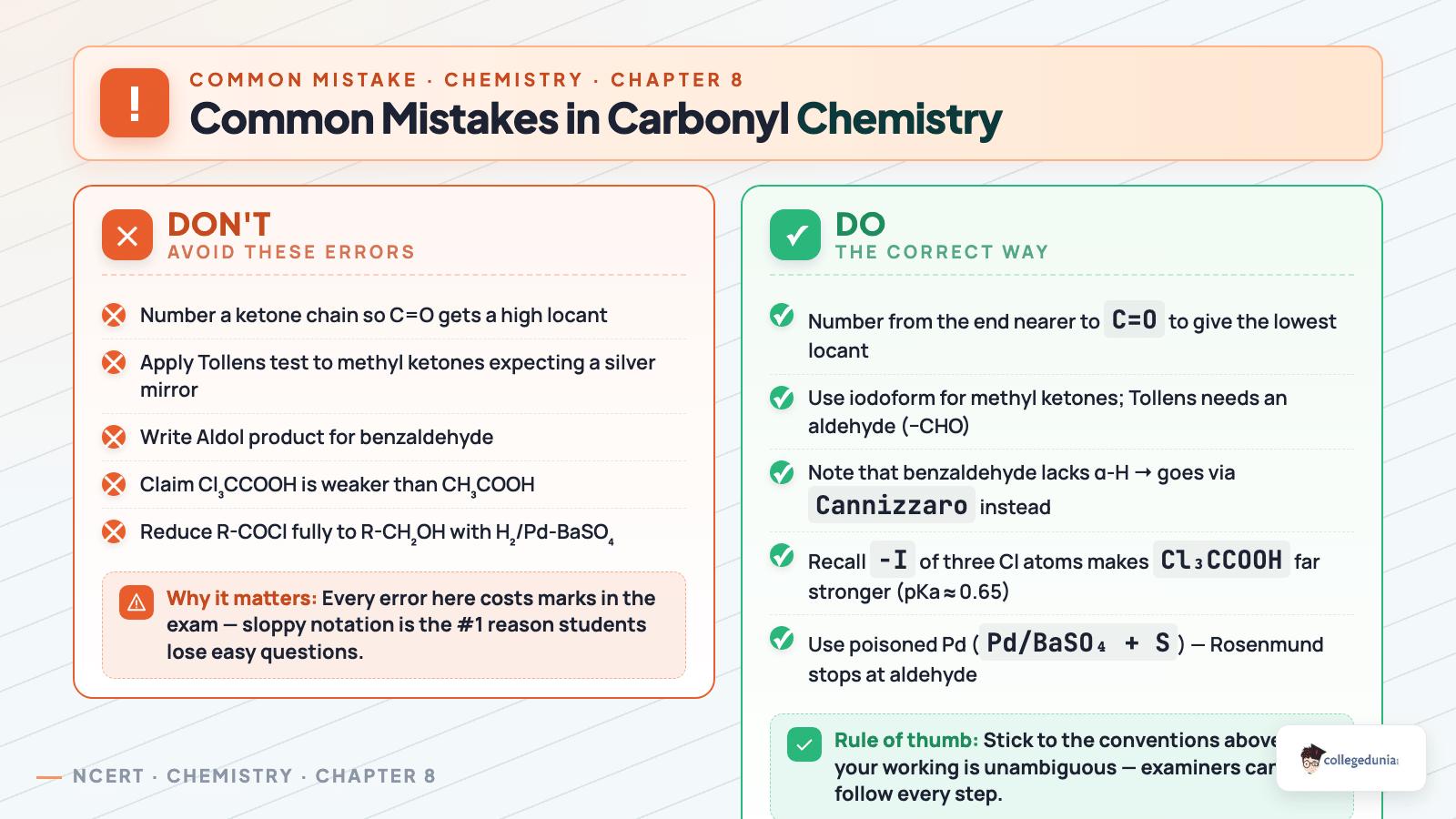



Comments