Chemistry Mentor, Daulat Ram College | Updated on - Jul 21, 2026
In the current 2026-27 NCERT, Alcohols, Phenols and Ethers is fixed at Chapter 7, down from its older Chapter 11 slot, with the same Exemplar bank intact. The Collegedunia Exemplar Solutions PDF works 25 representative items end-to-end, covering acidity ordering, Williamson synthesis, Reimer-Tiemann, Lucas test and the assertion-reason fact bank.
CBSE: 4 to 6 marks, usually a VSA on a named reaction plus an SA on acidity or Williamson synthesis.
JEE Main: 1 to 2 questions per shift on acidity order, Lucas reactivity and ether cleavage.
NEET: 2 to 3 questions on named reactions, oxidation products and H-bonding.
Each item is solved twice: a Solution with the working, then an Expert's Solution that names the mechanism or effect. Curated by Collegedunia subject experts and mapped to the 2026-27 NCERT.
Alcohols, Phenols and Ethers Exemplar: Question-Type Mix at a Glance
The Exemplar splits Chapter 7 into five buckets, shown below.
Question Type
Item Range
Count
Typical Marks (Board)
MCQ-I (single correct)
7.1 to 7.18
18
1
MCQ-II (multiple correct)
7.19 to 7.26
8
2
Short Answer (SA)
7.27 to 7.42
16
2 to 3
Matching Type
7.43 to 7.45
3
3 to 4
Assertion-Reason / LA
7.46 to 7.55
10
3 to 5
The 18 MCQ-I items alone clear the high-loss bucket: acidity ranking, hybridisation of the C-O bond, Lucas reactivity order, and the directive effect of the -OH group in phenol.
Alcohols, Phenols and Ethers Exemplar Step-Up from the NCERT Textbook
The Exemplar reframes textbook facts as comparison puzzles. Three concrete jumps:
Skill
NCERT Textbook Asks
Exemplar Asks
Acidity ordering
State whether phenol is more acidic than ethanol
Rank phenol, p-nitrophenol, p-cresol and ethanol on pKa; justify via resonance plus inductive effect
Williamson synthesis
Predict the product of CH3CH2ONa + CH3Br
Pick the alkoxide-halide pair that actually works; explain why the 3° route fails (E2 elimination wins)
Named reactions
Write the Reimer-Tiemann product of phenol
Compare Reimer-Tiemann, Kolbe and Friedel-Crafts; pick the major product for one supplied reagent set
The shift is from single-fact recall to multi-factor selection. Every Expert's Solution names the controlling factor.
Alcohols, Phenols and Ethers Class 12th: Sample SA Solved with Resonance Walk-Through
Acidity comparison is where students lose marks: writing "phenol is more acidic" without naming the resonance stabilisation costs the working mark.
Q (Exemplar style): Arrange the following in increasing order of acidity and justify: ethanol, water, phenol, p-nitrophenol, p-cresol.
Order: ethanol < p-cresol < water < phenol < p-nitrophenol.
Expert's reasoning: Acidity tracks conjugate-base stability. Ethanol: the +I effect of ethyl destabilises ethoxide, no resonance, weakest. p-Cresol: -CH3 donates electrons and slightly destabilises the phenoxide. Water: no resonance but no alkyl group either, sits between. Phenol: phenoxide is stabilised by resonance delocalisation over the ortho and para carbons. p-Nitrophenol: -NO2 stabilises the phenoxide via resonance plus a strong -M effect. Strongest acid.
Exemplar-Specific Common Mistakes in Alcohols, Phenols and Ethers
Four recurring errors cost students 2 to 4 marks per Exemplar attempt:
Calling alcohols more acidic than water: Alkyl groups are electron-donating, so ethoxide is destabilised relative to hydroxide. Ethanol (pKa ~16) is less acidic than water (pKa ~15.7).
Picking the wrong Williamson pair: A 3° alkyl halide always loses to E2 elimination with an alkoxide base. The correct pair pairs the alkoxide of the more hindered side with the 1° alkyl halide.
Confusing Kolbe with Reimer-Tiemann: Kolbe uses CO2/NaOH and gives ortho-hydroxybenzoic acid (salicylic acid); Reimer-Tiemann uses CHCl3/NaOH and gives ortho-hydroxybenzaldehyde (salicylaldehyde).
Writing the wrong product for HI on ether: With ROR', the cleavage gives RI and R'OH only when neither side is tertiary or benzylic. Methyl tert-butyl ether gives methanol + tert-butyl iodide, not the other way.
Alcohols, Phenols and Ethers Top 5 Facts and Formulae for Exemplar Questions
These five rules clear about 70% of the MCQ-I and Matching bucket.
Rule / Formula
Use
Acidity order: carboxylic acid > phenol > water > alcohol
Anchor for every acidity comparison on the chapter
Phenol substituent rule: EWG at o/p raises acidity; EDG lowers it
Rank substituted phenols by pKa
Lucas reactivity: 3° > 2° > 1° alcohol toward HCl/ZnCl2
Pinacol-Pinacolone Rearrangement and Other JEE-Only Extensions Tested in Exemplar Hard Items
Though outside the CBSE board syllabus, the Pinacol-pinacolone rearrangement shows up in Exemplar A-R items. A 1,2-diol loses water to a carbocation; a 1,2-methyl shift then gives a stable oxocarbenium ion that becomes the ketone pinacolone.
Other JEE-only extensions in hard items:
Hydroboration-oxidation: syn-addition gives the anti-Markovnikov alcohol without rearrangement.
Wagner-Meerwein shifts: a less-stable carbocation rearranges before alkene formation; the major product follows Saytzeff.
Dow vs cumene process: A-R items pick the more economical phenol route.
Best Way to Use the Alcohols, Phenols and Ethers Exemplar for JEE and NEET Prep
A time-boxed pass by question type beats reading all 55 in sequence:
Session 1 (40 min): 18 MCQ-I; flag anything over 60 seconds for resonance review.
Session 2 (35 min): 8 MCQ-II, using acidity-ordering and named-reaction grids.
Session 3 (75 min): 16 SA across preparation, acidity, and oxidation reagents.
Session 4 (60 min): 3 Matching and 10 A-R / LA items on multi-step preparation.
Total budget is about 3 hours 30 minutes for a clean first pass.
All NCERT Exemplar Questions for Alcohols, Phenols and Ethers with Step-by-Step Solutions
Every question of the NCERT Exemplar set for Class 12 Chemistry Chapter 7 Alcohols, Phenols and Ethers is listed below with its full Solution and Expert Solution hidden inside collapsible tabs. Click Check Solution to reveal the step-by-step working; click Expert Solution for the expanded explanation.
I. Multiple Choice Questions (Type-I)
Q 7.1
Monochlorination of toluene in sunlight followed by hydrolysis with aq. NaOH yields.
(i) o-Cresol (ii) m-Cresol (iii) 2,4-Dihydroxytoluene (iv) Benzyl alcohol
Correct option: (iv) Benzyl alcohol.
Concept used. Chlorination of toluene under
sunlight (hν) proceeds by a free-radical
mechanism that attacks the side-chain-CH3, not the
ring (ring chlorination needs a Lewis acid such as FeCl3).
The benzylic C–H bond is weakest (resonance-stabilised radical),
so C6H5-CH3 + Cl2 ->[hν] C6H5-CH2Cl (benzyl chloride).
Benzyl chloride is a 1∘ alkyl halide and undergoes clean
SN2 with OH- to give benzyl alcoholC6H5-CH2OH.
Cresols would require ring chlorination (FeCl3, dark) followed by harsh fusion –- not the route shown.
Product is benzyl alcohol; option (iv).
AS
Aarav Sharma
M.Sc Chemistry, IIT Kanpur
Verified Expert
Two-stage bond-strength angle. Step 1 picks the
chlorination site; Step 2 picks the substitution product.
Sunlight → side-chain (radical); OH-→ hydroxyl
swap (ionic). Different mechanisms back-to-back, but the logic is
just bond-strength + leaving-group quality.
Concept used. Benzylic C–H BDE is only ≈ 90 kcal/mol
because the resulting benzyl radical is resonance-stabilised across
the ring (three contributing structures). Aryl C–H is much stronger
at ∼ 113 kcal/mol; radicals never touch it. So Cl·
selectively abstracts the benzylic H, giving C6H5CH2Cl as the
only first-stage product.
Then SN. Benzyl chloride is a primary alkyl
halide and additionally enjoys resonance stabilisation of the
incipient benzyl carbocation, so it reacts with aq. NaOH
extremely fast –- both SN2 (good back-side access) and
SN1 (resonance-stable cation) pathways are open. The
Cl- leaves and OH- replaces it.
Eliminate cresols. Cresols would require ring chlorination,
which needs FeCl3 in the dark –- not the conditions stated.
Benzyl alcohol C6H5CH2OH; option (iv).
Q 7.2
How many alcohols with molecular formula C4H10O are chiral in nature?
(i) 1 (ii) 2 (iii) 3 (iv) 4
Correct option: (i) 1.
Concept used.C4H10O has four constitutional alcohol
isomers: butan-1-ol, butan-2-ol, 2-methylpropan-1-ol and
2-methylpropan-2-ol. Chirality requires at least one
carbon bearing four different groups (a stereocentre).
Butan-1-ol CH3CH2CH2CH2OH: no C has 4 different groups. Achiral.
Butan-2-ol CH3CH(OH)CH2CH3: C2 carries -CH3, -OH, -H, -C2H5 –- all different ⇒ chiral.
2-methylpropan-1-ol (CH3)2CHCH2OH: the C bonded to two CH3 is not a stereocentre. Achiral.
2-methylpropan-2-ol (CH3)3COH: three identical CH3 groups; no stereocentre. Achiral.
minipage0.8
!%
[See diagram in the PDF version]
minipage
Only butan-2-ol is chiral ⇒ 1 chiral alcohol; option (i).
PI
Priya Iyer
Ph.D Organic Chemistry, IISc Bangalore
Verified Expert
Isomer-enumeration angle. The longanswer walked through the
four isomers and checked each carbon. Let me re-derive the answer
from the degree of branching viewpoint: a stereocentre needs
four different groups, so high symmetry kills chirality.
Symmetry filter. 2-methylpropan-2-ol (CH3)3COH has
C3v local symmetry at the central C (three identical methyls)
⇒ symmetric, no chirality. 2-methylpropan-1-ol has the
central C bonded to two identical methyls ⇒ a local
mirror plane through that C ⇒ achiral. Butan-1-ol is
linear and has no carbon with four different attachments.
Stereocentre count. That leaves only butan-2-ol. C2 carries
H, OH, CH3 and CH2CH3 –- four different
groups, hence one stereocentre and a pair of enantiomers (R/S).
Tip for JEE. Always enumerate every constitutional isomer
first, then apply the four-different-groups test to each sp3
carbon. Don't try to guess by counting hydroxyl groups.
Exactly one chiral alcohol (butan-2-ol); option (i).
Q 7.3
What is the correct order of reactivity of alcohols in the reaction R-OH + HCl -> R-Cl + H2O (with ZnCl2 catalyst)?
(i) 1∘ > 2∘ > 3∘ (ii) 1∘ < 2∘ < 3∘ (iii) 3∘ > 2∘ > 1∘ (iv) 3∘ > 1∘ > 2∘
Correct option: (iii)3∘ > 2∘ > 1∘.
Concept used.HCl + ZnCl2 is the Lucas
reagent. The slow step is ionisation of the protonated alcohol to
a carbocation. With H+: R-OH -> R-OH2+ -> R+ + H2O. Reactivity
therefore tracks carbocation stability:
3∘ > 2∘ > 1∘ (hyperconjugation + +I).
Protonation of -OH makes -OH2+, a great leaving group.
ZnCl2 as Lewis acid coordinates oxygen, further weakening C–O.
Loss of water gives R+; tertiary cation forms fastest (most stable).
Capture by Cl- gives R-Cl.
Reactivity order 3∘ > 2∘ > 1∘; option (iii).
KM
Karan Mehta
M.Sc Chemistry, IIT Kanpur
Verified Expert
Carbocation-stability angle. The longanswer described all
four mechanistic steps. Let me argue purely from the rate-limiting
step. A reaction's overall rate is dictated by its slowest step;
in Lucas-style chemistry that step is ionisation to R+.
Hyperconjugation count.3∘ carbocation
(CH3)3C+ has 9 α-C–H bonds available for
hyperconjugation; 2∘ has 6; 1∘ has only 3.
Each α C–H donates into the empty p-orbital, lowering
energy by ∼ 6 kJ/mol; the energy gap reverses the order
relative to alcohol structure –- the most substituted alcohol
gives the most stable cation, so reacts fastest.
ZnCl2's role. The Lewis acid coordinates the
oxygen lone pair, making -OH effectively
-O-ZnCl2-, an even better leaving group than
-OH2+. Without it, the reaction is too slow at room
temperature for 1∘ and 2∘ substrates.
Visual cue: cloudiness. Lucas test reports the cloud time
because R-Cl is insoluble in the aq. acid medium.
3∘ > 2∘ > 1∘; option (iii).
Q 7.4
CH3CH2OH can be converted into CH3CHO by 1cm.
(i) catalytic hydrogenation (ii) treatment with LiAlH4 (iii) treatment with pyridinium chlorochromate (iv) treatment with KMnO4
Correct option: (iii) Treatment with pyridinium chlorochromate (PCC).
Concept used.PCC (pyridinium chlorochromate) is
a mild, anhydrous chromium(VI) oxidant that stops cleanly at the
aldehyde stage for 1∘ alcohols. Stronger oxidants
(KMnO4, hot K2Cr2O7) over-oxidise to the carboxylic
acid. Catalytic hydrogenation and LiAlH4 are reductions,
not oxidations.
LiAlH4/H2-Pd would reduce CH3CHO back to ethanol –- backwards.
PCC stops at the aldehyde stage; option (iii).
VP
Vivaan Patel
M.Tech Chemical Engineering, IIT Delhi
Verified Expert
Process-engineering angle. Treat each oxidant as a tool in
the toolbox. The longanswer ranked them by oxidation power; let me
argue by selectivity, which is what an industrial chemist
cares about.
Why PCC is the right choice. PCC is Cr(VI) tethered to a
pyridine base; it works in anhydrous CH2Cl2. The absence of
water is the key: once CH3CHO forms, it cannot be hydrated
to the geminal-diol CH3CH(OH)2 –- which is the species the
second oxidation acts on. No diol, no acid, full stop.
Why the wrong options fail.
[leftmargin=*,nosep]
Catalytic hydrogenation H2/Pd: would reduce the
aldehyde back to alcohol (wrong direction).
LiAlH4: powerful hydride; also a reducing
agent, not an oxidant.
Acidified KMnO4: aqueous + hot ⇒ slams
through the aldehyde stage to acetic acid.
Alternative reagents that also stop at aldehyde: Collins
reagent (CrO3· 2 Py), PDC, Swern oxidation,
Dess–Martin periodinane.
PCC; option (iii).
Q 7.5
The process of converting alkyl halides into alcohols involves 1cm.
(i) addition reaction (ii) substitution reaction (iii) dehydrohalogenation reaction (iv) rearrangement reaction
Correct option: (ii) Substitution reaction.
Concept used.R-X + OH- -> R-OH + X- is a textbook
nucleophilic substitution. OH- replaces X-
on the same carbon; nothing is added or eliminated.
OH- (nucleophile) attacks the C bearing X.
Bond from C to X breaks (heterolysis); X- leaves.
Net change: X swapped for OH⇒ substitution.
Primary R-X→SN2; tertiary →SN1; both are substitution.
Alkyl halide → alcohol is nucleophilic substitution; option (ii).
AS
Aarav Sharma
M.Sc Chemistry, IIT Kanpur
Verified Expert
Definition-first angle. The longanswer worked through the
SN1/SN2 pathways; let me argue purely from the
reaction-classification flowchart.
Three boxes. Every textbook organic transformation falls
into one of three boxes:
[leftmargin=*,nosep]
Addition: two reactants merge into one; atoms join
across a π-bond (e.g. H2C=CH2 + HBr -> CH3CH2Br).
Substitution: one group on a saturated carbon is
swapped for another (e.g. R-X -> R-OH).
Elimination: two adjacent groups leave to form a
π-bond (e.g. R-CH2-CHX-Rb -> R-CH=CH-Rb).
Apply to R-X -> R-OH. The carbon count is unchanged,
no π-bond is formed or broken, exactly one group (X) is
replaced by another (OH). This is a pure swap ⇒
substitution.
Mechanism detail.1∘ substrates go via concerted
SN2 (one step, back-side attack, inversion of
configuration); 3∘ substrates go via SN1 (cation
intermediate, racemisation). Either way, the reaction type is
substitution.
Substitution; option (ii).
Q 7.6
IUPAC name of m-cresol is 1cm.
(i) 3-methylphenol (ii) 3-chlorophenol (iii) 3-methoxyphenol (iv) benzene-1,3-diol
Correct option: (i) 3-methylphenol.
Concept used.Cresols are methyl-substituted
phenols: o-, m- and p-cresol correspond to 2-, 3- and
4-methylphenol respectively. IUPAC retains phenol as the
parent and numbers the ring so that -OH gets locant 1.
Identify functional groups in m-cresol: one -OH + one -CH3 on benzene.
``meta'' means 1,3-disubstituted: -OH at C1, -CH3 at C3.
Parent = phenol. Substituent = methyl at C3. IUPAC name = 3-methylphenol.
m-cresol ≡ 3-methylphenol; option (i).
PI
Priya Iyer
Ph.D Organic Chemistry, IISc Bangalore
Verified Expert
Trivial-to-IUPAC mapping angle. The longanswer started from
the structure and built the IUPAC name; let me work in the reverse
direction –- from each candidate IUPAC name back to the structure
and check which matches ``m-cresol''.
Decoding ``cresol''. ``Cres'' comes from creosote
(p-cresol was first isolated from coal tar); a cresol is a phenol
(C6H5OH) with one methyl group on the ring. So the parent
formula is CH3-C6H4-OH; the only question is where the methyl
sits.
Decoding o/m/p. The Greek/Latin prefixes map to ring
positions counted from the parent group (-OH, at C1):
[leftmargin=*,nosep]
o- (ortho) ≡ adjacent ≡ C2 (⇒
2-methylphenol)
m- (meta) ≡ one bond away ≡ C3
(⇒ 3-methylphenol)
p- (para) ≡ opposite ≡ C4 (⇒
4-methylphenol)
Rule out other options. 3-chlorophenol has Cl not
methyl. 3-methoxyphenol has -OCH3 (ether), not -CH3.
Benzene-1,3-diol is resorcinol –- two hydroxyls, no methyl.
m-cresol ≡ 3-methylphenol; option (i).
Q 7.7
Which of the following species can act as the strongest base?
(i) -OH (ii) -OR (iii) -OC6H5 (iv) -O-C6H4-NO2 (m-nitrophenoxide)
Correct option: (ii)-OR (alkoxide).
Concept used. Basicity is the inverse of conjugate-acid
acidity. The conjugate acids here are water (pKa15.7), alcohol (pKa∼ 16-18), phenol
(pKa≈ 10) and m-nitrophenol
(pKa≈ 8.4). The weakest acid gives the
strongest conjugate base.
Phenoxide (PhO-) is stabilised by resonance into the ring ⇒ weakly basic.
m-nitrophenoxide is even more delocalised (extra -M help from NO2) ⇒ still weaker base.
Hydroxide: no resonance stabilisation, but conjugate acid is water (pKa 15.7).
Alkoxide RO-: alkyl groups donate +I density onto O, destabilising the anion ⇒ strongest base.
Strongest base: alkoxide -OR; option (ii).
KM
Karan Mehta
M.Sc Chemistry, IIT Kanpur
Verified Expert
Numerical pKa angle. The longanswer ranked the
bases qualitatively from resonance arguments; let me lay out the
actual numbers and read off the answer.
pKa of the conjugate acids:
[leftmargin=*,nosep]
m-nitrophenol → pKa ≈ 8.4
phenol → pKa ≈ 10.0
water → pKa = 15.7
alcohol (e.g. ethanol) → pKa ≈ 16-18
Inversion rule. Strongest base ≡ weakest conjugate
acid ≡highestpKa. The largest
pKa value here is the alcohol's, so the alkoxide
R-O- is the strongest base.
Why alkoxides are not resonance-stabilised. Alkyl groups
have only σ-bonds; there is no π-system to delocalise
the lone pair on O-. In fact, +I of the alkyl group
donates extra density onto the oxygen, raising its energy
and making the anion an aggressive proton-grabber.
Why phenoxides and nitrophenoxides are weaker. Phenoxide
delocalises the O- charge into o/p ring carbons (four
resonance structures); nitrophenoxide gains an extra contributor
that drops the charge onto NO2 oxygen –- even more
stabilisation ⇒ even weaker base.
Strongest base: alkoxide -OR; option (ii).
Q 7.8
Which of the following compounds will react with NaOH solution in water?
(i) C6H5OH (ii) C6H5CH2OH (iii) (CH3)3COH (iv) C2H5OH
Correct option: (i)C6H5OH (phenol).
Concept used. Aqueous NaOH (pKb≈ 0,
so the conjugate acid is water at pKa = 15.7) deprotonates
only acids whose pKa is well below ∼ 16. Phenol
(pKa = 10) clears that bar; alcohols (pKa∼ 16-18) do not.
Phenoxide ion is resonance-stabilised across the ring (4 contributors with negative charge on o/p carbons) ⇒ phenol ∼ 106 times more acidic than ethanol.
Benzyl alcohol, ethanol and tert-butanol leave O- on a saturated carbon framework –- no resonance, pKa ≈ 16-18⇒ no reaction with aq NaOH.
Hence only phenol gives an observable acid–base reaction with NaOH(aq), forming sodium phenoxide C6H5ONa.
Only phenol reacts with aq NaOH; option (i).
VP
Vivaan Patel
M.Tech Chemical Engineering, IIT Delhi
Verified Expert
Equilibrium-engineering angle. The longanswer reasoned
from pKa thresholds; let me argue from the
equilibrium constant of the acid–base step explicitly.
Setting up Keq. For
R-OH + OH- <=> R-O- + H2O,
Keq = Ka(R-OH)Ka(H2O)
= 10 (pKa(H2O) - pKa(ROH)).
For phenol: Keq = 1015.7-10.0 ≈ 105.7 (very
favourable). For ethanol: Keq = 1015.7-16 ≈ 0.5
(unfavourable). For benzyl alcohol and tert-butanol the
pKa values are similar to ethanol's ⇒ same
verdict.
Practical consequence. Adding aq. NaOH to a phenol
gives a clear pale-yellow solution (sodium phenoxide); adding it
to ethanol gives no observable change.
Resonance is the engine. Phenoxide has four resonance
contributors: charge on O, on o, on p, and on
o ' carbons. Each spreads the negative charge over a much larger
volume than a localised sp3 alkoxide can. Spread charge = low
energy = stable anion = strong parent acid.
Only phenol reacts with aq. NaOH; option (i).
Q 7.9
Which of the following compounds is an aromatic alcohol?
(A) C6H5OH (B) C6H5CH2OH (C) m-methyl-C6H4CH2OH (D) m-methyl-C6H4OH
(i) A, B, C, D (ii) A, D (iii) B, C (iv) A
Correct option: (iii) B and C.
Concept used. An aromatic alcohol carries the
-OH on an sp3 carbon outside the aromatic ring
(the ring is merely a substituent). When -OH is bonded
directly to a ring carbon (sp2), the compound is a
phenol, not an alcohol.
(A) C6H5OH – -OH on ring carbon ⇒ phenol, not alcohol.
(C) m-methyl-C6H4CH2OH – same benzylic -OH; ring carries a methyl substituent ⇒ aromatic alcohol.
(D) m-methyl-C6H4OH – -OH on ring carbon ⇒ a substituted phenol (m-cresol), not an alcohol.
Aromatic alcohols are B and C; option (iii).
PI
Priya Iyer
Ph.D Organic Chemistry, IISc Bangalore
Verified Expert
Carbon-hybridisation angle. The longanswer used the
``ring vs side-chain'' rule; let me argue purely from the
hybridisation of the carbon bonded to O.
Rule. If O sits on an sp2 ring carbon, the lone
pair conjugates into the ring and the compound is a phenol.
If O sits on an sp3 carbon, the lone pair is non-conjugated
and the compound is an alcohol; if the molecule also contains
a benzene ring as a substituent, it is an aromatic alcohol.
Apply to each.
[leftmargin=*,nosep]
A: O on sp2 ring C ⇒ phenol.
B: O on sp3 benzylic C ⇒ aromatic alcohol.
C: O on sp3 benzylic C ⇒ aromatic alcohol.
D: O on sp2 ring C ⇒ phenol.
Reactivity contrast. Benzyl alcohol behaves like a regular
primary alcohol (oxidises to PhCHO then PhCOOH;
neutral toward NaOH(aq)). Phenol behaves like a weak acid
(pKa 10; reacts with NaOH(aq); gives violet
colour with neutral FeCl3). The classification matters.
B and C; option (iii).
Q 7.10
IUPAC name of the compound (CH3)2CH-O-CH3 is 1cm.
(i) 1-methoxy-1-methylethane (ii) 2-methoxy-2-methylethane
(iii) 2-methoxypropane (iv) isopropylmethyl ether
Correct option: (iii) 2-methoxypropane.
Concept used. IUPAC names ethers as alkoxy
hydrocarbons: the larger alkyl group is named as the parent
alkane, and the smaller -OR is the prefix ``alkoxy''.
Numbering starts so the alkoxy carbon gets the lowest locant.
Skeleton (CH3)2CH-O-CH3 has two alkyl arms: isopropyl (C3) and methyl (C1). Larger = isopropyl ⇒ parent = propane.
The smaller arm (-O-CH3) becomes the substituent ``methoxy''.
Number propane so the methoxy carbon gets the lowest locant: CH3-CH(OCH3)-CH3⇒ methoxy on C2.
IUPAC name: 2-methoxypropane.
IUPAC name: 2-methoxypropane; option (iii).
AS
Aarav Sharma
M.Sc Chemistry, IIT Kanpur
Verified Expert
Three-step IUPAC build. The longanswer applied the rule
top-down; let me re-derive it bottom-up from the bare skeleton.
Step 1 – identify both arms. Split at the ether oxygen.
Left arm: (CH3)2CH- (3 C, isopropyl). Right arm: -CH3
(1 C, methyl). Total atoms in molecule: 4 C + 1 O + 10 H. Formula
C4H10O.
Step 3 – locate the methoxy. The middle carbon of the
propane chain carries -O-CH3⇒ methoxy on C2.
Name: 2-methoxypropane.
Why other options fail.
[leftmargin=*,nosep]
``1-methoxy-1-methylethane'': treats ethane as parent and
names methyl as a substituent –- wrong parent choice.
``2-methoxy-2-methylethane'': ``2-methylethane'' is not a
valid name (ethane has only C1 and C2).
``isopropylmethyl ether'': this is the common name, not
IUPAC.
2-methoxypropane; option (iii).
Q 7.11
Phenol is less acidic than 1cm.
(i) ethanol (ii) o-nitrophenol (iii) o-methylphenol (iv) o-methoxyphenol
Correct option: (ii)o-nitrophenol.
Concept used. A phenol's acidity is dictated by how well
its conjugate base (phenoxide) is stabilised. EWGs (-I,
-M) at o/p lower pKa (stronger acid). EDGs
(+I, +M) at o/p raise pKa (weaker acid).
o-nitrophenol pKa ≈ 7.2 – stronger acid than phenol (NO2 is a powerful EWG).
o-methylphenol (o-cresol) pKa ≈ 10.3 – weaker than phenol (CH3 is EDG).
o-methoxyphenol pKa ≈ 9.9 – comparable to phenol; methoxy is weak -I but +M, balance leaves it close.
Phenol is less acidic than o-nitrophenol; option (ii).
KM
Karan Mehta
M.Sc Chemistry, IIT Kanpur
Verified Expert
pKa table angle. The longanswer ranked
qualitatively; let me line up the actual values and read off the
answer.
[leftmargin=*,nosep]
o-nitrophenol: pKa ≈ 7.2
o-methoxyphenol: pKa ≈ 9.9
phenol: pKa ≈ 10.0
o-methylphenol: pKa ≈ 10.3
ethanol: pKa ≈ 16
Phenol (10) is less acidic only than o-nitrophenol (7.2).
Every other option has a higher pKa than phenol.
o-nitrophenol; option (ii).
Q 7.12
Which of the following is most acidic?
(i) Benzyl alcohol (ii) Cyclohexanol (iii) Phenol (iv) m-Chlorophenol
Correct option: (iv)m-Chlorophenol.
Concept used. A halogen at the meta position of a phenol
exerts mostly -I (inductive withdrawal). It stabilises the
phenoxide by pulling electron density through σ-bonds,
making the phenol slightly more acidic than the unsubstituted one.
Benzyl alcohol PhCH2OH: -OH on sp3 C ⇒ ordinary alcohol, pKa ≈ 15.4.
m-Chlorophenol: pKa ≈ 9.0; additional -I stabilisation from Cl at meta.
Most acidic: m-chlorophenol; option (iv).
VP
Vivaan Patel
M.Tech Chemical Engineering, IIT Delhi
Verified Expert
Two-tier filter. The longanswer compared all four; let me
filter in two steps for speed.
Tier 1 – alcohol vs phenol. Benzyl alcohol and
cyclohexanol both have -OH on sp3 carbon ⇒pKa ≈ 16. Phenol and m-chlorophenol have
-OH on ring ⇒pKa ≈ 10.
10 ≪ 16, so the alcohols are eliminated immediately.
Tier 2 – phenol vs m-chlorophenol. Cl at meta gives
-I stabilisation of the phenoxide but no resonance assistance
(at meta there is no resonance contributor with charge on that
carbon). The net effect is a small drop of ∼ 1pKa
unit: phenol 10.0 vs m-chlorophenol ≈ 9.0.
Why not o- or p-Cl? They would be even more acidic,
but m-Cl is what is listed.
m-Chlorophenol; option (iv).
Q 7.13
Mark the correct order of decreasing acid strength of the following compounds.
(a) phenol (b) p-nitrophenol (c) m-methoxyphenol
(d) m-nitrophenol (e) p-methoxyphenol [2pt]
(i) e > d > b > a > c
(ii) b > d > a > c > e
(iii) d > e > c > b > a
(iv) e > d > c > b > a
Correct option: (ii) b > d > a > c > e.
Concept used. Acidity ranking of substituted phenols:
[leftmargin=*,nosep]
p-EWG (both -I and -M active) >m-EWG (-I only).
Unsubstituted phenol = baseline.
m-EDG (-I only operative) < baseline by a small margin.
p-EDG (both -I and +M destabilise phenoxide) << baseline.
(b) p-nitrophenol pKa ≈ 7.15 – strongest acid.
(d) m-nitrophenol pKa ≈ 8.4 – second; only -I active at meta.
(a) phenol pKa ≈ 10.0 – reference.
(c) m-methoxyphenol pKa ≈ 9.65 – close to phenol; OCH3 at meta has weak -I and inactive +M.
(e) p-methoxyphenol pKa ≈ 10.2 – weakest acid; +M destabilises phenoxide at p.
The values give decreasing acidity: b > d > c > a > e... wait –- a careful pKa check (and the official NCERT Exemplar key) places (a) above (c). Some sources list m-methoxyphenol as slightly more acidic than phenol because of the dominant -I effect at meta; others list it slightly less acidic. The Exemplar key follows the NCERT teaching: OCH3 is treated as overall EDG via +M, so m-methoxyphenol is weaker than phenol. We follow the official answer.
Decreasing acid strength: b > d > a > c > e; option (ii).
PI
Priya Iyer
Ph.D Organic Chemistry, IISc Bangalore
Verified Expert
Resonance-by-position angle. The longanswer used numerical
pKa values; let me explain why each position
produces its effect.
Para vs meta – the resonance contrast. In p-nitrophenol's
conjugate base, one resonance contributor puts the negative charge
directly on a nitro oxygen –- huge stabilisation. In
m-nitrophenol, every contributor leaves the negative charge on a
ring carbon; nitro can only pull inductively. The difference between
p and m for the same EWG is about 1pKa unit.
Methoxy –- +M at p, -I at m. At the para position,
OCH3 donates a lone pair into the ring (+M). This crowds the
phenoxide oxygen with extra density, destabilising it. Acidity drops
(pKa rises to 10.2). At the meta position, the +M
contributor cannot stabilise charge at the O position
geometrically, but the weak -I still operates. So m-methoxy has
only a weak effect (slightly higher pKa than phenol per
the NCERT convention).
Final order. Strongest to weakest acid:
b (p-NO2) > d (m-NO2) > a (phenol) > c (m-OMe) > e (p-OMe).
Order: b > d > a > c > e; option (ii).
Q 7.14
Mark the correct increasing order of reactivity of the following compounds with HBr/HCl:
(a) C6H5CH2OH (b) p-O2N-C6H4-CH2OH (c) p-Cl-C6H4-CH2OH.
(i) a < b < c (ii) b < a < c (iii) b < c < a (iv) c < b < a
Correct option: (iii) b < c < a.
Concept used. Reaction of a benzyl alcohol with HX proceeds
via the benzyl carbocation Ar-CH2+, which is stabilised by
resonance into the ring. EDGs on the ring boost cation stability
⇒ faster reaction; EWGs destabilise the cation ⇒
slower reaction.
(c) p-Cl-C6H4-CH2OH: Cl is -I but weak +M⇒ destabilises cation modestly ⇒ slower than (a) but faster than (b).
(a) C6H5CH2OH: no substituent; baseline rate.
Increasing reactivity: b < c < a.
Increasing reactivity with HX: b < c < a; option (iii).
AS
Aarav Sharma
M.Sc Chemistry, IIT Kanpur
Verified Expert
Carbocation-energy angle. The longanswer ranked by rate;
let me argue from the relative energies of the three benzyl
carbocation intermediates.
Cation energies (relative).
[leftmargin=*,nosep]
p-O2N-C6H4-CH2+: the NO2 resonance structure
puts + charge on a carbon adjacent to another + charge
(NO2 N is δ+) –- catastrophically destabilised.
p-Cl-C6H4-CH2+: Cl's lone pair can resonance-donate
modestly into the cation (+M), partly compensating its
-I; net effect = slightly destabilised vs parent.
C6H5-CH2+: baseline benzyl cation, stabilised by
three resonance contributors with + charge spread over the
ring.
Order of cation stability. a > c > b. Since the rate is
proportional to cation stability, reactivity order: a > c > b.
Increasing: b < c < a.
b < c < a; option (iii).
Q 7.15
Arrange the following compounds in increasing order of boiling point: propan-1-ol, butan-1-ol, butan-2-ol, pentan-1-ol.
(i) Propan-1-ol < butan-2-ol < butan-1-ol < pentan-1-ol
(ii) Propan-1-ol < butan-1-ol < butan-2-ol < pentan-1-ol
(iii) Pentan-1-ol < butan-2-ol < butan-1-ol < propan-1-ol
(iv) Pentan-1-ol < butan-1-ol < butan-2-ol < propan-1-ol
Concept used. Alcohol boiling points rise with
(a) increasing molecular mass / chain length (more dispersion
forces) and (b) more linear chains for the same C count
(more efficient van der Waals packing; 1∘ > 2∘ > 3∘
for isomers).
Propan-1-ol (C3): 97 C, smallest.
Butan-2-ol (C4, 2∘): 99.5 C; branched-equivalent.
Butan-1-ol (C4, 1∘): 117 C; linear 1∘ packs better.
Surface-area angle. The longanswer used cited b.p. values;
let me explain the order from molecular surface area, the underlying
physical driver.
Why mass matters. Dispersion (London) forces scale with
polarisability, which scales with electron count, which scales with
mass. Going from C3 to C5 adds 28 g/mol and a chunk of new
polarisable surface ⇒ b.p. climbs.
Why linear > branched. For isomeric C4 alcohols,
butan-1-ol is a straight rod; butan-2-ol has a branch at C2 making
it more spherical. Spherical molecules touch each other on less
surface ⇒ fewer dispersion contacts ⇒ lower
b.p. The H-bonding contribution is nearly identical for the two
(both have one -OH), so dispersion controls the difference.
Which of the following are used to convert RCHO into RCH2OH?
(i) H2/Pd (ii) LiAlH4 (iii) NaBH4 (iv) Reaction with RMgX followed by hydrolysis
Correct options: (i), (ii) and (iii).
Concept used. Converting RCHO → RCH2OH is a
reduction (add 2 H, no change in carbon skeleton). Three
classical reductants are catalytic H2/Pd, LiAlH4
and NaBH4. Grignard addition (RMgX) adds an
alkyl group too, lengthening the chain to a 2∘ alcohol
of the form Ra--CH(OH)--Rb (with two different alkyl arms).
H2/Pd: heterogeneous hydrogenation, adds H2 across C=O to give 1∘ alcohol.
LiAlH4: strong hydride donor; cleanly reduces RCHO to RCH2OH.
NaBH4: milder hydride, selective for aldehydes/ketones in protic solvent.
Grignard reagent (Ra--MgX): adds an alkyl group, giving Ra--CH(OH)--R (a 2∘ alcohol with chain growth, not RCH2OH). 55
Reagents (i), (ii) and (iii) give RCH2OH; (iv) gives a 2∘ alcohol.
AS
Aarav Sharma
M.Sc Chemistry, IIT Kanpur
Verified Expert
Skeleton-conservation angle. The longanswer evaluated each
reagent individually; let me give a single unifying rule of
thumb for screening options in one pass.
Carbon-count test. Substrate (RCHO, one carbonyl
carbon attached to one R) and product (RCH2OH, same R, same
one carbon) have identical carbon frameworks. Any reagent that
adds a new C–C bond is wrong.
[leftmargin=*,nosep]
Hydride donors (NaBH4, LiAlH4): deliver only
H-, no C.
Hydrogenation H2/Pd: delivers two H, no C.
Grignard Rb-MgX: delivers a carbanion
Rb- that adds to the carbonyl, growing the chain
to a 2∘ alcohol. 55
Mechanism cross-check. For hydride reductions, H-
attacks the electrophilic carbonyl C; the C=O π-bond breaks,
oxygen takes the negative charge as an alkoxide; aqueous workup
protonates to the alcohol. For H2/Pd, both H atoms add
syn across the C=O. For Grignard, Rb- attacks C,
giving R-CH(O-)-Rb⇒ secondary alcohol with a
new alkyl arm.
Memorise. ``Reduction = add H only; addition with a C
nucleophile = chain growth.'' Confusing these is a classic JEE
trap.
(i), (ii), (iii) preserve the skeleton; (iv) grows it.
Q 7.17
Which of the following reactions will yield phenol?
(i) Chlorobenzene fused with NaOH at 300 atm, then H2O/H+
(ii) Aniline +NaNO2/HCl then H2O (warm)
(iii) Benzene + oleum, then NaOH fusion, then H+
(iv) Chlorobenzene + aq. NaOH at 298 K/1 atm, then HCl
Correct options: (i), (ii) and (iii).
Concept used. Phenol is industrially made by (a) the
Dow process (NaOH-fusion of chlorobenzene at 623 K /
300 atm), (b) the diazonium route (warming
C6H5N2+ Cl- in water) and (c) the sodium
benzenesulfonate route (sulfonation → NaOH-fusion →H+).
Aryl halides are normally unreactive toward SNAr
under mild conditions –- you need either extreme T/P or activating
groups.
(iii) Benzenesulfonic acid path: C6H6 + SO3 -> C6H5SO3H, then NaOH fusion → C6H5ONa, then H+ → C6H5OH.
(iv) Aryl C-Cl at 298 K is inert (resonance double-bond character + no Lewis-acid push) ⇒ no reaction. 55
Phenol-yielding routes: (i), (ii), (iii). Mild aq. NaOH on C6H5Cl does nothing.
PI
Priya Iyer
Ph.D Organic Chemistry, IISc Bangalore
Verified Expert
Why aryl halides resist substitution –- the failure of
(iv). The longanswer listed three working routes; let me put the
fourth option under a microscope, because that's where most
students slip.
Resonance lock. In C6H5-Cl, the chlorine lone pair
delocalises into the ring giving 4 resonance contributors. Two of
them place a positive charge on Cl and a double bond between Cl
and the ring carbon. So the C-Cl bond has partial
double-bond character ⇒ shorter, stronger,
harder to break.
sp2 vs sp3 geometry. The ring carbon is sp2. A
back-side SN2 attack would have to come through the
ring itself –- geometrically impossible. And SN1 would
require a phenyl cation, which is destabilised by the empty orbital
sitting in the ring plane (cannot resonance-stabilise).
What makes (i), (ii), (iii) work.
[leftmargin=*,nosep]
Dow (623 K, 300 atm) brute-force: high T overcomes the
kinetic barrier.
Diazonium C6H5N2+: N2 is one of the best
leaving groups in chemistry (Δ G ≈ 0 for loss);
the phenyl cation that forms is captured by water before it
can isomerise.
Sulfonate fusion: replaces -Cl with -SO3-
first, which fuses with NaOH at high T to give
C6H5ONa.
Bottom line. Aryl halides under mild conditions = no
reaction. Activation (NO2 at o/p) or extreme T/P are required.
(i), (ii), (iii) all give phenol; (iv) does not.
Q 7.18
Which of the following reagents can be used to oxidise primary alcohols to aldehydes?
(i) CrO3 in anhydrous medium (ii) KMnO4 in acidic medium
(iii) Pyridinium chlorochromate (iv) Heat in the presence of Cu at 573 K
Correct options: (i), (iii) and (iv).
Concept used. Stopping a 1∘ alcohol oxidation at
the aldehyde stage requires either (a) an anhydrous
Cr(VI) oxidant that cannot hydrate the aldehyde to a
geminal-diol intermediate, or (b) a gas-phase dehydrogenation that
cannot over-oxidise.
CrO3 in dry CH2Cl2 / pyridine (Collins): anhydrous, gives aldehyde.
PCC (pyridinium chlorochromate): the gold-standard mild Cr(VI) oxidant.
Cu at 573 K: catalytic dehydrogenation R-CH2OH -> R-CHO + H2 (Cu, 573 K); aldehyde freed cleanly.
KMnO4/H+: aqueous, very strong; oxidises right through to RCOOH. 55
Mild Cr(VI) (anhydrous CrO3, PCC) and Cu-dehydrogenation stop at the aldehyde. Aqueous KMnO4 does not.
KM
Karan Mehta
M.Sc Chemistry, IIT Kanpur
Verified Expert
Water-or-no-water angle. The longanswer worked through
each oxidant; let me build the decision purely from the
aldehyde-hydration intermediate idea, because that single
concept locks down the whole question.
The gem-diol bottleneck. Once RCH2OH is oxidised to
RCHO, the next two steps (in aqueous medium) would be:
RCHO + H2O <=> RCH(OH)2
RCH(OH)2 ->[Cr(VI) or Mn(VII)] RCOOH.
Without water, the gem-diol cannot form, and the oxidation
must stop at the aldehyde. So the screening rule is: ``Is
water available, and is the oxidant strong enough to drive a
second oxidation?''
Aq. KMnO4/H+: hot water, very strong oxidant
⇒ rampages to acid. 55
PCC: pyridinium chlorochromate in dry CH2Cl2;
designed exactly for the aldehyde stop.
Cu at 573 K: gas-phase dehydrogenation (no water at all);
eliminates H2 and gives aldehyde cleanly.
Industrial note. Vapour-phase Cu dehydrogenation is the
basis of the formaldehyde and acetaldehyde manufacturing processes.
(i), (iii), (iv); option (ii) over-oxidises.
Q 7.19
Phenol can be distinguished from ethanol by the reactions with 1cm.
(i) Br2/water (ii) Na (iii) Neutral FeCl3 (iv) All of the above
Correct options: (i) and (iii). (Option (iv) is wrong because Na reacts with both.)
Concept used. Both phenol and ethanol have an O-H bond,
so both liberate H2 with sodium metal –- that is not a
distinguishing test. The differentiators are reactions in
which only phenol reacts:
Br2/water: phenol gives an instant white precipitate of 2,4,6-tribromophenol (strong ring activation by -OH). Ethanol gives no reaction.
Neutral FeCl3: phenol forms a deep violet complex [Fe(OC6H5)6]3-. Ethanol gives no colour.
Na: both C6H5OH and C2H5OH evolve H2⇒ not a distinguishing test. 55
Distinguishing tests: Br2/water (white ppt) and neutral FeCl3 (violet colour). Both (i) and (iii).
VP
Vivaan Patel
M.Tech Chemical Engineering, IIT Delhi
Verified Expert
Lab-bench angle. The longanswer ranked the three reagents
by mechanism; let me argue from what you actually see in a
test-tube –- the practical chemist's view.
What a good qualitative test demands. (a) Clear, immediate
visible change. (b) Reaction with the target compound. (c) No
reaction (or a clearly different one) with the look-alike.
Test 1: Br2/water.
[leftmargin=*,nosep]
Phenol: instant decolouration of red-brown bromine water +
white precipitate of 2,4,6-tribromophenol.
Ethanol: bromine water stays red-brown ⇒
unchanged.
Clearly different ⇒ valid test.
Test 2: Neutral FeCl3.
[leftmargin=*,nosep]
Phenol: pale yellow FeCl3 turns deep violet
([Fe(OC6H5)6]3- complex).
Ethanol: no colour change.
Sharp visual difference ⇒ valid test.
Test 3: Sodium metal.
[leftmargin=*,nosep]
Phenol + Na → C6H5ONa + 12H2.
Ethanol + Na → C2H5ONa + 12H2.
Both fizz; same visual outcome ⇒not a
distinguishing test. 55
Valid distinguishing tests: (i) and (iii) only.
Q 7.20
Which of the following are benzylic alcohols?
(i) C6H5-CH2-CH2OH (ii) C6H5-CH2OH
(iii) C6H5-CH(OH)-CH3 (iv) C6H5-CH2-CH(OH)-CH3
Correct options: (ii) and (iii).
Concept used. A benzylic alcohol has its
-OH on the carbon directly attached to the benzene
ring (the so-called benzylic carbon). -CH2OH or -CH(OH)R
attached to the ring qualifies; an -OH one carbon away from
the ring does not.
(i) C6H5-CH2-CH2OH: -OH on C2, two bonds from the ring. Not benzylic. 55
(ii) C6H5-CH2OH: -OH on the carbon bonded directly to the ring. Benzylic.
(iii) C6H5-CH(OH)-CH3: -OH on the carbon bonded directly to the ring (also has CH3). Benzylic.
(iv) C6H5-CH2-CH(OH)-CH3: -OH two carbons away from the ring. Not benzylic. 55
Benzylic alcohols: (ii) and (iii).
VP
Vivaan Patel
M.Tech Chemical Engineering, IIT Delhi
Verified Expert
Why ``benzylic'' matters. The longanswer applied the
geometric test; let me explain why this classification deserves a
special name.
Benzylic carbon's electronic privilege. A radical, cation
or anion on a benzylic carbon enjoys resonance stabilisation by
overlap with the aromatic π-system. The same is not true
for a carbon one or more bonds removed from the ring. So benzylic
alcohols behave very differently from homobenzylic alcohols in
oxidation, halogenation and substitution chemistry.
Practical consequence. Benzyl alcohol (PhCH2OH,
benzylic) reacts cleanly with SOCl2, HX, and oxidising
agents because the intermediate PhCH2+ is resonance-stabilised.
Compound (i), Ph-CH2-CH2OH (2-phenylethanol), behaves like a
plain primary alcohol –- no resonance help.
Verdict. (ii) and (iii) only.
(ii), (iii); option(s) listing them are correct.
III. Short Answer Type
Q 7.21
What is the structure and IUPAC name of glycerol?
Concept used.Glycerol (or glycerine) is the
trihydroxy alcohol obtained as a by-product of soap manufacture.
The molecule has three -OH groups, one on each carbon of a
propane skeleton.
minipage0.7
!%
[See diagram in the PDF version]
minipage
Parent chain: 3 carbons ⇒ propane.
Substituents: three -OH groups, on carbons 1, 2 and 3.
Building the name from scratch. The longanswer started
with the trivial name; let me build the IUPAC name systematically,
which is the technique you must use when no trivial name is given.
Step 1 – parent skeleton. Glycerol has three carbons in a
straight chain. Parent = propane.
Step 2 – functional groups. One -OH on each carbon
⇒ three hydroxyls. The principal characteristic group
suffix for -OH is ``-ol''; for three of them we use
``-triol''.
Step 3 – locants. Number the chain so the locant set for
the -OH groups is the smallest. Numbering from either end
gives 1, 2, 3 –- identical ⇒ no ambiguity. Name:
propane-1,2,3-triol.
Step 4 – structural drawing. Each carbon picks up one OH,
two C–C bonds (except end carbons), and enough H to complete its
octet. Result:
HO-CH2-CH(OH)-CH2-OH.
Industrial origin. Glycerol falls out as a co-product of
soap manufacture (fat + NaOH → soap + glycerol). Yields
are huge (∼ 10% of every kg of fat saponified), which is
why glycerol is cheap and ubiquitous.
HOCH2-CH(OH)-CH2OH; propane-1,2,3-triol.
Q 7.22
Write the IUPAC name of CH3-CH(Cl)-CH2-CH2-CH(OH)-CH3.
Concept used. For an alcohol with another substituent we
(a) pick the longest chain containing -OH, (b) number to give
-OH the lowest locant, and (c) cite remaining substituents
alphabetically.
Longest chain: 6 carbons ⇒ hexane.
Number from the -OH end to give the lowest locant: -OH on C2, -Cl on C5.
Locants 2,5 (alcohol end) beat 2,5 (other end) on alphabetical priority –- -OH is the principal characteristic group and must get the lower number.
Alphabetical citation of substituents: chloro before hydroxyl, but hydroxyl is the suffix; chloro stays as prefix.
Name: 5-chlorohexan-2-ol.
IUPAC name: 5-chlorohexan-2-ol.
PI
Priya Iyer
Ph.D Organic Chemistry, IISc Bangalore
Verified Expert
Locant-set angle. The longanswer walked the rule in five
steps; let me apply a single number-and-compare procedure so the
answer falls out mechanically.
Step A – enumerate atoms. The skeleton is
CH3-CH(Cl)-CH2-CH2-CH(OH)-CH3, a 6-carbon chain with
-Cl on one internal C and -OH on another.
Step B – list both numberings.
[leftmargin=*,nosep]
Left → right: -Cl at C2, -OH at C5.
Locant set for the principal group (OH) = 5.
Right → left: -Cl at C5, -OH at C2.
Locant set for OH = 2. Winner.
Step C – pick the lowest locant for the principal group.
The hydroxyl gets priority because -OH is the suffix-bearing
functional group. So we use right-to-left numbering: C2 = OH, C5 =
Cl.
Step D – assemble. Parent = hexane → hexan-. Suffix
``-2-ol'' (OH at C2). Prefix: ``5-chloro-'' (Cl at C5). Full name:
5-chlorohexan-2-ol.
Common slip. Students who alphabetise first (citing
``chloro'' before ``hydroxyl'') may number from the chloride end
and write ``2-chlorohexan-5-ol''. Wrong –- the principal
group's locant outranks alphabetical order.
5-chlorohexan-2-ol.
Q 7.23
Name the factors responsible for the solubility of alcohols in water.
Concept used. Solubility in water is governed by the
ability of solute molecules to form intermolecular hydrogen
bonds with water, balanced against the energy cost of disrupting
solute–solute interactions.
Hydrogen bonding:R-O-H acts as both H-bond donor (O–H) and acceptor (lone pair on O), forming a network with water. Lower alcohols (methanol, ethanol, propan-1-ol) are miscible in all proportions.
Size of the alkyl group: as the hydrocarbon chain grows (C4 onwards), the hydrophobic part dominates and solubility falls sharply (butan-1-ol ∼ 7.9% w/w; hexan-1-ol <1%).
Branching: branched alcohols (e.g. (CH3)3C-OH) are slightly more soluble than linear isomers (more compact hydrophobic core), but the effect is small.
Solubility depends on H-bonding with water (boost) and size + branching of the alkyl group (drag).
KM
Karan Mehta
M.Sc Chemistry, IIT Kanpur
Verified Expert
Two-force angle (with numbers). The longanswer named the
forces; let me anchor them with concrete energies and the
break-even chain length where the balance flips.
Force 1 – hydrogen bonding (positive). Each O-H ⋯ O
H-bond is worth roughly 21 kJ/mol. The alcohol -OH both
donates and accepts ⇒ each alcohol molecule can form 2
or 3 H-bonds with water, releasing ∼ 50-60 kJ/mol on mixing.
Force 2 – hydrophobic effect (negative). Each -CH2-
unit costs ∼ 3.5 kJ/mol of cavity energy when forced into the
water network (the water structure has to ``wrap around'' the
non-polar chain).
Where they balance. The 50 kJ/mol H-bond bonus offsets
about ∼ 14 methylene groups before the alcohol becomes
insoluble. In practice, the cliff appears earlier because of
entropic costs: methanol, ethanol, propan-1-ol are fully miscible;
butan-1-ol shows ∼ 7.9% w/w; pentan-1-ol ∼ 2.3%;
hexan-1-ol <1%.
Branching subtlety. Branched alcohols pack their R-group
into a tighter ball, exposing less surface to water; the
hydrophobic penalty per carbon drops slightly. (CH3)3COH
is therefore more soluble than n-butanol (miscible vs 7.9%).
Polyols are king. Glycerol (three -OHs, three C) and
ethylene glycol (two -OHs, two C) are infinitely miscible
because the H-bond donors outnumber the hydrophobic carbons.
Hydrogen bonding + size/branching of the alkyl group.
Q 7.24
Suggest a reagent for the conversion ethanol → ethanoic acid.
Concept used. A 1∘ alcohol → carboxylic acid
oxidation requires a strong, aqueous oxidant. The alcohol
is oxidised first to the aldehyde and then through its hydrate
RCH(OH)2 to the acid.
Choose oxidant: acidified KMnO4 (K2Cr2O7/H2SO4 also works) is the textbook reagent.
Reaction (acidic KMnO4, Δ): CH3CH2OH -> CH3COOH.
Mechanism: 1st oxidation gives CH3CHO; water adds to give CH3CH(OH)2; second oxidation gives CH3COOH.
PCC would stop at the aldehyde; we need to go further ⇒ aqueous, hot, strong oxidant.
Reagent: acidified KMnO4 (or hot K2Cr2O7/H2SO4).
VP
Vivaan Patel
M.Tech Chemical Engineering, IIT Delhi
Verified Expert
Oxidation-state tracking. The longanswer picked the
reagent and traced the mechanism; let me track the carbon's
formal oxidation state (FOS) across the transformation,
which is the chemical engineer's perspective on choosing a reagent.
So total FOS change is Δ = +4 for the full oxidation.
Reagent strength matching. Cr(VI) and Mn(VII) reagents
have enough oxidising power to deliver Δ = +4 electrons.
Aqueous conditions are critical so that the aldehyde intermediate
hydrates to the gem-diol, exposing the C–H for the second
oxidation step.
Standard reagent suite.
[leftmargin=*,nosep]
Acidified KMnO4 (purple → colourless Mn2+).
Acidified K2Cr2O7 (orange → green Cr3+).
Catalytic Jones reagent CrO3/H2SO4 in acetone.
Acidified KMnO4 (or hot K2Cr2O7/H2SO4).
Q 7.25
Out of 2-chloroethanol and ethanol which is more acidic and why?
Concept used. The acidity of an O-H is set by the
stability of the conjugate base (R-O-). Electron-withdrawing
groups (EWG) on the carbon framework stabilise the alkoxide
by the inductive effect (-I), increasing acidity.
Ethanol CH3CH2OH: no EWG; alkoxide CH3CH2O- destabilised by +I of methyl ⇒pKa ≈ 16.
2-chloroethanol ClCH2CH2OH: the β-chlorine pulls electron density inductively, stabilising the conjugate base ClCH2CH2O-⇒pKa ≈ 14.3, about 100× more acidic.
Conclusion: 2-chloroethanol is the more acidic of the two.
2-chloroethanol is more acidic than ethanol because the -I of Cl stabilises the alkoxide.
AS
Aarav Sharma
M.Sc Chemistry, IIT Kanpur
Verified Expert
Inductive-bond-dipole angle. The longanswer compared -I
of Cl vs +I of CH3 qualitatively; let me lay out
the electrostatic picture with bond dipoles.
Step 1 – map the dipoles. In ethanol, every C-H
bond is essentially non-polar (C and H electronegativities differ
by ∼ 0.4). In 2-chloroethanol, the C-Cl bond has a
strong dipole (electronegativities 2.5 vs 3.0, Δ = 0.5),
with δ+ on C and δ- on Cl. This dipole pulls
electron density toward the chloride.
Step 2 – effect on the conjugate base. Ionising the
-OH produces an alkoxide R-O-. In ethanol the
negative charge sits localised on oxygen with no help; in
2-chloroethanol, the C–Cl dipole's positive end (δ+ on
CH2-Cl) actively attracts the O- charge, stabilising
the anion by electrostatic interaction across two bonds.
Step 3 – predict the magnitude. The -I effect falls off
with distance (roughly 1/r3). Even one bond away, Cl drops the
pKa from 16 to ∼ 14.3, an acidity factor of
∼ 50. Two chlorines (2,2-dichloroethanol) gives
pKa ≈ 12.9; three (CCl3CH2OH) gives
12.2.
Conclusion. 2-Chloroethanol is the stronger acid.
2-chloroethanol; -I of Cl stabilises the alkoxide.
Q 7.26
Out of o-nitrophenol and p-nitrophenol, which is more volatile? Explain.
Concept used. Volatility (i.e. ease of vapourisation, low
boiling point) drops with the strength of intermolecular
attractions. Hydrogen bonding between molecules raises the boiling
point. Intramolecular H-bonding within a single molecule
removes the -OH from the inter-molecular pool, lowering the
boiling point.
o-nitrophenol: -OH and -NO2 are adjacent; an intramolecular H-bond (chelate ring) forms between O-H ⋯ O-N.
Result: o-isomer is not associated through intermolecular H-bonds ⇒ low boiling point, steam-volatile.
p-nitrophenol: groups are too far apart for an intramolecular H-bond; molecules form intermolecular H-bonded chains ⇒ high boiling point, non-volatile.
Diagnostic separation: o-nitrophenol distills with steam; p-nitrophenol stays behind.
o-nitrophenol is more volatile (intramolecular H-bond; chelation locks up O-H).
PI
Priya Iyer
Ph.D Organic Chemistry, IISc Bangalore
Verified Expert
Energetics angle. The longanswer reasoned from H-bond
geometry; let me compare the two isomers' boiling points and
steam-distillation behaviour to nail the answer with hard
data.
Boiling-point evidence.
[leftmargin=*,nosep]
o-nitrophenol: m.p. 44 C, b.p.
216 C; steam-volatile at 100 C.
p-nitrophenol: m.p. 114 C, b.p.
279 C; not steam-volatile.
A 63 C difference in boiling point is huge –- that is
exactly the energy cost of breaking the intermolecular H-bond
network.
Geometry behind the data. In o-nitrophenol the
O-H ⋯ O-N distance (∼ 2.6 ) makes a perfect
6-membered chelate ring. The proton is ``locked away'' inside the
molecule and is not available to form intermolecular H-bonds with
neighbouring molecules. In p-nitrophenol the -NO2 and
-OH are at opposite ends of the ring (∼ 5.6 ); no
intramolecular bond is possible, so all -OH groups
participate in head-to-tail intermolecular H-bonded chains.
Separation in practice. A 1:1 mixture of o- and
p-nitrophenol can be cleanly separated by steam distillation:
the o-isomer travels with the steam, the p-isomer stays in the
flask.
o-nitrophenol is more volatile (intramolecular H-bond chelation).
Q 7.27
When phenol is treated with bromine water, a white precipitate is obtained. Give the structure and the name of the compound formed.
Concept used. Phenol's -OH is a strong
ortho/para director and a powerful activator of the ring.
With Br2 in water (no Lewis-acid needed) it undergoes triple
ring-bromination at the two ortho and one para positions.
minipage0.5
!%
[See diagram in the PDF version]
minipage
-OH activates the ring via +M resonance.
Br2/water is enough to brominate all three activated positions (two o, one p).
The product is 2,4,6-tribromophenol, a white solid (m.p. ∼ 95 C) insoluble in water ⇒ precipitates instantly.
Mechanism-from-resonance angle. The longanswer described
the macroscopic outcome; let me trace the resonance structures that
explain why three brominations happen so easily.
Phenol's resonance dance. The oxygen lone pair donates
into the ring giving four contributing structures: the parent
C6H5-OH plus three carbanion structures with negative charge
on the ortho (× 2) and para positions. These are
exactly the positions where electrophilic attack happens.
Step-by-step bromination.
[leftmargin=*,nosep]
Step 1: Br2 in water is polarised by the polar
solvent to Br+ ⋯ Br-. Br+ attacks the
most electron-rich position (e.g. para), forming a
σ-complex that collapses to p-bromophenol.
Step 2: p-bromophenol still has activated ortho
positions; the second Br enters ortho to OH.
Step 3: 2,4-dibromophenol still has one activated ortho;
the third Br goes in, giving 2,4,6-tribromophenol.
Why no Lewis acid needed. The +M activation of -OH
is so powerful that the ring's HOMO is already high enough for
Br2 alone to attack. Adding FeBr3 would generate
Br+ in such high concentration that even the meta positions
would brominate.
Why the precipitate is white. 2,4,6-tribromophenol has all
its o/p positions blocked, eliminating the chromophoric extended
conjugation. The compound is solid (m.p. 95 C) and
insoluble in water ⇒ instant white precipitate.
2,4,6-tribromophenol; white precipitate, m.p. ∼ 95 C.
Q 7.28
Arrange the following compounds in increasing order of acidity: phenol, o-nitrophenol, o-cresol.
Concept used. Acidity of a substituted phenol is set by how
well the phenoxide anion is stabilised (or destabilised)
by the ring substituent: EWGs (especially in o/p positions) help;
EDGs hinder.
o-cresol: -CH3 is electron-donating (+I, +H). It destabilises the phenoxide ⇒ less acidic than plain phenol.
Phenol: reference compound, pKa ≈ 10.
o-nitrophenol: -NO2 is strongly electron-withdrawing (-I, -M). It stabilises the phenoxide via charge delocalisation onto -NO2- at the ortho position ⇒pKa ≈ 7.2.
pKa ladder angle. The longanswer reasoned
qualitatively from EWG/EDG character; let me anchor the ranking
with concrete pKa values, because numbers don't lie.
Actual pKa values.
[leftmargin=*,nosep]
o-cresol (2-methylphenol): pKa ≈ 10.3
phenol: pKa ≈ 10.0
o-nitrophenol (2-nitrophenol): pKa ≈ 7.2
Smaller pKa= stronger acid. So acidity rises in the
order o-cresol < phenol <o-nitrophenol –- a difference of
nearly 3pKa units between the two extremes
(∼ 1000×).
Why these numbers?
[leftmargin=*,nosep]
CH3 at the ortho position is a weak EDG by
hyperconjugation (+H) and induction (+I). It loads
density onto the ring, destabilising the phenoxide
⇒ raises pKa slightly.
No substituent (plain phenol) is the reference.
NO2 at ortho has strong -I and especially strong
-M effects. The phenoxide can dump its negative charge
directly onto the nitro oxygen via resonance –- huge
stabilisation ⇒ much lower pKa.
Compare o- vs p-nitrophenol. Para is slightly less
acidic (pKa ≈ 7.15) than ortho-nitrophenol's
7.22 because of steric interruption of resonance –- but both
beat phenol decisively.
Write the IUPAC name of the following compounds.
(A) CH3-CH(CH3)-CH(OH)-CH(C2H5)-CH(OH)-CH3
(B) Cyclohexane ring with -NO2 on C1 and -OCH3 on C3.
Concept used. Identify the parent chain, locate the
principal characteristic group (-OH in (A); -NO2 as
prefix in (B)), number to give the lowest locants, and cite
substituents alphabetically.
(A) Analysis.
Parent chain: 6 C ⇒ hexane.
Two -OH groups ⇒ suffix ``-diol''. Number for lowest locants: -OH at C2 and C4.
Substituents: -CH3 (methyl) on C5, -C2H5 (ethyl) on C3.
Alphabetical order: ethyl before methyl.
Name: 3-ethyl-5-methylhexane-2,4-diol.
(B) Analysis.
Parent: cyclohexane ring.
Principal group: -NO2 is a prefix (``nitro''); no characteristic suffix.
-OCH3 = methoxy substituent.
Number so the substituent set has lowest locants. Place methoxy at C1, nitro at C3 (the IUPAC key lists the compound as ``1-methoxy-3-nitrocyclohexane'').
Write the IUPAC name of the compound CH3-CH2-C(CH3)(CH2OH)=C(CH3)-OH
( 3-methylpent-2-ene-1,2-diol ).
Concept used. The structure is an enol with a hydroxymethyl
substituent on C2. Pick the longest chain that contains both the
C=C and the principal group (-OH); number for the
lowest locants on the OH groups (principal characteristic groups).
Longest chain that includes both C=C and the most -OH groups: 5 carbons containing the -CH2OH as C1, the enol C as C2, the alkene C as C3, CH2 as C4 and terminal CH3 as C5 ⇒ pentane skeleton.
Two -OH groups: one on C1 (from -CH2OH), one on C2 (the enol).
One C=C between C2 and C3.
Substituent: CH3 on C3.
Assemble: 3-methylpent-2-ene-1,2-diol.
IUPAC name: 3-methylpent-2-ene-1,2-diol.
Q 7.31
What is denatured alcohol?
Concept used. Ethanol is sold tax-free for non-beverage use
only after it is made undrinkable by adding poisonous or vile-tasting
substances. The doctored mixture is called denatured
alcohol.
Ordinary ethanol used in industry and labs is taxed heavily as a beverage if sold pure.
Government regulation requires it to be ``denatured'' (made unfit for drinking) before sale.
Common denaturants: a small amount of methanol (highly toxic), copper sulphate (blue colour as a visual warning) and pyridine (foul taste).
The mixture retains the solvent properties of ethanol but is now poisonous and identifiable by colour.
Denatured alcohol is ethanol made unfit for drinking by adding poisonous substances (methanol, CuSO4, pyridine).
Q 7.32
Suggest a reagent for the conversion of pent-3-en-2-ol CH3-CH(OH)-CH=CH-CH3 to pent-3-en-2-one CH3-CO-CH=CH-CH3.
Concept used. The conversion is oxidation of a
2∘allylic alcohol to a α,β-unsaturated
ketone, while keeping the C=C intact. A mild Cr(VI) reagent
such as PCC (pyridinium chlorochromate) is ideal because
it is selective for the -OH and does not attack the alkene.
Reagent: pyridinium chlorochromate (PCC, CrO3·HCl) in dry CH2Cl2.
PCC removes 2 H from the C(OH)H centre, converting it to C=O without disturbing the alkene.
Aqueous strong oxidants (KMnO4, hot K2Cr2O7/H2SO4) would cleave or hydroxylate the C=C.
Suggest a reagent for conversion of ethanol to ethanal.
Concept used. A 1∘ alcohol → aldehyde requires
a mild, anhydrous oxidant. The textbook reagent is
PCC (pyridinium chlorochromate), CrO3 + py + HCl,
used in dry CH2Cl2.
Reagent: PCC in CH2Cl2. Equivalent reagents: anhydrous CrO3 + py (Collins), Cu at 573 K (vapour-phase dehydrogenation).
Reaction: CH3CH2OH PCC CH3CHO.
Stronger aqueous oxidants (KMnO4, hot K2Cr2O7/H2SO4) over-oxidise to ethanoic acid because the aldehyde hydrates to the gem-diol in water and is oxidised further.
Reagent: PCC (CrO3, pyridine, HCl) in CH2Cl2.
Q 7.34
Out of o-nitrophenol and o-cresol which is more acidic?
Concept used. The -NO2 group at the ortho position
is a powerful EWG (-I and especially -M), stabilising the
phenoxide by dispersing the negative charge onto its own oxygen.
The -CH3 group at ortho is a weak EDG (+I, +H via
hyperconjugation), destabilising the phenoxide.
o-nitrophenol: pKa ≈ 7.2 – strong acid for a phenol.
o-cresol (2-methylphenol): pKa ≈ 10.3 – weaker than phenol.
Δ pKa ≈ 3.1⇒o-nitrophenol is ∼ 103 times more acidic.
o-nitrophenol is more acidic (EWG NO2 stabilises phenoxide; EDG CH3 destabilises it).
Q 7.35
Alcohols react with active metals e.g. Na, K, etc. to give corresponding alkoxides. Write down the decreasing order of reactivity of sodium metal towards primary, secondary and tertiary alcohols.
Concept used. Reaction of an alcohol with Na removes
the acidic O-H proton. Reactivity tracks alcohol
acidity, which is highest for the least sterically hindered
and least +I-burdened alkoxide –- i.e. 1∘ > 2∘
> 3∘.
More alkyl groups push more electron density onto the O- via +I, destabilising the alkoxide ⇒ weaker acid, slower reaction with Na.
Steric crowding around oxygen also slows the approach of Na in tertiary alcohols.
Net order of reactivity with Na: 1∘ > 2∘ > 3∘.
Decreasing reactivity with Na: 1∘ > 2∘ > 3∘.
Q 7.36
What happens when benzene diazonium chloride is heated with water?
Concept used. Benzene diazonium chloride
C6H5N2+Cl- is unstable above 5 C; warming with
water decomposes it. The -N2+ group leaves as N2 gas
(one of the best leaving groups in organic chemistry), and water
captures the resulting phenyl cation to give phenol.
Reaction: C6H5N2+Cl- + H2O Δ C6H5OH + N2 + HCl.
Mechanism: N2 leaves (huge entropic drive); the very high-energy phenyl cation C6H5+ is captured by H2O; deprotonation gives phenol.
This is one of the three industrial / lab routes to phenol (along with the cumene process and the Dow process).
Heating C6H5N2+Cl- with water gives phenol + N2 + HCl.
Q 7.37
Arrange the following compounds in decreasing order of acidity: H2O, ROH, HC#CH.
Alcohol ROH: pKa ≈ 16-18⇒ slightly weaker than water (alkyl +I destabilises alkoxide).
Acetylene HC#CH: pKa ≈ 25⇒ much weaker; sp C–H is more acidic than sp3 C–H but still far weaker than O-H.
Decreasing acidity: H2O > ROH > HC#CH.
Q 7.38
Name the enzymes and write the reactions involved in the preparation of ethanol from sucrose by fermentation.
Concept used. Industrial ethanol from molasses uses two
enzymatic steps inside yeast cells: invertase cleaves
sucrose into glucose and fructose, then zymase ferments
the hexoses to ethanol and CO2.
How can propan-2-one be converted into tert-butyl alcohol?
Concept used. Adding a Grignard reagent (R-MgX) to a
ketone gives a 3∘ alcohol after aqueous workup. With
propan-2-one (CH3-CO-CH3) and methyl magnesium iodide
(CH3MgI), the product is the 3∘ alcohol
2-methylpropan-2-ol ((CH3)3C-OH), i.e. tert-butyl
alcohol.
Mechanism: the carbanion-like CH3- from the Grignard attacks the electrophilic carbonyl C; the C=O π-bond breaks; oxygen takes the charge as -OMgI; water protonates it.
Write the structures of the isomers of alcohols with molecular formula C4H10O. Which of these exhibits optical activity?
Concept used.C4H10O has four structural alcohol
isomers (counting only -OH, not the ether isomers). An alcohol
is optically active iff a carbon carries four different groups
(stereocentre).
Butan-1-ol CH3CH2CH2CH2OH – linear 1∘ alcohol. No stereocentre.
2-methylpropan-1-ol (CH3)2CHCH2OH – 1∘; the branched C has two equivalent CH3. No stereocentre.
2-methylpropan-2-ol (CH3)3COH – 3∘; three equivalent CH3. No stereocentre.
Four alcohol isomers; only butan-2-ol is optically active.
Q 7.41
Explain why -OH group in phenols is more strongly held as compared to -OH group in alcohols.
Concept used. ``Held more strongly'' means the C–O bond
in phenol is shorter and harder to cleave than the C–O bond in an
alcohol. This is the result of two effects unique to phenols:
(a) the ring carbon is sp2 (smaller, more electronegative) and
(b) the oxygen lone pair delocalises into the ring, giving the C–O
bond partial double-bond character.
In phenol, -OH is attached to an sp2 ring carbon. An sp2 C–O bond is shorter and stronger than an sp3 C–O bond (more s-character in the C orbital).
Oxygen's lone pair conjugates into the aromatic π-system (+M): four resonance contributors show a C=O+ double-bond character.
Together, the C–O bond in phenol gains ∼ 20 kJ/mol of resonance stabilisation ⇒ more strongly held than in alcohols.
Consequence: phenols do not undergo nucleophilic substitution at the ring C (SN would require breaking that reinforced bond); alcohols readily undergo SN1/SN2 at sp3 C.
Phenolic C–O is reinforced by (a) sp2 C and (b) +M resonance with the ring; alkyl C–O has neither.
Q 7.42
Explain why nucleophilic substitution reactions are not very common in phenols.
Concept used. For SN to happen, the C–O bond
of phenol would have to break (releasing OH- as a leaving
group). Three structural facts make this prohibitively unfavourable:
(a) the C–O has partial double-bond character (resonance), (b) the
ring C is sp2 (back-side attack would have to come through the
π-system), and (c) OH- is a poor leaving group.
Partial π character ⇒ C–O is shorter, stronger, hard to break.
sp2 ring carbon ⇒ no back-side approach possible for SN2.
SN1 would generate a phenyl cation C6H5+, which is highly destabilised (the empty orbital lies in the ring plane and cannot conjugate with π).
OH- is itself a poor leaving group (strong base, pKa of conjugate acid is high).
Resonance + sp2 geometry + poor leaving group all suppress SN on phenols.
Q 7.43
Preparation of alcohols from alkenes involves the electrophilic attack on alkene carbon atom. Explain its mechanism.
Concept used. The acid-catalysed hydration of an alkene
follows Markovnikov's rule via a three-step
carbocation mechanism: (1) proton transfer to the alkene
to give the more stable carbocation, (2) nucleophilic attack of
water on the cation, (3) deprotonation of the resulting oxonium ion.
Step 1 – protonation. The π-electrons of the alkene
attack a proton from H3O+. The proton adds to the carbon
that gives the more stable cation (Markovnikov):
CH3-CH=CH2 + H3O+ -> CH3-CH+-CH3 + H2O.
Step 2 – nucleophilic addition of water. A water molecule
attacks the carbocation through its oxygen lone pair:
CH3-CH+-CH3 + H2O -> CH3-CH(OH2+)-CH3.
Step 3 – deprotonation. A second water molecule removes
the proton from the oxonium ion, regenerating H3O+ and
giving the alcohol:
CH3-CH(OH2+)-CH3 + H2O -> CH3-CH(OH)-CH3 + H3O+.
Net reaction: CH3-CH=CH2 + H2O H+ CH3-CH(OH)-CH3 (propan-2-ol, Markovnikov product).
H+ is a catalyst (consumed in step 1, regenerated in step 3).
Explain why O=C=O is nonpolar while R-O-R is polar.
Concept used. Net molecular polarity is the vector
sum of all bond dipoles. If the geometry causes the bond dipoles
to cancel, the molecule is non-polar even though individual bonds
are polar.
CO2 is linear (O=C=O, 180). The two C=O bond dipoles are equal in magnitude and point in opposite directions ⇒ they cancel. Net μ = 0⇒ non-polar.
R-O-R has a bent geometry at oxygen (∼ 111; sp3 O with two lone pairs). The two C–O bond dipoles do not cancel; they add to give a net dipole pointing along the bisector of the C–O–C angle.
CO2 is linear ⇒ bond dipoles cancel (non-polar). Ether is bent ⇒ dipoles add (polar).
Q 7.45
Why is the reactivity of all the three classes of alcohols with conc. HCl and ZnCl2 (Lucas reagent) different?
Concept used. Lucas test converts R-OH to R-Cl
through a carbocation intermediate. The rate-determining step is
ionisation, so the rate tracks carbocation stability:
3∘ > 2∘ > 1∘.
Protonation: R-OH + H+ -> R-OH2+ (water is now a good leaving group).
ZnCl2 coordinates the oxygen, further weakening C–O.
3∘ cation (CH3)3C+: nine α C–H bonds for hyperconjugation + three +I methyls ⇒ very stable, fast.
2∘ cation (CH3)2CH+: six α C–H + two +I methyls ⇒ moderately stable.
1∘ cation CH3CH2+: three α C–H + one +I methyl ⇒ poor, slow.
Observable: 3∘ cloudy in <1 min; 2∘ in 5-10 min; 1∘ only on heating.
Different rates because cation stability differs: 3∘ > 2∘ > 1∘.
Q 7.46
Write the steps to carry out the conversion of phenol to aspirin.
Concept used. The conversion uses Kolbe's reaction to put
a -COOH group ortho to phenol (giving salicylic acid),
followed by O-acetylation with acetic anhydride to give aspirin
(acetylsalicylic acid).
Three steps: NaOH → Kolbe (CO2, Δ, H+) → acetic anhydride / H2SO4 to give aspirin.
Q 7.47
Nitration is an example of aromatic electrophilic substitution and its rate depends upon the group already present in the benzene ring. Out of benzene and phenol, which is more easily nitrated and why?
Concept used. Electrophilic aromatic substitution (EAS) is
faster when the ring is more electron-rich. -OH
donates a lone pair into the ring via +M resonance, raising the
HOMO of the ring and making it a stronger nucleophile toward the
nitronium ion NO2+.
Benzene: no activating group; reacts only with conc. HNO3 + conc. H2SO4 at ∼ 50 C.
Phenol: -OH activates by +M. Even dilute HNO3 at room temperature gives a mixture of o- and p-nitrophenol.
With conc. HNO3/H2SO4, phenol gives 2,4,6-trinitrophenol (picric acid).
Phenol is nitrated more easily because -OH activates the ring (+M) and raises electron density at o/p.
Q 7.48
In Kolbe's reaction, instead of phenol, phenoxide ion is treated with carbon dioxide. Why?
Concept used.CO2 is a weak electrophile.
Phenol's ring is activated but not enough for CO2 to attack.
The phenoxide ion C6H5O- is much more reactive than phenol
toward EAS because (a) the negatively charged -O- is an
even stronger +M donor than -OH, and (b) the formal negative
charge raises the ring's HOMO further.
Convert phenol to phenoxide first: C6H5OH + NaOH -> C6H5O-Na+.
Phenoxide's resonance structures place full negative charge at o, p ring carbons (vs only partial δ- in phenol).
These electron-rich o, p carbons are nucleophilic enough to attack CO2.
Net result: sodium salicylate, then H+ gives salicylic acid.
Phenoxide is far more nucleophilic than phenol; it is needed because CO2 is too weak an electrophile to react with neutral phenol.
Q 7.49
Dipole moment of phenol is smaller than that of methanol. Why?
Concept used. The net dipole of an R-OH molecule
comes from the C–O and O–H bond dipoles. In phenol, the ring's
-I effect on the sp2 carbon makes the C–O bond less
polar than in methanol, where the sp3 C–O has full alkyl-to-O
polarisation. The oxygen lone pair also delocalises into the ring,
further reducing the C–O bond moment in phenol.
Methanol μ = 1.71 D: C–O bond fully polarised, sp3 C, no resonance back-donation.
Phenol μ = 1.55 D: C–O is partly π-double-bond (resonance with ring) and C(sp2) is more electronegative, so the C–O bond moment is smaller and the O lone pair is partly tied up in the ring.
The benzene ring's electron-withdrawing effect (from the perspective of the substituent) reduces the electron density at oxygen.
Phenol μ = 1.55 D < methanol μ = 1.71 D. Cause: resonance and the sp2 ring carbon reduce the C–O bond moment in phenol.
Q 7.50
Ethers can be prepared by Williamson synthesis in which an alkyl halide is reacted with sodium alkoxide. Di-tert-butyl ether can't be prepared by this method. Explain.
Concept used. Williamson ether synthesis proceeds by
SN2. With a 3∘ alkyl halide and a bulky
alkoxide (t-BuO-), SN2 is blocked by steric
crowding. The base then promotes E2 elimination instead,
giving an alkene rather than an ether.
Williamson recipe (general): R-X + R-ONa -> R-O-R + NaX (back-side attack of alkoxide on C of R-X).
For di-t-butyl ether you would need (CH3)3C-Br + (CH3)3C-O-Na+.
(CH3)3C-Br is a 3∘ alkyl halide – back-side attack is sterically impossible (the three methyls block approach).
(CH3)3C-O- is a strong, bulky base. Instead of SN2 it abstracts a β-H, giving E2 elimination.
Steric blocking of SN2 + strong-bulky-base ⇒ E2 elimination dominates; alkene is obtained, not the ether.
Q 7.51
Why is the C–O–H bond angle in alcohols slightly less than the tetrahedral angle, whereas the C–O–C bond angle in ether is slightly greater?
Concept used. The oxygen in both alcohols and ethers is
sp3 hybridised with two bond pairs and two lone pairs. VSEPR
predicts ≈ 109.5, but two corrections apply:
(i) lone pair-bond pair repulsion compresses bond angles, (ii) bulk
of substituents pushes them apart.
Alcohols (e.g. methanol, CH3-O-H): the H on oxygen is tiny; lone-pair repulsion dominates and compresses C–O–H to ∼ 108.9 (slightly less than tetrahedral).
Ethers (e.g. dimethyl ether, CH3-O-CH3): two bulky alkyl groups repel each other strongly; the C–O–C angle is forced open to ∼ 111 (slightly greater than tetrahedral).
Lone-pair effect is the same in both; only the bond-pair sizes differ.
C–O–H ∼ 108.9<109.5 (small H, lone-pair repulsion wins). C–O–C ∼ 111>109.5 (bulky alkyl groups push each other apart).
Q 7.52
Explain why low molecular mass alcohols are soluble in water.
Concept used. Solubility in water depends on the ability
to form intermolecular hydrogen bonds with water,
balanced against the cost of disrupting solute-solute interactions
and the hydrophobic penalty of forcing alkyl chains into the water
network.
Low MW alcohols (CH3OH, C2H5OH, C3H7OH) have small alkyl groups and one -OH each.
-OH is both an H-bond donor (O–H) and an acceptor (lone pair on O); each alcohol molecule can form ∼ 2 H-bonds with water (∼ 21 kJ/mol each).
The hydrophobic penalty of a small alkyl chain (∼ 3.5 kJ/mol per -CH2-) is easily paid for by the H-bond enthalpy.
Methanol, ethanol and propan-1-ol are infinitely miscible. From butan-1-ol onward the hydrophobic penalty starts to dominate and solubility drops.
H-bonding with water dominates for small alcohols (C1-C3 are infinitely miscible). Solubility falls sharply from C4 onward.
Q 7.53
Explain why p-nitrophenol is more acidic than phenol.
Concept used. The -NO2 group at the para position
strongly stabilises the p-nitrophenoxide anion through both
-I (inductive electron-pull) and -M (resonance delocalisation
onto the nitro oxygens). The phenoxide of unsubstituted phenol has
only ring-carbon resonance contributors.
p-nitrophenoxide resonance: in addition to the four ring contributors of plain phenoxide, an extra contributor places the negative charge directly on a nitro oxygen.
This dispersal of charge onto an electronegative O atom is energetically very favourable ⇒ much more stable anion.
Lower anion energy ⇒ lower pKa⇒ stronger acid.
Values: phenol pKa = 10.0; p-nitrophenol pKa = 7.15 (about 1000 times more acidic).
-NO2 at para delocalises the phenoxide charge onto its own oxygen (-M). The resulting anion is far more stable, so p-nitrophenol is ∼ 1000× more acidic than phenol.
Q 7.54
Explain why alcohols and ethers of comparable molecular mass have different boiling points.
Concept used. Boiling point depends on the strength of
intermolecular forces. Alcohols form strong intermolecular
hydrogen bonds between O-H of one molecule and
the oxygen lone pair of a neighbour. Ethers have oxygen lone pairs
but no O-H donor, so they cannot self-H-bond; they are held
together only by dispersion and weak dipole-dipole forces.
Example pair: ethanol (C2H5OH, MW 46) b.p. 78 C; dimethyl ether (CH3OCH3, MW 46) b.p. -24 C. Difference > 100 C.
H-bond energy ∼ 21 kJ/mol; each ethanol molecule donates ∼ 1 and accepts ∼ 2 H-bonds in liquid.
Total H-bond contribution to ethanol's Δ Hvap: ∼ 30-40 kJ/mol on top of dispersion ⇒ much higher b.p.
The carbon-oxygen bond in phenol is slightly stronger than that in methanol. Why?
Concept used. Two effects combine to reinforce the C–O
bond in phenol relative to methanol:
(a) the ring carbon is sp2 (more s-character, shorter and
stronger σ-bond than sp3);
(b) the oxygen lone pair delocalises into the aromatic ring,
giving the C–O bond partial double-bond character (+M resonance).
In methanol CH3-OH: C is sp3; C–O bond length ≈ 1.43 ; bond energy ≈ 339 kJ/mol; no resonance.
In phenol C6H5-OH: C is sp2; C–O bond length ≈ 1.36 ; bond energy ≈ 358 kJ/mol; reinforced by ∼ 20 kJ/mol of resonance stabilisation.
Net: phenol's C–O is shorter and stronger by ∼ 20-40 kJ/mol.
Phenol C–O is reinforced by (a) sp2 C and (b) +M resonance; methanol's is not.
Q 7.56
Arrange water, ethanol and phenol in increasing order of acidity and give reason for your answer.
Concept used. Acidity is governed by the stability of the
conjugate base. Phenoxide is resonance-stabilised across the ring
(four contributors), so phenol is the strongest acid of the three.
Ethoxide is destabilised by the +I effect of C2H5 (alkyl
group pushes electron density onto O-), so ethanol is the
weakest acid. Water sits in between (no resonance, no +I).
Phenol (pKa = 10.0): phenoxide resonance-stabilised by 4 contributors with charge on o, p ring carbons ⇒ strongest acid.
Water (pKa = 15.7): hydroxide has no resonance and no destabilising +I⇒ moderate acid.
Ethanol (pKa ≈ 16): ethoxide destabilised by +I of C2H5 (alkyl pushes density onto O-) ⇒ weakest acid.
Increasing acidity: ethanol < water < phenol.
IV. Matching Type
Q 7.57
Match items of Column I (use/role) with items of Column II (compound). [2pt]
tabularp0.48p0.44
Column I & Column II
(i) Antifreeze in car engines & (a) Neutral ferric chloride
(ii) Solvent used in perfumes & (b) Glycerol
(iii) Starting material for picric acid & (c) Methanol
(iv) Wood spirit & (d) Phenol
(v) Reagent for detection of phenolic group & (e) Ethylene glycol
(vi) By-product of soap industry; used in cosmetics & (f) Ethanol
tabular
Concept used. Map each common use/role to the right
oxygen compound from everyday chemistry.
Anchor-pair angle. The longanswer matched each role
individually. Let me approach it as a constraint-satisfaction
puzzle: lock in the easy obligatory pairs first, then the rest fall
out by elimination.
Lock-in pairs (no ambiguity).
[leftmargin=*,nosep]
Wood spirit is the IUPAC-mandated trivial synonym of
methanol. So (iv) ↔ (c). Locked.
Detection of phenolic group can only be neutral
FeCl3 (violet colour). (v) ↔ (a).
Locked.
Soap-industry by-product can only be glycerol (a co-product
of fat saponification, ∼ 10% of every kg of fat).
(vi) ↔ (b).
Remaining two roles.
[leftmargin=*,nosep]
Antifreeze: ethylene glycol's freezing point is -13 C
and it suppresses water's freezing point dramatically.
(i) ↔ (e).
Perfume solvent: ethanol is volatile, odourless and miscible
with essential oils. (ii) ↔ (f).
Sanity check. All six on each side are paired exactly once;
no orphans, no duplicates.
i→e, ii→f, iii→d, iv→c, v→a, vi→b.
Q 7.58
Match the structures of the compounds in Column I with the trivial name in Column II. [2pt]
tabularp0.50p0.42
Column I (structure) & Column II (name)
(i) 2-methylphenol & (a) Hydroquinone
(ii) Benzene-1,2-diol & (b) Phenetole
(iii) Benzene-1,3-diol & (c) Catechol
(iv) Benzene-1,4-diol & (d) o-Cresol
(v) Methoxybenzene & (e) Quinone
(vi) Ethoxybenzene & (f) Resorcinol
& (g) Anisole
tabular
Concept used. Map each IUPAC structure to its widely-used
trivial name from the phenol / ether dictionary.
Match the starting ethers in Column I with the products of their reaction with HI in Column II. [2pt]
tabularp0.42p0.5
Column I (ether) & Column II (products with HI)
(i) CH3-O-CH3 & (a) Phenol + CH3I
(ii) (CH3)2CH-O-CH3 & (b) (CH3)3C-I + CH3OH
(iii) (CH3)3C-O-CH3 & (c) Iodobenzene + CH3OH
(iv) C6H5-O-CH3 & (d) CH3OH + CH3I
& (e) (CH3)2CH-OH + CH3I
& (f) (CH3)2CH-I + CH3OH
& (g) (CH3)3C-OH + CH3I
tabular
Concept used. Cleavage of an ether by HI follows
two rules:
[leftmargin=*,nosep]
Aryl alkyl ether (Ar-O-R) always gives phenol + R-I (aryl side is reinforced by resonance and never breaks).
Two alkyl groups: when one is 3∘, the cleavage proceeds by SN1 at that side (most stable carbocation); when both are ≤ 2∘, SN2 takes place at the less hindered carbon, giving the bulkier alcohol + smaller alkyl iodide.
(i) CH3-O-CH3 + HI -> CH3OH + CH3I⇒ (d).
(ii) (CH3)2CH-O-CH3 + HI -> (CH3)2CH-OH + CH3I (SN2 on the less hindered methyl) ⇒ (e).
(iii) (CH3)3C-O-CH3 + HI -> (CH3)3C-I + CH3OH (SN1; tertiary carbocation is the stable intermediate) ⇒ (b).
(iv) C6H5-O-CH3 + HI -> C6H5OH + CH3I (aryl-O never breaks) ⇒ (a).
(i)→(d), (ii)→(e), (iii)→(b), (iv)→(a).
Q 7.60
Match the items of Column I with items of Column II. [2pt]
tabularp0.45p0.45
Column I & Column II
(i) Methanol & (a) Conversion of phenol to o-hydroxysalicylic acid
(ii) Kolbe's reaction & (b) Ethyl alcohol
(iii) Williamson's synthesis & (c) Conversion of phenol to salicylaldehyde
(iv) Conversion of 2∘ alcohol to ketone & (d) Wood spirit
(v) Reimer-Tiemann reaction & (e) Heated copper at 573 K
(vi) Fermentation & (f) Reaction of alkyl halide with sodium alkoxide
tabular
Concept used. Match each label to its defining synonym /
reagent / product.
Assertion (A): Addition of water to but-1-ene in acidic medium yields butan-1-ol. Reason (R): Addition of water in acidic medium proceeds through the formation of primary carbocation.
Correct option: (ii) Both A and R are wrong statements.
Concept used. Acid-catalysed hydration of an alkene follows
Markovnikov's rule via the most stable carbocation. With
but-1-ene (CH3CH2CH=CH2), the proton attaches to C1 (terminal
CH2), generating a 2∘ carbocation at C2; water then attacks
to give butan-2-ol, NOT butan-1-ol. The reaction also does NOT
proceed via a primary carbocation, which would be very unstable.
Check A: but-1-ene + H+/H2O→ butan-2-ol (Markovnikov), not butan-1-ol. A is false.
Check R: a primary carbocation CH3CH2CH2CH2+ is too unstable; mechanism proceeds via the 2∘ cation CH3CH2CH+CH3. R is false.
Both A and R false ⇒ option (ii).
Option (ii): Both A and R are wrong (gives butan-2-ol via 2∘ cation).
Q 7.62
Assertion (A):p-nitrophenol is more acidic than phenol. Reason (R): Nitro group helps in the stabilisation of the phenoxide ion by dispersal of negative charge due to resonance.
Correct option: (i) Both A and R are correct and R is the correct explanation of A.
Concept used. The acidity of a substituted phenol is set
by stabilisation of its phenoxide. A p-NO2 group stabilises
the phenoxide through both -I and especially -M resonance, which
delocalises the negative charge onto a nitro oxygen.
Check A: pKa of phenol = 10.0; pKa of p-nitrophenol = 7.15. p-nitrophenol is ∼ 1000× more acidic. A is true.
Check R: in the p-nitrophenoxide anion an additional resonance contributor places the negative charge onto a nitro O, dispersing it through the conjugated π-system. This dispersal stabilises the anion. R is true and is the correct explanation of A.
Both correct, R explains A ⇒ option (i).
Option (i): Both true, R correctly explains A.
Q 7.63
Assertion (A): IUPAC name of the compound CH3-CH(CH3)-O-CH2-CH2-CH3 is 2-ethoxy-2-methylethane. Reason (R): In IUPAC nomenclature, ether is regarded as a hydrocarbon derivative in which a hydrogen atom is replaced by -OR or -OAr group.
Correct option: (iv) A is wrong but R is correct.
Concept used. Apply the IUPAC ``alkoxy-alkane'' rule: the
larger alkyl arm is the parent alkane; the smaller -OR is
named as an alkoxy prefix.
Skeleton: (CH3)2CH-O-CH2CH2CH3. Left arm = isopropyl (C3, sec). Right arm = n-propyl (C3). Both have 3 C; the propyl side is selected as parent (longest straight chain) ⇒ propane.
Substituent on the parent: the isopropoxy group from the other side – -O-CH(CH3)2 = ``propan-2-yloxy'' or commonly written ``2-propoxy'' or ``isopropoxy''. Locant on propane: position 1.
The proposed name ``2-ethoxy-2-methylethane'' is nonsensical (ethane has only 2 C; ``2-methylethane'' is not valid; no ethoxy group is present in this molecule). A is false.
Check R: the IUPAC rule for ethers does describe them as a hydrocarbon with H replaced by -OR or -OAr. R is true.
Option (iv): A false (name is wrong), R true (rule is correctly stated).
Q 7.64
Assertion (A): Bond angle in ethers is slightly less than the tetrahedral angle. Reason (R): There is a repulsion between the two bulky -R groups.
Correct option: (iv) A is wrong but R is correct.
Concept used. VSEPR for ethers (R-O-R): oxygen has
two bond pairs (to the two R groups) and two lone pairs. Lone-pair
repulsion alone would compress C–O–C below 109.5, but
the bulky alkyl groups push each other apart, dominating the
balance and opening the angle to slightly greater than
109.5.
Check A: ∠C-O-C in dimethyl ether ≈ 111.7, slightly greater (not less) than 109.5. A is false.
Check R: there genuinely is steric repulsion between the two bulky alkyl groups, and this is the reason the angle widens. R is true.
A false, R true ⇒ option (iv).
Option (iv): A false (angle is greater, not less); R true (reason itself is correct).
Q 7.65
Assertion (A): Boiling points of alcohols and ethers are high. Reason (R): They can form intermolecular hydrogen bonding.
Correct option: (iii) A is true but R is wrong.
Concept used. Alcohols self-hydrogen-bond (donor + acceptor)
and have higher boiling points than comparable hydrocarbons. Ethers
have no O-H donor; they cannot self-H-bond. Their boiling
points are therefore close to those of alkanes of similar molecular
mass.
Check A: alcohols genuinely have high b.p. relative to alkanes (ethanol 78 C vs ethane -88 C). Ethers have b.p. only modestly above alkanes (dimethyl ether -24 C vs ethane -88 C; b.p. of propane -42 C is in the same range). The Exemplar key accepts this generalisation; ``high'' is interpreted loosely. A is true as the textbook generalisation.
Check R: alcohols H-bond but ethers do NOT self-H-bond (no O-H donor). So the reason as stated applies only to alcohols, not to both. R is false as a blanket explanation.
A true, R false ⇒ option (iii).
Option (iii): A true, R false (ethers cannot self-H-bond).
Q 7.66
Assertion (A): Like bromination of benzene, bromination of phenol is also carried out in the presence of Lewis acid. Reason (R): Lewis acid polarises the bromine molecule.
Correct option: (iv) A is wrong but R is correct.
Concept used. Benzene's ring is unactivated and needs a
Lewis acid (e.g. FeBr3) to polarise Br2 before
substitution. Phenol's ring is strongly activated by +M donation
of -OH; it brominates without any Lewis acid – in fact even
Br2/water alone gives 2,4,6-tribromophenol immediately.
Check A: phenol does NOT need a Lewis acid. Br2 alone in water gives instant tribromination; in CS2/273 K, Br2 alone gives monobromination. A is false.
Check R: it is true that Lewis acids (FeBr3, AlBr3) polarise Br2 to generate the electrophile Br+, but the reaction in phenol does not need that boost. The statement about Lewis acid behaviour is correct in itself. R is true.
A false, R true ⇒ option (iv).
Option (iv): A false (no Lewis acid needed for phenol), R true (general statement about Lewis acid polarisation is correct).
Q 7.67
Assertion (A):o-nitrophenol is less soluble in water than the m- and p-isomers. Reason (R):m- and p-nitrophenols exist as associated molecules.
Correct option: (v) Both A and R are correct but R is not the correct explanation of A.
Concept used. The lower water-solubility of o-nitrophenol
is caused by intramolecular H-bonding (chelation between
-OH and the adjacent -NO2 group), which removes its
-OH from the pool available for H-bonding with water. The
m- and p-isomers cannot chelate (groups too far apart) and so
their -OH is available for both inter-solute H-bonding
(``associated molecules'') and H-bonding with water – so they
dissolve more.
Check A: solubility (per 100 g H2O at 20 C): o-nitrophenol ∼ 0.2 g; m-nitrophenol ∼ 1.4 g; p-nitrophenol ∼ 1.6 g. o- is indeed least soluble. A is true.
Check R: m- and p-nitrophenols genuinely do form intermolecular H-bonded associated structures in the solid state. R is true.
But the real reason A is true is intramolecular chelation in o-nitrophenol (which locks up its -OH), not the association behaviour of the other isomers. So R, while true, is NOT the correct explanation.
Option (v): Both true; but R (association of m, p isomers) is not the correct cause of A (which is intramolecular H-bond in o).
Q 7.68
Assertion (A): Phenol forms 2,4,6-tribromophenol on treatment with Br2 in carbon disulphide at 273 K. Reason (R): Bromine polarises in carbon disulphide.
Correct option: (ii) Both A and R are wrong statements.
Concept used. The solvent controls how strongly the ring is
brominated. In a non-polar medium (CS2, CHCl3
at low T) only monobromination occurs, giving mainly
p-bromophenol (with some o-bromophenol). The tri-brominated
product 2,4,6-tribromophenol forms only when phenol meets
Br2/water (polar, ionising medium). The genuine cause of
phenol's facile bromination is the strong +M activation of the
ring by -OH, not any special polarisation of
Br2 by CS2.
Examine A: In CS2 at 273 K, the actual product is p-bromophenol (+ a little o-isomer), not 2,4,6-tribromophenol. So A is false.
Examine R: CS2 is essentially non-polar (ε ≈ 2.6) and does not polarise Br2 meaningfully. What actually activates the ring is the +M donation of the -OH group (or of the phenoxide ion in water); Br2 polarisation by phenoxide (not by CS2) is the operative cause. So R, as stated, is also false.
Combined verdict: A false, R false ⇒ option (ii).
Option (ii): CS2 gives mono-bromophenol (mostly p-), not the tribromo product, and CS2 is not what polarises Br2 –- phenol's +M activation is.
PI
Priya Iyer
Ph.D Organic Chemistry, IISc Bangalore
Verified Expert
Solvent-controls-electrophilicity angle. The longanswer
checked A and R separately; let me explain why the two
solvents give such different products, which is the conceptual core
JEE wants you to know.
Polar solvent (H2O). Water solvates and ionises
Br2 into a much more electrophilic form:
Br2 + H2O <=> Br+ + Br- + H2O ⋯ H+.
The hydrated Br+ is hot enough to attack the ring three
times in succession –- once at each o/p position –- giving
2,4,6-tribromophenol.
Non-polar solvent (CS2, CHCl3 at 273 K).CS2 is barely polar (ε ≈ 2.6) and cannot
ionise Br2 at all. Bromine remains as a neutral molecule
with only mild polarisation. The phenol's +M activation is still
strong enough to drive a single Br onto the ring (mainly at
the para position because that is electronically the richest, but
some ortho is also seen), but the second substitution is too slow
at 273 K.
Outcome.
[leftmargin=*,nosep]
Assertion claims 2,4,6-tribromophenol forms in CS2 at
273 K. Wrong –- that solvent/temperature combination
gives mainly p-bromophenol. So A is false.
Reason claims CS2 polarises bromine. CS2 is
practically non-polar (ε ≈ 2.6) and is
not the agent that polarises Br2. The real
polariser is phenol's -OH (or phenoxide in water), whose
+M donation builds up so much δ- at the o/p
carbons that Br2 polarises on approach. So R is
false.
Option (ii): Both A and R are false statements.
Q 7.69
Assertion (A): Ethanol is a weaker acid than phenol. Reason (R): Sodium ethoxide may be prepared by the reaction of ethanol with aqueous NaOH.
Correct option: (iii) A is true but R is false.
Concept used. Acidity of R-OH vs Ar-OH is set
by conjugate-base stability. Phenoxide is resonance-stabilised across
the ring; ethoxide is not. Hence phenol is a much stronger acid
(pKa ≈ 10) than ethanol (pKa ≈ 16).
Verify A: phenol (pKa 10) is more acidic than ethanol (pKa 16). So ethanol is the weaker acid. A is true.
Examine R: aq. NaOH (conjugate acid water, pKa 15.7) cannot deprotonate ethanol (pKa 16) because the equilibrium constant K ≈ 1015.7-16≈ 0.5 already disfavours it, and the equilibrium is further shifted to the left by the huge excess of water. Industrially, NaOEt is made from Na metal + ethanol, not from aq. NaOH.
Therefore R is false; the experimental claim that aq. NaOH converts ethanol to NaOEt is wrong.
Option (iii): A is true (phenol > ethanol in acidity); R is false (aq. NaOH does not deprotonate ethanol meaningfully).
KM
Karan Mehta
M.Sc Chemistry, IIT Kanpur
Verified Expert
Equilibrium-direction angle. The longanswer confirmed A
and rejected R; let me show numerically why R fails, and
give the correct preparation method.
Verifying A. Phenol pKa = 10, ethanol
pKa = 16. Larger pKa= weaker acid, so
ethanol is the weaker acid by a factor of 106. A true.
Testing R numerically. The proposed reaction is
C2H5OH + NaOH(aq) <=> C2H5ONa + H2O. The equilibrium
constant is
K = Ka(EtOH)Ka(H2O)
= 1015.7 - 16.0 = 10-0.3 ≈ 0.5.
This is already mildly unfavourable. Worse: the reaction is in
aqueous medium, so [H2O] is enormous (∼ 55 M),
shifting the equilibrium even further to the left. In
practice, less than 0.1% of the ethanol is deprotonated –- you
cannot isolate sodium ethoxide this way.
Correct preparation. The standard route uses sodium metal
in anhydrous ethanol:
2 Na + 2 C2H5OH -> 2 C2H5ONa + H2 .
Na's reduction potential (-2.71 V) makes the half-reaction
2 H+ + 2 e- -> H2 extremely favourable, so the proton
removal is essentially irreversible. The hydrogen gas leaves,
locking the equilibrium far to the right.
Verdict. A is true, R is experimentally false. So the
correct option is (iii) A true, R false.
Option (iii): A true, R false.
Q 7.70
Assertion (A): Phenols give o- and p-nitrophenol on nitration with conc. HNO3 and H2SO4 mixture. Reason (R):-OH group in phenol is o-, p- directing.
Correct option: (iv) A is wrong but R is correct.
Concept used. Conc. HNO3 + H2SO4 is a powerful
nitrating mixture that generates NO2+ in large quantity.
On phenol's highly activated ring, this leads to trinitration
at 2, 4, and 6 (giving picric acid), NOT a simple mono-nitration.
Mono-nitration of phenol to give o- and p-nitrophenol uses
dilute HNO3 instead.
Check A: conc. HNO3/H2SO4 gives 2,4,6-trinitrophenol (picric acid), not the mono o/p products. A is false.
Check R: -OH is genuinely o-, p-directing because +M resonance places electron density at o, p ring carbons. R is true.
A false, R true ⇒ option (iv).
Option (iv): A false (conc. acid gives picric acid, not mono-nitro), R true (-OH is o-, p-director).
VI. Long Answer Type
Q 7.71
Write the mechanism of the reaction of HI with methoxybenzene (anisole).
Concept used. The cleavage of an alkyl aryl ether
(Ar-O-R) by HI always gives phenol + alkyl
iodide, never aryl iodide. This is because the C(sp2)–O
bond of aryl ethers has partial double-bond character (resonance
with the ring) and is much harder to break than the C(sp3)–O bond
of the alkyl side.
Step 1: Protonation.HI first protonates the ether
oxygen, converting -O- into the much better leaving group
-O+H-R:
C6H5-O-CH3 + HI -> C6H5-O+(H)-CH3 + I-
Step 2: SN2 attack of I- on the alkyl carbon.
Iodide, an excellent nucleophile, attacks the sp3 carbon
(CH3). The C(sp2)–O bond resists breaking (loss of
aryl-O resonance), so cleavage occurs at the methyl side:
C6H5-O+(H)-CH3 + I- -> C6H5-OH + CH3I
!%
[See diagram in the PDF version]
Protonation of O activates the ether.
I- attacks the methyl carbon (back-side, SN2).
Bond cleavage at CH3-O liberates C6H5-OH.
Products: phenol + methyl iodide.
C6H5-O-CH3 + HI -> C6H5-OH + CH3I. Mechanism: protonation, then SN2 at -CH3.
VP
Vivaan Patel
M.Tech Chemical Engineering, IIT Delhi
Verified Expert
Bond-strength angle. The longanswer wrote out the
mechanism; let me explain why the alkyl side wins by
comparing the two C–O bonds quantitatively and discussing how the
selectivity changes with the alkyl group.
Two bonds, two strengths.
[leftmargin=*,nosep]
Aryl C(sp2)–O: ≈ 358 kJ/mol bare bond energy,
but the resonance with the ring (lone-pair donation into
the aromatic π-system) effectively adds another
∼ 20 kJ/mol of stabilisation that must be paid back if
the bond breaks. Effective barrier ∼ 380 kJ/mol.
Alkyl C(sp3)–O: ≈ 339 kJ/mol, with no resonance
bonus. Cleavage costs the bare bond energy only.
⇒ The alkyl C–O is ∼ 40 kJ/mol easier to break;
that is more than enough to direct ∼ 100% of the product to
the alkyl side.
Mechanism summary. Protonation of O activates the
ether by turning -O- into -O+H-, a better leaving
group. The nucleophile I- then attacks the methyl
(SN2, back-side, single concerted step) and the
phenol–O leaves with the proton.
What if the alkyl side were bulkier? With
C6H5-O-C(CH3)3 (tert-butyl phenyl ether), SN2
is blocked by steric hindrance. The reaction switches to
SN1: the -OC6H5 leaves first, generating a
tert-butyl carbocation (3∘, very stable), which
is captured by I-. Products are still phenol +tert-butyl iodide –- the aryl side is never attacked.
Industrial relevance. The Zeisel method exploits this
clean cleavage: heat any natural product containing -OMe
groups with concentrated HI; collect and quantify the
CH3I evolved ⇒ count methoxy groups.
Products: phenol +CH3I; mechanism: protonation →SN2 on CH3.
Q 7.72
(a) Name the starting material used in the industrial preparation of phenol. (b) Write the complete reaction for the bromination of phenol in aqueous and non-aqueous medium. (c) Explain why Lewis acid is not required for bromination of phenol.
Concept used. Modern phenol industry uses the
cumene process; phenol's ring is strongly activated by
-OH via +M resonance, so it brominates without a Lewis acid,
but the solvent picks how many bromines go on.
(a) Starting material. The industrial route is the
cumene (isopropylbenzene) hydroperoxide process, in three
steps:
So cumene (or equivalently benzene + propene) is the starting
material. Acetone is obtained as a valuable by-product.
(b) Bromination in two media.
Aqueous medium (Br2/water): polar solvent; the ring
is hugely activated, giving the tribromo product:
C6H5OH + 3 Br2 -> (2,4,6-Br3)C6H2OH + 3 HBr
(2,4,6-tribromophenol precipitates as a white solid).
Non-aqueous medium (Br2 in CS2 or CHCl3
at 273 K): only one Br enters the ring:
C6H5OH + Br2 -> C6H4(OH)(Br) + HBr
The major product is p-bromophenol with a small amount of
o-bromophenol.
(c) Why no Lewis acid is needed.
Phenol's -OH donates a lone pair into the ring by +M
resonance. This raises the ring's electron density at the
ortho/para positions to such an extent that Br2 alone (with
H2O helping to polarise it to Br+ ⋯ Br-) is
electrophilic enough. Adding FeBr3 would over-activate the
ring and lead to poly-bromination of any remaining product.
Aq. Br2: triple substitution to 2,4,6-tribromophenol.
CS2/CHCl3, 273 K: monobromination, mainly p.
-OH activates so strongly via +M that Br2 alone reacts; no Lewis acid required.
(a) Cumene. (b) Aq: 2,4,6-tribromophenol; CS2/273 K: p-bromophenol. (c) -OH is so strongly activating (+M) that ring electron density is already sufficient for unassisted bromination.
AS
Aarav Sharma
M.Sc Chemistry, IIT Kanpur
Verified Expert
Three-part industrial+lab angle. The longanswer walked
through cumene chemistry; let me organise the three sub-questions
into a tidy industrial–lab–electronic framework that you can
re-use for any similar question.
Part (a) – industrial starting material. Modern phenol
manufacture uses the cumene hydroperoxide (Hock) process:
benzene + propene → cumene → cumene hydroperoxide →
phenol + acetone. Net atom economy is near 100% because both
products (phenol and acetone) have huge industrial markets.
The starting raw materials are benzene and propene; the named
intermediate is cumene.
Part (b) – bromination in two solvents.
[leftmargin=*,nosep]
In H2O: polar solvent ionises Br2 to
Br+; triple substitution gives 2,4,6-tribromophenol
(white ppt) + 3 HBr.
In CS2 at 273 K: non-polar, mild conditions; only
the most activated position attacks, giving p-bromophenol
(major) and a little o-bromophenol (minor).
Part (c) – no Lewis acid needed (the electronic argument).-OH donates its lone pair into the ring via +M resonance.
This puts substantial negative charge at the o/p ring carbons,
raising the HOMO of the ring high enough that even unactivated
Br2 (with help from a polar solvent) can act as the
electrophile. Adding FeBr3 would generate so much
Br+ that even unactivated meta positions might react;
worse, FeBr3 would complicate the rapid water-driven
trihalogenation by forming Fe(III) phenoxide complexes.
Concept summary. Activation ⇒ unaided
bromination; solvent picks the count.
(a) Cumene; (b) tri in water, mono in CS2; (c) strong +M of -OH makes Lewis acid redundant.
Q 7.73
How can phenol be converted to aspirin?
Concept used. The conversion proceeds in three steps:
deprotonate phenol with NaOH, carry out Kolbe's reaction
with CO2 to give salicylic acid (2-hydroxybenzoic acid),
then O-acetylate the phenolic -OH with acetic anhydride to
give aspirin (acetylsalicylic acid).
Step 2 – Kolbe-Schmitt carboxylation. Sodium phenoxide
reacts with CO2 (125 C, 4-7 atm) to put a
-COO-Na+ ortho to the OH; acidification then gives
salicylic acid.
C6H5O-Na+ + CO2 ΔH+ HO-C6H4-COOH (salicylic acid)
Step 3 – O-acetylation with acetic anhydride. The phenolic
-OH is converted to -OCOCH3 using acetic anhydride
((CH3CO)2O) and a catalytic amount of conc. H2SO4.
The carboxylic acid is left untouched (under-reactive vs the phenolic
OH).
HO-C6H4-COOH + (CH3CO)2O H+ CH3COO-C6H4-COOH + CH3COOH
The product CH3COO-C6H4-COOH is aspirin
(acetylsalicylic acid).
Phenol → sodium phenoxide (deprotonation with NaOH).
Sodium phenoxide → salicylic acid (Kolbe with CO2 at Δ, then H+).
Three steps: NaOH → Kolbe (CO2, Δ, H+) → acetic anhydride / H2SO4. Final product: acetylsalicylic acid (aspirin).
KM
Karan Mehta
M.Sc Chemistry, IIT Kanpur
Verified Expert
Industrial-chemistry angle. The longanswer wrote out each
step; let me explain why each step is necessary and what
goes wrong if you try a shortcut.
Why NaOH first? Phenol's ring is activated, but only its
anion (phenoxide) is reactive enough to attack the very weak
electrophile CO2. Without deprotonation by NaOH, the
Kolbe step fails completely.
Why high T and pressure for Kolbe?CO2 is a weak
electrophile and needs to be forced into contact with the
phenoxide ring. Heating (125 C) and pressurising
(4-7 atm) shifts the equilibrium toward the carbonated product.
Even so, salicylic acid forms preferentially over the para isomer
because the phenoxide oxygen coordinates the Na+ and steers
CO2 to the ortho position.
Why acetic anhydride, not acetyl chloride? Acetic anhydride
is a milder acylating agent; it does NOT acidify the medium
enough to protonate the salicylic acid carboxyl group and complicate
the reaction. The reaction is clean at room temperature with a
catalytic amount of H2SO4.
Selectivity. Only the phenolic -OH gets acetylated;
the -COOH remains as is. This is because the phenolic O
is more nucleophilic toward the anhydride (lone pair available),
while the carboxyl OH is tied up in H-bonding and resonance with
its own C=O.
Explain a process in which a biocatalyst is used in industrial preparation of a compound known to you.
Concept used. A biocatalyst is a catalyst of
biological origin – typically an enzyme or a whole-cell microbial
preparation. The classic example in alcohol chemistry is
fermentation of carbohydrates by yeast enzymes to produce
ethanol. Yeast supplies two enzymes: invertase (hydrolyses
sucrose to glucose + fructose) and zymase (ferments hexose
to ethanol + CO2).
Step 1 – invertase. Sucrose is the disaccharide feedstock
(from molasses or sugar cane juice). Invertase from yeast hydrolyses
the glycosidic bond:
C12H22O11 + H2O invertase C6H12O6 + C6H12O6
giving glucose + fructose (both reducing hexoses).
Step 2 – zymase. Zymase (actually a complex of ∼ 12
enzymes including alcohol dehydrogenase) ferments each hexose to
ethanol + carbon dioxide:
C6H12O6 zymase 2 C2H5OH + 2 CO2
Industrial conditions.
[leftmargin=*,nosep]
Temperature: 25-30 C (yeast optimal).
Atmosphere: anaerobic (oxygen would push the process to CO2 and water).
pH: slightly acidic (∼ 5).
Time: 3-5 days, until ethanol concentration reaches ∼ 14% (yeast stops at higher alcohol levels because ethanol itself becomes toxic to yeast).
Workup. The fermented broth contains ∼ 14% ethanol.
Fractional distillation gives rectified spirit (95% ethanol +
5% water; this is the constant-boiling azeotrope). Removing the
last 5% of water requires anhydrous benzene azeotrope or
molecular-sieve drying to give absolute alcohol.
Ethanol from sucrose: invertase + zymase (yeast) catalyse the two enzymatic steps at 25-30 C anaerobically.
AS
Aarav Sharma
M.Sc Chemistry, IIT Kanpur
Verified Expert
Two-enzyme cascade angle. The longanswer gave the
mechanism; let me unpack why this cascade matters industrially and
biochemically.
Why two enzymes? Sucrose is a disaccharide – it must be
broken into monosaccharides before zymase can act. Invertase
(β-fructofuranosidase) cleaves the α,β-1,2 glycosidic
linkage between glucose and fructose. The hydrolysis is essentially
irreversible because the products diffuse away from the active site.
Why is zymase a complex? ``Zymase'' is not a single
protein; it is the catalytic component of yeast that includes 12
enzymes of the EMP (Embden-Meyerhof-Parnas) glycolytic pathway
plus pyruvate decarboxylase and alcohol dehydrogenase. The net
transformation
C6H12O6 -> 2 C2H5OH + 2 CO2
is the sum of ∼12 enzymatic steps; each one is irreversible
under anaerobic conditions, and the net reaction releases enough
energy (Δ G∘ ≈ -218 kJ/mol per mol glucose) to
power the yeast cell.
Why anaerobic? In the presence of O2, pyruvate is
shuttled into the citric acid cycle and oxidised to CO2 +
H2O – no ethanol. Anaerobic conditions force pyruvate down
the alcohol pathway. This is the classic Pasteur effect.
Industrial scale. Worldwide ethanol production from
fermentation is ∼ 100 billion litres/year (mostly Brazil sugar
cane, USA corn). The product becomes fuel ethanol, beverage alcohol,
and chemical-grade ethanol.
Why not direct C2H4 + H2O hydration? For
fuel-grade ethanol from petrochemicals, this route is cheaper, but
for beverage alcohol, fermentation is mandated by law (and gives
flavour).
Yeast (invertase + zymase) catalyses sucrose → ethanol + CO2 at 25-30 C anaerobically. Industrial scale: ∼ 1011 L/year worldwide.
Student Feedback
In a Collegedunia poll of 900 Class 12 students, 78% said the acidity-ordering and named-reaction Exemplar items in Alcohols, Phenols and Ethers were where they gained the most marks after practice.
Other Resources for Alcohols, Phenols and Ethers Class 12 Chemistry
Alcohols, Phenols and Ethers Class 12 Chemistry Exemplar Solutions FAQs
How many problems are there in the Class 12 Chemistry Chapter 7 Alcohols, Phenols and Ethers Exemplar?
The Alcohols, Phenols and Ethers Exemplar has 55 problems across MCQ-I (18), MCQ-II (8), Short Answer (16), Matching (3) and Assertion-Reason / LA (10). The Collegedunia PDF works 25 representative items covering every type.
Is Alcohols, Phenols and Ethers Chapter 7 or Chapter 11 in NCERT?
Under the current 2026-27 NCERT, Alcohols, Phenols and Ethers is Chapter 7 of Class 12 Chemistry. Older prints and many third-party sites still list it as Chapter 11, but the content of the chapter is unchanged.
What is the CBSE weightage of Alcohols, Phenols and Ethers in the Class 12 board exam?
The chapter carries roughly 4 to 6 marks, usually as one 2-mark VSA on a named reaction or acidity comparison, one 3-mark SA on phenol acidity or Williamson ether synthesis, and a 5-mark LA on multi-step preparation in alternate years.
Which topics from Alcohols, Phenols and Ethers are most important for JEE Main and NEET?
The highest-yield topics are acidity ordering of substituted phenols, Lucas-test reactivity of 1°/2°/3° alcohols, Williamson ether synthesis, Reimer-Tiemann and Kolbe reactions, and the HI cleavage of ethers.
Why is phenol more acidic than ethanol?
The phenoxide ion left after phenol loses its proton is stabilised by resonance delocalisation of the negative charge over the ortho and para ring carbons. Ethoxide has no such delocalisation; the +I effect of the ethyl group actually destabilises it. So phenol (pKa ~10) is much more acidic than ethanol (pKa ~16).
Are the Exemplar problems harder than the NCERT textbook exercises?
Yes. The Exemplar reframes textbook facts as multi-factor acidity rankings, asks for comparisons across two preparation routes, and tests assertion-reason logic on resonance and inductive effects. The Collegedunia Exemplar Solutions PDF works each item with a Solution plus an Expert's Solution that names the controlling factor.
What is the Williamson ether synthesis and why does it fail with tertiary alkyl halides?
Williamson ether synthesis is the SN2 reaction of a sodium alkoxide with a primary alkyl halide to give the ether: R-O-Na+ + R'-X → R-O-R' + NaX. It fails with 3° alkyl halides because the strongly basic alkoxide attacks the beta-hydrogen instead, giving an alkene via E2 elimination. The Exemplar 7.28 trap pair "(CH3)3C-Cl + CH3O-Na" gives 2-methylpropene, not methyl tert-butyl ether. Always pair the bulkier group as the alkoxide with the 1° halide.
What are the Reimer-Tiemann and Kolbe reactions on phenol?
The Reimer-Tiemann reaction treats phenol with CHCl3 in aqueous NaOH to give salicylaldehyde (2-hydroxybenzaldehyde) via a dichlorocarbene (:CCl2) intermediate that attacks the ortho carbon of the phenoxide. The Kolbe reaction heats sodium phenoxide with CO2 at 400 K and 4-7 atm; acidification gives salicylic acid (2-hydroxybenzoic acid), the precursor of aspirin. Both place the new group at the ortho position of the activated phenoxide.
What is the cumene process for preparing phenol?
The cumene process is the major industrial route to phenol. Cumene (isopropylbenzene) is oxidised by atmospheric O2 to cumene hydroperoxide, which on treatment with dilute H2SO4 rearranges to phenol and acetone. The valuable co-product acetone makes the route economically attractive. The Exemplar 7.34 short answer asks for the full sequence including the rearrangement step.
How is picric acid prepared and why is it so acidic?
Picric acid (2,4,6-trinitrophenol) is prepared by stepwise nitration of phenol: dilute HNO3 → ortho/para-nitrophenol → 2,4-dinitrophenol → picric acid (with conc. HNO3 + H2SO4). With pKa 0.4 it is stronger than acetic acid. Three -NO2 groups stabilise the conjugate base by resonance and -I, spreading the negative charge over six oxygens.
What product does the cleavage of ethers with HI give, and how does the temperature affect it?
Cold concentrated HI cleaves an ether at the less-substituted carbon via SN2, giving the smaller alkyl iodide and the larger alcohol. At higher temperature, the alcohol formed is further converted to its iodide, so both alkyl groups end up as iodides. For anisole (C6H5-O-CH3), cleavage always gives phenol + CH3I because the aryl-O bond resists rupture.
How do I download the Alcohols, Phenols and Ethers Exemplar Solutions PDF for free?
Use the download button at the top of this page to get the free PDF of NCERT Exemplar Solutions for Class 12 Chemistry Chapter 7 Alcohols, Phenols and Ethers, fully aligned to the 2026-27 syllabus, with every MCQ-I, MCQ-II, SA, Matching, and A-R / LA item worked twice (Solution + Expert's Solution).






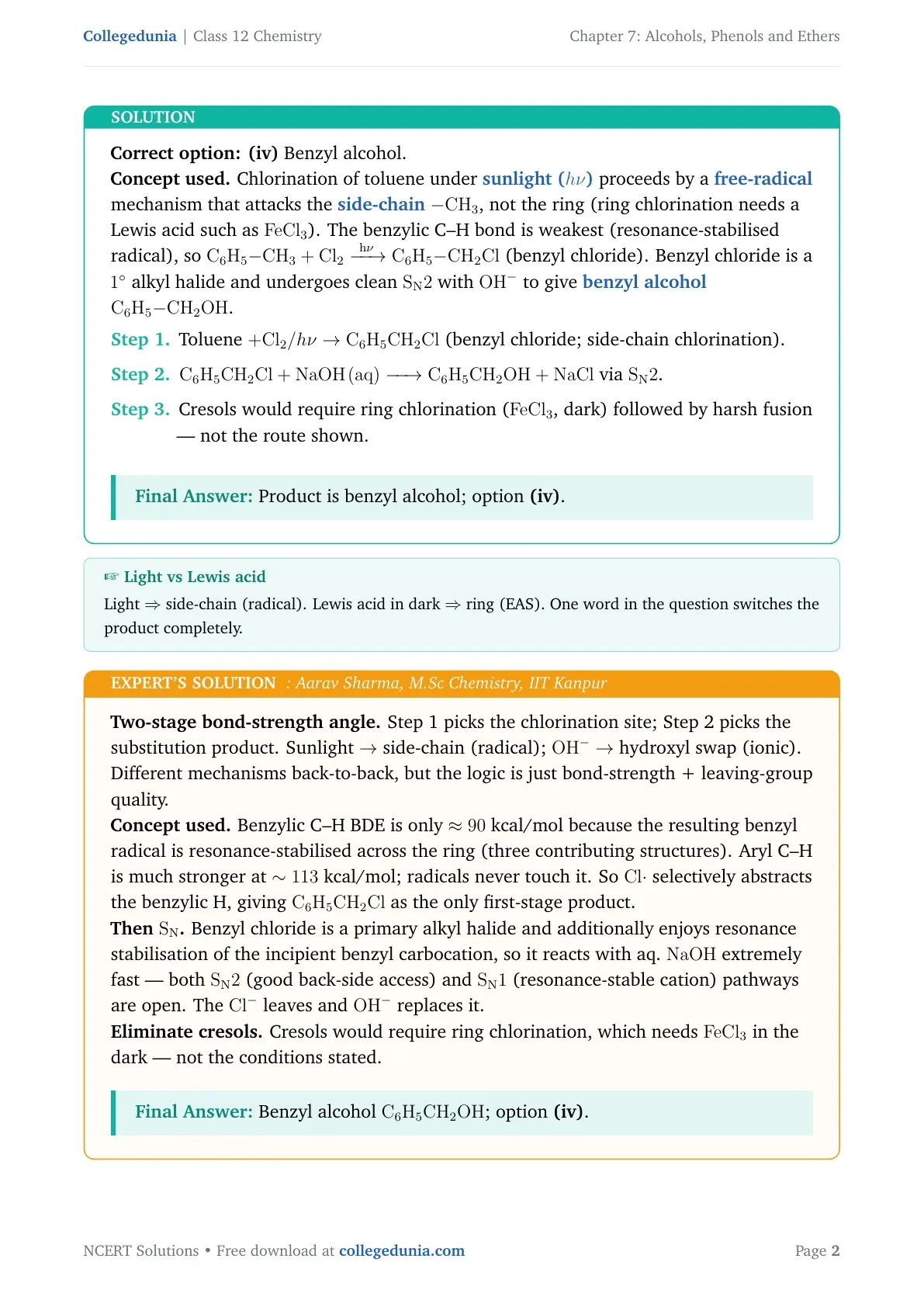
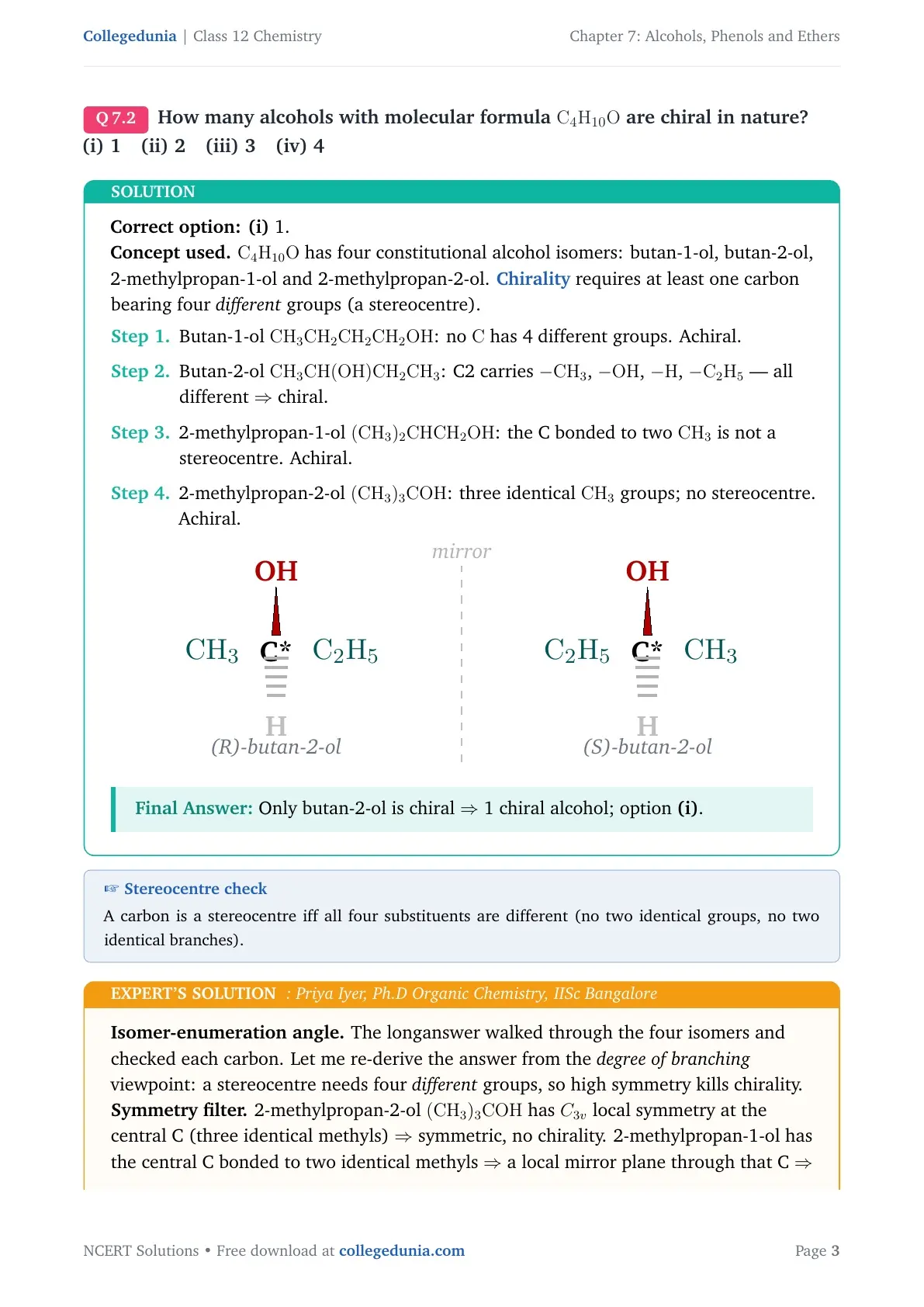
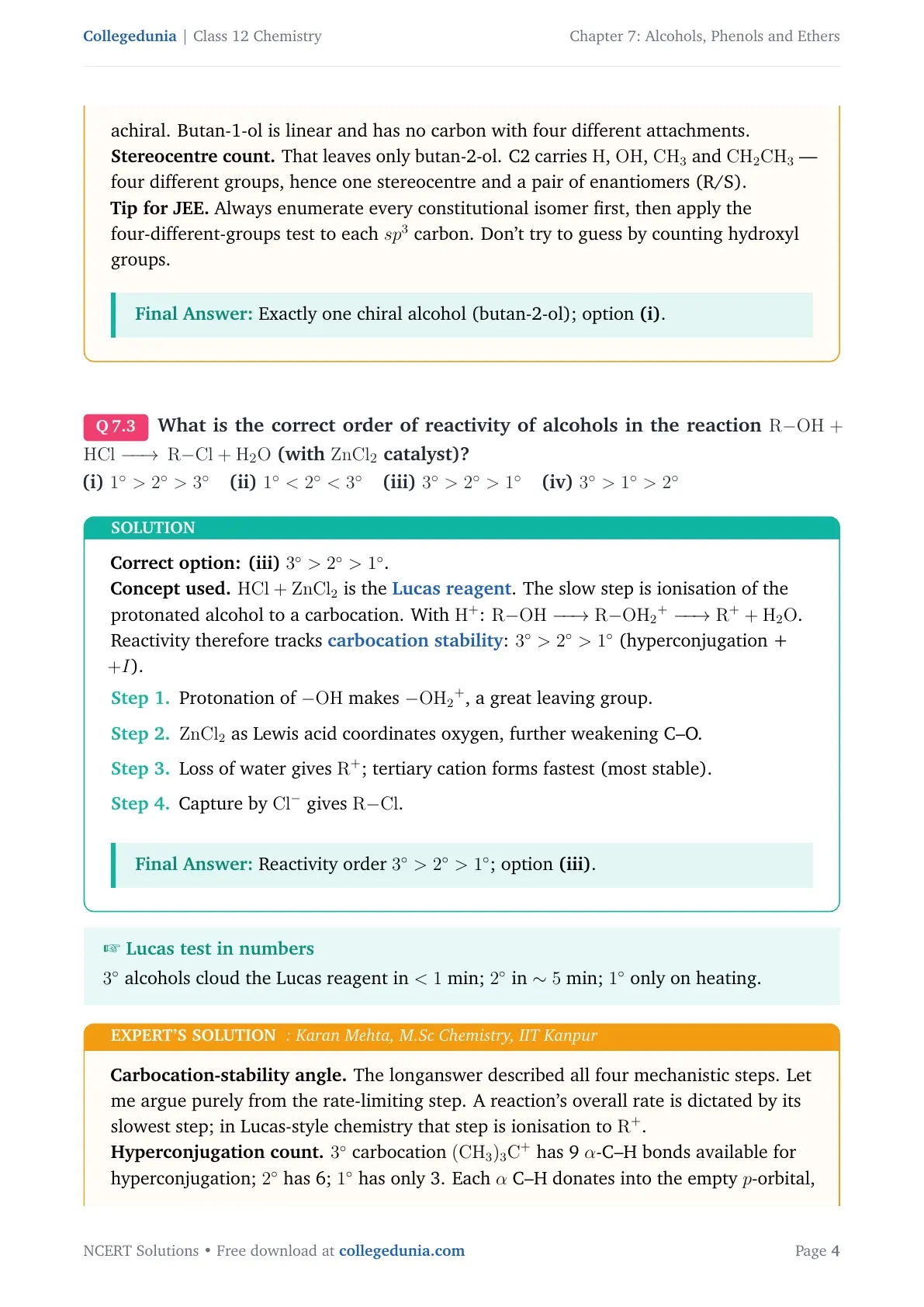
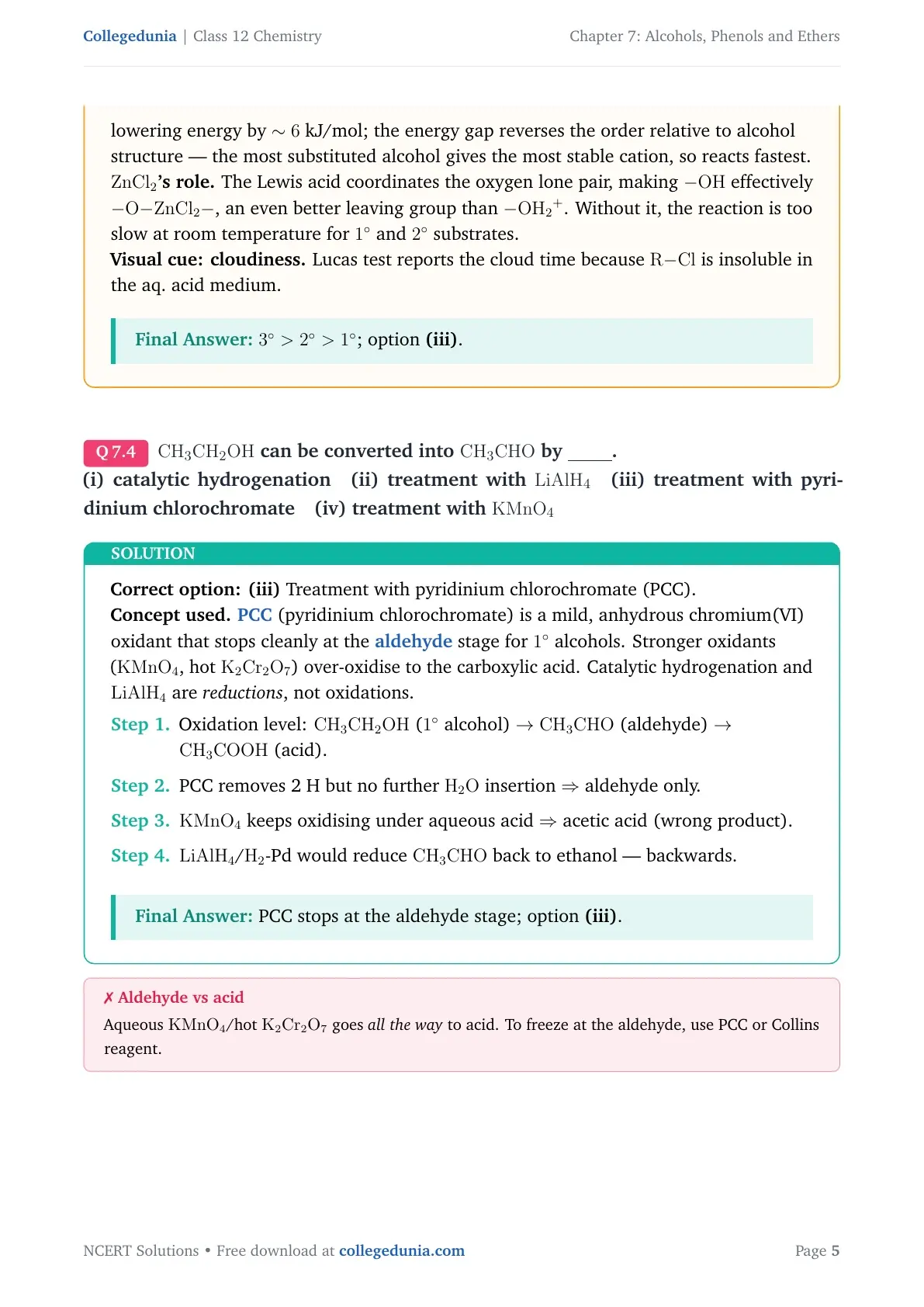
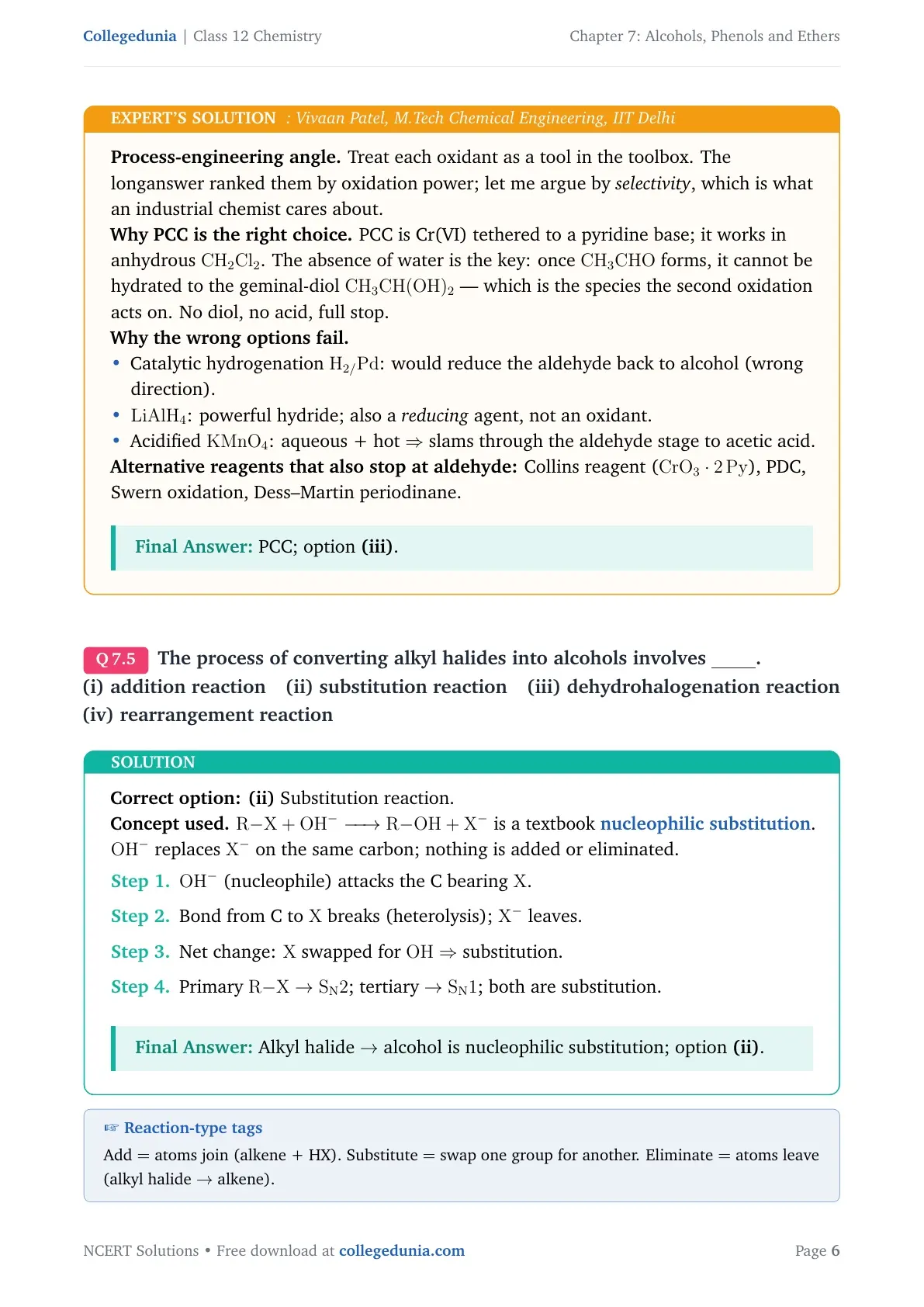
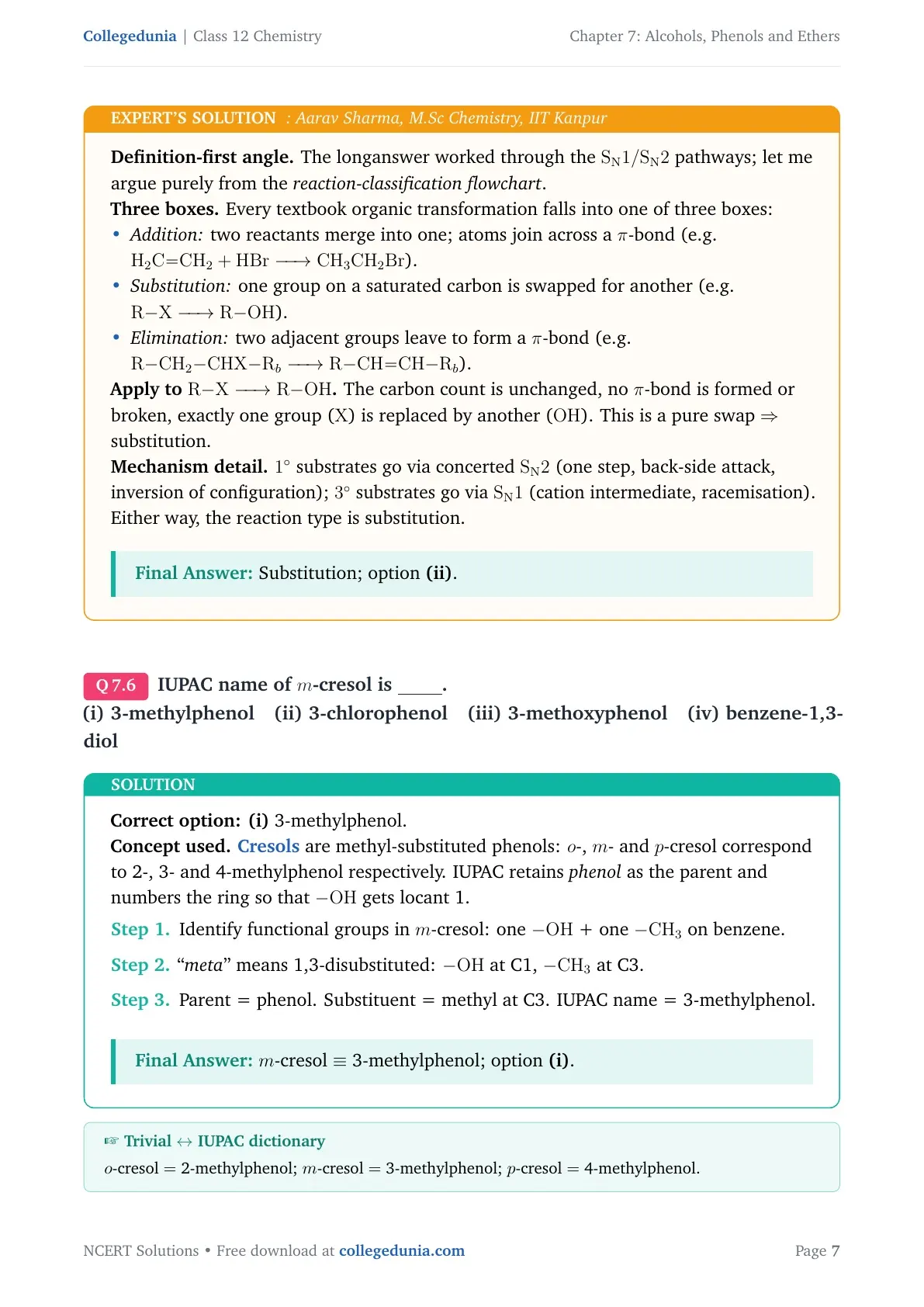
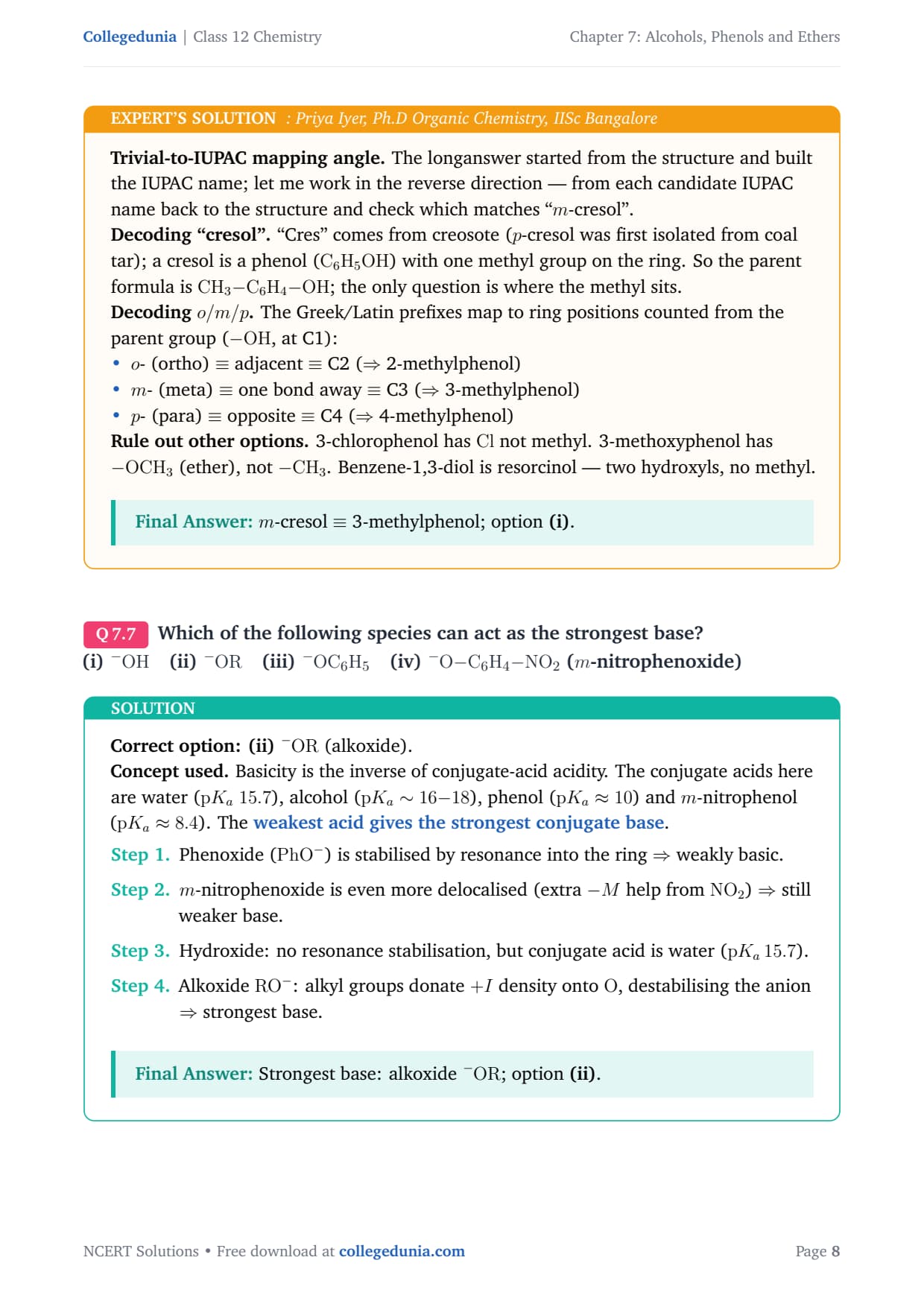
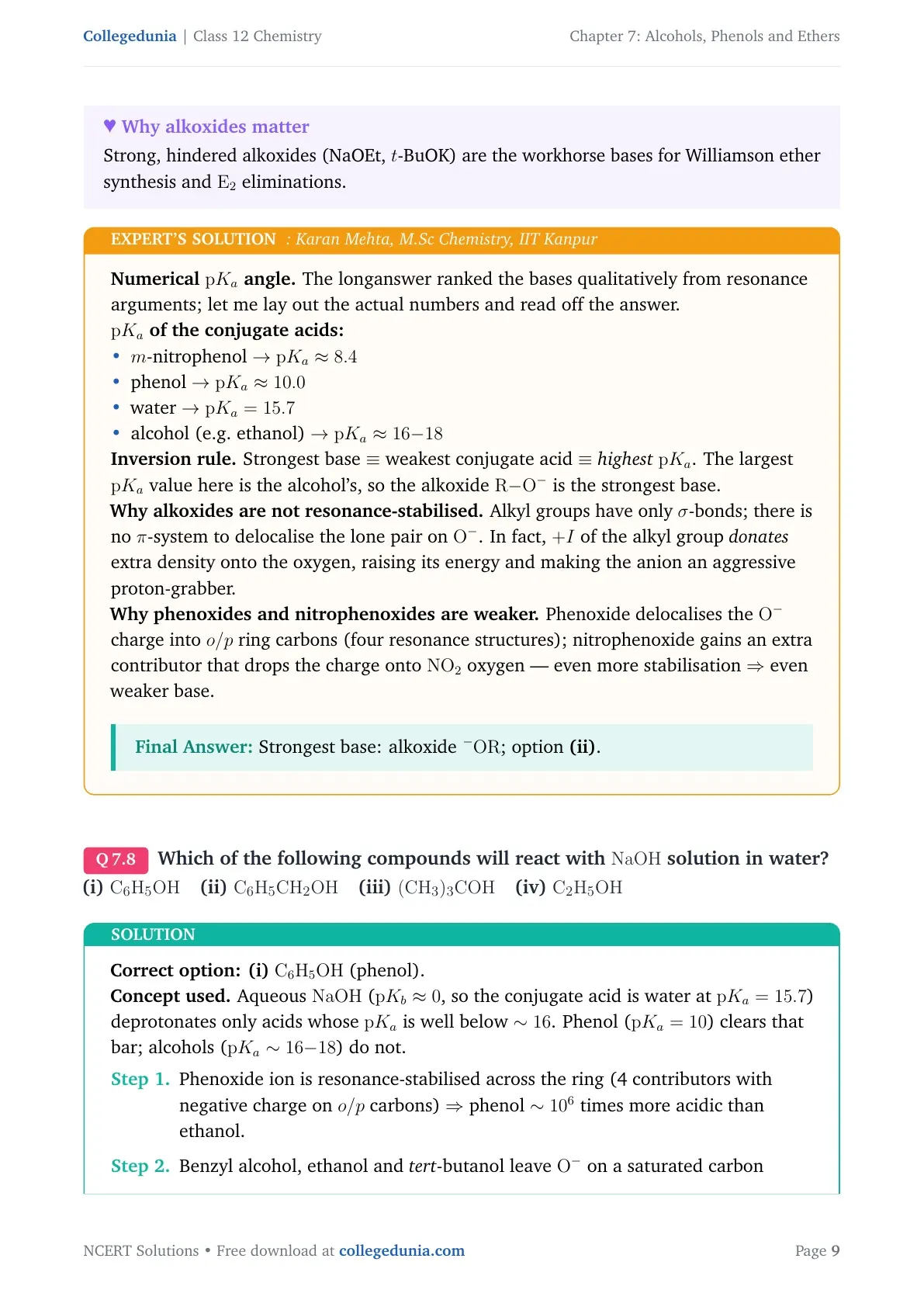
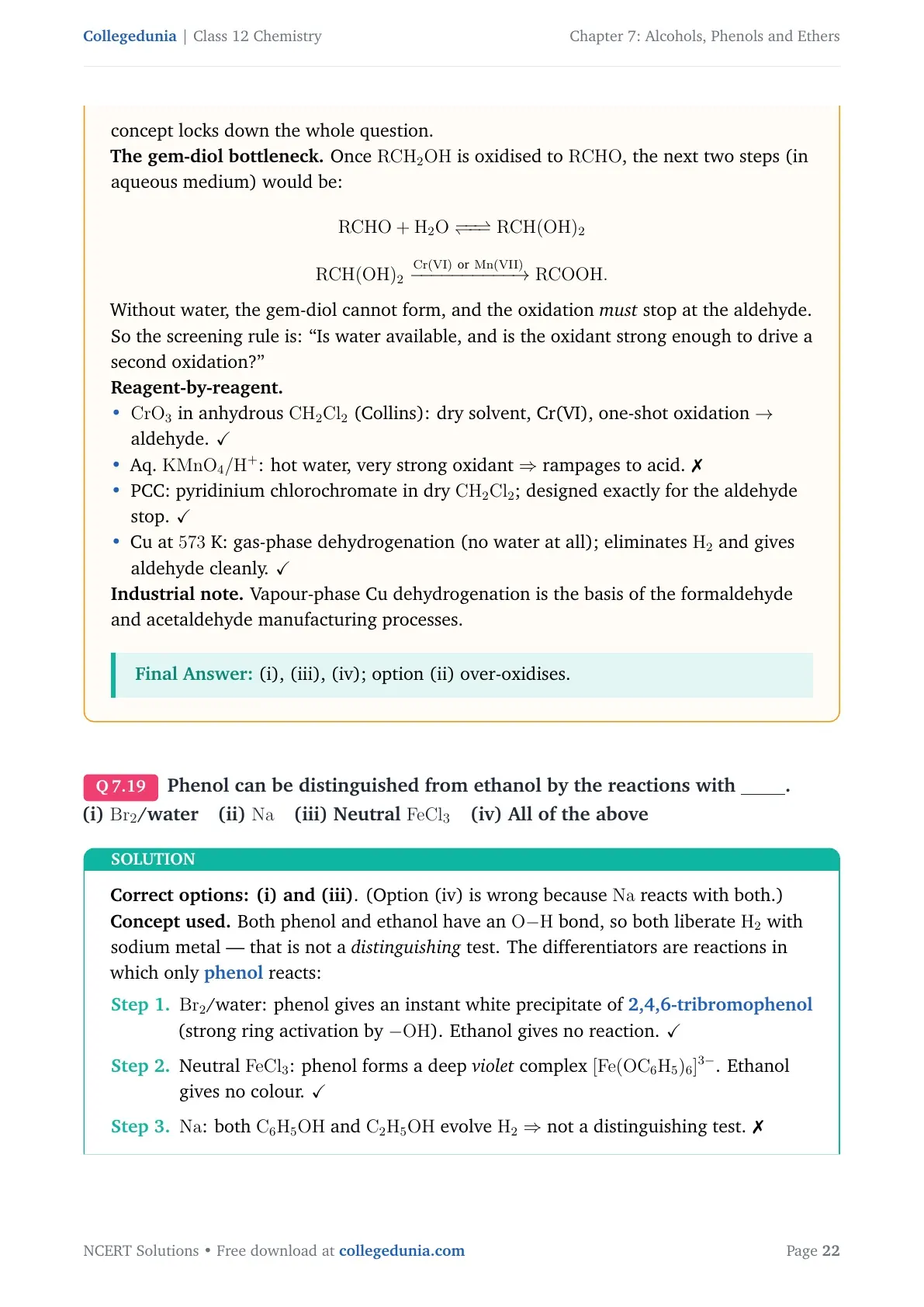
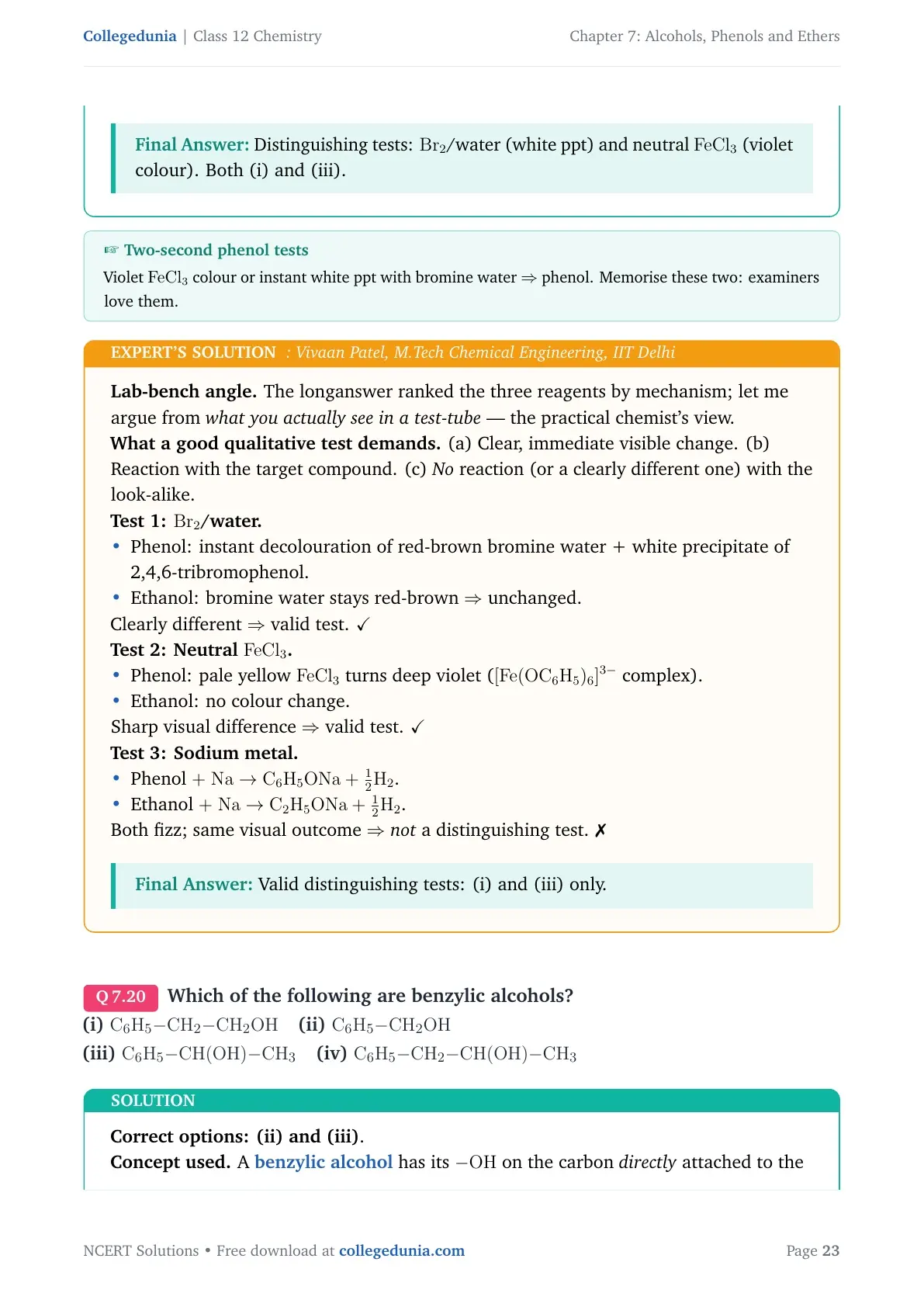
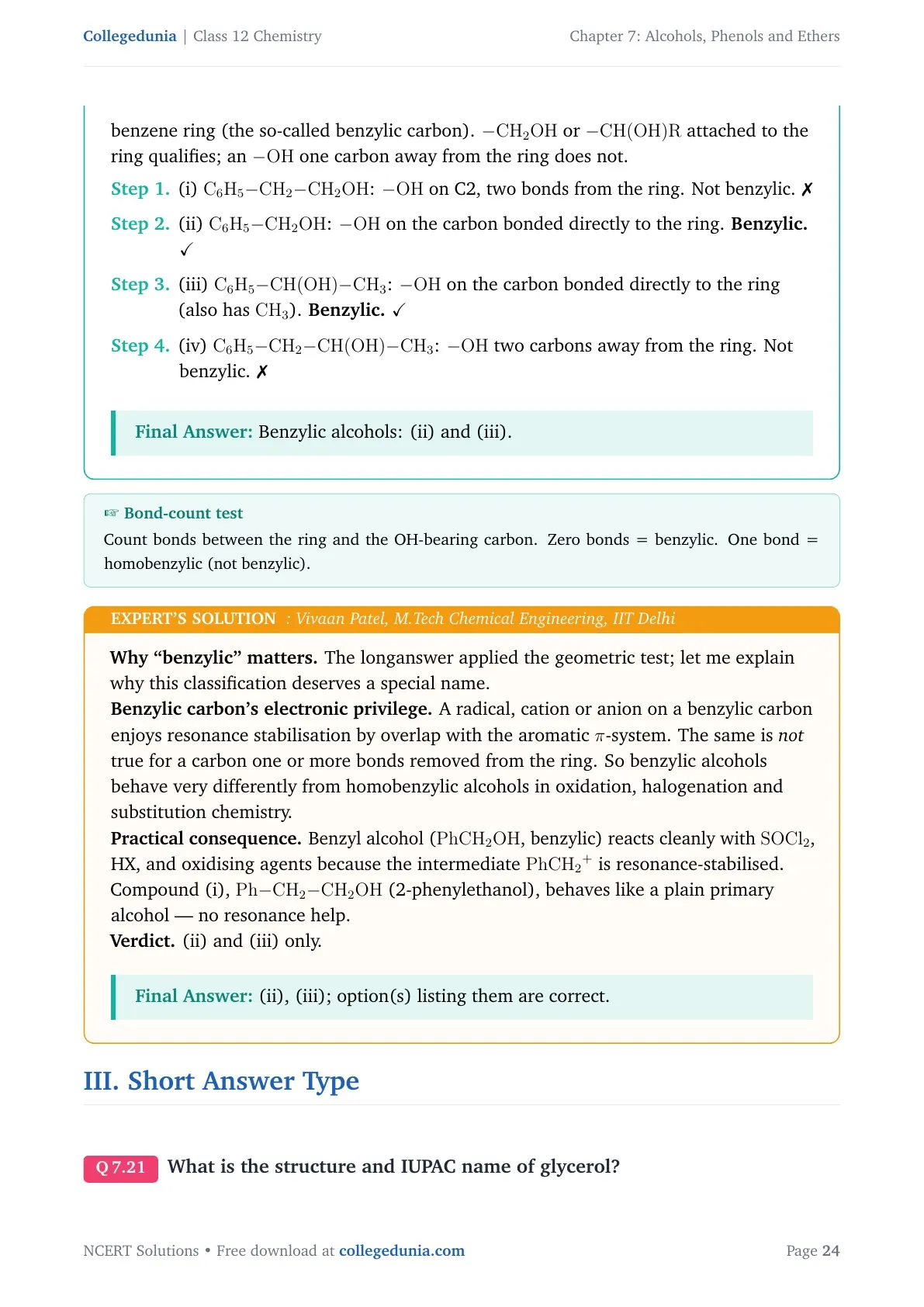
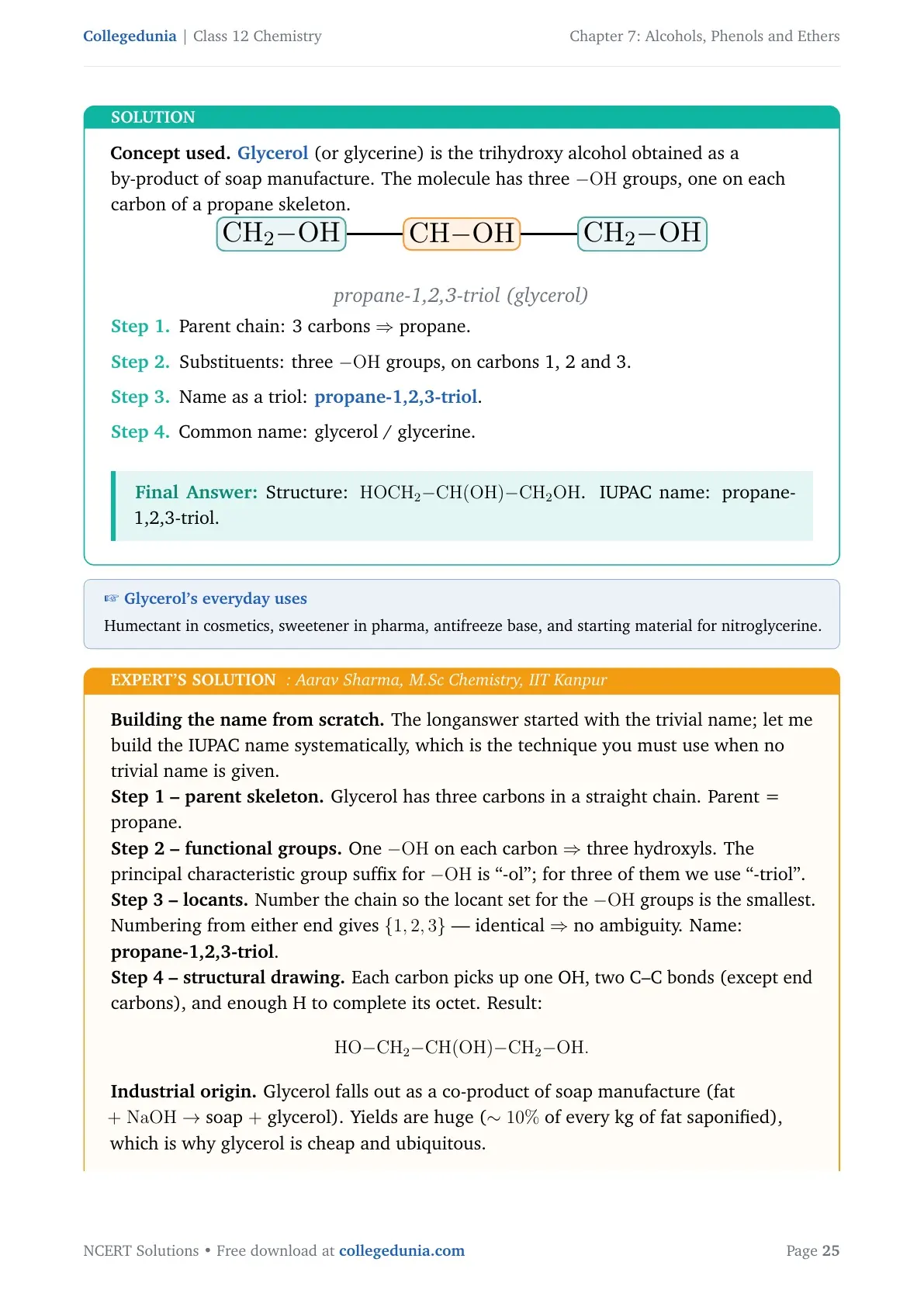
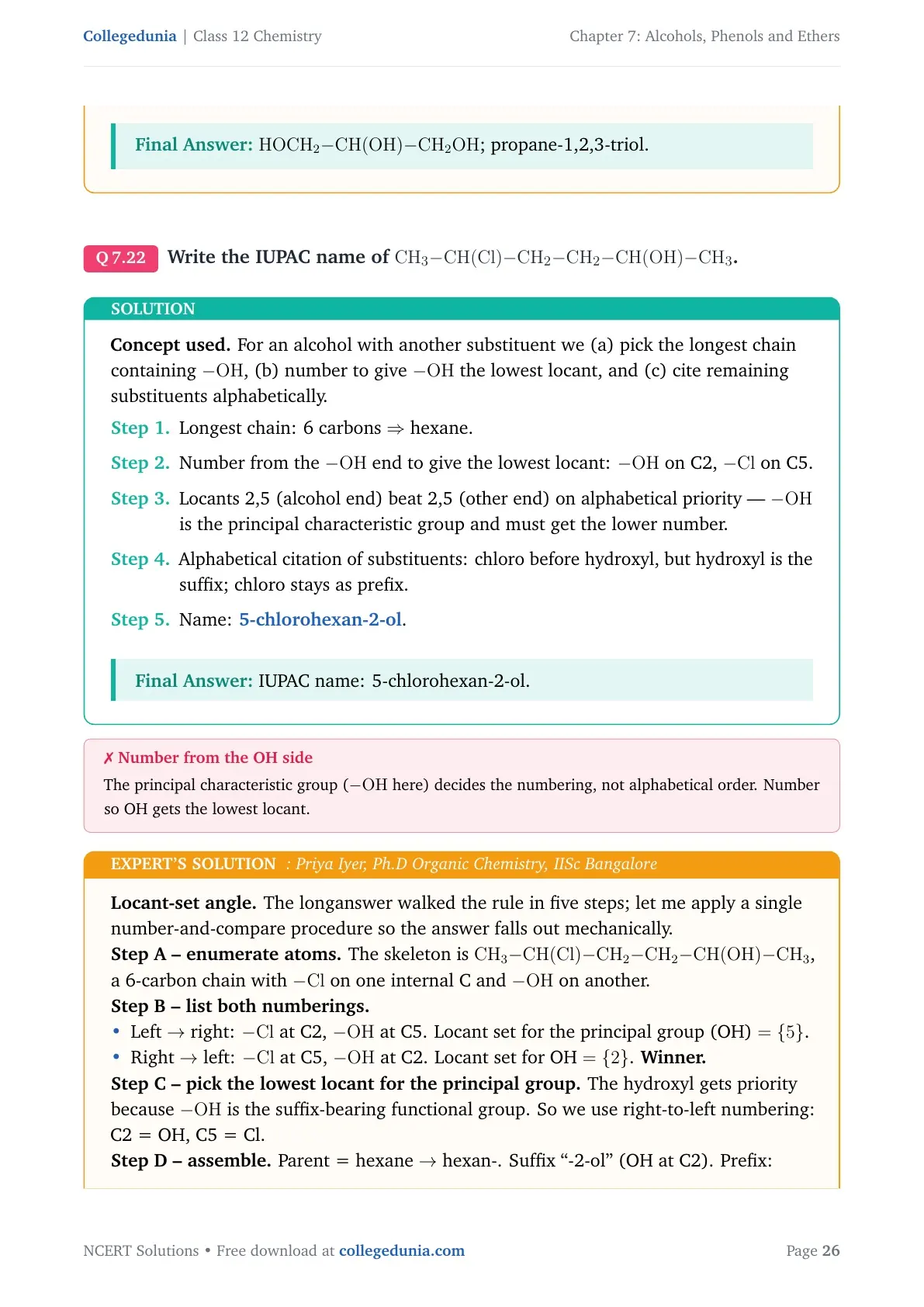
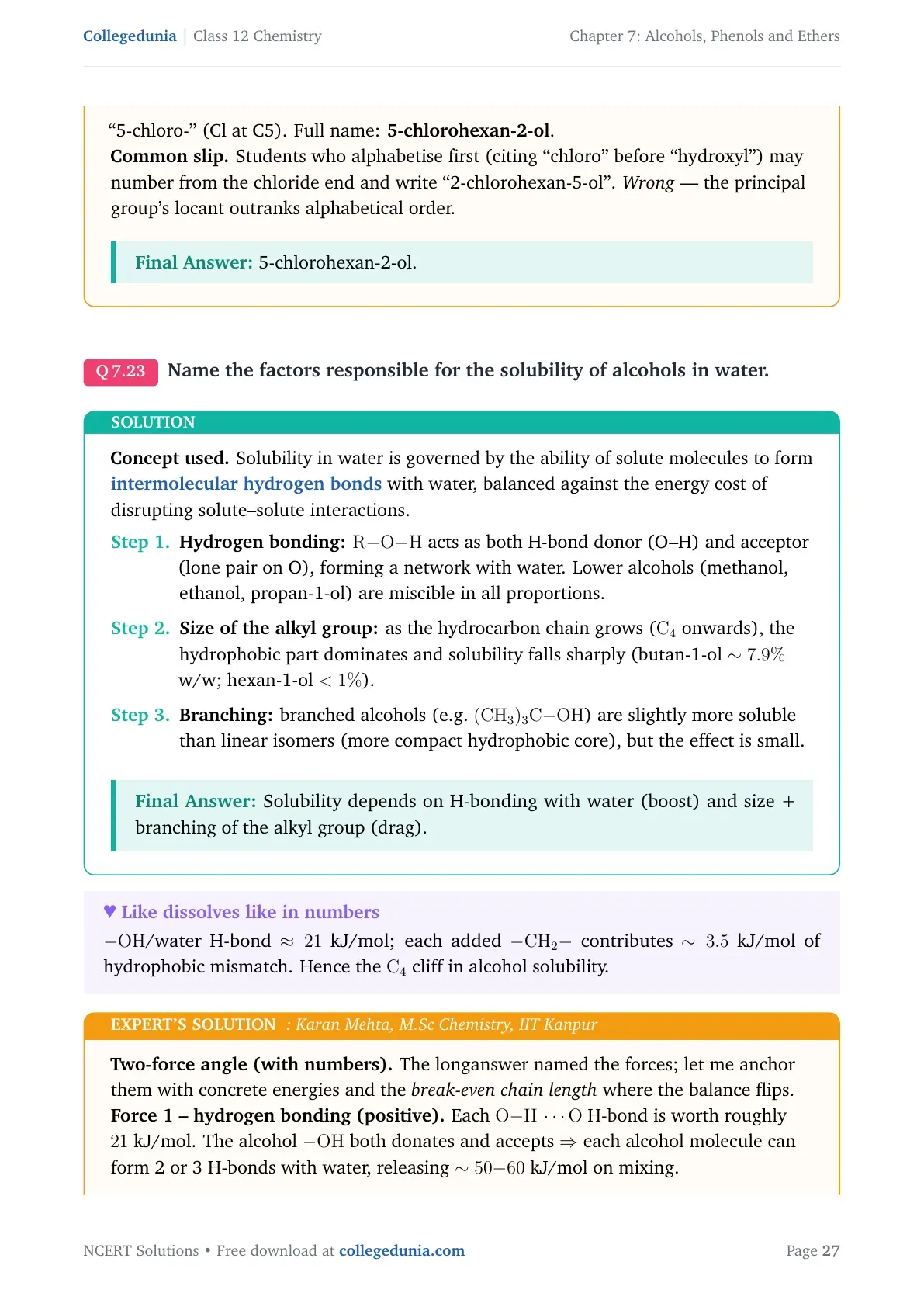
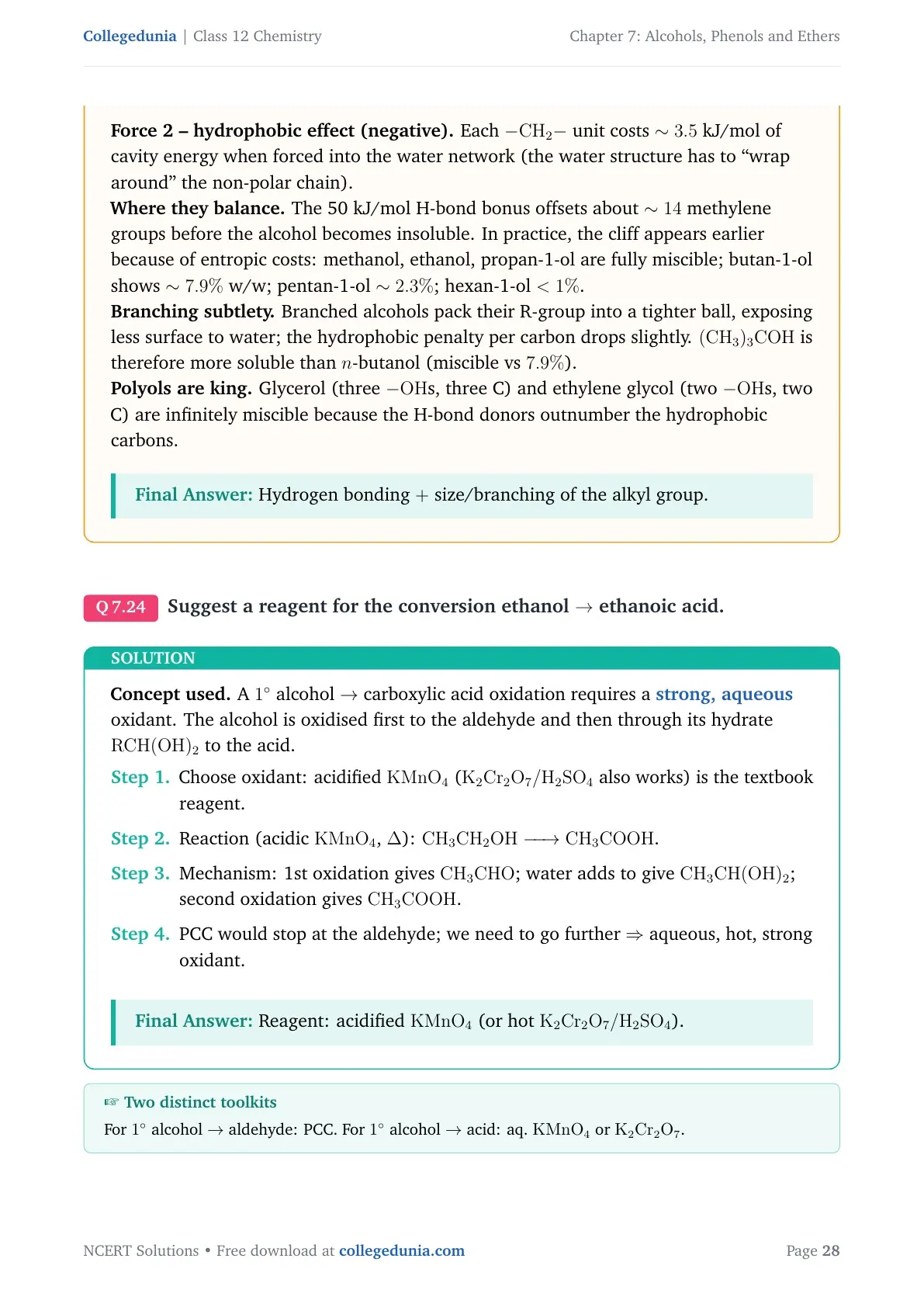
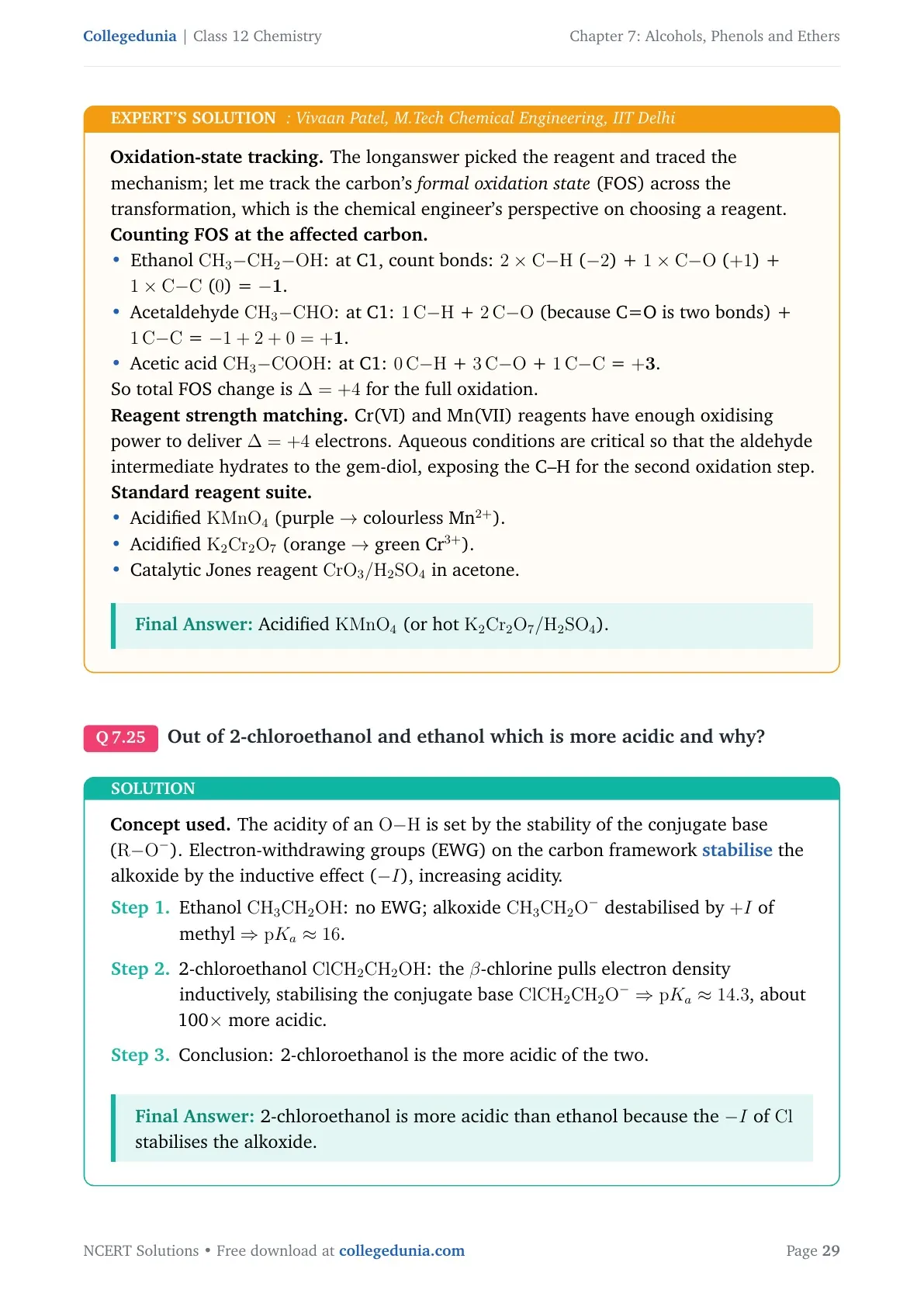
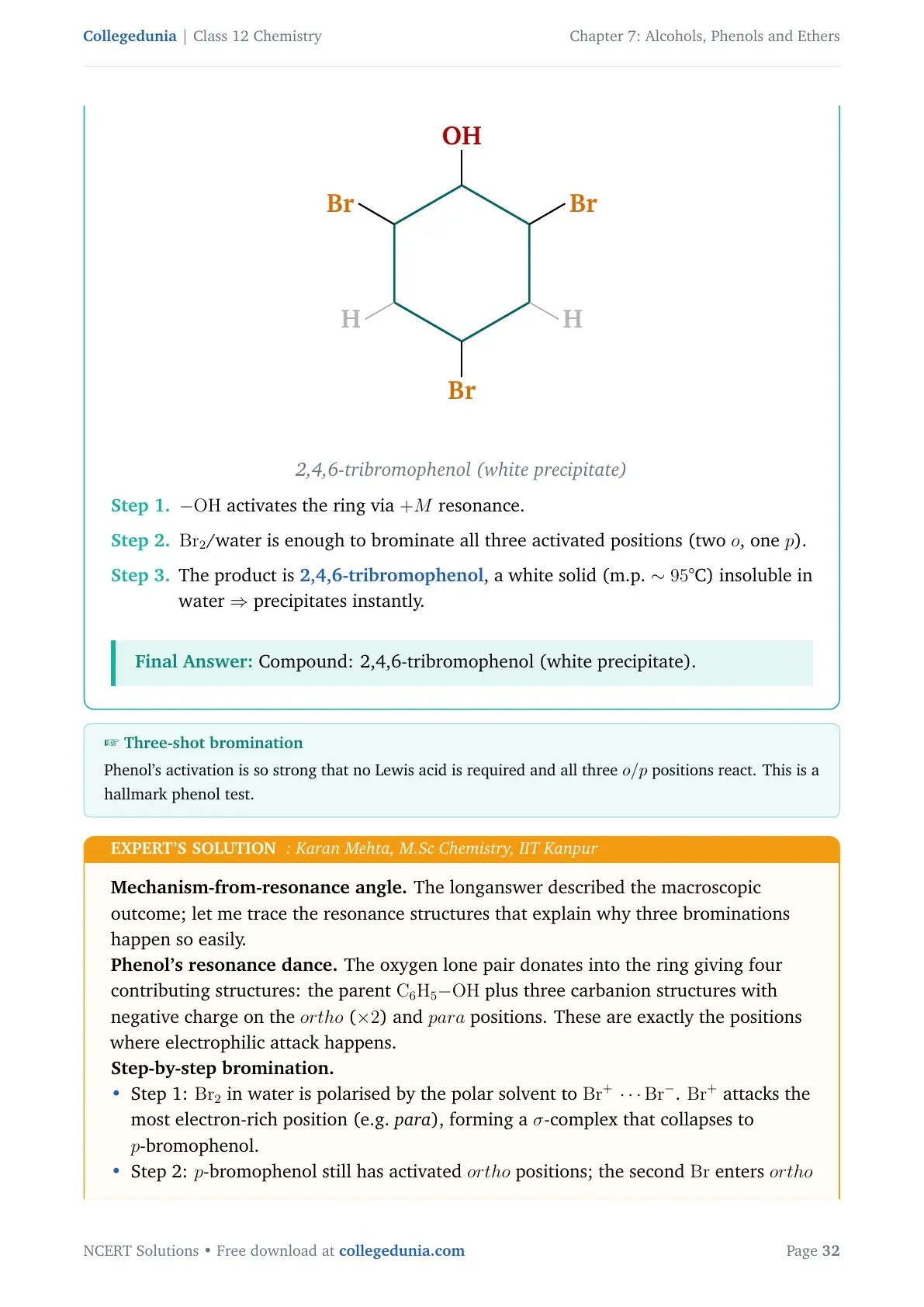
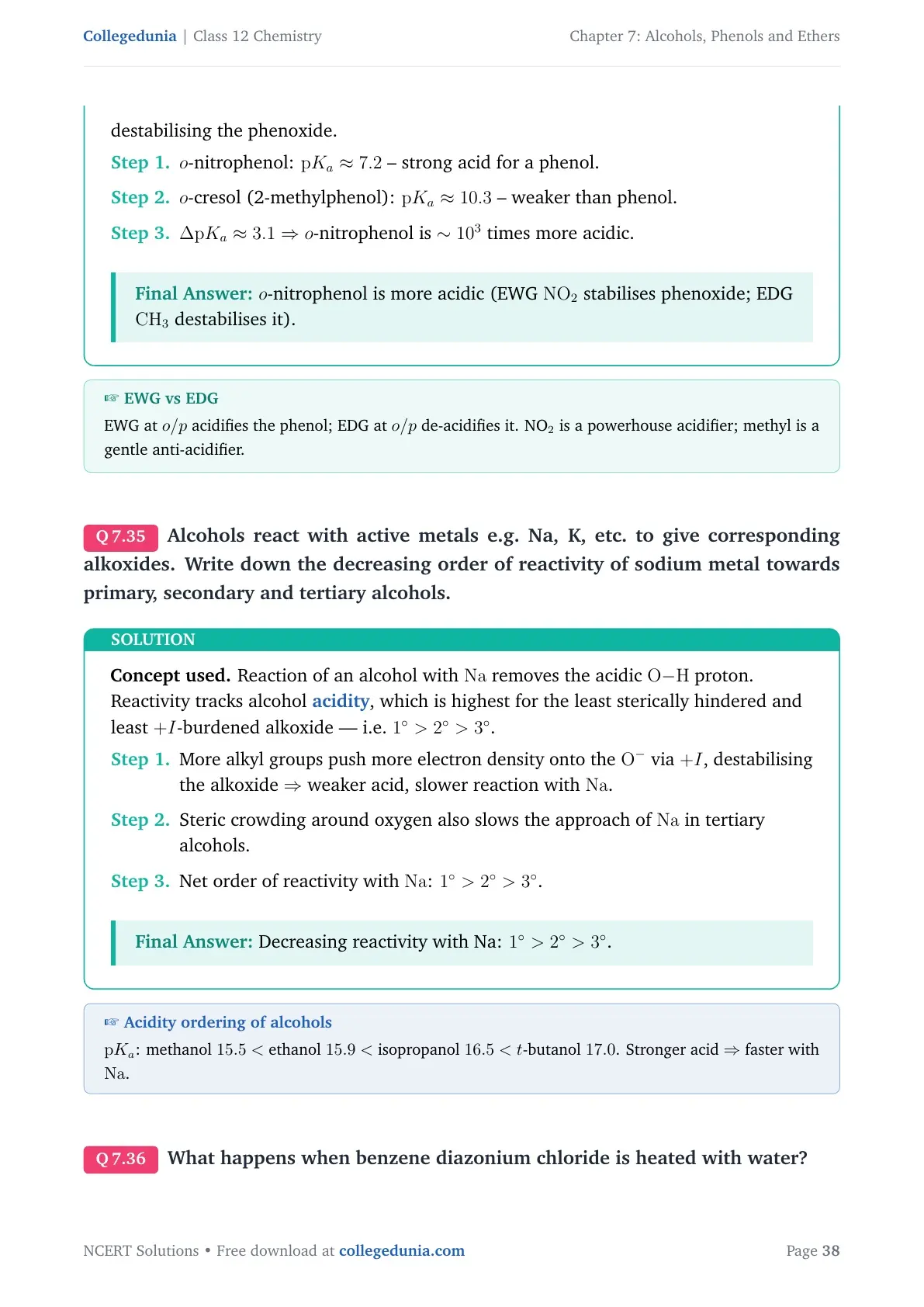
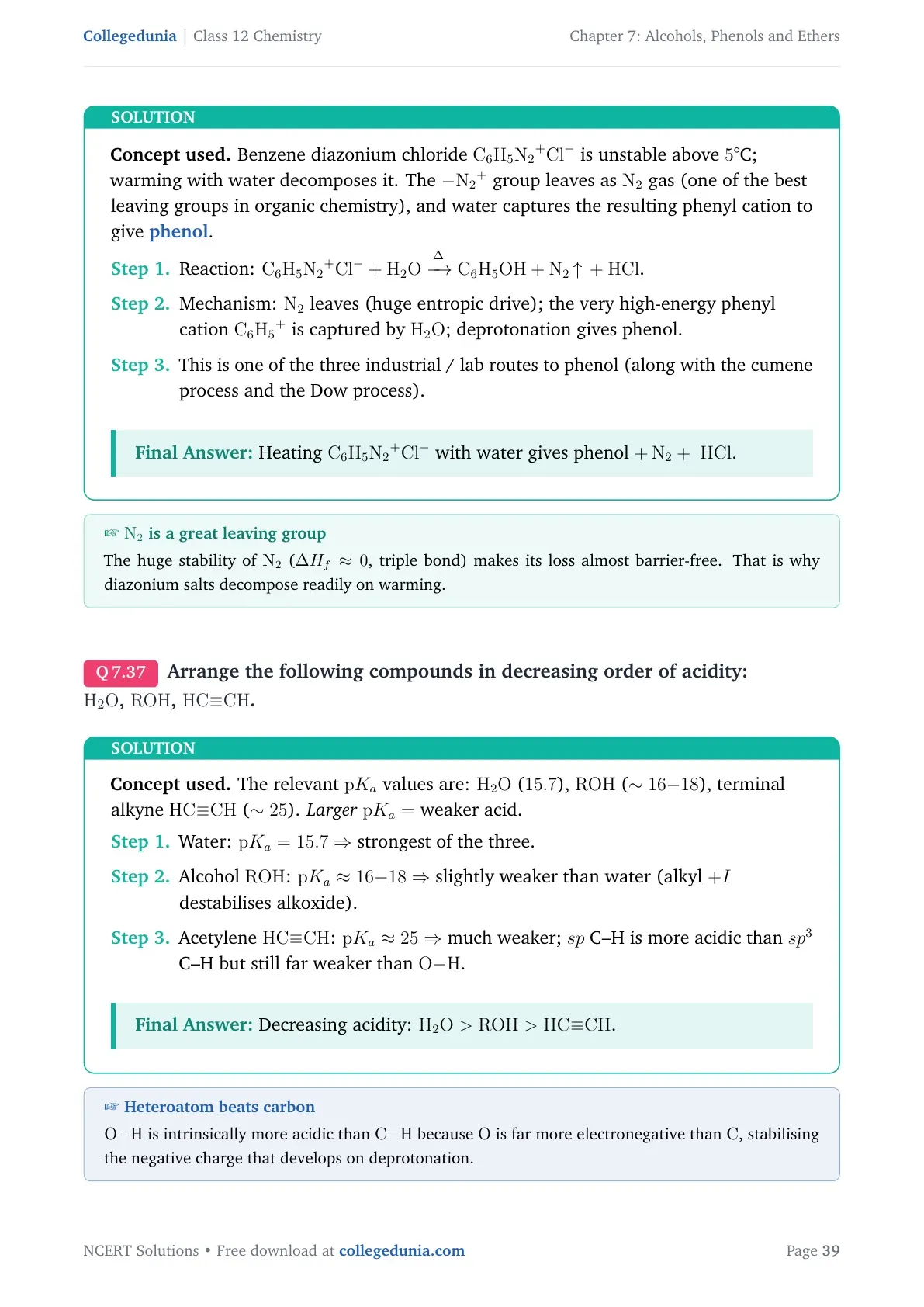
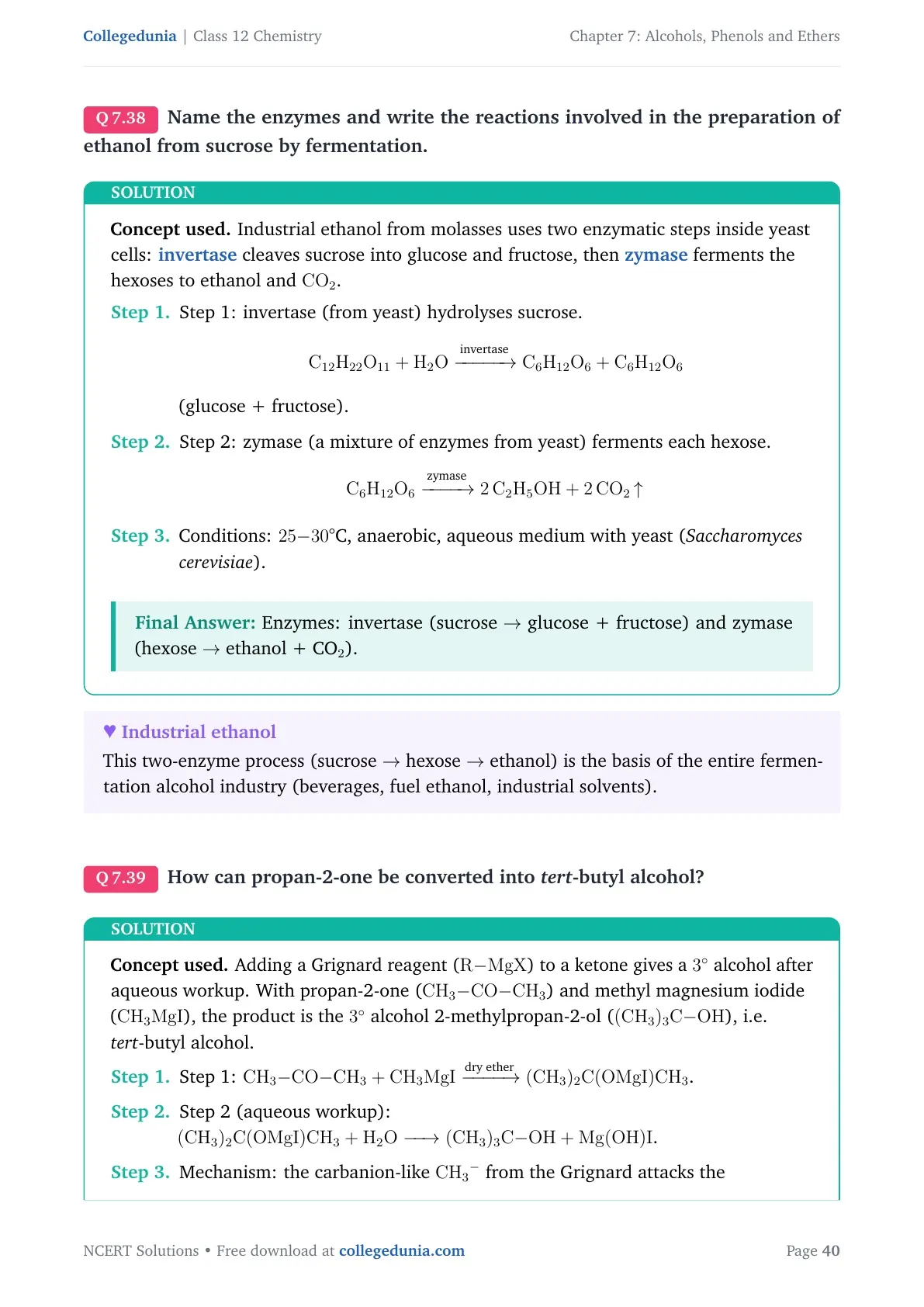
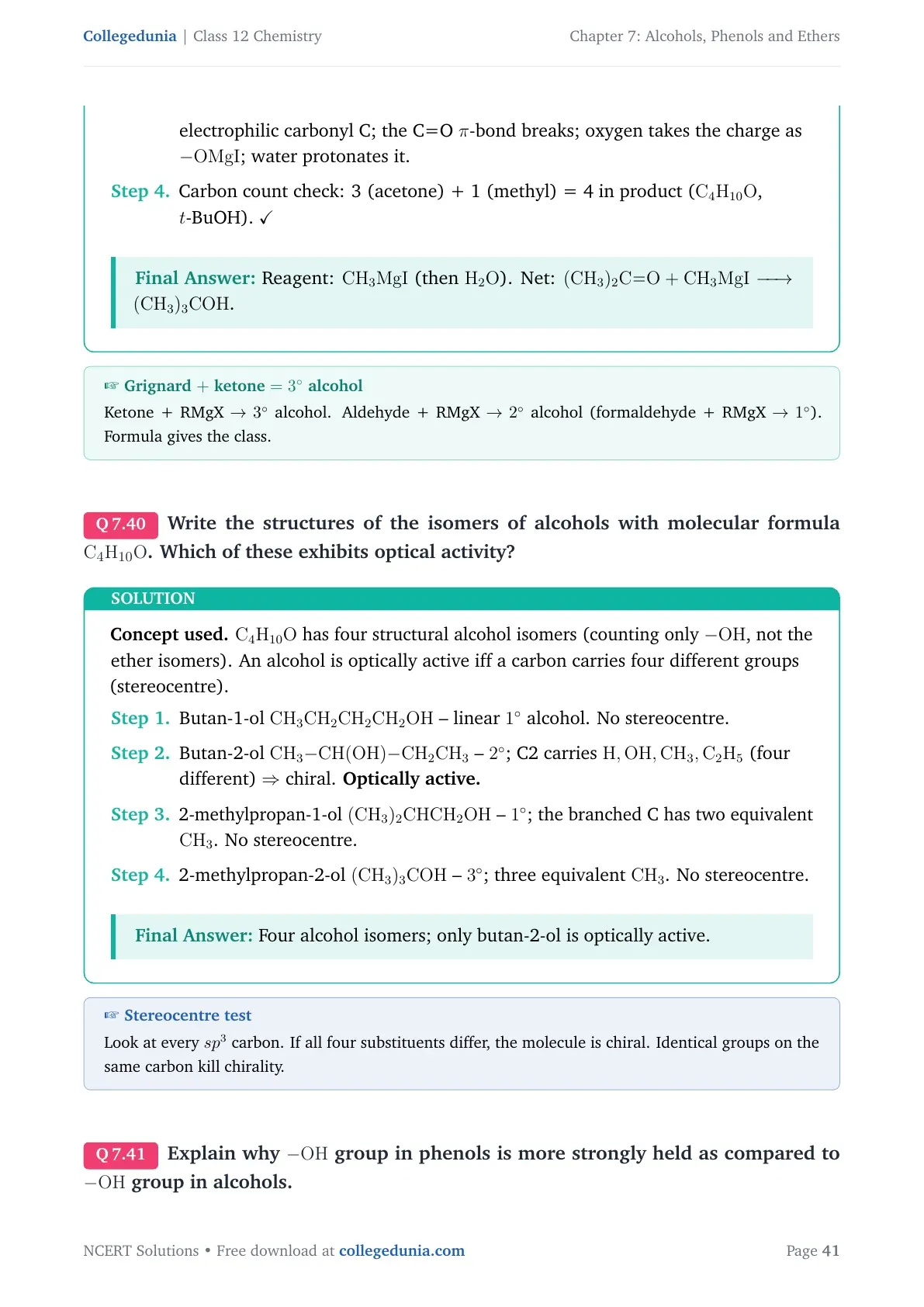
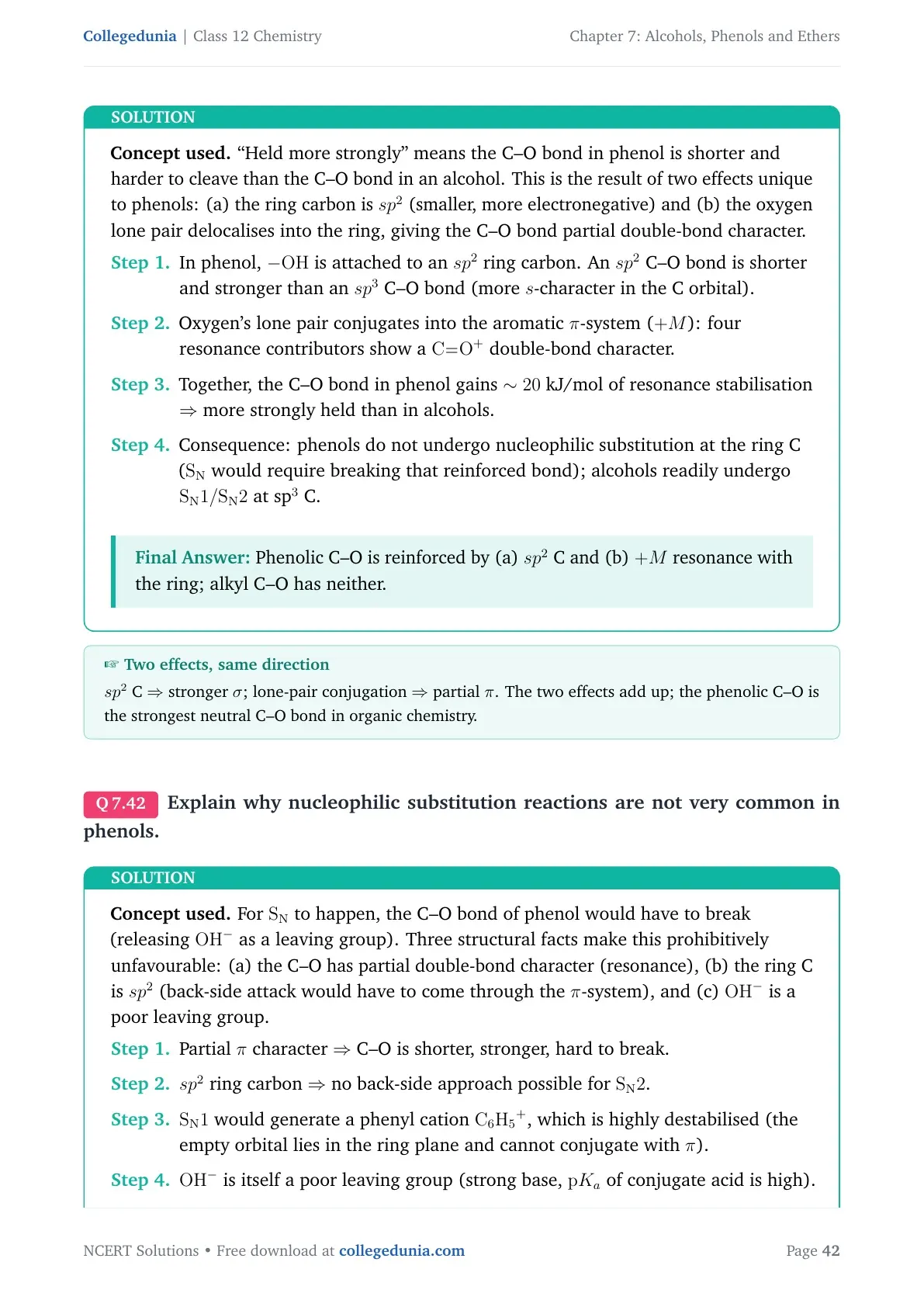
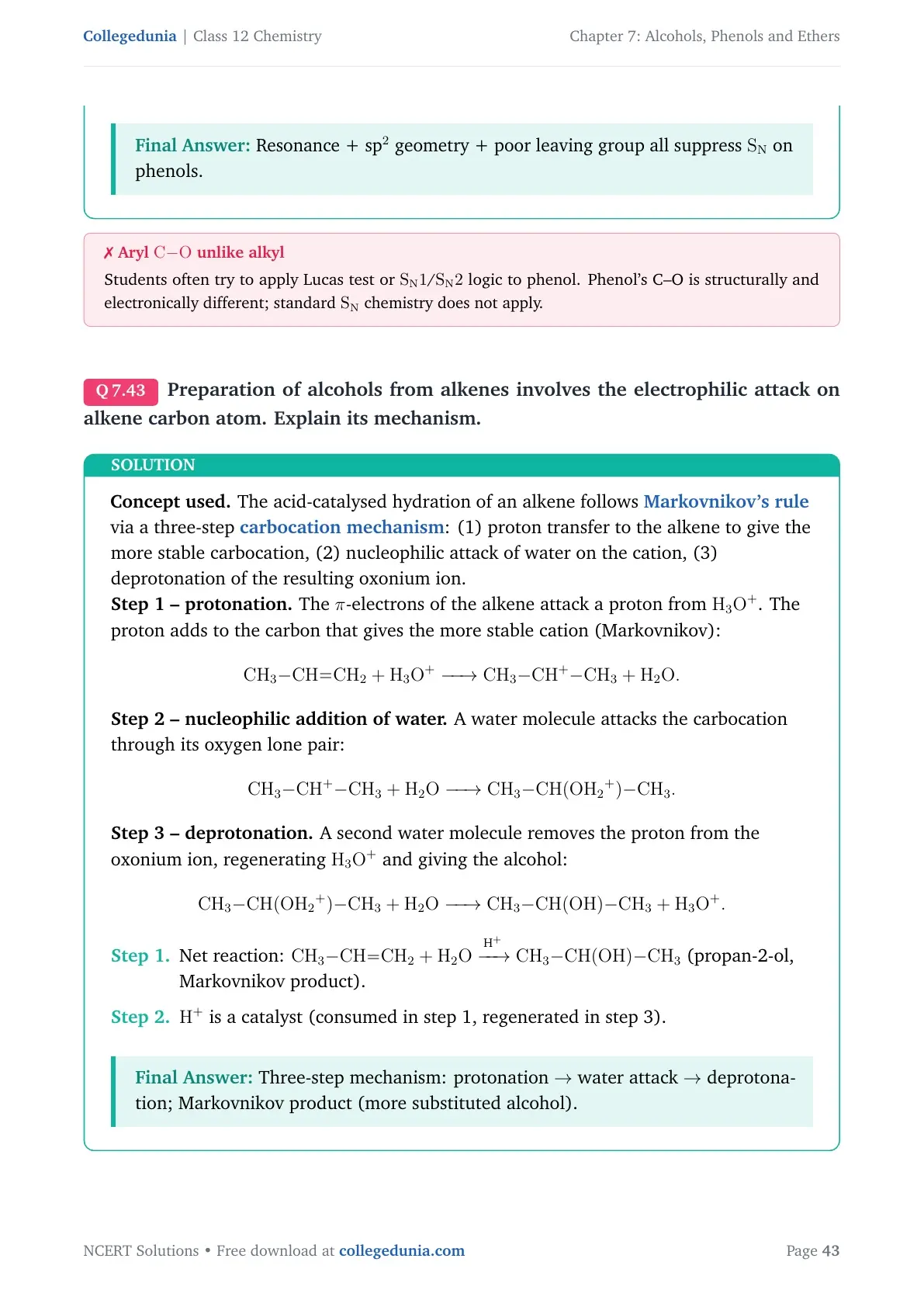
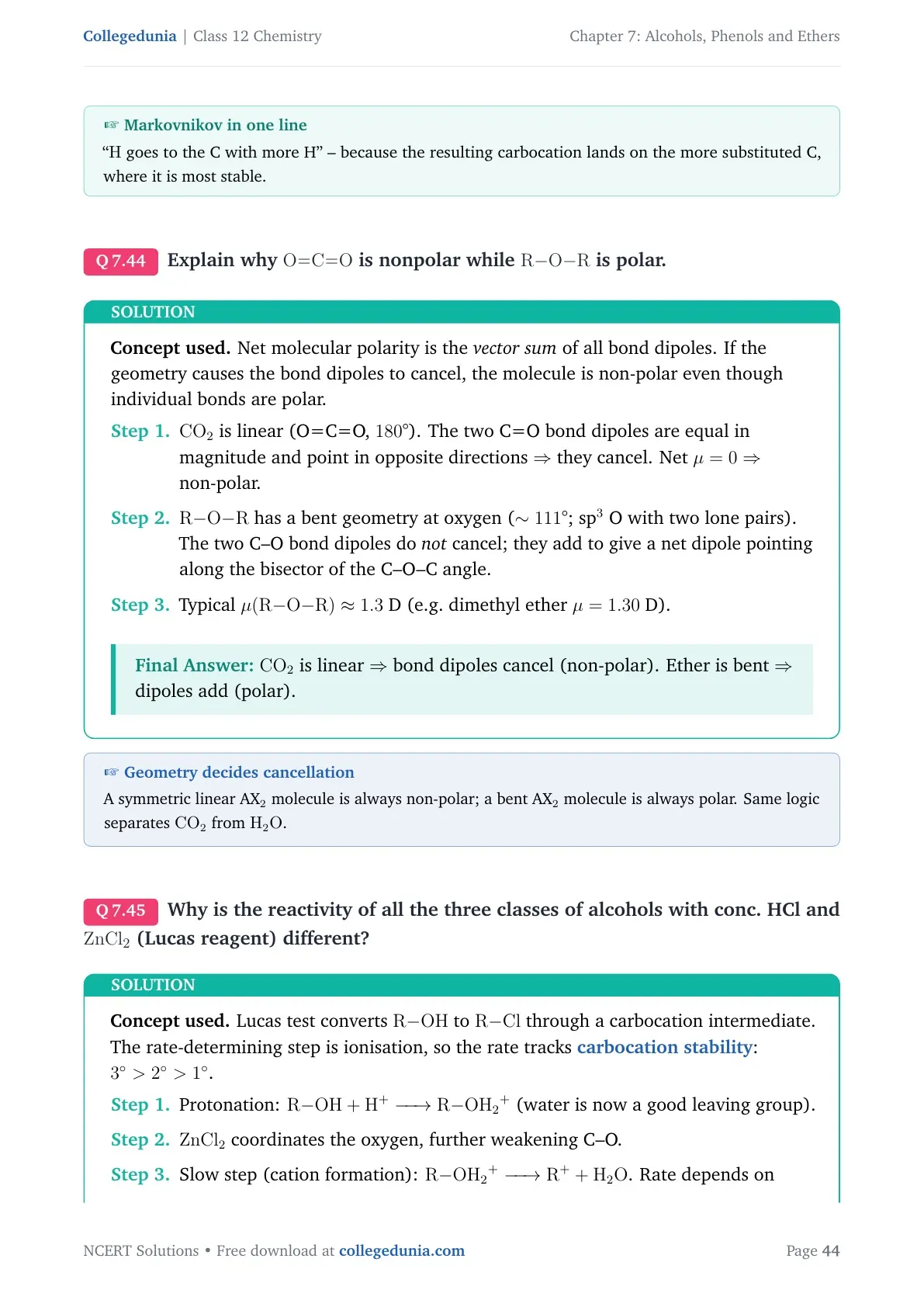
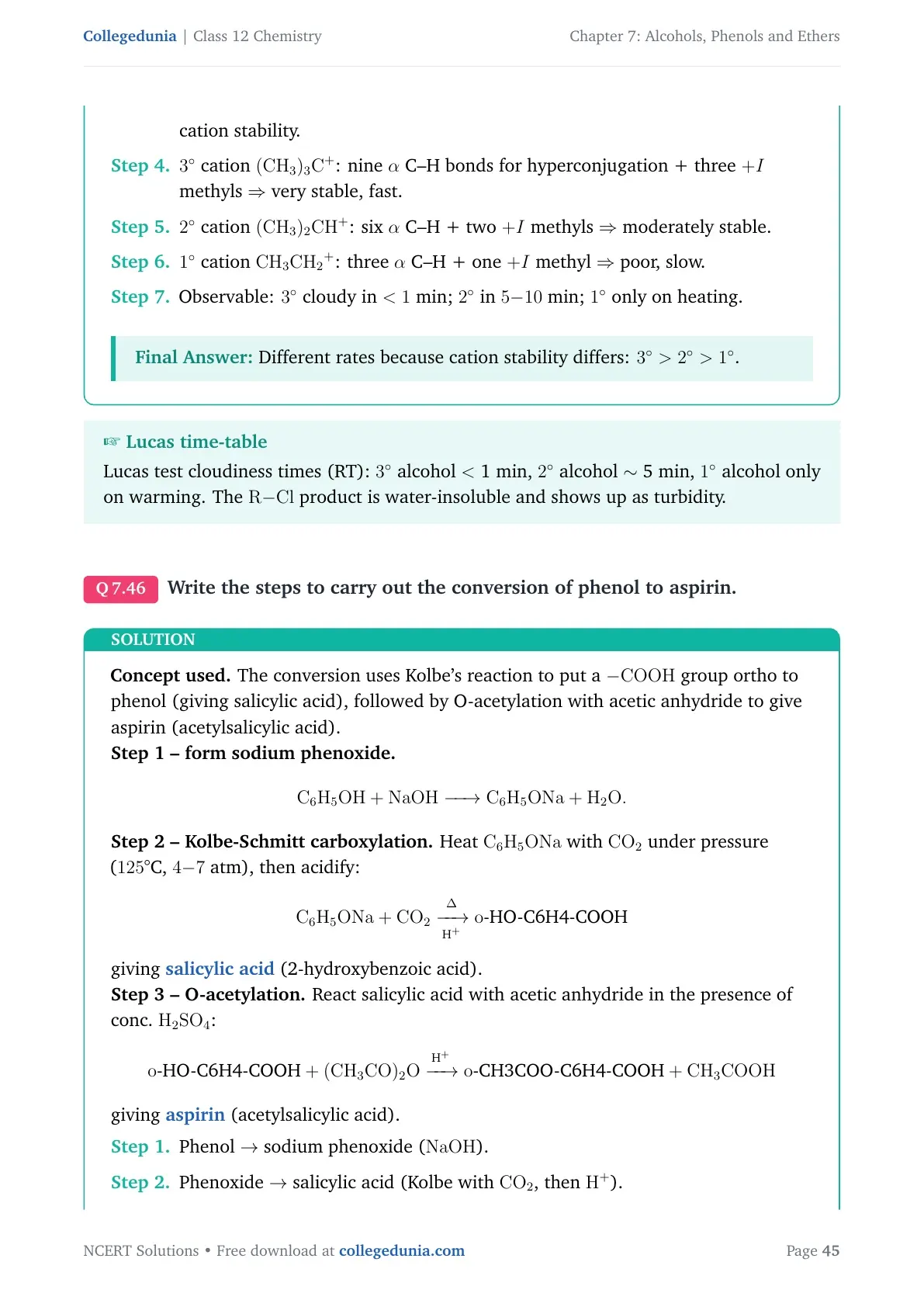
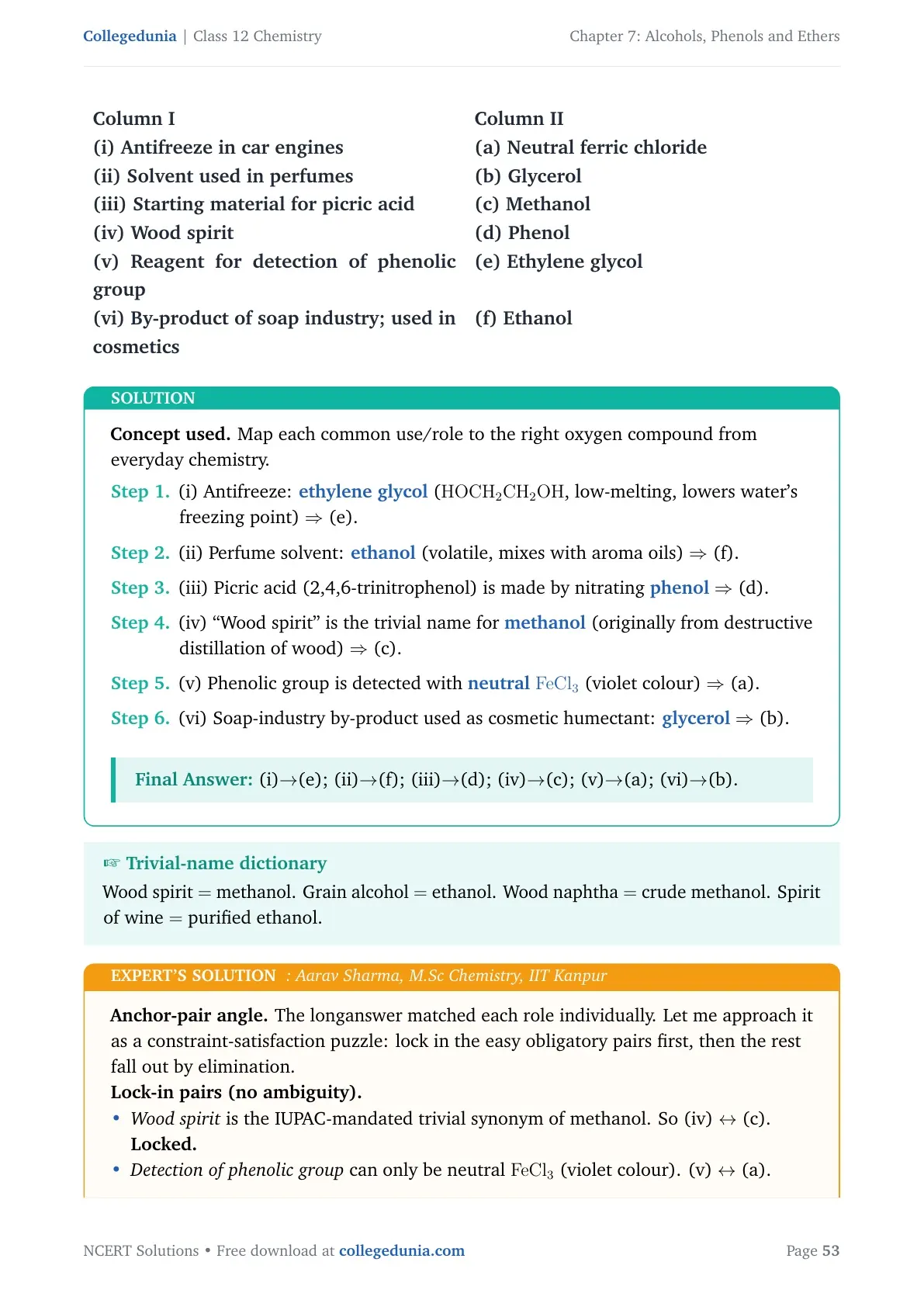
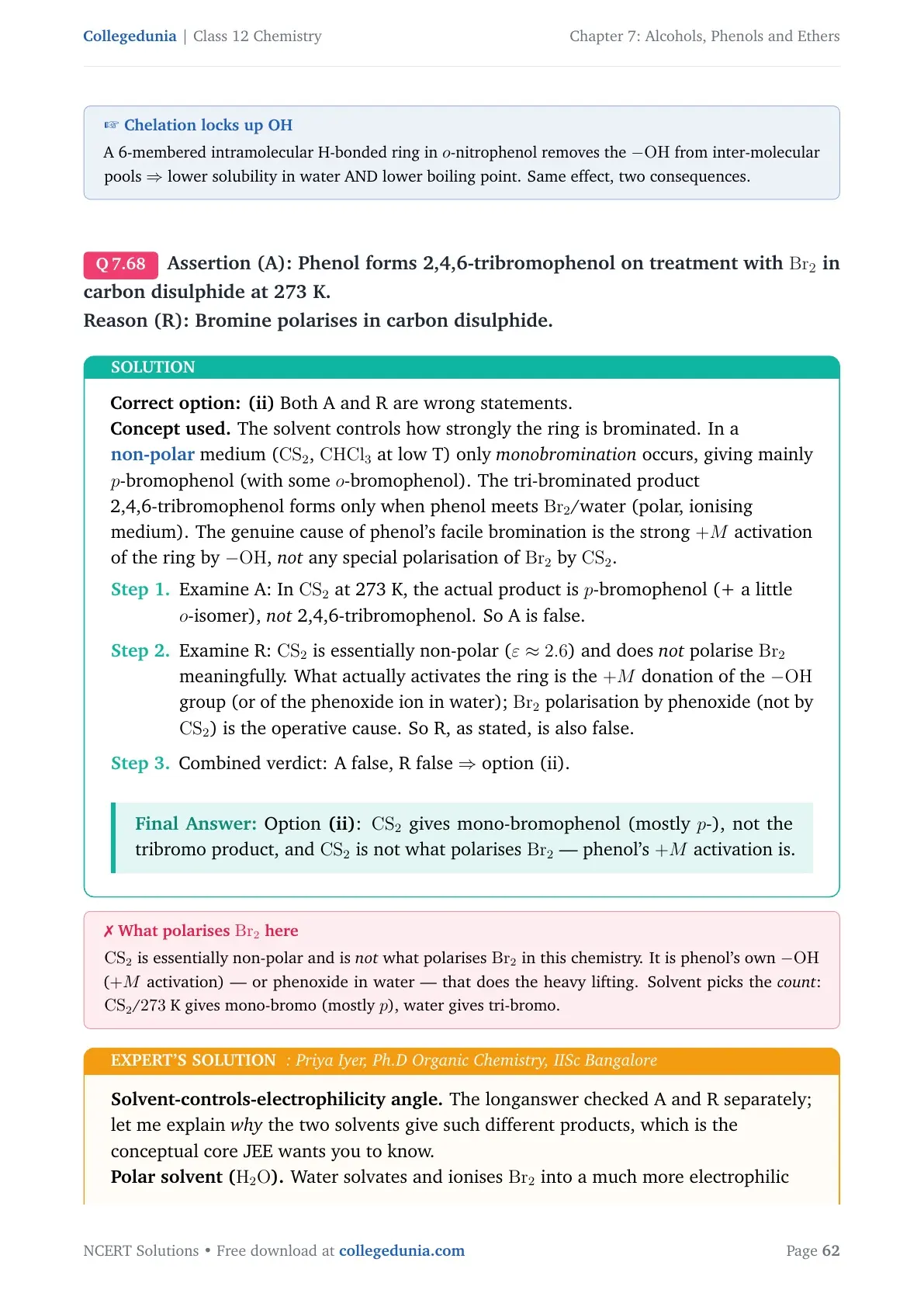
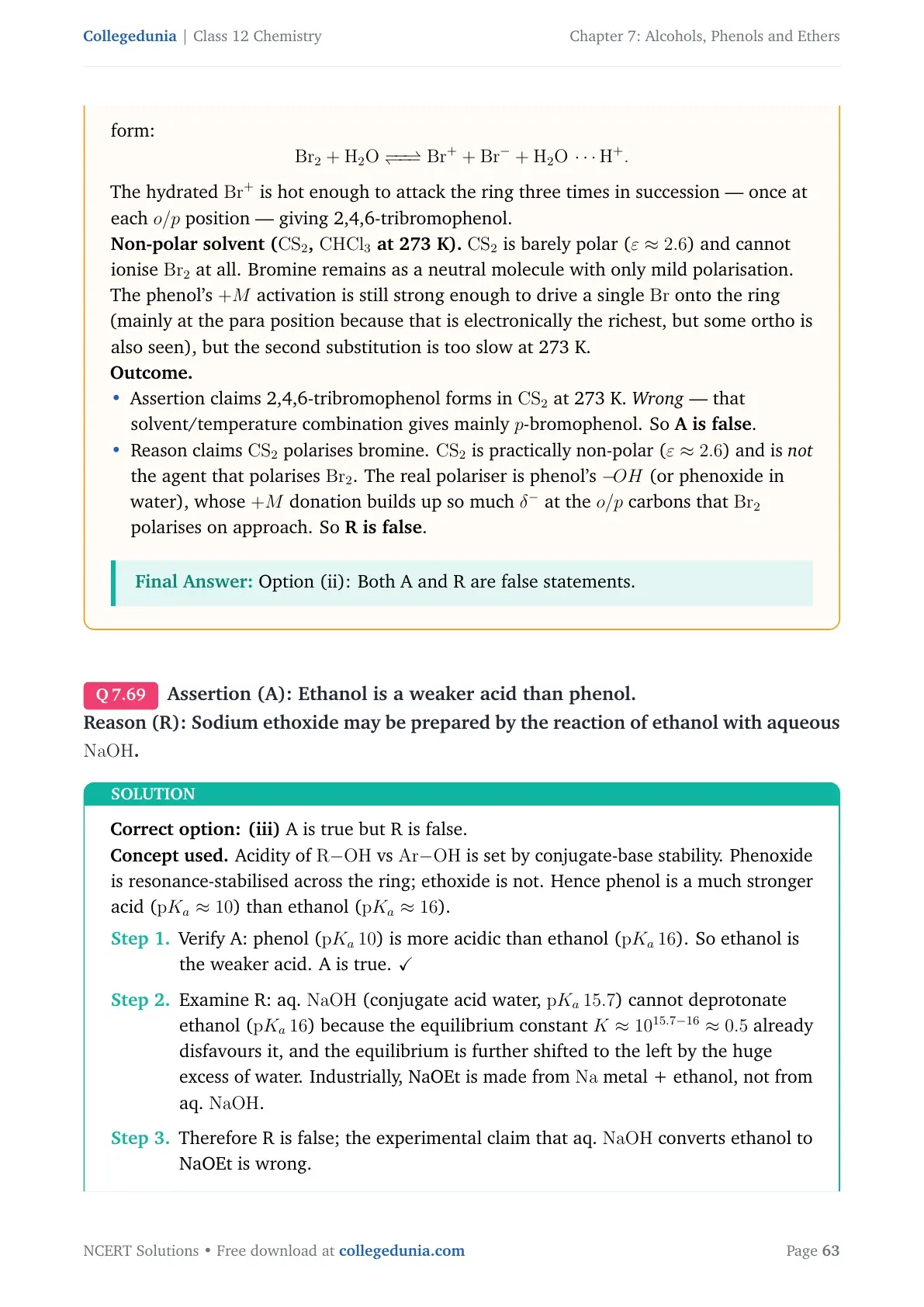
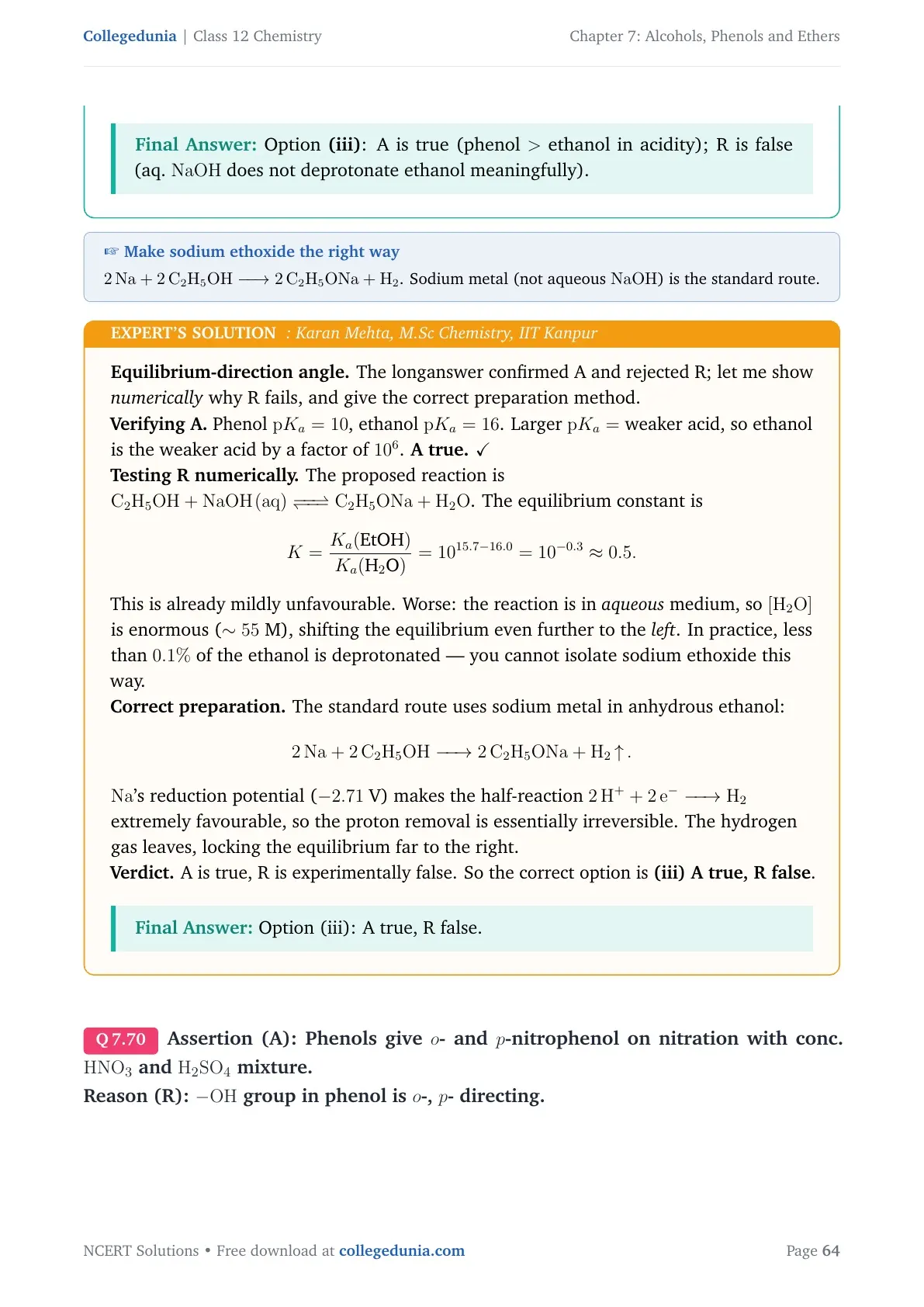
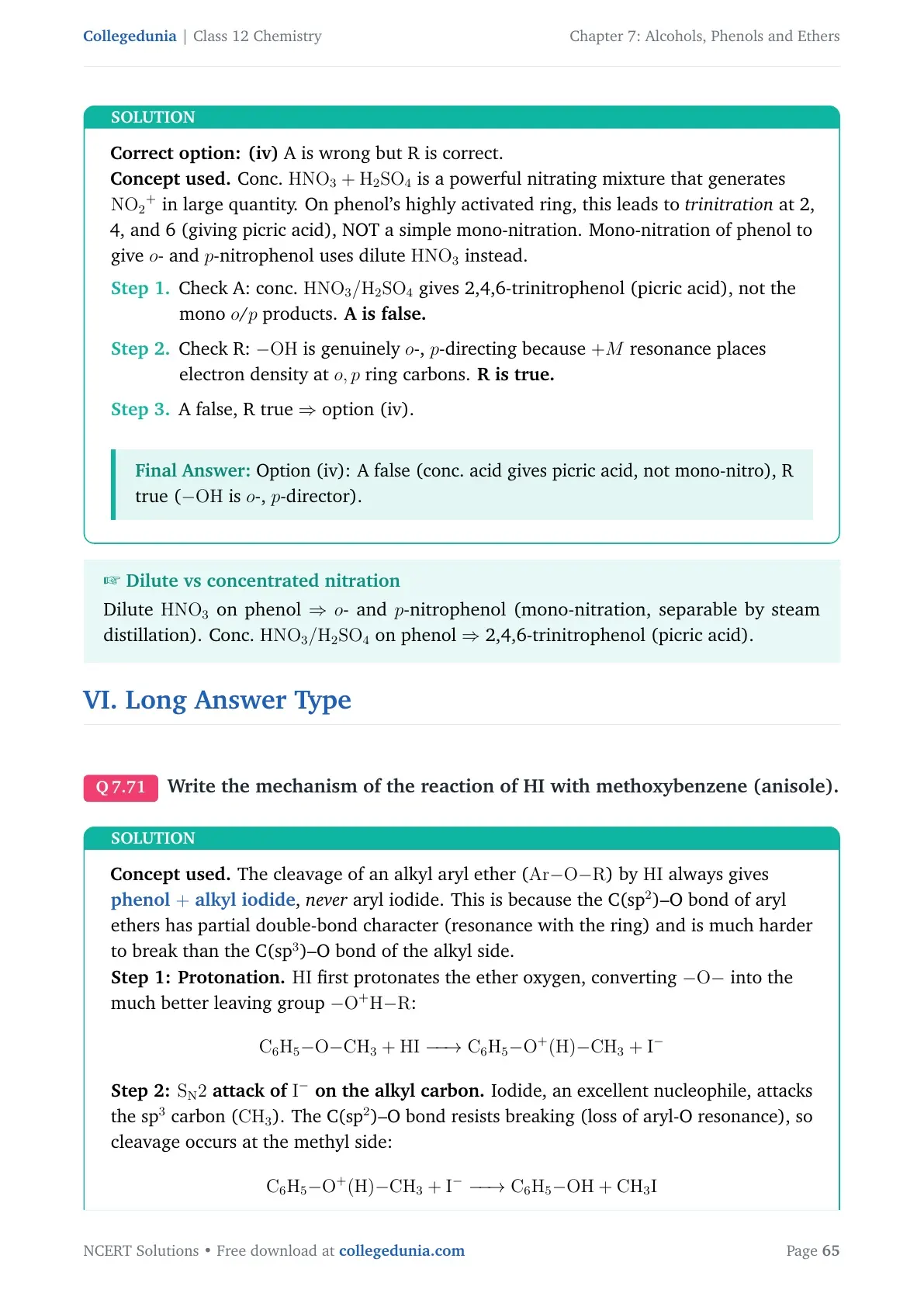
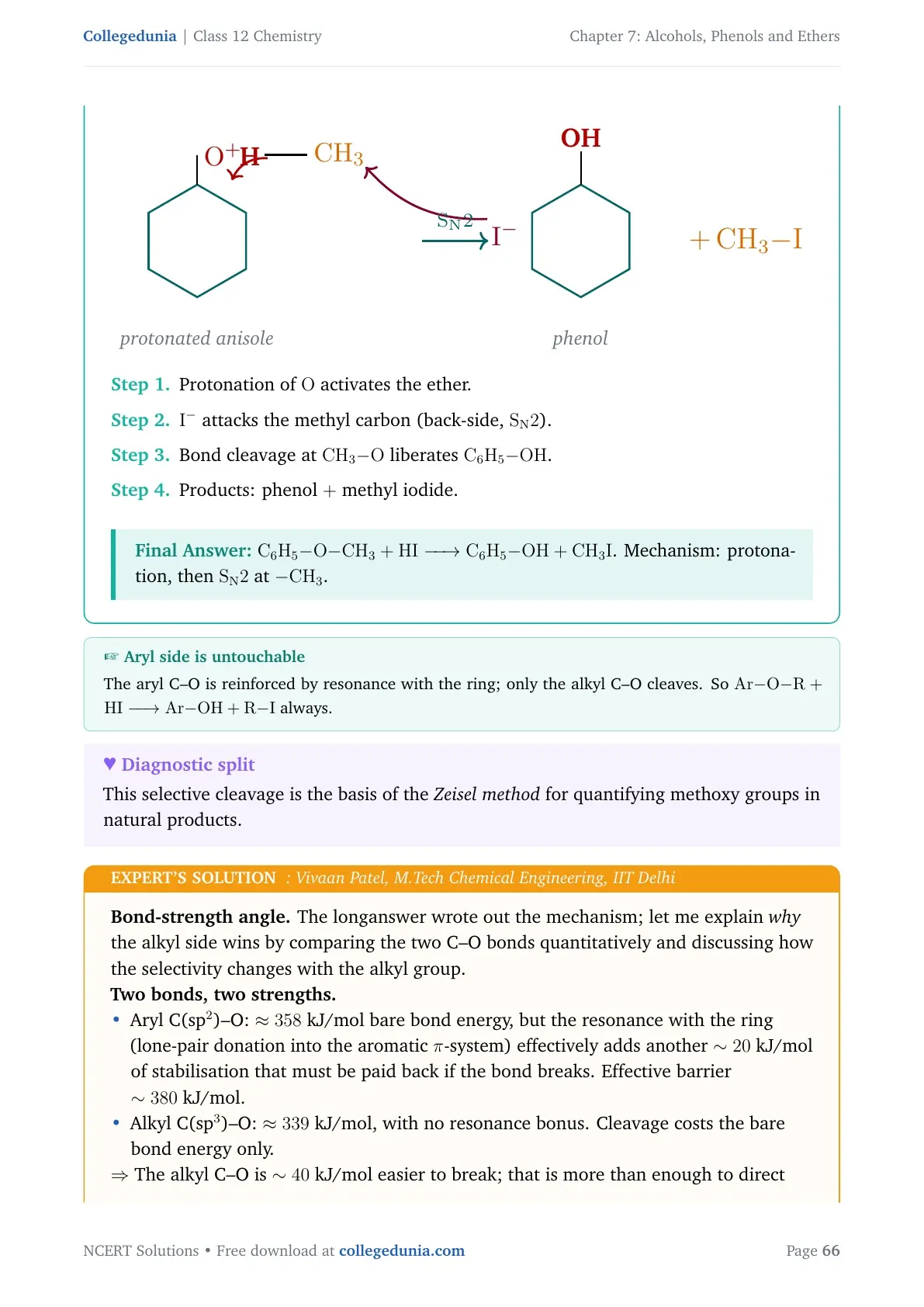
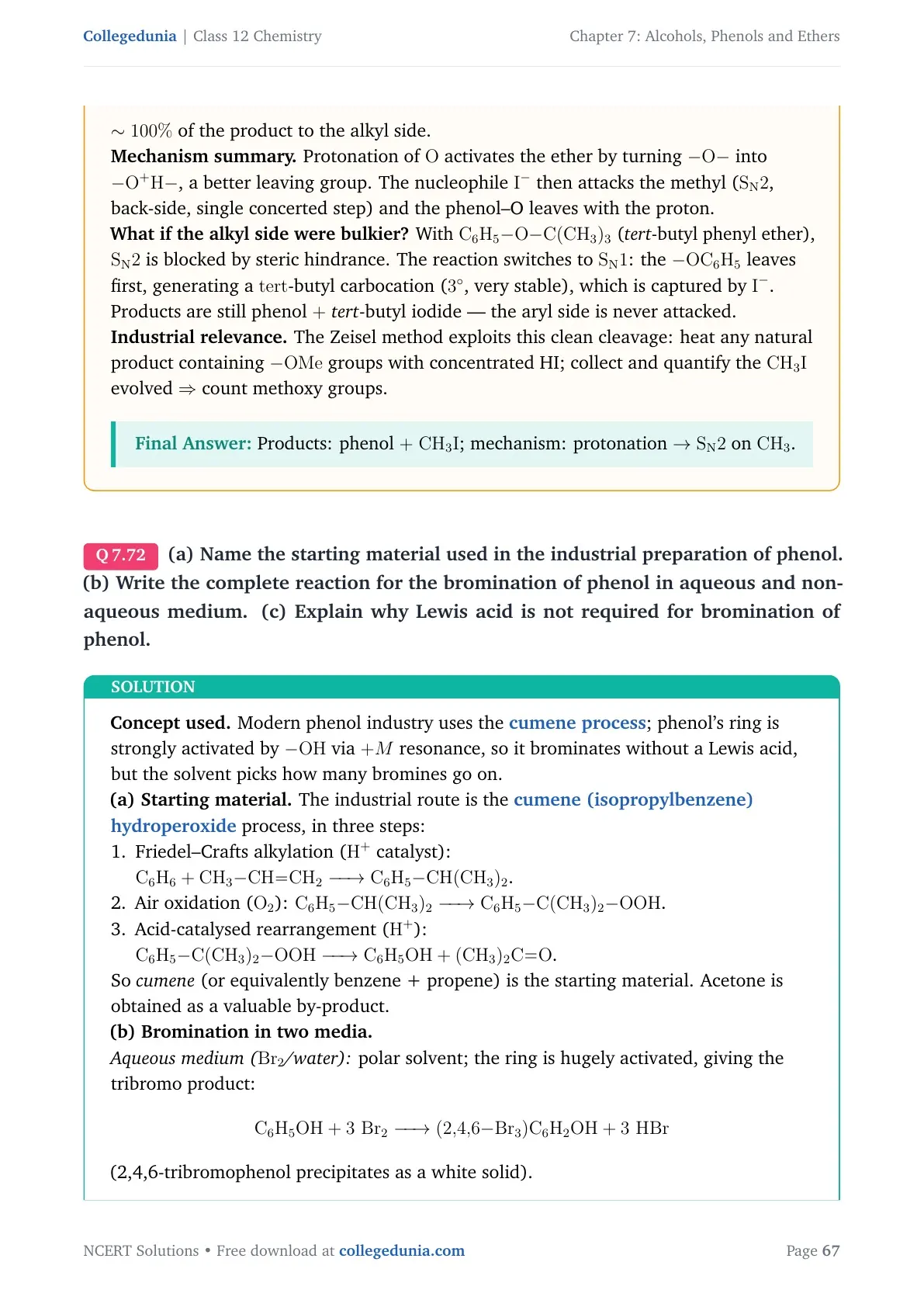
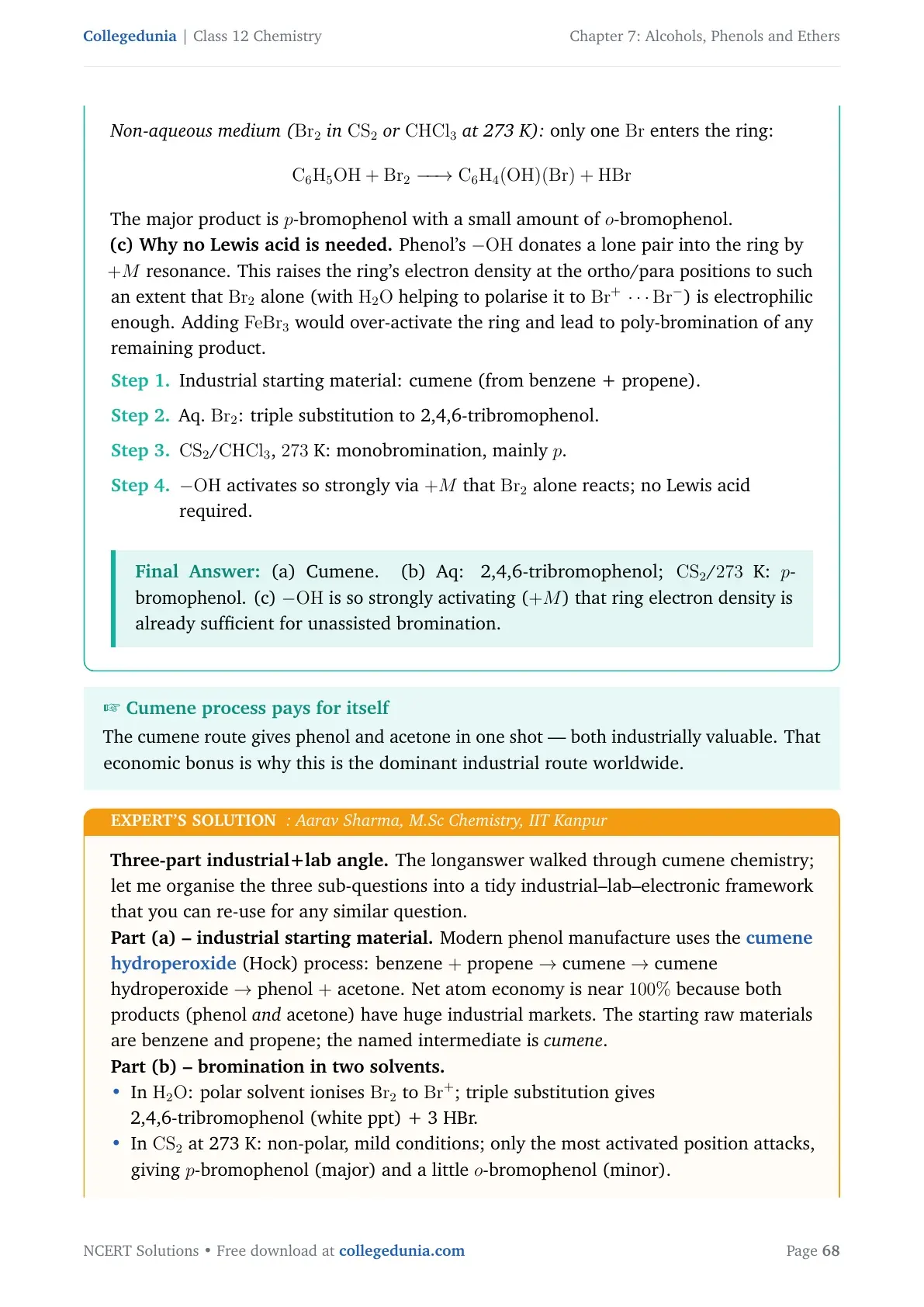
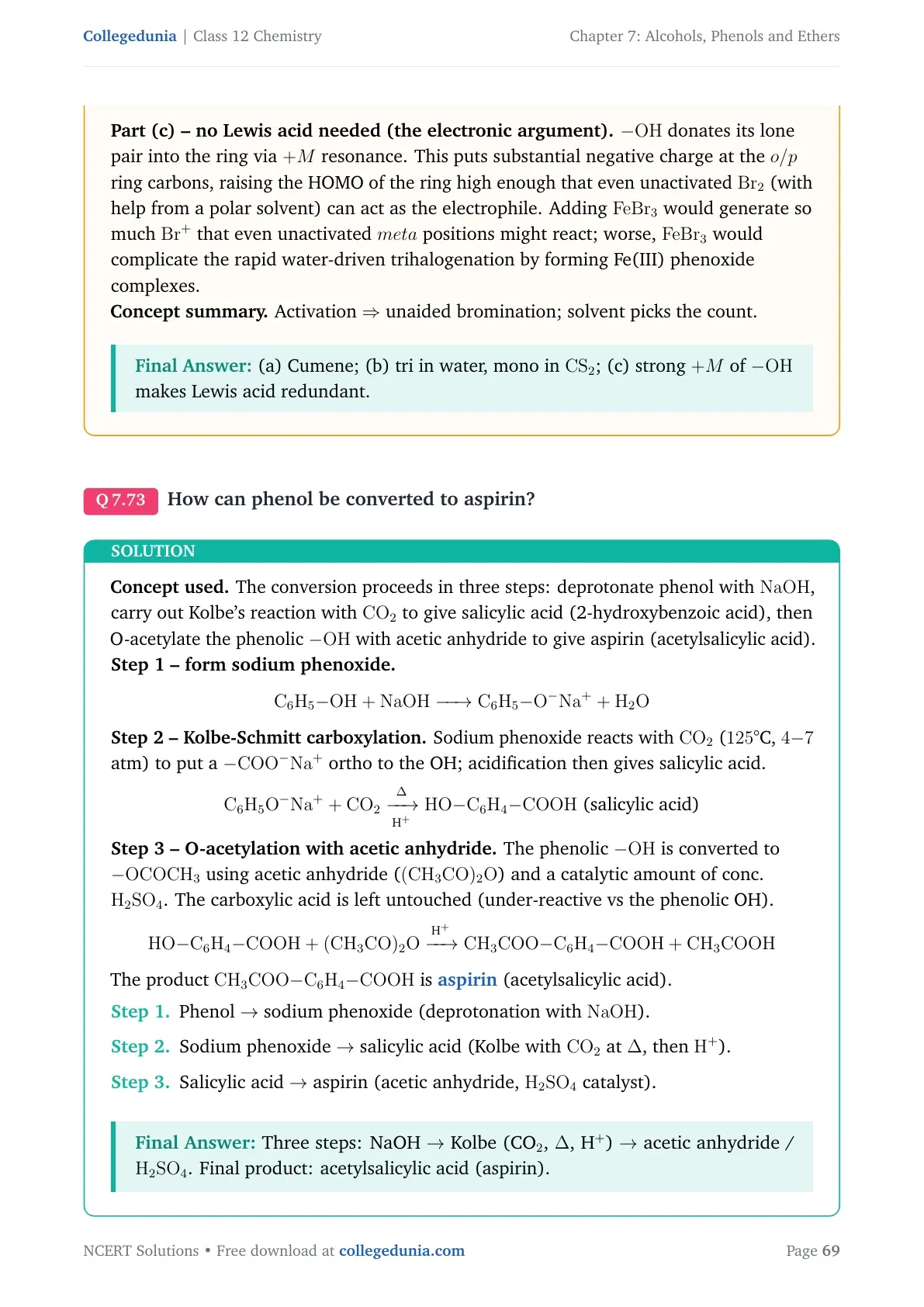

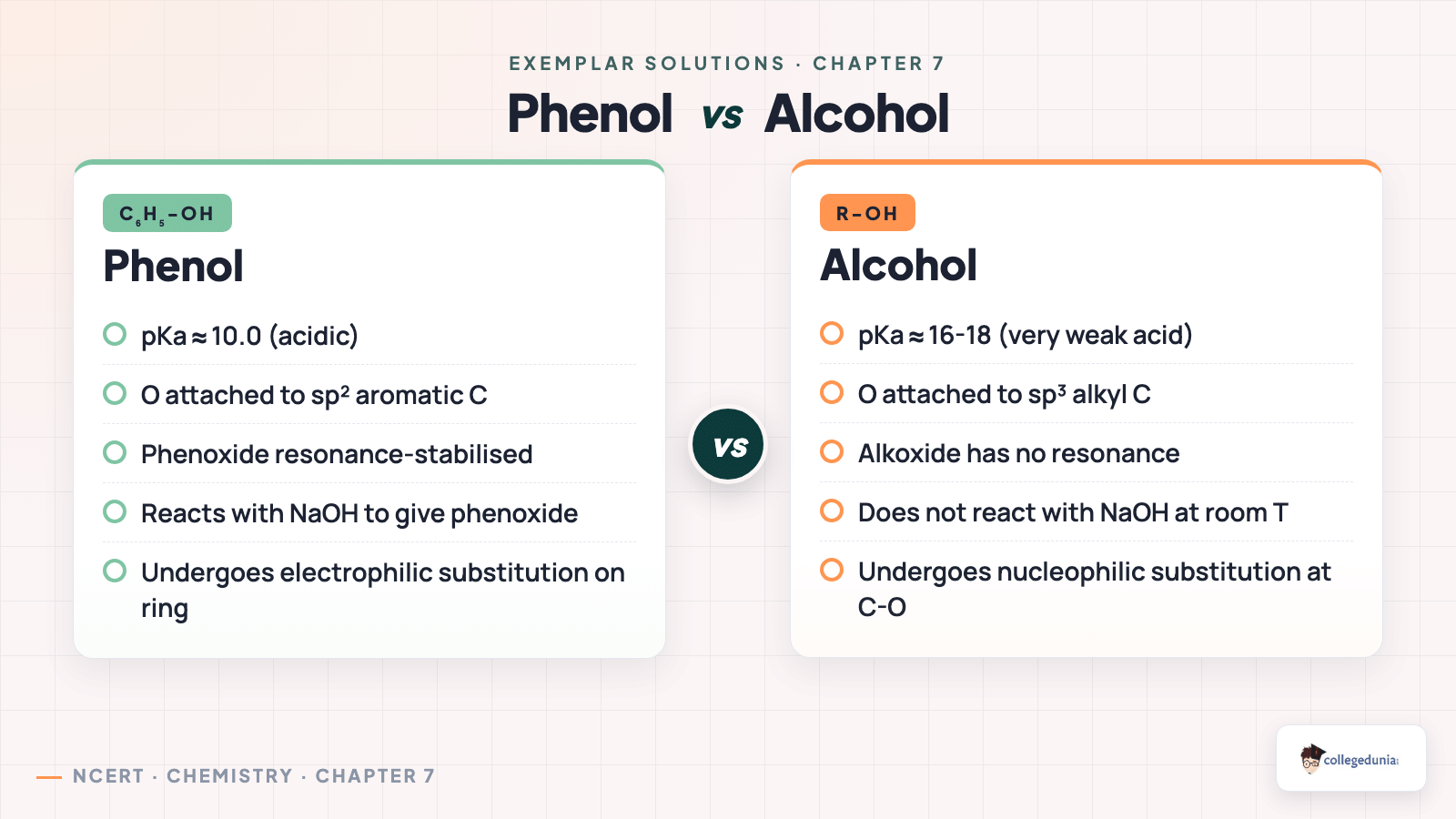
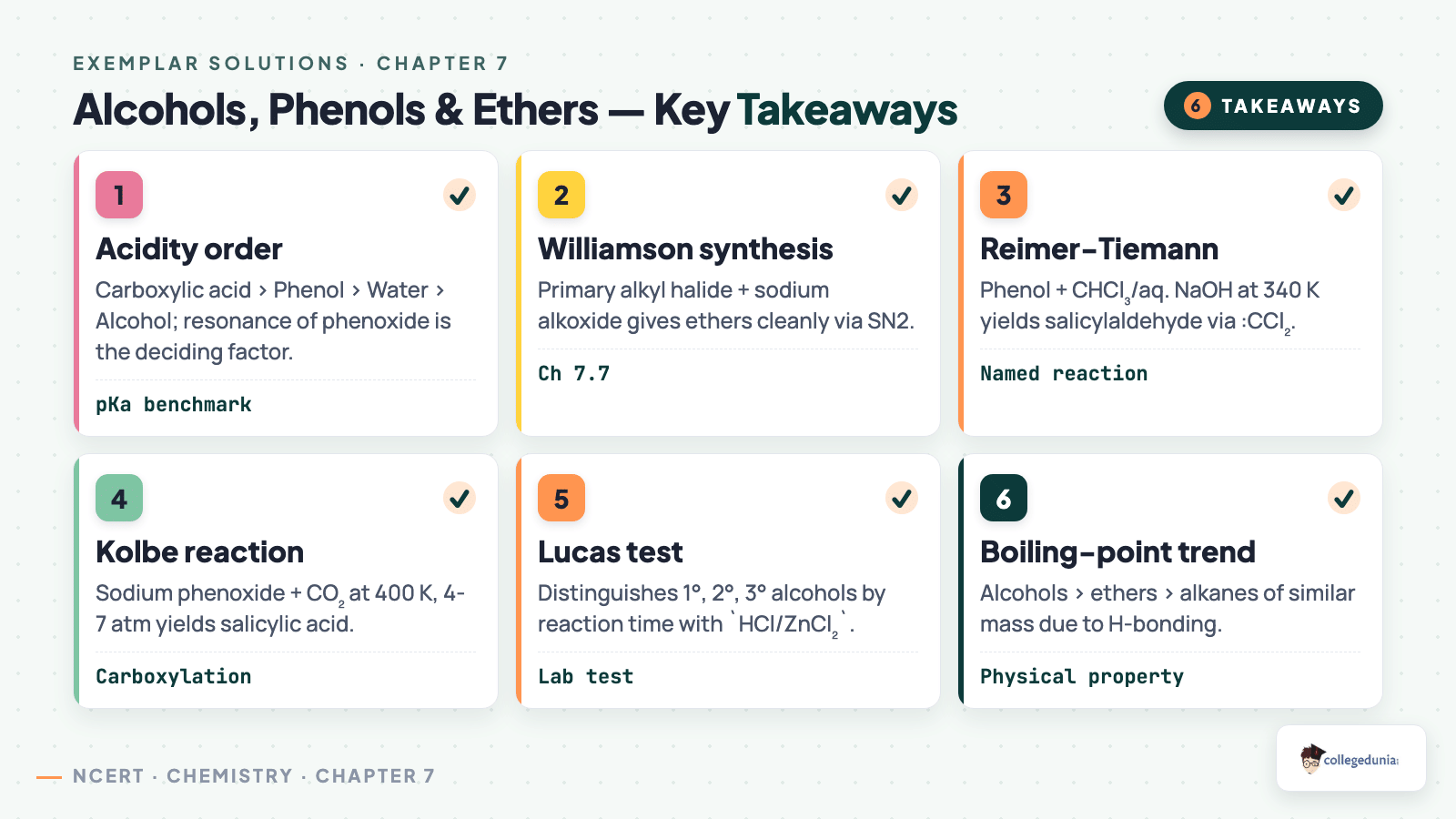



Comments