



Class 10 Science Chapter 1 Chemical Reactions and Equations is the first chemistry chapter of the 2026-27 NCERT, and it sets up the way every reaction is written and read for the rest of Class 10. This Chemical Reactions and Equations formula sheet gives you the state symbols, the balancing rule, the five reaction types, the energy-change signs, and the activity series on one page. Use it as a quick reference before any CBSE board test.
- CBSE Weightage: part of the Chemical Substances unit, worth 5 to 6 marks across one or two questions.
- Best used for: balancing practice, naming reaction types, and last-minute board revision.
You can find the complete Formula Sheet for Chemical Reactions and Equations, with every state symbol, balancing step, reaction type, and the activity series mapped to the 2026-27 NCERT, in the article below.
This Formula Sheet is curated by Science subject experts, mapped to the 2026-27 NCERT, and refined against the last five years of CBSE Class 10 board papers.
Also Check:
- Chemical Reactions and Equations Class 10 Science NCERT Solutions
- Chemical Reactions and Equations Class 10 Science Notes
How Collegedunia's Chemical Reactions and Equations Formula Sheet Helps You
This Formula Sheet gathers everything you need to write, balance, and classify any reaction from Class 10 Science Chapter 1 on one page, in NCERT order.
- One-page recall: the state symbols, five reaction types, and activity series side by side.
- Worked balanced equations: each reaction type carries a balanced example.
- Board focus: the most-asked facts, like oxidation vs reduction and the activity series, are pulled into quick cards.
Chemical Reactions and Equations Class 10 Science Video Revision
Source: Magnet Brains on YouTube
Equation Symbols and State Symbols in Chemical Reactions and Equations Class 10
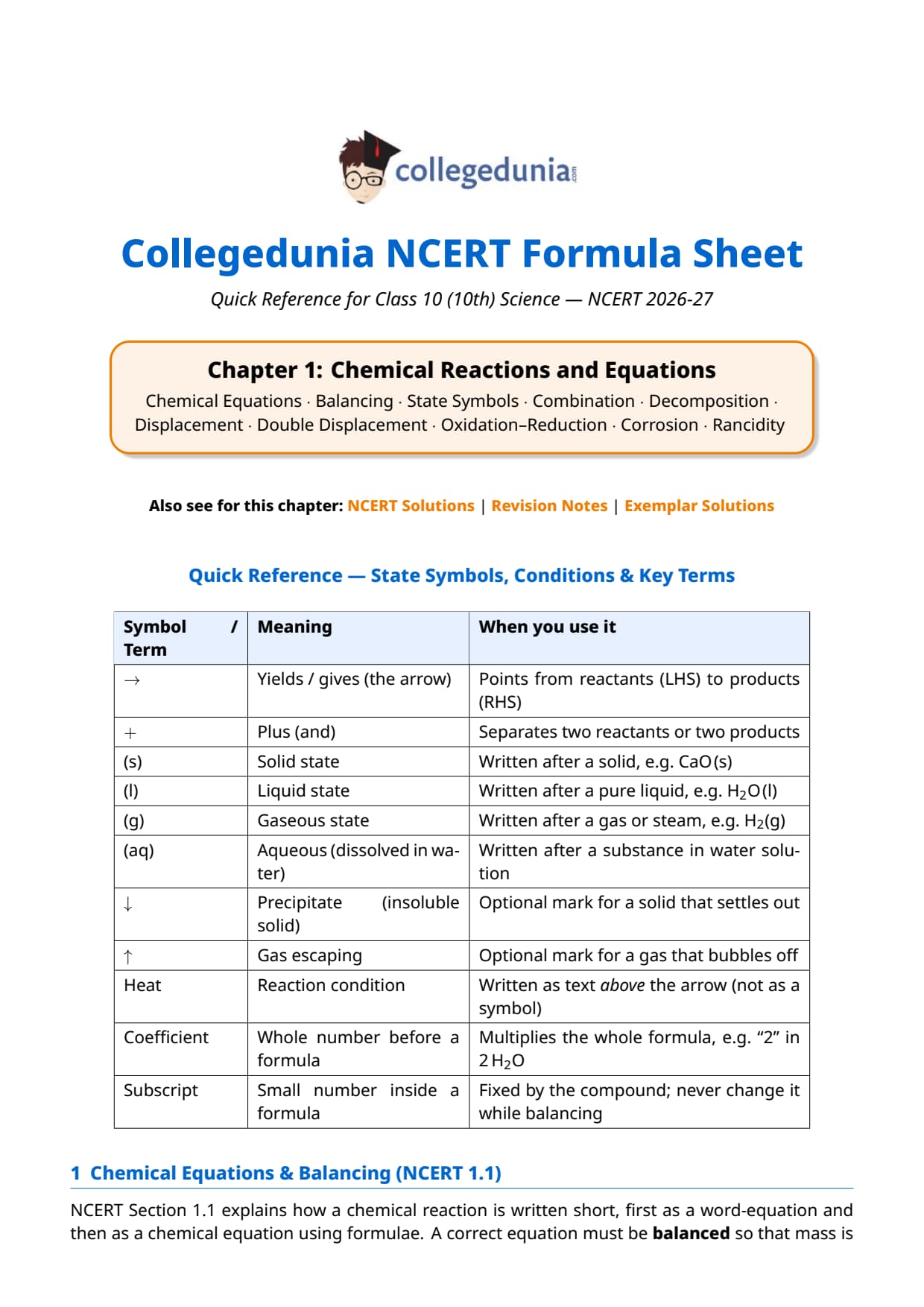
The table below decodes every symbol in a Class 10 chemical equation, including the state symbols.
| Symbol | Meaning | When you use it |
|---|---|---|
| → | Yields / gives | Reactants (left) to products (right) |
| + | Plus (and) | Separates two reactants or products |
| (s) | Solid state | e.g. CaO (s) |
| (l) | Liquid state | e.g. H2O (l) |
| (g) | Gaseous state | e.g. H2 (g) |
| (aq) | Aqueous (dissolved in water) | Substance in water solution |
| ↓ | Precipitate (insoluble solid) | Solid that settles out |
| ↑ | Gas escaping | Gas that bubbles off |
| Coefficient | Whole number before a formula | Multiplies the formula, e.g. 2 in 2 H2O |
| Subscript | Small number inside a formula | Never change it while balancing |
The reaction condition (heat, sunlight, a catalyst, or a pressure) is written as text near the arrow, never as a symbol on the line.
Balancing Chemical Equations in Class 10 Science Chapter 1
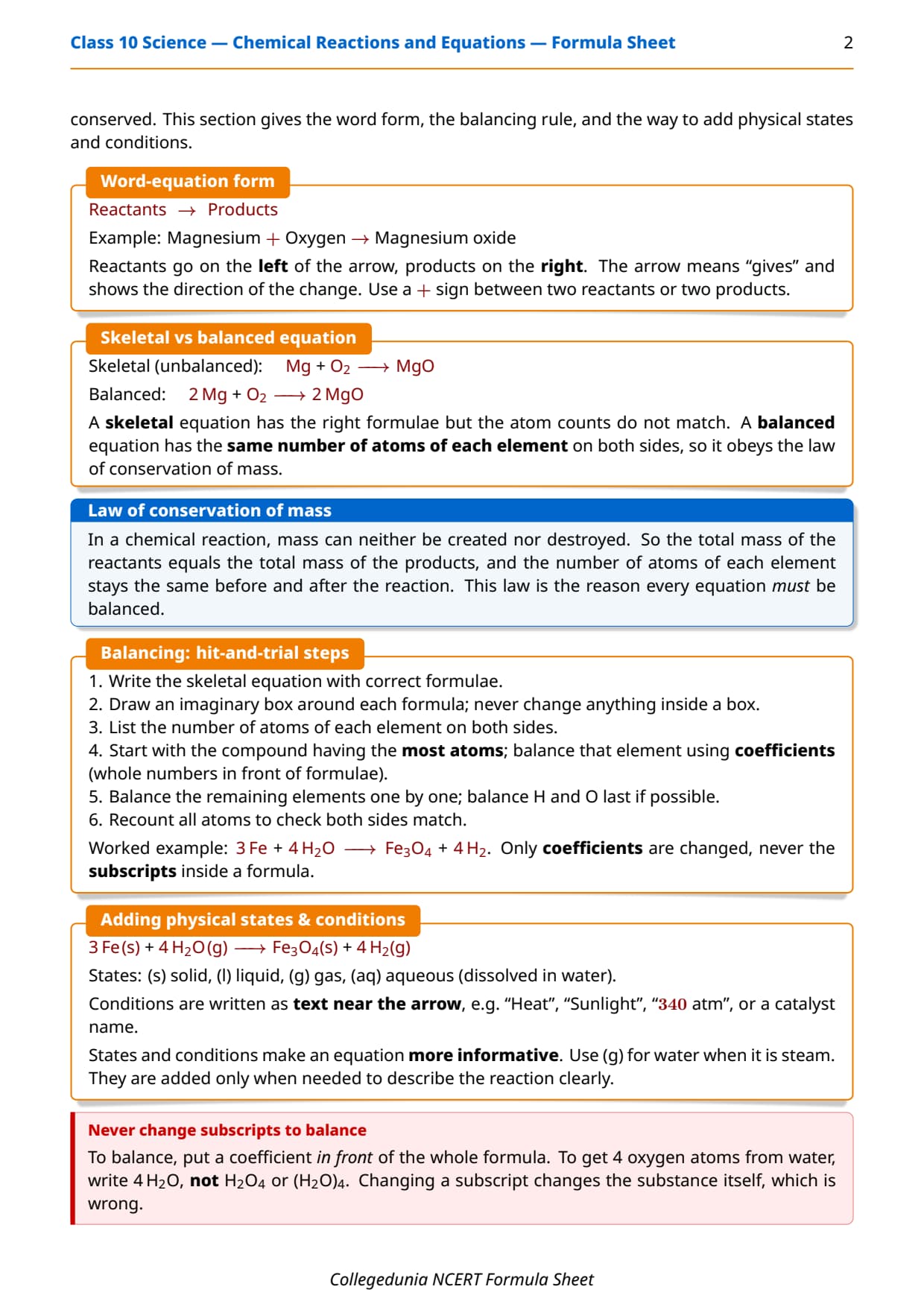
A correct equation must be balanced: by the law of conservation of mass, the number of atoms of each element must be the same on both sides.
The hit-and-trial method, step by step:
- Step 1: Write the skeletal equation, e.g. Mg + O2 → MgO.
- Step 2: List the atoms of each element on both sides.
- Step 3: Balance the compound with the most atoms first.
- Step 4: Balance the rest one by one; hydrogen and oxygen last.
- Step 5: Recount every atom, then add state symbols.
Worked example: 3 Fe (s) + 4 H2O (g) → Fe3O4 (s) + 4 H2 (g). Only coefficients were added; to get four oxygen atoms, write 4 H2O, never H2O4.
Five Types of Chemical Reactions Class 10 Science With Examples
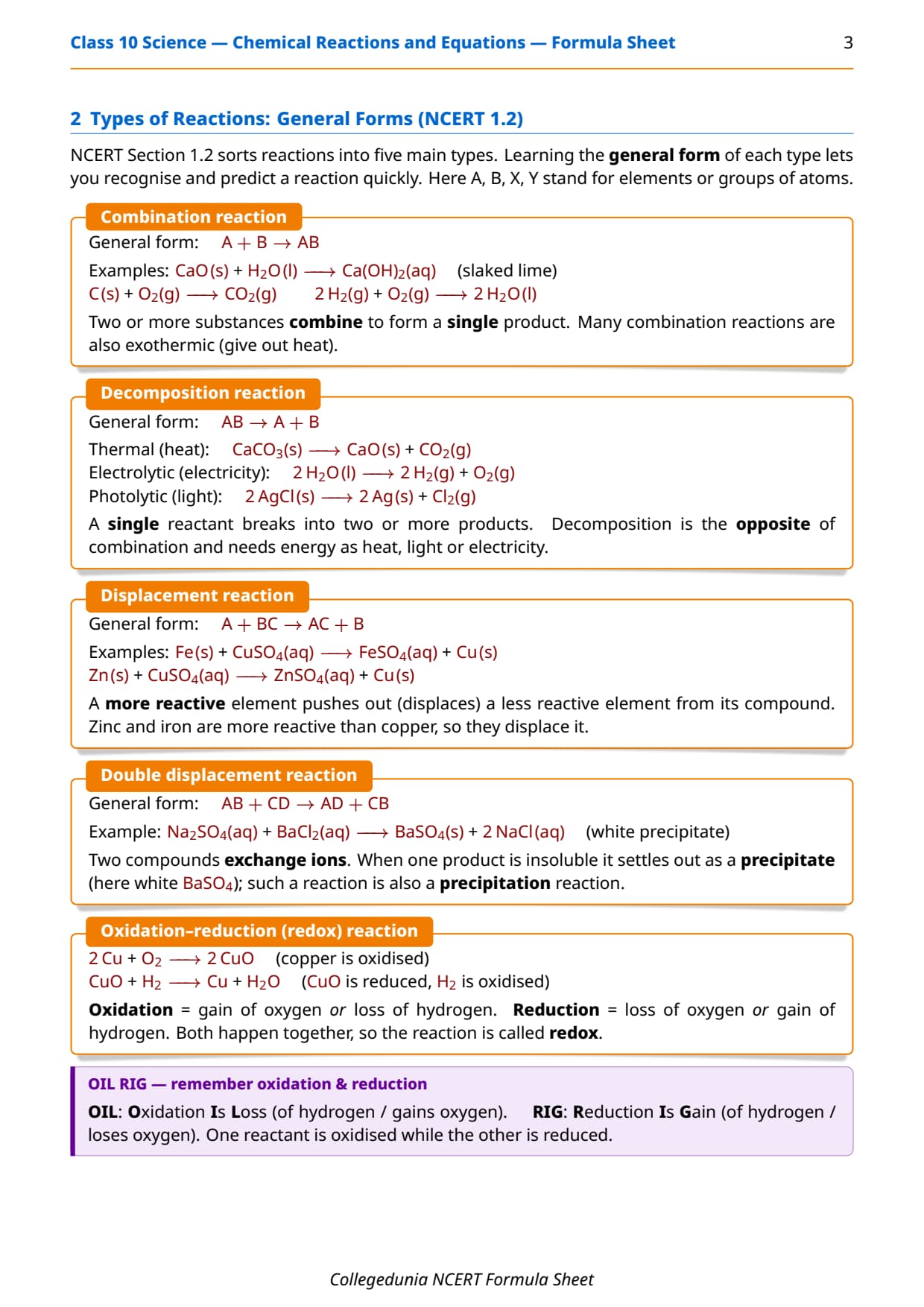
NCERT Section 1.2 sorts reactions into five main types. The general form lets you recognise a reaction fast.
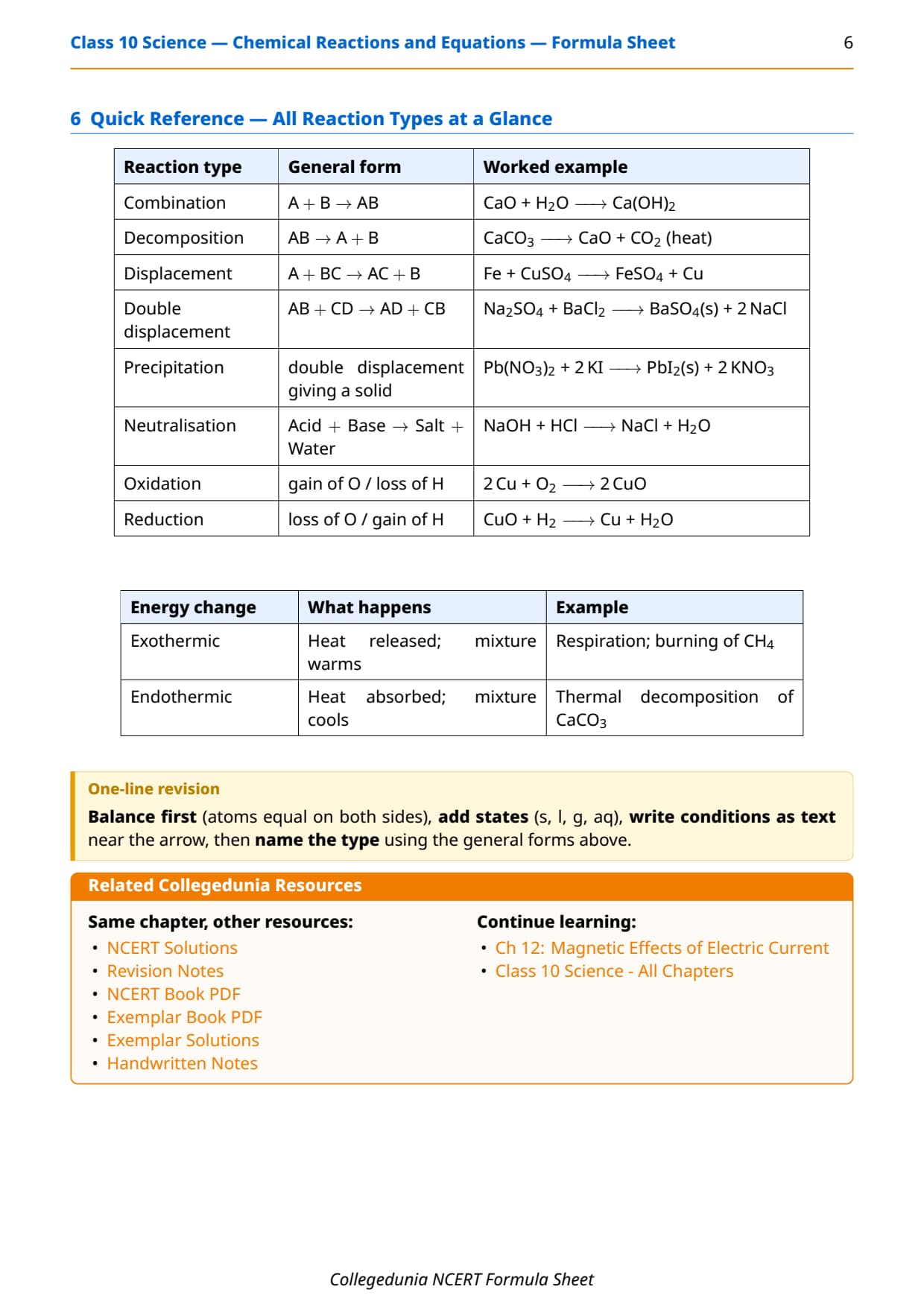
| Reaction type | General form | Balanced example | What happens |
|---|---|---|---|
| Combination | A + B → AB | CaO (s) + H2O (l) → Ca(OH)2 (aq) | Substances join into one product |
| Decomposition | AB → A + B | CaCO3 (s) → CaO (s) + CO2 (g) | One reactant breaks into two or more |
| Displacement | A + BC → AC + B | Fe (s) + CuSO4 (aq) → FeSO4 (aq) + Cu (s) | A more reactive element pushes out a less reactive one |
| Double displacement | AB + CD → AD + CB | Na2SO4 (aq) + BaCl2 (aq) → BaSO4 (s) + 2 NaCl (aq) | Compounds exchange ions; insoluble product is a precipitate |
| Redox | see notes | CuO + H2 → Cu + H2O | One oxidised, the other reduced |
A decomposition by heat is thermal, by light photolytic (2 AgCl → 2 Ag + Cl2), by electricity electrolytic. A double displacement giving an insoluble solid is a precipitation reaction.
Exothermic and Endothermic Reactions in Class 10 Science
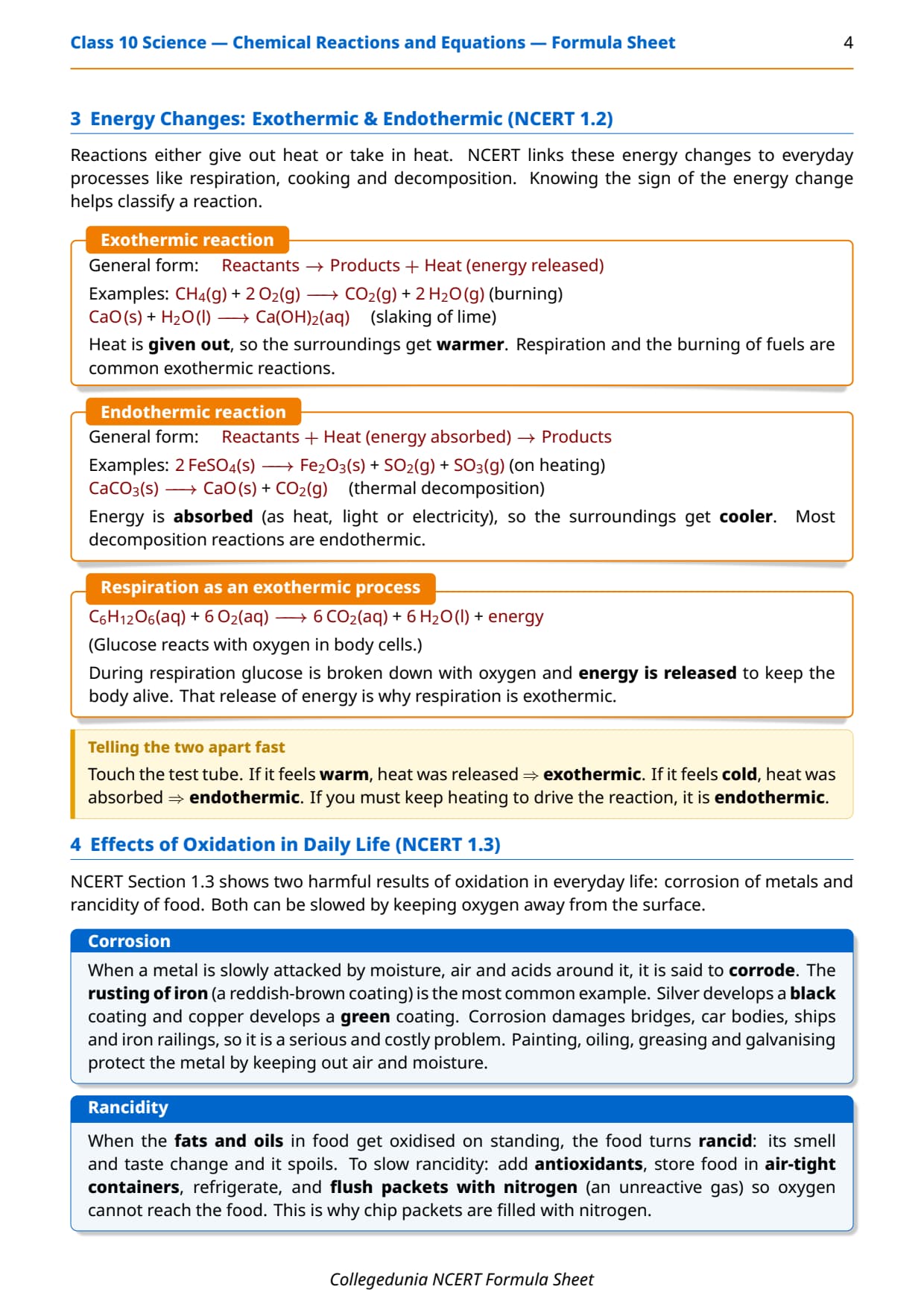
Reactions either give out heat or take in heat. Knowing the sign of the energy change is enough to classify the reaction.
- Exothermic: Reactants → Products + Heat. Burning of fuels (CH4 + 2 O2 → CO2 + 2 H2O), respiration, and slaking of lime.
- Endothermic: Reactants + Heat → Products. Most decomposition reactions, such as CaCO3 → CaO + CO2, are endothermic.
- Respiration: C6H12O6 + 6 O2 → 6 CO2 + 6 H2O + energy, an exothermic reaction.
Corrosion and Rancidity: Effects of Oxidation in Daily Life
NCERT Section 1.3 covers two harmful effects of oxidation: the corrosion of metals and the rancidity of food, both favourite board questions.
| Effect | What happens | How to slow it |
|---|---|---|
| Corrosion | A metal is attacked by moisture, air, and acids. Iron rusts, silver turns black, copper turns green. | Painting, oiling, greasing, galvanising keep out air and moisture. |
| Rancidity | Fats and oils oxidise on standing, so food smells and tastes bad. | Antioxidants, air-tight containers, refrigeration, nitrogen flushing. |
This is why chip packets are filled with nitrogen: the unreactive gas keeps oxygen away from the fat, so chips stay fresh. A coat of paint works on iron the same way.
pH Scale, Activity Series and Key Relations for the Year
A few number-based tools connect Chapter 1 to later chapters in the year.
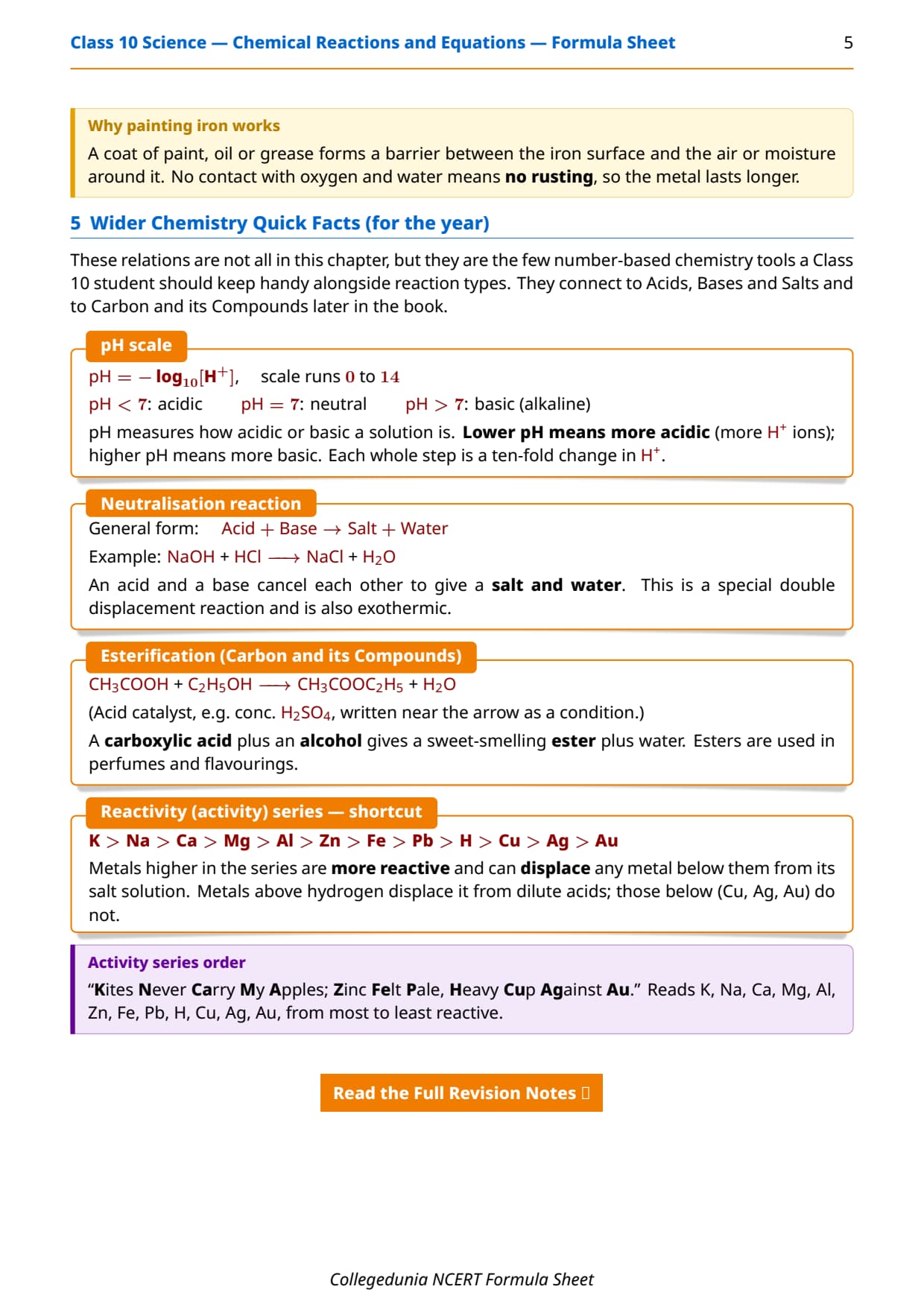
- pH scale: pH = − log10 [H+], 0 to 14. pH < 7 acidic, pH = 7 neutral, pH > 7 basic.
- Neutralisation: Acid + Base → Salt + Water (NaOH + HCl → NaCl + H2O). A special double displacement.
- Esterification: CH3COOH + C2H5OH → CH3COOC2H5 + H2O (conc. H2SO4 condition). Acid plus alcohol gives a sweet-smelling ester.
The activity series ranks metals from most to least reactive. A higher metal displaces any below it from its salt solution; any metal above hydrogen displaces it from a dilute acid:
One-Shot Revision Tips for Chemical Reactions and Equations Class 10
Treat this Formula Sheet as a checklist you tick off the night before a test. Recall each block out loud, then check it against the sheet.
- Lock the five reaction types. Combination, decomposition, displacement, double displacement, and redox cover every reaction.
- Always balance, never change a subscript. Coefficients go before whole formulae.
- Memorise OIL RIG. The fastest way to tell oxidation from reduction.
- Link energy change to feel. Warm means exothermic, cold means endothermic.
- Keep the activity series ready. Displacement and metal-acid questions lean on the K-to-Au order. Forgetting state symbols or leaving an equation unbalanced loses marks, so always recount atoms.
All Reaction Types of Chemical Reactions and Equations at a Glance
This strip adds neutralisation to the five reaction types above, the fastest one-shot before any test.
| Reaction type | General form |
|---|---|
| Combination | A + B → AB |
| Decomposition | AB → A + B |
| Displacement | A + BC → AC + B |
| Double displacement | AB + CD → AD + CB |
| Neutralisation | Acid + Base → Salt + Water |
Full topic-by-topic walkthrough: Chemical Reactions and Equations Class 10 Science Notes
More Chemical Reactions and Equations Class 10 Science Resources
Use the table below to move between the other Collegedunia resources for this same chapter, from full solutions to handwritten notes.
| Resource | Link |
|---|---|
| NCERT Solutions | Chemical Reactions and Equations NCERT Solutions |
| Revision Notes | Chemical Reactions and Equations Notes |
| Handwritten Notes | Chemical Reactions and Equations Handwritten Notes |
| Exemplar Solutions | Chemical Reactions and Equations Exemplar Solutions |
| NCERT Book PDF | Chemical Reactions and Equations NCERT Book PDF |
NCERT Formula Sheet for Class 10 Science: All Chapters
Use the table below to jump to the Formula Sheet for any other chapter in the Class 10 Science NCERT.
| Chapter | Resource |
|---|---|
| Chapter 2 | Acids, Bases and Salts Formula Sheet |
| Chapter 3 | Metals and Non-metals Formula Sheet |
| Chapter 4 | Carbon and its Compounds Formula Sheet |
| Chapter 5 | Life Processes Formula Sheet |
| Chapter 6 | Control and Coordination Formula Sheet |
| Chapter 7 | How do Organisms Reproduce? Formula Sheet |
| Chapter 8 | Heredity Formula Sheet |
| Chapter 9 | Light - Reflection and Refraction Formula Sheet |
| Chapter 10 | The Human Eye and the Colourful World Formula Sheet |
| Chapter 11 | Electricity Formula Sheet |
| Chapter 12 | Magnetic Effects of Electric Current Formula Sheet |
| Chapter 13 | Our Environment Formula Sheet |
Chemical Reactions and Equations Class 10 Formula Sheet FAQs
Ques. Where can I download the Chemical Reactions and Equations Class 10 Formula Sheet PDF?
Ans. You can download the Chemical Reactions and Equations Class 10 Science Formula Sheet PDF directly from this page. It is free and covers every state symbol, reaction type, and balanced example in the 2026-27 NCERT Chapter 1.
Ques. Is this Formula Sheet aligned with the 2026-27 NCERT?
Ans. Yes. The sheet reflects the current 2026-27 syllabus for Class 10 Science. Chapter 1 retains all five reaction types, the energy-change classification, and the corrosion and rancidity content from Section 1.3.
Ques. What are the five types of chemical reactions in Class 10 Science?
Ans. The five types are combination (A + B → AB), decomposition (AB → A + B), displacement (A + BC → AC + B), double displacement (AB + CD → AD + CB), and oxidation-reduction (redox), where one species is oxidised and the other reduced.
Ques. How do I balance a chemical equation in Class 10?
Ans. Use the hit-and-trial method: write the skeletal equation, count the atoms of each element on both sides, then add coefficients in front of whole formulae until both sides match. Balance hydrogen and oxygen last, and never change a subscript inside a formula.
Ques. What is the difference between oxidation and reduction?
Ans. Oxidation is the gain of oxygen or loss of hydrogen, and reduction is the loss of oxygen or gain of hydrogen. The mnemonic OIL RIG (Oxidation Is Loss, Reduction Is Gain) helps you recall it. Both always happen together in a redox reaction.
Ques. Why does changing a subscript while balancing give a wrong answer?
Ans. A subscript is fixed by the compound, so changing it creates a different substance. For example, H2O is water but H2O2 is hydrogen peroxide. To get more atoms you add a coefficient in front of the whole formula, such as 4 H2O for four oxygen atoms.
Ques. What are corrosion and rancidity?
Ans. Corrosion is the slow attack of a metal by moisture, air, and acids, such as the rusting of iron. Rancidity is the spoiling of fats and oils in food due to oxidation. Both are effects of oxidation in daily life and are slowed by keeping oxygen away from the surface.
Ques. How can you tell an exothermic reaction from an endothermic one?
Ans. An exothermic reaction releases heat, so the container feels warm; burning fuels and respiration are examples. An endothermic reaction absorbs heat, so the container feels cold; most decomposition reactions are endothermic. If you must keep heating to drive the reaction, it is endothermic.
Ques. What is the activity series and how is it used?
Ans. The activity series ranks metals from most to least reactive: K > Na > Ca > Mg > Al > Zn > Fe > Pb > H > Cu > Ag > Au. A metal higher in the series displaces any metal below it from its salt solution, and metals above hydrogen displace it from dilute acids.
Ques. What is the CBSE weightage of Chapter 1 in Class 10 Science?
Ans. Chemical Reactions and Equations sits in the Chemical Substances unit and usually carries 5 to 6 marks in the CBSE Class 10 Science board exam, asked as one or two questions on reaction types, balancing, or daily-life effects of oxidation.



Comments