




Class 10 Science Chapter 10 The Human Eye and the Colourful World packs almost every board numerical into one page of relations. This Human Eye and the Colourful World formula sheet puts the lens formula, magnification, power of a lens, refractive index relation, and prism angle-deviation rule together, alongside the defects of vision and the correcting lens for each.
- CBSE Weightage: part of the Natural Phenomena and Optics block, worth 6 to 8 marks across one defect-correction numerical and one reasoning question on dispersion or scattering.
- Best used for: the lens and power formulae, the three defects of vision and their correcting lenses, the prism angle-deviation relation, and last-minute board revision.
You can find the complete Formula Sheet for The Human Eye and the Colourful World, with the lens formula, magnification, the power of a lens, the refractive index relation, the prism angle-deviation rule, and the three defects of vision mapped to the 2026-27 NCERT, in the article below.
This Formula Sheet is curated by Science subject experts, mapped to the 2026-27 NCERT, and refined against the last five years of CBSE Class 10 board papers.
Also Check:
- The Human Eye and the Colourful World Class 10 Science NCERT Solutions
- The Human Eye and the Colourful World Class 10 Science Notes
How Collegedunia's The Human Eye and the Colourful World Formula Sheet Helps You
This Formula Sheet gathers every relation and rule for Chapter 10 in 2026-27 NCERT order.
- 2026-27 NCERT aligned: the lens formula, power of a lens, refractive index, and prism rule all match the current syllabus.
- Defects of vision in one block: myopia, hypermetropia, and presbyopia with cause, correcting lens, and sign of power.
- Concept rules built in: dispersion, atmospheric refraction, and scattering as short cause-and-effect rules for the reasoning marks.
The Human Eye and the Colourful World Class 10 Science Video Revision
Source: Magnet Brains on YouTube
The Human Eye and the Colourful World Class 10 Science Complete Formula Reference
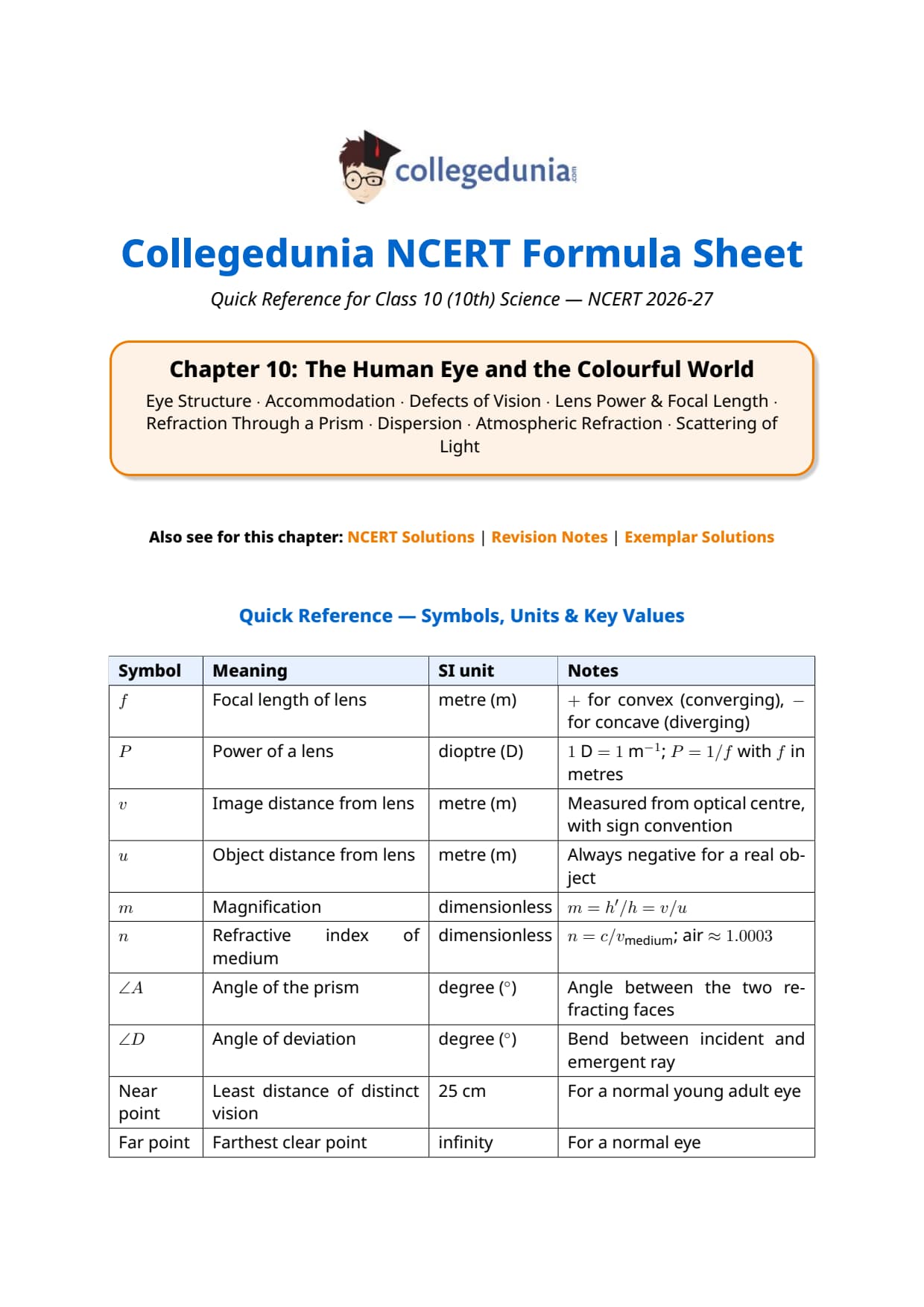
The table lists every formula and key value in Chapter 10, mapped to its NCERT section and typical question setup.
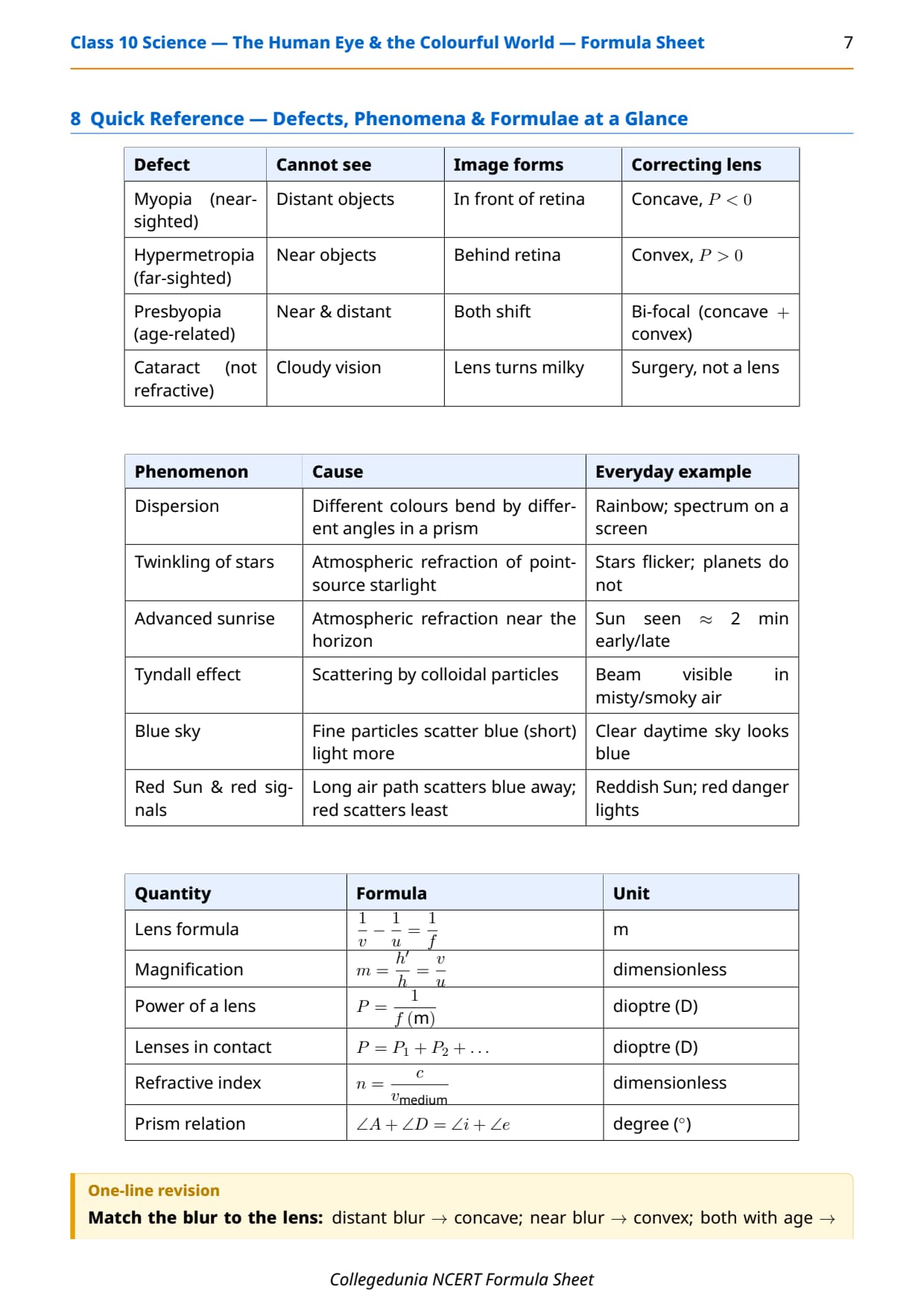
| Concept | Formula | SI Unit | NCERT Section | Typical Use |
|---|---|---|---|---|
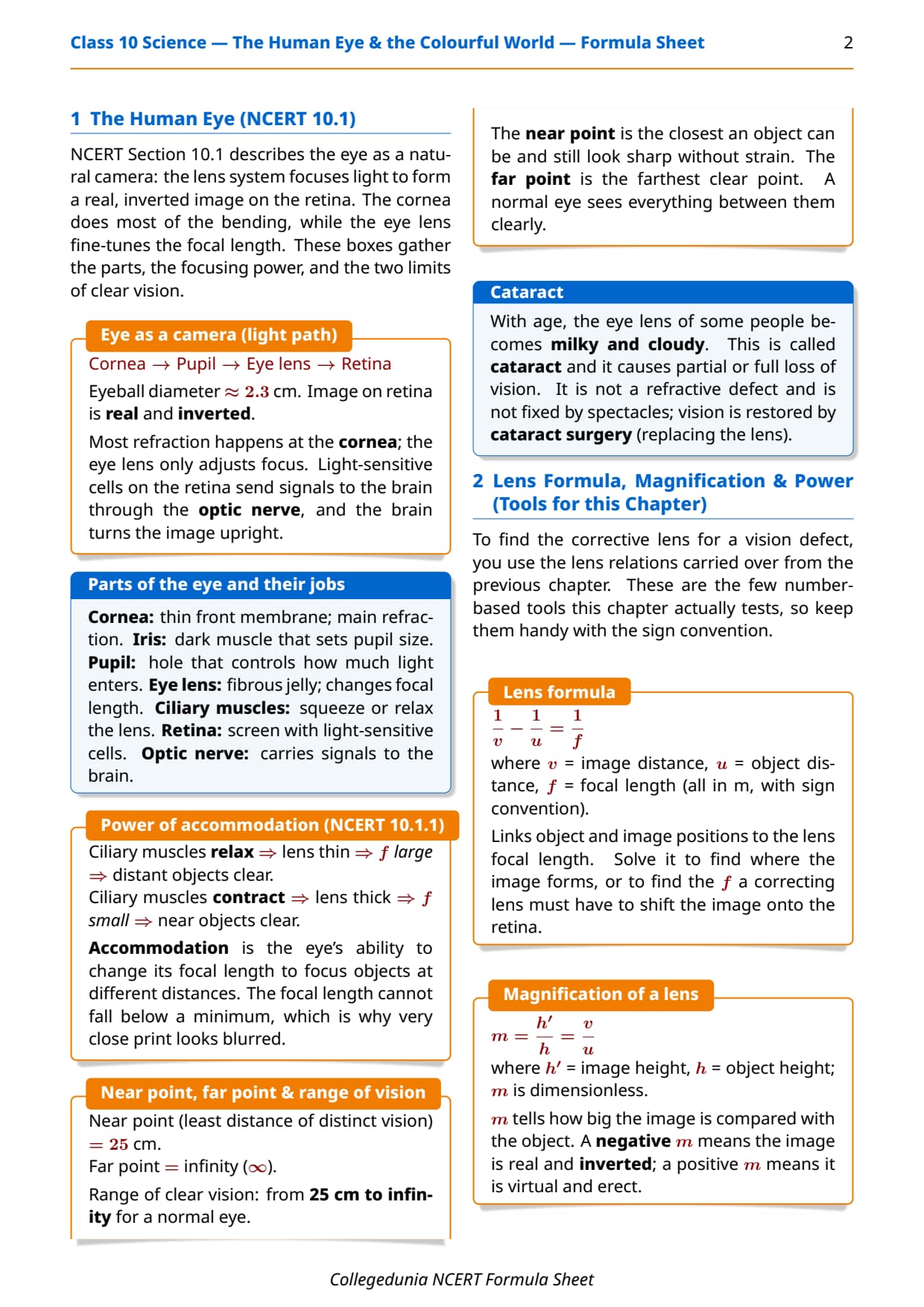
| Lens formula | 1v − 1u = 1f | m-1 | 10.2 | Find the correcting lens for a defect |
| Magnification of a lens | m = h'h = vu | - | 10.2 | Image size and nature for a lens |
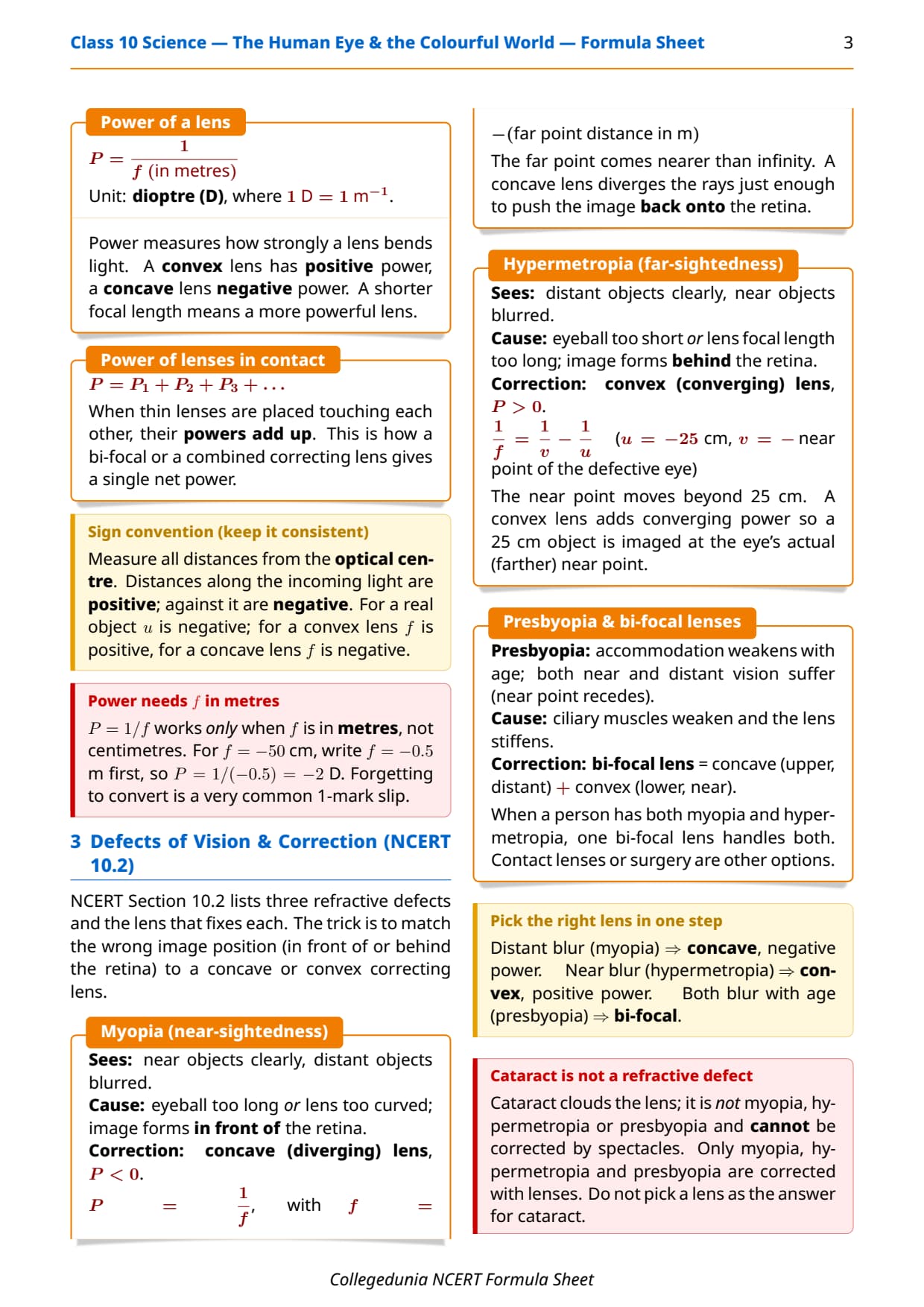
| Power of a lens | P = 1f | dioptre (D) | 10.2 | Bending ability; f in metres |
| Power of lenses in contact | P = P1 + P2 + … | D | 10.2 | Net power of a bi-focal or combined lens |
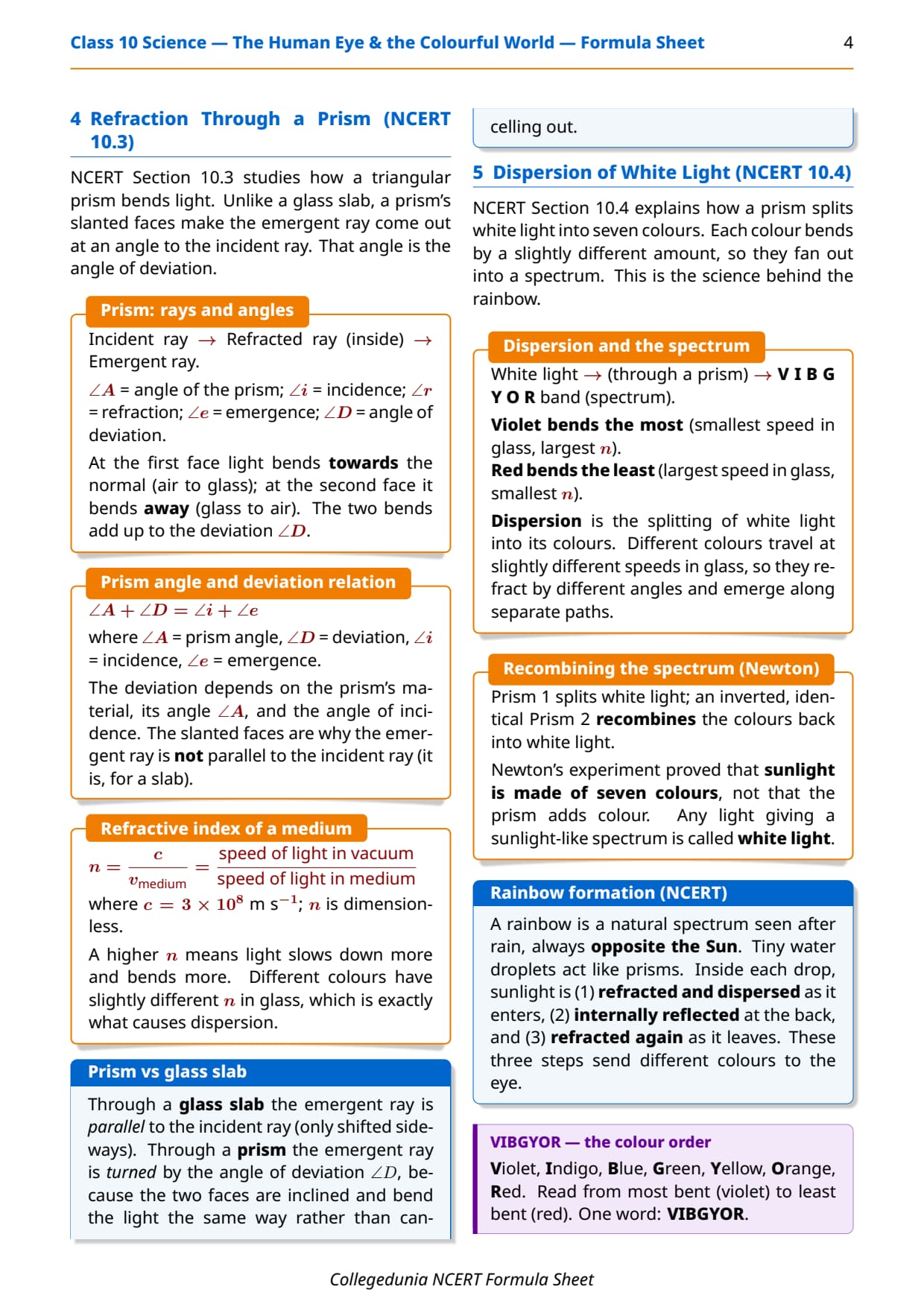
| Refractive index of a medium | n = cvmedium | - | 10.3 | c = 3 × 10⁸ m/s; dispersion |
| Prism angle and deviation | ∠A + ∠D = ∠i + ∠e | degree | 10.3 | Relate prism angle to deviation |
Defects of Vision and Their Correction in The Human Eye Class 10
The three defects of vision are the highest-scoring part of this chapter. Match the wrong image position to the correct lens, and most of the marks are yours.
| Defect | Sees clearly | Cause | Correcting lens | Power sign |
|---|---|---|---|---|
| Myopia (near-sight) | Near objects | Eyeball too long or lens too curved; image in front of retina | Concave (diverging) | P < 0 |
| Hypermetropia (far-sight) | Distant objects | Eyeball too short or lens too flat; image behind retina | Convex (converging) | P > 0 |
| Presbyopia | Neither, with age | Ciliary muscles weaken and lens stiffens; near point recedes | Bi-focal (concave + convex) | Both |
When to Use Which Formula in The Human Eye and the Colourful World Class 10
Pick the right relation from what the question hands you:
- Far point of a myopic eye given: concave lens has f = −(far point) , then P = 1/f ( f in metres) for the negative power.
- Near point of a hypermetropic eye given: lens formula with u = −25 cm and v = −(near point) gives the convex lens focal length.
- Image position or size: use the lens formula with m = v/u ; negative m means real and inverted.
- Speed of light in a medium: n = c/vmedium ; higher n means light bends more.
- Prism deviation: ∠A + ∠D = ∠i + ∠e .
The Human Eye and the Colourful World Class 10 Quick-Fact Cards for MCQ Recall
These atomic facts are the ones MCQ writers reach for most. Glance over them the morning of any test.
Symbol Glossary for The Human Eye and the Colourful World Class 10 Formulae
Every variable decoded, with its sign note attached:
| Symbol | What it means | SI Unit | Sign / note |
|---|---|---|---|
| f | Focal length of the lens | m | + for convex, − for concave |
| P | Power of a lens | D | P = 1/f with f in metres |
| v | Image distance from optical centre | m | Sign by New Cartesian convention |
| u | Object distance from optical centre | m | Always −ve for a real object |
| m | Magnification | - | m = v/u |
| n | Refractive index | - | n = c/vmedium |
The Human Eye and the Colourful World Top 5 Formulae Recap: Quick PYQ Map for Class 10
The five relations below carry the largest share of marks in CBSE Class 10 board papers from 2021 to 2025.
| Formula / rule | Most-recent exam appearance |
|---|---|
| P = 1/f (myopia, concave) | CBSE 2025 (3 marks), CBSE 2024 numerical |
| 1v − 1u = 1f (hypermetropia) | CBSE 2025 (3 marks), CBSE 2023 numerical |
| Myopia vs hypermetropia correction | CBSE 2024 (2 marks), CBSE 2022 |
| Scattering: blue sky and red Sun | CBSE 2025 (2 marks), CBSE 2023 reasoning |
| ∠A + ∠D = ∠i + ∠e (prism) | CBSE 2024 (2 marks), CBSE 2022 diagram |
Full year-wise PYQ map: The Human Eye and the Colourful World Class 10 Science NCERT Solutions
One-Shot Revision Tips for The Human Eye and the Colourful World Class 10
Treat the sheet as a checklist you tick off as you recall every defect and rule.
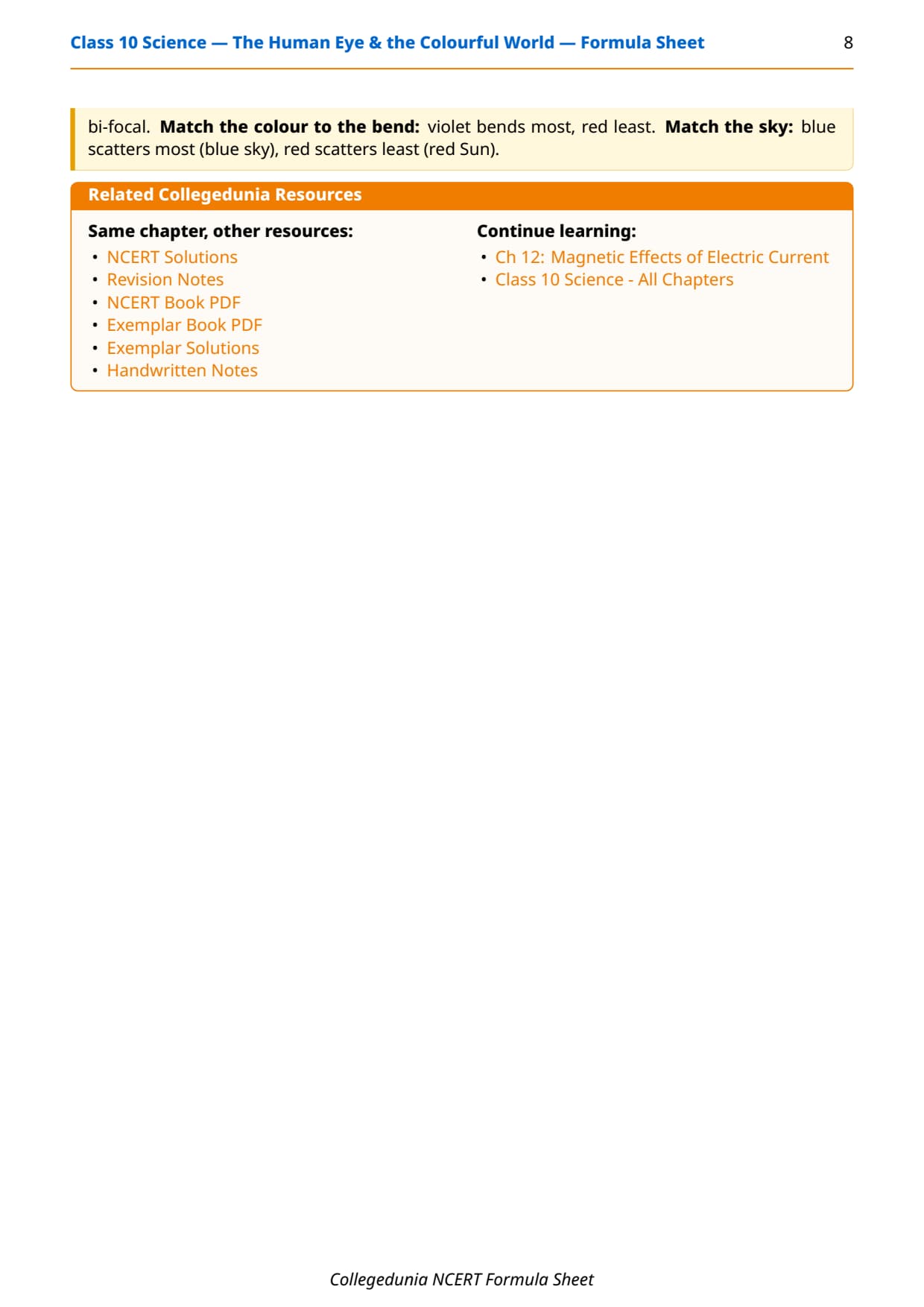
- Lock the three defects as one block: myopia (concave, P < 0 ), hypermetropia (convex, P > 0 ), presbyopia (bi-focal). This is the most-asked board question.
- Convert focal length to metres for power: a lens of f = −50 cm gives P = −2 D.
- Remember VIBGYOR and scattering: violet bends most, red least; small particles scatter blue more, so the sky is blue and the Sun looks red at sunrise and sunset.
The Human Eye and the Colourful World Top 5 Concept Recall for Class 10 Science
These five concepts carry the reasoning marks:
- Power of accommodation: the ciliary muscles change the lens focal length to focus near and far objects; it cannot fall below a minimum, so very close print blurs.
- Dispersion: a prism splits white light into VIBGYOR because each colour bends by a different amount; violet most, red least.
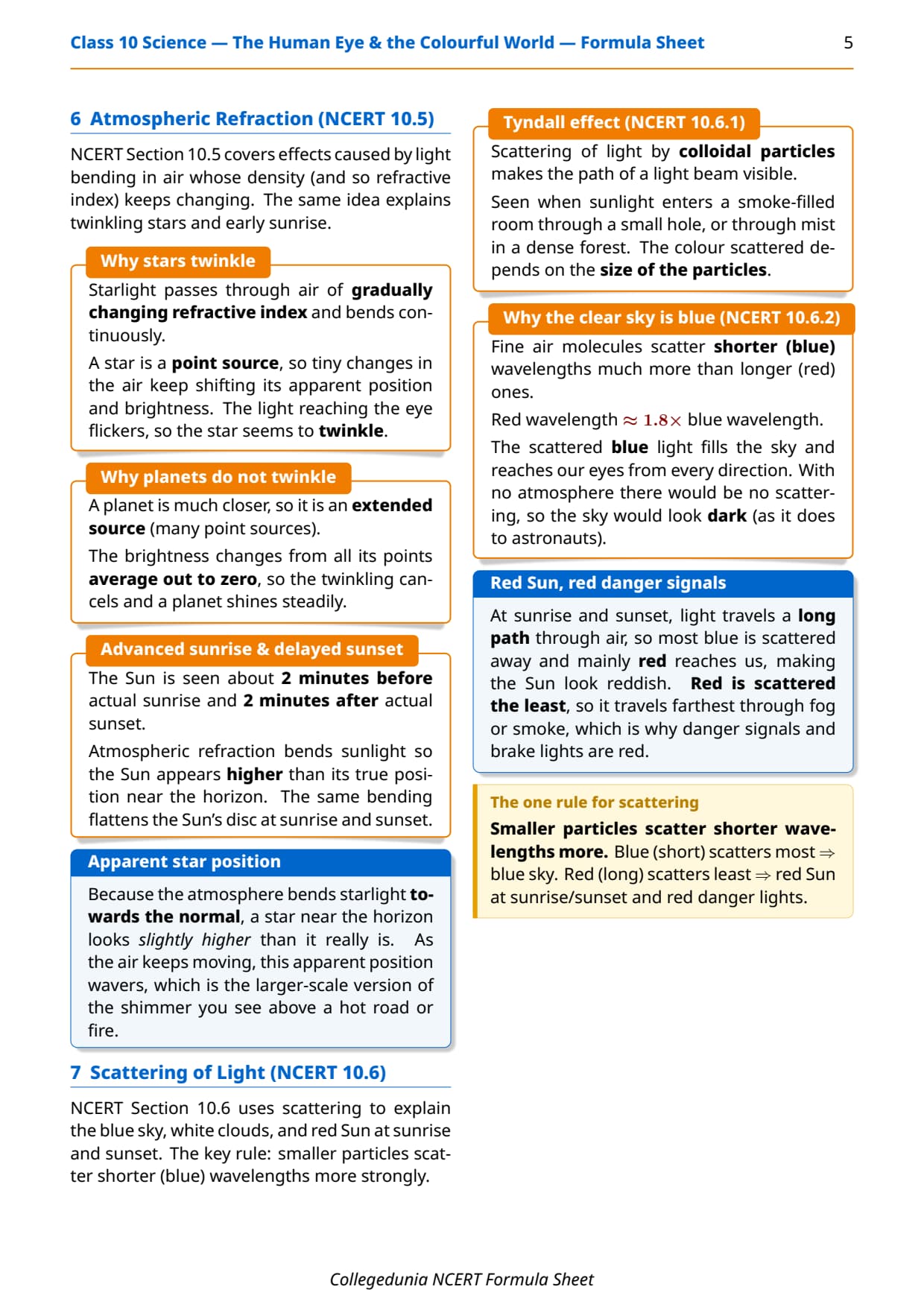
- Atmospheric refraction: bending in air of changing density explains star twinkling and the advanced sunrise / delayed sunset.
- Scattering: small particles scatter blue more, so the sky is blue; the long path at sunrise and sunset leaves the Sun reddish.
Full topic-by-topic walkthrough: The Human Eye and the Colourful World Class 10 Science Notes
More The Human Eye and the Colourful World Class 10 Science Resources
Use the table below to move between the other Collegedunia resources for this same chapter, from full solutions to handwritten notes.
| Resource | Link |
|---|---|
| NCERT Solutions | The Human Eye and the Colourful World NCERT Solutions |
| Revision Notes | The Human Eye and the Colourful World Notes |
| Handwritten Notes | The Human Eye and the Colourful World Handwritten Notes |
| Exemplar Solutions | The Human Eye and the Colourful World Exemplar Solutions |
| NCERT Book PDF | The Human Eye and the Colourful World NCERT Book PDF |
NCERT Formula Sheet for Class 10 Science: All Chapters
Use the table below to jump to the Formula Sheet for any other chapter in the Class 10 Science NCERT.
| Chapter | Resource |
|---|---|
| Chapter 1 | Chemical Reactions and Equations Formula Sheet |
| Chapter 2 | Acids, Bases and Salts Formula Sheet |
| Chapter 3 | Metals and Non-metals Formula Sheet |
| Chapter 4 | Carbon and its Compounds Formula Sheet |
| Chapter 5 | Life Processes Formula Sheet |
| Chapter 6 | Control and Coordination Formula Sheet |
| Chapter 7 | How do Organisms Reproduce? Formula Sheet |
| Chapter 8 | Heredity Formula Sheet |
| Chapter 9 | Light - Reflection and Refraction Formula Sheet |
| Chapter 11 | Electricity Formula Sheet |
| Chapter 12 | Magnetic Effects of Electric Current Formula Sheet |
| Chapter 13 | Our Environment Formula Sheet |
The Human Eye and the Colourful World Class 10 Formula Sheet FAQs
Ques. Where can I download the The Human Eye and the Colourful World Class 10 Formula Sheet PDF?
Ans. You can download the The Human Eye and the Colourful World Class 10 Science Formula Sheet PDF directly from this page. It is free and covers the lens formula, the power of a lens, the three defects of vision, the prism deviation relation, dispersion, and scattering in the 2026-27 NCERT Chapter 10.
Ques. Is this Formula Sheet aligned with the 2026-27 NCERT?
Ans. Yes. The sheet reflects the current 2026-27 syllabus for Class 10 Science. Chapter 10 retains the human eye and accommodation, the defects of vision, refraction through a prism, dispersion of white light, atmospheric refraction, and scattering of light.
Ques. What are the three defects of vision in Class 10 Science Chapter 10?
Ans. The three refractive defects are myopia (near-sightedness), hypermetropia (far-sightedness), and presbyopia. Myopia is corrected by a concave lens, hypermetropia by a convex lens, and presbyopia by a bi-focal lens. A cataract is not a refractive defect and is treated by surgery, not by spectacles.
Ques. Which lens is used to correct myopia and hypermetropia?
Ans. Myopia (distant objects blurred) is corrected by a concave (diverging) lens with negative power, because the image forms in front of the retina and must be pushed back. Hypermetropia (near objects blurred) is corrected by a convex (converging) lens with positive power, because the image forms behind the retina and must be pulled forward.
Ques. What is the power of a lens and what is its unit?
Ans. The power of a lens measures its bending ability and is the reciprocal of its focal length in metres, P = 1/f . The SI unit is the dioptre (D), where 1 D = 1 m-1. A convex lens has positive power and a concave lens negative power. A lens of f = −0.5 m has a power of −2 D.
Ques. What is the near point and far point of a normal human eye?
Ans. The near point is the closest distance at which the eye can see an object clearly without strain, about 25 cm for a normal young adult, and is called the least distance of distinct vision. The far point is the farthest distance the eye can see clearly, which is infinity for a normal eye. So the range of clear vision is from 25 cm to infinity.
Ques. What is the power of accommodation of the eye?
Ans. Accommodation is the ability of the eye to change the focal length of its lens to focus objects at different distances. The ciliary muscles relax to make the lens thin (large focal length) for distant objects and contract to make it thick (small focal length) for near objects. The focal length cannot fall below a minimum, which is why very close print looks blurred.
Ques. Why is the sky blue and the Sun red at sunrise and sunset?
Ans. Fine air molecules scatter shorter (blue) wavelengths much more than longer (red) ones, so the scattered blue light fills the sky and makes it look blue. At sunrise and sunset, light travels a long path through the air, most of the blue is scattered away, and mainly red reaches us, making the Sun look reddish.
Ques. What is dispersion of white light and what is the colour order?
Ans. Dispersion is the splitting of white light into its seven colours when it passes through a prism, because each colour travels at a slightly different speed in glass and bends by a different amount. The colour order is VIBGYOR: violet, indigo, blue, green, yellow, orange, red. Violet bends the most and red the least.
Ques. What is the relation between the angle of the prism and the angle of deviation?
Ans. For a prism, ∠A + ∠D = ∠i + ∠e , where ∠A is the angle of the prism, ∠D the angle of deviation, ∠i the angle of incidence, and ∠e the angle of emergence. Unlike a glass slab, a prism turns the emergent ray by the angle of deviation because its two faces are inclined.
Ques. Why do stars twinkle but planets do not?
Ans. A star is a point source of light, so atmospheric refraction through air of constantly changing refractive index keeps shifting its apparent position and brightness, making it twinkle. A planet is much closer and acts as a collection of many point sources, whose brightness variations average out to zero, so a planet shines steadily.
Ques. What is the CBSE weightage of Chapter 10 The Human Eye and the Colourful World in Class 10 Science?
Ans. The Human Eye and the Colourful World sits in the Natural Phenomena and Optics block and usually carries 6 to 8 marks in the CBSE Class 10 Science board exam, asked across one defect-correction numerical (myopia or hypermetropia) and one reasoning or diagram question on dispersion, atmospheric refraction, or scattering of light.



Comments