



Class 10 Science Chapter 11 Electricity is the most numerical-heavy physics chapter of the 2026-27 NCERT, and one page of relations covers almost every board sum. This Electricity formula sheet puts the charge-current relation, Ohm's law, resistance and resistivity, series and parallel resistor rules, Joule's law of heating, and electric power on a single page. Use it as a quick reference before any CBSE Class 10 board test.
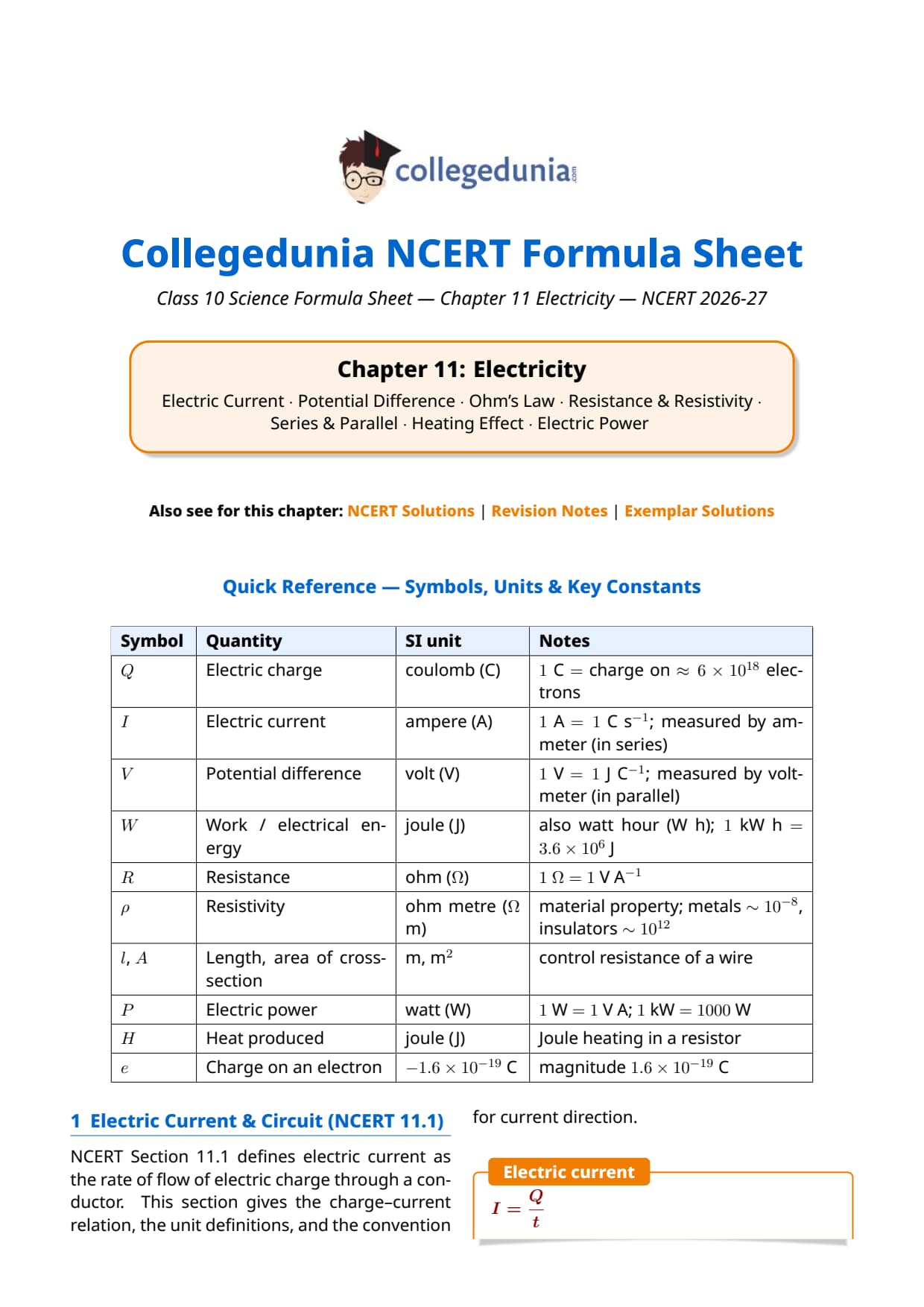
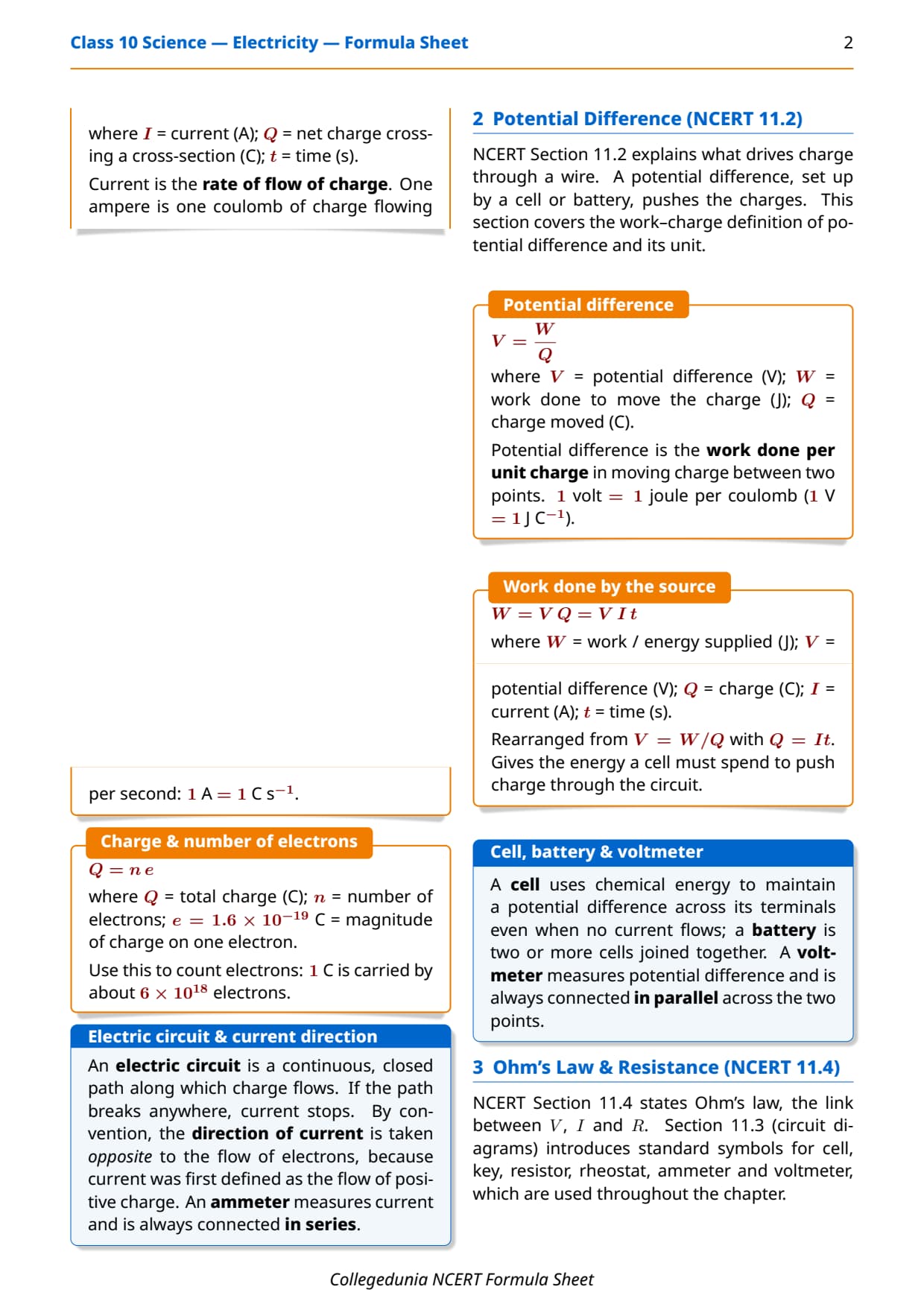
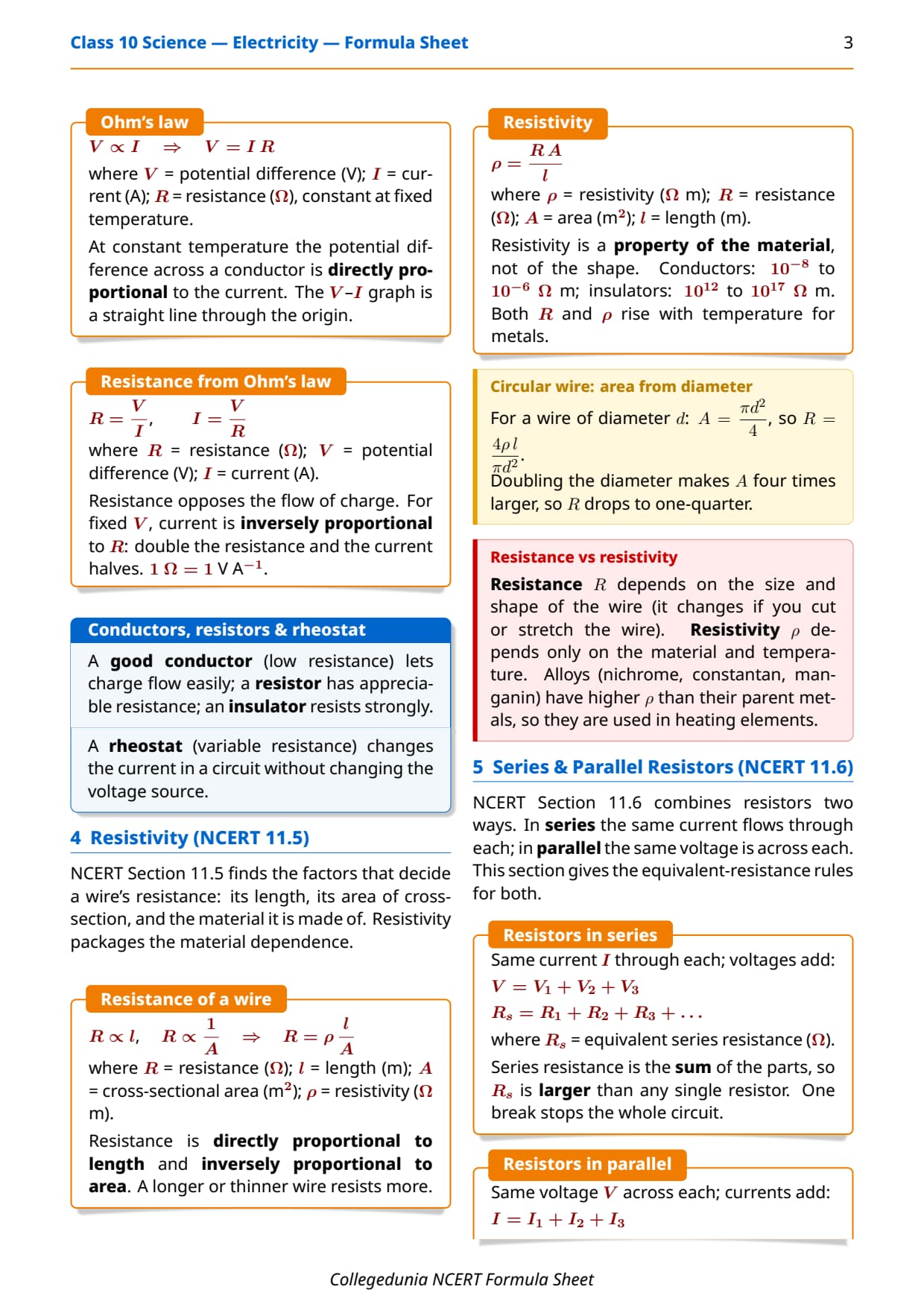
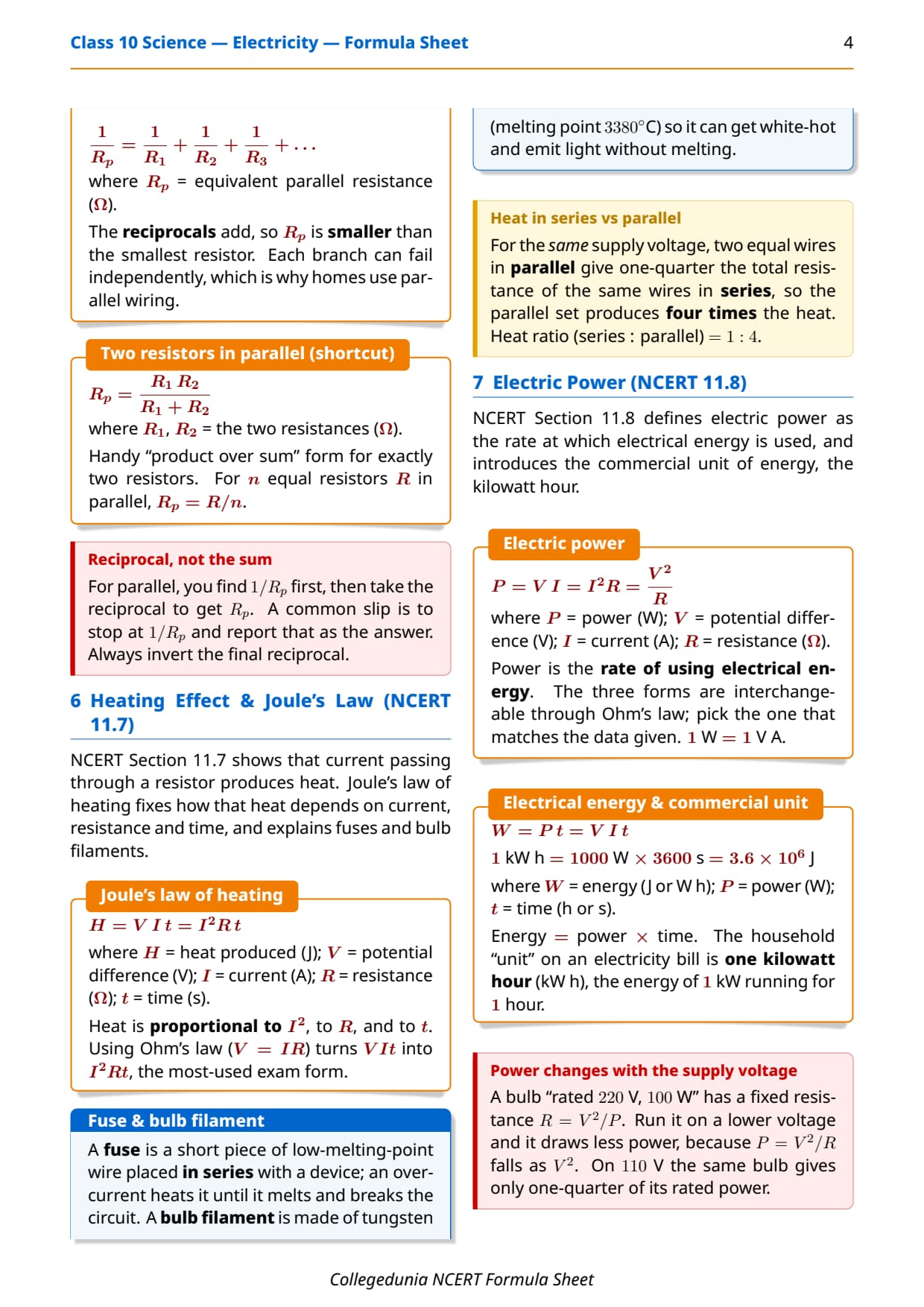
- CBSE Weightage: part of the Effects of Current block, worth 6 to 8 marks across one numerical and one reasoning question.
- Best used for: Ohm's law sums, equivalent resistance in series and parallel, the resistivity formula, Joule heating, electric power numericals, and last-minute board revision.
You can find the complete Formula Sheet for Electricity, with the charge-current relation, Ohm's law, resistance and resistivity, series and parallel rules, Joule's law of heating, and electric power mapped to the 2026-27 NCERT, in the article below.
This Formula Sheet is curated by Science subject experts, mapped to the 2026-27 NCERT, and refined against the last five years of CBSE Class 10 board papers.
Also Check:
How Collegedunia's Electricity Formula Sheet Helps You
This Formula Sheet gathers every relation you need for Class 10 Science Chapter 11 numericals on one page, in the order the NCERT introduces them.
- 2026-27 NCERT Alignment: every formula, from the charge-current relation and Ohm's law to resistivity, the series and parallel rules, Joule's law, and electric power, matches the current syllabus.
- Series and parallel rules side by side: the equivalent-resistance formulae sit next to each other, so you pick the right one before starting the sum.
- Quick-fact cards for MCQs: key constants like the electron charge, the resistivity of copper, and 1 kW h = 3.6 × 10⁶ J sit in a colour-coded card row.
Electricity Class 10 Science Video Revision
Source: Magnet Brains on YouTube
Electricity Class 10 Science Complete Formula Reference
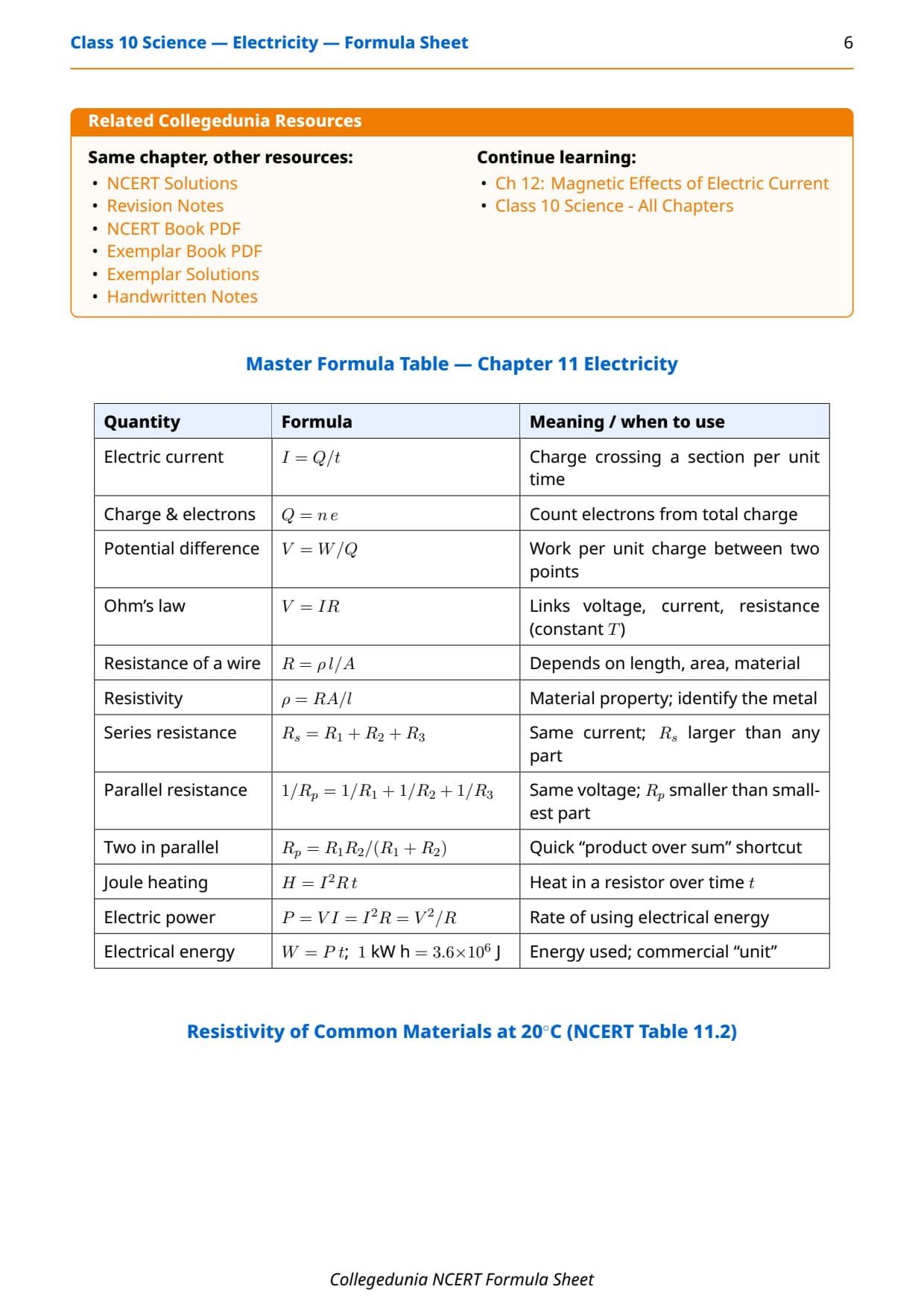
The table lists every formula in Chapter 11, mapped to its NCERT section and typical question setup.
| Concept | Formula | SI Unit | NCERT Section | Typical Use |
|---|---|---|---|---|
| Electric current | I = Qt | ampere (A) | 11.1 | Charge crossing a section per second |
| Charge and electrons | Q = n e | coulomb (C) | 11.1 | Count electrons from total charge |
| Potential difference | V = WQ | volt (V) | 11.2 | Work done per unit charge |
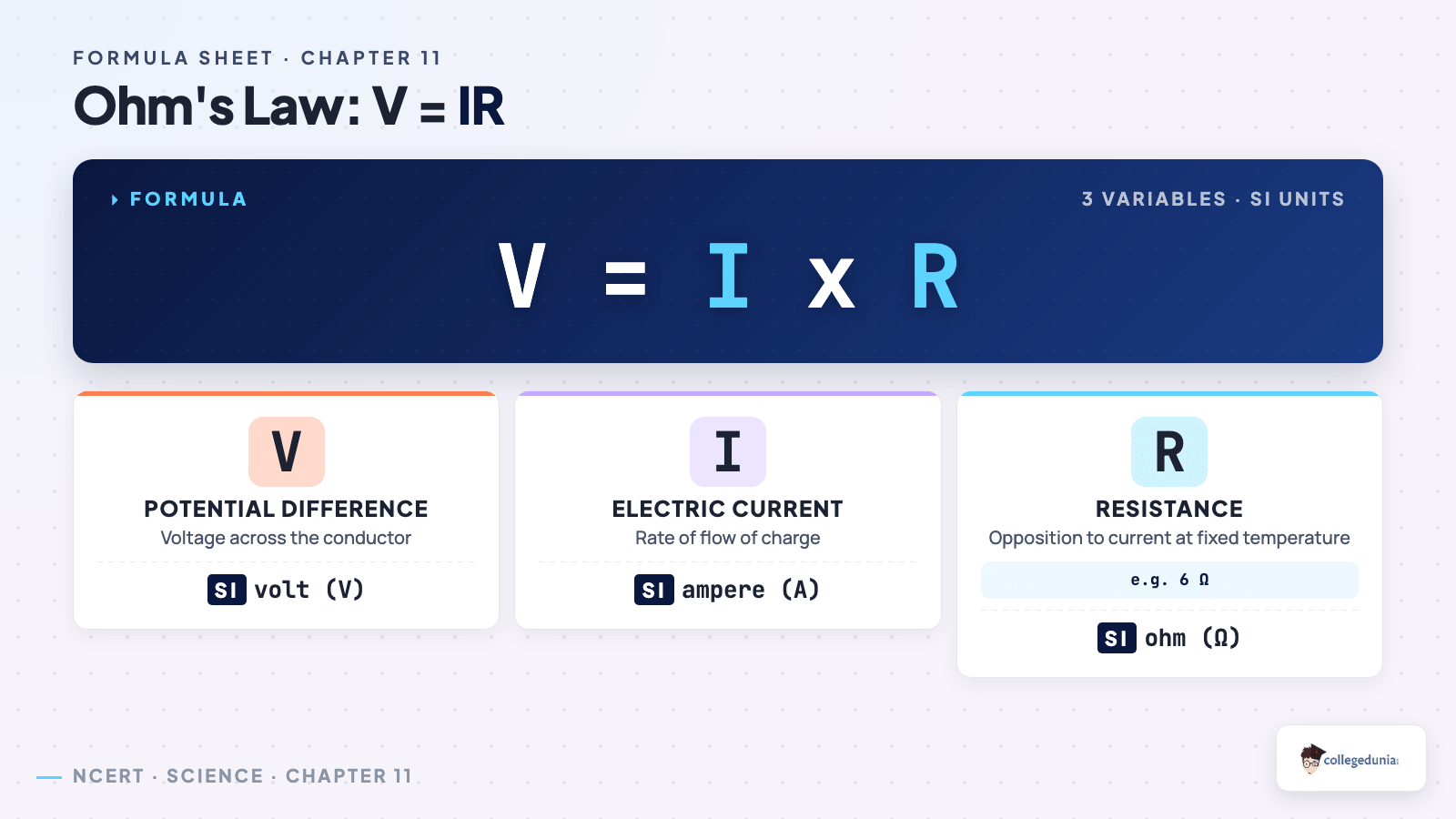
| Ohm's law | V = I R | V | 11.4 | Links voltage, current, resistance |
| Resistance from Ohm's law | R = VI | ohm (Ω) | 11.4 | Find resistance from V and I |
| Resistance of a wire | R = ρ lA | Ω | 11.5 | Depends on length, area, material |
| Resistivity | ρ = R Al | Ω m | 11.5 | Identify the material of a wire |
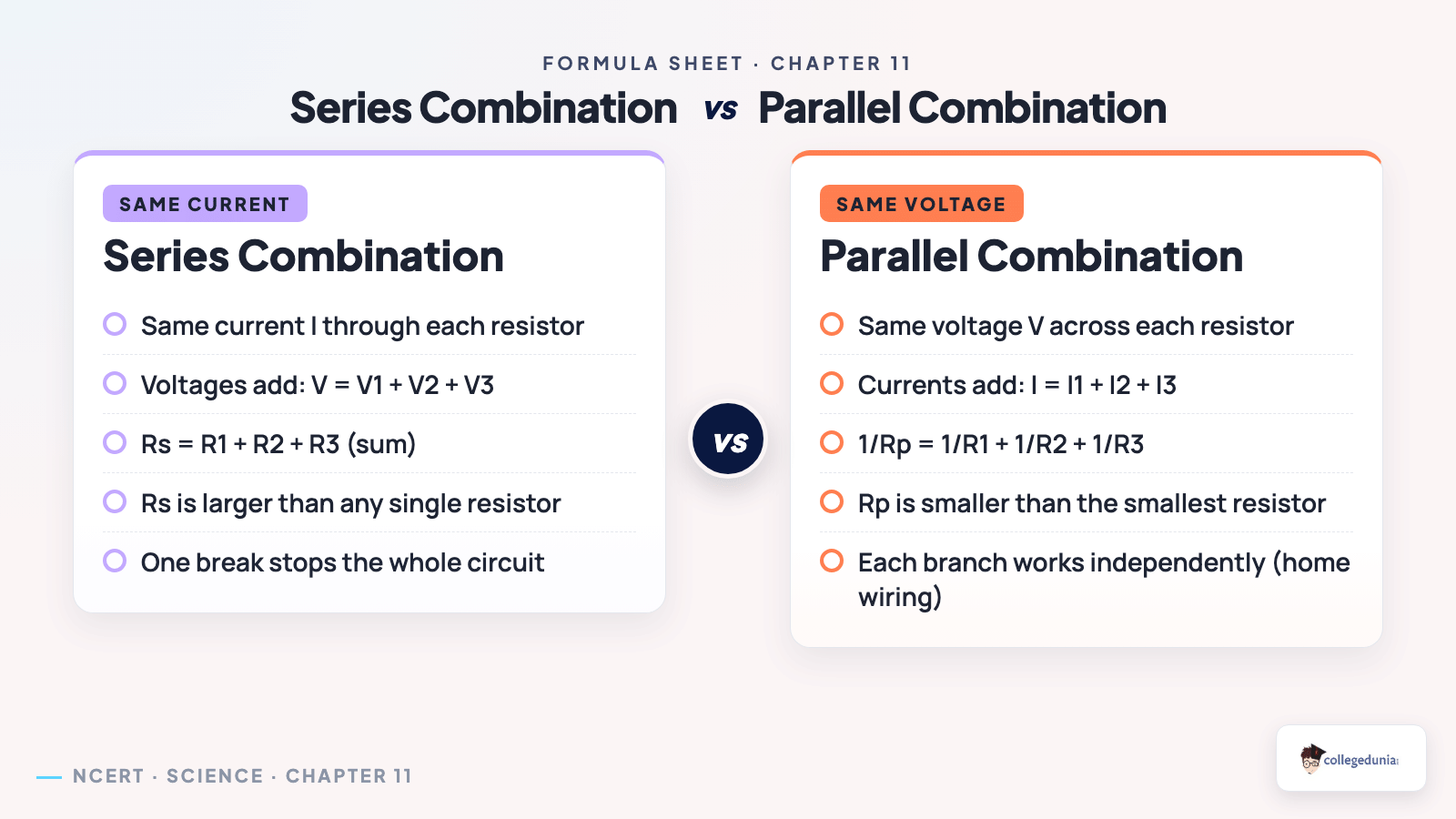
| Resistors in series | Rs = R1 + R2 + R3 | Ω | 11.6 | Same current; net R grows |
| Resistors in parallel | 1Rp = 1R1 + 1R2 + 1R3 | Ω | 11.6 | Same voltage; net R shrinks |
| Two in parallel (shortcut) | Rp = R1 R2R1 + R2 | Ω | 11.6 | Quick "product over sum" form |
| Joule's law of heating | H = I2 R t | joule (J) | 11.7 | Heat produced in a resistor |
| Electric power | P = V I = I2 R = V2R | watt (W) | 11.8 | Rate of using electrical energy |
| Electrical energy | W = P t = V I t | J or kW h | 11.8 | Energy used; the "unit" on a bill |
Memorising these formulae alone covers nearly every Electricity numerical asked in CBSE Class 10 board papers between 2021 and 2025.
When to Use Which Formula in Electricity Class 10
Picking the right formula is the difference between full marks and a slip. The list below tells you which expression to apply based on what the question gives you. Read the circuit first: same current everywhere means series (add the resistances); same voltage everywhere means parallel (add the reciprocals, then invert).
- Voltage and current given, asks resistance: Ohm's law R = V/I .
- Length, area, and material given: R = ρ l/A . For diameter d , area is A = π d2/4 .
- Resistors end to end (one path): series, add them: Rs = R1 + R2 + R3 .
- Resistors across the same two points: parallel; for two, use Rp = R1 R2/(R1 + R2) .
- Heat produced in a resistor: Joule's law H = I2 R t .
- Power or the energy bill: P = V I , then energy W = P t in kilowatt hours.
Electricity Class 10 Quick-Fact Cards for MCQ Recall
These atomic facts are the ones the MCQ writers reach for most often. Glance over them the morning of any test; every entry has been asked in CBSE Class 10 board papers in the last five years.
Symbol Glossary and Units for Class 10 Science Chapter 11
Every variable used above, decoded with its SI unit. Note: resistance R depends on the wire's size and shape; resistivity ρ depends only on the material.
| Symbol | What it means | SI Unit |
|---|---|---|
| Q | Electric charge | coulomb (C) |
| I | Electric current (ammeter in series) | ampere (A) |
| V | Potential difference (voltmeter in parallel) | volt (V) |
| R | Resistance | ohm (Ω) |
| ρ | Resistivity | Ω m |
| l, A | Length and area of cross-section | m, m2 |
| P | Electric power | watt (W) |
| H | Heat produced | joule (J) |
| W | Electrical energy | J or kW h |
| e | Charge on an electron (1.6 × 10⁻¹⁹ C) | C |
Electricity Top 5 Formulae Recap: Quick PYQ Map for Class 10
The five formulae below carry the largest share of marks in CBSE Class 10 board papers from 2021 to 2025.
| Formula | Most-recent exam appearance |
|---|---|
| V = I R | CBSE 2025 (3 marks), CBSE 2024 numerical |
| 1Rp = 1R1 + 1R2 | CBSE 2025 (3 marks), CBSE 2023 numerical |
| P = V2R | CBSE 2024 (2 marks), CBSE 2022 |
| H = I2 R t | CBSE 2025 (2 marks), CBSE 2023 MCQ |
| R = ρ lA | CBSE 2024 (2 marks), CBSE 2022 MCQ |
Full year-wise PYQ map: Electricity Class 10 Science NCERT Solutions
One-Shot Revision Tips for Electricity Class 10
Treat the sheet as a checklist you tick off as you recall every term the night before a test.
- "Series shares current, Parallel shares voltage." In series, resistances add; in parallel, reciprocals add. This settles most combination sums.
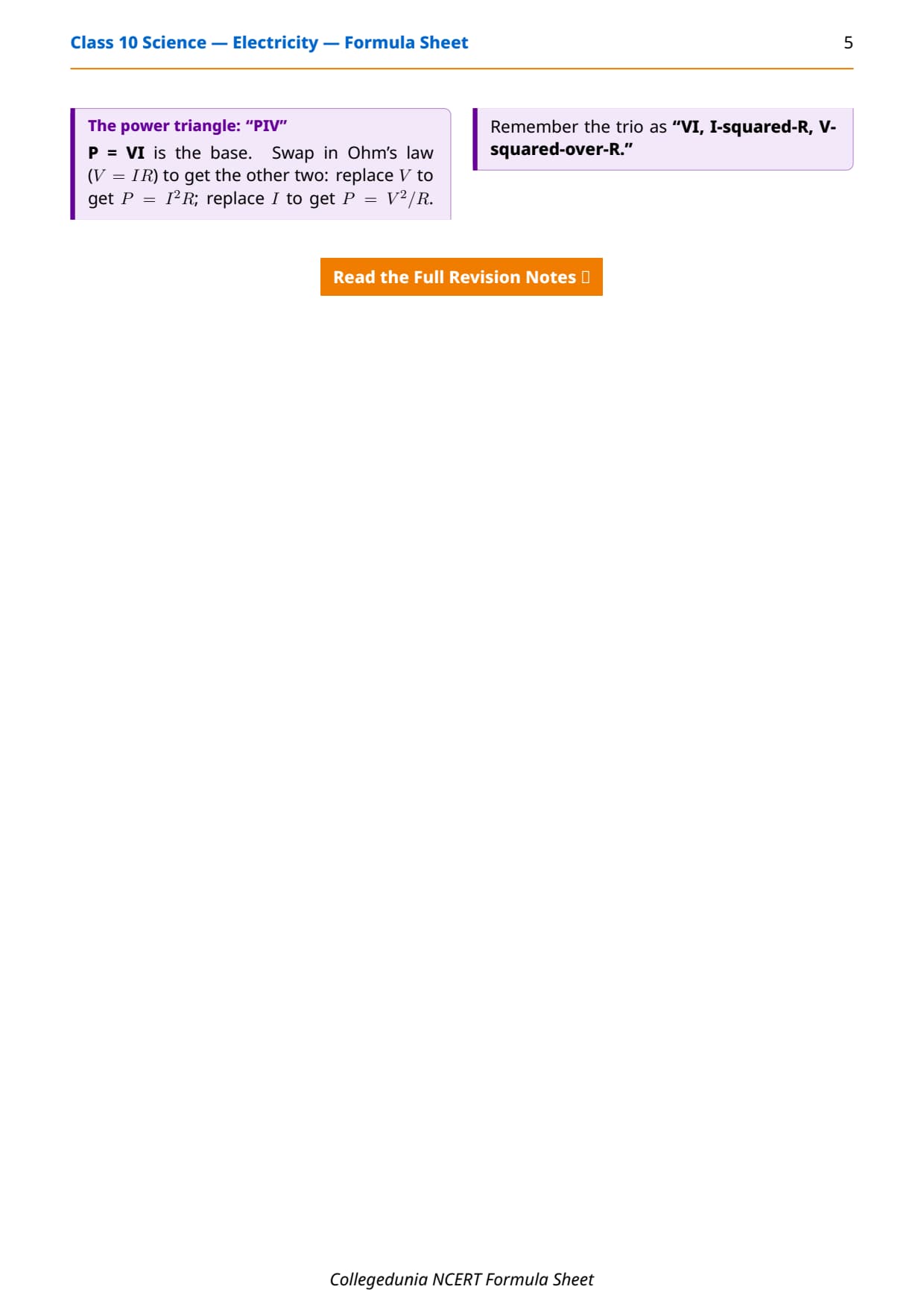
- Keep the power triangle ready: P = V I = I2 R = V2/R . Pick the form that matches the data.
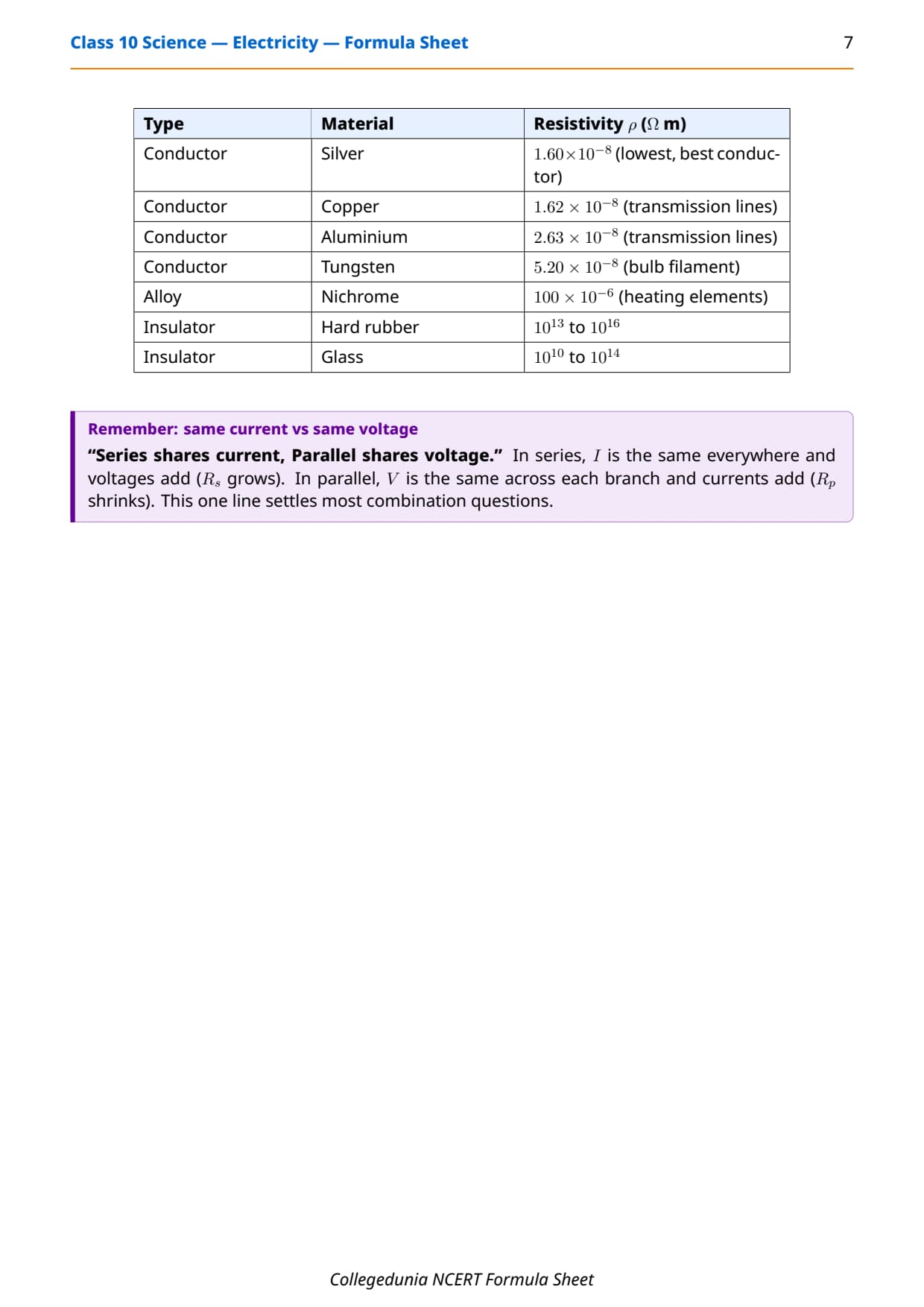
- Resistance vs resistivity: R changes if you cut or stretch the wire; ρ depends only on material. Nichrome's high ρ suits heating elements.
- Heating: H = I2 R t . Doubling the current quadruples the heat.
- Constants: electron charge 1.6 × 10⁻¹⁹ C and 1 kW h = 3.6 × 10⁶ J appear in most numericals.
Full topic-by-topic walkthrough: Electricity Class 10 Science Notes
More Electricity Class 10 Science Resources
Use the table below to move between the other Collegedunia resources for this same chapter, from full solutions to handwritten notes.
| Resource | Link |
|---|---|
| NCERT Solutions | Electricity NCERT Solutions |
| Revision Notes | Electricity Notes |
| Handwritten Notes | Electricity Handwritten Notes |
| Exemplar Solutions | Electricity Exemplar Solutions |
| NCERT Book PDF | Electricity NCERT Book PDF |
NCERT Formula Sheet for Class 10 Science: All Chapters
Use the table below to jump to the Formula Sheet for any other chapter in the Class 10 Science NCERT.
| Chapter | Resource |
|---|---|
| Chapter 1 | Chemical Reactions and Equations Formula Sheet |
| Chapter 2 | Acids, Bases and Salts Formula Sheet |
| Chapter 3 | Metals and Non-metals Formula Sheet |
| Chapter 4 | Carbon and its Compounds Formula Sheet |
| Chapter 5 | Life Processes Formula Sheet |
| Chapter 6 | Control and Coordination Formula Sheet |
| Chapter 7 | How do Organisms Reproduce? Formula Sheet |
| Chapter 8 | Heredity Formula Sheet |
| Chapter 9 | Light - Reflection and Refraction Formula Sheet |
| Chapter 10 | The Human Eye and the Colourful World Formula Sheet |
| Chapter 12 | Magnetic Effects of Electric Current Formula Sheet |
| Chapter 13 | Our Environment Formula Sheet |
Electricity Class 10 Formula Sheet FAQs
Ques. Where can I download the Electricity Class 10 Formula Sheet PDF?
Ans. You can download the Electricity Class 10 Science Formula Sheet PDF directly from this page. It is free and covers the charge-current relation, Ohm's law, resistance and resistivity, the series and parallel rules, Joule's law of heating, and electric power in the 2026-27 NCERT Chapter 11.
Ques. Is this Formula Sheet aligned with the 2026-27 NCERT?
Ans. Yes. The sheet reflects the current 2026-27 syllabus for Class 10 Science. Chapter 11 retains electric current, potential difference, Ohm's law, resistance, resistivity, the series and parallel combinations, the heating effect of current, and electric power.
Ques. What is Ohm's law in Class 10 Science Chapter 11?
Ans. Ohm's law states that at constant temperature the potential difference across a conductor is directly proportional to the current through it, so V = I R , where R is the resistance. The V - I graph is a straight line through the origin.
Ques. What is the difference between resistance and resistivity?
Ans. Resistance R depends on the size and shape of the wire and changes if you cut or stretch it; it is measured in ohm (Ω). Resistivity ρ depends only on the material and its temperature; it is measured in ohm metre (Ω m). They are linked by R = ρ l/A .
Ques. What is the formula for resistors in series and in parallel?
Ans. In series the resistances add: Rs = R1 + R2 + R3 , so the net resistance is larger than any single resistor. In parallel the reciprocals add: 1Rp = 1R1 + 1R2 + 1R3 , so the net resistance is smaller than the smallest resistor.
Ques. How do you find the equivalent resistance of just two resistors in parallel?
Ans. For exactly two resistors in parallel, use the "product over sum" shortcut: Rp = R1 R2R1 + R2 . For example, a 6 Ω and a 3 Ω resistor in parallel give Rp = (6 × 3)/(6 + 3) = 2 Ω. For n equal resistors R in parallel, Rp = R/n .
Ques. What is Joule's law of heating?
Ans. Joule's law of heating states that the heat produced in a resistor is H = I2 R t , where I is the current, R the resistance, and t the time. Heat is proportional to the square of the current, so doubling the current produces four times the heat. This is the principle behind fuses, heaters, and bulb filaments.
Ques. What are the three formulae for electric power?
Ans. Electric power can be written three ways: P = V I , P = I2 R , and P = V2/R . All three are equivalent through Ohm's law; choose the one that matches the data given. The SI unit of power is the watt (W), where 1 W = 1 V A.
Ques. What is the commercial unit of electrical energy?
Ans. The commercial unit of electrical energy is the kilowatt hour (kW h), the energy used by a 1 kW appliance running for 1 hour. In joules, 1 kW h = 1000 W × 3600 s = 3.6 × 10⁶ J. The "unit" on a household electricity bill is one kilowatt hour.
Ques. Why is the charge on an electron important in this chapter?
Ans. The charge on an electron has a magnitude of 1.6 × 10⁻¹⁹ C. It links total charge to the number of electrons through Q = n e , so you can count how many electrons cross a section of wire. About 6 × 10¹⁸ electrons make up one coulomb of charge.
Ques. Why are appliances at home connected in parallel?
Ans. Home appliances are wired in parallel for two reasons. First, each device gets the same full supply voltage. Second, each branch works independently, so switching one appliance off (or one failing) does not stop the others. A parallel arrangement also gives a lower total resistance, allowing a larger current to be drawn when needed.
Ques. Which is the most important formula in Electricity Class 10?
Ans. Ohm's law V = I R , the series and parallel resistance rules, and the electric power forms P = V I = I2 R = V2/R are the highest-yield formulae. Together they account for the bulk of the numericals asked in CBSE Class 10 board papers between 2021 and 2025.
Ques. What is the CBSE weightage of Chapter 11 Electricity in Class 10 Science?
Ans. Electricity sits in the Effects of Current block and usually carries 6 to 8 marks in the CBSE Class 10 Science board exam, asked across one numerical (Ohm's law, equivalent resistance, or power) and one reasoning or circuit-diagram question on current, resistance, or the heating effect.



Comments