


Class 10 Science Chapter 12 Magnetic Effects of Electric Current is a rule-and-relation chapter where one page captures almost every fact the board asks. This Magnetic Effects of Electric Current formula sheet puts the field-strength relations, the right-hand thumb rule, the force on a conductor, Fleming's left-hand rule, and the domestic circuit facts on a single page.
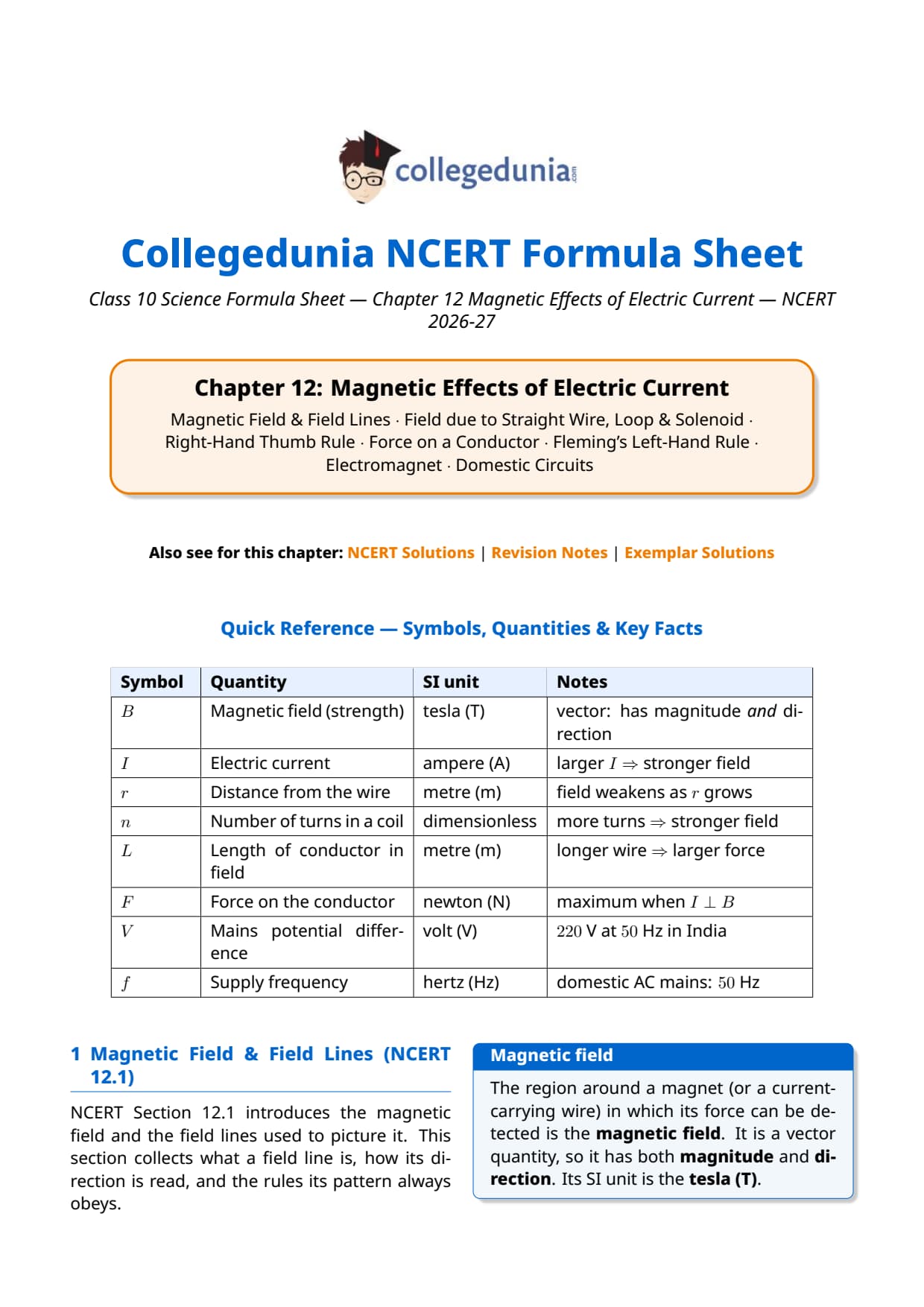
- CBSE Weightage: part of the Effects of Current block, worth 6 to 8 marks across one reasoning question and one rule-based or circuit-diagram question.
- Best used for: field-direction questions, the right-hand thumb rule, the force on a conductor, Fleming's left-hand rule, the electromagnet, the domestic circuit, and last-minute board revision.
You can find the complete Formula Sheet for Magnetic Effects of Electric Current, with the field-strength relations, the right-hand thumb rule, the force on a conductor, Fleming's left-hand rule, and the domestic circuit facts mapped to the 2026-27 NCERT, in the article below.
This Formula Sheet is curated by Science subject experts, mapped to the 2026-27 NCERT, and refined against the last five years of CBSE Class 10 board papers.
Also Check:
- Magnetic Effects of Electric Current Class 10 Science NCERT Solutions
- Magnetic Effects of Electric Current Class 10 Science Notes
How Collegedunia's Magnetic Effects of Electric Current Formula Sheet Helps You
This Formula Sheet gathers every relation and rule you need for Class 10 Science Chapter 12 on one page, in the order the NCERT introduces them.
- 2026-27 NCERT Alignment: every relation, from the field-strength dependence to the force on a conductor and the domestic circuit, matches the current syllabus.
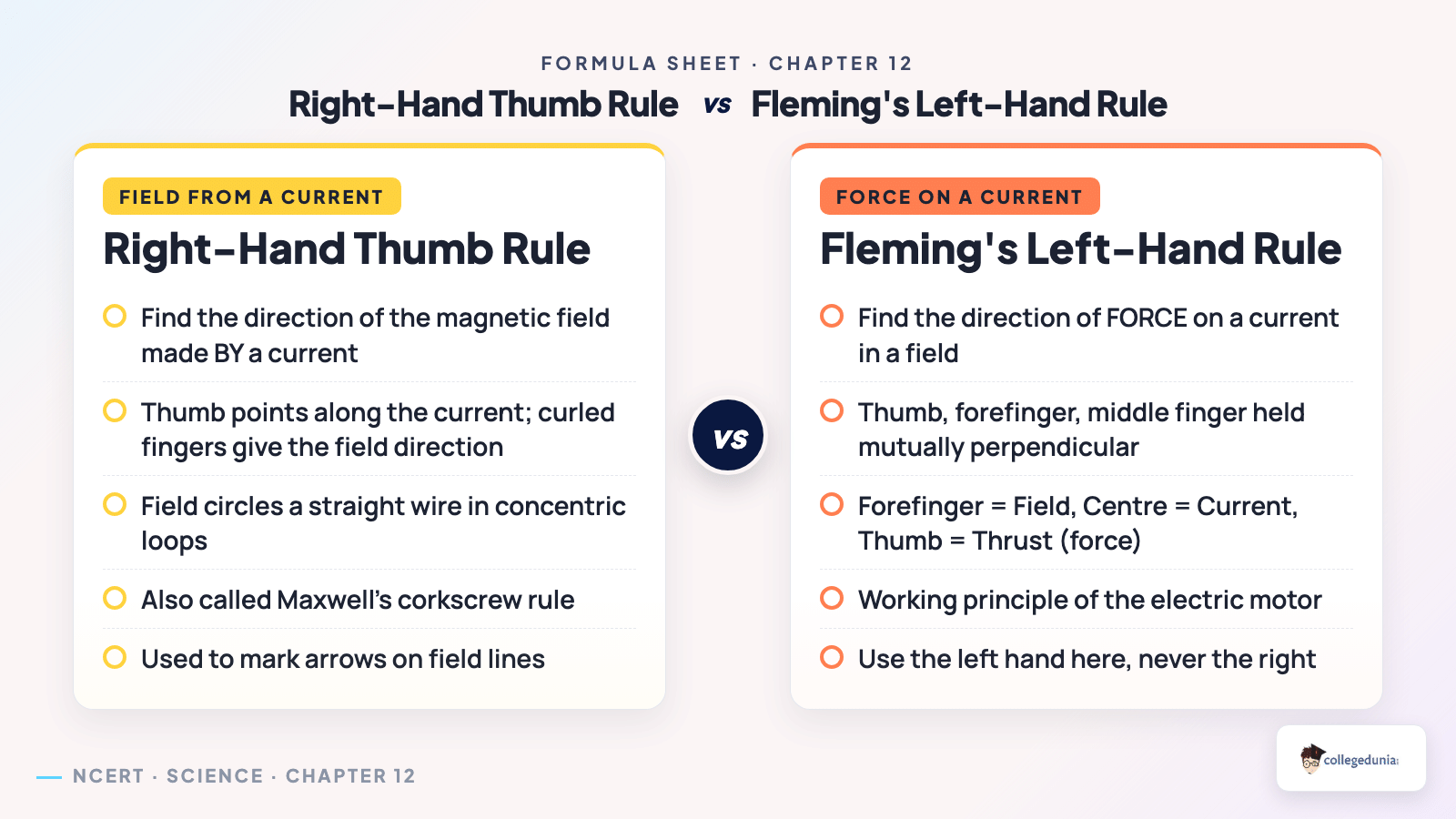
- Both hand rules side by side: the right-hand thumb rule (field) and Fleming's left-hand rule (force) sit next to each other, so you pick the correct hand first.
- Quick-fact cards for MCQs: the 220 V at 50 Hz mains, the SI unit (tesla), and the wire colours sit in a colour-coded card row for last-minute recall.
Magnetic Effects of Electric Current Class 10 Science Video Revision
Source: Magnet Brains on YouTube
Magnetic Effects of Electric Current Class 10 Science Complete Formula and Relation Reference
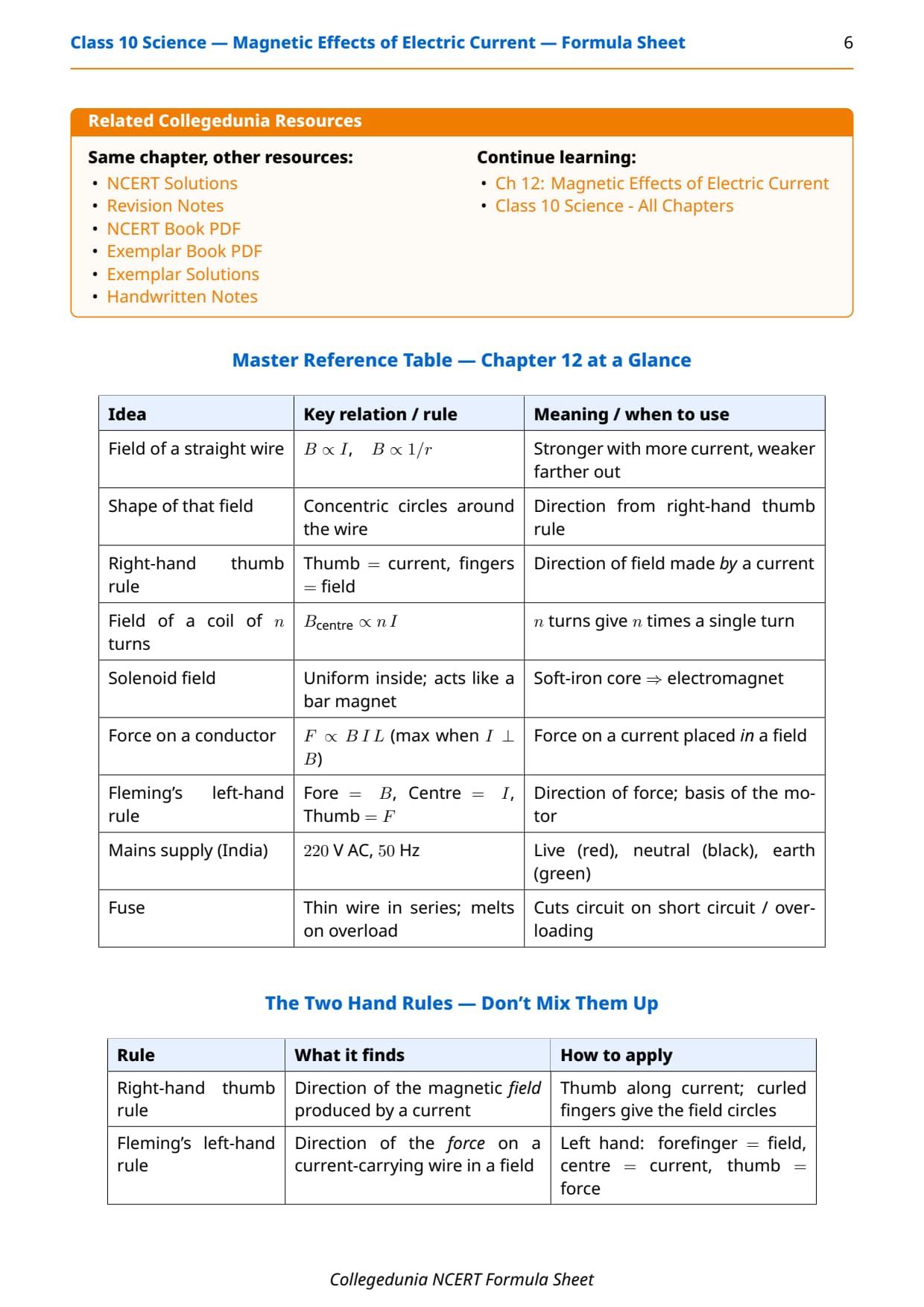
The table lists every relation and rule in Chapter 12, mapped to its NCERT section and typical question setup. Many entries are proportionalities and direction rules rather than plug-in equations, since this chapter is reasoning-led.
| Concept | Relation / Rule | SI Unit | NCERT Section | Typical Use |
|---|---|---|---|---|
| Magnetic field strength | B is a vector quantity | tesla (T) | 12.1 | Direction read from a compass north |
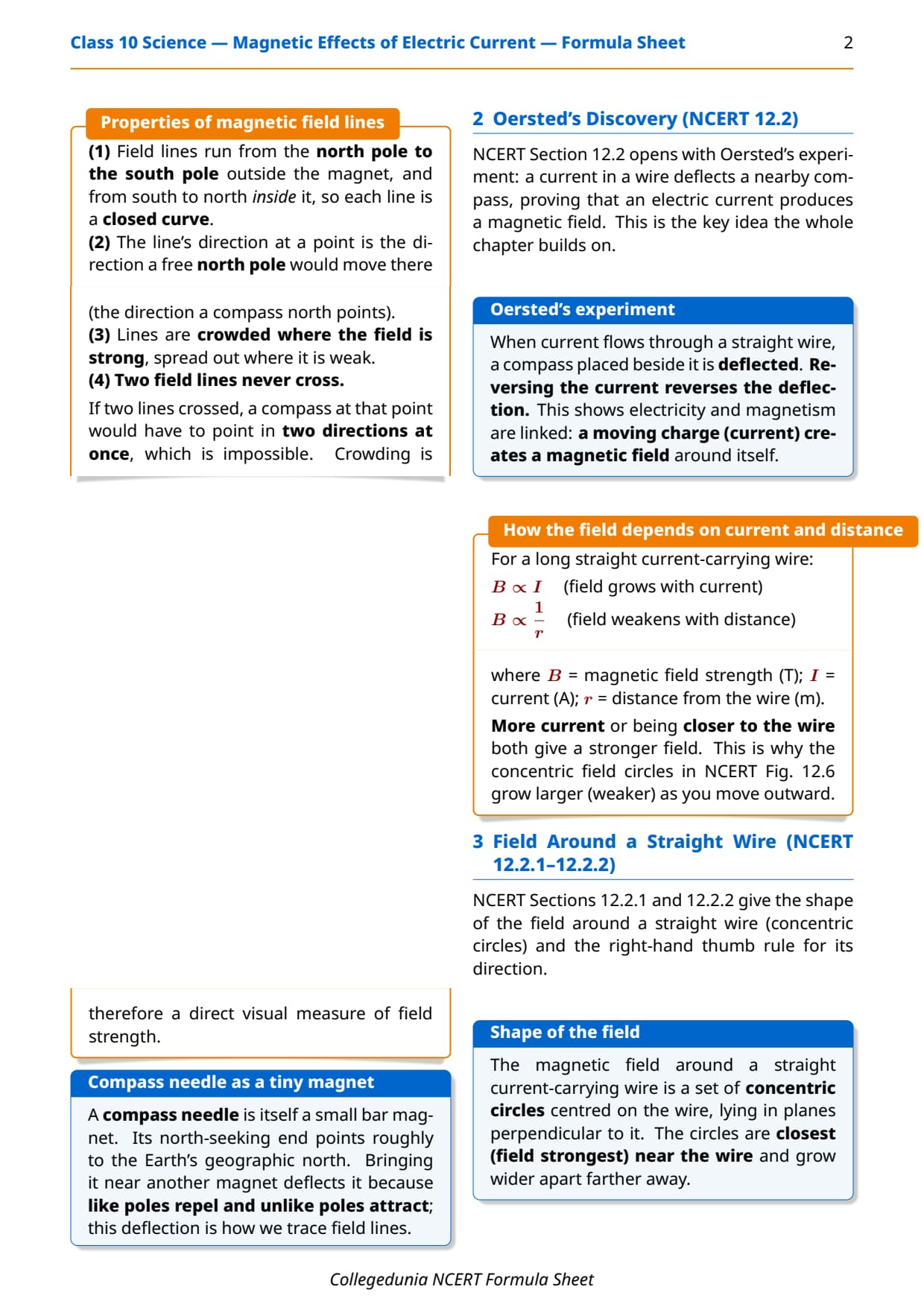
| Field around a straight wire (current) | B ∝ I | T | 12.2.1 | More current gives a stronger field |
| Field around a straight wire (distance) | B ∝ 1r | T | 12.2.1 | Field weakens farther from the wire |
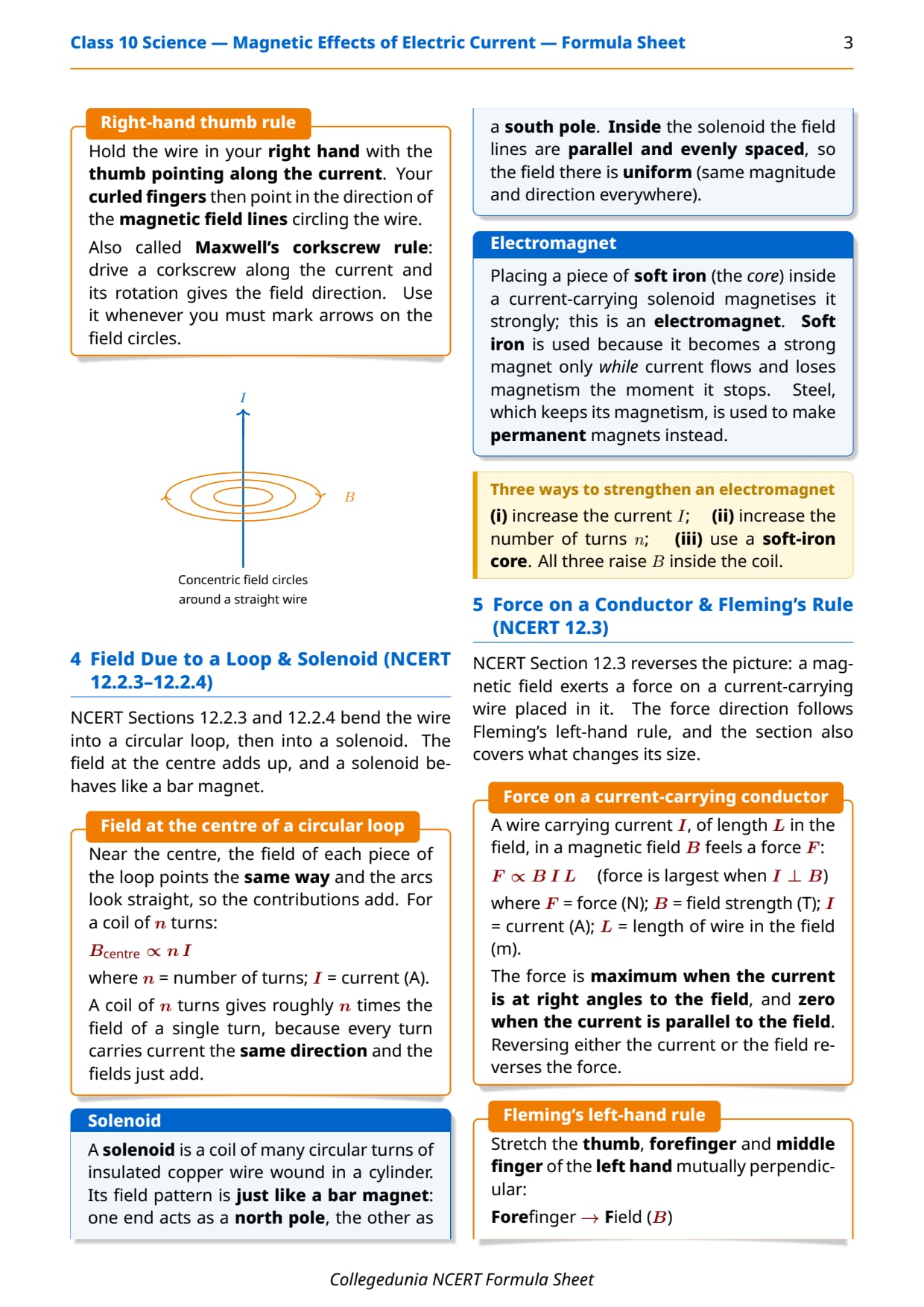
| Right-hand thumb rule | Thumb → current; curled fingers → field | - | 12.2.2 | Direction of field around a wire |
| Field at the centre of a loop | Bcentre ∝ n I | T | 12.2.3 | n turns give n times the field |
| Solenoid field | Uniform inside; acts like a bar magnet | T | 12.2.4 | One end north, the other south |
| Electromagnet | Stronger with more I , more n , soft-iron core | - | 12.2.4 | Temporary, strong magnet |
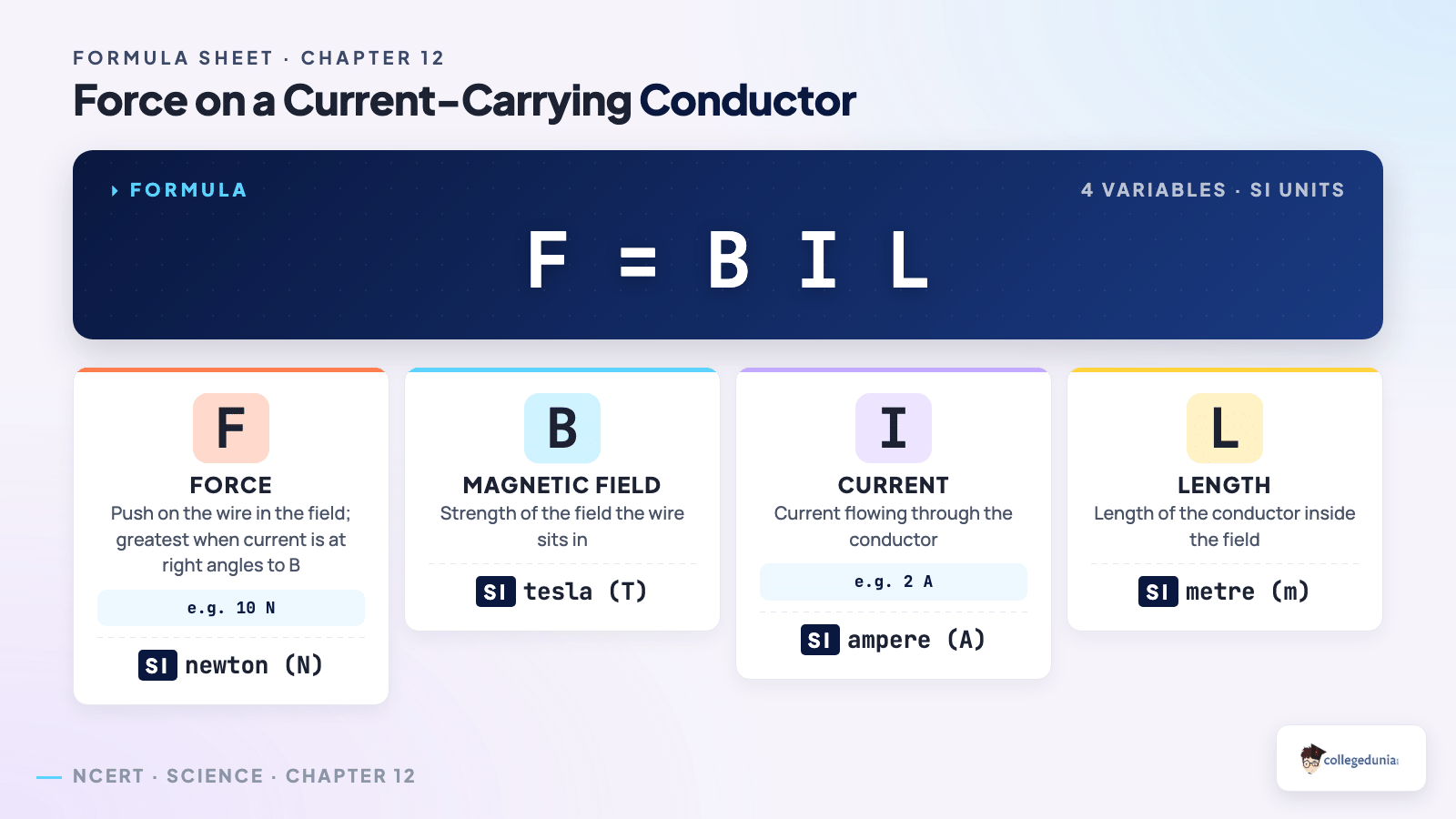
| Force on a conductor | F ∝ B I L | newton (N) | 12.3 | Largest when I ⊥ B |
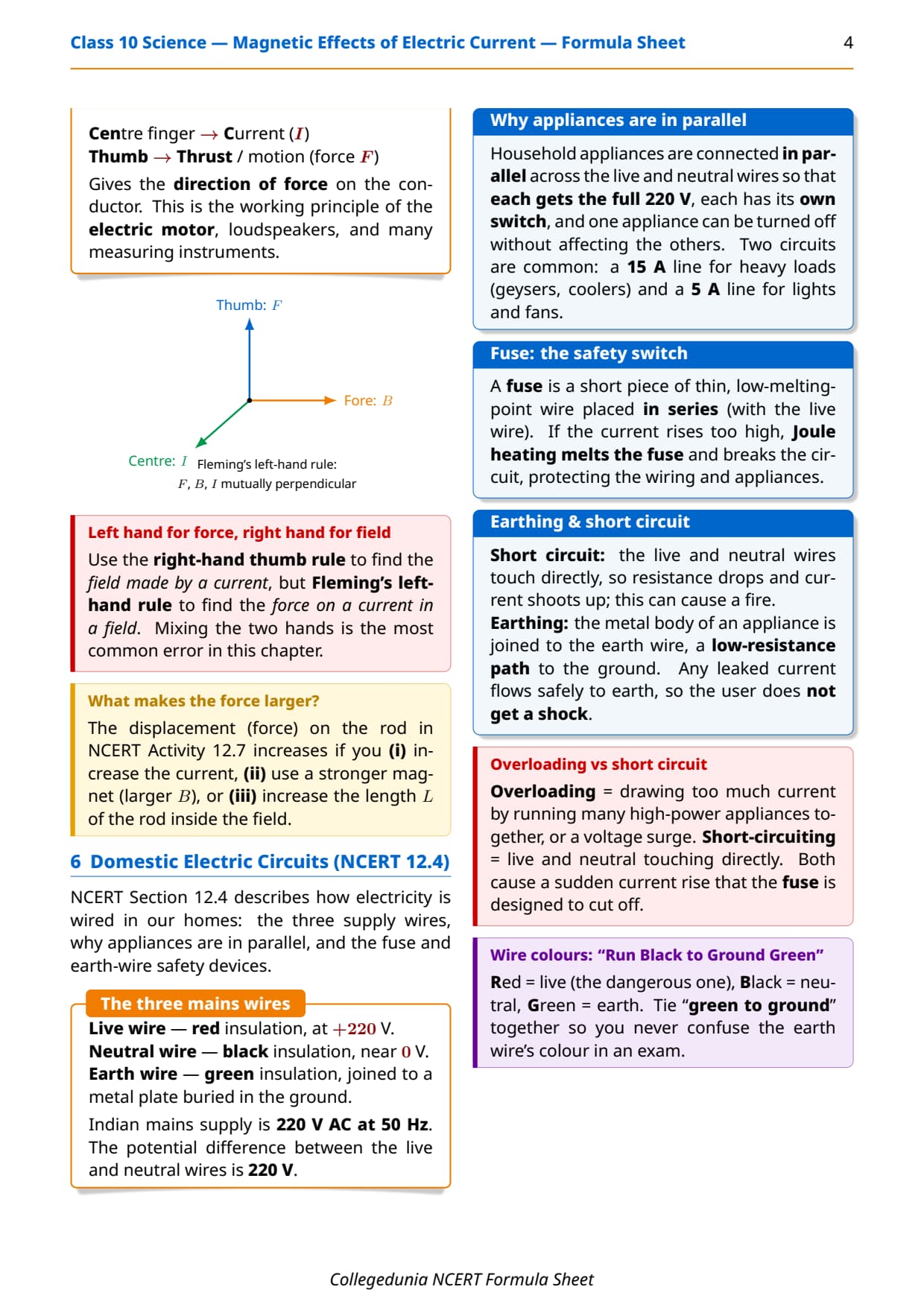
| Fleming's left-hand rule | Fore → field, Centre → current, Thumb → force | - | 12.3 | Direction of force on the conductor |
| Domestic mains supply | V = 220 V at f = 50 Hz | V, Hz | 12.4 | Live-to-neutral potential difference |
| Appliances in parallel | Same 220 V across each device | V | 12.4 | Independent switching at home |
| Fuse and Joule heating | H = I2 R t melts a thin wire | joule (J) | 12.4 | Cuts the circuit on overload |
Knowing these relations and rules alone covers nearly every Magnetic Effects of Electric Current question asked in CBSE Class 10 board papers between 2021 and 2025.
When to Use Which Rule in Magnetic Effects of Electric Current Class 10
Picking the correct hand is the difference between full marks and a slip. The list below tells you which rule to apply based on what the question gives you.
- Direction of the field around a wire: right-hand thumb rule. Thumb along the current; curled fingers give the field circling the wire.
- How the field changes with current or distance: B ∝ I and B ∝ 1/r .
- Field of a coil or how to strengthen it: Bcentre ∝ n I . Raise current, add turns, or add a soft-iron core for an electromagnet.
- Direction of force on a wire in a field: Fleming's left-hand rule. Forefinger field, centre finger current, thumb force.
- What makes the force larger: F ∝ B I L ; greatest when I ⊥ B .
- Home wiring: three wires (live, neutral, earth), appliances in parallel at 220 V, fuse melts by Joule heating H = I2 R t on overload.
Magnetic Effects of Electric Current Class 10 Quick-Fact Cards for MCQ Recall
These atomic facts are the ones the MCQ writers reach for most often. Glance over them the morning of any test; every entry has been asked in CBSE Class 10 board papers in the last five years.
Symbol Glossary and Units for Class 10 Science Chapter 12
Every variable used above, decoded with its SI unit.
| Symbol | What it means | SI Unit |
|---|---|---|
| B | Magnetic field strength | tesla (T) |
| I | Electric current | ampere (A) |
| r | Distance from the wire | metre (m) |
| n | Number of turns in a coil | - |
| L | Length of conductor in the field | metre (m) |
| F | Force on the conductor | newton (N) |
| V | Mains potential difference | volt (V) |
| f | Supply frequency | hertz (Hz) |
| H | Heat produced (in a fuse) | joule (J) |
Magnetic Effects of Electric Current Top 5 Relations Recap: Quick PYQ Map for Class 10
The five relations and rules below carry the largest share of marks in CBSE Class 10 board papers from 2021 to 2025.
| Relation / Rule | Most-recent exam appearance |
|---|---|
| Right-hand thumb rule (field direction) | CBSE 2025 (2 marks), CBSE 2024 diagram |
| Fleming's left-hand rule (force direction) | CBSE 2025 (3 marks), CBSE 2023 reasoning |
| F ∝ B I L | CBSE 2024 (2 marks), CBSE 2022 MCQ |
| Solenoid and electromagnet | CBSE 2025 (2 marks), CBSE 2023 MCQ |
| Domestic circuit, fuse and earthing | CBSE 2024 (3 marks), CBSE 2022 |
Full year-wise PYQ map: Magnetic Effects of Electric Current Class 10 Science NCERT Solutions
One-Shot Revision Tips for Magnetic Effects of Electric Current Class 10
Treat the sheet as a checklist you tick off as you recall every rule the night before a test.
- "Right hand makes the field, left hand feels the force." This one line settles most direction questions.
- Keep the force relation ready: F ∝ B I L , largest when the current is at right angles to the field.
- Soft iron vs steel: a soft-iron core makes an electromagnet that loses magnetism when current stops; steel keeps it, for permanent magnets.
- Three wire colours: red live, black neutral, green earth. The fuse melts by Joule heating H = I2 R t on overload.
- Mains numbers: 220 V at 50 Hz, appliances in parallel; 15 A heavy-load line, 5 A for lights and fans.
Full topic-by-topic walkthrough: Magnetic Effects of Electric Current Class 10 Science Notes
More Magnetic Effects of Electric Current Class 10 Science Resources
Use the table below to move between the other Collegedunia resources for this same chapter, from full solutions to handwritten notes.
| Resource | Link |
|---|---|
| NCERT Solutions | Magnetic Effects of Electric Current NCERT Solutions |
| Revision Notes | Magnetic Effects of Electric Current Notes |
| Handwritten Notes | Magnetic Effects of Electric Current Handwritten Notes |
| Exemplar Solutions | Magnetic Effects of Electric Current Exemplar Solutions |
| NCERT Book PDF | Magnetic Effects of Electric Current NCERT Book PDF |
NCERT Formula Sheet for Class 10 Science: All Chapters
Use the table below to jump to the Formula Sheet for any other chapter in the Class 10 Science NCERT.
| Chapter | Resource |
|---|---|
| Chapter 1 | Chemical Reactions and Equations Formula Sheet |
| Chapter 2 | Acids, Bases and Salts Formula Sheet |
| Chapter 3 | Metals and Non-metals Formula Sheet |
| Chapter 4 | Carbon and its Compounds Formula Sheet |
| Chapter 5 | Life Processes Formula Sheet |
| Chapter 6 | Control and Coordination Formula Sheet |
| Chapter 7 | How do Organisms Reproduce? Formula Sheet |
| Chapter 8 | Heredity Formula Sheet |
| Chapter 9 | Light - Reflection and Refraction Formula Sheet |
| Chapter 10 | The Human Eye and the Colourful World Formula Sheet |
| Chapter 11 | Electricity Formula Sheet |
| Chapter 13 | Our Environment Formula Sheet |
Magnetic Effects of Electric Current Class 10 Formula Sheet FAQs
Ques. Where can I download the Magnetic Effects of Electric Current Class 10 Formula Sheet PDF?
Ans. You can download the Magnetic Effects of Electric Current Class 10 Science Formula Sheet PDF directly from this page. It is free and covers the field-strength relations, the right-hand thumb rule, the force on a conductor, Fleming's left-hand rule, the electromagnet, and the domestic circuit facts in the 2026-27 NCERT Chapter 12.
Ques. Is this Formula Sheet aligned with the 2026-27 NCERT?
Ans. Yes. The sheet reflects the current 2026-27 syllabus for Class 10 Science. Chapter 12 retains magnetic fields and field lines, Oersted's discovery, the field due to a wire, loop and solenoid, the right-hand thumb rule, the force on a conductor, Fleming's left-hand rule, the electromagnet, and the domestic electric circuit.
Ques. What is the right-hand thumb rule in Class 10 Science Chapter 12?
Ans. The right-hand thumb rule gives the direction of the magnetic field around a straight current-carrying wire. Hold the wire in your right hand with the thumb pointing along the current; your curled fingers then point in the direction of the field lines circling the wire. It is also called Maxwell's corkscrew rule.
Ques. What is the difference between the right-hand thumb rule and Fleming's left-hand rule?
Ans. The right-hand thumb rule finds the direction of the magnetic field made by a current. Fleming's left-hand rule finds the direction of the force on a current-carrying wire placed in a field. In Fleming's rule the forefinger is the field, the centre finger the current, and the thumb the force or thrust. Using the wrong hand reverses the direction, which is the most common slip in this chapter.
Ques. What is the formula for the force on a current-carrying conductor?
Ans. The force on a current-carrying conductor in a magnetic field follows F ∝ B I L , where B is the field strength, I the current, and L the length of the wire inside the field. The force is largest when the current is at right angles to the field ( I ⊥ B ) and zero when the current is parallel to the field. Reversing either the current or the field reverses the force.
Ques. What is a solenoid and why does it behave like a bar magnet?
Ans. A solenoid is a coil of many circular turns of insulated copper wire wound in a cylinder. When current flows, the fields of all the turns add up, so one end becomes a north pole and the other a south pole, exactly like a bar magnet. Inside the solenoid the field lines are parallel and evenly spaced, so the field there is uniform in both magnitude and direction.
Ques. How can you strengthen an electromagnet?
Ans. An electromagnet is strengthened in three ways: increase the current I through the coil, increase the number of turns n , or place a soft-iron core inside the solenoid. Soft iron is used because it becomes a strong magnet only while current flows and loses its magnetism the moment the current stops; steel, which keeps its magnetism, is used for permanent magnets instead.
Ques. How does the magnetic field around a straight wire depend on current and distance?
Ans. For a long straight current-carrying wire, the field strength is directly proportional to the current, B ∝ I , and inversely proportional to the distance from the wire, B ∝ 1/r . So more current or being closer to the wire both give a stronger field, while the concentric field circles grow wider and weaker as you move outward.
Ques. What are the three wires in a domestic electric circuit and their colours?
Ans. A domestic circuit has three wires: the live wire (red insulation, at +220 V), the neutral wire (black insulation, near 0 V), and the earth wire (green insulation, joined to a metal plate buried in the ground). The potential difference between the live and neutral wires is 220 V, and the Indian mains supply is AC at 50 Hz.
Ques. Why are domestic appliances connected in parallel?
Ans. Appliances are wired in parallel across the live and neutral wires for two reasons. First, each device gets the full 220 V supply. Second, each branch works independently, so one appliance can be switched off (or fail) without stopping the others. Homes usually have a 15 A line for heavy loads like geysers and coolers, and a 5 A line for lights and fans.
Ques. What is the role of a fuse and of earthing in a household circuit?
Ans. A fuse is a short piece of thin, low-melting-point wire placed in series with the live wire. If the current rises too high during an overload or short circuit, Joule heating H = I2 R t melts the fuse and breaks the circuit, protecting the wiring. Earthing joins the metal body of an appliance to the earth wire, a low-resistance path to the ground, so any leaked current flows safely away and the user does not get a shock.
Ques. What is the difference between overloading and a short circuit?
Ans. Overloading happens when too much current is drawn, usually by running many high-power appliances together or during a voltage surge. A short circuit happens when the live and neutral wires touch directly, dropping the resistance so the current shoots up. Both cause a sudden rise in current that the fuse is designed to cut off before a fire can start.
Ques. What is the CBSE weightage of Chapter 12 Magnetic Effects of Electric Current in Class 10 Science?
Ans. Magnetic Effects of Electric Current sits in the Effects of Current block and usually carries 6 to 8 marks in the CBSE Class 10 Science board exam, asked across one reasoning or rule-based question (the right-hand thumb rule, Fleming's left-hand rule, or the force on a conductor) and one question on the electromagnet or the domestic electric circuit with its safety devices.



Comments