



Class 10 Science Chapter 13 Our Environment is a short, high-scoring biology chapter of the 2026-27 NCERT, and a single page of key facts covers almost every board question. This Our Environment formula sheet puts the ecosystem and its biotic and abiotic parts, producers, consumers and decomposers, food chains and webs, trophic levels, the 10% energy law, biological magnification, the ozone layer, and waste management on one page. Use it as a quick reference before any CBSE Class 10 board test.
- CBSE Weightage: part of the Natural Resources unit, worth 3 to 5 marks across one or two questions.
- Best used for: the food-chain and trophic-level rules, the 10% energy law, the biological-magnification logic, the ozone facts, and last-minute board revision.
You can find the complete Formula Sheet for Our Environment, with the ecosystem and its biotic and abiotic parts, producers, consumers and decomposers, food chains and webs, trophic levels, the 10% energy law, biological magnification, the ozone layer, and waste management mapped to the 2026-27 NCERT, in the article below.
This Formula Sheet is curated by Science subject experts, mapped to the 2026-27 NCERT, and refined against the last five years of CBSE Class 10 board papers.
Also Check:
How Collegedunia's Our Environment Formula Sheet Helps You
This Formula Sheet gathers the ecosystem and its parts, food chains, trophic levels, the 10% energy law, biological magnification, the ozone layer, and waste management from Chapter 13 on one page, in NCERT order.
- 2026-27 NCERT aligned: every term and rule matches the current Class 10 syllabus.
- One-page recall: terms, food-chain rules, and the glance table sit side by side for a quick look before a test.
- Board focus: the most-asked facts, like why decomposers matter, why energy flow is one-way, and why CFCs destroy ozone, are flagged as quick tips.
Our Environment Class 10 Science Video Revision
Source: Magnet Brains on YouTube
Must-Know Terms at a Glance in Class 10 Science Chapter 13
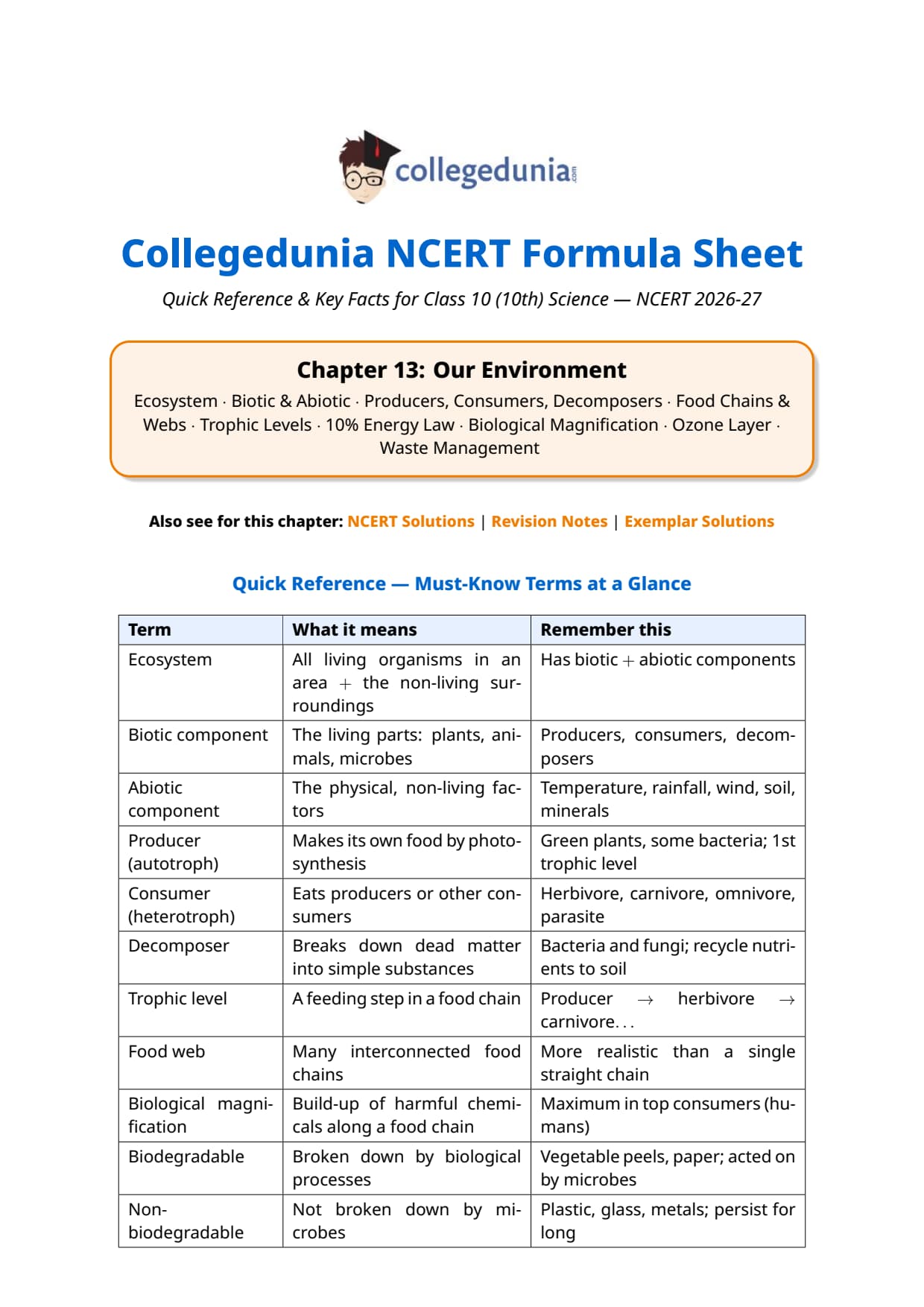
An ecosystem is all living organisms in an area plus the non-living surroundings, with biotic and abiotic parts. Lock these terms first; most one-mark questions are built on them.
| Term | Meaning | Remember this |
|---|---|---|
| Ecosystem | All living organisms in an area plus the non-living surroundings | Has biotic + abiotic components |
| Biotic component | The living parts: plants, animals, microbes | Producers, consumers, decomposers |
| Abiotic component | The physical, non-living factors | Temperature, rainfall, wind, soil, minerals |
| Producer (autotroph) | Makes its own food by photosynthesis | Green plants, some bacteria; 1st trophic level |
| Consumer (heterotroph) | Eats producers or other consumers | Herbivore, carnivore, omnivore, parasite |
| Decomposer | Breaks down dead matter into simple substances | Bacteria and fungi; recycle nutrients to soil |
| Trophic level | A feeding step in a food chain | Producer → herbivore → carnivore... |
| Biological magnification | Build-up of harmful chemicals along a food chain | Maximum in top consumers (humans) |
Ecosystem and its Components in Class 10 Science Chapter 13
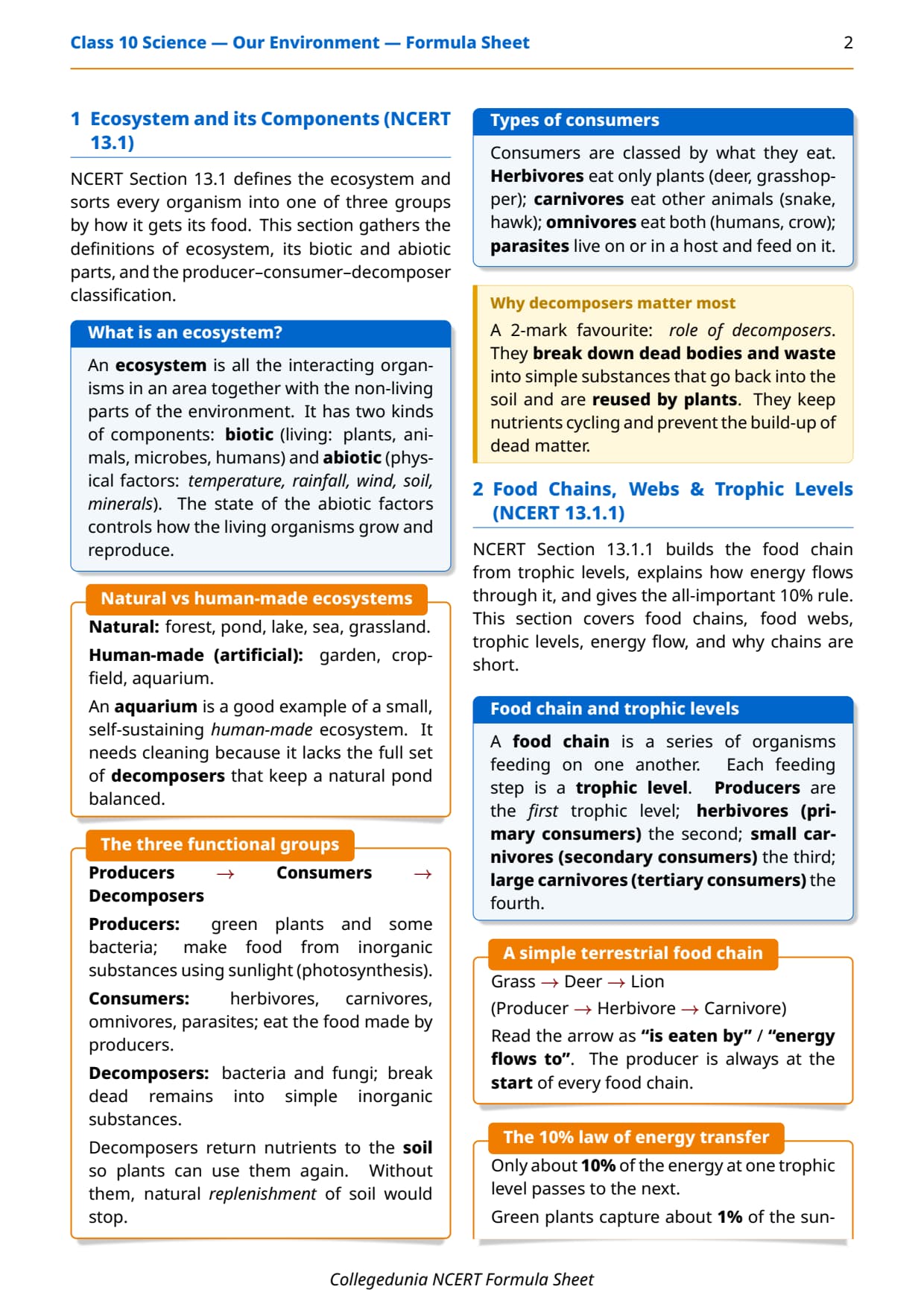
NCERT Section 13.1 sorts every organism into three groups by how it gets food, splitting the surroundings into biotic (living) and abiotic (non-living) parts.
- Biotic vs abiotic: biotic is every living thing (plants, animals, microbes); abiotic is the physical factors (temperature, rainfall, wind, soil, minerals), which control how organisms grow.
- Natural vs human-made: a forest, pond or lake is natural; a garden or aquarium is human-made. An aquarium needs cleaning because it lacks the decomposers that balance a natural pond.
- Three functional groups: producers (green plants) make food by photosynthesis; consumers eat that food; decomposers (bacteria, fungi) break dead remains into simple substances and return nutrients to soil.
- Consumer types: herbivores eat only plants; carnivores eat animals; omnivores eat both; parasites feed on a host.
Food Chains, Food Webs and Trophic Levels in Class 10 Science Chapter 13
A food chain is a series of organisms feeding on one another, and each feeding step is a trophic level (NCERT 13.1.1).
| Trophic level | Who is here | Example in Grass → Deer → Lion |
|---|---|---|
| First (T1) | Producers (autotrophs) | Grass |
| Second (T2) | Herbivores (primary consumers) | Deer |
| Third (T3) | Small carnivores (secondary consumers) | Snake / small carnivore |
| Fourth (T4) | Large carnivores (tertiary consumers) | Lion |
- Read the arrow: it points from the eaten to the eater ("is eaten by"). Grass → Deer → Lion is right; a chain must start with a producer.
- Food web: in nature an organism is eaten by several others, so chains criss-cross into a food web, a more realistic picture than a single chain.
- Energy flow is one-way: energy moves Sun → producers → consumers, lost as heat at each step. It is unidirectional and decreases, so producers are most numerous and top carnivores fewest.
The 10% Law of Energy Transfer in Class 10 Science Chapter 13
NCERT Section 13.1.1 gives the 10% rule for energy flow, the most-asked numerical idea in this chapter. It explains why food chains are short.
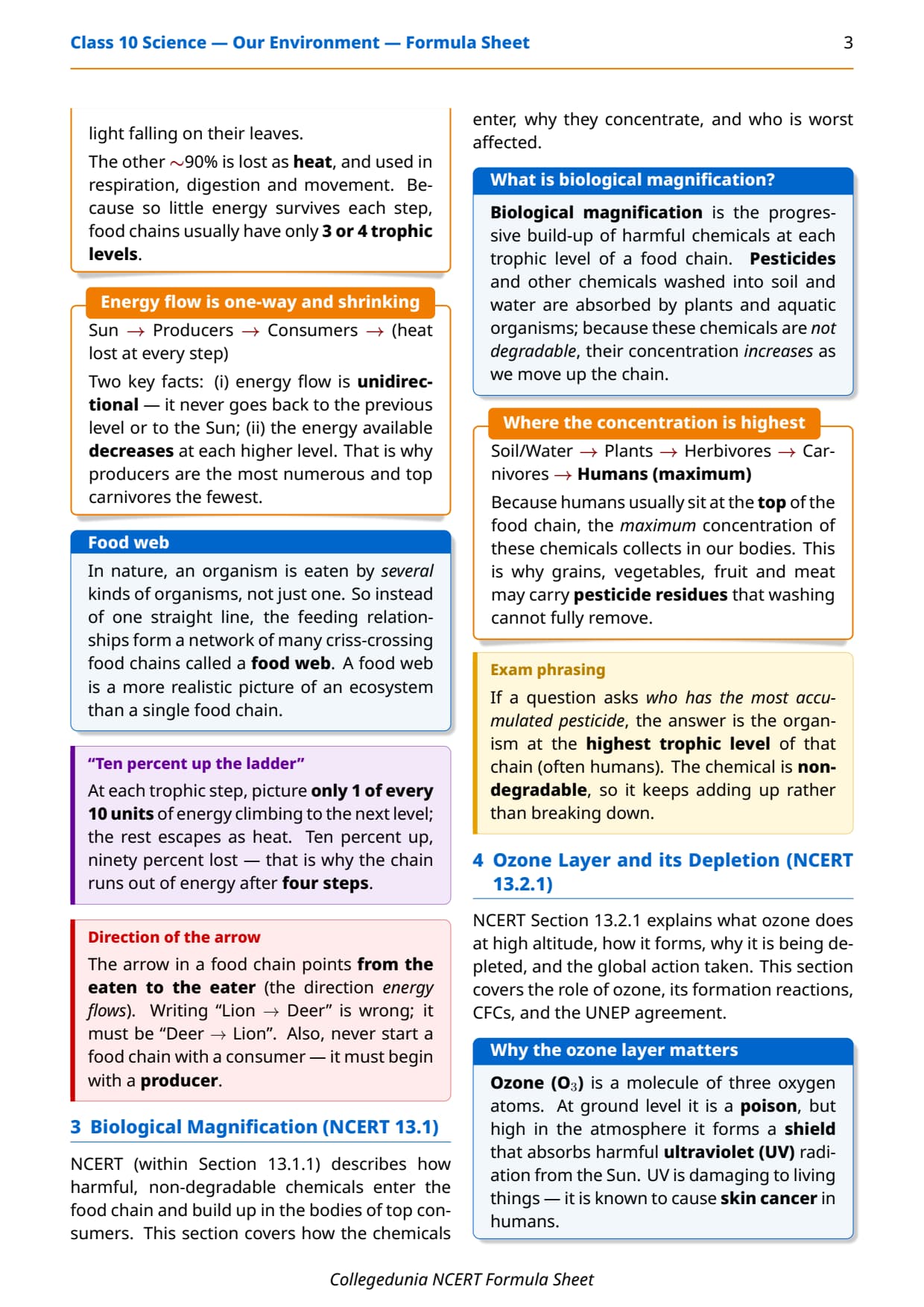
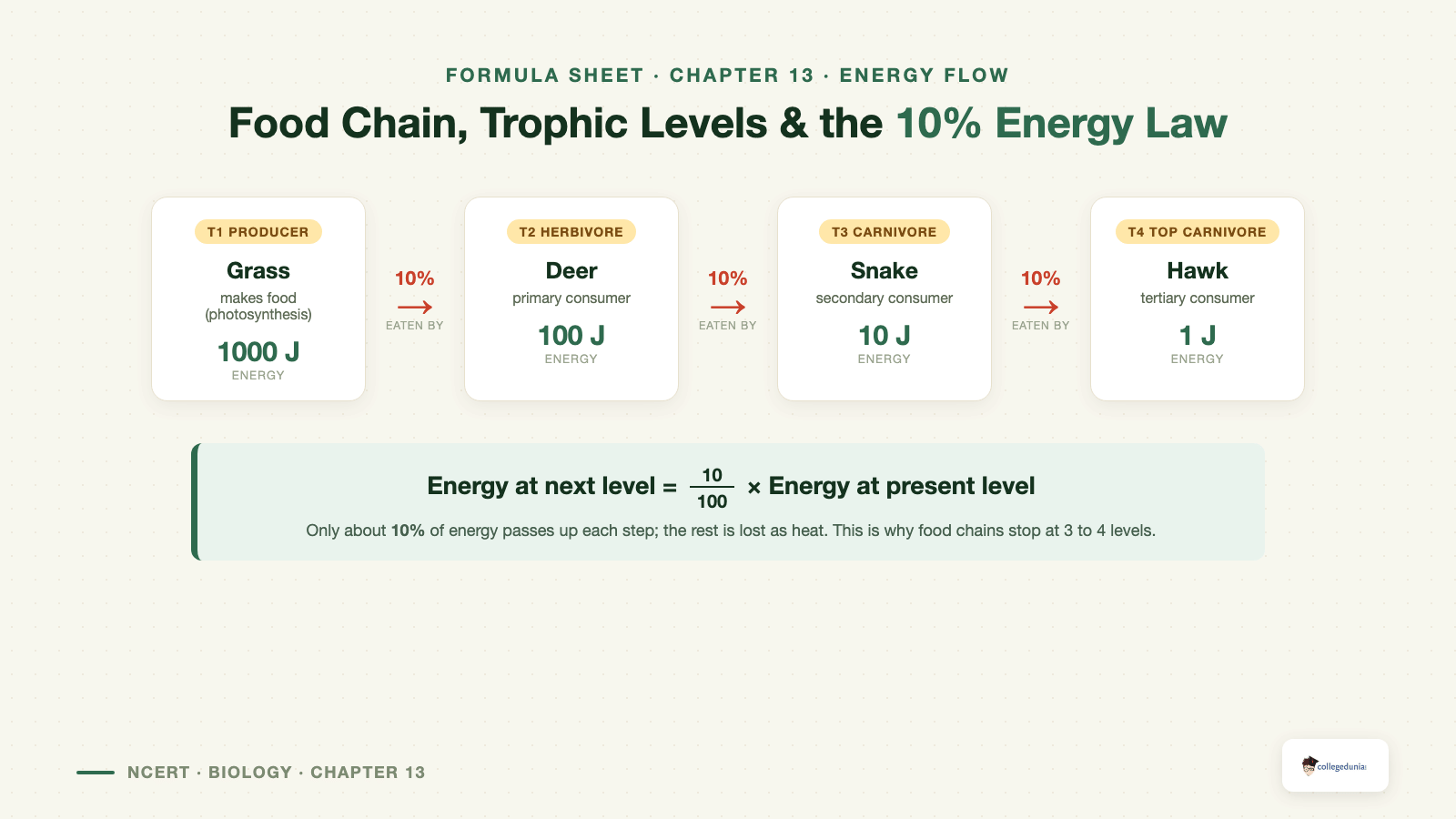
- The 10% law: only about 10% of energy passes to the next level. Plants capture about 1% of sunlight; the other 90% is lost as heat and in respiration and movement.
- Worked idea: if plants store 1000 J, deer get about 100 J, the small carnivore 10 J, and the top carnivore only 1 J, too little to support a fifth level.
- Pyramid shape: since energy shrinks at every step, food chains usually have only 3 or 4 levels, with producers most numerous and top carnivores fewest.
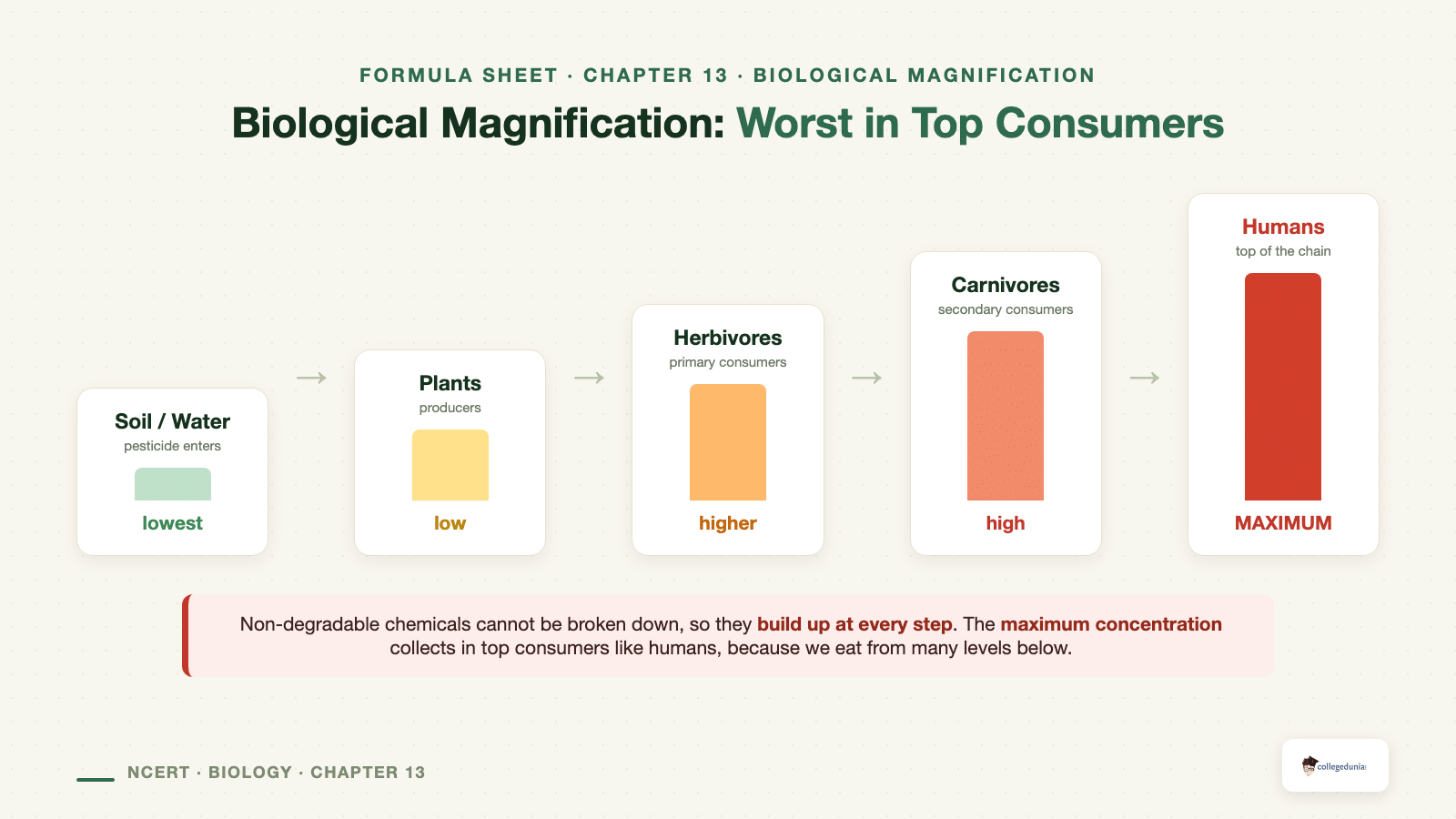
Biological Magnification in Class 10 Science Chapter 13
NCERT (within Section 13.1.1) describes how harmful, non-degradable chemicals enter the food chain and build up in top consumers, a guaranteed 2 to 3-mark reasoning question.
- What it is: biological magnification is the build-up of harmful chemicals at each trophic level. Pesticides wash into soil and water, then enter plants and animals.
- Why they concentrate: because they are not degradable, concentration increases up the chain, as each animal eats many from the level below.
- Highest concentration: Soil/Water → Plants → Herbivores → Carnivores → Humans (maximum). Humans sit at the top, so the maximum collects in our bodies; washing cannot remove all residues.
- Exam phrasing: the organism with the most pesticide is the one at the highest trophic level (often humans).
Ozone Layer and Waste Management in Class 10 Science Chapter 13
NCERT Sections 13.2.1 and 13.2.2 cover the ozone shield, its depletion, and waste management. Both are favourite board questions, so lock the key facts below.
- Why ozone matters: ozone (O3) has three oxygen atoms. At ground level it is a poison, but high up it is a shield absorbing harmful UV, which causes skin cancer.
- O2 vs O3: O2 is breathing oxygen; O3 is ozone, protective high up. Only O3 blocks UV; never mix them up.
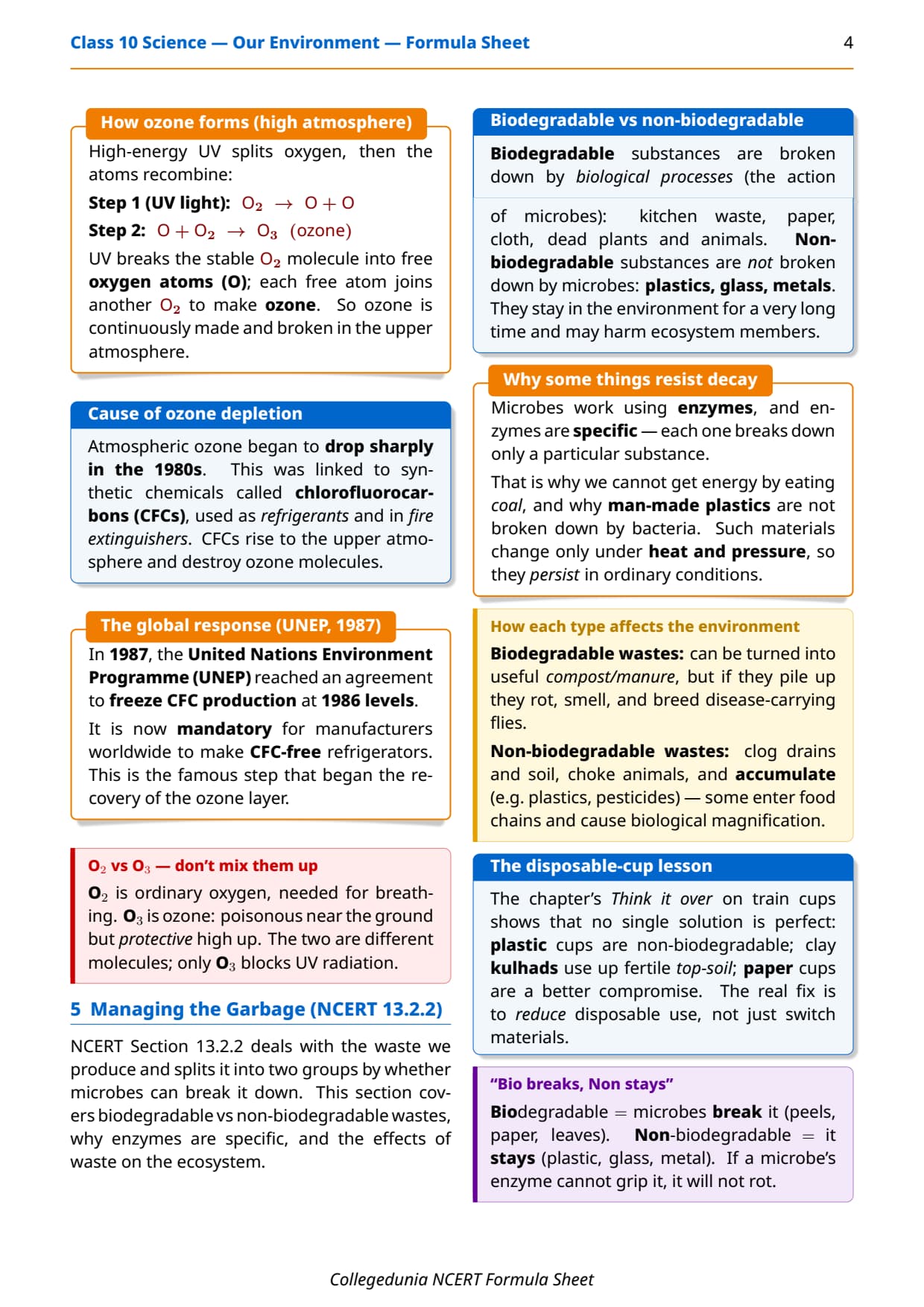
- Depletion: ozone dropped sharply in the 1980s due to chlorofluorocarbons (CFCs), used as refrigerants. CFCs rise and destroy ozone.
- Response (UNEP, 1987): UNEP froze CFC production at 1986 levels; CFC-free refrigerators are now mandatory, starting the ozone layer's recovery.
- Waste: biodegradable waste (peels, paper) is broken by microbes and makes compost; non-biodegradable waste (plastic, glass, metal) persists, clogs drains, and can enter food chains.
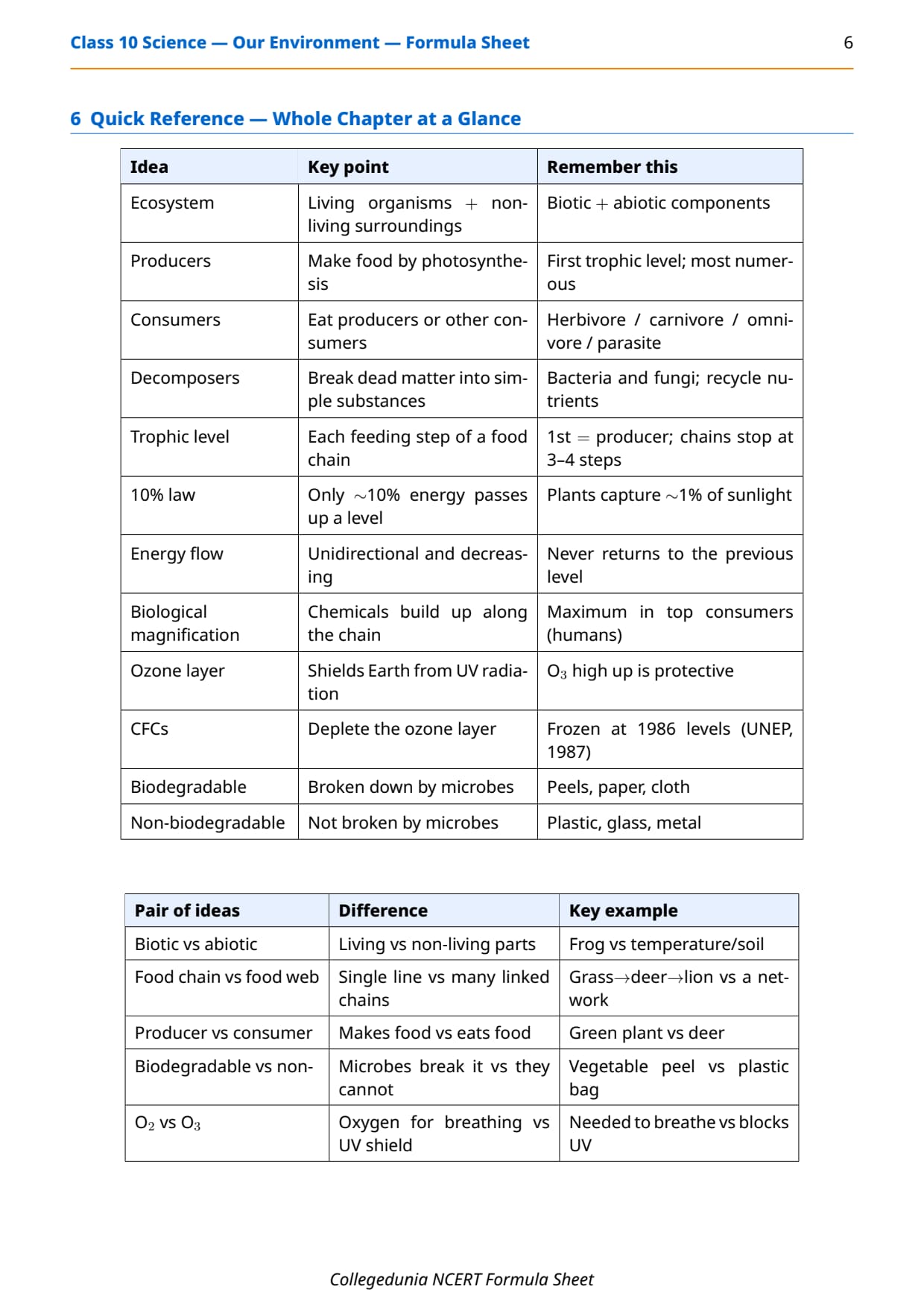
Whole Our Environment Chapter at a Glance for Class 10 Science
This single table pulls the key ideas into one block for the fastest recall before the exam. Read it last, after the sections above.
| Idea | Key point | Remember this |
|---|---|---|
| 10% law | Only about 10% energy passes up a level | Plants capture about 1% of sunlight |
| Energy flow | Unidirectional and decreasing | Never returns to the previous level |
| Ozone layer | Shields Earth from UV radiation | O3 high up is protective |
| CFCs | Deplete the ozone layer | Frozen at 1986 levels (UNEP, 1987) |
| Biodegradable | Broken down by microbes | Peels, paper, cloth |
| Non-biodegradable | Not broken down by microbes | Plastic, glass, metal |
Full topic-by-topic walkthrough: Our Environment Class 10 Science Notes
More Our Environment Class 10 Science Resources
Use the table below to move between the other Collegedunia resources for this same chapter, from full solutions to handwritten notes.
| Resource | Link |
|---|---|
| NCERT Solutions | Our Environment NCERT Solutions |
| Revision Notes | Our Environment Notes |
| Handwritten Notes | Our Environment Handwritten Notes |
| Exemplar Solutions | Our Environment Exemplar Solutions |
| NCERT Book PDF | Our Environment NCERT Book PDF |
NCERT Formula Sheet for Class 10 Science: All Chapters
Use the table below to jump to the Formula Sheet for any other chapter in the Class 10 Science NCERT.
| Chapter | Resource |
|---|---|
| Chapter 1 | Chemical Reactions and Equations Formula Sheet |
| Chapter 2 | Acids, Bases and Salts Formula Sheet |
| Chapter 3 | Metals and Non-metals Formula Sheet |
| Chapter 4 | Carbon and its Compounds Formula Sheet |
| Chapter 5 | Life Processes Formula Sheet |
| Chapter 6 | Control and Coordination Formula Sheet |
| Chapter 7 | How do Organisms Reproduce? Formula Sheet |
| Chapter 8 | Heredity Formula Sheet |
| Chapter 9 | Light - Reflection and Refraction Formula Sheet |
| Chapter 10 | The Human Eye and the Colourful World Formula Sheet |
| Chapter 11 | Electricity Formula Sheet |
| Chapter 12 | Magnetic Effects of Electric Current Formula Sheet |
Our Environment Class 10 Formula Sheet FAQs
Ques. Where can I download the Our Environment Class 10 Formula Sheet PDF?
Ans. You can download the Our Environment Class 10 Science Formula Sheet PDF directly from this page. It is free and covers the ecosystem and its biotic and abiotic parts, food chains and webs, trophic levels, the 10% energy law, biological magnification, the ozone layer, and waste management in the 2026-27 NCERT Chapter 13.
Ques. Is this Formula Sheet aligned with the 2026-27 NCERT?
Ans. Yes. The sheet reflects the current 2026-27 syllabus for Class 10 Science. Chapter 13 retains the ecosystem and its components, food chains and webs, trophic levels and energy flow, biological magnification, the ozone layer and its depletion, and the management of biodegradable and non-biodegradable waste.
Ques. What is the 10% law of energy transfer in Class 10 Science?
Ans. The 10% law states that only about 10% of the energy at one trophic level passes to the next; the other roughly 90% is lost as heat and used in respiration, digestion and movement. Green plants capture only about 1% of the sunlight falling on their leaves. Because so little energy survives each step, food chains usually have just 3 or 4 trophic levels.
Ques. What is the difference between a food chain and a food web?
Ans. A food chain is a single straight line of organisms feeding on one another, such as Grass → Deer → Lion. A food web is a network of many interconnected food chains, because in nature one organism is eaten by several kinds of organisms, not just one. A food web is a more realistic picture of an ecosystem than a single food chain.
Ques. What is an ecosystem in Class 10 Science Chapter 13?
Ans. An ecosystem is all the interacting living organisms in an area together with the non-living parts of the environment. It has two kinds of components: biotic (living: plants, animals, microbes) and abiotic (physical factors such as temperature, rainfall, wind, soil and minerals). A forest, pond and lake are natural ecosystems, while a garden and an aquarium are human-made ones.
Ques. Why do decomposers matter in an ecosystem?
Ans. Decomposers, such as bacteria and fungi, break down the dead bodies and waste of plants and animals into simple substances. These simple substances go back into the soil and are reused by plants. So decomposers keep nutrients cycling and prevent dead matter from piling up. Without them, the natural replenishment of soil would stop and the ecosystem could not work.
Ques. What is biological magnification and who is most affected by it?
Ans. Biological magnification is the progressive build-up of harmful, non-degradable chemicals such as pesticides at each trophic level of a food chain. The chemicals are washed into soil and water, absorbed by plants, and then concentrated as they move up the chain. Because humans usually sit at the top of the food chain, the maximum concentration collects in our bodies, so humans are the most affected.
Ques. Why is energy flow in a food chain called unidirectional?
Ans. Energy flow is unidirectional because it moves only one way: Sun to producers to consumers, and it never goes back to the previous level or back to the Sun. At each step, a large part of the energy is lost as heat. The energy available also decreases at each higher level, which is why producers are the most many and top carnivores the fewest.
Ques. How is the ozone layer formed and why is it important?
Ans. High-energy UV light splits an oxygen molecule into free oxygen atoms (O2 → O + O); each free atom then joins another O2 to make ozone (O + O2 → O3). High in the atmosphere, this ozone forms a shield that absorbs harmful ultraviolet radiation from the Sun. UV is damaging to living things and is known to cause skin cancer in humans, so the ozone layer protects life on Earth.
Ques. What causes ozone depletion and what was done about it?
Ans. Atmospheric ozone began to drop sharply in the 1980s due to synthetic chemicals called chlorofluorocarbons (CFCs), used as refrigerants and in fire extinguishers. CFCs rise to the upper atmosphere and destroy ozone molecules. In 1987, the United Nations Environment Programme (UNEP) reached an agreement to freeze CFC production at 1986 levels, and it is now mandatory to make CFC-free refrigerators.
Ques. What is the difference between biodegradable and non-biodegradable substances?
Ans. Biodegradable substances are broken down by biological processes (the action of microbes), such as kitchen waste, paper, cloth, and dead plants and animals. Non-biodegradable substances, such as plastics, glass and metals, are not broken down by microbes. They stay in the environment for a very long time and may harm ecosystem members, with some entering food chains to cause biological magnification.
Ques. What is the CBSE weightage of Chapter 13 Our Environment in Class 10 Science?
Ans. Our Environment sits in the Natural Resources unit and usually carries 3 to 5 marks in the CBSE Class 10 Science board exam, asked across one or two questions on the ecosystem and its components, food chains and trophic levels, the 10% energy law, biological magnification, the ozone layer, or biodegradable and non-biodegradable waste.



Comments