



Class 10 Science Chapter 6 Control and Coordination is a high-scoring biology chapter of the 2026-27 NCERT, and a single page of key facts covers almost every board question. This Control and Coordination formula sheet puts the nerve-signal pathway, the reflex arc, the three brain regions, the plant tropisms, and the gland-hormone-effect table on one page. Use it as a quick reference before any CBSE Class 10 board test.
- CBSE Weightage: part of the World of Living unit, worth 6 to 8 marks across one or two questions.
- Best used for: the signal pathways, the gland-hormone table, the tropism chart, and last-minute board revision.
You can find the complete Formula Sheet for Control and Coordination, with the nerve-signal pathway, the reflex arc, the three brain regions, the plant tropisms, and the gland-hormone-effect table mapped to the 2026-27 NCERT, in the article below.
This Formula Sheet is curated by Science subject experts, mapped to the 2026-27 NCERT, and refined against the last five years of CBSE Class 10 board papers.
Also Check:
- Control and Coordination Class 10 Science NCERT Solutions
- Control and Coordination Class 10 Science Notes
How Collegedunia's Control and Coordination Formula Sheet Helps You
This Formula Sheet gathers the nerve-signal pathway, the reflex arc, the three brain regions, the plant tropisms, and the gland-hormone-effect table on one page, in NCERT order.
- 2026-27 NCERT aligned: every term, pathway, and gland-hormone pair matches the current syllabus.
- One-page recall: terms, signal pathways, and the gland-hormone table sit side by side for a quick refresh.
- Board focus: the most-asked facts, like why reflexes use the spinal cord and why iodised salt is advised, are flagged as quick tips.
Control and Coordination Class 10 Science Video Revision
Source: Magnet Brains on YouTube
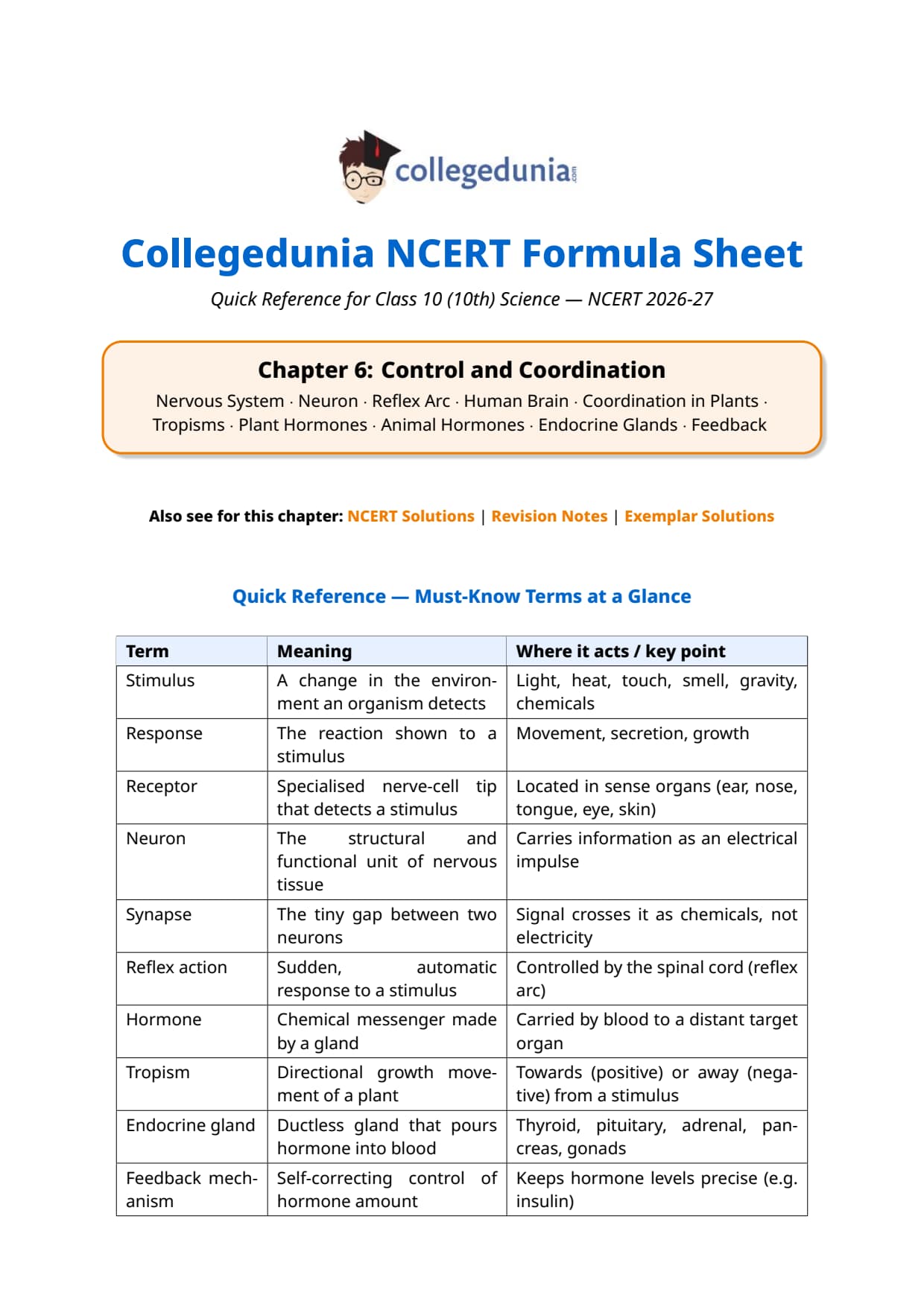
Must-Know Terms at a Glance in Class 10 Science Chapter 6
Control is deciding what to do for each change, and coordination is body parts working together. Lock these terms first; most one-mark questions are built on them.
| Term | Meaning | Where it acts / key point |
|---|---|---|
| Stimulus | A change in the environment an organism detects | Light, heat, touch, smell, gravity, chemicals |
| Response | The reaction shown to a stimulus | Movement, secretion, growth |
| Receptor | Specialised nerve-cell tip that detects a stimulus | In sense organs (ear, nose, tongue, eye, skin) |
| Neuron | Structural and functional unit of nervous tissue | Carries information as an electrical impulse |
| Synapse | The tiny gap between two neurons | Signal crosses as chemicals, not electricity |
| Reflex action | Sudden, automatic response to a stimulus | Controlled by the spinal cord (reflex arc) |
| Hormone | Chemical messenger made by a gland | Carried by blood to a distant target organ |
| Tropism | Directional growth movement of a plant | Towards (positive) or away (negative) from a stimulus |
| Endocrine gland | Ductless gland that pours hormone into blood | Thyroid, pituitary, adrenal, pancreas, gonads |
| Feedback mechanism | Self-correcting control of hormone amount | Keeps hormone levels precise (e.g. insulin) |
Nervous System: Neuron and Signal Pathway in Class 10 Science
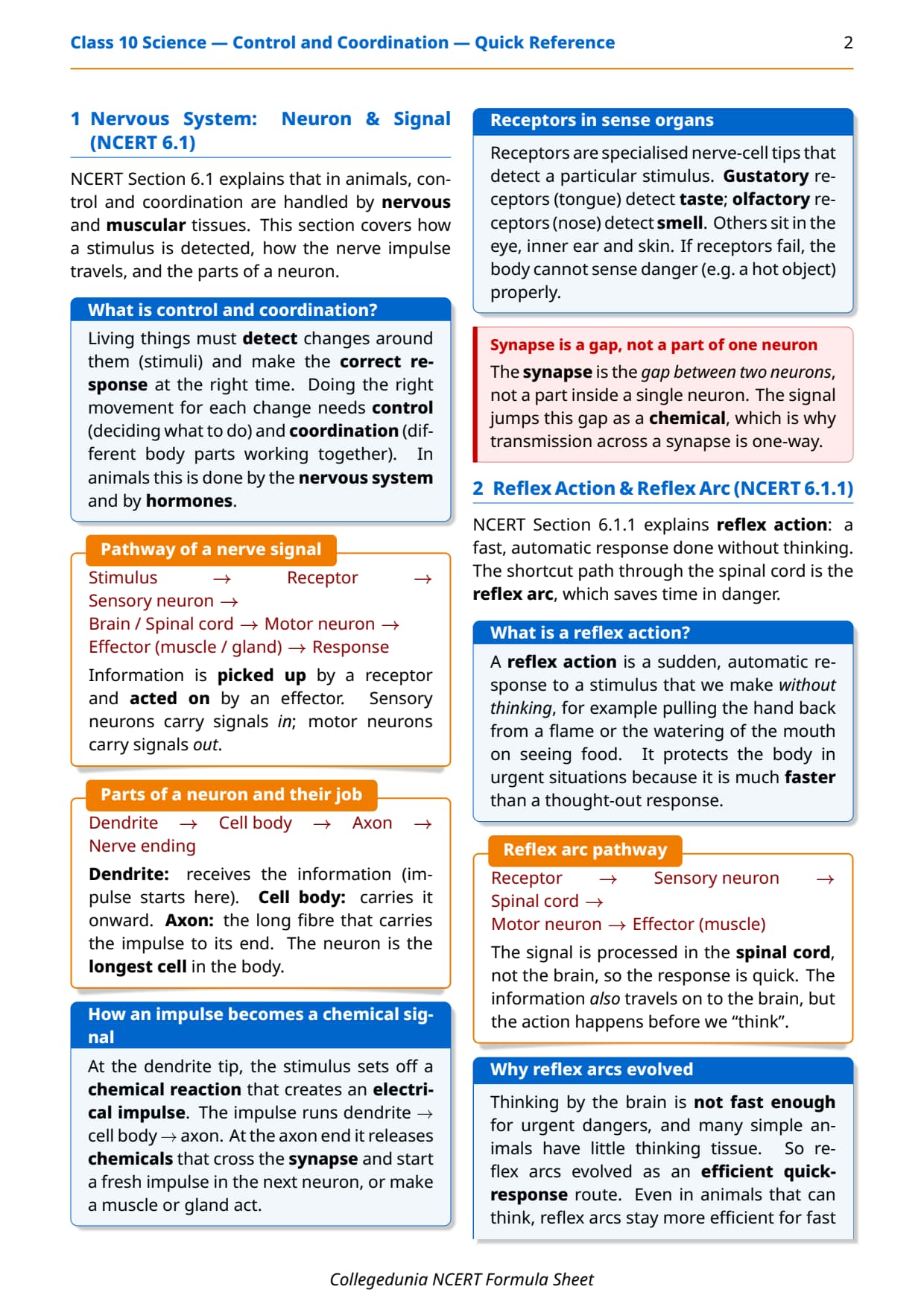
In animals, control and coordination use nervous and muscular tissues (NCERT 6.1). A receptor picks up a stimulus, the neuron carries the message, and an effector acts.
- Parts of a neuron: dendrite → cell body → axon → nerve ending. The dendrite receives the impulse; the axon is the long fibre that carries it to the end.
- The impulse: at the dendrite tip the stimulus sets off a chemical reaction making an electrical impulse, which runs along the neuron.
- Synapse: the gap between two neurons. At the axon end the impulse releases chemicals that cross the synapse, so transmission is one-way. (It is not a part of one neuron.)
- Receptors: gustatory (tongue, taste) and olfactory (nose, smell); others sit in the eye, ear, and skin.
Reflex Action and the Reflex Arc in Class 10 Science Chapter 6
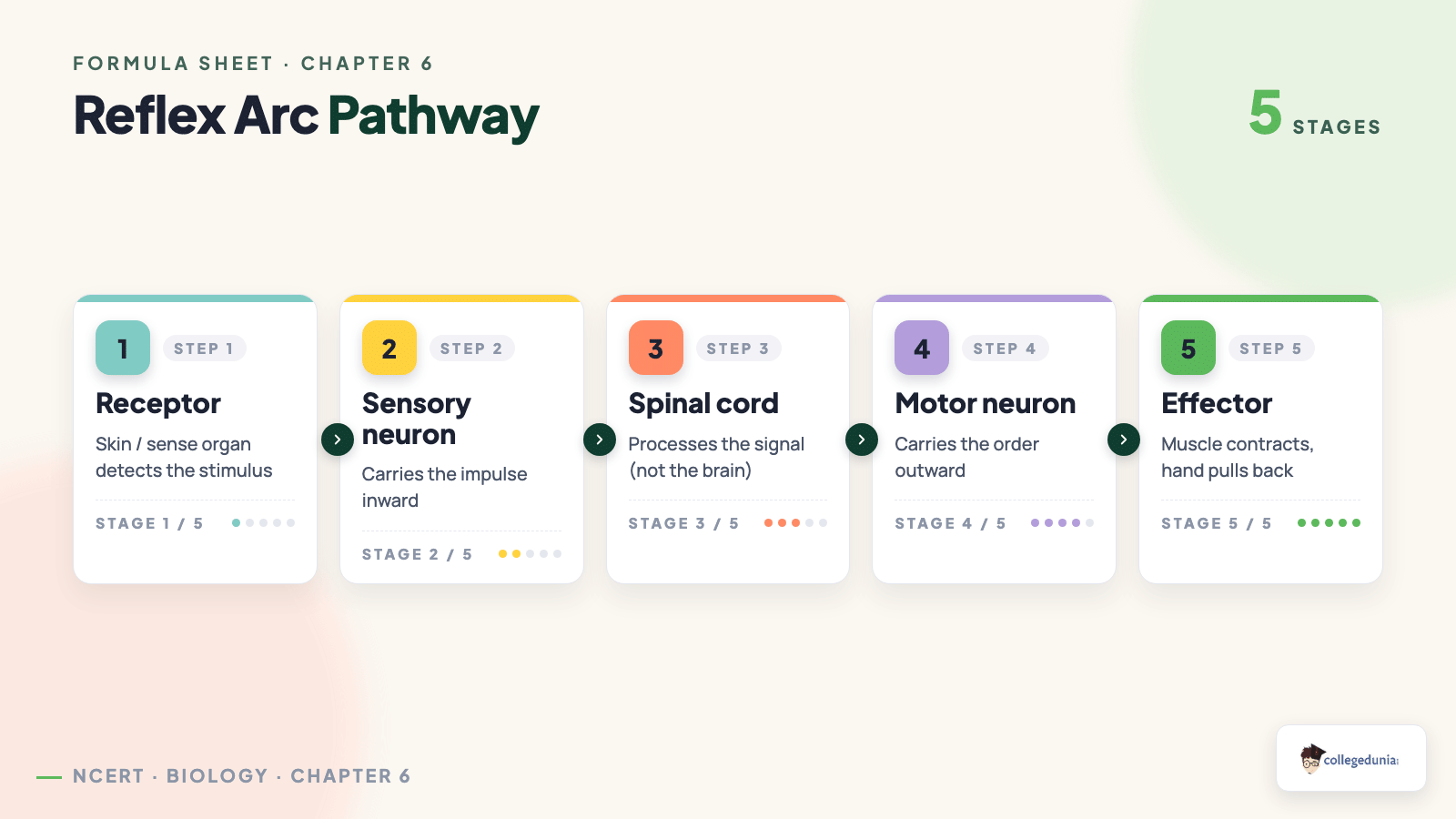
Reflex action is a fast, automatic response made without thinking, like pulling the hand back from a flame (NCERT 6.1.1). The shortcut path through the spinal cord is the reflex arc, which saves time because the brain is not fast enough in danger.
| Step | Part | What happens |
|---|---|---|
| 1 | Receptor | Skin or sense organ detects the stimulus |
| 2 | Sensory neuron | Carries the impulse inward toward the spinal cord |
| 3 | Spinal cord | Processes the signal (not the brain), so the response is quick |
| 4 | Motor neuron | Carries the order outward to the muscle |
| 5 | Effector (muscle) | Contracts, so the hand pulls back |
The information also reaches the brain, but the action happens before we "think". A reflex is automatic; walking is voluntary, decided by the brain.
Human Brain: Three Regions and Their Jobs in Class 10 Science
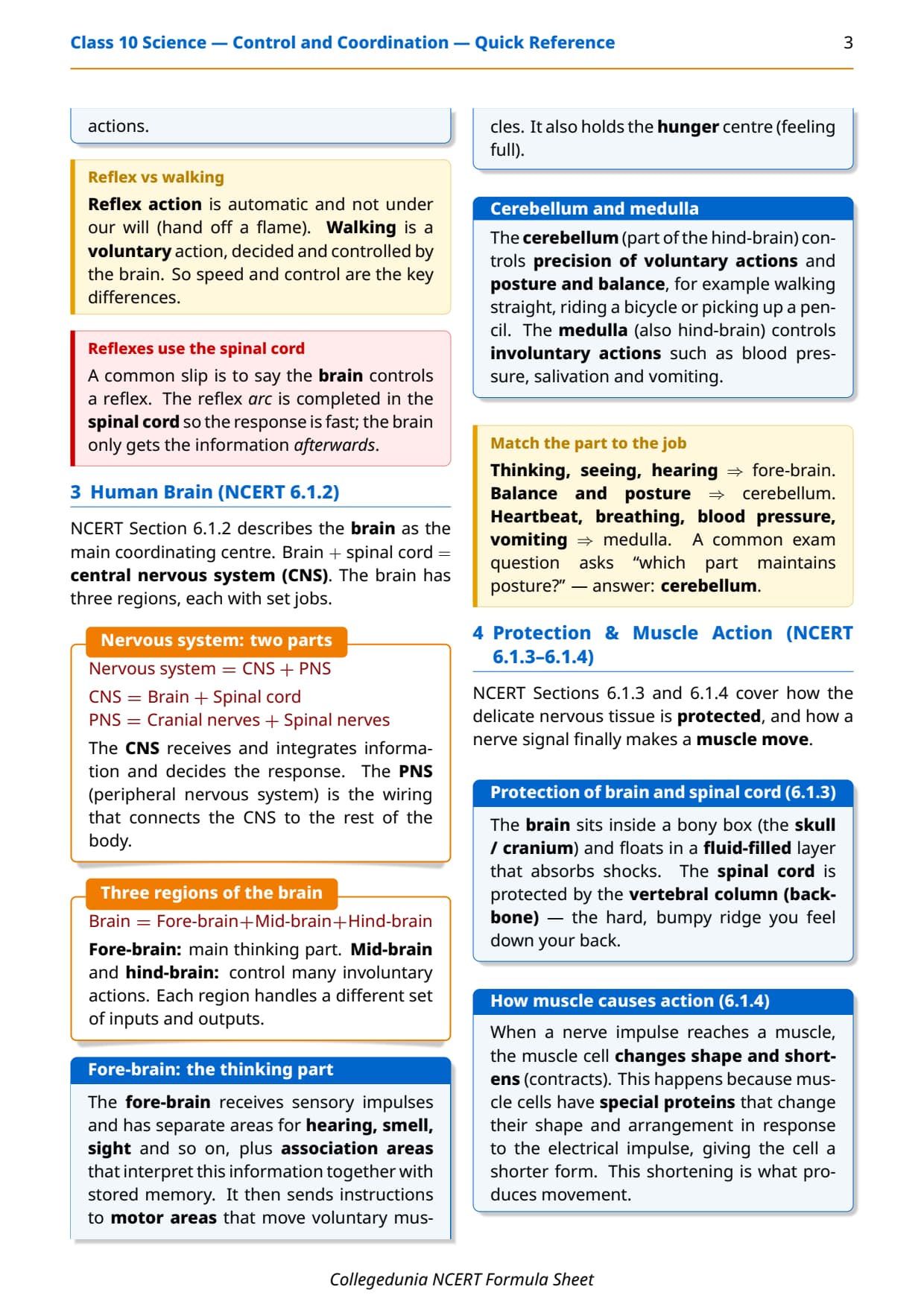
The brain is the main coordinating centre (NCERT 6.1.2). Brain plus spinal cord is the central nervous system (CNS); the nerves form the peripheral nervous system (PNS). The brain has three regions.
| Brain part | Region | Main job |
|---|---|---|
| Fore-brain | Fore-brain | Thinking part; areas for hearing, smell, sight, plus hunger centre |
| Cerebellum | Hind-brain | Precision of voluntary actions, posture and balance |
| Medulla | Hind-brain | Involuntary actions: blood pressure, salivation, vomiting |
| Mid-brain | Mid-brain | Controls many reflex and involuntary movements |
- Fore-brain: the thinking part, with areas for hearing, smell, and sight, plus association areas that interpret with memory.
- Protection: the brain sits in the skull (cranium) and floats in shock-absorbing fluid; the spinal cord is protected by the vertebral column.
Coordination in Plants: Tropisms and Plant Hormones in Class 10 Science
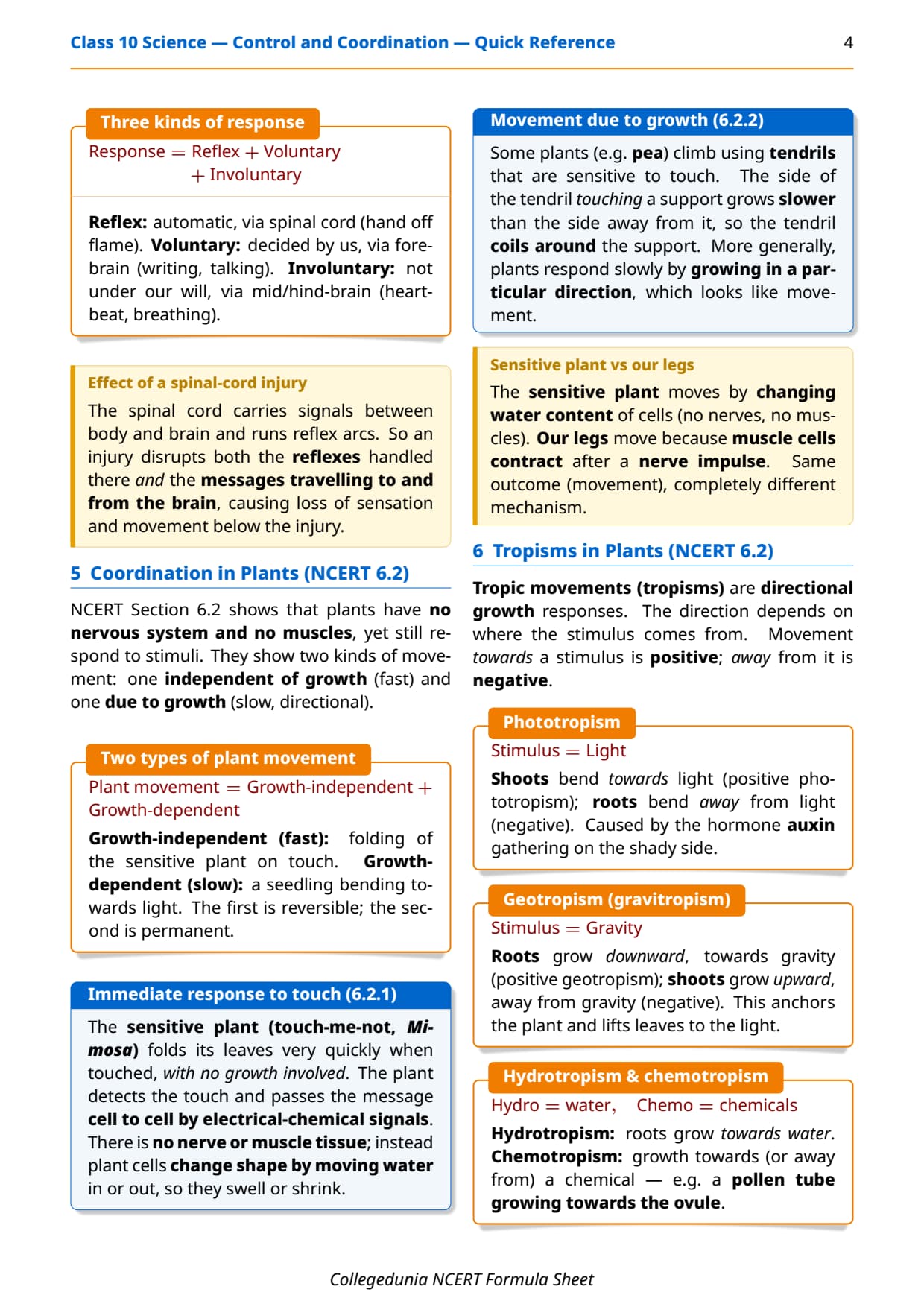
Plants have no nervous system and no muscles, yet respond to stimuli (NCERT 6.2). They show movement independent of growth (fast, like touch-me-not folding) and due to growth (slow, directional, a tropism). Towards a stimulus is positive, away is negative.
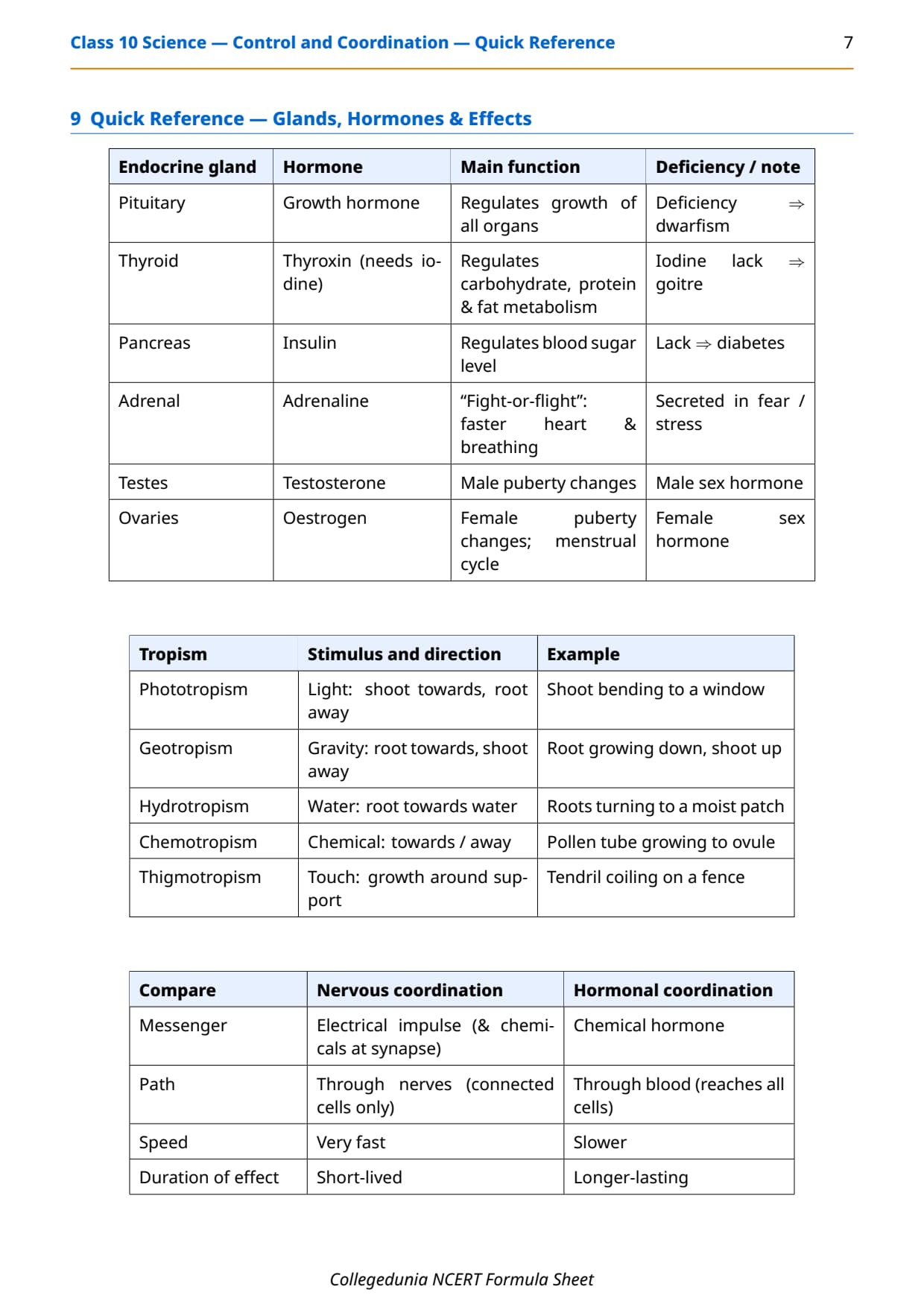
| Tropism | Stimulus and direction | Example |
|---|---|---|
| Phototropism | Light: shoot towards, root away | Shoot bending toward a window |
| Geotropism | Gravity: root towards, shoot away | Root growing down, shoot growing up |
| Hydrotropism | Water: root towards water | Roots turning to a moist patch |
| Chemotropism | Chemical: towards or away | Pollen tube growing to the ovule |
| Thigmotropism | Touch: growth around a support | Tendril coiling on a fence |
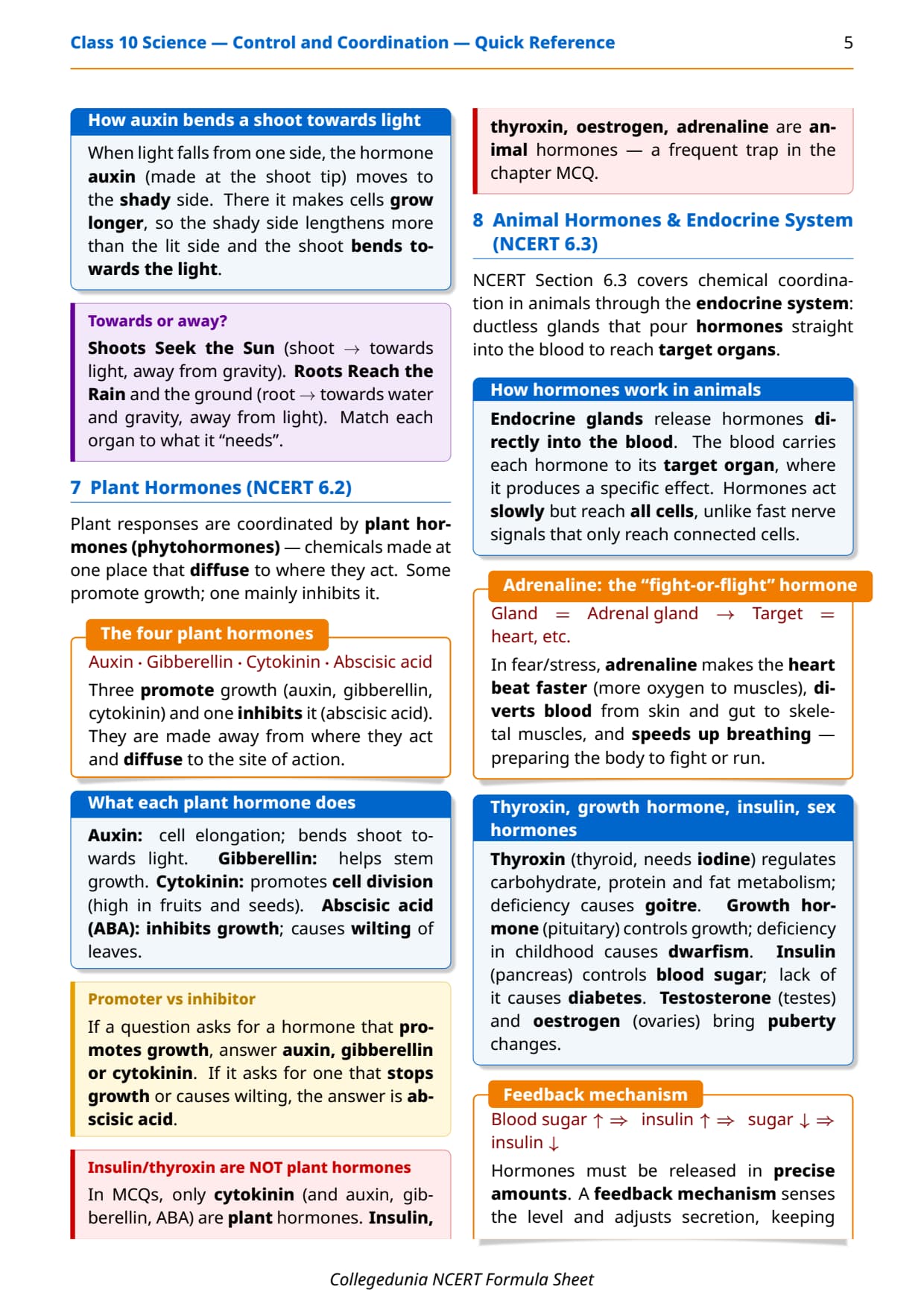
Plant responses are coordinated by plant hormones (phytohormones). The four are auxin (cell elongation), gibberellin (stem growth), cytokinin (cell division), and abscisic acid (inhibits growth, causes wilting). The first three promote growth.
Animal Hormones and Endocrine Glands in Class 10 Science Chapter 6
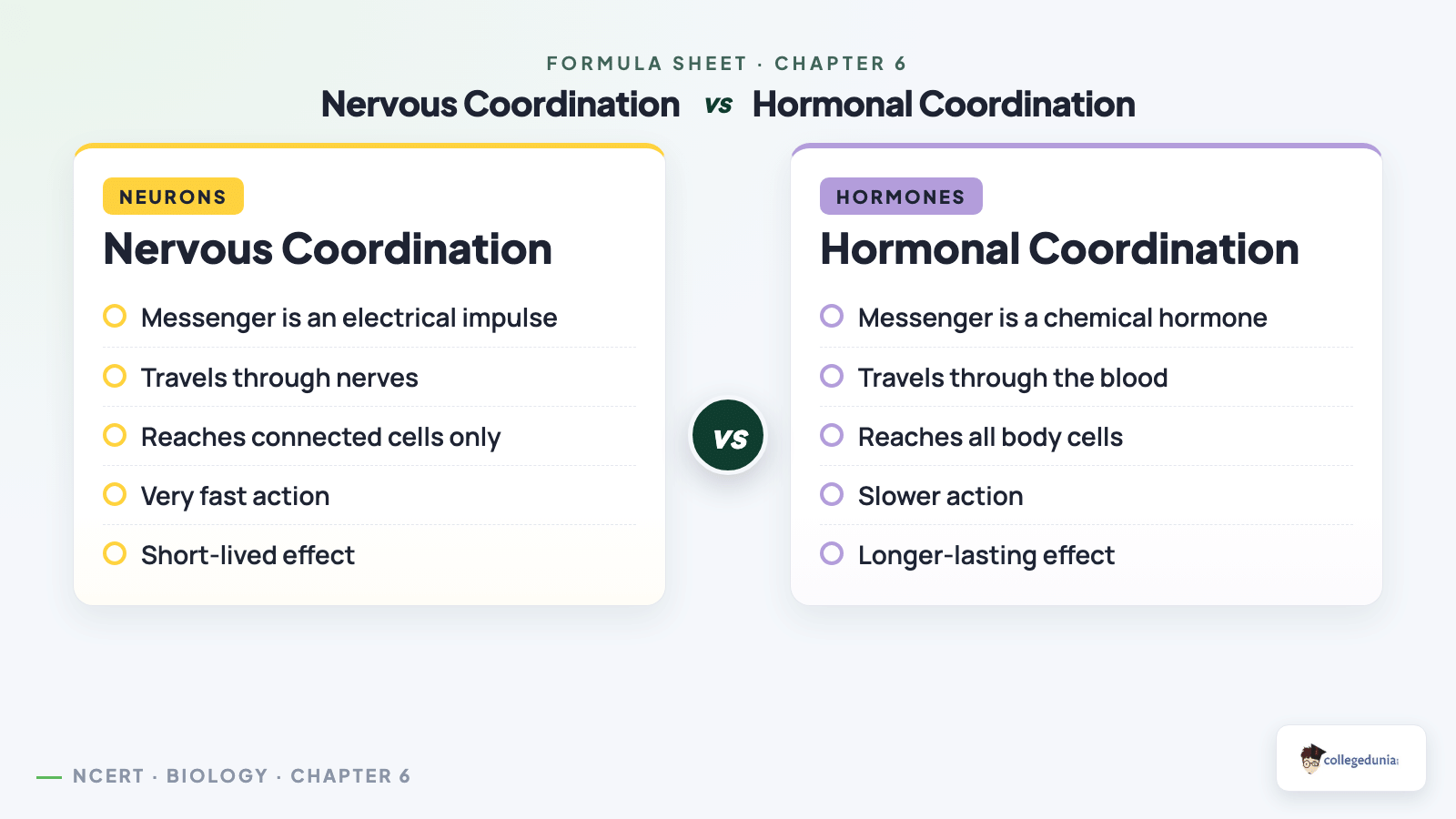
Chemical coordination in animals uses the endocrine system (NCERT 6.3): ductless glands pour hormones into the blood to reach target organs. Hormones act slowly but reach all cells, unlike fast nerve signals. A feedback mechanism keeps each hormone precise. The full gland-hormone table is below.
Glands, Hormones and Effects Table in Class 10 Science
This single table is the fastest revision strip for the endocrine part of the chapter.
| Endocrine gland | Hormone | Main function | Deficiency / note |
|---|---|---|---|
| Pituitary | Growth hormone | Regulates growth of all organs | Deficiency ⇒ dwarfism |
| Thyroid | Thyroxin (needs iodine) | Regulates carbohydrate, protein and fat metabolism | Iodine lack ⇒ goitre |
| Pancreas | Insulin | Regulates blood sugar level | Lack ⇒ diabetes |
| Adrenal | Adrenaline | Fight-or-flight: faster heart and breathing | Secreted in fear / stress |
| Testes | Testosterone | Male puberty changes | Male sex hormone |
| Ovaries | Oestrogen | Female puberty changes; menstrual cycle | Female sex hormone |
Full topic-by-topic walkthrough: Control and Coordination Class 10 Science Notes
More Control and Coordination Class 10 Science Resources
Use the table below to move between the other Collegedunia resources for this same chapter, from full solutions to handwritten notes.
| Resource | Link |
|---|---|
| NCERT Solutions | Control and Coordination NCERT Solutions |
| Revision Notes | Control and Coordination Notes |
| Handwritten Notes | Control and Coordination Handwritten Notes |
| Exemplar Solutions | Control and Coordination Exemplar Solutions |
| NCERT Book PDF | Control and Coordination NCERT Book PDF |
NCERT Formula Sheet for Class 10 Science: All Chapters
Use the table below to jump to the Formula Sheet for any other chapter in the Class 10 Science NCERT.
| Chapter | Resource |
|---|---|
| Chapter 1 | Chemical Reactions and Equations Formula Sheet |
| Chapter 2 | Acids, Bases and Salts Formula Sheet |
| Chapter 3 | Metals and Non-metals Formula Sheet |
| Chapter 4 | Carbon and its Compounds Formula Sheet |
| Chapter 5 | Life Processes Formula Sheet |
| Chapter 7 | How do Organisms Reproduce? Formula Sheet |
| Chapter 8 | Heredity Formula Sheet |
| Chapter 9 | Light - Reflection and Refraction Formula Sheet |
| Chapter 10 | The Human Eye and the Colourful World Formula Sheet |
| Chapter 11 | Electricity Formula Sheet |
| Chapter 12 | Magnetic Effects of Electric Current Formula Sheet |
| Chapter 13 | Our Environment Formula Sheet |
Control and Coordination Class 10 Formula Sheet FAQs
Ques. Where can I download the Control and Coordination Class 10 Formula Sheet PDF?
Ans. You can download the Control and Coordination Class 10 Science Formula Sheet PDF directly from this page. It is free and covers the nerve-signal pathway, the reflex arc, the three brain regions, the plant tropisms, the plant hormones, and the gland-hormone-effect table in the 2026-27 NCERT Chapter 6.
Ques. Is this Formula Sheet aligned with the 2026-27 NCERT?
Ans. Yes. The sheet reflects the current 2026-27 syllabus for Class 10 Science. Chapter 6 retains the neuron and nerve signal, reflex action and the reflex arc, the human brain, coordination in plants, tropisms, plant hormones, animal hormones, and the endocrine system.
Ques. What is the reflex arc pathway in Class 10 Science?
Ans. The reflex arc pathway is receptor → sensory neuron → spinal cord → motor neuron → effector (muscle). The signal is processed in the spinal cord, not the brain, so the response is fast. The information also reaches the brain afterwards, but the action happens before we think.
Ques. What are the three regions of the human brain and their functions?
Ans. The fore-brain is the thinking part and handles hearing, smell, sight, and hunger. The mid-brain controls many involuntary actions. The hind-brain holds the cerebellum (posture and balance) and the medulla (heartbeat, breathing, blood pressure, salivation, and vomiting).
Ques. What is the difference between nervous and hormonal coordination?
Ans. Nervous coordination uses an electrical impulse, travels through nerves, reaches only connected cells, is very fast, and has a short-lived effect. Hormonal coordination uses a chemical hormone, travels through the blood, reaches all body cells, is slower, and has a longer-lasting effect.
Ques. What are the four plant hormones in Class 10 Science?
Ans. The four plant hormones are auxin, gibberellin, cytokinin, and abscisic acid. Auxin causes cell elongation and bends the shoot towards light, gibberellin helps stem growth, cytokinin promotes cell division, and abscisic acid inhibits growth and causes wilting. Three promote growth and abscisic acid inhibits it.
Ques. What are the five tropisms in plants?
Ans. The five tropisms are phototropism (response to light), geotropism or gravitropism (response to gravity), hydrotropism (response to water), chemotropism (response to a chemical, such as a pollen tube growing to the ovule), and thigmotropism (response to touch, such as a tendril coiling on a support).
Ques. How does auxin make a shoot bend towards light?
Ans. When light falls from one side, the hormone auxin (made at the shoot tip) moves to the shady side. There it makes the cells grow longer, so the shady side lengthens more than the lit side, and the shoot bends towards the light. This is called positive phototropism.
Ques. Why is the spinal cord, and not the brain, responsible for a reflex action?
Ans. Thinking by the brain is not fast enough for urgent dangers like touching a hot object. So the reflex arc is completed in the spinal cord, giving a quick, automatic response. The information still travels to the brain, but only after the protective action has already happened.
Ques. Why is iodised salt advised in Class 10 Science?
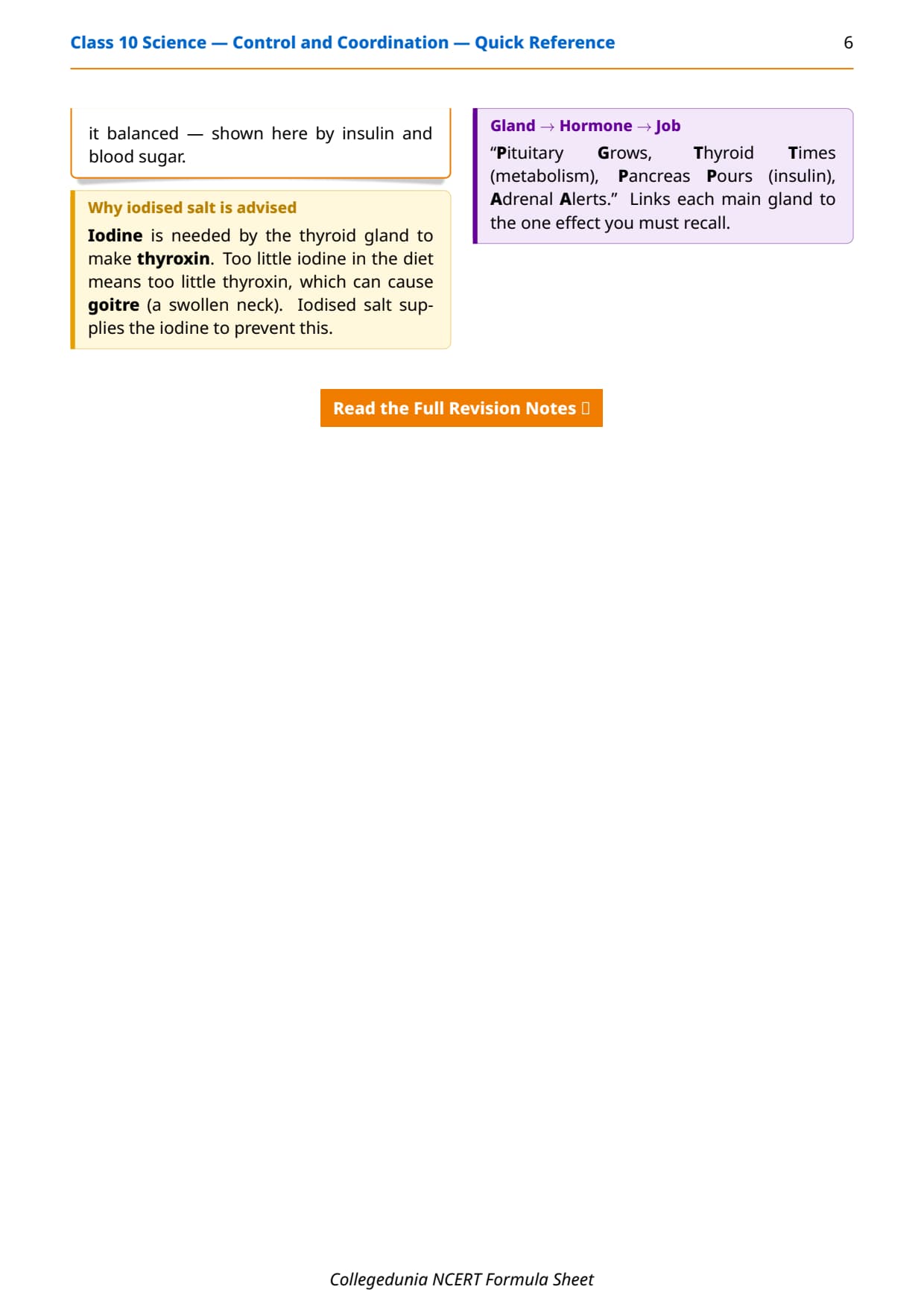
Ans. Iodine is needed by the thyroid gland to make the hormone thyroxin, which regulates carbohydrate, protein, and fat metabolism. Too little iodine in the diet means too little thyroxin, which can cause goitre (a swollen neck). Iodised salt supplies the iodine to prevent this.
Ques. What is a synapse and how does a signal cross it?
Ans. A synapse is the tiny gap between two neurons. The electrical impulse reaching the axon end releases chemicals that cross this gap and start a fresh impulse in the next neuron, or make a muscle or gland act. Because the signal crosses as a chemical, transmission across a synapse is one-way.
Ques. What is the feedback mechanism in hormone control?
Ans. Hormones must be released in precise amounts, so the body uses a feedback mechanism that senses the level and adjusts secretion. For example, when blood sugar rises, the pancreas releases more insulin to lower it; as the sugar falls, less insulin is released, keeping the level balanced.
Ques. What is the CBSE weightage of Chapter 6 Control and Coordination in Class 10 Science?
Ans. Control and Coordination sits in the World of Living unit and usually carries 6 to 8 marks in the CBSE Class 10 Science board exam, asked across one or two questions on the neuron and reflex arc, the human brain, coordination and tropisms in plants, plant hormones, or animal hormones and the endocrine system.



Comments