


The The Human Eye and the Colourful World Class 10 Science handwritten notes are scanned, boxed and built for fast last-minute revision, fully matched to the 2026-27 CBSE syllabus. They cover the parts of the human eye, the power of accommodation, the defects of vision (myopia, hypermetropia and presbyopia) with their correction, dispersion of light through a glass prism, atmospheric refraction, and the scattering of light, all in clear ruled-page form with hand-drawn ray diagrams and boxed key points.
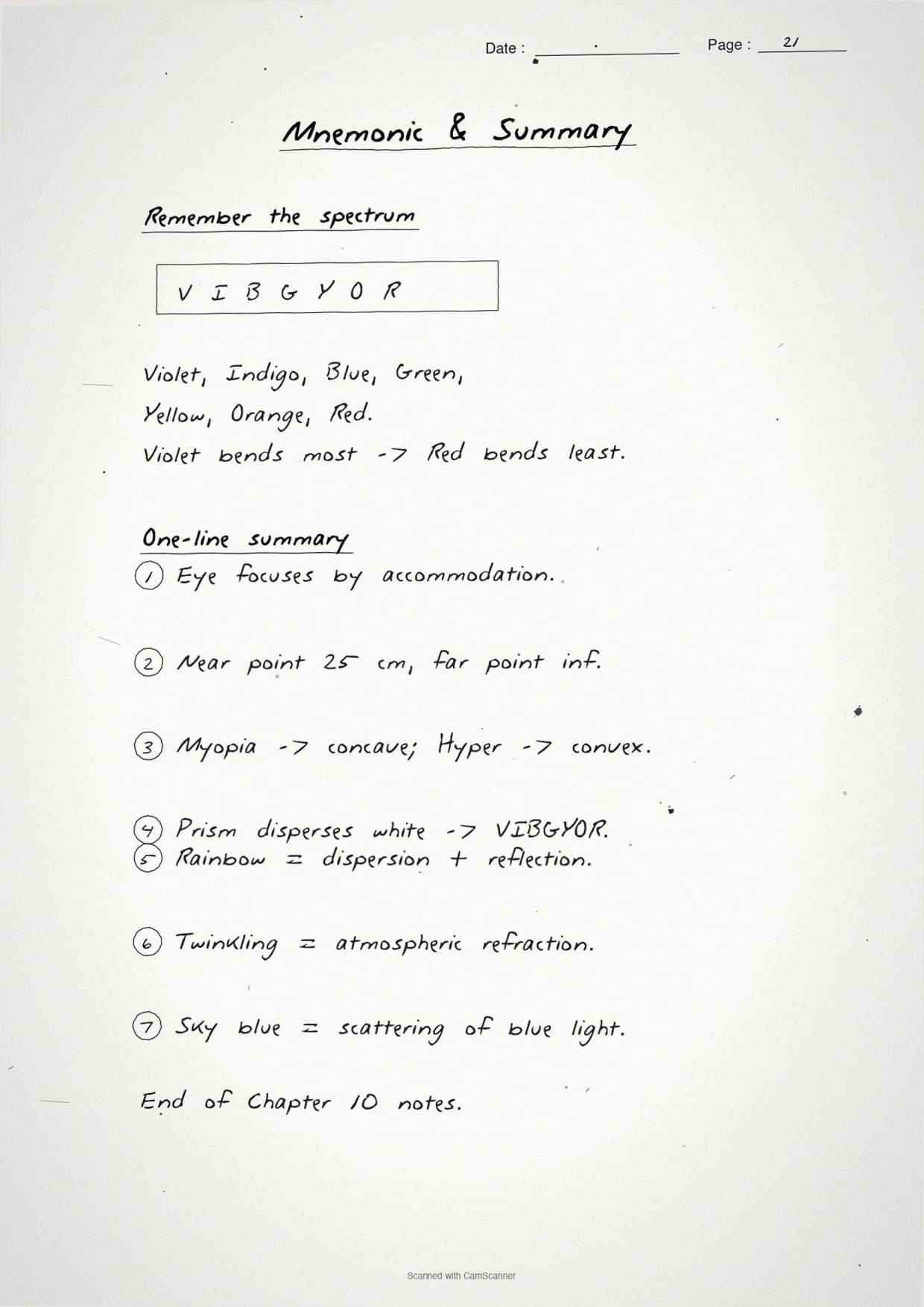
- CBSE Weightage: about 6 to 8 marks from the unit Natural Phenomena, often as ray-diagram, defect-correction and reason-based questions.
- Boxed key points and a hand-drawn diagram for every eye part, defect and phenomenon the board paper asks about.
- Pairs with the NCERT Solutions, Notes and Book PDF linked lower on this page.
These The Human Eye and the Colourful World handwritten notes are prepared from the official NCERT Science textbook and matched to the 2026-27 CBSE syllabus.
Student Feedback: In a Collegedunia poll of 11,800 Class 10 Science students before the 2026 boards, 81% of students said the hand-drawn defect-correction diagrams and the boxed scattering reasons were the fastest way to revise this chapter. Most students copied the boxed defect table straight onto practice answer sheets.
Source: 2026-27 Class 10 Science student poll. Sample of 11,800 students from CBSE schools across 15 states.
Solved by Collegedunia: Every ray diagram, table and key point in these The Human Eye and the Colourful World handwritten notes is checked by Collegedunia's Class 10 Science team against the latest 2026-27 NCERT textbook, so what you revise matches exactly what the CBSE board paper expects.
What These The Human Eye and the Colourful World Handwritten Notes Include
These The Human Eye and the Colourful World handwritten notes condense the chapter into 21 scanned pages of ruled paper, every diagram drawn by hand. They are built around the three big ideas the CBSE board paper tests:
- The human eye: the parts of the eye, the power of accommodation, the near and far point.
- Defects of vision: myopia, hypermetropia and presbyopia, the cause and corrective lens of each.
- The colourful world: dispersion through a prism, atmospheric refraction, and the scattering of light.
The Human Eye and the Colourful World Class 10 Science Video Lecture
Source: Magnet Brains on YouTube
Parts of the Human Eye: The First Page of the Notes
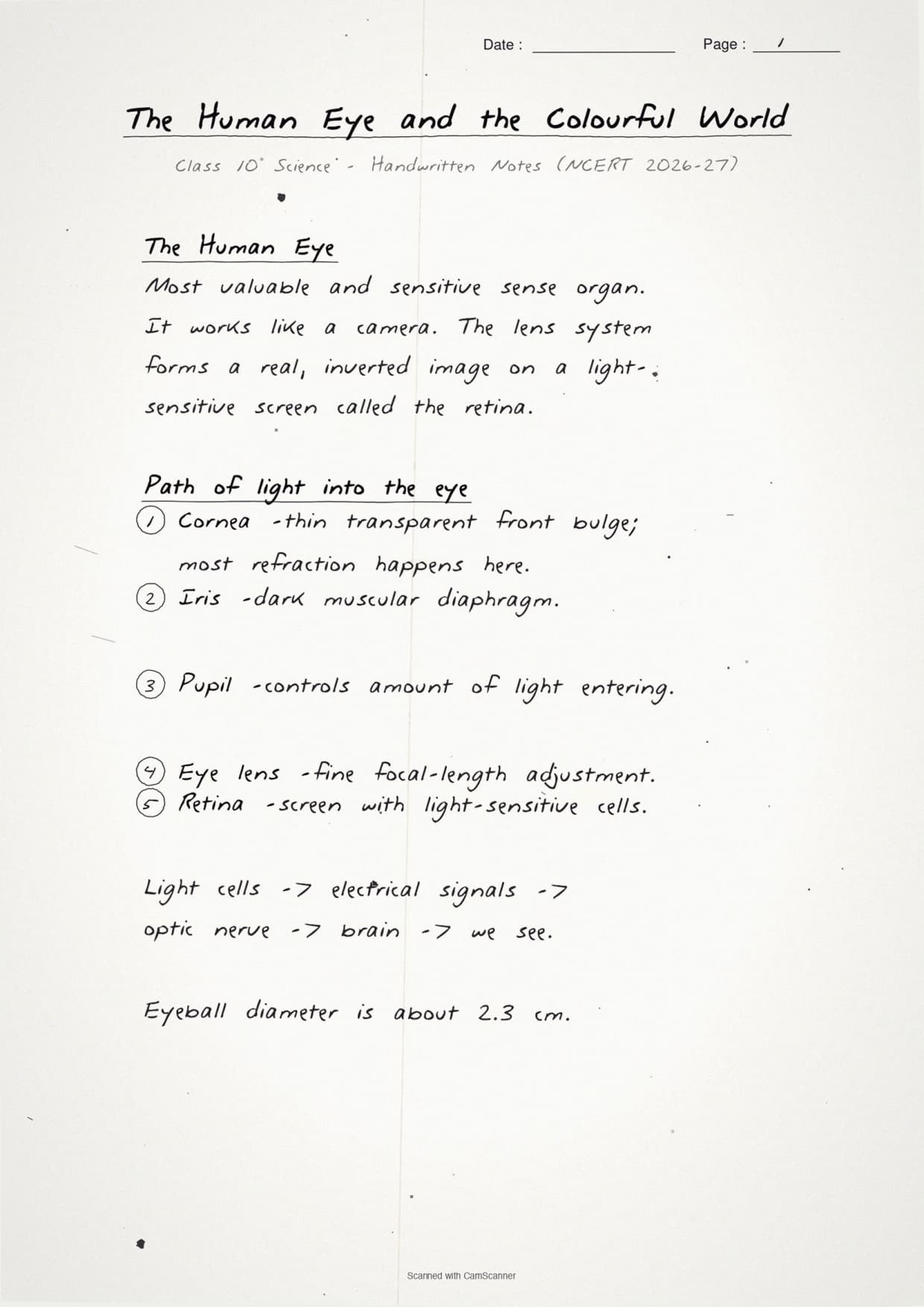
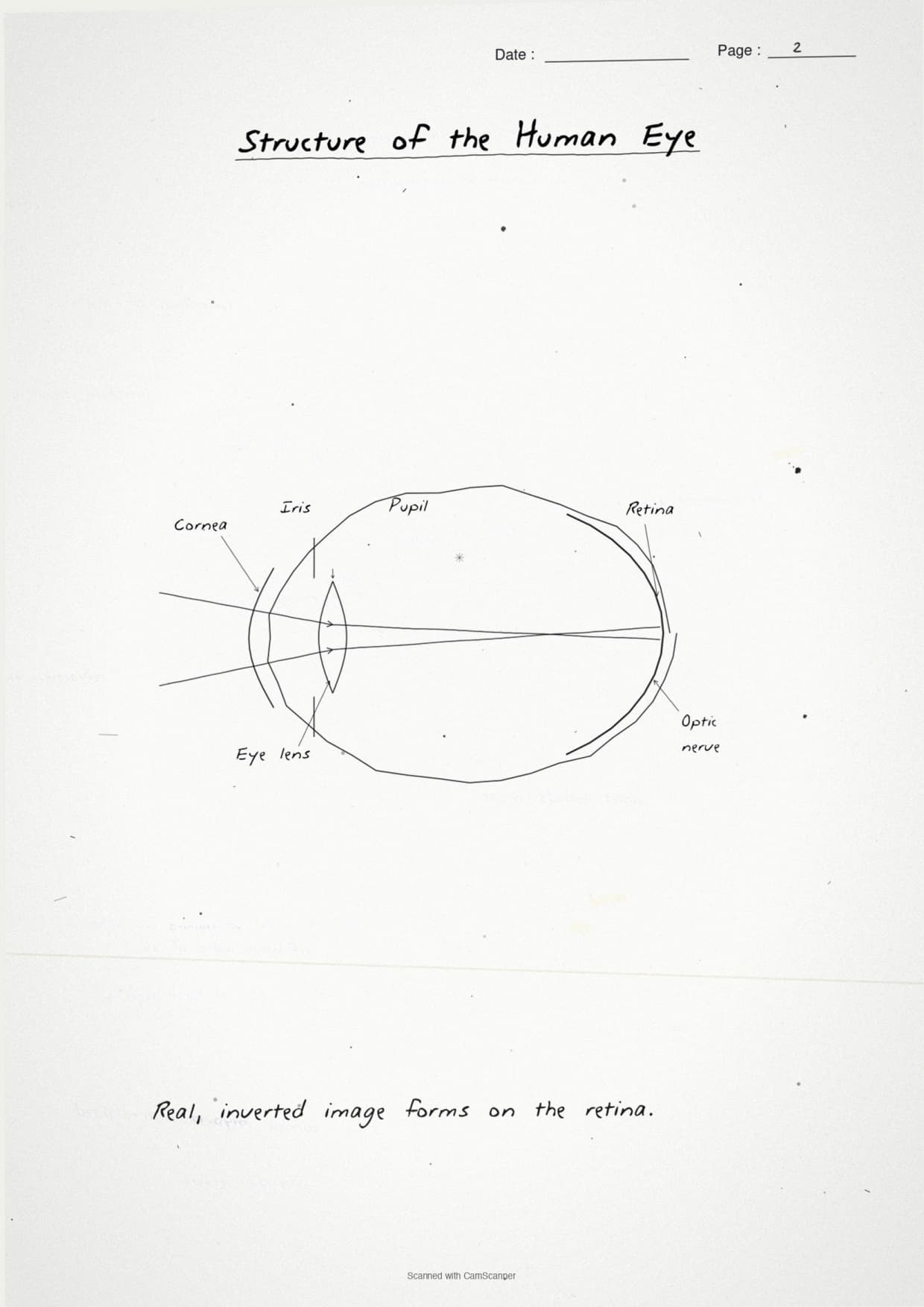
The opening page covers the parts of the human eye. The human eye works like a camera, forming a real, inverted image on the light-sensitive retina.
- Cornea: the thin front membrane where most bending of light takes place.
- Iris and pupil: the iris controls the size of the pupil, which lets light in. It shrinks in bright light, widens in dim light.
- Eye lens: a flexible lens that fine-tunes the focus onto the retina.
- Retina: the screen at the back, full of light-sensitive cells that signal the brain. The image is real and inverted; the brain reads it upright.
Takeaway: the cornea does most of the bending, the eye lens makes the final adjustment.
Power of Accommodation, Far Point and Near Point
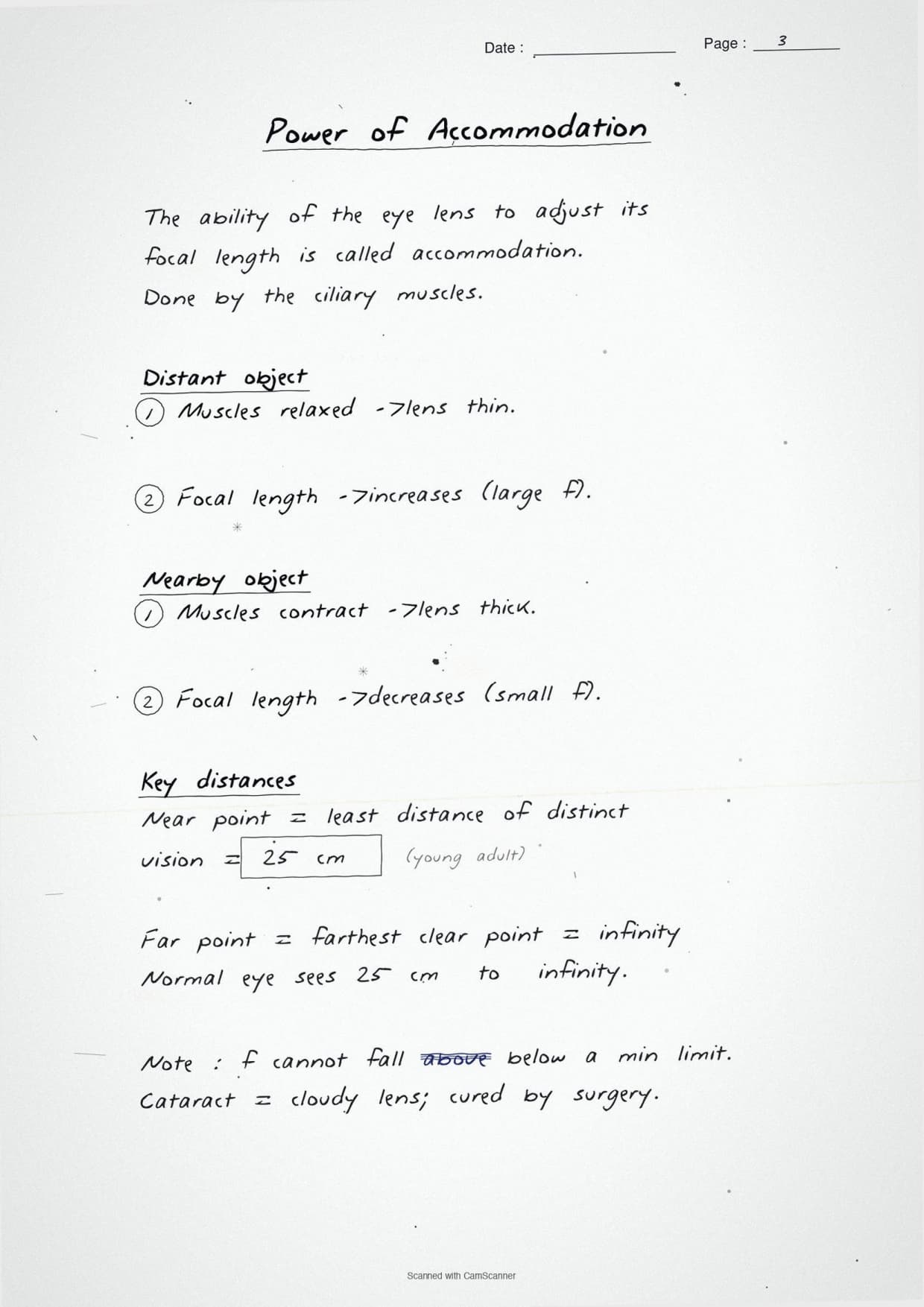
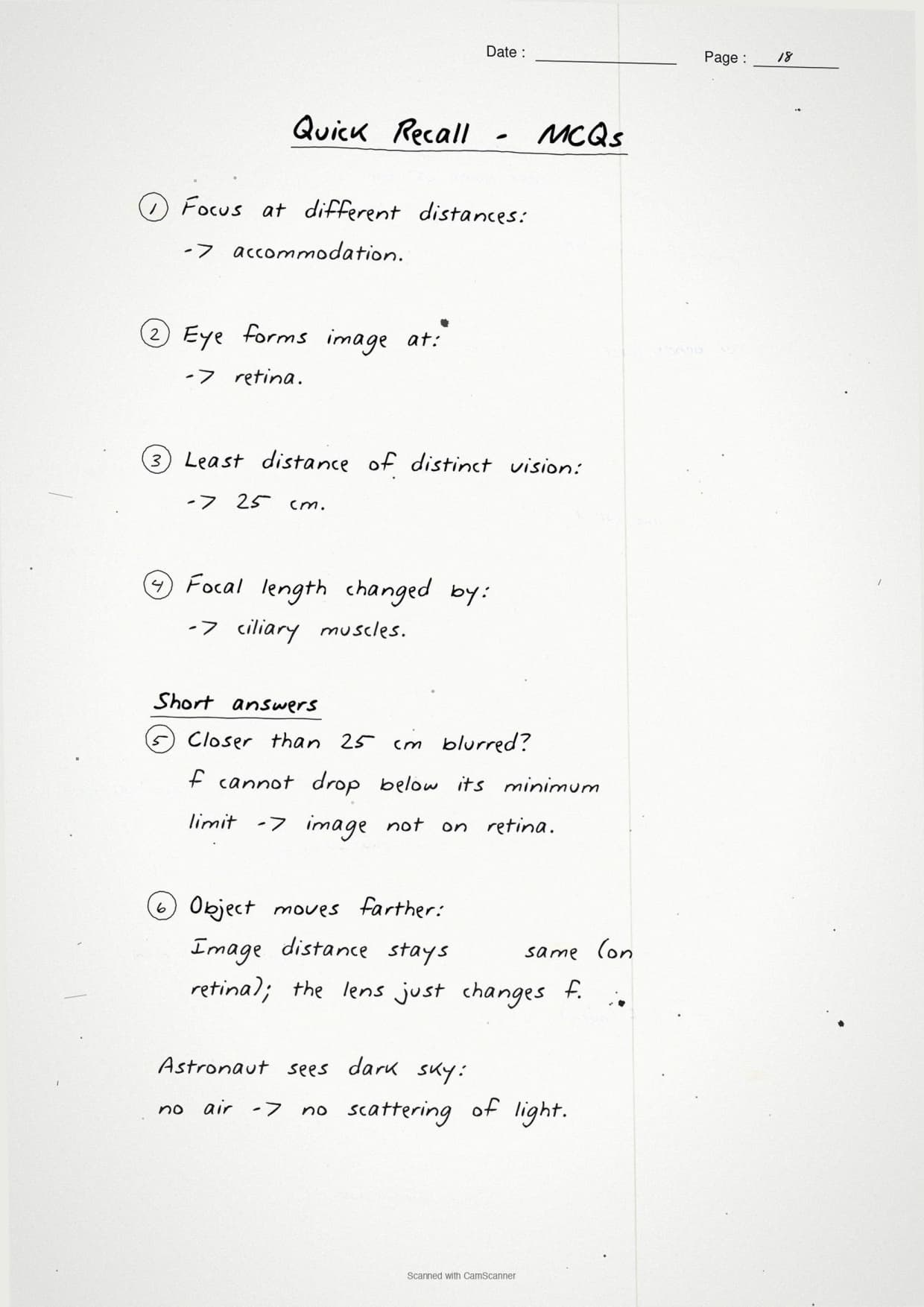
The idea behind every defect question is the power of accommodation: the eye lens can change its focal length so objects at different distances stay in focus.
- Ciliary muscles relaxed: the lens becomes thin, focal length increases, distant objects clear.
- Ciliary muscles contracted: the lens becomes thick, focal length decreases, near objects clear.
- The limit: the lens cannot stretch forever, so there is a closest and farthest point of clear vision.
| Term | Meaning | Value for a normal eye |
|---|---|---|
| Near point | Closest point seen clearly | About 25 cm |
| Far point | Farthest point seen clearly | Infinity |
| Least distance of distinct vision | Comfortable reading distance | 25 cm |
A normal eye has a near point of about 25 cm and a far point at infinity. When either limit shifts, there is a defect of vision.
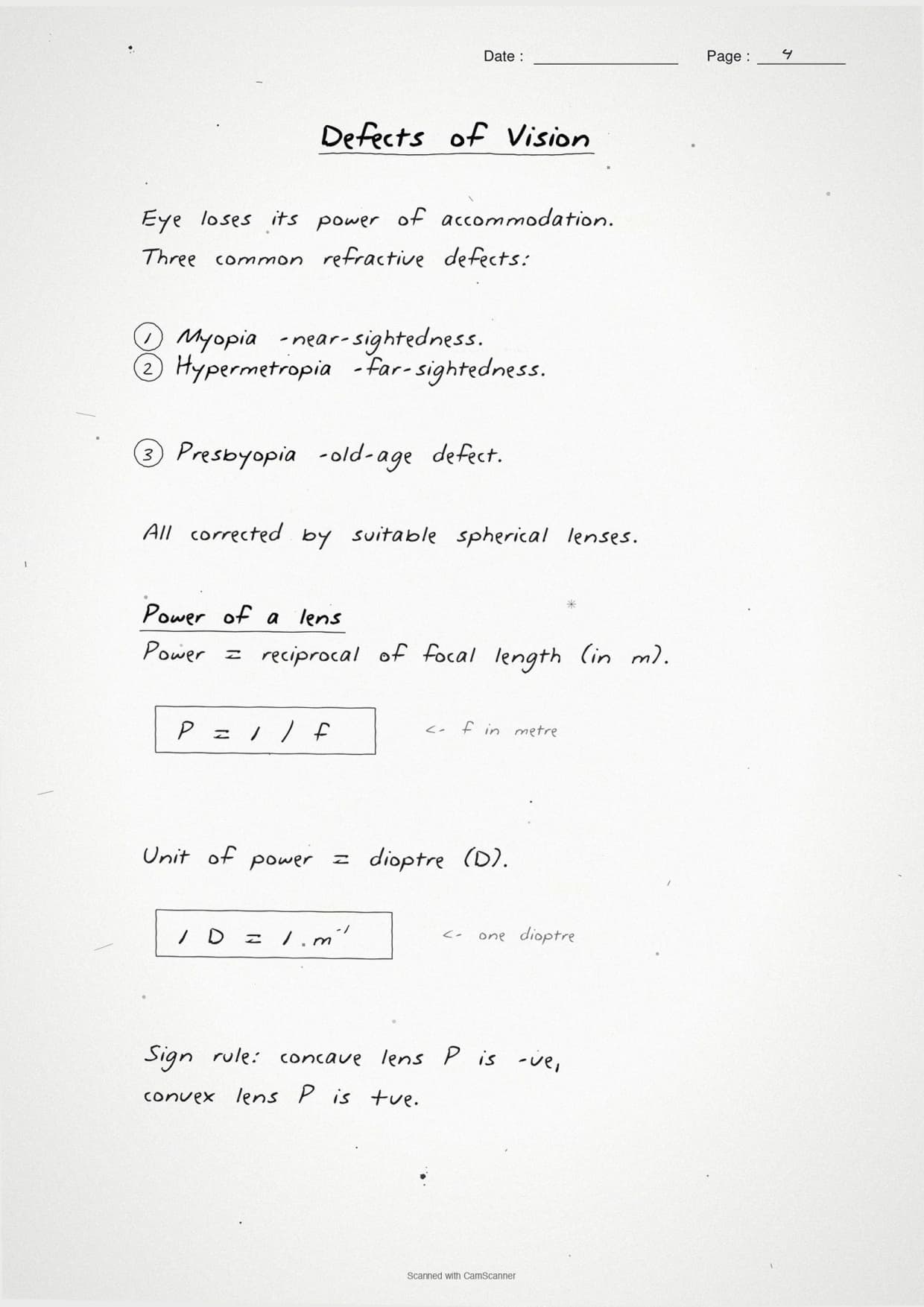
Defects of Vision and Their Correction
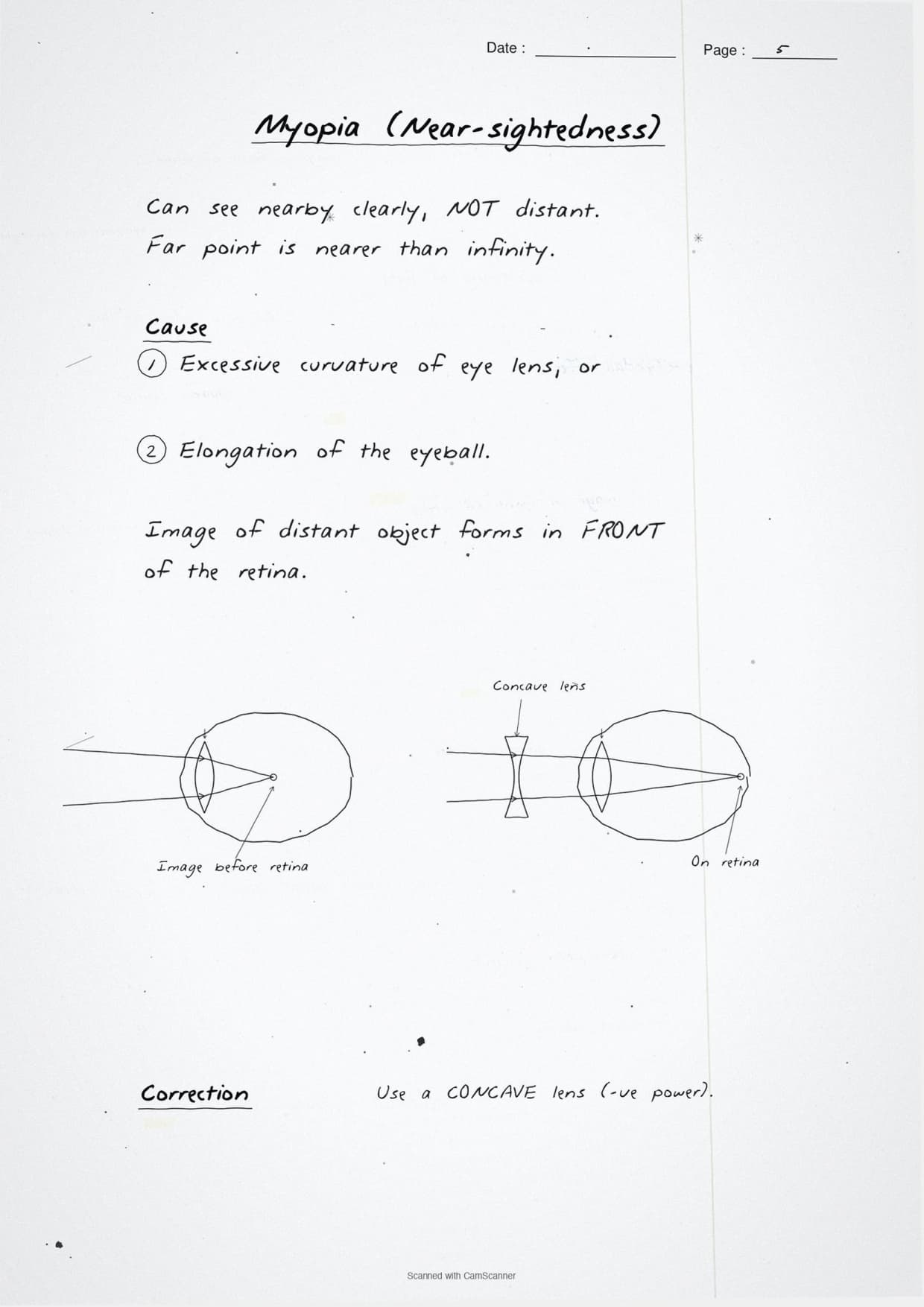
This page draws the three common defects of vision with cause and corrective lens, a guaranteed 3-mark question. The table mirrors the page.
| Defect | Also called | What it is | Cause | Corrective lens |
|---|---|---|---|---|
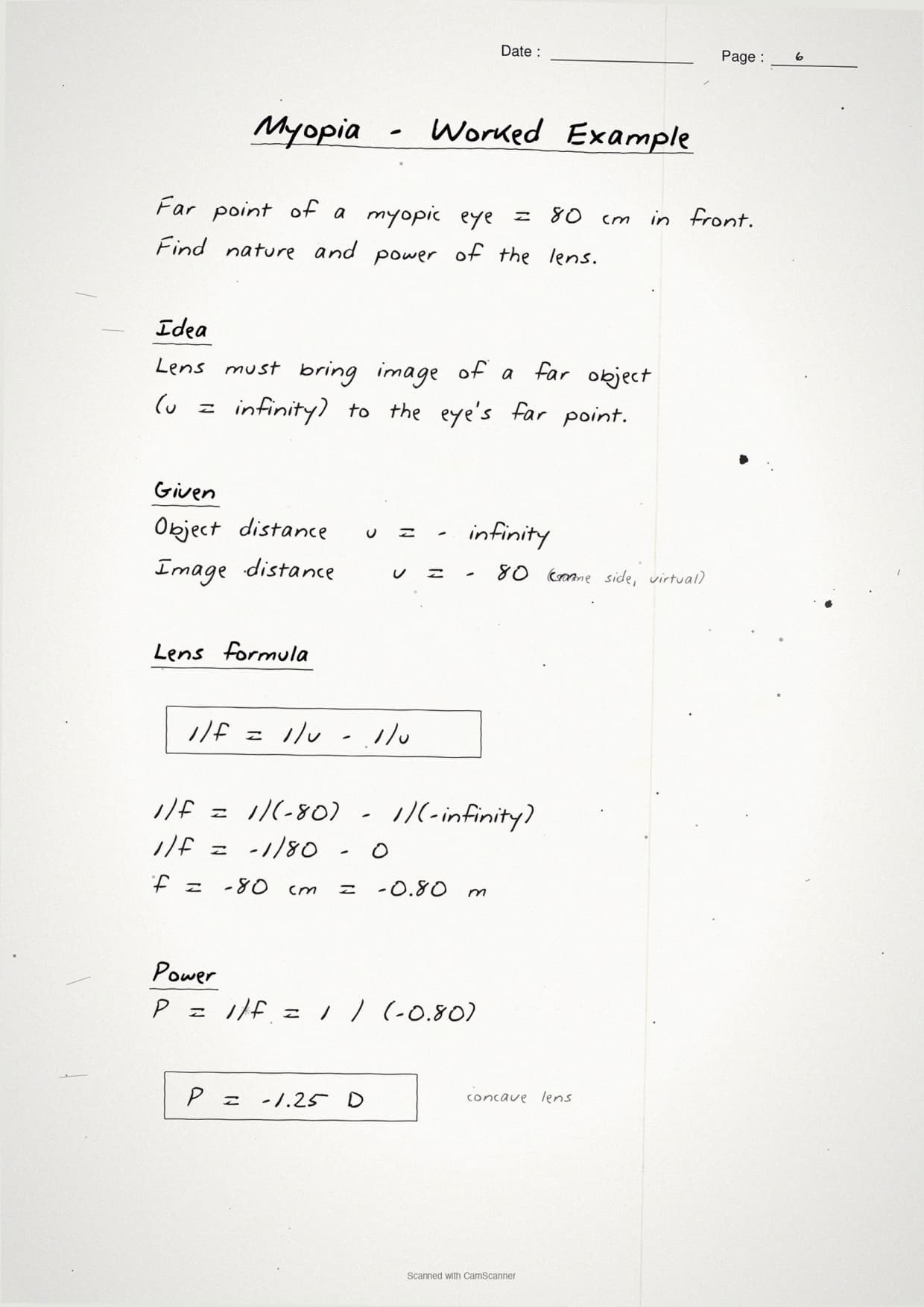
| Myopia | Short-sightedness | Cannot see distant objects | Eyeball too long; image forms in front of the retina | Concave lens |
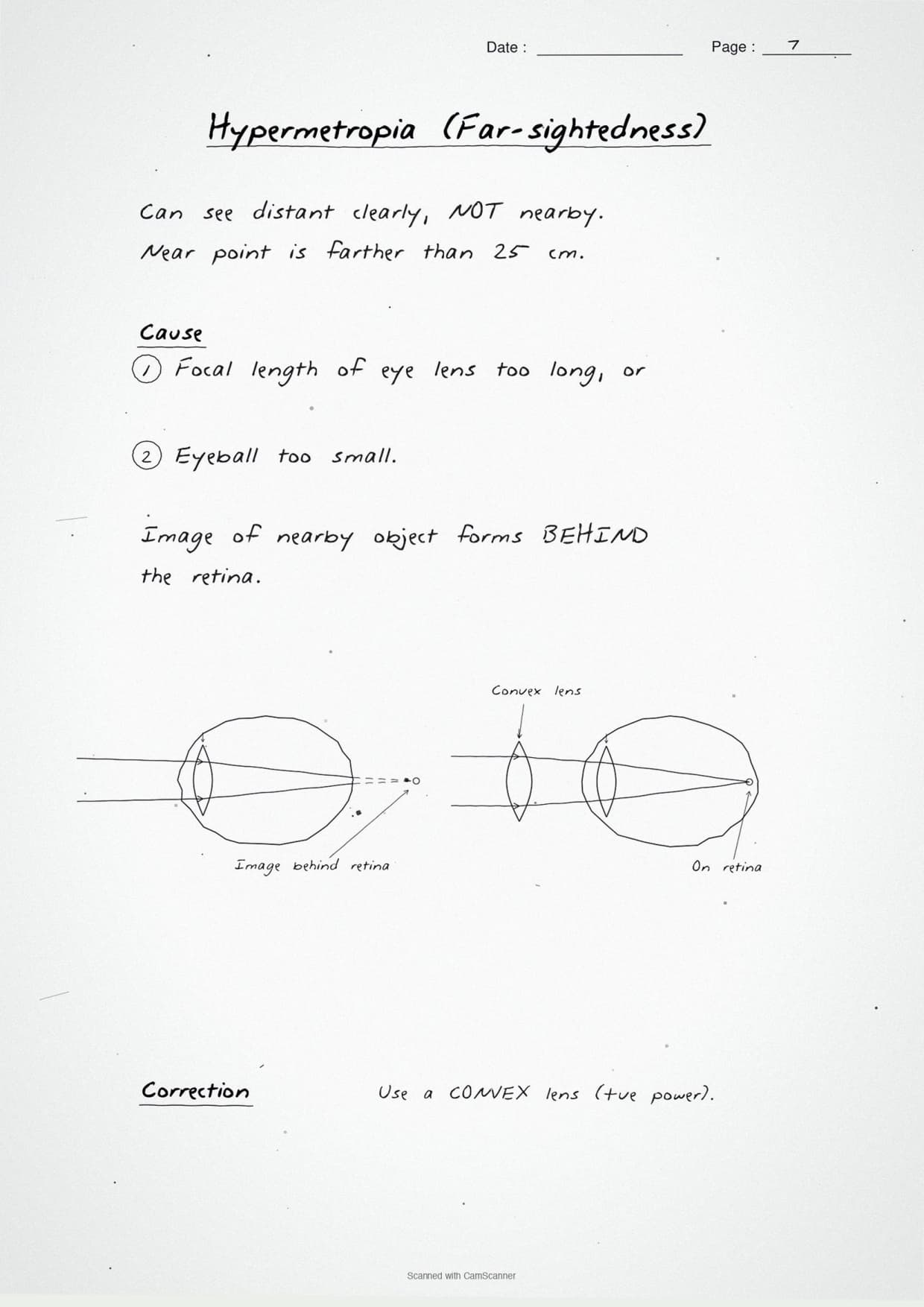
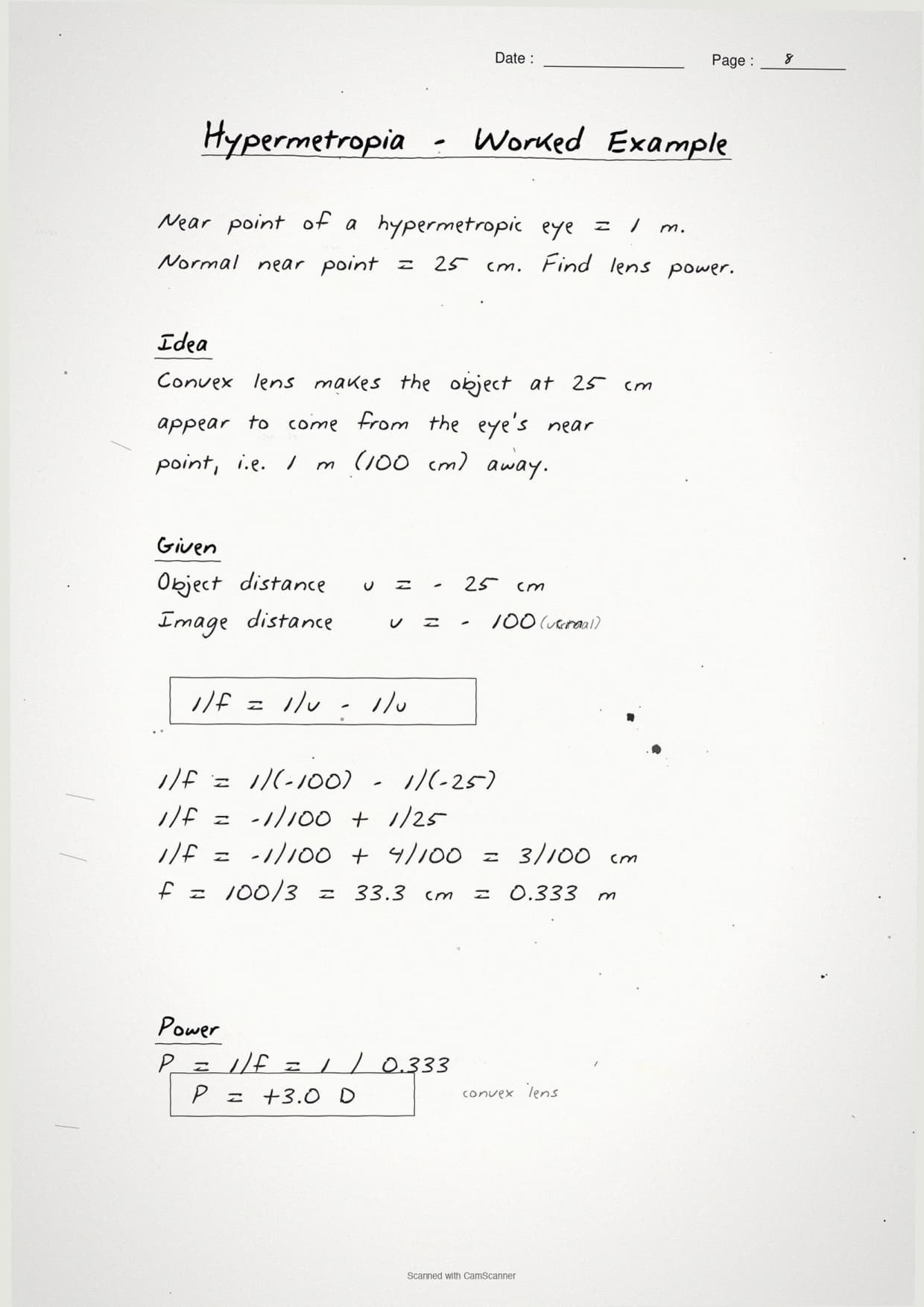
| Hypermetropia | Long-sightedness | Cannot see near objects | Eyeball too short; image forms behind the retina | Convex lens |
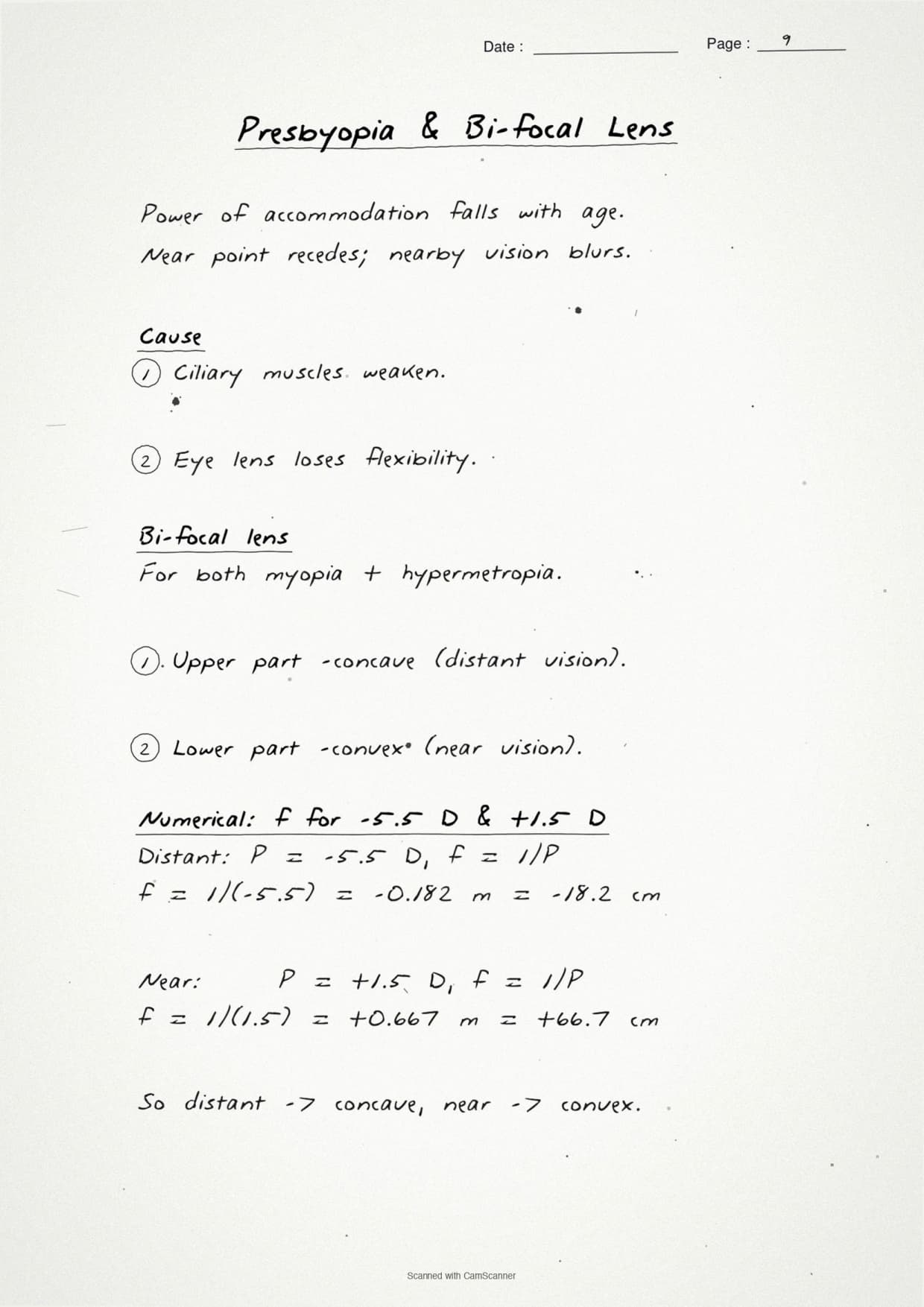
| Presbyopia | Old-age sight | Near point recedes with age | Ciliary muscles weaken, lens loses flexibility | Bifocal lens |
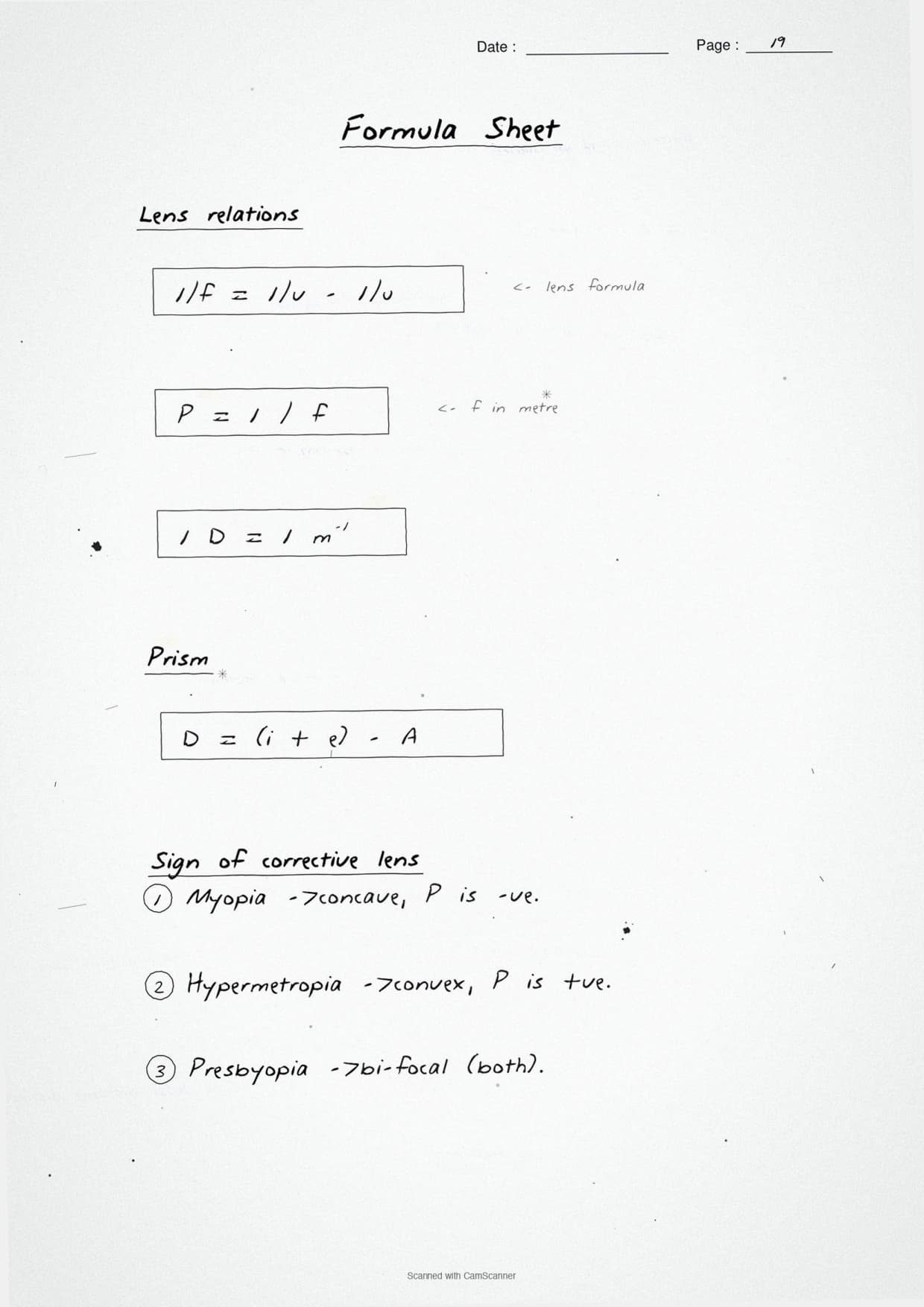
In myopia the image forms in front of the retina, so a concave lens pushes it back; in hypermetropia it forms behind, so a convex lens brings it forward. In presbyopia, both occur together in old age, so a bifocal lens is used. Cataract (cloudy lens) is treated by surgery, not a lens.
Dispersion of Light Through a Prism and the Rainbow
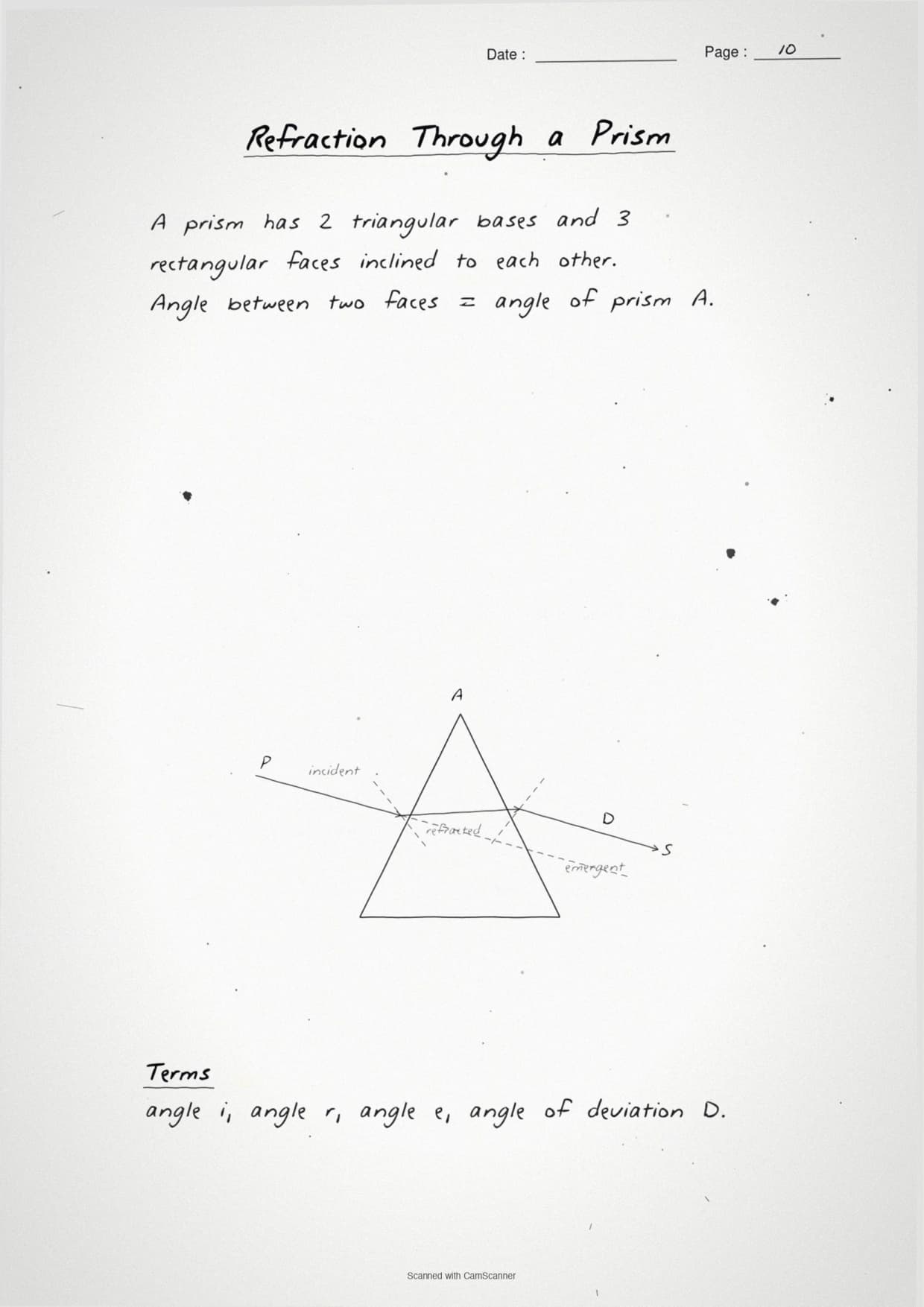
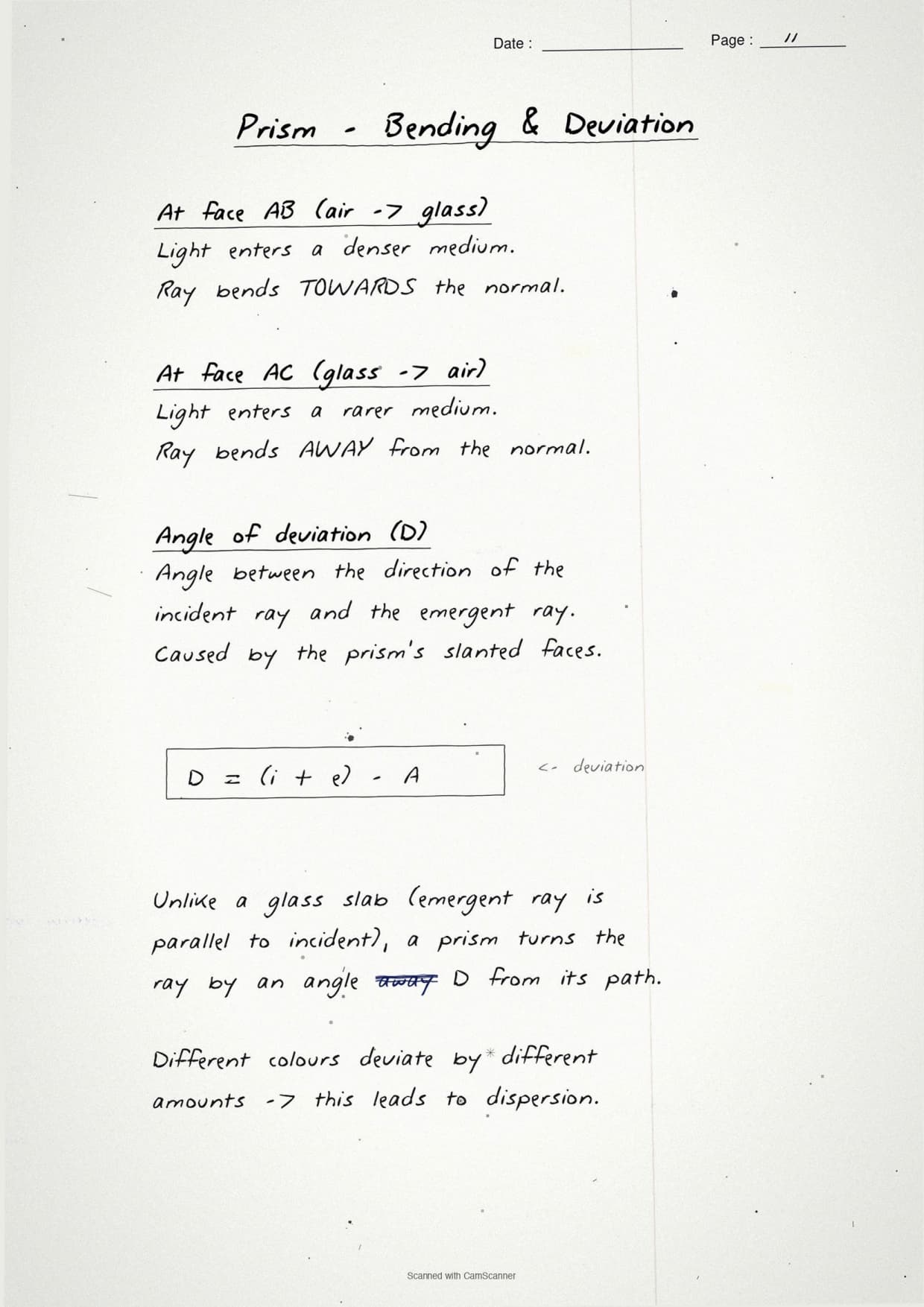
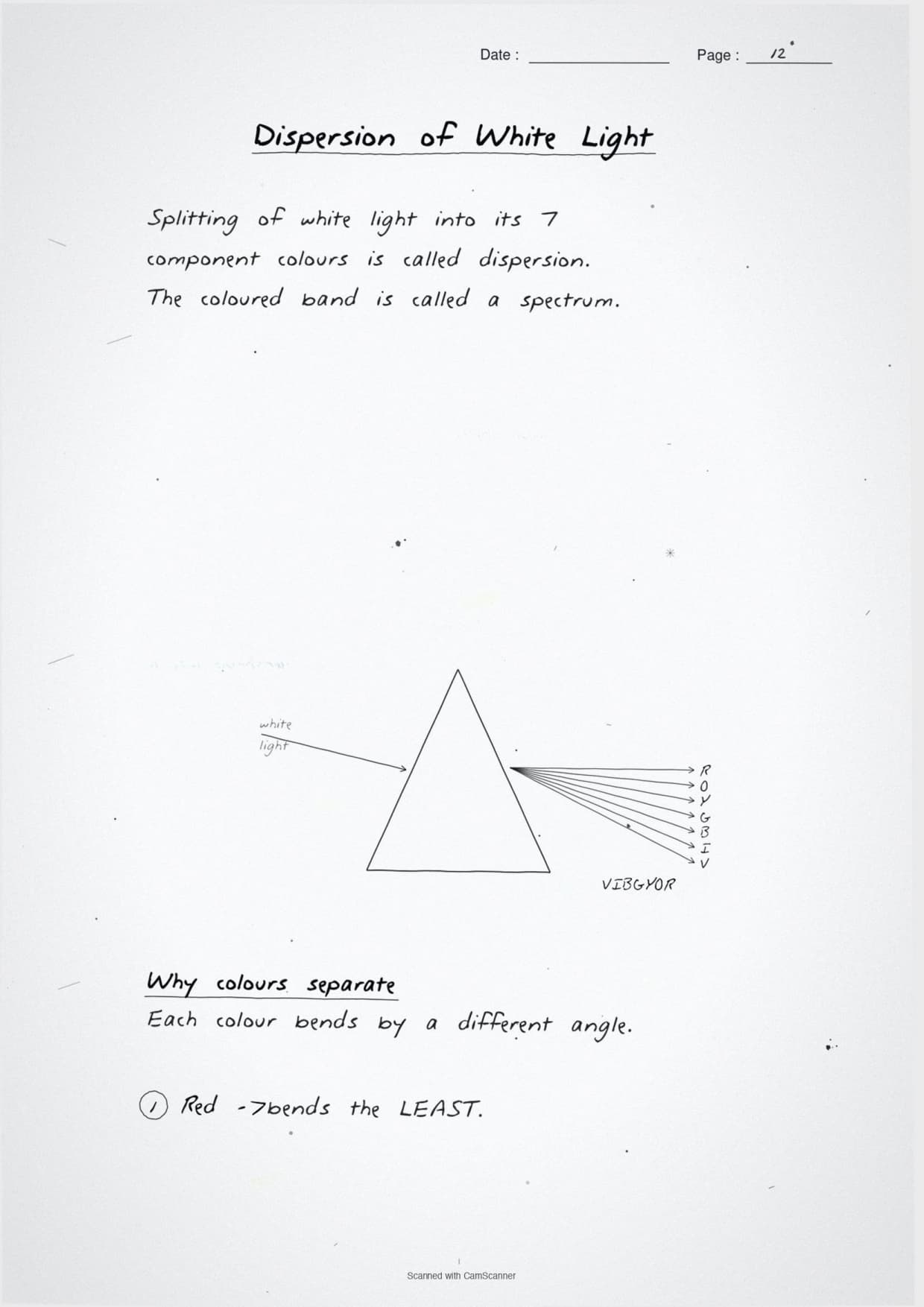
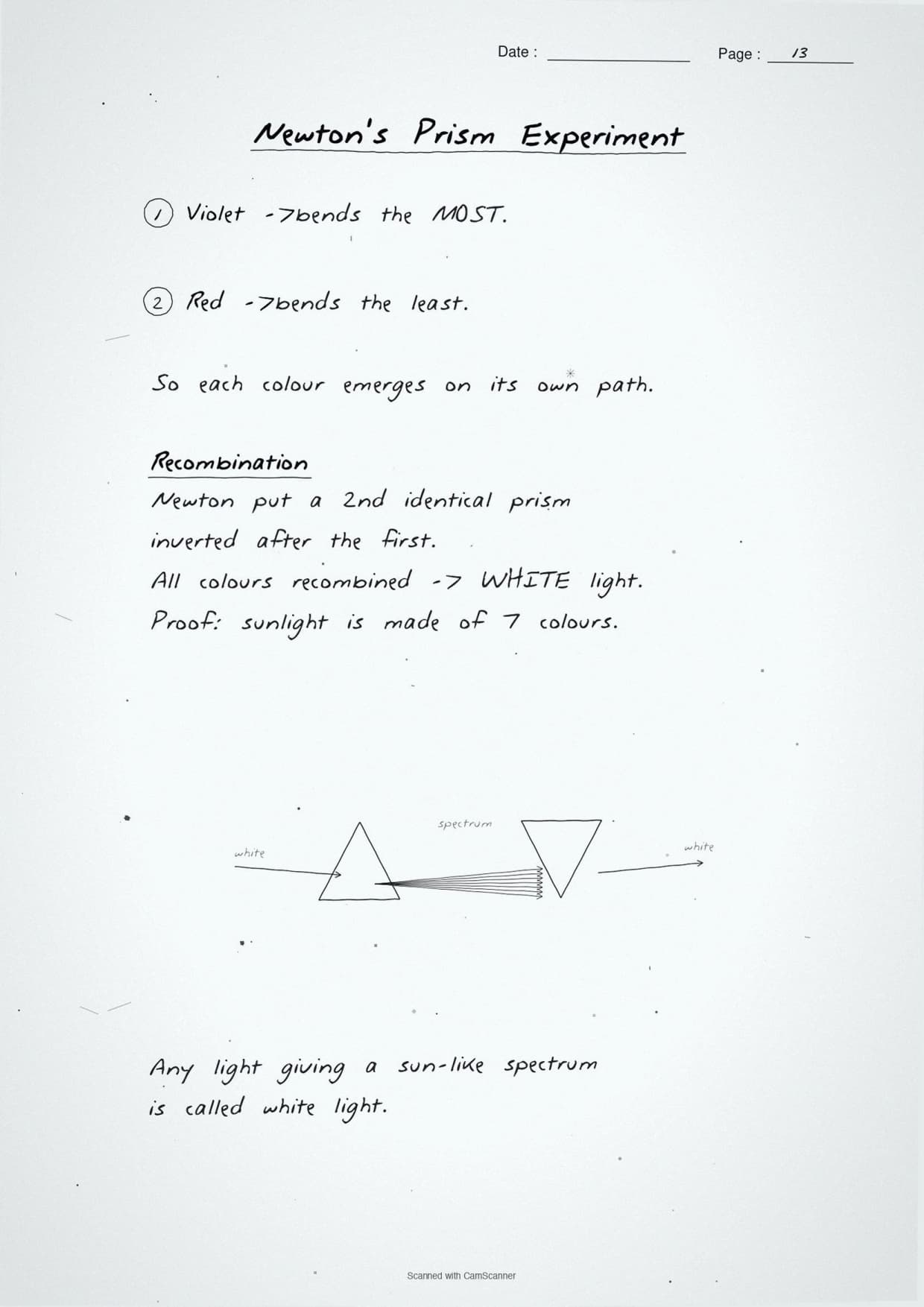
The dispersion of light is the splitting of white light into its seven colours when it passes through a prism.
- The cause: each colour travels at a slightly different speed in glass, so bends by a different amount.
- Most and least bent: violet bends the most, red the least.
- Order (VIBGYOR): Violet, Indigo, Blue, Green, Yellow, Orange, Red.
- Recombination: a second, inverted prism recombines the colours into white light, Newton's proof that white light is a mixture.
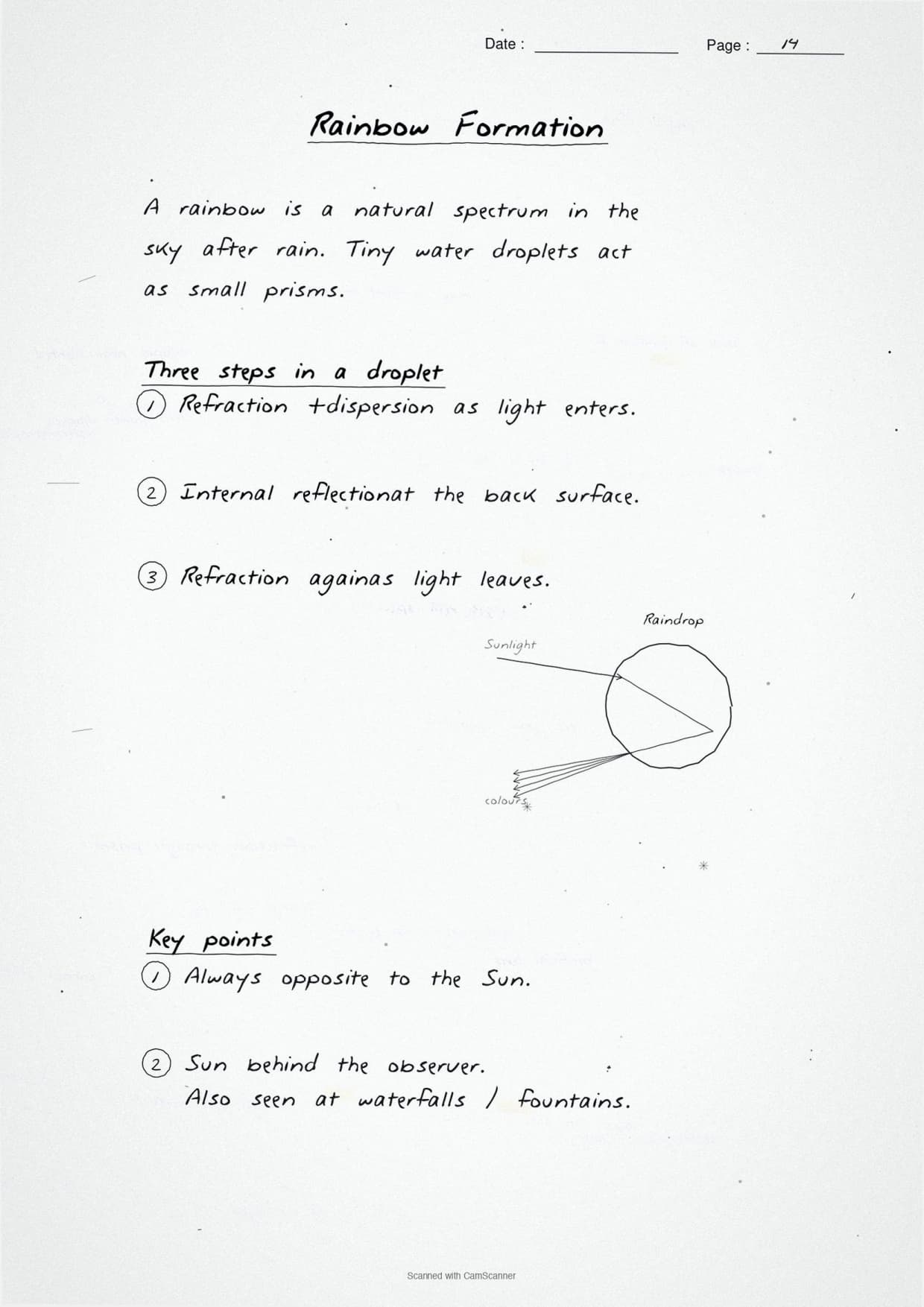
A rainbow forms when sunlight is refracted, dispersed and internally reflected inside tiny water droplets after rain; it is always seen opposite the Sun. Nature uses raindrops as tiny prisms.
Atmospheric Refraction and Scattering of Light
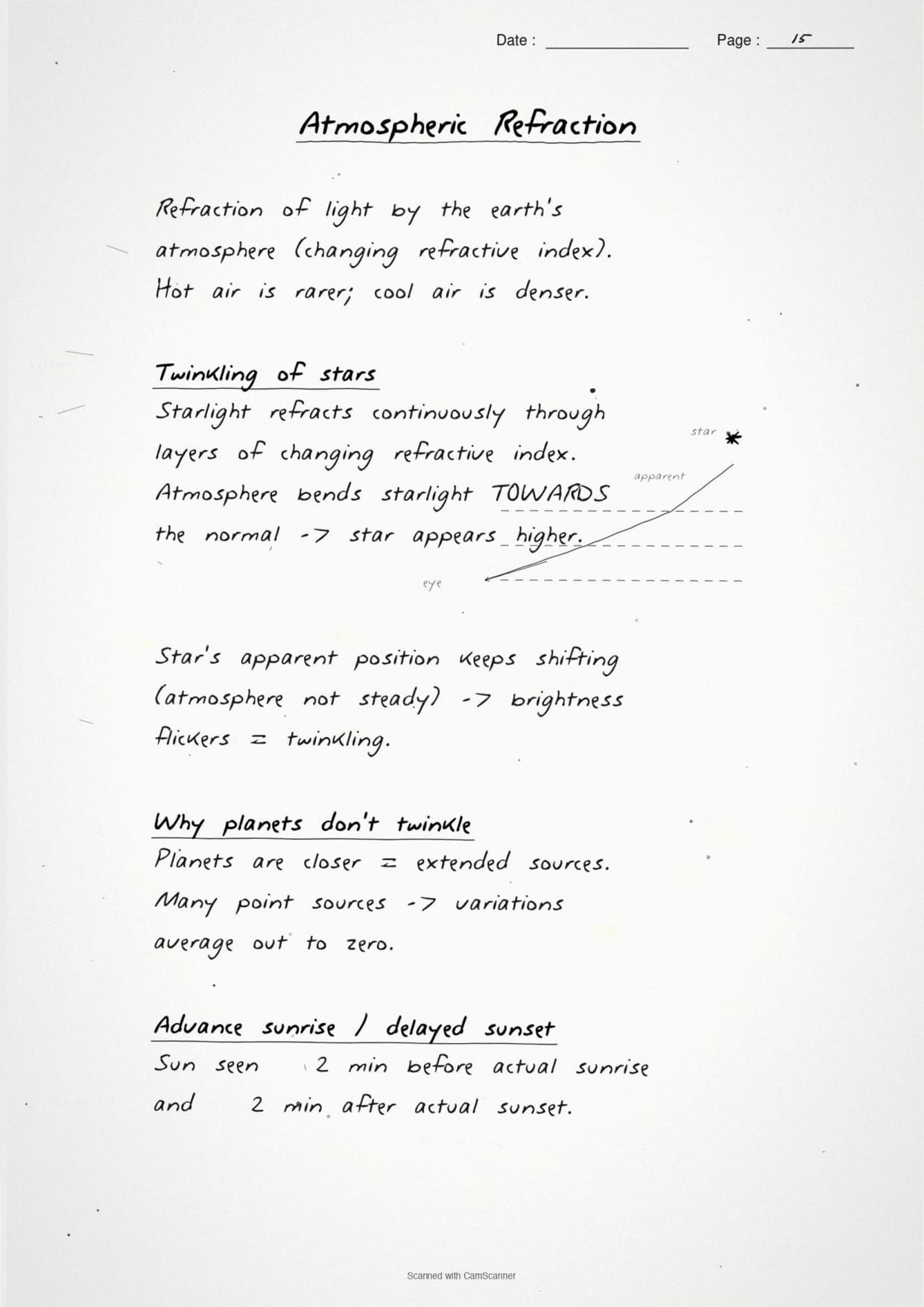
The last spread covers two reason-based topics. Atmospheric refraction is the bending of light through air layers of changing density.
- Twinkling of stars: star light bends by tiny, changing amounts in moving air, so it appears to twinkle.
- Planets do not twinkle: a planet is closer, acting as a large source whose flickers average out.
- Advance sunrise, delayed sunset: refraction lets us see the Sun about two minutes before it rises and after it sets.
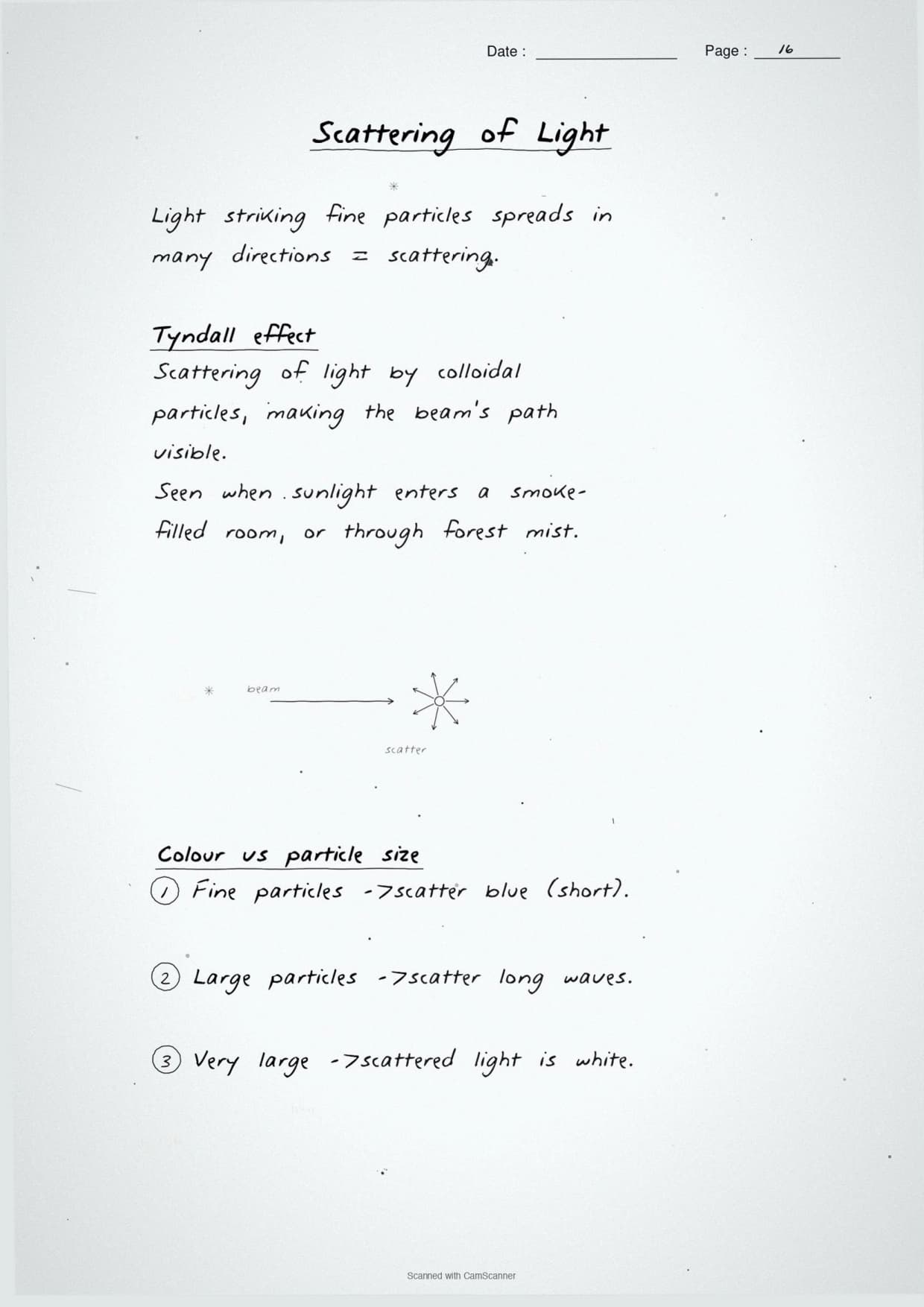
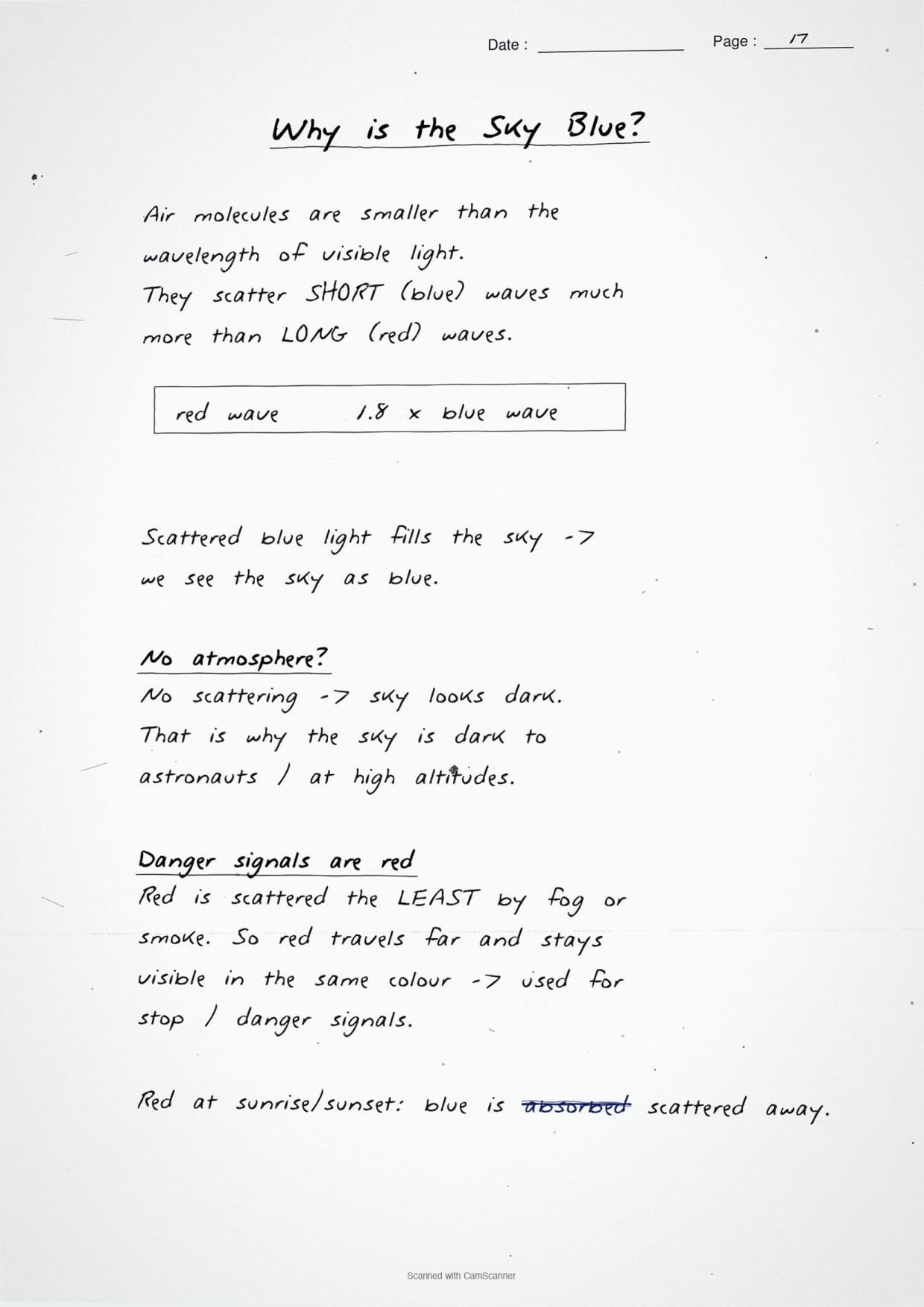
Scattering of light is the spreading of light when it strikes tiny particles in the air; the amount depends on colour.
- Tyndall effect: scattering by colloidal particles, seen when a beam passes through fog.
- Blue sky: air molecules scatter shorter blue light far more than red.
- Red Sun at sunrise/sunset: over a long path most blue is scattered away and only red reaches us. Danger signals are red because red scatters the least.
How to Use These Handwritten Notes Effectively
Handwritten notes work best as a final revision layer, not your first read. Use the The Human Eye and the Colourful World handwritten notes like this:
- First pass: read in order, the eye, accommodation and defects, then dispersion, refraction and scattering.
- Active recall: cover the defect table and redraw the myopia and hypermetropia diagrams from memory.
- Reason drill: write the one-line reason for the blue sky, red Sun and twinkling stars, as marks go for the reason alone.
- Self-test: attempt a short chapter 10 drill, then check against the full solutions.
Common Mistakes These Notes Help You Avoid
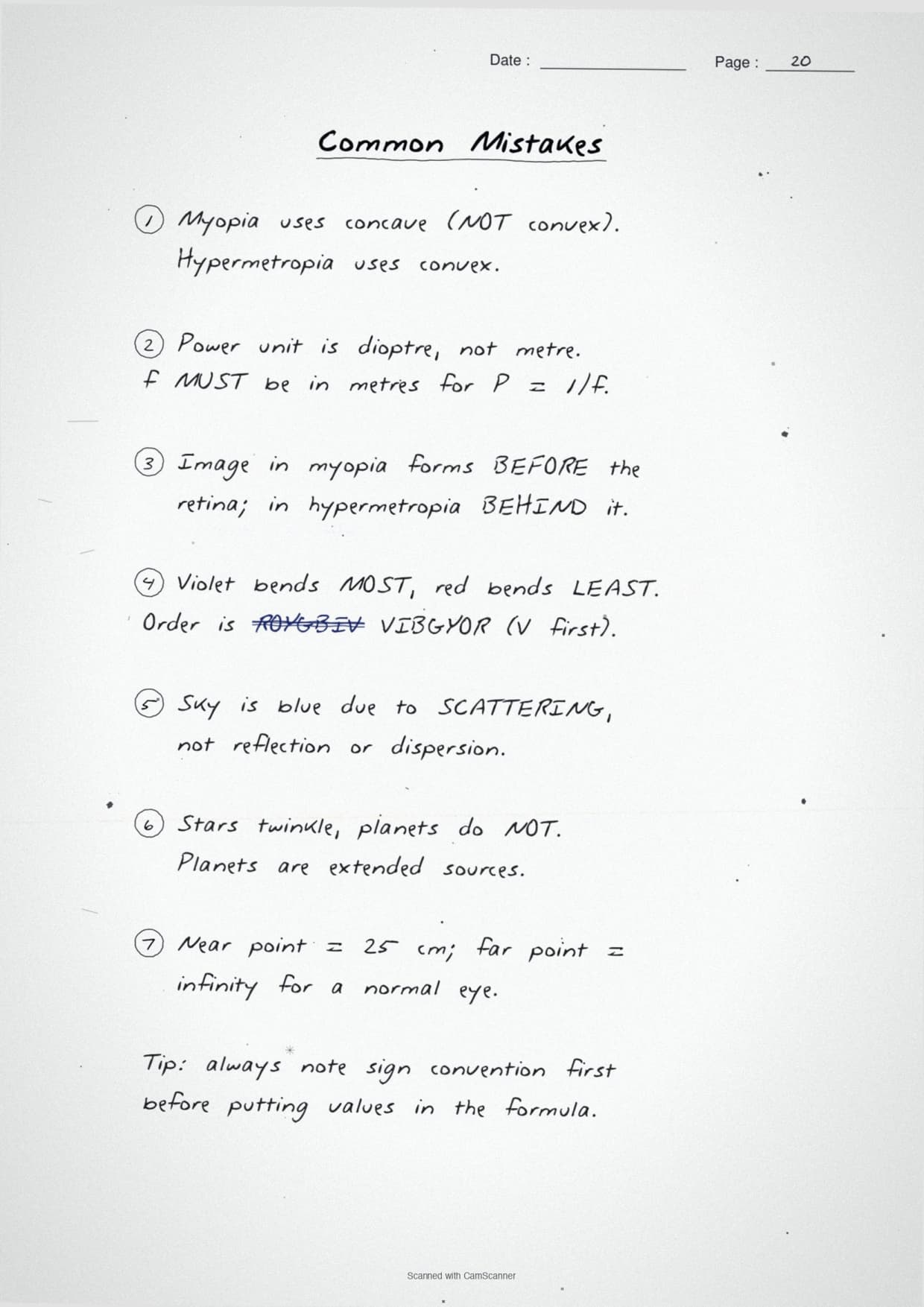
A few errors cost marks every year, mostly from swapping the lenses or giving the wrong reason. The notes flag each soft point in the margin.
- Using a convex lens for myopia. Myopia needs a concave lens; hypermetropia a convex lens.
- Saying the retinal image is virtual and erect. It is real and inverted; the brain reads it upright.
- Writing that the eye lens does most of the bending. The cornea does most; the lens fine-tunes.
- Saying the sky is blue because blue is reflected. It is blue because blue light is scattered the most.
- Confusing presbyopia (bifocal lens) with cataract (surgery only).
Fixing these five points moves most students from average to high marks. The exam rewards exact reasons and the right lens, so always name the defect, state its cause and give the corrective lens.
How These Notes Pair with the Solutions and Book PDF
To prepare fully, use these notes with the other resources for this chapter, linked below.
| Resource | Best used for |
|---|---|
| The Human Eye and the Colourful World NCERT Solutions | Step-by-step answers for every question |
| The Human Eye and the Colourful World Class 10 Notes | Quick typed summary in one place |
| The Human Eye and the Colourful World Formula Sheet | One-page quick reference |
| The Human Eye and the Colourful World NCERT Book PDF | The original NCERT chapter text |
Tip: redraw the myopia and hypermetropia correction diagrams from memory, then write the cause and corrective lens beside each.
All Class 10 Science Handwritten Notes by Chapter
The table links the handwritten notes for every Class 10 Science chapter. The Human Eye and the Colourful World is highlighted.
| Chapter | Handwritten Notes |
|---|---|
| Chapter 1 | Chemical Reactions and Equations |
| Chapter 2 | Acids, Bases and Salts |
| Chapter 3 | Metals and Non-metals |
| Chapter 4 | Carbon and its Compounds |
| Chapter 5 | Life Processes |
| Chapter 6 | Control and Coordination |
| Chapter 7 | How do Organisms Reproduce? |
| Chapter 8 | Heredity |
| Chapter 9 | Light - Reflection and Refraction |
| Chapter 10 | The Human Eye and the Colourful World |
| Chapter 11 | Electricity |
| Chapter 12 | Magnetic Effects of Electric Current |
| Chapter 13 | Our Environment |
FAQs on The Human Eye and the Colourful World Handwritten Notes
The Human Eye and the Colourful World Class 10 Science Handwritten Notes Common Questions
Ques. Are these class 10 science chapter 10 The Human Eye and the Colourful World handwritten notes free to download?
Ans. Yes. The The Human Eye and the Colourful World handwritten notes are free to download as a PDF from this page. They follow the 2026-27 NCERT syllabus and cover the full chapter across 21 scanned, hand-drawn-diagram pages for quick revision.
Ques. What does Chapter 10 The Human Eye and the Colourful World cover in Class 10 Science?
Ans. The notes cover the parts of the human eye, the power of accommodation, the near point and far point, the three defects of vision (myopia, hypermetropia and presbyopia) with their correction, dispersion of light through a glass prism, the formation of a rainbow, atmospheric refraction, and the scattering of light, all of which the CBSE board paper tests directly.
Ques. Which lens is used to correct myopia and hypermetropia?
Ans. Myopia, or short-sightedness, is corrected with a concave (diverging) lens because the image forms in front of the retina. Hypermetropia, or long-sightedness, is corrected with a convex (converging) lens because the image forms behind the retina. Presbyopia, the old-age defect, is corrected with a bifocal lens that combines both.
Ques. Why is the sky blue and why does the Sun look red at sunrise and sunset?
Ans. The sky is blue because air molecules scatter the shorter blue light far more than red light, so blue reaches our eyes from all directions. At sunrise and sunset the sunlight travels a long path through the air, so most of the blue is scattered away and mainly red light reaches us, which makes the Sun look red.
Ques. Are these notes enough for the class 10 science chapter 10 board exam?
Ans. They are a strong final revision layer. For full preparation, pair them with the NCERT Solutions linked on this page so you can write out complete answers, draw the defect-correction ray diagrams and give the correct reasons for every in-text and back-exercise question and check them against model answers.



Comments