



Inside the handwritten notes for Class 11 English Hornbill Chapter 13, Summarising, you will find the note-making-versus-summarising distinction explained in one place, the fully worked soybean passage redrafted stage by stage, and the Green Sahara practice passage laid out for revision, all according to the latest 2026-27 CBSE syllabus.
- Board Weightage: summarising is tested as a 10-mark writing-skill question, often paired with note-making in the same paper.
- Question Types: an unseen passage of about 200-250 words, to be summarised into connected prose within a fixed word limit.
- 2026-27 NCERT: Summarising stays unchanged in the rationalised Hornbill Writing Skills section.








Every page in these Summarising notes is written by hand, checked against the 2026-27 Class 11 Hornbill print, and matched to the exact word-limit format CBSE board papers expect.
You will find the full soybean worked example across all three drafting stages, the complete Green Sahara practice passage, and a ready list of common mistakes inside this 23-page set, all according to the latest 2026-27 CBSE syllabus.
|
Table of Contents |
Summarising vs Note-Making: How the Two Writing Skills Differ
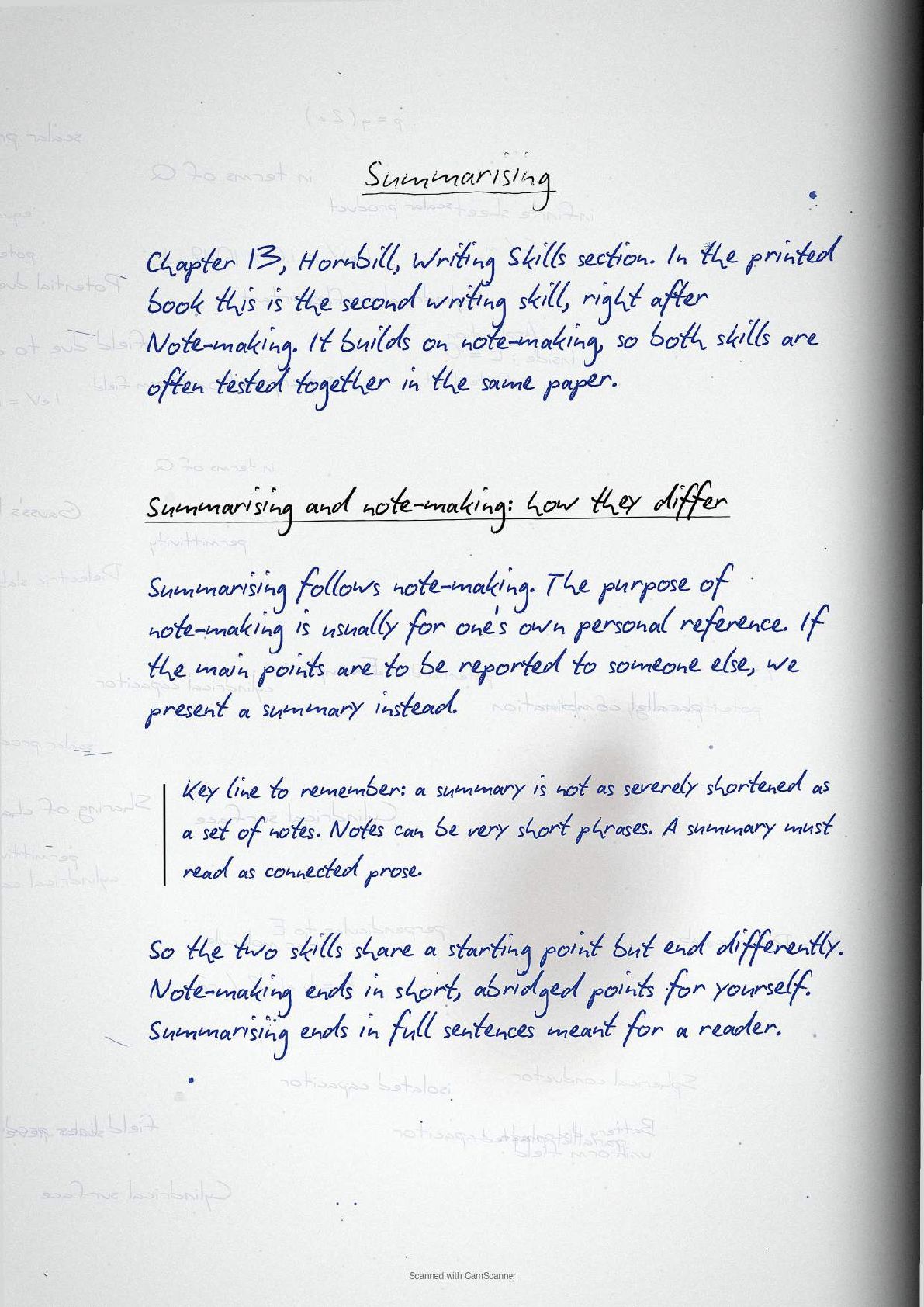
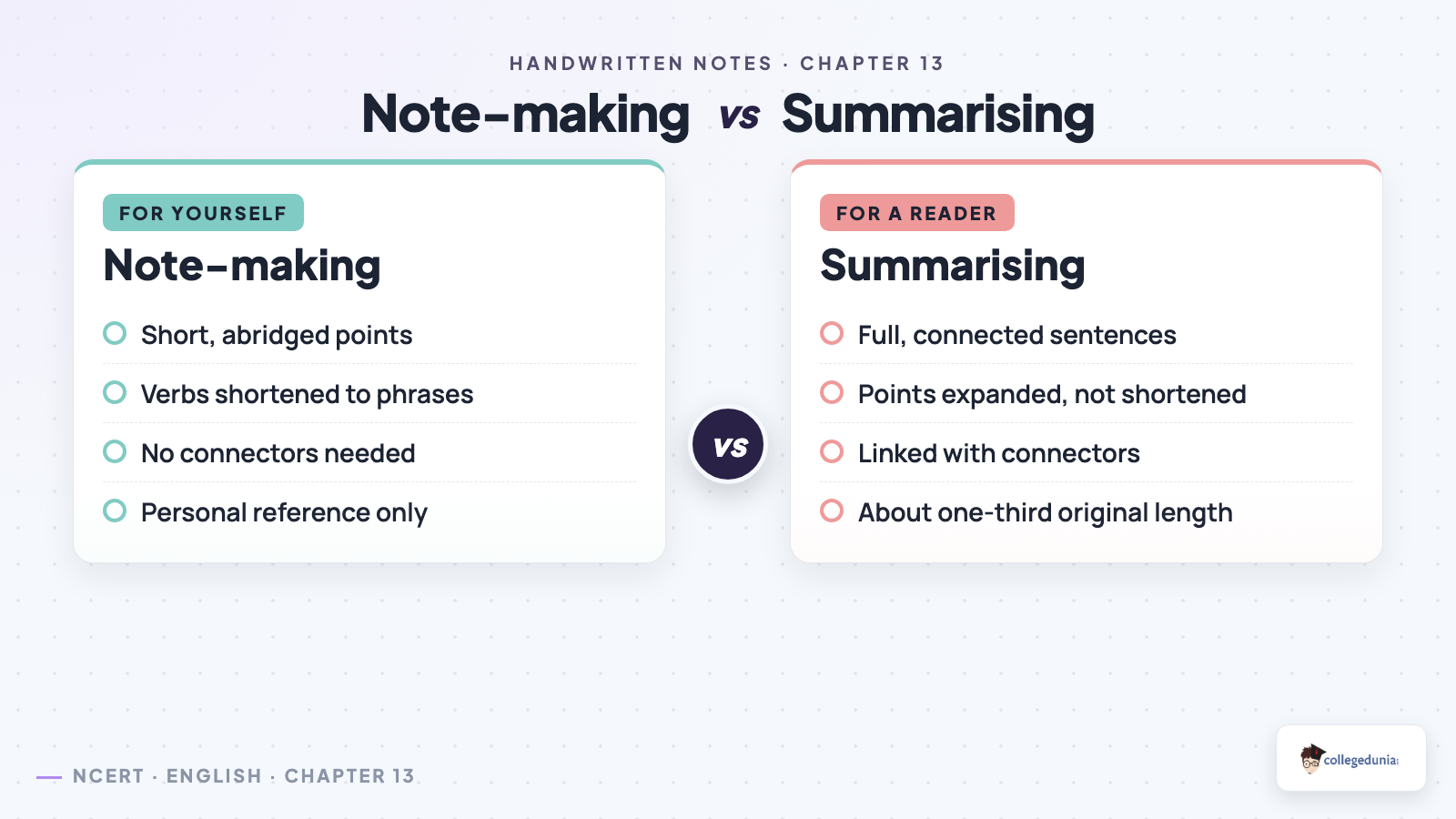
Summarising comes right after Note-making in the Hornbill Writing Skills section, and it builds directly on that skill. Note-making is written for your own personal reference; a summary is written to be read by someone else. That single difference decides how each one is written.
- Note-making ends in short, abridged points, often single words or phrases.
- Summarising ends in full sentences, linked with connectors, meant for a reader.
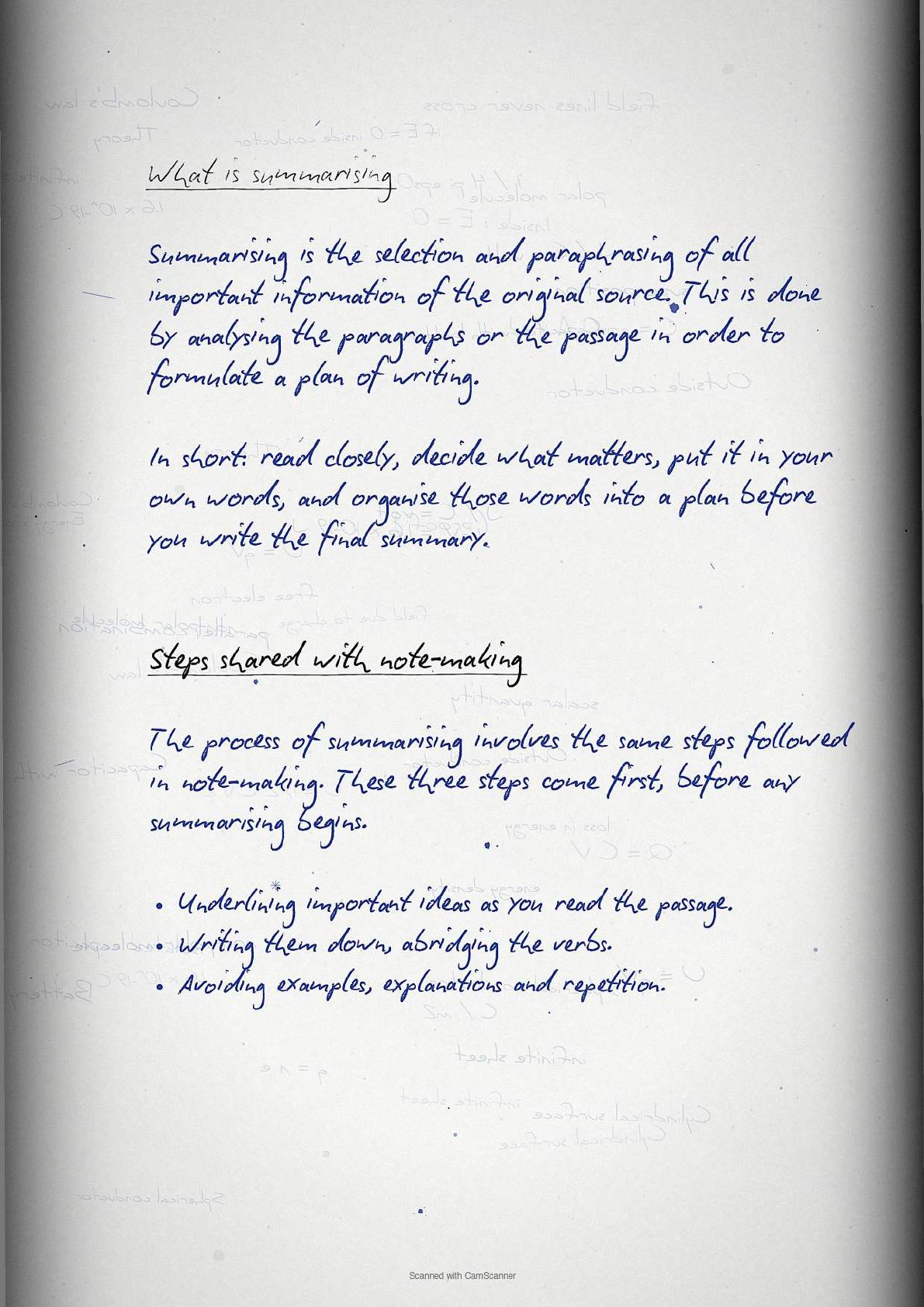
- Both skills start with the same first step: read the passage and underline the important ideas.
Summarising Explained in Simple Language
Source: Next Toppers on YouTube
What Is Summarising and Why Class 11 Students Need It
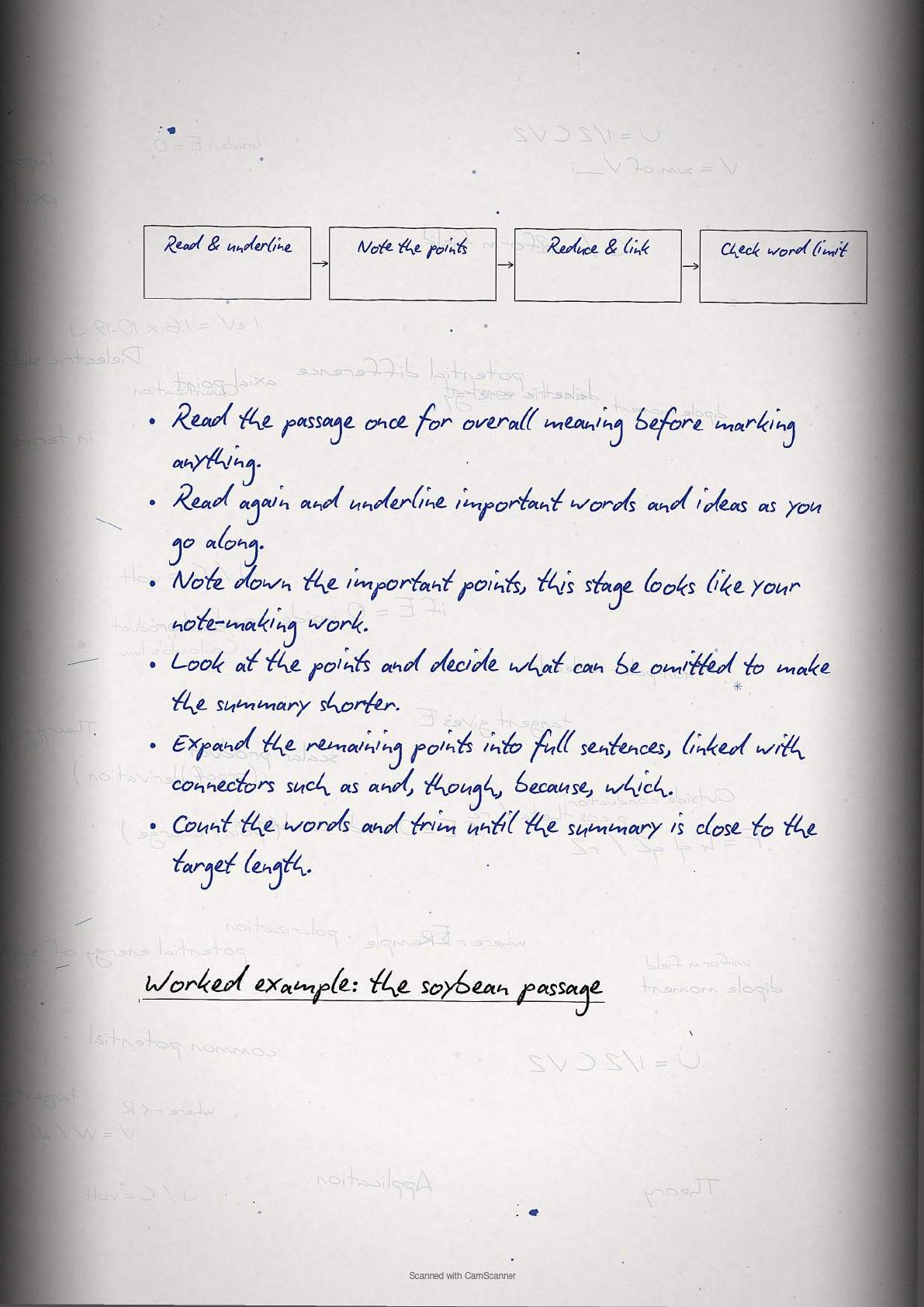
Summarising is the selection and paraphrasing of all the important information in a passage. You read closely, decide what matters, put it in your own words, and organise those words into a plan before you write the final summary.
- Read once for overall meaning. Do not mark anything on the first read.
- Read again and underline. Mark the important words and ideas as you go.
- Note down the points. This stage looks exactly like note-making.
- Decide what to omit. Cut examples, explanations and repeated points.
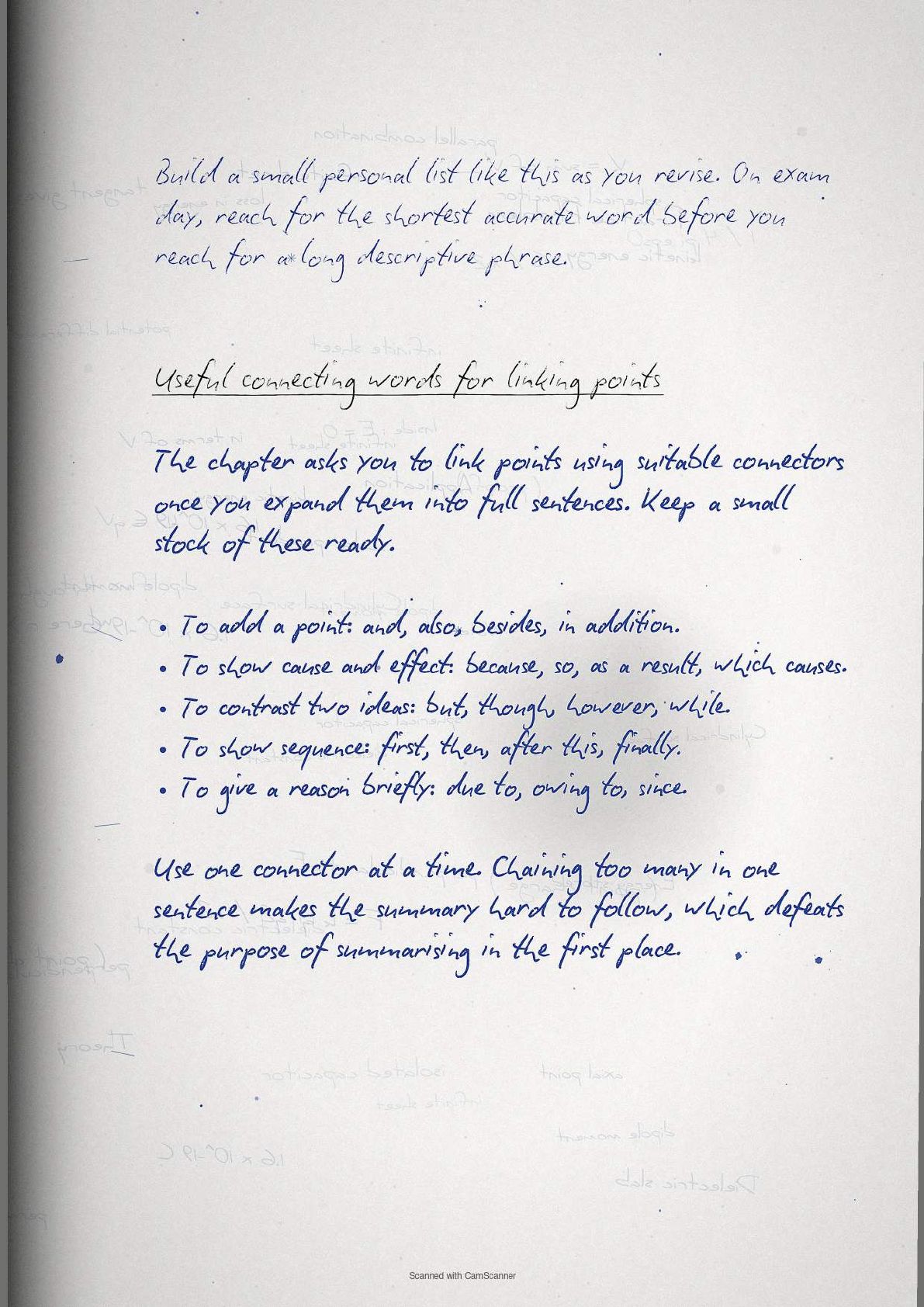
- Expand into full sentences. Link the remaining points with connectors such as and, though, because, which.
- Count the words and trim. Keep cutting until the summary is close to the target length.
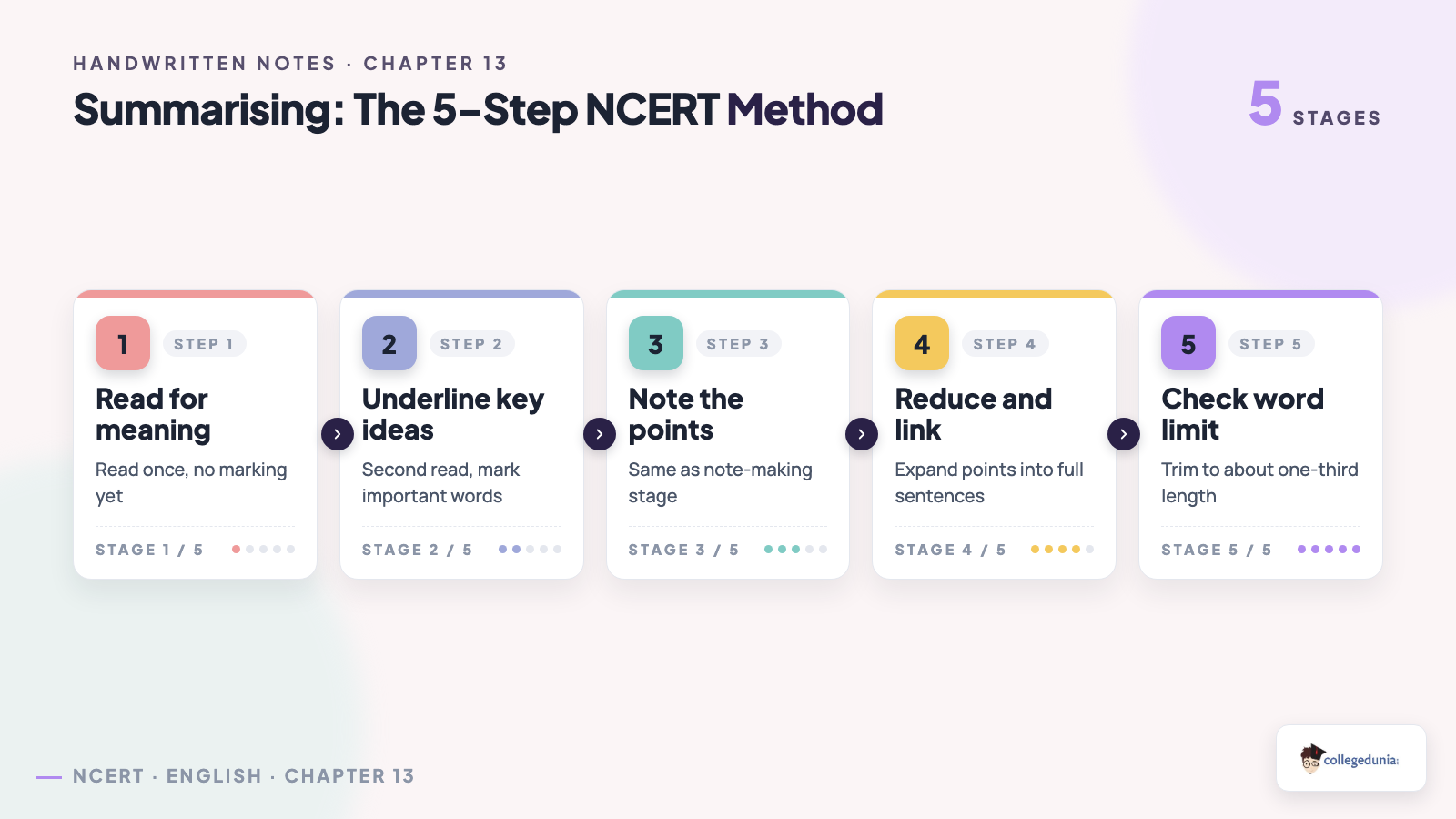
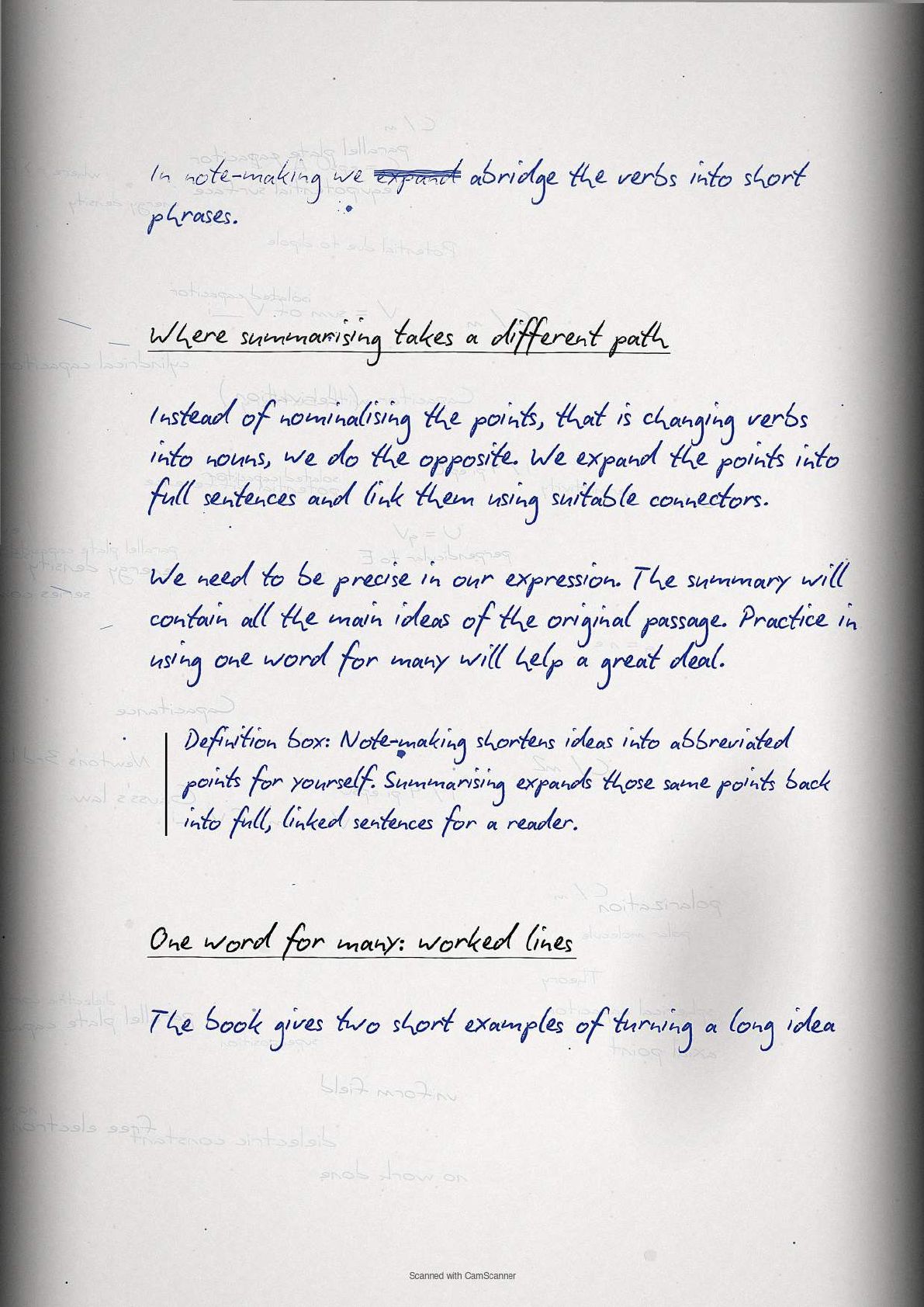
Where note-making abridges verbs into short phrases, summarising does the opposite: it expands the same points back into full, linked sentences for a reader.
One Word for Many: Paraphrasing Practice from the Chapter
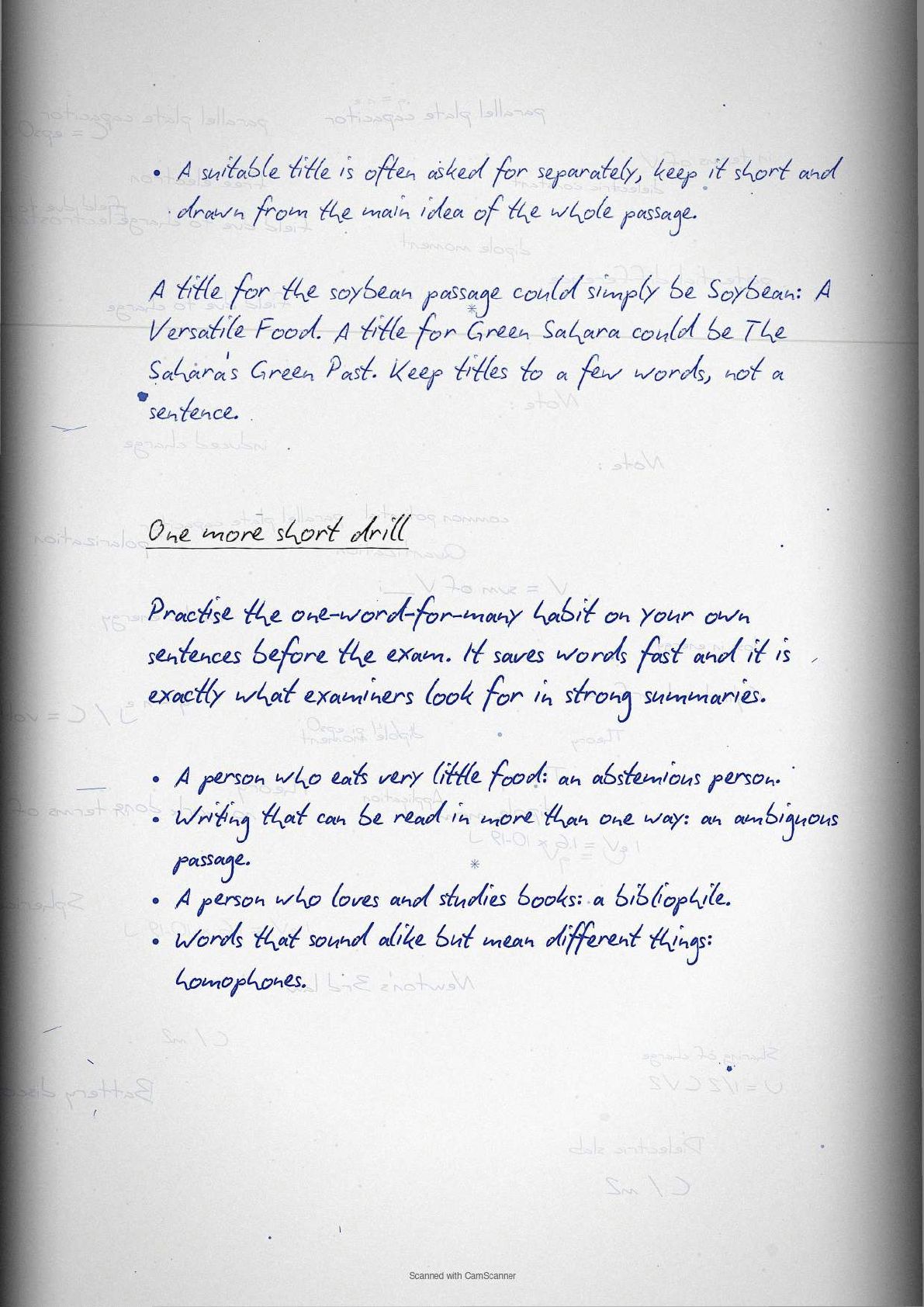
Before the worked example, the chapter gives two short lines that show how a long descriptive sentence collapses into a single precise word. These two lines are asked directly in exams, so they are worth learning by heart.
| Long Sentence | One Word / Phrase |
|---|---|
| Children who show intelligence far beyond their age often turn out to be mediocre in adult life. | Precocious children often turn out to be mediocre in adult life. |
| Her genius was marked by excellence in the various arts, languages and science. | She was a versatile genius. |
This is the heart of paraphrasing: replace a long descriptive clause with one well-chosen word, without losing the meaning.
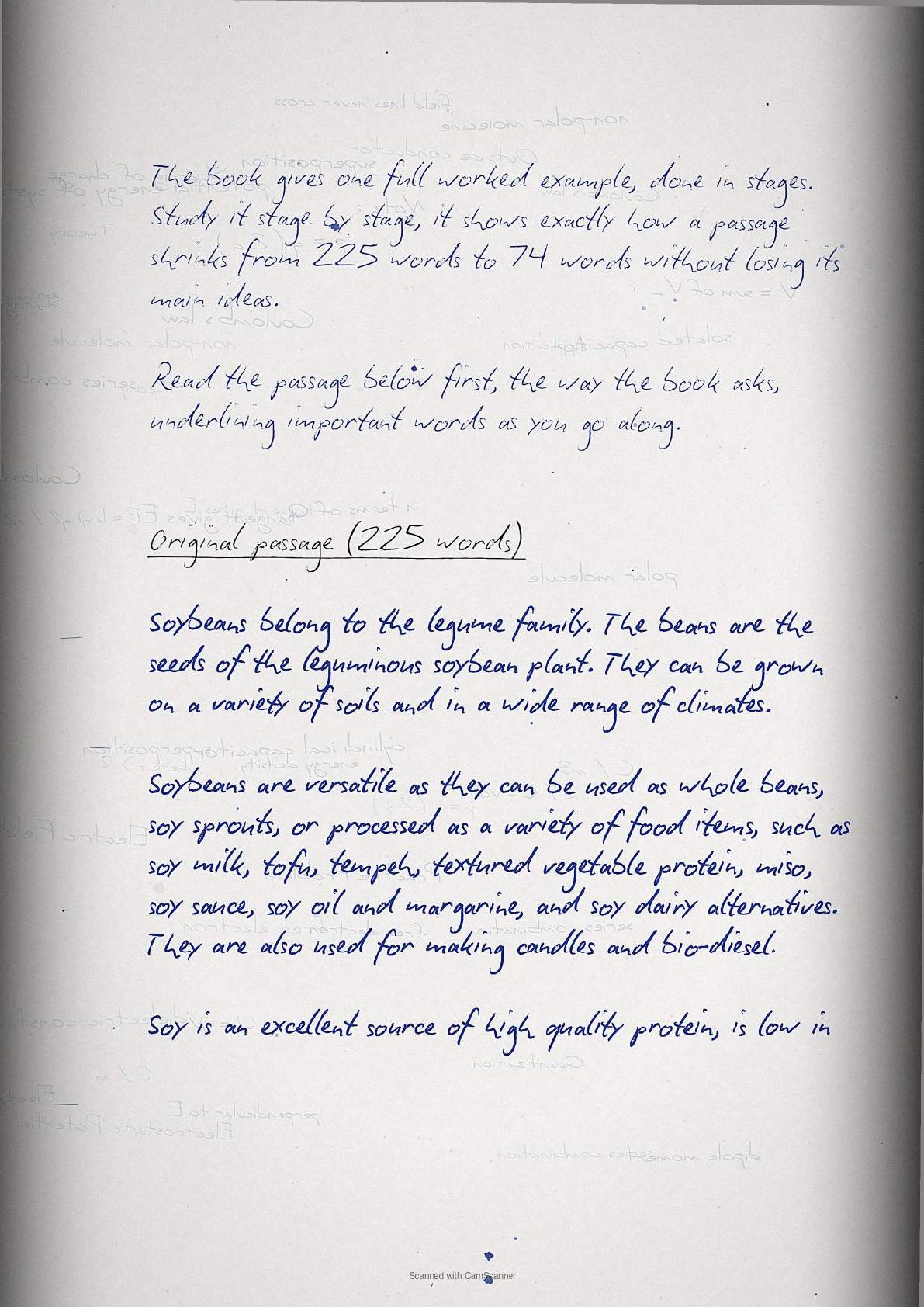
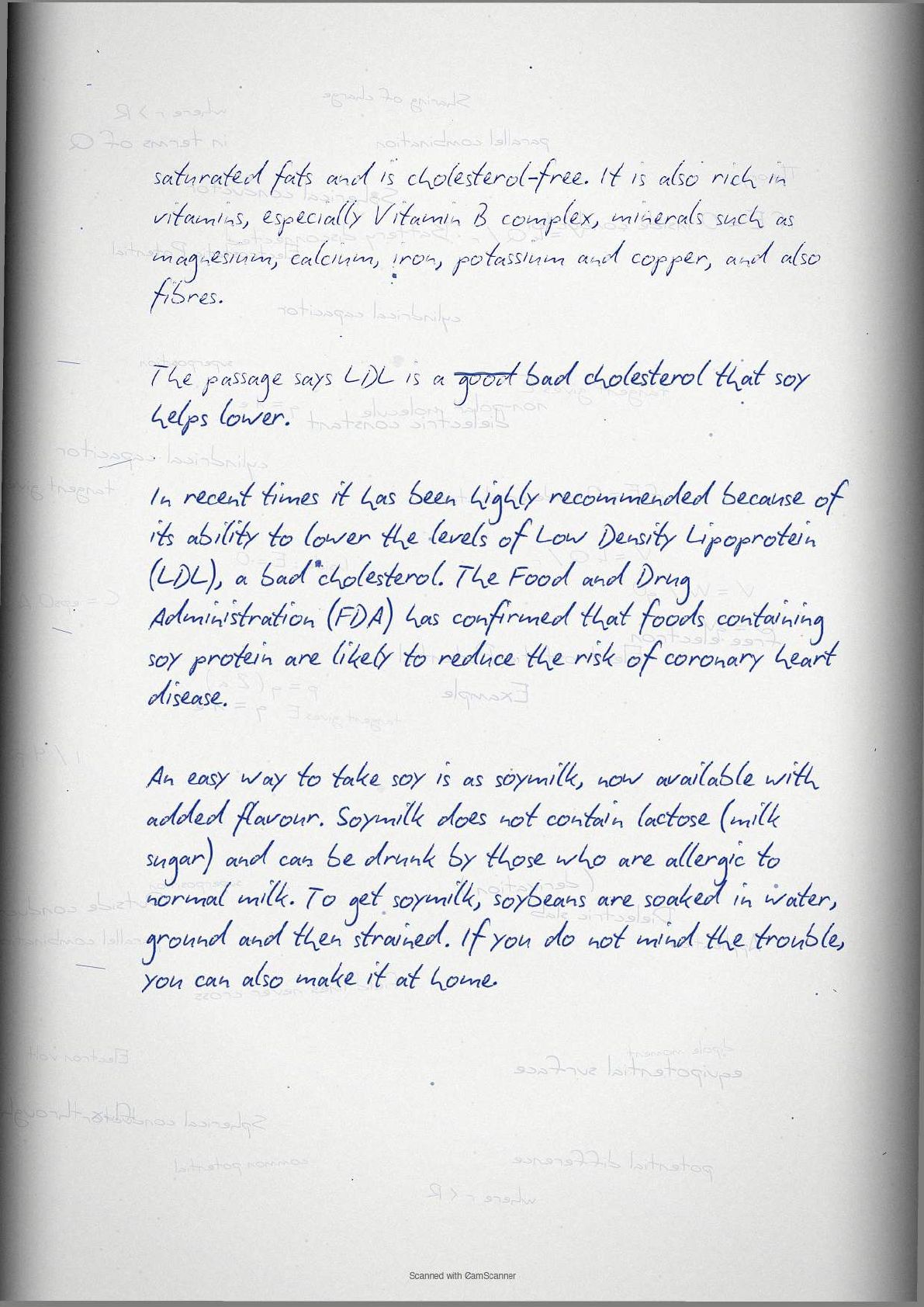
Worked Example: The Soybean Passage from 225 to 74 Words
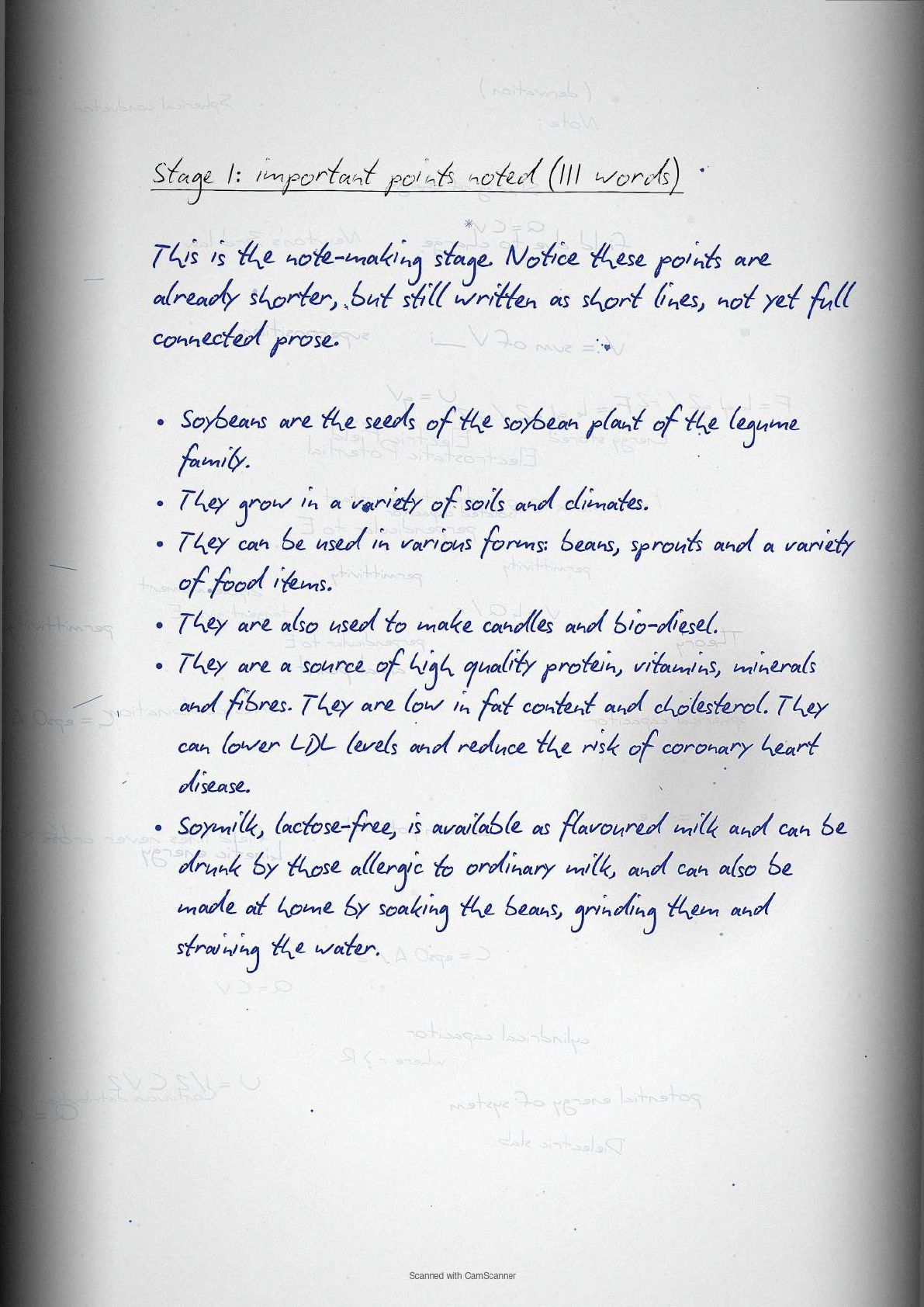
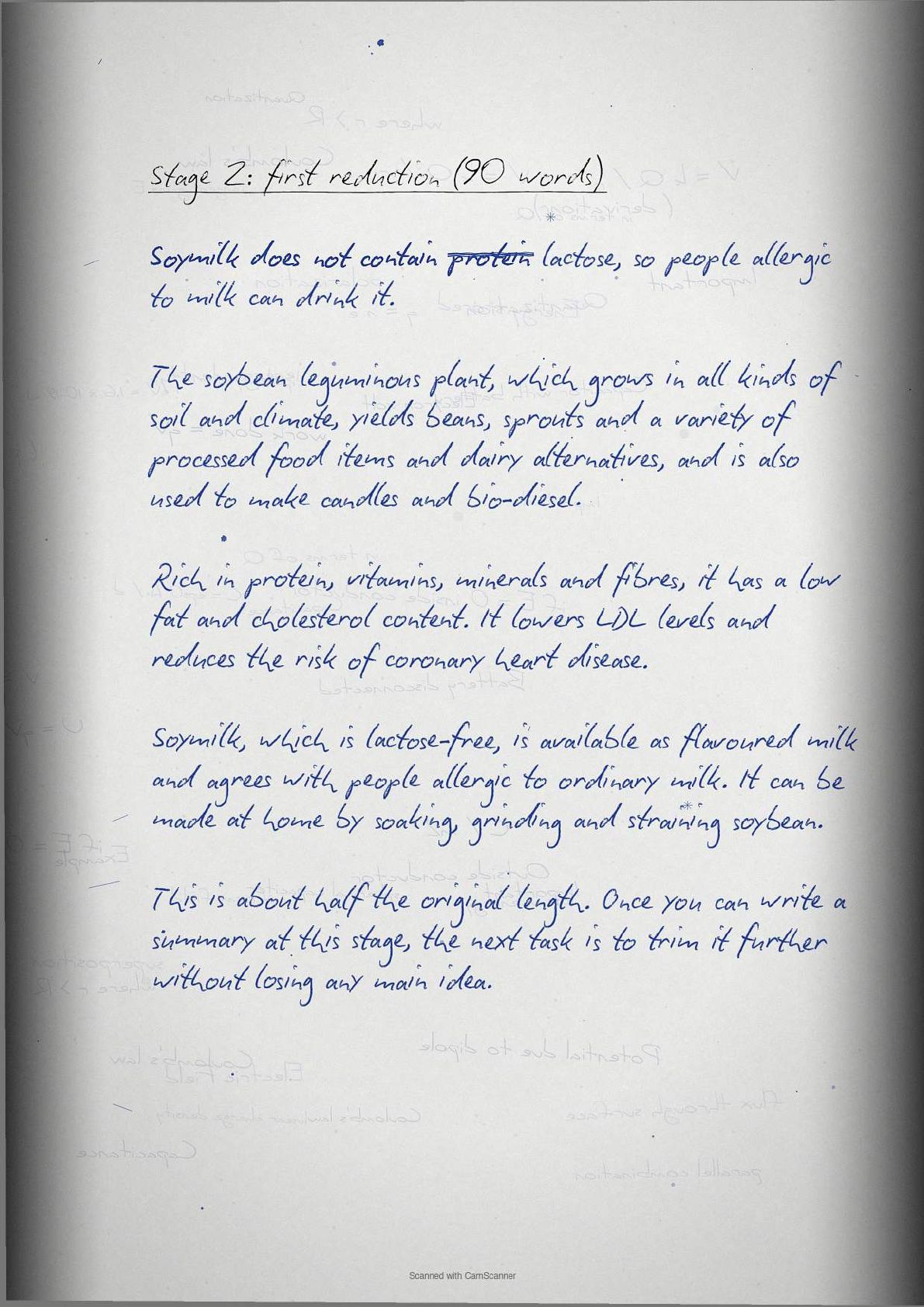
The chapter's one full worked example is done in stages, and it shows exactly how a passage shrinks from 225 words down to about 72-74 words without losing its main ideas. The handwritten notes copy out every stage by hand, line by line.
| Stage | Word Count | What Happens at This Stage |
|---|---|---|
| Original passage | 225 words | The full soybean passage, five paragraphs on the plant, its uses, its nutrition and soymilk. |
| Stage 1: notes | 111 words | Important points noted down as short lines, the same way you would for note-making. |
| Stage 2: first reduction | 90 words | Points expanded into linked sentences, about half the original length. |
| Stage 3: final summary | 72 to 74 words | Tightened further using apposition, participles and dropped opening phrases, with every main idea still intact. |
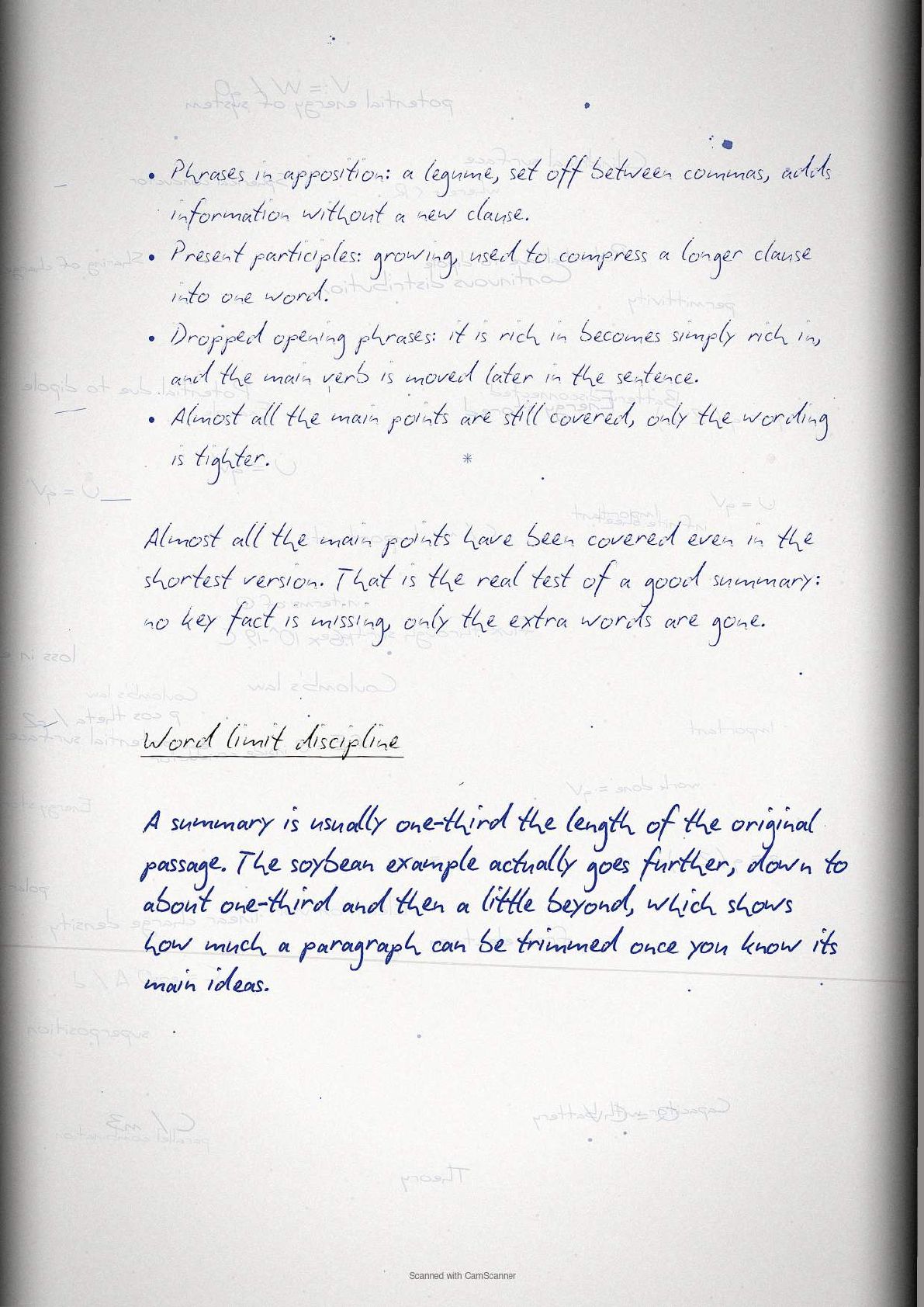
Almost all the main points are still covered even in the shortest version. That is the real test of a good summary: no key fact is missing, only the extra words are gone.
Techniques That Shrink a Summary Without Losing Meaning
The soybean example's final stage is shorter than Stage 2 because of three specific techniques, not random cutting. Learn these tricks, they are reusable on any unseen passage.
- Phrases in apposition: a word or phrase set off between commas ("soybean, a legume,") adds information without a new clause.
- Present participles: words like growing or used compress a longer clause into one word.
- Dropped opening phrases: "it is rich in" becomes simply "rich in," with the main verb moved later in the sentence.
The One-Third-Length Rule Every Summary Must Follow
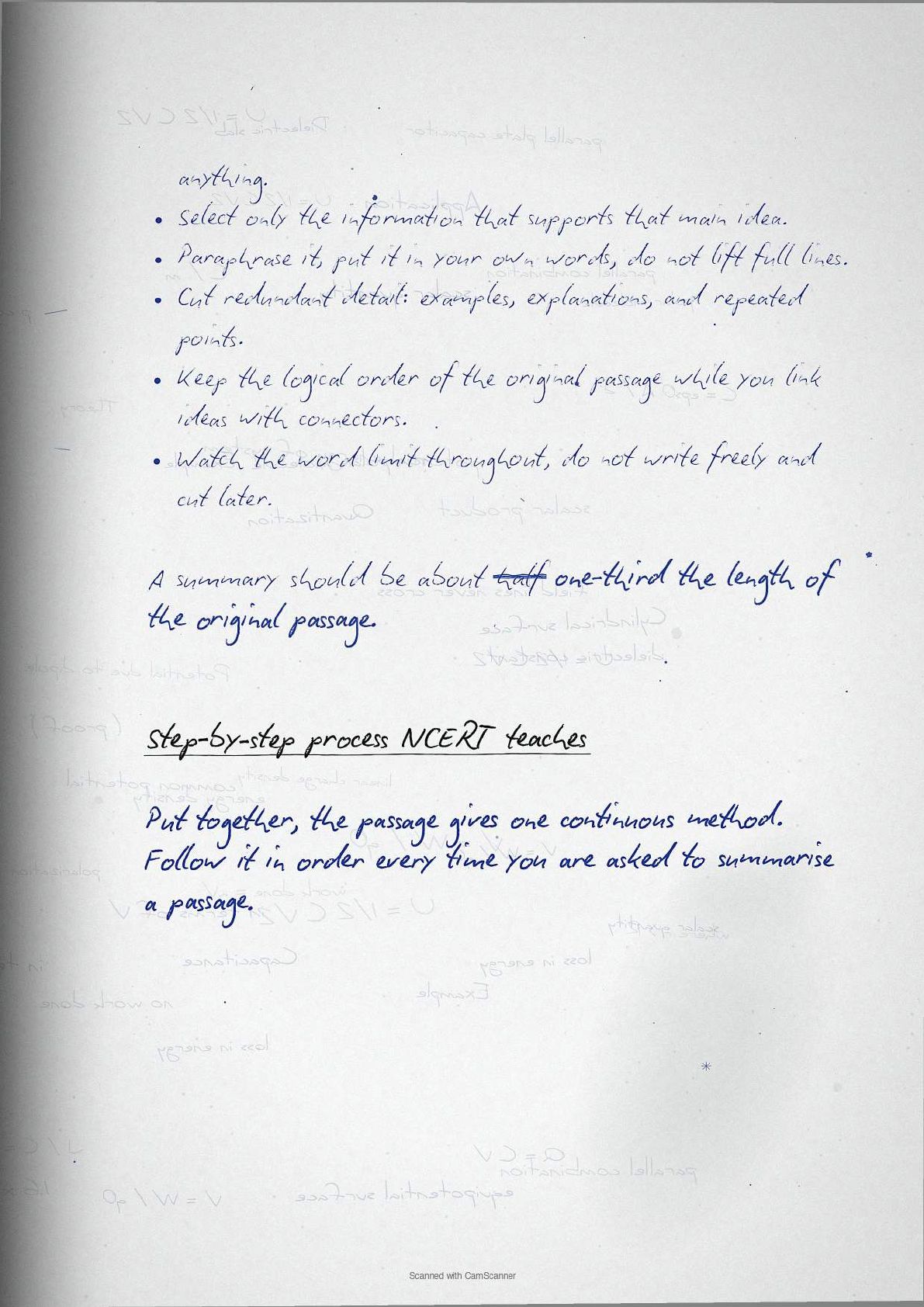
A summary is usually about one-third the length of the original passage, never half. The soybean example actually goes a little further than one-third, which shows how much a passage can be trimmed once you know its main ideas.
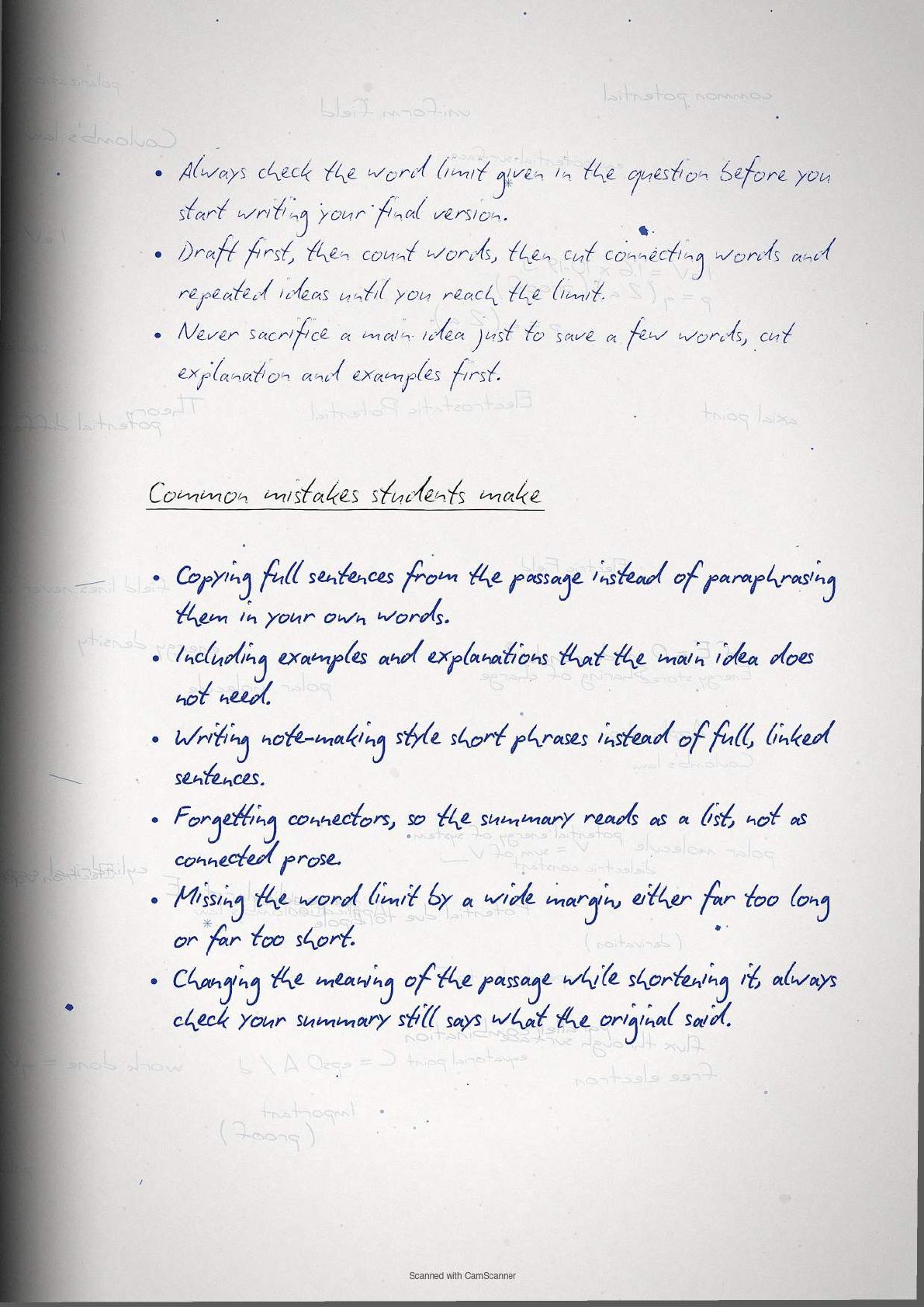
- Check the word limit given in the question before you start writing the final version.
- Draft first, then count words, then cut connecting words and repeated ideas until you reach the limit.
- Never drop a main idea just to save a few words, cut explanation and examples first.
NCERT Exercise: Green Sahara Practice Passage
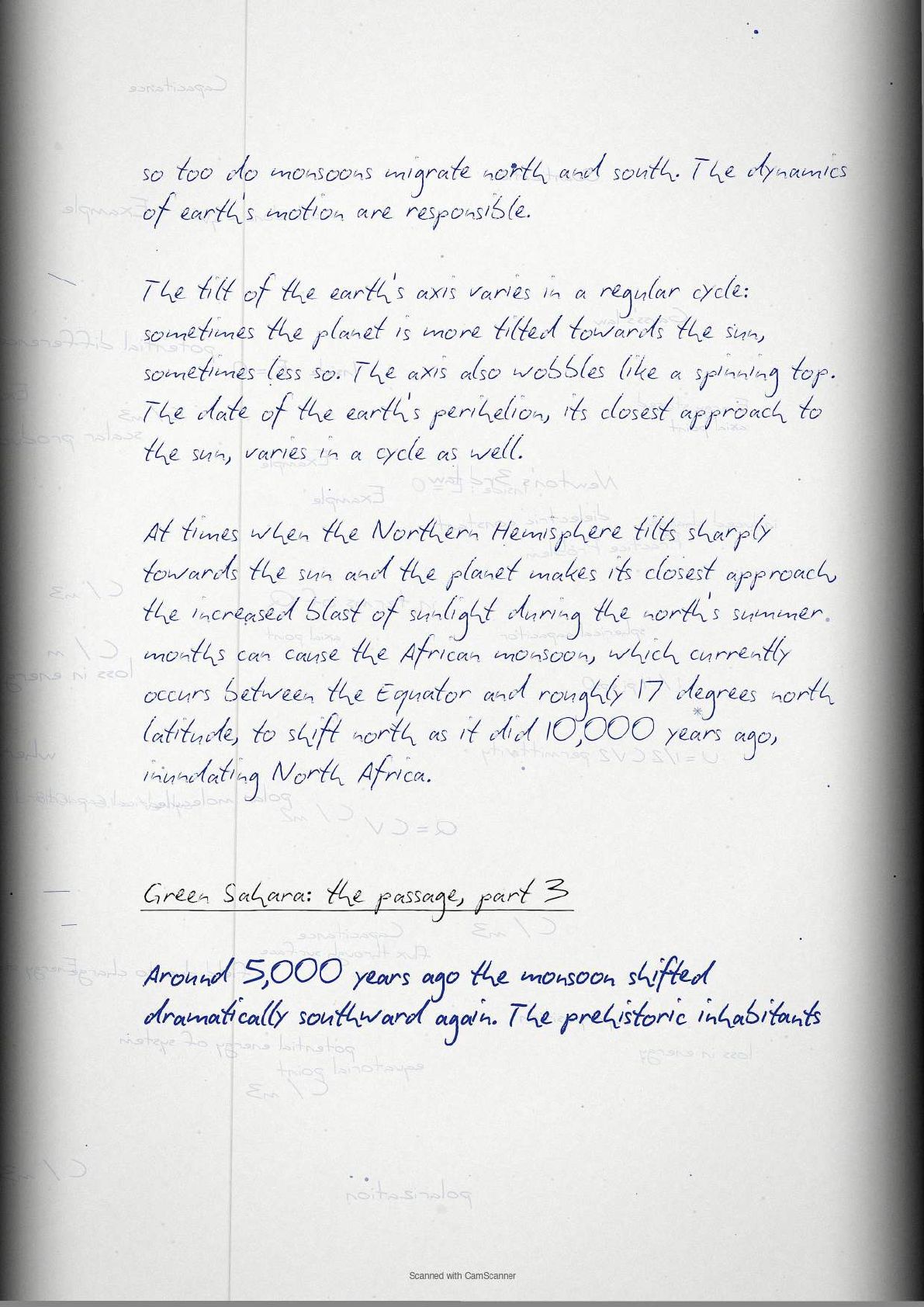
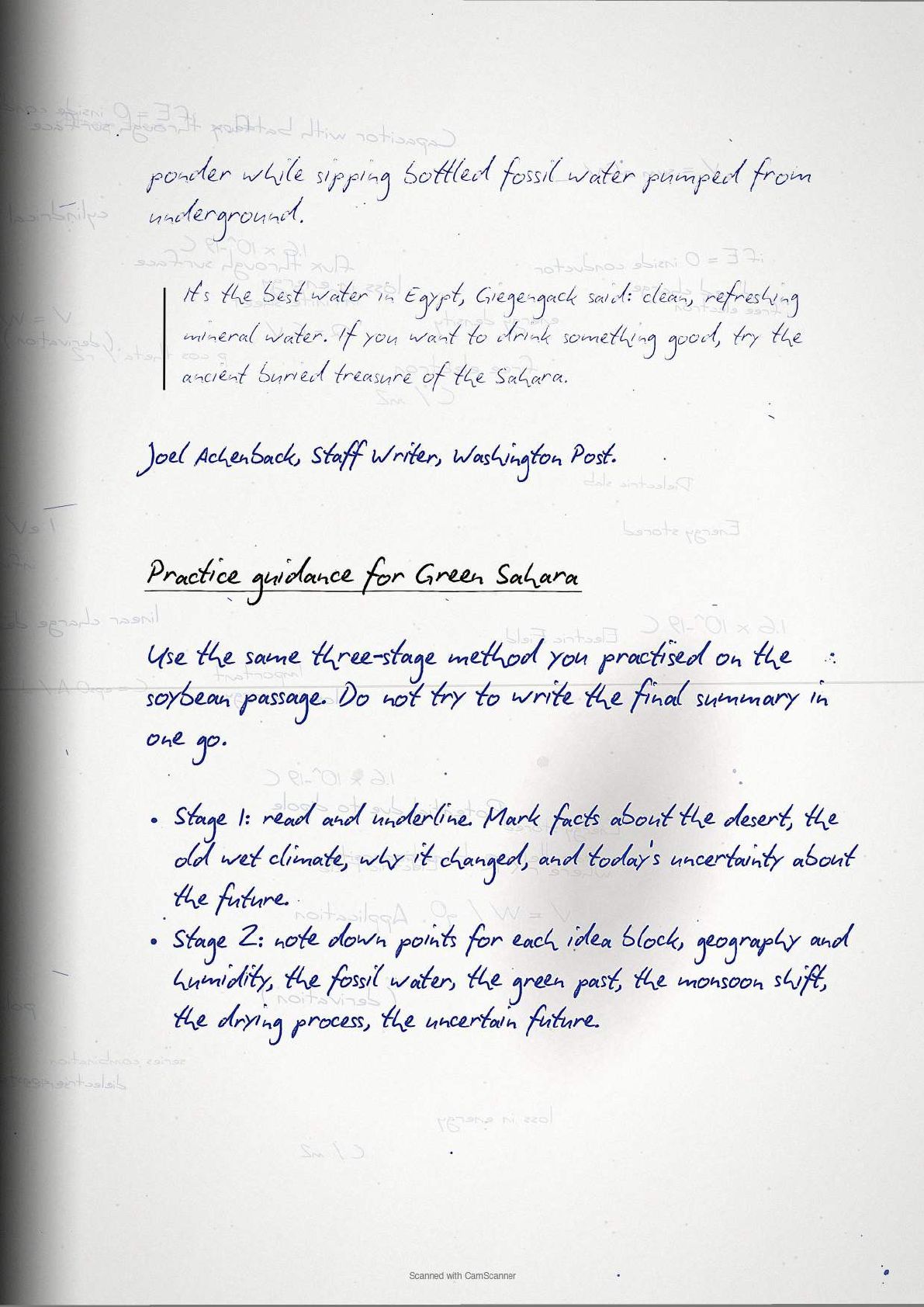
The chapter's practice passage is titled "Green Sahara: The Great Desert Where Hippos Once Wallowed." The instruction NCERT gives is simple: read the text and summarise it using the same method as the soybean example.
- Read once for overall meaning, then read again underlining important words.
- Note the points the way you would for note-making, before expanding them into prose.
- Write a linked summary and check it stays within your word limit.
The handwritten notes carry the complete Green Sahara passage plus guided practice notes, so students can attempt their own summary before checking the working shown in the PDF.
Common Mistakes Students Make While Summarising
Watch out for these:
- Copying full sentences from the passage instead of paraphrasing them in your own words.
- Writing note-making style short phrases instead of full, linked sentences.
- Forgetting connectors, so the summary reads as a list, not as connected prose.
- Missing the word limit by a wide margin, either far too long or far too short.
Copying sentences straight from the passage or writing note-style fragments instead of connected prose costs marks every year.
Student Feedback: In a Collegedunia survey of 10,620 Class 11 students conducted before the 2026 boards, 58% said keeping the summary within the one-third word limit was harder than finding the main points.
Source: 2026-27 Class 11 English student poll. Sample of 10,620 students from CBSE schools across 12 states.
How These Handwritten Notes Help You Revise Summarising
The notes are built to be read once, right before the exam, without needing the full textbook open beside you.
- Full Worked Example: the soybean passage is copied out by hand at all three drafting stages, with word counts marked.
- Green Sahara Passage: the complete practice passage plus guided notes for your own attempt.
- One-Word-for-Many Lines: both paraphrasing examples explained so you can apply the same trick to new passages.
- Word-Limit Checklist: a ready reminder of the one-third rule and the most common mistakes to avoid.
Cross-Resource Study Material for Summarising
These handwritten notes work best alongside the other Class 11 English Hornbill Chapter 13 resources for the 2026-27 session.
| Resource | Status |
|---|---|
| Summarising Handwritten Notes | Live on this page |
| Note-making Handwritten Notes | Read the Notes |
| Summarising NCERT Solutions | Coming soon (coming soon) |
| Summarising Notes | Coming soon (coming soon) |
| Class 11 English NCERT Book PDF | Read the Book PDF |
NCERT Handwritten Notes for Class 11 English Hornbill: All Chapters
Use this table to find handwritten notes for the rest of the Hornbill chapters as Collegedunia adds them through the 2026-27 session.
| Chapter | Resource |
|---|---|
| Chapter 11 | Father to Son Handwritten Notes |
| Chapter 12 | Note-making Handwritten Notes |
| Chapter 13 | Summarising Handwritten Notes |
| Chapter 14 | Sub-titling Handwritten Notes (coming soon) |
| Chapter 15 | Essay-writing Handwritten Notes (coming soon) |
Summarising Class 11 English Handwritten Notes FAQs
Ques. Where can I download Summarising Class 11 English Handwritten Notes PDF?
Ans. You can download the Summarising Class 11 English Handwritten Notes PDF directly from this page. Both the Normal and HD versions are available, and both are free.
Ques. How is summarising different from note-making in Class 11 English?
Ans. Note-making shortens ideas into abbreviated points for your own reference. Summarising expands those same points back into full, connected sentences meant for a reader.
Ques. How long should a summary be in Class 11 English?
Ans. A summary is usually about one-third the length of the original passage. The chapter's soybean example goes from 225 words down to about 72 to 74 words.
Ques. What passage does NCERT use as the worked example in Chapter 13 Summarising?
Ans. The chapter uses the soybean passage as its fully worked example, shown across three stages from 225 words to 111 words to 90 words to about 74 words.
Ques. What is the Green Sahara passage used for in Chapter 13?
Ans. Green Sahara: The Great Desert Where Hippos Once Wallowed is the chapter's practice passage. Students are asked to summarise it using the same method shown in the soybean example.
Ques. Is this Handwritten Notes PDF aligned with the 2026-27 NCERT?
Ans. Yes. This page reflects the current 2026-27 syllabus for Class 11 English Hornbill. Summarising is unchanged in the rationalised syllabus.



Comments