




The Accounting for Share Capital class 12 accountancy handwritten notes from Collegedunia cover an 8-page share issue journal, forfeiture, and pro-rata allotment guide for the 2026-27 CBSE Accountancy Part B paper.
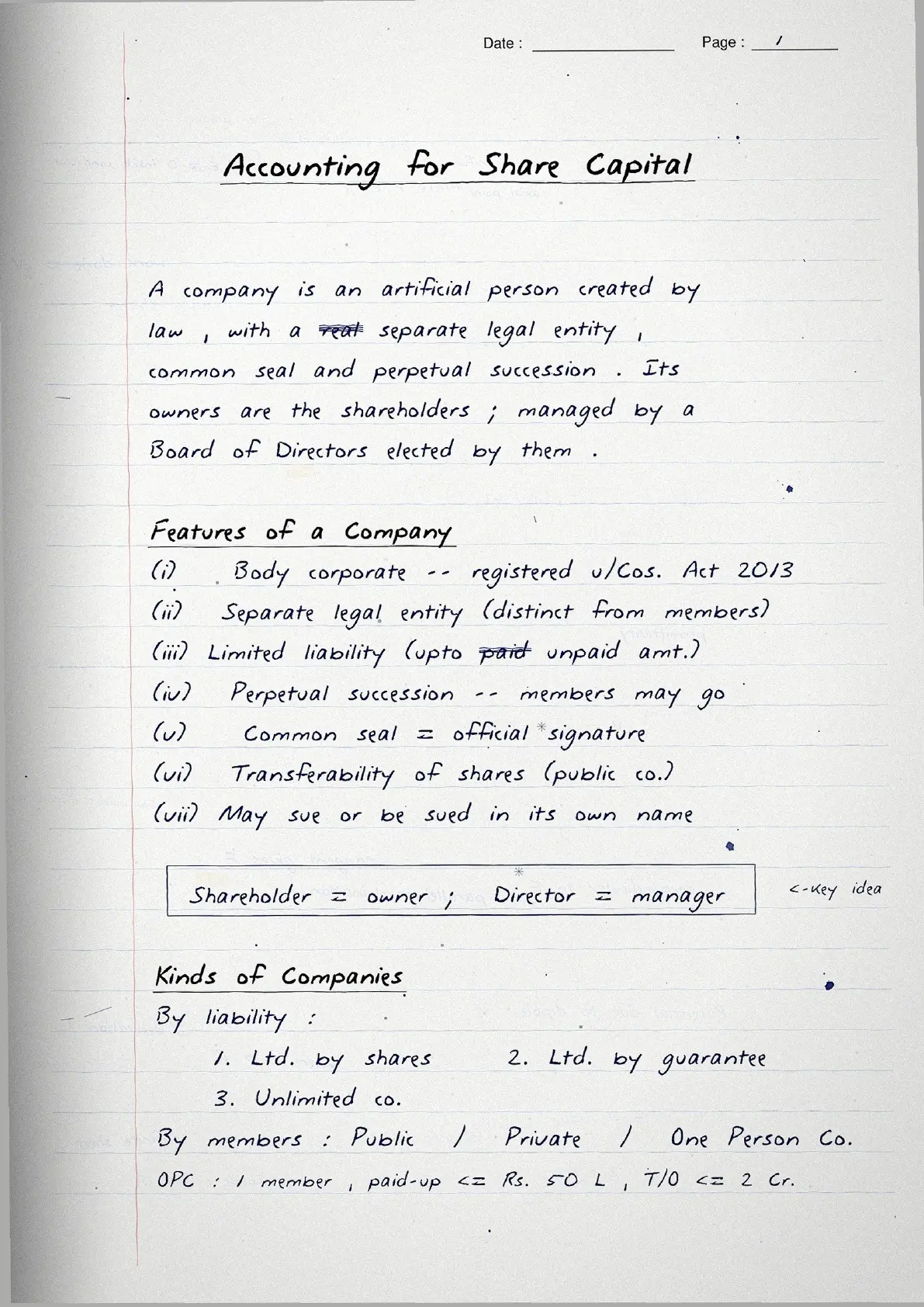
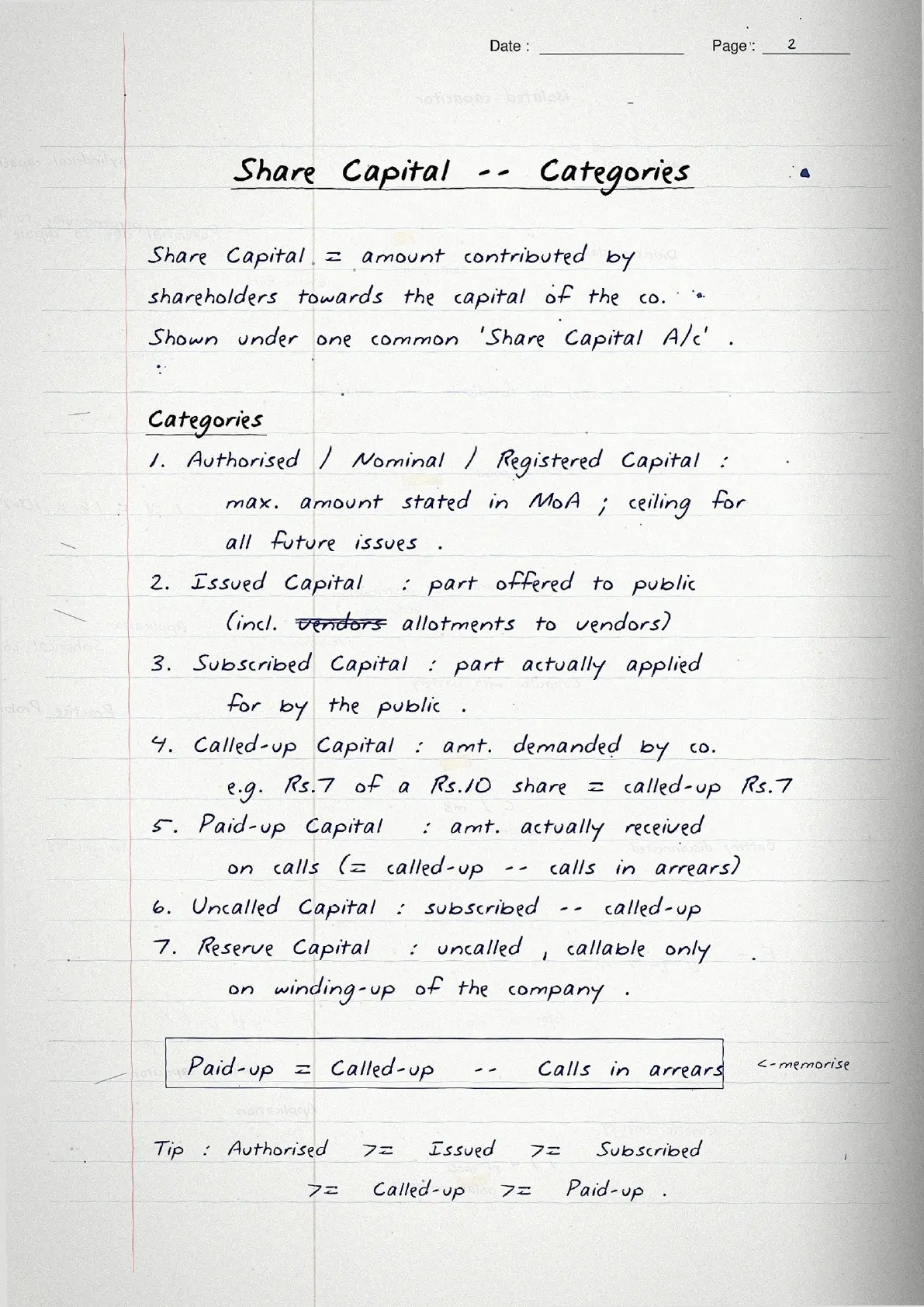
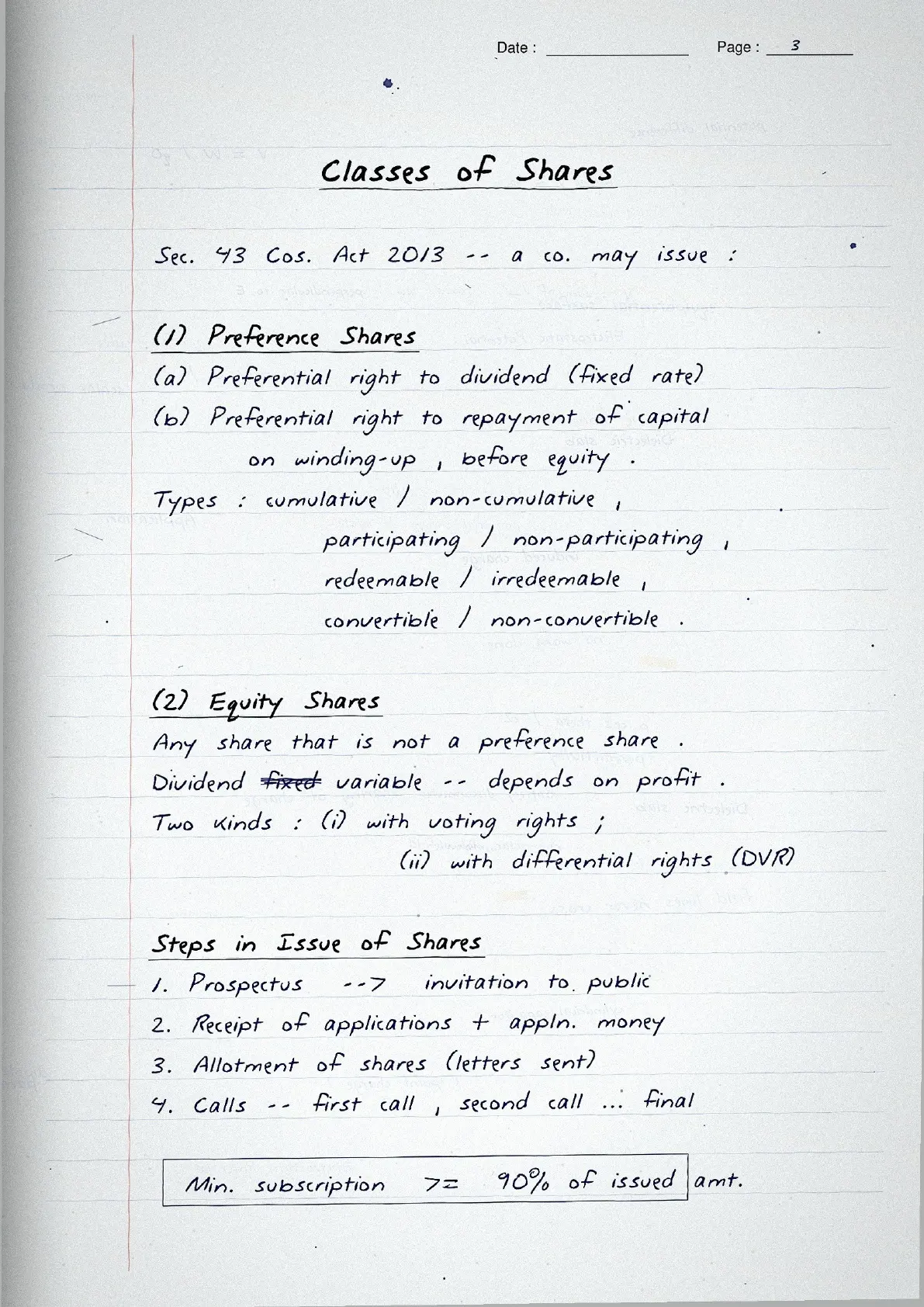
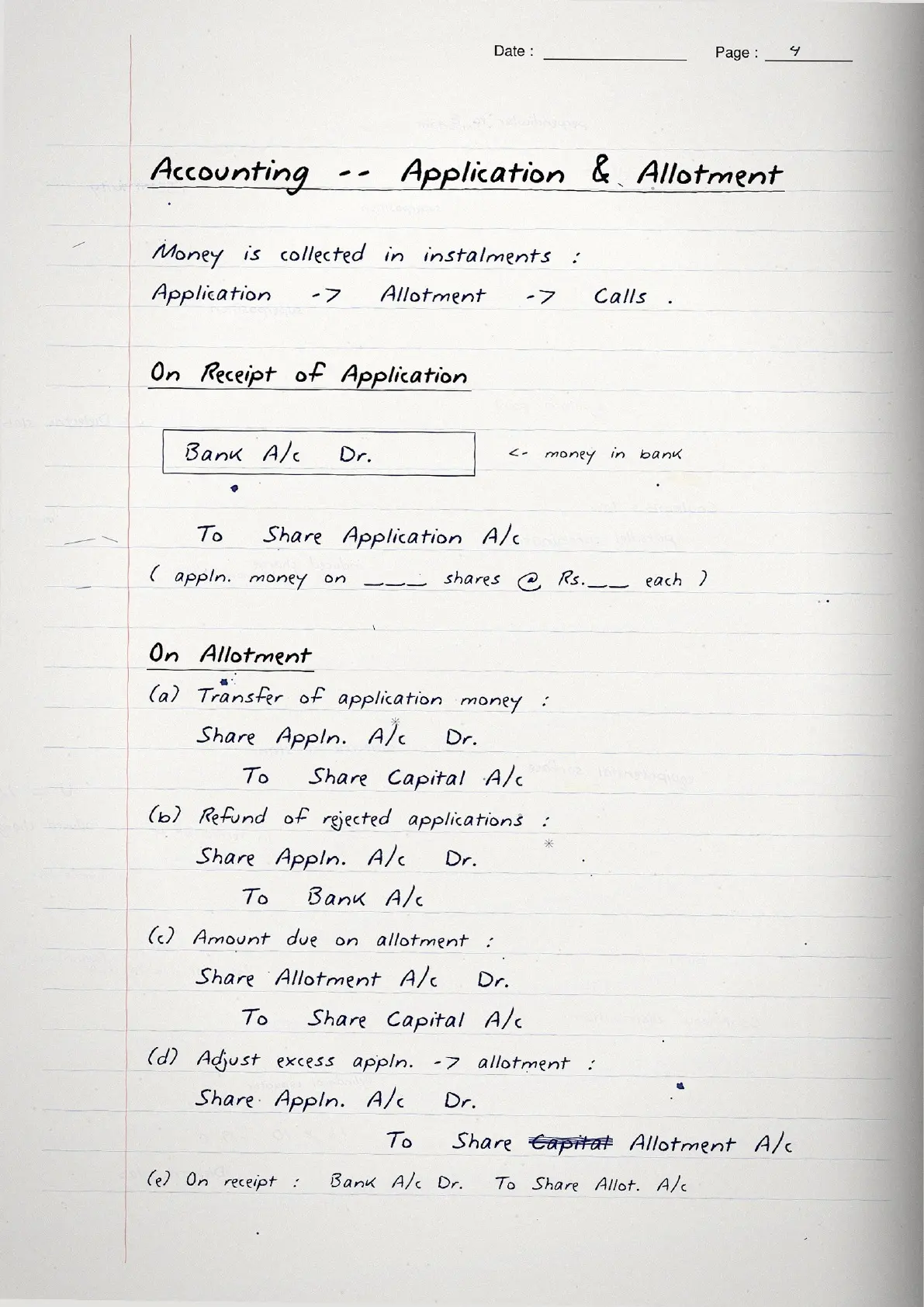
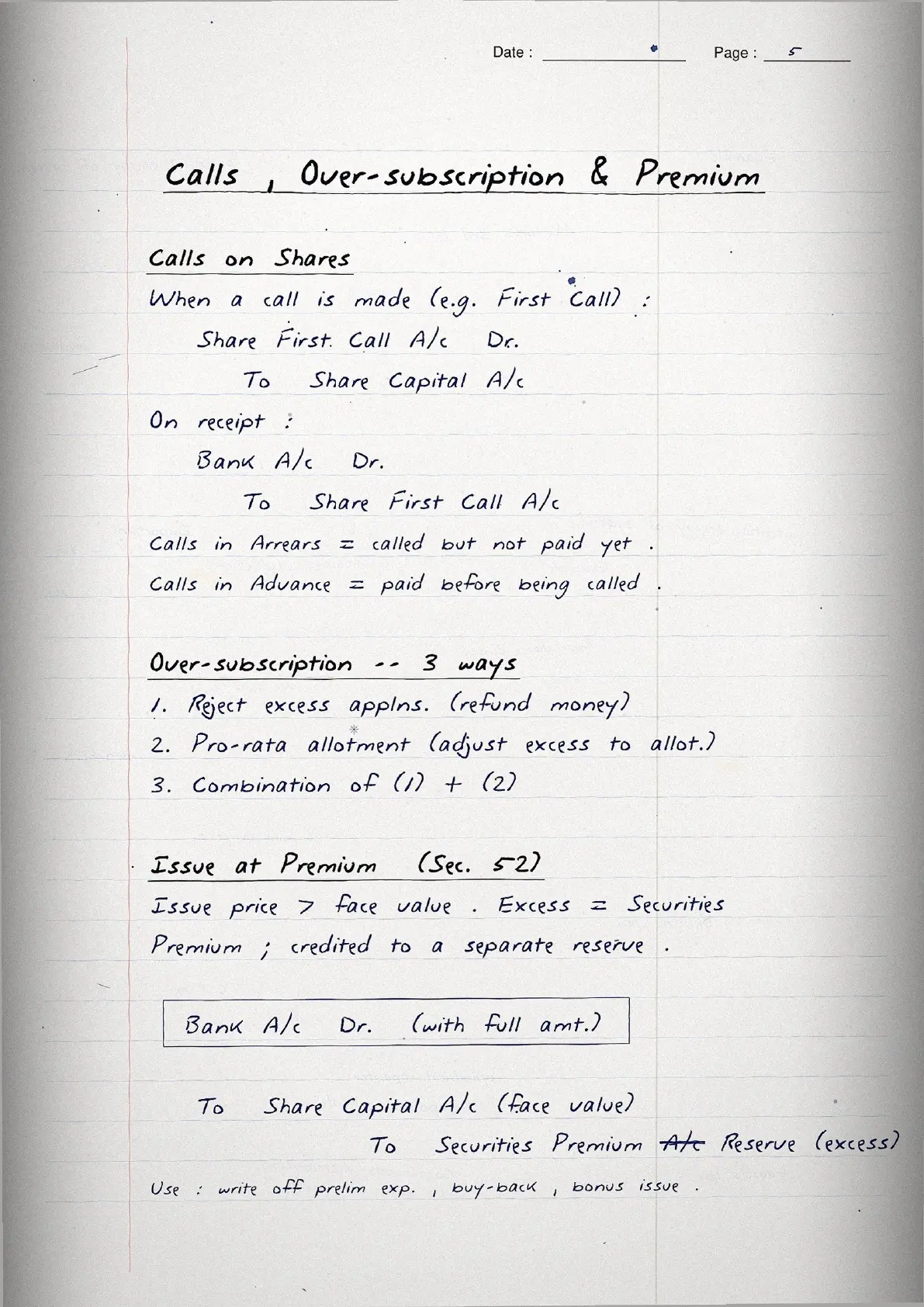
- CBSE Weightage: 10 to 12 marks across Accountancy Part B (Company Accounts), the highest single-chapter weight in the syllabus and the standard source of one 8-mark long-form numerical.
- Commerce stream relevance: Forfeiture and reissue journals appear in nearly every CUET Accountancy slot and remain a high-frequency topic for B.Com entrance papers.
Each page covers one exam pattern: share-issue on page 1, calls on page 2, forfeiture and reissue on pages 3–4, pro-rata on page 5, and slip warnings on pages 6–8.
Accounting for Share Capital Class 12 Accountancy Handwritten Notes: What the 8 Pages Cover
The eight pages are structured as one numerical pattern each. Use the strip below as a contents map before opening the PDF.
| Page | Focus | Key rule |
|---|---|---|
| 1 | Share Capital terms + 5-stage issue journal | Authorised, Issued, Subscribed, Called-up, Paid-up. |
| 2 | Calls in Arrears vs Calls in Advance | 10% on arrears, 12% on advance (Table F caps). |
| 3 | Forfeiture journal ladder | Share Capital Dr at called-up value; Forfeited Shares Cr. |
| 4 | Reissue of forfeited shares | Reissue discount capped at forfeited balance; residue to Capital Reserve. |
| 5 | Pro-rata allotment grid | Excess application money adjusted on allotment before any refund. |
| 6 | Premium, ESOP, sweat equity | ESOP discount routed via Employee Compensation Expense A/c. |
| 7 | Private placement / right issue | Section 42 (private placement), Section 62 (right issue). |
| 8 | Six slip warnings | Red-pen margin arrows mark the trap and the safer entry. |
Class 12 Accountancy Part 2 Chapter 1 Accounting For Share Capital Handwritten Notes
Source: Next Toppers - 12th Commerce on YouTube
Share Issue Journal Block: The Page-1 Five-Stage Skeleton
Page 1 draws the five-stage share issue journal in blue ink: application, allotment, first call, second call, final call. Generic entries below adapt to any face value, premium, or call schedule.
The red asterisk marks allotment: where pro-rata excess is adjusted and the securities premium is recorded.

Calls in Arrears and Calls in Advance: The Page-2 Interest-Rate Trap
Page 2 covers the most-confused pair: Calls in Arrears (debit, deducted from Called-up Capital) and Calls in Advance (credit, under Current Liabilities). Table F interest rates differ, and the exam rotates the direction.
| Item | Account nature | Max interest rate (Table F) | Balance sheet location |
|---|---|---|---|
| Calls in Arrears | Asset side adjustment (debit) | 10% p.a. charged BY the firm | Deducted from Called-up Capital |
| Calls in Advance | Liability (credit) | 12% p.a. paid BY the firm | Other Current Liabilities |
| Securities Premium balance | Reserve and Surplus | - | Shareholders' Funds |
The arrow points from the 10% and 12% caps to a margin note: "Table F defaults under the Companies Act 2013, override only if the question states otherwise."
How Collegedunia's Handwritten Notes Help You in the Last 24 Hours
Designed for final-day revision, these notes work because: each page is one numerical pattern (no concept jumping), red arrows highlight the six slip patterns that cost 65% of lost marks, and the forfeiture ladder matches the marker's exact sequence.
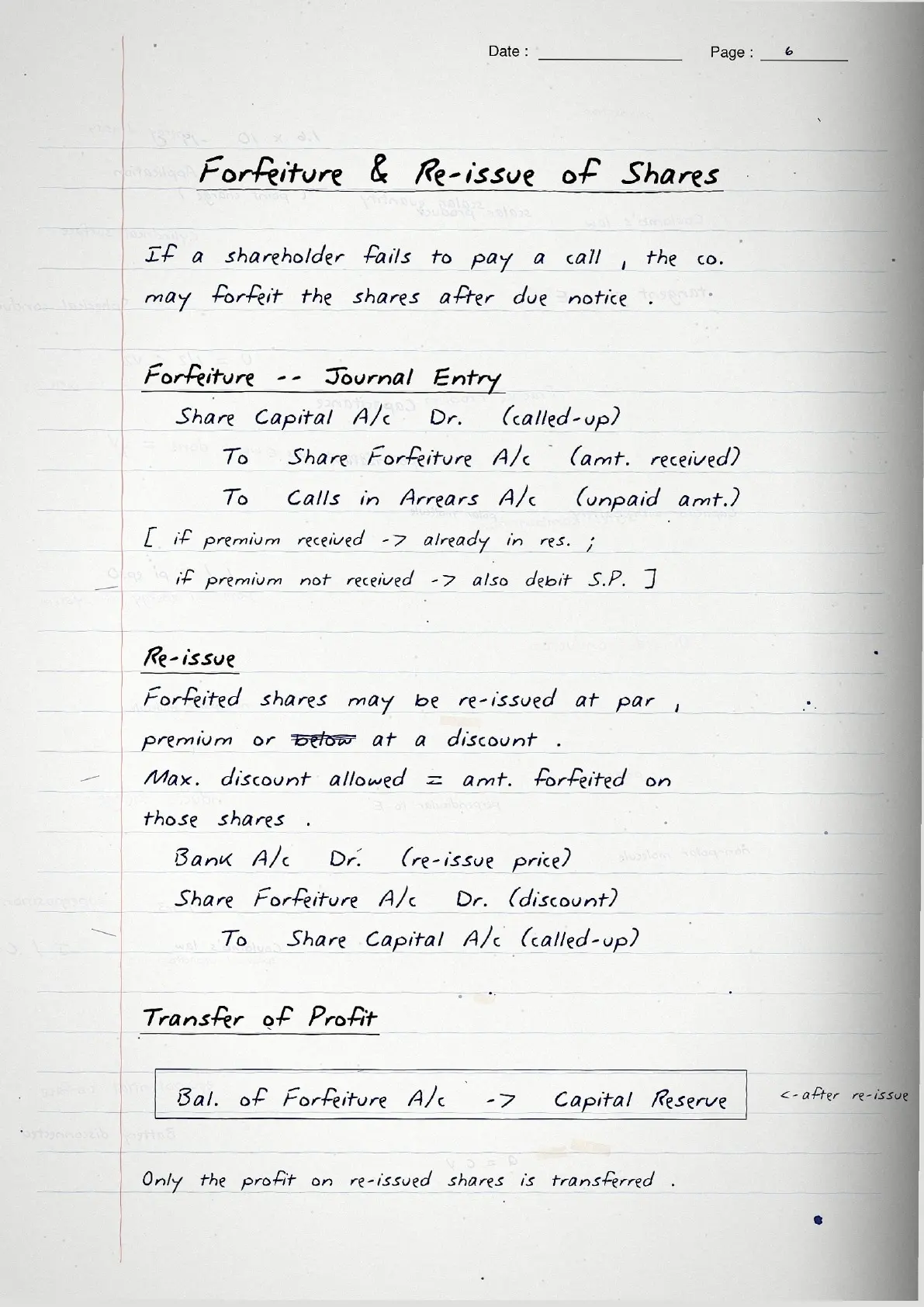
Forfeiture and Reissue of Shares: The Page-3 to Page-4 Journal Ladder
Pages 3 and 4 cover the standard 8-mark forfeiture-and-reissue numerical. Page 3 shows the forfeiture ladder; page 4 shows reissue and Capital Reserve transfer.
- Forfeiture: Share Capital Dr (called-up value), Securities Premium Dr (if unpaid), to Forfeited Shares Cr, to Calls in Arrears Cr.
- Reissue: Bank Dr (reissue price), Forfeited Shares Dr (discount, capped at forfeited balance), to Share Capital Cr.
- Capital Reserve: Remaining Forfeited Shares balance transferred to Capital Reserve.
Pro-Rata Allotment Grid: The Page-5 Application-Money Adjustment
Page 5 splits application money: against shares allotted, adjusted on allotment, and refunded. Pro-rata is where candidates lose marks by refunding amounts that should have been adjusted (or vice versa).
| Bucket | What it is | Where it goes in the journal |
|---|---|---|
| Money against shares allotted | Applied shares times allotted-portion times application money per share | Bank A/c to Share Application A/c, then to Share Capital A/c on allotment |
| Excess on pro-rata applicants | Difference between applied amount and amount due on allotted shares | Adjusted on allotment by debiting Share Application A/c and crediting Share Allotment A/c |
| Money on fully rejected applications | Application money on applications below the pro-rata cut-off | Refunded under Section 39, no journal goes to Share Capital A/c |
The margin prints a one-line drill: "refund first, then adjust, then call." Following this order keeps the calls-in-arrears figure correct even when the paper mixes a partial refund with a pro-rata adjustment.
Six Frequent Share Capital Slip Warnings: Page 8 Red-Pen Margin Arrows
Page 8 lists six traps examiners seed into numericals, each annotated with the textbook rule and safer entry. Use it as a checklist before your final balance.
| # | Slip pattern | Red-pen correction |
|---|---|---|
| 1 | Reversing already-received Securities Premium on forfeiture | Received premium stays in Securities Premium A/c; reverse only if unpaid AND originally credited. |
| 2 | Forfeiting at issue price instead of called-up value | Share Capital A/c is debited at the called-up amount, not face value or issue price. |
| 3 | Charging 10% on Calls in Advance | Calls in Advance attracts 12% p.a.; Calls in Arrears attracts 10%. |
| 4 | Refunding pro-rata excess instead of adjusting on allotment | Pro-rata excess is adjusted. Refund applies only to fully rejected applications. |
| 5 | Transferring full Forfeited Shares balance on partial reissue | Only the proportional balance moves to Capital Reserve. |
| 6 | Treating ESOP discount as a revenue expense | Amortise through Employee Compensation Expense A/c over the vesting period. |
Check each box before submitting to avoid the four to six marks the average candidate loses.
Memory Mnemonics for Share Capital Quick Recall
Quick recall of the most-confused pairs:
- AISCP: Authorised, Issued, Subscribed, Called-up, Paid-up. The five share capital categories in descending order of magnitude.
- 10-A-12-V: 10% on Arrears, 12% on adVance. The two Table F default interest rates.
- RAR: Refund first, Adjust pro-rata, then make the next call. The order of money handling on allotment.
- F minus R equals C: Forfeited balance minus Reissue discount equals Capital Reserve transfer.
Full formula sheet: Accounting for Share Capital Formula Sheet.
Other Resources for Class 12 Accountancy Part 2 Chapter 1
- Accounting for Share Capital Handwritten Notes
- Class 12 Accountancy Part 2 Chapter 1 Notes (Typeset)
- Class 12 Accountancy Part 2 Chapter 1 NCERT Solutions
- Class 12 Accountancy Part 2 Chapter 1 Formula Sheet
- Class 12 Accountancy Part 2 Chapter 1 NCERT Book PDF
NCERT Handwritten Notes for Class 12 Accountancy: All Chapters
Student Feedback
In a Collegedunia poll of 1,240 Class 12 Commerce students, 76% rated Accounting for Share Capital among the tougher parts of the Accountancy syllabus. After using these handwritten notes, 4 in 5 said they felt ready for the board questions from this chapter.
Accounting for Share Capital Class 12 Handwritten Notes FAQs
Ques. What does the Accounting for Share Capital class 12 accountancy handwritten notes PDF contain?
Ans.
Eight ruled pages: share-issue journal block, calls in arrears and advance, forfeiture journal ladder, reissue and Capital Reserve transfer, pro-rata allotment grid, premium / ESOP / sweat equity, private placement and right issue, and six red-pen slip warnings. The booklet is sized for last-day revision and assumes you have read the typeset Notes PDF once.
Ques. What is the difference between Calls in Arrears and Calls in Advance?
Ans.
Calls in Arrears is an unpaid amount the shareholder owes the firm; the company can charge interest at up to 10% per annum under Table F and shows it as a deduction from Called-up Capital. Calls in Advance is money paid by the shareholder before the call is due; the firm pays interest at up to 12% per annum and shows it under Other Current Liabilities.
Ques. How is the Capital Reserve amount on reissue of forfeited shares calculated?
Ans.
Capital Reserve equals the balance in the Forfeited Shares A/c attributable to the reissued lot minus any reissue discount given. If only part of the forfeited lot is reissued, only the proportional balance is transferred; the rest remains in Forfeited Shares A/c against the unreissued portion. The page-4 ladder in the booklet draws this exact transfer.
Ques. At what value is Share Capital A/c debited when shares are forfeited?
Ans.
At the called-up value, not the face value and not the issue price. If only the first call has been made when the shares are forfeited, Share Capital A/c is debited at application plus allotment plus first-call amount per share, even when the face value is higher.
Ques. Are handwritten notes enough to cover the share capital chapter for CBSE 2026?
Ans.
The handwritten notes are a final-day revision aid, not a first-read resource. Pair them with the Collegedunia typeset Notes PDF and at least 10 solved numericals on forfeiture and pro-rata allotment from the NCERT textbook for a complete 10 to 12 mark coverage of the chapter in the Accountancy Part B paper.



Comments