




NCERT Handwritten Notes for Class 12 English (Suppl.) Chapter 18 Kaleidoscope: The Argumentative Indian help students revise Amartya Sen's essay through clear handwritten revision points, argument maps and NCERT answer cues for the 2026-27 reprint.
- Resource: Class 12 English Supplementary Chapter 18 handwritten revision notes PDF.
- Chapter focus: Sen, the dialogic tradition, the Gita debate, social voice and democracy as public reasoning.
- Revision use: quick summary, evidence table, theme map and short answer frames.
The fastest revision route is: epics, Gita debate, wider voices and public reasoning.
Chapter18Kaleidoscope:TheArgumentativeIndianHandwrittenNotes.pdf?page=1&dpi=150)
Chapter18Kaleidoscope:TheArgumentativeIndianHandwrittenNotes.pdf?page=2&dpi=150)
Chapter18Kaleidoscope:TheArgumentativeIndianHandwrittenNotes.pdf?page=3&dpi=150)
Chapter18Kaleidoscope:TheArgumentativeIndianHandwrittenNotes.pdf?page=4&dpi=150)
Chapter18Kaleidoscope:TheArgumentativeIndianHandwrittenNotes.pdf?page=5&dpi=150)
Chapter18Kaleidoscope:TheArgumentativeIndianHandwrittenNotes.pdf?page=6&dpi=150)
Chapter18Kaleidoscope:TheArgumentativeIndianHandwrittenNotes.pdf?page=7&dpi=150)
Chapter18Kaleidoscope:TheArgumentativeIndianHandwrittenNotes.pdf?page=8&dpi=150)
Chapter18Kaleidoscope:TheArgumentativeIndianHandwrittenNotes.pdf?page=9&dpi=150)
Chapter18Kaleidoscope:TheArgumentativeIndianHandwrittenNotes.pdf?page=10&dpi=150)
Chapter18Kaleidoscope:TheArgumentativeIndianHandwrittenNotes.pdf?page=11&dpi=150)
Chapter18Kaleidoscope:TheArgumentativeIndianHandwrittenNotes.pdf?page=12&dpi=150)
Chapter18Kaleidoscope:TheArgumentativeIndianHandwrittenNotes.pdf?page=13&dpi=150)
Chapter18Kaleidoscope:TheArgumentativeIndianHandwrittenNotes.pdf?page=14&dpi=150)
Chapter18Kaleidoscope:TheArgumentativeIndianHandwrittenNotes.pdf?page=15&dpi=150)
Chapter18Kaleidoscope:TheArgumentativeIndianHandwrittenNotes.pdf?page=16&dpi=150)
Chapter18Kaleidoscope:TheArgumentativeIndianHandwrittenNotes.pdf?page=17&dpi=150)
Chapter18Kaleidoscope:TheArgumentativeIndianHandwrittenNotes.pdf?page=18&dpi=150)
Chapter18Kaleidoscope:TheArgumentativeIndianHandwrittenNotes.pdf?page=19&dpi=150)
Chapter18Kaleidoscope:TheArgumentativeIndianHandwrittenNotes.pdf?page=20&dpi=150)
Chapter18Kaleidoscope:TheArgumentativeIndianHandwrittenNotes.pdf?page=21&dpi=150)
Chapter18Kaleidoscope:TheArgumentativeIndianHandwrittenNotes.pdf?page=22&dpi=150)
Student Feedback: Students revise this chapter faster when they connect each example with Sen's main claim about public reasoning.
The Argumentative Indian Handwritten Notes Overview
The Argumentative Indian presents Amartya Sen's view that India has a long tradition of discussion, disagreement and public reasoning. Sen begins with India's fondness for speech, then moves to epics, moral debate, social voices and democracy.
The handwritten notes simplify the chapter into revision pages. Students can use them to revise the Krishna-Arjuna debate, the role of women speakers, challenges to caste hierarchy and Sen's explanation of democracy as public discussion.
Dialogic Tradition in The Argumentative Indian
Sen's essay is built by evidence. Each example supports the claim that Indian intellectual life has often tested ideas through dialogue and counterargument.
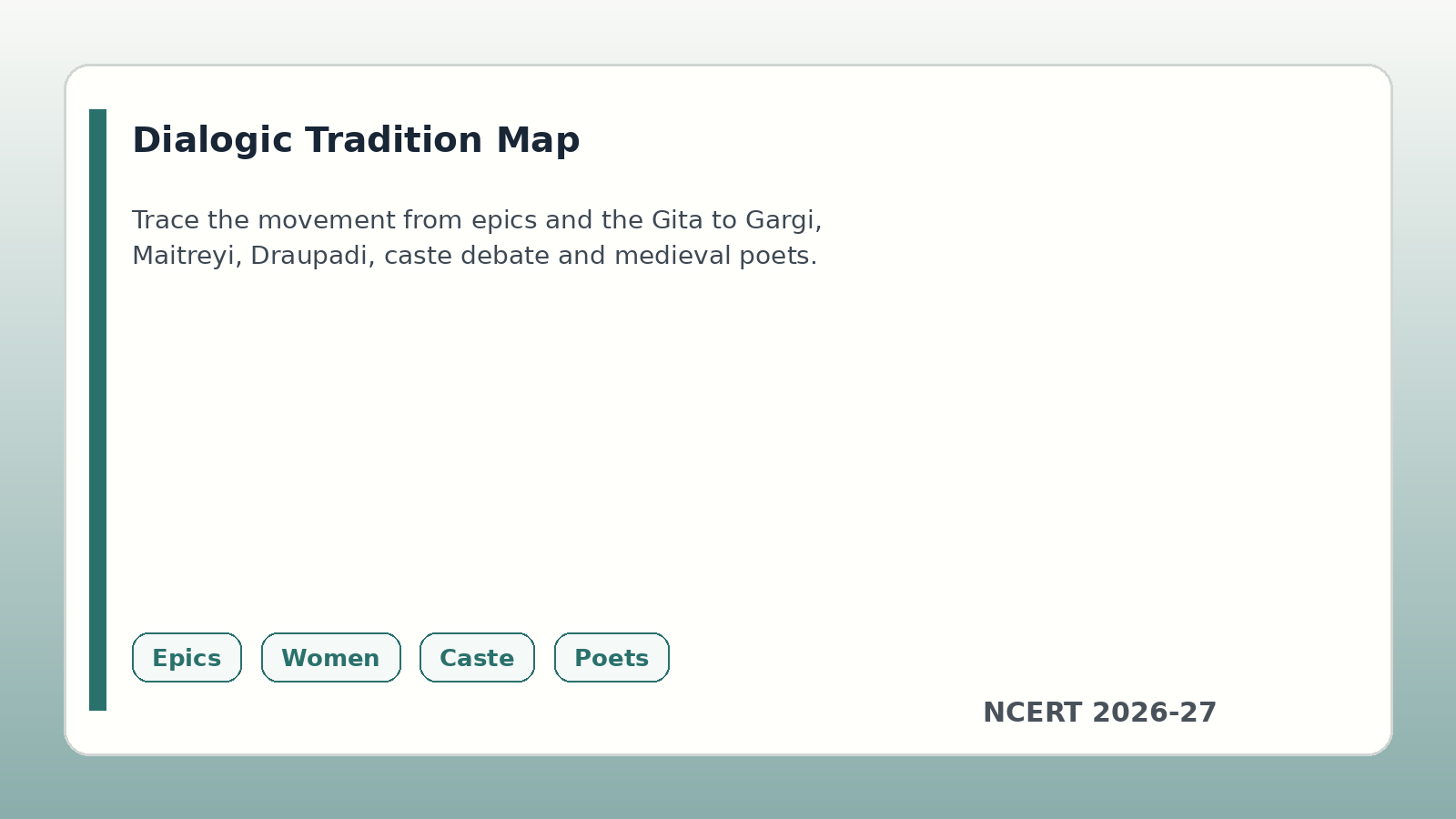
| Example | What it shows | Answer cue |
|---|---|---|
| Ramayana and Mahabharata | Long epics full of dialogue, dilemma and counterargument. | Use for historical range. |
| Krishna and Arjuna | Duty is tested against consequences before war. | Use for moral debate. |
| Gargi and Maitreyi | Women appear in serious intellectual questioning. | Use for gender and voice. |
| Bhakti and Sufi poets | Working-class and devotional voices challenge social barriers. | Use for caste and class reach. |
The Argumentative Indian Explanation Video
Source: Magnet Brains on YouTube
Gita Debate and Public Reasoning
The Gita debate is the chapter's strongest moral example. Krishna represents duty and action, while Arjuna raises the question of consequences and human suffering. Sen does not dismiss Krishna, but he insists that Arjuna's doubts remain powerful.
| Position | Meaning | Use in answers |
|---|---|---|
| Faring forward | Acting according to duty without being attached to results. | Connect with Krishna. |
| Faring well | Judging action by consequences and human cost. | Connect with Arjuna. |
| Oppenheimer parallel | Technical duty may need later moral criticism. | Connect ancient debate with modern history. |
| Public reasoning | Democracy grows stronger when claims are debated openly. | Connect the essay with politics. |
Gender, Caste and Democracy in Sen's Essay
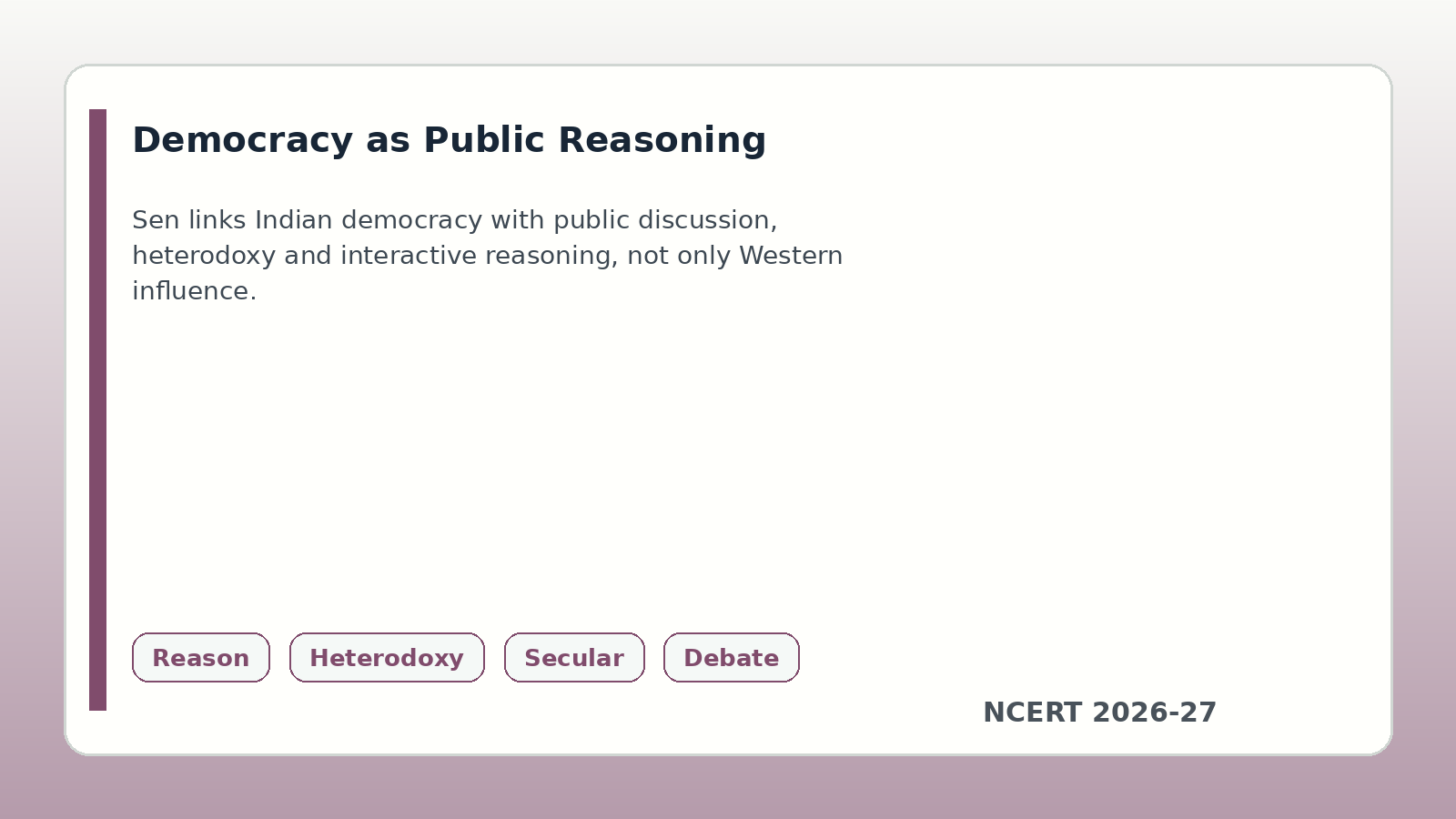
Sen asks whether argument belonged only to a small male elite. His answer is qualified. He accepts inequality, but he also gives examples where women, disadvantaged groups and working-class voices entered debate.
- Women speakers: Gargi, Maitreyi and Draupadi show powerful forms of questioning.
- Caste debate: Bharadvaja questions the logic of caste difference.
- Religious protest: Buddhism, Jainism, Bhakti and Sufi traditions challenge hierarchy.
- Democracy: India drew on institutional learning and its own tradition of public reasoning.
How to Use the The Argumentative Indian Handwritten Notes PDF
Use the PDF for quick revision before class tests or board-style practice. First revise the evidence chain, then read the pages on Krishna and Arjuna, gender and caste voice, and democracy as public reasoning.
- Use the opening pages for summary and central idea answers.
- Use the Gita pages for questions on faring forward and faring well.
- Use the Gargi, Maitreyi and Draupadi pages for gender and voice.
- Use the final pages for democracy, misconceptions and Language Work.
Related Class 12 English Supplementary Resources
Use these related resources with the handwritten notes for full chapter preparation.
| Resource | Best use | Link |
|---|---|---|
| NCERT Solutions | Step-by-step answers for The Argumentative Indian | Open solutions |
| NCERT Notes | Typed revision notes for the same chapter | Open notes |
| NCERT Book PDF | Official chapter reading | Open book PDF |
All Class 12 English Supplementary Handwritten Notes
The table below keeps the same resource type together, so students can move chapter by chapter through the Class 12 English Supplementary Kaleidoscope handwritten notes.
| Chapter | Title | Handwritten notes link |
|---|---|---|
| Chapter 15 | The Mark on the Wall | Open handwritten notes |
| Chapter 16 | Film-Making | Open handwritten notes |
| Chapter 17 | Why the Novel Matters | Open handwritten notes |
| Chapter 18 | The Argumentative Indian | Open handwritten notes |
| Chapter 19 | On Science Fiction | Open handwritten notes |
| Chapter 20 | Chandalika | Open handwritten notes |
| Chapter 21 | Broken Images | Open handwritten notes |
The Argumentative Indian Class 12 English Handwritten Notes FAQs
Ques. What do The Argumentative Indian handwritten notes cover?
Ans. The notes cover Amartya Sen, India's dialogic tradition, the Gita debate, gender and caste voices, public reasoning, democracy and NCERT answer cues for 2026-27.
Ques. What is Sen's main argument in The Argumentative Indian?
Ans. Sen argues that India has a long tradition of questioning ideas through discussion, dialogue and public reasoning.
Ques. What is the difference between faring forward and faring well?
Ans. Faring forward means acting from duty, while faring well means considering consequences and human cost before judging action.
Ques. Are these notes aligned with the 2026-27 NCERT book?
Ans. Yes. The notes are prepared for Class 12 English Supplementary Kaleidoscope Chapter 18 The Argumentative Indian in the 2026-27 NCERT reprint.



Comments