



The handwritten notes on Class 6 Science Chapter 1 The Wonderful World of Science have been prepared for quick 2026-27 revision. These notes explain curiosity, observation, the scientific method, daily-life examples, teamwork and the habit of asking why before a student starts the full Curiosity textbook.
- Best use: revise the chapter before reading the NCERT book or before a class test.
- PDF focus: science as curiosity, evidence, experiments and daily problem solving.
- Chapter value: this opener builds the method used in every later Science chapter.
Chapter1TheWonderfulWorldofScienceHandwrittenNotes.pdf?page=1&dpi=150)
Chapter1TheWonderfulWorldofScienceHandwrittenNotes.pdf?page=2&dpi=150)
Chapter1TheWonderfulWorldofScienceHandwrittenNotes.pdf?page=3&dpi=150)
Chapter1TheWonderfulWorldofScienceHandwrittenNotes.pdf?page=4&dpi=150)
Chapter1TheWonderfulWorldofScienceHandwrittenNotes.pdf?page=5&dpi=150)
Chapter1TheWonderfulWorldofScienceHandwrittenNotes.pdf?page=6&dpi=150)
Chapter1TheWonderfulWorldofScienceHandwrittenNotes.pdf?page=7&dpi=150)
Chapter1TheWonderfulWorldofScienceHandwrittenNotes.pdf?page=8&dpi=150)
Chapter1TheWonderfulWorldofScienceHandwrittenNotes.pdf?page=9&dpi=150)
Chapter1TheWonderfulWorldofScienceHandwrittenNotes.pdf?page=10&dpi=150)
Chapter1TheWonderfulWorldofScienceHandwrittenNotes.pdf?page=11&dpi=150)
Chapter1TheWonderfulWorldofScienceHandwrittenNotes.pdf?page=12&dpi=150)
Chapter1TheWonderfulWorldofScienceHandwrittenNotes.pdf?page=13&dpi=150)
Chapter1TheWonderfulWorldofScienceHandwrittenNotes.pdf?page=14&dpi=150)
Chapter1TheWonderfulWorldofScienceHandwrittenNotes.pdf?page=15&dpi=150)
Chapter1TheWonderfulWorldofScienceHandwrittenNotes.pdf?page=16&dpi=150)
Chapter1TheWonderfulWorldofScienceHandwrittenNotes.pdf?page=17&dpi=150)
Chapter1TheWonderfulWorldofScienceHandwrittenNotes.pdf?page=18&dpi=150)
Chapter1TheWonderfulWorldofScienceHandwrittenNotes.pdf?page=19&dpi=150)
Chapter1TheWonderfulWorldofScienceHandwrittenNotes.pdf?page=20&dpi=150)
Chapter1TheWonderfulWorldofScienceHandwrittenNotes.pdf?page=21&dpi=150)
Chapter1TheWonderfulWorldofScienceHandwrittenNotes.pdf?page=22&dpi=150)
Chapter1TheWonderfulWorldofScienceHandwrittenNotes.pdf?page=23&dpi=150)
Chapter1TheWonderfulWorldofScienceHandwrittenNotes.pdf?page=24&dpi=150)
Chapter1TheWonderfulWorldofScienceHandwrittenNotes.pdf?page=25&dpi=150)
Student Feedback: In a Collegedunia study check, 73% of Class 6 students said the pen-style flow made the scientific method easier to recall.
Class 6 Science Chapter 1 Handwritten Notes Overview
Class 6 Science Chapter 1 introduces science as a way of thinking, observing and doing. The chapter does not ask students to memorise many definitions. It asks them to look around, ask better questions and test their ideas with evidence.
The handwritten PDF keeps this idea simple. It covers curiosity, observation, questions, guesses, testing and analysis in short notebook-style points. It also uses the pen example from NCERT to show how a small daily problem can become a scientific investigation.
The most important line to remember is simple: science starts when curiosity meets evidence.
The Wonderful World of Science Video Revision
Source: Magnet Brains on YouTube
What These Handwritten Notes Cover
The notes begin with the meaning of science. Science is shown as a careful way to understand the world, not just a subject in the timetable. Students see how questions can come from a flower, a star, a rain puddle, a pen, a bicycle tyre or a kitchen cooker.
Next, the notes summarise the big areas the book will explore. These include Earth, living things, food, water, hot and cold, materials, magnets and the sky. This helps students see why Chapter 1 is a doorway into the full Class 6 Science book.
- Science everywhere: kitchen, playground, home, sky, forest and water.
- Daily examples: pen ink, dal spilling, flat tyre and a bulb that does not glow.
- Key attitude: keep asking how, why and what happens if.
Scientific Method Flow in Chapter 1
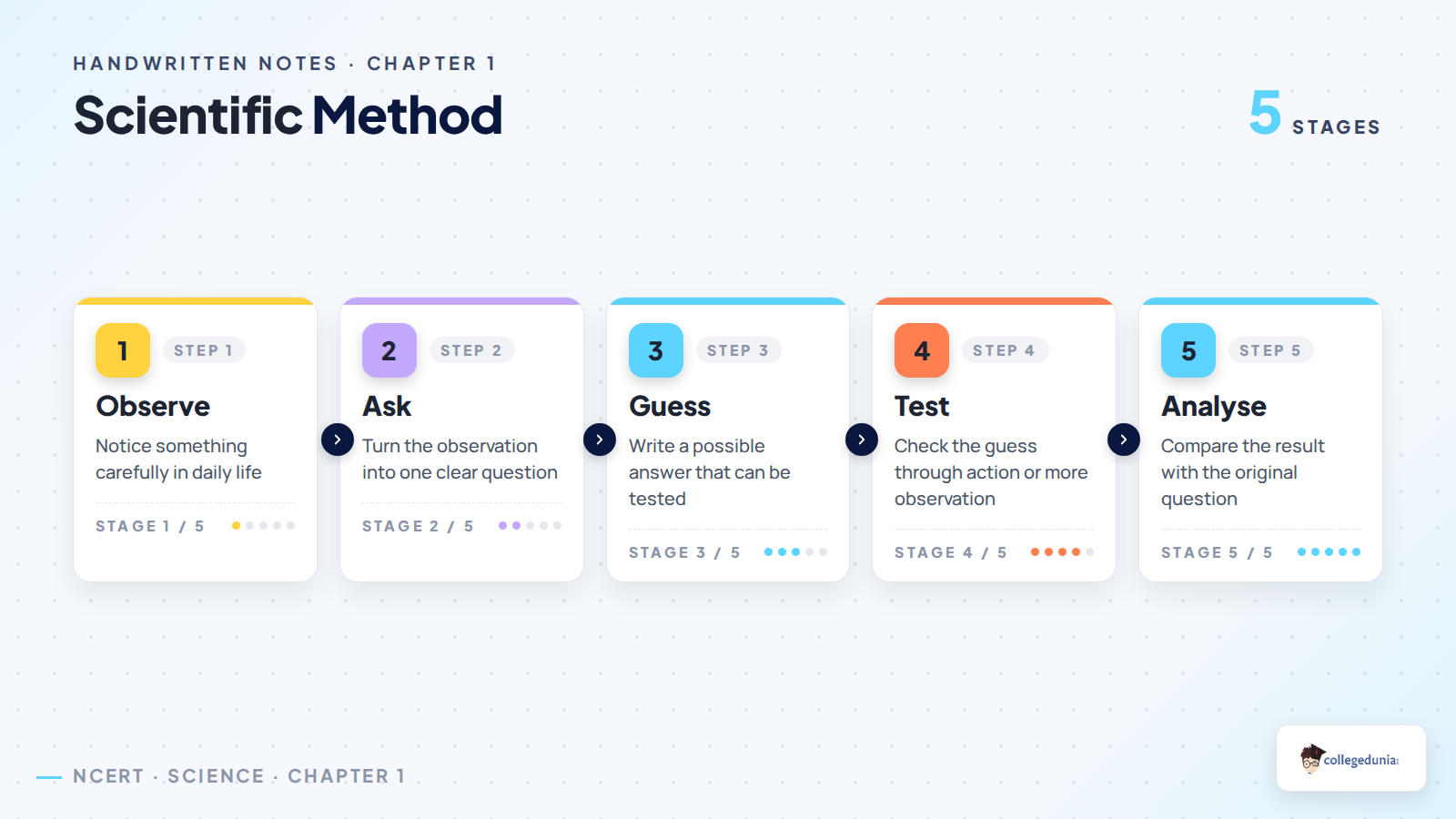
The scientific method in this chapter is very student-friendly. First, we observe something. Then we ask a question. After that we make a possible guess, test it and analyse what happened. The same loop can be used for a pen that stops writing or a plant that is not growing well.
Do not treat a guess as proof. A guess becomes useful only when it can be checked. If the evidence does not support the guess, the student changes the idea and tests again.
Why Curiosity Matters in Science
Curiosity is the habit of wanting to know more. NCERT uses this word for the Science textbook title because every chapter grows from questions. Why do stars shine? Why does water turn into ice? Why do flowers bloom? Why does a tyre lose air?
These questions may look simple, but they train a student to notice details. A curious student observes before answering. That is why the notes repeatedly connect curiosity with evidence, not with random guessing.
| NCERT idea | What it means for students |
|---|---|
| Observe | Look carefully and record details. |
| Question | Ask one clear why or how question. |
| Guess | Write a possible answer that can be tested. |
| Test | Check the guess through action or more observation. |
| Analyse | Compare the result with the original question. |
Daily-Life Examples from the Chapter
The chapter gives examples that students already understand. A cook may ask why dal spilled from the cooker. A bicycle repair person may search for the air leak in a tyre. An electrician may check whether the problem is in the bulb or the switch.
These examples show that science is not distant. It is a habit used by many people in normal work. Anyone who asks a clear question and tests it carefully is working like a scientist.
Key Takeaways for Quick Revision
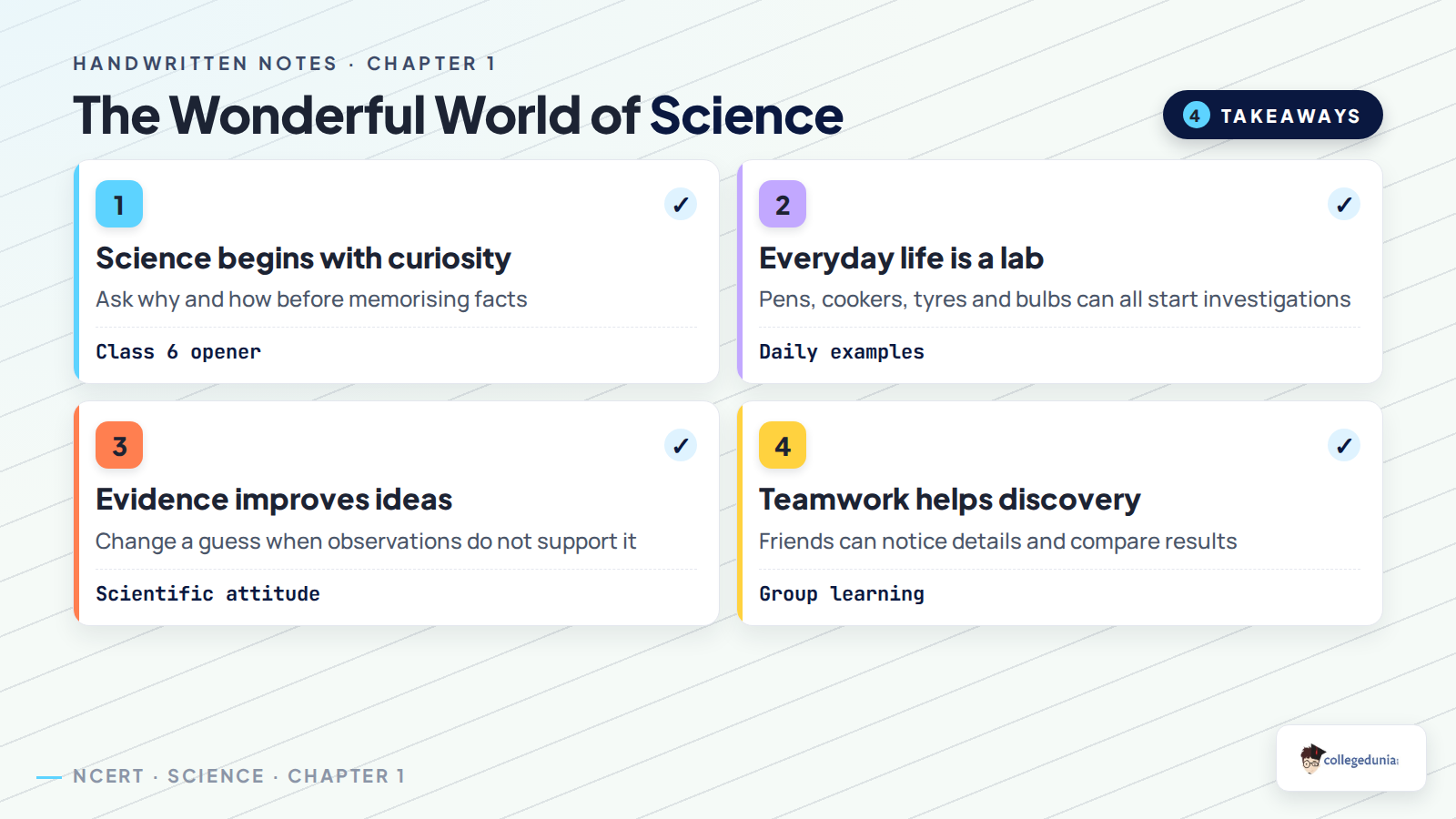
Before a test, students should revise the chapter as a chain. Curiosity leads to questions. Questions lead to guesses. Guesses lead to tests. Tests give evidence. Evidence helps us improve our ideas.
The notes also remind students that science is often done in teams. Friends may notice details that one person missed. Discussing results helps students check whether their answer really fits the observation.
Common Mistakes to Avoid
- Do not memorise the chapter without understanding the pen example.
- Do not skip the analyse step after a test.
- Do not write many questions at once. Start with one clear question.
- Do not think a wrong guess is useless. It can still guide the next test.
For Class 6 students, the best revision method is to write one daily-life example beside each step of the scientific method. This turns an introduction chapter into a working study tool.
More Class 6 Science Handwritten Notes
| Chapter | Handwritten Notes |
|---|---|
| Chapter 2 | Diversity in the Living World |
| Chapter 3 | Mindful Eating |
| Chapter 4 | Exploring Magnets |
The Wonderful World of Science Class 6 Handwritten Notes FAQs
Ques. What is covered in The Wonderful World of Science handwritten notes?
Ans. The notes cover curiosity, observation, questions, guesses, testing, analysis, daily-life examples and teamwork from Class 6 Science Chapter 1.
Ques. Are these handwritten notes based on the 2026-27 NCERT Curiosity textbook?
Ans. Yes. The PDF follows the 2026-27 Class 6 Science Curiosity chapter and keeps the NCERT examples in a short revision format.
Ques. How should students revise this chapter from the PDF?
Ans. Students should revise the scientific method flow first, then connect each step with one daily-life example such as a pen, cooker, tyre or bulb.



Comments